Decontamination of minds
A Japanese organization called “declaration of safety in Fukushima” (福島 安全 宣言) or something like that launched a campaign for the “decontamination of minds” (心 の 除 染) to convince that radioactivity is safe.
In a video taken in the twenty kilometers zone, sill evacuated, a person takes radiation readings and states that it is safe as it is well below 100 mSv. But the video avoids the most contaminated areas and confuses microsieverts and microsieverts / hour. When the Japanese authorities say there is no risk below 100 mSv, it is on the whole life span. To compare that value to microsieverts per hour or millisieverts per year is meaningless.
There are also videos of pseudo-scientific conferences to affirm that radiation in Fukushima is safe. The audience seems very small.
The group calls for the lifting of the evacuation orders and the return of inhabitants, and also for the restart of the declared safe nuclear reactors.
Another similar initiative, already presented by the Blog of Fukushima, has been to make children to pick up garbage along the highway 6 that passes thru the forbidden zone. This time, it was an organization called “Happy Road Net” which was the organizer. http://happyroad.net/wordpress/wp-content/uploads/2015/09/Image150915145225.pdf
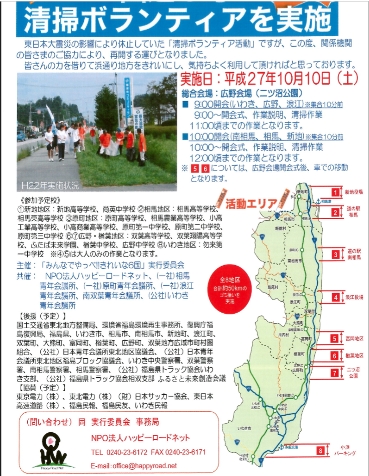
Let us remember that it is internationally recognized that there is no safe limit for radiation and that each radiation dose has an impact that is proportional to it. In such a context, it is recommended that the radiation exposure should be justified by a benefit. What was the benefit for these children?
It’s a safe bet to say that the decontamination of minds will be no more effective than the decontamination of the contaminated territories was …
Source: http://fukushima.eu.org/la-decontamination-de-lesprit/
Radioactive Wild Monkey Poops from Namie-city, Fukushima
January 23, 2016
An example of bio-accumulation of radioactive material in Fukushima:
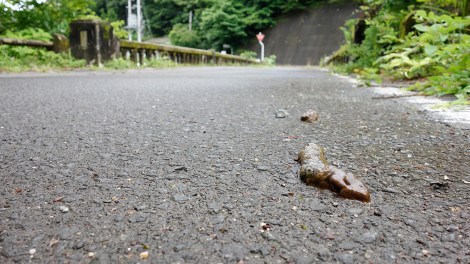
According to the following post, wild monkey poops from Namie-city, Fukushima had more than 150,000Bq/kg in terms of radioactive Cs137 & Cs134.
Cs137: 133987 Bq/kg
Cs134: 25186 Bq/kg
K40: 225 Bq/kg
The surrounding ground surface was about 500~600cpm.
More details at the Japanese blog :
http://www.autoradiograph.org/info/%E6%96%B0%E4%BD%9C35%EF%BC%9A%E3%82%B5%E3%83%AB%E3%81%AE%E7%B3%9E2/
Nothing Resolved at Fukushima, Japan Must Not Sponsor the Olympic Games

I strongly support “an honorable retreat from the 2020 Olympic Games” which is called for by former PM Hatoyama and a former Japanese Ambassador to Switzerland Mitsuhei Murata.
Hatoyama says, in an interview with the Japan Times, “In a situation in which nothing has been resolved at #Fukushima, Japan must not sponsor something like the Olympic Games.”
Hatoyama also said “There are still many inhabitants of the Tohoku region living in temporary housing. Moreover, the government has yet to admit the truth about the accident despite its having been more severe than Chernobyl. It is regrettable that the government has failed in its duty to inform both the people of Japan and the world about the true situation. The government even goes so far as to deny the increased incidents of thyroid cancer in the Fukushima region are connected to radiation releases from the multiple meltdowns.”
Hatoyama believes the government claimed the situation at nuclear plant was “under control” in order to lure the 2020 Olympic Games to Tokyo. “The government was successful in this ploy,” he says, “but this was a complete lie. Far from having been under control then, it is still not under control even now. This is a grave situation.”
He also shared interesting comments about Okinawa and the US base issues in the following exclusive interview with the Japan Times.
Hatoyama dreams of a Japan anchored within a united Asia
“I wish to apologize to the Japanese people for having betrayed their expectations,” says Yukio Hatoyama halfway through our interview, lowering his head and bowing deeply.
Hatoyama, prime minister for nine months of the Democratic Party of Japan’s three years in power between 2009 and 2012, is discussing the reasons behind his resignation in June 2010 — specifically, his failure to live up to his party’s promise to block the contentious U.S. Marine Corps base construction now underway at Henoko in Okinawa.
Recently, the former DPJ leader has been in the news for other mea culpas in Nanjing and Seoul — apologies made, he says, on behalf of Japanese for colonial-era crimes in Asia. These unsanctioned trips have incensed the ruling Liberal Democratic Party, which has painted Hatoyama as a charlatan and even a traitor for his foreign escapades.
For those having trouble placing Hatoyama among the three DPJ figures who served as prime minister in that brief, heady period when power in postwar Japan changed hands, he is the one who led the DPJ to that historic victory. You know — the “alien.”
Hatoyama, now 68 and retired from politics, has never been able to shake that nickname. Coined by the domestic media in 2001 during his first stint as DPJ leader, the foreign press had a field day with Hatoyama’s extraterrestrial appellation, rejoicing in the fact that they finally had a Japanese leader who stood out from the crowd.
But what was it that made Hatoyama appear so otherworldly? True, his saucer-like eyes did give him a vague resemblance to E.T., but his nickname was not just the product of his looks and his manner; it also owed much to his proposals — proposals that were and remain anathema to Japan’s conservative establishment.
But how did Hatoyama, who came from a well-known, politically conservative family, become a maverick? In an exclusive interview with The Japan Times, Hatoyama discussed a range of issues, including Okinawa, the relationship between the Fukushima No. 1 disaster and the 2020 Tokyo Olympic Games, and his proposal for the creation of an “East Asian EU.” He began by explaining the circumstances that led him to resign the prime minister’s post in 2010 after only nine months in office.
“The DPJ, of which I was leader, proposed a revision of the Japan-U.S. Status of Forces Agreement in our manifesto for the 2009 House of Representatives election. We also proposed the realignment of the U.S. military in Japan, including a review of the state of U.S. bases,” he explains. “As for the relocation of the U.S. Marine base to Henoko, I personally said that at the very least, it should be moved outside (Okinawa) Prefecture. However, as soon as the DPJ took power, bureaucrats close to the U.S. in the Foreign Ministry and Defense Ministry moved to crush my proposal.”
In the end, Hatoyama’s idea went nowhere, and Henoko was confirmed as the proposed site for the new base. Many Okinawans — and DPJ voters — felt betrayed, and the party began to fear defeat in the Upper House elections of July 2010. “So I decided to resign,” Hatoyama confesses. “There was no excuse.”
During his time in office, Hatoyama also emphasized the need for a less lopsided Japan-U.S. relationship.
“I thought that as prime minister, it was only natural for me to seek an equal relationship with the United States. However, there are many (Japanese) politicians and bureaucrats who believe that because Japan is dependent on the U.S. in so many ways, it isn’t appropriate to seek an equal relationship. Once again, my proposal ended in failure.”
This was the first time in the postwar period that a Japanese prime minister had made such a demand. Hatoyama even dared suggest that Japan’s security could be achieved without a permanent U.S. troop presence. None of this was welcomed by those, on both sides of the Pacific, long accustomed to Japan’s subservience to U.S. interests.
Hatoyama was born in 1947 and graduated from the University of Tokyo before going to earn a Ph.D. in industrial engineering at Stanford. Upon graduation, he initially pursued an academic career, but later decided to run for the House of Representatives in 1986.
His lofty aim was to “restore sovereign power to the people, breaking from a system dependent on the bureaucracy,” he says, and to “transform Japan from a centralized state to one of regional and local sovereignty, and from an insular island to an open maritime state.”
During his campaign, Hatoyama took advantage of his experience as a researcher and garnered public attention with his unique appeal for “a scientific approach to politics.” Following his election, he quickly became a controversial figure for, among other things, revealing the huge scale of political campaign funding the LDP was receiving from business interests — even though he was a member of the party at the time.
“I eventually left the Liberal Democratic Party because of repeated incidents involving money and politics, such as the Recruit insider-trading and corruption scandal of 1988 and Shin Kanemaru’s huge tax evasion affair of 1992,” Hatoyama says. “Political reform was urgently called for, but the LDP was unwilling to act.”
A messy political realignment soon followed, eventually leading to the creation of the current iteration of the Democratic Party of Japan in 1998. Hatoyama went on to lead the party between 1999 and 2002, and again from May 2009. The DPJ grew steadily until finally, in September 2009, it succeeded in ousting the scandal-tainted LDP.
Hatoyama became Japan’s 93rd prime minister, though he would not remain so for long. Government bureaucrats, long accustomed to running the country behind the scenes, acted quickly to undermine his administration and hasten its demise.
Hatoyama says that Defense Ministry officials attempted to scuttle his plan to relocate the U.S. Marine Corps’ Futenma air base outside of Okinawa by claiming that any replacement facility must be located within 65 miles (105 km) of the marines’ Northern Okinawa Training Area. “The bureaucrats and ministers who should have been doing their best to support me were in fact attempting to resolve the matter by supporting the U.S.,” Hatoyama says.
The 65-mile requirement effectively precluded moving the base off the main island of Okinawa, which is a convenient 70 miles long. Yet the source of this apparent requirement remains elusive. Hatoyama says the Defense Ministry simply claimed that this figure was included in a U.S. military document. “Whether or not this requirement was expressly stated in the document remains unclear even now,” he notes.
But what about the U.S.? Were American officials also involved in the attempt to derail Hatoyama’s base relocation plans? Apparently not, Hatoyama says.
“No documents on the U.S. side support the claim of Defense Ministry officials. Thus, it can be said their claim was groundless,” he explains. “It’s possible it was just their way of forcing me to abandon my proposal. However, when we consider the feelings of the Okinawan people, there’s no way they would grant permission for the base to be relocated within Okinawa.”
At this point in the interview, Hatoyama bowed and offered his apology.
Another blow to the fledgling DPJ administration came in December 2009, when it was revealed that Hatoyama had received some ¥1.2 billion in political donations that had been improperly reported. Most of the money came from his mother, the wealthy heiress to the Bridgestone empire, though ¥400 million of this was listed as coming from fictitious donors — including some who were deceased.
While Hatoyama denied personal knowledge of the donations, he later apologized to the nation for the scandal and promised to pay more than ¥600 million in gift taxes on donations made to him by his mother that were first deemed as “loans.” Hatoyama recognizes the major impact this issue had on his tenure as prime minister, admitting, “The political donations I received from my mother were the second major reason I had to resign.”
Prosecutors declined to bring charges against Hatoyama, citing insufficient evidence of criminal activity. They did, however, indict two of his former secretaries, resulting in a ¥300,000 fine for one and a suspended sentence for the other. While no question of corporate bribery or political favors was involved, the incident nevertheless served to raise questions in the public’s mind about just how different the DPJ was from the money-tainted politics of the long-ruling LDP.
The media was unforgiving. After all, Hatoyama had already managed to upset both the establishment media and their new-media competitors. The former fought against his proposal to open up the prime minister’s news conferences to journalists from outside the cozy “press club,” and the latter were angry after he failed to follow through on that pledge.
“When I became prime minister, I tried to abolish the press-club system, which had become a vested interest for its members,” Hatoyama explains. “However, I was subject to a fierce counterattack.”
One club-affiliated reporter told Hatoyama that the prime minister’s press conferences were not something he was in charge of but, rather, something the press club sponsored.
Although by March 11, 2011, Naoto Kan was prime minister, Hatoyama was still a member of the House of Representatives, and the multiple disasters — especially the nuclear meltdowns at Fukushima No. 1 plant — affected him deeply. In the December 2011 issue of the magazine Nature, Hatoyama co-authored an article expressing his concerns about both the radioactive and political fallout from the accident.
Titled “Nationalize the Fukushima Daiichi atomic plant,” Hatoyama first pointed out the need “to know precisely what happened (on March 11, 2011) and what is continuing to happen now.” He further argued that only when all the evidence relating to the accident had been gathered and made public “will the world be able to have faith in the containment plan developed by Tepco or be able to judge how it should be modified.”
Hatoyama and two fellow Diet members formed a committee to conduct an independent investigation of the accident. The group reached two major conclusions, outlined in the Nature article. First: “The Fukushima Daiichi nuclear power plant must be nationalized so that information can be gathered openly. Even the most troubling facts should be released to the public.” Second: “A special science council should be created to help scientists from various disciplines work together on the analyses. That should help to overcome the dangerous optimism of some of the engineers who work within the nuclear industry.”
Although Hatoyama is no longer a Diet member, he has not lost interest in this issue. Recently, he joined former Japanese Ambassador to Switzerland Mitsuhei Murata in calling for “an honorable retreat from the 2020 Olympic Games.” Echoing Murata, who was also present at the interview, Hatoyama says, “In a situation in which nothing has been resolved at Fukushima, Japan must not sponsor something like the Olympic Games.”
Hatoyama elaborates: “There are still many inhabitants of the Tohoku region living in temporary housing. Moreover, the government has yet to admit the truth about the accident despite its having been more severe than Chernobyl. It is regrettable that the government has failed in its duty to inform both the people of Japan and the world about the true situation. The government even goes so far as to deny the increased incidents of thyroid cancer in the Fukushima region are connected to radiation releases from the multiple meltdowns.”
Hatoyama believes the government claimed the situation at nuclear plant was “under control” in order to lure the 2020 Olympic Games to Tokyo. “The government was successful in this ploy,” he says, “but this was a complete lie. Far from having been under control then, it is still not under control even now. This is a grave situation.”
Hatoyama’s change of mind is significant because as prime minister in October 2009 he had given a speech in Copenhagen in support of Tokyo’s failed bid for the 2016 Games. At the time, he sought to promote a new image of the Olympics centered on environmental protection, held in harmony with nature and celebrating simplicity.
March 11, 2011, however, changed everything. Again, like Murata, Hatoyama stresses that he is not opposed to the Olympics per se, but asks: Why now, and why Tokyo — especially in the absence of any pressing need to do so? Hatoyama nods in assent when Murata states: “At this point there is no other solution than to stage an honorable retreat from the games. Failure to do so will ultimately lead to a disgraceful retreat, dishonoring our country. The time to act is now!”
Hatoyama’s reservations about Japan’s future are not limited to either Fukushima or the Olympics. Politically and militarily, Hatoyama believes Japan is moving in an ever more dangerous direction.
“Prime Minister (Shinzo) Abe’s recent passage of the collective security bills has made it possible for America to call upon Japan to participate in its wars,” he says. “However, the Constitution states that Japan will never again wage war and, accordingly, rejects the threat or use of force as means of settling international disputes.”
He continues: “Given this, I deeply regret that the road to our participation in war has been opened once again. It may be presumptuous of me to say this now that I am no longer a politician, but in light of the wrong direction our country is currently heading in, I earnestly hope for an end to the Abe regime.”
Just as relations between Tokyo and Beijing were sinking to new lows over historical and territorial issues, Hatoyama infuriated the Abe government with his decision to visit Nanjing in January 2013. At the Nanjing Massacre Memorial Hall, he bowed and offered a silent prayer, later explaining, “As a Japanese, I feel responsible for the tragedy, and I am here expressing my sincere apology.”
While in Nanjing, Hatoyama also urged the Japanese government to acknowledge the dispute between the two countries concerning sovereignty of the islands known the Senkakus in Japanese and Diaoyu in China. “The Japanese government says there are no territorial disputes, but if you look at history, there is a dispute,” he says.
Hatoyama’s comments led Japanese government officials to criticize him for admitting the existence of a territorial dispute with China, something they adamantly deny. The defense minister at the time went so far as to use the word “traitor.”
“If his remarks have been politically used by China, I’m unhappy,” said Itsunori Onodera. “At that moment, the word ‘traitor’ arose in my mind.”
In March 2015, Hatoyama made another controversial trip, this time to Crimea, where he expressed his belief that Japan should “normalize” relations with Russia by lifting sanctions imposed after Moscow’s annexation of the Ukrainian territory. Hatoyama defended the referendum in the region as constitutional, stating, “Crimea wasn’t annexed unilaterally under pressure from Russia. In fact, people reached a conclusion based on their own strong will.”
Once again, Hatoyama’s remarks earned him the condemnation of the Japanese government. “It’s unthinkable that such action and comments came from a person who was once prime minister,” said Chief Cabinet Secretary Yoshihide Suga. Suga also described Hatoyama’s behavior as “extremely imprudent.”
In August 2015, just prior to Prime Minister Abe’s statement commemorating the 70th anniversary of the end of World War II, Hatoyama visited the Seodaemun Prison History Hall in Seoul. He knelt down in front of a memorial stone to apologize to Korean independence activists jailed, tortured and executed during Japan’s colonial control of Korea from 1910 to 1945.
“In the hope that no such mistake is made in the future, I regard, in a spirit of humility, these irrefutable facts of history, and express here once again my feelings of deep remorse and state my heartfelt apology,” he said.
Though Hatoyama’s actions may seem quixotic or even deliberately provocative to some, they are best understood through the prism of his world view, which stands in stark contrast to one of the guiding principles of modern Japan in the years following the Meiji Restoration. Promoted by the famous Meiji educator Yukichi Fukuzawa, this principle is known as Datsu-A Ron or the “Goodbye Asia doctrine.” Fukuzawa maintained, “It is better for us to leave the ranks of Asian nations and cast our lot with the civilized nations of the West.”
While not turning his back on the West, Hatoyama nevertheless seeks to redirect Japan’s focus away from the U.S. and back to its geographical location in Asia. He imagines a Japan at peace with its neighbors — from Russia in the north to China and South Korea — and at ease with its position on the edge of the continent.
With this dream in mind, Hatoyama created the East Asian Community Research Institute in March 2013, with the ultimate goal of creating something resembling an East Asian EU. With membership open to the general public, the institute, through its educational arm, Sekai Yuai Forum, holds lectures and other events to promote Hatoyama’s vision.
All of which brings us back to the issue of the U.S. military presence on Okinawa. Hatoyama continues to be concerned about the struggle of the Okinawan people against the construction of the new U.S. base at Henoko. This led to a series of trips to Okinawa seeking a solution to this intractable problem. As recently as November, Hatoyama visited the island to encourage the anti-base demonstrators at Henoko.
Hatoyama envisions a future for Okinawa not as a “keystone of the Pacific” for the U.S. military but as a “keystone of peace” for the countries of Asia. He has called for the creation of an “East Asian Community” headquartered in Okinawa and composed of the 10 members of the Association of Southeast Asian Nations plus Japan, China and South Korea.
“It is important for the countries of East Asia to become self-reliant, helping one another by developing win-win relationships,” he explains. “Should, however, they engage in a military arms race, it would only lead to a decline in deterrent power.”
“If Europe can do it,” says Hatoyama, pointing to the continent’s postwar integration, “there is no reason East Asia can’t.”
Source : Japan Times
http://www.japantimes.co.jp/community/2016/01/20/our-lives/hatoyama-dreams-japan-anchored-within-united-asia/#.VqFRnFLzN_k
Special credits to Mari Inoue & Libbe Halevy
Impact of Radiation on Wildlife of Fukushima
Biologist Timothy Mousseau’s Lecture at Fukushima on Jan 11, 2016
” Impact of Radiation on Wildlife of Fukushima”
中継の視聴をのがしてしまったので、のちほど視聴してみます。
生物学の視点から。
Contamination of groundwater and sea discharges
The tritium contamination of the control well No. 10 upstream of the reactors continues to rise and has just beaten two new records with 1,800 Bq / L (sampling of 6 July) and 1,900 Bq / L (sampling of 9 July).
http://www.tepco.co.jp/nu/fukushima-np/f1/smp/2015/images/pump_well_15070802-j.pdf
http://www.tepco.co.jp/nu/fukushima-np/f1/smp/2015/images/pump_well_15071101-j.pdf
These are the fourth and fifth successive records.
This exceeds the limit for dumping at sea, which is 1 500 Bq / L, but TEPCO relies on dilution with water from other wells:
The tritium contamination of the waste water dumped into the sea is around 100 Bq / L.
http://www.tepco.co.jp/nu/fukushima-np/f1/smp/2015/images/weighted_average_150707-j.pdf
Further upstream, the tritium contamination of groundwater can reach 20 000 Bq / L in the E10 control well (sampling of 7 July).
http://www.tepco.co.jp/nu/fukushima-np/f1/smp/2015/images/around_h4_15070901-j.pdf
At the foot of the reactors, the tritium contamination also broke a record in the control well No. 3 with 8,500 Bq / L (sampling of 1 July)
http://www.tepco.co.jp/nu/fukushima-np/f1/smp/2015/images/2tb-east_15070601-j.pdf
The cesium also broke its own record in the control well 1-8 with respectively 170 and 670 Bq / L for cesium-134 and -137 respectively (levy of 6 July).
http://www.tepco.co.jp/nu/fukushima-np/f1/smp/2015/images/2tb-east_15070701-j.pdf
Cesium contamination of the seawater at the mouth of the port continues to oscillate.
http://www.tepco.co.jp/nu/fukushima-np/f1/smp/2015/images/port_entrance_150711-j.pdf
Furthermore, Fukushima Dairy reported that the frozen underground wall in the testing phase at the foot of reactor No. 4 does not take after two months of cooling. This is bad news because TEPCO will not be able to limit groundwater infiltration leaking.
http://fukushima-diary.com/2015/07/underground-wall-not-frozen-for-2-months/
Source: L’ACROnique de Fukushima
http://fukushima.eu.org/contamination-de-leau-souterraine-et-rejets-en-mer/
Fukushima Evening Radiation TV News

It is the evening TV screens in Fukushima Prefecture.
Before the accident at the TEPCO Fukushima Daiichi power plant, it looked like a scene from science fiction, but unfortunately it is now in real life.
People watch the news on TV, followed by weather forecast, then by the radiation measures of the day.
A scene that shows us what is living with radiation …
This is not to discuss the measures of radioactivity viewed on the screen, because there are many debates about the veracity of the measures communicated by the local channel NHK.
The purpose here is to show the trivialization of radiation.
Special thanks to Kurumi Sugita, Nos Voisins Lointains 3.11
_____
These photos were published July 13, 2015 on Facebook by Mrs. Kazue Morizono resident of the city of Koriyama in Fukushima Prefecture


The vegetables of a grandmother

Today, a grandmother in my neighborhood asked me if I ate the vegetables produced locally.
She had given me several times vegetables that she had grown.
It seems it’s tomato season now, and she has them abundantly.
I replied that I was eating them, but still selecting them.
It seems that her grand-daughter works in the medical sector. When the grandmother serves her at the table pumpkins or green beans, she says she will eat them later, but in fact she never eats them.
As for her son, before the disaster (of March 2011), he loved and ate every day salty pickled plums. After the disaster, he eats them no more, even after the lifting of the restriction on plums distribution.
I told the grandmother that it was sad.
No one is wrong, not the grandmother nor the son nor the grand-daughter.
I understand the feeling of the grandmother but I also understand the concern of the family members. And no one takes responsibility for this situation. It’s really absurd.
But the grandmother was well aware.
“I grow vegetables in a greenhouse, but as I aerate the greenhouse, it enters through the opening.”
I had heard that radioactivity was detected at the entrance of the greenhouse.
The grandmother said with a laugh, “We, the elderly, we eat everything.”
She also said that after the disaster she measured radioactivity, but as it is no longer detected, these days she does not measure.
___
Published on July 9, 2015 on Facebook by a resident of Date city (in Fukushima Prefecture)
Source : Nos Voisins Lointains 3.11
Radiation and Baseball Dream

The highschool baseball tournament in Fukushima Prefecture began today.
A former classmate of my son plays in it.
I remember that summer of 2011, my son was still in 2nd year highschool when he quarreled seriously with J, his best friend
J was playing in a baseball club.
Trainings were happening outside.
Slides, dust …
My son was concerned for J risk of internal radiation by inhalation.
The year when my son took refuge alone in Sapporo, J came to visit me.
During our conversation, he apologized.
“Every time when we met, S (my son) insisted me to pay attention to radiation. It was because he cared for me … but I was tired. I told him to stop. Still, I knew it was because S was thinking of me …. “
“But if I was careful to radiation, I could not play baseball. To avoid it, I would have been forced to give up my dream … “
In saying this, J had some tears in his eyes.
Two years already.
This summer, this is the last highschool baseball tournament for him.
I’d like to see his achievement.
Today his highschool won.
My son screamed with joy when I gave him the news.
I hope my son will have a chance to go to the tournament to show his support.
The radiation….
Currently there is an atmosphere of discomfort to use this word within Fukushima Prefecture.
The baseball exploits of the highschool students from Fukushima Prefecture.
My support is for them.
_____
Published: July 10, 2015 YOKOTA Asami, a resident of the city of Koriyama in Fukushima Prefecture.
Source : Nos Voisins Lointains 3.11
http://nosvoisins311.wix.com/voisins311-france#!La-radiation-et-le-r%C3%AAve-de-baseball/c1tye/55a184740cf286eab020799d
24 Taiwanese firms violate bans on Japanese food imports
 A customer selects Japanese biscuits in a store selling Japanese goods in Taipei, Taiwan.
Authorities find fault with entry documents and compliance with customs clearance procedures
The Food and Drug Administration said that since it began strengthening inspections on Japanese food imports in March, the 24 Taiwanese companies were found to have imported 381 food product items from the five prefectures.
After the March 2011 disaster, Taiwan banned food imports from Fukushima and nearby Ibaraki, Gunma, Tochigi and Chiba. It has been conducting random radiation checks on nine categories of imported foods.
Among the 24 firms, 23 filed entry documents inconsistent with the products they imported and one failed to follow proper customs clearance procedures, the administration said.
Wang Te-yuan, deputy director of the FDA’s Northern Centre for Regional Administration, said firms that unwittingly imported food products from the five prefectures must report it to authorities or face punishment.
Offenders could be fined up to NT$3 million (HK$750,000) and will lose permission to import the products in question, according to the Act Governing Food Safety and Sanitation.
Authorities beefed up inspections after investigators found some Japanese food imports carrying Chinese labels different from the actual place of origin – a practice allowed in Japan but illegal in Taiwan.
A legislative committee passed a motion in late March tightening inspections on food products imported from Japan.
Under the new measure that came into effect on May 15, such items must carry prefecture-specific labels of origin, and some food products from certain prefectures must carry documents proving that they had passed radiation checks.
Source: South China Morning Post
Significant level of I-131 detected from dry sludge of Fukushima sewage plant after rain in May

Funny I was just mentioning about this on our Facebook group Rainbow Warriors in some comments a couple of days ago, that Iodine-131 had been repeatedly found in 2011, 2012, 2013, 2014, and possibly as well in 2015, proving that there is still something constantly fissioning there unstopped since March 2011, and of course this something is not releasing only Iodine-131 into the air but also Cesium-134 and other radionuclides as well….
Significant density of I-131 was detected from dry sludge of Fukushima sewage plant this May. Cs-134 was also detected.
According to Fukushima sewage public corporation, 2 days after rain (26.5 mm) observed on 5/19/2015, Iodine-131 level started jumping up along with Cs-134/137 density.
It kept on being detected until the end of May. The highest reading was 794.4 Bq/Kg (5/23/2015). 113 Bq/Kg of Cesium-134/137 was also measured this day.
It is assumed that the rain carried I-131 from somewhere to the sewage plant, however Fukushima prefectural government has announced no analysis on this.
The data on June is not published yet.
http://www.pref.fukushima.lg.jp/uploaded/attachment/119348.pdf
Source: Fukushima Daiichi
Significant level of I-131 detected from dry sludge of Fukushima sewage plant after rain in May
Japan Increases Limits on Radiation Exposure Before Nuke Reactors Restart
Amid preparations to restart nuclear reactors shut down following the 2011 Fukushima meltdown, the Japanese government plans to set a new standard for the permissible upper limit of radiation exposure for those in charge of anti-disaster operations.
The list of those affected by the change in standards includes local government officials, police and fire department officials, as well as bus drivers, who would be charged with securing the steady evacuation of local residents in case of a nuclear accident.
The Japanese government plans to set a new standard for the permissible upper limit of radiation exposure for those in charge of anti-disaster operations.
The list of those affected by the change in standards includes local government officials, police and fire department officials, as well as bus drivers, who would be charged with securing the steady evacuation of local residents in case of a nuclear accident.
Currently, the maximum permissible radiation dose is 1 millisievert per year for ordinary residents, 50 millisieverts per year for decontamination workers, and 100 millisieverts per year for nuclear plant workers; the upper limit for police and fire department officials as well as national public servants and other relevant personnel, previously subject to the same standard as that for ordinary local residents, will be raised to 100 millisieverts per year in emergency situations. During the crisis at the Fukushima No. 1 Nuclear Power Plant, a considerable number of necessary people, such as government staff, were not secured for the local task force near the damaged nuclear power complex, which rendered evacuations and the transport of necessary emergency supplies difficult. The new standard is aimed at preventing similar obstacles in future, The Mainichi reported. “As it is possible that local officials and bus drivers will carry out their duty where radiation levels are relatively high, we need a new standard in order to provide effective evacuation guidance as well,” a Cabinet Office official said. Discussion of the new standard by a working group within the Cabinet Office is scheduled for next month.
Source: Sputnik News

Japan Contaminated Food: Charges In Taiwan, Japan Asks China To Ease Restrictions

Two men have been charged in Taiwan related to the importing of banned foods from Japan. Authorities in Taiwan have asked Japan to investigate the crime on their end, so far they have received no response.
At the same time Japan is being uncooperative with Taiwan, they are asking China to ease food import restrictions. Japan recently took South Korea to the WTO in an attempt to force them to remove restrictions on suspect food imports. So far there has been no indication Japan intends to do the same to China.
The higher restrictions in place in China have created an additional problem for Japan. If they are able to comply with China’s stringent documentation requirements they have little ability to claim less onerous documentation rules in other countries are too difficult to meet. ipei Times
Sources:
Taipei Times
http://www.taipeitimes.com/News/taiwan/archives/2015/06/18/2003620995
South China Morning Post
Fukushima Offshore Earthquake Reminder – M 4.3 & M 4.5; F. Nuclear Reactors Still Spewing Radiation into Air and Water
Update: A second earthquake occurred in the same area, after this post was published.


Unknown quantities of radioactive waste water are being dumped into the Pacific, even while lots is being stored on site as can be seen in images further down.
TEPCO admits to still be spewing radioactive materials into the air, over four years on. If you multiply the amount of Cesium which they admit to releasing per hour into the air for April 2015 times 24 hours and times 12 months it is 56,334 times more Cesium than the US’s largest single nuclear reactor, Grand Gulf, emits into the air in one year, and 59.6 times what the notorious Sellafield emits into the air in one year. TEPCO has released at a higher rate per hour and is allowed to release at a still much higher rate into the air. It was, indeed, TEPCO and others, saying how many tonnes of radioactive water that TEPCO could legally dump, which taught us that there was such a thing as legally dumping radioactive materials into the air and water by all nuclear power stations-facilities. North America is downwind…


Protecting nuclear disaster evacuees from radiation still a concern
 As prefectures and municipalities that host or border nuclear plants upgrade their regional disaster prevention plans based on the nuclear disaster response guidelines for citizen evacuation protocols announced by the Nuclear Regulation Authority (NRA) in April, the problem of how to measure and prevent radiation exposure among evacuees continues to loom large.
“Reactor No. 1 (at the Fukushima No. 1 Nuclear Power Plant) had exploded, and the inside of the offsite center (which was established as the disaster response base of operations within Fukushima Prefecture) also had high radiation levels. The figures for the screenings we were conducting into whether or not residents had been exposed to radiation were raised immediately afterward.”
So recalls Tsuyoshi Ebine, 62, chief councilor in charge of nuclear power measures with the Nagasaki Prefectural Government. He was working for the secretariat of the Cabinet Office’s Nuclear Safety Commission at the time the nuclear accident occurred, and headed shortly thereafter to the town of Okuma in Fukushima Prefecture to begin engaging in disaster response measures at the offsite center amidst the unfolding chaos.
According to the Fukushima Prefectural Government and other bodies, standards that were in place prior to the nuclear accident held that decontamination procedures should be performed on anyone for whom radiation levels measured near the skin stood above 13,000 counts per minute (cpm). In the case of a one year-old child who had inhaled radioactive substances, this would be equivalent to the thyroid gland being exposed to 100 millisieverts of radiation. (The permissible level of radiation exposure for the average adult is one millisievert per year.)
Following the hydrogen explosion at the No. 1 reactor at the Fukushima plant, however, which took place on March 12, 2011 — dispersing enormous amounts of radioactive materials — screening centers for local evacuees were thrown into a state of total confusion. Escaping to safety became the top priority, and acceptable levels of radiation exposure were raised tenfold to some 100,000 cpm. Readings exceeded this level for a total of 102 residents — a figure, moreover, that represented only those cases that were recorded.
According to the NRA’s proposed measures for dealing with nuclear power disasters, the radiation exposure level at which decontamination is to take place is set at above 40,000 cpm for screenings conducted within one month following a nuclear accident.
“For residents, the objective is evacuation — and speed is top priority,” comments Shinichi Araki, who heads the department of nuclear emergency response and radioactive material protection at the NRA’s secretariat office. “Here, we are applying the lessons learned from the experience of evacuations following the nuclear accident in Fukushima.”
A manual was additionally compiled outlining guidelines for conducting examinations of residents leaving specific areas following exposure to radiation. Hair and shoes are identified in the manual as areas where such exposure generally occurs, and it is explained that if a water source is available, hair should be washed — and clothing should additionally be changed — in order to help bring radiation levels down. If subsequent testing reveals a figure below 40,000 cpm, the guidelines continue, the individual can then proceed to evacuate.
In cases whereby residents evacuate knowing that they have already been exposed to radiation, however, alleviating their concerns is difficult.
“I hope that trainings can be conducted in order to avoid the type of chaos that we saw following the Fukushima nuclear accident,” comments Araki. “The next step we must take is to allay the fears that exist among residents who have faced radiation exposure.”
Nagasaki Prefecture, where radiation exposure has been experienced from the atomic bombing, has been rapidly implementing measures for dealing with potential nuclear power accidents — with four of its cities lying within a 30-kilometer radius of the Kyushu Electric Power Company’s Genkai Nuclear Power Plant.
The prefecture revised its regional disaster prevention plan in June 2012, prior to the national government announcing its future disaster policy guidelines. Provisions were made within the prefectural supplementary budget for radiation-blocking stable iodine tablets, and revisions were made to its emergency radiation exposure medical manual the following year in 2013, including efforts such as increasing the number of medical facilities specializing in early-stage radiation exposure from two to at least three.
Still, however, Ebine comments, “Radiation prevention measures are lagging behind.” The number of medical team specialists remains insufficient, and plans are not in place for evacuations at social welfare facilities or other establishments of a similar nature.
“If there were to be an accident at the Genkai Nuclear Power Plant that resulted in residents being exposed to more than 40,000 cpm of radiation, it would not be enough to do as the government advises — which is to simply undertake decontamination until the figure falls below the target level,” Ebine adds. “It is preferable to continue decontaminating until the lowest possible radiation exposure levels are reached — but no (government) standards are in place in terms of the purpose and methods in this regard.”
The medical manual for radiation exposure that was put together by Nagasaki Prefecture includes information regarding concrete methods for decontamination, such as using moist towelettes to wipe away radioactive substances.
“Nagasaki Prefecture has experience with the eruption of the Fugen-dake peak of the Unzen volcano, and we also sent our employees to Fukushima Prefecture following the nuclear accident there,” notes Shinichi Yoshida, director of the prefecture’s crisis management department. “In addition, we have a framework in place based upon research conducted at Nagasaki University with respect to our history with the atomic bombing.”
“Following the Fukushima nuclear disaster, decontamination had to be undertaken with no available water source — and nobody there knew what was going on,” Yoshida added. “We must be ready for any possible contingency — and we have no choice but to make efforts to educate as many residents as possible about the realities of radiation.”
Source: Mainichi
http://mainichi.jp/english/english/newsselect/news/20150621p2a00m0na010000c.html
1 This Month

of the week – Shut Down Drone Warfare!


Tell the Ukrainian Government to Drop Prosecution of Peace Activist Yurii Sheliazhenko

Petition to revoke the licensing of the Near Surface Nuclear Disposal Facility (NSDF) at Chalk River. https://www.ourcommons.ca/petitions/en/Petition/Details?Petition=e-7247
To see nuclear-related stories in greater depth and intensity – go to https://nuclearinformation.wordpress.com
-
Archives
- April 2026 (79)
- March 2026 (251)
- February 2026 (268)
- January 2026 (308)
- December 2025 (358)
- November 2025 (359)
- October 2025 (376)
- September 2025 (257)
- August 2025 (319)
- July 2025 (230)
- June 2025 (348)
- May 2025 (261)
-
Categories
- 1
- 1 NUCLEAR ISSUES
- business and costs
- climate change
- culture and arts
- ENERGY
- environment
- health
- history
- indigenous issues
- Legal
- marketing of nuclear
- media
- opposition to nuclear
- PERSONAL STORIES
- politics
- politics international
- Religion and ethics
- safety
- secrets,lies and civil liberties
- spinbuster
- technology
- Uranium
- wastes
- weapons and war
- Women
- 2 WORLD
- ACTION
- AFRICA
- Atrocities
- AUSTRALIA
- Christina's notes
- Christina's themes
- culture and arts
- Events
- Fuk 2022
- Fuk 2023
- Fukushima 2017
- Fukushima 2018
- fukushima 2019
- Fukushima 2020
- Fukushima 2021
- general
- global warming
- Humour (God we need it)
- Nuclear
- RARE EARTHS
- Reference
- resources – print
- Resources -audiovicual
- Weekly Newsletter
- World
- World Nuclear
- YouTube
-
RSS
Entries RSS
Comments RSS
 nuclear-news