Mutations, DNA damage seen in Fukushima forests, says Greenpeace
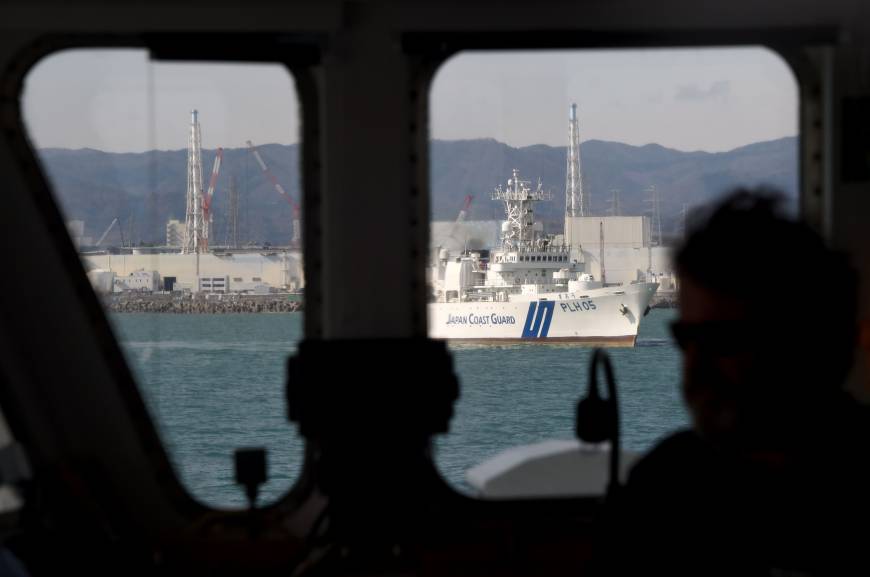
Conservation group Greenpeace warned on Friday that the environmental impact of the Fukushima nuclear crisis five years ago on nearby forests is just beginning to be seen and will remain a source of contamination for years to come.
The March 11, 2011 magnitude-9.0 undersea earthquake off the nation’s northeastern coast sparked a massive tsunami that swamped cooling systems and triggered reactor meltdowns at the Fukushima No. 1 nuclear plant.
Radiation spread over a wide area and forced tens of thousands of people from their homes — many of whom will likely never return — in the worst nuclear accident since Chernobyl in 1986.
As the fifth anniversary of the disaster approaches, Greenpeace said signs of mutations in trees and DNA-damaged worms were beginning to appear, while “vast stocks of radiation” mean that forests cannot be decontaminated.
In a report, Greenpeace cited “apparent increases in growth mutations of fir trees, … heritable mutations in pale blue grass butterfly populations” as well as “DNA-damaged worms in highly contaminated areas.”
The report came as the government intends to lift many evacuation orders in villages around the Fukushima plant by March 2017, if its massive decontamination effort progresses as it hopes.
For now, only residential areas are being cleaned in the short-term, and the worst-hit parts of the countryside are being omitted, a recommendation made by the International Atomic Energy Agency.
But such selective efforts will confine returnees to a relatively small area of their old hometowns, while the strategy could lead to re-contamination as woodlands will act as a radiation reservoir, with pollutants washed out by rains, Greenpeace warned.
The conservation group said its report relies largely on research published in peer-reviewed international journals.
But “most of the findings in it have never been covered outside of the close circles of academia”, report author Kendra Ulrich said.
The government’s push to resettle contaminated areas and also restart nuclear reactors elsewhere around the country that were shut down in the aftermath of the crisis are a cause for concern, Ulrich said, stressing it and the IAEA are using the opportunity of the anniversary to play down the impact of the radiation.
“In the interest of human rights — especially for victims of the disaster — it is ever more urgent to ensure accurate and complete information is publicly available and the misleading rhetoric of these entities challenged,” she said.
Scientists, including a researcher who found mutations of Fukushima butterflies, have warned, however, that more data are needed to determine the ultimate impact of the Fukushima accident on animals in general.
Researchers and medical doctors have so far denied that the accident at Fukushima would cause an elevated incidence of cancer or leukemia, diseases that are often associated with radiation exposure.
But they also noted that long-term medical examination is needed, especially due to concerns over thyroid cancer among young people — a particular problem for people following the Chernobyl catastrophe.
http://www.japantimes.co.jp/news/2016/03/04/national/science-health/mutations-dna-damage-seen-fukushima-forests-greenpeace/#.VtmtlObzN_m
Living in Limbo
Five years after the meltdown in Fukushima, the Japanese government’s effort to reboot its nuclear energy program is still being met with resistance.

The atmosphere in the packed meeting room is tense. It is a Wednesday night in November, and perhaps a hundred people have gathered at a community center in the city of Minamisoma, which begins about six miles north of the decimated Fukushima Daiichi nuclear power plant. At the front of the room sits a phalanx of government officials in dark suits. Facing them are men and women who were forced from their homes in Minamisoma’s Odaka district by nuclear fallout, and who are now being told they might be allowed back by spring. The question on the table is whether that move is premature. Twenty minutes into the discussion, the deep divide between the officials and the residents is clear.
An older man raises his hand. “There’s a tombstone behind my house where the radiation measures 10.5 microsieverts per hour. 10.5!” he says.
Multiplied over a year, the figure is 4.6 times the standard Japan’s government has set for mandatory evacuation, and 92 times the limit the International Commission on Radiological Protection recommends for the general population under normal circumstances. It is also far higher than most measurements taken recently in Odaka, where a massive government-sponsored cleanup – together with natural decay – is steadily lowering radiation levels.
“It’s probably a hotspot,” an environment ministry official says. “We can take care of it for you.”
“I asked the government for data about that spot in August, but I haven’t gotten anything. Why not?” the resident demands.
A woman in the audience shouts out: “Because they’re liars!”
“We think you’re afraid to give us the real data,” the man says.
Another resident speaks up: “The forest surrounding my house has not been decontaminated. Would you live in a place like that? I beg of you, please delay the resettlement!” Applause breaks out in the audience.
I kneel at the back of the crowd, surprised by the depth of the anger and skepticism coursing through the room. The normal tone of public space in Japan is deferential courtesy. That ordinary residents of a provincial town are willing to challenge officials so openly reflects a profound shift brought about by the nuclear disaster.
Simply put, far fewer people trust the government today than they did five years ago. The immediate cause of the disaster was an earthquake and tsunami on March 11, 2011 that deprived the coastal Fukushima plant of its power supply, and hence of its ability to keep reactors and spent fuel cool. A series of explosions and meltdowns followed, which led to the eventual evacuation of 164,000 people. Subsequent investigations soon revealed, however, that poor oversight and cozy ties between government, industry, and academia (the so-called “nuclear village”) laid the groundwork for the disaster. The public also learned that the government bungled the evacuation, causing thousands of people to suffer more radiation exposure than they otherwise would have.
Since then, resistance has extended deep roots. The clearest evidence of that is here in Fukushima, where residents like the ones in this room are fighting to make sure their rights are respected. But far beyond these borders as well, communities are embracing renewable energy and citizens are protesting government abuses of power more loudly than they have in decades. The question that remains after I slip out into the cool night air is how much that resistance is changing policy and politics in Japan.
At times, the answer seems to be: very little. The same political party that enabled the Fukushima disaster through half a century of pro-nuclear policy is back in power, three nuclear reactors are running again despite safety concerns, one more is about to restart, and 20 more are awaiting approval. Meanwhile, Japan played only a minor role at the Paris climate talks in November, and is pouring money into coal plants to compensate for its idled nuclear fleet. In Fukushima, the government remains intent on repopulating the 310-square-mile exclusion zone as quickly as possible.
I have come to Japan on the eve of the disaster’s fifth anniversary to try to make sense of these changes – to weigh hope against cynicism, transformation against retrenchment. What happens here matters globally. Japan is the world’s fifth largest carbon dioxide emitter, is the number-one importer of liquefied natural gas and number-two importer of coal, and a leading exporter of nuclear and “clean coal” technologies. Its domestic energy choices clearly affect the world’s efforts to tackle climate change. But my motivation is also personal. I was living in Japan when the disaster occurred. I witnessed firsthand both its devastating aftermath and the sense of hope for a more sustainable and democratic future that sprang up in its wake. I want to know the fate of that hope.
My host in Minamisoma is a retired postman and lifelong activist from Odaka named Tomio Kokubun. He began protesting nuclear power when he was 20 years old and a new plant – Fukushima Daiichi – was proposed south of his home. Back then, his anti-nuclear activism placed him on the fringe of a community eager to benefit from the jobs the plant brought to the region. Today, he tells me with just a hint of vindication, his neighbors concede he was right to worry.

Long-time anti-nuclear activist and Fukushima native Tomio Kokubun stands next to a sign he wrote and posted near his abandoned house. It reads: “Abe administration, don’t ignore the voice of the people and restart the nuclear reactors.”
I first met Kokubun in 2013 in the snowy mountains west of Fukushima City, where he and his family had been living since they fled the coast after the first explosion at the plant. It was clear that two years of displacement had taken their toll. Kokubun’s ailing mother-in-law and sister-in-law died after a series of evacuation-related moves, and his wife Mieko told me she felt isolated and unhappy in her new surroundings. His grown son, too, talked about how much he wanted his old life back.
Kokubun alone seemed galvanized by the chain of events. He had founded a sprawling association of evacuees and supporters, and was traveling regularly to speak against nuclear power. He was also deeply involved in a class-action lawsuit to gain more compensation from Tepco, the plant operator, for damages caused by the accident. (By 2015, over 10,000 evacuees and nearby residents had filed similar claims.) The stricter safety rules for nuclear plants that the government implemented later that year – including more rigorous backup power requirements – did not placate him. To the contrary, the disaster and its aftermath proved what he had always suspected – that any man-made system contains the potential for failure, and in the case of nuclear power, failure is catastrophic.
Now, two years later, Kokubun was back in Minamisoma, and I had arranged to meet him there the morning of the community meeting. As I looked around the clean, quiet bus stop, I caught sight of him grinning and waving at me from across the street. He was dressed in jeans and a plaid shirt, his snow-white hair poking out from under a tweed hat.
“We’re doing well,” he told me as I climbed into his car. He and Mieko had finally pulled together enough money to start building a new house farther north. In the meantime, they are living in a house in a part of their hometown that was only briefly evacuated. One reason for this move was Mieko’s worsening depression, which Kokubun told me had eased now that she was on familiar ground. The other reason was political.
“I felt strongly that I needed to expand my activism, and I thought if I came back here more people would sympathize with my message,” he said. In July of last year he launched a local organization focused on radiation safety, which so far has attracted around 100 members.
We headed into Odaka where Kokubun’s abandoned house is located. The cleanup was in full swing. Industrious men in masks power-washed sidewalks, dump trucks crowded the streets, and orange placards marked houses for demolition. Everywhere we went we saw squat black bags stuffed with tainted dirt and debris. (Almost 10 million of these bags litter Fukushima, awaiting transportation to a mid-term storage site near Fukushima Daiichi.)
At the community meeting later that night, the mayor of Odaka insisted that all this work was meant only to ensure displaced residents could return if they wanted to – not to force them back.
The dilemma, of course, is that contamination cannot be completely removed from the environment. It will linger in forests and ponds and backyard corners for decades to come, exposing anyone who returns to low but persistent levels of radiation. Science provides no clear answers regarding the potential health risks of that exposure. Above 100 millisieverts (mSv) cancer rates clearly rise; below that level, they may also rise slightly, but the increase is extremely hard to detect in population-level studies.
Following the Fukushima disaster, Japan’s government used the lack of scientific consensus on low-level radiation impacts to justify raising the acceptable level of exposure for the general population from 1 mSv to 20 mSv per year above background levels. (The International Commission on Radiological Protection’s recommended maximum exposure for the general population is 1 mSv under normal circumstances and between 1 mSv and 20 mSv after a nuclear accident.) The decision was, in effect, a pragmatic one. If the government had stuck with the 1 mSv limit, it would have had to evacuate far more people and establish a large, long-term exclusion zone similar to the one around Chernobyl. With the higher limit, bringing nuclear refugees back home became a possibility.
But why the fixation on return? Is it merely that Japan is small, land is precious, and people’s attachment to place fierce? As we drove through the strange landscape of black bags and masked men, Kokubun told me he believes otherwise. “The government is doing this to regain support for nuclear power,” he said. The logic is that if even Fukushima can be “fixed,” people will stop fearing the reopening and operation of other plants.
Kokubun’s response has been to do whatever he can to prevent the illusion of normalcy from seeping in – from dragging Tepco through court to lecturing nationwide about the situation on the ground to hosting visitors who want to see the exclusion zone for themselves. That he is 70 and has been fighting the same fight for 50 years appears not to bother him.
“Right now, the old have to protect the young,” he told me. “We’re the ones who accepted the nuclear plants, who allowed them to be built. The real responsibility lies with us.”
“Do you ever feel like giving up?” I asked.
“I will never give up,” he replied, almost cheerfully. “I will never accept nuclear power.”
A majority of Japanese now share Kokubun’s opinion. Over 70 percent of respondents in recent polls say they want to phase out nuclear power, and 8.5 million have signed a petition calling for renewable energy to replace reactors. Anti-nuclear protests in Tokyo drew hundreds of thousands of ordinary citizens at their peak in 2012. When the Democratic Party of Japan (DPJ) – which briefly held power before and after the disaster – asked for public input on its energy and environment policy in 2012, a record-breaking 89,000 people sent in comments, close to 90 percent of them opposing nuclear power.
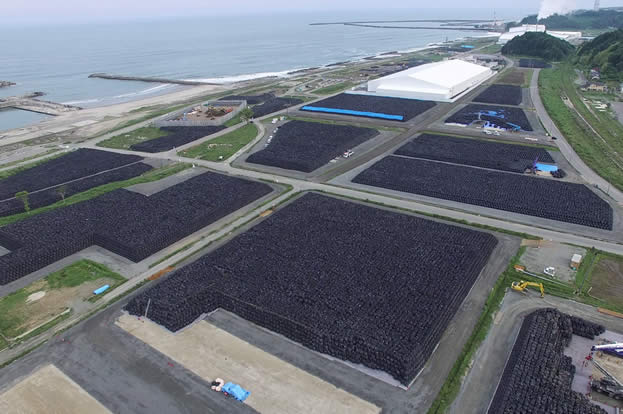
Bags stuffed with tainted dirt and debris stored near the sea. About 10 million of these bags litter Fukushima, awaiting transportation to a mid-term storage site.
The relationship between this surge in anti-nuclear sentiment and Japan’s broader energy policy is complex. The Fukushima disaster occurred just as global concern over climate change was accelerating. In 2009, then-Prime Minister Yukio Hatoyama had committed Japan to lowering carbon emissions a quarter below 1990 levels by 2020 – largely through a plan to increase nuclear power to half of the country’s electricity mix. The meltdowns changed everything.
“With the 3-11 disaster, everyone’s attention turned toward nuclear power. Since then, climate change has fallen more and more off the public’s radar as an important issue,” Takako Momoi told me when I stopped by the Tokyo office of Kiko Network, Japan’s biggest homegrown climate-change NGO, where she works as a manager. A minority of activists even began to spread the message that climate change was a ruse to gain support for nuclear power. In 2013, when the new government traded Hatoyama’s ambitious emissions goal for a 3 percent increase over 1990 levels by 2020, few people protested.
Coal has already seen a major resurgence. Construction of coal-fired power plants had stalled around 2009 due to climate change concerns, but now 48 new plants are planned or under construction, says Momoi. Even with much-touted new “clean coal” technology, she adds, these plants will emit as much carbon dioxide as those that burn oil.
Then there is the fact that even if the public prefers renewables to coal or nuclear, most people still prioritize the economy over the environment in elections. In 2012, voters ousted the DPJ in favor of the pro-nuclear Liberal Democratic Party (LDP), which has monopolized power for most of Japan’s post-war period. The LDP quickly set about formulating its own energy vision. It tossed out the public comments the DPJ had collected, kicked anti-nuclear advisors like those from Momoi’s organization off policy committees, and last summer finalized a long-term energy vision that calls for electricity to come from roughly equal parts nuclear, liquid natural gas, coal, and renewable sources by 2030.
At the local level, however, a more ambitious vision has started to emerge. Many communities are formulating their own renewable energy plans – Minamisoma among them. This March, the city of 63,000 released a “Non-Nuclear Power Declaration” reaffirming an earlier pledge to generate 65 percent of its electricity from renewable sources by 2020, and 100 percent by 2030 (compared to around 10 percent today). Construction is slated to begin this year on a solar farm large enough to power almost all of the city’s households, and four windmills are planned as well. A generous national feed-in tariff program introduced in 2012, which guarantees high prices to individuals and companies selling renewable energy to the grid, has lured corporate investors to these projects.

Cleanup workers power-wash a parking lot in the Odaka district of Minamisoma.
That, together with some smaller subsidy programs, should get the city to its 2020 goal, says Shunichi Shiga, who heads Minamisoma’s newly-established renewable energy division. Reaching 100 percent could be tougher. Power distributors say they’ve already reached the limit of how much renewable energy they can incorporate without major improvements to the grid, and now that the feed-in-tariffs are being ratcheted down, investing in renewable energy is looking riskier. Overcoming these obstacles, Shiga says, will require action at the national level. Momoi concurs. “The [local] movement to increase renewable energy is great, but within the current policy context, it will hit a ceiling,” she says. “There’s a need to think more about the big picture.”
Many people are, in fact, starting to think about what it will take to achieve true change at the national level. One of the most interesting developments set off by the disaster has been the emergence of a strong student movement protesting the government’s disregard for democratic processes. Although its focus is on military policy rather than energy issues, the underlying concern is the same.
Called Students Emergency Action for Liberal Democracy, or SEALDs, this small but vocal group of high school and university students coalesced in mid-2015 against a set of security bills that the LDP ultimately pushed through the Diet (Japanese parliament) in September. Using social media and protests outside the Diet building featuring fierce, smart speeches, the students quickly engaged a broader slice of society than old-school protesters had been able to. It was the most significant student movement since the 1960s.
Koichi Nakano, a political science professor at Tokyo’s Sophia University says SEALDs is a “direct descendant” of the civil-society awakening that followed the nuclear disaster. “They were high school students at the time [of the meltdowns], and for many of them the first experience of protest was those anti-nuclear rallies,” he tells me. “The disaster exposed the myth that was more credible in earlier times about the trustworthiness of ruling elites in Japan.”
Nakano is himself active in an organization opposing the security bills, and has collaborated closely with SEALDs over the past year. He too sees the roots of the nuclear and military issues as intimately linked. “There’s a sense that the 1 percent increasingly control our fate and the 99 percent of us are left out in the dark, uninformed and practically disenfranchised,” he says. “In the case of the security bills, it’s about the ruling elites of Japan in collusion with the American elites changing the interpretation of the constitution to allow Japan to take part in America’s wars even without Japan being attacked. The nuclear power issue is very similar because nuclear power is something that those big powers need to continue on for lucrative reasons. They wouldn’t want to see Japan dropping out from the nuclear power club.”
In spite of this, Nakano believes citizen activists have changed the government’s course, at least on energy. “There was a long period in which even [Prime Minister] Abe couldn’t restart the nuclear reactors. That has only to do with the strength of the opposition,” he tells me. “We are talking about ordinary citizens, without resources, stopping the reactors for many, many months.”
As important as these popular movements may be, the people who will determine Japan’s longer-term energy path are not in the crowds outside the Diet, or even inside its halls. They are in elementary and middle school classrooms across the country. Japan’s education system played a key role in creating the so-called “myth of nuclear safety” – the widespread belief that Japan’s reactors were indestructible – that led towards poor oversight and, ultimately, disaster. Likewise, the lessons children learn now about the Fukushima disaster will shape their views on energy and the environment throughout their lives. So, on my last day in Japan, I take the train back to Fukushima to talk with a professor who has spent the past five years trying to improve radiation education.

The contamination will linger in forests and ponds and backyard corners
for decades to come.
Shinobu Goto is a tall, serious man in his forties who teaches environmental education at Fukushima University. We meet on a Saturday evening in a cluttered university office, where we are joined by two members of the Fukushima teachers’ union, Toshiki Kokubun (no relation to Tomio) and Hiroshi Sato, whose name has been changed to protect his identity. All three were deeply impacted by the disaster.
Goto in particular says the unexpected catastrophe thrust him into a period of intense reflection and regret. He had not previously focused on nuclear education, but now he began to scour official teaching materials on the topic for evidence of bias. He found plenty: elementary-level readers titled Exciting Nuclear Power Land, illustrations of frowning coal plants juxtaposed with friendly nuclear reactors, claims that Japan’s reactors could withstand large earthquakes and tsunamis. Goto was not alone in his critique. The minister of education himself admitted that the pre-disaster texts contained information “contrary to reality,” and soon had them replaced.
Yet the new radiation readers that the ministry published in late 2011 were hardly an improvement. They included just 8 lines about the Fukushima disaster, and instead emphasized how useful and ubiquitous radiation is in daily life. In this, Goto saw the makings of a new myth – not that reactors are infallible, but that the radiation they emit when they do fail is nothing to worry about.
“The concept that the level of radiation we have in Fukushima is safe is being steadily created through education and PR,” he tells me as we sip tea in the quiet research building. He was particularly worried that kids weren’t getting the information they needed to protect their own rights to physical, mental, and social wellbeing. “If you don’t know the exposure limit is 1 or 5 mSv per year in other places, you don’t realize the situation in Fukushima is abnormal,” he says. “Education is empowerment in the sense that it allows you to make those critiques.”
Teachers needed a better option, so in early 2012 he assembled a group of 16 Fukushima University professors, and together they wrote an alternative reader from a human-rights perspective. He also began holding workshops to teach critical thinking skills to public school students, so they could assess government and media claims on their own. At this point, top-level administrators began pressuring him to tone down his activism. The school is the only national university in the prefecture; from the start, its administrators had echoed the government’s emphasis on recovery over risk.

A sign in Fatuba, directly north of the Fukushima Daiichi power plant, reading “Nuclear power, energy for a bright future.” The town is closed off now.
“They told me I had to put a sticker on the reader saying it wasn’t an official publication of the university. I said that’s discriminatory; you don’t do that for other publications,” Goto says. (University representatives tell me they are unable to confirm or deny Goto’s claims, citing personnel changes and a lack of relevant meeting minutes.)
He refused to back down. Ultimately, the reader was published without the sticker, helping to turn national attention on the official curriculum. That attention reverberated to the ministry of education; when the official readers were revised again in 2014, they included more information on the Fukushima disaster, and an acknowledgement that scientists hold “various views” on the impacts of low-level radiation. Still, a startling array of terms were missing: “meltdown,” “Nuclear Accident Child Victim’s Law,” “hotspot,” “thyroid cancer,” and “radioactive waste” among them.
Kokubun and Sato say most teachers in Fukushima don’t venture beyond the official curriculum, which allots just two hours a year for radiation education, partly because they are too busy, and partly because they’re pressured not to.
Sato, an elementary school teacher in Fukushima City, has experienced this pressure directly. “Some high-level board-of-education staff observed one of my classes [on radiation in 2013], and afterwards they said to me, Don’t you think today’s class might worry the children?” The content was purely science based: Sato had shown the kids a graph of the relationship between radiation and cancer, and pointed out that high levels of exposure can be deadly. (In lessons, he also explains that the current degree of contamination in Fukushima City carries a relatively low risk of cancer.)
Fukushima’s Board of Education tells me later that teachers are permitted to share science-based radiation material as long as it is widely accepted. “Our goal,” a staff member writes in an email, “is to teach children to make appropriate decisions based on correct knowledge and understanding of radiation.” However, Sato says he’s been told to avoid the topic by his principal, vice-principal, and other teachers.
Like Goto, he has not bowed to this pressure. Yet both he and Kokubun seem worn down by their lonely struggle. The government defends its interests tenaciously, and the public – with the exception of a determined minority – is all too eager to assist by turning away from the painful past. “People need to be angrier,” Kokubun says. “I’m sad that more people haven’t spoken out with us.”
Outside Goto’s office, the sky is growing dark. Kokubun and Sato need to head home. After they leave, I ask Goto how much hope he has that things will change. He says he feels like he is gasping for breath. The pace of progress is slow, and public interest in the disaster’s ongoing impact is dwindling. Still, he says, he is determined to continue his work.
Later, after he drops me off at the train station, I leaf through some papers he has given me, among them an essay he wrote for his hometown newspaper concluding with the following lines: “They say that history is written by the victors. I will be watching and acting to make sure the lessons of the Fukushima nuclear accident are not written to suit the interests of the perpetrators of this unprecedented man-made disaster.”
In that, and in the commitment of many others to do the same, there lies a glimmer of hope.
http://www.earthisland.org/journal/index.php/eij/article/living_in_limbo/
Are Organisms Adapting to Ionizing Radiation at Chernobyl?
Numerous organisms have shown an ability to survive and reproduce under low-dose ionizing radiation arising from natural background radiation or from nuclear accidents. In a literature review, we found a total of 17 supposed cases of adaptation, mostly based on common garden experiments with organisms only deriving from typically two or three sampling locations. We only found one experimental study showing evidence of improved resistance to radiation. Finally, we examined studies for the presence of hormesis (i.e., superior fitness at low levels of radiation compared with controls and high levels of radiation), but found no evidence to support its existence. We conclude that rigorous experiments based on extensive sampling from multiple sites are required.
Radiation research in children teeth in Japan
Prof. Chihiro Ichihara from Aichi Medical University, is an independent man.
He informed the audience about the children teeth project for measuring Strontium 90, with no government support, looking for funding.
Prof. Chihiro Ichihara collects children teeth and lets them measure for Strontium 90. He plans to build an own independent lab for parents.
Similar project was done until the1980s in the U.S. after the bomb tests. It was then supervised by Jay Gould. (STRONTIUM-90 IN BABY TEETH AS A FACTOR IN EARLY CHILDHOOD CANCER http://www.radiation.org/reading/ijhs/ijhs_9_2000.html)
To measure Sr90 is very difficult, because it emits only beta radiation. It causes bone marrow depression, destroys the stem cells and immune system, casuses bone cancer / sarcoma.
His project deserves more attention, because it is VITAL.
STRONTIUM-90 IN BABY TEETH AS A FACTOR IN EARLY CHILDHOOD CANCER
Jay M. Gould, Ernest J. Sternglass, Janette D. Sherman,
Jerry Brown, William McDonnell, Joseph J. Mangano
International Journal of Health Services
Volume 30, Number 3, Pages 515-539, 2000
Copyright Baywood Publishing Co., Inc
http://www.radiation.org/reading/ijhs/ijhs_9_2000.html
Kudos to Prof. Ichihara, wo worked at the research reactor in Kyoto: “He is a physicist specialising in Neutron transport experiments and their calculation as well as in gamma-ray spectrum measurement.
Currently, he teaches as a Visiting Professor at Aichi Medical University. He is a member of the Steering Committee of PDTN. Previously, Prof. Chihiro Ichihara was an Associate Professor at the Research Reactor Institute of Kyoto University.”
Special credits to Jan Hemmer for the pictures and the informations


Radiation research in children teeth in US
Radiation and Public Health Project
Tooth Donation Form/Kit
How to Send Teeth
- If not already clean, wash the teeth and let them dry.
- Wrap each tooth in paper and cushion with tissue or something similar.
- Print out the tooth donation form, fill it out, and send it with the teeth to:
Radiation and Public Health
P.O. Box 1260
Ocean City NJ 08226
Do not worry if you do not have all the information requested
There is some information we need in all cases:
- Where the mother lived when carrying the child.
- The child’s birthdate.
- Where the child lived the first year after birth.
If you can supply us with this information, don’t worry about the rest if you do not know the answers.
Important: If you have a tooth or teeth from more than one child, please fill out a separate form for each child and clearly mark which teeth came from which child. We cannot use teeth from more than one child when they are mixed together.
Would you like preprinted envelopes?
For envelopes with the teeth form pre-printed on them, email us (odiejoe@aol.com) with your name, address, and phone, and how many envelopes you need.
* For more than 10 envelopes and Group Networking, contact our Executive Director Joseph Mangano.(odiejoe@aol.com)
Tooth donation form: http://www.radiation.org/projects/tooth_donation_form.html
Source: http://www.radiation.org/projects/tooth_donation.html
Hot Spots in the 5th Year Over 20μSv h in Fukushima city Feb. 23, 2016
Here is the video made by Masa in Fukushima and his group. The video is available in English. This is the reality of 5 years after the nuclear accident. The area in the video is going to be “de-contaminated” in this coming spring, 2016.
Despite that there are numerous hot spots in school routes and parks, Masa says that in Fukushima, nobody talks about radiation anymore.
In the 5th year since the Fukushima nuclear accident, we found hotspots on the riverbed in Fukushima city. They exceeded 20μSv/h. We examine the present FUKUSHIMA which is facing the micro-hot-spots phenomena.
Five years on, Fukushima still faces contamination crisis: environmentalists

Crippled Fukushima Daiichi nuclear power plant in northeastern Japan.
Fish market vendor Satoshi Nakano knows which fish caught in the radiation tainted sea off the Fukushima coast should be kept away from dinner tables.
Yet five years after the worst nuclear accident since Chernobyl there is still no consensus on the true extent of the damage – exacerbating consumer fears about what is safe to eat.
Environmentalists are at odds with authorities, warning the huge amounts of radiation that seeped into coastal waters after a powerful tsunami caused a meltdown at the Fukushima Daiichi nuclear power plant on March 11, 2011, could cause problems for decades.
The Japanese government is confident it has stemmed the flow of radioactive water into the ocean, but campaigners insist contaminated ground water has continued to seep into the Pacific Ocean, and the situation needs further investigation.
“It was the single largest release of radioactivity to the marine environment in history,” Greenpeace nuclear expert Shaun Burnie said on the deck of the campaign group’s flagship Rainbow Warrior, which has sailed in to support a three-week marine survey of the area the environmental watchdog is conducting.
Fukushima is facing an “enormous nuclear water crisis,” Burnie warned.
He added: “The whole idea that this accident happened five years ago and that Fukushima and Japan have moved on is completely wrong.”
Existing contamination means fishermen are banned from operating within a 20-km radius from the plant.
Although there are no figures for attitudes on seafood alone, the latest official survey by the government’s Consumer Affairs Agency showed in September that more than 17 per cent of Japanese are reluctant to eat food from Fukushima.
Nakano knows it’s best for business to carefully consider the type of seafood he sells, in the hope it will quell consumer fears.
“High levels of radioactivity are usually detected in fish that move little and stick to the seabed. I am not an expert, but I think those kinds of fish suck up the dirt of the ocean floor,” he said from his hometown of Onahama by the sea.
Greenpeace is surveying waters near the Fukushima plant, dredging up sediment from the ocean floor to check both for radiation “hotspots” as well as places that are not contaminated.
On Monday, the Rainbow Warrior sailed within a 1.6km of the Fukushima coast as part of the project – the third such test it’s conducted but the closest to the plant since the nuclear accident.
Researchers on Tuesday sent down a remote-controlled vehicle attached with a camera and scoop, in order to take samples from the seabed, which will then be analysed in independent laboratories in Japan and France.
“It’s very important [to see] where is more contaminated and where is less or even almost not contaminated,” Greenpeace’s Jan Vande Putte said, stressing the importance of such findings for the fishing industry.
Local fishermen have put coastal catches on the market after thorough testing, which includes placing certain specimens seen as high risk through radiation screening – a programme Greenpeace lauds as one of the most advanced in the world.
The tests make sure no fish containing more than half of the government safety standard for radiation goes onto the market.
The 2011 disaster was caused by a magnitude 9.0 undersea earthquake off Japan’s northeastern coast which then sparked a massive tsunami that swamped cooling systems and triggered reactor meltdowns at the Fukushima Daiichi plant, run by operator Tokyo Electric Power (TEPCO).
Today, about 1,000 huge tanks for storing contaminated water occupy large parts of the site, but as 400 tonnes of groundwater a day flows into the damaged reactor buildings, many more will be needed.
TEPCO have said they are taking measures to stop water flowing into the site, including building an underground wall, freezing the land itself and siphoning underground water.
The government too insist the situation is under control.
“The impact of the contaminated water is completely contained inside the port of the Fukushima plant,” Tsuyoshi Takagi, the Cabinet minister in charge of disaster reconstruction, told reporters on Tuesday.
But Greenpeace’s Burnie says stopping the groundwater flow is crucial to protecting the region.
“What impact is this having on the local ecology and the marine life, which is going on over years, decades?”, Burnie asked.
He added: “We can come back in 50 years and still be talking about radiological problems” at the nuclear plant as well as along the coast, he said.

Storage site of contaminated soil generated by decontamination work in Fukushima Prefecture, home of the crippled Fukushima Daiichi complex
Upcoming Tokyo photo exhibition to convey scars of 2011 quake disaster

This 2013 photo shows radioactive materials on a slipper from the Fukushima Prefecture town of Namie, which was evacuated after the Fukushima No. 1 Nuclear Power Plant disaster. The white spots in the photo indicate the presence of radioactive cesium and other materials, visualized on large-format film after the slipper was exposed to it for two months. (Photo by Takashi Morizumi)
A photo exhibition on the theme of the 2011 Great East Japan Earthquake will be held in Tokyo beginning on March 1, and will aim to convey the scars left by the disaster ahead of its fifth anniversary on March 11.
About 100 photos taken by 39 photographers will be on display during the exhibit, which will be held at the Bengoshi Kaikan building in Chiyoda Ward.
Specifically, photos featuring Fukushima Prefecture will provide visitors with opportunities to think about the matter of how to recover from the Fukushima No. 1 Nuclear Power Plant disaster.
The exhibition, which is being put together by organizations including the Tokyo Bar Association, will run through March 10, except for March 6, when it will be closed. Admission is free.
A gathering for disaster evacuees will be held at the same building on March 5. For more information, call the Tokyo Bar Association at 03-3581-2251.
http://mainichi.jp/english/articles/20160225/p2a/00m/0na/021000c
For some Fukushima mothers, protecting children from radiation comes at heavy price

Residents who were evacuated from Okuma and three other towns in Fukushima Prefecture attend an event at a public housing facility in Iwaki to help them assimilate into the community on Feb. 19.
Three-and-a-half years after fleeing to central Japan, a mother received a package from her husband who had opted to remain at their home in Fukushima Prefecture despite the nuclear disaster.
From Tamura, about 35 kilometers west of the stricken Fukushima No. 1 nuclear plant, the father sent snacks for the couple’s two children. The cardboard box also contained divorce papers.
“I cannot send money to my family whom I cannot see,” the husband told his wife.
She still refused to return home.
Thanks to decontamination work, radiation levels have fallen around the nuclear plant since the triple meltdown caused by the Great East Japan Earthquake and tsunami in March 2011. And families are returning to their hometowns, trying to resume normal lives.
But many mothers, distrustful of the government’s safety assurances, still harbor fears that radiation will affect the health of their children. As a result of these concerns, families are being torn apart, friendships have ended, and a social divide remains wide in Fukushima communities.
Around 70,000 people are still not allowed to return to their homes located in evacuation zones designated by the central government. And an estimated 18,000 people from Fukushima Prefecture whose homes were outside those zones remain living in evacuation.
The government is pushing for Fukushima residents to return home and trying to counter false rumors about the nuclear disaster.
More families in Fukushima Prefecture are willing to buy food produced in the prefecture–but not all.
A 40-year-old mother who once lived on the coast of Fukushima Prefecture and moved farther inland to Koriyama said she still fears for the health of her 11-year-old daughter.
Her classmates started serving “kyushoku” school lunches containing Fukushima rice and vegetables that passed the screening for radioactive materials. But the fifth-grader has instead eaten from a bento lunch box prepared by her mother.
The daughter says that eating her own lunch led to teasing from her classmates. She heard one of them say behind her back: “You aren’t eating kyushoku. Are you neurotic?”
She does not talk to that classmate anymore, although they used to be friends.
“I now feel a bit more at ease even when I am different from other students,” the daughter said.
Her mother expressed concerns about her daughter’s social life, but protecting her child’s health takes precedence.
“My daughter may fall ill sometime,” the mother said. “I feel almost overwhelmed by such a fear.”
An official of the Fukushima prefectural board of education said a certain number of students act differently from other students because of health concerns over radiation.
“Although the number is limited, some students bring bento to their schools,” the official said. “Some students wear surgical masks when they participate in footraces during outdoor school athletic meets.
“The feelings toward radiation vary from person to person, so we cannot force them (to behave in the same way as other students).”
Sung Woncheol, a professor of sociology at Chukyo University, and others have conducted surveys on mothers whose children were 1 to 2 years old when the nuclear disaster started. The mothers live in Fukushima city and eight other municipalities in Fukushima Prefecture.
Of the 1,200 mothers who responded to the survey in 2015, 50 percent said they had concerns about child-rearing in Fukushima Prefecture.
Nearly 30 percent said they avoid or try to avoid using food products from Fukushima Prefecture, compared with more than 80 percent six months after the disaster.
But for some mothers, the passage of nearly five years since the disaster unfolded has not erased their fears of radiation.
The 36-year-old mother who received the divorce papers from her husband in autumn 2014 continues to live with her children in the central Japan city to which she had no previous connection.
A month after the nuclear disaster, she fled with her then 1-year-old son and her daughter, 10, from their home, even though it was not located in an evacuation zone.
She said she left Fukushima Prefecture because she “could not trust the data released by the central government.”
The mother still has not told her children that their parents are divorced.
“I believe I could protect the health of my children,” the woman said. “But my family has collapsed.”
http://ajw.asahi.com/article/0311disaster/fukushima/AJ201602230068
Japan Olympic teams to train in nuclear clean-up zone

Piles of used protective clothing worn by workers inside the contaminated ‘exclusion zone’, seen in 2011 at J-Village, a football training complex serving as an operation base for those battling Japan’s nuclear disaster in Fukushima
Tokyo (AFP) – Japan’s Olympic football teams will train for the Tokyo 2020 Games at a complex currently being used as a base for thousands of workers cleaning up the crippled Fukushima nuclear plant.
The Japan Football Association (JFA) said Monday that the Japanese men’s and women’s teams would hold their training camps at J-Village, once the country’s centre of excellence until it was taken over by plant operators following the 2011 nuclear disaster.
“The teams will use the J-Village facility as a training base,” JFA communications chief Takato Maruyama told AFP.
“It is something the JFA had been talking about but a timeline hadn’t been formally approved by the executive board, until now,” Maruyama said.
J-Village is on the fringes of the old 12-mile (20-kilometre) exclusion zone around the stricken plant, which suffered a triple reactor meltdown after a giant tsunami slammed into it in March, 2011, causing massive radiation leaks and forcing the evacuation of more than 150,000 people.
As the nuclear crisis raged, J-Village became the front line in the fight to control the situation, with helipads, medical centre and dormitories hastily erected for workers filing in and out of the plant in their protective suits and masks.

Workers queue for a bowl of soup at J-Village, a football training complex serving as an operation base for those battling Japan’s nuclear disaster in Fukushima prefecture, in 2011
Following the removal of the no-entry zone last September, the sprawling site located in the sleepy town of Naraha will undergo large-scale reconstruction with a view to a partial reopening by July 2018.
“Obviously the complex will need some refurbishment but that is the time frame we have heard from TEPCO (Tokyo Electric Power Company) and J-Village,” said Maruyama.
Japanese officials plan to reopen the facility — originally constructed by TEPCO and donated to the regional government in 1997 — to serve as a symbol of recovery for the Tokyo Olympics.
Venues in the tsunami-ravaged northeastern Tohoku region also hoping to be involved in the Games.
“J-Village has always been an important venue and it has a large role to play in the recovering of Fukushima,” JFA director Eiji Ueda told local media.
Despite the symbolic value of training at the complex, the JFA insisted that safety was of utmost importance.
“We can’t make any specific comment on radiation but clearly you can’t play football in places where it isn’t safe for people to go,” said Maruyama, referring to the proposal to reopen J-Village in 2018.
“Obviously it will be opened on condition that all decontamination work has been completed safely,” he added.
“We can’t say (at this point) if that decontamination will have been fully carried out and whether there will be zero effect from radiation by that time.”
Japan’s nuclear reactor restarts anger Minami Soma mayor

Katsunobu Sakurai: ‘It is necessary for all of Japan to change its way of thinking and its way of life’
TOKYO (TR) – One video made him one of the most well-known faces of the Fukushima nuclear crisis.
In the 11-minute YouTube video uploaded on March 24, 2011, mayor Katsunobu Sakurai begged for help for his city of Minami Soma, located 15 miles away from the crippled Fukushima Daiichi Nuclear Power Plant.
Five years later, Sakurai says his city still hasn’t fully recovered. Making matters worse, he says, is Japan’s reversion to nuclear energy: After a nationwide halt, two power companies restarted reactors in Fukui and Kagoshima prefectures beginning last year and Tokyo Electric Power (TEPCO), which operates Fukushima Daiichi, is scheduled to bring two reactors back online in Niigata Prefecture later this year.
“As a resident of an area affected by the nuclear power plant disaster, I must express great anger at this act,” said Sakurai at a press luncheon at he Foreign Correspondents’ Club of Japan on Thursday. “When we look at how all of the affected areas of Japan, including Minami Soma, can rebuild following the disaster, it is necessary for all of Japan to change its way of thinking and its way of life.”
After the Great East Japan Earthquake on March 11, 2011, the meltdown at the Fukushima Daiichi plant resulted in the halting of all nuclear power plants in Japan. In 2013, stricter safety regulations were implemented by the Nuclear Regulation Authority.
In August and October of last year, the first two reactors under the new regulations were brought back online at Kyushu Electric Power’s Sendai Nuclear Power Plant in Kagoshima. A third reactor was restarted by Kansai Electric Power at the Takahama Nuclear Power Plant in Fukui earlier this month.
This summer, TEPCO is expected to restart two reactors at its Kashiwazaki-Kariwa Nuclear Power Plant in Niigata. When asked to comment on the restart, Yukako Handa, a TEPCO spokesperson, wrote in an email, “For the restart, we will accurately respond to (any requests for) review with safety as a top priority while proceeding by putting our best efforts into sincere explanations about safety concerns (obtained) from local residents.”
Recovery
An evacuation order issued after the earthquake forced many residents in Minami Soma to leave their homes. But the population is recovering, says Sakurai. Having dipped as low as 10,000, the number of residents in Minami Soma is approximately 57,000, about 80 percent of the total before the disaster.
Radiation levels are being continually monitored. According to Sakurai, 70 percent of the children in Minami Soma have returned since the disaster, with 99.86 percent of those tested being radiation-free.
But, according to Sakurai, there remains lingering fears of high radiation levels and that compensation from the government may disappear. This, he says, is having social and economic implications: The city is suffering from a shortage of workers, especially for schools and nursery facilities.
“Our hope is for as many people as possible to be able to return to Minami Soma and also join or become involved in the ongoing recovery process,” said Sakurai. “However, we are also faced with the reality that five years has passed since the disaster. During that time, many of the younger generation have moved away and built new homes and new lives in their places of evacuation or in the places they have moved to.”
How officials and popular academics have responded to disaster victims in the wake up of Tokyo Electric Power Company’s Fukushima nuclear accident
 About the author
I worked as a full-time teacher at a public high school in Fukushima for about twenty-five-and-a-half years, until July 31, 2011. During the first four years of my career, I taught at Futaba High School in Futaba-machi, home to the Fukushima Daiichi Nuclear Power Plant. Naturally, I have heard stories about the harsh working conditions of nuclear workers. For example, in a certain area of the power plant, working for 10 minutes would exceed the legal maximum daily radiation exposure limit. So each shift was officially recorded as 10 minutes even though their actual worked shift was 8 hours. The workers would primarily wipe water leaking from the piping surrounding the nuclear reactor. When workers died of illnesses like cancer, their families received unusually high amounts of cash as lump-sum payments, while actual workmen’s compensation insurance was not provided.
 At the time of the 2011 nuclear accident, I was living in a city 53 kilometers (33 miles) away from the power plant with my wife and two children. I was working at a public school 60 kilometers (37 miles) from the plant.
After the accident, on the evening of March 15, 2011, the maximum airborne radioactive levels of 23 microsievert/hour was detected in Fukushima City, where I worked. Outside the school the following day, however, the annual school acceptance announcements were held as scheduled. Several faculty, including myself, met with the principal to insist that usual outdoor announcement be cancelled as to avoid having young students exposed to radiation–but the announcement event was forced outdoors. The principal cited reasons such as, “the Fukushima Prefecture office strongly supports the outdoor plan” and he “had no choice as the school principal.”
From April 2011 on, aside from the prohibition of outdoor gym classes, neither my school nor the Fukushima Board of Education took any measures to prevent further radiation exposure for students. The school had students practice club activities outdoors as usual. Indoor club athletes were made to run outdoors as well, without any protective measure against radiation exposure. Despite the standard practice, measures such as gargling, washing hands, changing clothes, and showering weren’t deemed necessary for students when returning from outdoor activities. Since I had some knowledge about radiation exposure, I advised the students to take caution to remove potential contamination whenever possible. However, in response to my giving the students advice to prevent radioactive materials from entering the building, I had been cautioned by the Fukushima Prefectural Board of Education, in the form of official “guidance” which forbids me to even talk about radiation and nuclear power plants to the students. Given that I was officially barred from protecting students from radiation exposure, I decided to make my move: along with my family, I evacuated my hometown and relocated to Sapporo city in Hokkaido. Once we evacuated, we found out about a financial system by Fukushima Prefecture which supports voluntary evacuees from the areas outside of the officially restricted zone (though it only approved applications from evacuees pre-December 2012; those who evacuated thereafter would not be financially supported).
I have been teaching part-time in Hokkaido. Since finding out that within the public school system the Fukushima Prefecture Board of Education can intervene to oversee public high school relocation anywhere, I have been teaching at private schools only. Aside from my part-time job, I have been involved in a nuclear power plant damages lawsuit as a plaintiff as well as a member of the refugee organization.
 1. Fukushima Prefectural Government and the Tokyo Electric Power Company (TEPCO)’s Fukushima Nuclear Accident
The reactors at the TEPCO Fukushima Daiichi Nuclear Power Plant, especially Unit 1 and Unit 2, were delivered and installed from the US after the US manufacturer finished all of their construction. As for Units 3, 4, 5, and 6 the Japanese manufacturer added their own “improvements” to the original structure.
I will try to avoid a lengthy explanation. TEPCO’s Fukushima Daiichi Nuclear Power Plant frequently had accidents immediately after beginning operation and the nuclear workers’ exposure levels amounted to twice to ten times the average exposure dose at other nuclear plants. Furthermore, TEPCO kept a lot of serious accidents hidden from Fukushima Prefecture and the Japanese government. TEPCO proposed using Unit 3 for so-called pluthermal power generation, utilizing fuel which can contain weapons-grade plutonium in order to reduce the plutonium surplus in Japan. Eisaku Sato, then-governor of Fukushima, strongly objected to the proposal.The Japanese government arrested and convicted Governor Sato on bribery charges with the amount of the bribe recognized as “zero yen.” They drove him to resign, then elected Yuhei Sato as the new governor. As described above, neither the Fukushima governor nor the organization called the Fukushima Prefectural Government had power over TEPCO.
 2. Nuclear accident and the Fukushima Prefectural Government
March 11, 2011, when a massive earthquake hit a wide area including Fukushima Prefecture, the building of the Fukushima prefectural office (which had been planned to function as a Disaster Response Headquarters) was damaged in the earthquake. The headquarters were set up in a small building next to the main office building to serve temporary functions. The prefectural government has never publicized records of proceedings and documents from over 20 meetings in the beginning. From the 25th meeting, they finally began keeping records of proceedings.
At the time, the temporary disaster response headquarters was believed to have had little to no communication lines, and had reportedly only two satellite mobile phones. Although the communication infrastructure began to be rebuilt gradually, what was happening then still remains largely unknown. There has been no official investigation into the correspondence between the local governments, the central government and TEPCO, and no evacuation orders to the local communities.
As far as public record goes, the only time Fukushima Governor issued an announcement in the first week was on the evening of March 14th. “Follow the instructions and do not panic,”“High school entrance announcements will be held as planned on March 16th,”— these two lines were broadcast repeatedly throughout local media.
From another angle, the recordings of the TEPCO video conference shows that Fukushima Prefecture requested TEPCO make a public announcement saying “the explosion in the Unit 3 at Fukushima Daiichi will not cause health damage.” Appalled by the request, thinking they “couldn’t say such an irresponsible thing,” TEPCO decided to “ask the central government to suppress Fukushima Prefecture,”—as evidently recorded during the video conference.
However Fukushima Prefecture repeatedly expressed that in the “Nakadōri” region—which includes the prefectural capitol, Fukushima City, and the commercially and industrially flourishing Koriyama City—there would be zero risk of health damage from radiation.
There has been a use of protective measures like wearing long-sleeves and masks for school children, which may have been a globally familiar sight through media reports. However this was not a recommendation or an order issued by Fukushima Prefecture, but rather a result of demands from local PTAs to boards of education in individual school districts.
 Towards the end of March 2011, right before the school year resumed, the Fukushima governor was seen out in local grocery stores saying “Fukushima today is business as usual,” in which he began a campaign to “dispel harmful rumors” about local agricultural produce being contaminated by radiation. The governor also opposed widening the evacuation zone beyond the 20km radius of the nuclear power plant, and has repeatedly made remarks to avoid increasing the number of evacuees from outside the official evacuation zone.
As a result, aside from two local Fukushima newspapers, NHK, and four private television networks in addition to NHK Radio and Radio Fukushima, there was little to no mention of messages from outside Fukushima offering free housings and support networks for voluntary evacuees. Fukushima Prefecture also prohibited the use of not only public conference centers, but private facilities for hosting “counseling room” for evacuation as well. People around me practically had no knowledge of local autonomous support groups offering evacuation support. I have heard numerous times that “there is no evacuation order from outside the prefecture, meaning we have been abandoned.” In fact, it was Fukushima Prefecture who had been interfering with such efforts to reach our community.
 3. Hiroshi Kainuma, “the Sociologist”
In 2011, an author from Fukushima became renowned after publishing the book “Fukushima’ theory–the birth of a nuclear village,” based on a thesis he wrote as a sociology student at the University of Tokyo Graduate School of Interdisciplinary Information Sciences. His name is Hiroshi Kaiuma, born in Iwaki City, Fukushima, and graduated from the University of Tokyo Literature department at the age of 25 and advanced to the graduate program. I must note that this is difficult to grasp if you are not well-connected within Fukushima. But in short, Iwaki City, where Mr. Kainuma was born and raised, has very little connection to the Futaba district which hosts TEPCO’s power plant. In terms of large-scale trading areas, while the Futaba district is part of the Sendai, Miyagi Prefecture trade area, Iwaki City would be part of Mito City in Ibaraki Prefecture. In any case, Mr. Kainuma did not have strong connections to the Fukushima Prefectural government prior to March 11th, 2011.
Since the meltdown, however, he has somehow become “the Fukushima spokesperson who speaks about Fukushima on TV and radio.”
Additionally, I have written several critiques of his writings, one of which can be found on the following link (in Japanese): “Personal note on “‘Fukushima’ theory–the birth of a nuclear village”
4. Hiroshi Kainuma and the Fukushima Prefectural Government
After 3.11, his master’s thesis was published in books and he began to be featured in various media, including an appearance as a commentator on the popular evening program “Hodo Station (News Station).” We must note that the content of his remarks have been consistent—such as, “The acceptance of nuclear power plant by local communities was necessary for the regions’ survival”; “Those outside of Fukushima protesting against nuclear energy do not understand the reality of nuclear-hosting communities.” His views and comments on the anti-nuclear movement have been antagonistic from the beginning, for example, “People who oppose nuclear energy are rubbing local communities the wrong way.”
Mr. Kainuma currently holds the title of Junior Researcher of the Fukushima Future Center for Regional Revitalization, but at the same time he is a PhD student at the University of Tokyo. While it would be appropriate to call him a sociology researcher, I feel it’s an overestimation to refer to him as a sociologist.
Currently the gist of Mr. Kainuma’s speech is towards the “recovery of Fukushima in visible forms” and its target audience is outside Fukushima Prefecture. While many others have in fact been referring to “bags” jammed with contaminated waste—seen everywhere and impossible to be ignored upon entering Fukushima—Mr. Kainuma continues to emphasize the “ordinary Fukushima” without mentioning the bags.
I see the previous governor of Fukushima, Yuhei Sato, in Mr. Kainuma in many ways, like in his seeming lack of experience interacting with people in temporary housings immediately following the meltdowns, or with shelter residents still living with much confusion and inconveniences as a result of the disaster.
Even the current Fukushima governor does not seem to have made too many visits to temporary shelters during or after elections.
To those who evacuated Fukushima to outer prefectures like myself, the Prefecture kept even more distance. By principle, they never made any official inspection visits to meet the evacuees. There is a notable lack of inspection visits not only in remote areas such as Hokkaido, but also in places like Yamagata and Niigata which are adjacent to Fukushima Prefecture.
In the wake of the disaster, though there was housing support for those who evacuated the areas outside of Fukushima as well, such efforts have gradually died down—as of March 2016, state subsidies for housing would be available only for evacuees who are from Fukushima. In addition, the housing subsidy program for those who evacuated the non-restricted zone will end in March 2017. However, there is no housing program for returning residents to Fukushima even if they decide to move back there.
Starting March 2017, voluntary evacuees still living in outer prefectures need to choose one of the three following choices:
1) Return home to Fukushima while paying out-of-pocket for most of the expenses associated with the move and your life thereafter. 2) Continue living outside Fukushima while relinquishing your rights to access resources as a disaster victim 3) Upon proving your need for financial assistance, receive housing subsidies for up to 2 years to live in privately-owned housing.
The reason for this policy change was credited to correspondence between the Minister of Environment and the Nuclear Regulatory Authority, a non-governmental agency to provide scientific grounds for nuclear policy. The Minister of Envirnoment asked the NRA if “it is considered desirable to evacuate the areas that don’t have restrictions” to which the NRA answered, ”these areas are no longer fit to be evacuated.” It should be noted that there was no legal ground for this correspondence to be treated as official; how this exchange was reviewed and by whom is unknown.
Based on this document issued by the NRA, the Japanese government made a Cabinet decision to largely reduce support for evacuees through the Nuclear Accident Child Victim’s Support Law.
Following this decision, Fukushima Prefecture also determined its policy would end support for the voluntary evacuees from non-restricted areas.
Hiroshi Kainuma is working from an assumed role to justify such policy of Fukushima Prefecture, utilizing his position as a so-called sociologist. Even if he has ideas and views that differ from Fukushima Prefecture’s policy, he does not speak about them on media or at talk events.
For instance, when Mr. Kainuma was relatively unknown before 3.11, he had reportedly interviewed local anti-nuclear activists. Another instance tells us that although he had met and interviewed several people who have moved voluntarily out of the non-restricted areas, he proceeds to ignore the voices and opinions of them as though they had never existed.
Last year, nuclear reactors in Japan started resuming operation. Mr. Kainuma has not been seen or heard expressing opposition to it. Neither Fukushima Prefecture nor the Prefectural Assembly expresses any intentions to oppose nuclear restorations.
5. The current presence of “Hiroshi Kainuma”
Through the circumstances described above, Hiroshi Kainuma is working so as to be portrayed by the media as a Fukushima Prefecture spokesperson, intent on selling “business-as-usual” appeal and depicting a Fukushima that “overcame a nuclear disaster.”
Meanwhile, and quite unfortunately, many Fukushima residents agree with his words and actions. Just as there are many people hoping to forget the scars from the 1995 Great Hanshin Earthquake, there are many who explicitly “do not evacuate,” comprising an overwhelming majority of the Fukushima population and wishing to forget and move past the disaster and nuclear crisis.
Here we have an academic scholar who speaks for us and to those who are outside Fukushima as well, saying to leave the nuclear disaster in the past.
Thus, this concludes the significance of Hiroshi Kainuma’s existence today.
http://mp-nuclear-free.com/

Something is wrong here
By Fonzy (6th testimony)
I hesitated longtime to mention the following anecdote, because I do not want to talk about the false informations or hoaxes that often are told just to scare people. Also I am lacking there statistics or precise data. However, I now tell myself it’s time to talk, especially to make known to those who live far away and do not know what happens here every day. In short, it is the increasing number of the so-called “urgent sick” on public transports.
What is an “urgent sick”? It is someone who had a pretty severe discomfort or fainted on the train.
Indeed, for at least a year or two. transportation is often disturbed in Tokyo because of “an urgent sick” rescue,
Japanese trains have long had a reputation for being punctual. Alas, it was the Japan of yesteryear.
Now, there are daily trains that are late because of unplanned stops to take care of the sick.I quote the tweets of @ Charley charleycharley7 that counts the number of people who tweet “urgent sick” in the Kanto, Chubu and Tohoku regions (Eastern Japan).
The total number of tweets “urgent sick ” | daily average
2015
mi-February 209 13,9
March 497 16,0
April 671 22,3
May 668 21,5
June 725 24,1
July 724 23,3
August 664 21,4
September 730 24,3
October 855 27,5
November 843 28,1
December 921 29,7
2016
January 872 28,1
These are not official data. Finally, these are just tweets. Everyone does not tweet soon as he finds an urgent sick on the train. It is therefore possible that the same patient was tweeted by several people. Still, it’s serious to me. Now there are some who think that eight hundred is not a significant figure given the total population of the regions. However, I say this is significant because I had never heard of “urgent sick” in my life. It’s been thirty years that I travel by train to Tokyo, but only since last year or the year before that I hear on the train often enough as an announcement
‘We are sorry that our train is delayed because of an urgent sick’ .I also add that there are many people who share my opinion.

I recently saw a man of about sixty years who was lying on the dock. He was not unconscious, but required aid to an employee of the station, the hand on the chest.
It was the Shin-Osaka station, about 800 km from the Fukushima Daiichi plant.
Yes, there are also cases in Western Japan. According Charley @ charleycharley7 on 1 February 2016, there were twenty to five tweets of the urgent sick in the East, against only eight in the West. It’s very little, but it exists.
Otherwise, as we see from time to time there are those who sleep like a log on a bench, on a platform or on the ground. I hear the siren of the ambulance every day, even every three or four hours .We have had since the beginning of the year four or five bus drivers who lost consciousness (one causing a serious accident that killed 15 people). This is not normal, but now the abnormal becomes almost normal here, although no evidence is linking this to radiation …
Update 16 February 2016
Adding a screenshot of tweet
Translation: “Around me there are more and more people who die or are ailing But it seems that on the train also now there are many.” Urgent sick “, here is the graph of the number of people had discomfort on trains in 2015. “

Comment
Reading this new testimony of Fanny, I remembered that I had written on the subject of health in late 2011 an item, “The effects of the Fukushima disaster on health.” At that time, I was surprised by statistical data on the evolution of three infectious diseases, pneumonia (Mycoplasma Pneumonia), acute hemorrhagic conjunctivitis and the diseases of hand-foot-mouth.
So I looked again the graphics provided by the Infectious Disease Surveillance Center (Infectious Desease suveillance Center (IDSC), dependent on the National Institute of Infectious Diseases (National Institute of Infectious Diseases (NIID)), based in Tokyo .
http://idsc.nih.go.jp/idwr/kanja/weeklygraph/index-e.html
The site still exists, I will again distribute these graphs, updated in 2012, only to realize that, of the three infectious diseases which had increased in 2011, two remained of concern because of the increase in 2012. Another pneumonia, Chlamydia pneumonia was also up in 2012.

Hemorrhagic acute conjunctivitis in red: back to normal in 2012

Hand, foot and mouth diseases in 2012 in red: the value exceeds before 2011

Pneumoniae (Chlamydia Pneumonia): increase in 2012

Pneumoniae (Mycoplasma Pneumonia): strong increase in 2012
Finally, I noticed another infectious disease that had not progressed in the right direction in 2012, is infection with respiratory syncytial virus (RSV).

Infections by respiratory syncytial virus: increase in 2012
Data for 2013, 2014 and 2015 are also available on another page of the site, harder to find, and this time only in Japanese. From the Infectious disease whose evolution was worrying in 2011 or 2012, remain today only of concern the hand-foot-mouth diseases with higher rates in 2013 and 2015 than in 2011, and the infections caused by respiratory syncytial virus

Hand, foot and mouth diseases: a new significant increase in 2015

Infections by respiratory syncytial virus: increase in 2014 and 2015
.
With the return to the normal average of hemorrhagic acute conjunctivitis and pneumonia, we would have liked to see a general improvement but two other infectious diseases now have a worrying development, exceeding the rate of the last 10 years: streptococcal pharyngitis and the fifth disease (the Erythema Infectiosum.).

Strep throat infections ( streptococcal pharyngitis),

Fifth disease (Erythema Infectiosum Infections),
Is there a link between the actual contamination, even at low doses, and the weakening of the immune system of the Japanese, especially children? These graphics alone can not prove it. However, they do not reflect a healthier population since 2011. This is also what led a doctor from Tokyo to relocate and encourage patients to live in western Japan.
http://www.save-children-from-radiation.org/2014/07/16/a-tokyo-doctor-who-has-moved-to-western-japan-urges-fellow-doctors-to-promote-radiation-protection-a-message-from-dr-mita-to-his-colleagues-in-kodaira-city-t/
Furthermore, in Fukushima Prefecture was detected an increase of about 30 times the number of thyroid cancer among young people aged 18 and under in 2011. This increase is not normal, as confirmed the Japanese epidemiologist, Professor Toshihide TSUDA University of Okayama.
Pierre Fetet
Source: Fukushima Blog
http://www.fukushima-blog.com/2016/02/ici-ca-ne-va-plus.html
Translation Hervé Courtois (D’un Renard)
NRA decided to reduce 70 percent of radiation monitoring posts in Fukushima

THEY REALLY THINK THAT WE’RE STUPID, EVEN IF IT IS AT THE EXPENSE OF THE JAPANESE PEOPLE
On February 10, 2016 The NRA (Nuclear Regulation Authority) declared that from April 2017 it will discontinue 2500 of its 3600 radioactivity monitoring terminals in the Fukushima Prefecture.
The NRA says it’s due to lack of budget and resources.
The 2500 to be removed terminals are located in public institutions including schools.
The NRA states that there has been no significant change in radioactivity recently detected.
While all radioactivity measurements have been increasing in the Fukushima Daiichi Nuclear plant, how can someone responsible says that there is no significant change?
On 2/10/2016, NRA (Nuclear Regulation Authority) announced they are going to abandon 2,500 of 3,600 radiation monitoring posts in Fukushima prefecture from April of 2017.
NRA states this is due to the limited resource such as budget and equipment.
2,500 posts to be removed are situated in public facility including schools.
NRA comments no significant change has been detected recently. However, the monitoring posts were also observed to become “under maintenance” occasionally.
Sources
https://www.nsr.go.jp/disclosure/committee/kisei/00000110.html
NRA decided to reduce 70 percent of radiation monitoring posts in Fukushima
Over 0.5 μSv/h detected from mud in Shibuya ward Tokyo

On 2/4/2016, a Japanese citizen posted on Twitter that 0.51 μSv/h was detected on accumulated mud in Shibuya ward of Tokyo.
The location is 2-17-5 Jingu-mae, Shibuya ward. The area is used as a coin-parking lot. The area is not blockaded.
Source : http://fukushima-diary.com/2016/02/photo-over-0-5-%CE%BCsvh-detected-from-mud-in-shibuya-ward-tokyo/
1 This Month

of the week – Shut Down Drone Warfare!


Tell the Ukrainian Government to Drop Prosecution of Peace Activist Yurii Sheliazhenko

Petition to revoke the licensing of the Near Surface Nuclear Disposal Facility (NSDF) at Chalk River. https://www.ourcommons.ca/petitions/en/Petition/Details?Petition=e-7247
To see nuclear-related stories in greater depth and intensity – go to https://nuclearinformation.wordpress.com
-
Archives
- April 2026 (79)
- March 2026 (251)
- February 2026 (268)
- January 2026 (308)
- December 2025 (358)
- November 2025 (359)
- October 2025 (376)
- September 2025 (257)
- August 2025 (319)
- July 2025 (230)
- June 2025 (348)
- May 2025 (261)
-
Categories
- 1
- 1 NUCLEAR ISSUES
- business and costs
- climate change
- culture and arts
- ENERGY
- environment
- health
- history
- indigenous issues
- Legal
- marketing of nuclear
- media
- opposition to nuclear
- PERSONAL STORIES
- politics
- politics international
- Religion and ethics
- safety
- secrets,lies and civil liberties
- spinbuster
- technology
- Uranium
- wastes
- weapons and war
- Women
- 2 WORLD
- ACTION
- AFRICA
- Atrocities
- AUSTRALIA
- Christina's notes
- Christina's themes
- culture and arts
- Events
- Fuk 2022
- Fuk 2023
- Fukushima 2017
- Fukushima 2018
- fukushima 2019
- Fukushima 2020
- Fukushima 2021
- general
- global warming
- Humour (God we need it)
- Nuclear
- RARE EARTHS
- Reference
- resources – print
- Resources -audiovicual
- Weekly Newsletter
- World
- World Nuclear
- YouTube
-
RSS
Entries RSS
Comments RSS
 nuclear-news