Radioactive wild boars rampaging around Fukushima nuclear site

Radioactive boars are running wild and breeding uncontrollably in the northern region of Japan contaminated by the Fukushima nuclear disaster.
The animals have been devastating local agriculture and eating toxic, nuclear-contaminated food from around the accident site.
Mass graves and incinerators have been unable to cope with the quantity of boar corpses, shot by local hunters.
A quarantine zone near the Fukushima Daiichi nuclear plant where a 2011 meltdown leaked radioactive material into the surrounding countryside has been uninhabited by humans since the disaster.
However, boars remained in the area, unchecked by humans. Their precise number is unknown, but since 2014, the number of boars hunted has increased from 3,000 to 13,000, The Times reported.
The damage to local farms beyond the quarantine zone caused by the boars has correspondingly increased, amounting to ¥98 million (£620,000) since the accident.
The animals are now being killed faster than they can be buried.
Three mass graves, big enough for 600 boars each, are almost full in the city of Nihonmatsu, 35 miles from the nuclear plant. There is no more public land on which further mass graves can be dug.
Hunters have buried the carcasses – often weighing 100kg – in their gardens, but they are often dug up by wild dogs.
“Sooner or later, we’re going to have to ask local people to give us their land to use,” said Tsuneo Saito, a local hunter. “The city doesn’t own land which isn’t occupied by houses.”
In desperation, the authorities are resorting to using incinerators to get rid of the corpses, although it has been difficult to find the workers to chop up the remains into pieces small enough to feed into the furnaces.
In the city of Soma, a purpose-built incinerator has been developed, complete with filters to absorb any radioactive material released by its cremations. However, even this £1million operation can only dispose of three boars a day.
The animals were considered a local delicacy, but the nuclear contaminated boars are unfit for human consumption. Tests have shown the contaminated area remains dangerous, with levels of radiation 300 times the safe limit for humans.
The radiation levels are expected to remain toxic for at least another 30 years.
Despite evidence of mutations to local plant and insect life, there has been nothing yet to suggest the boars suffer any ill effects from the radiation.
The illness caused to humans by the Fukushima disaster has been relatively limited.
Autoradiograph: radioactivity after the 3/11 quake
By Masamichi Kagaya (Photographer) and Dr. Satoshi Mori (University of Tokyo)
As a consequence of the Great East Japan Earthquake and ensuing tsunami on March 11, 2011, the cores of the first to third nuclear reactors at the Fukushima Daiichi Nuclear Plant underwent meltdowns as external power for the cooling pumps was lost. As a result, a huge amount of radioactive particles was released into the air. These particles were carried by southeasterly winds to Iitate Village, Fukushima City, and Nakadori, a central region of Fukushima Prefecture, leaving high levels of radioactive contamination in their wake. The particles were further carried along multiple routes creating radioactively contaminated areas in regions from Ibaraki to Tokyo and Kanagawa Prefecture, as well as in Northern Kanto and the Tohoku Region (Northeastern Japan).
Whether we are in Tokyo, Fukushima, or even in front of the damaged nuclear reactor buildings, we are exposed to radiation that we are unaware of. It is too small to see, it cannot be heard and it is odorless. Therefore, despite living in a region contaminated with radioactive particles, to this day, we are not consciously aware of the radiation. NaI (TI) scintillation detectors and germanium semiconductor detectors are used to measure the amount of radioactive contamination in soil, food, and water in units called Becquerels (Bq). Radioactivity is further measured in Sieverts (Sv), which is an index of the effects of radioactive levels in the air, doses of exposure, and so on. Nevertheless, from such values, it is impossible to know how the radioactive particles are distributed or where they are concentrating in our cities, lakes, forests, and in living creatures. These values do not enable us to “see” the radioactivity. Thus, radioactive contamination has to be perceived visibly, something that can be done with the cooperation of Satoshi Mori, Professor emeritus at Tokyo University. Professor Mori is using autoradiography to make radioactive contamination visible.
Today, dozens of radiographic images of plants created by Professor emeritus Mori since 2011 are on display together with radiographic images of everyday items and animals. This collection of radiographic images (autoradiographs) is the first in history to be created for objects exposed to radiation resulting from a nuclear accident. I hope that visitors will come away with a sense of the extent of contamination in all regions subject to the fallout — not just those in and around Fukushima. At the same time, I hope that this exhibition will remind visitors of the large region extending from the Fukushima Daiichi Nuclear Power Plant to Namie Town, Iitate Village and the dense forests of the Abukuma Mountain Area that, to this day, remain restricted areas. The radiation affects animals that continue to live in these areas and be exposed to heavy radiation, as well as the 140,000 people that had to evacuate and who lost personal assets (homes, property, work, interpersonal relationships). These people are in addition to the victims who directly breathed in the radioactive materials, subjecting them to internal exposure — victims that include anyone from the residents near the plant to people in Tokyo and the Kanto Region.
Although what can be done is limited, new progress has made it possible to record the otherwise invisible radioactivity and make it visible. The history of needless nuclear accidents occurring in the United States, the Soviet Union (Russia) and Japan over the last several decades may still potentially be repeated elsewhere in the world, but hopefully future generations will see the cycle be broken. Through exhibitions and other means of disseminating knowledge about radioactivity, future generations may learn to leave behind dependence on nuclear power and be free from the dangers of nuclear accidents and nuclear waste.
http://www.chinapost.com.tw/asia/japan/2016/04/10/463030/Autoradiograph-radioactivity.htm
Tell World Leaders: No Fukushima 2020 Olympics
ON BECQUEREL AWARENESS DAY, SUNDAY, APRIL 10, 2016, FUKUSHIMA FALLOUT AWARENESS NETWORK (FFAN) LAUNCHES ITS PETITION/CAMPAIGN TO URGE WORLD LEADERS TO SAY NO TO HOSTING THE 2020 JAPAN OLYMPICS/PARALYMPICS IN FUKUSHIMA PREFECTURE!
Children are now in training to compete at the 2020 Japan Olympics in close proximity to the most devastating and ongoing nuclear and industrial disaster in world history. Our children are our most beloved and cherished gift; and as such, we know they are the most vulnerable to the generational damaging effects of man-made radiation in air, soil, food and water. On March 11, 2016, on the occasion of fifth anniversary of the Fukushima triple nuclear meltdowns, Japan’s 2020 Olympic Minister, Toshiaki Endo, stated to the Associated Press that preliminary softball, baseball and possibly other games like soccer, would very possibly be moved from the host city of Tokyo to Fukushima Prefecture!
FACTS:
1) The International Commission on Radiological Protection (ICRP) guideline for the public is 1mSV/year compared to Japan’s at 20mSv/year due to the disaster. By hosting the 2020 Olympics, Japan is willing to expose not only their own citizens but also children, their families and coaches worldwide to higher than publicly acceptable levels of radiation per the ICRP.
2) There is no safe dose. The Biological Effects of Ionizing Radiation 7 (BEIR 7) Report unequivocally states that there is no threshold of exposure below which solid cancers are not induced.
3) Even after thirty years, the 30km area around Chernobyl remains an exclusion zone. This fact makes holding the 2020 Olympics in Fukushima even more shocking. There is no possible way to return Japan to normal in 2020 after the triple nuclear meltdowns, as explosions and ongoing ensuing leaks and incineration of radioactive waste are still happening in the wake of Fukushima Daiichi.
FFAN stands in solidarity with the children and families of Japan and is committed to educating the public about the dangers of man-made radiation. In our effort to raise awareness worldwide, FFAN is asking people everywhere to SIGN and SHARE this PETITION to Japanese Ambassador Caroline Kennedy, the State Department, UNICEF and other world leaders HERE: http://chn.ge/22j0Xko
Holding the Olympics and Paralympics in Fukushima, or in fact anywhere in Japan, will not make the problems of radioactive contamination go away. To the contrary, it will only spread cancer and other diseases farther afield worldwide. Let them know the whole world is watching this most dangerous game.
(Please RSVP here and join us on our EVENT PAGE: https://www.facebook.com/events

Massive amounts of radiation continue daily to enter Japan’s water and air, and the Pacific Ocean
Nuclear engineer Arnie Gundersen on Fukushima@5, Mar 7, 2016 (emphasis added): Massive amounts of radiation continue to enter Japan’s water and air, and the Pacific Ocean, daily… Due to its triple meltdowns and the unmitigable radioactive releases, Fukushima Daiichi will continue to bleed radiation into the Pacific Ocean for more than a century… There is no road map to follow with directions to stop the ongoing debacle…
Nuclear engineer Arnie Gundersen on KPFA, Mar 30, 2016: [Univ. of California] Berkeley’s nuclear program has been in the forefront of the pro-nuclear propaganda for decades, and since Fukushima has been aggressively downplaying the significance of it. So, whatever comes out of Berkeley, I just attribute to a very pro-nuclear faculty… [Woods Hole Oceanographic Institution is] measuring 1,000 miles offshore [of the US West Coast] and… picking up 10 becquerels per cubic meter [Bq/m3]. At my point, that’s when my alarm bells go off is 10 [Bq/m3]… That plume is still coming, the Pacific is a huge place and to think that a disaster on the opposite side of the world can be detected and begin to contaminate California, I think that the monumental shattering conclusion [is] radiation knows no borders… So this ‘dilution is the solution to pollution’ is what I think Berkeley believes in. What you can be sure of is that somebody’s going to die from the radiation that’s in the Pacific, but you just won’t know who it is – and they’re counting on that. The nuclear establishment is saying, ‘Well, we can smear that out in a broader epidemiological study.’
Nuclear engineer Arnie Gundersen on CCTV, Apr 5, 2016: We’re looking at newspaper coverage from the last couple of weeks and it’s clear that the plant continues to hemorrhage.
Fairewinds Japan Speaking Tour Series No. 1, Feb 12, 2016:
- Nuclear engineer Arnie Gundersen: [T]he Fukushima power plants… continues to bleed into the Pacific every day. But what no one is paying any attention to is that the entire mountain range that runs 100 miles up and down this coast is also contaminated. And as much radiation is pouring out… into the Pacific from the mountain range because it’s so contaminated, as from the Fukushima site… in fact, they’ve got an entire state pouring radiation into the Pacific. So what’s in the Pacific? Off of California, they’re finding radiation at what I would consider significant levels… in a cubic meter of ocean water, they’re finding 10 radioactive decays every second… So a cubic meter of water, if you’re in a dark room, would have 10 flashes of light every second, and that’s going to go on for 300 years. So we have contaminated the biggest source of water on the planet, and there’s no way to stop it.
- Maggie Gundersen, founder of Fairewinds: So are you saying that the contaminated water problem is hopeless? Is there nothing we can do to slow it down?
- Arnie Gundersen: It used to be that scientists believed dilution is the solution to pollution. But I think we’re finding with the biggest body of water on the planet, that you can’t dilute this stuff. And we’re going to begin to see this bio-accumulation, which is all the fish that are in the ocean are going to uptake the cesium and the strontium and become more and more and more radioactive…
Fukushima+5, Part 7. These women are pissed.
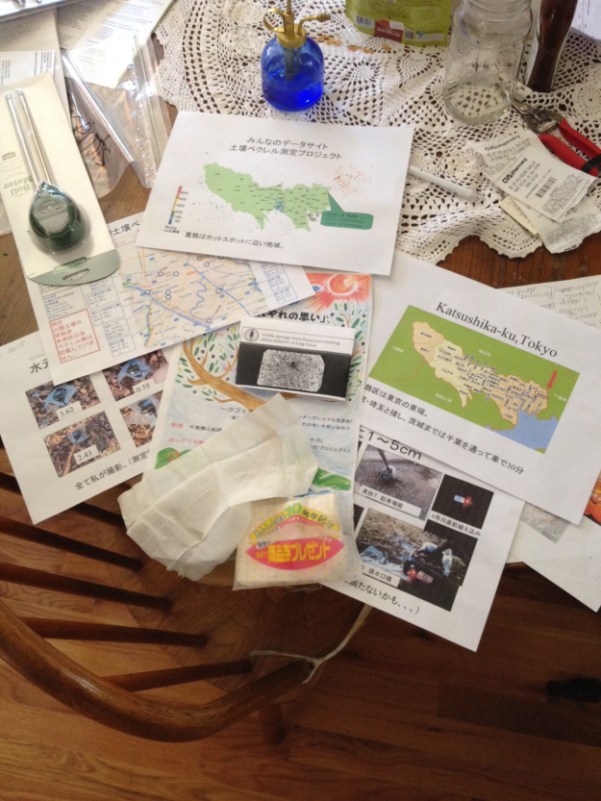
The post-Fukushima period is generating oceans of data, but much of it is useless. These women generate their own, but also want more solid data than the government has been willing to provide.
By Mary Olson
Don’t get me wrong: These women are pissed! (My word not theirs.) And they have every right to express that, even in Japan, at least according to its constitution.
I cannot leave Japan without peeling back the layer of sticky rice and sweet bean paste that keeps the victims of Tepco’s iodine, cesium and strontium on their feet.
One woman from Fukushima, who I met in Kyoto, said to me: “I am not as good as a guinea pig! They take tests from a guinea pig, but they don’t even test me.” She has thyroid cancer. There is a bias, since Chernobyl, toward focusing on thyroid cancer in children as a radiation impact. This is in part since they have less of a prior history of exposures, but in fact, radioactive iodine can cause cancer in people of any age.
This woman is asking to be studied. For me there are long and interesting questions about the moral and ethical basis of studying any victim…but this woman wants data. The post-Fukushima period is generating oceans of data, but much of it is useless, either for a study, or for the victims. This woman tells me that readings from a “full-body count” measuring Becquerels in her body, taken at an evacuation center in 2011 was destroyed after two years. She cannot get it. It is gone. She is more than pissed.
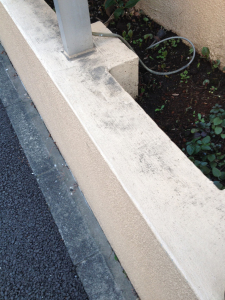
Fairewinds’ Arnie Gundersen dubbed this sort of urban particulate “Dark Matter” and often found that it contains radioactive particles. It’s not clear if these were directly deposited by a plume from the Fukushima meltdown or were perhaps released by post-tsunami incineration of debris.
I feel (or maybe project) other women would explode if they could, but they hold it together for their children.
This is the “triple bind” created by Tepco’s allies in the Japanese federal and (most) state governments:
First: One’s entire life is disrupted by radioactive contamination; any official support comes through cooperation;
Second: One’s children (and some Mamas) are having symptoms of radiation impact but the doctors are told* not to identify radiation in any diagnosis;
Third: The official message from over 400 government-paid Post-Tepco Meltdown staff psychologists is: the only harm to the children will come from the mother’s anxiety about radiation, which is unfounded, and results in stress to her and her family. Stress is bad.
This last point we can all agree on, but the word “stress”, has been appropriated by the “There is No Problem, the Radiation is Safe” story line. Now “stress” means a mother who is no longer cooperative with a government that would require her to move home to Fukushima Prefecture and support the use of local foods in the school lunch program, or face personal condemnation. There is no one to buy her home if she chooses not to.
This makes it a quadruple bind.
I support these Mamas by carefully, and slowly, stating, at each speaking event that if I were a mother I would leave contaminated zones and take my children with me. This does not touch, however, the incredible pressure on them from all sides to conform to the official line; talk about stress!
At one last Tokyo “Mama Meeting” or “tea party” as we have called the sessions with women concerned about radiation, these Mamas are not refugees. They are women monitoring hot spots here in Tokyo.
One woman has four children who bop in and out, cared for on the side. This mom is not at all happy with me, or maybe anyone from the U.S., having anything to say about her situation. I quickly shift to listen-mode and agree with her often. Another mom is much younger. She has done quite a bit of reading and has decided that internal emitters from food contamination are her big concern. I agree with her too. Another mom is interested in learning how to clean up hot spots…and has produced detailed maps with photos of her detector reading as high as 126 millirems per hour on hot spots at a park in Tokyo. Her readings in the same area were repeated over many months.
This group seems more engaged and active than any other Mama Tea Party group I have met with. The feeling fits with the large NGO events that I am doing at the end of this trip. The same day as the Tea Party I went on to the National Diet Building to speak at a large (and lively) event hosted by the Citizen’s Nuclear Information Center, which covered it here.
During this tea party it slowly begins to dawn on me that the bottom of pretty much the entire Japanese food chain is aquatic. I have a dim memory of hearing decades ago, when a U.S. fast-food chain selling fried chicken opened in Japan for the first time, it did not pass the “quality” check done by the chain’s U.S. corporate executives. The chicken tasted like fish. The eggs I have been eating for the past 2 weeks in Tokyo also taste, faintly, of fish. I share this with the Mama concerned about food. Color drains from her face. It is overwhelming to think of meats, dairy and eggs being at risk from possible radioactive sea-water contamination. She says “It makes me tired.” I say “yeah, especially when you factor in fish-fertilizer and all the soy products.”
So, in the end, we know, we all live in Fukushima…
My last day in Japan I was thinking about the old adage that Crisis = Opportunity. Years ago (1999), I traveled to Australia to help fight a global nuclear waste dump called the “Pangea Project” that was targeting Australia for all the world’s irradiated fuel rods. Over breakfast in Perth, in the home of a Green Party member of the Australian Parliament, I ventured an opinion: “The Pangea Project is an existential threat to your nation. You should work for a Constitutional Amendment to ban international waste from entering your waters or your land.” I was truly shocked, as a naive American, to hear the reply: “Australia does not have a constitution.” Unfortunately this ugly global dump threat has reared its head, targeting Australia again. (NIRS Action Alert coming soon!)
Here, now, in Japan, once again, in my view: this nation is facing an existential threat from radioactivity. So, I ask Steve Leeper, one of my hosts, “Does Japan have a constitution?” Steve explains that it does, the Peace Constitution, written post-WWII, by an American woman (under the aegis of a famous US General.). Established in 1947, under U.S. Occupation.
As I scan the Constitution of Japan, it is amazing how detailed it is in enunciating the rights of individuals…though ‘Free Speech’ appears as Article 21, not “first amendment.” I have often felt in these past weeks a common thread between my Japanese friends and my friends back home, south of the Mason/Dixon Line. It hits me: they are both warrior people who fought hard and had to accept defeat. From the same victor: Yankees.
Freedom cannot be given. It must be taken. I sincerely hope that the Mama’s rise, peacefully, to claim the provisions of this constitution (or a new one) for themselves, their children, and all of Japan.
BIG CRISIS = BIG OPPORTUNITY.
*Medical suppression: I heard first-hand accounts from three physicians. One at a prestigious clinic refused to take the “hint” that he should not mention radiation in his diagnoses of patients and had his hospital privileges revoked. Two other women doctors in private practice are persevering in their care for all their patients, including those with symptoms clearly from radiation exposure. One of them openly calls their medical association as “sell-outs” to the “nuclear mafia.” I met these doctors, but I am not “naming these names…” and that is a comment too.
http://safeenergy.org/2016/04/05/japan-diary-2016-fukushima5-part-7/
Protesters slam ‘radiation-exposed’ Japanese sake festival
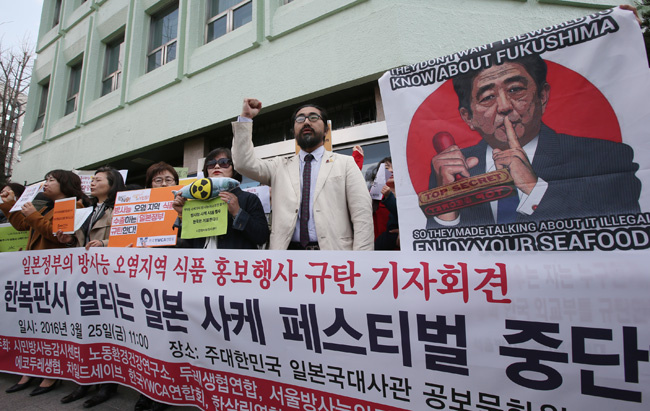
Civic groups protest in front of the Japanese Embassy in Jongno-gu, Seoul, demanding to stop the Seoul Sake Festival 2016 that may bring sakes contaminated with radiation from the Fukushima nuclear plant disaster five years ago.
By Ko Dong-hwan
Civic groups protested against a Japanese sake festival in Seoul on Friday, in a bid to prevent visitors from tasting possibly dangerous alcohol produced in areas near the Fukushima nuclear plant disaster five years ago.
Eleven civic groups held a press conference in front of the Japanese Embassy in Jongno-gu, demanding that Japan stop the Seoul Sake Festival 2016.
“Seven of the participating Japanese breweries made their liquor in areas near Fukushima, where our government has warned of possible danger from radiation,” a protester said. “The breweries must have made their liquor using water and rice from the areas. Such liquors will jeopardize our health.”
Three breweries in Miyagi Prefecture, as well as from Iwate Prefecture, Ibaraki Prefecture, Gunma Prefecture and Tochigi Prefecture participated in the festival. The Korean government stopped importing seafood from those areas in September 2013 to prevent possible radioactive contamination.
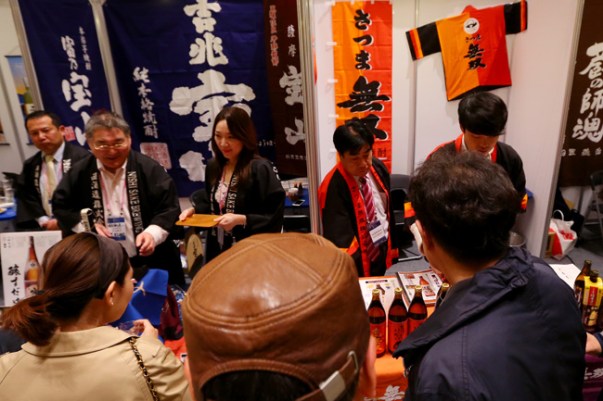
One hundred Japanese breweries introduced about 400 sakes at COEX, eastern Seoul, from Saturday to Sunday.
In March 2011, Fukushima 1 Nuclear Power Plant was hit by an earthquake-triggered tsunami. The impact caused a meltdown and release of radioactive material.
The Japanese embassy, according to Hankook Ilbo, said, “The festival organizers didn’t check whether the participating breweries were from areas that possibly were compromised by radioactive contamination, but all the food and liquor in the festival were tested in Japan and Korea.”
One hundred Japanese breweries introduced about 400 sakes at COEX, eastern Seoul, from Saturday to Sunday.
http://m.koreatimes.co.kr/phone/news/view.jsp?req_newsidx=201227
Fukushima’s invisible victims
By
It’s been a while since we last discussed the Fukushima Daiichi triple meltdown. That is not for lack of issues; it is primarily for lack of any meaningful progress in the ongoingdisaster.
We have just passed the fifth observance of the first catastrophic day, March 11, 2011 and pretty much all of nuclear safety expert Arnie Gundersen’s grim predictions of what we would learn in the aftermath have come to pass.
What Arnie could not have predicted iin 2011 is how unwilling both TEPCO and Japan’s government officials have been to learn from this disaster, and how persistent the effort would be to suppress important radiological and epidemiological information.
Without accountability, deaths of citizens who lived near the doomed reactors following the triple meltdown have simply been attributed to the stress of evacuation, and supposedly no one has been harmed by radiation. In an unbelievable extrapolation of a convenient myth, there has been a major government effort, supported by the atomic power industry, to increase allowable levels of radiation exposure and dismiss the need for future costly evacuations as harmful and unnecessary.
It was only a little over a week ago, that anyone in an official position at TEPCO was finally held accountable under the law. I find it unbelievable that only three individuals can be held responsible for the cascade of unaddressed design flaws, corruption, lax regulation, human error and human arrogance that all contributed to making a bad situation much, much worse.
Now we are learning of an even more egregious breach of the public trust and social justice at Fukushima.
Individuals who have exhibited symptoms of radiation poisoning and other illnesses are apparently being shunned by some of their neighbors and dismissed by the medical establishment without appropriate care and without acknowledgment in their medical records.
This mistreatment specific to radiation victims is apparently not without precedent in Japanese history.
On his current speaking tour of Japan, Arnie Gundersen has had the privilege of speaking with a small group of survivors of the 1945 bombing at Hiroshima who share a unique perspective on what may lie ahead for the people of Fukushima
Hiroshima survivor, Tomiko Matsumoto, 85, recalls being a schoolgirl following that inhuman bombing. Of the 80 students at her school, only thirty survived the blast. Tomiko could be said to have been one of the “lucky” ones, but mere survival is a pretty poor kind of ‘luck.’
Still traumatized by the mental and physical horrors of the blast experience, she recalls that there was no proper care provided for the injured who were regarded with suspicion and hostility by their neighbors and callous indifference or unfeeling curiosity by their occupiers, upon whom they depended for any care that they could get.
The discrimination must have been the hardest for a young girl with no surviving family to bear:
“I was shocked because I was discriminated against by Hiroshima people. We lived together in the same place and Hiroshima people know what happened but they discriminated against each other. ..I was shocked.”
“There were so many different kinds of discrimination. People said that girls who survived the bomb shouldn’t get married. Also they refused to hire the survivors, not only because of the scars, but because they were so weak. Survivors did not have 100 percent energy.”
“There was a survivor’s certificate and medical treatment was free. But the other people were jealous. Jealous people, mentally discriminated. So, I didn’t want to show the health book sometimes, so I paid. Some of the people, even though they had the health book, were afraid of discrimination, so they didn’t even apply for the health book. They thought discrimination was worse than paying for health care.”
The mistreatment and insensitivity experienced by survivors continued into Tomiko’s adulthood. She was the victim of employment discrimination and personal shame.
Though she was lucky enough to bear children, both of her daughters are sterile and one suffers from anemia. Doctors have dismissed the possibility that the family’s health issues might be linked to her exposure to radiation from the atomic bomb blast.
It may be precisely because of their uniquely traumatic history of nuclear attack that modern Japanese society is ill-prepared to challenge the current meme being promoted by TEPCO and the Abe government, that no one was harmed by the triple meltdown at Fukushima and there is no cause for concern about using atomic power as an energy source.
Having emerged from beneath the cloud of WWII, they want to view themselves under the lens of success and progress, not to revisit the shameful legacy of nuclear radiation sickness that they had hoped to leave behind.
Sadly, neither TEPCO nor the Abe government and functionaries right down to the regional level can be trusted to reveal the truth about radiation from Fukushima Daiichi and how it’s shadow has now been irreversibly cast over the Prefecture, marring the future of Japan.
So survivors of Fukushima, like those of Hiroshima before them are left to face unfolding health issues and despair in the friendless vacuum of their own thoughts and care.
(I am pleased to be a non-technical member of the Fairewinds Energy Education crew, but my posts on GMD are mine alone and do not necessarily reflect the views of Fairewinds.)
Japan urges China to lift import ban on farm products in place since March 2011
BEIJING – Japan urged China on Monday to scrap its import restrictions on agricultural, forestry and fisheries products and food that have been in place since the March 2011 Fukushima nuclear disaster.
Kazuyoshi Honkawa, vice minister of agriculture, forestry and fisheries, made the request at a bilateral subcabinet-level dialogue in Beijing on agricultural issues.
The two countries reopened the dialogue for the first time in six years, after suspending talks due to deteriorated bilateral ties.
After the nuclear disaster at Tokyo Electric Power Co.’s crippled Fukushima No. 1 plant, China prohibited all imports of agricultural, forestry and fisheries products and food from 10 prefectures , including Fukushima, Miyagi and Ibaraki.
Honkawa asked Chinese Vice Agriculture Minister Qu Dongyu to urge authorities to lift the import ban. The embargo is administered by China’s General Administration of Quality Supervision, Inspection and Quarantine.
Honkawa said he did not receive a clear answer on the issue from the Chinese ministry.
After the dialogue, he told reporters that the rapidly growing Chinese market is very attractive for Japanese agriculture, forestry and fisheries industries, suggesting his ministry’s aim of expanding farm exports to China.
Economic relations between Japan and China have been on the mend in recent months.
At talks last November, Prime Minister Shinzo Abe and Chinese Premier Li Keqiang agreed to restart a high-level economic dialogue that brings together the two countries’ key economic officials at an early date this year. In December, Japan and China held economic partnership talks led by vice ministerial officials for the first time in more than five years.
Nuclear accidents make mutant bugs and birds
Biologist Timothy Mousseau has spent years collecting mutant bugs, birds and mice around Chernobyl and Fukushima. In a DW interview, he shares some surprising insights into the effects of nuclear accidents on wildlife.

DW: Professor Timothy Mousseau, did you collect these mutant firebugs [pictured at the top of the page]?
Timothy Mousseau: Yes, the firebugs are really an eye-opener. My research partner Anders Moller and I were visiting Chernobyl on April 26, 2011. We were wandering around Pripyat collecting flowers, to study their pollen, when Anders reached down to the ground and pulled up this little bug with red and black markings. He said: “Tim, look, it’s a mutant – it’s missing an eye spot!”
From then on we started collecting these little bugs in each place we visited, from the most contaminated parts of the Red Forest to relatively clean areas in abandoned villages. Eventually we had several hundred of these little critters. It was very obvious that deformed patterns were much more prevalent in areas of high contamination.
This is just one of many similar anecdotes about the deformed critters of Chernobyl. Literally every rock we turn over, we find a signal of the mutagenic properties of the radiation in the region.

A pair of great tit birds collected near Chernobyl – left is normal, the individual on the right has a facial tumor
Is there a threshold of radiation below which there’s no effect?
The impact of radiation on rates of mutation, cancer and mortality varies a good deal by species. But statistically, there’s a simple relationship with dose. Small dose, small effect; big dose, big effect. There doesn’t appear to be a threshold below which there’s no effect.
Interestingly, organisms living in nature are much more sensitive to radiation than lab animals – comparing mice raised in labs and mice in the wild, exposed to identical levels of ionizing radiation, the mortality rate among wild mice is eight or 10 times that of lab mice. It’s because lab animals are protected from most stressors – like cold or hunger.
Are plants and trees affected too?
Yes, we’ve collected a lot of deformed pollen. Seen a lot of deformed trees, too. Pines often show growth-form abnormalities, even in normal areas with no radionucleotide contamination. Sometimes it’s an insect infestation, sometimes a hard freeze at the wrong time – you can find such anomalies anywhere.
But in contaminated areas of Ukraine, we have a correlation between frequency of abnormality and the Chernobyl event. It’s pretty strong evidence. There was a recent paper showing a very similar phenomenon in Fukushima. The trees there are very young, but will likely also be twisted up in knots 30 years from now!

Mousseau’s field crew collecting pollen and insect samples on the left, with the Chernobyl reactor in the distance. Right, a mutant pine tree at Chernobyl
What are the long-term effects of radiation on animal or plant species in contaminated areas? They’ve had their genomes altered. Will mutants persist?
Well, in the long run, no. The thing is, some background rate of mutations happens constantly in every species, even in uncontaminated areas – albeit at a much lower rate than in areas contaminated by nuclear accidents. So most genetic variants have been tried already. The great majority are either neutral or slightly deleterious. If a mutation had any benefit to offer, it would already be there in the population.
So the long-term effect of nuclear accidents on biodiversity is … none?
Yes, that’s right. Over evolutionary time, we expect that populations will return to normal after the mutagen disappears. Radionucleotides decay, hot sites eventually cool down, mutations become less frequent again, and healthy animal and plant populations recolonize the sites. So the genetic status quo ante returns – except if mutations have occurred that permanently enhance fitness, but that’s very rare.
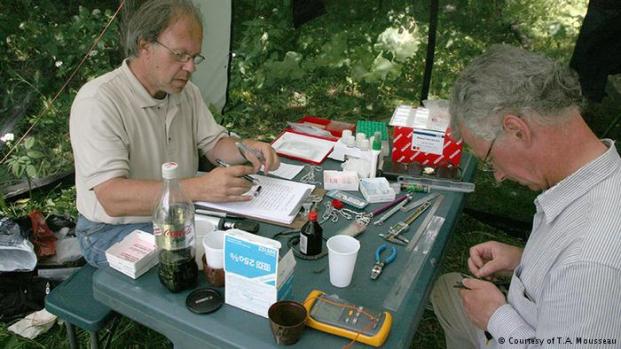
Mousseau (left) and colleague Anders Moller recording measurements in the field at Chernobyl
Some mutations might persist for a while if they’re adaptive during the hot phase. For example, there’s selection for animals whose cells produce a higher antioxidant load, which makes them more resistant to the effects of ionizing radiation. But that protection comes at a metabolic cost. After radiation levels die down, those variants will be selected back out of the population.
Where things get complicated is when the harmful mutations are recessive, that is, when it takes two copies [one for each chromosome] for the expression of the mutation. Many mutations fall into this category. They can accumulate in populations because they’re not expressed until two copies come into the same individual [one from the mother, the other from the father].
Because of this, populations can be affected by such mutations for many generations even after the mutagen is removed, and also, via dispersal, in populations that were never affected by the mutagen.
How can radioactive contamination interact with other problems that affect ecosystems, like habitat loss or climate change?
Certainly climate change is an additional stressor that is likely to interact with radiation to affect populations. We have demonstrated that while swallows in most places have moved their breeding dates forward in response to warming, in the Chernobyl area they are actually delayed. We hypothesize that this is due to the stress from the radioactive contaminants.
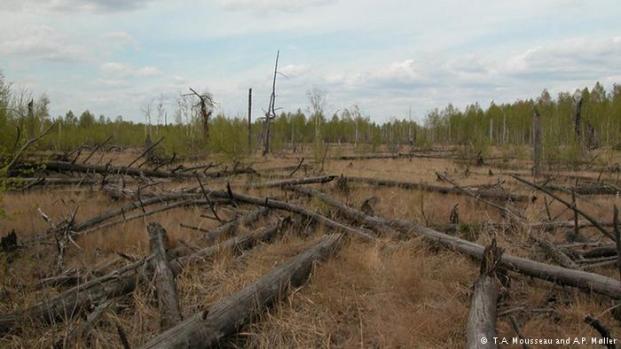
The Red Forest near Chernobyl in Ukraine presents a high risk of fire, as a lack of bacteria prevents the trees from decaying
The biggest fear at present is related to the observation of hotter and drier summers in Ukraine, and the resulting increase in number and size of forest fires. Last summer there were three large fires, and one of them burned through some very contaminated areas.
We have predicted that such events could pose a significant threat to both human populations and the environment via re-suspension and deposition of radionuclides in the leaf litter and plant biomass.
In addition to the threat of catastrophic wildfire spreading nuclear contamination, birds and mammals also move around. Do they absorb radioactive elements in their food and water in contaminated sites, carry them elsewhere, thus dispersing the contamination more widely?
Do animals move radionuclides? Yes! I did a study years ago that showed very significant amounts of radionuclides are exported every year by birds. But it seems unlikely that the amount is enough to cause measurable health effects – unless you’re eating the birds. It is known that some people living outside the Chernobyl Exclusion Zone are getting very significant doses from hunting the contaminated wild boar that leave the zone.
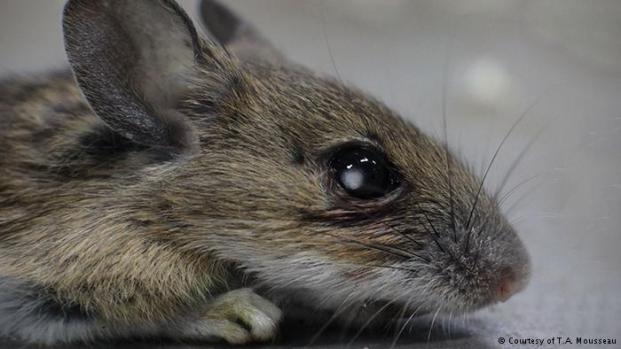
Mouse with cataract collected near Chernobyl – the more radioactive the site, the higher the frequency of defects
This year marks five years since the Fukushima accident, and 30 years since Chernobyl. How long will the contaminated zones around Chernobyl and Fukushima be mutagenic and dangerous?
Chernobyl was a nuclear fire and ongoing fission event for 10 days, with strontium, uranium and plutonium isotopes strewn into the landscape. They have long half-lives, so many areas will remain hazardous for centuries, even thousands of years.
Fukushima was largely a cesium event, and cesium radionucleotides have a relatively short half-life. The area will mostly naturally decontaminate itself within decades, at most within a couple hundred years.
Timothy Mousseau is a professor of biological sciences at the University of South Carolina in Columbia, South Carolina. He is one of the world’s leading experts on the effects of radionucleotide contamination from nuclear accidents on wild bird, insect, rodent, and plant populations.
Interview: Nils Zimmermann
No matter what BBC says: Fukushima disaster is killing people
Chris Busby – 14th March 2016

IAEA marine experts and Japanese scientists collect water samples in coastal waters near the Fukushima Daiichi Nuclear Power Station
The BBC has been excelling itself in its deliberate understatement of the Fukushima nuclear catastrophe, writes Chris Busby. While calling in pseudo experts to say radiation is all but harmless, it’s ignoring the science that shows that the real health impacts of nuclear fallout are around 1,000 times worse than claimed.
I am so ashamed of the BBC. It seems, as an institution, to be supporting and promulgating an enormous lie about the health effects of radioactive pollution. And not providing any balanced scientific picture.
On the 5th Anniversary of the catastrophe we saw Prof Geraldine Thomas, the nuclear industry’s new public relations star, walk through the abandoned town of Ohkuma inside the Fukushima exclusion zone with BBC reporter Rupert Wingfield-Hayes.
She was described as “One of Britain’s leading experts on the health effects of radiation”. Thomas is of the opinion that there is no danger and the Japanese refugees can come back and live there in the ‘zone’. Her main concern was how untidy it all was: “left to rack and ruin”, she complained, sadly.
At one point Rupert pulled out his Geiger Counter and read the dose of 3 microSieverts per hour. “What does that mean”, he asked, “how much radiation would it give in a year to people who came back here?”
Thomas replied, “About an extra milliSievert a year which is not much considering you get 2mSv a year from natural background. The long term impact on your health would be absolutely nothing.”
Now anyone who has a calculator can easily multiply 3 microSieverts (3 x 10⁻⁶ Sv) by 24 hours and 365 days. The answer is 26 mSv (0.026Sv) not “about 1mSv” as the “leading expert on the health effects of radiation” told the dumbfounded viewers.
Any real expert would not have made such a stupid mistake. But this woman is not a real expert, her CV shows she has published almost nothing in the way of original research, so we must ask how it is the BBC come to take her seriously.
Those who hate nothing so much as the truth
This recalled the day the first reactor exploded in 2011. I was in London, and the BBC asked me to come into the studio and comment. Also there was a nuclear industry apologist, Dr Ian Fells. Like Gerry Thomas he was unconcerned about the radiation: the main problem for him was that the lifts would not work. People would have to climb stairs, he complained.
I said then on that first day that this was a serious accident like Chernobyl but he and all the stooges that followed him told the viewers that it was no problem, not like Chernobyl, hydrogen explosion, no breach of containment pressure vessels etc. Some months later, looking back, it is clear I was correct on every point, but I never was invited back to the BBC.
I visited Japan, took sophisticated measuring equipment, obtained vehicle air filters, spoke to the Japanese people and advised them to take Calcium tablets to block the Strontium-90. My vehicle air filter measurements showed clearly that large areas of north east Japan were seriously contaminated including Tokyo.
This was too much for the nuclear industry: I was attacked in the Guardian newspaper by pro-nuclear Pauline-converted George Monbiot in an attempt to destroy my credibility. One other attacker was Geraldine Thomas. What she said then was as madly incorrect then as what she is saying now. But the Guardian would not let me respond.
The important evidence for me in the recent BBC clip is the measurement of dose given by Rupert’s Geiger counter, 3microSieverts per hour (3μSv/h). Normal background in Japan (I know, I measured it there) is about 0.1μSv/h. So in terms of external radiation, Ruperts’s measurement gave 30 times normal background.
Fukushima: we have a very serious problem
Is this a problem for health? You bet it is. The question no-one asked is what is causing the excess dose? The answer is easy: radioactive contamination, principally of Caesium-137. On the basis of well-known physics relationships we can say that 3μSv/h at 1m above ground represents a surface contamination of about 900,000 Bq per square metre of Cs-137. That is, 900,000 disintegrations per second in one square metre of surface.
And note that they were standing on a tarmac road which appeared to be clean. And this is 5 years after the explosions. The material is everywhere, and it is in the form of dust particles which can be inhaled. Invisible sparkling fairy-dust that kills hang in the air above such measurements.
The particles are not just of Caesium-137. They contain other long lived radioactivity, Strontium-90, Plutonium 239, Uranium-235, Uranium 238, Radium-226, Polonium-210, Lead-210, Tritium, isotopes of Rhodium, Ruthenium, Iodine, Cerium, Cobalt 60, the list is long.
The UN definition of radioactively contaminated land is 37,000Bq / square metre, and so, on the basis of the measurement made by the BBC reporter, the town of Ohkuma in the Fukushima zone (and we assume everywhere else in the zone) is still, five years after the incident, more than 20 times the level where the UN would, and the Soviets did, step in and control the population.
But the Japanese government want to send the people back there. It is bribing them with money and housing assistance. It is saying, like Gerry Thomas, that there is no danger. And the BBC is giving this criminal misdirection a credible platform. The argument is based on the current radiation risk model, that of the International Commission on Radiological Protection the ICRP.
Last month, my German colleagues and I published a scientific paper in the peer reviewed journal Environmental Health and Toxicology. It uses real-world data from those exposed to the same substances that were released by Fukushima to show that the ICRP model is wrong by 1,000 times or more.
This is a game changing piece of research. But were we asked to appear on the BBC, or anywhere else? No. What do our findings and calculations suggest will have happened in the five years since the explosions and into the future? Let’s take a look at what has happened since 2011.
And this is only the beginning …
The reactors are still uncontrolled five years after the explosions and continue to release their radioactive contents to the environment despite all attempts to prevent this. Concerning the melted fuel, there is no way to assess the condition or specific whereabouts of the fuel though it is clearly out of the box and in the ground. Robots fail at the extremely high radiation levels found.
Ground water flowing through the plant is becoming contaminated and is being pumped into storage tanks for treatment. High radiation levels and debris have delayed the removal of spent fuel from numbers 1, 2 and 3 reactor buildings. TEPCO plans to remove debris from reactor 3 and this work has begun. Then they are hoping to remove the fuel rods out of reactors 1 and 2 by 2020 and the work on removing debris from these 2 reactors has not begun yet.
Much of the radioactivity goes into the sea, where it travels several hundreds of km. up and down the coast destroying sea life and contaminating intertidal sediment. The radionuclides bind to fine sediment and concentrate in river estuaries and tidal areas like Tokyo Bay.
Here the particles are resuspended and brought ashore to be inhaled by those living within 1km of the coast. From work done by my group for the Irish Government on the contaminated Irish Sea we know that this exposure will increase the rate of cancer in the coastal inhabitants by about 30%.
The releases have not been stopped despite huge amounts of work, thought and action. The treated water is still highly radioactive and cannot yet be released. An ice wall designed to stop the flow of water getting to the plant is still not operational and the Japanese Nuclear regulator still has not given the go-ahead.
‘Son of Fukushima’ waiting to happen
This may be wise because an environment report showed that use of the ground water caused rapid subsidence and can destabilise the structures of the reactors. That is a real problem on site with 3 heavy spent fuel pools still full and largely inaccessible. Collapse of the buildings would lead to coolant loss and a fire or even explosion releasing huge amounts of radioactivity.
So this is one nightmare scenario: ‘Son of Fukushima’. A solid wall at the port side may have slowed the water down but diverting the water may cause problems with the ground water pressure on site and thus also threaten subsidence. Space for storing the radioactive water is running out and it seems likely that this will have to be eventually spilled into the Pacific.
Only 10% of the plant has been cleaned up although there are 8,000 workers on site at any one time, mostly dealing with the contaminated water. Run-off from storms brings more contamination down the rivers from the mountains. There are millions of 1-ton container bags full of radioactive debris and other waste which has been collected in decontamination efforts outside the plant and many of these bags are only likely to last a handful of years before degrading and spilling their contents. Typhoons will spread this highly contaminated contents far and wide.
TEPCO are also burning waste from the plant in a single incinerator. Further afield, contamination efforts to clean up the homes and roads are hampered by the torrential rains that are increasing because of global warming; the rain is bringing large amounts of contaminated soil back into these areas as well as the contaminated leaves and pollen from the forest areas that TEPCO are unable to clean.
Far off the shore there are natural areas that act as nurseries for many species of sea life. It has been found that intertidal marine species such as anemones, sponges, crustaceans, worms and bivalves within 30 km of the damaged reactors have disappeared altogether because of the 300 tons of highly radioactive water a day flowing out of the plant into the sea.
This water contains large amounts of tritium, making it radioactive; the effects of tritium on the larval stages of marine invertebrates has been studied in the UK. It was found at the University of Plymouth that levels involving doses of less than 1mSv of tritium inhibited the development.
Going global
Radioactivity from Fukushima has now migrated across the Pacific and is appearing on the West Coast of the USA. The scientific community there, like Gerry Thomas, subscribe to the flawed ICRP model, and since the levels of Caesium-137 measured are low, (maybe 10Bq/cubic metre of sea water), they say that there will be no health effects. But like Thomas they are wrong.
The problem is that ‘dose’ cannot be used to assess risk from internal radioactive particles. Dose is an average over large masses of tissue: but cancer begins in a single cell or local community of cells and these particles from Fukushima cause massive local doses. This is why there have been countless web reports of marine mammals with patchy sores or localised tumours. The question of the ongoing effect of this Fukushima radioactivity on the Pacific biota far from Japan remains open.
The effects on wild creatures in Japan are clear and have been studied. There have been peer-reviewed reports of genetic damage in birds and in insects; a major scientist studying these genetic effects at Fukushima and in the Chernobyl affected areas also is Tim Mousseau.
But whilst he can study plants and animals, no-one can study humans. There is a kind of closure on such data, with the Japanese government controlling it. The government is more interested in getting Fukushima ready for the Olympics and is using financial and cultural pressure to move families back into contaminated zones.
Japan is also exporting radioactive produce, and is using trade agreements to bully countries into accepting these poisons on the basis of the ICRP model. I was in Korea a few months back as an expert witness in a radiation case involving high levels of thyroid cancer near their nuclear sites. I was told about Japan using international trade laws to force its contaminated foods on to the Koreans, who were measuring the radioactivity and sending the stuff back. So watch out for radioactive items from Japan.
So what’s the evidence?
Let’s look at the only real health data which has emerged to see if it gives any support to my original estimate of 400,000 extra cancers in the 200km radius. Prof Tsuda has recently published a paper in the peer reviewed literature identifying 116 thyroid cancers detected over three years by ultrasound scanning of 380,000 0-18 year olds.
The background rate is about 0.3 per 100,000 per year, so in three years we can expect 3.42 thyroid cancers. But 116 were found, an excess of about 112 cases. Geraldine says that these were all found because they looked: but Tsuda’s paper reports that an ultrasound study in Nagasaki (no exposures) found zero cases, and also an early ultrasound study also found zero cases. So Geraldine is wrong. The thyroid doses were reported to be about 10mSv. On the basis of the ICRP model, that gives an error of about 2,000 times.
From the results of our new genetic paper we can safely predict a 100% increase in congenital malformations in the population up to 200km radius. In an advanced technological country like Japan these will be picked up early by ultrasound and aborted, so we will not actually see them, even if there were data we could trust.
What we will see is a fall in the birth rate and increase in the death rate. We know what has been happening and what will happen; we have seen it before in Chernobyl. And just like Chernobyl, the (western) authorities are influenced by or take their lead from the nuclear industry: the ICRP and the International Atomic Energy Agency, (IAEA) which since 1959 has taken over from the World Health Organisation as the responsible authority for radiation and health (Yes, really!).
They keep the lid on the truth using stupid individuals like Geraldine Thomas and, by analogy with New Labour: New BBC. Increasingly I could say ‘New Britain’ as opposed to the Great Britain of my childhood, a country I was proud of where you could trust the BBC. I wonder how the reporters like Rupert can live with themselves presenting these lies.
Fukushima is far from being over, the deaths have only just begun.
The BBC report: bbc.com/news/world-asia-35761141
The study: ‘Genetic Radiation Risks – A Neglected Topic in the Low Dose Dabate‘ by Busby C, Schmitz-Feuerhake I, Pflugbeil S is published in Environmental Health and Toxicology.
Chris Busby is an expert on the health effects of ionizing radiation. He qualified in Chemical Physics at the Universities of London and Kent, and worked on the molecular physical chemistry of living cells for the Wellcome Foundation. Professor Busby is the Scientific Secretary of the European Committee on Radiation Risk based in Brussels and has edited many of its publications since its founding in 1998. He has held a number of honorary University positions, including Visiting Professor in the Faculty of Health of the University of Ulster. Busby currently lives in Riga, Latvia. See also: chrisbusbyexposed.org, greenaudit.org and llrc.org.
“The Fukushima Nuclear Disaster is a Serious Crime”: Interview with Professor Koide
Introduction
Koide Hiroaki (66) has emerged as an influential voice and a central figure in the anti-nuclear movement since the nuclear meltdown at Fukushima Daiichi of March 11, 2011. He spent his entire career as a nuclear engineer working towards the abolition of nuclear power plants. His powerful critique of the “nuclear village” and active involvement in anti-nuclear movements “earned him an honorable form of purgatory as a permanent assistant professor at Kyoto University.”1 Koide retired from Kyoto University in the spring of 2015, but continues to write and act as an important voice of conscience for many who share his vision of the future free from nuclear energy and weapons. He has authored 20 books on the subject. Professor Kasai Hirotaka and I visited his office at Kyoto University’s Research Reactor Institute in Kumatori, Osaka, on December 26th, 2014 for this interview. We believe that the contents of the interview, which offer new information about the degree of radioactive contamination and invaluable insight into Koide’s ethical and political stance as a scientist, remain crucial for our critical reflection on ecological destruction, the violation of human rights, and individual responsibility. Professor Robert Stolz, the translator of this interview and the author of Bad Water (Duke University Press, 2015), provides a historical perspective on the interview in a separate article. KH

Interview
I The Fukushima Disaster and Government and Corporate Response
Hirano: How does the Fukushima accident compare with the bombing of Hiroshima or Chernobyl in its scale? What are the possible effects of this yet unknown exposure?
Koide: Let’s start with the scale of the accident: It was a core meltdown involving the release of various kinds of radioactive material. Radioactive noble gas isotopes were also released, as were iodine, cesium, strontium, and other radioactive material. The noble gas isotopes have a short half-life and so at this stage they are all gone. Iodine, too, is gone. So now four years since the accident the materials that are still a problem are cesium-137, strontium-90, and tritium; really, it’s these three.2
Now, as for the scale of the accident, I think it would be best to compare these three radionuclides. Today the main contamination of Japanese soil is the radionuclide cesium-137 [Cs-137 or 137Cs]. The ocean is largely contaminated with strontium-90 [Sr-90 or 90Sr] and tritium [T or 3H]. Right now the main culprit adding to the exposure of the people in Japan is Cs-137, so I think it’s best to use Cs-137 as a standard for measuring the scale of the accident.
But we simply don’t know with any precision how much Cs-137 was released. That’s because all the measuring equipment was destroyed at the time of the accident. How much Cs-137 was released into the air? How much was spilled in the sea? We just don’t know.
Still, the Japanese government has reported estimates to the IAEA [International Atomic Energy Agency]. According to those estimated levels, reactors 1, 2, and 3 had been in operation on March 11, 2011, and all three suffered meltdowns. Those three reactors released 1.5×10¹⁶ Becquerels of Cs-137, which would make it a release of 168 times more radioactive material than the Hiroshima bombing. And this is only material released into the atmosphere-at least according to Japanese government estimates.
But I myself think the government’s numbers are an underestimate. Various experts and institutes from around the world have offered several of their own estimates. There are those that are lower than the Japanese government’s numbers and those that are higher, some two or three times higher than the government’s numbers. According to these other estimates I think that the release of Cs-137 into the atmosphere could be around 500 times the Hiroshima bombing.
Now for what has been washed into the sea. That number is likely not much different from the levels released into the atmosphere. Even today we are unable to prevent this release. And so if we combine the amount of Cs-137 released in the air and the ocean together, we get an estimate several hundred times the Hiroshima levels. And some estimates suggest the Fukushima accident could be as much as one-thousand Hiroshimas.
Now to compare this with other accidents: The amount released into the atmosphere from the explosion during the accident at the Chernobyl nuclear plant was 800 to 1000 times the Hiroshima levels. Put simply, these estimates place Fukushima on par with Chernobyl.
Worse than any of these, however, is atmospheric testing. From the 1950s to the 1960s atmospheric testing of nuclear weapons had already released Cs-137 into the air more than sixty times the numbers released even by the Japanese government for Fukushima. Of course Fukushima is an incredible tragedy, but considered from the earth as a whole it is a rather small accident.

Hirano: I want to ask in more detail about the effect of Cs-137 on the human body and the environment.
Koide: Cesium is an alkaline metal. From the human body’s perspective, cesium closely resembles potassium. The body contains enormous amounts of potassium. It is essential for humans. It’s everywhere in our bodies. Especially our flesh and muscles are full of potassium. And because of this, when cesium is released into the environment, the body deals with cesium as it does with the alkaline metal potassium, which is to say that it is taken into the body and accumulates there.
Strontium is an earth metal. The body treats it like calcium. As you know calcium is a human body building block that accumulates in our bones. Strontium, too, is taken into and collects in the bones. Just as cesium is taken in and is transported to the flesh and muscle.
Hirano: Comparing the releases from nuclear tests by the US and the USSR during the Cold War period, you said that the Fukushima accident was small. So in what way should we think about Fukushima: is it best to consider it a Japanese problem, or to consider it from a global perspective?
Koide: The amount of products of nuclear fission released during atmospheric testing was enormous, and these particles continue to expose humans to radiation. I’m a bit older than you and I recall in my childhood being told not to let the rain fall on me at the time of the testing. In this way everyone on earth has been exposed (hibaku/ 被曝). And because of this testing, historically speaking, cancer rates have slowly risen; I believe this increase in cancer is due to the exposure suffered during the atmospheric testing. Now the radioactive material released from Fukushima has been dispersed across the globe and so once again everyone on earth has been exposed to additional radiation. I think we can expect cancer rates to rise once again.
Atmospheric nuclear testing released all of the radioactive material in the explosions, which entered the stratosphere. Between the stratosphere and the troposphere there is the tropopause, and every year come spring all that material dispersed in the stratosphere breaks through the tropopause and falls to earth. So that material, though initially dispersed in the stratosphere, eventually falls to earth evenly, everywhere. Actually, it might not be accurate to say that it falls evenly on the earth. The majority of the testing was done in the temperate regions of the northern hemisphere, such as Nevada and the Semipalatinsk test site [in Kazakhstan], so that the northern hemisphere-as the site of most of the testing-is heavily contaminated, and within that the temperate region is heavily contaminated. Still, I can say the atmospheric testing overall has caused global contamination.
My focus now is to figure out how to deal with the acute and heavy contamination from Fukushima. I know something needs to be done right there in that specific place. That contamination will disperse and be diffused across the globe. Once dispersed, the amount of radioactive material from Fukushima will be small when compared with the atmospheric testing. Which is not to say it is not harmful. An increase in cancer will be the result. I mention that for humanity as a whole; the atmospheric tests were worse.
Now, strontium-90 [Sr-90] has been leaking from Fukushima into the ocean, so it will eventually reach the United States, especially the west coast. This much we are sure of. But to answer your question, the amount of dispersed cesium and strontium released by the atmospheric tests is tens of times greater than the Fukushima levels. Because the west coast of the US is already contaminated from the atmospheric testing, though the dispersed contamination from Fukushima will reach US shores, for people living on the US west coast, the Fukushima accident―and this is perhaps awful to say―contamination from Fukushima is hardly worth considering. Historically a much greater event has already taken place.
Hirano: To put that another way, the current Fukushima accident gives us a chance to reconsider the enormity of the past contamination from US and Soviet atmospheric tests, which has not been openly discussed.
Koide: Yes, that’s exactly right. In fact, it is the masses of people who need to realize the impact of the contamination on them. In the case of the Fukushima disaster, for example, they need to be aware that some radioactive material is reaching the North American coast, and the prevailing westerly winds will carry anything released into the atmosphere to the US. Those earlier numbers from the Japanese government indicate that the levels for Cs-137 in the atmosphere are 168 times those of the Hiroshima bombing. I’ve been told that level is 1.5 x 10¹⁶ Becquerels [Bq]. These exponents can be a pain to process, so if we think of it in peta-units-which is 1015-we get essentially 15 petabecquerels [PBq].
That said, while we are not really sure this is the number, we do know that a portion of this material will ride the prevailing winds across the Pacific Ocean. On the other hand, closer to the ground, the winds will be east, south, and north, and therefore this other portion will fall on Japan―and we can investigate the actual levels here: how much fell on this town, on this prefecture? Adding these up, it seems to be only 2.4 PBq. Which is to say of the total fifteen PBq, 2.4, or roughly only 16%, fell on Japanese soil. If the totals are higher, still a smaller share of the total contamination will have fallen on Japan compared with the Pacific, with the largest portion falling on the west coast of the United States.
So why don’t we hear complaints from the US? Why are there no calls for compensation? Whenever someone asks me this, I simply say that there just aren’t any such complaints. Why is this so? Well the levels released by the US during the atmospheric testing were tens of times greater than Fukushima. They are the criminals, so they cannot ask for compensation from Japan. The U.S. government does not want to have to reflect on its own past, and I think they are eager to completely avoid bringing up anything like that conversation. That is why I believe it is so important that those who have been exposed to radioactive contamination realize what atmospheric testing has done to them.
Kasai: I’d like to get back to the moment of the accident in some detail. On March 11, 2011 we had the East Japan Disaster (meaning the earthquake and tsunami off Tohoku). You’ve already talked about the string of accidents at the nuclear plant. At the moment the accident was taking place, you were following the response by the Japanese government and the Tokyo Electric Power Company (TEPCO) in real time. What did you see in those initial moments?

Koide: It was truly a disastrous response. On the 11th I was in the laboratory in Kyoto as March was my month to work in the radiation-controlled area.3 It was normal workday hours and various tasks kept me busy working within the controlled area. Of course there is no TV or anything like that in the work space. That night there was a meeting so I came out to attend and that’s when I saw the images of the Sendai airport being swept away by the tsunami. The report said that there had been a devastating earthquake and tsunami. Then I wondered about the safety of the nuclear plants.
Right then, there really was no more information. We had scheduled a nuclear safety issues seminar for the 18th. I’ve participated in hundreds of these seminars. Participants from the Ukraine had just arrived on the 11th. We promised to go out drinking after they arrived and so that night I went out. There was no more TV, and while there was a vague unease among us, that’s how we spent the time.
The next day I learned that all power at Fukushima had been lost and I knew things were not going to be simple. Then at noon on the 12th the roof of reactor one was blown off; at that point any expert must have known there had been a reactor meltdown. So I was certain of a core meltdown and because once it has gone this far, there is no going back, it was time to call for anyone who could evacuate to do so. I thought we were at that stage on the 12th.
Yet neither the government nor TEPCO said a single word about a core meltdown; they announced that the incident merited a 3 or 4 on the International Nuclear Event Scale. I remember thinking “You’ve got to be kidding! There’s already been a meltdown. This is at least a level 6 or 7.” But neither the government nor TEPCO gave any indication of this and there was no word of it in the media either.
One by one there were explosions at reactors 3, 4, and 2. As an expert in nuclear power, I understood there was absolutely nothing that could be done. I thought people needed to be evacuating, but still the Japanese government didn’t make the call. Government officials had set up at an off-site center near a power plant in Fukushima―at first they announced evacuation inside two kilometers, then that expanded to three, five, ten, and finally twenty km. After that nothing was done. The offsite center was supposed to coordinate the emergency response in the event of an accident, but it turned out that every one of the officials fled. They left the employees behind and fled. The Japanese government’s response was indescribably cruel.
Kasai: It seems the very words “meltdown” (メルトダウン) and “core meltdown” (roshin yōyū/炉心熔融) were strictly forbidden.
Koide: Exactly.
Kasai: I was in Japan watching on TV. What shocked me was all the nuclear power experts explaining the incident in the studio. I suppose it was a satellite relay, but when reactor number three exploded on our screens they were giving their analyses of the explosion in real time. There were experts on TV saying that the reactor had a blast valve that was used successfully. Even hearing that, an average viewer might think something was amiss. But having physicists, experts on radiation, on TV saying these things, well, even the average viewer wouldn’t buy that explanation. In a broad sense, nuclear experts like yourself played several roles in the media and government.
Koide: Yes, that’s clearly true for pronuclear experts. They all tended to tell a story that underestimated the accident. Immediately after the accident public announcements and information were restricted. As a result individual opinions or statements were strictly forbidden and nearly all experts remained silent, so even basic information was not broadcast. Though I’d made statements from the nuclear lab beginning on the 12th, it is likely there were instructions from the Ministry of Science and Education to silence me. The head of the lab convened several meetings where he told each of us not to make any statement, that the lab would toe the official line when dealing with the mass media. I thought this was wrong and said that anyone who was asked a question by the media should answer it, further saying that if I were asked a question, I had a responsibility to answer. Since then I’ve continued to make statements in the media. Still the large majority of nuclear researchers were not able to do this.
As a result it was the pronuclear researchers who monopolized the interpretations – exactly. So as they went to the TV studios I think each was told: “Today, it’s your turn to go to the studio.” I think that’s how they played their part and handled the media.
Kasai: With respect to controlling information, would you say your experience with the head of the nuclear lab shows how the professional organizations exert pressure on the universities?
Koide: Yes, I would. The head of the lab opened a conference with all the other laboratories―even I went. There he said that any statements to the media should be on message and come only from the information office.
Kasai: So pressure came from academic conferences.
Koide: Yes, there was pressure coming from the academic conference side as well. Take for example something like a conference on nuclear power. From the very start it was never a real discussion; it was a meeting of powerful and vocal spokesmen for the nuclear community or village (genshiryoku kyōdōtai/原子力共同体 or genshiryoku mura/ 原子力村), which is to say the group of pronuclear government officials and private companies mainly centered around the LDP and Toshiba, Hitachi, Mitsubishi, and other pronuclear manufacturers of power plants―and of course their supporters in the media. Thus as an organization the conference was predisposed to underestimate the accident and to then promote that underestimation.
Hirano: Immediately after the accident you testified in the Diet presenting data indicating the seriousness of the disaster and demanding that the government terminate the operation of all the power plants.4
Koide: I did.
Hirano: After that it seems you weren’t again asked to speak publicly, or given the opportunity to offer more detailed thoughts on the situation.
Koide: By “speak publicly” you mean in the Diet or in some other official government setting?
Hirano: Yes, and also in the media.
Koide: With respect to the media, I’ve never really had any confidence in them. Since the accident, I’ve been overwhelmingly busy and haven’t accepted a single invitation from TV stations.
Hirano: I see. So there were invitations.
Koide: There have been many calls saying, “come down to the studio.” But I always tell them that I am too busy for this sort of thing. I’d say, if you come to my office, we could meet. Many did come by, even back then. But as everyone knows, in television you might talk for an hour and none of it makes it on air, or if it does, it’s maybe thirty seconds.
Hirano: Right, and only the convenient parts.
Koide: That’s it and there’s really nothing that can be done about it. There was, however, one outlet for which I was extremely grateful: the daily radio program called Tanemaki Journal (種まきジャーナル).5 There I could go on every day and offer my thoughts live. I wish it could have continued, but it was completely and totally smashed. What a world we live.
Kasai: So, on the subject of standards used for assessing the danger posed by radiation for the human body and the environment: What are your thoughts on how the government deals with this issue?
Koide: They are absolutely not dealing with it at all. I think you already know this but in Japan the average person is not supposed to be exposed to more than one milliSievert per year―that’s set by law. Why is that the level decided on? Because exposure to radiation is dangerous. If exposure weren’t dangerous, if low levels of exposure were safe, there’d be no problem even without that legal limit. But exposure to radiation is dangerous―this is the conclusion of all research. So every nation in the world has set legal limits for exposure.
For people like me who get paid to work with radiation, it’s not really possible to observe the 1mSv/yr limit [1mSv/yr]. We’re told that in exchange for our salaries, we accept exposure to twenty milliSieverts a year. That’s the standard I work under in my job. But the current Japanese government has now stated that if contamination is under 20mSv/yr somewhere, that place is safe to return to―safe to return to even for children. This is way beyond common sense.
Hirano: What is the basis of this claim? Why would the government announce these numbers and forcefully declare these areas safe to return to? What’s the basis for the government’s numbers?
Koide: The basis for those numbers…for example the government says that organizations like the IAEA or the ICRP [International Commission on Radiological Protection] suggest that in emergencies during which the 1mSv/yr standard cannot be maintained standards should be set between twenty and 100mSv/yr. The government seizes on this and declares that since the IAEA and the ICRP have said this, that 20mSv/yr is therefore a safe level-usually adding that membership in both the IAEA and the ICRP is voluntary anyway. But because these organizations have said this is no reason to break Japanese law. If Japan is a nation governed by the rule of law at all, surely this means that the very people who make the laws should also follow them―that should be obvious. But these guys have declared 20mSv/yr safe even for children. There is absolutely no way I can consent to this.
Hirano: So there is no scientific basis for these levels.
Koide: Well… the danger corresponds to the amount of exposure―you probably know this―so for a country that has declared its intention to maintain the 1mSv/yr standard to then turn around and ask people to endure twenty times that level, there is no scientific basis for that declaration. That’s a social decision.
But if you want to inquire as to why, as I’ve mentioned to you, some 2.4 petaBecquerels of radioactive material have fallen on Japan, that material has been dispersed, contaminating Tohoku, Kanto, and western Japan. So in addition to the law setting the legal limit for exposure at 1mSv/yr, there is another law that states that absolutely nothing may be removed from a radioactive management area in which the levels exceed 40,000 Becquerels per square meter.
So the question becomes how many places or how much area has been contaminated beyond 40,000 Bq/m2? And according to the investigations, that answer is 140,000 km2. The entirety of Fukushima prefecture has been contaminated to where all of it must be declared a radioactivity management area. Indeed, while centered on Fukushima, parts of Chiba and Tokyo have also been contaminated. The number of people living in what must be called a radiation-controlled area is in the millions, and could exceed ten million.
For me, if Japan is in fact a nation governed by the rule of law, I believe the government has the responsibility to evacuate these entire communities. Instead of taking a proper action to secure people’s livelihood, the government decided to leave them exposed to the real danger of radiation. In my view, Fukushima should be declared inhabitable and the government and TEPCO should bear a legal responsibility for the people displaced and dispossessed by the nuclear disaster. That’s what I think, but if that were to be done, it would likely bankrupt the country. I think that even though it could bankrupt Japan, the government should have carried out the evacuation to set an example of what the government is supposed to do. But obviously those in and around the LDP certainly didn’t agree. They’ve decided to sacrifice people and get by taking on as little burden as possible. So they’ve made the social decision to force people to endure their exposure. In my view, this is a serious crime committed by Japan’s ruling elite.
I would like people to know just how many thousands of people live in this abnormal situation where even nuclear scientists like me are not allowed to enter, not to mention, drink the water. It is strange that this issue has been left out of all debate over the effects of the radioactive exposure. We must be aware that contemporary Japan continues to operate outside the law in abandoning these people to their fate by saying it’s an extraordinary situation. Under such circumstances, I think, there are a multitude of symptoms of illnesses in contaminated areas. But if we’re talking about any given symptom, it’s hard to say since we just don’t have any good epidemiological studies, or even any good data. But there will surely be symptoms, namely cancer and leukemia.
However little exposure to radiation is, it causes cancer and leukemia―this is the conclusion of all current science. These symptoms are said to become visible 5 years after the initial exposure. But because radiation is not the sole cause of cancer or leukemia establishing a direct causal relationship is extremely difficult. For this very reason we need to continue to investigate the state of exposure by conducting rigorous epidemiological studies. But this government wishes instead to hide the damage so I’m afraid no such study is on the horizon. In addition, I have heard about many cases of nose bleeding, severe headaches, and extreme exhaustion. And I am truly concerned about small children and young people living in Fukushima as they are most vulnerable to exposure.
Hirano: So what is your view of the actual damages of radiation exposure on human health?
Koide: On the evening of the Fukushima dai-ichi reactor accident of March 11, 2011, a Radiation Emergency Declaration was announced. The Declaration suspended existing Japanese law concerning exposure to radiation. Though Japanese law sets the limit for exposure for the general population at one milliSievert a year [1mSv/yr], the new permissible level would be 20 mSv/yr. That Emergency Declaration is still in effect. It is common knowledge that even low levels of exposure are dangerous. Including even infants in this newly imposed 20mSv/yr standard will obviously lead to various diseases. Further, because the monitoring equipment was destroyed at the time of the accident we do not have accurate data on the exposure levels of the residents. Numerous cases of thyroid cancer have been found. The prevalence of thyroid cancer is dozens of times that of normal incidence. Pro-nuclear groups say those numbers are the result of the screening process itself, not the effect of radiation exposure. Which is to say that this was the first major screening of that population and so it was natural that many cases of thyroid cancer would be found. Put differently, what they are saying is that they have never conducted a thorough study of radiation exposure and its impact on human health. Science should acknowledge what it already knows and what it does not. If it is true that there is no established scientific data, a properly scientific approach would be to carry out a through investigation. To deny the damage to health by exposure to radiation without such an investigation is absolutely at odds with the scientific spirit. Prof. Tsuda at Okayama University has already conducted a detailed study on the outbreak of thyroid cancer, showing an epidemiological-like outbreak. Just as happened at Chernobyl, as time passes it is clear there will be more and more instances of all kinds of illnesses.
Hirano: In your books you’ve often stated that there is no uncontaminated food. But for most Japanese, such basic knowledge seems limited to food from Fukushima, and nearby parts of Ibaraki, Gumma, Chiba, Miyagi. For food produced outside these areas, do you think it’s necessary to have strict testing of food that is sold and consumed? What is to be done? Do you think food from outside these areas should also be subject to strict testing before being sent to market and consumed?
Koide: Right, as we discussed earlier, before the Fukushima accident the entire globe was already contaminated with radiation. This means that Tohoku or Kanto or Kansai food, all of it, has been contaminated with radiation―radiation from atmospheric tests. Beyond this, contamination from the 1986 Chernobyl accident reached Japan on the prevailing westerly winds, meaning that all Japanese food was contaminated. And on top of all this, with the Fukushima disaster, as I mentioned, it is not that a thick layer of contamination has dispersed to every corner of the globe from Fukushima, but that this thick layer of contamination is right now centered on Fukushima.
So if we were to carefully measure the levels of food contamination, we’d more or less find moving out from the highest levels in Fukushima to say western Japan or Kyushu, that the numbers would gradually decline to the lower levels received from the atmospheric tests. Right now the people of Fukushima have been abandoned in the areas of the highest levels of radiation. And abandoned people have to find a way to live. Farmers produce agricultural goods, dairy farmers produce dairy products, and ranchers produce meat; these people must do so in order to live. They are not the ones to be blamed at all.
As the Japanese state is absolutely unreliable in this matter, these people have no choice but to go on producing food in that place, all the while suffering further exposure. So I don’t think we can throw out the food they produce there under those conditions. Inevitably someone has to consume that food―I suggest it be fed to the pronuclear lobby (laughs). We should serve all of the most heavily contaminated food at say the employee cafeteria at TEPCO or in the cafeteria for Diet members in the Diet building. But that isn’t nearly enough. We must carefully inspect the food, and once we’ve determined what foods have what levels of contamination, once that is fully measured and delineated, then those who have the corresponding levels of responsibility should eat it, should be given it.
Now of course strict levels of responsibility cannot really be allotted one by one to individuals that way, so when it comes to this food, I would propose devising a “60 and over” system. The most contaminated foods could only be eaten by those 60 years old and older, and from there also have food for “50 and over,” “40 and over,” “30 and over” – giving the best food to children. For example, school lunches would get the most uncontaminated food available―there’d still be contamination from the atmospheric tests―but food with only those levels would be given to children and only adults would receive the contaminated food. That would be my proposal.
My proposal would first be a precise measurement, starting from Fukushima and then of course including western Japan and Kyushu, to sort out the levels and then determine the relative burdens. I am aware that this is a controversial proposal, but each one of us, especially those who built postwar Japan, bears responsibility for allowing our society to heavily dependent on nuclear energy without carefully reflecting on the risks and consequences of it. And more importantly, we have the responsibility for protecting children.
Kasai: Recently, that idea has been suggested in Nishio Masamichi’s Radioactive Archipelago (Hibaku retto/『被爆列島』). You’ve just stressed that though the first step must be a rigorous measurement, right now that is simply impossible.
Koide: Right, completely impossible.
Kasai: So, that’s true of water as well. First I don’t think most people know how to measure the levels in water. You’ve already said how the current minimum standards are worthless, that below a certain threshold it would be displayed as “ND” (Not Detectable). For example, for tap water, up to 20 Becquerels would be posted as “ND,” exactly as if there was no radiation detected at all. Yet even with all these doubts on measurement, we must start with it, though it’s a dizzyingly long road ahead. But what do you think can be done to change this situation for the better?
Koide: Right now Japan has a standard of 100Bq/kg for general foodstuffs. Before the Fukushima disaster, Japanese foodstuffs were contaminated―by the atmospheric tests―at a level of 0.1Bq/kg. Of course there were some foods with less contamination and some with more. Still, roughly speaking it was 0.1Bq/kg. So when you’re talking 100 Bq/kg that’s allowing 1,000 times the [pre-Fukushima] levels.
As I said before, any exposure is absolutely dangerous. And the dangers increase corresponding to an increase in levels of exposure; this is the conclusion of all research. 100 Bq/kg is dangerous, 99 is dangerous, as is 90, and 50, and 10―they are all dangerous. 10 Bq/kg is 100 times the pre-Fukushima levels.
So I think it’s necessary to precisely measure the levels of contamination. As many people are living in a state of anxiety, groups like consumers’ cooperatives and other sorts of organizations are trying to measure the contamination on their own. But the measuring devices that these groups are able to get, such as the ones called NAI, these devices can only measure levels above 20Bq/kg. While this means that they can measure levels as little as one-fifth of the national thresholds, from my perspective even this lower level is far too high.
And the worst thing that could happen is thinking that any contamination below the detectable limits of these machines, meaning below 20Bq/kg, would be misunderstood as being free of contamination, and then having the Fukushima prefectural government actively using this data as good news: “measurements below the detectable limits of the device must be clean; we can even serve this food in school cafeterias,” or PR campaigns announcing “Fukushima produce is safe.” Of course it would be totally outrageous and unthinkable and yes I think every effort should be made to serve the least contaminated food in school cafeterias―but the reality is that any food tested below detectable levels is distributed to schools as safe produce.
I think we need to stop this situation, and technically speaking, I think several germanium semiconductor detectors must be deployed instead. But a germanium detector would cost from $100,000 to $200,000. And in order to use it, the detector needs to be kept at 150 degree below zero Celsius. So these are not devices that the average citizen is going to be able to use.
So no matter how dedicated any individual citizen may be, there are real limitations when it comes to measuring radiation levels. If you ask me what should be done, for example when faced with Cs-137 or Sr-90, what should be done about these contaminants? Well these contaminants were produced in a nuclear reactor at TEPCO’s Fukushima Daiichi plant and it means that they are unmistakably TEPCO’s property. And if their private property is found to have contaminated other areas they have undeniable responsibility for it. So I think this is something that is required of TEPCO. I think it is TEPCO’s responsibility to precisely measure which foods have been contaminated, and to what extent, and then to report the results to the public. I think this is something the public should demand. After TEPCO the government also has responsibility―they gave their seal of approval to TEPCO after all. So the public should also demand that the government precisely measure the levels and publish the results.
Because there are limits to what one can do on one’s own, I think we need a movement that forces the government and TEPCO to take responsibility for the precise measurement of the contamination.
Hirano: Some have raised doubts over precisely this kind of rigorous measurement citing possible damage caused by rumors or misinformation (fūhyōhigai/風評被害), but to me this sort of criticism is tainted with a sort of “national morality” discourse (kokumin dōtokuron/国民道徳論).
Koide: Yes, I think so.
Hirano: There seems to be a very strong sense of dividing people into those who are seen as patriotic and those who are seen as un-Japanese (hikokumin/非国民).
Koide: For me, I’ve been making statements on the Fukushima contamination. These statements have been denounced and even made some angry with me. But the contamination is real. For a long time now I’ve been the kind of person who would rather hear the truth, no matter how awful, than to remain ignorant. I am absolutely not going to hide the truth; no matter how much criticism I have to take I am going to diligently report the truth. Yeah, a lot of people get angry with me. (Laughs).
Kasai: On this point, this year saw the publishing of Kariya Tetsu’s manga series Oi shinbo: Fukushima no shinjitsu (『美味しんぼ – 福島の真実』). 6 It would seem a kind of political campaign was developed to attack it. What is your take on this?
Koide: The editors sent me a copy and I’ve read it. It’s an awesome manga. In this day and age we just don’t have this kind of detailed manga on this problem and I am grateful for it. And more, Oi shinbo talks about the nosebleeds [caused by radiation]. The nosebleeds are real. Lots of Fukushima residents are said to be suffering from nosebleeds. Itokawa, the mayor of Futaba machi, has shown us proof. One of my acquaintances often talks about the nosebleeds.
It was true at Chernobyl, too. But nosebleeds have not been definitively and scientifically linked to exposure to radiation.7 Still there is no denying that it is real and happening. So even if current science is unable to explain it, it’s for science to ask just what is going on? Science has a duty to explain this, to tell the truth without obfuscation. No matter the reasons, we should be allowed to tell the truth. So for me I don’t think there is anything wrong with this part of Oi shinbo.
Kasai: I think Oi shinbo clearly exposed the politically constructed narratives “damage from rumor or misinformation” and “emotional bonds” (kizuna/絆) as fictions, and so for this reason it appears it had to be crushed.
Koide: Exactly. But Kariya, the author of Oi shinbo, is not one of the criminals responsible for the Fukushima disaster. Rather the government officials who caused the Fukushima disaster are the criminals. Yet it is these same government bureaucrats who now come out and complain that this manga is out of order. I say, “No, it’s you who are out of order. We need to send you to prison right now.”
But isn’t it always the case that a criminal who has committed a crime remains unquestioned and so starts bashing those who are telling the truth? When that happens I think the problem is precisely this word you just used “emotional bonds.” Since Fukushima, I have come to hate this word. (Laughs).
Hirano: “Bonds” seems to be the new nationalism, doesn’t it?
Koide: Yes, yes it does.
Hirano: You’ve often said that the Japanese economy and the people’s lifestyle would be fine even without a single nuclear power plant. In fact, since the government shut all the nuclear reactors down, the people have experienced no real trouble at all. In addition, considered in light of world standards we still have material riches and a lifestyle of surplus. Given this, what are your thoughts on the call to restart the reactors? For what purpose, what reason do you think the government has?8
Koide: First of all, the power companies don’t want to go bankrupt. In other words, the heads of the power companies do not want to take personal responsibility. For example, if the reactors are restarted and there’s an accident, are the heads of the power companies going to be punished? We already know that they will not be. Even after the Fukushima disaster neither the chairman, nor the CEO, nor anyone below―not a single person―was punished.9 It certainly looks as if the reactors are restarted and there’s an accident, the heads of the power companies would not be required to take any responsibility. The heads of the power companies, from Kyushu Electric to Kansai Electric, have received this message loud and clear.
What’s more, if the nuclear power plants are idled and not allowed to restart, then all the capital they represent becomes a non-performing asset. And of course this is anathema to anyone in management.
Hirano: If we could return to a technical discussion specifically how to decommission a reactor. As have others in your field you’ve already stated that a full end game cannot be envisioned yet. Still could you talk about what makes this issue so difficult?
Koide: By decommissioning you mean the endpoint of the Fukushima reactors?
Hirano: Yes, what does it mean for Fukushima dai-ichi?
Koide: When we say decommission we basically mean: How do we fully contain the radiation? At least I think that’s the main point. Now this is impossible if we don’t know the status of the melted core. Though it’s been four years since the disaster we simply do not know where the core is or in what state it is.
This is a situation that only happens in nuclear accidents. However large a chemical plant explosion may be there’d probably be an initial fire, but usually after several days, perhaps weeks you’d still be able to go on site and investigate. You’d be able to see just how things broke down. And in some situations might even be able to fix them. But with an accident at a nuclear plant you cannot even go on site four years later―probably not even ten years later.
Hirano: Because the contamination is so severe that no one can come close to it.
Koide: Yes. For humans going there means instant death, so the only way at all is to use robots. But robots are extremely vulnerable to radiation. Consider, robots receive their instructions through series of 1s and 0s, so should the radiation switch a 0 to a 1 you’d end up with completely different instructions. Essentially robots are useless. Even if you are able to send them in they can never return. Because this has been the case up to now, the only way left in the end might be to use robots that try to avoid exposure or that are built as much as possible to withstand exposure, but that is no simple thing.
So it means until we figure out what to do it would still take many years. Once you understand this fact you can start thinking about what can be done. And at the very least the “road map” devised by the government and TEPCO is the most absolutely optimistic road map that there could be. They are convinced that the melted core fell through the bottom of the pressure vessel and now lie at the bottom of the containment vessel―basically piling up like nuggets of the melted core. There’s no way this would be the case. (Laughs).
As the severity of the disaster became clear, water was repeatedly thrown on the reactors. This water would evaporate and dissipate continuously. That was the actual situation. There is no way that the melted core would have stayed as slimy liquid and then piled up like so many little nuggets. It should have been scattered all over the place. This is how the government and TEPCO’s roadmap goes: The buns would stay at the bottom of the containment vessel, above which is the reactor pressure vessel―a steel pressure furnace. With the furnace floor broken open, there is a hollow at the bottom through which the melted core must have leaked.
So at some point both the containment vessel and the pressure vessel would be filled with water and they’ll be able to see the nuggets of melted core by looking from above down into the water. They say the nuggets (the fallen material), yes, that they sit some thirty to forty meters below the water’s surface, that they’ll eventually be able to grab and remove them. This is all it takes, according to the government and TEPCO’s roadmap. Not a chance. This simply cannot be done.
Hirano: Obviously we can’t confirm or really say anything definitive about the situation in the reactors, but what do you think has happened?
Koide: I simply don’t know. But as I have mentioned, this whole “nugget” scenario is just not the case, and so I think the materials are scattered all over the place. Though the containment vessel is made of steel, if the melted core has come in contact with that steel, just as it ate through the floor of the pressure vessel, it could possibly have melted through the containment vessel. Depending on how things developed this, too, is a possibility. Unfortunately, I simply do not know.
Hirano: If that is in fact the situation, what steps are necessary?
Koide: First, as we talked about earlier, radiation must be prevented from being released into the environment. As I consider this task as “decommissioning” or the final containment of the accident, I think in order to prevent the release into the environment you must do whatever you can starting from the worst-case scenario.
There are situations in which the containment vessel can suffer a melt-through. I think this likely has already happened. And if it has happened what should be done? Outside the reactor there flows ground water. If the melted core were to come in contact with the ground water, the whole situation would be unmanageable. While this may have already have happened, in order to get any kind of control over the situation, some sort of barrier must be built to prevent the melted core from reaching the ground water. I’ve been saying this since May 2011―and they have not done a thing.
Kasai: This barrier would be an ice dam, a wall of super-chilled soil.
Koide: That’s the most recent idea. But it simply cannot be done successfully. It would cost billions of dollars. And it would fail. And when it did fail they’d say there’s nothing to be done but build a concrete wall. No matter how foolish an idea may be, they’ll just keep moving from failure to failure.
But really, for the construction companies that’s a good thing. I think Kashima would be the ones to build the super-chilled earth wall, for some billions of dollars. And if it doesn’t work―they wouldn’t have to take responsibility. Next they’d build an impermeable concrete wall. Several huge construction firms (zenekon/ゼネコン) would be contracted and would all make billions.
But considered from the perspective of actually ending the disaster, it would be a series of failures. Personally, I think an underground, impermeable wall needs to be built immediately. They are not going to be able to remove the material. All that can be done is to contain it. Underground the wall needs to be strengthened; above ground the only choice is some sort of sarcophagus like the one they built over Chernobyl. But even this would take dozens of years―I’ll probably be dead by then.
Kasai: There are temporary tanks sitting on land for this water, but they are starting to leak. What should be done about this contaminated water? There’s not enough space for all of it on land; it cannot be controlled; and every year the volume grows larger.
Koide: The radioactive water has penetrated the coastline around the Fukushima Daiichi. Underground water in the large area of Fukushima has been seriously contaminated. And at some point those contaminated water tanks will fail. I thought we must do everything that we possibly could. Already in March of 2011 there was some 100,000 tons of contaminated water. Even then I proposed moving it but didn’t get anywhere with it. Now there’s up-to 400,000 tons. In the near―meaning not too distant―future there will be nothing left but to release it into the sea.10 The water contains plutonium 239 and its release into the Ocean has both local and global impacts. A microgram of plutonium can cause death if inhaled.

Kasai: It appears that they are already moving toward that direction a little at a time aren’t they.
Koide: The Nuclear Regulatory Committee has been hinting at the possibility of releasing it into the ocean.
Kasai: They have been trying to persuade the fishing cooperatives and others to allow the release.
Koide: Yes, they have.
Kasai: Something that has not been much of a topic of discussion today is decontamination. It has become a rather large industry, in other words, “the exposure industry” (hibaku sangyō/被曝産業). Do you think decontamination is really meaningful and effective?
Koide: Yes, I do. And we must do it. But, to say that because we’ve decontaminated some area that the whole issue is resolved, or that people may safely live in a decontaminated place―I think that is a real problem.
First, fundamentally, people must not be forced to live in contaminated areas that must be decontaminated. First must come complete evacuation. The state must take on the responsibility to allow whole communities to evacuate. Of course, they did not do this.
Briefly, I use the word “decontamination” (josen/除染), which is a compound word written with the characters for “remove” and “stain.” But this is something that cannot be completed when it comes to radiation, so the original sense of the word “removal of contaminants” is impossible. But as long as people are abandoned in the contaminated areas, I believe all possible actions should be taken to lessen their exposure. It is essential that the contamination be removed as far away as possible, to be transported far from where people live. For this reason I prefer to call it “[toxic] relocation” (isen/移染).
But even if this is done, that does not mean that the radiation has been erased. This stuff contaminates everything from mountains to what have you, it gets into the space of people’s lives. When that happens it must be removed. But removal merely means moving it around―it does not mean eliminating it. It means another job is waiting to handle the contaminated materials that get moved around.
Right now the authorities say they want various prefectures and other local governments to build a temporary storage and bury the accumulated contamination there.
We talked about this before, but the contaminants themselves were clearly formerly in the reactor at TEPCO’s Fukshima Daiichi plant and are therefore also clearly TEPCO’s property. So while it is residents who are doing the hard work of collecting all these contaminants, I think it would be right and just for these contaminants to be returned to TEPCO. Earlier prof. Kasai told us the contaminants were being called “no-one’s property” (mushubutsu/無主物), but I say in all seriousness, the conclusion of my logic here is to say to TEPCO: “Hey, this is your crap” and return it to them. That way the residents are not forced to accept the stuff, TEPCO is. The best solution is to return all of the material back to the Fukushima Daiichi plant, but that is not possible. Right now that place is a battlefield between poorly paid workers and the radiation, so I don’t see this as a possibility.

What I would most like to do is have TEPCO’s headquarters buried under all the radiation, but whenever I say this people just laugh. (laughs)
I do have a second proposal. Fifteen kilometers south of Fukushima Daiichi [Fukushima 1] is the Fukushima dai-ni [Fukushima 2] nuclear plant. There is a lot of wide open space there. So first off we would return the Fukushima 1 contamination to TEPCO there. I think there would be enough space, but if there were not, the rest could be taken to TEPCO’s Kashiwazaki Kariya nuclear plant. It’s the world’s largest nuclear plant and so there is a lot of space. I think turning that place into a nuclear waste site is a good idea.
Lately I’ve been invited to Kashiwazaki11 and talked about it. I think I’ve become a hated man there. (Laughs). But I think taking full responsibility for various actions is the most important thing. And when it comes to this particular disaster no one has greater responsibility than TEPCO. As I think it important for one to take full responsibility, if Fukushima 2 doesn’t work out, then Kashiwazaki Kariya is the only other option.
Hirano: State expenditures for decontamination have supposedly reached one trillion yen.
Koide: It’s more than that.
Hirano: This summer I spent some time in Iitate village. Of course at the time the place was crawling with decontamination workers. It was a truly bizarre scene. I had the feeling of running around on a moonscape. Of course there were no residents there-just decontamination workers in strange gear, trucks running all over the place. Looking at that scene, being shown the actual work of decontamination, it seemed to be an excruciatingly slow―even endless―endeavor. I mean they were scrubbing everything with small brushes. I was able to ask the workers a few questions―off the record. Many were people from Hokkaido, Okinawa, and Fukushima who had lost their homes. It was a collection of modern day migrant workers and victims of disaster. They said that they work for just 15,000 yen a day.
I asked them if they thought their work was doing any good. They said they needed the money and honestly had no way of knowing if this sort of minute and delicate work would remove the contamination.
Was this a mistake? Is scrubbing everything by hand and then dumping it all in the ground really the only way to decontaminate an area?
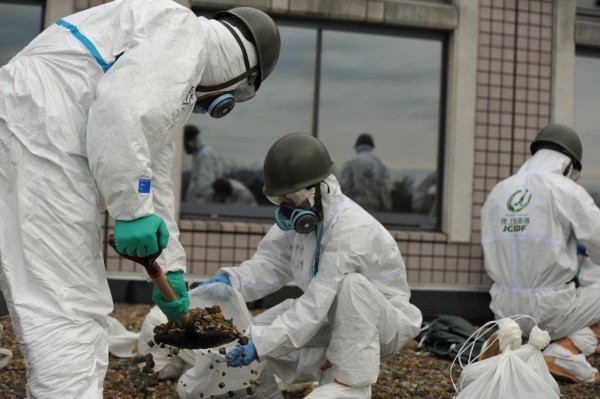
Koide: Well I think both that it is and it isn’t effective. For example, when they first started the decontamination work, what they did was blasting everything with high-pressure water hoses. That’s bad. All that does is get all the contamination moving around. It’s really just dispersing it.
Some of my colleagues have said that is a bad method. Be it a roof or a wall, you shouldn’t just douse it with water. To really remove the contamination, you would first cover it with something that could prevent the escape of radioactivity then knock down the radiated structure, tear it all off, and then fold it up and collect it all. I think that’s probably true. But it takes a long time.
I think there are effective ways of doing it and I think there are ineffective ways. Still it is fundamentally impossible to erase the contamination and so it must be moved. The only thing we should be doing is thinking about the easiest way to relocate it all.
Hirano: That’s the meaning of “effective” in this situation isn’t it.
Koide: Right. So the current method may be rather small in scale. But for me even small-scale methods are necessary. As long as people are living there everything is necessary.
Of course, there’s legitimate criticism over the fact that this is a decontamination business and that the large construction companies are getting rich, but again, for me, as long as there are abandoned people still living there it all must be done.
Hirano: It was really a shock going there and seeing it. To see those workers and, honestly, their lack of conviction for the work. It was a really weird scene. No real enthusiasm, but rather one day after the other, contingent labor. The media has reported that the workers come from a few particular prefectures, but actually being there and talking to them, I could really get a true sense of the structure of economic inequality in Japan, that this sort of work found this kind of person, a person coming from economically precarious and socially marginalized backgrounds. In fact, you come to understand that decontamination work depends on these people.
For example, decontamination, or your preferred “relocation,” couldn’t those jobs be made more equitable―say by requiring TEPCO office workers, especially executives, to do it?
Koide: I’ve said that.
Hirano: You have? (Laughs).
Kasai: So…about the airborne radiation dosage and the soil contamination, there is a public entity that measures and publishes the airborne levels. But the soil contamination is not measured. I remember reading about Chernobyl that the soil contamination levels are the standard by which one gets the right to evacuation and refuge. But Japan only measures the air. And there are those who doubt the accuracy of the levels recorded. I thought the soil contamination had not been measured yet, but from what you mentioned earlier, we do know the extent of the contamination, don’t we?

Koide: Yes, we do.
Kasai: The actual levels?
Koide: With respect to soil contamination we more or less know the extent of it. We largely know which prefectures, which towns, and which villages―as well as how badly―have been contaminated. Four years after the disaster it has moved around. Radiation moves through the environment; it has a material existence and also does die out. I’m sure much has changed since immediately following the accident.
We have the data necessary to draw a map of the situation immediately following the accident, but we don’t have the data necessary to draw a map of the contamination today. That said, we basically know the extent of the soil contamination.
Kasai: Who is it that is making these measurements?
Koide: It is basically the Ministry of Education, Culture, Sports, Science and Technology. Some local governments took part as well. Some independent groups, as well as some local governments, took part in taking measurements back then. But for us the number one data source is the US military.
Hirano: I see; how is that?
Koide: They worked at truly amazing speed-and accuracy.
Hirano: Sorry if this next thought seems a bit of a tangent, but right after the accident both the US and Japan were looking at the same data. But their interpretations of it were extremely far apart. The US ordered all of its personnel to evacuate an area 80 km from Fukushima. While Japan’s largest evacuation zone was 20 km. Where does this disparity in evacuation zones come from? They are both looking at the same data. How do they arrive at such definitive and divergent judgments?
Koide: Well…and this was true for me, too, any nuclear specialist would have known on March 11th-March 12th at the latest-that there had been a meltdown. And this means, quite simply, that control had been lost. And once control is lost you simply don’t know what is going to happen next-or that’s what you must think at the time. Disaster preparedness must always imagine the worst-case scenario. If you don’t plan for the worst-case scenario it will be too late. What the US did was believe there had been a worst-case scenario-a meltdown-and so moved to take care of its people. That’s why they ordered an 80 km evacuation. I think this was the correct strategy. Japan didn’t do this. Japan was always thinking of the ideal, the best case scenario. They had to be thinking they could still get control and based their policy on that optimistic assumption. So they only declared a 20 km evacuation zone. I would say that from this conclusion two things may unfold: one is their desire to see this as a best-case scenario and the other is their inability to deal with it.
Hirano: What do you mean by their inability?

Koide: In a word, the Japanese state is incapable of functioning adequately when dealing with a disaster. That’s why they evacuated those within 20 km by bus but when it came to the 30 km zone they told those who could easily evacuate to do so and for all others to merely close their doors and windows.
Hirano: So there was no emergency management.
Koide: None. There simply is not a single person in the Japanese government who had thought an accident like this was possible. They all immediately fled the off-site center and so there was absolutely no emergency management―there couldn’t be. And because management was now impossible, there were no announcements. Even if they had declared an 80 km evacuation zone there were no emergency shelters. They had made no preparations, so there was nothing to be done.
Hirano: Last summer I interviewed Murakami Tetsuya 12 Just as the accident was happening he reached out to the government. But he got no response. He went to the prefecture. No response from them either. In the end he just used his own judgment. So really there was essentially zero emergency management in place. His thoughts at the time were to get the whole village to emigrate; that really there was nothing to do but to buy land and move to Hokkaido. He said these were his actual plans at the time. In fact, it would seem that the myth of safety has so totally permeated the bureaucracy that there really is no one who thinks about these things―wouldn’t you say?
Koide: That’s right. Not a single nuclear expert or policy maker ever seriously considered the possibility of an accident like this. I knew accidents were possible, and that when they happened the damage would be enormous; I had been commenting on the possibility, referring to some results of simulations. But still I would have thought the kind of disaster that happened at Fukushima was some kind of impossible nightmare―yet it actually happened. It was like the worse nightmare becoming a reality. And if even I thought this then all those pronuclear people surely never gave it a moment’s thought. And so when it actually happened, no one had thought about, let alone built a system to deal with it.
II The Responsibility of the Scientist and the Citizen
Kasai: In your books and lectures you often express strong respect for Tanaka Shōzō.13 Can you connect what you’ve just said to this as well?
Koide: Sure. I first became aware of Shōzō when I was in the student movement during the 1970s This was a time when there was close attention paid to Japan’s many pollution incidents, such as at Minamata. Personally I was working on nuclear power, but it was a time when, like it or not, we learned of all the harm that came along with building Japan into a modern nation. What I got from Shōzō was this epiphany that just like the Minamata disease right there before our eyes these sorts of pollution incidents went way back in Japanese history. With Japan’s decision to cast off Asia and follow the West after the Meiji Ishin of 1868 came these sorts of incidents, and the question within that was just how should one live? I learned the way Shōzō lived his life. I thought: Wow, it is possible to live that way; I must do it. Unfortunately I am completely unable to do so, but I never stop thinking that Shōzō’s was a wonderful way to live a life.
Hirano: Going back to an earlier discussion. You’ve repeatedly talked about the government’s responsibility, scientists’ responsibility, and individual responsibility. It would seem that this word “responsibility” is an extremely important keyword for you. You often emphasize it in your writing, too. What I want to ask concerns the issue of scientists’ special responsibility, a particular social responsibility. Scientists are often thought of as technicians, but this is not really the case. As a result, I feel you’ve pursued an intense interrogation of yourself as a scientist. As you’ve said you are not going to enter politics, could you connect this discussion of scientific responsibility to your earlier discussion of doing all that has fallen to you personally to do? How should we think about these two things?
Koide: I am in science and as such I have to take on the responsibility of a scientist-Just as a politician must take political responsibility. I think I mentioned this to you the last time, but I am an absolute individualist (tetteiteki na kojinshugisha/徹底的な個人主義 者). I don’t want to be constrained by anyone. I want to be able to decide my own life for myself. But because I’ve made this choice by myself I must also take full responsibility for that choice.
It’s two sides of the same coin. I don’t take orders from anyone. And this means that I alone bear the responsibility. It’s really as simple as saying: I’m a scientist and so I have the responsibility of a scientist.
Hirano: On this way of thinking about responsibility: “Who is the subject responsible?”―this way of thinking about it seems to be quite absent in contemporary Japan.
Koide: Right. People living in Japan today have not made decisions as individuals. They just “go with the flow;” as long as they follow the “authorities” whom they believe will guarantee the happiness of their individual selves. This seems true of education, too. Go to a slightly better school; get into a slightly better company; grow a bit more rich, a bit more grand. I think everyone is swept up in this current, and it’s really senseless.
I think it is extremely important that each and every individual live out their individuality. The absolute worst thing is for everyone to become blindly obedient to the “authorities,” yet this is the Japan we find ourselves in today. And so no one takes any responsibility. Living in such a society it is too easy to say, “It can’t be helped.” Everyone is thus able to blame the society as a whole; “It can’t be helped.” And so no one takes any individual responsibility.
The most extreme and obvious example was the war. Everyone would say: “It’s not my fault; I was deceived. The military were the culprits.” Saying this allows people to remain at a distance, indifferent. It is bad news for a nation when its citizens have only this view of responsibility.
Hirano: You’ve declared, “I am an absolute individualist.” Personally I am very interested in that statement. So could you speak a bit more concretely about the meaning of your individualism for how one lives a life? In other words, could you explain just what you mean by this “individualism?”
That is, in Japan being individualistic is more often a way to say egotistical; a sort of disregard of others. One should pursue one’s own interests―in English the word is “selfish” ― egocentric ― pursue your own egotistic advantage. Now this seems completely different from the way you use the term. Could you speak directly to this difference?
Koide: I think you’ve just done so.
Hirano: Did I? (Laughs). So that’s it then, just as I said? Still it’s clearly not selfishness.
Koide: No, I don’t think it’s about interests.
Hirano: It’s about values isn’t it?
Koide: Yes, it’s about personal values. You and I are different people. I am different again from Mr. Kasai. Why? Well our genetic information is different. I received a bundle of information from my parents. You and Mr. Kasai, too, are influenced by your genetic information. Every one of the over one hundred million Japanese is a unique human being; and every one of the over 7.3 billion people on earth are unique individuals.
History may keep moving on, and there is a big, wide world here on this planet earth. That said, right now, at this moment, and right now, in this place, I exist as an irreplaceable being. It is nothing but an absolute truth. You normally live in Los Angeles, but right now at this moment you are a person who is here. Mr. Kasai has come down from Tokyo. While acknowledging all the implications of being within the flow of history, we are all right here, right now.
In other words, every single individual human being has a different way of living a life; they are each unique. They have each lived a life that absolutely no one else could have lived. It is a real loss if they don’t live up to their full potential. Those are my thoughts.
So for my own unique self, and so for your own unique self, and Mr. Kasai’s own unique self, none of us should be compelled by someone else to do something (meirei o sarete/命令されて). If we don’t live our lives according to the will coming from deep within ourselves, that’s a real loss; we must all live with our values coming from within ourselves.
I am going to retire next March, but though I am the lowest ranked employee here― above me are assistant professors and professors ― because of the peculiar arrangements of working where I do, I am not compelled to take orders from anyone. I am the lowest ranked so of course there is also no one below me to order around. So I am in a position where I never take nor give orders. For me this is the ideal position to be in.
And so I can live out my own life according to my own values; I’m allowed to live a life that suits me. Now I found myself in this position largely by accident, and then chose to continue to live my life this way. Related to this, I am a human being and so will make mistakes, but these mistakes will be things that I have chosen, things that I have personally done so there is nothing to do but to take responsibility for them. This is what I mean when I say that responsibility is an extremely important word.
Hirano: Well, you’ve exhaustively criticized this competitive society. You’ve said that this competitive society has ruined Japan and destroyed life based on what you call responsibility.
Koide: Yes. Everyone is running towards the exact same goal. It’s ludicrous. You want to go that way; I want to go this way. I think this would be the ideal society. Full mutual recognition is a good thing.
Hirano: Does your view come from your personal experience? In your books you state that you were a really conscientious student when you were younger (laughs).
Koide: (laughs) Well, yes.
Hirano: You studied extremely hard. Did everything extremely hard. You continued this in your nuclear research in college believing that a new energy source was cheap and good for everyone. You must have thought this was a great thing.
Koide: That’s right.
Hirano: But you eventually noticed that it was all wrong. So on this, from deep in your own experience, it’s an individual history, an individual experience, in one sense it’s connected to your current individualism, to how you live your life focused on the important things to you.
Koide: I think that’s right. So, well, when I was young, in my late teens, I was consumed by the dream of nuclear power. I devoted my life to it. That was all a mistake―it did not take me too long to realize that.
Hirano: When did it happen? In graduate school?
Koide: My third year in university.
Hirano: Third year―so as an undergraduate.
Koide: Yes, I came to this realization in the latter half of my undergraduate studies. It was foolish and I curse myself for it, but I didn’t quit. To this day I’ve lived my life as someone who made that wrong choice, and there is nothing to do but make amends for that choice.
At a minimum I wanted to get rid of nuclear power before there was a bad accident. I guess I’ve lived with this wish for over forty years―but that wish stayed out of reach. And here we have had the accident so my life has been for nothing. You could say that thing I wanted most to do has been denied. Really, what have I lived for? I think about that from time to time.
As this was my choice I have to accept it. So while the meaning of my life may have been lost, still I was able to live my own life as I pleased, without submitting to the orders of others and without ordering others around―for this I am grateful. My hopes were never realized. History is full of that kind of thing. Likely very few people see their hopes fulfilled. And while in my case they were rejected, I was able to live the life I wanted and that is a life to be grateful for.
Hirano: In a way, it’s just how Tanaka Shōzō lived his life isn’t it?
Koide: Yes it is. That is what I like about Shōzō.
Hirano: On that point. His life, too, was a defeat.
Koide: Complete and total defeat.
Hirano: Still, he used all sorts of means, and followed all the way through on his beliefs.
Hirano: So getting back to Fukushima, it seems when it comes to the life choices of the so-called Japanese elites, they seem caught in a system in which they will succeed and become famous by crushing their individuality and subsuming it under some organization in order to get ahead in a society and achieve fame and status. And the education system seems to be promoting this lifestyle where these sorts of people are created through intense competition. I think the very end result of this social and educational system was revealed, and it exploded in an explicit and ugly manner through various problems the Fukushima disaster has posed.
Koide: Yes, I think so. You said it.
Hirano: I see. In one sense it would have been possible even for these Japanese elites to make their personal responsibility clear and take appropriate actions only if they had lived a life based on individualism as you suggested.
Koide: Yes I think such a possibility exists, but unfortunately in Japan today that possibility has been completely crushed. It was abundantly clear from the Fukushima disaster that no one in this country is going to take responsibility.
Hirano: You’ve already talked about how TEPCO and the government made huge mistakes in dealing with the problem immediately after the accident. What do you see as the definitive mistake that led to this disaster?
Koide: There’s a ton of them. Any specialist would have known right away there had been a meltdown, and that everyone needed to be evacuated immediately. And evacuating to 20 km away is totally inadequate. Iitate village some 40-50 km away received an enormous amount of contamination and was neglected for over a month.
Soma residents evacuated to Iitate, this kind of stupidity cannot stand, the government’s criminal mistakes.
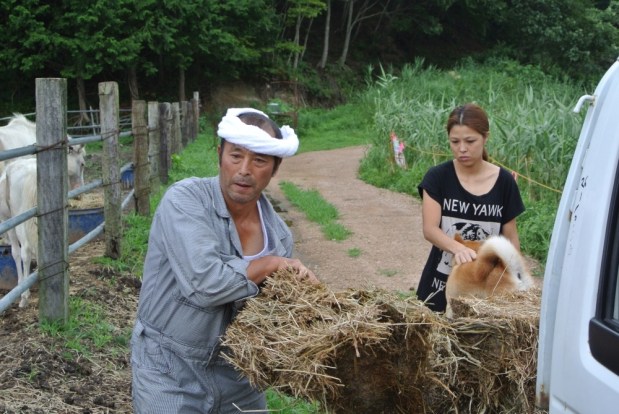
Kasai: I’m deeply taken by your previous discussion on responsibility. It’s really a story of something with no owner. A golf course that has had to close because it is considered contaminated with radiation from TEPCO’s plant has recently sued. TEPCO’s top attorneys argued in defense that the radiation is not their property, which would make it no one’s property and therefore TEPCO is not responsible. It seems the opposite of what you’ve just said about responsibility, to be sure, yet this declaration of complete lack of responsibility, once passed through the logic and system of the courts, these lawyers have arrived at precisely this conclusion. It is not a question of individual responsibility; it is a problem of the social system. Lack of any responsibility is the basis of the entire social system. What are your thoughts on this?
Koide: It’s exactly as you say. This is what it has come to. I couldn’t care less about a country like that. But in order to overcome this situation, it’s something I mentioned earlier, but there is no way but for rather foolish citizens to get smarter. Only each individual standing up for his or her own way is going to do it.
Hirano: You’ve also talked about “responsibility for being fooled.” You’ve said that even the deceived are guilty and stressed that they too must take responsibility. How do you think about this at the individual level? For example, you’ve often stated that there should be a new food labeling system put in place by which especially the generation that agreed to build the reactors would be obliged to eat the contaminated food―would this be an example of taking individual responsibility for you?
Koide: Yes, that’s exactly what I mean. So, because I think that every Japanese adult has responsibility for both allowing the rampant development of nuclear power and the Fukushima disaster, I said that they should be the ones to eat the contaminated food. And so that this disaster may never happen again, nuclear power must be eliminated―of course there should be no question of restarting the reactors. Yet, what I’ve just said is not really a widespread idea. Slowly all the reactors are being restarted.
Hirano: So in that sense Japanese citizens’ responsibility is increasing in that they are allowing the restart of the reactors.
Koide: I think the nuclear power issue is precisely analogous to the war.
Hirano: Indeed, as with the damage of misinformation and national morality discourse we talked about and the pressure that comes from those hints of someone being somehow “un-Japanese,” it seems to really resemble the war.
Koide: I think so, yes.
Hirano: I’d like to ask more about the responsibility for being misled. Up to now the reason most would say that nuclear power has been allowed is the myth of safety―a myth invented by the coordination of the government, TEPCO, and the media. So Japanese citizens have been robbed of being told the truth, of having the chance to know the truth.
Koide: That’s true.
Hirano: So the likely response to your position would be that it’s unjust to blame those who were robbed of the chance to know the truth. How would you answer this challenge?
Koide: I also said that the current situation is just like during the war. Then, too, the media only reported the information coming from imperial headquarters: The Japanese military enjoyed nothing but a string of victories. We were all told that because of the emperor Japan was a divine country and therefore could not lose. You would go to school and there would be the emperor’s portrait hanging on the wall. There was a place where the emperor was enshrined right there on school grounds. Every child was taught that the emperor was present there.
In such a country it wasn’t strange to think that Japan would win the war. But those who knew more about the world, including of course those in the military, knew that Japan could not win. Still they said nothing. And so everyone was swept along with the current.
But history is harsh, and in the end Japan was battered. And people at that time said, “Ah, we’ve been misled. The military are the culprits.” But even within all of this there were those who resisted the war. The number of people tortured and killed by the Special Higher Police was huge. And those people, too, were labeled as “un-Japanese” and ostracized from society by the majority of the population. Whole families, whole groups of people were obliterated.
So those who lived then were duped, they were given false information. But should they say that’s where their responsibility ends? I would respond that even if they were duped, the duped still bear the responsibility of the duped. How did each and every one of them live their lives during the war? How did they deal with the information they were being given? I think we need to include these kinds of questions when we interrogate ourselves over taking responsibility. Now if you say this people get angry but I think without question the emperor has absolute responsibility for the war. We ended up moving on without trying to pursue the emperor’s war responsibility.
Even today you’ll see people happily shouting “Tennō heika banzai,” Long Live the Emperor. At midnight NHK will broadcast the Japanese flag flapping in the wind. I can’t stand that and so don’t watch TV. Most Japanese get happy when they hear ‘honorable’ addresses by His Majesty the Emperor or news about the imperial family. From the bottom of my heart I think we should have pursued his war crimes and punished him with whatever it takes, including execution. I have been saying this and people get very angry.
I am told not to criticize the emperor. They say if I do I’ll harm the anti-nuclear movement.
Hirano: Even people in the anti-nuclear movement warn you about things like that? A critical reference to the emperor’s wartime responsibility could be fatally divisive for the movement?
Koide: Those roots are that strong when you talk about war responsibility. But as I have mentioned to you, I feel at the bottom of my heart that each and every individual must take personal responsibility for how he or she lived his or her life. That’s the reason why I wanted the emperor to take his responsibility as a person.
We must build such a country. Even the duped and the lied to have responsibility as individual human beings. It’s true for those who lived through the war, and it’s true for those who promote nuclear power in Japan today―indeed it’s true for everyone on earth. Each one, should they be deceived, is responsible for being deceived.
Hirano/Kasai: Well we’ve gone on long today and heard some really important things. Thank you very much.
Katsuya Hirano is Associate Professor of History at UCLA. He is the author of The Politics of Dialogic Imagination: Power and Popular Culture in Early Modern Japan (Chicago). This interview is the second installment of his oral history project on Fukushima in The Asia-Pacific Journal: Japan Focus. The first interview was with Murakami Tatsuya: “Fukushima and the Crisis of Democracy: Interview with Murakami Tatsuya”, The Asia-Pacific Journal, Vol. 13, Issue 20, No. 1, May 25, 2015.
Hirotaka Kasai is Professor of Political Thought at Tsuda College in Tokyo, Japan. He has published articles and book chapters on Maruyama Masao and radical democracy in Gendai Shiso and others.
Robert Stolz is Associate Professor of History at University of Virginia. He is the author of Bad Water: Nature, Pollution, and Politics in Japan, 1870-1950 (Duke). He has published an article on Tanaka Shozo in The Asia-Pacific Journal: “Remake Politics, Not Nature: Tanaka Shozo’s Philosophies of ‘Poison’ and ‘Flow’ and Japan’s Environment”, Vol. 5, Issue 1, January 2, 2007.
Akiko Anson is a freelance translator who lives in Iowa City, Iowa. Anson obtained a BA degree in English Literature from Gakushūin University in Tokyo, Japan and an MA degree in Asian Studies from the University of Iowa.
Recommended citation: Katsuya Hirano and Hirotaka Kasai interview Koide Hiroaki, “The Fukushima Nuclear Disaster is a Serious Crime”, The Asia-Pacific Journal, Vol. 14, Issue 6, No. 1, March 15, 2016.
Notes
INTERVIEW/ Kazuya Tarukawa: Reality of Fukushima is unrecoverable, uncompensable
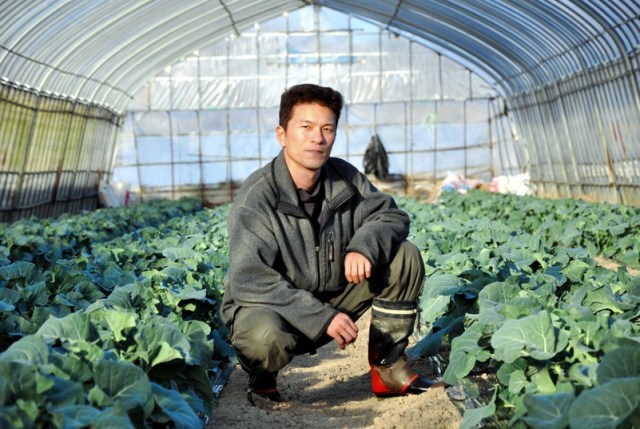
Farmer Kazuya Tarukawa at his greenhouse in Sukagawa, Fukushima Prefecture
Kazuya Tarukawa, a farmer in Sukagawa, Fukushima Prefecture, found himself in the media spotlight after his father committed suicide in the early stages of the disaster at the Fukushima No. 1 nuclear power plant.
In a recent interview with The Asahi Shimbun, Tarukawa recounted how his gratifying life as a farmer drastically changed on March 11, 2011.
He also shared his thoughts on the compensation system, rumors about Fukushima products, and how Tokyo Electric Power Co. sent him a fax instead of a direct apology for his father’s death.
Excerpts of the interview follow:
* * *
Question: What are things like five years after the disaster started?
Tarukawa: Radioactive materials fell on this central strip of Fukushima Prefecture, too. Rice paddies, farm fields and plastic greenhouses were all ruined, so our “workplaces” were contaminated. But Tokyo Electric Power Co., operator of the crippled nuclear plant, has not compensated us for lost assets or removed the radioactive substances.
Five years have passed, and that’s it. We have only sustained damage and suffering. I keep asking myself, “Why do we have to go through all this?”
We did receive 80,000 yen ($706) in the first year of the disaster and 40,000 yen in the second year for psychological suffering, but that was all. The thinking behind the payments was probably like, “Here’s 120,000 yen, so keep your mouth shut and wait for the radiation levels to go down on their own.”
How can that make up for the damage we sustained?
Q: I have been told that your father was dedicated to organic farming of vegetables. Could you elaborate?
A: He cared a lot about the environment. He began growing winter cabbage because you never get worms, even without a single disinfection, in winter. The cabbage grows under the snow and develops quite a sweet taste. All local schools were using our cabbage in their school lunches.
He was so happy to be feeding children with something really safe and tasty. He was once invited by school officials to give a talk about food education. He was proud of things like that.
He hanged himself on the morning the day after the central government told him to stop shipping his vegetables. Around 7,500 pre-harvest cabbages were ruined. His farmland was contaminated. His heart was probably heavy while he was wondering how he would get on with his life.
Q: You reached a settlement in the case through the intermediary of the Nuclear Damage Compensation Dispute Resolution Center, whereby TEPCO acknowledged a causal relation with the disaster. Could you elaborate on that?
A: I took the case to the center because I wanted to avenge my father so he would not die in vain. I finally won the settlement and received damages. I thought that TEPCO people would finally come to my place to offer incense and apologize. But that never happened. I got a fax instead.
Q: How is the cleanup work going?
A: Our rice paddies were cleaned up. The ground was plowed to about 40 centimeters using a big tractor, sprinkled with zeolite and then plowed again. We were told that the zeolite will absorb radioactive substances in the soil, and that’s the cleanup thing.
But it doesn’t make sense. Rice may stop pulling up radioactive materials, but the absolute amount in the soil remains the same.
We are toiling every day from morning until evening on contaminated soil. We are filled with anxiety about what will become of us in the future, and whether we might suffer the impact someday.
When we were negotiating with the central government, I repeatedly asked farm ministry officials on the podium: “Do you know the first kanji in the Japanese word for ‘cleanup?’ (The kanji means “remove.”) You are just stirring things up. How can that amount to a ‘cleanup?’”
Everyone then cast their eyes low at their documents. They must have thought I was right.
Q: Isn’t there a way to strip away the contaminated surface soil?
A: We would be luckier if only there was a way to strip it off in thin slices. But in the month after the disaster started, the prefectural government gave us directions, saying it was OK to plow the ground. I didn’t quite believe in that stuff, but everybody did plow the ground.
We shouldn’t have done the plowing thing back then. They could have told us to stop growing crops for a year, and you will be compensated for that. That was a big moment when the sides parted.
It’s easy to strip off soil with a machine. But if you remove 40 cm of soil, you wouldn’t get decent crops. It takes tens of years to make just 1 cm of fine, fluffy soil.
I stick to what I am doing because I don’t want to let my rice paddies go to ruin during my time, the time of the eighth generation.
The paddies would quickly go to ruin if you didn’t do anything about them and just let them lie around. That would also cause trouble with your neighbors. Come to think of it, if you didn’t grow anything, you also wouldn’t be getting compensation money, and you would be left without income. You couldn’t maintain your living.
Q: What compensation are you getting for the farm products you grow?
A: We are only being compensated for crops with records of sale and proof that we suffered damage. For example, if you sold something at 2,000 yen before the disaster but now are making only 1,500 yen from it, TEPCO will compensate you for the difference.
But we have not been compensated for cucumbers for the past two years because their prices soared due to the unseasonable weather. People are saying stuff like, “We are not paying you because you are selling them at higher prices than you did before the disaster.”
It’s funny, huh? We would be making more money if it were not for the disaster. We are getting less than in other prefectures. You know, TEPCO is loath to shell out money.
And there are so many things that we have no way to seek damages for. Things that will never be with us again. We used to grow shiitake mushrooms at our homestead every year for consumption. Butterbur sprouts and Japanese angelica tree shoots from the mountains–they have all been spoiled. But we are getting nothing for that.
Q: What about the impact of negative publicity?
A: The 2011 harvest of rice from our paddies measured up to 30 becquerels or so in radioactive content. That was a safe enough level because the regulation standard was 500 becquerels (per kilogram; 100 becquerels from fiscal 2012) or less. But it’s something that you are putting in your mouth, after all.
Frankly, I didn’t want to eat it myself. Well, I did eat it because I couldn’t have gone shopping elsewhere.
But I do have a sense of guilt about making shipments. So I know very well why Tokyoites don’t feel like eating things from Fukushima. Who would want to buy stuff to eat from a place with such a stupid old nuclear plant?
It’s not about “negative publicity.” You suffer from “negative publicity” when your sales have dropped because groundless rumors have spread. But our case is not like that. Everything is well-grounded. The radioactive materials actually fell.
Q: Do they still continue to be detected?
A: No radioactive materials were detected in rice last year and the year before last. In fact, we have done everything we can. We are spraying potassium chloride, which suppresses the absorption of radioactive substances, every year.
All bags of rice are being screened, and when you get measurement figures, you are not allowed to ship them. I believe that rice from Fukushima is now much safer than rice from other prefectures.
And our rice is selling well, in fact, in the restaurant industry and in hospitals because you may never know that the product is from Fukushima Prefecture. You may not see a lot on the surface, but vast quantities are on the move. Because Fukushima rice tastes good. It’s sticky and sweet. So restaurant industry people seem to be happy because they can buy tasty rice at cheap prices.
Q: What about vegetables?
A: Greenhouses were under plastic covers at the time of the disaster, so the soil in there was never contaminated. I decided to grow everything in greenhouses, so I have almost stopped growing things outdoors, including cabbage, because I don’t want to see measurement figures in my crops again.
I am now growing broccoli, but the prices are so cheap, beaten down. Urbanites don’t bother to differentiate between broccoli grown in greenhouses and those grown in open fields as long as they are from Fukushima Prefecture.
Q: Nuclear reactors are being brought back online these days. Your thoughts?
A: Japan remained free of nuclear power for some time. But look, was there any part of Japan where everything was pitch-dark at night during that time? We certainly had enough electricity.
We may have paid more for crude oil, and nuclear power may be cheaper in fuel costs. But think about it: How much do you have to pay to clean up after a disaster when one happens? It’s really a burden. What would become of this country if another nuclear plant were to fail somewhere? You could raise taxes, but would that be the end of it?
Q: With whom do you want to share your feelings now?
A: I could be better off if I didn’t raise my voice and kept silent. But I am somebody in the media spotlight because of my father. There are hosts of other farmers who feel like I do, that something is wrong. It’s not in my power, after all, to hold my voice about such feelings. Doing that is dishonest.
That’s why I decided to appear in the movie (“Daichi wo Uketsugu” (Taking over Mother Earth), a 2015 documentary directed by Junichi Inoue). I particularly want farmers in areas hosting nuclear plants to watch this film. I want them to know what will happen when there is a disaster.
My father used to say: “Human-made things will certainly fail someday. Nothing can stand the forces of nature.” And things have turned out exactly like that. And after five years, nobody has taken responsibility.
* * *
Born in 1975, Kazuya Tarukawa worked for a company in Iwaki, Fukushima Prefecture, after graduating from a university. He returned to his family home in Sukagawa, 65 kilometers from the Fukushima No. 1 nuclear power plant, 10 years ago to engage in farming.
Fukushima Report: 10,000 Excess Cancers Expected in Japan as a Result of 2011 Reactor Meltdowns, Ongoing Radiation Exposure
Report Gauges Cancer Prospects for Children, Rescue/Recovery Worker, and General Population; Japanese Government Criticized for “Disturbing” Failure to Examine Wider Radiation-Related Diseases
WASHINGTON, D.C. & BERLIN – March 9, 2016 – Residents of the Fukushima area and the rest of Japan will experience more than 10,000 excess cancers as a result of radiation exposure from the triple-reactor meltdown that took place on March 11, 2011, according to a new report from Physicians for Social Responsibility (PSR) and International Physicians for the Prevention of Nuclear War (IPPNW).
Titled “5 Years Living With Fukushima” and available online at www.psr.org/FukushimaReport2016, the PSR/IPPNW report laments that the full impact of Fukushima may never be known, due to Japan’s failure to immediately and fully track radiation exposures, as well as a “disturbing” lack of testing of the general population for radiation-related diseases and other impacts (miscarriages, fetal malformations, leukemia, lymphomas, solid tumors or non-cancerous diseases). The massive initial radioactive emissions were not recorded at the time of the triple-reactor meltdown and some radioactive isotopes (including strontium-90) have not been measured at all.
The PSR/IPPNW report uses the best available science and data to gauge the excess cancer rates among children, rescue and clean-up workers, and the general population of Japan. In addition to the 200,000 Fukushima residents relocated nearby into makeshift camps, the exposed include millions of others in Japan as a result of fallout-contaminated food, soil and water. Fukushima is often incorrectly seen as a “past” event; the reality is that radioactive emissions from the wrecked reactors continue to this day both into the atmosphere and in the form of 300 tons of leakage each day into the Pacific Ocean.
Key findings of the PSR/IPPNW report include the following:
- Children. “116 children in Fukushima Prefecture have already been diagnosed with aggressive and fast-growing, or already metastasizing, thyroid cancer – in a population this size about one to five case per year would normally be expected. For 16 of these children a screening effect can be excluded as their cancers developed within the last two years.”
- Workers. “More than 25,000 cleanup and rescue workers received the highest radiation dose and risked their health, while preventing a deterioration of the situation at the power plant site. If data supplied by the operator TEPCO is to be believed, around 100 workers are expected to contract cancer due to excess radiation, and 50 percent of these will be fatal. The real dose levels, however, are most likely several times higher, as the operator has had no qualms in manipulating the data to avoid claims for damages – from hiring unregistered temporary employees to tampering with radiation dosimeters and even crude forgery.”
- The rest of Japan. “The population in the rest of Japan is exposed to increased radiation doses from minor amounts of radioactive fallout, as well as contaminated food and water. Calculations of increased cancer cases overall in Japan range from 9,600 to 66,000 depending on the dose estimates.”
Catherine Thomasson, MD, report co-editor, and executive director, Physicians for Social Responsibility, said: “The health legacy of Fukushima will haunt Japan for years to come and it cannot be wished out of existence by cheerleaders for nuclear power. Unfortunately, the pro-nuclear Japanese government and the country’s influential nuclear lobby are doing everything in their power to play down and conceal the effects of the disaster. The high numbers of thyroid cancers already verified with 50 additional waiting for surgery in the children of Fukushima prefecture is astounding. The aim seems to be to ensure the Fukushima file is closed as soon as possible and the Japanese public returns to a positive view of nuclear power. This rush to re-embrace nuclear power is dangerous to the extent that it sweeps major and very real medical concerns under the rug.”
Dr. Alex Rosen, pediatrician and vice-chair, International Physicians for Prevention of Nuclear War, said: “One is of course reminded of the tobacco lobby disputing the notion that the horrific effects of its products have no adverse health impacts. This self-serving falsehood echoed for decades was made possible simply because the long-term health effects of smoking were not immediately observable. The 10,000 to 66,000 people who will develop cancer solely as a result of the “manmade disaster” are neither ‘negligible’ nor ‘insufficient,’ as Japanese authorities, the nation’s nuclear lobby, and various industry-dominated international bodies, would have you believe.”
Tim Mousseau, PhD, professor of Biological Sciences, University of South Carolina, said: “It is unfortunate that, in some regards, we have better and more complete data about the impacts of Fukushima radiation on trees, plants and animals than we do on humans. We are seeing higher mortality rates, reduction in successful reproduction and significant deformities. A great deal of this research has been done to date and it has troubling implications. The research findings should be heeded to direct human studies, particularly regarding the question of genetic and transgenerational effects of radiation.”
Robert Alvarez, senior scholar specializing in nuclear disarmament, environmental, and energy policies, Institute for Public Studies, and former senior policy advisor, US Department of Energy, said: “Radioactive fallout from the reactors has created de faco ‘sacrifice zones’ where human habitation will no longer be possible well into the future. In November 2011, the Japanese Science Ministry reported that long-lived radioactive cesium had contaminated 11,580 square miles (30,000 sq km) of the land surface of Japan. Some 4,500 square miles – an area almost the size of Connecticut – was found to have radiation levels that exceeded Japan’s allowable exposure rate of 1 mSV(millisievert) per year. Fourteen of the nation’s 54 reactors are permanently shut down as they are on fault lines and only four have been restarted.”
The PSR/IPPNW report also cautions that Fukushima was far from a one-time radiation incident: “The wrecked reactors have been leaking radioactive discharge since March 2011, despite assurances by the nuclear industry and institutions of the nuclear lobby such as the International Atomic Energy Organization that a singular incident occurred in spring 2011, which is now under control. This statement ignores the continuous emission of long-lived radionuclides such as cesium-137 or strontium-90 into the atmosphere, the groundwater and the ocean. It also ignores frequent recontamination of affected areas due to storms, flooding, forest fires, pollination, precipitation and even clean-up operations, which cause radioactive isotopes to be whirled into the air and spread by the wind. Thus, several incidents of new contamination with cesium-137 and strontium-90 have been discovered during the past years, even at considerable distance beyond the evacuation zone.”
The report also notes: “Finally, there are frequent leaks at the power plant itself – particularly from the cracked underground vaults of the reactor buildings and from containers holding radioactive contaminated water, which were hastily welded together and already exhibit numerous defects. According to TEPCO, 300 tons of radioactive wastewater still flow unchecked into the ocean every day – more than 500,000 tons since the beginning of the nuclear disaster. The amount and composition of radioactive isotopes fluctuate widely so that it is not possible to ascertain the actual effect this radioactive discharge will have on marine life. What is clear, however, is that increasing amounts of strontium-90 are being flushed into the sea. Strontium-90 is a radioactive isotope that is incorporated into living organisms in a similar way to calcium – in bones and teeth. As it travels up the marine food chain, it undergoes significant bioaccumulation and, because of its long biological and physical half-lives, will continue to contaminate the environment for the next hundreds of years.”
ABOUT THE GROUPS
Physicians for Social Responsibility has been working for more than 50 years to create a healthy, just and peaceful world for both the present and future generations. PSR advocates on key issues of concern by addressing the dangers that threaten communities. www.psr.org.
International Physicians for the Prevention of Nuclear War is a non-partisan federation of national medical groups in 64 countries, representing tens of thousands of doctors, medical students, other health workers, and concerned citizens who share the common goal of creating a more peaceful and secure world freed from the threat of nuclear annihilation. www.ippnw.org
http://www.psr.org/news-events/press-releases/fukushima-report-10000-excess-cancers-japan.html
Radiation fears keep Japan’s nuclear refugees from returning
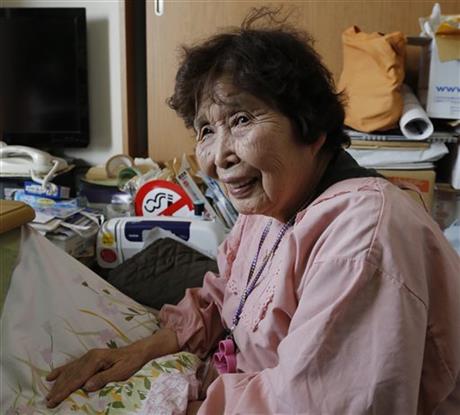
TOKYO (AP) — They feel like refugees, although they live in one of the world’s richest and most peaceful nations.
Five years ago, these people fled their homes, grabbing what they could, as a nearby nuclear plant melted down after being hit by a tsunami, spewing radiation. All told, the disaster in Fukushima displaced 150,000 by the government’s count.
About 100,000 are still scattered around the nation, some in barrack-like temporary housing units and others in government-allocated apartment buildings hundreds of kilometers (miles) away.
Although authorities have started to open up areas near the damaged reactors that were previously off limits, only a fraction of residents have returned. For example, in the town of Naraha, where evacuation orders were lifted in September, 459 people, or 6 percent of the pre-disaster population, have gone back.
Most say they don’t want to return for fear of lingering radiation. Some don’t want the upheaval of moving again after trying to start their lives over elsewhere.
With government housing aid set to end next year, many feel pressured to move back.
___
Tokiko Onoda, 80, lives with her husband in a cramped, cluttered apartment on the 21st floor of a high-rise in the edge of Tokyo where about 1,000 people displaced by the disaster live in rent-free housing.
Several Fukushima towns that were deserted now are urging residents to return, saying it is safe to live in certain areas. An ambitious effort to decontaminate vast swaths of land by removing topsoil and razing shrubbery has turned farmland and coastlines into stretches of dirt with rows upon rows of black garbage bags filled with grass, soil and debris.
When housing aid ends in April 2017, people in apartments under the government program will have to start paying rent or move out. Those whose homes in Fukushima that are in areas still off-limits for living will continue to receive the aid.
Onoda fears hers will be cut off because her home is in Namie, where evacuation orders are gradually being lifted in parts of the town.
She doesn’t believe it’s safe to go back. She feels duped because she had believed that nuclear power was safe.
Onoda angrily talks about how authorities are treating people like her. Why didn’t the government give her land elsewhere to build a new home?
When she lived in Fukushima, she had a big house with a garden where she grew vegetables and peonies. She picked mushrooms and ferns in the hills.
“We worked so hard to build that house,” she said, often stopping to wipe away tears. “We had no worries in the world except to plan vacation trips to the hot springs.”
That home is now in shambles. Although it survived the 9.0 magnitude quake on March 11, 2011, burglars have ransacked it and rats have chewed the walls. The last time she visited, the dosimeter ticked at 4 microsieverts an hour, more than 100 times the average monitored in-air radiation in Tokyo. That’s not immediately life-threatening but it makes Onoda feel uncomfortable because of worries that cancer or other sicknesses may surface years later.
Before the disaster, the government had set the safe annual radiation dosage level at 1 millisievert. Afterward, it has adopted the 20 millisievert recommendation of the International Commission on Radiation Protection set for emergencies, and 1 millisievert became a long-term goal.
Onoda says she has done her best to cope. She has made friends. She keeps busy with tea parties, art classes and a sewing circle.
And now they want her to go back, after all she has gone through?
“Only someone who has gone through this evacuation can understand,” she said.
___
Ryuichi Kino, a journalist who wrote, edited and compiled the 2015 book, “The White Paper on Nuclear Evacuees,” believes people like Onoda have been treated like “kimin,” which means “people who have been discarded” because they have been forgotten or abandoned by society.
“We don’t even know their real numbers,” he said, noting the government lacks a clear definition for “evacuees,” and bases its figures on tallies of those receiving aid. A recent count in Fukushima and a neighboring prefecture found the total number may be as high as 200,000, Kino said.
“Evacuation is a term that assumes the situation is temporary, and there is a place to go back,” said Kino.
The government is spending about 40 billion yen ($400 million) a year on housing aid for those displaced by the disaster. It’s also financially backing Tokyo Electric Power Co., operator of the damaged Fukushima Dai-ichi nuclear plant, to make monthly compensation payments, now at a cumulative 5.9 trillion yen ($59 billion) and rising.
Tests with volunteers who wore dosimeters for two weeks in the town of Naraha found average radiation exposure to be at a rate of 1.12 millsieverts a year.
Government official Yuji Ishizaki, who is overseeing the lifting of evacuation orders, says he is merely following policy.
“There is no clear boundary for what is safe or not safe for radiation,” he said. “Even 1 millisievert might not be absolutely safe.”
Fukushima Medical University, the main academic body studying the health effects of the nuclear disaster, says no sickness linked to radiation has been detected so far, although sickness from lack of exercise, poor diet and mental stress has been observed.
The more than 100 cases of thyroid cancer found among the 370,000 people 18 years old and younger at the time of the disaster the university calls “a screening effect,” or a result of more rigorous testing.
Some scientists say that is unusually high, given that thyroid cancer among children is rare at two or three in a million. Thyroid cancers among the young surged in the Ukraine and Belarus after the 1986 Chernobyl catastrophe.
___
Seiichi Nakate is relatively content in his new life with his wife and two children, 13 and 11, in the northern city of Sapporo, 600 kilometers (370 miles) from Fukushima. There, some 1,500 people from Fukushima have formed a support network, often getting together for drinks and helping each other find jobs.
Nakate recently bought a house and started a company that refers professional helpers to disabled people, and has hired former Fukushima residents. He vows to never return to Fukushima because of the radiation danger.
He believes that from the beginning, authorities underplayed those risks. He doesn’t trust them.
After the disaster, he immediately sent his wife and children to a relatives’ home in southern Japan. The family started living together in Sapporo a year later.
The end of government housing support makes people feel pressure to return, he says.
“The government abandoned the people of Fukushima, even the children. Now the policy is to push us to go back,” he said. “It’s a policy that forces radiation upon people.”
Megumi Okada, a mother of four, is fighting hard to keep her housing aid in Tokyo, getting people to sign petitions and meeting with government officials.
She scoffs at how officials keep saying that people are living “as normal” in much of Fukushima. She doesn’t want her children eating the food or breathing the air. They get periodic blood tests to make sure they are healthy.
Her husband has found a job as a construction worker in Tokyo. Their apartment is just two rooms and a kitchen, but the rent is covered. Okada wants to work, but publicly funded child-care is scarce in Japan, and private ones are costly.
“Nothing has progressed in five years,” she said. “We have the right to stay evacuated.”
Okada says she wants to apply for U.N. refugee status and move to Europe with her family, if she could.
“I know Japanese can’t become refugees now. But I wish we could,” she said. “It is about our staying alive.”
___
Government evacuation map for Fukushima September 2011: http://www.meti.go.jp/english/earthquake/nuclear/roadmap/pdf/evacuation_map_111125.pdf
Government evacuation map for Fukushima September 2015:
http://www.meti.go.jp/english/earthquake/nuclear/roadmap/pdf/150905MapOfAreas.pdf
32,000 workers at Fukushima No. 1 got high radiation dose, Tepco data show
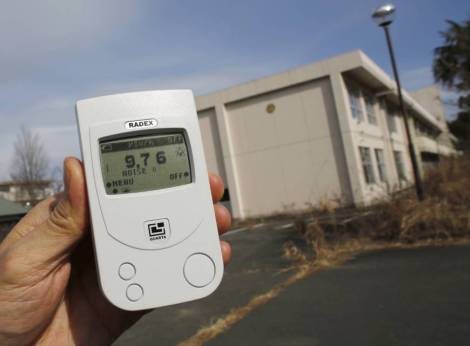
A Reuters reporter measures a radiation level of 9.76 microsieverts per hour in front of Kumamachi Elementary School inside the exclusion zone in Okuma, near Tokyo Electric Power Co’s tsunami-crippled Fukushima No. 1 nuclear power planton Feb. 13
A total of 32,760 workers at the Fukushima No. 1 nuclear plant had an annual radiation dose exceeding 5 millisieverts as of the end of January, according to an analysis of Tokyo Electric Power Co. data.
A reading of 5 millisieverts is one of the thresholds of whether nuclear plant workers suffering from leukemia can be eligible for compensation benefits for work-related injuries and illnesses.
Of those workers, 174 had a cumulative radiation dose of more than 100 millisieverts, a level considered to raise the risk of dying after developing cancer by 0.5 percent. Most of the exposure appears to have stemmed from work just after the start of the crisis on March 11, 2011.
The highest reading was 678.8 millisieverts.
Overall, a total of 46,490 workers were exposed to radiation, with the average at 12.7 millisieverts.
The number of workers with an annual dose of over 5 millisieverts increased 34 percent from fiscal 2013 to 6,600 in fiscal 2014, when workloads grew to address the increase in radiation-tainted water at the plant. The number was at 4,223 in the first 10 months of fiscal 2015, which ends this month, on track to mark an annual decline.
A labor standards supervision office in Fukushima Prefecture last October accepted a claim for workers compensation by a man who developed leukemia after working at the plant, the first recognition of cancer linked to work after the meltdowns as a work-related illness. Similar compensation claims have been rejected in three cases so far, according to the labor ministry.
The average radiation dose was higher among Tepco workers at the plant than among workers from subcontractors in fiscal 2010 and 2011. Starting in fiscal 2012, the reading was higher among subcontractor workers than among Tepco workers.
The average dose for subcontractor workers was 1.7 times the level of Tepco workers in fiscal 2013, 2.3 times in fiscal 2014 and 2.5 times in fiscal 2015 as of the end of January.
A separate analysis of data from the Nuclear Regulation Authority showed that the average radiation dose of workers at 15 nuclear power plants across the country, excluding the Fukushima No. 1 and No. 2 plants, fell to 0.22 millisievert in fiscal 2014, when none of the plants was in operation, down 78 percent from 0.99 millisievert in fiscal 2010
http://www.japantimes.co.jp/news/2016/03/07/national/science-health/32000-fukushima-no-1-workers-got-high-radiation-dose-tepco-data-show/#.Vt2gKfl95D8
1 This Month

of the week – Shut Down Drone Warfare!


Tell the Ukrainian Government to Drop Prosecution of Peace Activist Yurii Sheliazhenko

Petition to revoke the licensing of the Near Surface Nuclear Disposal Facility (NSDF) at Chalk River. https://www.ourcommons.ca/petitions/en/Petition/Details?Petition=e-7247
To see nuclear-related stories in greater depth and intensity – go to https://nuclearinformation.wordpress.com
-
Archives
- April 2026 (79)
- March 2026 (251)
- February 2026 (268)
- January 2026 (308)
- December 2025 (358)
- November 2025 (359)
- October 2025 (376)
- September 2025 (257)
- August 2025 (319)
- July 2025 (230)
- June 2025 (348)
- May 2025 (261)
-
Categories
- 1
- 1 NUCLEAR ISSUES
- business and costs
- climate change
- culture and arts
- ENERGY
- environment
- health
- history
- indigenous issues
- Legal
- marketing of nuclear
- media
- opposition to nuclear
- PERSONAL STORIES
- politics
- politics international
- Religion and ethics
- safety
- secrets,lies and civil liberties
- spinbuster
- technology
- Uranium
- wastes
- weapons and war
- Women
- 2 WORLD
- ACTION
- AFRICA
- Atrocities
- AUSTRALIA
- Christina's notes
- Christina's themes
- culture and arts
- Events
- Fuk 2022
- Fuk 2023
- Fukushima 2017
- Fukushima 2018
- fukushima 2019
- Fukushima 2020
- Fukushima 2021
- general
- global warming
- Humour (God we need it)
- Nuclear
- RARE EARTHS
- Reference
- resources – print
- Resources -audiovicual
- Weekly Newsletter
- World
- World Nuclear
- YouTube
-
RSS
Entries RSS
Comments RSS
 nuclear-news