Ocean survey 1.5 km off the coast of Fukushima Daiichi
Results collected in an ocean survey 1.5 km off the coast of Fukushima:
Cesium 137 – 51.6 Bq/kg
Cesium 134 – 16.5 Bq/kg
Strontium 90 – 1.92 Bq/kg
Fukushima Daiichi Nuclear Disaster Tests Pacific Ocean’s Ecosystem

By Cole Hambleton
On Friday March 11, 2011, following a major earthquake, a 15-meter tsunami disabled the power supply and cooling of three reactors at the Fukushima Daiichi power plant, causing a nuclear accident. All three reactor cores largely melted in the first three days, but were stabilized in the following weeks with seawater. By July 2011, they were being cooled with recycled water from a new treatment plant. An official “cold shutdown condition” was eventually achieved in mid-December 2011.
In November 2011, the Japanese Science Ministry reported that long-lived radioactive cesium had contaminated 11,580 square miles of the land surface of Japan – of which approximately 4,500 square miles (an area almost the size of Connecticut) was found to have radiation levels that exceeded Japan’s pre-earthquake allowable exposure rate of 1 millisievert (mSV) per year.1,2
The Fukushima Daiichi nuclear disaster also produced the largest discharge of radioactive material into the Pacific Ocean in history. Fifteen months after a quantity of radioactive cesium were deposited into the Pacific Ocean, 56% of all fish catches off the coast of Japan were found to be contaminated. 3 Fishing continues to be banned off the coast of Fukushima up to 20 kilometers from the nuclear plant, where 40 percent of bottom-dwelling fish were recently found to have radioactive cesium levels higher than current Japanese regulatory limits for human consumption. Contamination levels are also still unacceptably high in the base levels of the food chain, including algae and plankton. With contamination being found through the whole food chain, scientists believe that the long-term effects on the Japanese human population’s diet will be significant.4
What Has Been Released Into the Pacific Ocean?
Many different radioactive elements are contained in the water leaking from Fukushima. Plutonium 239, which can cause death if inhaled in microgram-sized doses, is found in the released water and can bio-accumulate in the food chain leading to leukemia and bone cancers if ingested by humans. Both short-lived radioactive elements, such as iodine-131, and longer-lived elements such as cesium-137 with a half-life of 30 years, that have been found in the discharged water can be absorbed by phytoplankton, zooplankton, kelp, and other marine life and then can be transmitted up the food chain, to fish, marine mammals, and humans. Other radioactive elements, including plutonium, which has been detected outside the Fukushima plant, also pose a threat to marine life. 5
Capacity of Ocean to Recover?
The Chernobyl accident in 1986 gave scientists a small amount of information on what to expect during a nuclear meltdown on land, but the world has not experienced a meltdown that affects the ocean. 6 Scientists generally agree that oceans have the unparalleled ability to dilute most contaminants to manageable levels and eventually break down those contaminants over time.
Unfortunately, the types of contaminants released due to the Fukushima disaster are substantially different from the more common oil or other chemical spills experienced by the world’s oceans. How the radioactive materials released from the Fukushima plant will behave in the ocean will depend on their chemical properties and reactivity.
If the radionuclides are in soluble form, they will behave differently than if they are absorbed into particles. Soluble iodine will disperse rapidly. But if a radionuclide reacts with other molecules or gets deposited on existing particulates – minerals, for example – they can be suspended in the water or, if larger, may drop to the sea floor where the water is not circulated or blended as often as the water closer to the surface. 7
If the contaminants make it to the ocean floor, they may be able to avoid being broken down by natural processes for a longer period of time. This type of pollution has never been seen before so the long-term consequences are not fully understood. Scientists are currently monitoring the ocean and land contamination. 8
While most scientists believe that the ocean’s powers of dilution will eventually spread the contamination in its suspended and soluble states over time and return the ocean to normal levels of radioactivity, those same scientists do not agree on the amount of time that this dilution will require. As Fukushima continues to dump contaminated water into the ocean, for the sake of the Pacific Ocean food chain, we must hope that the dilution occurs sooner rather than later.
1 About a month after the disaster, on April 19, 2011, Japan chose to drastically increase its “safe” radiation exposure levels from 1 mSV to 20 mSV per year, 20 times higher than the U.S. limit. This allowed the Japanese government to downplay the dangers of the fallout and avoid evacuation of many badly contaminated areas.
2http://www.psr.org/environment-and-health/environmental-health-policy-institute/responses/costs-and-consequences-of-fukushima.html
3 Roslin, Alex. “Post-Fukushima, Japan’s Irradiated Fish Worry B.C. Experts.” Straight.com 19 Jul. 2012. Web. 6 Nov. 2012 <http://www.straight.com/article-735051/vancouver/japans-irradiated-fish-worry-bc-experts>
4http://www.bloomberg.com/news/articles/2011-07-24/threat-to-japanese-food-chain-multiplies-as-cesium-contamination-spreads
5http://e360.yale.edu/feature/radioactivity_in_the_ocean_diluted_but_far_from_harmless/2391/
6http://www.world-nuclear.org/info/Safety-and-Security/Safety-of-Plants/Chernobyl-Accident/
7http://e360.yale.edu/feature/radioactivity_in_the_ocean_diluted_but_far_from_harmless/2391/
8http://e360.yale.edu/feature/radioactivity_in_the_ocean_diluted_but_far_from_harmless/2391/
Fukushima, the Gift That Keeps on Giving

Radiation from Fukushima has now officially entered the food chain, can it be fixed?
Fukushima, as you may recall, was an accident at a Japanese nuclear complex back in 2011. A combination of an earthquake and a tsunami damaged the facility, allowing radioactive water to pour into the ocean. In fact, ABC news reported that — “The 2011 quake of magnitude-9 was the strongest quake ever recorded in Japan, and it generated a tsunami that knocked out the Fukushima plant, causing the worst nuclear crisis since Chernobyl a quarter of a century earlier.”
Since then, there have been various plans to stabilize the situation, but all have failed. Robots sent in to find the cores have failed. The National Post wrote that — “It takes two years to build them. Each operator trains for a month before picking up their controls. And they get fried by radiation after working for just 10 hours.” That’s right. In just 10 hours, the robots are so damaged, they don’t work. In fact, the article continued by writing — “The reason the robots need to get inside core is that officials need to locate the plant’s melted (and still very radioactive) fuel rods before they can plan on what to do next”.
Wait, you might be asking yourself, what about the ice wall? Well, RT reported that — “In March, (a Japanese) construction company began building the frozen wall of earth around the four damaged nuclear reactors and had completed most of the 1.5-km (1 mile) barrier. TEPCO hoped that the frozen earth barrier would thwart most of the groundwater from reaching the plant and divert it into the ocean instead.
However, little or no success was recorded in the wall’s ability to block the groundwater during the five-month-period. The amount of groundwater reaching the plant has not changed after the wall was built.” That’s right. This plan has also failed.
And while media has effectively been silent on the issue, it does pop up from time to time, such as this article in Science World Report — “(a) Woods Hole chemical oceanographer, tracked down the radiation plume in the seawater. He proposed that the (contaminated) seawater crossed the Pacific Ocean and reached (America’s) west coast.” In fact, that article revealed that — “the seawater samples collected last winter from the Tillamook Bay and Gold Beach in the west coast indicated the presence of low levels of nuclear radiations. Thankfully, the levels were calculated too low to cause any harmful impact on the human or animal population of the region.” But that is missing the point – radiation has now officially entered the food chain.
Although the article in Science World Report notes that the levels were low, it should also be noted that their samples were all the way across the ocean. What if they took a sample in other places? Surely, logic would dictate that it would become stronger, the closer one gets to Japan.
It should also be noted that radioactive water continues to pour into the ocean on a daily, hourly, and by the minute basis. That hasn’t stopped. It is happening right now. It happens while you sleep. It happens while you are awake. It happens even if no one is talking about it and has been happening for more than 5 years, and there is no plan to stop it.
Data reveals leading edge of Fukushima plume is in BC’s coastal waters
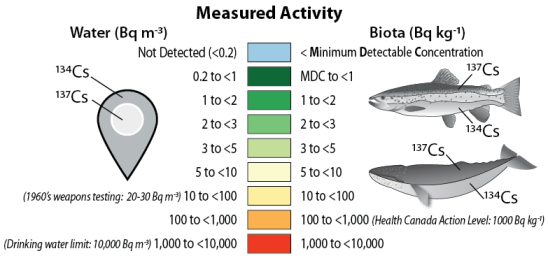
Current status:
Coastal monitoring: Seventeen more samples are in the books. Mostly from March and a few from April; no coastal samples contained any of the Fukushima fingerprint isotope, 134Cs (2 year half-life). Low levels of 137Cs (~30 year half-life) were present in all of the samples. These new data continue to lie along the increasing trend which indicates that the leading edge of the Fukushima plume is in BC’s coastal waters.

Monthly averaged 137Cs data from the BC coast collected by the InFORM citizen science network between October 2014 and March 2016. The dashed linear trendline shows that levels of 137Cs have been increasing over this period. Error bars indicate one standard deviation. Large error bars in Februray and May 2015 were months when Ucluelet samples tested positive for 134Cs. Colors are the same as used in the spatial map of the data.
The above trend is clear and shows a steady rise that would predict that the average sample will have double the initial background concentrations of 137Cs sometime this summer. While still far below the 10,000 Bq m-3 level of concern for cesium radionuclides in drinking water, these more contaminated samples should also more regularly contain the Fukushima fingerprint isotope, 134Cs.
While the increasing 137Cs trend is clear for the whole coast, it is also evident that each region is telling the story of how ocean waters circulate in coastal British Columbia.

Analysis as above, but with data grouped into regions as follows: Haida Gwaii / North Coast: Lax Kw’alaams, Prince Rupert, Masset, Hartley Bay, Sandspit, North Van Is / Central Coast: Bella Bella, Port Hardy, Winter Harbour, West Coast Van Is: Tofino, Ucluelet, Bamfield, Strait of Georgia: Powell River, Vancouver, Salt Spring Island, South Van Is: Port Renfrew, Victoria.
Looking at this regional graph and focusing on the period from August 2015 – March 2016, we see the highest concentrations of 137Cs shift from appearing on the west coast of Vancouver Island northward to Haida Gwaii. As explored last month, this could indicate a northward shift of the North Pacific Current bifurcation.
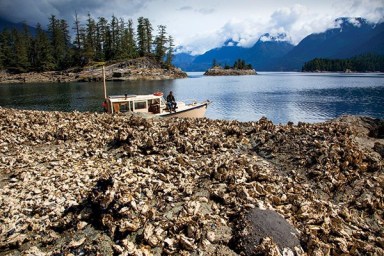
Biotic Monitoring:
Summer sampling season is back! We’re coordinating with many of the same First Nations as in 2015 for repeat sampling of the same salmon populations. In addition to salmon, this year we are joined by Dr. Helen Gurney-Smith from Vancouver Island University who specializes in marine invertebrates. She is coordinating the collection of mussels, clams, oysters, and scallops from all of the major shellfish beds in BC waters including Baynes Sound, Quadra Island, and Haida Gwaii. These samples will be new species in our sampling repertoire and will help us see how sessile organisms take up Fukushima radionuclides along the coast. The resulting data will be valuable to invertebrate scientists like Dr. Gurney-Smith and reassure consumers of the the $33 million BC shellfish industry.
Oceanic Monitoring:
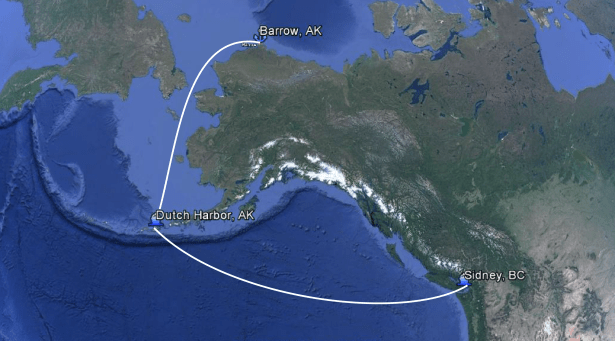
Three research cruises will collect InFORM samples this summer. Two out to Ocean Station Papa in the central NE Pacific, and currently, undergrad Saskia Kowallik is aboard the CCGS Sir Wilfred Laurier enroute from Sidney, BC to Dutch Harbor, then onto Barrow, AK. She will be reporting in a few times while away and you can read her first dispatch here.
Additionally, Dr. John Smith says that initial results from the February 2016 Line P cruise indicate that the concentrations of 134-Cs may have plateaued at Ocean Station Papa and possibly slightly decreasing. This isn’t so much a true decline as it is a smearing of the signal as the radionuclides are dispersing throughout the rest of the NE Pacific. In other interesting news, Dr. Smith just returned from a meeting in China where a colleague used a highly specialized gamma spectrometer and a very large volume of water sampled in the Chuckchi Sea to detect the trace level of 134-Cs that is ~5 times lower than the detection threshold (0.2 – 0.4 Bq m-3) for the instrumentation used at the University of Ottawa where the coastal samples are processed. This means that minute amounts of Fukushima contamination are entering the Arctic Ocean and that that it only takes ~5 years for waters to transit from coastal Japan to the Arctic. With the ability to detect such low levels of contamination, it will be interesting to see what else we can learn about oceanic transport times as monitoring continues into the future.
*Note: Results are preliminary and may be slightly adjusted pending results from further chemical analysis.
To carry better the Fukushima radioactive water into the ocean

New Drainage Channels Start Operations at Fukushima Daiichi Nuclear Power Station
More Drainage “Improvements” at Fukushima Daiichi: In advance of typhoon season, rainwater drainage has been further improved by the construction of a new drainage channel. The channel runs between Units 5-6 and the cluster of Units 1-4. It carries water into two drainages, both of which empty into the protected port area and not the open ocean. The new channel helps manage the increased runoff that results from extensive hard-surfacing that has been done to reduce radiation, prevent rainwater from seeping into the ground, and in turn “improve the environment”.
http://www.tepco.co.jp/en/news/library/archive-e.html?video_uuid=tq4l2aqa&catid=69631
Radioactive material from Fukushima plant coming back to Japan in the Pacific
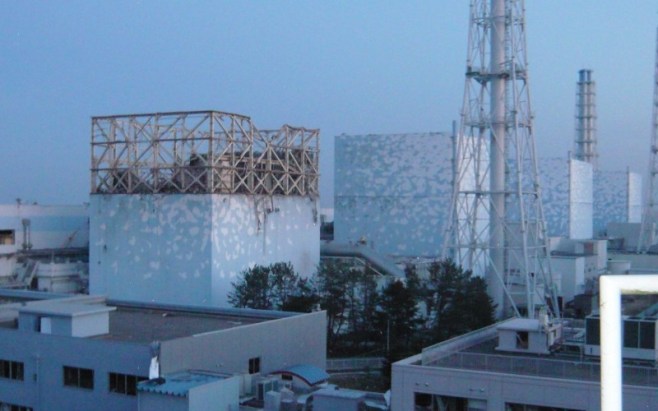
Prof. Aoyama from Institute of Environmental Radioactivity of Fukushima University reported that the radioactive material discharged from Fukushima plant circulated in the Pacific to come back to Japan offshore.
He implemented seawater analysis at 71 points from 11. 2015 to 2. 2016. The analysis is partially completed to show radioactive material has spread to the South West offshore of Japan. 2 Bq/m3 of Cs-137 was detected in seawater from South West offshore of Kyushu. 1.83 Bq/m3 was detected even offshore of the west coast of Japan.
0.38 Bq/m3 of Cs-134 was also measured to prove this is from Fukushima accident.
It is assumed that the discharged Cs-134/137 travelled to the east in the Northern Pacific. It was carried to the South and West to come back to Japan by taking 2 ~ 3 years.
He comments it is possible that the density of radioactive material increases from now.
http://www.asyura2.com/16/genpatu45/msg/611.html
Radioactive material from Fukushima plant coming back to Japan in the Pacific
Microscopic particles in oceans – From Fukushima to the USA in 1277 days

A new study published in Nature Communications reveals the global dispersal of plankton, but also provides insights for distribution of plastics, radioactive material and other pollutants.
New study in Nature Communications models global connectivity of the entire planet’s ocean surface
The distance between Fukushima and the west coast of the United States is about 8700 kilometres. If microscopic particles – like phytoplankton or radioactive isotopes – were to travel that fifth of the world’s circumference, it seems like that would take ages.
However, the world is not so big after all, since that is not actually the case.
A new study co-authored by centre researcher, James Watson, recently published in Nature Communications found that the earth’s global surfaces are highly connected.
http://www.nature.com/ncomms/2016/160419/ncomms11239/full/ncomms11239.html
By investigating the largely underexplored and rarely quantified mechanisms of global surface connectivity, Watson and his co-author Bror Jonsson from Princeton University found that microscopic particles can reach all regions of the ocean in only a decade.
This study emerged from contrasting camps of ideas about planktonic community dispersal in ocean ecosystems: one suggesting that everything is connected and environmental conditions decide where species live; another proposing that spatial isolation leads to genetically distinct species; and another suggesting that both of those ideas fail to tell the whole story.
On top of that, the time it takes for planktonic communities to travel around the ocean surface is a question that is still largely unresolved.
“These short surface-connection times are relevant to anyone studying dispersion in the surface ocean beyond planktonic species, including radioactive materials, plastics and other forms of pollution”
James Watson, co-author
Modeling global surface current connectivity
To tackle these inconsistencies in understanding and questions about time, Watson and his co-author create a model to track particles moving across the global ocean surface. To do this they use a number of different concepts and techniques.
This study uses minimum connection time, the fastest time that particles can travel from one location to another, instead of the commonly used expected connectivity time, which uses mean travel time. Watson notes there are two advantages to this approach.
“Minimum connection time is a more appropriate metric for phytoplankton and bacterial connectivity since asexually reproducing organisms have high reproductive output that attenuates low dispersal probabilities. Additionally, mean transit times in the global ocean are not well defined, as water can recirculate eternally and, hence, every particle seeded in a given patch eventually will reach all other patches if enough time is provided,” explains Watson.
Calculating minimum connection times from Lagrangian particle tracking, a method for understanding computational fluid dynamics, the authors described the global ocean as a network “with patches in the ocean as nodes and minimum connection times as edges connecting the nodes.”
The authors then considered each patch pair and multi-step connections, or in other words particles traveling along a number of patches, and applied Dijkstra’s algorithm, commonly used for finding the shortest path between nodes, to create a network of minimum connection times between every region of the ocean’s surface.
The authors point out that while this global network does account for timescales of physical connectivity, they do not account for environmental factors which undoubtedly play a role in connectivity.

Radioactive reality
While the idea for this study emerged from tiny plankton, the results have blue whale-sized relevance for other ocean surface traveling objects.
Furthermore, these results could in the future help us understand and prepare for how long it takes harmful particles to connect across the globe – like from Fukushima to western United States, or plastics aggregating along the coasts.
“A real example is the 2011 Fukushima disaster, in which a Japanese nuclear reactor released a large quantity of radioactive isotopes into the Pacific Ocean. Traces of radioactivity were detected on the Pacific Coast of the US in November of 2014 – 3.6 years later. Our estimated minimum connectivity time between the Fukushima release site and its detection site of the US west coast is 3.5 years,” explains Watson, an indirect verification of their method.
From a planktonic perspective, the results suggest that planktonic communities may be able to keep pace with climate change by changing locations to better suit their preferred environmental niche.
In a bigger global perspective, Watson concludes that these results, “quantify the effects of global-scale dispersal on how marine communities can adapt to their changing ocean environment.”
The timescales of global surface-ocean connectivity
http://www.nature.com/ncomms/2016/160419/ncomms11239/full/ncomms11239.html
From Fukushima to the USA in 1277 days
Global surface-ocean connectivity
Massive amounts of radiation continue daily to enter Japan’s water and air, and the Pacific Ocean
Nuclear engineer Arnie Gundersen on Fukushima@5, Mar 7, 2016 (emphasis added): Massive amounts of radiation continue to enter Japan’s water and air, and the Pacific Ocean, daily… Due to its triple meltdowns and the unmitigable radioactive releases, Fukushima Daiichi will continue to bleed radiation into the Pacific Ocean for more than a century… There is no road map to follow with directions to stop the ongoing debacle…
Nuclear engineer Arnie Gundersen on KPFA, Mar 30, 2016: [Univ. of California] Berkeley’s nuclear program has been in the forefront of the pro-nuclear propaganda for decades, and since Fukushima has been aggressively downplaying the significance of it. So, whatever comes out of Berkeley, I just attribute to a very pro-nuclear faculty… [Woods Hole Oceanographic Institution is] measuring 1,000 miles offshore [of the US West Coast] and… picking up 10 becquerels per cubic meter [Bq/m3]. At my point, that’s when my alarm bells go off is 10 [Bq/m3]… That plume is still coming, the Pacific is a huge place and to think that a disaster on the opposite side of the world can be detected and begin to contaminate California, I think that the monumental shattering conclusion [is] radiation knows no borders… So this ‘dilution is the solution to pollution’ is what I think Berkeley believes in. What you can be sure of is that somebody’s going to die from the radiation that’s in the Pacific, but you just won’t know who it is – and they’re counting on that. The nuclear establishment is saying, ‘Well, we can smear that out in a broader epidemiological study.’
Nuclear engineer Arnie Gundersen on CCTV, Apr 5, 2016: We’re looking at newspaper coverage from the last couple of weeks and it’s clear that the plant continues to hemorrhage.
Fairewinds Japan Speaking Tour Series No. 1, Feb 12, 2016:
- Nuclear engineer Arnie Gundersen: [T]he Fukushima power plants… continues to bleed into the Pacific every day. But what no one is paying any attention to is that the entire mountain range that runs 100 miles up and down this coast is also contaminated. And as much radiation is pouring out… into the Pacific from the mountain range because it’s so contaminated, as from the Fukushima site… in fact, they’ve got an entire state pouring radiation into the Pacific. So what’s in the Pacific? Off of California, they’re finding radiation at what I would consider significant levels… in a cubic meter of ocean water, they’re finding 10 radioactive decays every second… So a cubic meter of water, if you’re in a dark room, would have 10 flashes of light every second, and that’s going to go on for 300 years. So we have contaminated the biggest source of water on the planet, and there’s no way to stop it.
- Maggie Gundersen, founder of Fairewinds: So are you saying that the contaminated water problem is hopeless? Is there nothing we can do to slow it down?
- Arnie Gundersen: It used to be that scientists believed dilution is the solution to pollution. But I think we’re finding with the biggest body of water on the planet, that you can’t dilute this stuff. And we’re going to begin to see this bio-accumulation, which is all the fish that are in the ocean are going to uptake the cesium and the strontium and become more and more and more radioactive…
Continuous Leaking Of Radioactive Strontium, Cesium From Fukushima To the Ocean

Scientists from the Universitat Autònoma de Barcelona (UAB) investigated the levels of radioactive strontium and cesium in the coast off Japan in September 2013. Radioactive levels in seawater were 10 to 100 times higher than before the nuclear accident, particularly near the facility, suggesting that water containing strontium and cesium isotopes was still leaking into the Pacific Ocean.
March 11 will be the 5th anniversary since the nuclear accident in Fukushima, Japan. The Tohoku earthquake and the series of tsunamis damaged the Fukushima Dai-ichi Nuclear Power Plant (FDNPP) causing a massive release of radioactivity into the atmosphere and the Pacific Ocean. Since then, the Tokyo Electric Power Company (TEPCO) and the Japanese authorities have focused on controlling the water flowing in and out of the FDNPP and on decontaminating the highly radioactive water used as coolant for the damaged reactors (about 300 m3 a day, cubic meter = 1000 L). This cooling water is then stored in tanks and, to some extent, being decontaminated.
A new study recently published in Environmental Science and Technology, uses data on the concentrations of 90Sr and 134,137Cs in the coast off Japan from the moment of the accident until September 2013, and puts it into a longer-time perspective including published data and TEPCO’s monitoring data available until June 2015. This study continues the work initiated after the accident in 2011 by some of the authors. These and other partners from Belgium and Japan are currently involved in the European FRAME project lead by Dr. Pere Masqué that aims at studying the impact of recent releases from the Fukushima nuclear accident on the marine environment. FRAME is encompassed within the European COMET project (https://wiki.ceh.ac.uk/display/COM/COMET-FRAME).
Seawater collected from the sea surface down to 500 m between 1 and 110 km off the FDNPP showed concentrations up to 9, 124 and 54 Bq·m−3 for 90Sr, 137Cs and 134Cs, respectively. The highest concentrations, found within 6 km off the FDNPP, were approximately 9, 100 and 50 times higher, respectively, than pre-Fukushima levels. Before the accident, the main source of these radionuclides was atmospheric deposition due to nuclear bomb testing performed in the 1950s and 1960s. The presence of 134Cs (undetectable before the accident) and the distinct relationship between 90Sr and 137Cs in the samples suggested that FDNPP was leaking 90Sr at a rate of 2,3 — 8,5 GBq d-1 (giga-Becquerel per day) into the Pacific Ocean in September 2013. Such a leak would be 100-1000 times larger than the amount of 90Sr transported by rivers from land to ocean. Additional risk is related to the large amounts of water stored in tanks that have frequently leaked in the past. These results are in agreement with TEPCO’s monitoring data which show levels of 90Sr and 137Cs up to 10 and 1000 times higher than pre-Fukushima near the discharge channels of the FDNPP until June 2015 (most recent data included in the study). The presence of 90Sr and 134,137Cs in significant amounts until 2015 suggests the need of a continuous monitoring of artificial radionuclides in the Pacific Ocean.
Continuous Leaking Of Radioactive Strontium, Cesium From Fukushima To the Ocean
Radioactivity In Our Ocean: Fukushima & Its Impact On The Pacific
Ken Buesseler, Woods Hole Oceanographic Institution, Sep 14, 2015:
- 1:02:15 — Buesseler: “There have been ongoing releases… being maintained at higher levels… The groundwater is almost impossible to stop, so that will continue for decades… very hard to contain. Ice dams, things you can engineer to stop them, have never been done on this scale before, so it’s hard to predict what’s going to happen.”
- 1:09:30 — Audience Q&A: “Can anyone — scientists, physicists, anyone — really estimate the levels that are coming out of Fukushima on a daily basis? This rain event… how could anyone possibly estimate what is going… it’s disingenuous … to make these kind of assumptions — that it ‘probably’ won’t be a problem in the future. How can anyone say that? It’s never happened before… I don’t know where these predictions can really be nailed down, and was wondering your opinion on that as a couple of ‘good scientists’ (laughs).”
- 1:11:00 — Buesseler: “Fair points. It’s never happened before, it’s somewhat unpredictable and dynamic… There’s certainly not enough information. I was very frustrated after the rain event to find almost no information about the amount and levels that were in the ocean… There are some monitoring sites right in the harbor, and you can actually see the level of cesium go up from 1,000 of my units to 3,000 — so there was an impact. How long that’s going to continue? I can’t tell you… How it’s going to change in the future? We hope it gets back down to the levels that were near zero, but it never will be. It’s going to be — for decades, anyway — a site of continuous release… that’s what keeps me up at night, are continuous leaks that could happen at that site.”
1 This Month
10 March A LIVE WEBINAR THE REAL EFFECTS OF NUCLEAR POWER
What the Industry Isn’t Telling Us
1:00 PM Mountain, 2 pm Central, 3 pm Eastern. Live on the Keepers of the Water Facebook page



18 March Webinar @ 1 PM EST: An Assessment of SMR Projects: The Case of Canada
register for the zoom:
https://us02web.zoom.us/webinar/register/WN_o8BIIOUvQ2ONJR1nta65DQ#/registration


of the week – STOP SMALL MODULAR REACTORS IN CANADA
To see nuclear-related stories in greater depth and intensity – go to https://nuclearinformation.wordpress.com
-
Archives
- March 2026 (119)
- February 2026 (268)
- January 2026 (308)
- December 2025 (358)
- November 2025 (359)
- October 2025 (376)
- September 2025 (258)
- August 2025 (319)
- July 2025 (230)
- June 2025 (348)
- May 2025 (261)
- April 2025 (305)
-
Categories
- 1
- 1 NUCLEAR ISSUES
- business and costs
- climate change
- culture and arts
- ENERGY
- environment
- health
- history
- indigenous issues
- Legal
- marketing of nuclear
- media
- opposition to nuclear
- PERSONAL STORIES
- politics
- politics international
- Religion and ethics
- safety
- secrets,lies and civil liberties
- spinbuster
- technology
- Uranium
- wastes
- weapons and war
- Women
- 2 WORLD
- ACTION
- AFRICA
- Atrocities
- AUSTRALIA
- Christina's notes
- Christina's themes
- culture and arts
- Events
- Fuk 2022
- Fuk 2023
- Fukushima 2017
- Fukushima 2018
- fukushima 2019
- Fukushima 2020
- Fukushima 2021
- general
- global warming
- Humour (God we need it)
- Nuclear
- RARE EARTHS
- Reference
- resources – print
- Resources -audiovicual
- Weekly Newsletter
- World
- World Nuclear
- YouTube
-
RSS
Entries RSS
Comments RSS
 nuclear-news