OLYMPICS/ IOC’s Bach and Abe make brief visit to Fukushima
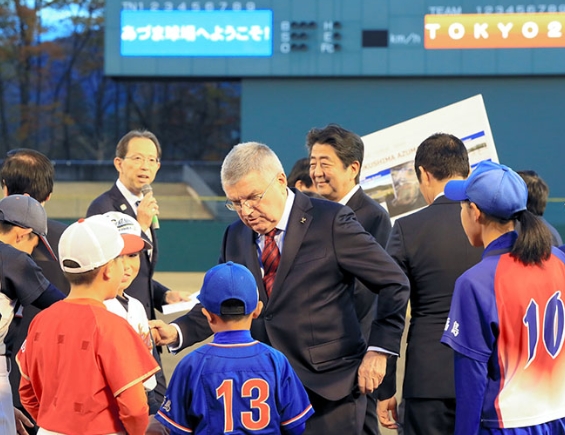 IOC President Thomas Bach, center, visits a baseball stadium in Fukushima with Prime Minister Shinzo Abe on Nov. 24.
November 24, 2018
FUKUSHIMA–IOC President Thomas Bach and Prime Minister Shinzo Abe made a quick trip Saturday to the region northeast of Tokyo that was devastated by a 2011 earthquake and tsunami that destroyed three nuclear reactors.
The Fukushima region will hold baseball and softball games during the 2020 Tokyo Olympics.
The visit was intended to showcase a region that government officials say is safe, except for a no-go zone around the nuclear plant. Environmental groups have disputed some government claims and have raised safety concerns.
Neither Abe nor Bach took questions after visiting a baseball stadium and meeting with local residents and athletes.
Government officials want the Olympics to convince a world audience that the region is safe.
Bach is in Japan for a week of meetings with Tokyo Olympic organizers and national Olympic officials for about 200 countries.
http://www.asahi.com/ajw/articles/AJ201811240041.html
Olympics chief part of the propaganda to minimize the seriousness of the nuclear catastrophe at Fukushima
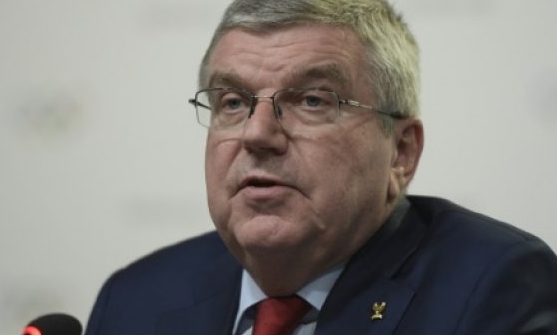 Olympics chief Thomas Bach will visit a stadium set to host 2020 Olympic baseball and softball games in Fukushima.
November 21, 2018
International Olympic Committee President Bach will on Saturday visit a stadium set to host 2020 Olympics baseball and softball games, and meet 60 students who play the sports, organisers said in a statement.
Bach will also speak with local high school students and meet Fukushima Governor Masao Uchibori. Japanese Prime Minister Shinzo Abe has expressed hopes of showing the world the recovery of Fukushima and other disaster-hit areas during the sporting event, for which Tokyo is the designated host city.
Fukushima was also chosen as the starting point for the Olympics torch relay.
The passing of the flame is scheduled to start on March 26, 2020, and the torch will head south to the subtropical island of Okinawa — the starting point for the 1964 Tokyo Games relay — before returning north and arriving in the Japanese capital on July 10.
The March 2011 tsunami, triggered by a massive undersea quake, killed around 18,000 people and swamped the Fukushima nuclear plant, sending its reactors into meltdown and leading to the world’s worst nuclear disaster since Chernobyl.
Tens of thousands of people evacuated their homes. Authorities have been working to rebuild the region, about 240 kilometres (150 miles) north of Tokyo, although areas near the crippled plant remain uninhabitable because of radiation dangers.
https://www.france24.com/en/20181121-revival-hopes-olympics-chief-set-visit-fukushima
Tell World Leaders: No Fukushima 2020 Olympics
ON BECQUEREL AWARENESS DAY, SUNDAY, APRIL 10, 2016, FUKUSHIMA FALLOUT AWARENESS NETWORK (FFAN) LAUNCHES ITS PETITION/CAMPAIGN TO URGE WORLD LEADERS TO SAY NO TO HOSTING THE 2020 JAPAN OLYMPICS/PARALYMPICS IN FUKUSHIMA PREFECTURE!
Children are now in training to compete at the 2020 Japan Olympics in close proximity to the most devastating and ongoing nuclear and industrial disaster in world history. Our children are our most beloved and cherished gift; and as such, we know they are the most vulnerable to the generational damaging effects of man-made radiation in air, soil, food and water. On March 11, 2016, on the occasion of fifth anniversary of the Fukushima triple nuclear meltdowns, Japan’s 2020 Olympic Minister, Toshiaki Endo, stated to the Associated Press that preliminary softball, baseball and possibly other games like soccer, would very possibly be moved from the host city of Tokyo to Fukushima Prefecture!
FACTS:
1) The International Commission on Radiological Protection (ICRP) guideline for the public is 1mSV/year compared to Japan’s at 20mSv/year due to the disaster. By hosting the 2020 Olympics, Japan is willing to expose not only their own citizens but also children, their families and coaches worldwide to higher than publicly acceptable levels of radiation per the ICRP.
2) There is no safe dose. The Biological Effects of Ionizing Radiation 7 (BEIR 7) Report unequivocally states that there is no threshold of exposure below which solid cancers are not induced.
3) Even after thirty years, the 30km area around Chernobyl remains an exclusion zone. This fact makes holding the 2020 Olympics in Fukushima even more shocking. There is no possible way to return Japan to normal in 2020 after the triple nuclear meltdowns, as explosions and ongoing ensuing leaks and incineration of radioactive waste are still happening in the wake of Fukushima Daiichi.
FFAN stands in solidarity with the children and families of Japan and is committed to educating the public about the dangers of man-made radiation. In our effort to raise awareness worldwide, FFAN is asking people everywhere to SIGN and SHARE this PETITION to Japanese Ambassador Caroline Kennedy, the State Department, UNICEF and other world leaders HERE: http://chn.ge/22j0Xko
Holding the Olympics and Paralympics in Fukushima, or in fact anywhere in Japan, will not make the problems of radioactive contamination go away. To the contrary, it will only spread cancer and other diseases farther afield worldwide. Let them know the whole world is watching this most dangerous game.
(Please RSVP here and join us on our EVENT PAGE: https://www.facebook.com/events

Japan Olympics minister backs Fukushima as host venue for 2020

Toshiaki Endo, center, minister in charge of the 2020 Tokyo Olympics
TOKYO – Japan’s Olympics minister says he hopes Fukushima prefecture can host preliminary rounds of baseball and softball at the 2020 Games.
Toshiaki Endo made the comments Friday on the fifth anniversary of a magnitude 9.0-earthquake that struck offshore and triggered a devastating tsunami, killing more than 18,000 people.
The Fukushima nuclear power plant spewed radiation after being hit by the tsunami. About 180,000 people in the northeastern region of Japan remain displaced because of the disaster.
Local organizers have recommended to the International Olympic Committee that baseball and softball be added to the program for the 2020 Games, allowing areas outside Tokyo to host events.
Other prefectures in the region will host games at the Rugby World Cup in 2019 and first-round soccer matches at the 2020 Olympics.
Japan Olympics minister backs Fukushima as host venue for 2020
Japan lifts evacuation orders on irradiated towns in preparation for 2020 Summer Olympics

The Japanese government recently announced they are lifting a four-year evacuation order on a town located 10 miles from the Fukushima disaster site, allowing residents to return full-time if they so desire, according to reports.
The evacuation order was issued in 2011 for the town of Naraha, which was among seven municipalities that were forced to vacate following a 15-meter tsunami triggered by an earthquake, subsequently resulting in the meltdown of three of Fukushima’s Daiichi reactors.
The Daily News reports:
Officials have said radiation levels in Naraha have fallen to levels deemed safe following decontamination efforts.
But according to a government survey, 53% of evacuees from Naraha, which is 12 miles south of the plant, say they’re either not ready to return home or are undecided. Some say they have found jobs elsewhere over the past few years, while others cite radiation concerns. Some houses are falling down, and wild boars roam at night.
About 100,000 people from about 10 municipalities around the wrecked plant still cannot go home. The government hopes to lift all evacuation orders except for the most contaminated areas closest to the plant by March 2017 — a plan many evacuees criticize as an attempt to showcase recovery ahead of the 2020 Tokyo Summer Olympics.
Other reports have raised concerns over dangerous radiation levels recorded in the area, as well as the town’s lack of infrastructure.
U.S. News and World Report states:
In the once-abandoned town, a segment of a national railway is still out of service, with the tracks covered with grass. Some houses are falling down and wild boars roam around at night.
Only about 100 of the nearly 2,600 households have returned since a trial period began in April. Last year, the government lifted evacuation orders for parts of two nearby towns, but only about half of their former residents have returned.
Source: Fukushimaz Watch
1 This Month

of the week – Shut Down Drone Warfare!


Tell the Ukrainian Government to Drop Prosecution of Peace Activist Yurii Sheliazhenko

Petition to revoke the licensing of the Near Surface Nuclear Disposal Facility (NSDF) at Chalk River. https://www.ourcommons.ca/petitions/en/Petition/Details?Petition=e-7247
To see nuclear-related stories in greater depth and intensity – go to https://nuclearinformation.wordpress.com
-
Archives
- April 2026 (68)
- March 2026 (251)
- February 2026 (268)
- January 2026 (308)
- December 2025 (358)
- November 2025 (359)
- October 2025 (376)
- September 2025 (257)
- August 2025 (319)
- July 2025 (230)
- June 2025 (348)
- May 2025 (261)
-
Categories
- 1
- 1 NUCLEAR ISSUES
- business and costs
- climate change
- culture and arts
- ENERGY
- environment
- health
- history
- indigenous issues
- Legal
- marketing of nuclear
- media
- opposition to nuclear
- PERSONAL STORIES
- politics
- politics international
- Religion and ethics
- safety
- secrets,lies and civil liberties
- spinbuster
- technology
- Uranium
- wastes
- weapons and war
- Women
- 2 WORLD
- ACTION
- AFRICA
- Atrocities
- AUSTRALIA
- Christina's notes
- Christina's themes
- culture and arts
- Events
- Fuk 2022
- Fuk 2023
- Fukushima 2017
- Fukushima 2018
- fukushima 2019
- Fukushima 2020
- Fukushima 2021
- general
- global warming
- Humour (God we need it)
- Nuclear
- RARE EARTHS
- Reference
- resources – print
- Resources -audiovicual
- Weekly Newsletter
- World
- World Nuclear
- YouTube
-
RSS
Entries RSS
Comments RSS
 nuclear-news