This week – nuclear news to 22 July
Some bits of good news. Support for parents and children from birth. Montenegro signs the Declaration on Children, Youth and Climate Action
TOP STORIES.
Nuclear industry faces acute cybersecurity threats – report.
International Court of Justice Tells Israel to End Occupation of Palestinian Territories, Pay Reparations.
- History of Ionizing Radiation and Human Health.
- ‘Low level’ ionizing radiation, and the history of debate about its effects.
- Time to confront to cover-up of the harm of low-level radiation.
- History of the medical profession’s role in illnesses and death caused by nuclear radiation. (Originals at https://ionizingradiationandyou.blogspot.com/)
From the archives. An unacceptable risk to children
Climate. 27 Ways Heat Can Kill You – Update 2024
Noel’s notes. The cover-up of the danger of nuclear radiation and health, but who is speaking for our grandchildren? Nuclear power -costs, wastes, etc, but what about the children? More American media madness.
********************************************
AUSTRALIA. Lots m of Australian nuclear news at https://antinuclear.net/2024/07/17/australian-nuclear-news-headlines-week-to-22-july/
………………………………………….
NUCLEAR ITEMS.
| ART and CULTURE. The chilling map that shows the devastation of a nuclear attack on Scotland. | ATROCITIES. Israeli soldiers tell story of savage cruelty in Gaza – one given blessing by the West. | CIVIL LIBERTIES. Never Forget Julian Assange. https://www.youtube.com/watch?v=5ZLbFkv7I4k |
| ECONOMICS. Premier of New Brunswick Higgs suggests New Brunswick’s Small Nuclear Reactors may not win race to commercialization. ALSO AT https://nuclear-news.net/2024/07/19/2-b1-premier-of-new-brunswick-higgs-suggests-n-b-s-smrs-may-not-win-race-to-commercialization/ France’s EDF faces fresh setback after losing Czech nuclear bid. | ENERGY. China is installing the wind and solar equivalent of five large nuclear power stations per week. Nuclear does not mean reliable power for Australia – by Peter Farley. What are the steps (and the COSTS) to building nuclear power stations – by Peter Farley |
| ENVIRONMENT. EDF’s plans to create new saltmarsh. | EVENT. Cold War Scotland – Exhibition National Museum of Scotland24 July. Rally – Washington – Stop the Gaza Genocide . |
| HEALTH. Radiation.New Book. The Scientists Who Alerted us to Radiation’s Dangers.Mounting evidence of cancer risk from low dose radiation in childhood, or in the uterus.Specific Radioactive Elements and Their Effects on Health – (Original at https://ionizingradiationandyou.blogspot.com/) | INDIGENOUS ISSUES. In New Mexico, a Walk Commemorates the Nuclear Disaster Few Outside the Navajo Nation Remember. | LEGAL. Overwhelming ICJ Ruling against Israeli Occupation Highlights Need for UN Action. ActionAid welcomes the historic judgment of the International Court of Justice. |
| MEDIA. With Media Enamored by US Presidential Race, Israeli Massacres in Gaza Get Even Deadlier. | OPPOSITION to NUCLEAR . Anti-nuclear weapons activists to camp outside RAF base for ten days. Nuclear Free Local Authorities challenge UK government on New Cleo’s application for “justification” of its small nuclear “fast” reactor. Nuclear convoys travelling to Coulport should be peacefully stopped |
| PERSONAL STORIES. Testimonies from the Mawasi massacre: 90 people buried in the sand. | PLUTONIUM . North Korea’s Yongbyon Nuclear Complex: New evidence of increased activity |
| POLITICS.J.D. Vance unlikely to advance peace advancing to Vice Presidency. UK: Ed Miliband unveils plans for mini-nuclear reactors ALSO AT https://nuclear-news.net/2024/07/22/1-b1-uk-ed-miliband-unveils-plans-for-mini-nuclear-reactors/Campaigners against Sizewell C hopeful new MPs will take their concerns to parliament. Absent but not missed: No mention of nuclear in King’s Speech. 80 CANADIAN ORGANIZATIONS CALL ON FEDERAL GOVERNMENT TO RESCIND APPOINTMENT OF NUCLEAR REGULATORY AGENCY PRESIDENT. | POLITICS INTERNATIONAL and DIPLOMACY.AUKUS – Australia-United Kingdom-United States nuclear pact endangers us all. Behind the plans for Australia to become a nuclear dumping ground and leverage synergies with the US military alliance and civilian nuclear. Saudi Arabia wants to fully recognize Israel in exchange for arms, nuclear facility — Biden.Nuclear-weapon states are disregarding political commitments accepted under the nuclear Non-Proliferation Treaty (NPT), |
| SAFETY. Major failure at southern Russia’s largest nuclear plant, 1 power unit shut down.‘Near miss’ incident reported at nuclear waste site near Carlsbad. High hopes and security fears for next-gen nuclear reactors | SPACE. EXPLORATION, WEAPONS. Space-Based Warfare: America’s Dominance Challenged.Please, No Weapons and Wars in Space. |
| SPINBUSTER. Shiny New MP’s Fizzingly Push For More Nuclear Waste – Hotter the better! And a Complaint to Advertising Standards – Standards? What Standards!. | TECHNOLOGY. Massive IT outage spotlights major vulnerabilities in the global information ecosystem. Small Modular Nuclear Reactors (SMRs)– Dirty Dangerous Distractions from Real Climate Action. | WASTES. Pacific leaders, Japan, agree on Fukushima nuclear wastewater discharge (not everyone is happy). Fukushima plant ends 7th round of treated water release into sea. |
| WAR and CONFLICT. Nuclear War Is Imminent. Exposing the Myth of the ‘Good War’US Ally South Korea Threatens Nuclear-Armed North Korea With Regime Destruction. | WEAPONS and WEAPONS SALES.Democrats to Keep Unconditional Military Aid to Israel in Party Platform. NATO’s Obscure Relations With Israel and its weapons industry. NATO/US Complicity in Israel’s Relentless Genocide of Gaza. Israel using water as weapon of war as Gaza supply plummets by 94%, creating deadly health catastrophe: Oxfam. North Korean nuclear weapons, 2024. China Stops Arms Control Talks With the US Over Arms Sales to Taiwan. Russia Says It May Deploy Nuclear Missiles in Response to New US Missile Deployment to Germany. |
Nuclear news to 2nd July

Some bits of good news –Nature restoration, rewilding and battery innovations: Positive environmental stories from 2024 A Living Seed Bank Is Preserving the Amazon’s Incredible Plants.
UK activists won a ‘stunning’ victory against big oil.
TOP STORIES
Julian Assange Is Finally Free, But Let’s Not Forget the War Crimes He Exposed. Julian Assange: Free at last, but guilty of practicing journalism. ‘Julian Assange Is Free’: WikiLeaks Founder Strikes Plea Deal With US. https://www.youtube.com/embed/4DF_Ag8NWeI?si=O-gRYvFVhtIaWfrG Assange Is Free, But US Spite Will Chill Reporting for Years.
Most important issue facing US, world, largely absent from presidential debate.
Save Ukraine from American meddling.
The Suspect Body Count: The Death Toll in Gaza is Much Higher Than We’re Being Told
From the archives. The persecution of Wilfred Burchett and Julian Assange.
Climate. Wildfires ravaging Arctic Circle – EU monitor. Deaths mount as Pakistan swelters in heatwave. Newly identified tipping point for ice sheets could mean greater sea level rise.
Noel’s notes. Australia’s Liberal-National Party really communist – wants a NATIONALISED NUCLEAR industry! The Assange case – a win for journalism? Sort of. Time to abandon the hypocrisy about Israel’s nuclear weapons – they are now a perilous target.
AUSTRALIA. Heaps of media about Peter Dutton’s plan to set up government-run-and funded nuclear industry – see all the article links at FROM 25 JUNE THE MOST RECENT AUSTRALIAN NUCLEAR NEWS.
The Coalition’s nuclear fantasy serves short-term political objectives – and its fossil fuel backers. Hidden costs? Cheaper energy? ‘Farcical’ locations? Debunking the hype around nuclear. How the media facilitates Dutton’s nuclear lies.
LABOR AGAINST WAR says nuclear power and nuclear submarines and their wastes should have no part in Australia. Nuclear option ‘not enough’ to avoid rush for more wind and solar. Nuclear more costly and could ‘sound the death knell’ for Australia’s decarbonisation efforts, report says.
Defence Minister Richard Marles takes on reality, comes off second-best in growing Thales scandal.
More news about Julian Assange – at Julian Assange News.
………………………………………………………………
NUCLEAR ISSUES
| CLIMATE. Climate-Nuclear Nexus. | CIVIL LIBERTIES. The State Failed to Break Assange |
ECONOMICS.
- Australian Opposition Leader Peter Dutton’s nuclear plan could cost as much as $600bn and supply just 3.7% of Australia’s energy by 2050, experts say.
- Nuclear power’s financial problems exposed in new report. Very late and over budget:
- Why newest large nuclear plant in US is likely to be the last.
- UK’s nuclear plant will cost nearly three times what was estimated.
| More ECONOMICS. CEO, staff suddenly depart New Brunswick reactor developer ARC Clean Technology. | EDUCATION. Small Modular Nuclear Reactors cost concerns challenge industry optimism. | ENERGY. “They just fit in with what we do:” Australian farmers reap rewards as they play host to wind and solar. Big Tech is turning to nuclear power because it needs more energy for AI. |
| ENVIRONMENT. The $91 billion wasted on nuclear weapons last year could transform ecosystem restoration. | EVENTS. Confronting NATO’s War Summit in Washington – 6 July | HISTORY. How Israel Became a Nuclear Power. |
| LEGAL. Why cost should not be an obstacle to compensating nuclear survivors Why WikiLeaks founder will plead guilty – and what happens next. | MEDIA. The Release of Julian Assange: Plea Deals and Dark Legacies. Webinar # 7 June 20, 2024 – What’s the harm? Julian Assange is finally free, but no thanks to the media. Radiation, Radioactive Emissions and Health. | OPPOSITION to NUCLEAR . A vigil behind bars: pair who protested US nuclear bombs in Germany serving time. Greenpeace activist climbs on top of Conservative election campaign bus. Uranium and the Grand Canyon – A Call to Close and Cleanup the Pinyon Plains Uranium Mine. |
| POLITICS. Congress’s Nuclear Addiction. U.S. Congress Votes To Bar State Department From Citing Gazan Health Ministry. Australia: Peter Dutton’s nuclear power plans are an ironic backflip to nationalisation for the Liberal Party. UK Election: A Different Kind of Nuclear Bomb. Nuclear weapons spending report reveals corporate intervention in UK nuclear policy – CND. Labour plans for nuclear expansion in Scotland are flying under the radar ALSO AT https://nuclear-news.net/2024/06/30/2-b1-labour-plans-for-nuclear-expansion-in-scotland-are-flying-under-radar/ | POLITICS INTERNATIONAL and DIPLOMACY. Iran Says Cooperation With UN Nuclear Watchdog Limited to Nuclear Non-Proliferation Treaty (NPT). The Australian Opposition party’s nuclear strategy relies on Trump winning the USA election, and tearing up global climate politics. |
| SAFETY. What does Chevron mean for nuclear? The USA courts can now supercede the safety role of the Nuclear Regulatory Commission. Scary truths on civilian nuclear power are coming to the fore. UK’s Nuclear weapons pose a risk to proposed new homes. | SECRETS and LIES. UK government hires scandal-ridden Fujitsu company to account and track its nuclear waste!. | SPINBUSTER. Complete BS from the IAEA about the non-existent “global consensus” on nuclear power. |
| TECHNOLOGY. Do thorium reactors prevent nuclear weapons proliferation risks? | WASTES. Japan starts 7th discharge of Fukushima nuclear-contaminated wastewater despite opposition. |
| WAR and CONFLICT. Unable to back down, Israel and Hezbollah move closer to all-out war. Israeli Defense Minister Vows to Return Lebanon to ‘Stone Age’. Israel’s main goal is the extermination of Palestinians – retired NATO colonel . Ukraine hit Russia’s space communications and early warning center. IDF Report Found Multiple Cases of Friendly Fire Deaths on Oct 7. The Nordic region from peace zone to war zone – https://www.youtube.com/watch?v=LahVN_wmftU Ukraine hit Russia’s space communications and early warning center. IDF Report Found Multiple Cases of Friendly Fire Deaths on Oct 7. WAR OR PEACE: Towards a Ukrainian Peace or a Direct NATO-Russian War. How far can American money push the Kiev regime’s suicidal war with Russia? | WEAPONS and WEAPONS SALES. Test site activity sparks fears of more nuclear blasts. The US nuclear arms control community needs a strategic plan. US can’t trace $62 million of military aid sent to Ukraine – watchdog.. |
TODAY. Time to abandon the hypocrisy about Israel’s nuclear weapons – they are now a perilous target
For many decades, the world, led by the USA, has swallowed the lie that nuclear weapons keep us safe.
“Deterrence” – what a hollow, hypocritical notion that is!
Along with that huge deception, there has been the deception that Israel does not have nuclear weapons -(it has 90 nuclear warheads, with fissile material stockpiles for about 200 weapons.)
Greedy, unethical, leaders of weapons manufacturers have continued to ply their wares – especially in the USA, but also among other Western powers, and Russia, and China, India, Pakistan, and Middle Eastern powers. And public and politicians have bought the lie, as clever lobbying preys on emotions of fear and patriotism.
Suddenly, the lie is all too apparent.
Why did Israel evacuate 91,000 citizens recently?
They feared an attack by Hezbollah.
Now that fear is starkly real – as Israel perpetrates atrocities on the Muslim people of Gaza, other Muslims are enraged and seek revenge.
What better target than Israel’s supposedly non-existent stash of nuclear weapons?
Apart from this current very real anxiety about Israel, this situation demonstrates the reality that nuclear weapons sites – (and indeed all nuclear sites) are the very opposite of public safety facilities.
It is almost comic, that politicians, and communities, seem comfortable with the idea of being incinerated, as long as the other side is incinerated too!
If by some magic, a nuclear conflagration in the Middle East is now avoided, perhaps the world will wake up to the peril of our safety deterrents being really our suicidal threats.
This week’s countering the nuclear spin

Some bits of good news. Solar Power’s Giants Are Providing More Energy Than Big Oil. Clean-Energy Investment This Year To Be Twice That of Fossil Fuels, IEA Says. A River’s Rights: Indigenous Kukama Women Lead the Way with Landmark Legal Victory.
TOP STORIES. Blinken made secret weapons promise to Israel – Netanyahu. The US, Russia, and Ukraine: 75 Years of Hate Propaganda. Nuclear-armed countries spent $2,898 per second last year on nuclear weapons. We’ve barely scratched the surface of how energy efficiency can help the energy transition.
Climate. Extreme heat and flash floods: Scientists warn of hazardous summer weather in Europe. Climate Emergency strikes Islam’s Holy Ritual, with nearly 600 dead of Heat stroke at 124.24° F. in Mecca. Saudi Arabia shuts pilgrims out of air-conditioned areas as more than 1,000 die in extreme heat.
Nuclear. Overwhelmed with Australian stuff this week!
Noel’s notes. Nuclear culture wars – especially in Australia. What a disaster, if the anti-war movement brings Donald Trump back to the White House!
*****************************************************************
AUSTRALIA Keep up to date at this site:
Australia’s media quagmire on nuclear power.
Lockheed Martin, Australian Government: joined at the hip. Australian Futures:
Bringing AUKUS Out of Stealth Mode, and the true financial costs.
*****************************************************************
NUCLEAR ISSUES
ECONOMICS. Big Tech Wants Nuclear Power But
Doesn’t See Role as Investor. Australian Opposition Leader Peter Dutton’s nuclear plan could cost as much as $600bn and supply just 3.7% of Australia’s energy by 2050, experts say. Nuclear power’s financial problems exposed in new report. Very late and over budget: Why newest large nuclear plant in US is likely to be the last. UK’s nuclear plant will cost nearly three times what was estimated.
| ENERGY. Why we are heading for a globally connected electricity system based on renewable energy. | EVENTS. Veterans for Peace Golden Rule Project 2024: the Pacific Northwest. | ETHICS and RELIGION. Ten Holocaust survivors condemn Israel’s Gaza genocide. |
| HEALTH. Nuclear industry workers face significant, inevitable and unavoidable radiation health risks. | LEGAL. Sellafield operators plead guilty to criminal charges over security breaches. Veterans for Peace Golden Rule Project 2024: the Pacific Northwest. | MEDIA. Comments to The Times: Nuclear won’t fix our energy crisis |
OPPOSITION to NUCLEAR .
Kenya’s first nuclear plant: why plans face fierce opposition in country’s coastal paradise.
POLITICS.
- Senate Nuclear Fetishists Take Lid Off of Pandora’s Box.
- No more ‘endless’ payments to Zelensky – Trump.
- Prime Minister Rishi Sunak reinforced his party’s commitment to nuclear energy UK nuclear power plants rollout may be hit by planning hurdles. ALSO AT https://nuclear-news.net/2024/06/22/1-b1-uk-nuclear-power-plants-rollout-may-be-hit-by-planning-hurdles/ Nuclear black hole could deal a knock-out blow to UK Labour’s renewable targets.
- Over budget and plagued with delays: UK nuclear lessons for Australia.
- Scotland’s First Minister Swinney hits back at ‘hopelessly ideological’ attack from nuclear industry.
- U.S. Congress passes bill to jumpstart new nuclear power tech, but it may be too little, too late.
- Gavin Newsom’s $12 Billion Radioactive Diablo Scam Could Soon Be Twisting In The Wind.
- Norway To Consider Developing Nuclear Energy.
| POLITICS INTERNATIONAL and DIPLOMACY.Why ‘no’ to NATO? U.S. and China hold first informal nuclear talks in five years, France’s Orano loses operating licence at major uranium mine in Niger. | SAFETY. ‘Lax’ nuclear security leaving UK at risk of cyber attacks from hostile nations. | SECRETS and LIES. Leaked doc reveals Israeli military KNEW of Hamas plan to raid and take hostages 2 weeks before Oct 7, Israeli news reports. |
SPACE. EXPLORATION, WEAPONS The United Nations Security Council takes up Space Security – it might have been best if it had not.
| SPINBUSTER. Australia’s Nuclear debate is getting heated, but whose energy plan stacks up? | WASTES. Specialised device tried to recover highly radioactive melted fuel at Fukushima plant. |
TECHNOLOGY. Researchers have doubts, but Bill Gates is hyping his new liquid-sodium nuclear reactor.URANIUM.
Iran’s Nuclear Point Man : We Won’t Bow to Pressure.
WAR and CONFLICT. Can Israel defeat Hamas? Its own military doesn’t seem to think so, clashing with Netanyahu. Delusional Netanyahu joins delusional Zelensky in seeking total victory when none possible. Israeli ‘extremist’ tells Australian audience Gaza should have been reduced to ashes.
Ukraine, Continued Aid, and the Prevailing Logic of Slaughter.
What nuclear annihilation could look like.
WEAPONS and WEAPONS SALES.
- Corporations are influencing government policy on nuclear weapons, a damning report shows.
- Congress will hold a hearing about the Sentinel missile’s exploding budget, but is it too little, too late?.
- NATO chief says members considering deployment of more nuclear weapons, Kremlin warns it’s an ‘escalation of tension’
- Top lawmakers sign off on massive US arms sale to Israel. Chutzpah: Netanyahu demands Biden give him more genocide weapons “to finish the job a lot faster.” Former Official: Biden State Department Bending US Law to Send Israel Weapons.
- Sweden opens doors to possible US nukes deployment.
- US greenlights new arms sale to Taiwan.
- Vandenberg Conducts Test Launch for Development of New Weapon System.
Nuclear news for the last week of March.

Some bits of good news. More Teens Than You Think Understand the Positive and Negative Aspects of Smartphones–Survey. India makes significant progress on malaria. Renewables blew gas away in the UK.
TOP STORIES
UK Court Gives Biden Chance to Dodge Assange Appeal by “Assuring” His Rights .
Spending Unlimited – The Pentagon’s Budget Follies Come at a High Price.
Air attacks on Ukraine have again put the Zaporizhzhia nuclear power plant(ZNPP), under Russian control, in danger. ALSO AT ………
Nuclear waste clean-up company to be prosecuted over alleged cyber blunders, lax security.
THE R.A.F’S NUCLEAR FLIGHTS OVER BRITAIN AND THE ATLANTIC.
Is Nuclear Fusion Really The Ultimate Solution to AI’s Crazy Power Use?
Climate. Oil company chief urges investment in fossil fuels, as world heats at a record pace. Antarctic sea ice ‘behaving strangely’ as Arctic reaches ‘below-average’ winter peak. Copernicus online portal offers a terrifying view of climate emergency.
Noel’s notes. Sellafield scandals – a case study in why the nuclear industry must be shut down. A world run by 11 year-old boys? The tiresome spin of the nuclear lobby in Australia.
******************************************************************
NUCLEAR ISSUES
ART and CULTURE. Decades of Dissent: Anti-Nuclear movement explored in LSE Library exhibition, London.
CIVIL LIBERTIES. The Empire Slowly Suffocates Assange Like It Slowly Suffocates All Its Enemies.
Arrested for peaceful protest against Israeli-owned military technology company.
ECONOMICS.
- UK’s ever more expensive nuclear submarines will torpedo spending plans for years to come.
- ‘Nuclear Dinosaurs’ Roam New Brunswick, Ontario as ‘Jurassic’ Partnership Looms.
- Nuclear energy everywhere costs an arm and a leg.
- EDF Names New Head of Nuclear Plant Projects Amid Cost Overruns.
- United Arab Emirates signals interest in European nuclear energy investments.
- Famous UK seaside town ‘decimated’ by £46bn nuclear power station and huge Pontins change.
| EDUCATION. Nuclear and weapons industry propaganda to schools. Missing Links in Textbook History: War | EMPLOYMENT. Sellafield’s head of information security to step down. | ETHICS and RELIGION. A Genocide Foretold. |
EVENTS. The First Annual Plutonium Trail Caravan is on Saturday April 6th – Join Us!
| LEGAL. Assange Extradition Delayed Unless US Provides ‘Assurances’ He Won’t Be Executed for Revealing the Truth. Chris Hedges: The Crucifixion of Julian Assange. Purgatorial Torments: Assange and the UK High Court. Now there are three court challenges against Ontario nuclear waste disposal facility. The Decision That Wasn’t A Decision. The Office for Nuclear Regulation (ONR) will prosecute Sellafield Ltd on charges of security offences. British nuclear site Sellafield to be prosecuted for cybersecurity failures. Court Allows Ageing Japanese Nuclear Plants to Continue Operations. | MEDIA. This is how nuclear war would begin – in terrifying detail. ‘My jaw dropped’: Annie Jacobsen on her scenario for nuclear war. Review: Annie Jacobsen’s ‘Nuclear War: A Scenario’ Will Make You Start Worrying And Hate The Bomb. The Rising Nuclear Threat: Readers respond to the “At the Brink” series of Opinion articles Einstein’s vision for peace. Oppenheimer: Monaghan man, Daniel A. McGovern, who captured nuclear devastation. |
| OPPOSITION to NUCLEAR . Scotland’s National Party attacks £200m extra for nuclear deterrent and industry. | POLITICS. Whaat! Romania’s state-owned Nuclearelectrica to partner with NuScale to build small nuclear reactors- U.S, government to give $1.52 billion loan guarantee to Holtec to resuscitate Palisades Nuclear Plant. IAEA Warns Of Iraq-Like Scenario For Iran Without Transparency Australian government seeks top quality PR team to persuade Aborigines that a nuclear waste dump is a good thing. |
| POLITICS INTERNATIONAL and DIPLOMACY. New NATO member Finland admits US pact ‘restricts sovereignty’. Biden claims binding UN Security Council Gaza ceasefire resolution is ‘non-binding.’ | PUBLIC OPINION. Most Americans now disapprove of Israel’s military action in Gaza new poll reveals as tensions rise between allies. | SAFETY. Atomic blackmail – Russia-Ukraine war and Ramberg’s theory of vulnerability. NRC admits San Onofre Holtec nuclear waste canisters are all damaged. Special nuclear flights between the US and UK: the dangers involved. Security concerns as UAE Eyeing Investments in Europe’s Nuclear Energy Sector. |
| SECRETS and LIES. IAEA Unaware Of Secret Iranian Nuclear Site Targeted By Israel. | SPINBUSTER.ChatGPT’s boss claims nuclear fusion is the answer to AI’s soaring energy needs. Not so fast, experts say. Cancer “epidemic” in the Young as Radioactive Wastes are Increasingly Dispersed to the Environment meanwhile Nuclear given “green” status in Brussels.. | TECHNOLOGY. Weaponizing Reality: The Dawn of Neurowarfare. New nuclear reactor types will not solve waste and safety issues. |
| WASTES. UK nuclear watchdog takes Sellafield nuclear waste operator to court over alleged IT breaches. Experts from Japan and China held talks on treated radioactive wastewater. Decommissioning. How much will extra decades of nuclear decommissioning work at Dounreay cost? Dounreay decommissioning date ‘never achievable’ says Caithness councillor Also at https://nuclear-news.net/2024/04/01/1-b1-dounreay-decommissioning-date-never-achievable-says-caithness-councillor/. | WAR and CONFLICT. Putin says Russia will not attack NATO, but F-16s will be shot down in Ukraine. Atrocities. Israel Remains Intent on Genocide Despite World Court Orders. Michigan Republican congressman says Gaza should be destroyed with nuclear bomb ‘like Nagasaki and Hiroshima’, as he slams US for sending humanitarian aid. | WEAPONS and WEAPONS SALES.Biden Is Quietly Funding Nuclear Weapons Upgrades That Could Imperil the Planet. The Nuclear Explosion That Makes US Aid to Israel Illegal. US secretly sending more bombs to Israel – Washington Post.. U.S., Germany Supplied 99% of Israel Weapons Import Despite Pressure: Data.France will help Brazil develop nuclear-powered submarines, Macron says.Nabbed Australian Protestors Stopping Military Shipment to Israel.UK to test new ‘Astraea’ nuclear warheads without detonation. |
This week in nuclear news
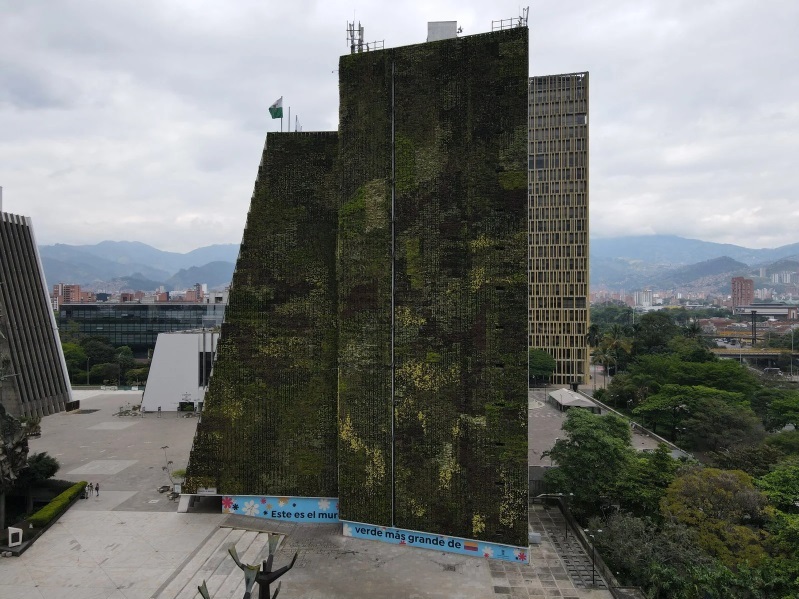
A vertical garden at Medellin’s City Hall.
Ralph Nader: Stop the Worsening Undercount of Palestinian Casualties in Gaza.
The horrors of nuclear weapons testing.
March 11 – reflecting on Fukushima.
********************************************
Climate. Climate change is warping the seasons. The world is not moving fast enough on climate change — social sciences can help explain why.Europe unprepared for rapidly growing climate risks, report finds.
Noel’s notes. The need for clear thinking on the Holocaust in Gaza. Oh for a bit of sanity and genuine leadership! Normalising the unthinkable – the 16th Annual Nuclear (so-called) Deterrence Summit.
NUCLEAR ISSUES
| EMPLOYMENT. Fukushima fishers strive to recover catches amid water concerns. | ENVIRONMENT. Hinkley Point Responds to Environmental Concerns Over Bristol Channel Eel Populations. | ETHICS and RELIGION. Aiding Those We Kill: US Humanitarianism in Gaza. The West has set itself on a path of collective suicide — both moral and economic’ Oceans. Could Fukushima’s radioactive water pose lasting threat to humans and the environment? |
| HISTORY. The lesson from the criminal H Bomb Bravo “test”– Hibakusha remind us. Oppenheimer feared nuclear annihilation – and only a chance pause by a Soviet submariner kept it from happening in 1962 | MEDIA. New York Times: Nuclear Risks Have Not Gone Away.US Media and Factcheckers Fail to Note Israel’s Refutation of ‘Beheaded Babies’ Stories. ‘Mr Dutton is right’: Murdoch’s News Corp papers grant nuclear power glowing coverage. NewsGuard AI Censorship Targets People Who Read Primary Sources To Fact-Check The News. – (a pro-Trumpist article?- but probably true) | OPPOSITION to NUCLEAR . ‘It’ll be a shortlist of one!’ Villagers in England fear nuclear dump proposal. An Open Letter from Hollywood On Oppenheimer and Nuclear Weapons. Kenya. Senator Omtatah to take the Uyombo nuclear power plant war international. |
| POLITICS Australia’s Opposition party’s nuclear red herring is a betrayal of the Australian people . – also at https://antinuclear.net/2024/03/11/1-a-coalitions-nuclear-red-herring-is-a-betrayal-of-the-australian-people/ . Australia has had many significant inquiries into nuclear power, over the past 60 years. Scottish National Party ministers to set out plans for removing nuclear weapons after independence. UK Labour versus Green. UK Budget: Government confirms £160m deal to acquire Hitachi nuclear sites. U.S. Congress about to fund revival of nuclear waste recycling to be led by private start-ups. | SAFETY. Greenpeace warns on danger of restarting Zaporizhzhia nuclear plant . Improvement notice served over storage of hazardous materials at Dounreay. ‘Sometimes I can’t sleep at night’: Adi Roche warns of nuclear risks of Ukraine conflict as she picks up peace award. Aberdeen shipping logistics company warned over nuclear transport safety failings.. | SPACE. EXPLORATION, WEAPONS. China outlines position on use of space resources. Russia says it is considering putting a nuclear power plant on the moon with China. Russia and China announce plan to build shared nuclear reactor on the moon by 2035, ‘without humans’. |
WEAPONS and WEAPONS SALES.
- The West’s over-involvement in Ukraine.
- F-35A aeroplanes officially certified to carry thermonuclear bomb. NATO bringing missiles closer to Russia – member state.
- Plutonium. Plutonium pit ‘panic’ threatens America’s nuclear ambitions. Does the US Need New Plutonium Pits?.
- Biden is building for Israel a super weapon to replace the Iron Dome.
- Coalition Kill Chain for the Pacific: Lessons from Ukraine. U.S. Sells ‘Link 16’ Battlefield Communications System to Taiwan – https://www.youtube.com/watch?v=SfF4In5Q99Q
- AUKUS: Are nuclear-powered submarines a good idea for Australia?
WOMEN. Our International Women’s Day Heroine: Rosalie Bertell.
Nuclear news – week to 29 January

A bit of good news. Pre-Pesticides, Pro-Farmer: The Rise of Agroecology
One part ancient practices, one part worker justice, a new-old way of farming is adapting agriculture for an uncertain world.
TOP STORIES.
NOWHERE TO HIDE – How a nuclear war would kill you — and almost everyone else.
Nuclear lobby “kills” nomination of regulator whocares too much about safety . also at https://nuclear-news.net/2024/01/23/3-a-nuclear-lobby-kills-nomination-of-regulator-who-cares-too-much-about-safety/
Nuclear hype in meltdown.
International Court of Justice Rules That Israel Must Stop Killing Palestinians.
Growing mountain of wasted money is a radioactive prospect. also at https://nuclear-news.net/2024/01/28/2-a-growing-mountain-of-wasted-money-is-a-radioactive-prospect/
Hinkley Point C woes threaten to break UK and France’s nuclear fusion.
Climate: Towards an unliveable planet: Climate’s 2023 annus horribilis
Nuclear. Lots about UK’s nuclear mess
Noel’s notes. A new Waterloo defeat for France – a nuclear economic one.
NUCLEAR ISSUES
| CLIMATE. Small modular reactors may have climate benefits, but they can also be climate-vulnerable EMPLOYMENT. Berkshire nuclear defence workers strike. | CIVIL LIBERTIES. In Assange’s Darkest Hour, Committee To Protect Journalists Yet Again Excludes Him From Jailed Journalist Index ENERGY. Microsoft Looks to Nuclear to Fuel AI Plans. | ECONOMICS. EDF a total basket case, weighed down by its 50 Billion pound nuclear turkey at Hinkley Point. Sorry, France, you’re on the hook at Hinkley Point. Hinkley Point is glowing on my doorstep, but that won’t help us get a bus into town. France to push UK government for additional support for faltering nuclear projects. US nuclear agency isn’t consistent in tracking costs for some construction projects, report says. NuScale / Countries Likely To ‘Double Down On Scrutiny’ Following SMR Project Cancellation. |
LEGAL. The ICJ’s Provisional Orders: The Genocide Convention Applies to Gaza.
Two Men Sentenced for Falsifying Documents Related to Testing of Equipment at Nuclear Power Plants.
MEDIA. The War On Journalism In Belmarsh, The War On Journalism In Gaza.As ‘Oppenheimer’ leads Oscar nominees, Sentor Hawley wants spotlight on nuclear testing victims. URANIUM FILM FESTIVAL MARATHON ACROSS THE USA.
OPPOSITION to NUCLEAR . Fijian youths condemn Japan’s discharge of radioactive water.
CAMPAIGNERS opposing the development of nuclear power inBradwell-on-Sea say they believe ‘new nuclear’ in the area “remains dead in the water”. UK government pours good money after bad, into failing Hinkley Point C nuclear boondoggle .
| SPINBUSTER. Tripling nuclear power: public relations fairy dust . What is wrong with UK nuclear power? Too much “Hopium”? Detailed response to a barrage of nuclear nonsense from Zion Lights.. | WASTES. Plutonium NNSA Issues Final Surplus Plutonium Environmental Impact Statement. Japan’s Fukushima nuclear plant: further delays for removal of melted fuel debris. Still no end in sight for Fukushima nuke plant decommissioning work. Plan to store nuclear waste under Holderness for 175 years. MP wants public vote on nuclear waste disposal |
| WAR and CONFLICT. ”Doomsday Clock” Kept at 90 Seconds to Midnight for 2024. Doomsday clock stays at 90 seconds to midnight: What we know. The Doomsday Clock is still at 90 seconds to midnight. But what does that mean? Israel minister renews call for striking Gaza with ‘nuclear bomb’. It May be Genocide, But it Won’t Be Stopped | WEAPONS and WEAPONS SALES. Nuclear-armed Israel is at war: What might this mean? Italy’s FM reveals country ceased arms shipments to Israel starting October 7 over ‘war crime’ concerns As Trump looms, top EU politician calls for European nuclear deterrent. Finland is a focal point of Nato’s largest exercise since the Cold War, and looks to siting nuclear weapons. US plans to store nuclear weapons in UK: report. US will station nukes in Britain for the first time in 15 years, as West escalates conflicts on multiple fronts. https://www.youtube.com/watch?v=cZcg409HYIc Ukraine uncovers another $40 Million in weapons fraud. |
Okinawa Disproves The US Narrative About Overseas Bases
Notes From The Edge Of The Narrative Matrix, CAITLIN JOHNSTONE, SEP 22, 2023
Okinawa governor Denny Tamaki has implored the UN for international backing in his opposition to the prefecture being overrun with US military bases.
The Japan Times reports:
“I am here today to ask the world to witness the situation in Okinawa,” Tamaki told a session of the world body’s Human Rights Council, arguing that the concentration of the military bases there threatens peace.
Tamaki, the first Okinawa governor in eight years to address the council, said, “The reclamation work proceeds despite the fact that it was clearly opposed by Okinawan voters in a democratically held referendum.”
Whenever I talk about the rapidly increasing number of US military bases and operations surrounding China I get empire simps telling me “But the people in those countries WANT us there!” Okinawa shows it’s always been a nonconsensual relationship disguised as a consensual one.
And it should here be noted that Japan’s national government was itself the product of extensive US manipulation after World War II. A 1994 New York Times article titled “C.I.A. Spent Millions to Support Japanese Right in 50’s and 60’s” details the massive amount of energy the US intelligence cartel poured into stomping down the Japan Socialist Party and ensuring that the Japanese right wing “maintained their one-party rule, forged close ties with Washington and fought off public opposition to the United States’ maintaining military bases throughout Japan.” https://www.caitlinjohnst.one/p/okinawa-disproves-the-us-narrative?utm_source=post-email-title&publication_id=82124&post_id=137283613&utm_campaign=email-post-title&isFreemail=true&r=1ise1&utm_medium=email
The legacy of Shinzo Abe: a Japan divided about nuclear weapons

August 24, 2022
On August 1, Prime Minister Fumio Kishida became the first Japanese leader to ever attend the Review Conference for the Treaty on the Non-Proliferation of Nuclear Weapons (NPT), which is taking place this month at UN headquarters in New York. Kishida, whose family hails from Hiroshima, is one of the very few voices within Japan’s ruling party, the Liberal Democratic Party (LDP), to consistently emphasize the humanitarian impacts of the use of nuclear weapons and Japan’s unwavering commitment to nuclear disarmament. This contrasts with his most-recognized predecessor, former Prime Minister Shinzo Abe, whose assassination on July 8, 2022, shocked the entire world.
Abe’s views about nuclear weapons. Shinzo Abe was known to hold views that underscored the effectiveness of nuclear deterrence and the usefulness of nuclear weapons. He even hinted at the possibility that Japan could one day acquire such weapons. During his eight years as prime minister, Abe made Japan’s ambivalent nuclear policy emphasize the importance of the US nuclear umbrella. In doing so, he shifted further away from the brief momentum in favor of nuclear disarmament created by former US President Barack Obama and Abe’s predecessors. From 2012 to 2020, Abe’s second term[1] was marked by heightened tensions and a rapidly deteriorating regional security environment—from China’s aggressive military buildup advancing claims in the East China Sea to North Korea’s increasing nuclear and missile capabilities. In February 2017, during a visit to US President Donald Trump in Washington, Abe successfully obtained reassurance about the unwavering “U.S. commitment to defend Japan through the full range of U.S. military capabilities, both nuclear and conventional.” One year later, in another remarkable sign of Abe’s focus on the role of nuclear weapons, his Foreign Minister Taro Kono issued swift and unequivocal praise of President Trump’s Nuclear Posture Review.
The increasingly tense regional security environment over the past 10 years may certainly have influenced the Abe government’s nuclear views. But Abe’s focus on nuclear weapons started before 2012. Shinzo Abe’s political rhetoric certainly caused several uproars among the Japanese public throughout his political career. But its analysis provides a useful glimpse into his and his party’s nuclear thinking. In one famous example, in May 2002, Shinzo Abe reportedly told students at Waseda University: “The possession of nuclear bombs is constitutional, so long as they are small.”[2] Then Japan’s deputy chief cabinet secretary, Abe was undeterred by the public outcry that followed his remarks and will maintain his views for the rest of his career.
Two decades later, as Russia was invading Ukraine, Shinzo Abe said on television that Japan needs to discuss the option of a NATO-style nuclear-sharing agreement with the United States. This was an apparent revision by Abe of the third principle of Japan’s Three Non-Nuclear Principles, which states Japan shall never permit the introduction of nuclear weapons into its territory. Japan’s Three Non-Nuclear Principles of not possessing, not producing, and not introducing nuclear weapons were established in 1967 by Prime Minister Eisaku Sato, Abe’s great-uncle. Although these principles were never made into law, they are still viewed as the cornerstone of Japan’s official nuclear policy to this day.
In his February 2022 television interview, Abe did try to stand by these principles, saying: “Japan is a party to the Nuclear Non-Proliferation Treaty (NPT) and has the Three Non-Nuclear Principles. As a country that has suffered atomic bombings, it is important to move toward the goal of nuclear abolition.” Still, his remarks about nuclear sharing were harshly criticized by the Hibakusha community—the survivors of the atomic bombings of Hiroshima and Nagasaki in August 1945.
A long political tradition of rhetorical ambivalence. Shinzo Abe’s positive view about the potential value of nuclear weapons for Japan was certainly not unique among Japanese politicians and has been shared by many within the LDP. Several of Abe’s government ministers spoke publicly in favor of the nuclear option or answered that “Japan should consider acquiring nuclear weapons if the international situation calls for it” in surveys by the Mainichi Shimbun, one of Japan’s major newspapers. These included Abe himself, former Deputy Prime Minister Taro Aso, and five former defense ministers. Shinzo Abe’s younger brother and current Defense Minister Nobuo Kishi gave the same response to the Mainichi survey in 2012, although in 2020 he ruled out the nuclear option and publicly supported the Three Non-Nuclear Principles.
Abe’s 2002 assertion about the legality of possessing nuclear weapons under the Japanese Constitution has been made several times by Japanese politicians since the 1950s. For instance, Prime Minister Nobusuke Kishi—Abe’s grandfather—stated in May 1957 during a session of the Diet (Japan’s parliament) that the postwar Constitution did not explicitly forbid Japan from possessing nuclear weapons if they were small. This caused several members of the Diet to interrogate Kishi at the time. Later, during a Diet session in April 1968, a socialist member asked State Minister Kaneshichi Masuda to clarify his position on Japan’s security arrangement with the United States, to which Masuda responded, I translate, “the Constitution, indeed, does not forbid Japan to possess tactical nuclear weapons if they’re solely for self-defense. … Just like the Constitution does not forbid the entry of another country’s nuclear weapons.” But Masuda immediately added that the Three Non-Nuclear Principles are here to cover that loophole.
In March 1973, Prime Minister Kakuei Tanaka also reaffirmed the Three Non-Nuclear Principles. But this time, he added that “while [Japan is] not able to have offensive nuclear weapons, we are not saying that we will have no nuclear weapons at all.” “[S]trategic nuclear weapons are offensive in character and tactical nuclear weapons are defensive,” Tanaka explained, and “defensive nuclear weapons are constitutional.” A similar argument was made by Prime Minister Takeo Fukuda in 1978 during a Diet debate: “[A]rticle 9 of the Constitution does not prohibit the possession of nuclear weapons by Japan. Japan can have them if their purpose is for a minimum level of defense. However, Japan also has the Three Non-Nuclear Principles.”
Shinzo Abe’s position of questioning the limits of Japan’s non-nuclear policy is therefore part of a long political tradition advancing the idea that nuclear weapons might be a possibility for Japan.
Getting rid of Japan’s non-nuclear policy? The long-standing reluctance by Japanese elites to publicly discuss nuclear weapons for Japan, called “the nuclear taboo,” derives from the strong public aversion to such weapons. This aversion was amplified after the Lucky Dragon no. 5 incident on March 1, 1954, when a Japanese fishing boat was contaminated by the nuclear fallout from the US nuclear test at Bikini Atoll. From that day, whenever a Japanese politician even mentioned nuclear weapons, the public reacted very strongly and stayed skeptical of any rhetoric that might suggest the non-nuclear principles and Japan’s status as a Hibakukoku—a country that suffered atomic bombings—not be upheld. Japanese officials and LDP members together have lamented that discussions over a nuclear Japan are still considered taboo. Former Defense Minister Shigeru Ishiba commented in 2017: “How can we take any responsibility if the Three Non-Nuclear Principles are actually four: not possessing, not producing, not introducing, and not even discussing nuclear weapons?” The gap between what the public expects Japanese politicians to say—and not say—and the LDP’s rhetoric about nuclear weapons truly reveals the ambivalence of the country’s official nuclear policy, which has been in place since the end of World War II.
In an ill-timed and bold rhetorical shift, however, Abe omitted the usual pledge to uphold the Three Non-Nuclear Principles in his Hiroshima speech on August 6, 2015. The omission, during the official ceremony commemorating the 70th anniversary of the atomic bombings, caused great anxiety among many and prompted angered responses from the Hibakusha community. Anti-nuclear activist and Hibakusha Tomoyuki Mimaki noted: “It seems like the government is disrespecting the Three Non-Nuclear Principles.” Another activist, Kazuo Okoshi, commented: “Some politicians advocate for nuclearization. This is proof that the Three Non-Nuclear Principles are weakening.” Probably in response to the public outcry following his omission, Abe did mention the Three Non-Nuclear Principles in his speech in Nagasaki three days later. In doing so, Abe was reassuring the Japanese that there would be no change to the official nuclear policy.
This long history of mixed messages and rhetorical mishaps by leaders of Japan’s ruling party can be read as the inevitable consequence of the country’s ambiguous nuclear policy, swinging between effective nuclear deterrence and global nuclear disarmament aspirations. But this posture can be also understood as creating a hedging strategy about nuclear weapons perceived as necessary by many within the LDP. Politicians of the ruling party may indeed have seen it as advantageous for Japan to flash the “nuclear card” from time to time while still referring to the Three Non-Nuclear Principles.
Talking to different audiences. The ambivalent nature of Japan’s nuclear policy may appear useful in catering to different audiences at home and abroad. The first and most obvious audience intended to receive signaling about the nuclear card consists of Japan’s regional adversaries, especially China. Statements about the constitutional right to possess nuclear weapons exemplify such rhetoric and are partly aimed at keeping Japan’s adversaries uncertain about their neighbor’s ultimate security intentions. As former Executive Director of the International Energy Agency Nobuo Tanaka wrote in 2018: “[G]iven recent geopolitical developments in Northeast Asia, eliminating Japan’s nuclear capability could be very unwise. If so, whether and how we should maintain Japan’s nuclear capability needs to include the national security perspective as part of a serious public discussion. Japan will never ever build nuclear weapons, and yet being suspected of doing so by some of its neighbors, is probably the strongest national security reason for Japan to continue to use nuclear power.”
The second audience is domestic. Japan is widely viewed as a nuclear threshold state, as it has significant latent capabilities due to its highly advanced nuclear fuel cycle technologies. That Japan refuses to develop nuclear weapons despite its latent nuclear status has been used by Japanese officials to reassure the public about the security of the archipelago, while keeping its moral stance vis-à-vis global peace. Possessing latent nuclear capabilities yet not going nuclear is indeed considered proof that Japan is an international role model and fits in the official narrative that Japan is a bridge-builder between nuclear and non-nuclear states. At the same time, because this rhetoric is ambiguous, it also provides Japanese leaders with another way to remind the public of the country’s potential to go nuclear, if it decides to.
The first recorded instance of such reassurance discourse dates from 1958. In his memoirs published in 1983, Prime Minister Nobusuke Kishi wrote after a visit to the new Tokai-mura nuclear facility “Japan does not have nuclear weapons, but by showing that we possess the technology to build them, we can increase our political leverage at the international level when it comes to disarmament issues and nuclear testing.”
A more explicit version of this argument features in a Diet debate in October 2006, when Akira Amari, minister of economy, trade, and industry under Shinzo Abe’s first premiership, stated, I translate: “Japan has the capabilities [to go nuclear], but doesn’t. The fact that Japan declares that it has no intention of doing so while maintaining those capabilities is what truly makes Japan’s policy convincing. If a country that doesn’t have the capabilities to go nuclear declares that it will not go nuclear, it is just lip service. However, Japan does have the technical capabilities, yet it asserts that it will not go nuclear: this is exactly what makes Japan a credible and persuasive advocate for the abolition of nuclear weapons around the world.” In other words, retaining nuclear latency adds credibility to disarmament matters.
The third audience is the United States, with which Abe has been particularly keen to engage. On some occasions, nuclear statements made by Japanese officials have alluded to a “nuclear option.” These were directed to the United States and meant to test its commitment to defend Japan. Commenting on North Korea’s nuclear test and ballistic missile launch of early 2016, Abe stated, in presence of US Pacific Commander Admiral Harry Harris, that “[t]he missile launch by North Korea was not only a direct threat to Japan but also a challenge to the United States.” Japanese political scientist Shogo Imoto commented at the time: “It is clearly an exaggeration to state that Mr. Abe is thinking of nuclear weapons for Japan. However, I interpret [his quote] as the following: ‘If the United States abandons Japan now and runs away from the North Korean threat, Japan will seriously consider a shift in its policy and nuclearize. Japan wants the United States to be fully aware of this as you tackle the North Korean issue.’”
These messages have appeared each time Japan felt its regional environment was becoming more challenging, as happened in December 1964 when Japan’s Prime Minister Eisaku Sato reportedly told US ambassador Edwin Reischauer that Japan could develop nuclear weapons. Sato’s remarks were made after China had conducted its first successful nuclear bomb test in October 1964.
The fourth and last audience is the most conservative part of the Japanese public. Using the slogan “Take Japan back” (Nippon wo torimodosu), Abe’s campaign for a second term appeared to go beyond the mainstream conservatism of LDP politicians and revealed the prime minister’s overtly nationalistic values and agenda. When Abe rose to power for the second time in 2012, many Japanese and international analysts warned about his revisionist and nationalist views and the regional instability they could cause. Some analysts even labeled Abe as “the most conservative leader in Japan’s postwar history.” Abe, however, quickly managed to eclipse his nationalist label by skillfully handling newly elected US President Donald Trump and even enjoyed a new reputation as a proactive diplomat seeking engagement and mediation. But in the nuclear rhetoric of Shinzo Abe, as of his closest allies, one could still find hints and allusions to nuclear weapons’ prestige and relevance to international politics.
Abe’s nuclear legacy. The deeply ambivalent messages that paved Abe’s political career point to the perception by LDP leaders that a nuclear stance needs to simultaneously address all four audiences—adversaries, allies, the Japanese public, as well as its most conservative fraction. But Shinzo Abe’s views on nuclear weapons do not only reflect the longstanding strategy of his party. His continued, strong emphasis on the need for nuclear deterrence also resulted in a sharper divide and a greater hostility between the government and largely anti-nuclear public opinion in Japan. Moreover, even though Abe’s views were not at odds with the LDP, his government’s reliance on nuclear deterrence uniquely contributed to consolidating Japan’s nuclear hedging posture even further. The delays and hesitation by Abe’s government in presenting a clear roadmap for the management of the country’s plutonium stockpile as well as its nuclear energy policy also exacerbated the distrust of the public, still embittered by how the government managed the aftermath of the 2011 Fukushima nuclear disaster.
Japan’s current prime minister, Fumio Kishida, is now highlighting Japan’s goal of nuclear disarmament and publicly rejected Abe’s idea of nuclear sharing. But the country’s nuclear hedging posture is so entrenched in the political thinking of the LDP’s leadership that it is highly unlikely Japan’s ambivalent nuclear policy will change in the foreseeable future.
Kishida’s speech on August 1 at the United Nations on the first day of the NPT Review Conference already drew harsh criticism from the Hibakusha community for failing to mention the Treaty on the Prohibition of Nuclear Weapons (TPNW, also called the “ban treaty”) and for not clarifying Japan’s future role in nuclear disarmament. Kishida’s efforts to re-center the country’s nuclear policy towards disarmament may be sincere, but it will have to overcome the wide gap between the public and the government that Abe’s focus on nuclear deterrence further exacerbated.
Through his security-oriented nuclear views, Shinzo Abe attempted to diminish the Japanese public’s long-standing allergy to and the country’s emotional wounds over nuclear weapons. However, his nuclear legacy has created an even wider divide in Japan—between those who think of nuclear policy exclusively in terms of disarmament and those who prefer emphasizing Japan’s deterrence needs. How Abe’s nuclear legacy will impact the future of nuclear policy in Japan—in one direction or another—is an open question.
Notes
[1] Shinzo Abe served four terms as prime minister of Japan, in 2006–2007, 2012–2014, 2014–2017, and 2017–2020. His last three contiguous terms from 2012 to 2020 are often referred to as his “second term.” Abe has been the longest-serving prime minister in Japan to date.
[2] What Shinzo Abe is reported to have said is not entirely clear. Some news outlets report that he said: “There is no problem with atomic bombs, constitutionally speaking. As long as they’re small.” (Wall Street Journal Japanese version) Others state he said: “The possession or use of nuclear weapons is not a problem constitutionally, as long as they’re small” (Sunday Mainichi magazine). As this was an oral remark at an event at Waseda University, it is difficult to know what Abe said exactly. In any case, his remarks were later criticized very harshly by the Japanese public.
Source; https://thebulletin.org/2022/08/the-legacy-of-shinzo-abe-a-japan-divided-about-nuclear-weapons/
Nuclear Weapons Policies of Japan and South Korea Challenged

July 31, 2022
By Jaya Ramachandran
GENEVA (IDN) — The Basel Peace Office, in cooperation with other civil society organisations, has challenged the nuclear weapons policies of Japan and South Korea in the UN Human Rights Council, maintaining that these violate the Right to Life, a right enshrined in Article 6 of the International Covenant on Civil and Political Rights (ICCPR).
The two East Asian countries’ nuclear strategies have been called into question in reports submitted on July 14 as part of the Universal Periodic Review (UPR) of the obligations of Japan, South Korea and 12 other countries under human rights treaties. (See Submission on Japan and Submission on South Korea).
The submissions, presented at a time when Russia has made nuclear threats to the US and NATO if they intervene in the Russian invasion of Ukraine, underline the need to address the risks of nuclear deterrence policies. Besides, Russia is not the only country that possesses nuclear weapons and/or maintains options to initiate nuclear war.
“In times of high tensions involving nuclear-armed and/or allied states, plans and preparations for the use of nuclear weapons elevate the risk of nuclear war, which would be a humanitarian catastrophe, severely violating the rights of current and future generations,” says Alyn Ware, Director of the Basel Peace Office. “Compliance with the Right to Life with respect to nuclear weapons is, therefore, an urgent matter, impacting the rights of all humanity.”
In 2018 the UN Human Rights Committee affirmed that the threat or use of nuclear weapons is incompatible with the Right to Life, and that States parties to the ICCPR have obligations to refrain from developing, acquiring, stockpiling and using them. They must also destroy existing stockpiles and pursue negotiations in good faith to achieve global nuclear disarmament.
But both Japan and South Korea are engaged in extended nuclear deterrence policies which involve the threat or use of US nuclear weapons on their behalf in an armed conflict. Both have also supported the option of first use of nuclear weapons on their behalf, even when the United States has been trying to step back from such a policy.
The Basel Peace Office and other civil society organisations argue that the extended nuclear deterrence policies of Japan and South Korea violate their human rights obligations, as is their lack of support for negotiations for comprehensive, global nuclear disarmament.
The submissions make several recommendations of policies the governments could take to conform to the Right to Life. These include adopting no-first-use policies and taking measures to phase out the role of nuclear weapons in their security doctrines.
This they could do by establishing a Northeast Asia Nuclear-Weapon-Free Zone and urging at the ongoing Non-Proliferation Treaty (NPT) Review Conference an agreement on the global elimination of nuclear weapons by 2045, the 75th anniversary of the NPT.
The submissions are not solely critical of the two governments. They also applaud Japan and South Korea for the positive steps taken. South Kora, in particular, has deployed sports diplomacy (the 2018 Winter Olympics peace initiative) and other diplomatic efforts to rebuild dialogue and agreement with North Korea on a process for peace and denuclearization of the Korean Peninsula.
If the UN Human Rights Council decides to pick up on the challenges and recommendations in the submissions, and direct these to Japan and South Korea, the two countries are required to respond.
Similar submissions were made over the past two years to the Human Rights Council and other UN human rights bodies with regard to the nuclear policies of Russia, the USA, France, Canada, Denmark, Iceland, North Korea, Netherlands and the United Kingdom (see Nuclear weapons and the UN human rights bodies).
At that time, the issues were not taken up in earnest by the relevant bodies. However, it is hoped that the increased threat of nuclear war arising from the Ukraine conflict might stimulate the Human Rights Council to make this a much higher priority for the current review cycles. [IDN-InDepthNews — 31 July 2022]
Ukraine war triggers debate on Japan’s nuclear option
In a new and volatile strategic environment, a decades-old commitment on non-proliferation is up for discussion.

14 Mar 2022
In the wake of the Ukraine conflict, Shinzo Abe, Japan’s former prime minister and now head of the largest faction of the ruling Liberal Democratic Party (LDP), has suggested that Japan consider hosting US nuclear weapons facilities on Japanese soil, similar to some European nations, such as Germany, which have nuclear sharing arrangements with the United States.
Abe’s suggestion was made in the context of Ukraine having renounced nuclear weapons in 1994, leaving itself vulnerable today. The announcement also comes on top of deepening concerns about China’s growing military assertiveness around Japan’s maritime space and beyond, and the dangerous situation on the Korean peninsula with threats from the nuclear-capable rocket-launching North Korea.
Debates over whether Japan should host nuclear weapons or even go fully nuclear are not new. In the mid-1970s, a book-length study by John Endicott considered the nuclear option. In the early 2000s, then Chief Cabinet Secretary Yasuo Fukuda and Deputy Chief Cabinet Secretary Shinzo Abe (both of whom later served as prime minister) again raised this prospect. It was quickly put to rest by Japan’s security analysts. Discussion has since continued among political and scholarly communities as to whether Japan should go nuclear, opt for a nuclear sharing arrangement with the United States by hosting nuclear weapons, or maintain its current non-nuclear weapons status.
Some smaller conservative opposition parties want to include nuclear options in policy discussions while considering Japan’s strategic objectives.
This latest eruption though is in a different context. This time, chairman of the General Council of the LDP Tatsuo Fukuda, who like his father Yasuo Fukuda before him holds an influential ruling party post and is touted as a future prime minister, has suggested that “we must not shy away from any debate whatsoever”. Last year’s LDP party presidential candidate and current LDP policy chief Sanae Takaichi also favours a debate. Some smaller conservative opposition parties want to include nuclear options in policy discussions while considering Japan’s strategic objectives. The main opposition parties have, however, strongly resisted any such prospects, arguing in favour of Japan’s non-nuclear status.
Abe’s suggestion was promptly and solidly rejected by Prime Minister Fumio Kishida, as well as by the leader of the Komeito, the junior coalition partner of the ruling LDP. Even Defence Minister Nobuo Kishi, Abe’s younger brother, adopted into the Kishi family, also dismissed the idea of hosting nuclear weapons on Japanese shores. Kishi may have expressed this view in order to align with his boss, Prime Minister Kishida, rather than reflecting his true thinking on the matter, given his political pedigree.
ishida quickly confirmed that Japan firmly adheres to the three non-nuclear principles adopted in 1967, to not possess, produce or permit the introduction of nuclear weapons into Japan’s territory. These principles remain sacrosanct, even though Japan has made substantial departures in defence and security matters in the past decade.
Abe’s comments can be understood in this context, which emanates from a rapidly evolving strategic environment, regionally as well as globally. As prime minister, Abe had introduced several policy initiatives that were unthinkable in previous decades, such as removing bans on defence-related exports, allowing Japan to work with allies and partners in collective self-defence, establishing Japan’s first National Security Council (NSC), and issuing the first-ever National Security Strategy (NSS).
Not only has the Kishida government announced an intended update to the NSS, first issued in 2013, it has also promised to revise the National Defence Program Guidelines and Mid-Term Defence Program issued in 2013 and 2018. All these updates and revisions are undertaken in view of a rapid transformation in the strategic environment.
The Kishida government is likely to go even further and consider acquiring strike capabilities to ensure Japan’s territorial integrity and the safety of its people as well as protect US military assets in Japan, including some 50,000 US defence personnel.
The long-time self-imposed constraints on Japan’s defence spending, keeping it to less than one per cent of GDP, are also likely to be breached soon. The LDP under Kishida’s leadership has promoted for the first time the idea of spending two per cent of GDP in its policy documents just before the last general election in October 2021. Although such a change seems unlikely any time soon due to Japan’s poor fiscal health and significant public opposition, defence spending will definitely increase, as it has over the past decade.
Japan, along with Germany, has often been recognised as an example of a “civilian state”. Germany currently hosts US nuclear weapons facilities and, in view of the Ukraine conflict, has announced a significant increase to its defence budget. Calls are now being made to urge Japan to follow suit.
The postwar US-Japan Treaty of Mutual Cooperation and Security has ensured that Japan has lived happily under US extended deterrence, including the nuclear umbrella. This arrangement is unlikely to change, barring an existential threat to Japan’s territory and sovereignty. But what seemed to be taboo in terms of Japan’s strategic policy – that is, breaching one per cent of GDP on defence spending and developing strike capabilities – is now being discussed seriously. No policy in international relations is eternal, it must change as a nation’s interests change.
https://www.lowyinstitute.org/the-interpreter/ukraine-war-triggers-debate-japan-s-nuclear-option
Pope Francis calls for a ‘world without nuclear weapons’ during Nagasaki visit


Commercial plutonium a bomb material
 The Rokkasho nuclear fuel reprocessing plant under construction in Rokkasho, Aomori Prefecture. Japan currently possesses 48 tons of reactor-grade plutonium
Reprocessed nuclear fuel can be used to make effective and powerful nuclear weapons
You would think that by now, in discussing the future of Japan’s plutonium stockpile, one fact would be incontrovertible: Commercial plutonium — often called reactor-grade plutonium — can be used as an effective nuclear explosive material in weapons. We are not talking about simple or primitive nuclear weapons, but modern weapons comparable in sophistication and performance to those held in the arsenals of the major nuclear powers.
Yet despite the availability of public information and repeated statements by knowledgeable officials, the advocates of commercial plutonium use as fuel still refuse to acknowledge the point. The respected Council for Nuclear Fuel Cycle (CNFC) prominently displays on its website an article that dismisses concerns expressed by nuclear experts over stockpiles of Japanese plutonium separated from power reactor fuel. The Tokyo-based CNFC specifically criticizes expert statements at meetings in Japan in 2015. As we were among those experts expressing concern at those meetings, we think it is important to explain why CNFC is wrong.
It is understandable that CNFC defends commercial use of plutonium. The organization believes that plutonium use is essential to long-term reliance on nuclear energy. It has been devoted for many years, in its own words, to “promotion of peaceful uses of plutonium.” It has relied on the assumption that plutonium from Japan’s nuclear power reactors — of the so-called light water reactor (LWR) type — cannot be used for bombs. The fact that it is now clear such plutonium is useful for bombs threatens the foundation of CNFC’s thinking. It is difficult to convince the public that a plan to use many tons of nuclear explosives to fuel power plants is an entirely peaceful one when 1 ton could be used to produce over 100 nuclear warheads. The usability of reactor-grade plutonium for weapons thus threatens the whole nuclear fuel-cycle concept of CNFC. This includes not only extraction of plutonium by reprocessing and recycling it in LWRs, but also the planned use of plutonium from LWRs to fuel a future generation of fast breeder reactors — the ultimate goal of plutonium advocates.
CNFC is naturally looking for some way to protect its traditional position on the necessity to use plutonium fuel in the face of undeniable facts about plutonium’s weapon usefulness. The council has been forced to concede that it is indeed possible to use reactor-grade plutonium for a nuclear “device.” But it seizes on the difference between weapon-grade plutonium and reactor-grade plutonium, the latter coming from spent fuel that has been irradiated for a much longer time than weapon-grade plutonium produced in military production reactors. The reactor-grade material contains an admixture of undesirable plutonium isotopes (other forms of plutonium). CNFC insists the use of it for an explosive device poses difficult technical problems. Such a device, in its view, would be too heavy and bulky and dangerous to be a practical weapon. No country has created an arsenal of such weapons, from which CNFC concludes it would be “absurd” to think any country would do so in the future. It goes on to flatly predict: “Nuclear weapons will never be made from plutonium extracted from LWR fuels.”
The problem is that CNFC’s thinking regarding the technical characteristics of nuclear weapons is 70 years out of date, and simplistic as a result. The additional plutonium isotopes in reactor-grade plutonium increase the radioactivity, and therefore also the heat output, of the material. But nuclear- weapon designers have found ways to keep the devices from overheating, without significantly adding to the weight. And fabricators can easily cope with the additional radioactivity.
Some of the additional isotopes spontaneously release neutrons. In the first nuclear- weapon designs this neutron background would tend to initiate a chain reaction too early and thus tend to reduce the yield of the explosion and make it less predictable. But this is an irrelevant consideration for the weapons use of this material by an industrially advanced country.
Quoting from the U.S. Department of Energy Publication — Nonproliferation and Arms Control Assessment of Weapons-Usable Fissile Material Storage and Excess Plutonium Disposition Alternatives dated January 1997: “Advanced nuclear weapon states such as the United States and Russia, using modern designs, could produce weapons from reactor-grade plutonium having reliable explosive yields, weight, and other characteristics generally comparable to those of weapons made from weapons-grade plutonium.”
Until now, CNFC has apparently been unaware of this. This should make CNFC aware of the essential equivalence of reactor grade and weapons grade plutonium for modern nuclear weapons use. One of us, having extensive experience in nuclear explosives design, can attest to the truth of this U.S. government statement.
We would urge CNFC and others who hold similar views to reflect on this and to reconsider their position on the weapon usability of reactor-grade plutonium. It may have been tenable years ago, but no longer. It would be a shame if those who guide Japan’s nuclear energy policy disregarded this fact out of suspicion that it is presented for political purposes. It is undeniable that reactor-grade plutonium — extracted from spent reactor fuel by reprocessing — can be used for effective and powerful nuclear weapons.
Mounting evidence of long term harm of depleted uranium weapons
There is increasing worldwide support for a Depleted Uranium ban….There is a
growing consensus among civil society groups, scientists and
some military organisations that the health risks from DU have been seriously underestimated.
Latest documents advocating the ban of depleted uranium. By Jerry Mazza, Online Journal, 23 July 2010, US Armed Forces Radiobiology Institute Between 2000 and 2003, Dr Alexandra Miller of AFFRI was at the forefront of US Government sponsored research into DU�s chemical toxicity and radioactivity. Through a series of peer-reviewed papers, Dr Miller and her colleagues demonstrated for the first time that internalised DU oxides could result in �a significant enhancement of urinary mutagenicity,� that they can transform human cells into cells capable of producing cancerous tumours,
……and that DU was capable of inducing DNA damage in the absence of significant radioactive decay, i.e. through its chemical toxicity alone. In one study, 76% of mice implanted with DU pellets developed leukaemia.
International response�There is increasing worldwide support for a DU ban. In 2007 Belgium became the first country in the world to ban all conventional weapons containing uranium with �other states set to follow their example. Meanwhile the Italian government agreed to a 170m Euro compensation package for personnel exposed to uranium weapons in the Balkans.
Later that year the UN General Assembly passed a resolution highlighting serious health concerns over DU and in May 2008, 94% of MEPs in the European Parliament strengthened four previous calls for a moratorium by calling for a DU ban treaty in a wide-ranging resolution. In December 2008 141 states in the UN General Assembly ordered the World Health Organisation, International Atomic Energy Agency and United Nations Environment Programme to update their positions on the long-term health and environmental threat that uranium weapons pose.
With more than 100 member organisations worldwide, ICBUW represents the best opportunity yet to achieve a global ban on the use of uranium in all conventional weapon systems. Even though the use of weapons containing uranium should already be illegal under International Humanitarian, Human Rights and Environmental Laws, an explicit treaty, as has been seen with chemical and biological weapons, landmines and cluster bombs, has proved the best solution for confirming their illegality. Such a treaty would not only outlaw the use of uranium weapons, but would include the prohibition of their production, the destruction of stockpiles, the decontamination of battlefields and rules on compensation for victims.
ICBUW has prepared a draft treaty, which contains a general and comprehensive prohibition of the development, production, transport, storage, possession, transfer and use of uranium ammunition.
There is a growing consensus among civil society groups, scientists and
some military organisations that the health risks from DU have been seriously underestimated. Establishment scientific bodies have been slow to react to the wealth of new research into DU and policy makers have been content to ignore the claims of researchers and activists. Deliberate obfuscation by the mining, nuclear and arms industries has further hampered efforts to recognise the problem and achieve a ban. The past failure of the UN Convention on Certain Conventional �Weapons to deal with landmines and cluster bombs suggests that an independent treaty process is the best route to limiting the further use and proliferation of uranium weapons.As enshrined in the Geneva Conventions, the methods and means of warfare are not unlimited. We must not allow the short term military advantage claimed for uranium weapons to override our responsibility for the long-term welfare of people and planet.
Nuclear pact’s future could emerge in Abe-Trump talks, arms remarks to complicate talks on U.S.-Japan deal ending in ’18
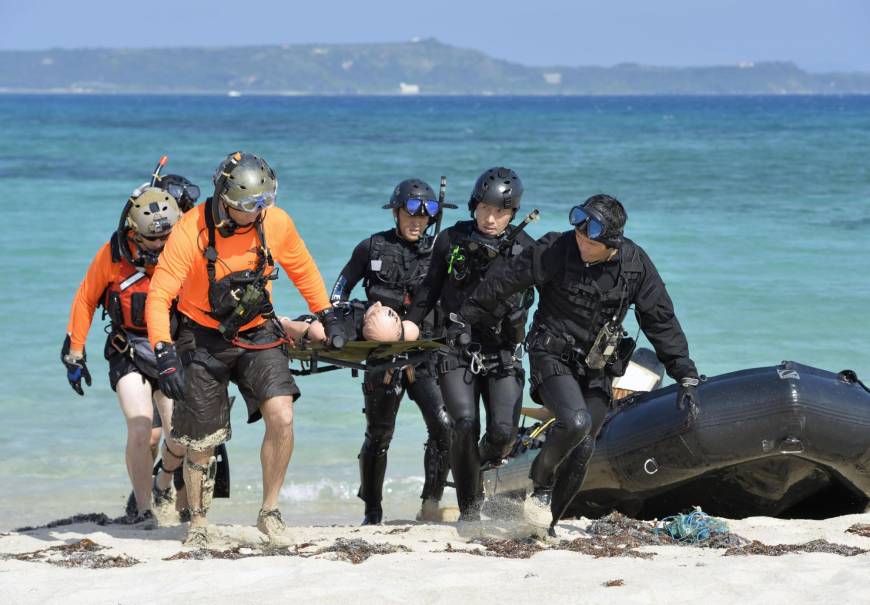
Troops from the Self-Defense Forces and the U.S. military carry out a joint exercise on Ukibaru Island, Okinawa Prefecture, on Monday.
OSAKA – When Prime Minister Shinzo Abe meets with U.S. President-elect Donald Trump in New York next week, both men will size up each other and discuss the bilateral relationship and the challenges that lie ahead.
One challenge, whether it’s on the agenda or not, will be the future direction of Japan’s nuclear power program.
With a key 1988 bilateral agreement on the peaceful use of nuclear power due to expire in July 2018, Tokyo and Washington next year will have to begin addressing the question of what, exactly, Japan’s nuclear policy should be.
Renegotiating the treaty is also sure to raise questions about the possibility of Japan using nuclear materials for military purposes, especially as Trump made contradictory statements about the possibility of arming Japan with nuclear weapons.
In an April TV interview, he suggested that Japan might defend itself from North Korea’s nuclear weapons by way of a nuclear arsenal of its own. That comment came a few weeks after another television interview in which he said that it is time to reconsider America’s policy of not allowing Japan to arm itself with nuclear weapons because it is going to happen anyway, and is only a question of time.
Trump later claimed that his opponents were misrepresenting his position. In the weeks before Tuesday’s election, he toned down his rhetoric on nuclear weapons use in general.
Japan’s reply to Trump was that it would continue to maintain its three non-nuclear principles of not manufacturing, possessing, or introducing nuclear weapons.
Now, with the agreement’s extension soon to become an issue in the bilateral relationship, experts are wondering how Trump, when he is president, will handle negotiations.
“I have absolutely no idea what position the Trump administration will adopt. It’s pretty clear their issues team hasn’t thought through things like this,” says James Acton, co-director of the Nuclear Policy Program and senior associate at the Carnegie Endowment for International Peace.
The U.S. has a long-standing policy against the accumulation of plutonium, but Japan already has about 48 tons stockpiled domestically and in Europe, and how it will consume or disposed of it remains uncertain.
“Japan has plans to produce more plutonium in the Rokkasho Reprocessing Plant. Given how few MOX-burning reactors will be operating in the foreseeable future, there is a very serious risk of a large imbalance between plutonium supply and demand,” Acton said, using the acronym for mixed uranium-plutonium oxide fuel. “I suspect the U.S. will use the occasion of the agreement’s renewal to try and address this problem.”
The Rokkasho plant is in Rokkasho, Aomori Prefecture.
Shaun Burnie, a senior nuclear specialist at Greenpeace Germany, says Trump has created an unprecedented degree of uncertainty in Japan about nuclear cooperation in general.
“Regardless of what position the new U.S. administration takes with regard to renewing the 1988 agreement, it is Japan, with its 48 tons of separated plutonium and no peaceful use plans, together with the nations of East Asia, that need to take a leadership role in reducing the risks from nuclear power. That includes terminating Rokkasho,” Burnie said.
The 1988 agreement came about after concerns in the U.S. that Japan was pursuing a plutonium program that could lead to proliferation issues, and a desire by Japan to make it easier to obtain U.S. approval for nuclear material shipments to Japan from Europe, as required by a previous agreement. In turn, the U.S. got more say in the inspection and security requirements for nuclear facilities in Japan.
The agreement also clearly emphasized it was only for the peaceful uses of power.
Article 8 of the agreement specifically bans the transfer of nuclear material to Japan (or from Japan to the U.S.) for use in nuclear explosive devices, for research specifically on, or development of, nuclear devices, and for military purposes.
“The U.S. does not think that Japan is looking to possess nuclear weapons. But holding so much plutonium, like Japan does, sets a very bad example for other countries and creates great concerns in the U.S. about the problem of nuclear terrorism,” wrote Tetsuya Endo, former deputy chairman of the Japan Atomic Energy Commission in a March article for the Tokyo-based Institute for Peace Policies.
1 This Month

of the week – Shut Down Drone Warfare!


Tell the Ukrainian Government to Drop Prosecution of Peace Activist Yurii Sheliazhenko

Petition to revoke the licensing of the Near Surface Nuclear Disposal Facility (NSDF) at Chalk River. https://www.ourcommons.ca/petitions/en/Petition/Details?Petition=e-7247
To see nuclear-related stories in greater depth and intensity – go to https://nuclearinformation.wordpress.com
-
Archives
- April 2026 (34)
- March 2026 (251)
- February 2026 (268)
- January 2026 (308)
- December 2025 (358)
- November 2025 (359)
- October 2025 (376)
- September 2025 (257)
- August 2025 (319)
- July 2025 (230)
- June 2025 (348)
- May 2025 (261)
-
Categories
- 1
- 1 NUCLEAR ISSUES
- business and costs
- climate change
- culture and arts
- ENERGY
- environment
- health
- history
- indigenous issues
- Legal
- marketing of nuclear
- media
- opposition to nuclear
- PERSONAL STORIES
- politics
- politics international
- Religion and ethics
- safety
- secrets,lies and civil liberties
- spinbuster
- technology
- Uranium
- wastes
- weapons and war
- Women
- 2 WORLD
- ACTION
- AFRICA
- Atrocities
- AUSTRALIA
- Christina's notes
- Christina's themes
- culture and arts
- Events
- Fuk 2022
- Fuk 2023
- Fukushima 2017
- Fukushima 2018
- fukushima 2019
- Fukushima 2020
- Fukushima 2021
- general
- global warming
- Humour (God we need it)
- Nuclear
- RARE EARTHS
- Reference
- resources – print
- Resources -audiovicual
- Weekly Newsletter
- World
- World Nuclear
- YouTube
-
RSS
Entries RSS
Comments RSS
 nuclear-news