Added ‘development’ in the Medical Data Obtained from Minami-soma Municipal General Hospital in Fukushima

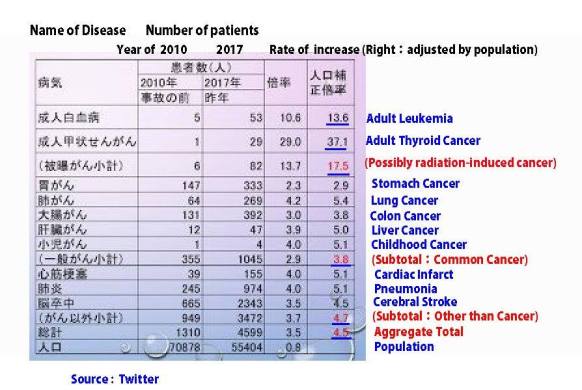
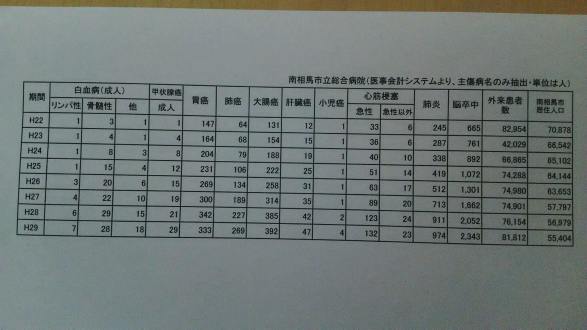
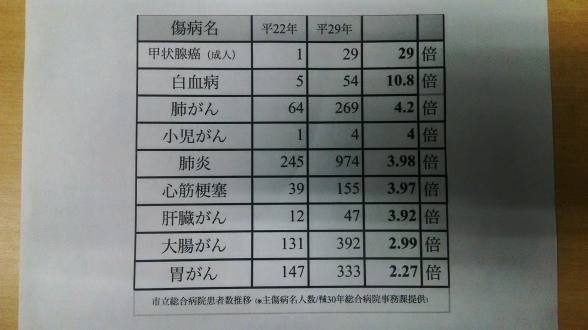
It was very courageous to the city council Koichi Oyama to leak to the public those medical data, despite the new laws to stop medical staff releasing data on health effects that may be caused by the nuclear disaster. This new controvertial law (against the supposed new open transparency purported by the nuclear industry post Fukushima disaster) was enacted in late 2013 and threatens to imprison or give huge fines to medical staff. This makes verification difficult.
Not surprisingly there was a quick reaction to that release, now claiming that the data in question represents cumulative patient visits. With the present new laws it is quite impossible to verify now that claim to be true. One thing only is sure: the Minami-soma city council issued a written warning to the city council member Koichi Oyama for disseminating the data.
The Minamisoma city council verified with the Minamisoma Municipal General Hospital business office that the data in question represents cumulative patient visits.
Once a patient is registered through the hospital system with a certain diagnosis, subsequent visits are counted cumulatively for accounting purposes unless the patient’s information is removed from the system due to reasons such as death or transfer to another hospital.
The city council chair has issued a written warning to the city council member Koichi Oyama who originally disseminated the data. (Source: Hirono town council member, Kenichi Abe)
Read also previous article: https://nuclear-news.net/?s=A+First%3A+Medical+Data+Obtained+from+Minami-soma+Municipal+General+Hospital+in+Fukushima
A First: Medical Data Obtained from Minami-soma Municipal General Hospital in Fukushima

Fukushima City Still Struggling with Labor Shortages
 Recent soil contamination map made by the “Environmental Radioactivity Measurement Project around Fukushima Daiichi Nuclear Power Plant.” https://dunrenard.wordpress.com/2017/01/14/new-data-show-massive-radiation-levels-in-odaka-minamisoma/
Minamisoma, Fukushima Pref., July 12 (Jiji Press)–Minamisoma is still struggling with labor shortages, one year after the Japanese government lifted its nuclear evacuation advisory for part of the Fukushima Prefecture city.
In the city, only slightly over 20 pct of residents have returned home, and the productive-age population of people aged 15-64 fell by some 8,200 from the level before the March 2011 meltdowns at Tokyo Electric Power Company Holdings Inc.’s <9501> disaster-crippled Fukushima No. 1 nuclear plant.
The situation is “tough,” said Takuzo Tsuchida, a 58-year-old worker at a factory in the Kashima district that is run by a subsidiary of clothing maker Fukuso Co. The factory saw its number of employees halve to some 70.
The Fukuso unit this year hired five graduates from a dressmaking school with which it held a joint fashion show last year. But the move was insufficient because some workers quit.
To cover its lower output, the company has asked a partner factory for increased production. “We have to continue to put up with” the situation, Tsuchida said.
Landscapes I saw

A short poem at the beginning of the year.
Accumulated dust can make mountains.

Here are the pictures that show reality.
Taken on January 2nd 2017.

These black bags are full of soil and fallen leaves gathered in the course of the decontamination work.
These bags last from 3 to 5 years.
What do we do now?

Over the mountain of black bags lies Odaka station.
Now anybody can get on and off the train.

Source: Akiyoshi Imazeki, Odaka Station, Minamisoma-shi, Fukushima Prefecture
Surf Contest in Minamisoma, Fukushima

On July 17, 2012, they had a national surf contest in Minami Soma city, Fukushima..
In Fukushima, Minami Soma City, after the nuclear accident, for the first time a surfing tournament took place.
Competition in Minami Soma after the nuclear accident had been canceled. It was held for the first time in six years.
Before March 2011, Minami Soma was known as one of Japan’s leading surfing spots.
The evacuation order having been lifted in most of Minami Soma city, Minami Soma city aimed to boost its reconstruction by reviving its surf contest on its Kitaizumi coast.
200 participants from all over Japan came to engage in that surf contest.
Japan: Returning home after Fukushima nuclear disaster
Minamisoma returnees keen to rebuild lives after lifting of evacuation order for first time since 2011 nuclear disaster.
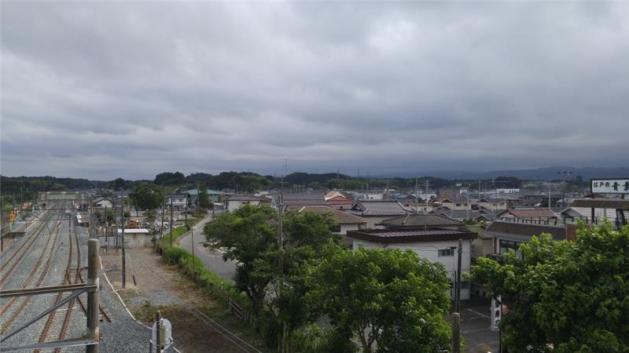
Around 20 percent of Minamisoma’s residents decided to come back
Fukushima, Japan – This week, authorities lifted an evacuation order for nearly all parts of Minamisoma city, Fukushima prefecture, allowing more than 10,000 people to return to their homes for the first time since 2011’s nuclear disaster.
Tens of thousands of people across the prefecture had to abruptly leave their homes five years ago after a devastating earthquake and tsunami in Japan’s northeast wrecked the Fukushima Daiichi Nuclear Power Plant.
The lifting of the evacuation order marked the largest number of people allowed back into their hometown – yet only around an estimated 20 percent of Minamisoma’s 10,807 residents in 3,487 households decided to come back.
Since 2014, the government has been gradually lifting up evacuation orders within a 20km radius of the nuclear power plant, following the progress of some clean-up efforts.
Our team drove to Minamisoma from Tokyo along the country’s northeastern coast.
It was not difficult to spot the on-going clean-up efforts.
A great number of big contaminated waste disposal bags were piled up at temporary holding areas on fields across Fukushima prefecture.
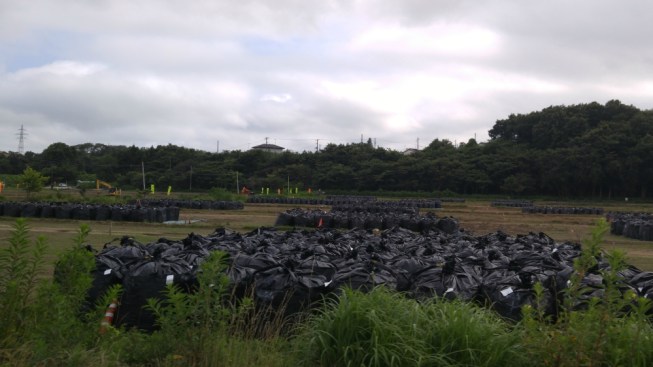
Some holding areas were massive in size, occupying huge chunk of the fields, with a string of trucks constantly dropping off black bags.
Roads into contaminated towns were still blocked by big barricades, and checkpoints were put in place to only allow people with a special permit to enter.
As we drove past contaminated areas, the reading on our Geiger counter, which measures the level of radiation, would from time to time jump above usual levels, reaching as high as 3μSv/h – the government’s long-term reduction goal for areas within a 20km radius of the nuclear power plant stands at 0.23μSv/h.
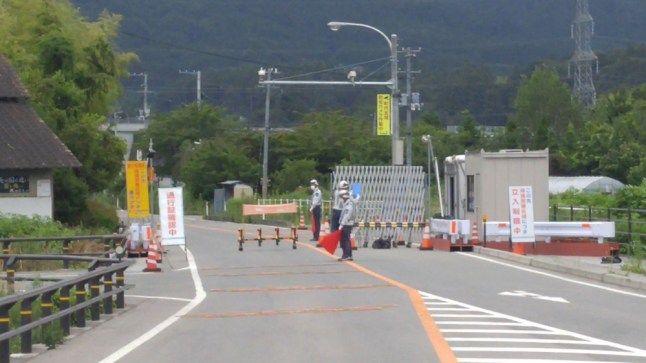
Passing through the still largely empty, yet seemingly peaceful streets of Minamisoma, we arrived at the Odaka station in the city’s Odaka district.
Although the train service had been resumed for the first time in more than five years on the 9.4km stretch between Odaka and Haranomachi station, only a handful of passengers were seen during the day.
 |
Trains arrived and departed, largely empty.
What caught my attention was a large screen in front of the station, showing radiation levels in real time.
The reading was 0.142μSv/h, which was higher than 0.06μSv/h in Tokyo – but still below the 0.23μSv/h government goal.
Such screens were set up across the city to assuage the public’s lingering concerns over radiation contamination.
Over the past few years, a growing number of Minamisoma residents settled somewhere else, worried over the potential long-term health effects of a return back home.
However, people who did decide to come back were trying their best to ensure that life in their hometown, albeit slowly, returned to normal.
About a three-minute walk distance from the station, we spotted around 30 young students and residents.
Preparations were under way by a number of local organisations to celebrate the opening of a community centre in a makeshift building, where residents could freely come and talk about their life back in hometown.
An old lady asked passers-by to take a seat as she served local food. Young students were hanging out withtheir friends, doing hula hoop and blowing bubbles.
Many of the returnees told us that despite the uncertainties and doubts, they hoped to restore a sense of community – and thus prove to friends and families who were having second thoughts about coming back that it was worth returning home.
“Although we cannot bring back Odaka to what it used to be before the disaster, as residents here, we want to bring back its spirit and the community,” Yoshiki Konno, a local resident and the head of an NGO, told.
“That is the most important thing we must do.”
1 This Month

of the week – Shut Down Drone Warfare!


Tell the Ukrainian Government to Drop Prosecution of Peace Activist Yurii Sheliazhenko

Petition to revoke the licensing of the Near Surface Nuclear Disposal Facility (NSDF) at Chalk River. https://www.ourcommons.ca/petitions/en/Petition/Details?Petition=e-7247
To see nuclear-related stories in greater depth and intensity – go to https://nuclearinformation.wordpress.com
-
Archives
- April 2026 (19)
- March 2026 (251)
- February 2026 (268)
- January 2026 (308)
- December 2025 (358)
- November 2025 (359)
- October 2025 (376)
- September 2025 (257)
- August 2025 (319)
- July 2025 (230)
- June 2025 (348)
- May 2025 (261)
-
Categories
- 1
- 1 NUCLEAR ISSUES
- business and costs
- climate change
- culture and arts
- ENERGY
- environment
- health
- history
- indigenous issues
- Legal
- marketing of nuclear
- media
- opposition to nuclear
- PERSONAL STORIES
- politics
- politics international
- Religion and ethics
- safety
- secrets,lies and civil liberties
- spinbuster
- technology
- Uranium
- wastes
- weapons and war
- Women
- 2 WORLD
- ACTION
- AFRICA
- Atrocities
- AUSTRALIA
- Christina's notes
- Christina's themes
- culture and arts
- Events
- Fuk 2022
- Fuk 2023
- Fukushima 2017
- Fukushima 2018
- fukushima 2019
- Fukushima 2020
- Fukushima 2021
- general
- global warming
- Humour (God we need it)
- Nuclear
- RARE EARTHS
- Reference
- resources – print
- Resources -audiovicual
- Weekly Newsletter
- World
- World Nuclear
- YouTube
-
RSS
Entries RSS
Comments RSS
 nuclear-news