FUKUSHIMA – A former mayor of a city hit by the 2011 Fukushima nuclear crisis told a court on Wednesday that he wants to express his “anger” on behalf of citizens who had to flee their homes due to the disaster and whose lives are still filled with uncertainties.
Katsunobu Sakurai, who was mayor of Minamisoma at the time the crisis erupted, testified before the Fukushima District Court in a lawsuit filed by 151 people seeking ¥3.7 billion ($32.7 million) in damages from Tokyo Electric Power Company Holdings Inc. They say the nuclear accident destroyed their communities due to the evacuations.
Sakurai was chosen among U.S. Time magazine’s 100 most influential people in the world in 2011 after sharing the city’s predicament and calling for support via YouTube in the wake of one of the world’s worst nuclear disasters.
Following the accident, part of the city was designated as an evacuation zone where the 151 people, comprising 47 households, used to live. Most of the city is no longer subject to evacuation orders.
Sakurai said the city was forced to arrange evacuation buses on its own amid a lack of information from the central government, and that he “felt bitter and angry” after learning that the government helped arrange transportation for some other municipalities.
He also said the city’s residents are reluctant to return due to the slow progress of decommissioning the crippled Fukushima No. 1 nuclear power plant.
“They think they might have to evacuate again,” Sakurai said.
Sakurai had been the city’s mayor until losing his seat in an election in January.
The Minamisoma residents filed the damages suit in 2015 for their losses and changes to their hometown as a result of the nuclear accident, triggered by a major earthquake and tsunami on March 11, 2011.
December 7, 2018
Posted by dunrenard |
Fukushima 2018 | Evacuees, Forced Return, Fukushima, Minamisoma, Minamisoma Law suit |
Leave a comment
One man is advocating for their protection
By Linda Pentz Gunter
A UN Special Rapporteur who last August joined two colleagues in sounding an urgent alarm about the plight of Fukushima workers, has now roundly criticized the Japanese government for returning citizens to the Fukushima region under exposure levels 20 times higher than considered “acceptable” under international standards.
He urged the Japanese government to “halt the ongoing relocation of evacuees who are children and women of reproductive age to areas of Fukushima where radiation levels remain higher than what was considered safe or healthy before the nuclear disaster seven years ago.”
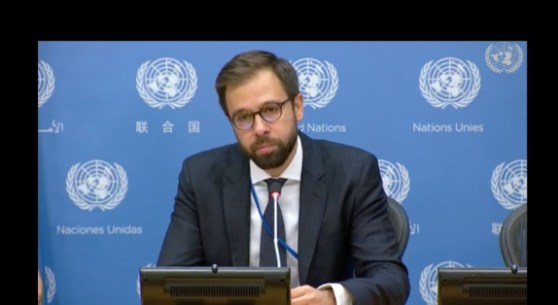
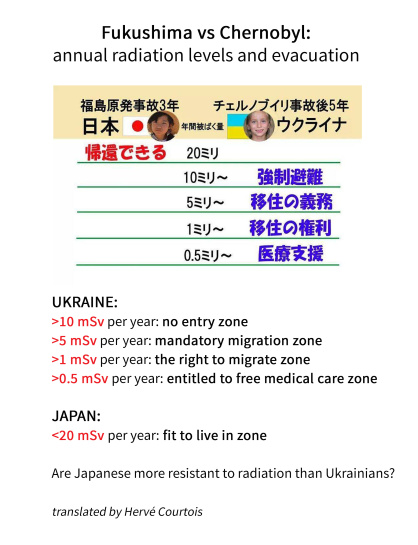
Baskut Tuncak, (pictured at top) UN Special Rapporteur on hazardous substances and wastes, noted during a October 25, 2018 presentation at the UN in New York, as well at a press conference, that the Japan Government was compelling Fukushima evacuees to return to areas where “the level of acceptable exposure to radiation was raised from 1 to 20 mSv/yr, with potentially grave impacts on the rights of young children returning to or born in contaminated areas.”
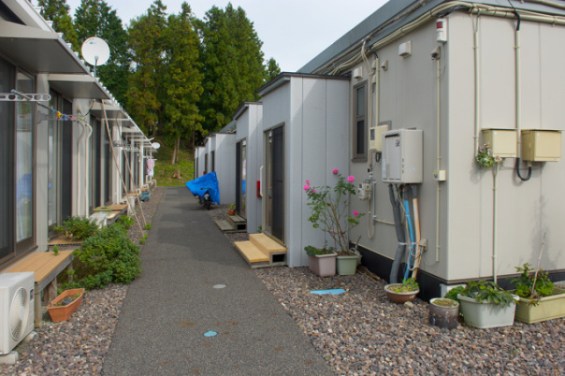
Typical housing for evacuees. 20 m2 prefab cabins, evacuation site, Miharu, Fukushima, 46 km north west of Fukushima-Daichi Nuclear Power Plant. (Photo: Lis Fields.)
He described exposure to toxic substances in general as “a particularly vicious form of exploitation.”
In August, Tuncak, along with Urmila Bhoola and Dainius Puras, expressed deep concern about the Fukushima “cleanup” workers, who include migrants, asylum seekers and the homeless. They feared “possible exploitation by deception regarding the risks of exposure to radiation, possible coercion into accepting hazardous working conditions because of economic hardships, and the adequacy of training and protective measures.
We are equally concerned about the impact that exposure to radiation may have on their physical and mental health.”
Now, Tuncak is urging Japan to return to the 1 millisievert a year allowable radiation exposure levels in place before the 2011 Fukushima Daiichi disaster.
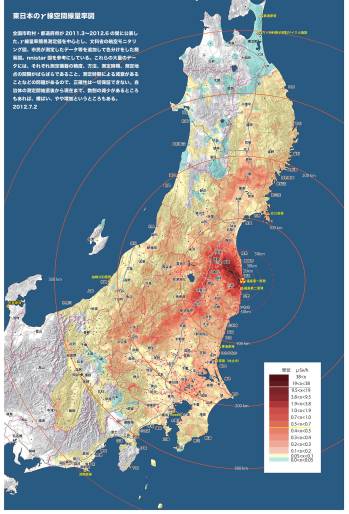
2011 map showing wide deposition of radioactive materials from Fukushima Daiichi nuclear power plant. (Courtesy 20 Millisieverts A Year. https://lisfields.org/20msvyear/)
In a revealing response to Tuncak’s presentation at the UN, the delegate from Japan claimed that 20 msv “is in conformity with the recommendation given in 2007 by the International Commission on Radiological Protection.” He also claimed that Tuncak’s press release would cause people in Fukushima to suffer “an inaccurate negative reputation” that was “further aggravating their suffering,” and that the government and people of Japan were “making effort with a view to dissipating this negative reputation and restoring life back to normal.”
This view is deeply characteristic of the Abe government which is desperately attempting to “normalize” radiation among the population to create a public veneer that everything is as it was. This is motivated at least in part by an effort to dissipate fears about radiation exposure levels that will still be present during the 2020 Summer Olympics there, with events held not only in Tokyo but also in the Fukushima prefecture.
However, Tuncak corrected the delegate’s information, responding that:
“In 2007, the ICRP recommended deployment of “the justification principle. And one of the requests I would make for the Japanese government is to rigorously apply that principle in the case of Fukushima in terms of exposure levels, particularly by children, as well as women of reproductive age to ensure that no unnecessary radiation exposure and accompanying health risk is resulting.” Tuncak said Japan should “expeditiously implement that recommendation.”
He also reminded the delegate that “the Universal Periodic Review of the Human Rights Council last year, did issue a recommendation to lower the acceptable level of radiation back down from 20 millisieverts per year to one millisievert per year. And the concerns articulated in the press release today were concerns that the pace at which that recommendation is being implemented is far too slow, and perhaps not at all.”
During the press conference Tuncak noted that Japan is a party to the UN Convention on the Rights of the Child and that forcing evacuees back into areas contaminated to 20 mSv/yr was against the standards contained in that Convention. “We are quite concerned in particular for the health and well-being of children who may be raised or born in Fukushima,” he said.
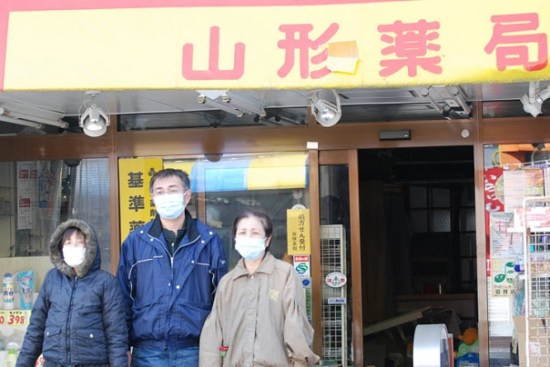
The Yamagata family in front of their quake-damaged pharmacy in Namie, Fukushima Prefecture, Japan April 12 2011 (VOA – S. L. Herman)
Earlier, Japan had sounded tacit agreement to reducing allowable exposure levels back down from 20 mSv/yr to 1 mSv/yr. But few believed they would carry this out given that it is virtually impossible to clean up severely contaminated areas in the Fukushima region back to those levels.
Bruno Chareyron, the director of the CRIIRAD lab (Commission de Recherche et d’Information Indépendentes sur la RADioactivité), noted in an August 17, 2018 Truthout article that:
“It is important to understand that the Fukushima disaster is actually an ongoing disaster. The radioactive particles deposited on the ground in March 2011 are still there, and in Japan, millions of people are living on territories that received significant contamination.”
Of the cleanup process, Chareyron told Truthout: “The ground and most contaminated tree leaves are removed only in the immediate vicinity of the houses, but a comprehensive decontamination is impossible.” He said in the article that the powerful gamma rays emitted by Cesium 137 could travel dozens of meters in the air. Therefore, the contaminated soil and trees located around the houses, which have not been removed, are still irradiating the inhabitants.
While the UN delegate from Japan claimed that no one was being forced to return and the decision rested with the evacuees alone, Tuncak expressed concern about coercion. “The gradual lifting of evacuation orders has created enormous strains on people whose lives have already been affected by the worst nuclear disaster of this century. Many feel they are being forced to return to areas that are unsafe, including those with radiation levels above what the Government previously considered safe.”
Recalling his efforts to protect Fukushima workers, Tuncak observed the irony that Japan had admitted that the death of a Fukushima worker from lung cancer was directly related to exposure to radiation at the stricken plant and “quite interestingly, the level of radiation that he was exposed to in the past five years was below the international community’s recommendation for acceptable exposure to radiation by workers.”
Tuncak’s report did not focus solely on Fukushima. It also included exploitation and abuse of Roma people, South Koreans exposed to a toxic commercial product and air pollution in London. During his UN presentation, he observed that “over two million workers die every year from occupational diseases, nearly one million from toxic exposures alone. Approximately 20 workers will have died, prematurely, from such exposures at work by the time I finish my opening remarks to you.”
Before addressing the plight of Fukushima evacuees, he pointed out how “exposure to toxic pollution is now estimated to be the largest source or premature death in the developing world, killing more people than HIV AIDS, tuberculosis, and malaria combined.” While noting that this problem exists to a greater or lesser degree the world over, he added that “pediatricians today describe children as born ‘pre-polluted,’ exposed to a cocktail of unquestionably toxic substances many of which have no safe levels of exposure.”
Japan’s decision to ignore pleas to halt repatriation of evacuees into high radiation exposure levels usually deemed unavoidable (but not safe) for nuclear workers, not ordinary citizens, will now tragically contribute to these numbers.
Mr. Baskut Tuncak is Special Rapporteur on the implications for human rights of the environmentally sound management and disposal of hazardous substances and wastes. As a Special Rapporteur, he is part of what is known as the Special Procedures of the Human Rights Council. Special Procedures, the largest body of independent experts in the UN Human Rights system, is the general name of the Council’s independent fact-finding and monitoring mechanisms that address either specific country situations or thematic issues in all parts of the world.
December 7, 2018
Posted by dunrenard |
Fukushima 2018 | Evacuees, Exposure, Forced Return, Fukushima, Human Rights, United Nations |
Leave a comment
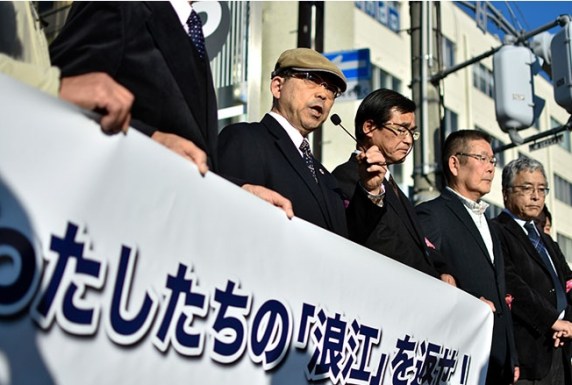 Plaintiffs in the lawsuit against TEPCO and the government gather in front of the Fukushima District Court in Fukushima on Nov 27.
November 28, 2018
FUKUSHIMA–Dismayed at a breakdown in talks for compensation, residents of the disaster-stricken town of Namie filed a lawsuit against Tokyo Electric Power Co. and the central government for damages stemming from the nuclear accident here in March 2011.
The plaintiffs are seeking 1.3 billion yen ($11.4 million) in financial redress.
The entire town was evacuated in the aftermath of a triple core meltdown at TEPCO’s Fukushima No. 1 nuclear power plant triggered by the Great East Japan Earthquake and ensuing tsunami.
The lawsuit was filed at the Fukushima District Court on Nov. 27 after five years of negotiations between the town and TEPCO collapsed in April over the utility’s refusal to meet demands for more compensation.
According to court papers, 109 plaintiffs of 49 households are seeking 12.1 million yen in individual compensation.
They stated that the nuclear accident destroyed their community and forced them to live as evacuees for a prolonged period.
TEPCO, under guidelines established by the central government, has been paying 100,000 yen a month to each resident forced to evacuate.
However, town officials argued that the figure was painfully low and should be increased to compensate for psychological suffering caused by the disaster.
In May 2013, the Namie municipal authorities, acting on behalf of residents, asked the nuclear damage claim dispute resolution center, an organization established by the central government in response to the Fukushima disaster, to mediate in the dispute.
About 15,000 residents, more than 70 percent of the town’s population, signed a petition for the mediation in an alternative dispute resolution (ADR) process at the center.
In March of 2014, an ADR proposal called for the monthly compensation to be uniformly increased by 50,000 yen.
The town accepted the offer but TEPCO rejected it, citing potential unfairness to others who had been compensated. In April, the center discontinued the reconciliation process.
Pointing out that TEPCO had reneged on its promise to “respect ADR reconciliation proposals,” the plaintiffs argued that the utility should pay for betraying the trust of residents.
An additional 2,000 or so townsfolk are planning to join the lawsuit.
In a statement, TEPCO said, “We will listen to the plaintiffs’ requests and complaints in detail and respond sincerely.”
Not only were the lives of residents turned upside down by the nuclear disaster, but more than 180 perished in the tsunami that engulfed the town.
Although the evacuation order was lifted for some parts of the town at the end of March 2017, entry to most of the area remains prohibited.
http://www.asahi.com/ajw/articles/AJ201811280053.html?fbclid=IwAR1O0aNAvKOkAVVRm2UH44C6RT88xLhOntskaKyVvL3VSZmDlYSd7SMC1Vs
November 30, 2018
Posted by dunrenard |
Fukushima 2018 | Fukushima, Lawsuit, Namie, Tepco |
2 Comments
 Olympics chief Thomas Bach will visit a stadium set to host 2020 Olympic baseball and softball games in Fukushima.
November 21, 2018
International Olympic Committee President Bach will on Saturday visit a stadium set to host 2020 Olympics baseball and softball games, and meet 60 students who play the sports, organisers said in a statement.
Bach will also speak with local high school students and meet Fukushima Governor Masao Uchibori. Japanese Prime Minister Shinzo Abe has expressed hopes of showing the world the recovery of Fukushima and other disaster-hit areas during the sporting event, for which Tokyo is the designated host city.
Fukushima was also chosen as the starting point for the Olympics torch relay.
The passing of the flame is scheduled to start on March 26, 2020, and the torch will head south to the subtropical island of Okinawa — the starting point for the 1964 Tokyo Games relay — before returning north and arriving in the Japanese capital on July 10.
The March 2011 tsunami, triggered by a massive undersea quake, killed around 18,000 people and swamped the Fukushima nuclear plant, sending its reactors into meltdown and leading to the world’s worst nuclear disaster since Chernobyl.
Tens of thousands of people evacuated their homes. Authorities have been working to rebuild the region, about 240 kilometres (150 miles) north of Tokyo, although areas near the crippled plant remain uninhabitable because of radiation dangers.
https://www.france24.com/en/20181121-revival-hopes-olympics-chief-set-visit-fukushima
November 25, 2018
Posted by dunrenard |
Fukushima 2018 | Fukushima, Minimizing Propaganda, Olympics |
Leave a comment
Noriyuki Kowata is seen on a temporary visit to his home in the Fukushima Prefecture town of Futaba, one of two towns that the stricken Fukushima No. 1 Nuclear Power Plant straddles, on Sept, 25, 2018. His yard and vegetable garden were covered in overgrown grass and other vegetation.
FUTABA, Fukushima — It was late September, and the heat of summer had finally begun to ease. Norikiyo Kowata, 77, was on a temporary visit to his home here, whose screen doors were tattered, having been exposed to the elements for over seven years. His garden, where he used to grow vegetables like butterbur sprouts and myoga ginger, showed signs of having been trampled on by wild hogs.
Ninety-six percent of Futaba — one of two towns straddled by the stricken Fukushima No. 1 Nuclear Power Station — is designated by the central government as “areas to which return will be difficult.” Even though Kowata prepares himself mentally, seeing his house in an increasingly dilapidated state every time he visits is hard: “It’s disheartening.”
After the March 2011 disaster broke out at the nearby nuclear station, the entire town was forced to evacuate. Kowata moved from one place to another, including Kazo, Saitama Prefecture, where the Futaba Municipal Government set up shop temporarily, and where a branch of the municipal government still exists. In the summer of 2012, Kowata bought a used single-family home in the Fukushima Prefecture city of Iwaki, where he has since been living with his 70-year-old wife, Mineko. Prior to the nuclear crisis, the couple enjoyed walking in the mountains close to their home in Futaba to forage for mushrooms and wild vegetables. Now that they can no longer do that, their only emotional crutch is their pet dog.
Kowata’s hope to someday return to his hometown faded as he accrued more and more years as an evacuee. Now, a strong sense of resignation has taken over. There are plans to demolish his home in Futaba soon. “I’m old now. It’s sad, of course, since it’s where I lived for 70 years.”
After the onset of the nuclear disaster, along with the growing momentum of the anti-nuclear movement, was criticism for the national government and power companies that had long been building nuclear power plants in regional areas. The common trope was that people living in regional areas who had complied with national policy were now being forced from their homes. Kowata, too, wanted the people of Tokyo — for whom the Fukushima plant was primarily generating electricity — to look that fact straight in the eye. But when he thought about the benefits that he reaped from the nuclear power station, being told he was “sacrificed” for the sake of the big city and the central government didn’t feel quite true.
The Fukushima prefectural towns of Futaba and Okuma decided to host the Fukushima No. 1 nuclear plant in 1961, in the midst of Japan’s rapid economic growth. The central government’s desire to meet the increasing electricity demands of the Tokyo metropolitan area came together with the desire of a regional area that did not want to be left behind in the high-speed economic growth that the country was undergoing. As a result, six massive structures spanning the two towns were built.
The region’s industrial framework, in which residents farmed in the warmer months and became migrant workers elsewhere in the winters, underwent a radical transformation. Following graduation from high school, Kowata had been working in Tokyo as a conductor in the subway system. But he returned to his hometown once the nuclear plant was built, and became a regular employee at Fukushima No. 1 nuclear plant operator Tokyo Electric Power Co. (TEPCO) in 1971, when the nuclear plant began its operations.
“The pay was good, as were the benefits,” Kowata recalled. “It felt like a big company.” He worked for TEPCO and its affiliates until the age of 65.
Municipal governments that host nuclear power plants are given large amounts of money in subsidies based on the Three Power Source Development Laws. At its peak, the Futaba Municipal Government received over 1 billion yen per year, and nuclear plant-related income, including fixed property tax, enriched town coffers. This allowed for the construction of public facilities and other infrastructure.
“Nuclear power plants are monsters,” Kowata said. “I bet there’s no other mechanism out there that brings that much money and employment to a depopulated area.”
There were some people who warned of the risks of nuclear power. In 1972, some residents launched a Futaba region anti-nuke alliance. However, confronted by the very palpable benefits of the nuclear plant, the movement faded.
In 1991, the Futaba Town Assembly unanimously voted for the additional construction of the No. 7 and No. 8 reactors at the plant. The town’s expenditures were ballooning, due to the cost of maintaining and managing public facilities it had built with subsidies it received from the central government for hosting the nuclear power plant. So in seeking even more of that “nuclear power plant money,” Futaba became more proactive in promoting the national government’s nuclear policy.
Futaba’s mayor at the time was the late Tadao Iwamoto, who served for five terms, four years each, starting in 1985. He was a former prefectural assembly member from the Socialist Party who at one time served as the head of an anti-nuke alliance. But after he became the mayor of Futaba, he promoted community building that assumed coexistence with nuclear power plants.
To his former comrades, this seemed like a sellout, but his son, Hisato Iwamoto, 61, who is the vice-speaker of the Futaba town assembly, argues that nothing had changed, in that his father continued efforts to work for the happiness of the townspeople and for the Futaba region. Hisato said he remembers his father yelling at news reports on the nuclear disaster that were being aired on television in the gymnasium that the family had evacuated to in the Fukushima prefectural city of Minamisoma in March 2011: “What are they doing!” His father subsequently said not a word about the nuclear plant, and died just four months later due to illness at the age of 82.
Akira Kawate, who was formerly a bureaucrat at the Ministry of Home Affairs, the predecessor to the Ministry of Internal Affairs and Communications, and subsequently served as Fukushima Prefecture’s deputy governor from 1999 to 2006, looked back on the proposed construction of the No. 7 and No. 8 reactors at the Fukushima No. 1 nuclear plant. “The prefectural government’s view was that we shouldn’t keep relying on nuclear reactors,” he said. The prefecture, however, was unable to come up with any specific economic revitalization measures to replace nuclear power plants. The additional reactors were never built. Then, in 2011, disaster struck.
Kawate, who now serves as an executive director of a nationwide federation promoting the independence of depopulated regions, understands the obstacles of implementing depopulation countermeasures. “It’s very difficult for municipal governments that have neither the money nor the manpower to be independent. With the exception of Tokyo, all communities must be dependent on the central government, though the extent to which they are may vary,” he said. But, he continued, “There are various ways to think about the relationship between regional areas and the central government, whether it’s the regional areas that are being sacrificed, or they’re the ones shrewdly taking advantage of the central government. It’s OK to have a shrewd outlook on life. It liberates you from emotional subordination.”
Aside from the noise of heavy machinery, the town of Futaba is quiet. Little by little, homes are being torn down and new infrastructure is being built. The plan is to make about 55 hectares of land surrounding JR Futaba Station livable again as a specially designated reconstruction and revitalization zone. If all goes well, evacuation orders for the area will be lifted around the spring of 2022.
If people do not return to the town, however, there will be no town revival. The 7,140 people who lived here at the time the nuclear disaster began are now scattered everywhere, and as of late August this year, 4,074 lived within Fukushima Prefecture, and 2,818 lived outside the prefecture as evacuees. According to a survey of Futaba residents and others conducted in fall of last year, 60 percent of the 1,564 households that responded said that they had “decided not to return.”
Ever since the onset of the nuclear crisis, former TEPCO employee Kowata has been questioning himself over and over again. The nuclear power plant had allowed him to work in his hometown and provide for his family. But if it hadn’t been for the nuclear power plant, the disaster would not have occurred. “I carry a weight on my shoulders.”
Kowata has given up hope on returning to his home in Futaba, but he wants to remain involved in his hometown. His residence registry is still there. “I want to live a long life, and watch what happens to this town,” he says, hopefully.
(Japanese original by Yukinao Kin, Osaka Cultural News Department)
November 3, 2018
Posted by dunrenard |
Fukushima 2018 | Disaster Victims, Fukushima |
Leave a comment
Incumbent Fukushima Gov. Masao Uchibori receives flowers at his election office in the city of Fukushima on Sunday evening as vote counts suggest he has secured a second-term victory in the gubernatorial election held earlier in the day.
FUKUSHIMA – Incumbent Fukushima Gov. Masao Uchibori secured another four-year term in a gubernatorial election Sunday, beating three challengers.
Throughout the election campaign, the 54-year-old governor, who was in his first term, enjoyed a comfortable lead over the other candidates — Jun Kanayama, 78, a self-employed worker, Sho Takahashi, 30, the owner of an IT company, and Kazushi Machida, 42, prefectural chairman of the Japanese Communist Party (JCP).
While all four candidates ran as independents, Uchibori received support from the ruling and opposition parties, except for the JCP.
The prefecture, where there are about 1.6 million eligible voters, is still on the road to recovery following nuclear meltdowns at the Fukushima No. 1 power plant, which were triggered by the devastating Great East Japan Earthquake and tsunami on March 11, 2011.
During the campaign, Uchibori pledged further efforts to rebuild local communities and promote the return of residents who have moved out of the prefecture due to the disasters, although many voters voiced concerns about the candidates proposing few specific measures to help residents recover from the devastation.
November 3, 2018
Posted by dunrenard |
Fukushima 2018 | Fukushima, Gubernatorial Elections |
Leave a comment
New Reconstruction Minister Hiromichi Watanabe wants the world to know that, seven years after the March 2011 Great East Japan Earthquake, Fukushima Prefecture and other disaster-struck areas of the Tohoku region are now safe.
“I know that outside Japan (radiation) stigma still lingers and I believe it’s our mission to destroy,” that notion, Watanabe said in an interview with The Japan Times and other media organizations Wednesday.
In the wake of the reactor meltdowns at the Fukushima No. 1 nuclear power plant many countries around the world imposed import restrictions on vegetables, fruits and other food products from Fukushima and neighboring Ibaraki, Tochigi, Chiba and Gunma prefectures.
But in recent months the European Union, Brazil and several other countries have eased import restrictions and China reportedly intends to relax the ban. Taiwan is set to hold a referendum next month on whether to keep the restrictions in place.
“First, I want people to learn about the situation in Fukushima, I want them to taste farm and marine produce and last but not least, I want people to visit Fukushima” to see for themselves how it has rebounded, Watanabe said, responding to a question about lingering concerns over safety and slow progress in recovery.
Watanabe believes the 2020 Tokyo Games will be “a golden opportunity” to showcase the disaster-hit region’s advancement.
He referred to a large-scale project in the town of Namie, Fukushima Prefecture, where construction work has already started for what will be one of the world’s largest hydrogen plants.
The plant will use solar power and other energy sources to extract up to 900 tons of hydrogen each year from water for storage and supply.
The hydrogen generated at the plant will be used for fuel-cell vehicles and other purposes during the Olympics and Paralympics.
“Using Fukushima-generated hydrogen in Tokyo would be a great display” of the region’s progress, he said.
“Given that the Olympic torch relay will start in Fukushima, I wish we could use hydrogen to light up the torch as well,” he added, noting that such ideas are being considered.
When the Reconstruction Agency was established in 2012, the government set a 10-year period of intensive efforts to rebuild the devastated areas.
Watanabe said that recovery of housing and public infrastructure is nearing completion, except for in zones with restricted access closest to the Fukushima No. 1 power plant.
Watanabe admitted that progress is slower in some areas and he wants to speed up the rate of reconstruction ahead of the Summer Games.
“To better grasp the situation, I will make it my priority to go to those areas. It’s my basic strategy to listen to all requests and demands directly from those regions and to try to respond to them,” he said.
The government will draw up a concrete action plan to complete rebuilding efforts before disclosing them by year-end.
For Watanabe, the clock is ticking as the agency is scheduled to fold in 2021.
“There are only 2½ years left and during this period I am motivated to do the utmost to complete rebuilding,” he said. “Obviously reconstruction of areas devastated by the nuclear disaster should be seen from a long-term perspective and even after the agency is abolished, Japan should make concerted efforts to act on the aftereffects (of the nuclear disaster).”
October 22, 2018
Posted by dunrenard |
Fukushima 2018 | Denial, Fukushima, Propaganda, Reconstruction Minister |
1 Comment

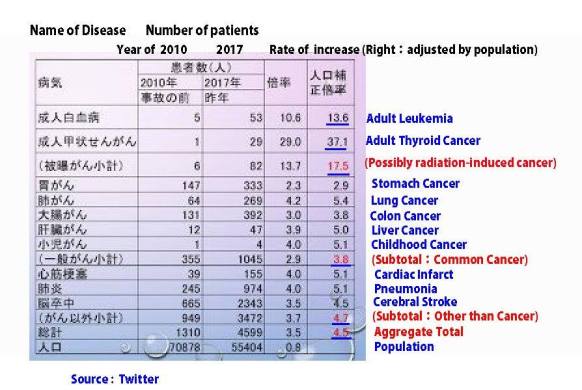
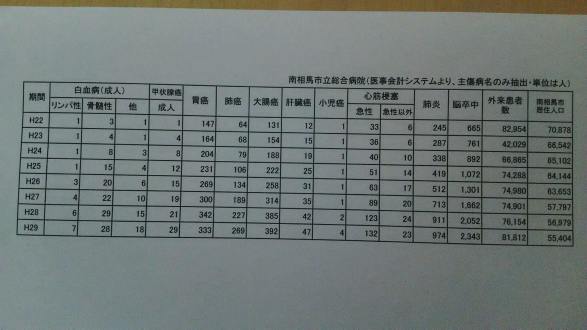
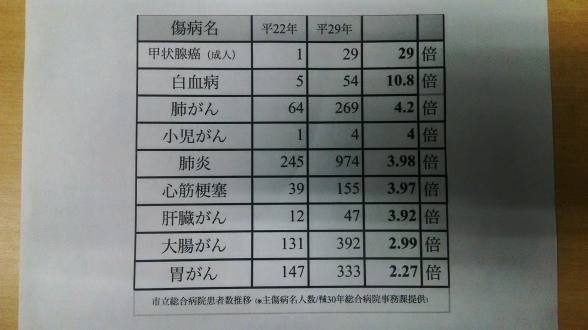
It was very courageous to the city council Koichi Oyama to leak to the public those medical data, despite the new laws to stop medical staff releasing data on health effects that may be caused by the nuclear disaster. This new controvertial law (against the supposed new open transparency purported by the nuclear industry post Fukushima disaster) was enacted in late 2013 and threatens to imprison or give huge fines to medical staff. This makes verification difficult.
Not surprisingly there was a quick reaction to that release, now claiming that the data in question represents cumulative patient visits. With the present new laws it is quite impossible to verify now that claim to be true. One thing only is sure: the Minami-soma city council issued a written warning to the city council member Koichi Oyama for disseminating the data.
The Minamisoma city council verified with the Minamisoma Municipal General Hospital business office that the data in question represents cumulative patient visits.
Once a patient is registered through the hospital system with a certain diagnosis, subsequent visits are counted cumulatively for accounting purposes unless the patient’s information is removed from the system due to reasons such as death or transfer to another hospital.
The city council chair has issued a written warning to the city council member Koichi Oyama who originally disseminated the data. (Source: Hirono town council member, Kenichi Abe)
Read also previous article: https://nuclear-news.net/?s=A+First%3A+Medical+Data+Obtained+from+Minami-soma+Municipal+General+Hospital+in+Fukushima
October 22, 2018
Posted by dunrenard |
Fukushima 2018 | Fukushima, Medical data, Minamisoma City, Secrecy Law |
Leave a comment
Translation Sean Arclight
The commune of Iitate, in the department of Fukushima, was hard hit by the fallout from the disaster of March 2011. Deserted by the inhabitants after the evacuation order, it bears the aftermath of the accident and several years of abandonment. While authorities encourage return and abolish aid to refugees, former residents are afraid to return to an environment where radioactivity remains above international standards.
The Tohoku disaster, which was accompanied by an unprecedented industrial disaster with the explosion of the Fukushima daiichi power station on March 11, 2011, has not finished generating debate and tensions over the proposed solutions for the management of the protection of the inhabitants. The situation is complex, mixing international and national industrial interests, the need for local revitalization and health and social management. The inhabitants are torn between the desire for an impossible return, the policies of resilience constrained [1] and the difficult resettlement in their new host community (Asanuma-Brice, 2014, 2015, 2016, 2017).
In this article, we propose to make an initial assessment of the situation in Iitate, an old village evacuated after the disaster, reopened to housing in 2017, and whose former residents saw the public financial aid suspended at the shelter in April 2018.
1. The village of Iitate: between ocean and mountain
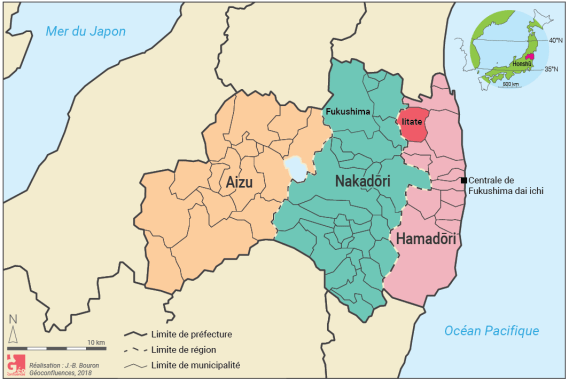
The department of Fukushima is crossed by two large mountain ranges: Ousanmiyaku, the longest mountain range in Japan, which crosses the main island from Aomori Prefecture to the north, ending in the south of Tochigi, and Abukumakochi (commonly known as Abukumasanchi) stretching from south of Miyagi to the north of Ibaraki Department. These two rocky mountain ranges cut the territory into three zones: in the west the region of Aizu, in the center Nakadôri and in the east, the area of Hamadôri which runs along the coast to extend to the Pacific (figure 1 ).
Figure 1. Localization of Iitate in Hamadôri Region and Fukushima Prefecture
Iitate is located northwest of Hamadôri, on the emerged part of the Pacific Plate. The inhabited area is engulfed in the heart of the Abukumakochi Mountains, whose highest point on the perimeter of the community is Mount Hanatsukaya (918.5 meters). The population was approximately 6,000 at the time of the accident.
The forests that cover almost the entire territory (Figure 2) are rich in a variety of trees: ginkgo biloba, keyaki (Zelvoka serrata), fir, beech, harigiri (kaopanax pictus, a thorn), osmanthus, oaks … In addition to the forest (75% of the forest area of which about 50% is state-owned), the territory of the commune was mainly devoted to agriculture (8% of meadows for raising beef, known as “black beef”, 6.2% of rice fields, 4.9% of fields, the remaining 7% are scattered in various activities [source:
http://iitate-madei.com/village01.html%5D ).
Figure 2. A forest environment about 40 kilometers from the Fukushima daiichi power station
The location of the urbanized areas within the basins between each mountain has made them particularly vulnerable to the deposits of isotopes carried by the winds coming from the Fukushima dai ichi plant (Asanuma-Brice, Libération, 2018).
The municipality is thus at the extreme north-west of the torch of contamination, the winds carrying the cloud laden with nuclear material having rushed into it. As the radioactive cloud flew over the area on March 14th, the snow deposited contamination on the ground, soiling for many years a lush nature.
Figure 3. Radiation doses and prohibited area after the disaster
In 2011, a few months after the readjustment of the evacuation zone first demarcated in a semi-circle of 20 km around the power plant (Figure 3), the village of Iitate is finally evacuated as well as all the communes on which the radioactive cloud had fallen (Figure 4). If since 2016 the evacuation order had been pushed back under the pressure of the inhabitants, it has been effective since March 2017. In April 2018, the financial aid to the shelter allocated to the former inhabitants of the village are abolished. Since 2014, the government had opted for a risk communication budget to influence refugees on their return. The government and international institutions maintain the argument of too high a cost that would be linked to a shelter policy (Asanuma-Brice, 2014).
Figure 4. Status of prohibition lifts in the area, situation in 2018
This decision is not without arousing the confusion of scientists specialized in nuclear physics who believe that it is still much too early to take such measures. This is particularly the case of Professor Imanaka Tetsuji, a professor at the Nuclear Experimentation Center at Kyôto University, or Kôji Itonaga, a professor in the Department of Biological Resources at Nihondaigaku University in Tokyo. Both of them presented the results of their expertise at the Iisora symposium, which was held in Fukushima on 17 February 2018 by former village residents and researchers of various persuasions to discuss the relevance or otherwise of this decision (figure 5).
Figure 5. Iisora Symposium in Fukushima, February 17, 2018
Iisora Symposium in Fukushima, February 17, 2018 – Professor Imanaka (Kyota University Nuclear Experiment Center) presents his results: “Is 20 msv an acceptable safety rate? “. Photo: Cécile Asanuma-Brice
2. Did the decontamination work?
In the village of Iitate, the situation is still far from settled. The multiple decontamination campaigns have not been able to overcome the radioactivity rate, which is still equivalent to 10 times the pre-accident standard for measurements made around dwellings, and 20 times for measurements taken in the mountains. In August 2017, a measurement campaign carried out by Professor Itonaga’s team (University of Japan / Nihondaigaku) on 8 houses in the village revealed rates ranging between 0.15 and 0.4 microsievert / h for measurements made on the floor, and 0.23 to 0.78 microsievert / h for measurements made near the ceiling of dwellings. In 2014, the rates were considerably higher, up to 2 microsievert / hour depending on the case. There is therefore a drop, but nevertheless deemed insufficient by the two teachers to allow the return to housing, especially as outside homes, rates recorded are flying quickly. The average measured on the ground is 0.65 microsievert / h, that made at 1 meter from the ground is 0.59 microsievert / h. These houses surrounded by forest suffer the effects of surrounding vegetation that can not be decontaminated. These houses paradoxically become victims of their natural environment, polluted for many years to come. Rainfall following steep gradients carries isotopes to valleys where dwellings are located which in turn see the increased contamination rate despite repeated waves of decontamination.
On the sample taken, Professor Itonaga (Figure 6) estimates that it will take another fifty years before the average level of environmental irradiation returns to 1 msv / year, a rate internationally defined as acceptable for the population [2]. In addition, this rate of acceptability has been increased to 20 msv / year, the municipality being part of the perimeter classified as a state of emergency. The removal of the evacuation order is therefore decided in the state by the administration which, while recognizing the instability of the environment still classified “emergency zone”, forced, by removing subsidies to the shelter and by closing temporary housing estates, residents return to live in areas still contaminated.
Figure 6. Iisora Symposium in Fukushima, February 17, 2018
Iisora Symposium in Fukushima, February 17, 2018 – Professor Itonaga (Department of Biological Resources, Nihondaigaku University, Tokyo) leads the debate with the speakers of the day, composed of scientists and former residents of the village of Iitate. Photo: Cécile Asanuma-Brice
In 2017, the authorities declared that they wanted to recycle all the waste below 8,000 Bq / kg, although the norm before the accident was 100 Bq / kg, in road works. Nevertheless, the radioactivity levels measured in the Iitate region are more than twice this threshold, with peaks of up to 40 000 Bq / kg for the measurement of only cesium 134 and 137 in the surrounding mountains. In June 2017, measurements on the sap of trees in the mountains adjacent to the dwellings revealed levels of 143 298 Bq / kg (by association of the measurement of 2 cesium 134 and 137) for an oak tree and 39 185 Bq / kg for the sap of a cherry tree (see Box 1).
Although the contamination is disparate and mobile depending on precipitation, and the decontamination is momentarily effective on a lot of soil for which 15 cm of surface soil replaced by healthy soil had been scraped off, the half-life of cesium 137 being thirty years, it seems difficult to consider a decline in the general rate of radiation irradiation before the end of this period.
Radioactivity, becquerels, cesium, what are we talking about?
The becquerel per gram (or per kilogram) characterizes the overall content of radioactive elements. Cesium 134 and 137 are the two main nuclides dispersed in the environment after the explosion of the Fukushima plant. It is found in large quantities and potentially far from the plant. Other nuclides such as plutonium or strontium are also present, but in smaller quantities and mainly within a hundred kilometers around the plant because these particles are heavier. The half-life of cesium is 30 years on average. However, “cesium is an alkali metal. For the human body, it strongly resembles potassium. But the body contains significant amounts of potassium, it is essential to humans […]. And for this reason, when the cesium is released into the environment, the body considers it as it does with the alkali metal potassium, that is to say, it integrates and accumulates in our body. “*
* Hirano, Kasai, 2016, extract translated from Japanese by Robert Stolz and English by Geoconfluences
3. The village of Iitate, an impossible return?
The village of Iitate which extends over 230 km² had already begun its demographic decline before the evacuation, from 9 385 inhabitants in 1970 to 6 209 in 2010 (Figure 7). It is only composed of 41 people according to the authorities in 2015. In 2018, part of the population returned to live in these territories, unable to pay rent elsewhere without subsidies from the state, and today about 700 people who returned to live in the village.
Figure 7. Communal population of the village of Iitate 1970-2015
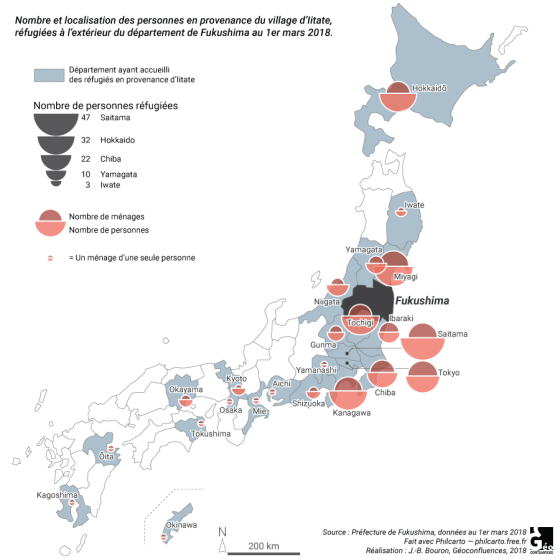
Of the initial pre-disaster population, 4,934 persons [3] in 2,032 households fled to the interior of Fukushima Prefecture, with the vast majority in Fukushima itself (3,174 people) ( Figure 9). Only 297 persons, divided into 156 households, migrated out of the department, mainly to the Tokyo area (Saitama, Chiba, Kanagawa and Tokyo departments, see Figure 8). A total of 90% of the population has moved in seven years while 546 people in 288 households plan to return to the village. For the latter, the breakdown by household shows that they are almost exclusively couples without children, the size of these households being 1.9 persons. They are preparing to enter an ecosystem mainly composed of forests, formerly anthropized, but left abandoned for 7 years. Thus, the rice fields formerly in activity would require a colossal work to be rehabilitated. The forests themselves are no longer maintained and nature has regained its rights in the vast majority of the territory.
Figures 8 and 9. Destination of refugees from the village of Iitate
The lifting of benefits in April 2018 led, for most of the elderly without resources, to a forced return to a deserted region. Of the 4,934 people who sought refuge within the department, 384 of them, divided into 233 households, were housed in seven temporary housing sites that were being closed. 363 persons (174 households) were rehoused in public housing, or 8% of the total, 1,053 (550 households) are relocated to private sector housing rented by the public services, and the 49%, made up of 3,119 people in 1,060 households, is hosted by parents. 15 single people are in retirement homes.
In December 2017, a survey conducted by Professor Itonaga’s laboratory of 52 households totaling 195 people revealed the main trends in residents’ intentions regarding the return policy (Figure 10).
Figure 10. Decisions of residents about their return and their house in Iitate.
These statistics show that of the 28.9% of households that decided to return, 11.1% of households do so to comply with the order of the administrative authorities, but 17.8% because they can not to assume their daily lives elsewhere without the help of the allowances. 20% of these households, despite the financial strain they are in, will not return, and 46.7% have not yet decided in December 2017.
The results of the multiple-choice questionnaire concerning the types of housing within the village of Iitate for the inhabitants who returned to live in the village show that while 25% of these 17 households were able to renovate their former home, 25% will preserve it in its current state, and 12.5% do not plan to rebuild it, for lack of physical and / or financial means. However, most buildings were made with natural materials and therefore perishable (wood structure, tatami, etc.). Japan is under the influence of a humid sub-continental climate in summer, which results in the simultaneous recording of high heat with a very high level of humidity. A monsoon season (May-June) precedes two typhoon seasons that sweep the archipelago in June and September, producing very high rainfall and generating regular floods. All these reasons make frequent renovation of buildings necessary. These buildings, which have been vacant for seven years, are for the most part in an advanced state of disrepair. In addition, animals have reconquered these spaces long uninhabited. Houses ravaged by wild boars or cattle, come to discover the places, are not rare. We can therefore assume that in the 37.5% of households that will preserve their habitat in the current state, a good part will live in precarious and unstable conditions.
The main reason (68.9%) for which the inhabitants do not wish to return to their village is the fact of having to live without the proximity of their children and grandchildren who, as for them, will not return.
A significant part of the former inhabitants justifies their decision of no return by the refusal to live in a territory where mountains and forests are still contaminated (64.4%). Forests covering more than 70% of the town, this point is important and can not be easily resolved. The same percentage of people (about 65%) are reluctant to return because of the renewal of nature on the village. Among other things, there is the overabundance of wild animals that have regained their rights over these territories [4].
For 62.2% of them, the absence of shops, hospitals and other daily services are at the origin of their decision of no return.
53.3% believe that the level of ambient radioactivity is still too high to consider returning to live in their village. 51.1% mention the impossibility of having an agricultural activity, 51.1% are worried about future health effects. A similarly large number of inhabitants, 46.7% will not return because of the presence of sacks of contaminated soil strewn on the territory of the municipality. Secondary reasons (below 40%) relate to the inability to consume mushrooms and other mountain plants, the absence of neighbors and the breakdown of community links. For some residents of Iitate, it’s simply “inhuman to get people to find that” (McNeill & Matsumoto, 2017).
4. What are the inhabitants’ demands?
The question of whether the government or TEPCO took responsibility for the accident led the residents to form associations to defend their rights in court. Nevertheless, these approaches are parallel and do not respond to situations of resettlement forced by the authorities. We list below some points regularly mentioned by the inhabitants during our field surveys:
it would be desirable for the authorities to recognize the difficulty of maintaining the right of residence in municipalities where the rate of contamination remains high due to “long-term industrial pollution”. Thus, for the inhabitants who wish to return, allowances should be put in place in order to allow the renovation of their habitat, as well as the decontamination works which are imposed at regular rate.
a constant and free health monitoring of the re-entrant populations
frequent radioactivity measurements, not only atmospheric, but also plants and other consumer products.
for those who decide to live outside the municipality: help and support should be established to ensure, if not possession, in any case the rental of a secure property in the place as well as job search support for people of working age. For people who are no longer able to work, a grant must be awarded to them to enable them to support their daily lives.
the problems relating to simultaneous membership of two separate communes due to the duplication of the place of settlement also remain to be resolved. This generates questions relating to the payment of local taxes, the right to vote as well as various everyday documents (driver’s license, administrative point of attachment for any employment procedure, etc.).
a recurring problem is the presence of radioactive waste in the territory that participates in maintaining a high level of ambient radioactivity. The need to create adapted legislative rules recognizing the damage caused by the obligation to live in a territory affected by an industrial disaster and to obtain the appropriate compensation.
The removal of the evacuation order in the contaminated areas of Fukushima prefecture plunges the population into the deepest disarray. The impossible choices that the inhabitants have been facing for seven years now lead them too many times to turn to the ultimate exit: suicide.
On March 3, 2018, the local newspaper, Fukushima Minpo wrote: “In the heart of the shelter, more than 2,211 people died from reasons directly attributable to the stress of the shelter.” The most affected municipalities are Minamisôma (507 people), Namie (414) Tomioka (410 people), Futaba (147 people), in other words, the communes whose population was evacuated without support for a possible reintegration in their place of residence. ‘Home. The number of deaths in question here exceeds those attributable to the natural disaster (tsunami or earthquake). Of a total of 4,040 inhabitants of Fukushima County who lost their lives for reasons directly related to the disaster, 1,605 (39.7%) people died as a result of the natural disaster and 2,211 (54.7%) because of the mismanagement of the shelter.
The suicide of these people is attributable to the stress of the forced return policies, the prolongation of the accommodation for seven years in temporary housing (whereas this period is limited to four years in the law), the maintenance in the hope of a possible return of people, often elderly, who are confronted with a deplorable reality of the environment in which they return nevertheless, for not being able to assume their life elsewhere.
On February 21, 2018 national and local newspapers dedicated theirs to the suicide of a 102-year-old man from the village of Iitate. ” Oh ! I think I lived too long, “were the last words of Mr. Okubo, a farmer of Iitate like so many others.
To complete:
- JAEGLER Hugo, POINTURIER Fabien, ONDA Yuichi, HUBERT Amélie, LACEBYAD Patrick J., CIRELLAB Maëva, EVRARD Olivier (2018), “Plutonium isotopic signatures in soils and their variation (2011-2014) in sediment transiting a coastal river in the Fukushima Prefecture, Japan“, Environmental Pollution, Volume 240, Sept. 2018, Elsevier, pages 167-176.
- HIRANO Katsuya and KASAI Hirotaka (2016) : ““The Fukushima Nuclear Disaster is a Serious Crime”: Interview with Koide Hiroaki”, The Asia-Pacific Journal, Japan Focus, volume 14, issue 6, Number 2.
- IMANAKA Tetsuji, ENDO Satoru, SUGAI Masuro, OZAWA Shoji, SHIZUMA Kiyoshi and YAMAMOTO Masayoshi (2012) : “Early radiation survey of Iitate village, which was heavily contaminated by the fukushima daiichi accident, conducted on 28 and 29 march 2011”, in Health Physics Society, pp. 680-686.
- IMANAKA Tetsuji, ENDO Satoru, SHIZUMA Kiyoshi, SUGAI Masuro, OZAWA Shoji (2011), Interim Report on Radiation Survey in Iitate Village area conducted on March 28th and 29th, 11 p. [pdf]
- MCNEILL David, MATSUMOTO Chie (2017) : “In Fukushima, a land where few return : The evacuation orders for most of the village of Iitate have been lifted. But where are the people?”, Japan Times, 2017 May 13.
- MIZOGUCHI Masaru (2013) : “Remediation of Paddy Soil Contaminated by Radiocesium in Iitate Village in Fukushima Prefecture”, in T.M. Nakanishi and K. Tanoi (eds.), Agricultural Implications of the Fukushima Nuclear Accident, pp. 131 – 142.
- SATO Akihiko, (2017) : Challenges of just rebuilding, case studies of Iitate Village and Tomioka Town, Fukushima Prefecture, in Rebuilding Fukushima, Mitsuo Yamakawa, Daisaku Yamamoto, pp. 39-47.
- TSUJIUCHI Takuya, (2015) : Mental Health Impact of the Fukushima Nuclear Disaster: Post-Traumatic Stress and Psycho-Socio-Economic Factors, Fukushima Global Communication Programme Working Paper Series Number 8, United Nations University.
- “The struggle to repopulate Fukushima, Six years after the nuclear disaster, Japan is pushing villagers back to the homes they left”, The Economist, May 2017.
From the same author:
- Cécile Asanuma-Brice : (2018) « L’être en son milieu, du rapport humain-objet-milieu au Japon comme ailleurs sur la planète », Libération, 11 juin 2018,
- Cécile Asanuma-Brice (2017) “Atomic Fission and Japan’s Nuclear Meltdown: When politics prevails over scientific proof”, in Christophe Thouny and Mitsuhiro Yoshimoto (eds.), Planetary Atmospheres and Urban Society After Fukushima, Palgrave McMillian.
- Cécile Asanuma-Brice, « Les migrants du nucléaire », Géoconfluences, octobre 2017.
- Cécile Asanuma-Brice (2016). La mémoire de l’oubli, une forme de résistance à la résilience, publication des actes du colloque « Après le désastre, réponses commémoratives et culturelles », Éditions de l’Université de Tôkyô (en français).
- Cécile Asanuma-Brice (2016) Franckushima, rédaction de la Préface et chapitres, Direction Géraud Bournet, L’utopiquant.
- Cécile Asanuma-Brice (2015) « De la vulnérabilité à la résilience, réflexions sur la protection en cas de désastre extrême : Le cas de la gestion des conséquences de l’explosion d’une centrale nucléaire à Fukushima », Revue Raison Publique, no. « Au-delà du risque Care, capacités et résistance en situation de désastre », Sandra Laugier, Solange Chavel, Marie Gaille (dir.)
- Cécile Asanuma-Brice (2015) « À Fukushima, la population est dans une situation inextricable », CNRS Le Journal, mars 2015.
- Cécile Asanuma-Brice (2014) « La légende Fukushima », Libération, septembre 2014.
- Cécile Asanuma-Brice (2013) « Fukushima, une démocratie en souffrance », Revue Outre terre, mars 2013.
- Cécile Asanuma-Brice (2012) « Les politiques publiques du logement face à la catastrophe du 11 mars », in C. Lévy, T. Ribault, numéro spécial de la revue EBISU de la Maison franco-japonaise n° 47, juin 2012.
Autres articles de l’auteure à consulter ici :
https://cnrs.academia.edu/C%C3%A9cileAsanumaBrice
October 16, 2018
Posted by dunrenard |
Fukushima 2018 | Evacuation Zone, Evacuees Return, Fukushima, Iitate |
Leave a comment

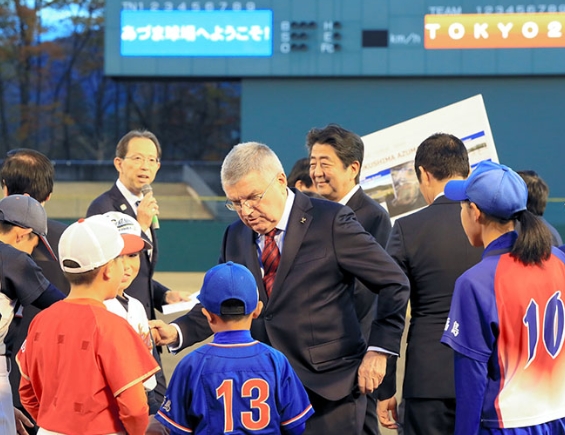 IOC President Thomas Bach, center, visits a baseball stadium in Fukushima with Prime Minister Shinzo Abe on Nov. 24.












 nuclear-news