Olympics no relief for devastated city
 Weeds grow in an abandoned apartment complex Tuesday in Futaba, Japan. Government officials say it’s the “recovery Olympics” for the disaster-hit areas and residents. But the town of Futaba, home to the tsunami-wrecked nuclear plant, is still largely frozen in time for nearly nine years since the disaster, with thousands of its former residents still unable to return.
December 14, 2019
FUTABA, Japan — The torch relay for the Tokyo Olympics will kick off in Fukushima, the northern prefecture devastated almost nine years ago by an earthquake, tsunami and the subsequent meltdown of three nuclear reactors.
They’ll also play Olympic baseball and softball next year in one part of Fukushima, allowing Tokyo organizers and the Japanese government to label these games the “Recovery Olympics.” The symbolism recalls the 1964 Tokyo Olympics, which showcased Japan’s reemergence just 19 years after World War II.
But tens of thousands still haven’t recovered in Fukushima, displaced by nuclear radiation and unable to return to deserted places like Futaba.
Time stopped in the town of 7,100 when disaster struck on March 11, 2011.
Laundry still hangs from the second floor of one house. Vermin gnaw away at once intimate family spaces, exposed through shattered windows and mangled doors. The desolation is deepened by Japanese tidiness with shoes waiting in doorways for absent owners.
“This recovery Olympics is in name only,” Toshihide Yoshida told The Associated Press. He was forced to abandon Futaba and ended up living near Tokyo. “The amount of money spent on the Olympics should have been used for real reconstruction.”
Olympic organizers say they are spending $12.6 billion on the Olympics, about 60% public money. However, an audit report by the national governments said overall spending is about twice that much.
The Olympic torch relay will start in March in J-Village, a soccer stadium used as an emergency response hub for Fukushima plant workers. The relay goes to 11 towns hit by the disaster, but bypasses Futaba, a part of Fukushima that Olympic visitors will never see.
“I would like the Olympic torch to pass Futaba to show the rest of the world the reality of our hometown,” Yoshida said. “Futaba is far from recovery.”
The radiation that spewed from the plant at one point displaced more than 160,000 people. Futaba is the only one of 12 radiation-hit towns that remains a virtual no-go zone. Only daytime visits are allowed for decontamination and reconstruction work, or for former residents to check their abandoned homes.
The town has been largely decontaminated and visitors can go almost anywhere without putting on hazmat suits, though they must carry personal dosimeters — which measure radiation absorbed by the body — and surgical masks are recommended. The main train station is set to reopen in March, but residents won’t be allowed to return until 2022.
A main-street shopping arcade in Futaba is lined by collapsing store fronts and sits about 4 kilometers (2.5 miles) from the nuclear plant, and 250 kilometers (150 miles) north of Tokyo. One shop missing its front doors advertises Shiseido beauty products with price tags still hanging on merchandise. Gift packages litter the ground.
“Let us know if you start feeling unwell,” Muneshige Osumi, a former town spokesman told visitors, apologizing for the musty smell and the presence of rats.
About 20,000 people in Japan’s northern coastal prefectures died in the magnitude 9.0 earthquake and resulting tsunami. Waves that reached 16 meters (50 feet) killed 21 people around Futaba, shredding a seaside pine forest popular for picnics and bracing swims.
A clock is frozen at 3:37 p.m. atop a white beach house that survived.
Nobody perished from the immediate impact of radiation in Fukushima, but more than 40 elderly patients died after they were forced to travel long hours on buses to out-of-town evacuation centers. Their representatives filed criminal complaints and eventually sent former Tokyo Electric Power Company executives to court. They were acquitted.
When Tokyo was awarded the Olympics in 2013, Prime Minister Shinzo Abe assured International Olympic Committee members that the nuclear disaster was “under control.” However, critics say the government’s approach to recovery has divided and silenced many people in the disaster-hit zones.
Under a development plan, Futaba hopes to have 2,000 people — including former residents and newcomers such as construction workers and researchers — eventually living in a 550-hectare (1,360-acre) site.
Standing outside the Futaba station, Mayor Shirou Izawa described plans to rebuild a new town. It will be friendly to the elderly, and a place that might become a major hub for research in decommissioning and renewable energy. The hope is that those who come to help in Fukushima’s reconstruction may stay and be part of a new Futaba.
“The word Fukushima has become globally known, but regrettably the situation in Futaba or (neighboring) Okuma is hardly known,” Izawa said, noting Futaba’s recovery won’t be ready by the Olympics.
To showcase the recovery, government officials say J-Village — where the torch relays begins — and the Azuma baseball stadium were decontaminated and cleaned. However, problems keeping popping up at J-Village with radiation “hot spots” being reported, raising questions about safety heading into the Olympics.
The baseball stadium is located about 70 kilometers (45 miles) west of Futaba, J-Village is closer, about 20 kilometers (12 miles) away along the coastal area.
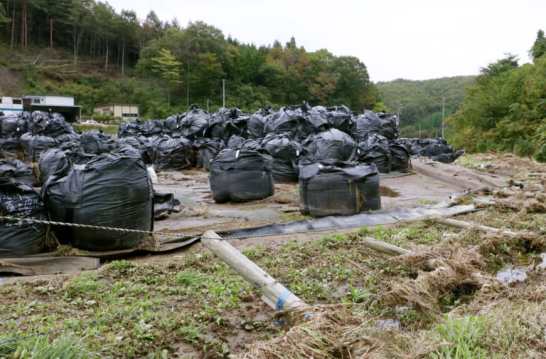
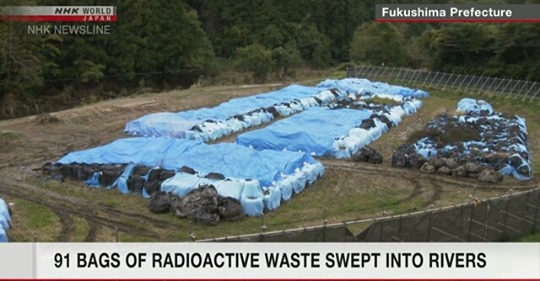
The radioactive waste from decontamination surrounding the plant, and from across Fukushima, is kept in thousands of storage bags stacked up in temporary areas in Futaba and Okuma.
“Who wants to come to live in a place like that? Would senior officials in Kasumigaseki government headquarters go and live there?” Yoshida asked, referring to the high-end area in Tokyo that houses many government ministries.
“I don’t think they would,” Yoshida said. “But we have ancestral graves, and we love Futaba, and we don’t want Futaba to be lost. The good old Futaba that we remember will be lost forever, but we’ll cope.”
https://www.nwaonline.com/news/2019/dec/14/olympics-no-relief-for-devastated-city-/
Olympics-Radiation hot spots found at Tokyo 2020 torch relay start – Greenpeace
 J-village
December 4, 2019
TOKYO, Dec 4 (Reuters) – Radiation hot spots have been found at the J-Village sports facility in Fukushima where the Tokyo 2020 Olympic torch relay will begin, Greenpeace Japan said on Wednesday.
Greenpeace found that radiation levels around the recently refurbished venue, which also hosted the Argentina team during the Rugby World Cup earlier this year, were significantly higher than before the Fukushima Daiichi nuclear reactor meltdown following the March 2011 earthquake and tsunami.
Greenpeace’s survey found radioactivity readings taken at J-Village on Oct. 26 as high as 71 microsieverts per hour at surface level.
People are exposed to natural radiation of 2,000-3,000 microsieverts a year, so anyone staying in the vicinity of J-Village for two or more days could be exposed to more than that.
These readings, although not deemed life-threatening if exposed for a short length of time, are 1,775 times higher than prior to the March 2011 disaster, according to the NGO.
The Olympic flame is due to arrive from Greece in Japan on March 20, with the torch relay officially starting from J-Village on March 26.
Greenpeace said in a statement that it had sent its findings to Japan’s Ministry of Environment, but had received no response.
“There is a risk that heavy rain will spread these higher levels of contamination on public roads, and thus re-contaminate already decontaminated surfaces,” warned Greenpeace nuclear specialist Shaun Burnie, team leader of the J-Village survey, in a statement.
An ministry official acknowledged to Reuters on Wednesday that the ministry had been alerted to higher radiation level readings in an area surrounding J-Village and that decontamination measures had been taken.
“The ministry cooperated with related groups to decrease radiation levels in that area,” said the official.
“On Dec. 3, Tokyo Electric Power (Tepco) took measures to decrease radiation levels in said area.”
The Fukushima Daiichi nuclear station, located about 220 km (130 miles) northeast of Tokyo, was rocked by a magnitude 9.0 earthquake and subsequent tsunami in March 2011, sparking three reactor meltdowns.
More than 160,000 residents fled nearby towns in the aftermath as radiation from the reactors contaminated water, food and air. Greenpeace called on the Japanese government to conduct more extensive radiation surveys in the area and the NGO planned to return to J-Village soon to “determine if subsequent decontamination attempts have been adequately conducted.”
Tokyo 2020 organisers could not be immediately reached for comment.
Worries that local food could be contaminated by the nuclear disaster has prompted plans by South Korea’s Olympic committee to buy radiation detectors and ship homegrown ingredients to Japan for its athletes at the Tokyo Games. (Additional reporting by Mari Saito; editing by Simon Cameron-Moore)
Radiation hotspots ‘found near Fukushima Olympic site’
Greenpeace calls for fresh monitoring of region where nuclear disaster occurred
 The Fukushima Daiichi power plant, which was the site of a nuclear disaster in 2011. Officials are keen to showcase the area’s recovery.
Wed 4 Dec 2019
Greenpeace has said it detected radiation hotspots near the starting point of the upcoming Olympic torch relay in Fukushima.
Japan’s environment ministry said the area was generally safe but it was in talks with local communities to survey the region before the 2020 Games, which open on 24 July.
The government is keen to use the Olympics to showcase Fukushima’s recovery from the 2011 tsunami. It intends to use J-Village, a sports complex located about 12 miles from the nuclear plant that was damaged in the disaster, as the starting point for the Japan leg of the torch relay taking place in March.
Originally designed as a training centre for athletes, J-Village functioned for years as a logistics hub for crews working to control and decommission the defunct reactors.
After a cleanup process, the sports centre became fully operational again in April this year, shortly after the torch relay decision.
Greenpeace urged fresh radiation monitoring and continued cleanup efforts, saying it had detected some spots with radiation levels as high as 1.7 microsieverts per hour when measured one metre above the surface.
This compared with the national safety standard of 0.23 microsieverts per hour, and a normal reading in Tokyo of about 0.04 microsieverts per hour. The hotspots showed a reading of 71 microsieverts per hour at the surface level, Greenpeace said.
However, J-Village’s website said the radiation reading at its main entrance was 0.111 microsieverts per hour on Wednesday, while one of its fields showed a reading of 0.085 microsieverts per hour.
The Tokyo Electric Power Company, which operates the Fukushima plant, said it cleaned the spots on Tuesday after the environment ministry told the firm about them.
Greenpeace said it relayed its findings to the Japanese government as well as local and international Olympic organisers. The group will publish a report of its findings in the region next year.
Fukushima Journey, Pt. 2: Olympics Propaganda, Thyroid Cancers, Japanese Govt. Lies – 4 days in Fukushima Prefecture w/Beverly Findlay-Kaneko

November 28, 2019
This Week’s Featured Interview:
- Fukushima Journey: The “Disappearing” Nuclear Disaster – 4 days on-the-ground in Fukushima Prefecture with Beverly Findlay-Kaneko continues. She lived in Yokohama, Japan for 20 years until March 2011 after the Great Eastern Japan Earthquake. She worked at Yokohama National University and The Japan Times. Beverly has a Master’s degree in East Asian Studies from Stanford University, and speaks Japanese fluently.
Since returning from Japan, Beverly and her husband, Yuji Kaneko, have been active in raising awareness about nuclear issues, including the nuclear accident at Fukushima. Their main activities have included organizing speaking tours, giving presentations, networking in activist and nuclear-impacted communities in the U.S. and Japan, and co-producing the annual Nuclear Hotseat podcast “Voices from Japan” special on Fukushima.
This is the second half of the “Fukushima Journey” Nuclear Hotseat interview, based on more than three hours of source material. Pt. 1 appeared in episode #439 from November 19, 2019.
Transparency, the olympics, and that damned water, Part 2
 Official messaging about Fukushima focuses on happiness.
Tuesday November 26th, 2019
Part 2: What about the Olympics?
The concerns we hear about the 2020 Olympics are more generalized and less focussed than those about the water in the tanks at Fukushima Daiichi. Some people ask us if it’s safe to come to Japan at all. Others narrow it down to Fukushima Prefecture. A few journalists and others have specifically asked us to weigh in on the potential risks to people who attend the events which will be held in Azuma Stadium in Fukushima City. Our response to Tokyo businessman Roy Tomizawa was to suggest he build a bGeigie and survey the stadium himself. He did, and wrote about it. Helping people find out for themselves is how we prefer to interact with and inform the public. We often point out that the entire framing of “safety” when it comes to radiation risk is problematic. The guidelines for acceptable radiation limits in food, the environment, and elsewhere are not really “safety” limits, and exceeding them does not mean “unsafe.” They are warning levels that trigger protective actions intended to prevent actually “unsafe” exposures. In each case, the important questions are: Do you understand this risk, and is it acceptable to you? This is where people need help, and where government has so far largely failed in its mission to inform. Once again we think it comes down to transparency.
A quick Google search of “Fukushima Olympics” will illustrate the widespread belief that athletes and visitors who go to Fukushima next year will be putting their lives at risk. The Korean government has announced that their teams will bring their own food so as not to incur potential health risks from eating local products. Many people suspect that the Japanese Government is holding Olympic events in Fukushima in order to cover up the effects of the disaster and paint the prefecture with a tint of normality. It seems clear that the government lost control of this narrative long ago and may well be unable to recover before the 2020 Olympics begin, and that the negative effects could persist for years afterwards. We do not see any adequate messaging or information about the kinds of risks people around the world are concerned about, presented understandably and accessibly. What messaging we have seen so far is clumsy and tends heavily towards images of smiley happy people intended to suggest that everything is fine. No-one really trusts these blithe reassurances, because they distrust government itself.
Japanese government agencies seem to be operating under the assumption that their authority in matters like this is still intact in the eyes of the public. Their messages appear to be shaped under the assumption that they can simply say, “We’ve had a committee look into it and we’ve determined that it’s safe,” without demonstrating the necessary transparency and breaking the explanation down in appropriate ways. We have no desire to make government’s job easier about any of this, but we care about the people in Fukushima, and so we want government to present clear and accurate information about their situation. Things in Fukushima are not as bad as alarming Google hits often suggest, but it’s definitely not hunky-dory either. Honest messaging would reflect this. We too wonder why the government has rushed to hold Olympic events in Fukushima, ignoring the global public’s existing fear and skepticism. Many Fukushima residents are supportive of the games and hope they will shed a positive light on the progress the prefecture has made since the disasters in 2011. It could be good for local economies as well. On the other hand, it could be another avoidable PR disaster.
We think people can visit Fukushima today without undue fear. The preponderance of data, both independent data like ours as well as official data, shows that typical visitors are extremely unlikely to travel anywhere in the prefecture where external radiation exposure is higher than natural background radiation levels in most of the world, unless they go out of their way to enter very contaminated areas to which access is normally prohibited. If people are willing to consider normal background radiation levels “safe,” then most of Fukushima fits this description. There are a lot caveats, however. There may be cesium contamination in the ground even in places where the external dose rate is in the normal range (Minnanods has published a very good map of their independent measurements of soil contamination). While food produced in Fukushima is closely monitored by both official bodies and independent labs, both of which indicate that it is overwhelmingly “safe,” people should avoid wild mushrooms, wild vegetables, wild game, and other items which are not produced under controlled agricultural conditions and distributed by supermarkets. With few exceptions the forests are not being decontaminated, and radiation levels can be considerably higher there, so it’s probably best to avoid entering unknown forests.
We get a lot of pushback for saying this, but years of Safecast radiation measurements in Fukushima and elsewhere show that short-term visitors to Fukushima will almost certainly get a higher radiation dose on their flights to Japan than they will by spending several days in Fukushima. (You can see Safecast measurements taken during air travel here.) These exposures are not entirely comparable, though, and the equation is different for people who live in parts of Fukushima where they are likely to receive decades of elevated radiation doses. But we stand by our overall conclusions, while pointing out that the only way to be sure is to have good data available for the places you’re going, which Safecast tries hard to provide. We’re very critical of the Korean government’s politically motivated manipulation of fear about Fukushima food despite not presenting any measurement data in support of its claims. On the other hand, Korea has demanded that radiation risks for next year’s Olympics be verified by independent third-parties, which we highly endorse. The Japanese government and the Olympic committee have announced that the torch relay will run though over 20 Fukushima towns, but they have not provided the public with survey data showing the current radiation levels along those routes. Safecast volunteers are ready to measure these routes, and indeed most have probably already been measured at some point, and while our data might indicate no particular risks for participants and viewers in most locations, it might reveal areas of concern. What maddens us is that we have been unable to obtain information about the actual street routes for the Fukushima portions of the relay and do not know how long before the event’s route information will actually become available.
Ultimately, we expect that official messaging about the Fukushima 2020 Olympic events will continue to avoid frank discussions of radiation risks and will continue to focus on “happiness.” The current information void and amateurish messaging are likely to be shattered at some point early next year by a massive and expensive PR blitz which will also focus on “happiness” but with higher production values and market reach. If radiation is dealt with at all, it is likely to be in a superficial and somewhat misleading manner. It doesn’t have to be that way.
Azby Brown
Azby Brown is Safecast’s lead researcher and primary author of the Safecast Report. A widely published authority in the fields of design, architecture, and the environment, he has lived in Japan for over 30 years, and founded the KIT Future Design Institute in 2003. He joined Safecast in mid-2011, and frequently represents the group at international expert conferences.
https://blog.safecast.org/2019/11/transparency-the-olympics-and-that-damned-water-part-2/
Fukushima Disappearing? An on-the-ground report by Beverly Findlay-Kaneko

November 20, 2019
Fukushima Disappearing? An on-the-ground report by Beverly Findlay-Kaneko. She lived in Yokohama, Japan for 20 years until March 2011 after the Great Eastern Japan Earthquake. She worked at Yokohama National University and The Japan Times. Beverly has a Master’s degree in East Asian Studies from Stanford University, and speaks Japanese fluently.
Since returning from Japan, Beverly and her husband, Yuji Kaneko, have been active in raising awareness about nuclear issues, including the nuclear accident at Fukushima. Their main activities have included organizing speaking tours, giving presentations, networking in activist and nuclear-impacted communities in the U.S. and Japan, and co-producing the annual Nuclear Hotseat podcast “Voices from Japan” special on Fukushima.
TEPCO estimates tritium volume for disposal from Fukushima plant

Experts warn against fires from disaster waste after Typhoon Hagibis

Fukushima to Become Solar, Wind Hub Using Farmland Tainted by Radiation

21 new plants to help transform Fukushima into a renewable energy hub

10 More Years for Japan’s Reconstruction Agency to Aid Fukushima Nuclear Disaster Recovery


Dozens of bags of radioactive waste still missing in Fukushima three weeks after intense typhoon
‘Only’ 91 bags of radioactive waste swept into rivers
9 Japan water purification plants flooded by Typhoon Hagibis lacked watertight doors

Area of Fukushima Nuclear Power Station Disaster Badly Impacted By Flooding, High Waves, Landslides


1 This Month

of the week – Shut Down Drone Warfare!


Tell the Ukrainian Government to Drop Prosecution of Peace Activist Yurii Sheliazhenko

Petition to revoke the licensing of the Near Surface Nuclear Disposal Facility (NSDF) at Chalk River. https://www.ourcommons.ca/petitions/en/Petition/Details?Petition=e-7247
To see nuclear-related stories in greater depth and intensity – go to https://nuclearinformation.wordpress.com
-
Archives
- March 2026 (244)
- February 2026 (268)
- January 2026 (308)
- December 2025 (358)
- November 2025 (359)
- October 2025 (376)
- September 2025 (257)
- August 2025 (319)
- July 2025 (230)
- June 2025 (348)
- May 2025 (261)
- April 2025 (305)
-
Categories
- 1
- 1 NUCLEAR ISSUES
- business and costs
- climate change
- culture and arts
- ENERGY
- environment
- health
- history
- indigenous issues
- Legal
- marketing of nuclear
- media
- opposition to nuclear
- PERSONAL STORIES
- politics
- politics international
- Religion and ethics
- safety
- secrets,lies and civil liberties
- spinbuster
- technology
- Uranium
- wastes
- weapons and war
- Women
- 2 WORLD
- ACTION
- AFRICA
- Atrocities
- AUSTRALIA
- Christina's notes
- Christina's themes
- culture and arts
- Events
- Fuk 2022
- Fuk 2023
- Fukushima 2017
- Fukushima 2018
- fukushima 2019
- Fukushima 2020
- Fukushima 2021
- general
- global warming
- Humour (God we need it)
- Nuclear
- RARE EARTHS
- Reference
- resources – print
- Resources -audiovicual
- Weekly Newsletter
- World
- World Nuclear
- YouTube
-
RSS
Entries RSS
Comments RSS
 nuclear-news
