Fukushima: Novel Fixes Fail, Waste Dumping Threatens Pacific Ocean

September 30, 2022
by John Laforge
During the 11-year-long, estimated $57.4 billion (partial) decontamination efforts at the destroyed Fukushima-Daiichi reactor site in Japan, almost every novel program invented to deal with the complex, unprecedented triple catastrophe has initially failed and then needed to be re-invented. Unworkable schemes instigated to repair, decontaminate, plug-up, or prevent ongoing radioactive contamination, along with cover-ups and corruption by the Tokyo Electric Power Co. which runs the operation, have left the Japanese public wary of the company’s plans and of safety assurances from the government.
Japan’s extensive bull-dozing and mass collection of contaminated topsoil and debris, poisoned by the meltdowns’ radioactive fallout, has filled approximately 20 million one-ton bags. These millions of tons of cesium-contaminated waste are standing outdoors in mountainous stacks scattered across seven states. Some of the heavy bags have been jostled and broken open by torrential rains during typhoons.
Attempts to locate and examine the total of 900 tons of melted reactor fuel (which possibly burned through the wrecked “containments” and foundations of the three units) have failed, because robotic cameras have repeatedly been destroyed by the ferociously hot and radioactive melted wastes. Eleven years after the catastrophe, the condition and location of the melted fuel masses, known as “corium,” is still uncertain because Tepco has yet to develop a robust enough camera.
The reactors’ concrete foundations were so severely broken up by the record 9.0 magnitude earthquake, that groundwater rushes through cracks and broken pipes, pours over the three huge masses of corium and becomes highly contaminated with a mix of at least 62 radioactive materials. Tepco’s installation of an expensive “ice wall” that was dug into the ground behind the wrecked reactors, was intended to divert the groundwater keeping it away from the foundations. This fix has also failed.
Tepco has slowed the direct flow of the contaminated water into the Pacific by filtering it and then collecting it in giant tanks. But the tank farm is plagued by leaks and by the discovery that the filter system has failed. In 2018, Tepco admitted that its “Advanced Liquid Processing System” or ALPS had not removed iodine-129, ruthenium-106 and technetium-99, as well as carbon-14, and 60 other long-lived poisons, putting the lie to its repeated assurances that ALPS would remove everything but tritium. The company then promised that it would re-treat the collected water, before dumping all 1.3 million tons of the waste water into the Pacific.
In July, Japan’s nuclear regulator formally approved Tepco’s plan to dump the water into the ocean beginning in spring 2023 and continuing for 30 years. The reactors produce 140 cubic meters of contaminated water every day, a combination of ground- and rainwater that seeps into the wreckage, and cooling water mechanically poured over the three corium piles. While independent scientists and environmental historians have charged that dumping would constitute the worst premeditated maritime pollution in recorded history, Tepco’s ocean pollution solution has already been okayed by the government in Tokyo and by the International Atomic Energy Agency.
Ocean dumping would violate international law
In August, Tepco announced that it would begin constructing a tunnel to the sea for releasing the waste water. Complaints from scientists, environmental groups and Pacific Rim countries, particularly South Korea and China, have not forced Japan to reconsider the plan.
Certain international treaties forbid such deliberate pollution of the global commons. The “Convention on the Prevention of Marine Pollution by Dumping of Wastes and Other Matter,” or London Convention, prohibits any intentional release of radioactive wastes into the sea. Writing in The Korea Times, environmental attorney Duncan Currie and nuclear specialist Shaun Burnie of Greenpeace Germany noted that ocean dumping would also violate the UN Convention on the Law of the Sea by posing a direct threat to the marine environment and the jurisdictional waters of the Korean peninsula.
Tepco says the tritium concentration in the wastewater will be lowered before dumping by diluting it with seawater. However, dilution is basically a public relations scheme since the total amount of radioactive tritium will remain the same. Greenpeace’s Burnie and Currie and others have warned about tritium’s ability to form organically-bound tritium, and that — if ingested with seafood —the biological power of tritium’s beta radiation can damage human DNA.
John LaForge is a Co-director of Nukewatch, a peace and environmental justice group in Wisconsin, and edits its newsletter.
Inside the Primary Containment Vessel of Fukushima Daiichi Nuclear Power Station Unit 1.
by Citizens’ Nuclear Information Center · Published September 30, 2022 · Updated September 30, 2022
Pedestal with Exposed Reinforcing Steel
By Kamisawa Chihiro (CNIC)
Survey of the pedestal exterior in the Unit 1 primary containment vessel
On February 9, 2022, Tokyo Electric Power Company Holdings, Inc. (TEPCO) and the International Research Institute for Nuclear Decommissioning (IRID) conducted a survey into the underground level of the primary containment vessel (PCV) of Fukushima Daiichi Nuclear Power Station (FDNPS) Unit 1, using an underwater remotely operated vehicle (ROV). The survey was intended to be a preliminary to investigating the conditions inside the vessel. The survey revealed that there were vast amounts of deposits, which were attributed to melted nuclear fuel, and exposed reinforcing steel, which appeared to be the skeletons of damaged concrete structures.
On March 14, the two parties started a close visual inspection along the periphery of the pedestal (reinforced concrete base on which the reactor pressure vessel was installed) with an ROV. However, on March 16, a serious earthquake of magnitude 7.4 occurred off the coast of Fukushima Prefecture. The water level in the PCV of Unit 1 declined due to the earthquake, and the inspection was suspended.
The two parties thereafter adjusted the water level by increasing the rate of water feed to the reactor, realizing the required water level in the PCV. On May 17, close inspection of the PCV interior was resumed using the ROV. The visual inspection was continued until May 21. The thickness of the deposits were also measured and thermal neutron flux measurements were conducted to learn whether the deposits were from nuclear fuel. It was confirmed that a major part of the deposits was from the fuel.
Fuel debris deposits and damaged wall concrete on the pedestal periphery
In the survey, the outside of the pedestal was visually inspected in detail with the underwater ROV camera along more than half the cylindrical surface of the pedestal (Figure 1).
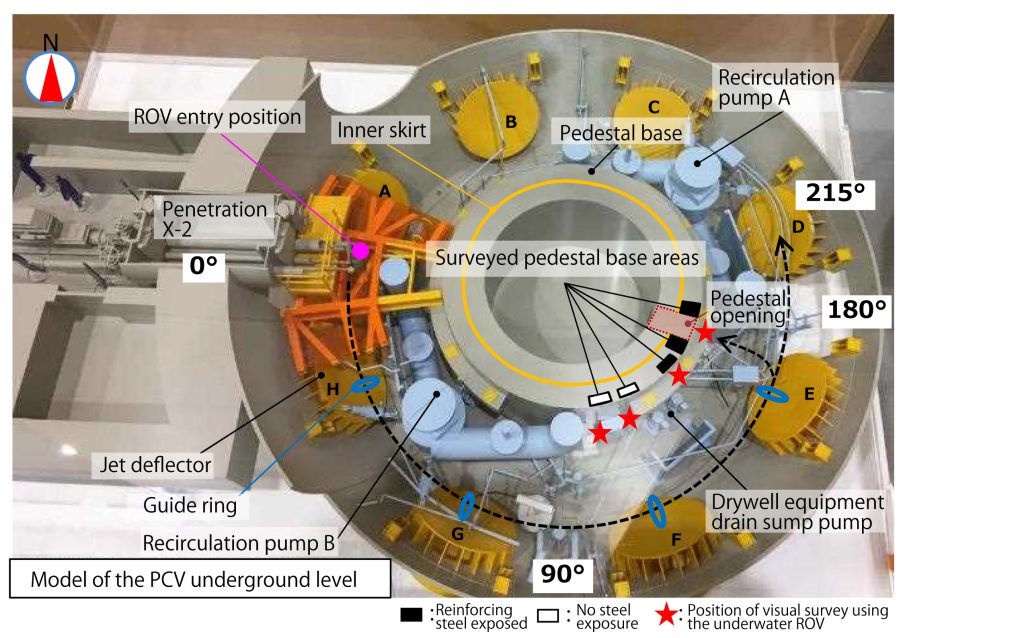

The videos and photographs taken from the pedestal periphery show there are deposits that have accumulated deep on the PCV floor (Photograph 1).
The lower periphery of the drywell has eight vent pipes that connect to the suppression chamber. Each vent pipe is provided with a jet deflector to protect the pipe inlet. About one-third of the length of the jet deflectors are buried in the deposits from below (especially deflectors C through F). It was confirmed that deposits also exist behind the jet deflectors. This shows that fuel debris is likely to have entered the suppression chamber.
TEPCO says that the piping and valves of the reactor auxiliary cooling system and the piping of the reactor recirculation system are not seriously damaged.

However, as those photographs show, the piping and valves of the reactor auxiliary cooling system are covered with deposits, while keeping their original shape. Especially, the greater part of the piping looks to be buried under the deposits, and it is unknown whether the piping is damaged or not (Photograph 2).
The valves and piping of recirculation system B do not look seriously damaged as far as the released videos and photographs show. The valves and piping of system A on the opposite side look vague, and it is unknown whether they are damaged or not. It seems possible that there is an anomaly in the proximity of the piping elbow near the pedestal opening.
The pedestal opening lies nearly halfway around from the underwater ROV entry position. Before the 2011 accident, operators entered the space below the reactor through this opening to inspect and maintain the control rod drive and neutron instrumentation.
Currently there is no concrete on either side of the pedestal opening, which must have been there before the accident. As the photographs show, the reinforcing steel skeletons are exposed, and deposits have settled on them (Photographs 3 and 4). The sheet-steel cylindrical structure called the inner skirt, built inside the pedestal, is also exposed.

This means that, on both the sides of the opening, the originally 120-centimeter-thick concrete wall of the pedestal has completely vanished down to the height of about 100 centimeters from the base floor of the PCV. The data by TEPCO and IRID, as shown in Figure 1, indicates the approximate positions of the exposed reinforced steel, but we believe that these are not the only positions where steel is exposed.

The Unit 1 pedestal and lower part of the PCV have the construction shown in Figure 2. The wall of the pedestal base is about 120 centimeters thick. According to the report of the Nuclear Regulation Authority’s investigative hearing with TEPCO, the inner skirt was originally buried in the pedestal base down to about the height of about 100 centimeters.
This means that, on both the sides of the opening, the originally 120-centimeter-thick concrete wall of the pedestal has completely vanished down to the height of about 100 centimeters from the base floor of the PCV. The data by TEPCO and IRID, as shown in Figure 1, indicates the approximate positions of the exposed reinforced steel, but we believe that these are not the only positions where steel is exposed.
How did the concrete vanish?
Concrete is produced from cement and aggregates such as sand and crushed stones, which are mixed with water and then solidified. Concrete and cement are known to have the following characteristics under elevated temperature (Kasami and Ohno, “Solid-state Properties of Concrete in High-temperature Ranges”).
- When placed in a high-temperature range for a brief period, such as when exposed to a fire, concrete may flake off or explosively crack.
The characteristics of concrete and cement under more moderate temperature changes can be explained as follows:
- When a hydration reaction has continued sufficiently in the hardened cement body, free water and gel water are lost at about 105°C.
- When the body is further heated, part of the chemically bound water starts to be given off, and in the temperature range from approximately 250°C to 350°C, calcium silicate hydrates in the cement lose about 20% of their retained moisture.
- Between 400°C and 700°C, the moisture remaining in the calcium silicate hydrates is mostly lost. Calcium hydroxides are dehydrated and decomposed.
Melted nuclear fuel that consists mostly of uranium dioxide may reach 2,800°C. The melting temperature for concrete is about 1,200°C (which may differ depending on the amount of aggregates).
The core and concrete reaction analysis conducted by TEPCO in 2011 assumed that concrete erosion started when the temperature was at 1,500 K (approximately 1,227°C), concluding that the pedestal concrete floor was eroded down to a depth of sixty-five centimeters.
Did the melted nuclear fuel blow out from the bottom of the Unit 1 RPV, drop down to the floor inside the pedestal, spread over the floor, and attack the concrete wall of the pedestal, causing concrete flaking or explosive cracking? It is also possible that while such a process went ahead, the concrete, heated to 400°C through 700°C, became progressively weaker and fell apart little by little.
The reinforcing steel and inner skirt are not significantly deformed or melted as far as the videos and photographs show. However, the condition of other structures and to what extent the reinforcing concrete fell apart are also unknown at present.
Can the RPV tolerate a massive earthquake?
The loss of the concrete of the pedestal base presents a concern: The RPV, standing on the pedestal, may collapse or fall.
TEPCO, referring to the results of the RPV and PCV seismic assessment conducted by IRID in 2016, is extremely optimistic, stating that, even if a part of the pedestal is deteriorated or damaged, the pedestal can retain the function of supporting the RPV against an assumed earthquake, using the criteria at the time, of a ground motion Ss of 600 Gal.
However, a close examination of IRID’s assessment and TEPCO’s perspective show that their assumptions are overly optimistic. As an example, the model used for the seismic assessment is incorporated into the function of the containment vessel stabilizer and pressure vessel stabilizer, which control the lateral movement of the containment vessel and pressure vessel respectively, but the integrity of those stabilizers is unknown at present.
The TEPCO and IRID analysis concludes, based only on the observed ranges, that the reinforcing steel of the pedestal base does not show damage such as buckling, and that the function of the inner skirt has not deteriorated. The conditions used for the analysis lack discreteness. These conditions may change as the survey is continued in the future. As an example, greater damage in the concrete walls and floor may be discovered. In that case, completely different results may be derived from the seismic assessment.
References (all in Japanese)
- 東京電力, 福島第一原子力発電所1~3号機の炉心状態について, 2011年11月30日
TEPCO. “Fukushima Daiichi Nuclear Power Station Units 1, 2 and 3 Reactor Core Conditions,” Nov. 30, 2011.
www.tepco.co.jp/nu/fukushima-np/images/handouts_111130_09-j.pdf
- IRID, 2014年度補正予算廃炉・汚染水対策事業費補助金, 圧力容器/格納容器の耐震性・影響評価手法の開発 (2016年度成果報告), 2017年7月
IRID. “Fiscal 2014 Supplementary Budget Grant for Decommissioning and Contaminated Water Countermeasures — Development of RPV and PCV Earthquake Resistance and Impact Evaluation Methods (Fiscal 2016 Achievement Report),” July 2017.
irid.or.jp/wp-content/uploads/2017/06/20160000_11.pdf
- 東京電力・IRID・日立GEニュークリアエナジー, 福島第一原子力発電所1号機原子炉格納容器内部調査の実施状況 (2月9日調査分) について, 2022/2/10
TEPCO, IRID and Hitachi-GE Nuclear Energy. “Updates on Fukushima Daiichi Nuclear Power Station Unit 1 Reactor PCV Interior Survey (of Feb. 9)” [Video], Feb. 10, 2022.
www.tepco.co.jp/library/movie/detail-j.html?catid=107299&video_uuid=k593g02e
- 東京電力・IRID・日立GEニュークリアエナジー, 福島第一原子力発電所1号機原子炉格納容器内部調査(ROV-A2) の実施状況 (3月14~16日の作業状況), 2022/3/24
TEPCO, IRID and Hitachi-GE Nuclear Energy. “Updates on Fukushima Daiichi Nuclear Power Station Unit 1 Reactor PCV Interior Survey (ROV-A2) (Mar. 14–16)” [Video], Mar. 24, 2022.
www.tepco.co.jp/library/movie/detail-j.html?catid=107299&video_uuid=s19dq021
- 東京電力・IRID・日立GEニュークリアエナジー, 福島第一原子力発電所1号機原子炉格納容器内部調査(ROV-A2)の実施状況 (2022年5月17~19日の作業状況), 2022/5/23
TEPCO, IRID and Hitachi-GE Nuclear Energy. “Updates on Fukushima Daiichi Nuclear Power Station Unit 1 Reactor PCV Interior Survey (ROV-A2) (May 17–19)” [Video], May 23, 2022.
www.tepco.co.jp/library/movie/detail-j.html?catid=107299&video_uuid=og07od6u
- 東京電力・IRID, 廃炉・汚染水・処理水対策チーム会合/事務局会議 (第102回), 1号機 PCV内部調査の状況について, 2022年5月26日
TEPCO and IRID. “Updates on Unit 1 PCV Interior Survey,” Decommissioning, Contaminated Water and Treated Water Team Secretariat Meeting (102nd), May 26, 2022.
www.meti.go.jp/earthquake/nuclear/decommissioning/committee/osensuitaisakuteam/2022/05/3-3-2.pdf
- 東京電力・IRID, 第100回特定原子力施設監視・評価検討会, 資料3: 1号機原子炉格納容器内部調査の状況 [東京電力], 2022年6月20日
TEPCO and IRID. “Document No. 3: Updates on Unit 1 Reactor PCV Interior Survey,” 100th Meeting of Specific Nuclear Facility Monitoring and Evaluation Study Group, June 20, 2022.
www.nra.go.jp/data/000393949.pdf
- 東京電力・IRID, 第30回東京電力福島第一原子力発電所における事故の分析に係る検討会, 資料1-1: 1号機PCV内部調査の状況について, 2022年6月30日
TEPCO and IRID. “Document 1-1: Updates on Unit 1 PCV Interior Survey,” 30th Meeting of TEPCO FDNPS Accident Analysis Study Group, June 30, 2022.
www.nra.go.jp/data/000395861.pdf
- 東京電力・IRID, 第30回東京電力福島第一原子力発電所における事故の分析に係る検討会, ・補足説明資料1: 1号機PCV内部調査の状況について, 2022年6月30日
TEPCO and IRID. “Supplement 1: Updates on Unit 1 PCV Interior Survey,” 30th Meeting of TEPCO FDNPS Accident Analysis Study Group, June 30, 2022.
www.nra.go.jp/data/000395885.pdf
- 原子力規制委員会, 第30回東京電力福島第一原子力発電所における事故の分析に係る検討会, 追加説明資料, 2022年6月30日
NRA. “Additional Explanatory Document,” 30th Meeting of TEPCO FDNPS Accident Analysis Study Group, June 30, 2022.
www.nra.go.jp/data/000395866.pdf
- 嵩英雄, 大野定俊, 高温下コンクリートの物性、 コンクリート工学 Concrete Journal, 1984年22巻3号, p. 13–20
Kasami, H. and Ohno S. (1984). Solid-state Properties of Concrete in High-temperature Ranges, Concrete Journal, 22 (3), pp. 13–20.
www.jstage.jst.go.jp/article/coj1975/22/3/22_13/_article/-char/ja/
Source: https://cnic.jp/english/?p=6276
The TEPCO Shareholders’ Lawsuit: Why TEPCO Executives Have Been Ordered to Pay 13 Trillion Yen in Compensation
by Citizens’ Nuclear Information Center · September 30, 2022
By Kaido Yuichi (Attorney representing TEPCO Shareholders)

A Nuclear Accident that Could Have Led to Collapse of the Nation Itself
We succeeded in winning a ruling in favor of the plaintiffs on July 13 in the Tokyo Electric Power Co. (TEPCO) shareholders’ derivative lawsuit* that I began working on immediately after the Fukushima Daiichi Nuclear Power Station (NPS) accident. During the 10 years since we filed this lawsuit in March 2012, 62 sessions were held in Tokyo District Court. Judge Asakura Yoshihide of Tokyo District Court Commercial Division, who presided over the trial, took about 40 minutes to read the summary, with joyful applause filling the courtroom.
The ruling recognized damages in excess of the amounts paid for decommissioning, compensation for damages to the victims, and the costs of interim storage measures for decontamination resulting from the Fukushima Daiichi NPS accident, which had occurred due to breach of duties by the four TEPCO executives (Katsumata Tsunehisa (former Chairman), Shimizu Masataka (former President), Takekuro Ichiro and Muto Sakae (both former Vice-Presidents)).
The ruling thus ordered the four defendants to pay damages of 13.321 trillion yen ($97 billion) to TEPCO.
The ruling says first, that a nuclear power plant (NPP) operator has the obligation to prevent any chance of a serious accident, and that it was the executives’ responsibility to order the company to take measures to prevent a serious accident from occurring as a result of a tsunami. It also says that serious accidents at NPPs, such as reactor core damage, result not only in broken communities, but “could lead the nation itself to collapse.” The ruling determined that there was a duty to society in the public interest to prevent even the remote chance of such serious accidents from occurring. Here, the Supreme Court’s 1992 decision on Ikata NPP was cited.**
I think this ruling, in mentioning “collapse of the nation itself,” strongly reflects the judge’s experience in visiting a “difficult-to-return zone” and entering one of the reactors involved in the accident for on-site consultation.
Long-term Assessment by Suihon Reliable as Basis for Tsunami Countermeasures
In addition, this ruling recognized the reliability of the long-term assessment published in July 2002 by the Headquarters for Earthquake Research Promotion (a government agency abbreviated as Suihon) as a basis for implementing tsunami countermeasures. The assessment in question had indicated that tsunami-generating earthquakes had occurred offshore along Japan’s Pacific coast along the Sanriku (northernmost Honshu) area down to the Boso (Chiba) area three times in the past 400 years, and that there was a 6 percent chance of such a tsunami-generating earthquake occurring during the subsequent 30 years off the coast of Fukushima.
In particular, the long-term assessment was judged as having high reliability that was recognized as follows:
“In light of the facts that Suihon is an institution established as a state organ for the purpose of centralized earthquake evaluation; that the nature of long-term assessment is the objective evaluation of seismic activity, mainly through scientific knowledge, for the purpose of promoting earthquake disaster countermeasures; that the long-term assessment was compiled over the course of three stages of discussions by the Subduction Zone Subcommittee, the Long-term Assessment Committee, and the Earthquake Investigation Committee; and that many of our nation’s top-level earthquake and tsunami researchers were brought together to produce it, it is clear that the views in this long-term assessment cannot be regarded as if they were merely a prediction presented in one researcher’s paper or such. These points by themselves provide the scientific reliability that corresponds to definitive authority.”
Various views had been expressed, including that there were differences between localities from north to south, such as the presence of accretionary complexes (wedges) along the Japan Trench, but none of them had amounted to anything more than hypothetical conjecture and could not form a basis for tsunami countermeasures. Regarding the tsunami evaluation technology employed by the Japan Society of Civil Engineers in 2002, on which TEPCO’s executives based their assertion that there were no wave-generating sources located off the coast of Fukushima, it was judged as having been put together without actual consideration of such wave-generating sources.
The initial decision by Tokyo District Court on September 19, 2019 in the TEPCO criminal trial held that the Suihon’s long-term assessment lacked reliability as a basis for halting nuclear reactors. It found the defendants innocent while making no judgement regarding measures aside from halting reactors for avoiding that outcome. Thus the current ruling is the exact opposite.
Whether the national government bears any responsibility with regard to the Fukushima nuclear accident is disputed. The majority opinion expressed in the Supreme Court’s ruling last June 16 mysteriously evaded a decision on this burning issue. Furthermore, in the elaborate Miura minority opinion included in that ruling for appearances’ sake, the reliability of basing tsunami countermeasures on the long-term assessment was recognized, just as it has been in the current ruling.
The clear judgement indicated in the current ruling is likely the result of influence from testimonies during the criminal trial from Long-term Assessment Committee Chairman Shimazaki Kunihiko, Maeda Kenji of the Suihon Secretariat and Tsuji Yoshinobu, a leading expert in earthquake research, who were adopted as witnesses along with Hamada Nobuo, director of Japan Meteorological Agency’s seismology and volcano division, who was also a subcommittee member. Not one of these experts challenged the conclusion of the long-term assessment; rather, they testified that the opinions summarized in the consensus should have been respected by both the national government and the electric power industry.
Moreover, this ruling held that reliability as a basis for tsunami countermeasures was recognized even for the knowledge revealed in Satake Kenji’s thesis, in which he modeled the wave source that produced the tsunami in the 869 Jogan earthquake based on a survey of tsunami sediments. This ruling did not limit its judgement to the reliability of public institutions’ views only.
Defendants’ Liability Owing to Unsatisfactory Professional Conduct
In addition, regarding the fact that defendant Muto Sakae rejected proposals from TEPCO’s civil engineering group, who suggested taking tsunami countermeasures in June and July 2008, and took no countermeasures whatsoever over a period of several years until their assessment was compiled (inaction in this case), Muto was suspected of delaying countermeasures. However, even if the rationality of his actions could be acknowledged somehow, the inaction by the civil engineering group resulted in continuation of conditions under which the nuclear reactors would have been unable to handle a natural disaster, and he was found guilty because there was no latitude for allowing that.
Regarding the plaintiff’s claim that postponement of the measures could be seen as unreasonable, the ruling recognized that, “Given facts such as that in his consultations with other NPS operators, Sakai Toshiaki of TEPCO’s civil engineering group said that, regarding the policies behind Muto’s decisions, it was a matter of how TEPCO would manage if the Fukushima Daiichi and Fukushima Daini reactors were shut down while those at the Kashiwazaki-Kariwa were idled; the fact that after giving his opinion on the long-term assessment in an e-mail to Takao Makoto and Kaneto Toshimichi of the same engineering group, Sakai also pointed out regarding the Jogan tsunami that the Electric Technology Research Association was asking if it would be too much trouble to ask for more time, and he took it to mean that with regard to Muto’s decision he should play for time and not implement tsunami countermeasures; and that there were critical reactions to Muto’s decision policies among councils within Japan’s nuclear power industry, such as ‘Are such delays okay? and ‘Why has such a decision been made?’ Suspicions that Muto’s decision may have been a deliberate ploy to put off measures for the sake of TEPCO’s management cannot be dispelled. However, even based on these points, a certain rationality to Muto’s decision has been deemed as undeniable, but I think this is because the ruling has been written in such a way that it will not be overturned by the high court.
First, with this kind of judgement assumed, this ruling acknowledges facts such as that TEPCO’s civil engineering group had established a policy of taking tsunami countermeasures, explained this to others in the company including the president at a “Gozen Kaigi” (literally “Imperial Council”) in February 2008, and also explained its policy for taking tsunami countermeasures in response to Suihon’s long-term assessment in a Q&A it compiled for handling inquiries at the time of the interim quake-resistance back-check in March. In the Q&A, it states that Muto’s decision in itself was “Not based on the engineering group’s explanations and opinions, but his own judgement in opposition to those.”
The first ruling by the criminal court mentioned above held that the information revealed at the ‘Imperial Council’ with the president was unacceptable, misinterpreting the evidence, but it did recognize the reliability of the prosecutor’s statement from Yamashita Kazuhiko, director of the Countermeasure Center for the Niigata Chuetsu Offshore Earthquake, who testified on this point.
Also, given that consideration by the civil engineering group would take at least several years and construction of seawalls would take at least several years more, in the event of a tsunami, there was a high likelihood of it resulting directly in a serious accident with enormous damage, and thus the current ruling holds that these countermeasures had a high priority, that it was an urgently important issue and that it indicates problems regarding the very basis of TEPCO’s management. Moreover, if this way of thinking is “hindsight” after the accident, it notes, “In the final analysis, there was a common perception at TEPCO that such a tsunami would not be brought up until measures such as a seawall could be completed” and “It shows a lack of ability to envisage severe accidents, a lack of awareness regarding safety, and laxity in perceptions, which should have been considered fundamental for TEPCO as an NPS operator to have had prior to the accident. This is unacceptable.” Thus the defendants were found guilty.
Defendant Takekuro, who was the executive in charge of nuclear power, also heard defendant Muto’s explanation in a similar way in August of that year, so his responsibility was recognized in the same way as Muto’s.
Also, even regarding then President Shimizu and then Chairman Katsumata, at the February 2009 Imperial Council, views were recognized from persons with reasonable credibility that took a large-scale tsunami into account, so indeed it was affirmed that they had the duty of due care because they could have made an appropriate decision by investigating and discussing tsunami countermeasures. The defendants claimed that the Imperial Council served simply as a venue for sharing information, but the ruling did not recognize the defendants’ excuse, because “An Imperial Council should be considered an important meeting regarding the conduct of affairs at TEPCO, and that the president, chairman and other executives attend it and express their opinions means that these are not just private words and deeds, but actions in the execution of business by the directors.”
A Fundamental Lack of Safety Awareness and Sense of Responsibility Required from NPS Operators
In the section of the ruling summing up judgments that recognized unsatisfactory professional conduct by the defendants, the ruling pointed out the responsibility of TEPCO’s executives in the following harsh terms.
“Looking at the circumstances of this case, TEPCO did not take action based on safety awareness, which is a matter of course and very rigorously demanded from a nuclear power plant operator, with consideration of all possible countermeasures before accidents happen, and in accordance with the degree of risk, how such countermeasures may be implemented quickly based on the latest scientific knowledge so that even unlikely severe accidents do not have a chance to occur. Instead, almost consistently, they failed to reveal information they had obtained themselves in their relations with NISA (Nuclear and Industrial Safety Agency) and other regulating authorities…and what stands out is that they took great pains to figure how they could use the most convenient parts of experts’ opinions while ignoring inconvenient parts and keeping them from coming to light so that they could maintain the status quo to the utmost.
“Even when the division in charge of tsunami countermeasures, which was negotiating with NISA and others, found the situation no longer sustainable and declared that they would take genuine measures against tsunamis, the defendants did not accept the opinions of that division. To the contrary, they decided to continue examining matters such as wave sources using external organizations (citation note: this refers to the Japan Society of Civil Engineers) through which they could effectively involve themselves in discussions. Moreover, during that time, they implemented no tsunami countermeasures whatsoever.
“Within TEPCO at that time, the judgement and responses of the defendants may have been actions that could have been viewed as reasonable and a matter of course, so to speak, but it must be said that the safety awareness and sense of responsibility required from nuclear power plant operators and their executives whether before or after the accident in this case were fundamentally lacking.”
The above words can be viewed in the context of comprehensive recognition of facts on such matters as results of tsunami height calculations and behind-the-scenes negotiations with experts, which TEPCO could not bring itself to submit even to NISA, or if it did, it presented them in a misleading way.
Then, what the defendants chose as their tsunami countermeasures were items like large-scale seawalls, which were expected to take a certain amount of time to implement—measured in multiple years—while continuing to operate the reactors as these countermeasures were being completed, but it would have been possible for them to have thought of and implemented emergency measures against tsunamis such as waterproofing the main buildings and rooms with important equipment. Those countermeasures could have been completed before the accident, and in fact, examples of those are acknowledged to have been implemented at the Hamaoka NPS, Tokai Daini NPS and JAEA (Japan Atomic Energy Agency) prior to the time the accident occurred. Judge Asakura Yoshihide and his team conducted an on-site investigation of the Fukushima Daiichi NPS in October 2021 and confirmed conditions at the site and specific places where waterproofing work should have been implemented.
The majority opinion of the Supreme Court mentioned above, which denied the government’s liability, overlooked this point, but the Miura minority opinion in the Supreme Court’s ruling indicated a similar judgement as in the current ruling.
Against the Denial of Responsibility and Disavowal of Damage by TEPCO and the Government
The only trials looking into the individual responsibility of former management figures in the nuclear accident and TEPCO’s Fukushima Daiichi NPS have been the TEPCO criminal trial and the current shareholder derivative lawsuit.
The excellent ruling we achieved this time made it clear to the entire nation that the Fukushima nuclear accident occurred due to a fundamental lack of safety awareness and sense of responsibility among TEPCO’s executives. We can say that we have gained an extremely valuable bridgehead against the denial of responsibility and disavowal of damage by TEPCO and the Japanese government. Requests were made at the hearing of immediate appeal of the TEPCO criminal trial by the designated lawyers and plaintiffs’ representatives to look into the evidence for the ruling and to reopen the case. If we are able to reopen that case and have the documented facts associated with this ruling examined as evidence, there is a tremendously strong possibility of having the verdict of innocent reconsidered.
The four defendants have appealed the ruling. The plaintiffs are appealing former Managing Executive Officer Komori Akio’s exclusion from the demand for compensation on the grounds that his term as an executive at TEPCO had been too short. The stage for the case will move on to Tokyo High Court, and I invite you to keep an interested eye on it in the future.
*A shareholders’ derivative lawsuit can be launched by shareholders against company executives whose actions have caused the company damages. If the plaintiffs win the lawsuit, damages are paid by the executives to the company, not to the shareholders.
**The Supreme Court’s judgement on the annulment of the Ikata NPP Unit 1 operating license, even though it rejected the annulment, stated that it was the duty of NPP operators to ensure that the safety of their NPPs was based on the most recent information available.
Source: https://cnic.jp/english/?p=6288
Current State of Post-Accident Operations at Fukushima Daiichi Nuclear Power Station (Jan. to Jun. 2022)
by Citizens’ Nuclear Information Center · September 30, 2022
By Matsukubo Hajime (CNIC)
State of the Plant
The water temperature in the containment vessels and the spent fuel pools (SFPs) varies mostly around less than 35oC and no great changes have been seen. The state of releases of Xenon-135 (half-life roughly nine hours), released when uranium fuel undergoes fission is also unchanged and it can therefore be estimated that the state of the reactors is stable. Further, according to an assessment by TEPCO in June 2022, around 17,000 becquerels per hour (Bq/h) of radioactive materials were being released to the atmosphere from the buildings (Fig.1).
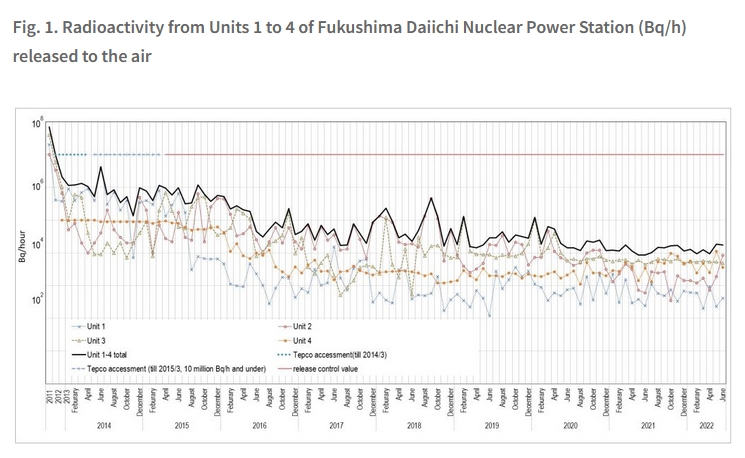
At the same time, decay heat has fallen greatly with the passage of time, and thus the volume of cooling water injected into the reactors has been reduced (falling from 7-10m3 per hour in May 2011 to 1.5-2.1m3 per hour as of June 2022).

The state of removal of spent nuclear fuel from the SFPs is summarized in Table 1. Spent nuclear fuel removal from Units 4 and 3 has been completed. However, as it has not been possible to remove control rods and other high-dose equipment stored in the SFPs, preparatory work is underway for removal of this equipment from Unit 3 in the second half of FY2022 and from Unit 4 in the second half of FY2024. Units 1 and 2 are being prepared for spent nuclear fuel removal.
Preparations for the removal of fuel debris are also under way. The arrival of the device for removing debris from Unit 2, developed in the UK, was delayed due to the spread of the coronavirus and finally arrived at the Naraha mockup facility in Japan in February. Removal tests are scheduled to be conducted during 2022. Plans are underway for an internal investigation device to be inserted into Unit 1 reactor pressure containment vessel (PCV), and also to withdraw water in two stages from the Unit 3 PCV and suppression chamber due to a water level drop.

The changes in the average number of workers onsite per day is shown in Fig. 2. As of June 2022, the number of workers was 4,100, about half the number it was at its peak. Changes in the number of cases of work non-conformance (work states that differ from the states originally intended or acts or judgments that differ from those that should have been taken) up to March 2022 are shown in Fig.3, as reported on the TEPCO website. As ever, problems appear to occur frequently, and this attests to the severe conditions under which work is being carried out at the site.
State of Contaminated Water
Contaminated water countermeasures at FDNPS can be broadly divided into three areas: 1) Reduction of groundwater flowing into buildings, 2) Reduction of contaminated water flowing into the sea, and 3) Reduction of the toxicity of contaminated water. The main countermeasures to reduce water inflow into the buildings are, from higher elevations downward, (A) Pumping up groundwater at the groundwater bypass and releasing it into the sea (754,521m3 up to August 22, 2022), B) Installation of a frozen earth barrier (on-land water barrier, total length roughly 1,500m) surrounding FDNPS Units 1-4. C) Pumping up water at the subdrains and releasing it into the sea (1,365,094m3 up to August 22), and D) Paving of the site with asphalt to suppress permeation of rainwater into the soil. Measures to prevent the discharge of contaminated water into the ocean include A) Groundwater leakage prevention by a steel water barrier on the sea side, B) Pumping up of groundwater dammed up behind the sea-side water barrier from the well points and groundwater drains (roughly 278,000m3 up to August 3; highly contaminated groundwater is being transferred to the turbine building), and other measures.
To reduce the toxicity of contaminated water, after removal of cesium and strontium, and removal of impurities using a reverse osmosis (RO) membrane, radionuclides other than tritium are removed by the multi-radionuclide removal equipment (ALPS – Advanced Liquid Processing System) and then stored in tanks (containing 1,310,518m3 as of August 4. However, due to past equipment malfunctions and operational policies, in many cases radionuclides other than tritium are also present, resulting in only around 32% of the stored water being below the notification concentration). Besides this, roughly 12,660m3 water remain in buildings, as well as 10,634m3 strontium-treated water, etc., 7,605m3 water treated by RO, 100m3 concentrated brine, and 9,280m3 concentrated wastewater etc. also existing onsite.
The frozen earth barrier consists of about 1600 freeze pipes buried in the ground. The freeze pipes are each 30 meters long and -30°C coolant is circulated through them to freeze the surrounding soil. The effectiveness of the frozen earth barrier has been questioned since it was first installed, but since 2019 there have been several coolant leakage incidents. This is due not to the technology but to aging of the equipment, which was originally not intended for long-term operation.
Concerning TEPCO’s policy of releasing contaminated water into the ocean after ALPS treatment, the policy to release the water was authorized at the 25th Meeting of the Nuclear Regulatory Authority on July 22, and the construction was approved by the governor of Fukushima Prefecture and the mayors of both Okuma Town and Futaba Town in August. TEPCO is aiming to begin.

Source: https://cnic.jp/english/?p=6292
Seoul asks IAEA for verification of Japan’s plan to discharge treated water from Fukushima plant
September 28, 2022
The South Korean government has asked the IAEA for thorough verification of Japan’s plan to discharge treated water from the Fukushima Number One nuclear power plant into the ocean. Attending the 66th Regular Session of the International Atomic Energy Agency in Vienna on Tuesday, Seoul’s vice minister of science and ICT, Oh Tae-seok, also called for Tokyo to share details of the process with the rest of the international community in a transparent manner. He also asked for unwavering support from IAEA member-states in denuclearizing North Korea, stressing that the regime’s nuclear programs pose a serious threat to international society.
Japan asking world to pay too high a cost
September 26, 2022
The president of the Pacific island state of Micronesia vehemently denounced Japan’s decision to discharge nuclear-contaminated water from its Fukushima Daiichi Nuclear Power Station into the Pacific Ocean at the United Nations last week. If anyone still believes this a viable option, his words should disabuse them of the notion.
In an address to the UN General Assembly in New York, David Panuelo said Micronesia had the “gravest concern” about Japan’s decision to release the so-called Advanced Liquid Processing System water into the ocean. “We cannot close our eyes to the unimaginable threats of nuclear contamination, marine pollution, and eventual destruction of the Blue Pacific Continent”, he said on Thursday. “The impacts of this decision are both transboundary and intergenerational in nature … I cannot allow for the destruction of our ocean resources that support the livelihood of our people.”
Japan insists that the release of the water used to cool the melted nuclear fuel rods at the three destroyed reactors at Fukushima is safe, as it has been processed to remove almost all radioactive elements and thus these are greatly reduced.
But that is not true. There has been increasing evidence suggesting that the ALPS has consistently failed to eliminate many radioactive elements including iodine, ruthenium, rhodium, cobalt and strontium. In late September 2017, Tokyo Electric Power Company, which runs the nuclear plant, was forced to admit that around 80 percent of the water stored in tanks at the Fukushima site still contains radioactive substances above legal levels. The water amounted to more than 1.3 million metric tons by July, and is still being added to at the rate of about 300 tons a day.
TEPCO and Japanese government officials also say that tritium, which cannot be removed from the water, is not harmful as it already exists in the sea. But what Tokyo doesn’t say is that the concentration of tritium in the water in the holding tanks is about a million times more than in the open sea. Scientists also say the long-term impact on marine life from exposure to such large volumes of radioactive water is unknown.
Dumping hazardous, nuclear-contaminated water is not only illegal under international law, but also unethical as this is not the only option that Tokyo has at its disposal to deal with the waste. For example, the Japanese government can still buy more land and keep on building more holding tanks to allow for radioactive decay to take place and buy more time for scientists to find better ways to deal with the aftermaths of the 2011 Fukushima disaster.
Tokyo should not proceed with its reckless cheapest-option plan to dump the contaminated water into the ocean as the cost it is asking the world to pay is too high.
https://global.chinadaily.com.cn/a/202209/26/WS63319171a310fd2b29e79cee.html
Fukushima radioactive sludge storage container will be full of nuclear wastewater purification may be hindered.
September 26, 2022
According to Kyodo News on the 25th, Tokyo Electric Power Company (TEPCO) stated that since the container for storing sludge generated during nuclear sewage treatment will be full by the end of April 2023 at the earliest. Work on the treatment of nuclear wastewater at the island’s first nuclear power plant may face obstacles.
A slurry-like mixture of liquids and solids is reported to be produced during the purification of nuclear wastewater from the Fukushima Daiichi Nuclear Power Plant with polynuclide removal equipment (ALPS). This sludge produces strong radiation, so during processing they are placed in special polyethylene containers and kept in radiation-blocking cement boxes.
As of August, the cement boxes in the factory area were 96% full, and if no measures are taken, they will be full by the end of April 2023 at the earliest. At that point, if there is nowhere for the sludge to pile up, the ALPS cannot continue to operate.
According to reports, there are currently 4,192 storage places for storage containers, and TEPCO plans to add 192 more on this basis. But even if the storage space is increased, the filling time can only be delayed by about a year. Therefore, the problem of reducing the amount of sludge generated is still under discussion.
TEPCO expects that storage can be reduced if equipment to extract moisture from sludge is activated. However, due to reasons such as seismic design re-evaluation, it is not yet possible to determine when the equipment will be put into use.
On March 11, 2011, an earthquake with a magnitude of 9.0 occurred in the waters off northeastern Japan and triggered a huge tsunami. Affected by the earthquake and tsunami, a large amount of radioactive material leaked from the Fukushima Daiichi Nuclear Power Plant.
On April 13, 2021, the Japanese government officially decided to discharge the Fukushima nuclear sewage into the sea after filtering and diluting it. However, in the process of nuclear sewage treatment, problems such as filter damage and excessive strontium-90 activity of the radioactive material after treatment were encountered successively. . Japan’s decision to discharge sewage into the sea was also strongly opposed by residents of Fukushima Prefecture and the National Federation of Fisheries Trade Unions in Japan.
Businesses worry about reputational damage from Fukushima water discharge

Sep 26, 2022
The plan to discharge treated water from the Fukushima No. 1 nuclear power plant into the ocean has been met with a wave of opposition, not only from residents of Fukushima Prefecture, but also those living in neighboring Ibaraki Prefecture.
Businesses in Ibaraki are calling for a fostering of public understanding and providing consumers with a sense of security to prevent harmful rumors from spreading.
At the Otsu fishing port in Kitaibaraki, which borders the southern part of Iwaki, Fukushima Prefecture, containers of freshly caught baby sardines are brought into processing plants one after another. The silver-colored fish shine under the late August sunlight and its lingering summer heat.
“We want to offer a taste of fresh, in-season fish,” said fisherman Seiji Suzuki, 31, who was busy landing his catches.
While keeping himself busy in a bustle of the port, Suzuki cannot shake off his anxiety about the future, as the Fukushima No. 1 plant, located about 70 kilometers away, plans to discharge processed water containing radioactive tritium into the ocean as early as next spring.
“The ocean (off the coast of Fukushima and Ibaraki prefectures) is connected. If the water is released, the image of seafood from Ibaraki Prefecture will be tarnished, and sales will be hit again,” Suzuki lamented.
According to the Otsu Fisheries Cooperative, seafood from Ibaraki Prefecture, like that from Fukushima Prefecture, is distributed throughout Japan as “Joban-mono,” referring to the seafood culled from the waters off the coast of both prefectures.
Major species from Ibaraki Prefecture include baby sardine, flounder, and anglerfish. “It’s almost the same as those in Fukushima,” a member of the fisheries cooperative said.
Ibaraki Prefecture’s fisheries output declined by about 30% after the Fukushima meltdown disaster, according to the fisheries ministry. Since 2012, the output has gradually recovered, and in recent years it has exceeded the pre-accident level due to an increase in fish catches.
However, radiation sampling inspections for almost all edible fish species are still being conducted. According to Ibaraki Prefecture, there has not been a discussion about abolishing the inspections. “Many consumers are concerned about the safety of seafood. This is even more so since there are plans to discharge treated water into the ocean,” a prefectural official said.
According to a survey conducted by the Ibaraki Shimbun newspaper of voters in the prefecture at the time of Upper House election this summer, 44.3% of respondents were opposed to the water discharge, more than the 35.5% who were supportive. The remaining 20.2% said that they were not sure or gave no answer. By age and gender, young respondents and women were particularly cautious about the water discharge.
Yoshinori Sakamoto, director of the Otsu Fisheries Cooperative, stresses there is no border between waters off Fukushima and Ibaraki prefectures. “If treated water is released into the ocean, Ibaraki seafood will suffer reputational damages as well,” he said.
The government may disseminate information about the scientific safety of the products, but unless the information is widely shared by consumers and a sense of security is fostered, consumers will be reluctant to buy the products, which will lead to price falls, he said.
Looking back on the many years of suffering from harmful rumors following the Fukushima nuclear accident, Sakamoto said, “We have finally come this far. It is a matter of life and death, and I am opposed to the water release under the current situation, where providing consumers with a sense of security is not guaranteed.”
A third nightmare
This is not the first time Ibaraki Prefecture has faced reputational damage from nuclear incidents. The September 1999 criticality accident at JCO, a nuclear fuel processing company in Tokai, Ibaraki Prefecture, caused extensive damages to residents and businesses in the region.
In the accident at the Tokai Plant of JCO, three workers were heavily exposed to radiation after a nuclear fission chain reaction occurred by accident, and two of them subsequently died. More than 600 residents of the surrounding area were also exposed to radiation, and more than 300,000 residents were forced to evacuate or stay indoors.
According to a report by Ibaraki Prefecture, a wide range of industries were affected, including agriculture, livestock, fisheries, commerce and tourism, with damages totaling more than ¥15 billion.
Businesses affected by the JCO criticality accident and the Fukushima No. 1 meltdown disaster are deeply concerned about a “third nightmare” from the planned discharge of treated water from the Fukushima plant.

Chizuko Suda, 57, who runs a seafood restaurant near the Nakaminato fishing port in Hitachinaka, Ibaraki Prefecture, is one of those who experienced the reputational damage caused by the 1999 incident.
Suda’s restaurant is located about 15 km south of the JCO plant. She remembers that the number of customers dropped to less than half of what it was before the accident, although she does not know the amount of damage because she was not the owner at the time. “It took three years for things to get back to normal,” she recalls.
Twelve years after the JCO accident, the Fukushima No. 1 accident struck. Almost every day, tourists asked if it was safe to visit the area around her restaurant and if the seafood was safe. Each time, she told them that tests for radioactive materials had confirmed that the area was safe to visit. Even so, sales dropped to 20% to 30% of what they were before the accident. Once again, she felt the pain of harmful rumors.
After going through such experiences twice, Suda wonders if there is any way to prevent it from happening again with the release of treated water into the ocean. The key is to foster public understanding, she says. “If it is scientifically safe, that fact should be released nationwide. This would be an opportunity for the public to think about the water discharge issue as their own.”
She has relatives in the coastal areas of Fukushima Prefecture, and she feels that it is “unacceptable to force only the people in Fukushima to bear the burden.”
Meanwhile, the fishing industry is not the only businesses concerned about the impact of water discharge.
Hiroyuki Onizawa, 60, a dried sweet potato processor in Hitachinaka who was affected by both accidents, also urges the government to take a cautious approach. “It would be better not to discharge,” he says, stressing that the image of Ibaraki Prefecture could be worsened.
Yoshihisa Takeshi, 46, who runs an inn in Kitaibaraki that offers Joban-mono anglerfish as its specialty, feels the need to dispose of treated water. “We have no choice but to discharge it,” he said.
On the other hand, he called on the government to provide support for a wide range of businesses in addition to taking measures against harmful rumors. The discharge “will definitely have a negative effect,” he said.
https://www.japantimes.co.jp/news/2022/09/26/national/ibaraki-fukushima-water/
At U.N., Micronesia denounces Japan plan to release Fukushima water into Pacific

September 23, 2022
UNITED NATIONS, Sept 22 (Reuters) – The president of the Pacific island state of Micronesia denounced at the United Nations on Thursday Japan’s decision to discharge what he called nuclear-contaminated water from the Fukushima Daiichi Nuclear Power Station into the Pacific Ocean.
In an address to the U.N. General Assembly in New York, David Panuelo said Micronesia had the “gravest concern” about Japan’s decision to release the so-called Advanced Liquid Processing System (ALPS) water into the ocean.
“We cannot close our eyes to the unimaginable threats of nuclear contamination, marine pollution, and eventual destruction of the Blue Pacific Continent,” he said.
“The impacts of this decision are both transboundary and intergenerational in nature. As Micronesia’s head of state, I cannot allow for the destruction of our Ocean resources that support the livelihood of our people.”
Japan said in July that its nuclear regulators had approved a plan to release into the Pacific ocean water used to cool reactors in the aftermath of the March 2011 Fukushima disaster.
The water has been stored in huge tanks in the plant, and amounted to more than 1.3 million tonnes by July.
Japan’s Foreign Ministry said at that time that regulators deemed it safe to release the water, which will still contain traces of the radioactive isotope tritium after treatment.
Asked about Panuelo’s statement, Yukiko Okano, the ministry’s deputy press secretary, said in reference to Fukushima that Japan would try its best “to gain understanding from the international community about the safety of our activities there.”
The plant operator, Tokyo Power Electric Company (Tepco), plans to filter the contaminated water to remove harmful isotopes apart from tritium, which is hard to remove. Then it will be diluted and released to free up plant space to allow the decommissioning of Fukushima to continue.
The plan has encountered stiff resistance from regional fishing unions which fear its impact on their livelihoods. Japan’s neighbors China, South Korea, and Taiwan have also voiced concern.
Panuelo also highlighted the threat posed by climate change, to which Pacific island states are particularly vulnerable. He called on geopolitical rivals the United States and China to consider it “a non-political and non-competitive issue for cooperation.”
“For the briefest period of time, it seemed as if the Americans, with whom Micronesia shares an Enduring Partnership, and the Chinese, with whom Micronesia shares a Great Friendship, were starting to work together on this issue, despite increases in tension in other areas,” he said. “Now, they are no longer speaking to each other on this important issue.”
China announced in August it was halting bilateral cooperation with the United States in areas including defense, narcotics, transnational crime and climate change in protest against a visit to Taiwan by U.S. House Speaker Nancy Pelosi.
Panuelo’s remarks coincided with a meeting U.S. Secretary of State Antony Blinken hosted of the Partners in the Blue Pacific countries, which include Japan with the aim of better coordinating assistance to the region in the face of competition from China.
Fukushima: Japan attempts to safely remove nuclear fuel from crippled reactors
More than a decade after the second-worst nuclear disaster in history, engineers want to construct a huge water-filled tank around one of the damaged reactors and carry out underwater dismantling work.

September 22, 2022
Nuclear experts pondering the safest way to decommission the three crippled reactors at the Fukushima Daiichi atomic energy plant have devised a new plan to recover highly radioactive debris at the site, with even anti-nuclear campaigners giving the proposal their qualified support.
They warn, however, that the situation at the plant — on the northeast coast of Japan— remains precarious more than a decade since three of the six reactors suffered meltdowns after an offshore earthquake of magnitude 9 triggered a series of powerful tsunamis.
In their latest annual strategy report on progress at the plant, experts at the Nuclear Damage Compensation and Decommissioning Facilitation Office (NDF) have proposed the construction and filling with water of a massive concrete tank to completely enclose one of the reactor buildings.
The water would act as a shield to prevent radiation from escaping into the surrounding environment and give engineers more space, in which to operate heavy equipment to dismantle and remove the outer shell of the reactor building.
That, in turn, would permit experts to deploy robots to more closely examine the condition of the reactor, as well as the fuel that has escaped and pooled in the building’s basement levels.
The plan was presented to the government at a meeting in Iwaki, just south of the plant, in early September, during which NDF President Hajimu Yamana explained the benefits.
Safe from radioactivity
“No radioactive materials would be swirling up underwater, so there would be almost zero impact on the outside,” Yamana told the Asahi newspaper.

He emphasized, however, that the proposal was in the initial stages and no final decision had been taken. If it worked, however, then the same strategy could be deployed to help in the decommissioning of the remaining two damaged reactors at the facility.
“I cannot say anything for sure yet,” Yamana said. “We are still in the very, very early stages of the concept study. There are still a lot of things to study as the attempt would be the first of its kind in the world.”
Hajime Matsukubo, secretary-general of the Tokyo-based Citizens’ Nuclear Information Center, remains a vocal critic of the Japanese government’s insistence on the need for atomic energy, but agreed that the NDF plan appeared to offer a number of benefits for the decommissioning process.
“The work cannot go ahead without the water shield because it would expose workers to dangerously high levels of radiation so this idea for the construction of a tank around one of the reactors is positive,” he told DW.
“But that does not mean that I am not concerned,” he said. “It will be very difficult to construct this tank, to make sure it does not leak, and it will be very expensive and take more time, of course.”
Another earthquake
Another concern that has been a constant since the March 2011 disaster is the possibility of another major earthquake or tsunami damaging the tank and potentially exposing radioactive debris to the air.
“We have already seen what long-term exposure to salt water at the site does to metal and other materials, and if there was another major tremor then that could very easily affect the tank and even see it collapse,” Matsukubo said. “To me, that is the biggest worry.”
He also questioned why it had taken the Tokyo Electric Power Company (TEPCO), decommissioning experts, the government and Japan’s nuclear regulators more than a decade to think up the plan. It is likely that the delay will further extend the schedule and total cost of rendering the site safe.
Government estimates put the cost of decommissioning at 8 trillion yen (€56 billion, $55.3 billion), although that figure may increase if new complications crop up, while the work will probably continue for another 30 years.
Kazuto Suzuki, a professor of science and technology policy at Tokyo University, agreed that the new approach to the decommissioning of the reactors “seems to be a good one, but the problem will be in the execution.”
“I’m not an expert, but I can see problems with leaks — as they have already experienced from the tanks holding contaminated water at the site — and then that water escaping into the sea,” he said. “This is a really big issue for the people still living in the region and they have to be able to guarantee a safe level of water within the tank surrounding the reactor.”
Seismic concerns
There are also concerns about the stability of the ground that the tank will stand on due to the immense weight it will have to bear, Suzuki pointed out.
He was less worried, however, about the possibility of another earthquake wreaking further havoc at the site.
“Concern about another earthquake is legitimate, but we have to remember that the original damage to the Fukushima plant was almost entirely the result of the tsunami, not the earthquake,” he said.
“I actually believe that Japan can be quite proud of the sophisticated anti-seismic technology that is incorporated into all buildings here, but especially our nuclear plants,” Suzuki said.
“I am confident that thanks to the lessons we have learned at Fukushima already, the impact of another earthquake on the walls of a tank around a reactor would be factored into the construction process.”
40,000 signatures submitted to TEPCO and METI opposing release of treated water from nuclear power plants

September 21, 2022
On September 21, representatives of consumers’ cooperatives in Iwate, Miyagi, and Fukushima prefectures and Miyagi fishery cooperatives submitted about 40,000 signatures opposing the discharge of treated water from TEPCO’s Fukushima Daiichi Nuclear Power Plant into the ocean. On March 21, representatives of consumer cooperatives in Miyagi and Fukushima prefectures and Miyagi fishermen’s cooperatives submitted approximately 40,000 signatures to TEPCO and the Ministry of Economy, Trade and Industry opposing the discharge of treated water from TEPCO’s Fukushima Daiichi Nuclear Power Plant into the ocean. They demand that instead of discharging the water into the ocean, it be treated in a different way that can be understood by the concerned parties and the public.
According to a person in charge of the co-op, they have been collecting signatures online and in writing since June 2021, and together with those already submitted, they have collected about 21,000 signatures nationwide. The total number of signatures, including those already submitted, amounted to about 21,000 nationwide.
Katsuhito Fuyuki, president of the Miyagi Co-op, explained the reason for his opposition at the TEPCO headquarters: “We are concerned about the negative impact on the resumption of full-scale fishing operations in Fukushima, the fishing industry in Miyagi, and the local economy.
https://www.tokyo-np.co.jp/article/203849?rct=national&fbclid=IwAR1NBf2UdsSbO5dnwol-1MV3Tk76UJu9gvzuyAlN18k6OfTustPAO72RPd8
The sea is not Japan’s dustbin, nor the Pacific Ocean its sewer: Chinese FM

Sep 19, 2022
Chinese Foreign Ministry on Monday once again called on Japan to stop its dubious and irresponsible plan of dumping Fukushima nuclear-contaminated water into the sea, as the radioactive substance in the nuclear-contaminated water, although it had already been treated through a filtration system, was once tested to be two times higher than the discharge standard.
According to Kyodo News, the Tokyo Electric Power Company (TEPCO), which is in charge of construction of the facility to be used for releasing the nuclear-contaminated water, said on Thursday that the company found the level of radioactive substance Strontium 90 as high as three times of Japan’s national standard, even though the samples on July 28 had been treated through a filtration system called ALPS (Advanced Liquid Processing System).
The report came after the repeated claim of both the Japanese government and TEPCO that nuclear-contaminated water is “safe” to be dumped into the ocean because it would go through the multi-nuclide removal system ALPS and radioactive substances such as Strontium 90 and Carbon 14 that cause genetic mutation in the ecosystem can be reduced to a “safe” level.
“I’ve noticed related media report and this proves the exact rationality of international community’s concern over the reliability of Japan’s data, the efficacy of the treatment system, and the uncertainty of environmental impact,” said Chinese Foreign Ministry spokesperson Mao Ning on Monday’s regular press conference.
The sea is not Japan’s dustbin, nor the Pacific Ocean its sewer, Mao emphasized, saying the Japanese government is extremely irresponsible for forcing through its disposal plan and the construction of underwater pipeline to dump the nuclear-contaminated water from Fukushima nuclear power plant into the ocean given doubts in the plan and unsettled international concerns.
Mao once again urges Japan to deal with the nuclear-contaminated water in a scientific, open, transparent and safe manner on the basis of negotiations with neighboring countries and international institutions.
Despite concerns and opposition from within and neighboring countries including South Korea and China, TEPCO started construction of facility on August 4 for dumping the nuclear-contaminated water after Japan’s nuclear regulator approved its discharge plan in late July.
[Interview] Japanese anti-nuclear activist says fishers’ consent is crucial for Fukushima water release

September 20, 2022
What exactly is going on off the coast of Japan’s Fukushima Daiichi Nuclear Power Plant?
Hideyuki Ban, co-director of the Citizens’ Nuclear Information Center in Japan, says the Fukushima tunnel for offshore dumping of the water is unlikely to be up to scratch
On Aug. 4, the Japanese government and the Tokyo Electric Power Company (TEPCO) began construction on the underwater tunnel that will be used to release treated water from the Fukushima nuclear power plant into the ocean.
Their plan is to use the Advanced Liquid Processing System (ALPS) to reduce the amount of radioactive material in the contaminated water, after which the treated water would be released into the ocean. Currently, they are at the soil preparation stage. Concerns are being raised not only in neighboring countries but also within Japan itself, pointing out that the ALPS’s ability to remove radioactive material is still unclear, and that the release of the contaminated water is being pushed ahead even though the amount of water to be released has yet to be decided.
On Sept. 6, TEPCO even opened the construction site for the underwater tunnel, 80 meters of which was already complete, to the public, suggesting that it has no intention of backing down from its plan to release the contaminated water during the first half of next year.
During his interview with the Hankyoreh, Hideyuki Ban, co-director of the Citizens’ Nuclear Information Center in Japan, commented that TEPCO and the Japanese government made a written promise not to release the contaminated water without the consent of interested parties, adding that he doubted they would be able to earn the consent of fishers and environmental groups. Even technologically speaking, Ban said it was unlikely that the construction would pass the necessary safety tests upon completion.
An internationally acclaimed anti-nuclear activist, Ban has been serving as the co-director of CNIC, a private Japanese think tank working toward “a society that doesn’t rely on nuclear power” through research and studies into Japan’s nuclear policy, for the past 24 years. The interview took place on Sept. 13 over email.
■ One month into the construction of the tunnel
Hankyoreh (Hani): It’s been a month since construction for the underwater tunnel began. What stage is it currently in?
Hideyuki Ban: Excavation work for the underwater tunnel began on Aug. 4. At the same time, construction related to the stirrer inside the storage tank containing the contaminated water, the transfer pump for the treated water, and the embankment for seawater intake commenced as well. TEPCO has said it would provide “timely updates” regarding the progress of the construction, but its website doesn’t offer much information as to how it’s going. Two local governments that have jurisdiction over the nuclear power plant as well as Fukushima Prefecture consented to the construction ahead of time. The next day, civic groups protested in front of the Fukushima Prefecture office building. Civic groups are still continuing their movement against the release of the contaminated water. Plus, fishers’ groups are also firmly expressing their opposition.
Hani: The plan is to release the contaminated water into the ocean in June next year — do you think that’s likely?
Ban: For the contaminated water to be released into the ocean, consent from fishers’ groups comes above all else. TEPCO and the government promised in writing not to release the contaminated water without the consent of fishers’ groups. However, fishers’ groups are proposing special resolutions opposing the release of the contaminated water into the sea at their general meetings this year. I doubt [TEPCO and the Japanese government] will be able to earn their consent. The same goes from the technological perspective. For the contaminated water to be discharged next June, not only do various constructions currently in progress need to be completed as scheduled, but other hurdles should be jumped over, such as a safety test that would come afterward. I believe the technology is not enough to pass such tests. There are other practical issues. Problems on the site, such as the increasing number of COVID-19 patients among workers at the Fukushima Daiichi plant, will probably delay the construction as well.
■ Beneath the water’s surface The construction site TEPCO revealed to the Japanese media on Sept. 6 indicated that the construction is progressing quickly. According to Japanese public broadcaster NHK’s footage, the steel-framed concrete tunnel round in shape is big enough for people and equipment to pass through. Inside, a dozen or so green drainpipes stretch to the distance. The tunnel has gotten roughly 80 meters closer to the ocean since construction began. TEPCO is extending the underwater tunnel, which starts from the drainage system for nuclear reactors No. 5 and No. 6 at the Fukushima Daiichi plant, by 16 meters each day. The tunnel’s outlet will be created 1 kilometer (0.62 miles) from land. TEPCO previously stated that its goal was to complete construction of the facilities “by spring next year,” but said that completion could take place in summer, depending on weather conditions.
Hani: There were many controversies related to the underwater tunnel even before its construction began, such as when International Atomic Energy Agency (IAEA) Director General Rafael Grossi took the side of TEPCO in April, saying he was satisfied with the progress Japan made during its preparation process.
Ban: The IAEA’s report says that “the government or the regulatory body are required to provide information to, and engage in consultation with, parties affected by its decisions and, as appropriate, the public and other interested parties.” The report defines “interested parties” as “individuals or organizations representing members of the public; industry; government agencies or departments whose responsibilities cover public health, nuclear energy and the environment; scientific bodies; the news media; environmental groups; and groups in the population with particular habits that might be affected significantly by the discharges, such as local producers and indigenous peoples living in the vicinity of the facility or activity under consideration.” It’s hard to understand why the IAEA determined progress had been made without properly evaluating the current situation, which hardly indicates “consultations” have been sufficiently carried out.
Hani: But the Japanese government is saying the IAEA task force’s criticism enabled it to reinforce the contents of its implementation plan and radiological impact assessment, which it is citing as the reason the plan to release the contaminated water should be pushed ahead.
Ban: TEPCO’s November 2021 report on the radiation effects of the release of ALPS-treated water into the ocean on humans and the environment indicates that the effects of tritium, which Japanese regulations acknowledge as having negative effects on the human body, were not reflected. It’s hard to say the contents have been dutifully reinforced. The report doesn’t even mention the total amount of radioactive material that would be released, which is a figure civil society has been demanding. It’s a big problem that how much of each nuclide would be released wasn’t revealed, as that information would precede any kind of agreement or discussions that would take place between the government [and interested parties] ahead of the release of the contaminated water. The IAEA should also demand that TEPCO and the Japanese government announce the total amount [of radioactive materials] it expects to release.
■ Action needed now
Hani: How unsafe do you think it is to release the contaminated water into the ocean?
Ban: The contaminated water currently contains 64 different radioactive nuclides, including tritium, which can enter the human body and cause internal exposures. The government and TEPCO plan to use the ALPS over and over until the amount of radioactive material in the contaminated water has been reduced to a level fit for release to the ocean. However, the contaminated water will be released for over 30 years. Additionally, risk assessments presume the contaminated water will evenly spread across the ocean and become diluted, but in reality, it will accumulate in specific regions underwater or in seafood. This will ultimately lead to the radiation of people who eat seafood.
Hani: The release of the contaminated water has moved from the “preparation stage” to the “implementation stage,” in a sense.
Ban: Yes. Concerns about radiation caused by radioactive material and the voices of those worried about negative effects on the tourism industry, as well as the fishing, forestry and agriculture industries, are growing louder and louder.
Hani: What are some things people can do right now?
Ban: People should be vocal so that the plan to release the contaminated water into the ocean can be stopped immediately. The Japanese government and TEPCO say nuclear power plants around the world regularly emit tritium. While such everyday tritium emissions will ultimately lead to radioactive contamination, the bigger problem is that the world has never seen a case in which 64 nuclides including tritium were released into nature simultaneously, as the release of the contaminated water from Fukushima will. The water will keep on being discharged for the next 30 years while the total amount of radioactive material being released remains a mystery. Pollution of the marine environment caused by radioactive material emitted by the water should not be overlooked. By Hong Seock-jae, staff reporter
New submersion method in consideration for Fukushima debris cleanup

September 2, 2022
TOKYO (Kyodo) — The operator of the Fukushima Daiichi nuclear power plant, which suffered core meltdowns in 2011, is considering a new submersion method for removing radioactive fuel debris that would wholly encase a reactor building in a water-filled, tank-like structure, a source close to the company said Thursday.
Conceptual breakthroughs with the method, whose advantages include using water’s ability to interrupt radiation and thereby provide a safer working environment, have made it a promising candidate for the cleanup of the defunct nuclear plant, according to the source close to Tokyo Electric Power Company Holdings Inc.
But with no proven track record in the nuclear field, investigations are ongoing into future technological issues and costs, among other contingencies. The source said it could “require advanced technology to stop water leaking out and become a huge construction project.”
Were it to go ahead, the process from building to actual debris removal would be lengthy and would likely affect total decommissioning costs, currently pegged at about 8 trillion yen ($57.45 billion).
In the aftermath of the March 2011 Great East Japan Earthquake and tsunami, nuclear fuel cooling processes failed at the Fukushima plant’s reactors 1 through 3, causing the fuel to melt and resolidify into radioactive debris mixed with concrete, metal and other materials present in the reactors.
Debris removal is the operator’s most challenging issue in the Fukushima plant cleanup. Some 880 tons of the radioactive waste material is estimated to have been created by the nuclear meltdown across the three reactors.
The new submersion method, which is currently expected to be applied to the No. 3 reactor, would involve building a strong, pressure-resistant structure, such as a ship’s hull or a plane’s body, completely encapsulating the reactor, including underground.
The structure could then be filled with water, and removal work would take place from the top.
The operator initially considered a similar method to fill the reactor’s containment vessel with water. But the idea was abandoned due to potential difficulties fixing holes in the structure and the possibility it would increase workers’ exposure to radiation.
Preparations are being made to include the new submersion method in the 2022 edition of a strategic plan for decommissioning to be compiled by the state-backed Nuclear Damage Compensation and Decommissioning Facilitation Corp., which is helping the operator scrap the reactors.
In the case of the No. 2 reactor, preparations remain under way for its debris removal via a dry method, involving extracting the material without filling the reactor with water. The NDF intends to keep it as a potential option in its strategic plan.
While the No. 2 reactor’s cleanup was slated to begin this year, on Aug. 25, the government said removal work would be delayed a further 12 to 18 months to ensure safety and reliability.
The government and the power company are operating under a plan to complete debris removal and finish decommissioning work sometime between 2041 and 2051.
Amid the extensive cleanup in Fukushima, the Japanese government said on Aug. 24 that it is considering the construction of the next generation of nuclear plants amid an increasingly fraught energy supply environment and the country’s dependency on imported natural resources.
https://mainichi.jp/english/articles/20220902/p2g/00m/0na/002000c
As Japan builds nuclear dumping facilities, Pacific groups say ‘stop’

September 1, 2022
Pacific civil society groups are calling on Japan to halt its plans to dump radioactive nuclear wastewater into the Pacific Ocean.
Earlier this month the Japanese government started building facilities needed for the discharge of treated, but still radioactive, wastewater from the defunct Fukushima nuclear power plant.
In a joint statement, civil society groups, non-governmental organisations and activists described the Fumio Kishida Government’s plans as a fundamental breach of Pacific peoples’ right to a clean, healthy and sustainable environment.
Joey Tau from the pan-Pacific movement Youngsolwara Pacific said this breaches Pacific peoples’ rights to live in a clean environment.
Tau told Pacific Waves the Pacific Ocean is already endangered and Japan’s plan will have devastating impacts.
“We have a nuclear testing legacy in the Pacific. That continues to impact our people, our islands and our way of life, and it impacts the health of our people.
“Having this plan by Japan poses greater risks to the ocean which is already in a declining state.
“The health of our ocean has declined due to human endured stresses and having this could aggravate the current state of our region.
“And also, there are possible threats on the lives of our people as we clearly understand in this part of the world, the ocean is dear to us, it sustains us,” Tau said.
Tau said both the opposition in Vanuatu and the president of the Federated States of Micronesia have expressed serious concerns at Japan’s plans, and the Pacific Islands Secretariat this year has appointed an international expert panel to advise the Forum Secretary-General and national leaders.
The Northern Marianas’ House of Representatives has also condemned Japan’s plan to dump the nuclear waste.
Tau said the plans should not proceed without the Pacific people being able to voice their concerns and being better advised.
1 This Month


18 March Webinar @ 1 PM EST: An Assessment of SMR Projects: The Case of Canada
register for the zoom:
https://us02web.zoom.us/webinar/register/WN_o8BIIOUvQ2ONJR1nta65DQ#/registration


of the week – STOP SMALL MODULAR REACTORS IN CANADA
To see nuclear-related stories in greater depth and intensity – go to https://nuclearinformation.wordpress.com
-
Archives
- March 2026 (129)
- February 2026 (268)
- January 2026 (308)
- December 2025 (358)
- November 2025 (359)
- October 2025 (376)
- September 2025 (258)
- August 2025 (319)
- July 2025 (230)
- June 2025 (348)
- May 2025 (261)
- April 2025 (305)
-
Categories
- 1
- 1 NUCLEAR ISSUES
- business and costs
- climate change
- culture and arts
- ENERGY
- environment
- health
- history
- indigenous issues
- Legal
- marketing of nuclear
- media
- opposition to nuclear
- PERSONAL STORIES
- politics
- politics international
- Religion and ethics
- safety
- secrets,lies and civil liberties
- spinbuster
- technology
- Uranium
- wastes
- weapons and war
- Women
- 2 WORLD
- ACTION
- AFRICA
- Atrocities
- AUSTRALIA
- Christina's notes
- Christina's themes
- culture and arts
- Events
- Fuk 2022
- Fuk 2023
- Fukushima 2017
- Fukushima 2018
- fukushima 2019
- Fukushima 2020
- Fukushima 2021
- general
- global warming
- Humour (God we need it)
- Nuclear
- RARE EARTHS
- Reference
- resources – print
- Resources -audiovicual
- Weekly Newsletter
- World
- World Nuclear
- YouTube
-
RSS
Entries RSS
Comments RSS
 nuclear-news