Difficult to be innovative on the subject of Fukushima. Would we have already said everything for the last six years that the catastrophe is going on?
Well, no, with the film of Linda Bendali, “From Paris to Fukushima, the secrets of a catastrophe”, the subject of the attitude of nuclear France in March 2011 had never been approached from this angle: while Japanese Prime Minister Naoto Kan faced with nuclear fire became anti-nuclear, the Fillon government launched the heavy artillery to counter any vehemence of debate on this subject in France.
For the french Minister of Industry, Eric Besson, it was an just incident.Nicolas Sarkozy invited himself to Japan while he was not expected, to promote nuclear in the midst of the atomic crisis.And France pretended to help Japan by sending unusable or outdated products.
That said, this report has awakened in me an old anger, never really extinct since 1986, and you will not escape the comments that inspires me this report.
Pierre Fetet
The lies of Tepco
At the beginning of the documentary, Tepco, champion of the lie and the unspoken is expressed by the voice of his spokesman Yuichi Okamura: “We never imagined that such an accident could happen. From the statistics, we calculated that the tsunami should not exceed 5 meters. Our forecasts were exceeded. “
He is then contradicted by the film director.I very much thank Linda Bendali for insisting that the report of the parliamentary inquiry commission on Fukushima gave as first conclusion that the Fukushima disaster was of human origin.Because few people understand the sequence of events and it is too often heard that “the Fukushima disaster was caused by the tsunami”.
Now, the real logical chain of events was this:
1) Irresponsibility: Tepco decides to build a nuclear power plant at sea level.
2) Stupidity: While seven tsunamis of 12 to 28 meters in height took place in Japan in the twentieth century, they decided to construct a protective dike of 5 m.
3) Corruption: Japan Nuclear Safety Organizations accept the construction project.
4) A natural event: a 15 m tsunami falls on the east coast of Honshu, and therefore on the Fukushima Daiichi power plant.
The IRSN is advertising its own self
The IRSN is always taken as an example and looks after its image. Normal, it is the official reference body.Yet I have already taken this institute several times in flagrante delicto of lie: Assurance that the evacuees would return within three months in 2011,http://fukushima.over-blog.fr/article-le-nouveau-pellerin-est-arrive-71748502.html
In the documentary, the narrator assures that “IRSN is the first organization in the world to announce that the molten core has escaped from its confinement”.Indeed, listening to Jacques Repussard we get the impression that his institute communicated on this subject in March 2011.
Yet the Japanese government had already received a report from the IAEA on June 7 recognizing the possibility of perforations in the tanks of reactors 1 to 3 …
No seriously. The first organization that announced the me of the three cores is Tepco, on 24 May 2011. And the IRSN announced it the next day.Previously, IRSN never wrote anything else, for reactors 1, 2 and 3, that “The injection of fresh water continues.The flow rate of the water injection is adjusted in order to ensure the cooling of the core, which remains partially depleted. “
That’s the story, that’s how it happened. IRSN never said that before anyone.The IRSN respected the omerta on the total meltdown of the three hearts like all the actors of the nuclear world and obediently waited for Tepco to announce the reality to acquiesce, no matter what Jacques Repussard is saying now six years later.
The Naoto Kan myth
The image of the then Prime Minister of Japan is to be nuanced. After seeing the documentary, it seems as though Naoto Kan acted as hero.It must also be admitted that he made several errors:
– Naoto Kan went to the Fukushima Daiichi plant in full crisis and greatly disturbed the ongoing management of the ongoing crisis. Director Masao Yoshida was asked to explain and explain what he was doing, wasting precious time on those who tried to solve problems one by one(It was just before the explosions of No. 2 and No. 4!).The documentary suggests that Masao Yoshida was going to leave the nuclear plant with all the workers, and that through Kan’s intervention they were forced to stay.It’s not true. Tepco may have intended to leave the ship, but the plant’s director denied any plan to abandon the site.
– The documentary shows Naoto Kan kneeling before Nicolas Sarkozy. Politeness or industrial pressures?It is not known why he did not dare to counter the French nuclear VRP.
– Naoto Kan will remain for all inhabitants of evacuated areas the one who decided to raise the standard from 1 to 20 mSv / year. On the one hand, he was ready to evacuate Tokyo, but on the other he made a whole region irradiated with a very high radiation rate.Something is bizarre in these contradictory attitudes.
The ghost of Chernobyl
Pierre Pellerin, even disappeared, is still doing damages … Between the two parts of the documentary, Frédéric Boisset, editor-in-chief of Brainworks Press, presents the story of Chernobyl in this way:“In 1986, the radioactive cloud spread throughout Europe.The authorities do not have the technical means to measure the fallout, to give instructions to the French.Can we eat fruit and vegetables? Should we caulk indoors?It was to avoid this type of failure that this institute was created [the IRSN]. “
But this is not an interview taken on the spot, it is a carefully prepared text before the recording. Frédéric Boisset therefore pretends without blushing that the SCPRI of 1986, the ancestor of the IRSN, did not have the means to alert the French of the dangers of radioactivity!What an enormity! In Germany, they had the means to prohibit the sale of spinach and salads, to confine the students inside but not in France.Frédéric Boisset refeeds us the story of the Chernobyl radioactive plume that stops at the border?It is unbelievable that still in 2017 a journalist perpetuates the disinformation lie that began in 1986.
However, the IRSN, worthy successor of SCPRI, made this statement on March 15, 2011, the day when the radioactive cloud of Fukushima arrived in Tokyo:“A slight increase in ambient radioactivity in Tokyo is noted by a few measures. This elevation is not significant in terms of radiological impact. “Pierre Pellerin would not have said better!At the same time, Olivier Isnard, an IRSN expert sent to Tokyo, advocated caulking the premises of the French embassy. Fortunately, Philippe Faure, the French ambassador to Japan, communicated to his expatriates at 10 am:“Stay in your houses, making sure to caulk them to the maximum, this effectively protects against the low-intensity radioactive elements that could pass through Tokyo. ” But at 8 pm, he changed his tone and resumed the official speech dictated by the IRSN:“The situation remains at this time quite safe in Tokyo.A very slight increase in radioactivity was recorded.It represents no danger for human health. “100 Bq / m3 would pose no health hazard for a radioactive cloud coming directly from a nuclear reactor?I am feeling not any more safe than in 1986 unfortunately.
The taboo of the steam explosion
One last deception.The IRSN has purposedly mistranslated the words of Masao Yoshida, director of the Fukushima Daiichi power station.Immediately after the explosion of Unit 3, the latter, distraught, called the headquarters to inform them of the situation.Tepco released this recording and the IRSN broadcasted it in a video in 2013.I do not know Japanese but I have Japanese friends who have assured me of the translation of his words.I give you both versions, that of my friends and that of the IRSN. The people knowing japanese will be able to check for themselves.
The documentary gives another version:“HQ, HQ, it’s terrible! This is very serious !“Yes, here HQ.” “It seems there was an explosion on reactor 3, which looks like a hydrogen explosion.”Who recommended this text to journalists? Even though Yoshida himself said “suijôki” (steam) and not “suiso” (hydrogen).The IRSN’s translation therefore censures the hypothesis put forward by the director of the nuclear plant: the steam explosion.This is normal, it is the official version of the Japanese government and the IRSN can not go against it.
The steam explosion is a taboo issue among nuclear communicators.Experts talk about it to each other, carry out studies about it, write theses about it, but never talk about it to the public because the subject of a nuclear power plant explosion is too anxiogenic.If we ever learned that a steam explosion had arrived in Fukushima, it would undermine the image of nuclear power worldwide.
In France, the political-industrial lobby has axed its communication on the control of hydrogen:All French power plants have hydrogen recombiners to avoid hydrogen explosions.But against an steam explosion, nothing can be done.When the containment vessel is full of water and the corium at 3000 ° C falls in it, it’s boom, whether in Japan or in France, whether it be a boiling water reactor or a pressurized water reactor.
Dr Helen Caldicott, explains recent robot photos taken of Fukushima’s Daiichi nuclear reactors: radiation levels have not peaked, but have continued to spill toxic waste into the Pacific Ocean — but it’s only now the damage has been photographed.
RECENT reporting of a huge radiation measurement at Unit 2 in the Fukushima Daichi reactor complex does not signify that there is a peak in radiation in the reactor building.
All that it indicates is that, for the first time, the Japanese have been able to measure the intense radiation given off by the molten fuel, as each previous attempt has led to failure because the radiation is so intense the robotic parts were functionally destroyed.
The radiation measurement was 530 sieverts, or 53,000 rems (Roentgen Equivalent for Man). The dose at which half an exposed population would die is 250 to 500 rems, so this is a massive measurement. It is quite likely had the robot been able to penetrate deeper into the inner cavern containing the molten corium, the measurement would have been much greater.
These facts illustrate why it will be almost impossible to “decommission” units 1, 2 and 3 as no human could ever be exposed to such extreme radiation. This fact means that Fukushima Daichi will remain a diabolical blot upon Japan and the world for the rest of time, sitting as it does on active earthquake zones.
What the photos taken by the robot did reveal was that some of the structural supports of Unit 2 have been damaged. It is also true that all four buildings were structurally damaged by the original earthquake some five years ago and by the subsequent hydrogen explosions so, should there be an earthquake greater than seven on the Richter scale, it is very possible that one or more of these structures could collapse, leading to a massive release of radiation as the building fell on the molten core beneath. But units 1, 2 and 3 also contain cooling pools with very radioactive fuel rods — numbering 392 in Unit 1, 615 in Unit 2, and 566 in Unit 3; if an earthquake were to breach a pool, the gamma rays would be so intense that the site would have to be permanently evacuated. The fuel from Unit 4 and its cooling pool has been removed.
But there is more to fear.
The reactor complex was built adjacent to a mountain range and millions of gallons of water emanate from the mountains daily beneath the reactor complex, causing some of the earth below the reactor buildings to partially liquefy. As the water flows beneath the damaged reactors, it immerses the three molten cores and becomes extremely radioactive as it continues its journey into the adjacent Pacific Ocean.
Every day since the accident began, 300 to 400 tons of water has poured into the Pacific where numerous isotopes – including cesium 137, 134, strontium 90, tritium, plutonium, americium and up to 100 more – enter the ocean and bio-concentrate by orders of magnitude at each step of the food chain — algae, crustaceans, little fish, big fish then us.
Fish swim thousands of miles and tuna, salmon and other species found on the American west coast now contain some of these radioactive elements, which are tasteless, odourless and invisible. Entering the human body by ingestion they concentrate in various organs, irradiating adjacent cells for many years. The cancer cycle is initiated by a single mutation in a single regulatory gene in a single cell and the incubation time for cancer is any time from 2 to 90 years. And no cancer defines its origin.
We could be catching radioactive fish in Australia or the fish that are imported could contain radioactive isotopes, but unless they are consistently tested we will never know.
As well as the mountain water reaching the Pacific Ocean, since the accident, TEPCO has daily pumped over 300 tons of sea water into the damaged reactors to keep them cool. It becomes intensely radioactive and is pumped out again and stored in over 1,200 huge storage tanks scattered over the Daichi site. These tanks could not withstand a large earthquake and could rupture releasing their contents into the ocean.
But even if that does not happen, TEPCO is rapidly running out of storage space and is trying to convince the local fishermen that it would be okay to empty the tanks into the sea. The Bremsstrahlung radiation like x-rays given off by these tanks is quite high – measuring 10 milirems – presenting a danger to the workers. There are over 4,000 workers on site each day, many recruited by the Yakuza (the Japanese Mafia) and include men who are homeless, drug addicts and those who are mentally unstable.
There’s another problem. Because the molten cores are continuously generating hydrogen, which is explosive, TEPCO has been pumping nitrogen into the reactors to dilute the hydrogen dangers.
As previously explained, these radioactive elements concentrate in the food chain. The Fukushima Prefecture has always been a food bowl for Japan and, although much of the rice, vegetables and fruit now grown here is radioactive, there is a big push to sell this food both in the Japanese market and overseas. Taiwan has banned the sale of Japanese food, but Australia and the U.S. have not.
Prime Minister Abe recently passed a law that any reporter who told the truth about the situation could be gaoled for ten years. In addition, doctors who tell their patients their disease could be radiation related will not be paid, so there is an immense cover-up in Japan as well as the global media.
The Prefectural Oversite Committee for Fukushima Health is only looking at thyroid cancer among the population and by June 2016, 172 people who were under the age of 18 at the time of the accident have developed, or have suspected, thyroid cancer; the normal incidence in this population is 1 to 2 per million.
However, other cancers and leukemia that are caused by radiation are not being routinely documented, nor are congenital malformations, which were, and are, still rife among the exposed Chernobyl population.
Bottom line, these reactors will never be cleaned up nor decommissioned because such a task is not humanly possible. Hence, they will continue to pour water into the Pacific for the rest of time and threaten Japan and the northern hemisphere with massive releases of radiation should there be another large earthquake.
Cleaner Robot Pulled From Fukushima Reactor Due to Immense Radiation
The camera on the bot was compromised by the high levels of radiation.
A remote-controlled cleaning robot sent into a damaged reactor at Japan’s Fukushima nuclear plant had to be removed Thursday before it completed its work because of camera problems most likely caused by high radiation levels.
It was the first time a robot has entered the chamber inside the Unit 2 reactor since a March 2011 earthquake and tsunami critically damaged the Fukushima Da-ichi nuclear plant.
Tokyo Electric Power Co. said it was trying to inspect and clean a passage before another robot does a fuller examination to assess damage to the structure and its fuel. The second robot, known as the “scorpion,” will also measure radiation and temperatures.
Thursday’s problem underscores the challenges in decommissioning the wrecked nuclear plant. Inadequate cleaning, high radiation and structural damage could limit subsequent probes, and may require more radiation-resistant cameras and other equipment, TEPCO spokesman Takahiro Kimoto said.
“We will further study (Thursday’s) outcome before deciding on the deployment of the scorpion,” he said.
TEPCO needs to know the melted fuel’s exact location and condition and other structural damage in each of the three wrecked reactors to figure out the best and safest ways to remove the fuel. It is part of the decommissioning work, which is expected to take decades.
During Thursday’s cleaning mission, the robot went only part way into a space under the core that TEPCO wants to inspect closely. It crawled down the passage while peeling debris with a scraper and using water spray to blow some debris away. The dark brown deposits grew thicker and harder to remove as the robot went further.
After about two hours, the two cameras on the robot suddenly developed a lot of noise and their images quickly darkened — a sign of a problem caused by high radiation. Operators of the robot pulled it out of the chamber before completely losing control of it.
The outcome means the second robot will encounter more obstacles and have less time than expected for examination on its mission, currently planned for later this month, though Thursday’s results may cause a delay.
Both of the robots are designed to withstand up to 1,000 Sieverts of radiation. The cleaner’s two-hour endurance roughly matches an estimated radiation of 650 Sieverts per hour based on noise analysis of the images transmitted by the robot-mounted cameras. That’s less than one-tenth of the radiation levels inside a running reactor, but still would kill a person almost instantly.
Kimoto said the noise-based radiation analysis of the Unit 2’s condition showed a spike in radioactivity along a connecting bridge used to slide control rods in and out, a sign of a nearby source of high radioactivity, while levels were much lower in areas underneath the core, the opposite of what would normally be the case. He said the results are puzzling and require further analysis.
TEPCO officials said that despite the dangerously high figures, radiation is not leaking outside of the reactor.
Images recently captured from inside the chamber showed damage and structures coated with molten material, possibly mixed with melted nuclear fuel, and part of a disc platform hanging below the core that had been melted through.
Extremely high radiation breaks down Fukushima clean-up robot at damaged nuclear reactor
A clean-up mission using a remotely operated robot at Japan’s crippled Fukushima nuclear plant has had to be aborted, as officials feared they could completely lose control of the probe affected by unexpectedly high levels of radiation.
The robot equipped with a high-pressure water pump and a camera designed to withstand up to 1,000 Sieverts of cumulative exposure had been pulled off the inactive Reactor 2 at the Fukushima Daiichi nuclear complex earlier this week, The Japan Times reported Friday, citing the plant operator, Tokyo Electric Power Company (TEPCO). The device reportedly broke down just two hour into the probe.
The failure led experts to rethink estimated levels of radiation inside the damaged reactor.
While last week TEPCO said it might stand at 530 Sieverts per hour – a dose that can almost instantly kill a human being, following the latest aborted mission a company official has said a reading of up to 600 Sieverts should be “basically correct.”
Even despite the considerable 30-percent margin of error for the revised estimate, the latest probe left no doubt that radiation levels are at record highs within the reactor. Even though it cannot be measured directly with a Geiger counter or dosimeter, the dose is calculated by its effect on the equipment.
Last month, a hole of no less than one square meter in size was discovered beneath the same reactor’s pressure vessel. The apparent opening in the metal grating is believed to have been caused by melted nuclear fuel, TEPCO then said.
The recent mission has demonstrated that the melted fuel is close to the studied area.
While extreme radiation levels have been registered within the reactor, officials insist that no leaks or increases outside have been detected.
The failure might force Japan to rethink the robot-based strategy it has adopted for locating melted fuel at Fukushima, according to The Japan Times.
The robot affected by radiation was supposed to wash off thick layers of dirt and other wreckage, clearing ways for another remotely controlled probe to enter the area, tasked with carrying out a more proper investigation to assess the state of the damaged nuclear reactor. Previously, even specially-made robots designed to probe the underwater depths beneath the power plant have crumbled and shut down affected by the radioactive substance inside the reactor.
The Fukushima Daiichi nuclear power plant suffered a blackout and subsequent failure of its cooling systems in March 2011, when it was hit by an earthquake and tsunami. Three of the plant’s six reactors were hit by meltdowns, making the Fukushima nuclear disaster the worst since the Chernobyl catastrophe in Ukraine in 1986. TEPCO is so far in the early stages of assessing the damage, with the decommissioning of the nuclear facility expected to take decades.
Kevin Kamps, Beyond Nuclear. Almost 6 years after a massive meltdown – radiation levels at the crippled Fukushima Daiichi power plant in Japan are as dangerously high as ever. So is nuclear power ever worth the risk?
….A number of commentators, Arnie Gundersen at Fairwinds, Kendra Ulrich at Greenpeace International, Nancy Foust at Simply Info, have pointed out that the levels of radioactivity that are being talked about by Tokyo Electric (TEPCO), 53,000 rem per hour levels that were documented just a week ago have probably been there this whole time since March 2011 since the meltdown happened because what they are doing is they are getting closer where the melted core is at, they still don’t know where they ‘re at but what they are doing they are getting closer to that dangerous place and so sure enough it stands to reason that they would find these levels….
As announced, TEPCO has inserted a cleaner robot onto the gangway in the Reactor 2 containment enclosure. It is equipped with a snowplow at the front, two cameras and a jet of pressurized water.
The robot was able to clean only one meter instead of the 5 expected. According to the Japanese document put online by TEPCO, in some places deposits were more adherent than expected, which slowed down the robot’s progress.
There are areas where the robot could not move forward. There are up to 2 cm of deposits that can be insulation and paint that have melted before sticking to the bridge. On a first attempt, the water pump did not work.
After two hours of activity, the cameras became obscured and the robot was quickly removed. TEPCO believes this is due to extremely high radiation levels.
The camera can only withstand a cumulative dose of about 1000 Sv. The analysis of the images gives an approximate dose rate of 650 Sv / h. This is even more than the recorded dose few days ago (530 Sv / h).
The company is reluctant to send the scorpion measuring robot because it could only take data for two hours.
It is not under the reactor vessel that the dose rates are the highest and TEPCO does not understand why.
TEPCo has released a new series of photos and a video. The video shows the magnitude and the difficulty of the task expected for this small robot.
The daily Asahi has posted a video report on the Fukushima dai-ichi plant. This is in Japanese.
One sees first the reactor n ° 1 where there are 150 microsieverts per hour in the vicinity and then the reactor n ° 3 where the dose rate in the vicinity rises to 335 microsievert per hour.
Then we see the Reactor No. 2 and the recent images taken by TEPCO on the inside of the confinement enclosure.
Then the tanks with contaminated water, followed by archive images without the tanks. It is explained that the water stock is increasing by 200 m3 per day currently. There are nearly a thousand tanks now.
At the end of the report, we see that the working and living conditions on the site have improved and that there is no need to wear a full face mask anywhere.
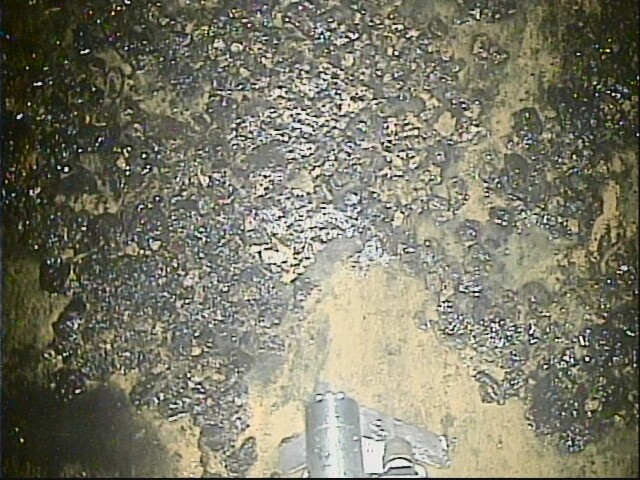
A pressure washer-equipped robot clears the path inside the containment vessel of Fukushima No. 1 nuclear power plant’s No. 2 reactor on Feb. 9. The black lumps are believed to be melted fuel. (Provided by Tokyo Electric Power Co.)
The road to decommissioning Fukushima No. 1 nuclear power plant’s No. 2 reactor could be rockier than expected, as radiation levels on Feb. 9 were even deadlier than those recorded in late January.
Tokyo Electric Power Co. announced that day that radiation levels inside the reactor were estimated at up to 650 sieverts per hour, much higher than the record 530 sieverts per hour marked by the previous survey.
A camera attached to the robot deployed inside Fukushima No. 1 nuclear power plant’s No. 2 reactor shows how it clears its path covered with debris and deposits using a pressure washer. (Captured from video provided by Tokyo Electric Power Co.)
A camera made its way inside the reactor’s containment vessel for the first time on Jan. 30 and spotted fuel rods that had melted into black lumps in the nuclear accident in the aftermath of the 2011 Great East Japan Earthquake and tsunami disaster.
The plant operator made the latest estimate from the amount of camera noise experienced by the robot that ventured into the lion’s den that morning.
Equipped with a pressure washer, the machine was deployed to pave the way for the Sasori (scorpion) robot that is set to survey the reactor’s interior in greater detail.
The robot’s task was to hose down melted fuel and other substances as it traveled along a rail measuring 7 meters long and 0.6 meter wide connecting the outer wall of the containment vessel with the reactor’s core. It started operating from a point located 2 meters from the exit of the tunnel bored into the side of the vessel.
But about two hours into its journey, in which it had progressed about a meter, the camera footage started getting dark, TEPCO said. The amount of radiation emitted by the melted fuel may have taken a toll on the camera’s well-being.
As the robot could be left stranded inside the vessel if the camera broke down completely, the utility called off the operation seven hours earlier than scheduled and retrieved the device.
TEPCO analyzed the footage and concluded that the doses amounted to about 650 sieverts per hour, which is deadly enough to kill a human in less than a minute.
As the robot’s camera was designed to withstand a cumulative dosage of 1,000 sieverts per hour, the utility commented that “it’s consistent with how the camera started to break down after two hours.”
The plant operator plans to deploy the Sasori surveyor robot before the end of February.
“We will be assessing the amount of deposits and debris to decide how far Sasori can advance,” a TEPCO official said.
Robot probe of Fukushima reactor halted due to glitch
An operation to prepare to examine the inside of the No. 2 reactor at the disaster-struck Fukushima Daiichi nuclear plant was halted Thursday due to a technical glitch, the plant operator said.
Tokyo Electric Power Company Holdings Inc. said it sent a robot with a high-pressure water nozzle into a containment structure housing the pressure vessel, but suspended the work after video images from a camera on the robot became dark.
TEPCO said high radiation levels may have caused the camera glitch. The camera was designed to withstand cumulative radiation exposure up to 1,000 sieverts. Previously the company said up to 530 sieverts per hour of radiation was detected within the reactor containment structure in late January. The radiation reading during the robot operation Thursday was 650 sieverts, TEPCO said.
In this image released by Tokyo Electric Power Co. (TEPCO), a remote-controlled “cleaning” robot, bottom, enters the reactor containment chamber of Unit 2 for inspection and cleaning a passage for another robot as melted materials are seen at Fukushima Dai-ichi nuclear power plant in Okuma town, Fukushima prefecture, northeastern Japan, Thursday, Feb. 9, 2017. The “cleaning” robot that entered one of three tsunami-wrecked Fukushima reactor containment chambers was withdrawn before completing its mission due to glitches most likely caused by high radiation.
Cleaner robot pulled from Fukushima reactor due to radiation
TOKYO (AP) — A remote-controlled cleaning robot sent into a damaged reactor at Japan’s Fukushima nuclear plant had to be removed Thursday before it completed its work because of camera problems most likely caused by high radiation levels.
It was the first time a robot has entered the chamber inside the Unit 2 reactor since a March 2011 earthquake and tsunami critically damaged the Fukushima Da-ichi nuclear plant.
Tokyo Electric Power Co. said it was trying to inspect and clean a passage before another robot does a fuller examination to assess damage to the structure and its fuel. The second robot, known as the “scorpion,” will also measure radiation and temperatures.
Thursday’s problem underscores the challenges in decommissioning the wrecked nuclear plant. Inadequate cleaning, high radiation and structural damage could limit subsequent probes, and may require more radiation-resistant cameras and other equipment, TEPCO spokesman Takahiro Kimoto said.
“We will further study (Thursday’s) outcome before deciding on the deployment of the scorpion,” he said.
TEPCO needs to know the melted fuel’s exact location and condition and other structural damage in each of the three wrecked reactors to figure out the best and safest ways to remove the fuel. It is part of the decommissioning work, which is expected to take decades.
During Thursday’s cleaning mission, the robot went only part way into a space under the core that TEPCO wants to inspect closely. It crawled down the passage while peeling debris with a scraper and using water spray to blow some debris away. The dark brown deposits grew thicker and harder to remove as the robot went further.
After about two hours, the two cameras on the robot suddenly developed a lot of noise and their images quickly darkened — a sign of a problem caused by high radiation. Operators of the robot pulled it out of the chamber before completely losing control of it.
The outcome means the second robot will encounter more obstacles and have less time than expected for examination on its mission, currently planned for later this month, though Thursday’s results may cause a delay.
Both of the robots are designed to withstand up to 1,000 Sieverts of radiation. The cleaner’s two-hour endurance roughly matches an estimated radiation of 650 Sieverts per hour based on noise analysis of the images transmitted by the robot-mounted cameras. That’s less than one-tenth of the radiation levels inside a running reactor, but still would kill a person almost instantly.
Kimoto said the noise-based radiation analysis of the Unit 2’s condition showed a spike in radioactivity along a connecting bridge used to slide control rods in and out, a sign of a nearby source of high radioactivity, while levels were much lower in areas underneath the core, the opposite of what would normally be the case. He said the results are puzzling and require further analysis.
TEPCO officials said that despite the dangerously high figures, radiation is not leaking outside of the reactor.
Images recently captured from inside the chamber showed damage and structures coated with molten material, possibly mixed with melted nuclear fuel, and part of a disc platform hanging below the core that had been melted through.
The ongoing Fukushima nuclear catastrophe has been back in the news lately following record high readings at the reactor site. Radiation levels were a maximum of 530 sieverts per hour, the highest recorded since the triple core meltdown in March 2011.
But upon further examination, the story has been misreported, in part due to mistranslation. In fact, according to Nancy Foust of SimplyInfo.org, interviewed on Nuclear Hotseat, there was no spike. High readings were in expected locations that TEPCO was only able to access recently. Therefore, the reading became evident because workers were getting closer to the melted fuel in more dangerous parts of the facility. In other words, it’s not a new hot mess, just the same hot mess it’s always been, pretty much from the beginning. The good news is nothing has changed. The bad news is – nothing has changed.
The confusion was initially caused by a translation error that SimplyInfo.org thinks occurred between the Kyodo News and Japan Times. Since this happened, Foust and her group have been trying to get news sources to correct the stories, with limited success.
The elevated radiation levels are inside containment (good news) in ruined unit 2 and were discovered using a camera, not proper radiation monitors. Therefore, the high reading may not be reliable since it is an estimate based on interference data with the camera. TEPCO is planning on sending in a robot properly equipped with radiation detectors to take a reliable reading. Although no date has been given, TEPCO indicates it expects to deploy the robot within 30 days or so.
Foust theorizes that the bulk of spent fuel is probably right below the reactor vessel burned into the concrete below. No one knows if fuel has gone into the ground water below that.
The operator of the damaged Fukushima nuclear plant has suspended a preliminary survey using a robot inside the containment vessel of one of its reactors.
On Thursday, a remote-controlled robot was sent toward the middle of the No. 2 reactor, but the operation was later suspended after images captured by one of the robot’s 3 cameras turned out black.
The survey is part of efforts toward decommissioning the No.1 to No. 3 reactors, which suffered meltdowns.
Officials of Tokyo Electric Power Company say they will find out what went wrong before deciding how to proceed with the survey. The utility originally planned to use the same robot on Tuesday, but put it off to Thursday due to mechanical trouble.
The exact conditions inside the containment vessel must be determined before a full survey can be undertaken. The full survey will use a scorpion-shaped robot to measure radiation levels and temperatures.
A remote-controlled camera used in a survey last week captured footage of what seemed to be debris of molten fuel on the partially broken floor grate in the vessel.
The government on Feb. 7 submitted a legal revision bill to the Diet to stabilize funding for the decommissioning of the Fukushima No. 1 nuclear plant.
The subject of the revisions is the law establishing the Nuclear Damage Compensation and Decommissioning Facilitation Corp. (NDF), which manages the flow of funds to nuclear accident victims and the long process of dismantling the disaster-stricken Fukushima No. 1 plant.
The revisions will require plant operator Tokyo Electric Power Co. (TEPCO) to set aside funds secured through corporate restructuring with the NDF. The revisions will also give the Ministry of Economy, Trade and Industry the right to perform spot inspections of TEPCO offices to make sure the utility is making appropriate deposits.
Furthermore, the revision bill states that TEPCO must submit a reactor decommissioning plan and a financing scheme to fund that plan to the industry ministry every fiscal year. The NDF and the industry ministry will examine the utility’s decommissioning project structure, and judge if it is being properly implemented.
The government is looking to have the revisions enter force within the year, with TEPCO capital transfers to the NDF to commence as early as next fiscal year, which starts on April 1, 2017.
Last year, the industry ministry increased the total estimated cost for Fukushima No. 1 plant decommissioning from 2 trillion yen to 8 trillion yen, in preparation for the difficult work of removing the melted fuel from three of the power station’s reactors.
TEPCO’s annual revenues currently stand at about 400 billion yen, while reactor decommissioning alone is expected to cost some 300 billion yen per year. Nevertheless, the industry ministry believes the utility should be able to cover its obligations if it can improve its earning power through management restructuring and the restart of the Kashiwazaki-Kariwa Nuclear Power Plant in Niigata Prefecture.
However, the governor of Niigata Prefecture has been reluctant to green-light the restart of the Kashiwazaki-Kariwa reactors, and there is no projected schedule to bring the plant back on line. In addition, it is possible that the cost of decommissioning the Fukushima No. 1 plant reactors will continue to swell.
There are many shoes still to drop at Fukushima Daiichi, said Kevin Kamps, radioactive waste monitor at Beyond Nuclear. If something goes wrong with the radioactive waste storage pools, there could be a release of high-level radioactivity into the air, he added.
Radiation at Fukushima’s nuclear power plant is at its highest level since the tsunami-triggered meltdown nearly six years ago. Tokyo Electric Power Company (TEPCO) is reporting atmospheric readings inside Daiichi’s reactor No.2 are as high as 530 sieverts an hour, while a human exposed to a single dose of 10 sieverts would die in a couple of weeks.
RT: Can you explain what is likely going on here?
Kevin Kamps: This catastrophe that is ongoing is nearly six years old at this point. The fuel, the melted cores have been missing an action. TEPCO doesn’t know where they are; the Japanese government doesn’t know where they are; nobody knows where they are. What could have happened is these probes, these cameras, these robots, these radiation monitors that are being sent in by TEPCO to try to figure out what is going on, may have encountered the closest they have come yet to these melted cores. They may even have come upon melted fuel that is not under water, and water serves as a radiation shielding. So if this is an open area and there is no water – that could explain.
But what you’ve got are melted reactor cores. Of course, human beings can’t be in operating atomic reactors. They also can’t be in this area where there is a meltdown. There is also imagery – it looks like a melt through of a metal grade. It all stands to reason that the cores melted through the reactor pressure vessels and down into the containment structures right through that metal grating.
It is not unexpected, but we still don’t know where the cores are. There are claims that “it’s all contained, don’t worry about it.” It is indisputable that there is a daily flow of radioactively contaminated groundwater into the ocean. The figures something like 80,000 gallons per day of relatively low-level radioactive waste water. Then you’ve got those storage tanks – we’re talking 800,000 tons of highly radioactive water stored in tanks. Every day they pour a hundred tons of water on each of these three melted down cores. Sometimes they lose those tanks. They leak, they overflow – it is an ongoing catastrophe.
RT: So the contamination, in this case, could leak out, couldn’t it?
KK: There is some leakage on a daily basis. Then they try to capture as much as they can and contain it in the storage tanks, which they sometimes lose, whether during a typhoon or through human error – they have had overflows. So many shoes can still drop at Fukushima Daiichi. One of the ones is the high radioactive waste storage pools that aren’t even inside radiological containment. They don’t have all of that spent nuclear fuel transferred to a safer location in a couple of the units still. If something were to go wrong with that – those would be open air releases of very high-level radioactivity.
The prime minister at the time the catastrophe began, [Naoto] Kan, had a contingency plan to evacuate all of North-East Japan – up to 50 million people. It was predominantly because of those storage pools. We’re still in that predicament- if one of those pools were to go up in flames. As Tokyo plans to host the 2020 Olympics and bring in many millions of extra people into this already densely populated area -it is not a good idea.
RT: Going back to this specific leak: how does this complicate the cleanup efforts there? Is it possible even to get something in there right now to examine what is going on?
KK: State of the art robotic technology – Japan is a leader in robotics – can only last so long, because the electronics get fried by the gamma radiation, and probably neutron radiation that is in there. That is the situation deep in there. They are already saying it will take 40 years to so-called decommission this, but that may be optimistic.
RT:Also in December the government said it is going to take twice as much money – nearly twice as much as they originally thought – to decommission that. Does this make matters ever worse – this leak? Or is this just kind of the situation to expect at this point?
KK: It just shows how dire the situation is. The figures of $150 billion to decommission – I have seen figures from a think tank in Japan sided by Green Peace Japan up to $600 billion. If you do full cost accounting: where is this high-level radioactive waste going to go? It is going to need a deep geological depository. You have to build that and operate it. That costs a hundred billion or more. So when you do full cost accounting, this catastrophe could cost hundreds of billions of dollars to recover from. We’re just in the beginning.
The news headlines concerning Fukushima Daiichi over the last week have been rather confusing because some seem to imply that radiation levels have risen, as illustrated in this article by The Guardian:
I have not interpreted the latest news from TEPCO as indicating that radiation levels have risen.
Rather, I interpret the latest news as indicating that TEPCO was successful in getting a robot into an existing high-radiation area in the plant, under the reactor-pressure vessel of unit 2, as explained in this excerpt from an article published in The Japan Times:
The radiation level in the containment vessel of reactor 2 at the crippled Fukushima No. 1 power plant has reached a maximum of 530 sieverts per hour, the highest since the triple core meltdown in March 2011, Tokyo Electric Power Co. Holdings Inc. said.
Tepco said on Thursday that the blazing radiation reading was taken near the entrance to the space just below the pressure vessel, which contains the reactor core…
Tepco also announced that, based on its analysis of images taken by a remote-controlled camera, that there is a 2-meter hole in the metal grating under the pressure vessel in the reactor’s primary containment vessel. It also thinks part of the grating is warped.
As the article observes, the hole was probably made when the fuel “escaped the pressure vessel after the mega-quake and massive tsunami triggered a station blackout.”
Simply Info, an excellent source of information and technical analysis about Fukushima, offers this summary analysis of the origins of the hole:
This large but concentrated hole appears to be the failure point for the unit 2 reactor pressure vessel (RPV). Melted fuel (corium) likely flowed through this hole and collected into the sump in the containment structure floor. The slow failure and small opening melted through the RPV likely allowed the molten fuel to burn down as it collected in the sump. This new visual evidence shows conditions that could have led to the molten fuel burning down into the reactor building concrete basemat. Without sufficient cooling, it could have potentially burned down through the basemat.
Simply Info has a follow up article where Nancy Foust offers her analysis. Here is her hypothesis concerning what happened to the fuel in reactor 2 after the earthquake 3/11:
What has been found seems to track with the theory of a slow failure and melt out that may have burned down into the concrete basemat rather than flowed out across the containment floor.
These reports beg the question as to where the reactor fuel from unit 2 is now located. Is it under the site? Is it in the basement? How structurally intact is the basement? TEPCO stated several years ago that water in the basement of unit 2 was encountering melted fuel and that this contaminated water was not entirely contained by the building (I have this documented in my published work on Fukushima).
And what are the conditions of reactors 1 and 3? These reactors remain too hot for robots.
There is a near continuous stream of atmospheric emissions that can be seen nightly on the webcam around unit 3. I always presumed that the MOX remains of unit 3 reactor’s fuel were responsible for that stream of visible heat/steam.
Could slumped fuel from unit 2 have ended up moving toward unit 3?
Here is a screenshot from today of the emission stream:
Well, no way to know for sure but I do feel safe concluding that Daiichi’s mysterious missing fuel is probably dispersing in ground water, ocean, earth, and atmosphere….
Dec 18, 2015 – As I’ve mentioned previously on my blog, there was no word on the fuel … are in danger of collapse due to an earthquake or liquefaction of the …
Sep 28, 2012 – Majia here: When I listened to Arnie Gundersen’s recent interview and … 2012, the loose soil under Fukushima underwent liquefaction during a …
Jan 11, 2014 – Majia here: Ok so strontium levels in the ground water and in ocean … This explains why site liquefaction is occurring at the Daiichi site. So, we …
Jan 29, 2017 – The New York Times has a poignant article about the plight of US service men who were required to clean up Enewetak atoll, part of the …
Aug 28, 2016 – Liquefaction has been a risk for years now at the plant. It is amazing (what’s left of) the buildings are still standing…. Posted by Majia’s Blog at …
Mar 30, 2016 – [xv] Water saturation from the underground river and TEPCO’s injections contribute to ground liquefaction, which poses direct risks to the …
Feb 22, 2014 – The ground water saturation is contributing to ground liquefaction, which poses direct risks to the reactor buildings and common spent fuel pool …
Video footage of the inside of the No. 2 reactor at the Fukushima No. 1 Nuclear Power Plant has proved that it is more difficult than initially believed to decommission the tsunami-ravaged plant. The camera that was inserted into an area below the reactor’s pressure vessel shows a deposited substance near a foothold in the area. The substance is highly likely to be melted nuclear fuel.
Nearly six years have passed since the March 2011 Great East Japan Earthquake and tsunami that triggered the nuclear crisis. The fact that the condition of the inside of the reactor has been confirmed represents a step forward. However, analysis conducted by Tokyo Electric Power Co. (TEPCO), the operator of the crippled power station, shows that the levels of radiation in the reactor building are so high that someone would die within less than a minute if they were exposed to radiation inside the facility. The footage shows that the deposited substances are scattered around in a wide area of the structure. TEPCO had planned to introduce a robot equipped with a camera into the reactor building possibly by the end of this month to fully probe the condition inside, but the footage has forced the utility to reconsider the plan.
If the situation is left as it is, the time required to decommission and dismantle the power station, which is believed to take 30 to 40 years, could be prolonged and the estimated costs of decommissioning the plant, which has already been revised upward from the initial 2 trillion yen to 8 trillion yen, could further rise. TEPCO is required to foot the costs of decommissioning the Fukushima plant, but the expenses will be passed on to consumers who pay electric power charges.
The government and TEPCO should fundamentally review their responses to the nuclear disaster, such as the development of technologies necessary to decommission the plant and ways to reduce decommissioning costs.
Meltdowns occurred in the cores of the No. 1 to 3 reactors at the Fukushima No. 1 Nuclear Power Plant in the accident. According to the road map toward decommissioning the plant, drawn up by the government and TEPCO, the utility is supposed to determine a method to remove melted fuel at one of the reactors by the end of fiscal 2018 and begin work within 2021.
To do so, it is necessary to ascertain where and how deposits of melted fuel are scattered, but this remains unclear.
TEPCO hit a snag at the beginning of the recent survey on the No. 2 reactor. Still, the condition of the reactor is far better than those of the No. 1 and 3 reactors — which were badly damaged in hydrogen explosions, obstructing surveys of their interiors.
Reactor core meltdowns occurred in an accident at a nuclear plant on Three Mile Island in the United States in 1979. Work to remove melted fuel commenced six years after the outbreak of the disaster and was completed 11 years after the accident. Workers remotely controlled a device to remove melted fuel from the pressure vessel while filling the vessel with water to block radiation.
Work at the Fukushima plant is far more difficult than at the Three Mile power station because nuclear fuel has melted and leaked out of the pressure vessels of the No. 1 to 3 reactors. How and where the melted fuel will be stored has not been decided yet. The government and TEPCO should obtain knowledge both from Japan and overseas to develop technologies to store melted fuel.
In considering the road map toward decommissioning the plant, it should be kept in mind that the degree of progress in the work will affect the restoration of areas hit by the nuclear disaster and the prospects for evacuated residents to return to their homes. However, if an unreasonably tight schedule is created, it could increase the risks of worker accidents and exposure to radiation.
Although it is a difficult task, the government and TEPCO are required to ensure transparency and steadily overcome obstacles to decommission the crippled power station.
Some pages and websites choose to publish sensationalism about Fukushima, as a mean to draw big numbers of visitors, like flies on the sh@t, hooking the adrenaline kick hungry crowd to get there their daily junk dose of B.S.
Fukushima is a serious catastrophe, after almost 6 years it’s only at its beginning and will not be resolved after 100 years, the technology needed to clean-up 3 reactors’ meltdowns has not yet been invented.
The mainstream media are minimizing the scale of that still ongoing catastrophe, gagged by governments having their own economic and political priorities.
Those reactors are opened belly up and still spitting nonstop radioactive nanoparticles into our skies and environment, contaminating the food chain with many consequences not yet well known, being not properly studied, identified and quantified.
The nuclear lobby and their accomplices, are muzzling in many ways the scientific community, and there is no funding to be found for those studies to be made.
We have only few dedicated straight scientists, such as Tim Mousseau, Chris Busby and a few others who still believe science as being more important than their personal career and moneyed interests, who are not selling out to pressure and personal rewards. They do work hard to bring us the real facts, the hard facts, and with very little means. As an example the biologist Tim Mousseau has been the scientist making the highest number of field trips to Chernobyl and Fukushima to research the effects of radiation on the wild life there, always on a shoe string budget.
We also have many Japanese citizen-scientists on location in Fukushima, who betrayed by their government and the Japanese scientific community, are organizing themselves to measure radiation in their environment and in their food so as to protect themselves and their families.
Those are the people we must look up to, the people who dig for the facts and fight for the real facts to be known.
I refuse to deal in sensationalism, we will stick to facts, time passing by only facts can and will prevail.






 nuclear-news