China supports IAEA review of Fukushima treatment
“Just because China supports the task force’s work does not mean it approves of Japan’s decision to discharge the contaminated water, Mao also said, urging Japan to find an appropriate way to treat the contaminated water, instead of pushing forward with its discharge plan.”

2022-11-21
China supports the International Atomic Energy Agency and its task force in reviewing Japan’s treatment of nuclear contaminated water, and hopes the task force will strictly implement the IAEA’s nuclear safety standards and ensure the “absolute safety” of the treatment, Foreign Ministry spokeswoman Mao Ning said.
Mao made the remarks at a daily news conference on Monday after the task force carried out a new mission last week to review Japan’s plan to discharge treated nuclear-contaminated water from the Fukushima Daiichi Nuclear Power Station.
The IAEA said a report of the mission will be made available within three months.
In response, Mao said a time limit should be avoided to ensure the quality and credibility of the report, and Japan should coordinate closely with the task force.
The IAEA didn’t review other plans of treating contaminated water than discharging it to sea, thus failing to make a full assessment and find the best treatment plan, Mao pointed out.
Just because China supports the task force’s work does not mean it approves of Japan’s decision to discharge the contaminated water, Mao also said, urging Japan to find an appropriate way to treat the contaminated water, instead of pushing forward with its discharge plan.
https://global.chinadaily.com.cn/a/202211/21/WS637b7603a31049175432b07c.html
Report on Fukushima water release plan to ‘provide confidence’: IAEA
The IAEA’s plan to provide confidence in TEPCO’s radioactive water dumping into the Pacific Ocean demands for sure a lot of gullibility on our part….

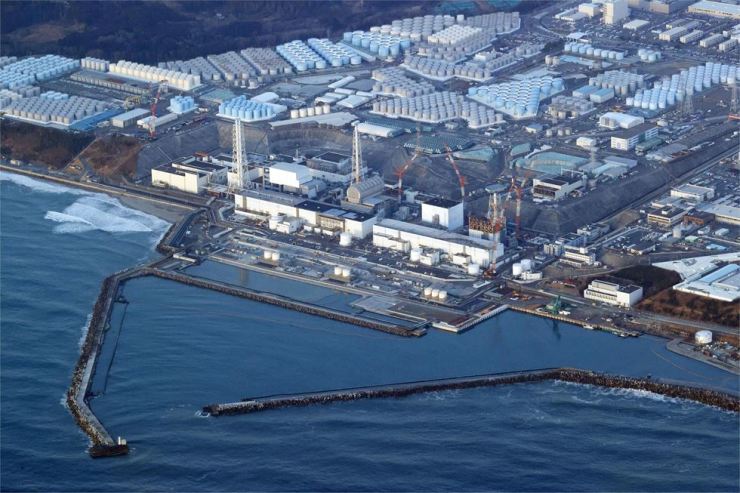
This Feb. 13, 2021 photo taken from a Mainichi Shimbun helicopter shows the Fukushima Daiichi nuclear power plant in Fukushima Prefecture.
November 18, 2022
TOKYO (Kyodo) — An International Atomic Energy Agency official said Friday that a report to be released early next year on Japan’s plan to discharge treated radioactive water into the sea from the crippled Fukushima Daiichi nuclear power plant “will provide confidence to Japanese society, neighbors, all the (IAEA) member states.”
The report will be an independent and scientific evaluation based on international standards, said Gustavo Caruso, director and coordinator of the IAEA’s Department of Nuclear Safety and Security, at a press conference in Tokyo following the completion of the organization’s second safety review.
During the five-day on-site assessment through Friday, an IAEA task force of experts led by Caruso discussed radioactivity measurements that should be taken when the water is released with plant operator Tokyo Electric Power Company Holdings Inc. and the Ministry of Economy, Trade and Industry.
On Wednesday, the team inspected the Fukushima Daiichi nuclear power plant, crippled by the 2011 earthquake and tsunami.
Tokyo decided in April last year to gradually discharge the water, treated through an advanced liquid processing system that removes radionuclides, except tritium, into the Pacific Ocean after dilution from around spring 2023.
Water that has become contaminated after being pumped in to cool the melted reactor fuel at the plant has been accumulating at the facility, mixing with rainwater and groundwater at the site. Tanks holding the water occupy a large area of the complex and are nearing capacity.
But even if the review by the IAEA finds that some aspects do not comply with international standards, it will be left up to the Japanese government to decide whether to postpone or cancel the water release, according to Caruso.
The IAEA will revisit Japan in January to exchange views with the Nuclear Regulation Authority.
“Before the water discharge begins, the IAEA will issue a comprehensive report on all collected findings until now,” Caruso said.
https://mainichi.jp/english/articles/20221118/p2g/00m/0na/060000c
TEPCO announces method for measuring concentration of radioactive materials to be discharged into the ocean, targeting 31 species to be discharged from next spring
The radioactive polluting of our Pacific ocean is just a too important issue for us to trust Tepco, a company which has never been honest in the past 10 years with its announced facts and numbers.

November 14, 2022
Tokyo Electric Power Company (TEPCO) announced on April 14 that it will measure the concentrations of 30 types of radioactive materials, including tritium, which cannot be removed by the purification facilities, to determine whether or not to discharge contaminated water from the Fukushima Daiichi Nuclear Power Plant (Okuma and Futaba, Fukushima Prefecture) after purifying and treating it, immediately prior to its discharge into the ocean. The purification system removes 62 types of radioactive materials, but radioactive materials with short half-lives were excluded from the evaluation because they have decayed.
According to TEPCO, radioactive materials that are expected to be reduced by half in less than one year and that were determined to be almost nonexistent in the treated water were excluded from the evaluation. TEPCO will continue to measure the excluded substances before they are discharged.
At a press conference on the same day, Junichi Matsumoto, head of the TEPCO’s Fukushima Daiichi Decommissioning Promotion Company, explained that the reason for reducing the number of substances to be evaluated compared to the radioactive substances to be removed by the ALPS is “to prevent unrealistic evaluations under excessively strict conditions. The measurement details will be submitted to the Nuclear Regulation Commission, and the Commission will review whether they are appropriate or not.
The evaluation targets include radioactive cesium and strontium. It was confirmed that the total concentration of 30 types of radioactive substances other than tritium was below the government’s standard for release. Then, a large amount of seawater will be mixed with the treated water, which still contains tritium, to dilute the tritium concentration to less than 1/40th of the standard level, and the water will be discharged from the seafloor about 1 km offshore.
TEPCO is now digging undersea tunnels with the aim of starting tritium discharge in or after next spring.
https://www.tokyo-np.co.jp/article/213918?fbclid=IwAR29ZLfidwVblCHKcRUglDDyMiz9hp5WvZFb8wjHb-n3nh6c9lChLxRor6k
Orano and TEPCO strengthen co-operation on fuel debris removal at Fukushima
This is a lot of nuclear baloney: former Areva now Orano’s unique experience in the dismantling of a nuclear power plant is at the Brennilis nuclear power plant, started in 1995 and still unfinished since then, Brennilis nuclear power plant having only one reactor and no meltdown whatsoever.

11 November 2022
Orano has signed an engineering support contract with Tokyo Electric Power Company (TEPCO) and its Fukushima Decontamination and Decommissioning Engineering Company subsidiary for the design of a high-activity facility for small scale retrieval of nuclear fuel debris from the Fukushima Daiichi NPP.
These debris consist mainly of a solidified mixture of molten nuclear fuel and other materials, located in facilities inside the reactor buildings. Orano engineers will be embedded directly within TEPCO’s organisation to provide technical support on the project to design High Active Cells for Small Scale Retrieval Planning and share Orano’s best practices in terms of engineering and operation.
Orano has unique experience in the design, operation and dismantling of reprocessing plants in France. This know-how will contribute to the enhancement of TEPCO’s in-house decommissioning and engineering capabilities which are necessary for stable and safe fuel debris retrieval operations.
Exchange visits to the Fukushima NPP and Orano’s La Hague site were organised to launch the contract. This will allow TEPCO to become familiar with the know-how developed by the teams from Orano at la Hague site in the retrieval of legacy waste.
China Urges Japan to Safely Dispose of Nuclear Water

11 November 2022
The International Atomic Energy Agency will continue a comprehensive safety review of the Fukushima Daiichi nuclear power station.
On Friday, Chinese Foreign Affairs Ministry spokesperson Zhao Lijian once again urged Japan to respond to the legitimate concerns of all relevant parties and dispose of nuclear-contaminated water in a scientific, open, transparent, and safe way.
The International Atomic Energy Agency (IAEA) announced Wednesday that its technical task force would visit Japan from Nov. 14 to 18 to continue a comprehensive safety review of Japan’s plan to pipe nuclear-contaminated water from the Fukushima Daiichi nuclear power station into the Pacific Ocean.
In response to a related query, Zhao said at a daily press briefing that China supports the work of the IAEA and its technical task force.
He said China hopes that the task force will adhere to the principles of objectivity, fairness, and science, strictly implement the IAEA’s nuclear safety standards, and ensure the absolute safety of the disposal of contaminated water. “Japan should fully cooperate with the review by the IAEA’s technical task force,” said Zhao.

While the IAEA’s working group has not completed the assessment and review, and the international community’s concerns have not been effectively resolved, the Japanese side has nevertheless approved the discharge plan and accelerated the construction of the discharge pipeline, intending to create a fait accompli.
“This undermines the authority of institutions and technical working groups and is highly irresponsible to the international community and the Japanese people,” Zhao said.
China once again urges the Japanese side to face up to the legitimate concerns of all parties, fully consult with stakeholders including its neighbors and relevant international institutions, and dispose of the nuclear-contaminated water in a scientific, open, transparent, and safe manner to protect the marine environment and safeguard the health and food safety of people of all countries.

Bring voices from the coast into the Fukushima treated water debate

October 28, 2022
More than a decade has passed since the accident at the Fukushima Dai’ichi nuclear power plant in Japan—but the most contentious aspect of bringing the site under control is only just beginning. The Japanese Government has approved plant operator TEPCO’s plan to release treated water into the Pacific Ocean. That water is currently being stored onsite and retains some radioactive substances after treatment. The decision to release this water has provoked political contention and societal concern. South Korea, China, and Taiwan, as well as international environmental nongovernmental organizations, have expressed strong concern; and fisheries cooperatives in Japan remain opposed to the releases for fear of possible reputational impacts on Fukushima seafood. TEPCO are confirming specific details of the release process, and an International Atomic Energy Agency (IAEA) task force has made multiple visits to the Fukushima Dai’ichi site at the behest of the Japanese Government and TEPCO. The releases are scheduled to start in 2023 and run for many years.
A technical committee within Japan, formed by the Ministry of Economy, Trade, and Industry, made the recommendation to release the treated water; it’s unlikely that the Japanese Government or TEPCO will revisit their decision. And so, a key role for technical and policy communities, both within Japan and internationally, is to ensure that the concerns of affected stakeholders are identified and addressed as the releases proceed. However, despite significant global science–policy interest in the treated water situation at Fukushima Dai’ichi (1, 2), the concerns of local fishers and coastal communities in Fukushima, key stakeholders living in the shadow of the nuclear site who will live with the consequences of the releases on a daily basis, have had only limited visibility in the science–policy discourse surrounding the aftermath of the Fukushima disaster.
Even if TEPCO and the government minimize environmental impacts through careful management of the process, as some international experts believe possible (3), the indirect socioeconomic impacts of the treated water releases on Fukushima’s coastal fishing communities are likely to be experienced over the long term. Proposals made by the community of researchers and institutions working at the science–policy interface for Fukushima treated water must be informed by a deep understanding of the local community context—and they must be responsive to the concerns of local stakeholders. We believe local community concerns can be more fully incorporated into decision making for treated water at Fukushima Dai’ichi.
Local Influence
Within Japan, the government expert committees advising the management of treated water are dominated largely—albeit not exclusively—by engineering and physical science expertise (4). Despite fisheries cooperatives’ long-standing and vocal opposition to the releases, plant operator TEPCO explained in August 2021 that they had not at that point had direct consultations with fisheries representatives regarding the discharges (5). Formal dialogue between the operator and the fisheries sector in Fukushima on the topic of releases did not start until TEPCO and the Japanese Government had determined most of the technical details. This left little room for the plans to be adjusted in response to any concerns from Fukushima’s fishers or coastal residents.
Decisions over treated water at Fukushima Dai’ichi rest with the Japanese authorities and plant operator. However, the global community of researchers and organizations working at the interface of science and policy can influence local community engagement at Fukushima in at least three ways. The first is participation as experts in intergovernmental forums, such as the IAEA and United Nations Scientific Committee on the Effects of Atomic Radiation (UNSCEAR), which provide actors such as the Japanese Government with evidence-based guidelines and oversight on the management of environmental radioactivity. The second is peer-reviewed research into the marine environment in Fukushima and potential impacts of treated water releases (e.g., 6, 7), which often contains policy recommendations and forms part of the scientific record that’s drawn on to justify decisions taken about management of treated water. The third is reports and opinion pieces, grounded in scholarly evidence, on an individual or organizational basis with the intention of influencing government actions within Japan or initiating broader civil society action towards specific outcomes for the management of treated water (e.g., 8).
Both within Japan and internationally, Fukushima’s fishers and coastal residents, although not completely absent, have received limited consideration as stakeholders. Fishers and residents tend to be caricatured as being concerned over rumors and reputational damage to Fukushima seafood owing to the treated water releases (9, 10)—or as harboring “irrational” safety fears over the relatively small amounts of radioactivity from pollutants such as tritium that are contained in the tanks currently storing treated water onsite (e.g., 3). Many suggest that fishers and coastal residents can eventually be appeased with the right compensation strategies along with judicious use of language. This, they argue, would promote a precise understanding of the science behind the releases and avoid potentially stigmatizing or misleading language around radioactivity.
Missing Local Context
The Japanese Government is unlikely to reverse their decision to release treated water. Even so, it’s important to recognize that fishing is both an economic activity and the subject of deep emotional investment on the Fukushima coast. When issues of value are at stake, the social sciences have long argued (11) that providing “more and better” technical information or economic compensation alone is unlikely to be an effective risk governance approach. The resilience of Fukushima’s fishing communities during the treated water releases depends on careful engagement with and deep understanding of fishers’ and residents’ concerns.
One aspect is the significant effort that has gone into revitalizing fisheries to date and concerns over these revitalization efforts being jeopardized by the treated water releases. Trial fishing operations commenced off the Fukushima coast in 2012, with the aim of restarting fisheries on a smaller-scale basis (about 10% of pre-disaster levels) once government fisheries scientists failed to detect radioactive cesium in different species.
In spring 2021, the trial phase ended and coastal fisheries moved to a new “expansion” phase, with an aspiration to return to pre-disaster capacity. Fishers have responded positively to the gradual recovery and expansion of fisheries in Fukushima, citing factors such as renewed opportunity for interaction with and mutual support from their peers, a chance to reduce down time spent in the family home with associated tensions, and the return of a sense of pride and purpose in being out fishing and doing “their” work (12).
The revitalization of fisheries has hence brought significant benefit to the Fukushima coast, both for sales of seafood and also fishers’ wellbeing, which cannot be offset through economic compensation alone. Moreover, the amount of effort that has gone into this revitalization, through re-engaging fishers and building trust with consumers and brokers, should not be underestimated, nor should the time taken to reach a stage where local seafood is once again part of daily life (13). When viewed through this lens, any actions that may jeopardize this recovery—such as releases of water perceived as “tainted” into the marine environment—are likely to be met with concern or opposition.
A second aspect receiving little explicit attention in the debates over Fukushima treated water centers around the social and cultural significance of fisheries to the Fukushima coast. The distinctive environmental characteristics of Fukushima waters—where the warm Kuroshio and cold Oyashio currents meet—have led to particular pride in the uniqueness and quality of Fukushima’s fish (14). Consumers and Fukushima residents have responded positively to the return of Fukushima seafood to menus and supermarket shelves, with events celebrating locally landed and seasonally caught fish. If Fukushima’s waters are again perceived as being degraded, fishers’ and residents’ attitudes towards the releases may stem at least in part from concerns over the implications for their livelihoods and sense of belonging and identity—it’s not simply about their incomes.
There are actions that can be taken to more fully understand coastal communities’ concerns and hence mitigate societal impacts in Fukushima. These action have implications both within Japan and internationally.
We recommend the establishment of a body to independently evaluate the effects of treated water releases on the marine environment and fish stocks. Right now, there are good indications that the Japanese public questions the competence of government and regulatory agencies to manage radioactive waste (15). To ensure that claims of Fukushima seafood remain credible, we must create institutions viewed as trustworthy and independent assessors of marine environmental quality.
A good model may be the Environmental Evaluation Group established to monitor the Waste Isolation Pilot Plant in New Mexico from 1978 to 2004. The group was federally funded, but the state did not control the issues the group researched, the staff it hired, or the reports it published (16). There are already independent groups in Fukushima that invite citizens to collaborate with researchers to assess marine and land-based environmental quality. It’s important that such groups receive long-term core funding to undertake environmental monitoring perceived as independent and trustworthy, while, at the same time, retaining a regulatory firewall to prevent government influence. This will help maintain societal trust in the quality of Fukushima waters and seafood during the releases.
We also recommend that there be a greater diversity of experiences and stakeholders participating in committees responsible for designing and implementing the treated water releases. As outlined earlier, local and experiential knowledge, and to a lesser extent social science and humanities expertise, are under-represented on the technical committees advising the Japanese Government on treated water.
A possible template is the partnership approach adopted as part of low- and intermediate waste management in Belgium in the late 1990s. Sundqvist (17) explains partnerships involving site operators, local governments, and potentially affected stakeholders were established in candidate host communities. The Belgian national waste agency handed the partnerships power to decide on all aspects of the project (with the operator retaining a veto on proposals that were technically unfeasible) and granted budget to commission additional studies or ask for second opinions on proposals. Social science researchers were embedded and tasked with developing ground rules for fair and equitable formation and operation of the partnerships.
Stakeholder engagement exercises can sometimes be more contentious than harmonious, and there is no guarantee that collaborative models of decision making will lead to more satisfactory outcomes. Fukushima represents an extreme case, but also one where there is opportunity for innovation and setting precedents. Fishers, citizens, and local governments could work with marine scientists and plant engineers to decide on timing, locations, and monitoring strategies for releases, by drawing on fishers’ and coastal dwellers’ own knowledge of how fish move around the coastal environment. Partnerships could collate anecdotal and narrative accounts from restaurants, fishmongers, and brokers of how consumers’ perceptions of Fukushima seafood change after the releases, and they can use these accounts in combination with market data to determine compensation levels and additional support requirements for fishing communities. Funding from the national government is needed to sustain these partnerships long-term. Periodic reviews every six months, led by partnership representatives, would give an opportunity for technical details of the releases or communication and compensation strategies to be altered in response to emerging concerns.
However, we need to ensure that committees and partnerships can initiate tangible change rather than “rubber stamping” predetermined recommendations. It is also important that the technical experts who advise on releases have a diversity of opinion among themselves and are able to participate in healthy and constructive disagreement on how the releases ought to proceed. To reduce the risk of “groupthink,” technical committees should also include overseas experts as advisors or observers, individuals who may have relevant experience effectively engaging stakeholders on radioactivity. This could involve government officials who have set up and run stakeholder partnerships for radioactive waste management, scientists who have engaged publics and stakeholders in the aftermath of nuclear accidents such as Chernobyl, or even citizens from other places globally who can share first-hand experience of living with environmental radioactivity.
Last, we believe that international institutions and the science-policy community have an important role to play in informing best practice within Japan. We challenge this community to expand their remits to more explicitly incorporate the societal dimensions of treated water and to engage more fully with local researchers within Japan. At present, social science perspectives have only a marginal role within the IAEA’s work on Fukushima and the sea (18, 19) and indeed lie largely outside the remit of UNSCEAR (20).
From a natural and physical science standpoint, research into the marine environment in the wake of the Fukushima disaster stands as a good example of international collaboration on a complex scientific issue, a collaboration whose activities are meant to inform decision making. This ethos of cooperation in Fukushima’s seas could be further enhanced by more international collaboration with the social sciences, especially with researchers based in Japan who have rich contextual knowledge, spanning research and practice, into how fishers and communities on the Fukushima coast have engaged with the treated water problem (see, e.g., 21, 22).
The treated water issue at Fukushima is a cautionary tale. Investigations into environmental controversies that have international implications and require global scientific cooperation can overlook impacts on local communities. The management of the treated water releases could prove to be an important case study for how local stakeholders, such as fishers, can be embedded into the decision-making for complex marine environmental issues with long-term implications. Yet, for this learning to be realized, local community “on the ground” experiences in Fukushima, related to treated water, need to be better connected to a national and global audience.
References
1 K.O. Buesseler, Opening the floodgates at Fukushima. Science369(6504), 621–622 (2020).
2 D. Normile, Japan plans to release Fukushima’s wastewater into the ocean. Sciencehttps://doi.org/10.1126/SCIENCE.ABI9880 (2021).
3 B. Nogrady, Scientists OK plan to release one million tonnes of waste water from Fukushima. Naturehttps://doi.org/10.1038/D41586-021-01225-2 (2021)
4 METI, Measures against decommissioning, contaminated water, and treated water: Portal site (2021). https://www.meti.go.jp/earthquake/nuclear/hairo_osensui/index.html.
5 Reuters, Tepco to consult fishing communities over water release plan-official (2021, August 26). https://www.reuters.com/business/environment/tepco-consult-fishing-communities-over-water-release-plan-official-2021-08-26/. Accessed 21 October 2022.
6 R. Bezhenar, H. Takata, G. de With, V. Maderich, Planned release of contaminated water from the Fukushima storage tanks into the ocean: Simulation scenarios of radiological impact for aquatic biota and human from seafood consumption. Mar. Pollut. Bull.173 (Pt B), 112969 (2021).
7 Z. Xixi, Q. Tongkun, W. Yecheng, Optimal strategies for stakeholders of Fukushima nuclear waste water discharge in Japan. Mar. Policy135, 104881 (2022).
8 National Bureau of Asian Research, Japan’s role in the Indo-Pacific following the Fukushima nuclear disaster: Through the Pacific Islands’ lens (2022, February 8). https://www.nbr.org/publication/japans-role-in-the-indo-pacific-following-the-fukushima-nuclear-disaster-through-the-pacific-islands-lens/. Accessed 21 October 2022.
9 OECD-NEA, Fukushima Daiichi Nuclear Power Plant Accident, Ten Years On Progress, Lessons and Challenges (OECD-NEA, 2021).
10 R. Rao, Will Fukushima’s Water Dump Set a Risky Precedent? – IEEE Spectrum. IEEE Spectrum. (2021, September 24). https://spectrum.ieee.org/fukushima-wastewater-cleanup-questions#toggle-gdpr.
11 R. Kasperson, Four questions for risk communication. J. Risk Res.17, 1233–1239 (2014).
12 L. Mabon et al., Inherent resilience, major marine environmental change and revitalisation of coastal communities in Soma, Fukushima Prefecture, Japan. Int. J. Disaster Risk Reduct.51, 101852 (2020).
13 T. Morita, D. Ambe, S. Miki, H. Kaeriyama, Y. Shigenobu, “Impacts of the Fukushima Nuclear Accident on Fishery Products and Fishing Industry” in Low-Dose Radiation Effects on Animals and Ecosystems: Long-Term Study on the Fukushima Nuclear Accident, M. Fukumoto, Ed. (Springer Singapore, 2020), pp. 31–41.
14 L. Mabon, M. Kawabe, “Fighting against harmful rumours, or for fisheries? : Evaluating framings and narrations of risk governance in marine radiation after the Fukushima nuclear accident” in Split Waters: The Idea of Water Conflicts, L. Cortesi, K. Joy, Eds. (Routledge India, 2021), pp. 51–68.
15 M. Aoyagi, The impact of the Fukushima accident on nuclear power policy in Japan. Nat. Energy6, 326–328 (2021).
16 Southwest Research and Information Center, Environmental Evaluation Group Archives (2022). http://www.sric.org/nuclear/eeg.php. Accessed 21 October 2022.
17 G. Sundqvist, ‘Heating up’ or ‘cooling down’? Analysing and performing broadened participation in technoscientific conflicts. Environ. Plann. A46, 2065–2079 (2014).
18 IAEA. Review Report: IAEA Follow-up Review of Progress Made on Management of ALPS Treated Water and the Report of the Subcommittee on Handling of ALPS treated water at TEPCO’s Fukushima Daiichi Nuclear Power Station. (IAEA, 2020).
19 IAEA, International Conference on a Decade of Progress after Fukushima-Daiichi: Building on the Lessons Learned to Further Strengthen Nuclear Safety (IAEA, 2021).
20 UNSCEAR. UNSCEAR 2020 Report SCIENTIFIC ANNEX B: Levels and effects of radiation exposure due to the accident at the Fukushima Daiichi Nuclear Power Station: implications of information published since the UNSCEAR 2013 Report (UNSCEAR, 2020).
21 Y. Igarashi, H. Kainuma, Jobancentrism (Kawade, 2015) (in Japanese).
22 Y. Igarashi, Nuclear Accidents and Food: Market, Communication, Discrimination (Chuokoron-Shinsha, 2018) (in Japanese).
Fukushima Daiichi Nuclear Power Plant, method to remove debris by submerging the buildings in water: Symbolic of project difficulties after repeated changes, with no prospects for feasibility
October 24, 2022
In order to remove melted nuclear fuel (debris), which is considered the most difficult part of the restoration work at TEPCO’s Fukushima Daiichi Nuclear Power Plant, a method has emerged to submerge the entire reactor building, including its basement, under water. This would require unprecedented large-scale construction work, and there are doubts about its feasibility. The fact that the debris removal plan has been repeatedly changed and a proposal that seems to be grasping at a cloud has emerged is symbolic of the difficulties involved. (The fact that a proposal that seems to be grasping at a cloud has emerged is symbolic of the difficulties that lie ahead.)
Even the experts are not confident.
The first of its kind in the world,” “Technically quite difficult,”
◆”Not confident” even experts are bearish

At a press conference held on November 11 to explain the proposal that includes a new construction method for the Unit 3 reactor, Mr. Mitsuroku Ikegami, executive director of the Nuclear Damage Liability and Decommissioning Support Organization, who is in charge of providing technical support to help bring about a restoration from the accident, repeated his bearish comments.
The new construction method is based on the “hull construction method” used for tanker hull construction. The new method is characterized by enclosing the building with a structure that is resistant to water pressure, and ETIC is considering digging a tunnel under the building and enclosing the entire building with a structure consisting of a series of square rooms made of steel.
If this is realized, water filled with the building will be used to shield it from radiation, thereby increasing the safety of the work. On the other hand, submerging the building in water is expected to generate about 150,000 tons of highly contaminated water that has come into contact with debris. This is equivalent to about 150 tanks storing treated water on the site, and the risk of a leakage accident is immeasurable.
◆”Flooding” first, stop once, flood again.
At the beginning of the accident in 2011, the government and TEPCO planned to use the “flooding method” to fill the containment vessel with water and remove debris underwater. However, the containment vessels of Units 1 through 3, where debris was located, were all damaged, and even if water was filled, it would leak out of the vessels. The high radiation dose makes it inaccessible to humans, and it is still difficult to determine which parts of the containment vessels are damaged.

In 2005, they switched to the “in-air” method of removing debris without water, and are aiming to begin trial removal of debris from Unit 2 in the latter half of FY2011. However, since the method prioritizes easy access to the debris and uses a robot arm in a confined space, only about 1 gram of debris can be removed in a single operation. It is estimated that there is a total of 880 tons of debris in the three reactors, making it almost impossible to complete the removal using this method.
Therefore, JAEA has switched to a method to remove a large amount of debris from the Unit 3 reactor. The work is expected to involve the scattering of enormous amounts of radioactive materials, such as by cutting the debris into chunks, and if the debris is not shielded by water, it will be very dangerous. Since the containment vessel cannot be filled with water, the idea of submerging the entire building outside of it has emerged. In other words, it is a flooding method that has been reshaped on a large scale.
◆Even after 11 years, it remains unrealistic.
Debris from the Unit 1 reactor is believed to be scattered over a wide area of the containment vessel, and there is no way to remove the debris. Eleven and a half years after the accident, debris removal remains unrealistic.
A spokesperson for TEPCO has refused to go into the feasibility of the proposed new method, saying, “It is still in the idea stage. Even the OIST’s proposal suggests a bleak outlook, concluding with the following words: “If the criteria are not met, we will be forced to take out the debris. If the criteria are not met, we will have to start over from the identification of issues.
https://www.tokyo-np.co.jp/article/209821
PIF objects Japan’s proposal to dispose nuclear treated water

October 17, 2022
The Pacific Island Forum member-countries continue to object Japan’s proposal to dispose nuclear treated water at the Fukushima Daiichi Nuclear Power Station into the Pacific Ocean.
Secretary General Henry Puna reiterated their stance on this proposal, saying that this issue remains as one of the forum’s urgent priorities.
“This is one of the urgent priorities of the forum, because our leaders in July reiterated their objection to what Japan is proposing to do. A lot of our leaders actually spoke strongly on this Fukushima issue, the treated water issue.”
Puna says they have had the opportunity to raise their concern on this issue, with the Japanese Foreign Affairs Minister during his visit earlier this year.
He says they have asked to have an audience with the Prime Minister of Japan, to raise their concern on this issue.
Puna says there are indications that Japan is leaning in favour of this requested engagement, but they are moving in their own pace.
The Secretary-General says there is a possibility that they would be able to meet with the Japanese government, after COP27 – towards the end of November.
Japan’s TEPCO ‘exaggerates’ nuclear wastewater safety with faulty dosimeter

The Fukushima Daiichi nuclear power plant run by TEPCO, Okuma town, northeastern Japan, March 3, 2022
October 9, 2022
The Tokyo Electric Power Company Holdings Inc. (TEPCO) has been exaggerating the safety of treated nuclear wastewater with a dosimeter that fails to detect certain radioactive substances at Japan’s Fukushima Daiichi nuclear power plant, local media has reported.
When demonstrating the safety of treated nuclear wastewater, the company uses a dosimeter that fails to detect radioactive tritium, but only responds to high-concentration cesium emitted by gamma rays, the Tokyo Shimbun reported.
During tours at the plant, TEPCO staff put a dosimeter that detects only gamma rays near a bottle containing treated water, as a demonstration that the treated water is safe, according to the newspaper.
However, the water contained tritium which is about 15 times the amount of the release standard, it reported.
The gamma rays, which may affect the human body due to external exposure, are generated by the radioactive cesium contained in the radiation-tainted water.
Katsumi Shozugawa, assistant professor at the University of Tokyo, said the demonstration was “meaningless scientifically,” noting that even when the amount of cesium in the sample water is dozens of times higher than the release standard, it can not be detected, as the equipment would only respond to gamma rays emitted by highly concentrated cesium.
According to a plan released by TEPCO, nuclear wastewater from cooling core meltdowns of reactors at the Fukushima Daiichi nuclear plant should be treated at least twice before it is discharged into the sea, with the treated water containing tritium that emits weak beta rays. Tritium can not be removed by TEPCO’s treatment facilities.
TEPCO said the demonstration had been shown to about 1,300 organizations and 15,000 visitors since July 2020.
The company claimed that the purpose of the demonstration is to explain that the gamma rays emitted by the treated wastewater are reduced, and admitted that the tritium emitting beta rays exceeds the standard amount, said the newspaper.
Struck by a magnitude-9.0 earthquake and ensuing tsunami that hit Japan’s northeast on March 11, 2011, the No. 1-3 reactors at the Fukushima Daiichi nuclear plant suffered core meltdowns, resulting in a level-7 nuclear accident, the highest on the International Nuclear and Radiological Event Scale.
The plant has been generating a massive amount of radiation-tainted water since the accident happened. TEPCO started construction of facilities that will dump nuclear wastewater into the sea.
Korea urges int’l discussions on Japan’s Fukushima plan at London Convention
October 8, 2022
Korea urged the international community to discuss Japan’s plan to discharge radioactive water from its crippled Fukushima nuclear power plant into the ocean at this week’s international maritime gathering, the oceans ministry said Saturday.
The Fukushima nuclear power plant meltdown in 2011 has spread heavy safety concerns among nearby countries.
The Korean Ministry of Oceans and Fisheries said Tokyo’s disposal of radioactive water may have a serious impact on the health, safety and ecosystem of neighboring nations, during the weeklong 44th London Convention and the 17th London Protocol that ended Friday.
The Korean government has brought the Fukushima discharge agenda to London since 2019.
Japan has refuted Seoul’s call, claiming the discharge of radioactive water from nuclear power plants should not be seen as an act of marine dumping.
The London Convention promotes the effective control of all sources of marine pollution and takes steps to prevent marine pollution by human activities. Korea joined the convention in 1993.
The London Protocol calls for banning all dumping, with some exceptions. It has 53 signatories, including Korea which joined it in 2009.
Earlier in August, the United Nations-specialized International Marine Organization (IMO) decided that the Fukushima discharge agenda is appropriate to be discussed in London, with mutual agreement of the members involved.
At the IMO convention, the Korean oceans ministry said the members should discuss ways to safely dispose the contaminated water from the Fukushima power plant, actively exchange information and monitor the situation. (Yonhap)
https://www.koreatimes.co.kr/www/nation/2022/10/120_337530.html
Japanese rally against Fukushima nuclear wastewater discharge
6 oct. 2022
Many #japanese gathered at the offices of #tokyo Electric Power Company to protest the plan to discharge nuclear wastewater into the Pacific Ocean on Wednesday. More than 11 years after the #fukushima nuclear disaster, radioactive waste processing and nuclear-contaminated wastewater treatment are almost at a standstill. In April 2021, the Japanese government decided to discharge the nuclear-contaminated wastewater into the Pacific Ocean, beginning in the spring of 2023.
Rival parties call for govt. response to Japan’s Fukushima water release plan

Oct 6, 2022
Rival parties on Thursday called on the government to come up with measures to respond to Japan’s plan to discharge radioactive water from its crippled Fukushima nuclear power plant into the sea starting next year.
The ruling People Power Party (PPP) and the main opposition Democratic Party (DP) voiced concerns over the plan in unison during an annual parliamentary audit session on the Ministry of Oceans and Fisheries, calling it a “matter of people’s safety.”
In July, Japan’s nuclear regulator, the Nuclear Regulation Authority, formally approved the plan to discharge the radioactive waste water stored in tanks at the Fukushima Daiichi Nuclear Power Plant into the Pacific Ocean. More than 1.2 million tons of tritium-laced water is expected to be released starting in spring next year.
“The government should work to resolve the Fukushima water release issue with all possible measures,” Rep. So Byung-hoon, head of the parliamentary oceans committee, said, adding “the golden time is almost over.”
DP Rep. Wi Seong-gon urged the government to have a clearer position on the matter, saying “uncertain” and “unsafe” substances from the polluted water can be contained in food South Korean people eat and damage the country’s marine environment.
PPP Rep. Choi Chun-sik pointed out the oceans ministry lacks data and reports on Japan’s plan.
Oceans Minister Cho Seung-hwan told the lawmakers his ministry is considering whether to petition an international court over Tokyo’s decision, and the foreign ministry is also looking into the expected damage from the water release with international law experts and scientists. (Ypnhap)
Scientific or Unscientific: Divided Views on the Effects of Radiation Exposure from the Nuclear Power Plant Accident


October 6, 2022
Last March, the United Nations Scientific Committee on the Effects of Atomic Radiation, a group of scientists from Europe, the United States, Japan, and other countries, released a report stating that the high incidence of thyroid cancer among young people in Fukushima Prefecture was not caused by exposure to radiation from the nuclear accident, but by highly sensitive testing. Researchers in Japan disagree with this report. They say that the report, which is supposed to be scientific, is based on “unscientific” analysis. What are the contents of the report?
In July, the Scientific Committee held a dialogue meeting in Iwaki City, Fukushima Prefecture, regarding the “2020/21 Report,” which was released last March. Gillian Haas, former chairperson of the committee, proudly stated, “This report is a reliable, independent, and up-to-date assessment.
The report aims to “provide a more realistic assessment of radiation doses” than the 13th edition, which was released in 2002. The report took into account Japan’s unique dietary habits and other factors, and revised the estimates of radiation doses from eating contaminated food and other factors.
For example, the coefficient for estimating radiation doses has been reduced to half that used in the 2001 edition, based on the assumption that kelp, which is traditionally consumed by Japanese people, contains high levels of stable iodine and is therefore unlikely to contain radioactive iodine, which can cause thyroid cancer. The radiation dose from food during the evacuation was revised to be “negligible,” and the effect of the evacuation of people indoors on reducing radiation exposure was estimated to be higher than in the 13th edition.
As a result, the average radiation doses to the thyroid gland during the first year after the accident ranged from 1.2 to 30 millisieverts for one-year-olds in the prefecture and from 1 to 22 millisieverts for ten-year-olds, with the lowest values being about one-tenth of those in the 13th edition. Mr. Haas said at the dialogue meeting, “Overall, the radiation doses are extremely low. The possibility of an increase in cancer incidence in susceptible infants and children is not discernible,” he stressed.
Since the nuclear accident, more than 300 people in the prefecture have been diagnosed with thyroid cancer or suspected cancer. This is a high incidence compared to the usual rate of 1 to 2 per million people. The report concluded that it is highly likely that the thyroid cancer was detected by highly sensitive ultrasound screening.
◇ ◇A group of researchers in Japan
A group of researchers in Japan has voiced doubts about the contents of the report.
At an online press conference held at the end of August, Tadashi Motoyuki, professor emeritus of radiobiology at Osaka University, criticized the report, saying that it “drastically underestimates [radiation doses] by using the minimum or lower values that can be estimated for various factors related to radiation exposure.
Motoyuki first pointed out the problem of the “kelp effect,” which led to the lowering of radiation doses in the 2008/21 edition.
The report cited as supporting data a study of only 15 people 55 years ago, which “is not helpful at all,” Motoyuki said. Due to changes in dietary habits, the most recent iodine intake of Japanese people cannot be said to be higher than the world standard, and the assessment is not based on facts, he said.
As for exposure to radiation from food during the evacuation, it is clear that contaminated vegetables and other products were on the market immediately after the accident, and Motoyuki points out that this goes against the precautionary principle of adopting maximum values for uncertain items.
The overdiagnosis theory, which was cited in the report as the cause of the high incidence of cancer, is also viewed with suspicion, as it “has not been scientifically verified at all” (Professor Toshihide Tsuda of Okayama University).
At a press conference in early August, Dr. Yasuyuki Taneichi, a physician, explained that in Fukushima Prefecture, the size of thyroid cancer tumors is inspected based on strict standards to prevent overdiagnosis. In particular, he said that nodules smaller than 5 mm are not scrutinized closely, and that this does not constitute overdiagnosis, which he said detects small, non-life-threatening cancers.
He also introduced a report that the use of highly sensitive equipment has reduced the number of cases that lead to surgery, as the detailed morphology of the cancer can now be determined. The report criticized the use of highly sensitive instruments, saying that they prevent overdiagnosis and that the report says the opposite.
The Scientific Committee refrained from giving a detailed response to these points. Former Chairman Haas said during the interactive meeting that the report is a robust document and that its findings will not change in the future. (Tetsuya Kasai, Keitaro Fukuchi)
◇ ◇ ◇
The United Nations Scientific Committee on the Effects of Atomic Radiation (UNSCEAR) was established in 1955, and as of June of this year, 31 countries, including Europe, the United States, and Japan, are members. UNSCEAR’s role is to review papers and other information and compile scientific evidence on the effects of radiation exposure on human health. After the accident at the Fukushima Daiichi Nuclear Power Plant, the Japanese government supported the preparation of the report to “dispel excessive anxiety about the effects of radiation,” contributing 71 million yen in FY13 and 70 million yen in FY17. The government has also used the report and other documents to deny any health damage caused by exposure to radiation in Fukushima.
https://www.asahi.com/articles/ASQB57VYKQ9GUGTB005.html?fbclid=IwAR3BN6Y8JaPJNlyIUPGeOub7OwQvaW9kPy6evxYvVV2ZX58fweZpoabGVZ4
Japanese activists protest the discharge of nuclear waste water

October 6, 2022
Activists gathered outside the Tokyo Electric Power Company Holdings (TEPCO), protesting the decision to proceed with the plan of discharging nuclear wastewater from the wrecked Fukushima Daiichi nuclear power plant into the sea.
The Japanese government said on April 23 last year that they would discharge over one million tons of contaminated water into the Pacific Ocean starting in the spring of 2023.
Protesters of the decision held banners demanding TEPCO to take responsibility for the core meltdown accident at the Fukushima Daiichi nuclear plant in 2011 and compensate victims. The activists also called on withdrawing the nuclear water dumping plan.
Activists say that tritium is easily soluble in water and will enter the human body once discharged into the sea, expressing their concerns over contamination of fish and seaweed, causing harm to citizens.
Waves of public anger and serious concerns over sea pollution have been triggered in and outside Japan. TEPCO’s statement that declares nuclear-contaminated water safe after dilution is met with large-scale skepticism.
Although the Japanese government lifted evacuation orders for all areas in Fukushima Prefecture in August, very few people have applied to return home. The citizens from the area expressed their distrust in TEPCO and the government for modifying safety standards with what they felt to be arbitrary.
Struck by a magnitude 9.0 earthquake and ensuing tsunami that hit Japan’s northeast on March 11, 2011, the No. 1-3 reactors at the Fukushima Daiichi nuclear plant suffered core meltdowns, resulting in a level-7 nuclear accident, the highest on the International Nuclear and Radiological Event Scale.
The nuclear-contaminated waste water accumulated in the plant had exceeded 1.3 million tons so far, while the government and TEPCO’s solution is deeply disturbing to residents.
https://tvpworld.com/63763346/japanese-activists-protest-the-discharge-of-nuclear-waste-water
TEPCO overstates safety of treated water with dosimeter that cannot detect tritium during inspection tour of Fukushima Daiichi Nuclear Power Plant

October 3, 2022
The treated water is highly contaminated water from the cooling of nuclear fuel melted down in the reactor that has been decontaminated at least twice to basically contain only tritium, which emits weak beta radiation. Tritium cannot be removed even by decontamination equipment.
During the inspection tour, a dosimeter that detects only gamma rays was applied to a bottle containing treated water, which contains about 15 times the standard level of tritium for release, to show that there was no reaction. According to TEPCO, it has been shown to about 1,300 groups and 15,000 people since July 2020. This paper received an explanation during an interview on March 14, 2008.
The person in charge explained that, among the radioactive materials contained in the highly contaminated water in the buildings, cesium and other materials that emit gamma rays have been removed, and that the treated water is equivalent to the radiation level of the surrounding area. However, as long as they did not use a measuring instrument for beta radiation, it can only be said that “cesium is not contained in high enough concentration to react with dosimeters.
Tetsuji Imanaka, a former researcher at the Compound Nuclear Science Institute of Kyoto University, said, “The energy of tritium is weak. Even if you soak tritium in filter paper and apply a beta-ray detector to it, it will not react unless the concentration is much higher,” said Tetsuji Imanaka, a former researcher at the Kyoto Combined Research Institute for Nuclear Science. Katsumi Azukawa, assistant professor of environmental analytical chemistry in the graduate school of the University of Tokyo, said, “Scientifically, it is completely meaningless. Gamma rays of cesium must be several thousand becquerels per liter for the dosimeter to react. Even if the cesium content is several dozen times the emission standard (90 becquerels per liter), it still gives the impression that there is no cesium.
TEPCO told us, “The purpose of the demonstration is to explain that gamma rays that affect the human body due to external exposure have been reduced. The demonstration also explains that tritium, which emits beta rays, exceeds the emission threshold. As for how the demonstration should be, he only stated, “We will work on it while devising various ways.
◆Commentary: Are they really willing to gain understanding of treated water?
TEPCO used a dosimeter that cannot detect tritium, a radioactive substance, in a demonstration to promote the safety of treated water at the Fukushima Daiichi Nuclear Power Plant. TEPCO had previously caused problems by giving unscientific demonstrations for the mass media. TEPCO’s attitude of continuing to show the same demonstration to many observers makes one wonder if they are really interested in gaining understanding of treated water.
As experts have pointed out, TEPCO’s demonstration does not provide any verification of beta or gamma radiation. To confirm this, the reporter applied a dosimeter of the same model as that used in the demonstration to water containing about 19 times the level of radioactive cesium that is the standard for emissions, but there was no reaction.
Nevertheless, if the safety of the treated water was emphasized in this manner, it could be perceived as “manipulation of impressions” or “lies. A woman from Minamisoma City, Fukushima Prefecture, who was shown the demonstration during a recent public inspection tour, told this newspaper, “My distrust of TEPCO has grown stronger again.
TEPCO has made efforts to reduce the risk of contaminated water at the Fukushima Daiichi Nuclear Power Plant by building durable welded tanks to prevent a recurrence of leakage accidents and by storing water using current technology. The shortest way to gain the public’s understanding of the treated water is to show that they are continuing their efforts in an honest manner at the site. (Takeshi Yamakawa)
https://www.tokyo-np.co.jp/article/206024?fbclid=IwAR2ZO9iKCa2vg_g9UCQSaPawnq9P_pZsnt6pOCuM–Bh7qMbD_rl_OqwFNk
1 This Month

of the week – Shut Down Drone Warfare!


Tell the Ukrainian Government to Drop Prosecution of Peace Activist Yurii Sheliazhenko

Petition to revoke the licensing of the Near Surface Nuclear Disposal Facility (NSDF) at Chalk River. https://www.ourcommons.ca/petitions/en/Petition/Details?Petition=e-7247
To see nuclear-related stories in greater depth and intensity – go to https://nuclearinformation.wordpress.com
-
Archives
- April 2026 (19)
- March 2026 (251)
- February 2026 (268)
- January 2026 (308)
- December 2025 (358)
- November 2025 (359)
- October 2025 (376)
- September 2025 (257)
- August 2025 (319)
- July 2025 (230)
- June 2025 (348)
- May 2025 (261)
-
Categories
- 1
- 1 NUCLEAR ISSUES
- business and costs
- climate change
- culture and arts
- ENERGY
- environment
- health
- history
- indigenous issues
- Legal
- marketing of nuclear
- media
- opposition to nuclear
- PERSONAL STORIES
- politics
- politics international
- Religion and ethics
- safety
- secrets,lies and civil liberties
- spinbuster
- technology
- Uranium
- wastes
- weapons and war
- Women
- 2 WORLD
- ACTION
- AFRICA
- Atrocities
- AUSTRALIA
- Christina's notes
- Christina's themes
- culture and arts
- Events
- Fuk 2022
- Fuk 2023
- Fukushima 2017
- Fukushima 2018
- fukushima 2019
- Fukushima 2020
- Fukushima 2021
- general
- global warming
- Humour (God we need it)
- Nuclear
- RARE EARTHS
- Reference
- resources – print
- Resources -audiovicual
- Weekly Newsletter
- World
- World Nuclear
- YouTube
-
RSS
Entries RSS
Comments RSS
 nuclear-news