Kyodo News wrote about a new admission at Fukushima Daiichi. The ALPS water decontamination systems are not removing almost all of the contamination as previously claimed. TEPCO admitted new levels of specific radioactive isotopes in the treated and stored water.
Iodine 129 has a half life of 15.7 million years
Ruthenium 106 has a half life of 373.59 days
Technetium 99 has a half life of 211,000 years
All are considered to pose enough of a public health risk that they need to be controlled. Iodine 129 levels found in the water samples exceeds the legally admissible levels. The other two isotopes fall below the legal level. The considerable total amounts of these radioactive substances make them a concern.
Total post ALPS water: 920,000 tons of water
1,000 liters per ton
920,000,000 liters total
Total of newly declared becquerels of contamination:
196,604,000,000 bq
TEPCO has been trying to gain the needed permissions to dump this water into the Pacific ocean, claiming it only contained tritium and trace amounts of other isotopes. The actual radioactive isotope contents of the treated water has not been clearly declared to the public. Statements like “removes almost all” or only mentioning the removal rate of a specific isotope has been the standard pattern of disclosure. This has left questions about what exactly is in this water they are so eager to dump. TEPCO’s reluctance to be more transparent about the contamination in this water raises concerns they are hiding information.
Regional fishing groups have fought the dumping plan claiming it would hurt seafood sales. This issue of undeclared contamination or the environmental ethics of dumping it into an international body of water are rarely discussed. TEPCO mentioned they have not tested all of the tanks of treated water. The estimated totals we compiled could go up or down based on what is found in those untested tanks. TEPCO did not disclose the process of selecting tanks or how many of the total have been sampled.
The plan to dump the water into the ocean has been based on the claim that this water only contained tritium. With a half life of 12,3 years, this alone seemed a problem the public might tolerate. The addition of these long lived isotopes makes any potential plan to store the water while the tritium decays problematic. The removal of these other isotopes will need to be proven before any long term plan can realistically be determined.
Water at Fukushima nuclear plant still radioactive even after treatment, Government wants to dump the contaminated water into the sea, but locals and fishermen oppose the idea.
19 August, 2018
Radioactive substances have not been removed from treated but still tritium-containing water at the crippled Fukushima Daiichi nuclear power plant. The government and Tokyo Electric Power Company have faced the pressing need to dispose of such treated water now kept in tanks. One option is to dump it into the sea, as tritium is said to pose little risk to human health.
If the plan goes ahead, tritium-tainted water from the nuclear plant is expected to be diluted so it is likely to lower the levels of other radioactive materials as well before being discharged.
But locals and fishermen are worried about the water discharge and a government panel debating how to deal with it has mainly focused on tritium, not other radioactive substances.
According to Tepco, a maximum 62.2 becquerels per litre of lodine 129, far higher than the 9 becquerel legal limit, was found in the water filtered by the Advanced Liquid Processing System used to remove various types of radioactive materials
Iodine 129 has a half-life of 15.7 million years.
Tepco, which gathered data in fiscal 2017 through March, also detected a maximum 92.5 becquerels of Ruthenium 106 – more than the 100 becquerel legal limit – and 59 becquerels of technetium 99 against the limit of 1,000 becquerels.
The Fukushima Daiichi nuclear complex was damaged by the 2011 earthquake and tsunami. Reactors 1 and 3 suffered fuel meltdowns as their cooling systems were crippled.
Water was injected to keep the fuel cold but it is extremely toxic. The water is filtered but it is hard for tritium to be separated.
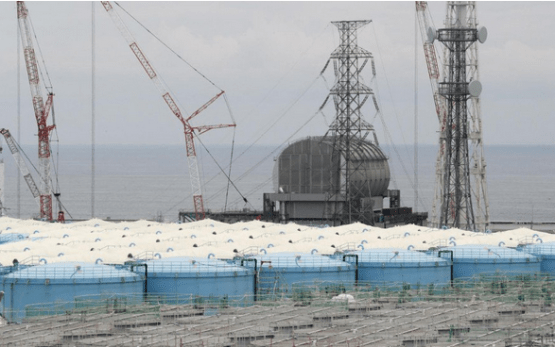
In August, there were around 920,000 tonnes of tritium-containing water stored in some 680 tanks at the plant. But Tepco said it has not checked the concentration of radioactive materials in each tank.
The government has examined several ways to dispose of tritium-containing water, including the release of it into the sea or atmosphere.
Toyoshi Fuketa, who heads the Nuclear Regulation Authority, said pumping the water into the sea is the only solution.
ALPS system at Fukushima No. 1 plant failing to remove more than tritium from toxic cooling water
Aug 19, 2018
The tritium-tainted water piling up at the crippled Fukushima No. 1 nuclear power plant has been found to contain other radioactive substances, defying the defunct plant’s special treatment system, Kyodo News has learned.
The government and Tokyo Electric Power Company Holdings Inc. are under pressure to dispose the treated water, which is accumulating in hundreds of tanks on the premises. One option is to dump it into the sea, as tritium, a normal byproduct of nuclear operations, is said to pose little risk to human health in diluted form.
If the plan goes through, the tritium-tainted water is expected to be diluted so it will likely lower the levels of the other radioactive materials before discharge.
But fishermen and residents are worried about the water discharge plan, and a government panel debating how to deal with it has mainly focused on the tritium rather than the other substances.
According to Tepco, a maximum of 62.2 becquerels per liter of iodine 129, far higher than the 9 becquerel legal limit, was found in the water filtered by the Advanced Liquid Processing System, which was reportedly capable of removing everything but tritium.
Iodine 129 has a half-life of 15.7 million years.
Tepco, which gathered data in fiscal 2017 through March, also detected a maximum 92.5 becquerels of ruthenium 106, shy of the 100 becquerel legal limit, as well as 59 becquerels of technetium 99 against the limit of 1,000 becquerels.
The Fukushima No. 1 complex was damaged by the 2011 earthquake and tsunami. Reactors 1 to 3 suffered fuel meltdowns as their cooling systems were crippled.
Water is injected perpetually to keep the fuel cold but it is extremely toxic. The water is filtered by the ALPS system but removing the tritium remains difficult.
As of August, around 920,000 tons of tritium-containing water are stored in some 680 tanks within the premises. But Tepco said it has not checked the concentration of radioactive materials in each tank.
Toyoshi Fuketa, who heads the Nuclear Regulation Authority, has been calling the ocean discharge plan the “only” solution.
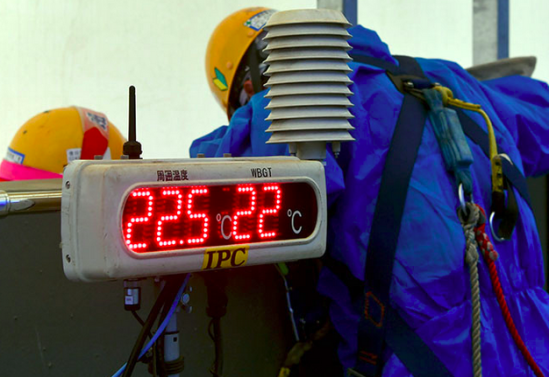
The temperature is about 22.5 degrees around 6 a.m. on Aug. 6 at the Fukushima No. 1 nuclear plant in Okuma, Fukushima Prefecture.
Aug 18, 2018
OKUMA, Fukushima Prefecture–How to avert a heatstroke is more pressing than usual in Japan this summer as the archipelago bakes in a record heat wave.
It’s not just sun-worshipers, children, the elderly and the infirm who should worry.
Spare a thought for the 5,000 or so workers who toil at the crippled Fukushima No. 1 nuclear power plant to get it ready for decommissioning.
They have to work outside in protective gear, with limited access to water and other resources.
At 5 a.m. on Aug. 6, a manager reminded a 20-strong group from IHI Plant Construction Co., which was contracted by Tokyo Electric Power Co., of the importance of adhering strictly to work rules.
“Please limit your efforts to shifts of less than 90 minutes,” the manager told the assembled workers in a lounge at the plant as he checked the complexion of each individual to gauge their health condition.
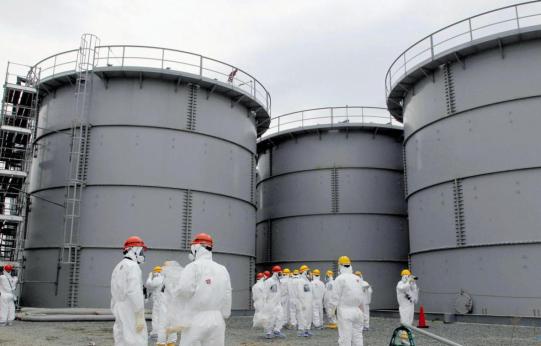
The workers are installing storage tanks for radioactive water that is accumulating at the plant.
They are not permitted to take food and beverages with them because of the risk of internal radiation exposure if the perishables are contaminated while they are working.
Water stations have been set up, but workers generally don’t bother to quench their thirst as it means they have to change out of their work gear to reach the sites.
During the morning meeting, the manager also checked each worker’s alcohol level and made sure that everybody had water from oral rehydration solution. After that, workers put a cold insulator in their vests and headed to the work site.
The Fukushima plant complex has about 900 tanks set up. IHI Plant Construction installed about 20 percent of them.
The workers’ primary responsibility in recent weeks is to inspect the condition of covers put in place to stop rainwater from accumulating around the tanks.
The workers are spared from the scorching sun as they work under cover, but coping with 90 to 95 percent humidity is a formidable challenge.
Junichi Ono, the head of the IHI Plant Construction’s task force assigned to the plant, said his company has tried to take every precaution against heatstroke.
“We need to pay attention because we work in a humid environment,” he said. “If a worker falls sick, we will lose valuable time taking that person to the doctor.”
According to TEPCO, 23 workers suffered heatstroke in the summer of 2011, shortly after the nuclear crisis unfolded at the plant.
Learning a lesson from that, workers were later instructed to start their tasks early in the morning and not work outdoors in principle between 2 p.m. and 5 p.m. in July and August, the hottest part of the day.
The “summer time” schedule appears to be paying off.
In fiscal 2014, the number of workers afflicted with heatstroke at the plant stood at 15.
It dropped to four in fiscal 2016, but went back up to six in fiscal 2017 despite it being a relatively cool summer that year.
Although this year’s heat wave is unprecedented, only four workers have suffered heatstroke at the plant this summer.
The Japan Meteorological Agency forecast blistering summer heat in the coming week after a respite this weekend.
More than 200 Japanese scientists and citizens decleared “A Resolution Against the Ocean Dumping of Radioactive Tritium-contaminated Waste Water From the Fukushima Nuclear Power Plant.”
Please read it and you could take the situations more seriously how dangerous it can be if TEPCO dumps as
planned the tritium-contaminated water from the defunct Fukushima nuclear plant to the Pacific Ocean.
If you could post this document onto your web-pages or blogs and share it with your friends and acquaintances, it would be very helpful to spread the real picture of Fukushima nuclear disaster, that the Japanese government wants to conceal by any nasty means.
Physics Professor Emeritus at Kyoto University, Kosaku Yamada, who led the process to declaring this resolution, hopes that everyone who agrees with this resolution could e-mail him and register as an assenter of it.
With greeting of solidarity,
Etsuji Watanabe
Members of the Association for Citizens and Scientists Concerned about Internal Radiation Exposures (ACSIR) and citizens and scientists who are concerned about internal radiation exposure
It was announced in March, 2014, that in the defunct Fukushima Nuclear Power Plant there was a total of approximately 3,400 trillion becquerels of tritium, with 830 trillion becquerels stored in tanks. This enormous amount of radioactive waste water has still continued to increase since then. In these circumstances, the Japanese government and Tokyo Electric Power Company Ltd. (TEPCO), in their efforts to find an easy way to dispose of the tritium-contaminated waste water created by the Fukushima nuclear disaster, have been trying to dilute and dump it into the ocean. They have been watching for an unguarded moment among the opposition movements, such as fishery cooperatives. Now they are about to finally decide to implement the ocean dumping plan. Far from regulating such activities, Toyoshi Fuketa, the chairman of the Nuclear Regulatory Authority has been championing this plan.
We are determined that the Japanese government and TEPCO shall never dump the radioactive waste water into the ocean for the following reasons:
1. Generally misunderstood as posing little risk to life and health, tritium is an extremely hazardous radioactive material. This is because organisms are not able to chemically distinguish tritium water from the normal water which composes most of the human body. This means that tritium can invade any part of the human body, irradiating it from inside; therefore, tritium can damage cell membranes and mitochondria in cells, indirectly through reactive oxygen species (ROS) and other radicals generated in irradiation. Tritium decay can directly cut chemical bonds of genomes or DNA strands. The risk peculiar to tritium is that if some hydrogen atoms which make up the genomes are replaced with tritium, the beta decay of the tritium into helium will cut off the chemical bonds of the genome.
Plants produce starch from water and carbon dioxide gas by using photosynthesis. Some of hydrogen atoms in this starch can be replaced with tritium, forming organic tritium, which animals, plants and human beings absorb into their bodies over the long term, causing internal radiation.
2. With reference to the tritium released by various nuclear facilities, reports indicate a number of findings including: an increased incidence of leukemia among those living around the Genkai Nuclear Power Plant; an increased incidence of infant leukemia around nuclear reprocessing plants all over the world; and an increased incidence of child cancers around nuclear power plants. Real damage has already occurred.
3. Tritium, even if diluted and dumped into the ocean, will become concentrated again through aspects of the ecosystem such as food chains. Furthermore, tritium will vaporize into tritium-containing moisture or hydrogen gas only to return to the land and eventually circulate within the environment. The idea that dilution ensures safety has caused fatal blunders to be repeated in many environmental pollution cases in the past, the vital factor being the total quantity released into the environment. Therefore, as far as environmental pollution problems are concerned, the only righteous and principled policy is to thoroughly confine and isolate radioactive materials or toxic substances from the ecosystem.
As tritium has a long half-life of 12 years, it destroys the environment over the long term. Tritium is an isotope of hydrogen which constitutes not only most of the living body but also its genes, so tritium disposal via dilution cannot be safe. Thus, we strongly urge the Japanese government and the Nuclear Regulatory Authority never to dump tritium into the ocean.
UN human rights experts have said the workers, most of them migrants, risked “exposure to radiation and coercion.” They have called on Japan to protect the workers cleaning up the damaged nuclear power station.
Tens of thousands of cleanup workers at the damaged Fukushima Daiichi nuclear power station risk exploitation, UN human rights experts said in a statement on Thursday.
The three experts, who report to the UN Human Rights Council, warned that exposure to radiation remained a major risk for workers handling the cleanup of the plant.
“Workers hired to decontaminate Fukushima reportedly include migrant workers, asylum-seekers and people who are homeless,” said the three: Baskut Tuncak, an expert on hazardous substances, Dainius Puras, an expert on health, and Urmila Bhoola, an expert on contemporary slavery.
“We are deeply concerned about possible exploitation. The workers risk exposure to unhealthy levels of radiation not only because they work in places with high radiation but also because they work for longer hours than they should,” Tuncak told DW after the statement was released.
“They are not sufficiently trained, which exposes them to serious health risks. Also, most of them are economically vulnerable, who may not turn down the job despite hazardous working conditions,” he said.
Tuncak added that the team’s observations were based on “repeated and reliable” reports.
TEPCO, the owner of the nuclear power station, which was damaged by a tsunami in 2011, has faced criticism for its treatment of workers involved in the cleanup, which is expected to take decades.
In July, a survey conducted by the Japanese Justice Ministry showed that four construction companies had hired foreign trainees for radioactive decontamination work at the plant.
The survey found that one of the four companies paid only 2,000 yen ($18, €16) per day to the trainees, a fraction of the 6,600 yen provided by the government as a special allowance for decontamination work.
An investigation by Reuters news agency in 2013 also found widespread labor abuses, including workers who said their pay was skimmed.
Japan must act
The UN experts called on Japanese authorities to act urgently to protect the workers.
“The government must conduct greater oversights. In cases of wrongdoing, it must prosecute the wrongdoers to set an example for others,” Tuncak said.
“The government must also allow independent experts to visit Fukushima to review the existing work conditions.”
Tuncak said Japan has not responded to several of his and other experts’ requests to visit the damaged nuclear station.
Japan dismisses UN claims
On Friday, Japan’s Foreign Ministry rejected the UN’s accusations and said the statement could unnecessarily spark worries and confusion, the Kyodo News agency reported.
“It’s regrettable, as the statement is based on one-sided allegations that could exacerbate the suffering of people in the disaster-hit areas,” the ministry said. “We properly handled problematic cases in the past and do not regard
it as a situation which requires any urgent response,” an unnamed official at the Health, Labour and Welfare Ministry told Kyodo.
I think Tepco should better sell diluted contaminated water as souvenirs. Why not If people are enough baka (dumb) to buy it and take it home. It is maybe finally a good solution for Tepco to dispose of all that accumulated radioactive water away from the plant site.
Tepco halts sale of folders with Fukushima nuclear plant pictures
FUKUSHIMA (Kyodo) — The operator of the crippled Fukushima nuclear plant has halted its sale of file folders with photos showing the current conditions of the complex due to public criticism, company sources said Wednesday.
“We received many views, including favorable ones. We will consider whether we can restart their sale (which began Aug. 1),” an official of the operator Tokyo Electric Power Company Holdings Inc. said.
The folders, offered in a set of three for 300 yen ($2.70), have pictures of the Nos. 1-4 units of the Fukushima Daiichi nuclear complex, stricken by the 2011 earthquake and tsunami disaster.
The operator known as Tepco said it sold them at two convenience stores on the premises of the Fukushima complex after people involved in work to scrap the plant asked the company to sell souvenirs. Tepco said it does not make any profit on the folders.
But there have been complaints from people who were offended by the folders.
A Tepco official involved in the folder sale has said, “As there are very few opportunities to show the real situation of the Fukushima complex, we wanted people to become aware of it through these goods.”
In one of the world’s worst nuclear crises, the Fukushima Daiichi plant on the Pacific coast suffered meltdowns at three of its six reactors, spewing radioactive materials in the surrounding environment.
Decontamination and other efforts are under way to enable people who lived near the disaster-stricken plant to return to their hometowns, while Tepco struggles with massive compensation payments and cleanup costs stemming from the disaster.
Tepco halts sales of souvenirs from Fukushima No. 1 nuclear plant following public outcry
A plastic file folder is seen with pictures of Tepco’s Fukushima No. 1 nuclear power plant. The utility halted sales of the folders amid criticism it was looking to profit from the 2011 disaster at the plant.
Aug 9, 2018
Tepco suspended the sale of souvenirs at its crippled Fukushima No. 1 nuclear power plant Wednesday — just eight days after launching the products — following public outcry that it was looking to profit from the 2011 disaster.
Tokyo Electric Power Company Holdings Inc. had been selling plastic file folders imprinted with pictures of the Nos. 1 to 4 units at the crisis-hit plant at two of the facility’s convenience stores since Aug. 1, after receiving requests for memorabilia from visitors and workers.
But the sales by the utility immediately drew criticism with many people posting angry comments on social media. One comment said Tepco was responsible for the disaster and “had no right to profit from” it, adding that the move was “arrogant and showed scant consideration for the disaster victims.” Others said the plant operator should at least donate the proceeds from the sales to local residents and charities.
“We have received a wide variety of opinions over the past week and decided to suspend sales in order to reflect on those views and consider what would be the proper way to handle such merchandise,” Tepco spokeswoman Yuka Matsubara said.
Matsubara also said the utility is unsure if sales would ever resume.
She emphasized the company never intended to take profits from the sales as the ¥300 retail price for a set of three folders was almost the same as the production cost.
“We had learned that visitors and workers had been keeping the receipts they received from the convenience stores at the complex as souvenirs to show their families,” Matsubara said. “To allow visitors a chance to share their experiences and inform everyone that Fukushima is gradually recovering, we made the decision to sell souvenirs.”
After the sales of souvenirs were reported by several news outlets, mixed comments began appearing on Twitter.
A tweet by @mtycskni_ said, “I guess it would be proper to give away such things to the visitors who wish to have them” instead of selling them, while another from @potetohakusyaku asked, “Why don’t visitors buy local products made in Fukushima instead of such goods?”
The Fukushima plant that suffered nuclear meltdowns following the March 2011 earthquake and tsunami disaster is not open to the general public. Only plant workers, decommissioning support staff, media representatives, local politicians and residents are permitted on the grounds as long as they are 18 or older. Last year, 12,500 people visited the complex — up 1,800 from 2016.
Officials have been gradually trying to rebrand the Fukushima nuclear plant, bringing in school groups, diplomats and other visitors
August 3, 2018
Call it an extreme makeover: In Japan’s Fukushima, officials are attempting what might seem impossible, an image overhaul at the site of the worst nuclear meltdown in decades.
At the Fukushima Daiichi nuclear plant, there’s a flashy new administrative building, debris has been moved and covered, and officials tout the “light” radioactive security measures now possible.
“You see people moving around on foot, just in their uniforms. Before that was banned,” an official from the plant’s operator TEPCO says.
“These cherry blossoms bloom in the spring,” he adds, gesturing to nearby foliage.
If it sounds like a hard sell, that might be because the task of rehabilitating the plant’s reputation is justifiably Herculean.
In 2011, a massive earthquake triggered a devastating tsunami that killed thousands and prompted the meltdown of several reactors.
It was the worst nuclear disaster since Chernobyl, and has had devastating psychological and financial effects on the region.
But TEPCO officials have been gradually trying to rebrand the plant, bringing in school groups, diplomats and other visitors, and touting a plan to attract 20,000 people a year by 2020, when Tokyo hosts the Summer Olympics.
Upbeat messaging from Fukushima’s operator TEPCO belies the enormity of the challenge to decommission the plant
Officials point out that protective gear is no longer needed in most of the plant, except for a small area, where some 3,000 to 4,000 workers are still decontaminating the facility.
Since May, visitors have been able to move around near the reactors on foot, rather than only in vehicles, and they can wear “very light equipment,” insists TEPCO spokesman Kenji Abe.
That ensemble includes trousers, long sleeves, a disposable face mask, glasses, gloves, special shoes and two pairs of socks, with the top pair pulled up over the trouser hem to seal the legs underneath.
And of course there’s a geiger counter.
The charm offensive extends beyond the plant, with TEPCO in July resuming television and billboard adverts for the first time since 2011, featuring a rabbit mascot with electrical bolt whiskers called “Tepcon”.
But the upbeat messaging belies the enormity of the task TEPCO faces to decommission the plant.
It has installed an “icewall” that extends deep into the ground around the plant in a bid to prevent groundwater seeping in and becoming decontaminated, or radioactive water from inside flowing out to the sea.
About 100,000 litres of water still seeps into the plant each day, which requires extensive treatment to reduce its radioactivity
But about 100,000 litres (26,400 gallons) of water still seeps into the plant each day, some of which is used for cooling. It requires extensive treatment to reduce its radioactivity.
Once treated, the water is stored in tanks, which have multiplied around the plant as officials wrangle over what to do with the contaminated liquid.
There are already nearly 900 tanks containing a million cubic metres of water—equal to about 400 Olympic swimming pools.
And the last stage of decommissioning involves the unprecedented task of extracting molten nuclear fuel from the reactors.
“There was the Chernobyl accident, but they didn’t remove the debris,” said Katsuyoshi Oyama, who holds the title of TEPCO’s “risk communicator”.
“So for what we have to do here, there is no reference.”
The Fukushima No. 1 Nuclear Power Plant is seen in this file photo taken from a Mainichi Shimbun helicopter on July 17, 2018.
The Nuclear Regulation Authority (NRA) plans to require that highly radioactive waste generated when nuclear reactors are decommissioned be buried underground at least 70 meters deep for about 100,000 years until the waste becomes no longer hazardous.
Moreover, disposal sites for such waste should not be built in areas that could be affected by active faults or volcanoes.
The plan is part of the proposed regulatory standards on disposal sites for radioactive waste from dismantled nuclear reactors, which the NRA approved on Aug. 1. The NRA will hear opinions from power companies operating nuclear plants and other entities before finalizing the regulatory standards.
Low-level radioactive waste generated when reactors are dismantled is graded by three ranks in descending order from L1 to L3.
The proposed regulatory standards cover L1 waste, such as containers for control rods and fuel assemblies.
There have been no regulatory standards for L1 radioactive waste even though a growing number of nuclear reactors are bound to be decommissioned under the regulatory standards for nuclear plants that have been stiffened following the outbreak of the Fukushima nuclear crisis in March 2011.
Under the proposed regulatory standards for L1 waste, electric power companies would be required to build disposal sites on stable ground. Such facilities should not be built near faults at least 5 kilometers in length. Moreover, utilities would be mandated to confirm from records or geological surveys that there has been no volcanic activity over the past 2.6 million years or so near where they plan to build the disposal sites.
Power companies would also be obligated to avoid building disposal sites near oil or mineral deposits because areas with such natural resources may be excavated in the future.
Such radioactive waste must be regularly monitored over a roughly 300- to 400-year period following its disposal to see if the waste contaminates nearby groundwater. The owners of disposal sites would then be banned from digging areas surrounding the facilities without permission from the central government.
The proposed standards also require that additional radiation exposure dosages from disposal sites be limited to 0.3 millisieverts or less a year in accordance with international standards. It is also required to confirm whether radiation doses would be below that limit even if the functions for shielding radiation were partially lost, such as the container holding radioactive waste being broken, by analyzing doses under such scenarios.
Work has begun on the unit 2 refueling floor at Fukushima Daiichi. Previously, TEPCO installed a controlled building on the side of unit 2. This building provides filtered ventilation and a staging area. It will allow workers to send equipment into the reactor building refueling floor. The wall between the two buildings was opened earlier this spring.
After the initial disaster it that unit 2 was creating the most significant radiation releases to the environment. The highest of the three units that melted down. In 2012 an obvious steam leak from the reactor well was discovered via TEPCO images.
TEPCO eventually put a filtration system on the building. This prevented radiation releases to the environment. The future plans for this unit include removing the entire refueling floor level. The roof and walls down to the refueling floor deck are to be removed. Then a new cover building with replacement systems will be installed. Workers are still unable to enter the refueling floor area. High radiation levels prevent human entry. Only robots have entered. TEPCO has not addressed this radiation risk during the demolition and construction phase. Earlier reporting mentioned the planned use of dust suppressants during the demolition work. There is no management plan for potential radiation releases from the reactor well.
TEPCO’s schedule shows they may begin removing equipment from inside unit 2’s refueling floor as early as mid-July. The building demolition and spent fuel removal schedule is still somewhat vague. This is dependent on other work completion.
The inside of the containment vessel of the No. 2 reactor at the Fukushima No. 1 nuclear plant is seen in this frame grab from video provided by the International Research Institute for Nuclear Decommissioning (IRID).
TOKYO — The government and Tokyo Electric Power Co. (TEPCO) are considering starting the removal of molten nuclear fuel from the No. 2 reactor of the Fukushima No. 1 Nuclear Power Plant, people familiar with the matter have told the Mainichi Shimbun.
Three of the four reactors at the plant in the northern Japanese prefecture of Fukushima suffered core meltdowns after the reactors’ cooling systems shut down due to tsunami triggered by the Great East Japan Earthquake of March 2011.
According to the sources, an on-site inspection of molten fuel debris inside the reactor’s containment vessel using remote control equipment will be conducted this fiscal year. Data from the test, such as the hardness of the debris and whether it is movable, will be used to develop equipment to remove and store the highly radioactive materials.
Under the road map for decommissioning the power plant revised in September last year, the government and TEPCO are to decide on a reactor on which to start debris removal and determine how to carry out the procedure by March 2020, the end of next fiscal year. Actual removal is scheduled to begin in 2021.
In January of this year, the government and TEPCO managed to insert a pipe with a camera into the No. 2 reactor’s containment vessel and captured the image of gravel- or clay-like deposits believed to be fuel debris on the floor.
According to the people familiar with the matter, the government and TEPCO have judged that it is necessary to further examine the conditions of the No. 2 reactor as a possible starting point for fuel debris removal, since inspections needed for such an operation have progressed further on the No. 2 unit more than on the other two reactors that suffered core meltdowns in 2011.
The government and TEPCO will carry out the new probe in the fall or later of this year by inserting a camera-equipped pipe attached with a device capable of directly touching the debris, which will gather data on the reactor’s current conditions. The debris is not taken out of the containment vessel at any point of this survey. In the next fiscal year starting April 2019, they will consider examining wider areas inside the containment vessel and recovering a small sample of molten fuel for analysis ahead of full-fledged extraction in 2021.
As for the other reactors, the No. 3 unit has water inside the containment vessel, the removal of which is difficult, although images of what appeared to be fuel debris were captured inside the reactor in July 2017. The No. 1 reactor, meanwhile, will receive another probe to determine the existence of molten fuel inside because an inspection carried out in March last year failed to spot any debris.
TEPCO will shortly submit a plan for the examination of the No. 1 and No. 2 reactors’ interior for fiscal 2019 and later to the Nuclear Regulation Authority.
(Japanese original by Toshiyuki Suzuki and Ei Okada, Science & Environment News Department)
Soon after the disaster workers at the plant discovered that their dosimeters would high radiation alarm then be unable to give a reading when they approached the unit 1-2 shared vent tower. This was an indication that radiation levels near the tower were so high that their dosimeters were unable to accurately read the level. One of the most dangerous places at Fukushima Daiichi may undergo work to reduce the ongoing risk.
One of the two units connected to this vent tower ejected considerable amounts of radioactive materials via the tower during the initial disaster. The area has been declared off limits with shielding walls installed. Closer inspection with cameras and drones showed that the tower had suffered structural damage and was at risk of collapse or further damage. Since then TEPCO and the research agencies tasked with disaster clean up at the site have been working on a plan to dismantle the tower.
The current plan includes a complex series of machines and equipment designed specifically for this task. The work would remove the upper portions of the vent tower then install a cap on the top of the remaining pipe. This is assumed to be used to prevent further release of radioactive materials or inflow of rainwater into the highly radioactive area. The actual demolition work is scheduled for fall of 2018 and could take a year to complete.
The graphic below shows the steps towards cutting down the tower in sections.
TEPCO’s most recent update on the decommissioning work at Fukushima Daiichi included an update on the movement and storage of the spent fuel on site.
Currently dry cask storage only has space for 50 spent fuel casks. According to TEPCO’s documentation 58 fuel assemblies can be placed into each storage cask.
There are currently 13137 spent and unused fuel assemblies on site that require removal to long term storage. This would indicate that 227 casks and storage locations will be needed to handle all of the on site fuel assemblies.
Those 50 cask slots can hold a total of 2930 fuel assemblies. 10207 fuel assemblies remain in need of a long term storage location.
Currently the cask storage has 33 of the 50 cask slots occupied, this leaves space for 17 more casks. TEPCO has not provided any specific plan for adding additional spent fuel storage on site beyond the current 50 cask storage unit.
The common pool on site has been used as a way point for spent fuel before being sent to dry cask storage. It is currently at 93.9% of capacity.
Some of unit 4’s spent fuel was sent to unit 6’s spent fuel pool for storage due to space constraints. Currently unit 4 is the only reactor to have the spent fuel stored there removed to a safer location.
Unit 3 is the next to begin offloading spent fuel. It has 566 assemblies, 148 more than the available room in the common pool. Dry storage has enough space to accept a few more casks from the common pool. Once unit 3 is offloaded, storage will be tight.
Dry cask storage can be used for long term storage but this is not a permanent solution. Most dry casks have a life span of 20 years before the cask gaskets are no longer considered viable. This requires fuel to be moved to permanent storage or the fuel would need to be transferred to a new cask. A fuel transfer can only take place in a spent fuel pool or similar facility to provide the needed shielding and radiation control for the work. Japan currently has no permanent nuclear repository.
This does not include storage of any melted fuel debris from the damaged reactors.
Japanese firms used foreign trainees for Fukushima clean-up
13 July, 2018
Vietnamese in Japan for professional training were among those picking up soil as part of decontamination work at the crippled nuclear power plant
Four Japanese companies made foreign trainees who were in the country to learn professional skills take part in decontamination work after the Fukushima nuclear disaster, the government said on Friday.
The discovery is likely to revive criticism of the Technical Intern Training Programme, which has been accused of placing workers in substandard conditions and jobs that provide few opportunities for learning.
The misconduct was uncovered in a probe by the Justice Ministry conducted after three Vietnamese trainees were found in March to have taken part in clean-up work in Fukushima.
The Vietnamese were supposed to do work using construction machines according to plans submitted by the company.
“But they joined simple clean-up work such as removing soil without machines,” an official said.
A powerful earthquake in March 2011 spawned a huge tsunami that led to meltdowns at the Fukushima nuclear plant, causing the world’s worst such accident since Chernobyl in 1986.
One of the four companies has been slapped with a five-year ban on accepting new foreign trainees as it was found to have paid only 2,000 yen (US$18) per day to the trainees out of the 6,600 yen provided by the state as a special allowance for decontamination work.
The ministry is still investigating how many trainees in the other three firms were involved.
The four companies cited in the interim report no longer send foreign trainees to help with the radiation clean-up. It did not name the four firms.
The ministry has finished its investigation into 182 construction companies that hire foreign trainees, and will look into another 820 firms by the end of September.
Japan has been accepting foreign trainees under the government programme since 1993 and there were just over 250,000 in the country in late 2017.
But critics say the trainees often face poor working conditions including excessive hours and harassment.
The number of foreign trainees who ran away from their employers jumped from 2,005 in 2012 to 7,089 in 2017, according to the ministry’s survey. Many cited low pay as the main reason for running away.
The investigation comes as Japan’s government moves to bring more foreign workers into the country to tackle a labour shortage caused by the country’s ageing, shrinking population.
The government in June said it wanted to create a new visa status to bring in foreign workers, with priority given to those looking for jobs in sectors such as agriculture that have been hardest hit by the labour shortage.
The workers would be able to stay for up to five years, but would not be allowed to bring their family members.
The government put the number of foreign workers in Japan in 2017 at 1.28 million people.
But more than 450,000 of those are foreign spouses of Japanese citizens, ethnic Koreans long settled in Japan, or foreigners of Japanese descent, rather than workers coming to Japan simply for jobs. Another nearly 300,000 are students.
Japan firms used Vietnamese, foreign trainees at Fukushima cleanup
July 14, 2018
Four Japanese companies have been found to made foreign trainees take part in decontamination work after the Fukushima nuclear disaster.
The discovery is likely to revive criticism of the foreign trainee program, which has been accused of placing workers in substandard conditions and jobs that provide few opportunities for learning, the government said Friday.
The misconduct was uncovered in a probe by the Justice Ministry conducted after three Vietnamese trainees, who were in the country to learn professional skills, were found in March to have participated in cleanup work in Fukushima.
The Vietnamese were supposed to do work using construction machines according to plans submitted by the company.
“But they joined simple cleanup work such as removing soil without machines,” an official told AFP.
A powerful earthquake in March 2011 spawned a huge tsunami that led to meltdowns at the Fukushima nuclear plant, causing the world’s worst such accident since Chernobyl in 1986.
The justice ministry said after the discovery this March that decontamination work was not appropriate for foreign trainees.
One of the four companies has been slapped with a five-year ban on accepting new foreign trainees, and the ministry is still investigating how many trainees in the other three firms were involved.
The ministry has finished its investigation into 182 construction companies that hire foreign trainees, and will look into another 820 firms by the end of September.
Japan has been accepting foreign trainees under the government program since 1993 and there were just over 250,000 in the country in late 2017.
But critics say the trainees often face poor work conditions including excessive hours and harassment.
The number of foreign trainees who ran away from their employers jumped from 2,005 in 2012 to 7,089 in 2017, according to the ministry survey. Many cited low pay as the main reason for running away.
The investigation comes as Japan’s government moves to bring more foreign workers into the country to tackle a labor shortage caused by the country’s aging, shrinking population.
The government in June said it wanted to create a new visa status to bring in foreign workers, with priority given to those looking for jobs in sectors such as agriculture that have been hardest hit by the labor shortage.
The workers would be able to stay for up to five years, but would not be allowed to bring their family members.
The government put the number of foreign workers in Japan in 2017 at 1.28 million people.
But more than 450,000 of those are foreign spouses of Japanese citizens, ethnic Koreans long settled in Japan, or foreigners of Japanese descent, rather than workers coming to Japan simply for jobs.Another nearly 300,000 are students.
A robotic probe has found that radiation levels remain too high for humans to work inside one of the reactor buildings at the damaged Fukushima Daiichi nuclear power plant.
Tokyo Electric Power Company, the operator of the plant, plans to relocate 615 units of nuclear fuel from the spent fuel pool, which is located on the top floor of the No. 2 reactor building and is separate from the reactor itself.
TEPCO says the relocation will help reduce risks, including possible damage caused by earthquakes.
The No. 2 reactor underwent a meltdown, but did not experience a hydrogen explosion in the 2011 nuclear accident. The building is likely to still have a high concentration of radioactive materials.
Last month, TEPCO drilled a hole in the wall of the building in order to use a camera-equipped robot to create a detailed map of the radiation on the top floor.
On Monday, workers started the survey and measured radiation levels at 19 points, mainly near the opening. Up to 59 millisieverts were detected per hour.
That’s above workers’ allowable annual exposure of 50 millisieverts and more than half of their 5-year exposure limit. TEPCO has concluded it cannot let humans work inside the building.
TEPCO will use the results to determine specific ways to remove the fuel from the pool. It plans to start the work in fiscal 2023.
The operator of the damaged Fukushima Daiichi nuclear power plant says work to remove spent nuclear fuel from a cooling pool at one of its reactors may be delayed.
A total of 566 fuel units remain in the cooling pool at the No.3 reactor, which suffered a meltdown in 2011. Tokyo Electric Power Company, or TEPCO, planned to start removing the fuel as early as this autumn, as part of the decommissioning of the nuclear complex.
But on Thursday, TEPCO revealed the control board of a crane used in the removal malfunctioned during a test run last month. It blamed a voltage error and said the board will be replaced.
The company said the test run may be delayed by one or 2 months, pushing back the start date for fuel removal.
TEPCO’s chief decommissioning officer, Akira Ono, says he takes the glitch seriously as it shows key equipment was not handled properly.
He says that although safety must come first, his team still aims to stick to the original timetable and start the removal of nuclear fuel by around the middle of the current fiscal year, which ends in March next year.







 nuclear-news