Ken Watanabe to Star in Film About Fukushima Nuclear Disaster
I ‘d like to know who are this movie producers, who are financing it…. Will it be straightforward or will it be just another spinned piece???

November 19, 2018
‘Fukushima 50’ will tell the story of the workers who stayed at the power plant after a massive tsunami had knocked out its cooling systems.
Ken Watanabe will star as the head of the crisis-hit Fukushima Dai-ichi nuclear plant in Fukushima 50, from Japan’s Kadokawa Corporation and directed by Setsuro Wakamatsu.
Watanabe will play Masao Yoshida, the superintendent of the plant who was on duty when it was swamped by a tsunami that followed a massive earthquake in Japan’s northeast on March 11, 2011, knocking out the cooling systems. Yoshida ignored orders by his bosses at Tokyo Electric Power Co. and pumped seawater into the overheating reactors, likely preventing a worse disaster.
The following year, Yoshida was diagnosed with esophageal cancer and died in July 2013 at age 58.
The crewmembers at the plant who stayed on to try and prevent the meltdown of three reactors at the nuclear power station were lauded in the international media as the “Fukushima 50.”
Appearing alongside Watanabe will be veteran actor Koichi Sato, who in his 106th career role will play the shift supervisor at the time of the disaster. The film is based on the book On the Brink: The Inside Story of Fukushima Daiichi by Ryusho Kadota.
“I had promised to Koichi that I would play any role in his next film,” said Watanabe. “However, this was a challenging film to be a part of when the people of Fukushima are still suffering such loss and devastation. My hope is that, along with the wonderful cast and Wakamatsu directing, we will make a film that shows the intensity and bravery of these people that prevented a tragedy of epic proportions.”
Said Wakamatsu: “The Fukushima accident shook not only the people of Japan but also around the world. This film is about the power plant workers on the front line who faced an unprecedented crisis and risked their lives to save their families, their hometown and avert a disaster of global magnitude.”
Shooting on the film is set to begin at the end of November, with a release scheduled for 2020.
https://www.hollywoodreporter.com/news/ken-watanabe-star-is-fukushima-nuclear-disaster-film-1162835?fbclid=IwAR1xjr4TVEoSr2Lkbkne9Eh3TVHf127L80HUME1Ip9J3dRb7DA-y0sPi8Zg
Fukushima Daiichi control room revealed 7 yrs after meltdowns
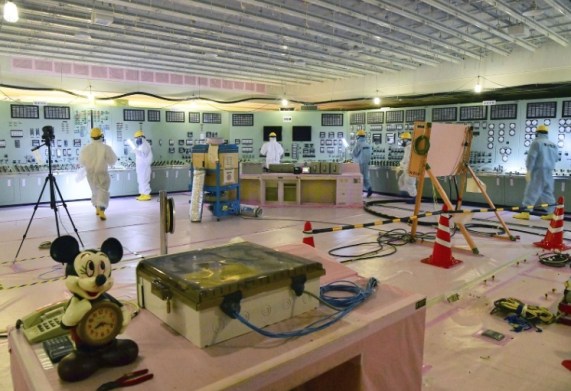 This photo taken on Nov. 15, 2018 shows the inside of the main control room of the Fukushima Daiichi nuclear power plant.
November 19, 2018
FUKUSHIMA (Kyodo) — Time seemed to have stopped inside the main control room for the Fukushima Daiichi nuclear power plant’s crippled Nos. 3 and 4 reactors — that is how Kyodo News reporters felt when they recently became the first journalists to enter the facility since the 2011 nuclear meltdowns there.
The control room’s interior has been left almost untouched since the disaster. Handwriting was found on the wall near an instrument that used to measure the No. 3 reactor’s water levels, showing the urgency faced by some 10 workers there at the time of the crisis.
“We don’t write (on the wall) under a normal situation, so it indicates it was an emergency,” said an official of the plant’s operator, Tokyo Electric Power Company Holdings Inc.
The nuclear crisis was triggered by the magnitude 9.0 earthquake and ensuing tsunami that flooded the facility on the Pacific Coast of Japan on March 11, 2011.
The No. 3 reactor suffered a fuel meltdown and a hydrogen explosion, while the No. 4 reactor, which did not have nuclear fuel inside, also exploded due to a hydrogen inflow from the nearby reactor.
In February 2014, TEPCO showed the media the control room for the Nos. 1 and 2 reactors, which also suffered meltdowns, but had kept the control room for the Nos. 3 and 4 closed due to high levels of radiation in the area.
Radiation levels inside the control room for Nos. 3 and 4, whose floor is now covered by special sheets, was 6 microsieverts per hour, which contrasts with 0.037 microsievert per hour in Tokyo’s Shinjuku Ward on Sunday.
The room, which now has only a few lights, is no longer in use as its functions have been transferred to a quake-resistant building.
Following the crisis, which equaled the severity of the 1986 Chernobyl disaster, some 160,000 people were evacuated and more than 40,000 remained displaced as of late September.
https://mainichi.jp/english/articles/20181119/p2g/00m/0dm/065000c?fbclid=IwAR0KsoEOYkuQbzeAYYhC6TBM5NHDaMpv0fnA8yyvaHtbHLD22CF-hVnQAcA
IAEA Urges TEPCO on Fukushima Daiichi Radioactive Water Disposal
LIES: ‘Treatment of contaminated water can remove all radioactive substances except tritium, which also exists in nature. As things stand, other radioactive substances also remain because the purification process is premised on the water being stored. In the event of this water being released into the ocean, or disposed of in another way, the tritium would of course be diluted and the other substances brought to or below allowable levels by purifying the water again.’
1. Radioactive tritium does not exist in nature.
2. Other radioactive substances remain in the radioactive water because both of their radionuclides removal systems failed to do fully the job.
3. In the event of this radioactive water being released into the ocean those radionuclides would not be “diluted’ but only scattered through the ocean, affecting all marine life and contaminating our food chain.

IAEA’s report sensible on Fukushima N-plant contaminated water disposal
November 18, 2018
An international organization has provided some sensible advice. The government and Tokyo Electric Power Company Holdings Inc. must act quickly to move ahead with decommissioning reactors at the Fukushima No. 1 nuclear power plant.
A review team of the International Atomic Energy Agency has compiled a preliminary summary report that urges a quick decision on the disposal method for the massive volume of water being stored at the power plant. The report warns that storage tanks will reach capacity in three to four years.
Groundwater enters the damaged nuclear plant buildings, where it becomes contaminated by radioactive substances. TEPCO purifies this water and stores it in tanks that stand in vast rows on the nuclear plant’s premises. There is little space available for more tanks.
The IAEA team hit the nail on the head with its concern that getting stuck on this problem could slow down the entire decommissioning process.
The review team came to Japan at the request of the Japanese government. The team is expected to objectively evaluate the current status of the decommissioning process, and to convey information about this situation to the world. The team will soon write a report containing its findings and advice, based on information including that gleaned from a visit to the site.
Given its role is to provide advice, the team’s report did not mention in detail any specific water disposal methods. However, at a press conference, the team’s leader pointed out that releasing such water into the ocean — an option under consideration by the government — is commonly done by many nuclear power facilities.
It also has been made clear that gaining the support of the Fukushima prefectural government and others will be a major precondition for any water disposal option.
Explain clearly to public
All steps need to be taken to keep the negative effects of harmful rumors about radiation to a minimum. The government and TEPCO should painstakingly continue to hold dialogue with local communities.
The review team also recommended how information about the disposal of treated water should be provided to the public.
Treatment of contaminated water can remove all radioactive substances except tritium, which also exists in nature. As things stand, other radioactive substances also remain because the purification process is premised on the water being stored. In the event of this water being released into the ocean, or disposed of in another way, the tritium would of course be diluted and the other substances brought to or below allowable levels by purifying the water again.
Distrust of the government and TEPCO has heightened because this fact has not been well-publicized.
On its website, TEPCO has posted information about the quality of water that has been treated. The review team said TEPCO should work to provide relevant information “in an easy-to-understand manner.”
Technical information delivered without proper explanations also will not be understood among the general public. Ingenuity will be required.
The decommissioning process has shifted from the emergency response immediately after the accident to a more stable situation and a phase in which work should be steadily implemented. The review team expressed awareness of this point, but also showed concern over ongoing problems, such as difficulty in removing fuel from reactor No. 3’s storage pool.
Difficult challenges lie ahead, including removing fuel debris. This will be a long process that takes 40 years. The technology and human resources development called for by the preliminary summary report must not be neglected.
http://the-japan-news.com/news/article/0005357348
IAEA urges quick plan on Fukushima radioactive water cleanup
November 18, 2018
TOKYO (AP) — Experts from the International Atomic Energy Agency urged the operator of Japan’s tsunami-wrecked Fukushima nuclear plant on Tuesday to urgently decide on a plan to dispose of massive amounts of treated but still radioactive water stored in tanks on the compound.
A 13-member IAEA team told reporters in Tokyo after a weeklong review that managing nearly 1 million tons of radioactive water is critical to the plant’s safe and sustainable decommissioning.
The IAEA team said in a preliminary report that hundreds of tanks currently used to store the water over large areas of the plant’s compound can only be a temporary solution and must be removed “urgently.”
The cores of three reactors at the plant suffered meltdowns following a massive 2011 earthquake and tsunami that devastated parts of northeastern Japan.
Radioactive water has leaked from the damaged reactors and mixed with groundwater and rainwater at the plant. The water is treated and stored in large tanks.
More than 7 ½ years since the accident, officials have yet to agree on what to do with the radioactive water. A government-commissioned panel has picked five alternatives, including the controlled release of the water into the Pacific Ocean, which nuclear experts say is the only realistic option. Fishermen and residents, however, strongly oppose the proposal.
That option faced a major setback this summer when the plant’s operator, Tokyo Electric Power Co., acknowledged that the water, which it said had been carefully treated, was not clean enough. It said the water contains cancer-causing cesium and other elements in excess of allowable limits for release into the environment.
The IAEA interim report said TEPCO could run out of space for tanks in a few years, and the water storage adds to safety risks and could hamper the decommissioning of the plant, which is already an unprecedented challenge.
It said the water problem has improved recently because of measures such as an underground frozen wall installed around the reactor buildings to keep the radioactive water from mixing with groundwater. It suggested that TEPCO could further reduce the amount of contaminated water by cutting back on the use of cooling water injected into the reactors because the temperature of the melted fuel has fallen significantly.
IAEA mission leader Christophe Xerri told reporters that it is uncertain whether all of the melted fuel can ever be successfully removed because too little is known about the damage to the cores of the three reactors.
TEPCO and government officials plan to start removing the melted fuel in 2021. Robotic probes inside the reactors have detected traces of damaged fuel but its exact location, contents and other details remain largely unknown.
“If you don’t have the information it’s very difficult to say it’s possible or not” to remove all the fuel, Xerri said.
The team’s final report from its review is expected in late January.
https://www.statesmanjournal.com/story/news/2018/11/18/iaea-urges-quick-plan-fukushima-radioactive-water-cleanup/2049924002/?fbclid=IwAR2YaM-t-dDeHcjfbdttTho4j1t4v-89qz5zrRwSPABOKrUmk1g-Sa-kBlo
Excerpts from Asahi Journalist AOKI Miki’s “Streets Erased from the Map: Post-3.11, the Prohibited Truth”

November 18, 2018
AOKI Miki (青木美希) is a journalist at the Asahi newspaper, one of Japan’s major news companies. Kodansha published her book, Streets Erased from the Map: Post-3.11, the Prohibited Truth(『地図から消される街ー3.11後の「言ってはいけない真実」』), in March 2018. It is the culmination of 7 years of continuous reporting on the 2011 TEPCO nuclear disaster. I have roughly translated and/or summarized some of the stories she documented in this book. (Where she refers to herself in the text, I have translated it as “I”; clarifying annotations/notes are mine).
CHAPTER 1: Local TEPCO Employees Who Can’t Raise Their Voices
Pages 28-39 (summarized):
Before the nuclear disaster, becoming a TEPCO employee was something many people aspired to. People used to say, “For a man to work at TEPCO means lifelong security; women should try to marry a TEPCO employee.” But after the disaster, they were resented. In the evacuation shelters, parents watched as their sons went back to work at Ichi-efu (1F = Fukushima Daiichi nuclear power plant). Before they left, they would write letters conveying their final farewells. I talked to a father who could not tell anyone at the shelter that his child worked at TEPCO.
I spoke to a young TEPCO worker. He was a local hire with a high school degree. He often went to TEPCO’s public relations museum as a kid, hoping he could one day become part of the future it displayed. When the earthquake happened, he wasn’t worried. The Meteorological Agency estimated that the tsunami height would be 3 meters, so he figured it would be about 1 meter, if it came at all. But as he was working in the reactor building, the power went out. Sea water started gushing in in the darkness. He ran up to the central control room, filled with monitors that would normally display live footage from various sectors of the power plant. But since there was no electricity, there was no information. He couldn’t get any of the pumps to move, since there was nothing to power them. So there was nothing to do but wait. That is where he was when the first hydrogen explosion happened. There were no windows in the control room, so he only heard it—an awful noise. The phones were still working, and he learned from a coworker that reactor 1 had exploded, and was thick with smoke.
About 2-3 hours after the explosion, an older employee said at least all the guys in their 20s and 30s should go to the quake-proof building, which is built with thick steel-enforced concrete [i.e., younger workers should evacuate there because the radiation levels are lower]. By then, more people had come in to work, and there were quite a few present who were in their 40s and 50s. So it was decided that all the younger men would evacuate—about 20 to 30 people total. They put on full face masks, light protective gear, and gloves to protect themselves from radioactive contamination, then ran together to the building, 350 meters away. The area was covered in debris, so they couldn’t use any of the cars onsite. They ended up running about 1 km to avoid getting too close to reactors 1 and 2.
Once they got there, he heard that two coworkers who had been sent to reactor 4 were missing. The building they had evacuated to still had power, so they could use the computers. But they still couldn’t do anything. All they could do was wait. They were still there during the explosion at reactor 3 on March 14th. Then the fuel rods in reactor 2 were damaged. The young TEPCO workers evacuated to a gym at the Daini nuclear power plant. They stayed there until the evening of March 16th, and then were told to go home.
After a week, the young worker was told to come back. His father didn’t say anything, but his mother told him not to go. But he told himself, “Who is there but us? This is happening in the town I grew up in. I need to keep the damage to a minimum.”
He did work like helping other workers out of their protective gear and handling the power switches for various machines at the entrance of a reactor building.
When he had been waiting in the quake-proof building, he had learned that two of his coworkers were missing. Someone started a rumor online that they were just enjoying themselves in Koriyama, drinking and joking about having pretended to be victims of the tsunami. Their bodies were found on March 30th, in one of the lower levels. The cause of death was shock from external bleeding from various injuries. Like him, they had been working in reactor 4 as ordered by their superior when the tsunami hit.
Things started to calm down in fall 2011, and he started to worry about the impact of the working conditions from that earlier period. His radiation exposure levels had not been recorded. He had been working without an APD (active personal dosimeter).
Note: It is industry standard for all workers to carry a personal dosimeter with them to record their external radiation exposure levels. According to a study summarized by the Radiation Work Network (Hibaku Rodo Network), the amount recorded can vary significantly even depending on where the dosimeter is kept on the body. It should also be noted that there are frequent reports of various workarounds to manipulate radiation exposure measurements. Though journalistic reports of the Japanese nuclear industry have suggested that conditions improved when records started being digitally displayed instead of being transcribed by hand, personal dosimeter measurements remain one of the things that are made flexible in a work-related pinch. Some workers who go to areas with high radiation levels are not issued APDs; sometimes a veteran worker might take both his and a subordinate’s APD with him to make that worker’s exposure levels seem lower or higher; etc. (In some cases, workers want their exposure levels to seem lower than they actually are to stay under the exposure limit so they can keep working).
At first, this was because nearly all the APDs were lost in the tsunami. Of the 5000 or so APDs that were onsite, only the 320 or so stored in the earthquake-proof building remained. At first, TEPCO said there would be enough to go around if only one representative from each work team used an APD. But even after huge amount of APDs were sent to 1F from other nuclear power plants, TEPCO kept up with this policy. So about 3000 people continued working without APDs.
Radiation levels varied significantly by location (0.03-0.04 millisieverts/hr in the central control room, versus 1 millisievert/hr+ close to the exhaust stacks where the hydrogen explosions had occurred). But the radiation levels for all members of a team were recorded as the same as that of the team leader.
Note: This account actually understates the extreme degree to which radiation levels can vary onsite. There are small hotspots with extremely high radiation levels, whose locations might change with conditions in the plant. One worker remembered being told to stay away from a particular corner. The radiation levels there were 600-some millisieverts/hour. He was shocked, and said, “600 millisieverts, not microsieverts?” To which he received the dry reply, “That’s right, millisieverts. In microsieverts, it would be 600,000 per hour.” The area was not cordoned or marked off in any way. This was a few years after the meltdown. (For reference, average radiation levels in Fukushima prior to the meltdown were 0.05~0.07 microsieverts/hr; the international standard for the general population’s annual exposure limit is 1 millisievert/year).
On March 31st, TEPCO was issued a warning by the Nuclear and Industrial Safety Agency, and subsequently recommenced issuing one APD per person. After that, workers were told that the company would correct its records of their radiation exposure levels. They were asked for details about where they had worked during the first week. But they probably couldn’t do much to correct the numbers, since no one had measurements of the radiation levels in different areas of the site at that time.
The first time they were able to measure their internal radiation levels was in early summer. A bus drove a simplified whole body counter (WBC) to Iwaki city, and measurements were taken. But the data was not shared with the workers. They were told it could not be share with them because it was “personal information.”
After repeatedly asking for it, the young worker finally got his data. He found his internal exposure level had been recorded at 50 millisieverts (mSv). Combined with his external exposure of 30 mSv, he had been exposed to a total of 80 mSv. When he thought about the standards for occupational illness recognition, he became afraid. It’s 5 mSv for leukemia; 25 mSv for a malignant lymph tumor; 50 mSv for multiple myeloma; 100 mSv for stomach cancer or esophageal cancer… He wanted to get married down the road and have kids… What if he got cancer 20 years later?
Note: Radioactive particles cycle through the body at different speeds according to their chemical properties. For example, Cesium-137 and Cesium-134 generally remain in the body for about one month. Additionally, much of the radiation emitted during the early stages of a nuclear meltdown comes from radioactive isotopes with short half-lives. A WBC is unable to measure the amount of radiation that was emitted by particles that already cycled out of someone’s body, nor can it measure the amount of radiation that had been emitted by particles that have already ceased to emit radiation. Consequently, even the figure of 50 mSv is an underestimation of his total internal dose from the nuclear meltdown.
<<Rough translations start here>>
He asked to be transferred, but his superior refused, telling him, “You haven’t gotten to 100 mSv yet. I’ll let out people with high exposure levels first.”
He thought about quitting. His mother encouraged him as well. But, he thought to himself, the reality is that about half of the hires at TEPCO are local people. If we don’t go, who will? Not to mention, all of my neighbors, relatives, and classmates know that I work at TEPCO. If I quit, maybe they will reproach me, asking “Why did you quit?”
It wasn’t just this young worker who thought that way. Many people kept their mouths shut, tortured with worry. Running away was scary; continuing to work was scary.
Every time he left for work, he felt like there was no place for him to run. Some people became depressed a few weeks after the disaster. At first, people were working thinking, “What can you do,” but now that it was fall, he felt like he was becoming depressed…
The young TEPCO worker wondered to himself, as one member of a worksite that tasked itself with providing “the safe energy of the future,” why had things turned out like this for him?
The company created something this dangerous in their pursuit of profit. They ignored the opinions of experts. Why didn’t they implement measures so that even if a tsunami came, they could continue to cool the reactors using the emergency power generators?
There had been times when the president of TEPCO and senior directors came to the site.
“Thank you.”—That’s what they would say. Even though he heard them, he could not feel that he was being thanked for his labor. They were not saying, “I’m sorry that we caused you this hardship,” or “Hang in there.” They said it as though it was entirely someone else’s affair, and he felt the insurmountable distance between conditions on the ground and company headquarters in Tokyo.
Residents of Fukushima often said, “Move your headquarters to Naraha town (where the nuclear power plant is), don’t leave it in the top-class district of Shimbashi [in Tokyo].” Even as a TEPCO local hire, he could understand their feelings.
He feels that people view the circumstances of those like him who are at Fukushima Daiichi nuclear power plant like, “This is where we are; what else is there to do?” But he wants others to know that it’s not that everyone is resting on their laurels. At the very least, he did all he could in the midst of that terror.
His dad said, “It’s the people on the ground that lose.” That’s exactly how it is.
The young TEPCO worker’s request to be transferred was granted after more than a year had passed. But, he was told it was for a “limited time,” and after a few years he was issued another appointment, and returned to Fukushima.
Pages 40-43:
The Reality That 26% of Men in Their 50s Are Without Work
People chose many paths in the life they lived with TEPCO. There were people who stayed at Fukushima Daiichi nuclear power plant, and there were people who left, seeking a different path. But there are also people who can’t go forward, who can’t help being fixed to one spot. Men in their 50s, who have trouble finding new employment.
A man in in his 50s who had done electricity-related work at Fukushima Daiichi nuclear power plant was speaking at an evacuation center in Iwaki city, his face red: “I’m never going back to 1F (Fukushima Daiichi nuclear power plant).” There was an open one-cup sake can next to him. A man I spoke to in Saitama was also saying, “I didn’t know it was so dangerous.” He was also about 50 years old. But, if they left their jobs, there was no way they were going to find work.
Though not limited to TEPCO-related workers, Fukushima University conducted a survey of the residents of the municipalities of Futaba County, which surround the nuclear power plant, in February to March 2017. There were 10,081 respondents. 31%, the largest percentage, responded that they had “little hope” for their future work or lives. 19% responded that they had “absolutely no hope.” 26% of those in their 50s reported being without work.
Note: She says “TEPCO-related” because the nuclear industry is composed of multiple layers of subcontractors. Power companies contract work out to monolith “zenekon,” or general contractors, like Mitsubishi, Hitachi, Toshiba, and so on. These companies then parcel out jobs to a vast array of subcontractors, who then further distribute the work through their own networks. There have been reports of at most 7 or even 12 layers of subcontractors, though a local expert noted that it would probably be impossible for the lowest-level subcontracting company to break even if the reports of 7+ layers were true.
Many people who worked at the nuclear power plant lived in Naraha town, on the southern side of Fukushima Daiichi nuclear power plant.
A man who was 48 years old at the time of the disaster, who ran a subcontracting company in Naraha town and worked as a site foreman, went to work in Fukushima Daiichi nuclear power plant right after the accident in March 2011.
The site was wrecked. It completely overturned his sense that nuclear power plants are safe.
He was called to Fukushima Daiichi again in April of that year, but after that he thought, “I don’t want to see that wrecked nuclear power plant anymore,” and went to Saitama prefecture, where his wife and children had evacuated.
In September 2015, Naraha town’s evacuation orders were lifted. Shortly thereafter, he returned to his hometown. He renovated his house, and, wanting his family to return, he left a cumulative dosimeter in the house to measure its radiation levels. After one year, it read 0.1 mSv. He explained to his wife, “The radiation levels aren’t that high. I know because I’ve worked at the nuclear power plant.”
“I don’t want to be close to the nuclear power plant.”
That was his wife’s reply.
While displaced, the man developed diabetes, and in May 2016, he was diagnosed with depression. Since, he has been seeing a psychotherapist.
When I heard his story in April 2017, he was 54 years old. With white hair and a tired face, he looked far older than his fifty years.
His eldest son and eldest daughter are both in their 20s and working. His wife and children already bought a house in Saitama. Before, he would drive two hours and forty minutes one way to be with his family in Saitama. But before he realized it, his visits became rare, and he said he could not remember the last time he went.
Their life over there must be better now…
He wanted to be with his family. He is lonely and sad. He started to drink. Whenever he has time, he drinks. When he drinks, he feels a little better. When he gets sober, he starts to feel sad again. So he drinks again. If he drinks, he gets sleepy. It’s more of a “win” to fall asleep drinking.
But even so, he has fitful sleep, and at the very least he wakes up twice during the night. It’s a cruel cycle.
About 2 months after the national government lifted Naraha town’s evacuation orders, the returnee rate was at the 4% mark. Even later, it did not rise much, and the town stopped publishing statistics with the 11.1% it recorded in March 2017. Instead, it now publishes “town resident percentages,” which include new residents such as new nuclear power plant workers and recovery construction workers.
In the last available statistics on returnees, published in March 2017, 65% were in their 60s or older, and 5% were minors.
In the former site foreman’s neighborhood, only elderly people in their 60s to 80s have returned. He is the youngest in his block. He said to me, “I don’t know what is going to happen at the nuclear power plant so I think I’m going to quit. I want to work a normal job and die normally. It’s not like I can find new work now – what should I do? Right now, we get 160,000 yen per month as compensation, but TEPCO is saying it will stop paying. Are they telling us to die?”
His son was a nuclear worker, too. Their pride in their work, their life with their families, and their health was broken… They don’t have the energy to get back on their feet anymore.
Nuclear Pollution in the East China Sea from the Fukushima Disaster

November 5, 2018
Abstract
Nuclear pollution has become a new form and perhaps more harmful type of pollution that obsesses coastal regions; it has been of increasing concern after the disastrous Fukushima nuclear leak on March 11, 2011. In order to assess the impact of the Fukushima accident on the East China Sea (ECS), a highly resolved model is set up to simulate the evolution of the 137Cs concentration. Different from previous studies in this regard, here we take into account the radionuclides originally existing in the ocean. It is found that the radionuclides from the Fukushima leak do have reached ECS, though with a concentration far below the harmful level. The major waterways that inlet the radionuclides are Taiwan Strait and the waterway east of Taiwan. The radioactive material tends to accumulate in the ECS until reaching its peak in 2019; afterward, the outflux through Tokara Strait and Tsushima exceeds the influx through the two southern waterways, and the material resumes in 2021 to its original state. The concentration is neither homogeneously nor stationarily distributed; for example, usually in summer, there is a high center over the Subei Bank in the Yellow Sea. This study is expected, should a similar accident happen again, to help decide where to monitor the ocean, and, hopefully, how to get the pollution under control.
Read more at:
https://www.intechopen.com/books/coastal-environment-disaster-and-infrastructure-a-case-study-of-china-s-coastline/nuclear-pollution-in-the-east-china-sea-from-the-fukushima-disaster
IAEA urges Japan to reach decision soon on handling of radioactive water at crippled Fukushima nuke plant
 The growing number of tanks storing radioactive water at the Fukushima No. 1 plant can be seen in February.
November 14, 2018
The growing number of tanks storing radioactive water at the Fukushima No. 1 plant can be seen in February.
A team of nuclear experts from the International Atomic Energy Agency urged Japan this week to reach a decision quickly on what to do with treated water that contains low toxicity radioactive tritium, which is accumulating at the crippled Fukushima No. 1 nuclear plant.
“We advised the Japanese government that … (a) decision should be taken very rapidly for the disposition path for water which is stored in these tanks,” said Christophe Xerri, leader of the 13-member team, on Tuesday following a nine-day review of progress on scrapping the Fukushima No. 1 plant.
The facility was damaged in the March 2011 earthquake and tsunami.
“There is space limitation, so some solution has to be decided and implemented,” Xerri said, adding that the volume of treated water containing tritium in tanks is expected to reach the planned capacity within the “coming three to four years.”
As of last Thursday around 970,000 tons of tritium-containing water was stored on the premises of the plant, according to Tokyo Electric Power Company Holdings Inc.
The government has studied options for the tritium-containing water, including releasing it into the sea, as it is regarded as not harmful to humans.
The tainted water has been stored in tanks after being produced as a byproduct of cooling the plant’s reactors, which suffered core meltdowns following the 2011 disaster.
But local fishermen and residents have expressed concern about discharging the water, fearing the potential impact on food.
“Controlled discharge to the sea is something which is applied in many nuclear facilities, so it’s not something which is new,” Xerri said.
“Our review was not to advise the Japanese government on one solution or another one,” he added.
“It is up to the Japanese government to decide — in engaging with stakeholders, of course — on the option Japan wants to implement,” he said.
Toyoshi Fuketa, who heads the Nuclear Regulation Authority, has described discharging the water into the sea as the “only” solution.
Tepco has been running the Advanced Liquid Processing System, said to be capable of removing almost all radioactive materials from the toxic water except tritium.
It was the fourth such review conducted by a team of experts from the Vienna-based agency, following two in 2013 and one in 2015.
The IAEA will issue its final report by the end of January 2019.
Xerri said his team was impressed by the progress that has been made at the plant since the previous review, including the full operation of a frozen soil wall around the reactors that has reduced the volume of groundwater that enters the reactor buildings.
But he acknowledged many challenges in the decommissioning process, which is set to take “30 to 40 years or even more,” including the removal of melted fuel from the reactors — seen as the hardest part.
When asked about the possibility of discarding the fuel — the location and volume of which remaining within the reactors is yet to be grasped due to high levels of radiation — Xerri said, “We don’t have enough information to tell you yes or no.”
https://www.japantimes.co.jp/news/2018/11/14/national/iaea-urges-japan-make-decision-treated-radioactive-water-crippled-fukushima-nuke-plant/?fbclid=IwAR10h4F1walNk1hOujMjrwNbnuqm7xhkl4Ri91mmLZ6pk-igVMa-TYXvOdE#.W-2FBPZFzIW
Tepco to temporarily stop injecting water at Fukushima reactor

November 9, 2018
Tepco to temporarily stop injecting water at Fukushima reactor
The operator of the Fukushima Daiichi nuclear power plant plans to temporarily stop injecting water into one of its damaged reactors to test the cooling of fuel debris.
Tokyo Electric Power Company announced it will conduct the 7-hour test at the No.2 reactor as early as March next year.
The unit is one of 3 in the 6-reactor facility that suffered a meltdown after the March 2011 earthquake and tsunami. The damaged reactors contain a mixture of molten nuclear fuel and structural parts.
TEPCO officials say water injections keep temperatures stable in the 3 reactors at around 30 degrees Celsius.
The planned experiment is aimed at checking how the debris is being cooled. It will be the first time to halt water injections into the reactor since they were stabilized after the accident.
TEPCO’s assessment says the reactor temperature would rise by around 5 degrees per hour if injections were halted by accident. But it says the rise will be limited to about 0.2 degrees per hour when natural heat radiation is taken into account.
TEPCO officials say they will begin cutting back on water injections by around half to 1.5 tons per hour for about a week as early as in January, before halting them completely in March after checking the results.
TEPCO estimates the 7-hour stoppage may raise the reactor temperature by about 1.4 degrees but says water injections will resume if the temperature rises more than 15 degrees.
Company officials say they want to assess changes in the temperature so they can use the data in future emergency cases, including earthquakes and tsunamis.
https://www3.nhk.or.jp/nhkworld/en/news/20181109_10/
Radioactive water threatens Fukushima fishery’s fragile gains

November 4, 2018
Plant operator plans to dump contaminated water into the ocean
TOKYO — Since a catastrophic nuclear accident seven years ago, Fukushima fishermen have made painstaking efforts to rebuild their livelihood, assiduously testing the radioactivity levels of their catches to ensure safety. Now, rapidly accumulating wastewater from the crippled power plant is again threatening this hard-won business recovery.
Faced with the prospect that there will be no more space to store tanks containing radioactive water leaking from the Fukushima Daiichi nuclear power plant, operator Tokyo Electric Power Co. Holdings and the Japanese government are considering diluting the water and dumping it into the ocean.
Even though Fukushima’s fishery has been recovering, the haul throughout the entire prefecture amounted to about 3,300 tons last year, just 10% of the average prior to the 2011 disaster. And even reaching there has not been easy.
Fish markets in the prefecture now house testing rooms filled with equipment. Staff members mince seafood caught every morning to screen for radioactivity. Such painstaking efforts gradually enabled fishermen to return to the sea, with all fishing and farming operations resuming in February this year.
But the trend could reverse if the government goes through with plans to release nuclear wastewater into the sea.
Tepco has been cooling down the molten fuel cores by pumping water into the ruined reactors. The tainted water is later taken out and treated, but the system in place does not filter out tritium, a radioactive hydrogen isotope.
The tritium-laced water is currently stored in tanks within the premises of Fukushima Daiichi, but space is due to run out within five years.
Tritium occurs naturally and is present in rainwater in the atmosphere. The chemical is not known to accumulate within living things, and it is assumed that it can be safely released in the ocean if properly diluted. Nuclear plants in France and elsewhere normally empty treated tritium wastewater into the sea.
Resolving the wastewater issue is a key step in achieving a sustainable fishing revival in Fukushima, according to Shuji Okuda, an official in charge of decommissioning and wastewater management at the Ministry of Economy, Trade and Industry’s Agency for Natural Resources and Energy.
“I understand that we should cooperate for revival,” one Fukushima fisher said.
“But I’m afraid of the damage to our reputation,” this fisher said. “I don’t want them to dump anything into the ocean.”
The waters off the coast of Fukushima teem with about 200 species of fish and shellfish, such as flounder, saury and surf clam.
Despite such abundant marine resources, demand for Fukushima seafood has yet to fully recover. At Tokyo’s Toyosu market, wholesale prices for fish caught in the prefecture sell for about 30% cheaper than product from neighboring areas, according to a major wholesaler. Some distributors do not stock up on the prefecture’s seafood for fear of driving away customers.
Before the nuclear accident, fishing boats from other prefectures would visit Fukushima harbors. Now, “they have all but vanished,” said a representative at the Fukushima Prefectural Federation of Fisheries Co-operative Associations.
Japan’s trading partners are slowly normalizing restrictions on Fukushima exports — Russia lifted its remaining ban in March. But despite the scientific verification of safety, many localities still block Fukushima marine products.
In turn, domestic lobbying groups are resisting plans to discharge nuclear wastewater into the ocean — at least not until there is consensus at home and abroad that the practice is safe. “As a national representative of fishers, we oppose it,” said JF Zengyoren, the nationwide federation of fishing cooperatives.
“The reputational risk is still at hand,” said Tetsuji Suzuki, managing director at the Fukushima Prefectural Federation of Fisheries Co-operative Associations.
“Revival should come after disaster recovery,” Suzuki said.
https://asia.nikkei.com/Economy/Radioactive-water-threatens-Fukushima-fishery-s-fragile-gains
So who will foot the bill if another nuclear disaster strikes Japan?

Ex-TEPCO Executive Downplays Role in Fukushima Nuclear Meltdown

Tsunami Couldn’t Have Been Foreseen, Says Fukushima Plant Operator’s Ex-Chaiman

Tepco apologizes over inappropriate hashtag for image of crippled Fukushima plant

Draft bill omits state burden for nuclear accident compensation

France presents vitrification process for Fukushima

Putting tsunami countermeasures on hold at Fukushima nuke plant ‘natural’: ex-TEPCO VP


1 This Month

of the week – Shut Down Drone Warfare!


Tell the Ukrainian Government to Drop Prosecution of Peace Activist Yurii Sheliazhenko

Petition to revoke the licensing of the Near Surface Nuclear Disposal Facility (NSDF) at Chalk River. https://www.ourcommons.ca/petitions/en/Petition/Details?Petition=e-7247
To see nuclear-related stories in greater depth and intensity – go to https://nuclearinformation.wordpress.com
-
Archives
- April 2026 (91)
- March 2026 (251)
- February 2026 (268)
- January 2026 (308)
- December 2025 (358)
- November 2025 (359)
- October 2025 (376)
- September 2025 (257)
- August 2025 (319)
- July 2025 (230)
- June 2025 (348)
- May 2025 (261)
-
Categories
- 1
- 1 NUCLEAR ISSUES
- business and costs
- climate change
- culture and arts
- ENERGY
- environment
- health
- history
- indigenous issues
- Legal
- marketing of nuclear
- media
- opposition to nuclear
- PERSONAL STORIES
- politics
- politics international
- Religion and ethics
- safety
- secrets,lies and civil liberties
- spinbuster
- technology
- Uranium
- wastes
- weapons and war
- Women
- 2 WORLD
- ACTION
- AFRICA
- Atrocities
- AUSTRALIA
- Christina's notes
- Christina's themes
- culture and arts
- Events
- Fuk 2022
- Fuk 2023
- Fukushima 2017
- Fukushima 2018
- fukushima 2019
- Fukushima 2020
- Fukushima 2021
- general
- global warming
- Humour (God we need it)
- Nuclear
- RARE EARTHS
- Reference
- resources – print
- Resources -audiovicual
- Weekly Newsletter
- World
- World Nuclear
- YouTube
-
RSS
Entries RSS
Comments RSS
 nuclear-news