TEPCO simulates release of Fukushima wastewater

April 6, 2020
Tokyo Electric Power Company has made public a simulation showing the flow of radioactive wastewater released into the ocean from the damaged Fukushima Daiichi nuclear plant. TEPCO says winds and tides will spread the wastewater in an elongated shape along the coastline.
The Japanese government has been looking into ways to dispose of the roughly 1.2 million tons of wastewater accumulated at the plant, which contains approximately 860 trillion becquerels of tritium.
TEPCO’s simulation estimated the area of ocean that would contain more than 1 becquerel of radioactive materials per liter.
The simulation shows that when water containing 100 trillion becquerels of radioactive materials is released each year, the area would be 2 kilometers offshore from the plant and stretch 30 kilometers from north to south.
When wastewater with 22 trillion becquerels of radioactive materials is released per year, it would spread 700 meters from shore and stretch 3 kilometers from north to south.
A government panel said in a report released in February that releasing diluted radioactive water into the sea or air are realistic options. The head of the International Atomic Energy Agency expressed some understanding for the plan. But the proposal drew opposition from local fishermen and others.
TEPCO has yet to show its simulation of wastewater released into the air.
IAEA supports discharge of Fukushima Daiichi water
Yes it is technically feasible but also totally unsafe for our health and our living environment!!!
03 April 2020
A review of the management of treated water stored at the damaged Fukushima Daiichi nuclear power plant in Japan has been carried out by the International Atomic Energy Agency (IAEA). It says the two options under consideration for disposing of this water – discharge into the sea and via vapour release – are both technically feasible.
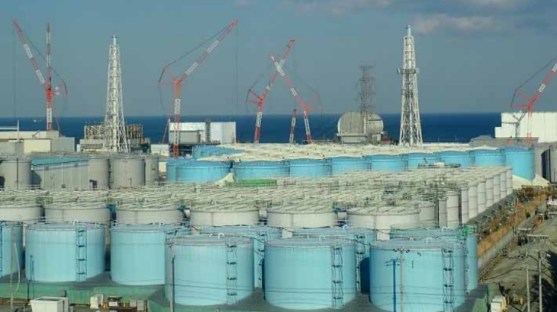 Tanks of treated water at the Fukushima Daiichi site
At the Fukushima Daiichi site, contaminated water is treated by the Advanced Liquid Processing System (ALPS), which removes most of the radioactive contamination, with the exception of tritium. This treated water is currently stored on site. As of 12 March, some 1.19 million cubic metres of treated water are stored within 979 tanks on the plant site. The total tank storage capacity will amount to approximately 1.37 million cubic metres by the end of 2020 and all the tanks are expected to be full around the summer of 2022.
The Japanese government had requested an IAEA review of the management of the stored water, including of the report by the Subcommittee on Handling ALPS Treated Water issued on 10 February.
In a review published yesterday, the IAEA said the two options for controlled disposal outlined by the advisory subcommittee – vapour release and discharges to the sea – were both technically feasible. These methods, it noted, are routinely used by operating nuclear power plants worldwide under specific regulatory authorisations based on safety and environmental impact assessments. The IAEA experts said the subcommittee’s recommendations to the Japanese government were based on “a comprehensive and scientifically sound analysis addressing the necessary technical, non-technical and safety aspects”.
The IAEA team said water management, including the treated water disposal, was “critical to the sustainability of the Fukushima Daiichi decommissioning activities”. Reiterating advice from an IAEA decommissioning review mission to the plant in 2018, the experts said a decision on the disposition path for the stored treated water – after further treatment as needed – should be taken urgently, considering safety aspects and engaging all stakeholders. “Once the Government of Japan has decided on its preferred disposition option, the IAEA is ready to work with Japan to provide radiation safety assistance before, during and after the disposition,” it said.
“The safe and effective implementation of the disposition of ALPS treated water is a unique and complex case,” said team leader Christophe Xerri, director of the IAEA’s Division of Nuclear Fuel Cycle and Waste Technology. “Solutions are available. They will require sustained attention, safety reviews, regulatory supervision, a comprehensive monitoring programme supported by a robust communication plan, and proper engagement with all stakeholders.”
https://www.world-nuclear-news.org/Articles/IAEA-supports-discharge-of-Fukushima-Daiichi-water
Protective gear shortage hits Fukushima workers
April 2, 2020
The shortage of protective gear caused by the coronavirus pandemic has hit the workers at the meltdown-hit Fukushima No. 1 nuclear power plant, where they’ve needed them daily for years to guard against radiation.
Shipments temporarily stopped coming in, although an alternative supplier was later found, according to Tokyo Electric Power Co., the utility that runs the Fukushima plant. The 4,000 workers at the plant cannot always practice social distancing as they must come close to each other to carry out cleanup work, spokesman Joji Hara said Thursday.
To reduce the possibility of infection, workers have been forbidden from riding on public transportation, such as trains, and must either drive to work or take the special company buses. When eating at the cafeteria, they can’t sit facing each other, and their temperatures are checked daily, he said.
“We are involved in decommissioning work that can’t ever stop and so we are taking every precaution we can,” said Hara.
The workers with special skills, who would be hard to replace, have reduced contact with people to minimize risks of infection. There is no lockdown in Japan and so all such efforts outside work are voluntary.
In March 2011, a tsunami swallowed the plant and sent three reactors into meltdowns, causing the worst nuclear disaster since Chernobyl. The reactors must be chilled constantly, producing tons of contaminated water every day.
http://www.asahi.com/ajw/articles/13266255
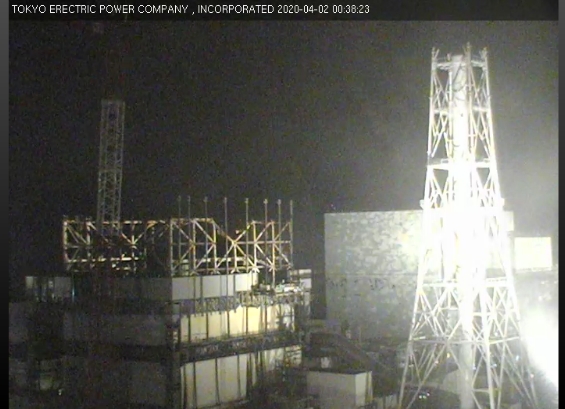
Fukushima Daiichi Live Camera
New problem at Fukushima site; sandbags found to be radioactive
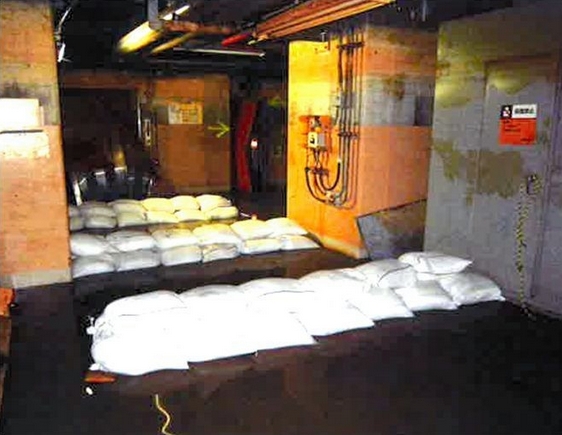 Sandbags sunk in the basement of a high-temperature incinerator building at the Fukushima No. 1 nuclear power plant shortly after the 2011 nuclear crisis flared
March 31, 2020
Sandbags placed as an emergency measure to lower radiation levels of contaminated water in the aftermath of the 2011 nuclear disaster now turn out to be so highly radioactive they pose an obstacle to the decommissioning of the stricken Fukushima No. 1 nuclear power plant.
A recent survey showed that the materials are in such a hazardous state that plant operator Tokyo Electric Power Co. is having to postpone its program to discharge the contaminated water.
“The sandbags should be removed, but that will not be so simple,” said an official of the Nuclear Regulation Authority.
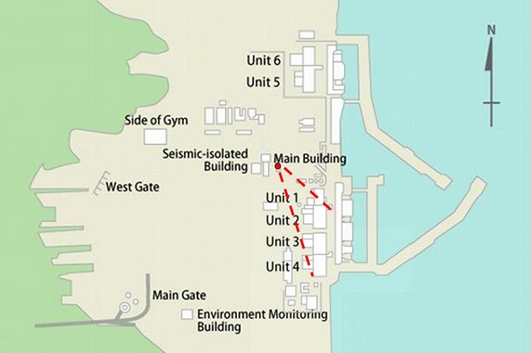
TEPCO is struggling to find ways to safely remove 26 tons of sandbags in the basements of two buildings near the No. 1 to No. 3 reactors, where a triple meltdown occurred. They were packed with a mineral called zeolite to absorb radioactive cesium.
They are emitting radiation levels of up to 3 to 4 sieverts per hour, which would kill half of the people exposed to the high reading for an entire hour.
Soon after the nuclear crisis began to unfold, TEPCO used the two buildings as substitutes for tanks to temporarily store a huge volume of heavily contaminated water produced on the plant site.
In doing so, the zeolite-packed sandbags were installed on the floors of the buildings’ basements to absorb radioactive substances in the water.
Interest in the sunken sandbags waned as the years passed, but the issue surfaced again in December 2018 when TEPCO measured radiation levels in the two buildings’ basements in preparation for removing radioactive water there.
Significantly high radiation levels were detected just above the floors.
A zeolite sample collected from the sandbags recorded a cesium concentration of about 130 million becquerels per gram.
TEPCO has been forced to delay the water removal procedure at the two buildings to fiscal 2023 or later. It initially planned to finish the process by 2020. If it doesn’t have countermeasures in place when the water is released, the highly radioactive sandbags will be exposed to air.
TEPCO is now weighing ways to safely dispose of the contaminated materials. One idea is to suck up the zeolite from floors above ground and store it in other receptacles, and the other is to pack the material in different containers in water for temporary storage.
But officials acknowledge that those measures will not eliminate all safety risks.
TEPCO puts cost to remove melted nuclear fuel at over 1 trillion yen
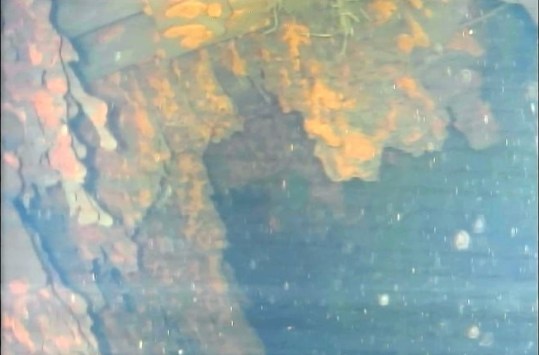 A video image shows what appears to be melted nuclear fuel within the No. 3 reactor at the Fukushima No. 1 nuclear power plant.
March 31, 2020
Tokyo Electric Power Co. estimates that 1.37 trillion yen ($12.6 billion) will be needed over 12 years to remove melted nuclear fuel from reactors at the crippled Fukushima No. 1 nuclear power plant.
TEPCO’s announcement on March 30 covers only two of the three reactors that suffered meltdowns triggered by the 2011 Great East Japan Earthquake and tsunami.
No estimate was attempted for the cost to prepare for the removal of melted nuclear fuel from the No. 1 reactor. The situation at that reactor is the most difficult among the three reactors, and TEPCO officials are still struggling to come up with a plan for removing the debris from within.
The estimate covers the period between fiscal 2020 and fiscal 2031. Of that amount, 350 billion yen will be applied as a special loss to the company’s balance statement for the fiscal year ending March 31, 2020.
The utility had already released its plan for decommissioning the three reactors, which foresaw a start to removing melted nuclear fuel from the No. 2 reactor before the end of 2021, while removal would begin for the No. 3 reactor by 2031.
In announcing its expected profits for the current fiscal year, TEPCO also outlined its estimated expenses for melted fuel removal over the next 12 years.
A total of 330 billion would be needed as preparatory measures, such as further examining the interior of the No. 2 reactor and decontaminating radiation from the area around the three reactors.
Another 20 billion yen is expected to be spent for trial removal of melted nuclear fuel from the No. 2 reactor, while 1.02 trillion yen would be required to construct the facilities needed to remove the melted fuel from the No. 2 and No. 3 reactors.
The construction cost would be written off as a special loss from TEPCO’s balance statement in the fiscal year when the work takes place.
TEPCO forecasts a net profit of 79 billion yen for the current fiscal year, a decrease of 66 percent from fiscal 2019. Sales are expected to decrease by 2.2 percent to 6.199 trillion yen.
http://www.asahi.com/ajw/articles/13259804
South Korea Expresses Concern About New Fukushima Water Release Plan
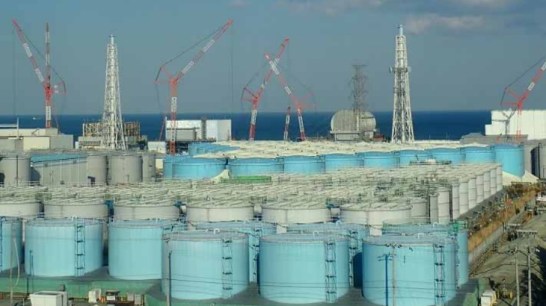
30 Mar 2020 – 08:15 by OOSKAnews Correspondent
SEOUL, South Korea
South Korea has expressed concern about a new draft plan from Japan to release contaminated Fukushima water from its disabled Fukushima nuclear power plant into the sea.
The country’s Office for Government Policy Coordination said March 26 that Japan should ensure that its plan does not affect the health and safety of South Koreans or the maritime ecosystem, while the Ministry of Oceans and Fisheries said that it “cannot support the Japanese government discharging contaminated water from the Fukushima Daiichi Nuclear Power Plant in the sea without discussions with neighbouring countries”.
South Korea’s latest protest came two days after the Tokyo Electric Power Company (TEPCO) issued a more detailed draft plan to release the contaminated water over 30 years.
Currently, treated, but still radioactive water, is accumulating at about 170 tons per day and is being treated to remove most contaminants, following the earthquake and tsunami in March 2011.
TEPCO reports that currently there is 1.19 million cubic meters of contaminated water in storage on site. The concentration of tritium, which cannot be completely removed, is about 730,000 Bq/litre, or a total of 16 grams. Quantities of treated water are increasing constantly and storage capacity is expected to run out in 2021.
The utility’s report discusses the treatment and disposal methods, which have been developed by outside experts, as being “practical options, both of which have precedents in current practice…the radiation impact of both the discharge into the sea and vapor release is notably small, compared to natural radiation exposure,” saying that the government of Japan, not TEPCO, will make the final decision as to release.
The tritium concentration will be lowered as much as possible under the plan: “For vapor release: TEPCO will study dilution of tritium at a rate equivalent to that for discharge into the sea, as against the regulatory concentration limit of tritium in the atmosphere (5 Bq in 1 liter air)…For discharge into the sea: TEPCO will study dilution rates of tritium with reference to operational standards for “groundwater bypass” and “subdrains” (1,500 Bq in 1 liter water), which are well below the regulatory concentration limit for tritium in seawater (60,000 Bq in 1 liter water).” This is against WHO drinking water guideline (10,000 Bq in 1 liter water)”
If any abnormality is detected, the disposal process will stopped under the draft plan. Monitoring will be enhanced by [an] increase in sampling points and frequency; information will be published promptly.
The report is described as being aimed at the general public and other stakeholders who plan to participate in government-organised “opinion hearings”.
TEPCO plans to take 30 years to release Fukushima nuke plant water into sea or air
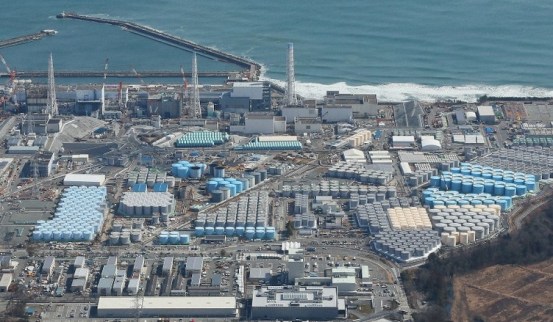 Tanks holding treated radioactively contaminated water are seen on the premises of the tsunami-ravaged Fukushima Daiichi Nuclear Power Station in Okuma, Fukushima Prefecture, in this file photo taken from a Mainichi Shimbun helicopter on March 3, 2017
March 25, 2020
TOKYO — Tokyo Electric Power Company Holdings Inc. (TEPCO) is planning to take about 30 years to release treated radioactively contaminated water accumulating at its crippled Fukushima nuclear plant into the sea or air if the government chooses that option.
According to a draft plan, TEPCO will complete the disposal of radioactively contaminated water at its Fukushima Daiichi Nuclear Power Station, which was hit by the 2011 Great East Japan Earthquake and tsunami, sometime between 2041 and 2051. By that time, the government plans to end work to decommission the plant.
If the state decides to release the water into the sea, TEPCO will aim to lower the density of radioactive tritium to around one-fortieth the upper limit set by the government at 60,000 becquerels per liter, while lowering the levels of other radioactive substances as much as possible. The World Health Organization sets the upper limit of radioactive tritium in water for human consumption at 10,000 becquerels per liter. Tritium cannot be removed from contaminated water even if an advanced liquid processing system (ALPS) is used to treat the water.
TEPCO will pay compensation if the release of such water gives rise to harmful rumors and causes damage to local industries.
If the government chooses to release treated water into the atmosphere, TEPCO will also strive to lower the levels of tritium well below the upper limit set by the government.
The government’s subcommittee comprising experts released a report this past February proposing to release radioactively contaminated water at the Fukushima nuclear plant into either the sea or air. The report then emphasizes the advantages of the plan to release the water into the sea.
Junichi Matsumoto, head of TEPCO’s division promoting the decommissioning of the crippled power plant, said the utility remains undecided over the way to dispose of the treated water.
While agreeing that releasing the water into the sea is a better option, Matsumoto said “it’s not true that we can’t technically explore the possibility” of releasing the water into the air.
“We haven’t decided whether to release the water into the sea or atmosphere,” he added.
Tanks on the premises of the nuclear complex are currently holding some 1.19 million metric tons of treated radioactively contaminated water. Since the water contains not only tritium but also other radioactive substances, TEPCO has indicated a plan to begin in the business year of 2020 to conduct experiments using an ALPS and other devices to lower the levels of radioactive substances in treated water.
The government is scheduled to hold hearings to listen to opinions from local communities about the disposal of radioactively contaminated water at the plant, starting in the city of Fukushima on April 6. While explaining the subcommittee’s report and TEPCO’s draft plan in these meetings, the government will make a final decision on the disposal method.
Tepco to pursue its radioactive water sea release plan
Tepco to pursue its radioactive water sea release plan and “Tepco also plans to use social media to counter rumors that exposure to radiation from the released water is harmful.”
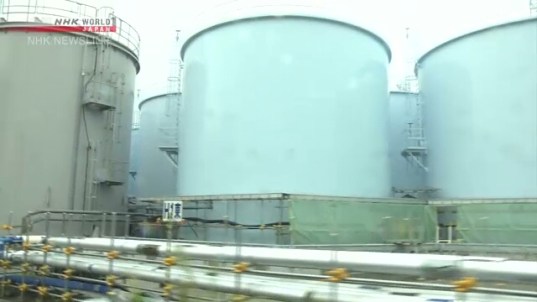
Plan to dispose of Fukushima wastewater drafted
March 24, 2020
NHK has learned that Tokyo Electric Power Company, or TEPCO, has drafted a plan for disposing of radioactive wastewater stored at the troubled Fukushima Daiichi nuclear power plant.
Water used to cool molten nuclear fuel from the 2011 accident is treated to remove most radioactive material. But tritium and other substances remain in the water, a huge amount of which is stored in about 1,000 large tanks.
A government panel last month compiled a report that says releasing diluted radioactive wastewater into the sea or air are realistic options.
TEPCO’s plan for doing so would involve diluting the wastewater with seawater, aiming for a tritium level of one-fortieth that allowed by national regulation.
The firm would gradually release the diluted water over about 30 years, taking into consideration the amount of similar water released at other nuclear plants.
TEPCO would also test treating the wastewater again to further remove other radioactive materials.
The utility is to explain the plan to local officials and residents in Fukushima Prefecture. People in the local fishery and tourism industries oppose releasing the water into the ocean.
https://www3.nhk.or.jp/nhkworld/en/news/20200324_42/
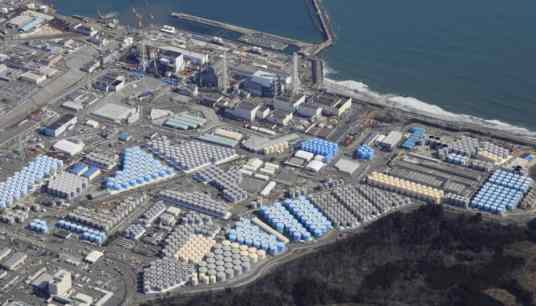 Tanks storing contaminated water at the Fukushima No. 1 nuclear power plant in February
Tepco may take 30 years to release Fukushima No. 1 radioactive water
March 25, 2020
Tokyo Electric Power Company Holdings Inc. said Tuesday it may spend up to 20 to 30 years releasing contaminated water into the surrounding environment from its disaster-crippled Fukushima No. 1 nuclear power plant.
The possible time span was mentioned in draft plans Tepco drew up in line with a government panel’s report in February, calling the release of the water into the ocean or the air in the form of vapor a “realistic option.”
The company currently stores roughly 119 tons of water that still contains tritium and other radioactive substances after passing through a treatment process at the nuclear plant, which suffered a triple meltdown in March 2011 caused by a magnitude 9.0 earthquake and tsunami. The amount of contaminated water stored at the facility is still increasing.
According to the draft plans, Tepco will first conduct secondary treatment work to reduce the amount of radioactive substances in the water other than tritium — which cannot be removed by existing systems — to levels below national standards.
Following the treatment, the water will be released into the ocean, after being diluted with seawater to lower the radiation level to 1,500 becquerels per liter, or emitted into the air from a tall exhaust stack after being vaporized.
Tepco also plans to use social media to counter rumors that exposure to radiation from the released water is harmful.
27
Dramatizing the reality of a nuclear meltdown
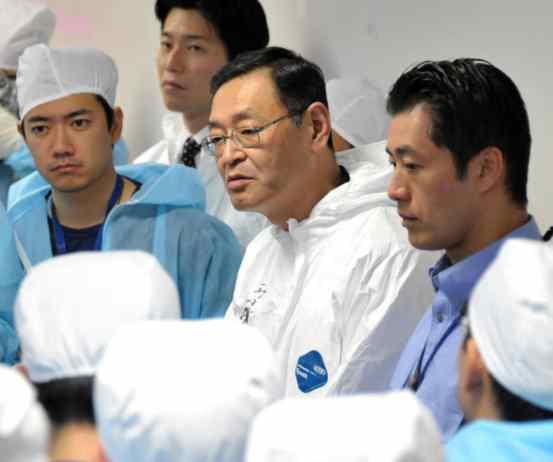 We can be heroes: “Fukushima 50” offers a dramatic account of real-life on-site manager Masao yoshida (pictured here with reporters in 2011) and his team as they fought to prevent the crippled nuclear plant from melting down in the wake of the Great East Japan Earthquake and tsunami.
March 21, 2020
As with many feature films based on real-life incidents, “Fukushima 50,” which opened nationwide March 6 and depicts the actions of the men who struggled to contain the disaster at the Fukushima No. 1 nuclear power plant following the Great East Japan Earthquake of March 2011, is a blend of factual exposition and dramatic enhancement. Stories require conflict to keep them interesting, usually with a hero fighting an adversary. In “Fukushima 50,” the hero is plant manager Masao Yoshida (Ken Watanabe), who makes life-and-death decisions in resistance against higher-ups rendered as incompetents.
One of these “villains,” as pointed out by writer and editor Yusuke Nakagawa in the March 6 online edition of Gendai Business, is Naoto Kan, who was the prime minister at the time of the disaster. In the movie, Kan’s name is never uttered and, as Nakagawa points out, the actor who plays him, Shiro Sano, doesn’t look like him, but that’s not what concerns Nakagawa. Sano portrays Kan as a puddle of hysteria whose decisions threaten lives because they make Yoshida’s job more difficult. Kan has an infamous temper and Nakagawa acknowledges that he made mistakes during the course of the emergency, but the movie fails to detail the reasons for his actions. Turning him into a babbling fool makes the filmmakers’ job easier, which is to show Yoshida as a towering figure of courage and resourcefulness in the face of a crisis that could have ended in the destruction of eastern Japan.
Nakagawa admits to having a horse in this race, as he helped Kan write his own account of what went down at the Prime Minister’s Office during those fateful days, and he concurs with the conclusion that Yoshida and the men who worked at the plant are heroes and that Yoshida’s employer, Tokyo Electric Power Company Holdings Inc. (Tepco), was the main problem. However, he can’t help but think that the film’s pillorying of Kan was due to more than dramatic license. There was something political about it. Kan has since become a pariah to many people. As much as any other matter, it was Kan’s handling of the Fukushima disaster that led to the destruction of his party. The Democratic Party of Japan no longer exists.
Nevertheless, Kan has no problem with the portrayal, according to the film’s director, Setsuro Wakamatsu, who said so during a news conference at the Foreign Correspondents’ Club of Japan following a press screening of “Fukushima 50” on March 4. Kan’s magnanimity is noble, perhaps, but it should be noted that he has his own film to promote, or, at least, a film that shows him in a more sympathetic light. “The Seal of the Sun,” originally released in 2016, had a much smaller budget than “Fukushima 50” and no marquee stars. It looks at the disaster from the vantage point of the Prime Minister’s Office, focusing on Tepco’s lack of cooperation with the government, and while it doesn’t contradict the Yoshida hero narrative, it does complicate it with points that “Fukushima 50” downplays or doesn’t even bring up.
Kan has made himself available to discuss those points at public screenings of “The Seal of the Sun.” Such local events aren’t going to counteract the message of “Fukushima 50,” and they aren’t meant to, but the narrative distinctions do show how uneven the coverage of the Fukushima disaster has been. The most glaring example of this unevenness is a 2014 story by the Asahi Shimbun’s special investigative team based on an interview that Yoshida gave to the government. The report undermined the Fukushima hero narrative by saying that 90 percent of the plant workers fled the facility in fear for their lives. The Asahi Shimbun management, already smarting from other recent scandals, eventually retracted the piece after receiving complaints saying the article implied the workers were cowards, effectively ending the special investigative team in the process. Ryusho Kadota, the journalist who wrote the book that was the basis for the “Fukushima 50” script, wrote another book refuting the Asahi Shimbun’s coverage, though, as former New York Times Tokyo bureau chief Martin Fackler points out in an article he wrote for the Asia-Pacific Journal, there was nothing essentially untrue in the Asahi Shimbun story. In fact, Tepco admitted that about 650 workers had fled, but said many were not regular company employees. The legendary “Fukushima 50” (in reality, they numbered 69), a term coined by foreign media, remained at the plant.
The argument about what really happened isn’t over facts. It’s over how those facts are interpreted. In “Fukushima 50,” Kan’s desperation is presented as a danger to the country. In “The Seal of the Sun,” it shows how hard he is trying to grasp the actual situation on the ground. Before the Yoshida report in 2014, the Asahi Shimbun’s editorial slant was generally critical of nuclear power. Afterward, it became neutral.
Nakagawa thinks these differences are politically influenced. Almost all of Japan’s nuclear power capacity has been off-line since the Fukushima incident, a situation the present government wants to reverse but finds difficult to do because of public resistance. In that sense, the story of the men who saved Japan from nuclear catastrophe can be exploited by both sides. Anti-nuclear forces say it proves how dangerous nuclear power is, while pro-nuclear forces say that it shows how Japanese ingenuity and dedication prevails.
However, even that distinction is subject to dispute. Retired Fukui District Court Chief Justice Hideaki Higuchi was one of the few judges to find in favor of plaintiffs suing to stop resumption of nuclear power plants. Higuchi reached these decisions after carefully studying the Fukushima No. 1 disaster and concluding that it was averted as much by serendipity as by Yoshida’s and the Fukushima 50’s bravery. These “miracles,” which had to do with the availability of cooling water and quake-related damage to the reactor housing, have been openly discussed, but they aren’t emphasized as much because it takes something away from the hero tale. As a judge, Higuchi had to pay closer attention to all the facts than a feature film script writer does.
Japan’s 3/11 Recovery Stalled by Fukushima Decommissioning Delays

March 13, 2020
Delays in dismantling the disaster-stricken nuclear power complex cast doubt on whether recovery goals will move forward according to schedule.
Nine years after a quake-triggered tsunami sparked a triple meltdown at Fukushima Daiichi nuclear power plant, decontamination and decommissioning continues in northeastern Japan. The ultimate goal of removing all debris is expected to take anywhere between 30 to 40 years, but progress has been slower than originally planned. So far just one-fourth of decommission work has been completed, drawing attention to work that has not yet begun.
The Fukushima decommissioning and decontamination draft has been amended five times. While changes published in December offered a specific time frame for the first time, the latest timetable for debris removal has been pushed back five years, citing the need for additional safety precautions. Previously, the process of removing spent fuel was scheduled from 2021 to 2024. But work on reactor two looks more likely to start in 2025 and last until 2027, followed by reactor one work commencing sometime between March 2028 and March 2029.
The powerful tsunami, which reached over 40 meters in some areas, took the lives of 22,167 people. At the same time, the loss of power to the entire Fukushima Daiichi plant caused reactors one, two, and three to overheat, sparking hydrogen explosions and the release of radioactive contaminants. This forced 160,000 survivors to evacuate. Despite evacuation orders being lifted in some of the “difficult to return” areas, many still opt to stay away from their homes nine years later.
The next decommissioning stage sets out the removal of 4,471 spent fuel rods inside the cooling pools of reactors one to six. But the biggest obstacle is finding a way to locate and remove the molten nuclear fuel. With frequent delays, evacuees face a constant sense of uncertainty, tangled in a waiting game to see whether decommissioning work can be completed in 30 years.
Reactor two is seen as the safest and easiest option to start full-scale debris removal since it suffered the least structural damage with only “some fuel” melting through the pressure vessel and accumulating at the bottom of the containment vessel. But with no established method for debris retrieval, attempts to survey the location and distribution of molten nuclear fuel among the rubble requires a lengthy trial and error process. In mid-February 2019 an attempt to probe and collect samples from reactor two failed to find and lift the main nuclear fuel debris, instead lifting portions of pebble-like sediment with the lowest radiation readings from the surface. At this stage there is no way for TEPCO, the company that owns the Fukushima Daiichi plant, to determine where fuel debris lies among the rest of the metal debris. It’s estimated that reactor two alone contains 237 metric tons of debris while reactors one and three contain a combined 880 tons. The complexity of debris removal requires developing specialized technology that does not yet exist.
Also plaguing decommissioning efforts is the battle over how to safely dispose of 1 million tons of contaminated water that were used to cool nuclear fuel. Currently, huge tanks on the premises store the polluted runoff, which could fill 400 Olympic swimming pools, but space is expected to run out by mid-2022.
On average 170 tons of contaminated water is produced to cool fuel in nuclear reactors. Without constant cooling, nuclear fuel risks melting from its own heat in a process called decay heat. With two years needed to prepare a disposal method, time is running out for a final decision.
Government proposals to slowly release contaminated water into the ocean has sparked fierce backlash from locals and the agriculture and fishing industries, who argue traces of radioactive materials such as tritium still found in “treated” water could further harm a region still struggling to restore its international reputation.
Last month, International Atomic Energy Agency (IAEA) Chief Rafael Mariano Grossi visited the Fukushima nuclear power plant where he commended the government’s “dual approach” of decommissioning the plant while revitalizing the local community. Grossi said the IAEA could help provide reassurance to the public that Japan’s plan to release treated water into the ocean meets international standards.
To make matters worse, decommissioning operations have been temporarily suspended due to the spread of coronavirus. Tepco was forced to cancel on-site inspections of reactor one scheduled during March, which would have brought together some 1,800 experts and members of parliament, as well as local residents and student groups.
https://thediplomat.com/2020/03/japans-3-11-recovery-stalled-by-fukushima-decommissioning-delays/
‘Fukushima’s radioactive water discharge is important to Koreans’
 Greenpeace nuclear campaigner Shaun Burnie in front of the Fukushima Daiichi nuclear plant, five years after the accident. The environmental organization has launched an underwater investigation into the marine impacts of radioactive contamination on the Pacific Ocean resulting from the 2011 nuclear disaster,
By Bahk Eun-ji
March 13, 2020
Shaun Burnie, a senior nuclear specialist at Greenpeace Germany, has been working in Fukushima since 1997 to stop the operation of the Fukushima Daiichi Nuclear Power Plant, with much of his time based in Japan.
Among a number of nuclear experts around the world who have been condemning the Japanese government’s plan to discharge radioactive water from the destroyed Fukushima power plant into the Pacific Ocean, Burnie claims this issue is clearly important to Koreans as they understand the risks of nuclear energy and care about the environment.
“Fukushima is a defining issue of this time as it continues to pose a threat to the environment not just of Japan but the Asia Pacific region. This is a nuclear disaster with no end and Koreans realize that only by speaking up and opposing bad decisions can the progress be made in protecting our environment,” he said.
The nuclear expert said the opposition in Korea to the Japanese government’s plan to discharge contaminated water from Fukushima is entirely justified and essential, so the opposition should continue here in Korea. At the same time, Koreans also should be supporting the local Japanese communities who are opposed to the discharges.
Burnie also said the discharges of the contaminated water are a direct threat to the marine ecosystem and human health as all radioactivity has the potential to cause harm as technically there is no safe level of exposure. The discharges are more than tritium, which can cause damage to human and non-human DNA, but also many other radionuclides such as strontium that, even if processing of the contaminated water is successful, will still be discharged in enormous quantities.
“None of this can be justified from an environmental perspective when there is a clear alternative ― long term storage and processing to remove radionuclides, including tritium.”
The Japanese government has sought for many years to deny that there are radiation risks in Fukushima, which is a central part of their strategy to support nuclear power. By creating the illusion that Fukushima has recovered from the 2011 disaster, the Japanese government think they can convince people to support the restarting of nuclear reactors although the majority of Japanese people are against it.
“It is one reason why the human rights of tens of thousands of Fukushima citizens, including women and children, as well as tens of thousands of workers are violated consistently by the Japanese government,” he said.
https://www.koreatimes.co.kr/www/nation/2020/03/371_286064.html
Fukushima cleanup struggle focuses on what to do with contaminated water
Fukushima disaster shook the world, one of the biggest impediments to cleaning up the site in Northeastern Japan is coming from an unexpected source: The water.
 A waterlogged radiation and tsunami warning sign found on Fukushima beaches in 2013
March 13, 2020
Nine years after the Fukushima disaster shook the world, one of the biggest impediments to cleaning up the site in Northeastern Japan is coming from an unexpected source: The water.
That water, specifically 1.2 million tons of it, is still radioactive. Stored in 1,000 special tanks on the site of the nuclear power plant’s ruins, it’s taking up needed space – which the Japanese government plans to free up by dumping it into the sea.
But local residents, especially fishermen are opposed to that plan, telling touring reporters on the nine-year anniversary of the disaster that the water release would further damage the already battered reputation of fisheries – where sales remain at only half of what they were before the catastrophe.
Under discussion are two possible ways of disposing of Fukushima’s contaminated water. According to a government report released earlier this year, one possibility is that technicians could dilute the water to levels below the allowable safety limits, and then release it into the sea in a controlled way. The other is to allow the water to evaporate over the course of several years.
The dilemma over what do with the water is part of the complicated aftermath of the 9.0 magnitude earthquake and subsequent tsunami that hit on March 11, 2011. A wall of water destroyed cooling capabilities at the Fukushima nuclear plant and three of its six nuclear reactors melted down, forcing the evacuation of 160,000 people.
In the days that followed the quake, the Fukushima-Daiichi plant was rocked by hydrogen explosions, which burst through the roofs of the three afflicted reactors, sending radioactive iodine, cesium and other fission by-products belching into the environment. Millions of liters of water were pumped from the ocean to cool the overheating reactors, cascading contamination into the sea.
 A clock stopped at the time the tsunami gushed in from the sea found in the destruction of a beach community in Fukushima.
Ever since then, the name of Fukushima has become synonymous with Chernobyl – the world’s other most notorious nuclear disaster – in connoting catastrophe, contamination and mass human evacuation.
Officials with Tokyo Electrical Power Co, or Tepco, say that the excess water they have collected must be disposed of so they can build facilities they need to begin the retrieval of radioactive debris within the reactors.
That wreckage is slated for removal by December 2021. Remote control cranes are being used to dismantle the cooling tower of the No 2 reactor, the first from which molten nuclear fuel was removed. Spent nuclear fuel stored in a pool at the No 3 reactor is being removed ahead of attempts to remove that reactor’s melted down fuel.
As the Associated Press reported, most above ground areas at the Fukushima plant can now be visited with minimal protective gear and a Geiger counter. The radioactive remains of the reactor buildings are, however, still off limits.
But areas underground beneath the plant remain extremely hazardous. Radioactive cooling water is leaking from the melted-down reactors and mixing with groundwater. The groundwater then must be pumped out to keep it from leaking into the sea. Other contaminated water – some of which was initially sprayed and dumped on the reactors while they were melting down – sit in other underground locations, leaking continuously into groundwater outside the plant.
Tepco has attempted to remove most radionuclides — like cesium and strontium – from the excess water, but the technology does not exist to cleanse it of tritium, a radioactive isotope of hydrogen. Coastal nuclear plants commonly dump water that contains tritium, which occurs naturally in nature, and Japanese officials insist it is harmless when ingested in small quantities.
But many are not pleased with Tepco’s assurances. Katsumi Shozugawa, a radiology expert at the University of Tokyo who has studied Fukushima’s groundwater, told the AP that long term, low-level radiation exposure in the food chain is poorly understood.
“At this point, it is difficult to predict a risk,” he told AP. “Once the water is released into the environment, it will be very difficult to follow up and monitor its movement. So the accuracy of the data before any release is crucial and must be verified.”
Fukushima: How the ocean became a dumping ground for radioactive waste
The nuclear disaster at Fukushima sent an unprecedented amount of radiation into the Pacific. But, before then, atomic bomb tests and radioactive waste were contaminating the sea — the effects are still being felt today.
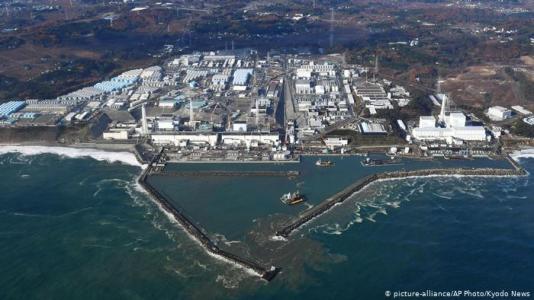
March 11, 2020
Almost 1.2 million liters (320,000 gallons) of radioactive water from the Fukushima nuclear power plant is to be released into the ocean. That’s on the recommendation of the government’s advisory panel some nine years after the nuclear disaster on Japan’s east coast. The contaminated water has since been used to cool the destroyed reactor blocks to prevent further nuclear meltdowns. It is currently being stored in large tanks, but those are expected to be full by 2022.
Exactly how the water should be dealt with has become highly controversial in Japan, not least because the nuclear disaster caused extreme contamination off the coast of Fukushima. At the time, radioactive water flowed “directly into the sea, in quantities we have never seen before in the marine world,” Sabine Charmasson from the French Institute for Radiological Protection and Nuclear Safety (IRSN) tells DW.
Radiation levels in the sea off Fukushima were millions of times higher than the government’s limit of 100 becquerels. And still today, radioactive substances can be detected off the coast of Japan and in other parts of the Pacific. They’ve even been measured in very small quantities off the US west coast in concentrations “well below the harmful levels set by the World Health Organization,” according to Vincent Rossi, an oceanographer at France’s Mediterranean Institute of Oceanography (MIO).
 The contaminated water in these storage tanks at Fukushima could be released into the sea as of 2022
 People observing a minute of silence for the victims of the 2011 earthquake and tsunami
But that doesn’t mean there’s no risk, says Horst Hamm of the Nuclear Free Future Foundation. “A single becquerel that gets into our body is enough to damage a cell that will eventually become a cancer cell,” he says.
A study from the European Parliament reached a similar conclusion. The research found that “even the smallest possible dose, a photon passing through a cell nucleus, carries a cancer risk. Although this risk is extremely small, it is still a risk.”
And that risk is growing. Radioactive pollution in the ocean has been increasing globally — and not just since the disaster at Fukushima.
Atomic bomb tests
In 1946, the US became the first country to test an atomic bomb in a marine area, in the Pacific Bikini Atoll. Over the next few decades, more than 250 further nuclear weapons tests were carried out on the high seas. Most of them (193) were conducted by France in French Polynesia, and by the US (42), primarily in the Marshall Islands and the Central Pacific.

But the ocean wasn’t just being used as a training ground for nuclear war. Until the early 1990s, it was also a gigantic dump for radioactive waste from nuclear power plants.
From 1946 to 1993, more than 200,000 tons of waste, some of it highly radioactive, was dumped in the world’s oceans, mainly in metal drums, according to the International Atomic Energy Agency (IAEA). Several nuclear submarines, including nuclear ammunition, were also sunk during this time.
Is the ocean a perfect storage site?
The lion’s share of dumped nuclear waste came from Britain and the Soviet Union, figures from the IAEA show. By 1991, the US had dropped more than 90,000 barrels and at least 190,000 cubic meters of radioactive waste in the North Atlantic and Pacific. Other countries including Belgium, France, Switzerland and the Netherlands also disposed of tons of radioactive waste in the North Atlantic in the 1960s, 70s and 80s.
“Under the motto, ‘out of sight, out of mind,’ the dumping of nuclear waste was the easiest way to get rid of it,” says Horst Hamm.
To this day, around 90% of the radiation in the ocean comes from barrels discarded in the North Atlantic, most of which lie north of Russia or off the coast of Western Europe.
“The barrels are everywhere,” says ecologist Yannick Rousselet of Greenpeace France. He was present in 2000 when the environmental organization used submarines to dive for dumped drums a few hundred meters off the coast of northern France, at a depth of 60 meters (196 feet).
“We were surprised how close they were to the coast,” Rousselet says. “They are rusty and leaking, with the radiation clearly elevated.”
 The radioactive pollution of the oceans began in 1946 when the US tested a nuclear bomb at Bikini Atoll Micronesia.
 Nuclear waste barrels dumped in the sea decades ago, a common practice in the Channel between France and England in the 1960s, are now rusty and are leaking radioactive substances
Germany also implicated
In 1967, Germany also dumped 480 barrels off the coast of Portugal, according to the IAEA. Responding to a 2012 request for information from the Greens about the condition of those barrels, the German government wrote: “The barrels were not designed to ensure the permanent containment of radionuclides on the sea floor. Therefore, it must be assumed that they are at least partially no longer intact.”
Germany and France don’t want to salvage the barrels. And even Greenpeace activist Yannick Rousselet says he sees “no safe way to lift the rusted barrels” to the surface. That means nuclear waste will likely continue to contaminate the ocean floor for decades to come.
For Horst Hamm, the long-term consequences are clear. The radiation will be “absorbed by the marine animals surrounding it. They will eventually end up caught in fishing nets, and come back to our plates,” he says.
In its 2012 response to the Greens, however, the German government described the risk to humans from contaminated fish as “negligible.”
Rousselet sees things differently: “The entire area along the coast is contaminated by radiation — not just in the sea, in the grass, in the sand, you can measure it everywhere.”
 The reprocess in plant in La Hague is still discharging radioactive water into the sea. Cancer rates have increased in the region, according to a report by the European Parliament
Radioactive dumping ground
The main reason behind the radiation along the northern French coastline isn’t the underwater barrels, but rather the nuclear fuel reprocessing plant at La Hague. It is located directly on the coast and “legally discharges 33 million liters of radioactive liquid into the sea each year,” says Rousselet. He thinks it’s scandalous.
In recent years, La Hague has also been the scene of several incidents involving increased radioactivity levels.
The dumping of nuclear waste in drums was banned in 1993 by the London Convention on the Prevention of Marine Pollution. But discharging liquid contaminated with radiation into the ocean is still permitted internationally.
Spike in cancer rates
According to a study by the European Parliament, statistics show cancer rates are significantly higher in the region surrounding La Hague. Cancer rates are also high near the nuclear processing plant in Sellafield in northern England. A study from 2014 concluded that the total amount of radioactivity discharged into the sea from the Sellafield plant over the years is equivalent to the amount released by the nuclear meltdown at Fukushima.
The report say a link to health effects “cannot be ruled out” even if there is no clear evidence to date of a link between illness and radioactive discharges from nuclear facilities.
“The exact effects of radioactive radiation are extremely difficult to measure and prove. We only know that it has an impact,” says Rousselet, adding that it’s crucial to walk away from everything that causes radioactive waste.

Dumping more waste at Fukushima
In Fukushima, the operating company of the Tokyo Electric Power Company nuclear plant claims that before the cooling water is discharged into the sea as planned, all 62 radioactive elements will be filtered down to safe levels — except for the isotope tritium. The advisory panel in Tokyo considers discharging the cooling water into the sea to be “safer” than other alternatives, such as evaporating the water.
Just how harmful tritium is to humans is a source of controversy. According to the plant operator, the concentration of tritium in the collection tanks is sometimes much higher than that of conventional cooling water from nuclear power stations.
“The local fishermen and residents cannot accept the discharge of water,” Takami Morita of the National Research Institute of Fisheries Science said in a press release. While fish pollution levels are below the harmful limit, demand for fish from the region has dropped to one-fifth of what it was before the disaster.
Releasing the cooling water into the sea “is a good method because of the diluting properties of the water,” Sabine Charmasson of the IRSN says. “There aren’t any real problems on the security side, but it’s difficult, because there are also social implications. It might be an appropriate method, but it’s never easy to release radioactive substances into the environment.”
In a press release, Greenpeace said: “There is no justification for additional, deliberate radioactive pollution of the marine environment or atmosphere.”
Safety of Fukushima nuke plant waste water focus of sea release debate
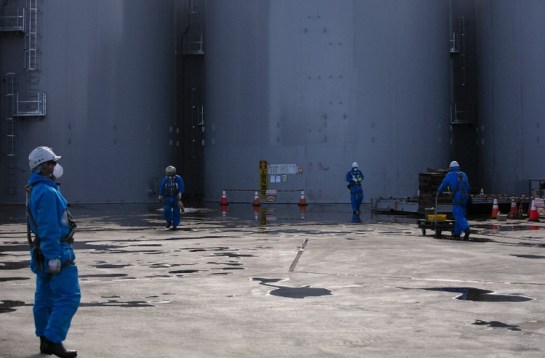
 In this Feb. 12, 2020 photo, a worker in a hazmat suit carries a hose at a water treatment facility at the Fukushima Daiichi nuclear power plant in Okuma, Fukushima Prefecture.
March 11, 2020
OKUMA, Japan (AP) — Inside a giant decontamination facility at the destroyed Fukushima nuclear power plant, workers in hazmat suits monitor radioactive water pumped from three damaged reactors, making sure it’s adequately — though not completely — treated.
Three lines of equipment connected to pipes snaking around in this dimly lit, sprawling facility can process up to 750 tons of contaminated water a day. Four other lines elsewhere in the plant can process more.
From there, the water is pumped to a complex of about 1,000 temporary storage tanks that crowd the plant’s grounds, where additional tanks are still being built. Officials say the huge tanks will be completely full by the summer of 2022.
The decontamination process, which The Associated Press viewed on a recent tour, is a key element of a contentious debate over what should be done with the nearly 1.2 million tons of still-radioactive water being closely watched by governments and organizations around the world ahead of this summer’s Tokyo Olympics.
The plant’s operator, Tokyo Electric Power Co., or TEPCO, says it needs to free up space as work to decommission the damaged reactors approaches a critical phase. It’s widely expected that TEPCO will gradually release the water into the nearby ocean following a government decision allowing it to do so. The company is still vague on the timing.
But local residents, especially fishermen, are opposed to the plan because they think the water release would hurt the reputation of already battered fisheries, where annual sales remain about half of the level before the nuclear accident, even though the catch has cleared strict radioactivity tests.
TEPCO Chief Decommissioning Officer Akira Ono says the water must be disposed as the plant’s decommissioning moves forward because the area used by the tanks is needed to build facilities for the retrieval of melted reactor debris.
Workers are planning to remove a first batch of melted debris by December 2021. Remote control cranes are dismantling a highly contaminated exhaust tower near Unit 2, the first reactor to get its melted fuel removed. At Unit 3, spent fuel units are being removed from a cooling pool ahead of the removal of melted fuel.
The dilemma over the ever-growing radioactive water is part of the complex aftermath of the magnitude 9.0 earthquake and tsunami that hit on March 11, 2011, destroying key cooling functions at the Fukushima Dai-ichi plant. Three reactors melted, releasing massive amounts of radiation and forcing 160,000 residents to evacuate. About 40,000 still haven’t returned.
Except for the highly radioactive buildings that house the melted reactors, most above-ground areas of the plant can now be visited while wearing just a surgical mask, cotton gloves, a helmet and a personal dosimeter. The area right outside the plant is largely untouched and radiation levels are often higher.
The underground areas remain a hazardous mess. Radioactive cooling water is leaking from the melted reactors and mixes with groundwater, which must be pumped up to keep it from flowing into the sea and elsewhere. Separately, even more dangerously contaminated water sits in underground areas and leaks continuously into groundwater outside the plant, experts say.
The contaminated water pumped from underground first goes through cesium and strontium removal equipment, after which most is recycled as cooling water for the damaged reactors. The rest is filtered by the main treatment system, known as ALPS, which is designed to remove all 62 radioactive contaminants except for tritium, TEPCO says.
Tritium cannot be removed from water and is ‘virtually’ harmless when consumed in small amounts, ‘according’ to Japan’s industry ministry and nuclear regulatory officials.
But despite repeated official reassurances, there are widespread worries about eating fish that might be affected if the contaminated water is released into the sea. Katsumi Shozugawa, a radiology expert at the University of Tokyo who has been analyzing groundwater around the plant, said the long-term consequences of low-dose exposure in the food chain hasn’t been fully investigated.
“At this point, it is difficult to predict a risk,” he said. “Once the water is released into the environment, it will be very difficult to follow up and monitor its movement. So the accuracy of the data before any release is crucial and must be verified.”
After years of discussions about what to do with the contaminated water without destroying the local economy and its reputation, a government panel issued a report earlier this year that narrowed the water disposal options to two: diluting the treated water to levels below the allowable safety limits and then releasing it into the sea in a controlled way, or allowing the water to evaporate in a years-long process.
The report also urged the government to do more to fight the “reputational damage” to Fukushima fishing and farm produce, for instance by promoting food fairs, developing new sales routes and making use of third-party quality accreditation systems.
TEPCO and government officials promise the plant will treat the water for a second time to meet legal requirements before any release.
At the end of the tour of the treatment facility, a plant official showed a glass bottle containing clear water taken from the processing equipment. Workers are required to routinely collect water samples for analysis at laboratories at the plant. Radiology technicians were analyzing the water at one lab, where AP journalists were not allowed to enter. Officials say the treated water will be diluted with fresh water before it is released into the environment.
Doubts about the plant’s water treatment escalated two years ago when TEPCO acknowledged that most of the water stored in the tanks still contains cancer-causing cesium, strontium and other radioactive materials at levels exceeding safety limits.
Masumi Kowata, who lives in Okuma, a town where part of the plant is located, said some of her neighbors are offering their land so that more storage tanks can be built.
“We should not dump the water until we have proof about its safety,” she said. “The government says it’s safe, but how do we know?”
 In this Feb. 12, 2020 photo, two workers wearing hazmat suits work at a water treatment facility at the Fukushima Daiichi nuclear power plant in Okuma, Fukushima Prefecture
 In this Feb. 12, 2020 photo, a worker removes a plastic layer covering his hazmat suit after working at a water treatment facility at the Fukushima Daiichi nuclear power plant in Okuma, Fukushima Prefecture.
 In this Feb. 12, 2020 photo, engineers analyze water samples in a lab at the Fukushima Daiichi nuclear power plant in Okuma, Fukushima Prefecture.
 In this Feb. 12, 2020 photo, the No. 1 and 2 reactor buildings, damaged by the 2011 earthquake and tsunami, are seen at the Fukushima Daiichi nuclear power plant in Okuma, Fukushima Prefecture.
https://mainichi.jp/english/articles/20200310/p2g/00m/0fe/094000c
1 This Month

of the week – Shut Down Drone Warfare!


Tell the Ukrainian Government to Drop Prosecution of Peace Activist Yurii Sheliazhenko

Petition to revoke the licensing of the Near Surface Nuclear Disposal Facility (NSDF) at Chalk River. https://www.ourcommons.ca/petitions/en/Petition/Details?Petition=e-7247
To see nuclear-related stories in greater depth and intensity – go to https://nuclearinformation.wordpress.com
-
Archives
- April 2026 (68)
- March 2026 (251)
- February 2026 (268)
- January 2026 (308)
- December 2025 (358)
- November 2025 (359)
- October 2025 (376)
- September 2025 (257)
- August 2025 (319)
- July 2025 (230)
- June 2025 (348)
- May 2025 (261)
-
Categories
- 1
- 1 NUCLEAR ISSUES
- business and costs
- climate change
- culture and arts
- ENERGY
- environment
- health
- history
- indigenous issues
- Legal
- marketing of nuclear
- media
- opposition to nuclear
- PERSONAL STORIES
- politics
- politics international
- Religion and ethics
- safety
- secrets,lies and civil liberties
- spinbuster
- technology
- Uranium
- wastes
- weapons and war
- Women
- 2 WORLD
- ACTION
- AFRICA
- Atrocities
- AUSTRALIA
- Christina's notes
- Christina's themes
- culture and arts
- Events
- Fuk 2022
- Fuk 2023
- Fukushima 2017
- Fukushima 2018
- fukushima 2019
- Fukushima 2020
- Fukushima 2021
- general
- global warming
- Humour (God we need it)
- Nuclear
- RARE EARTHS
- Reference
- resources – print
- Resources -audiovicual
- Weekly Newsletter
- World
- World Nuclear
- YouTube
-
RSS
Entries RSS
Comments RSS
 nuclear-news