Pressure drops inside vessel at Fukushima plant
February 13 earthquake could have exposed damaged part

February 22, 2021
Tokyo Electric Power Company has found that the pressure inside one of the reactor containment vessels at the Fukushima Daiichi nuclear plant has dropped.
The utility said the earthquake that hit the area on February 13 may have been to blame. TEPCO said no radioactive material has leaked.
The nuclear plant in Fukushima Prefecture in northeastern Japan is now undergoing decommissioning.
TEPCO said it confirmed at around 6 p.m. on Sunday that pressure inside the vessel of the No.1 reactor dropped to 0.9 kilopascals from the usual 1.2 kilopascals. Nitrogen is being added to the vessel to raise the pressure and reduce the risk of a hydrogen explosion.
TEPCO found that after the quake the level of water in the containment vessel had dropped.
It said the part damaged in the 2011 nuclear accident may have been exposed after the water level dropped, possibly causing an air leakage and the drop in pressure.
TEPCO said it is continuing to pump water into the vessel and there should be no safety problem.
It said there have been no abnormality in the measurements at radioactivity monitoring posts in the compound.
The utility said it will keep watching the data at the vessel and other facilitieshttps://www3.nhk.or.jp/nhkworld/en/news/20210222_02/
TEPCO neglected seismograph failure for more than six months, failed to record the earthquake of March 13 at Fukushima Daiichi Unit 3

February 22, 2021
The Tokyo Electric Power Company (TEPCO) announced on Wednesday that two seismographs installed in the reactor building of the Unit 3 reactor at the Fukushima Daiichi Nuclear Power Plant had failed but had been left unrepaired for more than half a year, so they were unable to record data from a seismic intensity 6-weak earthquake that occurred late at night on the 13th of this month.
The water level in the reactor containment vessel dropped by more than 30 centimeters at the Fukushima Daiichi Nuclear Power Plant Units 1 and 3, possibly due to the magnitude 6-weak earthquake.
The explanation was given by TEPCO when it reported on the effects of the earthquake at a Nuclear Regulation Authority meeting. TEPCO made no mention of the seismograph failure in its press conference after the quake or in its public documents, and had not announced it before that.
Akira Ono, chief executive officer of the Fukushima Daiichi Nuclear Decommissioning Promotion Company, apologized at the review meeting, saying, “We missed a chance to get valuable data and we regret it.
According to TEPCO, seismographs were installed in March 2020, one on the operation floor and one on the first floor, both on the top five floors of the Unit 3 reactor building, and the one on the first floor broke down in July, four months after it was installed, when it was submerged in water due to rain, and the other broke down in October of the same year due to another cause.
At a press conference on the evening of the 22nd, a TEPCO spokesperson said, “We had planned to install seismographs with countermeasures. The seismograph in the Unit 3 reactor was “installed on a trial basis” to study the earthquake resistance of the building where a hydrogen explosion occurred during the accident, he explained.
At the Fukushima Daiichi Nuclear Power Plant, seismographs were installed on the basement floor of the reactor buildings of Units 1-6, but the equipment in Units 1-4, which were flooded by the tsunami, is not working. (Kenta Onozawa) https://www.tokyo-np.co.jp/article/87498?fbclid=IwAR10pYQZCCKlLhFL8juxyOLZMvOCVTaiP7kQt1C0B46KSxj91KtREIEezP8
10 years after Fukushima, justice remains elusive for victims of nuclear disasters
New report warns of inevitable nuclear accidents in the future

February 22, 2021
A new report from Northwestern University’s Meridian 180 community is sounding the alarm that victims of nuclear disasters worldwide remain inadequately compensated and calls for a more inclusive process for approving nuclear projects and making nuclear energy decisions that gives ordinary citizens a seat at the table.
The report, “Nuclear Compensation: Lessons from Fukushima,” calls for a rigorous and inclusive process that transcends national borders and enables wiser decisions about nuclear projects and their many lingering consequences.
“We’re often inclined to think that nuclear disasters don’t happen very often, but that doesn’t take into view the damaging impact these disasters have in the long run on people, agriculture and anyone in the path of the nuclear fallout, sometimes beyond national borders,” said Hiro Miyazaki, Kay Davis Professor of Anthropology in the Weinberg College of Arts and Sciences at Northwestern and editor of the report.
The report is an outgrowth of more than five years of collaborative research on the Chernobyl, Three Mile Island and Fukushima nuclear disasters among scholars and experts across three continents. Its authors include Northwestern Associate Provost and Roberta Buffett Institute for Global Affairs Executive Director, Annelise Riles, the University of Toronto’s Mary Mitchell, Virginia Tech’s Sonja Schmid, Waseda University professor Takao Suami and Nagoya University professor Dai Yokomizo.
The report particularly emphasizes how compensation schemes for victims of nuclear accidents have not adequately addressed the plight of affected citizens.
“In the case of Fukushima, a large amount of money has been paid out to victims, but remains inadequate,” said Riles. “Many who suffered tremendous losses, but reside outside of the mandatory evacuation zone, have not been compensated. We need new, and much more inclusive nuclear disaster preparation processes involving careful deliberation over who deserves to be compensated in the wake of a nuclear disaster, and who should bear the costs.”
The report will be released during a virtual event co-sponsored by Northwestern and the Bulletin of the Atomic Scientists on March 9, featuring experts on nuclear issues, as well as victims of the 2011 Fukushima disaster.
The keynote address will be delivered by Allison Macfarlane, former chair of the U.S. Nuclear Regulatory Commission and director of the University of British Columbia School of Public Policy and Global Affairs.
The event will also include perspectives from Kazuhiro Yoshida, mayor of the town of Namie in Fukushima, as well as victims of Fukushima, including Masakazu Suzuki and Hidenori Konno, who are leaders of the plaintiffs in lawsuits against the Japanese government and Tokyo Electric Power Company (TEPCO).
Leading voices on nuclear issues and disaster response, including Bulletin of the Atomic Scientists president and CEO Rachel Bronson and University of Chicago professor Robert Rosner, will conclude the event with a panel discussion and live Q&A session.
“Ten years after Fukushima, it remains essential that we tackle, head on, the full costs and benefits of nuclear energy. Fukushima is a warning of what happens when we shirk that responsibility,” Bronson said.
Fukushima Daiichi Nuclear Power Plant Unit 3 Finished Removing Deformed Nuclear Fuel
A supposedly excellent news. However to the risk of sounding the suspicious type, the one thing that I have learned covering for the past 10 years the ongoing nuclear disaster of Fukushima daiichi, is that when Tepco releases some good news it is usually to cover up a bad news, a bad happening behind the good news. Because for Tepco and the nuclear village, lying and secrecy are their second nature. They never inform us on time of what is really up. And just after the last severe earthquake that occured, we have all the reasons to believe that they are not telling us the real facts as usual.

February 20, 2021
The Tokyo Electric Power Company (TEPCO) has announced that it has finished using a special device to remove nuclear fuel that was partially deformed in the accident and could not be pulled out of the spent fuel pool.
Since last year, the Unit 3 reactor at the Fukushima Daiichi Nuclear Power Plant has been in the process of transferring 566 nuclear fuels in the spent fuel pool to a safe facility on the plant grounds.
Of these, four nuclear fuels have a handle on the top of the fuel that was deformed by the debris that fell into the pool during the accident, making it impossible to lift the fuel with normal equipment.
Therefore, TEPCO, in cooperation with a manufacturer, developed a device with an ingenious shape so that even if the handle is deformed, it can be grabbed and pulled up, and announced that they started removing four fuel cells this month and finished removing them this week.
When the fuel was pulled up, it was slightly tilted and lifted up, unlike normal, healthy fuel, but there were no safety problems and the work was completed.
With this, the work to remove the nuclear fuel from the spent fuel pool of the Unit 3 reactor has passed a milestone, and the number of remaining nuclear fuel is 22, and TEPCO plans to finish removing all the fuel by next month.
Water levels at Fukushima reactor containers falling after quake

A Tepco employee wearing a protective suit and mask gives lectures in front of No. 3 reactor building at the tsunami-crippled Fukushima No. 1 nuclear power plant in Okuma, Fukushima Prefecture, in February 2019.
February 20, 2021
Tokyo Electric Power Co. Holdings Inc. has said that the water levels in the containment vessels for the No. 1 and No. 3 reactors at its disaster-crippled Fukushima No. 1 nuclear power plant have fallen by tens of centimeters.
The water levels are continuing to drop by several centimeters each day, Tepco said Friday.
The event has had no radiation impact outside of the plant’s premises, the company said, noting that the injection of water into the reactors, as well as operations to cool melted nuclear fuel debris at the bottom of the containment vessels, are continuing.
The plant was heavily damaged in the powerful March 2011 earthquake and tsunami.
On Feb. 13, an earthquake measuring a strong 6 — the second-highest level on the Japanese seismic intensity scale — rocked the Tohoku region, which includes Fukushima Prefecture. Existing damage to piping and other parts of the containment vessels may have expanded as a result of the temblor, Tepco officials said.
The utility is continuing to pump 3 tons of water per hour into the reactor containers to cool the fuel debris.
While water continues leaking to the reactor buildings through the damaged areas of the containment vessels, the water levels in the No. 1 and No. 3 reactor containers had been kept at some 1.9 meters and 6.3 meters from the bottom, respectively, before Saturday’s earthquake.
According to the officials, workers detected a fall in the water level in the No. 1 reactor container around 11 p.m. Thursday.
The water level is seen to have dropped by 40-70 centimeters in the No. 1 reactor container and by some 30 centimeters in the No. 3 reactor container, the officials said.
Drops in the water levels are believed to have started around Monday in the No. 1 reactor vessel and around Sunday in the No. 3 reactor vessel, they said.
The sizes of the falls in the water levels are almost the same as those observed during an experiment conducted last year to suspend water injection, the officials said.
The company will take measures, such as increasing water injection, as needed while continuing to monitor the water levels, the officials said.
Ramping up water injection will lead to an increase in the amount of radioactive water, possibly affecting the quantity of water that is kept in tanks at the premises of the nuclear power station after being treated to remove some radioactive substances.https://www.japantimes.co.jp/news/2021/02/20/national/fukushima-water-leak-earthquake/
Water leaks indicate new damage at Fukushima nuclear plant
Radioactive cooling water levels inside the wreckage of Fukushima Daiichi units is falling in a least two units. This indicates that new damage from the recent 7.3 M earthquake has created drainage routes for more radioactive contamination to escape to the offsite environment.

This Sept. 4, 2017, aerial file photo shows Fukushima Dai-ichi nuclear power plant’s reactors, from bottom at right, Unit 1, Unit 2 and Unit 3, in Okuma, Fukushima prefecture, northeastern Japan. The utility operating a wrecked Fukushima nuclear plant said Friday, Feb. 19, 2021, it has detected cooling water levels at two of its three melted reactors have fallen over the past few days apparently due to additional damage done to its reactors from a powerful earthquake that shook the area last weekend.
February 19, 2021
TOKYO (AP) — Cooling water levels have fallen in two reactors at the wrecked Fukushima nuclear plant since a powerful earthquake hit the area last weekend, indicating possible additional damage, its operator said Friday.
New damage could further complicate the plant’s already difficult decommissioning process, which is expected to take decades.
Tokyo Electric Power Co. spokesman Keisuke Matsuo said the drop in water levels in the Unit 1 and 3 reactors indicates that the existing damage to their primary containment chambers was worsened by Saturday’s magnitude 7.3 quake, allowing more water to leak.
The leaked water is believed to have remained inside the reactor buildings and there is no sign of any outside impact, he said.
In 2011, a powerful magnitude 9.1 earthquake and tsunami damaged the Fukushima plant’s cooling systems, causing three reactor cores to melt and nuclear fuel to fall to the bottom of their primary containment vessels.
TEPCO will monitor the water and temperatures at the bottom of the containment vessels, Matsuo said.
Since the 2011 disaster, cooling water has been escaping constantly from the damaged primary containment vessels into the basements of the reactor buildings. To make up for the loss, additional cooling water has been pumped into the reactors to cool the melted fuel remaining inside them. The recent decline in the water levels indicates that more water than before is leaking out, TEPCO said.
More than 180 people received mostly minor injuries from Saturday’s earthquake, according to the Fire and Disaster Management Agency. The quake also triggered landslides, damaged homes and a high-speed train line, and caused widespread power and water supply disruptions.
TEPCO initially reported that there was no abnormality at the plant from Saturday’s quake.
Matsuo said the cooling water level fell as much as 70 centimeters (27 inches) in the primary containment chamber of the Unit 1 reactor and about 30 centimeters (11 inches) in Unit 3. TEPCO wasn’t able to determine any decline in Unit 2 because indicators have been taken out to prepare for the removal of melted debris, it said.
Increased leakage could require more cooling water to be pumped into the reactors, which would result in more contaminated water that is treated and stored in huge tanks at the plant. TEPCO says its storage capacity of 1.37 million tons will be full next summer. A government panel’s recommendation that it be gradually released into the sea has faced fierce opposition from local residents and a decision is still pending.
Meanwhile, the Tokyo High Court on Friday held the government as well as TEPCO accountable for the 2011 nuclear disaster, ordering both to pay about 280 million yen ($2.6 million) in compensation to more than 40 plaintiffs forced to evacuate to Chiba, near Tokyo, for their lost livelihoods and homes.
Friday’s decision reverses an earlier ruling by the Chiba district court that excluded the government from responsibility. Judge Yukio Shirai said the government could have foreseen the risk of a massive tsunami and taken measures after a long-term assessment in 2002 of seismic activities.
Lawyers representing the plaintiffs welcomed the decision and said it would affect other pending cases.
“The case raises the question of whether we should tolerate a society that prioritizes economic activities over people’s lives and health,” said Izutaro Mangi, a lawyer representing the plaintiffs.https://apnews.com/article/water-leaks-fukushima-new-damage-a7ecf765d0233b1cad7332ff9fed5ffe?fbclid=IwAR1OEHbFv9DnWxom8Jw5sBW9_se6ph-7R_H-tQiL9Op_C2JIddwrZa6HqcY
Water level drops at Daiichi Nuclear Power Plant Units 1 and 3
February 19, 2021
The Tokyo Electric Power Company (TEPCO) has announced that the water level inside the containment vessels of the Unit 1 and Unit 3 reactors at the Fukushima Daiichi Nuclear Power Plant, which are filled with water to cool down the melted down nuclear fuel, is dropping.
There is a possibility that a broken part of the containment vessel expanded after the earthquake on the 13th of this month, increasing the amount of water leaking out, but there has been no noticeable change in the values of monitoring posts, etc., and there is no impact on the outside.
According to the Tokyo Electric Power Company (TEPCO), at around 11:00 p.m. on the 18th, it was confirmed that the water level in the containment vessel of the Unit 1 reactor, which is used to cool down the melted down nuclear fuel, had dropped.
TEPCO confirmed the data and found that the water level has been declining since the 15th of this month in the Unit 1 reactor and since the 17th in the Unit 3 reactor.
The water level in the Unit 1 reactor is estimated to have dropped by 40 to 70 centimeters, and in the Unit 3 reactor by about 30 centimeters.
However, the thermometers installed at the bottom of the reactors do not show any rise in temperature, there is no noticeable change in the radiation level inside the containment vessel, and there is no abnormality in the values of the monitoring posts installed at the site boundary. There is no problem with the cooling of the nuclear fuel and no external impact.
The containment vessel was broken during the accident at the nuclear power plant, and a certain amount of cooling water that is poured into the vessel usually leaks out, but the earthquake on the 13th of this month may have widened the damaged area and increased the amount that leaked out.
In the towns of Okuma and Futaba, where the Fukushima Daiichi Nuclear Power Plant is located, a tremor of lower 6 on the Japanese intensity scale was observed.
If the water level continues to drop, TEPCO is considering increasing the water injection rate, which is currently set at 3 cubic meters per hour.
https://www3.nhk.or.jp/lnews/fukushima/20210219/6050013511.html?fbclid=IwAR0CjCLPZXz2hBtGGcV4DghnfenN5vssaY4zj-XGsOh7SeX_gFqtiVuaEqc
Fukushima Continues To Supply Surprises

Back-scattered electron (BSE) image of the cross section of the most radioactive particle (FTB26) accompanied by elemental maps of its major constituents. Credit: Satoshi Utsunomiya et al.
February 18, 2021
The 10 year anniversary of the Fukushima Daiichi nuclear accident occurs in March. Work just published in the Journal ‘Science of the Total Environment’ documents new, large (> 300 micrometers), highly radioactive particles that were released from one of the damaged Fukushima reactors.
Particles containing radioactive cesium (134+137Cs) were released from the damaged reactors at the Fukushima Daiichi Nuclear Power Plant (FDNPP) during the 2011 nuclear disaster. Small (micrometer-sized) particles (known as CsMPs) were widely distributed, reaching as far as Tokyo. CsMPs have been the subject of many studies in recent years. However, it recently became apparent that larger (>300 micrometers) Cs-containing particles, with much higher levels of activity (~ 105 Bq), were also released from reactor unit 1 that suffered a hydrogen explosion. These particles were deposited within a narrow zone that stretches ~8 km north-northwest of the reactor site. To date, little is known about the composition of these larger particles and their potential environmental and human health impacts.
Now, work just published in the journal Science of the Total Environment characterizes these larger particles at the atomic-scale and reports high levels of activity that exceed 105 Bq.
The particles, reported in the study, were found during a survey of surface soils 3.9 km north-northwest of reactor unit 1 (Fig. 1).
From 31 Cs-particles collected during the sampling campaign, two have given the highest ever particle-associated 134+137Cs activities for materials emitted from the FDNPP (specifically: 6.1 × 10⁵ and 2.5 × 10⁶ Bq, respectively, for the particles, after decay-correction to the date of the FDNPP accident).
The study involved scientists from Japan, Finland, France, the UK, and USA, and was led by Dr. Satoshi Utsunomiya and graduate student Kazuya Morooka (Department of Chemistry, Kyushu University). The team used a combination of advanced analytical techniques (synchrotron-based nano-focus X-ray analysis, secondary ion mass spectrometry, and high-resolution transmission electron microscopy) to fully characterize the particles. The particle with a 134+137Cs activity of 6.1 × 10⁵ Bq was found to be an aggregate of smaller, flakey silicate nanoparticles, which had a glass like structure. This particle likely came from reactor building materials, which were damaged during the Unit 1 hydrogen explosion; then, as the particle formed, it likely adsorbed Cs that had had been volatized from the reactor fuel. The 134+137Cs activity of the other particle exceeded 106 Bq. This particle had a glassy carbon core and a surface that was embedded with other micro-particles, which included a Pb-Sn alloy, fibrous Al-silicate, Ca-carbonate / hydroxide, and quartz (Fig. 2).
The composition of the surface embedded micro-particles likely reflect the composition of airborne particles within the reactor building at the moment of the hydrogen explosion, thus providing a forensic window into the events of March 11th 2011 (Fig. 3). Utsunomiya added, “The new particles from regions close to the damaged reactor provide valuable forensic clues. They give snap-shots of the atmospheric conditions in the reactor building at the time of the hydrogen explosion, and of the physio-chemical phenomena that occurred during reactor meltdown.” He continued, “whilst nearly ten years have passed since the accident, the importance of scientific insights has never been more critical. Clean-up and repatriation of residents continues and a thorough understanding of the contamination forms and their distribution is important for risk assessment and public trust.
Professor Gareth Law (co-author, University of Helsinki) added, “clean-up and decommissioning efforts at the site face difficult challenges, particularly the removal and safe management of accident debris that has very high levels of radioactivity. Therein, prior knowledge of debris composition can help inform safe management approaches”.
Given the high radioactivity associated with the new particles, the project team were also interested in understanding their potential health / dose impacts.
Dr Utsunomiya stated, “Owing to their large size, the health effects of the new particles are likely limited to external radiation hazards during static contact with skin. As such, despite the very high level of activity, we expect that the particles would have negligible health impacts for humans as they would not easily adhere to the skin. However, we do need to consider possible effects on the other living creatures such as filter feeders in habitats surrounding Fukushima Daiichi. Even though ten years have nearly passed, the half-life of 137Cs is ~30 years. So, the activity in the newly found highly radioactive particles has not yet decayed significantly. As such, they will remain in the environment for many decades to come, and this type of particle could occasionally still be found in radiation hot spots.”
Professor Rod Ewing (co-author from Stanford University) stated “this paper is part of a series of publications that provide a detailed picture of the material emitted during the Fukushima Daiichi reactor meltdowns. This is exactly the type of work required for remediation and an understanding of long-term health effects”.
Professor Bernd Grambow (co-author from IMT Atlantique) added “the present work, using cutting-edge analytical tools, gives only a very small insight in the very large diversity of particles released during the nuclear accident, much more work is necessary to get a realistic picture of the highly heterogeneous environmental and health impact”.
Reference
Morooka K, Kurihara E, Takehara M, et al. New highly radioactive particles derived from Fukushima Daiichi Reactor Unit 1: Properties and environmental impacts. Science of The Total Environment. 2021;773:145639. doi:10.1016/j.scitotenv.2021.145639
https://www.technologynetworks.com/tn/news/fukushima-continues-to-supply-surprises-345722
New highly radioactive particles found in Fukushima

Date: February 17, 2021 Source: University of Helsinki Summary: The 10 year anniversary of the Fukushima Daiichi nuclear accident occurs in March. Recent work documents new, large (> 300 micrometers), highly radioactive particles that were released from one of the damaged Fukushima reactors.
The 10 year anniversary of the Fukushima Daiichi nuclear accident occurs in March. Work just published in the Journal ‘Science of the Total Environment’ documents new, large (> 300 micrometers), highly radioactive particles that were released from one of the damaged Fukushima reactors.
Particles containing radioactive cesium (134+137Cs) were released from the damaged reactors at the Fukushima Daiichi Nuclear Power Plant (FDNPP) during the 2011 nuclear disaster. Small (micrometer-sized) particles (known as CsMPs) were widely distributed, reaching as far as Tokyo. CsMPs have been the subject of many studies in recent years. However, it recently became apparent that larger (>300 micrometers) Cs-containing particles, with much higher levels of activity (~ 105 Bq), were also released from reactor unit 1 that suffered a hydrogen explosion. These particles were deposited within a narrow zone that stretches ~8 km north-northwest of the reactor site. To date, little is known about the composition of these larger particles and their potential environmental and human health impacts.
Now, work just published in the journal Science of the Total Environment characterizes these larger particles at the atomic-scale and reports high levels of activity that exceed 105 Bq.
The particles, reported in the study, were found during a survey of surface soils 3.9 km north-northwest of reactor unit 1.
From 31 Cs-particles collected during the sampling campaign, two have given the highest ever particle-associated 134+137Cs activities for materials emitted from the FDNPP (specifically: 6.1 × 10⁵ and 2.5 × 10⁶ Bq, respectively, for the particles, after decay-correction to the date of the FDNPP accident).
The study involved scientists from Japan, Finland, France, the UK, and USA, and was led by Dr. Satoshi Utsunomiya and graduate student Kazuya Morooka (Department of Chemistry, Kyushu University). The team used a combination of advanced analytical techniques (synchrotron-based nano-focus X-ray analysis, secondary ion mass spectrometry, and high-resolution transmission electron microscopy) to fully characterize the particles. The particle with a 134+137Cs activity of 6.1 × 10⁵ Bq was found to be an aggregate of smaller, flakey silicate nanoparticles, which had a glass like structure. This particle likely came from reactor building materials, which were damaged during the Unit 1 hydrogen explosion; then, as the particle formed, it likely adsorbed Cs that had had been volatized from the reactor fuel. The 134+137Cs activity of the other particle exceeded 106 Bq. This particle had a glassy carbon core and a surface that was embedded with other micro-particles, which included a Pb-Sn alloy, fibrous Al-silicate, Ca-carbonate / hydroxide, and quartz.
The composition of the surface embedded micro-particles likely reflect the composition of airborne particles within the reactor building at the moment of the hydrogen explosion, thus providing a forensic window into the events of March 11th 2011. Utsunomiya added, “The new particles from regions close to the damaged reactor provide valuable forensic clues. They give snap-shots of the atmospheric conditions in the reactor building at the time of the hydrogen explosion, and of the physio-chemical phenomena that occurred during reactor meltdown.” He continued, “whilst nearly ten years have passed since the accident, the importance of scientific insights has never been more critical. Clean-up and repatriation of residents continues and a thorough understanding of the contamination forms and their distribution is important for risk assessment and public trust.
Professor Gareth Law (co-author, University of Helsinki) added, “clean-up and decommissioning efforts at the site face difficult challenges, particularly the removal and safe management of accident debris that has very high levels of radioactivity. Therein, prior knowledge of debris composition can help inform safe management approaches.”
Given the high radioactivity associated with the new particles, the project team were also interested in understanding their potential health / dose impacts.
Dr Utsunomiya stated, “Owing to their large size, the health effects of the new particles are likely limited to external radiation hazards during static contact with skin. As such, despite the very high level of activity, we expect that the particles would have negligible health impacts for humans as they would not easily adhere to the skin. However, we do need to consider possible effects on the other living creatures such as filter feeders in habitats surrounding Fukushima Daiichi. Even though ten years have nearly passed, the half-life of 137Cs is ~30 years. So, the activity in the newly found highly radioactive particles has not yet decayed significantly. As such, they will remain in the environment for many decades to come, and this type of particle could occasionally still be found in radiation hot spots.”
Professor Rod Ewing (co-author from Stanford University) stated “this paper is part of a series of publications that provide a detailed picture of the material emitted during the Fukushima Daiichi reactor meltdowns. This is exactly the type of work required for remediation and an understanding of long-term health effects.”
Professor Bernd Grambow (co-author from IMT Atlantique) added “the present work, using cutting-edge analytical tools, gives only a very small insight in the very large diversity of particles released during the nuclear accident, much more work is necessary to get a realistic picture of the highly heterogeneous environmental and health impact.”
Story Source:
Materials provided by University of Helsinki. Note: Content may be edited for style and length.
Journal Reference:
- Kazuya Morooka, Eitaro Kurihara, Masato Takehara, Ryu Takami, Kazuki Fueda, Kenji Horie, Mami Takehara, Shinya Yamasaki, Toshihiko Ohnuki, Bernd Grambow, Gareth T.W. Law, Joyce W.L. Ang, William R. Bower, Julia Parker, Rodney C. Ewing, Satoshi Utsunomiya. New highly radioactive particles derived from Fukushima Daiichi Reactor Unit 1: Properties and environmental impacts. Science of The Total Environment, 2021; 773: 145639 DOI: 10.1016/j.scitotenv.2021.145639
https://www.sciencedaily.com/releases/2021/02/210217134852.htm
Korean, Japanese bishops oppose discharge from Fukushima plant
Scientists, environmentalists and fishing groups are against the idea of releasing contaminated water into the sea

February 17, 2021
Catholic bishops in South Korea and Japan have issued a joint statement to strongly oppose the Japanese government’s decision to discharge radioactive water from the damaged Fukushima nuclear power plant into the sea.
Following years of debate over the disposal of the liquid which includes water used to cool the Fukushima Daiichi plant that was hit by a massive tsunami and earthquake in 2011, Japanese authorities have decided to release a million tonnes of treated water into the sea.
The initial plan was to start releasing the water from 2022 but a final decision has not been made, according to Japanese media.
Most of the radioactive isotopes have been removed using a complex filtration process. But one isotope, tritium, cannot be removed, so water has been stored in huge tanks that will fill up by 2022, the BBC reported.
Scientists, environmentalists and fishing groups have opposed the idea of releasing contaminated water into the sea, citing possible risks.
“We oppose the discharge of tritium-containing water, a radioactive material that has been purified and treated, into the ocean,” said a joint statement from the Justice and Peace Commissions of the bishops’ conferences of Korea and Japan, the Korean bishops’ ecological and environmental committee and the Japanese bishops’ subcommittee on nuclear for peace.
The statement has been signed by heads of each organization and concerns have been raised about the direct impact of the contaminated water on public health and marine life.
“The water contains tritium, which is a radioactive material, purified through the contaminated water treatment system of the Fukushima plant. Secondary treatment of radionuclides remaining in the treated water is still in the testing stage, and no definite results have been obtained,” the statement said.
The statement also pointed out that the report from the Japanese government did not mention the effects of the treated water on marine life, the marine environment and human health.
“Once released into the sea, radioactive material cannot be restored to its original state. It will have impacts on humans and nature. It will cause greater anxiety and damage to people around the world.”
In a separate statement, the Korean bishops’ ecological and environmental committee expressed concerns about the recent tritium leak at the Wolseong nuclear power plant in Gyeongju in South Korea.
On Jan. 7, Korean media reported on radioactivity leaking from the plant, prompting Korea Hydro and Nuclear Power Company to investigate. The initial results exposed a wide range of radioactive contamination in the plant and adjacent areas
The Korean Church demanded the government “conduct a thorough and transparent investigation into the leakage and immediate follow-up measures for radioactive leaks in all nuclear power plants.”
Japan’s Fukushima Meltdowns (New Video): Much Still Unknown 10 Years Later

By The Fairewinds Crew
February 17, 2021
As we approach the 10th commemoration of Japan’s March 11, 2011, Fukushima Dai-ichi triple meltdowns, organizations around the globe, including environmental groups, nonprofits (like Fairewinds Energy Education), engineering and pronuclear organizations, and media organizations like Japan’s Nippon TV, will release new information.
Some of this information is really new and recently uncovered. Other media events will bring people together to share and discuss what these major meltdowns meant to the people of Japan and communities worldwide. And sometimes, these media events are just a corporation or an agency marketing new nukes by putting their positive spin on nuclear power rather than acknowledging its dangers. For example, nuclear zealots continue to claim that atomic power reactors are safer for workers than working at Toys R Us, and reactors cannot meltdown and certainly will never blow up. The Fukushima disaster proved them wrong, but yet they persist!
As Fukushima Daichi Units One, Two, and Three were melting down, Nippon TV, the largest and flagship station of the Nippon Television Network System, dispatched television film crews to monitor the events as they unfolded. No one in the world has ever captured the core melting down, but Nippon TV captured two meltdown-induced explosions on film.
Now, Nippon TV has just released a new digital copy of the Fukushima Dai-ichi Unit One and Unit Three explosions.
At Fairewinds, we congratulate Nippon for the excellent work they did to create the original initial explosion footage in 2011 and on this essential remastered copy just completed in 2021. Nippon’s newly released digital footage is important historically and technically.
That said, the new video footage and Nippon’s ensuing interview with Tokyo Electric Company (TEPCO), the atomic power corporation that owns all six Fukushima Dai-ichi nuclear power plants, contain three glaring technical errors.
- First, Fairewinds continues to have significant concerns about TEPCO’s technical interpretations of these explosions’ cause.
- Second, TEPCO is blaming newly uncovered lethal radioactivity sitting at the top of the containment structure on the supersonic shockwave.
- Third, TEPCO does not discuss that there likely was a second explosion that occurred 3 seconds after the first.
Understanding the mechanics behind explosions is critical to understanding what happened at Fukushima and what such a danger means to nuclear power anywhere in the world.
- There are two explosion methods: a deflagration shock wave, which happened at Fukushima Unit One and Three Mile Island in Middletown, Pennsylvania, in the United States. While still destructive, a deflagration shockwave travels at subsonic speeds (less than 760 miles an hour, the speed of sound).
- The second type of explosion is called a detonation shockwave. It is much more destructive because it travels at supersonic speeds. In 2011, with Geoff Sutton’s assistance from the United Kingdom, Fairewinds clearly showed that the Unit Three explosion was the more destructive detonation shockwave while Unit One’s was a deflagration.
Does it matter whether or not an explosion at Fukushima was a detonation or a deflagration? Absolutely! Hydrogen gas at room (atmospheric) pressure cannot create a supersonic shockwave. Fairewinds’s 2011 findings that a detonation shockwave occurred should have changed the scientific and nuclear engineering analyses of such events worldwide.
No nuclear power radioactive release containment system built anywhere in the world will withstand a detonation shockwave!
The fact that a detonation shockwave did occur is something the nuclear industry has ignored since Fairewinds’ Arnie Gundersen and Geoff Sutton identified it did happen at Fukushima Unit Three in 2011.
The nuke industry and its regulatory handlers do not believe that a supersonic shockwave explosion will ever happen in a nuclear power plant. If they admitted that an atomic reactor containment system would fail by Does it matter whether or not an explosion at Fukushima was a detonation or a deflagration? Absolutely! Hydrogen gas at room (atmospheric) pressure cannot create a supersonic shockwave. Fairewinds’s 2011 findings that a detonation shockwave occurred should have changed the scientific and nuclear engineering analyses of such events worldwide.
No nuclear power radioactive release containment system built anywhere in the world will withstand a detonation shockwave!
The fact that a detonation shockwave did occur is something the nuclear industry has ignored since Fairewinds’ Arnie Gundersen and Geoff Sutton identified it did happen at Fukushima Unit Three in 2011.
The nuke industry and its regulatory handlers do not believe that a supersonic shockwave explosion will ever happen in a nuclear power plant. If they admitted that an atomic reactor containment system would fail by detonation, the nuke industry would also have to acknowledge that nuke plants’ containment systems are not failsafe. Nuclear power containment systems will fail when there is a supersonic shockwave explosion.
The supposedly failsafe containment system at Fukushima Dai-ichi Unit Three failed and released massive amounts of radioactivity into the local environment and the worldwide atmosphere. Such an enormous human tragedy will happen again at an atomic power reactor somewhere in the world.
Think about that. No nuke in the world can withstand a supersonic shockwave, and here is the evidence on international TV and across the Internet that it occurred in 2011, as Fairewinds said.
Fairewinds second area of concern about TEPCO’s analysis on this latest NIPPON video is the linkage of recently discovered lethal radiation levels at the top of the containment to the supersonic detonation. Ten years ago, immediately following the three meltdowns at Fukushima in 2011, Fairewinds identified superheated highly radioactive gases escaping from this same area that TEPCO suddenly claims it has just uncovered in 2021. The containment was leaking before the explosion and continued to spread radioactivity after the blast. Still, no nuclear engineer or scientist is surprised that significant contamination continues to leak from the damaged containment system. The containment was breached, which allowed this radiation to leak! However, there is no evidence to suggest that the explosion is the cause of that leak since the containment was leaking before the supersonic shockwave.
Finally, Nippon’s remastered video vividly shows Fairewinds’ third concern. The eye is drawn to the detonation’s sudden flash and the ensuing upward-moving black cloud of rubble. Now, look again. About three seconds after the initial vertical blast, a white cloud suddenly moves horizontally at ground level to the north.
Detonation, the nuke industry would also have to acknowledge that nuke plants’ containment systems are not failsafe. Nuclear power containment systems will fail when there is a supersonic shockwave explosion.
The supposedly failsafe containment system at Fukushima Dai-ichi Unit Three failed and released massive amounts of radioactivity into the local environment and the worldwide atmosphere. Such an enormous human tragedy will happen again at an atomic power reactor somewhere in the world.
Think about that. No nuke in the world can withstand a supersonic shockwave, and here is the evidence on international TV and across the Internet that it occurred in 2011, as Fairewinds said.
Fairewinds second area of concern about TEPCO’s analysis on this latest NIPPON video is the linkage of recently discovered lethal radiation levels at the top of the containment to the supersonic detonation. Ten years ago, immediately following the three meltdowns at Fukushima in 2011, Fairewinds identified superheated highly radioactive gases escaping from this same area that TEPCO suddenly claims it has just uncovered in 2021. The containment was leaking before the explosion and continued to spread radioactivity after the blast. Still, no nuclear engineer or scientist is surprised that significant contamination continues to leak from the damaged containment system. The containment was breached, which allowed this radiation to leak! However, there is no evidence to suggest that the explosion is the cause of that leak since the containment was leaking before the supersonic shockwave.
Finally, Nippon’s remastered video vividly shows Fairewinds’ third concern. The eye is drawn to the detonation’s sudden flash and the ensuing upward-moving black cloud of rubble. Now, look again. About three seconds after the initial vertical blast, a white cloud suddenly moves horizontally at ground level to the north.

Community-volunteer citizen-scientists Arnie met while collecting radioactive samples in Fukushima prefecture say they heard more than one explosion. They said it sounded like the snapping of bamboo burning in a fire. This new video shows that there were at least two explosions, one vertically and one horizontally. As more data becomes available, Fairewinds Energy Education will put forward the reasons why, but as of now, the entire explosion sequence at Fukushima Unit Three is something the nuclear industry zealots want to ignore. They continue to hope that history will not repeat itself while they continue to build and operate more lethally radioactive and highly risky atomic reactors.
Throughout the Nippon video, the announcer reverentially refers to TEPCO and the Japanese Regulators as “the authorities” and “officials”. This kind of public propaganda occurs because TEPCO, the Japanese Government and its regulators, and the International Atomic Energy Agency (IAEA) have successfully captured the Japanese media.
What was called for in 2011 and is still desperately required in 2021 are independent experts. These would be people from outside TEPCO, its captive regulators, or its allies embedded in the nuclear industry. Once again, Fairewinds calls for an independent consortium of experts who would be able to give a frank assessment of the magnitude and extent of the problems that lie ahead for the failed Fukushima cleanup.
Did you know that in 2013, Fairewinds and 16 other international experts coauthored a letter to the United Nations (UN) asking it to establish this independent panel? The UN never had the courtesy even to acknowledge that it received these serious requests and recommendations. Such machinations by TEPCO, the Japanese Government, and the international nuclear industry are indeed a human rights and environmental injustice issue!
Ten years have passed, yet Japan’s citizens still wait for independent oversight of the Fukushima disaster. The people of Japan deserve better than the authorities covering up the truth and lying to them.
Fukushima spillage raises questions about threat of future earthquakes
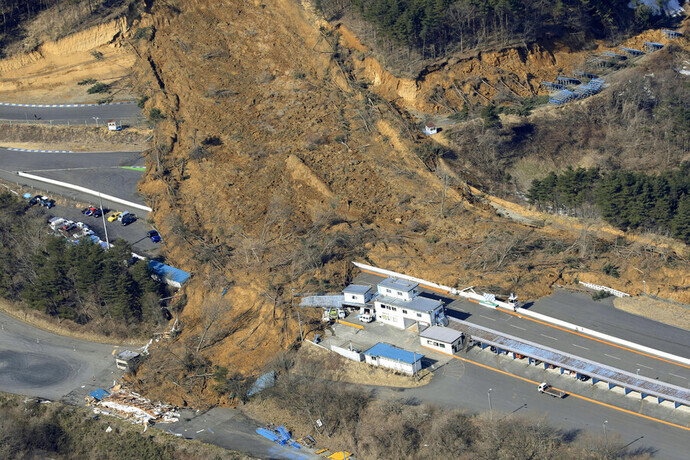
A road in Nihonmatsu has been blocked by a landslide on Feb. 14 following a 7.3-magnitude earthquake the day before in Japan’s Fukushima Prefecture.
Feb.16,2021
The occurrence of a 7.3-magnitude earthquake in the waters off of Fukushima on Feb. 13 is prompting growing concerns about the safety of the Fukushima Daiichi Nuclear Power Plant, as some mention the possibility of other quakes at a similar scale.
Experts said that with no way of knowing how large future earthquakes will be, swift preparations are needed to prevent damage to the plant.
According to reporting by Japan’s NHK television network on Feb. 15, the Japanese government’s Earthquake Survey Committee stressed the need to be on the alert over the next week or so for earthquakes at a “strong 6” on the Japanese seismic intensity scale. The warning suggested the possibility of additional quakes on par with the one on Feb. 13, which was a strong 6.
“We need to prepare,” the committee said, noting the possibility of eastern Japan being “ambushed by strong vibrations and/or a tsunami caused by a large-scale earthquake.”
In an interview with NHK, Tohoku University professor Shinji Toda said there was the “possibility of a 9.0-magnitude earthquake and tsunami occurring in the waters off of Fukushima and Miyagi, as well as the north and south of the area where the [2011 Tohoku] earthquake occurred 10 years ago and the area outside of the Japan Trench.”
Hong Tae-kyung, a professor of earth system sciences at Yonsei University, warned that the associated ground motion could be large relative to the scale of the earthquake itself.
“The scale of this earthquake was within a predictable level for the region, but the fact that the ground motion was so much larger gives pause,” he explained.
“Ground motion differs according to earthquake scale, sedimentary layer thickness, observation position and other factors, and it’s common for ground motion to be larger near the coast due to the sedimentary layer’s thickness. But even when you take all of that into account, the ground motion was very large,” he said.
“There’s a possibility the ground motion exceeded what the Fukushima nuclear power plant could withstand in terms of its design.”
With predictions that additional large-scale earthquakes could occur, observers are calling for swift preparations to prevent damage to the Fukushima plant. According to Kyodo News and other Japanese media, some spillage was determined to have occurred during the earthquake in tanks holding spent nuclear fuel at the upper layers of the No. 5 and 6 reactors at the Fukushima plant.
Japanese nuclear power authorities and the Tokyo Electric Power Company (TEPCO), which operates the plant, stated that there had been no radiation exposure as a result of the tank spillage.
Institute of Nuclear Safety director Han Byeong-seop agreed that the “nuclear power plant safety issues resulting from the earthquake were not at a concerning level,” but stressed the “need to prepare for a compound disaster in the wake of an earthquake.”
“The amount of water that spilled from the spent nuclear fuel in this earthquake was minute, so it wasn’t at a worrisome level, and there does not appear to have been any damage to the power plant,” he said.
“But with the Tohoku earthquake in 2011, there was major damage resulting from a compound disaster involving both an earthquake and tsunami, and there’s no way of predicting the scale of additional earthquakes that we might see this time,” he added.
“There need to be continued preparations for a compound disaster.”
Oh Chang-whan, a professor of earth and environmental sciences at Jeonbuk National University, said, “Nuclear power plants are designed to be safe during earthquakes, yet even so we saw issues with water spillage.”
“Nobody can predict for certain what kind of damage an earthquake or tsunami might cause. We need to prepare,” he urged.
http://english.hani.co.kr/arti/english_edition/e_international/983206.html
At the nuclear power plant in Fukushima found a leak of radioactive water
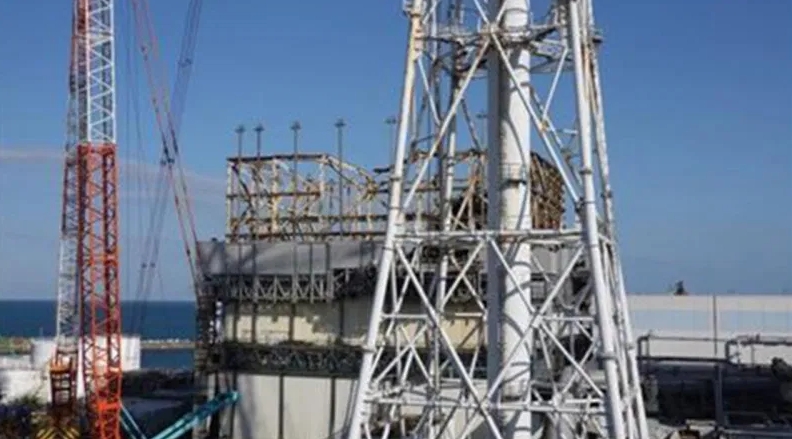
February 14, 2021
A radioactive water leak was discovered at the Fukushima nuclear power plant. It is reported by RIA Novosti citing a press release from TEPCO (Tokyo Electric Power Company).
TEPCO specialists found out that due to the earthquake in northeast Japan, a small amount of water poured out of the pools for storing spent nuclear fuel at various units of the Fukushima-1 and Fukushima-2 nuclear power plants.
Representatives of the company said that about 160 milliliters of water were spilled at the first power unit of the Fukushima-2 nuclear power plant, and another 1.4 liters spilled from another pool. They assured that this incident should not affect the cooling of the spent fuel. Local media also reported that about 600 milliliters of water spilled out at the fifth power unit of the emergency nuclear power plant “Fukushima-1”, and 1.6 liters of liquid at the sixth. Another 600 milliliters were missing in the common pool for the two power units.
It is noted that the spilled water does not pose a threat to the environment, since its volumes are too small, and the content of radioactive substances in it is insignificant.
Earlier it was reported that in northeast Japan happened powerful earthquake. The magnitude of the earthquake was 7.1, the epicenter was recorded in the area of Fukushima prefecture. The number of victims of the disaster exceeded 100 people.
Tremors continue in northeast Japan
February 14, 2021
People in northeastern Japan remain vigilant as several tremors have followed the magnitude 7.3 earthquake that struck late on Saturday night.
The Meteorological Agency warns that jolts as strong as the initial one could occur over the next week or so.
The initial quake registered six-plus on the Japanese scale of zero to seven in Miyagi and Fukushima prefectures.
The agency estimates that the focus was off the coast of Fukushima Prefecture, at a depth of 55 kilometers. The quake did not trigger any tsunami.
Jolts are continuing off the coast of the prefecture.
As of 6 p.m. on Sunday, the agency had reported one quake with an intensity of four, two with an intensity of three, 10 with an intensity of two, and 22 with an intensity of one.
There are reports of landslides and damaged buildings.
The agency says people in Miyagi and Fukushima prefectures should be on the alert for more landslides, as an approaching low-pressure system off the coast may bring strong winds and heavy rain.
Powerful magnitude 7.3 earthquake jolts Fukushima area
(Slight) leak from the spent fuel pool of the reactor #1 of Fukushima Daini, nothing said about Fukushima Daiichi yet. But as usual Tepco is never very trustworthy to forward vital information.
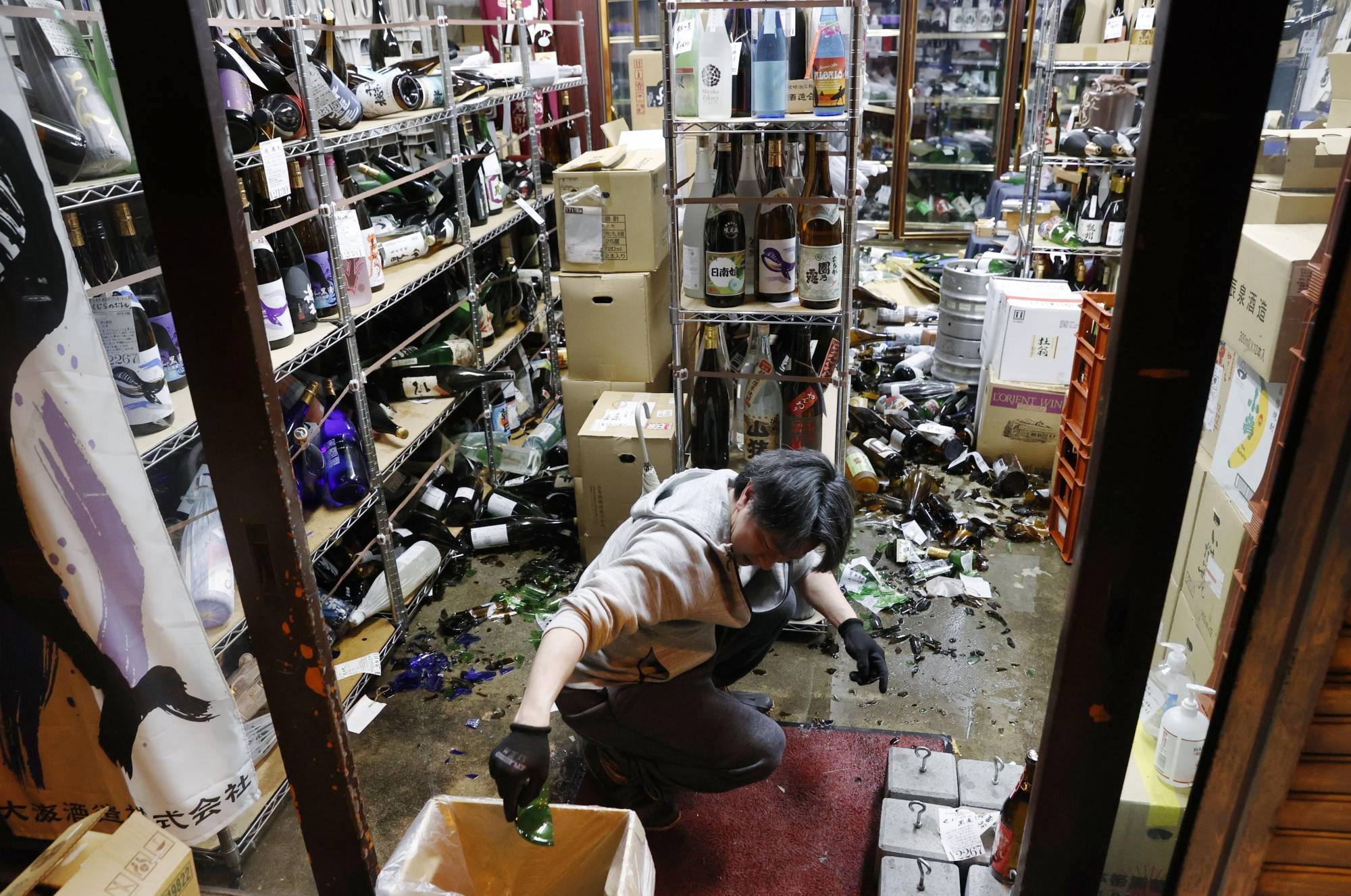
February 13, 2021
A powerful magnitude 7.3 earthquake, which measured a strong 6 on the Japanese seismic intensity scale — the second-highest level — jolted Miyagi and Fukushima prefectures in the Tohoku region late Saturday night. No tsunami warning was issued.
Local authorities in Miyagi and Fukushima prefectures reported a total of at least 20 people injured.
Nationwide, at least 950,000 homes were without power as of midnight, top government spokesman Katsunobu Kato said at a news conference. Kato added later that several power plants were offline.
The quake, which was also felt in Tokyo, where it registered a 4 on the Japanese scale, struck at around 11:08 p.m., according to the Meteorological Agency. The epicenter was off the coast of Fukushima, about 220 kilometers (135 miles) north of Tokyo. Its focus was estimated to be at a depth of about 60 kilometers.
At a news conference early Sunday morning, a Meteorological Agency official said aftershocks of up to a strong 6 on the Japanese scale could occur for at least a week. The official said Saturday’s quake was believed to be an aftershock of the Great East Japan Earthquake that struck the same region on March 11, 2011.
“Because (the 2011 quake) was an enormous one with a magnitude of 9.0, it’s not surprising to have an aftershock of this scale 10 years later,” said Kenji Satake, a professor at the University of Tokyo’s Earthquake Research Institute.
The quake registered a strong 6 in the southern part of Miyagi, and in the Nakadori central and Hamadori coastal regions of Fukushima, the agency said.
Power outages were reported in parts of Fukushima, Miyagi, Iwate, and Tochigi prefectures, according to media reports. Tokyo Electric Power Company Holdings reported blackouts across several prefectures as of early Sunday morning.
No abnormalities have been found at the Fukushima Nos. 1 and 2 nuclear power plants, according to Tokyo Electric Power. The same was true for Japan Atomic Power Co.’s inactive Tokai No. 2 nuclear power plant in the village of Tokai in Ibaraki Prefecture and Tohoku Electric Power Co.’s Onagawa nuclear plant in Miyagi Prefecture, according to their operators.
Following the quake, JR East temporarily halted operations of its Tohoku, Joetsu and Hokuriku shinkansen lines. Power outages occurred on some sections. A landslide had covered a section of the Joban Expressway in Soma, Fukushima Prefecture, officials said, but no vehicles were found to be trapped.
Horizontal shaking lasted for a few minutes inside a traditional inn in Minamisoma, Fukushima Prefecture, with plates for food scattered in its dining room.
“The initial jolt felt more powerful than the one I experienced in the Great East Japan Earthquake,” said Tomoko Kobayashi, 68, who works at the inn. “I wondered if it would end.”
After the 7.1 quake, many smaller earthquakes with magnitudes between 3 and 5 occurred off Fukushima.
Prime Minister Yoshihide Suga immediately directed government agencies to assess damage, rescue any potential victims, work with municipalities and provide necessary information about any evacuation plans and damage as soon as possible. The government was setting up a task force to examine the quake.
Defense Minister Nobuo Kishi directed the Self-Defense Forces to gather information on the scope of the damage and be prepared to respond immediately.
The quake, which comes less than a month before the 10th anniversary of the Great East Japan Earthquake, registered a 4 on the Japanese scale as far north as Aomori Prefecture and as far west as Shizuoka Prefecture. It was the strongest quake in the region since April 7 that year, the meteorology agency said.
https://www.japantimes.co.jp/news/2021/02/14/national/earthquake-fukushima/
1 This Month

of the week – Shut Down Drone Warfare!


Tell the Ukrainian Government to Drop Prosecution of Peace Activist Yurii Sheliazhenko

Petition to revoke the licensing of the Near Surface Nuclear Disposal Facility (NSDF) at Chalk River. https://www.ourcommons.ca/petitions/en/Petition/Details?Petition=e-7247
To see nuclear-related stories in greater depth and intensity – go to https://nuclearinformation.wordpress.com
-
Archives
- April 2026 (34)
- March 2026 (251)
- February 2026 (268)
- January 2026 (308)
- December 2025 (358)
- November 2025 (359)
- October 2025 (376)
- September 2025 (257)
- August 2025 (319)
- July 2025 (230)
- June 2025 (348)
- May 2025 (261)
-
Categories
- 1
- 1 NUCLEAR ISSUES
- business and costs
- climate change
- culture and arts
- ENERGY
- environment
- health
- history
- indigenous issues
- Legal
- marketing of nuclear
- media
- opposition to nuclear
- PERSONAL STORIES
- politics
- politics international
- Religion and ethics
- safety
- secrets,lies and civil liberties
- spinbuster
- technology
- Uranium
- wastes
- weapons and war
- Women
- 2 WORLD
- ACTION
- AFRICA
- Atrocities
- AUSTRALIA
- Christina's notes
- Christina's themes
- culture and arts
- Events
- Fuk 2022
- Fuk 2023
- Fukushima 2017
- Fukushima 2018
- fukushima 2019
- Fukushima 2020
- Fukushima 2021
- general
- global warming
- Humour (God we need it)
- Nuclear
- RARE EARTHS
- Reference
- resources – print
- Resources -audiovicual
- Weekly Newsletter
- World
- World Nuclear
- YouTube
-
RSS
Entries RSS
Comments RSS
 nuclear-news