S. Korea imports 400 tons of Fukushima goods
SEOUL, Sept. 19 (Yonhap) — South Korea has imported over 400 tons of foods grown with radiation exposure in Fukushima, Japan, over the past six years, a South Korean opposition lawmaker said Monday, despite local consumers’ worries over contamination.
A total of 407 tons of goods from the region were brought into the country, said Choi Do-ja of the main opposition Minjoo Party of Korea, citing data of the Korea Food and Drug Administration (KFDA) submitted to the National Assembly.
A devastating earthquake off the east coast of Japan and a subsequent tsunami in 2011 led to the meltdown of nuclear reactors there, sparking worries among South Korean consumers that Japanese-produced goods, especially fishery products, have been contaminated with radiation.
By products, processed fishery goods stood as the top product with 233 tons, followed by mixed products with 51 tons and candy with 41 tons, the data showed.
The South Korean government currently sends back unsafe products from the region after screening them for cesium and iodine.
“Our people think that the government should more sternly limit imported foods from Japan despite the Seoul government’s stance that food from Fukushima is relatively safe following strict quarantine,” Choi said.
Despite the increased exports, industry watchers said the public anxiety over Japanese fishery goods still exists. In 2015, local authorities rounded up owners of 70 stores that deceived consumers on the origins of Japanese fishery products.
http://english.yonhapnews.co.kr/news/2016/09/19/0200000000AEN20160919008100320.html
High-level Post-traumatic Stress Symptoms of the Residents in Fukushima Temporary Housing: Bio-psycho-social lmpacts by Nuclear Power Plant Disaster
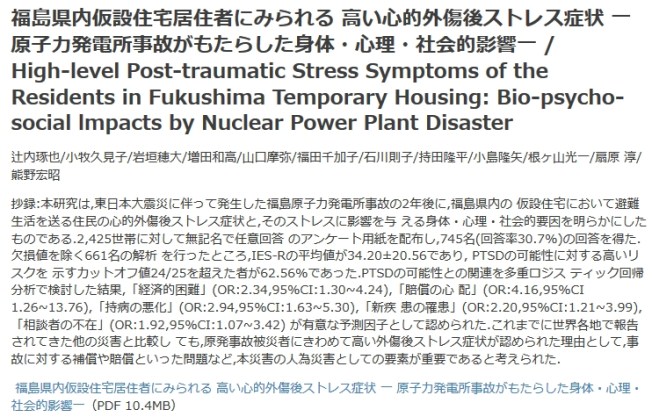
Takuya Tsujiuchi, Kumiko Komaki, Takahiro lwagaki, Kazutaka Masuda, Maya Yamaguchi, Chikako Fukuda, Noriko Ishikawa, Ryuhei Mochida, Takaya Kojima, Koichi Negayama, Atsushi Ogihara, Hiroaki Kumano
Backgrounds: Fukushima nuclear power plant disaster occurred following the Great East Japan Earthquake on March 11,2011. It bears comparison with the incident in Chernobyl in 1986 in the degree of radiological contamination to the surrounding environment.164,218 residents were displaced losing their home-land by this serious incident, of which 97,321 were relocated to other regions within the Fukushima prefecture, and 57,135 residents were relocated to other prefectures. The evacuees from Fukushima can be considered the largest number of internally displaced persons’ or ‘domestic refugees’ in Japan after the world war two.
Objective:This study investigated the scale of post-traumatic stress(PTS)symptoms in the evacuees as of two years after the Fukushima nuclear power plant disaster. It also tried to identify the impact of bio-psycho-social factors related to PTS symptoms.
Samples and methods:Questionnaire survey was conducted by Waseda University and Japan Broadcasting Corporation(NHK). 2,425 households living at temporary housings within Fukushima prefecture were asked to answer the Impact of Event Scale-Revised(IES-R)and the self-report questionnaires that we generated in order to evaluate the damage by the disaster in relation to several bio-psycho-social factors in refugee lives. There were 745 replies(the cooperation rate;30.7%),of which 661 were analyzed. Besides, multiple logistic regression analysis was performed to examine several bio-psycho-social factors as predictors for probable PTSD.
Results:High level PTS symptoms were found. The mean score of IES-R was 34.20±20.56, and 62.56%were over 24/25 cut-off point determined as broadly defined PTSD which means high-risk presence of probable PTSD. The significant differences by chi-square test of high-risk subjects were found among economic difficulty (P=.000), concerns about compensation (p=.000), lost jobs (p=.023), unsatisfying housing (p=.025), unsatisfying environment around temporary housing (p=.000), having chronic disease (p=.003), aggravation of chronic disease (p=.000), affection of new disease (p=.000), lack of necessary information (p=.000), family split-up (prO31), and lack of acquaintance support (p=.000). By the result of multiple logistic regression analysis, the significant predictors of probable PTSD were economic difficulty (OR:2.34,95%CI:1.30-4.24), concerns about compensation (OR:4.16,95% CI 1.26-13.76), aggravation of chronic disease (OR:2.94,95%CI:1.63-5.30), affection of new disease (OR:2.20,95%CI:1.21-3.99), and lack of acquaintance support (OR:1.92,95%CI:1.07-3.42).
Conclusion:The findings revealed that there is a high-risk presence of probable PTSD strongly related to a number of bio-psycho-social factors due to the nuclear power plant disaster and its consequent evacuation. Our findings underscore the specific characteristics of the nuclear disaster as man-made disaster. Since the socio-economic problems such as compensation and reparation have not been solved, it is suggested that prolonged uncertainty regarding the insufficient salvation of the evacuees might account for the high-level PTS symptoms.
(Received August 9,2015;accepted January 9,2016)
Fukushima unveils grand plan for alternative energy transmission line networks
A public-private sector consortium tasked with promoting alternative energy in Fukushima Prefecture will start building new power transmission networks next fiscal year.
The consortium, made up of central government agencies, the Fukushima Prefectural Government and electric power companies, met on Sept. 7. It formulated a plan to make the prefecture staggered by 2011 mega-quake, tsunami and nuclear disaster a pioneer in clean energy.
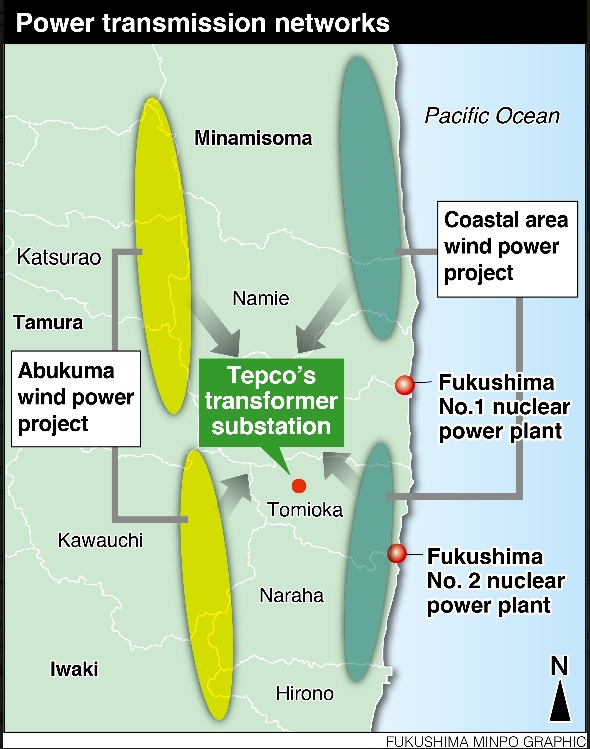
The prefecture has announced plans to create two new wind power generation zones.
The coastal zone, which is close to Tokyo Electric Power Co. Holdings Inc.’s crippled Fukushima No. 1 nuclear plant, encompasses the cities and towns of Minamisoma, Namie, Futaba, Okuma, Tomioka, Naraha and Hirono.
The other is the inland Fukushima Abukuma zone, covering Tamura and the villages of Kawauchi and Katsurao. Together, the zones are expected to be among the biggest bases for wind power in Japan.
But due to the lack of power transmission lines in the mountains of Abukuma, operators have dragged their feet on the project.
According to the plan, private-sector companies, as well as Tepco and Tohoku Electric Power Co., will set up a new company tasked with building, maintaining and running power transmission lines. Construction will be financed by the Ministry of Economy, Trade and Industry, which has requested ¥10 billion for the project in fiscal 2017 budget.
The METI subsidy is expected to make it easier for private-sector firms to join the project, as they will not have to make huge capital investments. It is also hoped the project will generate new industries and jobs.
Fukushima Prefecture will start to study the areas where new power lines can be built, with plans to begin construction in fiscal 2017.
The transmission lines will be used to send both wind and solar power by connecting four power generation facilities in the Hama-dori coastal area and the Abukuma mountains with a transformer substation in the town of Tomioka.
The power generated will be used not only in Fukushima, but also in the Tokyo metropolitan area. The consortium hopes to start transmitting power by 2020, when Tokyo hosts the Olympic and Paralympic Games.
The total length of the transmission lines is projected to be around 100 km, most of which will be buried under roads. The project will also use existing transmission lines that connect Tepco’s Fukushima No. 2 nuclear plant with the transformer substation.
The prefecture, which plans to have renewable energy sources cover all its energy needs by 2040, as opposed to around 20 percent as of 2009, is surveying the best sites for wind power production.
The prefecture plans to pick the operators for the wind project in the Abukuma area at the end of this fiscal year. But it has yet to find firms willing to participate in the coastal project.
In Fukushima, A Bitter Legacy Of Radiation, Trauma and Fear
Five years after the nuclear power plant meltdown, a journey through the Fukushima evacuation zone reveals some high levels of radiation and an overriding sense of fear. For many, the psychological damage is far more profound than the health effects.
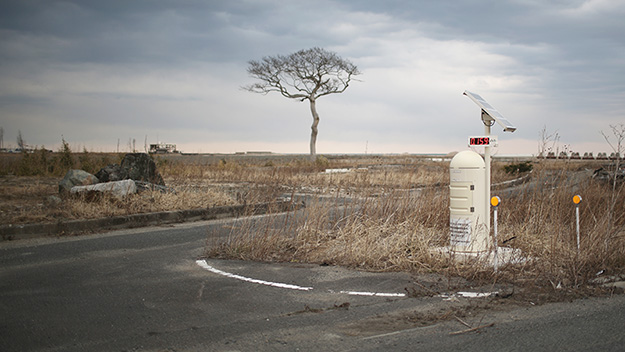
A radiation monitoring station alongside a road in Namie, Japan.
Japan’s Highway 114 may not be the most famous road in the world. It doesn’t have the cachet of Route 66 or the Pan-American Highway. But it does have one claim to fame. It passes through what for the past five years has been one of the most radioactive landscapes on the planet – heading southeast from the Japanese city of Fukushima to the stricken nuclear power plant, Fukushima Daiichi, through the forested mountains where much of the fallout from the meltdown at the plant in March 2011 fell to earth.
It is a largely empty highway now, winding through abandoned villages and past overgrown rice paddy fields. For two days in August, I traveled its length to assess the aftermath of the nuclear disaster in the company of Baba Isao, an assemblyman who represents the town of Namie, located just three miles from the power plant and one of four major towns that remain evacuated.
At times, the radiation levels seemed scarily high – still too high for permanent occupation. But radiation was just the start. More worrying, I discovered, was the psychological and political fallout from the accident. While the radiation – most of it now from caesium-137, a radioactive isotope with a half-life of 30 years – is decaying, dispersing, or being cleaned up, it is far from clear that this wider trauma has yet peaked. Fukushima is going to be in rehab for decades.
I began my journey with Baba, a small bustling man of 72 years, at Kawamata, a town on Highway 114 that is a gateway to the mountains beyond. These mountains are where the fallout was greatest, and the forests that cover most of their slopes have retained the most radioactivity. The mountains make up most of the government-designated “red zone,” where radiation doses exceed 50 millisieverts a year and which are likely to remain uninhabited for many years.
A second “yellow zone” has doses of 20-50 millisieverts, where returning may soon be possible; and a third “green zone,” with less than 20 millisieverts, is deemed safe to live in, and an organized return is under way or planned. Zones are re-categorized as radioactivity decays and hotspots are decontaminated.
To check progress, I took with me a Geiger counter that measured gamma radiation, the main source of radiation for anyone not eating contaminated food.
Beyond Kawamata, the road was largely empty and houses sat abandoned and overgrown. There was no cellphone signal. At first, houses we measured at the roadside had radiation doses equivalent to only around 2 millisieverts per year, a tenth of the government threshold for reoccupation. But within minutes, as we climbed into the mountains, radiation increased as we moved from green to yellow to red zones.
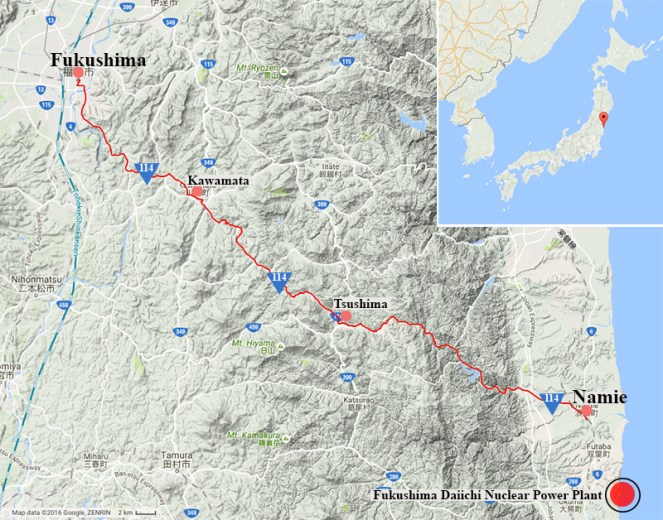
A map tracing Japan’s Highway 114 through the Fukushima evacuation zone
Despite the radiation, wildlife is thriving in the absence of people, Baba said. There are elk, wolves, lynx, monkeys, and bears in the mountains. “Nature here is beautiful,” he said, “but we can’t fish or collect bamboo shoots or eat the mountain vegetables that people used to harvest from the forests.”
We stopped by an abandoned gas station in Tsushima, a village in the lee of Mount Hiyama, where wild boar had excavated the soil right by a vending machine that appeared remarkably intact. The bright-red digital display on an official Geiger counter read the equivalent of 21 millisieverts per year, just above the limit for human habitation.
The day after the disaster at the power plant began, 1,400 people from Namie came to Tsushima after being ordered to evacuate. “I was among them,” said Baba. “We had no information. People were just told to come. When we arrived, we went to the village police station and found that the police there were in full protective clothing against the radiation. They said it was a precaution in case they had to go to the power plant, but they had obviously been told that something serious was going on that the population hadn’t been told. That’s when our suspicion about the honesty of the authorities began.”
Tsushima has since become an unofficial shrine to the disaster. In the window of an abandoned shop are posters with bitter, ironic messages, some directed at the nuclear plant’s operator, Tokyo Electric Power: “Thanks to TEPCO, we can shed tears at our temporary housing,” read one. “Thanks to TEPCO, we can play pachinko.” But one, in English, just said, “I shall return.”
Back on Highway 114, a car stopped, and a woman got out. Konno Hidiko was driving to Namie – day trips are allowed, but overnight stays banned – to clean her parents’ former house and tidy an ancestral grave before relatives visited during an upcoming religious holiday. “My parents are dead now, but I still clean their house,” she said. “There are mice inside and wild boar have been in. We won’t ever return to live there. But we might build a new house there one day.”
Further along, Baba stopped the car and walked up a path swathed in vegetation. “This is my house,” he said suddenly, pointing to a barely visible building. It was shuttered. But I noticed laundry still hanging to dry in an upstairs window. On a tour of the grounds, Baba showed me his plum trees. “The fruit is too dangerous to eat now, and we can’t drink the water from the well, either.” We found a shed where he and his schoolteacher wife once kept cattle, and a former hay shed where he stored old election banners.
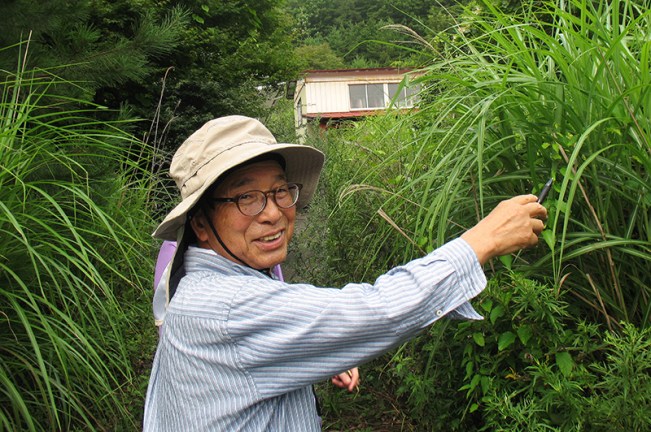
Baba Isao approaches his abandoned house in Namie.
I checked my meter. It read 26 millisieverts per year in the hay shed, but shot up to an alarming 80 in undergrowth outside. That was four times the safe level for habitation. No wonder Baba had no plans to return. “I am just the son of a farmer. I wonder who has a right to destroy our home and my livelihood,” he mused bitterly. “Please tell the world: No Nukes.”
At his local post office, an official monitor by the road measured 56 millisieverts. Mine agreed, but when we pointed it close to a sprig of moss pushing through the tarmac, it went off the scale. “They measured 500 millisieverts here last week,” Baba said. “Moss accumulates radioactivity.”
As we drove on, the roadside was now marked every few kilometers by massive pyramids of black plastic bags, containing radioactive soil that had been stripped from roadside edges, paddy fields, and house gardens as part of government efforts to decontaminate the land. An estimated 3 million bags, all neatly tagged, now await final disposal at facilities planned along the coast. But the task of transporting the soil is so huge that the authorities are building a new road so trucks can bypass the scenic mountain villages along Highway 114.
Through a checkpoint we came at last to Namie town. Just before my visit, major media such as The Guardian and CNN had published images of the town by a photographer who claimed to have gained secret, unauthorized entry to the “ghost town.” He posed in his images wearing a gas mask to show how dangerous it was.
My visit to the town had required a request in advance, via Baba, but no subterfuge. And I found Namie a surprisingly busy “ghost town.” Nobody is yet allowed to live there. But some 4,000 people work there every day, repairing the railway line and roads, building new houses, and knocking down quake-damaged shops, preparing for the planned return of its citizens in April 2017.
There was plenty of earthquake damage, and vegetation pushed through cracks in the roads and the pavement in the front yards. Black bags were everywhere. But the traffic lights functioned, and drivers obeyed them; there was a 7-Eleven and the vending machines had Coke in them. Nobody wore protective clothing or masks. My biggest safety concern was not radiation, but the news, conveyed over the town’s public address system on the afternoon I was there, that a bear had been spotted in the suburbs.
Despite its proximity to the power plant, average radiation levels in the town were down to around 2 millisieverts per year in Namie – lower, in fact, than I recorded in Fukushima City, which was never evacuated.
“I have no idea how many people will come back,” said Baba. “They have a lot of misgivings because of the radioactive contamination. And I think their fears are totally justified. It is totally unthinkable for me to return to my old place, so I cannot encourage them to return to theirs.” He quoted a survey of the town’s 21,000 former residents showing that only 18 percent wanted to come back. That sounded similar to nearby Naraha town, where only a fifth returned after the all-clear was given last year.
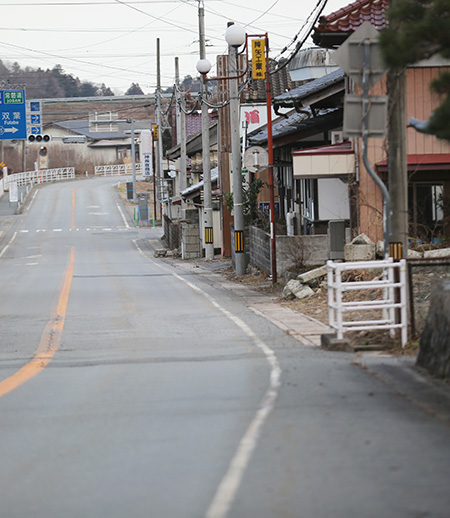
A deserted street in Namie in early 2016.
People especially feared for their children. The biggest concern was reports of an epidemic of thyroid cancer among children exposed to radioactive iodine in the days after the accident. An ultrasound screening program had found an apparent 30-fold increase in cysts, nodules, and some cancers in children’s thyroid glands. It had made headline news.
But at the Fukushima Medical University, doctors and medical researchers insisted that radiation doses were far too low to pose a serious cancer risk, not least because contaminated foodstuffs that could have harbored the iodine were rapidly withdrawn from sale. Ken Nollet, an American who is director of radiation health at the university, insists that the apparent epidemic was evidence only of better searching for disease. He told me a Korean screening study using the same techniques on a non-exposed population found similar rates to those in Fukushima’s contaminated zone.
Thanks to the rapid, if chaotic, evacuation of the area after the power plant began its meltdown, and the controls of foodstuffs, doctors say they believe there are unlikely to be many, if any, deaths among the public from radiation from the Fukushima accident. “A few members of the public got a CT scan’s worth of radiation; almost nobody received more than the dose from a barium meal,” said Nollet.
But there have been deaths nonetheless. Some 60 old people died as a direct result of the evacuation, including several who died of hunger after being left behind, said a doctor at Soma hospital, Sae Ochi. And depression remains widespread among evacuees, she says. There have been around 85 suicides linked to its after-effects. “It’s post-traumatic stress,” said Masaharu Maeda at Fukushima Medical University. “People with very negative views about the risks of radiation are more likely to be depressed. It’s a vicious circle.”
Some doctors told me that while the initial evacuation was necessary, the failure to plan a swift return as radiation levels fell had been disastrous. Apart from a few high-dose areas in the mountains, the psychological risks of staying away exceed the radiological risks of coming back. But the confusion has contributed to a serious loss of trust among the public for medical, as well as nuclear, authorities. “When we try to explain the situation,” says Nollet, “we are seen as complicit in nuclear power.”
It seems increasingly unlikely that the majority of families will return to the abandoned towns as the official all-clear is given. As we drove back from Namie, I dropped in on a group of old women living in an evacuation camp outside Kawamata. One told me they wanted to return to their old homes, but that “most young people simply won’t go back. They fear for their children, but also they have moved on in their lives, with new jobs and their children in new schools.”
And maybe that is not a bad thing. At a kindergarten in Soma City, just outside the exclusion zone, teachers told me that, away from the fear of radiation, there was a baby boom going on there. The crop of new students this year was the largest since the accident.
http://e360.yale.edu/feature/fukushima_bitter_legacy_of_radiation_trauma_fear/3035/
6th Citizen-Scientist International Symposium on Radiation Protection Date: Friday, October 7 – Monday, October 10, 2016
From the Reality of Chernobyl and Fukushima
Date: Friday, October 7 – Monday, October 10, 2016
Venue: Main Hall, Fukushima Gender Equality Centre 1-196-1 Kakunai, Nihonmatsu, Fukushima, 964-0904
The Citizen-Scientist International Symposium on Radiation Protection (CSRP), a politically, financially, ideologically and religiously independent non-profit organization, has been committed to keeping to minimum the damages on health and environment caused by the Tokyo Electric Fukushima Daiichi Nuclear Power Plant disaster that followed the Great East Japan Earthquake and Tsunami in March 11, 2011.
CSRP has been inviting administrative officials, researchers, NGOs, member experts of governmental inquiry commissions and international organizations working on radiation protection, etc. Since around the 3rd CSRP, this approach has started to bear fruit, because scientists and other stakeholders with different positions and paradigms began to share the same table of discussion, thus gradually making possible constructive exchange of views.
In the course of this approach, however, we began to encounter a new challenge that may concern the premise of the CSRP; the deeper we got into scientific discussion, the higher the hurdle for participation got for the general public, especially for younger generations. Also, the diversity of voices were to be alienated from pointed scientific discussions that are decisive for the decision-making of the radiation protection of the general public. This lead us to some interrogations : “Isn’t ‘science’ given too much importance in decision-making?”; “Is ‘science’ the only way for citizens to bring today’s situation under their power?”
While always continuing to examine new scientific findings with respect to health, environmental and social impacts of low-dose exposure, we added the theme of “Between Art and Science” to the 5th symposium last year, exposed various art works inspired by nuclear power and nuclear disasters, and organized a panel discussion with artists and scientists. This was the CSRP’s new attempt to question “science” and “scientificity” with a view to reexamining the relationships between science, art and philosophy before and after the modernity. The 6th CSRP of this year, held in the city of Nihonmatsu, Fukushima Pref., will collaborate with the Institute of Regional Creation by Arts, the University of Fukushima, to cosponsor the Fukushima Biennale 2016. We hope this new attempt will bring new visions to the participants.
As a place to learn and make full use of new findings exploring the effects of low-dose radiation exposure accumulating day by day, and to think together about the rights of people facing the consequences of the nuclear accident and about what epidemiology and public health should do in order to minimize the damage, we open the 6th Citizen-Scientist International Symposium on Radiation Protection.
Photos show nuclear tragedy’s toll on pets
“They never came back because the radiation levels were too high. The animal rescue teams knew the animals were abandoned and left there, so they had three weeks to go in there to find them,” said O’Connor, who added that farm animals usually had to be euthanized.

Akira Honda, founder of Nyander Guard Animal Rescue, shows photos of animals left behind in the aftermath of the 2011 earthquake, tsunami and nuclear disaster in Japan. The photos are on display at Ventura County Animal Services’ Camarillo shelter.
Shortly after the Fukushima Daiichi nuclear disaster in 2011 in Japan, nearby residents were immediately evacuated from their homes because of the risk of radiation exposure. They were forced to leave their animals behind.
Akira Honda, nicknamed Taicho, immediately raced to the disaster area from his hometown six hours away to help, and realized the need for an animal shelter near the radiation-contaminated exclusion zone.
A month later, Taicho established the Nyander Guard Animal Rescue about 25 miles away.
Photos of the animal rescue operation in Japan are being exhibited until Tuesday at the Ventura County Animal Services shelter in Camarillo. A fundraiser is also being held for the continued care of animals at Nyander Guard.
Taicho toured the no-kill Camarillo shelter, met with Camarillo Mayor Mike Morgan and shared his story with visitors to the shelter on Saturday.
Visitors to the exhibit have an opportunity to donate to Nyander Guard, which has rescued 740 dogs and cats and currently cares for more than 200 animals.
Kerry O’Connor, a Nyander Guard volunteer from Camarillo who now lives in Japan, helped bring the photo exhibit to the Camarillo shelter. Some of the photos of animals with severe injuries are too graphic and are kept in a separate notebook that can still be viewed.
O’Connor went to Japan to volunteer after the nuclear disaster that followed an earthquake and tsunami. She said residents in Fukushima were assured they’d be back at home after a day or so, so they left their animals.
“They never came back because the radiation levels were too high. The animal rescue teams knew the animals were abandoned and left there, so they had three weeks to go in there to find them,” said O’Connor, who added that farm animals usually had to be euthanized.
“A lot of people were scared but realized saving the animals was the right thing to do,” said O’Connor, who translated for the Japanese-speaking Taicho.
She said the rescued dogs and cats had been exposed to radiation.
“But unless you had a really high dosage in a short amount of time, it really does not affect them until about 30 years later, and they don’t live that long,” O’Connor said.
Taicho had a cat rescue operation before he started Nyander Guard.
At Nyander Guard, cats are able to roam in cat rooms, while bigger dogs have spacious kennels and smaller dogs are kept indoors. The dogs are walked twice a day and sometimes taken on trips to parks.
Although five years have passed since the disaster, the shelter still rescues and feeds abandoned animals in the restricted areas, which are becoming extremely hard to enter.
In addition to Nyander Guard, Taicho recently acquired another shelter that aided in rescuing the Fukushima animals, which tripling the staff’s work.
His goal is to make Japan a place where animals shelters are no-kill and to start a national protection organization.
http://www.vcstar.com/story/news/2016/09/17/photos-show-nuclear-tragedys-toll-pets/90376664/
Study on the impact of the Fukushima Nuclear Accident On Animals:
(Adobe. 64pg. PDF.)
Information about malformations of fetus and abortions in Fukushima
This video is from April 9, 2016, 6 months ago.
Two evacuated women from Fukushima talk about their experiences. One of them gives information about malformations of fetus and abortions.
With English subtitles which are not great but you can follow the story.
Long-term stays start in Tomioka
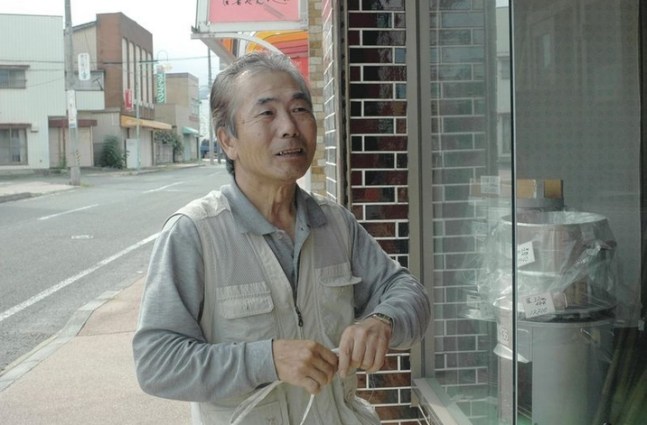
Shizuo Suzuki stands in front of his shop in Tomioka, Fukushima Prefecture, on Wednesday, with the empty shopping street visible in the background.
TOMIOKA, Fukushima — Long-term stays (see below) for residents of Tomioka, Fukushima Prefecture, started on Saturday. Evacuation orders for the town limits issued after the accident at Tokyo Electric Power Company Holdings, Inc.’s Fukushima No.1 nuclear power plant still stand.
The success of the project will hinge on how many residents the town can get back, with a view to having the evacuation orders lifted in April next year.
Shizuo Suzuki, 63, who resumed business 2½ years ago on a shopping street in the town’s Chuo district, which is part of a zone people are allowed to enter during the daytime, is hoping for some of the bustle of the town to return.
Suzuki’s hardware shop is on Chuo shopping street, which is on the west side of the JR Joban Line’s Tomioka Station. Suzuki took over the shop, which was established in 1952, after his father died in 1998. Before the 2011 Great East Japan Earthquake, the shop mainly dealt with materials such as cement, gravel and reinforced steel, supplying local building companies.
Although the earthquake didn’t do much damage to the shop, the nuclear plant accident which followed forced Suzuki and his 58-year-old wife to move out. After they drifted around various places in Fukushima Prefecture, including a gymnasium in Kawauchi, a neighboring village to the west of Tomioka, and a home of their relatives in Aizuwakamatsu, they finally settled in Iwaki.
Entering Tomioka became easier when the government eased regulations in 2013. The area around Suzuki’s shop was designated a residence restriction zone, making it possible for him to resume business there.
Suzuki, who was then working part-time at a construction company in Iwaki, decided to go back to his shop in January 2014. Although he did not know how many customers would come, he was looking forward to working in his hometown again.
“I wanted to stay positive and uphold my sense of purpose in life,” he said. Commuting from Iwaki, he cleaned up the shop and resumed business in March 2014, after decontamination of the area was complete.
Suzuki still commutes to Tomioka from Iwaki, which takes about an hour each way by car. The shop is open from 9 a.m. to 3 p.m. Five or six workers involved in decontamination work or building demolition in the neighborhood visit the shop daily and purchase items such as shovels, crowbars and ropes. As Suzuki’s shop is the only one to have resumed business in the area, the bustle of the shopping street has not yet returned.
According to the municipal government, shops that have reopened other than Suzuki’s are limited to convenience stores and gas stations. The town plans to open a commercial facility, publicly funded and privately operated, that includes a home-improvement center and restaurants at the end of November, for long-term-stay residents and in preparation for the lifting of evacuation orders.
“Streets will come back to life as people start returning for long stays. I hope other shops will resume business too,” Suzuki said. He had his home next to the shop demolished as it had decayed while he was away. He intends to rebuild his house and live in the town when other residents start to return.
■ Long-term stay
In anticipation of the lifting of evacuation orders, registered residents are allowed to stay in their houses to find out what problems they may face when they return to the town. The number of registered residents in Tomioka, Fukushima Prefecture, as of July 12 was 9,679 from 3,860 households. According to the central government, 119 residents from 56 households have applied for long-term stays as of Thursday.
Burning debris from Fukushima
Local government officials, rather than objectively scientifically determine whether it was safe or not for the people just accepted the central government political decision to have debris from Fukushima brought and burned in many municipalities and prefectures throughout Japan.
As a result not only the Fukushima people have inhaled radioactive nanoparticles, but also many other people in other locations.
The map below, from year 2012, shows locations where Fukushima debris was burned then, it was really spread all over Japan during the first 3 years, 2011, 2012, 2013.

Today incineration of Fukushima debris continues in 19 locations in Fukushima prefecture…

… and some of the Eastern Japan prefectures.
http://blog.goo.ne.jp/flyhigh_2012/e/1c0f117cf0b30ab535f2e74a4534ee3d
Radioactive Food And Water The New Normal In Japan
“We forget that the water cycle and the life cycle are one.” — Jacques Cousteau
“When drinking water, remember its source.” — Chinese proverb
“Ye shall know them by their fruits. Do men gather grapes of thorns, or figs of thistles?
Even so every good tree bringeth forth good fruit; but a corrupt tree bringeth forth evil fruit.
A good tree cannot bring forth evil fruit, neither can a corrupt tree bring forth good fruit.
Every tree that bringeth not forth good fruit is hewn down, and cast into the fire.
Wherefore by their fruits ye shall know them.” — Matthew 7:16-20, Holy Bible
Japan has an amazing food culture thanks in part to the rich volcanic soil and ample rainfall, despite the lack of spacious farms. As it stands, Japan can feed approximately one third of its population from domestic production.
If you watch Japanese TV from time to time, you will see a bizarre and disturbing fetishization of food that borders on the insane. The media and in turn consumers are obsessed with food as not only a source of nutrition and social cohesion (all for the good), but as art, fashion and status symbol, a celebration of gluttony and greed; an infantile obsession with eating for self satisfaction.
I love good and healthy food and appreciate Asian cuisine, but we eat to live, not live to eat. This social pathology affects other cultures as well as seen by increasing rates of extreme obesity especially in Western countries due to the proliferation of shopping malls, junk food and high fructose corn syrup.
How ironic then that a “high food” society like Japan would have to suffer the insult of radioactive contamination. This is not a tuna melt sandwich but a nuclear melt-down sundae.
The long-term consequences of the Fukushima nuclear disaster continue to linger years after the event. Anyone who studies Chernobyl will know that even after three decades radioactive contamination persists. Although a different type of accident occurred there, in the case of Fukushima it was three reactors that had meltdowns instead of one, and even possibly “melt throughs” referring to corium penetrating the reactor buildings in lateral and vertical outward paths.
In the days and months that followed the Fukushima disaster in March of 2011, many people became very worried about radioactive contamination of the food and water supply, especially from short-lived iodine isotopes, followed by the more persistent and harmful cesium, strontium and plutonium. There was much testing by both the government and independent researchers and organizations. Despite the best efforts of the Japanese government, nuclear industry and mainstream media to downplay the crisis, social media proved helpful in educating the public about how to reduce consumer risks.
The worst contamination occurred nearest the disaster site of the Fukushima No. 1 nuclear power station (Dai-ichi) which is located about half way up the east coast in Fukushima prefecture.
When I visited Hirano town with my colleague Yoichi Shimatsu in 2013, we traveled on foot within a few kilometers of the site. We observed abnormally high levels of radiation making it unfit for long-term habitation. Decontamination has taken place there but it is not a thorough removal method and basically shifts radiation from one spot to another in the environment.
Today, if you visit the Japanese government website of the Nuclear Regulation Authority (1) you can find a variety reports on radiation levels with most reports citing very low levels of radiation. How the government arrives at such measurements is not clearly explained at the website. Are their measurements reliable or being taken in a selective manner?
The government hopes to normalize the former evacuation zone by allowing and encouraging residents to move back as soon as possible, despite their reluctance to do so.
Only 28% of Fukushima children returning to former schools….
The majority of schoolboys and girls are opting to stay out of their hometowns due to anxiety over radiation exposure and resettlement at evacuation sites (2).
The problem of radioactive contamination is not unique to Fukushima but to the entire region including Tokyo, home of millions. Recall that 60 million people were originally exposed to radioactive fallout from the accident. Japan was actually lucky because the majority of radiation blew out to sea away from Honshu, not back over the population.
While the government moves to allow wide-scale fishing off the coast of Fukushima (3), and the NRA reports minimal levels of radiation leaking from the plant into the ocean, this confidence in a safe environment is undermined by a report from Greenpeace which found “[r]adiation along Fukushima rivers up to 200 times higher than Pacific Ocean seabed.”
Riverbank sediment samples taken along the Niida River in Minami Soma, measured as high as 29,800 Bq/kg for radiocaesium (Cs-134 and 137). The Niida samples were taken where there are no restrictions on people living, as were other river samples. At the estuary of the Abukuma River in Miyagi prefecture, which lies more than 90km north of the Fukushima Daiichi plant, levels measured in sediment samples were as high as 6,500 Bq/kg (4).
The rivers and ocean are connected and one wonders why the media does not report on these worrying hotspots. These dangerously high levels are indicative of the widely scattered hotspots in the region. In contrast, I could find no reports on the radiation levels at river banks and lake beds at the NRA website, only some reports on radiation found in dust, seawater and so on.
For example, one 2014 report states:
Air dose rates in both “Road and its adjacent area” and “Vacant land lot” have decreased more rapidly than we expected considering the physical half-life of radionuclide in 32 months after the accident. Air dose rates in “Road and its adjacent area” have decreased more rapidly than “Vacant land lot” in 32 months after the accident (5).
The Culture Of Cover Up: Spiked!
A few months ago I was shopping at my health food store in central Tokyo when I was asked by the clerk if I would like to be interviewed by a TV reporter from the Asahi News. I said “sure why not.” Japanese TV often has “man on the street” types of interviews and if you put the shop in a good light, you might appear in a news “infomercial.”
The reporter asked me various questions about why I buy organic food and I spoke proficiently in Japanese about the positive benefits of eating organic food including its superior nutrition and flavor, and because it contributes to the local farm economy.
But I shocked the guy at this point when I bluntly stated that due to the radioactive contamination from Fukushima nuclear disaster, I prefer to buy food produced from as far away as possible, never from the northeast or Tokyo regions of Japan. Food from the west and far southwest of Japan has substantially less radioactive contamination.
I’m not sure if the reporter was even aware of the issue, being a “news reporter” you think he might have been. But it was clear from his reaction that this was a one hundred percent taboo topic. Perhaps because I was a foreigner I was perceived as rude and barbaric for raising it, and I knew ahead of time that by mentioning this my interviewed would not be aired, and it wasn’t.
In fact, after the 3/11 accident my regular health food shop very noticeably shifted the origin of their produce away from the northeast and Tokyo and toward the west, southwest of Japan due to consumer concerns. As for the Asahi News who are an arm of the Abe Propaganda Establishment (APE), Fukushima must only be presented to the public as a pristine location whose products are reliable and safe. A recent study reported:
According to the agriculture ministry, 260,538 food items were inspected in fiscal 2015, and 99 percent of farm products had cesium of less than 25 becquerels per kilogram. The tests showed that 264 items, or 0.1 percent of the total, had cesium exceeding the upper limit. Of these, 259 — or 98 percent — were wild mushrooms, game meat, freshwater fish and other so-called “hard-to-control items” (6).
According to this official data, small numbers of becquerels could be – probably are – routinely entering the general food supply, not to mention the issue of Tokyo’s persistently contaminated water supply which contains minute amounts of cesium.
Radiation is the new normal.
Although the majority of food is under 25 bq per kg of contamination, we don’t know the exact amount. If you multiply that small amount by the number of items consumed daily the danger to health grows exponentially over time.
It is good that Japan has strict standards on radioactive food products — the US allows 1,500 becquerels per kilogram versus Japan’s 100 — but the ubiquitous and long-term aspect of the problem is an ongoing concern.
Richard Wilcox is a contributing editor and writer for the book: Fukushima: Dispossession or Denuclearization? (2014) and a Tokyo-based teacher and writer who holds a PhD in environmental studies. He is gratefully a periodic contributor to Activist Post.
References
1 – Nuclear Regulation Authority
http://radioactivity.nsr.go.jp/en/
2 – Only 28% of Fukushima children returning to former schools
http://mainichi.jp/english/articles/20160910/p2a/00m/0na/001000c
3 – 83 species now eligible for test fishing off coast of Fukushima
http://www.asahi.com/ajw/articles/AJ201609110002.html
4 – Radiation along Fukushima rivers up to 200 times higher than Pacific Ocean seabed – Greenpeace
http://www.greenpeace.org/international/en/press/releases/2016/Radiation-along-Fukushima-rivers-up-to-200-times-higher-than-Pacific-Ocean-seabed—Greenpeace/
5 – Monitoring air dose rates in road/its adjacent area and vacant land lot from a series of surveys by car-borne radiation detectors and survey meters after the Fukushima Daiichi NPS accident
https://www.nsr.go.jp/data/000067236.pdf
6 – 0.1% of food items exceed radiation limit 5 1/2 years after nuke disaster
http://mainichi.jp/english/articles/20160909/p2a/00m/0na/023000c
http://www.activistpost.com/2016/09/radioactive-food-water-new-normal-japan.html
Fan club formed to promote Fukushima produce
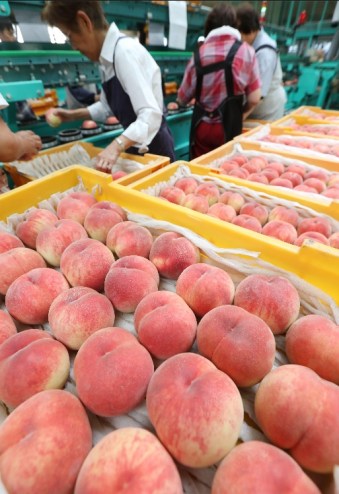
Nearly 5½ years after the 2011 Great East Japan Earthquake, a fan club was launched last week with an ambitious membership goal: gain 200,000 members by 2020 and boost the region’s products in the process.
Called Team Fukushima Pride, the project’s fans aren’t devoted to a pop idol group, but instead the local specialties of Fukushima Prefecture.
Already it has the support of organizations such as Yahoo Japan Corp. and Synergy Marketing Inc., which runs the fan club for professional baseball team Tokyo Yakult Swallows.
“Many people want to support Fukushima products but don’t know how to purchase them. I would like to organize a community for them and increase fans,” reconstruction minister Hiroaki Nagasawa, whose ministry spearheads the project, said.
At the heart of the project is a website that sells local products.
Hayato Ogasawara, spokesman for Fukushima Challenge Hajimeppe, an organization tasked with running the fan club and website, said the time of begging people to buy Fukushima products is over. Instead, the focus is to make Fukushima a brand of high-quality farm and marine produce.
“Rather than stressing the safety of the products, we want to inform people simply how great producers and products” in Fukushima are, said Ogasawara.
He said since the disaster the prefecture has been working to assure the safety of its local produce.
“We don’t conduct our own (radiation) checks on the products, but if asked we would explain the efforts of the prefecture,” he said.
Although many people supported Fukushima products in 2011 in the wake of the quake and tsunami, and subsequent radiation crisis at Tokyo Electric Power Company Holdings Inc.’s Fukushima No. 1 nuclear power plant, Ogasawara said sales figures have declined as a result of what he describes as the spread of misinformation about food safety, and due to diminished public focus on the area.
The Fukushima Prefectural Government continues to monitor radiation levels of the prefecture’s food products, ranging from vegetables and fruit to seafood. Among the 9,445 samples of 374 food items checked between April 1 and Aug. 31, just three samples were found to contain radioactive cesium exceeding the government limit of 100 becquerels per kilogram, according to the prefecture. The items that exceeded the limit were banned from distribution.
“The market value of peaches grown in Fukushima is roughly 80 percent of the price levels before the disaster,” Ogasawara said.
“It’s easy to beat the price down if the product is made in Fukushima. Our mission is to bring the price up and eventually develop fan bases for each producer there.”
Available for purchase are fruit, vegetables, sake and traditional crafts produced in the prefecture.
While the website allows anyone to make purchases, fan club members also have access to exclusive items.
Admission is free, and members are also offered opportunities to interact with Fukushima farmers through a special Facebook group and harvesting tours.
“After the disaster, I felt what we farmers could do by ourselves (was) very limited,” said Emi Kato, 35, a rice farmer in the city of Fukushima, who is involved in the project.
“But now there is a platform, which connects farmers and consumers. I’d like to keep on promoting the charm of Fukushima products.”
In Fukushima, a Determination to Move Past Nuclear Power
Local governments are making progress on their goal of generating all of the prefecture’s power from renewable sources by 2040
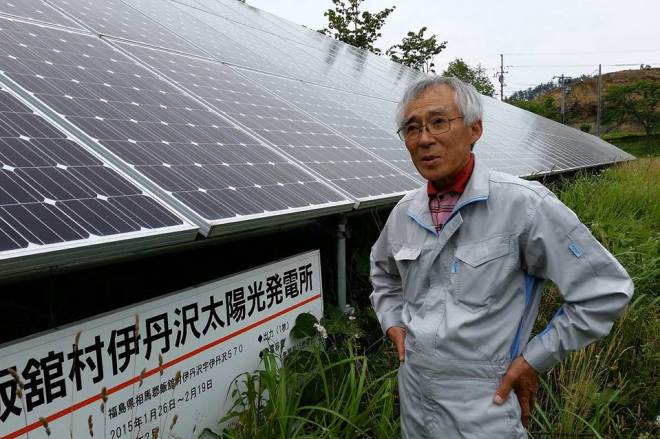
Cattle farmer Minoru Kobayashi has built solar arrays on land that can’t be used for farming
IITATE, Japan—Many residents of Fukushima prefecture are still angry about the nuclear disaster five years ago that contaminated towns, farm fields and forests. But as the cleanup continues, local governments and some business owners here are channeling their frustration into something positive: clean-energy development.
Fukushima prefecture, about 150 miles (240 kilometers) north of Tokyo and roughly the size of Connecticut, was the site of the devastating meltdown of the Daiichi nuclear-power plant following an earthquake and tsunami in March 2011. Since then, most of Japan’s 50-plus nuclear plants, which were shut down after the accident for a safety review, have remained off line.
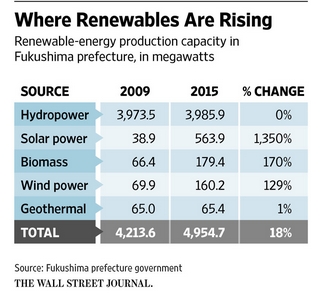
Determined to move away from nuclear energy permanently, local governments in Fukushima, as well as some local entrepreneurs, have taken advantage of national subsidies and embraced solar and wind power. Even as Japan’s overall move toward renewables appears to be stalling amid resistance from utilities and cheap fossil-fuel imports, the prefecture has made progress on its goal of generating 100% of the power its residents use from green sources by 2040.
New solar, wind and geothermal power generators, combined with Fukushima’s already abundant supply of hydropower, have boosted the share of renewable energy in the prefecture’s total power supply to more than one-quarter from one-fifth in 2009. By comparison, renewables made up just 14% of Japan’s overall energy production in the year ended in March.
Fukushima wants a “zero nuclear” power supply, says government spokesman Norihiro Nagao.
Among the business owners who have jumped into the fray is Minoru Kobayashi, 64, who ran a cattle farm about 25 miles inland from the Daiichi plant before the accident. Radioactive contamination forced him and his family to evacuate, along with their cattle, and the government tore down the family’s home and everything else within a 20-meter radius of the house.
Left with fields that couldn’t be used for farming, Mr. Kobayashi, along with a group of local farmers and investors, built four 50-kilowatt solar arrays on their land and plan to build 12 more by the end of next year. The group is selling power to the local utility at prices set by the government and expects to turn a profit by the end of this year. (The company signed power contracts with the local utility when prices were between 27 and 32 yen (26 to 31 cents) a kilowatt-hour. The current rate is 24 yen a kilowatt-hour.)
Mr. Kobayashi says solar power represents more than just a business opportunity to him and his partners. “We welcome renewable energy as a protest to the nuclear power plant,” says Mr. Kobayashi.
Elsewhere, Yauemon Sato, who ran his family’s 226-year-old sake brewery for more than two decades, started the solar-power developer Aizu Electric Power Co. in Fukushima in 2013 with a group of friends and local business associates. The company has built 21 small and medium-size solar arrays and a one-megawatt solar farm in northern Fukushima. He says the new clean-energy businesses will create jobs and boost the economy.
“We started this company as part of a social-justice movement,” Mr. Sato says.
Some business owners are even hoping renewable energy will become a tourist attraction.
In Tsuchiyu Onsen, a resort area known for its natural hot springs and proximity to national parks, local hotel owners joined forces to build a 400-kilowatt geothermal power generator and a small hydroelectric generator.
It has become a new selling point for the resort area, says Katsuichi Kato, 68, president of Genki Up Tsuchiyu Co. “There are many other hot springs towns,” he says. “We had to create a new industry: renewable energy tourism.”
http://www.wsj.com/articles/in-fukushima-a-determination-to-move-past-nuclear-power-1473818580
Fukushima Backlash Hits Japan Prime Minister
Nuclear power may never recover its cachet as a clean energy source, irrespective of safety concerns, because of the ongoing saga of meltdown 3/11/11 at Fukushima Daiichi Nuclear Power Plant. Over time, the story only grows more horrific, painful, deceitful. It’s a story that will continue for generations to come.
Here’s why it holds pertinence: As a result of total 100% meltdown, TEPCO (Tokyo Electric Power Company) cannot locate or remove the radioactive molten core or corium from the reactors. Nobody knows where it is. It is missing. If it is missing from within the reactor structures, has it burrowed into the ground? There are no ready answers.
And, the destroyed nuclear plants are way too radioactive for humans to get close enough for inspection. And, robotic cameras get zapped! Corium is highly radioactive material, begging the question: If it has burrowed thru the containment vessel, does it spread underground, contaminating farmland and water resources and if so, how far away? Nobody knows?
According to TEPCO, removing the melted cores from reactors 1,2 and 3 will take upwards of 20 years, or more, again who knows.
But still, Japan will hold Olympic events in Fukushima in 2020 whilst out-of-control radioactive masses of goo are nowhere to be found. TEPCO expects decades before the cleanup is complete, if ever. Fortunately, for Tokyo 2020 (the Olympic designation) radiation’s impact has a latency effect, i.e., it takes a few years to show up as cancer in the human body.
A week ago on September 7th, Former PM Junichiro Koizumi, one of Japan’s most revered former prime ministers, lambasted the current Abe administration, as well as recovery efforts by TEPCO. At a news conference he said PM Shinzō Abe lied to the Olympic committee in 2013 in order to host the 2020 Summer Olympics in Japan.
“That was a lie,” Mr Koizumi told reporters when asked about Mr Abe’s remark that Fukushima was “under control,” Abe Lied to IOC About Nuke Plant, ex-PM Says, The Straits Times, Sep 8, 2016. The former PM also went on to explain TEPCO, after 5 years of struggling, still has not been able to effectively control contaminated water at the plant.
According to The Straits Times article: “Speaking to the IOC in September 2013, before the Olympic vote, PM Abe acknowledged concerns but stressed there was no need to worry: “Let me assure you, the situation is under control.”
PM Abe’s irresponsible statement before the world community essentially puts a dagger into the heart of nuclear advocacy and former PM Koizumi deepens the insertion. After all, who can be truthfully trusted? Mr Koizumi was a supporter of nuclear power while in office from 2001-2006, but he has since turned into a vocal opponent.
Speaking at the Foreign Correspondents Club of Japan in Tokyo, Mr Koizumi said: “The nuclear power industry says safety is their top priority, but profit is in fact what comes first… Japan can grow if the country relies on more renewable energy,” (Ayako Mie, staff writer, Despite Dwindling Momentum, Koizumi Pursues Anti-Nuclear Goals, The Japan Times, Sept. 7, 2016).
Mr Koizumi makes a good point. There have been no blackouts in Japan sans nuclear power. The country functioned well without nuclear.
Further to the point of nuclear versus nonnuclear, Katsunobu Sakurai, mayor of Minamisoma, a city of 70,000 located 25 km north of Fukushima No. 1 nuclear plant, at a news conference in Tokyo, said: “As a citizen and as a resident of an area affected by the nuclear power plant disaster, I must express great anger at this act… it is necessary for all of Japan to change its way of thinking, and its way of life too – to move to become a society like Germany, which is no longer reliant on nuclear power,” (Sarai Flores, Minamisoma Mayor Sees Future for Fukushima ‘Nonnuclear’ City in Energy Independence, The Japan Times, March 9, 2016).
In March of 2015, Minamisoma declared as a Nonnuclear City, turning to solar and wind power in tandem with energy-saving measures.
Meanwhile, at the insistence of the Abe administration, seven nuclear reactors could restart by the end of FY2016 followed by a total of 19 units over the next 12 months (Source: Japanese Institute Sees 19 Reactor Restarts by March 2018, World Nuclear News, July 28, 2016).
Greenpeace/Japan Discovers Widespread Radioactivity
One of the issues surrounding the Fukushima incident and the upcoming Olympics is whom to trust. Already TEPCO has admitted to misleading the public about reports on the status of the nuclear meltdown, and PM Abe has been caught with his hand in the proverbial cookie jar, but even much worse, lying to a major international sports tribunal. His credibility is down the drain.
As such, maybe third party sources can be trusted to tell the truth. In that regard, Greenpeace/Japan, which does not have a vested interest in nuclear power, may be one of the only reliable sources, especially since it has boots on the ground, testing for radiation. Since 2011, Greenpeace has conducted over 25 extensive surveys for radiation throughout Fukushima Prefecture.
In which case, the Japanese people should take heed because PM Abe is pushing hard to reopen nuclear plants and pushing hard to repopulate Fukushima, of course, well ahead of the 2020 Tokyo Olympics since there will be events held in Fukushima Prefecture. After all, how can one expect Olympians to populate Fukushima if Japan’s own citizens do not? But, as of now to a certain extent citizens are pushing back. Maybe they instinctively do not trust their own government’s assurances.
But, more chilling yet, after extensive boots-on-the-ground analyses, Greenpeace issued the following statement in March 2016: “Unfortunately, the crux of the nuclear contamination issue – from Kyshtym to Chernobyl to Fukushima- is this: When a major radiological disaster happens and impacts vast tracts of land, it cannot be ‘cleaned up’ or ‘fixed’.” (Source: Hanis Maketab, Environmental Impacts of Fukushima Nuclear Disaster Will Last ‘decades to centuries’ – Greenpeace, Asia Correspondent, March 4, 2016).
That is a blunt way of saying sayonara to habitation on radioactive contaminated land. That’s why Chernobyl is a permanently closed restricted zone for the past 30 years.
As far as “returning home” goes, if Greenpeace/Japan ran the show rather than PM Abe, it appears they would say ‘no’. Greenpeace does not believe it is safe. Greenpeace International issued a press release a little over one month ago with the headline: Radiation Along Fukushima Rivers up to 200 Times Higher Than Pacific Ocean Seabed – Greenpeace Press Release, July 21, 2016.
Here’s what they discovered: “The extremely high levels of radioactivity we found along the river systems highlights the enormity and longevity of both the environmental contamination and the public health risks resulting from the Fukushima disaster,” says Ai Kashiwagi, Energy Campaigner at Greenpeace Japan.
“These river samples were taken in areas where the Abe government is stating it is safe for people to live. But the results show there is no return to normal after this nuclear catastrophe,” claims Kashiwagi.
“Riverbank sediment samples taken along the Niida River in Minami Soma, measured as high as 29,800 Bq/kg for radiocaesium (Cs-134 and 137). The Niida samples were taken where there are no restrictions on people living, as were other river samples. At the estuary of the Abukuma River in Miyagi prefecture, which lies more than 90km north of the Fukushima Daiichi plant, levels measured in sediment samples were as high as 6,500 Bq/kg” (Greenpeace).
The prescribed safe limit of radioactive cesium for drinking water is 200 Bq/kg. A Becquerel (“Bq”) is a gauge of strength of radioactivity in materials such as Iodine-131 and Cesium-137 (Source: Safe Limits for Consuming Radiation-Contaminated Food, Bloomberg, March 20, 2011).
“The lifting of evacuation orders in March 2017 for areas that remain highly contaminated is a looming human rights crisis and cannot be permitted to stand. The vast expanses of contaminated forests and freshwater systems will remain a perennial source of radioactivity for the foreseeable future, as these ecosystems cannot simply be decontaminated” (Greenpeace).
Still, the Abe administration is to be commended for its herculean effort to try to clean up radioactivity throughout Fukushima Prefecture, but at the end of the day, it may be for naught. A massive cleanup effort is impossible in the hills, in the mountains, in the valleys, in the vast forests, along riverbeds and lakes, across extensive meadows in the wild where radiation levels remain deadly dangerous. Over time, it leaches back into decontaminated areas.
And as significantly, if not more so, what happens to the out-of-control radioactive blobs of corium? Nobody knows where those are, or what to do about it. It’s kinda like the mystery surrounding black holes in outer space, but nobody dares go there.
Fukushima is a story for the ages because radiation doesn’t quit. Still, the Olympics must go on, but where?
http://www.counterpunch.org/2016/09/12/fukushima-backlash-hits-japan-prime-minister/
83 species now eligible for test fishing off coast of Fukushima
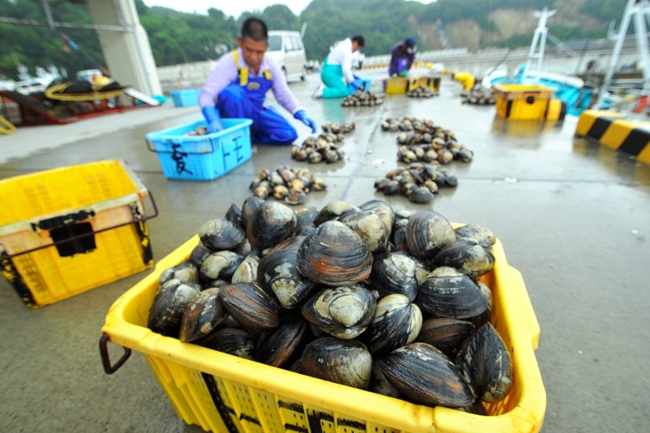
These surf clams, seen here in June at Hisanohama Port in Iwaki, Fukushima Prefecture, were caught during test fishing.
IWAKI, Fukushima Prefecture–Ten species were added to the list of catches eligible for test fishing off the coast of Fukushima Prefecture, but lingering concerns about radiation are keeping sales of such marine products low.
Still, the latest additions, which include the Japanese flounder, the white-spotted conger eel and the spotted halibut, have encouraged fishermen who have been struggling to rebuild their lives since the Fukushima nuclear disaster started in March 2011.
The Fukushima Prefectural Federation of Fisheries Cooperative Associations on Aug. 25 added the 10 species to bring the total number eligible for test fishing to 83. The additions were approved during a meeting in Iwaki of the prefectural council for the rebuilding of regional fisheries.
“I think the 83 fish species accounted for about 70 percent of our pre-disaster hauls,” said Tetsu Nozaki, president of the prefectural fisheries federation. “I am placing particularly high hopes for a great boost in the value of our catches from the resumed fishing of Japanese flounder.”
Test fishing for flounder started on Sept. 2.
The Soma-Futaba fisheries cooperative association, which is part of the prefectural federation, plans to resume catches of white-spotted conger eel in September. But the Iwaki city fisheries cooperative association has decided to wait until water temperatures are low enough to ensure freshness of the white-spotted conger eel.
Test fishing has expanded because the environment of the sea has significantly improved since the initial impact of the nuclear disaster. Radioactivity levels in fish caught there now stably remain within the safety limit for many species.
Despite extensive testing to ensure safety of Fukushima marine products, many dealers are still reluctant to buy the species.
Fish and shellfish from Fukushima Prefecture are being shipped to various parts of Japan, such as the Tohoku, Kanto, Chubu and Hokuriku regions. Prices of seafood items from Fukushima Prefecture are not much lower than those from other prefectures, according to Yoshiharu Nemoto, head of the fishing ground environment division with the Fukushima Prefectural Fisheries Experimental Station.
Yet few dealers are bidding for Fukushima marine products. If this trend continues with more Fukushima fish reaching the market, unsold leftovers from the prefecture could start to pile up and project a negative image, Nemoto said.
“It will become more necessary than ever to make publicity efforts, such as regularly releasing data concerning safety,” he said.
Test fishing began in June 2012, 15 months after the Great East Japan Earthquake and tsunami caused the triple meltdown at the Fukushima No. 1 nuclear power plant. Initially, only three species were covered: two kinds of octopuses and one type of shellfish.
While coverage has since expanded in stages, the latest addition of 10 species at one time is second only to the addition of 12 species, including brown sole and red sea bream, in August 2015.
Since April 2011, the Fukushima prefectural government has been monitoring the impact of radioactive fallout from the Fukushima No. 1 nuclear plant on fish and shellfish. The radiation tests, which cover about 200 samples every week, have so far been conducted on 38,000 samples of 184 species.
The concentration of radioactive cesium initially exceeded the central government’s safety limit of 100 becquerels per kilogram in most of the fish and shellfish surveyed. But the concentration has declined from year to year, and no sample has exceeded the safety limit since April 2015.
In more than 90 percent of the samples tested in July 2015 and later, radioactivity levels were below the detection limit.
Radioactivity levels in fish caught near the Fukushima No. 1 nuclear plant are also falling.
The central government’s Japan Fisheries Research and Education Agency (FRA) on Aug. 25 released data on radioactivity levels in Japanese flounder caught in July in waters around the crippled nuclear plant.
The FRA said its high-precision tests, with a lower limit of detection set at a mere 1 becquerel per kg, found radioactivity levels of less than 10 becquerels per kg in all 41 individual organisms tested. More than 90 percent of them measured less than 5 becquerels per kg.
Catches from test fishing have continued to grow: 122 tons in 2012, 406 tons in 2013, 742 tons in 2014 and 1,512 tons in 2015.
But last year’s catch was only 5.8 percent of the annual catch of 26,050 tons averaged over the decade preceding the 2011 disaster.
Fishermen are holding out high hopes for more fish species being eligible for catches.
Only 28% of Fukushima children returning to former schools
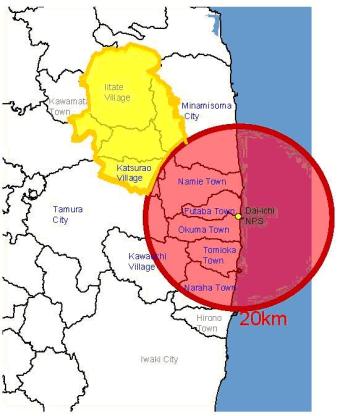
Only 28 percent of children are returning to their public elementary and junior high schools in five towns and villages in Fukushima Prefecture following the lifting of evacuation orders imposed after the 2011 nuclear disaster, the Mainichi Shimbun has learned. The majority of schoolboys and girls are opting to stay out of their hometowns due to anxiety over radiation exposure and resettlement at evacuation sites.
The trend raises concerns that the number of young people in these towns and villages will dwindle and the survival of the municipalities is at stake.
The five municipalities are the towns of Hirono and Naraha and the villages of Iitate, Kawauchi and Katsurao. They set up temporary elementary and junior high schools at evacuation sites after the March 2011 earthquake and tsunami disaster triggered the multiple core meltdowns at the Fukushima No. 1 Nuclear Power Plant. Hirono and Kawauchi reopened their public schools in 2012 and Naraha and Katsurao will follow suit in April 2017. Iitate plans to reopen its schools in April 2018, one year after the evacuation order is lifted.
Once these public schools have reopened, the temporary schools at evacuation sites are shut down, prompting children from the five affected municipalities to choose one of three options — return to their hometowns, commute to their former schools by school bus or other means, or attend schools at evacuation sites.
According to the Mainichi study, 55 percent of 259 pupils and students from Hirono and Kawauchi have returned to their former elementary and junior high schools because the evacuation orders were relatively short. But only 139 students or 15 percent of students from Naraha, Katsurao and Iitate responded to a survey in 2015-2016 that they would return to their original schools. Only three students, or 4 percent, of 74 students from Katsurao said they would return to their hometown schools.
As for students from Naraha, 17 percent of students replied that they would attend their hometown schools but half of them hoped to commute to their hometown schools from outside the town. If young evacuees in Iwaki, a major evacuation destination, try to commute by train and bus, a one-way trip takes one hour. An official of the Naraha board of education expressed concerns that these students are really serious about commuting to their hometowns. A Kawauchi village official says that the returns of child-rearing generations are the village’s lifeline. These municipalities operate school buses to encourage the evacuees to return to their hometowns as a stopgap measure rather than as a permanent solution.
Yusuke Yamashita, an associate professor of urban and rural sociology at Tokyo Metropolitan University, says, ”There are some parents who send their children to temporary schools before eventually returning to their hometowns. If these municipalities reopen their schools hastily, some families may abandon plans to return home (out of safety fears). It is important for the communities to offer as many options as possible by keeping temporary schools.”
http://mainichi.jp/english/articles/20160910/p2a/00m/0na/001000c
1 This Month
19 February – VIRTUAL EVENT-Decision Time: AI and Our Nuclear Arsenal
12:45 p.m. Central / 1:45 p.m. Eastern
To see nuclear-related stories in greater depth and intensity – go to https://nuclearinformation.wordpress.com
-
Archives
- February 2026 (181)
- January 2026 (308)
- December 2025 (358)
- November 2025 (359)
- October 2025 (376)
- September 2025 (258)
- August 2025 (319)
- July 2025 (230)
- June 2025 (348)
- May 2025 (261)
- April 2025 (305)
- March 2025 (319)
-
Categories
- 1
- 1 NUCLEAR ISSUES
- business and costs
- climate change
- culture and arts
- ENERGY
- environment
- health
- history
- indigenous issues
- Legal
- marketing of nuclear
- media
- opposition to nuclear
- PERSONAL STORIES
- politics
- politics international
- Religion and ethics
- safety
- secrets,lies and civil liberties
- spinbuster
- technology
- Uranium
- wastes
- weapons and war
- Women
- 2 WORLD
- ACTION
- AFRICA
- Atrocities
- AUSTRALIA
- Christina's notes
- Christina's themes
- culture and arts
- Events
- Fuk 2022
- Fuk 2023
- Fukushima 2017
- Fukushima 2018
- fukushima 2019
- Fukushima 2020
- Fukushima 2021
- general
- global warming
- Humour (God we need it)
- Nuclear
- RARE EARTHS
- Reference
- resources – print
- Resources -audiovicual
- Weekly Newsletter
- World
- World Nuclear
- YouTube
-
RSS
Entries RSS
Comments RSS
 nuclear-news