The Japanese government’s plan to build intermediate storage facilities for radioactive waste from the 2011 nuclear accident is set to move ahead, now that the candidate sites have accepted the plan.
The government wants to build facilities for storing contaminated soil and debris on a 16-square-kilometer site straddling the towns of Futaba and Okuma in Fukushima Prefecture. The 2 towns host the damaged Fukushima Daiichi nuclear plant.
Okuma accepted the plan last month. The mayor of Futaba made the same decision on Tuesday in Iwaki city, where most of the town’s residents have evacuated.
Those in favor of accepting the intermediate storage facilities say they will help speed up decontamination efforts in the region.
But others cite the risk of the intermediate facilities becoming permanent unless the government fulfills its promise to dispose of nuclear waste outside the prefecture.
The government plans to continue purchase negotiations with the site’s landowners. It is also working out safety arrangements with the prefecture and the 2 towns for the transportation of radioactive waste to the facilities.
Futaba Mayor Shiro Izawa said acceptance of the government’s plan is an unavoidable part of accelerating post-disaster rebuilding.
“No, nothing. I have nothing planned for New Year’s. Nothing at all. No one is coming.” A shy, round-faced woman spat these words like darts into the protective mask she wore. Moments earlier she had been laughing happily together with several other former residents of the small town of Tomioka as they reminisced about a friend they all knew. She quickly became raw, however, when asked about the coming holidays.
Tomioka counted 15,839 residents before the March 11, 2011 nightmare of earthquake, tsunami, and nuclear explosion began. All but one person has left — Matsumura Naoto, the now well-known rice farmer who refuses to abandon his family’s fifth-generation farm.
Confusion and despair among the others is common, a state of existence that government officials bewilderingly made even worse on March 25, 2013 when they divided the roughly 25-square-mile seaside spot into three zones: never to return, return for short periods, and in preparation to return. Government-sponsored scientists determined such divisions here and in other areas near the nuclear plant based on so-called acceptable annual dosage rates. Such designations may make surreal sense in scientific terms. In daily life, however, it means streets separated down the middle, one side “safe” while houses around the corner are condemned for tens of thousands of years to come.
All involved understand that the official designations are of critical significance in terms of compensation. If your property was anywhere but “never to return” you won’t be paid for much longer. Less appreciated is how such nuances taken together are playing out among those on the verge of their fourth winter in limbo.
Life in Internal Exile
Many of the former residents of Tomioka are now living 25 miles to the west in the rural town of Miharu, famous for its 1,000-year-old cherry tree. Miharu currently houses about 2,000 people of a total of nearly 140,000 officially classified as “displaced” by the crisis. The term “nuclear refugee” is out. All are lumped together as one. Yet those permanently shut out of their former lives since the Fukushima Daiichi power plant spiraled into meltdown include some who have been in as many as 10 shelters in three-and-a-half years.
On a recent afternoon a small group of Tomioka’s forever “displaced” villagers gathered to talk in a brightly lit common room hidden among twenty or so rows of tightly spaced sand-colored buildings that have been subdivided into small rooms for couples and individuals mainly in their sixties and seventies. A younger man in his fifties stood out. Before the crisis, his business supplied lunches for workers at the nuclear power plant. Vibrant and seemingly able to go anywhere, he is trapped by rules that among other things prevent him from living in Tomioka yet allow him several times a week to visit his beloved dachshund Chocolat, whom he refuses to leave to die.
Many of the displaced still believed in the possibility of return up to a few months ago. The group’s mayor Matsumoto-san no longer sees such a resolution. “If only they had told me then, told me that we wouldn’t be able to go back, I could have taken my family and moved to Aomori (in northern Japan), and we would be together,” he said. He was sharing what many express as the worst of it: families torn apart, children and grandchildren now living scattered throughout Japan and rarely if ever visiting. The shelters offer small, attached units, yet there is little open space, and certainly no land to farm. Freshly painted signs on the streets point to the housing units and appear welcoming, yet those inside say they know they are “in the way” and that “after a while you understand they don’t want you anymore.”
A Lottery Winner
One woman had a surprise for the others. “I’m so sorry I didn’t tell you before,” she began, perhaps taking advantage of the two strangers in the mix to break her news. “I applied to the (housing) lottery, and I’m sorry to tell you that I won. I’m very sorry. In a few weeks I’ll move away to a permanent unit. It isn’t much. I know I had a better chance because I’m on my own. I hope you’ll forgive me.”
Some might reduce these words to cultural essentialisms, yet a powerfully unprocessed atmosphere filled the room. The thin sense of community was yet again torn asunder, and while a few wished her luck — she had been in six different shelters before this — the rest gradually looked as if they would be sick and said nothing. Another woman fought off tears.
The newly published housing policy appears under the awkward slogan in Japanese and English — “Future From Fukushima” — and reveals itself for what it has been from the beginning: make it up as it goes along. Tiny details drive home the point. Even if you’re fortunate enough to win a permanent place and you manage to survive for more than 11 years, you’ll start having to pay rent.
The woman who won did not know this, nor did anyone fill her in if they did. She would escape to a place to call home this winter. Meanwhile, some among the others would become part of a sad statistic, one of the only clear facts to come out since March 2011. More people have died from stress-related causes than from the initial disasters in Fukushima.
Alexis Dudden is a professor of history at the University of Connecticut, a contributor to Foreign Policy In Focus, and the author of Troubled Apologies Among Japan, Korea, and the United States (Columbia University Press, 2008).
The Foreign Ministry will help local governments tear down overseas barriers on food imports maintained because of worries over radiation, sources said.
Some states still ban some imports of agricultural, forestry and fishery products because of the fear of contamination from Tokyo Electric Power Co.’s Fukushima No. 1 nuclear plant. As a result, the ministry will cooperate with local governments in organizing events overseas to assure regulators and consumers that products are safe.
In 2015, the ministry plans to hold two to three such events, the sources said Sunday.
Unfounded rumors are a matter of life and death for municipalities where agriculture, fisheries or forestry are key industries.
The ministry said 13 countries, including Canada and Vietnam, have lifted import restrictions imposed after the accident on agricultural, forestry and fishery products from affected areas, but nine economies including South Korea, Singapore and Taiwan still have bans.
South Korea bans marine products from prefectures such as Miyagi and Fukushima.
Many countries also implement some kind of import control, such as requiring safety certificates.
When the ministry holds the events abroad, it will give assistance through embassies, aiming to allay concerns among local companies and media organizations.
A senior ministry official said the support for local governments boils down to wanting to disseminate correct information and to sell Japan’s attractions.
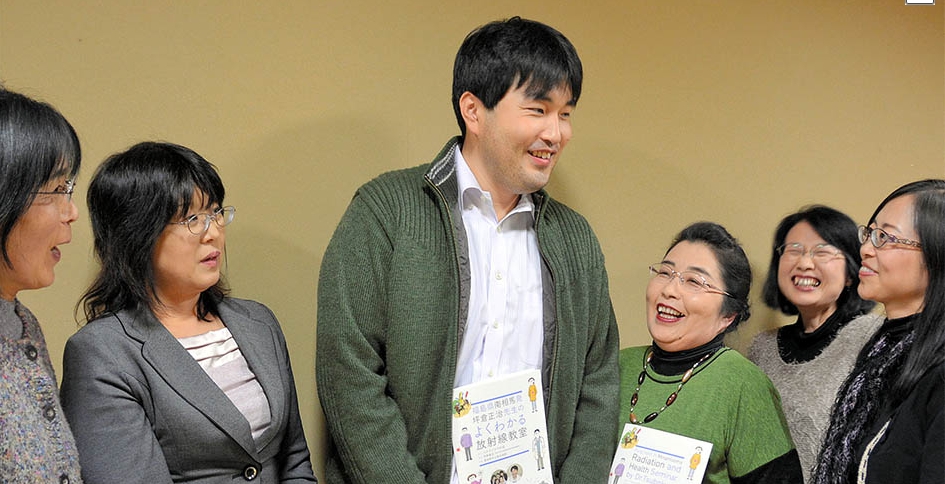
Masaharu Tsubokura, center, and the members of the Veteran Mothers’ Society in Minami-Soma, Fukushima Prefecture
December 29, 2014
MINAMI-SOMA, Fukushima Prefecture–Mothers living near the stricken Fukushima No. 1 nuclear plant have compiled a booklet offering basic knowledge about radiation and explanations addressing safety concerns arising from the disaster.
The booklet, titled “Yoku Wakaru Hoshasen Kyoshitsu” (Radiation and Health Seminar), is available in both Japanese and English and was created by the Veteran Mothers’ Society, which consists of five mothers from the city of Minami-Soma.
The members, some of whom are former high school classmates, decided to create the booklet “for children’s sake.”
The information incorporates lessons learned from doctors at seminars the group organized following the accident at Tokyo Electric Power Co.’s Fukushima No. 1 nuclear plant in March 2011.
Amid the confusion and fears over radiation after the disaster unfolded, the mothers convened their first seminar for children and guardians in December 2011. They invited Masaharu Tsubokura, a doctor of hematology from the University of Tokyo’s Institute of Medical Science who had been providing consultations at the Minami-Soma municipal general hospital.
Other physicians later joined the effort to spread accurate information about radiation, and the mothers have held the sessions once or twice a month.
In the seminars, the children peppered Tsubokura with questions, such as “Can I touch my pets?” and “Is it OK to lick the snow?”
Ikumi Watanabe, the society’s 54-year-old vice chairwoman, recalled that Tsubokura’s explanations “were spoken in an easy-to-understand manner so the information popped straight into our heads. It was nice that we could talk with him on the same level and in person.”
Even now, the nature of the questions has not changed much.
“People have felt pressured not to talk about radiation, and some mothers have finally gotten the information only now, more than three years after the accident,” Tsubokura said. “I hope I can help them make decisions without thinking negatively about themselves or losing their self-confidence.”
In addition to basic knowledge, such as the differences between external and internal radiation exposure and between becquerels and sieverts, the booklet answers questions like: “Can radiation be transmitted from one person to another?” and “Is the tap water OK?”
According to the Veteran Mothers’ Society, 20,000 copies of the Japanese version were distributed to schools, companies and other organizations. The English version has been ordered by international schools, international exchange organizations and other groups.
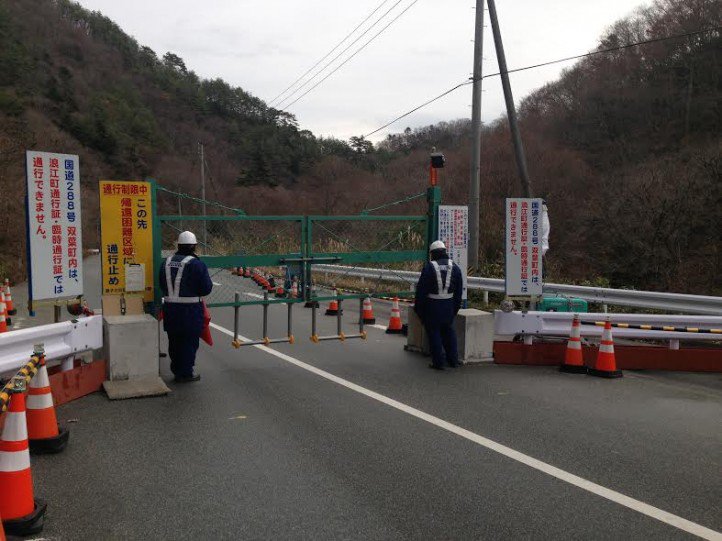
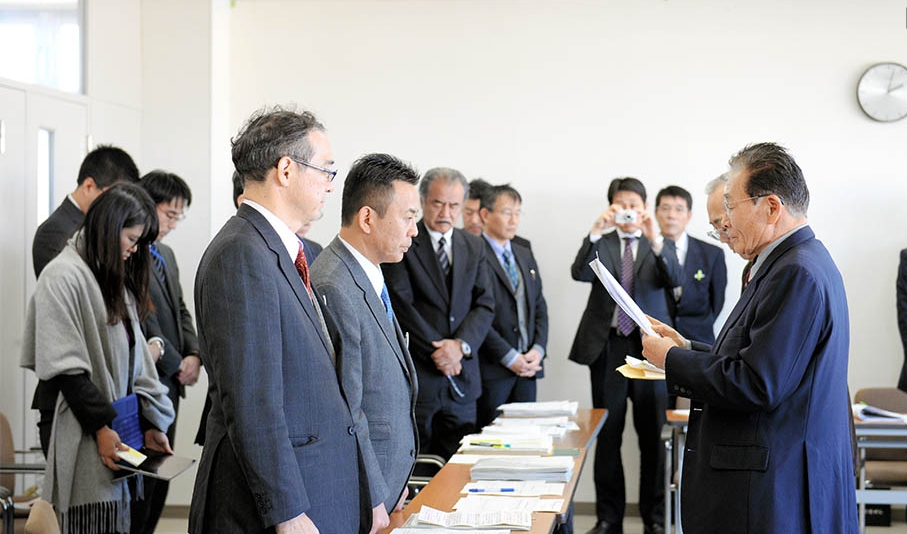
MINAMI-SOMA, Fukushima Prefecture–The central government lifted on Dec. 28 the last recommended evacuation advisory for several districts in this city, saying radiation levels from the nuclear accident fell below the annual exposure limit.
However, many of the residents of 152 households within these districts voiced their opposition to the lifting.
The central government designated areas that registered high radiation levels outside the zones under mandatory evacuation orders as specific recommended evacuation spots following the triple meltdown at the Fukushima No. 1 nuclear power plant. The residents living within these locales were encouraged to evacuate from their homes.
The districts in Minami-Soma were designated as such because they were at risk of exceeding the annual accumulated dose limit of 20 millisieverts, or 3.8 microsieverts per hour.
The central government in June 2011 issued the advisory for some locales in the cities of Minami-Soma and Date and the village of Kawauchi, all in Fukushima Prefecture, home to 281 households. The advisory for Date and Kawauchi was lifted earlier.
Central government officials explained their latest decision to the residents and local officials, saying that the health risks are not expected because radiation levels in their sites now measure well below the designated limit of 20 millisieverts.
They also presented support measures to encourage the residents to return to their homes.
However, evacuee Katsuji Sato, among the residents of the 152 households, said he would not immediately return home.
The 79-year-old, who lives in temporary housing in Minami-Soma, had lived in a family of six of four generations before the Great East Earthquake and tsunami on March 11, 2011, set off the nuclear disaster.
Sato’s mother died where she evacuated to, and his eldest son, the son’s wife and their elementary school child moved to Miyagi Prefecture.
“My wife and I cannot return to our home even though we want to unless decontamination work is undertaken again,” Sato said.
The head of the Takakura district, right, reads aloud a statement in opposition to the lifting of a recommended evacuation advisory to officials of the nuclear emergency local response headquarters
Radionuclides go everywhere. The first fallout did fall, first or highest to least amount (both ocean and landfall):
Coast of North America into north Pacific, Bering Strait, Alaska, Canada, Pacific Northwest of USA
(Washington and Oregon), California and Baja California/Mexico, and then EASTward around the globe. Back sweep also hit Japan hard, of course, far east Asian continent (Russia, Korea)… Initial fallout at least ast far as 1,700 km from Fukushima. (as reported in enews).
Pure Propaganda
As predicted, IAEA is about control of information – propaganda – and not transparency, not disclosure. IAEA is the pro-nuclear body for U.N., overrides anything and everything W.H.O. can say or do.
As an example, this recent ‘report’ (cough-cough) – this piece of propaganda issued by IAEA — expects us to believe that NO contamination from Fukushima will reach NorthAmerica! Absolutely preposterous!
B) ‘Thumbs down’ on tracking plastics http://adrift.org.au/fukushima This one also ignores the far north, Bering Sea, and we know that got hit.
C, Certainly we do want to track the debris from Japan, it could be a mammoth problem, not sure how much radioactivirty might be involved: Washington blog article includes Japanese debris distribution of U of Hawaii – I would NOT assume debris of various sizes, weight, dimensions and type to behave the same as radioisotopes. Nor do we know if they got hit with radionuclide contamination. Plastics tracked across Pacific, again, not the same as radioisotopes, cannot expect the same behavior of unlike material.
There is a difference between radionuclides spreading across the Pacific and debris from the tsunami… How it travels, variable depths… Briefly: radionuclides’ fallout on to land and rivers and (both) travels to the ocean, radionuclides tend to coalesce and float together (referred to as pools, clouds or streams); settle in at about 1-100 meters depth, travel along ocean currents (varies by weight).
In the ocean, uranium buckyballs flew across the ocean’s surface in days after 311; radionuclides also biomagnify up the food chain; can be estimated by the degree of plankton uptake; concentrates in seawater, sea spray and is especially troublesome along coastlines – the entire Pacific rim.
Radionuclides also find their way back into the ATMOSPHERE via the natural water (hydrolic) cycle. Radionuclides traveling up with evaporation process is called ‘resuspension,’ thus finding its way to be redistributed on land wherever rain falls. The life-giving micronutrients from the ocean – the source of life and 50-85% of the oxygen in our world, is thus transformed into genomic instability, every possible breakdown of systems that sustain all life… e.g. death. Call it ecocide or omnicide, the more we pollute our environment, the more we pollute ourselves. The global growth of chronic disease is in step with the spread of man-made radioisotopes and man-made chemicals…. it destroys the ‘stuff of life’ as we know it.
WHERE DOES FUKUSHIMA GO UPON ENTERING THE OCEAN?
Tracking Radionuclides aka Radioisotopes
‘Plume’ is being used to address both Atmospheric (NOAA) and sometimes ‘into the ocean’ dispersal as well. Important to notice the distinction and be clear which one we mean when we post or write about Fukushima. Likewise, ‘cloud’ is being used to describe the coalescing of radioisotopes in pools that float and move together. Another study calls it ‘rivers’ or ‘streams’. Be very clear in disseminating information.
1. The first detection, of course, “The Comprehensive Nuclear-Test-Ban Treaty (CTBT) is meant to deter nuclear explosions by everyone, everywhere: on the Earth’s surface, in the atmosphere, underwater and underground. (All nukes have their own chemical ‘signature as well.)http://www.ctbto.org/verification-regime/the-11-march-japan-disaster/
5. Various agencies have done plume modeling estimates. These take weather conditions and releases and estimate where the radioactive releases went or will go.
7. The U.S. Geological Survey (USGS) collaborated with the National Atmospheric Deposition
Program in an effort to monitor North American precipitation samples for the presence of nuclear fallout in response to the Japan Fukushima Dai-ichi Nuclear Power Station incident that occurred on March 11, 2011.
8. Radionuclides (aka radioisotopes) like Strontium will collect in ‘rivers’ or ‘streams’ of
contamination… (SEE ALSO #10b and #11) will not ‘dilute’… Evidence of bioaccumulation in species, biomagnification- denser concentrations in the Pacific, as well as remaining in collective rivers and streams of its own making are derived from decades-long research chemical changes interacting with the salt… all speak to multiple, deadlier pathways
10. Concentration & RESUSPENSION of Radionuclides from ocean back into atmosphere brings the fallout inland – AGAIN – and contaminates through rainfall & snowfall…
10a In the ocean, radionuclides become concentratedMarine plankton as an indicator of low-level radionuclide contamination in the Southern Ocean
[SciTech Connect] by Marsh, K.V.; Buddemeier, R.W. 1984
in the ocean STRATIFIED about 100m ~> into the atmosphere ~> into the rainfall everywhere…
globally(from the era of atomic bomb tests in the Pacific) [added 11.11.2013]
”On May 16, 1958, the Wahoo event was detonated underwater two miles south-west of Enewetak.
Plankton sampling was begun as soon as possible, and at H + 6 hours the major part of the total
radioactivity was found in the top 25 m and about one-eighth at the thermocline, 110 m. By H + 28 hoursthe activity was distributed through the upper half of the mixed layer to about 50 m, but by H +• 48 hours it was concentrated at 100 m, the upper edge of the thermocline. At no time was the activity uniformly mixed; it was always stratified”
[The thermocline is the transition layer between the mixed layer at the surface and the deep water
layer. The definitions of these layers are based on temperature.]
10b Through the water cycle
“National Weather Service; Jetstream-Online school for Weather; The Hydrologic Cycle” [water cycle] and returns inland in rainfall
“The ocean is known to be a major source of atmospheric particulate [ matter]. There is considerable,evidence, however, that the chemical composition of the particles in the marine aerosol is often considerably different from that of seawater. Barker and Zeitlin found enrichment factors for transition metals in the aerosol approaching and exceeding three and four orders of magnitude relative to sodium. Cattell and Scott suggest that a biogenic agent may be responsible for the approximately 20,000-fold enrichment of copper during aerosol production in the ocean. The whole question of fractionation at the sea surface was the subject of a 1976 review article.^’
It seems possible, even likely, that the correlation we observe between radionuclides in plankton
and in the air samples is due, at least in part, to resuspension.”
Because of the ocean spray being concentrated, as well as fog, and the presence of uranium
buckyballs specific to Fukushima, (at least) and the higher likelihood of fish consumption in
coastal areas (internal contamination) — coastal areas might experience a higher likelihood of
{this is also why Dr. Busby estimates coastal areas being more likely to have higher rates of cancer… both resuspension and higher likelihood of fish consumption… see his work relative to Sellafield, UK}
11. Further understanding of the damage of the atomic age on our environment, and climate
change
11a Dr. Rosalie Bertell talks about the 5 layers of atmosphere and the “Five Rivers or
Vapours” upon which the flow of air and water – sustains us all.
This entry is solely to support the ‘rivers’ and ‘streams’ metaphor as very real, not discovered until mid-Century [and a part was quickly destroyed by an atomic bomb] and how fast esp jetstream moves, hownthe planet has its own highways, byways, …. circuitous routes – types and pathways — in the atmosphere and in the oceans and seas.
Rosalie Bertell – Space Weapons of War – part 1 of 4 – PLANET EARTH
More than 2,800 evacuees from a village near the damaged Fukushima Daiichi nuclear power plant are seeking state arbitration for a rise in compensation from Tokyo Electric Power Company, the plant’s operator.
Iitate Village is still an evacuation zone three years and eight months after the nuclear accident at the power plant. But decontamination work is proceeding across the village, which is located about 40 kilometers from the plant.
About half the village’s population, or 2,837 evacuees, filed for arbitration with the Center for Settlement of Fukushima Nuclear Damage Claims on Friday.
They say their prolonged evacuation is splitting local communities and families and threatening generations of the village’s history.
The evacuees are seeking increased compensation and an apology from TEPCO. They want the current monthly evacuation compensation per capita more than tripled to 350,000 yen, or roughly 3,000 dollars per month. They also call for around 172,000 dollars per evacuee in compensation for ruining their village lives.
The representative of the evacuees, Kenichi Hasegawa, explained why they filed for the class-action arbitration. He said the evacuees decided they must express their anger as their lives have not improved since the nuclear accident. He added that the evacuees want their village lives back.
TEPCO said in a statement it has yet to learn the details of the documents. But the company pledges a sincere response to the arbitration in line with settlement procedures
A Greenpeace radiation monitoring team checks contamination in Fukushima City
13 Nov 2014
Tokyo, Japan – “Hot spots” of nuclear radiation still contaminate parts of Fukushima Prefecture, according to findings from the latest Greenpeace radiation monitoring mission near the Daiichi nuclear power plant that experienced a melt down after an earthquake and tsunami in March 2011.
Experts from the environmental organisation also claim that authorities have consistently underestimated the amount of contamination and the health risks involved.
Greenpeace will use these results to try to persuade local governments with nuclear power plants in their districts to resist lobbying from the central government to have them reactivated. All 50 of Japan’s remaining nuclear plants were shut down following the 2011 disaster.
Greenpeace began independently monitoring radiation in Fukushima within a few days of the nuclear accident, and it has conducted field trips each year since then. The latest such trip took place from October 24-27.
Heinz Smitai, a nuclear physicist, Greenpeace campaigner and participant in the radiation monitoring mission, told foreign journalists at an October 30 press conference in Tokyo that radiation hot spots exist as far as 60 kilometres from the site of the disaster.
For instance, one street in front of a hospital in Fukushima City “is quite contaminated”, Smitai said, measuring 1.1 microsieverts of radiation per hour. Although this was one of the highest readings, Greenpeace found 70 other places in the city where the amount of radiation recorded exceeded the Ministry of Environment’s long-term target of 0.23 microsieverts per hour.
A sievert is the standard unit for measuring the risk of radiation absorbed by the body. A millisievert is equal to one-thousandth of a sievert, while a microsievert is one-millionth of a sievert. A typical CT scan can deliver from 2 to 10 millisieverts of radiation, depending on the area being scanned.
Japanese doctors threatened for revealing data on how bad Fukushima-related illnesses have become — Gundersen: We had pregnant sisters in Tokyo deliver two dead babies and one with deformities that’s alive; Gov’t refuses to disclose miscarriages or stillbirths around Fukushima
Nuclear expert Arnie Gundersen, Fairewinds Energy Education: We have firsthand knowledge from at least a half dozen Japanese doctors… who have said they have been threatened… if they speak frankly to their patients about the health effects that they’re experiencing; or if they frankly speak in public about their fears — and, in fact, measurements — of how bad radioactive illnesses really are. So we know of at least a half a dozen doctors who are being ‘sat on’, and if 6 are, you can be certain that many more are as well. It’s a pressure that’s being applied up and down the spectrum… [You would now expect] exactly what we’re seeing — earlier cancers and thyroid nodules. Then over the next 15 to 20 years, increased organ cancers as well as muscular cancers… The fact of the matter is, we’re going to see cancers in that 4 to 30 year time span. And I still stand by what I’ve been saying now for 3 years. I think there will be a million extra cancers as a result of Fukushima Daiichi.
Gundersen: For Asahi Shimbun, a major newspaper, to basically call on people to [move] back home based on the [claim there’s no increase in birth defects]… is absolutely absurd. The number they’re not giving us is how many stillbirths and how many miscarriages there’s been in relation to the rest of Japan — and those are radiation-induced. You’ll get a stillbirth or you’ll get a miscarriage when a fetus is deformed or it is already developing cancer… The Japanese are not reporting stillbirths and miscarriages in Fukushima… That’s a much better indication… There are 35 million people in the Tokyo Metropolitan Area [and] their homes are contaminated… We had two women, sisters, both pregnant at the same time — one with twins, and one with a single baby. Two of the kids were stillbirths. The other was born with a deformity. They had the metallic taste in their mouth as the babies were in [the womb]. They lived in Tokyo, 130 miles from the accident. They’re people, they’re not statistics… and they’ve got no place to run…. no place to go.
Monitoring efforts along the Pacific Coast of the U.S. and Canada have detected the presence of small amounts of radioactivity from the 2011 Fukushima Dai-ichi Nuclear Power Plant accident 100 miles (150 km) due west of Eureka, California. Scientists at the Woods Hole Oceanographic Institution (WHOI) found the trace amounts of telltale radioactive compounds as part of their ongoing monitoring of natural and human sources of radioactivity in the ocean.
In the aftermath of the 2011 tsunami off Japan, the Fukushima Dai-ichi Nuclear Power Plant released cesium-134 and other radioactive elements into the ocean at unprecedented levels. Since then, the radioactive plume has traveled west across the Pacific, propelled largely by ocean currents and being diluted along the way. At their highest near the damaged nuclear power plant in 2011, radioactivity levels peaked at more than 10 million times the levels recently detected near North America.
“We detected cesium-134, a contaminant from Fukushima, off the northern California coast. The levels are only detectable by sophisticated equipment able to discern minute quantities of radioactivity,” said Ken Buesseler, a WHOI marine chemist, who is leading the monitoring effort. “Most people don’t realize that there was already cesium in Pacific waters prior to Fukushima, but only the cesium-137 isotope. Cesium-137 undergoes radioactive decay with a 30-year half-life and was introduced to the environment during atmospheric weapons testing in the 1950s and ’60s. Along with cesium-137, we detected cesium-134 – which also does not occur naturally in the environment and has a half-life of just two years. Therefore the only source of this cesium-134 in the Pacific today is from Fukushima.”
The amount of cesium-134 reported in these new offshore data is less than 2 Becquerels per cubic meter (the number of decay events per second per 260 gallons of water). This Fukushima-derived cesium is far below where one might expect any measurable risk to human health or marine life, according to international health agencies. And it is more than 1000 times lower than acceptable limits in drinking water set by US EPA.
Scientists have used models to predict when and how much cesium-134 from Fukushima would appear off shore of Alaska and the coast of Canada. They forecast that detectable amounts will move south along the coast of North America and eventually back towards Hawaii, but models differ greatly on when and how much would be found.
“We don’t know exactly when the Fukushima isotopes will be detectable closer to shore because the mixing of offshore surface waters and coastal waters is hard to predict. Mixing is hindered by coastal currents and near-shore upwelling of colder deep water,” said Buesseler. “We stand to learn more from samples taken this winter when there is generally less upwelling, and exchange between coastal and offshore waters maybe enhanced.”
Because no U.S. federal agency is currently funding monitoring of ocean radioactivity in coastal waters, Buesseler launched a crowd-funded, citizen-science program to engage the public in gathering samples and to provide up-to-date scientific data on the levels of cesium isotopes along the west coast of North America and Hawaii. Since January 2014, when Buesseler launched the program, individuals and groups have collected more than 50 seawater samples and raised funds to have them analyzed. The results of samples collected from Alaska to San Diego and on the North Shore of Hawaii are posted on the website http://OurRadioactiveOcean.org. To date, all of the coastal samples tested in Buesseler’s lab have shown no sign of cesium-134 from Fukushima (all are less than their detection limit of 0.2 Becquerel per cubic meter).
The offshore radioactivity reported this week came from water samples collected and sent to Buesseler’s lab for analysis in August by a group of volunteers on the research vessel Point Sur sailing between Dutch Harbor, Alaska, and Eureka, California. These results confirm prior data described at a scientific meeting in Honolulu in Feb. 2014 by John Smith, a scientist at Fisheries and Oceans Canada in Dartmouth, Nova Scotia, who found similar levels on earlier research cruises off shore of Canada. Buesseler and Smith are now working together on a new project, led by Jay Cullen at the University of Victoria, Canada, called InFORM (http://fukushimainform.wordpress.com/) that involves Canadian academic, government and NGO partners to determine and communicate the environmental risks posed by Fukushima for Canada’s Pacific and Arctic coasts and their inhabitants.
Buesseler believes the spread of radioactivity across the Pacific is an evolving situation that demands careful, consistent monitoring of the sort conducted from the Point Sur.
“Crowd-sourced funding continues to be an important way to engage the public and reveal what is going on near the coast. But ocean scientists need to do more work offshore to understand how ocean currents will be transporting cesium on shore. The models predict cesium levels to increase over the next two to three years, but do a poor job describing how much more dilution will take place and where those waters will reach the shore line first,” said Buesseler. “So we need both citizen scientists to keep up the coastal monitoring network, but also research vessels and comprehensive studies offshore like this one, that are too expensive for the average citizen to support,” said Buesseler.
KenBuesseler is a senior scientist at the Woods Hole Oceanographic Institution (WHOI) who specializes in the study of natural and man-made radionuclides in the ocean. His work includes studies of fallout from atmospheric nuclear weapons testing, assessments of Chernobyl impacts on the Black Sea, and examination of radionuclide contaminants in the Pacific resulting from the Fukushima nuclear power plants. Dr. Buesseler has served as Chair of the Marine Chemistry and Geochemistry Department at WHOI, as Executive Scientist of the U.S. Joint Global Ocean Fluxes Planning and Data Management Office, and two years as an Associate Program Director at the U.S. National Science Foundation, Chemical Oceanography Program. In 2009, he was elected Fellow of the American Geophysical Union and in 2011 he was noted as the top-cited ocean scientist by the Times Higher Education for the decade 2000-2010. He is currently Director of the Center for Marine and Environmental Radioactivity at WHOI. For more info, visit his lab, Café Thorium.
Funding for the citizen monitoring effort at ourradioactiveocean.org comes from close to 400 individuals and sponsoring organizations including Alaska Ocean Observing System, Alaska SeaGrant, Bamfield Marine Science Centre, Cook Inlet Keepers, David Suzuki Foundation, Deerbrook Charitable Trust, Dominical Real Estate, Fukushima Response Campaign, Gordon and Betty Moore Foundation, Gwaii Haanas National Park Reserve, Parks Canada, Humboldt State University Marine Lab, Idaho Section of the American Nuclear Society, Integrated Fukushima Ocean Radionuclide Monitoring (InFORM) Network, International Medcom, KUSP Santa Cruz, Lush Cosmetics, Norton Sound Economic Development Corporation, Nuxalk Nation, Onset Computer, Pacific Blue Foundation, Peaceroots Alliance, PFx, a Picture Farm Company, Point Blue Conservation Science, Prince William Sound Science Center, Resurrection Bay Conservation Alliance, San Luis Obispo Mothers for Peace, Santa Barbara Channel Keeper, Say Yes! to Life Swims LLC, Scripps Institution of Oceanography, Southwest Alaska Inventory and Monitoring Program National Park Service, St. Mary’s School, The Guacamole Fund, The Institute for Building Biology and Ecology, Tillamook Estuaries Partnership, Ucluelet Aquarium, Umpqua Soil & Water Conservation District, University of California Davis Marine Pollution Studies Lab, University of Hawaii, Woods Hole Oceanographic Institution.
The Woods Hole Oceanographic Institution is a private, independent organization on Cape Cod, Mass., dedicated to marine research, engineering, and higher education. Established in 1930 on a recommendation from the National Academy of Sciences, its primary mission is to understand the ocean and its interaction with the Earth as a whole, and to communicate a basic understanding of the ocean’s role in the changing global environment. For more information, please visit www.whoi.edu.
Three and a half years after the tragedy, most of plants and materials will be burned and the ashes stored.
By Marc Cherki Published 11/09/2014
Translation by D’un Renard
In Kawauchi, a small village located on both sides of of 20 kilometers division line around the Fukushima plant, many one cubic meter bags, are filled by the decontaminators with radioactive vegetal waste. Plants, grasses, lichens, shrubs that lined the road are now piled into these big bags.
Thus, the radiation received by persons traveling on this path is reduced. The plants are also removed within 20 meters around houses.
With Date and Minamisoma, Kawauchi is one of the “model villages” exemplified by the IAEA (International Atomic Energy Agency) and the Japanese government.
The committed efforts are huge . In less than a year, since the nuclear accident in March 2011, projects funded by the government were already valued at 10 billion euros only for the decontamination of soils, houses and a microscopic part of the forests.
At present, the kariokiba, the temporary storage sites, are overfull of waste.
About 43 million cubic meters (43 million tons), as plastic bags of blue, black or gray colors depending on the choice of the town, are piling into a thousand temporary sites.
The bags are half filled with plants.
The others contain the contaminated soil removed from the surface of rice fields and schoolyards, materials polluted by radioactive fallout cloud or dust collected in houses gutters,
The Japanese government has pledged to deal with the waste from 1 January 2015. But nobody believes this possible in such a short time. “We’re late,” admits Mr Ozawa, deputy director general of the department of environmental restoration in Fukushima, under the Ministry of the Environment.
As early as our first work, which started in the summer of 2012 and mobilized 17,000 people, “local authorities told us that we were too slow,” he admits.
But it is “like playing chess without having the rules. So we had to make the pieces and invent the rules. ”
At the Otsube storage site in Kawauchi, Youichi Igari, 40, who works for decontamination, admits that the government should not be able to recover the waste in the time promised.
This thorny issue of waste is closely related to the return of populations. Currently, 130,000 people are still displaced, according to the Government, out of which 50,000 out of the Fukushima Prefecture. The family of Youichi Igari family is one of those who left the town of Kawauchi. “My wife is afraid to come back,” admits the technician.
Compared to our own surveys made with a Geiger counter, the measuring of the radioactivity carried by the city is minimized by a third.
A difference that their expert justified by “the margin of error of measurement” … More serious over the bags covered with a green tarp, plants began to grow. Sign that the sealing is no longer guaranteed.
And if in the kariokiba visited in Date the black bags seem tight, the official measurements of radioaction that people can find on the Internet are lower than our measurements.
Divide by ten the number of bags could improve decontamination and encourage the return of the nuclear exiles.
The Japanese government is planning to burn and store its waste on two sites in Futaba and Okuma for those highly radioactive and in Tomiaka for those weakly radioactive (8,000 Bq / kg). Three towns near the Fukushima Daiichi Nuclear Power Plant.
The most active ash (100,000 Bq / kg) will be trapped in concrete and stored in an intermediate site for thirty years. Then to be moved after to a final repository to be stored there for more than two centuries and a half.
For already one year the Japanese government has informed the IAEA of its intentions.
“It’s good management, rather than letting the plants rot and release biogas. Burning waste is a method that we already use in France to reduce volumes.
For some of the waste, the operation in France is performed at the Centraco plant near Marcoule, a subsidiary of Socodei, which packages the ash into concrete, “says Bruno Cahen, the Andra industrial director.
This is particularly the case of technical waste containing cesium-137 which radioaction is halved every thirty years. “It is not possible to recover 100% of the fumes.
But technology can improve the collection of emissions to limit emissions into the atmosphere, “says Didier Dall’Ava, deputy director of sanitation and nuclear decommissioning at CEA.
Finally, in the case of the Japanese waste “the safety of the ashes with concrete must be confirmed from a chemical and mechanical point of view,” adds François Besnus, director of waste at the Institute for Radiological Protection and Nuclear Safety.
Still, the scale of the Japanese project is extraordinary, outside the norm.
The Marcoule site has the capacity to incinerate 3,000 tons of solid waste per year, it is quite low compared to 22 million tons of radioactive waste that the Japanese government wants to eliminate. Even if Japan opts for the best technique (rejection of one radionuclide in 100,000 to 1 million, according to Areva) this operation will lead to significant emissions into the atmosphere. As to incinerate waste will not remove the radioaction . Reconquérir le territoire reste une tâche titanesque. To reconquer that territory from radiation will remain a gigantic task.
One country is at least becoming aware of the food contamination risks and taking measures to protect its citizens’ health. How about the others?
Oct 31, 2014
TAIPEI – Taiwanese authorities are considering requiring production area certificates for all food imports from Japan and radiation check certificates for some, according to informed sources.
The authorities plan to implement the new policy in 2015 after gauging public opinion.
Following the nuclear accident at the Fukushima No. 1 power plant caused by the March 2011 earthquake and tsunami, Taiwan banned imports of food products from five prefectures, including Ibaraki, Tochigi and Chiba.
In addition, radiation checks have been conducted on vegetables, fruit and fisheries products imported from Japan.
Production area certificates are currently not required.
Under the envisioned policy, Taiwan would require production area certificates for all food imports from Japan and radiation check certificates by the Japanese government for those subject to current radiation checks and certain other products, such as tea and biscuits.
Consumer groups in Taiwan have been calling for stronger regulations on Japanese food imports.
A temporary housing complex in Iwaki, Fukushima Prefecture, for evacuees
from the Fukushima No. 1 nuclear power plant crisis
October 20, 2014
Twenty-seven percent of voters in Fukushima Prefecture, home to the crippled Fukushima No. 1 nuclear plant, want Japan to immediately abolish nuclear energy, around double the national average, an Asahi Shimbun survey found.
About 55 percent of voters in the prefecture support a break away from nuclear power in the near future, according to the telephone survey conducted on Oct. 18-19.
The survey results showed anti-nuclear sentiment is higher in Fukushima Prefecture than in the rest of the country.
Thirteen percent of voters in Tokyo supported the immediate abolition of nuclear energy in a survey in February, while 15 percent expressed the same opinion in a nationwide survey in January.
In those earlier surveys, 61 percent of Tokyoites and 62 percent of respondents nationwide said Japan should break away from nuclear power in the near future.
The latest survey covered 1,701 voters in Fukushima Prefecture and received 1,091 valid responses.
Only 15 percent of Fukushima voters said Japan should continue relying on nuclear energy, compared with 22 percent in the survey in Tokyo and 19 percent nationwide.
The survey also revealed that 66 percent of Fukushima voters accept Governor Yuhei Sato’s decision to allow the construction of an interim facility to store radioactive waste from cleanup work in the prefecture.
Eighteen percent said they disagree with Sato’s decision.
In addition, 53 percent said they support the central government’s decision to end its policy of helping all evacuees from the nuclear disaster return to their homes and instead assist them in resettling elsewhere. Twenty-eight percent were against the decision.
Up to 56 percent of respondents said they highly evaluate the governor’s efforts to rebuild the prefecture from the damage caused by the 2011 Great East Japan Earthquake, tsunami and nuclear disaster, compared with 25 percent who said otherwise.
Forty percent of Fukushima voters said they support Prime Minister Shinzo Abe’s Cabinet, matching the 40 percent who did not support the Cabinet.
Source: Asahi Fukushima http://ajw.asahi.com/article/behind_news/social_affairs/AJ201410200030
The former vice principal of a junior high school in Fukushima Prefecture has been encouraging his former students by blogging while undergoing 11 years of treatment for cancer.Yuki Sanbonsugi, 55, who fled to Koriyama after his hometown, Futaba, was evacuated to escape the radiation from the core meltdowns at the Fukushima No. 1 nuclear plant, became a junior high school teacher in 1981, after graduating from Senshu University.He has taught classes in Iitate, Iwaki, Minamisoma, Katsurao, Namie and Tomioka — villages, towns and cities all close to the No. 1 power plant.
Eleven years ago, when he was vice principal of Tomioka Dai-ichi Junior High School, he was diagnosed with malignant lymphoma, a form of blood cancer, and decided to quit to concentrate on treatment.
Although he could not return to teaching, he gave lectures at schools and community centers to convey his thoughts on the importance of life.
In March 2011, the nuclear crisis forced Sanbonsugi to flee to several places in the prefecture, including the town of Furudono and the cities of Aizuwakamatsu and Koriyama, and even to Hokkaido.
Despite his hardships, he kept thinking about all the students he had taught. He was worried they might be in the throes of despair with their futures still unclear 3½ years into the nuclear crisis, or on the verge of giving up on returning to their hometowns.
“I want to support former students who are living as evacuees as much as I can,” said Sanbonsugi, who avidly updates his blog.
“Rather than grieving over what you cannot do, just simply do something you can do. Then, quietly wait for spring to come,” he recently wrote.
Hidefumi Sanpei, 35, one of his former students, works for the Tomioka Municipal Government, which ordered a full evacuation in light of the Fukushima No. 1 meltdowns. As an official in charge of residential support, he helps evacuees deal with their worries and sometimes gets a tongue-lashing in the process.
As an evacuee himself supporting a wife and two children in new surroundings, Sanpei often got fed up with the work and his longing for his hometown.
He said Sanbonsugi’s blog gives him the courage to move forward. One phrase he always keeps in mind is: “Under the same sky, each one of us is living life to the fullest.”
Natsumi Yoshida, 33, who was one of Sanbonsugi’s students at Katsurao Junior High School, now teaches at a special needs school attached to Fukushima University. When the village of Katsurao was forced to evacuate, her former classmates were scattered all over the country.
Yoshida said she hopes to convey to her students a message she read in Sanbonsugi’s blog: “Planting seeds of kindness on the hearts of each and every one of us.”
This section, appearing every third Monday, focuses on topics and issues covered by the Fukushima Minpo, the largest newspaper in Fukushima Prefecture. The original article was published on Oct. 4.



 nuclear-news