Fukushima, June 28 (Jiji Press)–Nuclear policy has been put on the back burner in the Fukushima prefectural constituency in the election campaign for the House of Councillors, the upper chamber of Japan’s parliament.
Some 90,000 residents are still evacuated in the northeastern prefecture five years after the triple meltdown at Tokyo Electric Power Co. Holdings Inc.’s <9501> Fukushima nuclear power plant.
Two main candidates, one each from the ruling Liberal Democratic Party and the major opposition Democratic Party, are both campaigning to scrap all nuclear reactors in the prefecture.
But the candidates, the LDP’s Mitsuhide Iwaki and the DP’s Teruhiko Mashiko, both incumbents, have not elaborated on nuclear policy, reflecting gaps with their respective parties’ Tokyo headquarters.
On Wednesday, when the official campaign period for the July 10 Upper House election began, Prime Minister and LDP President Shinzo Abe criticized the DP’s predecessor, the Democratic Party of Japan, for delays in reconstruction efforts in the prefecture.
An Environment Ministry decision to allow reuse of contaminated soil emanating from the Fukushima nuclear disaster under road pavements came despite an estimate that it will take 170 years before the soil’s radiation levels reach safety criteria, it has been learned.
According to the revelation, an Environment Ministry panel approved the recycling of tainted soil generated from Fukushima decontamination work despite an estimate presented during a closed meeting of a working group that it will require 170 years for radioactivity concentrations in the contaminated soil to drop to legal safety standards, shelving a decision over whether such soil should be put under long-term management.
The ministry is planning to allow reuse of the tainted soil in mounds beneath road pavements, asserting that radiation will be shielded by concrete covering such mounds. However, an estimate presented at the closed meeting of the working group on the radiation impact safety assessment states that such mounds would be durable for just 70 years, suggesting that the soil would need to be managed for another 100 years after its road use ends.
“There’s no way they can manage the soil for a total of 170 years without isolating it,” said an angry expert.
The working group is a subgroup of an Environment Ministry panel called “the strategic panel for technical development of volume reduction and reuse of removed soil in temporary storage,” and the two groups share some of their members. According to the working group’s in-house documents obtained by the Mainichi Shimbun, the closed meetings were held six times between January and May, with the attendance of over 20 people including eight group members and officials from the Environment Ministry and the Japan Atomic Energy Agency (JAEA).
Under the Act on the Regulation of Nuclear Source Material, Nuclear Fuel Material and Reactors, the safety standards for recycling metals and other materials generated from the decommissioning of nuclear reactors are set at up to 100 becquerels of radioactive cesium per kilogram. Meanwhile, the special measures law concerning decontamination of radioactive materials, which was enacted after the 2011 Fukushima No. 1 Nuclear Power Plant crisis, classifies materials whose radiation levels top 8,000 becquerels per kilogram as designated waste, and stipulates that waste whose radiation levels are 8,000 becquerels or lower can be put to ordinary disposal.
According to working group chairman and Hokkaido University professor Tsutomu Sato, the group served as a forum to “prepare itself for theoretical argument” over setting the upper radiation dose limit for reusing contaminated soil at 8,000 becquerels.
The Environment Ministry set forth the plan to reuse contaminated soil in public works such as in mounds beneath road pavements and in coastal levees on the grounds that the “radiation levels can be contained to levels on par with clearance levels” by covering tainted soil with concrete and other materials. During the second meeting of the working group on Jan. 27, a member pointed out, “The problem is what to do with tainted soil after use (in roads and other structures). If such soil is allowed to be dug over freely, it would be difficult to convince the upper limit of radiation levels (for soil reuse).”
A JAEA official presented the aforementioned estimate, saying, “For example, it will take 170 years for radiation levels to reduce to 100 becquerels if tainted soil of 5,000 becquerels is put to reuse. Because the durable life of soil mounds is set at 70 years, a total of 170 years will be required to manage that soil — both when the soil is being used in mounds and after that.”
Discussions on the soil management period never went any further, and the strategic panel overseeing the working group on June 7 approved recycling such contaminated soil on condition that the maximum radiation levels of such soil be 8,000 becquerels and that the levels should be no more than 6,000 becquerels if the soil is covered with concrete and no more than 5,000 becquerels if the soil is planted with trees.
The Environment Ministry is set to begin a demonstration experiment possibly later this year, in which radiation levels will be measured in mounds using soil with different radioactivity concentrations at temporary storage sites in Fukushima Prefecture.
Working group chairman Sato, who also serves as a member of the strategic panel, admitted the existence of the 170-year estimate, but said, “We have discussed the matter but haven’t decided anything. We just presented our initial idea for reuse (of tainted soil) this time, and we will examine the feasibility of the plan later.”
Hiroshi Ono, who headed the Environment Ministry’s decontamination and interim storage planning team, said, “We have yet to decide what to do (with the tainted soil) in the end (after reuse), but the Environment Ministry will take responsibility for that.”
Another working group set up under the strategic panel, whose members primarily comprise those from the Japan Society of Civil Engineers, has presented a view, stating, “It will be in no way easy to secure the traceability (of recycled tainted soil).”
On Saturday June 25, 2016 Sun Life gave thyroid screenings in Fukushima city. A lot of people, small children and adults came to be examined.
The attending physician was Nomune Yoshihiro, a professor from the Ota Integrated Medical Development Center of Shimane University School of Medicine.
The next thyroid screening is scheduled to be performed at Tarachine, Iwaki city on July 17 2016. To schedule an appointment, those who wish to be examined should please contact Tarachine Screening Center as soon as possible. Adults as well as children can be examined.
The screening test considers cysts, and also thyroid of a state other than nodules, divided as follows:
No findings = nothing particular seen.
Yes, some Findings = cysts or nodules were observed, (follow-up required). It requires close examination by a specialist.
In addition A2 has been subdivided to three status:
A2-a Cysts that occur in the course of the A2-a anagen phase.
A2-b Anagen phase is not a reaction cyst.
A2-c Nodule (1mm ~ up to 5 mm)
The results of the echo image and the medical examination report are immediately available and given to you after the examination is finished.
Tarachine Screening Center
Onahamahanabatake-cho 11-3, Iwaki city, Fukushima Prefecture
Makiko Sekine tends flowers at a public housing unit for disaster survivors in Kawauchi, Fukushima Prefecture, with her husband, Hiroshi, on June 14. That day, the evacuation order was lifted for parts of the village, including the couple’s home district of Kainosaka.
KAWAUCHI, Fukushima Prefecture–In a rush of sorts, evacuation orders are being lifted from municipalities of this northeastern prefecture that were affected by the 2011 nuclear disaster.
The order was lifted for part of the village of Katsurao on June 12, followed by an area of Kawauchi village on June 14. It will be lifted for a section of Minami-Soma city on July 12.
The central government has decided to have all evacuation orders lifted by March next year, except for in “difficult-to-return” zones where radiation levels remain elevated.
Prime Minister Shinzo Abe, having toured Katsurao and Kawauchi on June 3, said, “I want to make sure that the livelihood of the communities, as well as family and community ties, is revived as soon as possible.”
Having covered news in Fukushima Prefecture for four years, I cannot believe that everything is so rosy simply because evacuation orders are being lifted.
It is certainly good news that disaster-affected areas are becoming freely accessible again, but I know that some residents are being left behind in the process.
Hiroshi Sekine, 88, and his wife, Makiko, 81, a couple I have known for three years, are from the Kainosaka district of Kawauchi, where the evacuation order has been lifted.
They moved there from the neighboring city of Iwaki in 1959, five years before the first Tokyo Summer Olympic Games.
Deep within the mountains far from the center of the village, the couple reclaimed wasteland and turned it into farmland. They raised four children.
The Sekines, who now live in a public housing unit for disaster survivors elsewhere in Kawauchi, said they are not returning home.
Before the nuclear disaster, Kainosaka, home to 13 households, functioned as a small “community” where people helped out each other.
After five years spent in evacuation, the couple no longer have the energy to restart life in their inconveniently situated home district.
Even if they returned, they would be unable to sustain their life because nobody else is going back to Kainosaka.
“The lifting of the evacuation order is about deregulation,” a central government official told the Sekines. “It is up to you to decide whether you are going back or not.”
Once the evacuation order is lifted, however, the couple’s status switches from “those being forced by the central government into evacuation” to “those choosing to remain in evacuation despite having the option of returning.”
This new status will oblige them to feel apologetic, wary of what others may think of them.
The lifting of evacuation orders scheduled through next spring will allow around 46,000 people to return to their homes.
But many communities, like the Kainosaka district, will never be like what they were before.
How can we prevent people like the Sekines from being made to feel small because the evacuation order has been lifted? That is a complicated question about moral dignity, which cannot be solved with cash.
The Law on Special Measures for the Reconstruction and Revitalization of Fukushima was enacted a year after the onset of the nuclear disaster.
The law designates only “people who have been evacuated from zones under evacuation orders” and “people who have moved back to zones where evacuation orders have been lifted” as those entitled to coverage under the central government’s measures for “ensuring stability.”
When the law was enacted, nobody expected the cleanup of radioactive substances to take so long that it would delay the lifting of the evacuation orders, and that so many residents would choose not to return home after the orders are lifted, a central government official said.
The Sekines will be obliged to continue to live a life different from the one they had before the disaster.
I think people like the Sekines should be given the clearly defined status of “evacuees” by, for example, legally guaranteeing them the right to remain in evacuation.
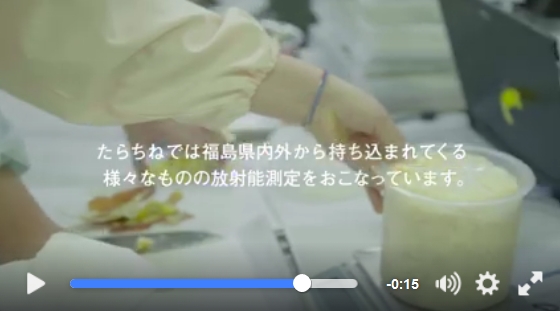
In Iwaki city, Fukushima, the Tarachine “screening center” is a fully independent citizen laboratory, well equipped and employing qualified technicians to help the Fukushima population with anything involving radiation measuring or contamination testing.
For a minor fee people can come to the Tarachine screening clinic to have their foods tested, but also their house lot soil tested, or even the vacuumed dust of their house tested.
The Tarachine screening center fulfill a very important role for the Fukushima families, as families do not have the means to acquire all the necessary expensive equipment nor the technical qualifications.
As the Japanese government does not provide such vital service nor could be trusted with radiation measure numbers, some citizens organized themselves to set up such laboratories. There are at present about 100 such laboratories which have spread up, but Tarachine is certainly the most efficient and fully equipped for various types of radiation measures.
For example, since in a lot of places very young children cannot anymore play outside safely, but are kept to play indoors, it is therefore vital for the mothers to constantly control the level of contamination inside their house, thus they bring to the Tarachine center their vacuumed dust to be measured.
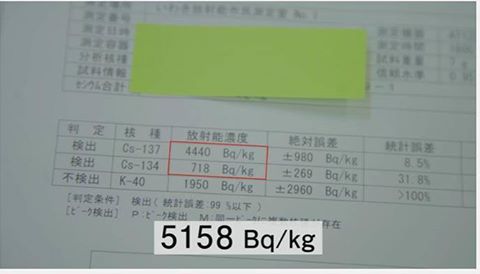
As an example this mother having brought her house vacuumed dust to be analyzed learned that it is contaminated by 4400 Bq/kg of Cesium 137, 718 Bq/kg of Cesium 134 and 1950 Bq/kg of Potassium 40, thus a total contamination of 5158 Bq/kg. The levels of Cesium 137 and Cesium 134 have too high, 4 times higher than the advised contaminated threshold and could therefore be harmful to the persons living in that house, especially for children.
As a comparison, you may see vaccumed dust from 3 different locations, one in Iwaki, Fukushima, one in Chiba, nearby Tokyo, and one in Vancouver, British Columbia,Canada:
Vacuum House Dust in Fukushima (Iwaki)
Cs 137 4440 Bq/kg
Cs 134 718 Bq/kg
Vacuum House dust in Chiba (Makuhari)
Cs 137 137Bq/kg(± 2%)
Cs 134 27Bq/kg(± 5%)
Vacuum House dust in Vancouver, BC
Cs 137 <1.08Bq/kg
Cs 134 <0.86bq/kg
The Japanese government during the past 5 years has constantly lied to the Fukushima population about the harmful radiation risks, condemning the people to stay and live with radiation. Consequently citizens have learned to rely only on their own for radiation measuring and protection.
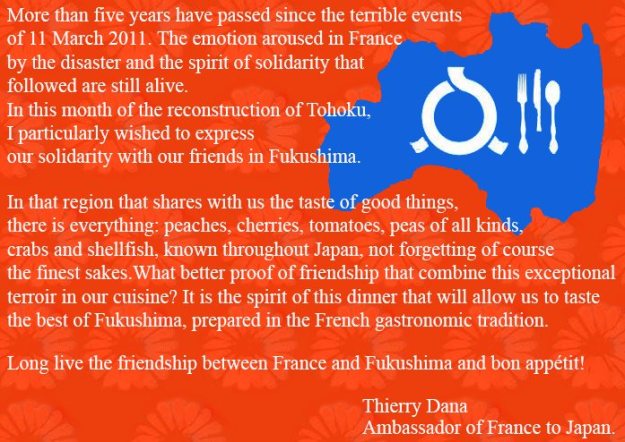
Last week, the Embassy of France in Tokyo, Japan organized a “friendship dinner” to promote agricultural products from Fukushima. In this great communication exercise, the main purpose was to “serve the interests of France in Japan”, that is by defending the nuclear industry.
” The oceans are garbage dumps, the seabeds are soiled, smultiple Chernobyls are seeing fetuses stillborn”, sang in 2009 Charles Aznavour in “The Earth dies”.
Yet at the Embassy of France in Tokyo, Friday, June 17, at a dinner during which he was the guest of honor, it was another song that was sung to the the nonagenarian by the Ambassador Thierry Dana. In partnership with Fukushima Prefecture and the Aeon supermarkets chain, the Embassy of France organized within its walls a great event for the promotion of agricultural products from Fukushima. Some “delicious dishes” were prepared and served by the chef of the Embassy to the handpicked guests.
Charles Aznavour with Ambassador Thierry Dana
This is not the first time that the Embassy of France is actively promoting the nuclear industry and minimizing the risks following the Fukushima accident.
The former minister-counselor had even told us point blank, in 2013, that the main role of the embassy was “to serve the interests of France in Japan, that is to say nuclear.”
“We want to end this drama with this event”
But with this event, a new milestone was reached in the promotion of nuclear power, assumed and uninhibited: an outright negation of the health consequences of this disaster on the region. For, under the guise of a pseudo “friendship” with the people of Fukushima, singularly absent from the reception, the dinner was above all a great exercise in communication.
“We want to end this drama with this event,” explains a communication officer before the press conference starts. And to end the debate about radioactivity? “We do not want to present things like that …” she begins, before going elsewhere. And indeed, the ambassador of France, Thierry Dana, achieved the feat of making a speech on Fukushima never saying the words “nuclear accident” or “radioactivity”. He should have thought about it strongly, however when talking about “unfounded rumors on products that are both delicious and safe for health” [1]. When the phrase was translated into Japanese, Masao Uchibori, governor of Fukushima, and Tsuyoshi Takagi, Minister for Reconstruction, nodded, visibly satisfied that France plays its role of stooge in this case.
Masao Uchibori, the governor of Fukushima, Thierry Dana and Tsuyoshi Takagi, the Minister for Reconstruction (left to right), Friday, June 17, at the Embassy of France in Tokyo.
When we questioned the ambassador on the left unspoken and the danger or irresponsibility, to promote products from a contaminated region, in the time allotted to us – 5 minutes for questions of the journalists in a “press conference” of 1 hour 15 – he made a well-rehearsed reply: “Our goal is to enlighten the people who do not know, and as your question proves, we must continue to promote these products which are safe, and to eat them”, before to hand us theatrically before the cameras of TV Asahi, a cucumber from Fukushima.
Stay and learn to live with radioactivity
Indeed, explains Mr. Uchibori, who’d like also to answer us, tests are performed on products such as rice, and a maximum of 100 becquerels per kilogram of radioactivity has been set since 2012 for vegetables and fruits – In the first months, the threshold was set at 500 becquerels.
But even if these tests were systematic, which is not the case for all vegetables, food from Fukushima often contain low doses of radioactive particles. Even water from Tokyo tap still contains traces of cesium 134 and 137. Now we know that the radioactivity is more harmful when internal and repeated. Ingested, radioactive particles accumulate and can cause cancer, weakened immune system and various diseases.
On location, a hundred citizens laboratories were created to verify the content of radioactivity in food after food. A practice that could become over the years horribly banal: the life of radioactive elements is measured in decades or even thousands of years for plutonium.
A selection of products, among which mushrooms, from Fukushima.
The presence of Aeon, first supermarket chain of the Japanese archipelago, as a partner of this event is more significant. The company is very engaged with the Fukushima Prefecture in the denial of the radioactive risk. In August, 2011, Aeon was the center of a scandal after it sold in its Tokyo supermarkets several hundred kilos of Minamisoma beef, whose radioactive cesium content was three to six times higher than normal. The company president, Mr. Okada, although present at the press conference and dinner, has been inconspicuous. And yet he seems to have been the main architect of this event.
A candlelight dinner, to the invisible radioactivity.
“Mr. Okada and Mr. Dana met upstream, and the ambassador has generously offered to host this event,” explains the director of communication of Aeon. Okada knows well indeed the ambassador, who presented him with the Legion of Honor in December 2015. Mr. Yasuhide Chikazawa, vice- president of Aeon, participated in the Ethos program in 2013. The Ethos program, benefiting from significant EU subsidies had already been set up in Chernobyl, and seeks nothing less than to encourage residents of contaminated areas with radioactivity to stay and to learn to live with it, because their evacuation is considered too expensive.
Free trade agreements between Japan and the European Union
A program that appears to have paid off as in the town of Tamura, highly contaminated but open to refugees since April 2014, small school children are taught about radioactivity and agricultural activities, professed by Ms. Yukiko Okada, of the atomic energy laboratory of the University of Tokyo city.
Since 2012, Aeon began to flood its supermarkets with products from Fukushima, at bargain prices.
For if the apology of products coming from an area that experienced a nuclear disaster is a first for France, in Japan, advertisements for Fukushima products orchestrated by Dentsu advertising, are permanent. [2] Aeon, well developed in the rest of Asia, has also started to export these products to other countries. And tomorrow, to Europe?
The Japanese seem to think about it very much. The Minister of Reconstruction, Mr. Takagi, laments, “Unfortunately, there are still countries or regions in the world who refuse to import products from Fukushima. ” But that could change. Since January 2016, the European Commission has facilitated the importation stopping simply to require radioactivity test certificates for most fruits and vegetables, tea or beef from Fukushima.
This facilitation, far from health considerations, was in fact granted under free-trade agreements being between Japan and the EU. In short, the EU condones products from Fukushima in exchange for lower tariffs in Japan for pork, cheese or wine exports. This “friendship dinner” might be just one of the final steps in those trade negotiations.
[1] The term “rumors” is a language element very quickly adopted by the Japanese government. From March 2012, the Japanese Embassy in France had sent to all French journalists writing about this country, a press release entitled “Fight against harmful rumors.” “To come to Japan and buy Japanese products, including those produced in the affected areas, is the best support for reconstruction that can be provided,” it read.
There’s an old saying “disasters bring out the best in people,” but Fukushima 3/11 of March 11, 2011 has put an exclamation point on cynicism rather than heartfelt concern.
Similar to America’s experience of outright lies by its government about the Iraqi Massacre, the blowback of cynicism and contempt bring forth a strain of populism, rejecting establishment, attracting lowly dishonorable politics, as America gooses-up an abomination!
Fukushima’s a horror story of hidden agendas, lies, scare tactics, and harsh secrecy laws, yet it’s held up as a icon of safe nuclear power by clever mastery of pro-nuke Oceania Newspeak, which, in the novel 1984 penalized “rebellious thoughts” as illegal, similar to Japan’s 2013 secrecy law wherein the “act of leaking itself” is bad enough for prosecution, regardless of what, how, or why, off to jail for 10 years. These decadent precepts are hard to accept with a straight face.
However, the day is fast approaching when the pro-nukie crowd, which claims Fukushima 3/11 caused few, if any, major radiation casualties, will be forced to “munch on their own words.” As time passes, it becomes ever more obvious that pro-nuke arguments, supporting big fat cumbersome nuclear power plants, metaphorically, hang by fingertips on an electric fence.
As an aside, it is rumored, thru the grapevine in Japan, that hospitals have been instructed to categorize, and officially report, patients’ radiation symptoms as “stress-related cases.” Hmm!
As for pro-nuclear news:
“In spite of this whole theatrical drama the result was…nobody killed or injured, and no indication of long term negative radiation effects on people. So the lesson of Fukushima is that nuclear power is much safer than people thought,” Kelvin Kemm, The Lesson of Fukushima – Nuclear Energy is Safe, Cfact, Feb. 16, 2015.
Another example:
“No one has been killed or sickened by the radiation — a point confirmed last month by the International Atomic Energy Agency. Even among Fukushima workers, the number of additional cancer cases in coming years is expected to be so low as to be undetectable, a blip impossible to discern against the statistical background noise,” George Johnson, When Radiation Isn’t the Real Risk, New York Times, Sept. 21, 2015
And, one more:
“There were no cases of radiation sickness among plant workers, because their radiation doses were too low to produce sickness,” Georgetown Radiation Expert, Author Reflects on 5th Anniversary of Fukushima Meltdown, Georgetown University Medical Center, Newswise, Feb. 23, 2016.
Bunk! To the contrary, not only have several independent sources in Japan reported cover ups of Fukushima worker deaths, bodies incinerated with ashes hidden in Buddhist temples, and instances of hair falling out, nose bleeding, and assorted serious ailments unique to radiation poisoning, now several deaths of U.S. sailors may be closely linked to this disaster that a pro-nuclear crowd claims demonstrates how “safe” nuclear power really is.
Thus, begging the question: Are the pro-nukites liars and/or are they being lied to, or what’s up? Who knows, and who really cares which, but their published articles, grandstanding nuclear power, are prominent throughout mainstream big time, and small time, magazines and newspapers and hyperspace, Oceania redux.
Whereas, in vivid contrast to this pro-nuke claptrap, one of Japan’s most eminent former prime ministers Junichiro Koizumi (2001-06) declares support for the U.S. sailor’s TEPCO lawsuit, more on this later.
Additionally, PM Koizumi has repeatedly urged PM Abe to halt efforts to restart Japan’s nuclear reactors. He is the second former Japanese prime minister, including PM Naoto Kan (2010-11), to plea for a halt to nuclear power. They claim nuclear power is not safe!
Luckily for the nuclear power industry, Abe is the prime minister.
Yet, there’s a festering problem, prevalence of radiation-poisoned deaths:
“The ashes of half a dozen unidentified laborers ended up at a Buddhist temple in this town just north of the crippled Fukushima nuclear plant. Some of the dead men had no papers, others left no emergency contacts. Their names could not be confirmed and no family members had been tracked down to claim their remains. They were simply labeled “decontamination troops” — unknown soldiers in Japan’s massive cleanup campaign to make Fukushima livable again five years after radiation poisoned the fertile countryside,” Mari Yamaguchi, Fukushima ‘Decontamination Troops’ Often Exploited, Shunned, AP & ABC News, Minamisona, Japan, March 10, 2016.
And, here’s another:
“It’s a real shame that the authorities hide the truth from the whole world, from the UN. We need to admit that actually many people are dying. We are not allowed to say that, but TEPCO employees also are dying. But they keep mum about it,” Katsutaka Idogawa, former mayor of Futaba (Fukushima Prefecture), Fukushima Disaster: Tokyo Hides Truth as Children Die, Become Ill from Radiation – Ex-Mayor, RT, April 21, 2014.
And, one more:
Mako Oshidori, director of Free Press Corporation/Japan, investigated several unreported worker deaths, and interviewed a former nurse who quit TEPCO: “I would like to talk about my interview of a nurse who used to work at the Fukushima Daiichi Nuclear Power Plant (NPP) after the accident… He quit his job with TEPCO in 2013, and that’s when I interviewed him… As of now, there are multiple NPP workers that have died, but only the ones who died on the job are reported publicly. Some of them have died suddenly while off work, for instance, during the weekend or in their sleep, but none of their deaths are reported.”
“Not only that, they are not included in the worker death count. For example, there are some workers who quit the job after a lot of radiation exposure… and end up dying a month later, but none of these deaths are either reported, or included in the death toll. This is the reality of the NPP workers,” (The Hidden Truth about Fukushima by Mako Oshidori, delivered at the international conference Effects of Nuclear Disasters on Natural Environment and Human Health held in Germany, 2014 co-organized by International Physicians for Prevention of Nuclear War).
Still and all, PM Abe insists upon fireside chats with pro-nuke campers whilst reopening nuclear power plants even though Japan survived just fine for five years without. He appears to have ants in his pants, pushing hard to restart the ole nuke plants A-SAP.
Meanwhile, in another universe, former PM Koizumi supports the lawsuit of U.S. sailors aboard the USS Ronald Reagan that participated in Operation Tomodachi, providing humanitarian relief after the March 11th Fukushima meltdowns. Allegedly, they were assured that radiation levels were okay!
“There is no excuse for Tokyo Electric Power Co. not to give the 400 U.S. sailors and marines who are now suing the company the proper facts. Things are looking especially good for the plaintiffs now that former Prime Minister Junichiro Koizumi is backing the lawsuit over the Fukushima radiation,” Support for U.S. Sailor’s Tepco Suit, The Japan Times, June 17, 2016.
“Undoubtedly, Koizumi was convinced to help the sailors because they now suffer from radiation poisoning. He said: ‘Those who gave their all to assist Japan are now suffering from serious illness. I can’t overlook them,” Ibid.
According to lawyers representing the sailors, Charles Bonner & Cabral Bonner & Paul Garner, Esq., Sausalito, CA, seven sailors have already died, including some from leukemia.
With passage of time, the number of plaintiffs and numbers of deaths grows as the latency effect of radiation sets in. Thus, over time, the latency effect works against the pro-nuclear squawk talk that “all’s clear.”
Initially, the lawsuit represented less than 200 sailors but over time, the latency effect brings forward 400 sailors claiming radiation-poison complications, including leukemia, ulcers, gall bladder removal, brain cancer, brain tumors, testicular cancer, uterine bleeding, thyroid illness, stomach ailments, and premature deaths. These are youngsters.
The lawsuit process has been exacting for the young sailors: “Lindsey Cooper, for example. The woman who started the whole thing was torn apart on a CNN program by atomic energy experts and was later mocked on conservative radio shows,” Alexander Osang, Uncertain Radiological Threat: US Navy Sailors Search for Justice After Fukushima Mission, Spiegel Online International, Feb. 5, 2015.
As it happens, it’s not disasters that turn people’s stomachs as much as cover-ups and lying, bringing forth cynicism, contempt, and ultimately populist blowback as people get fed up with establishment politics.
It is very likely that, similar to American populist blowback, Japan will meet the same fate.
On second thought:
“There is one thing that really surprised me here in Europe. It’s the fact that people here think Japan is a very democratic and free country.” (Mako Oshidori, director/Free Press Corporation/Japan, speech in Germany)
France being one of the major exporters of nuclear, to be expected that its Embassy in Tokyo would collaborate with the Japanese Government to put on a show that Fukushima products are safe, that Fukushima is no more contaminated, that everything is great.
The event certainly was organized behind the scenes by the Project ETHOS, financed by the nuclear lobby, whose main mission is to minimize the gravity of any nuclear catastrophe in the mind of the affected population, so as to encourage the People to stay and live with the “non-harmful” radiation. Ethos did the same propaganda campaign, same program during the Chernobyl catastrophe.
According to the French embassy in Japan, they held Fukushima food dinner party on 6/17/2016.
Fukushima governor. Uchibori, Minister for Reconstruction. Takagi, and a French singer. Charles Aznavour were invited by the Ambassador of France. Thierry Dana.
Fukushima beef, Cherry, and locally raised chicken were served as French cuisine.
In the press release, the major retail company Aeon is mentioned as a partner of this event.
CEO of Aeon is the older brother of Japanese Democratic Party’s leader. Okada.
Fukushima Governor commented they have not detected excessive density of radioactive material in any of their agricultural products over the past year.
It’s horrible to think that if the rice is over 99 Bq/kg it cannot be sold in Japan yet it can have up to 600Bq/kg (?) of Cs137/134 and be sold in the EU. One man’s poison is another man’s food …
Rice harvested in Japan’s Fukushima region, heavily affected by a nuclear meltdown in 2011, is returning to the EU, starting with Britain next month, the Japan Times reports.
A total of 1.9 tons of Fukushima rice called Ten no Tsubu will be sold in London, making the UK the first EU nation to import the region’s produce after the nuclear disaster. The sale became possible after a long campaign from Fukushima natives in London to fend off rumors about the potential danger of the crops, the media said.
“With the UK as a foothold, we hope to expand the sale of prefecture-produced rice to other EU member countries,” said Nobuo Ohashi from Japanese farmers group Zen-Noh.
Brussels requires rice from Fukushima to undergo a radiation test in Japan or the importer country.
“It’s bright news for Fukushima, which has been struggling with the import restrictions. We will make further efforts so the restrictions will be lifted entirely,” said a spokesperson for a prefectural office.
The disaster at the Fukushima-Daiichi Nuclear Plant was caused by a tsunami that resulted in the meltdown of three nuclear reactors and the release of radioactive material. It was the largest nuclear disaster since the Chernobyl accident in 1986, and the second to receive the highest level classification on the International Nuclear Event Scale.
A March report by the US National Academy of Sciences said that five years following the disaster, most seafood caught off the coast of Japan is now safe to be consumed, adding, “the overall contamination risk for aquatic food items is very low.”
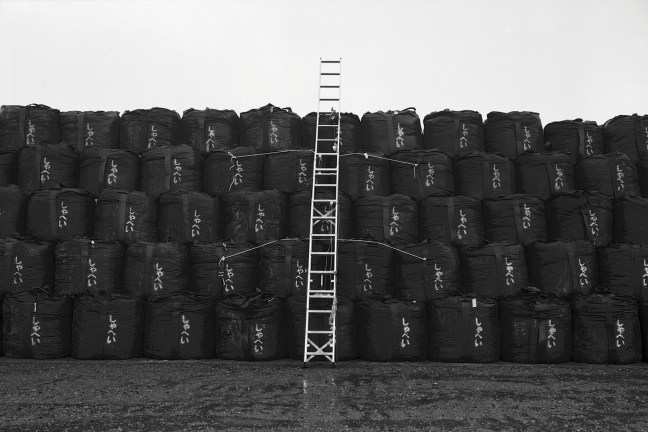
ABOVE: Radioactive waste from the evacuation zone is stored at massive dump sites. In Naraha, thousands of decontamination workers dug up and disposed of a two-inch layer of soil around every building in town.
Hisao Yanai, a one-armed, chain-smoking, retired yakuza boss, stands alone behind the bar at Ippei, the restaurant he owns in the Japanese town of Naraha. There are no customers today. The streets outside the restaurant are deserted. Five years ago, on March 11, 2011, a powerful earthquake and tsunami triggered a triple meltdown at the Fukushima Daiichi nuclear power plant, located ten miles north of Naraha, forcing the evacuation of roughly 160,000 people. Half of them still cannot go home. Last fall, Naraha became the first town in Fukushima’s mandatory evacuation zone to reopen fully, allowing all 7,400 residents to return. Nothing like it had ever been attempted before. Could a town despoiled by radiation be summoned back to life?
When I visit Naraha in the fall of 2015, not long after it reopens, only 150 residents have returned. (The number has since risen to 500.) Most are elderly. The town seems abandoned, like a seaside resort in the off-season. With no functioning banks, schools, or even a post office, Naraha has reverted to the rural backwater that Yanai escaped 50 years ago as a high school dropout. At 15, he ran off to Tokyo and learned to drive a dump truck during the construction boom leading up to the 1964 Olympics. At 16, he lost his left arm to a conveyor belt at a quarry. Eventually, he returned to Naraha and went to work at Fukushima Daiichi, which was flooding the area with high-paying jobs and government subsidies. Naraha, once known in Japan as “the Tibet of Fukushima,” had suddenly been thrust into the nuclear age.
“The nuclear plant changed the history of this town,” Yanai says. “They told us it was 100 percent safe.”
Naraha still has the outward appearance of a sleepy farming community, with tidy neighborhoods separated by rice paddies, fruit orchards, and two rivers tumbling to the sea from the nearby Abukuma Mountains. Since decontamination began about 18 months after the disaster, thousands of workers equipped with little more than garden tools have cut down trees, power-washed streets, and peeled off a two-inch layer of radioactive soil in a 65-foot perimeter around every structure in town. Vast fields and mountainsides have been left largely untouched, save for large burial mounds of black plastic bags filled with low-level radioactive waste that metastasized across the landscape as the work progressed.
There’s no blueprint for remediating a radioactive town and then moving people back into it. After the 1986 nuclear disaster in Chernobyl, the Soviet Union simply abandoned scores of towns. But in a country as densely populated as Japan, abandoning an area the size of Connecticut wasn’t an option. In a concerted push to resettle all but the most severely contaminated areas, the government has spent $31 billion on the cleanup effort, and a staggering $58 billion in compensation payments to evacuees.
The government maintains that it is safe for residents to return to Naraha. Radiation levels in the central part of town average less than 1 millisievert per year—the maximum allowable exposure for ordinary citizens under guidelines set by the International Commission on Radiological Protection. An annual dose of 1 millisievert would increase a resident’s risk for cancer by .005 percent. For a smoker like Yanai, cigarettes pose a far greater threat than radioactive fallout.
Hisao Yanai, a retired yakuza boss, returned to Naraha without his wife and daughter.
Like many residents, however, Yanai distrusts the government. Surveys indicate that half of all evacuees don’t plan to return home. The cleanup effort is widely viewed as political theater, designed to whitewash Fukushima in time for the 2020 Olympics. Encouraging evacuees to return home now would also put an early stop to some compensation payments, which aren’t set to expire until 2018. The government, in short, has a financial incentive to strong-arm mayors into reopening towns before they’re ready, or even properly decontaminated.
“The central government pressured us to lift the evacuation order,” Yanai says. “Nobody in town wanted it, because nothing is prepared.” His restaurant remains the only place in Naraha where you can get a beer. In the two weeks I spent in town, I saw only two people dining at Ippei. Behind the bar, the hands on the clock are frozen at 2:47, the moment when the earthquake hit. Yanai has vowed not to reset it until life in Naraha returns to normal.
One day, Yanai invites me to his home, to see the results of the government’s decontamination program. His house sits on a hilltop, ringed by a concrete wall. When I arrive, Yanai is sitting at a picnic table, smoking. Thick weeds mark the border of the decontaminated buffer zone around his house. Before it was decontaminated, radiation levels in Yanai’s yard measured 10 microsieverts per hour—nearly 50 times higher than the government’s allowable limit.
“There are still places in town that measure 10 micro-sieverts,” Yanai says. He walks over to the corner of his garage, which houses a dusty Mercedes resting on flat tires, and points to a patch of gravel beneath a downspout. This particular spot, he says, was decontaminated three times, because rain kept washing radioactive particles off the garage roof. Government contractors excavated the hot spot each time, but only after Yanai filed a request through the town office.
“If you don’t ask,” Yanai shrugs, “they won’t do it.”
The government has strict decontamination guidelines, but in the field practices are often improvised. At Yanai’s house, contractors dumped wheelbarrow-loads of contaminated dirt in a corner of his garden.
“Look, I’m a nice guy,” says Yanai, grinning. He crushes a cigarette butt into the gravel with his heel. “I said, ‘Fine, if you want to dump it there, I’m not going to say anything. But if you do the same thing in the neighbor’s yard, they might shoot you.’ ”
Yanai is keen to show me his menagerie. His prized specimen is Boo, a boar named for the sound, in Japanese, that a pig makes. After the Fukushima disaster, wild boars came down from the mountains and roamed the evacuation zone, tearing up gardens and ransacking houses. They can still be seen in Naraha, trotting along the road at night. Boo is the size of a small, snaggle-toothed dog. He snorts and gnaws at Yanai’s shin. “They’re not very friendly to people,” says Yanai, shooing the pig away with his foot. “But I’m determined to make him my pet.”
Of the 500 villagers who have returned to Naraha, most are elderly. It is a town without children.
Although Yanai professes to be retired from the Japanese Mafia, his years as a yakuza boss have left him with wealth, influence, and a fearsome reputation. It was rumored that he’d served time in prison for assault. After the nuclear disaster, he used his mojo to force the big construction companies in charge of the cleanup to hire local firms as subcontractors. “In a way,” he says, “the disaster was a good thing.”
Stepping onto the patio in back of his house, Yanai reaches into a galvanized steel tub full of water and pulls out a goldfish as big as a grapefruit. There is a technique to feeding them, he observes. “Do it too quick and they die.”
It’s obvious that Yanai misses being a yakuza boss. He is still bending creatures to his will, only now it’s a quirky hobby. He has a wife and daughter, but they live in Tokyo.
“It must get lonely here,” I venture.
“That’s true,” says Yanai, releasing the goldfish back into the tub. He watches the fish rejoin its companions. “When I get home they’re waiting for me. They don’t complain if they’re hungry, but they’ll die if I don’t take care of them.”
At the ceremony to mark Naraha’s reopening, Mayor Yukiei Matsumoto performed the banal civic rituals required of mayors everywhere. He planted a tree using a gold shovel, celebrated with a group of children, and projected confidence while posing next to a brightly colored illustration of Naraha’s future. “The clock that was stopped,” he declared, “has now begun to tick.”
A few weeks later, I meet Matsumoto at the town hall. Scattered among the office’s sober furnishings are stuffed toys portraying Naraha’s mascot, an anthropomorphic yellow citrus fruit named Yuzutaro. Between sips of green tea, Matsumoto speaks in a soft monotone. To hear him tell it, running a radioactive ghost town for more than three years was marginally more eventful than a meeting of the zoning commission. He attended countless meetings with government officials and oversaw infrastructure repairs. When he speaks of the town, the word “radiation” rarely crosses his lips. Instead, he prefers vague euphemisms like “environment.”
I ask him to describe what evacuees are most concerned about. At first, he says, they were “quite angry” about “the environmental conditions of the town.”
“And now?” I ask.
“Now there are no problems,” he says, “and people have become tranquil.”
Later, as I talk to more residents, it becomes clear that this characterization is a vast overstatement. It’s obvious to even the most casual observer that only old people are returning to Naraha. If young people are afraid to raise children here, I ask Matsumoto, what kind of future is there for Naraha?
“Naturally we want everybody to come back,” he says. “Elderly people are coming back first.” He places his teacup on the table. “But if the children do not come back here, the town cannot exist.”
For a moment, Matsumoto seems surprised by his own candor. Then he hastens to obfuscate it. Leaning forward in his chair, he redefines Naraha’s existential dilemma as a simple misunderstanding. Naraha is completely safe, he asserts. Parents with young children just need a little more convincing to return. One thing his office could do, he suggests, is to “make the environment around the schools better. Also we need to do something to make the parents understand.”
“Understand … what?”
“Regarding the issue of—radiation,” says Matsumoto, searching for a more diplomatic word. “People have their own ideas about what’s safe. But actually, in Naraha, it’s lower than 1 millisievert per year, which is what the government set for exposure to the public. That’s the reality I want people to understand.”
I ask him if he is happy with the government’s decontamination efforts. Matsumoto chuckles. “Let me say I’m not 100 percent satisfied,” he says. For further details, he refers me to Hiroyuki Igari, the town’s director of radiation measurement.
A week later I speak to Igari, a churlish man with a dosimeter badge—a device that measures a person’s cumulative radiation exposure—hanging on a lanyard around his neck. If anything, he insists, the government is actually overstating the amount of radiation that residents are being exposed to. “I live in Naraha,” he says. “I commute to work. Sometimes I stop by the store. Then I go home. That’s my routine.” He yanks on the dosimeter. “After two weeks, it’s obvious from this dosimeter that my exposure won’t exceed 1 millisievert per year.”
While Igari doesn’t put any stock in the notion that the government is pressuring towns like Naraha to reopen prematurely, he acknowledges that the cleanup is imperfect. In his view, the government has done a poor job of educating people about radiation, and its standards for mopping up recurring hot spots like the one in Yanai’s yard are nonexistent. But he believes that radiation isn’t a determining factor in whether people choose to return.
“People who were stressed in the temporary houses, they just want to come home. They don’t care about dose rates,” Igari says. “People who don’t return are used to their new lives. They’re used to living under one roof. But now they’re split up, and they don’t want to leave their families again.”
But dosimeter readings and official reassurances have done nothing to alter a more fundamental reality: In post-Fukushima Japan, nuclear safety is a bankrupt concept. Officials like Mayor Matsumoto who use the word “safe” in an absolute sense echo the corporate propaganda of companies like Tokyo Electric Power Company, the disgraced utility that owns Fukushima Daiichi. As the son of a TEPCO salaryman, Matsumoto has spent his career working the levers of a political machine that is oiled with money from the nuclear industry. Yet in the aftermath of one of the world’s worst nuclear disasters, he still believes himself to be a credible authority on the relative safety of low-dose radiation.
The truth is that there’s no such thing as a “safe” dose of radiation, only gradations of risk. Epidemiological studies show that cancer risk increases in tandem with radiation dose, but we know very little about the risks associated with doses below 100 millisieverts per year. Denying that risk contradicts most people’s inherent understanding of safety as a cost-benefit equation. A patient who agrees to a CAT scan of their head, for example, knows that the diagnostic benefit outweighs any increased risk for brain cancer.
Matsumoto prefers to focus on the benefit side of the equation, which doesn’t require him to invent new euphemisms for “radiation.” He points to the brand new secondary school that will open next year, as well as a $50 million retrofit of J-Village, a national soccer training facility presently serving as a staging ground for 7,000 nuclear workers, which will open in time for the 2020 Tokyo Olympics.
“It’s going to be big news,” says Matsumoto.
There are also plans for a new hotel, office building, and a “compact town” that will house a supermarket, pharmacy, home center, and medical clinic. A robotics research facility is due to open this summer. And thanks to government subsidies, ten companies, including a battery-maker, a pharmaceutical firm, and a steel manufacturer, are thinking of moving to Naraha.
For its investment in Naraha, Tokyo got a showpiece to justify the trillions of yen it’s pouring into Fukushima. Since the disaster, only two of Japan’s 42 operable nuclear reactors have reopened over public protests, and the nuclear industry is desperate for a public relations coup. As we part, Matsumoto repeats the promise he made personally to Prime Minister Shinzo Abe. “I told the prime minister that we’re not going to simply reconstruct the town—we’re going to be a model town of the reconstruction,” Matsumoto says, beaming with conviction. “We’re going to do that, and you’re going to see it.”
Convoys of construction vehicles rumble continuously down Route 6, the coastal highway that runs through Naraha and connects the boomtown of Iwaki to the ghost towns of the restricted zone clustered around the nuclear plant. Built for the 1964 Olympics, Route 6 was instrumental in nudging the region out of rural isolation and onto the planning maps of authorities in charge of Japan’s nascent nuclear energy program. Within a decade, Naraha and its neighbors became charter members of Japan’s “nuclear village,” a network of company towns that received government subsidies in return for hosting nuclear power plants.
Tokuo Hayakawa was a young man in 1967 when TEPCO began building Fukushima Daiichi. He is the chief monk at Naraha’s 600-year-old Hyokoji temple, and an ardent antinuclear activist. I visit Hayakawa on two occasions, and each time he wears a white NO NUCLEAR PLANT button pinned to his lapel.
“Since TEPCO started operating here, nobody believed what they were saying about safety,” Hayakawa says. And yet the utility was able to build not just one, but two nuclear plants in Fukushima prefecture: Daiichi and Daini. (Daini was also damaged by the tsunami, narrowly averting a meltdown.) How could TEPCO accomplish this, I ask, if nobody thought the plants were safe?
“As a foreigner, it’s really difficult for you to understand,” Hayakawa says after a long pause. “There’s an atmosphere that keeps people from raising their voices. If something is dangerous, they can’t say it’s dangerous. If something isn’t right, they can’t say it’s not right.”
Tokuo Hayakawa, chief monk at Naraha’s 600-year-old temple, believes the town can’t be revived: “Naraha isn’t a place to live anymore.”
Social unity is a bedrock feature of Japanese culture, especially in rural areas. The inbred politics of the nuclear village exploited this tendency, fusing the emphasis on communal harmony with corporate interests. Questioning the safety of the nuclear plant was akin to disavowing one’s family, friends, and neighbors. For decades, skeptics bit their tongues, government regulators promoted the absolute safety of nuclear power, and TEPCO executives operated with little or no oversight. This conspiracy of complacency led to dangerous practices, such as locating diesel generators at Fukushima Daiichi in areas that were vulnerable to flooding—a factor that contributed directly to the disaster. Last February, three former TEPCO executives were charged with criminal negligence for their role in the nuclear meltdown.
Hayakawa didn’t want to return to Naraha, but he had no choice. “I cannot abandon the temple,” he says. “There are family tombs here.” Besides, he feels too old to start a new life. He had his hopes set on his grandson taking over for him. But the disaster eliminated that possibility. “I am definitely the last one,” he says. “It’s clear that Naraha isn’t a place to live anymore.”
“The monk was opposed to the nuclear plant from the beginning,” says Toshimitsu Wakizawa, a gregarious 67-year-old newspaper deliveryman who seems to know everybody in Naraha. “And everything he said came true.”
When I approach him, Wakizawa is gathering sticks in his front yard. Japanese people don’t generally engage in conversations with strangers, to say nothing of American journalists who walk up to them unannounced. But Wakizawa chats with me as if we’ve been neighbors for years. He points to houses that are going to be demolished because their owners aren’t coming back.
“I thought 30 percent might return,” he says, “But now I think it’ll be 20 percent, or even less.”
Wakizawa doesn’t blame his neighbors for preferring the conveniences of city life in Iwaki, where 80 percent of Naraha’s evacuees went during the disaster, to the preternatural quiet of their hometown. “It’s even worse here than before the nuclear plants were built 40 years ago,” he says. “When I drive up Route 6, I don’t see any life, not even insects. Around 8 o’clock it’s scary, because nobody’s here.”
Wakizawa is preparing to move back to Naraha in a few days to restart his newspaper delivery business. “People want to read the obituaries,” he says. “That’s why they want the local newspapers—to see who died and what the radiation levels are.”
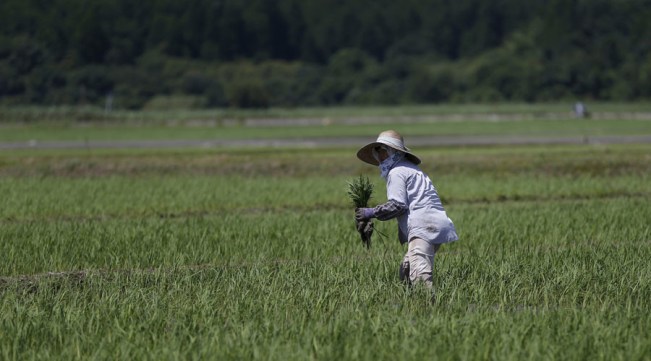
In May, residents planted one of the town’s first rice crops since the disaster. Many believe Naraha’s water is still too contaminated to drink.
Today there are only 50 houses on Wakizawa’s delivery route, down from 250 before the disaster. “The town is disappearing,” he says. He’s troubled by the sense of alienation he feels in Naraha’s desolate neighborhoods. People live alone, outside the traditional support networks of neighbors and extended families. Somebody could die at home and nobody would even know. When I tell him that such deaths aren’t an unusual occurrence in the United States, he looks aghast. “That never happens here! We always talk to our neighbors!” He shakes his head, as if attempting to dislodge the thought of a world where neighbors are strangers and people die alone.
“It’s all mixed up,” he says. “Everything is so confused.”
I leave Wakizawa and drive to the ocean, hoping to find some trace of the houses swept away by the tsunami. Instead I find a vast radioactive waste dump, half-hidden behind flimsy white panels decorated with pictures of birds and trees. I stand with my back to the sea, looking west over the dump toward the dark-shouldered mountains. The river plain is a ragged checkerboard of fallow rice paddies dotted with mounds of black decontamination bags. It is a sobering sight in a country where every inch of arable land is intensively cultivated. The Japanese expression for it is mottainai, a feeling of sorrow for something wasted.
Naraha’s “business district” consists of a single prefab metal shed tucked in a corner of the town hall parking lot. It contains a diner named Takechan, owned and operated by Miyuki Sato and her husband, who commute an hour to and from Iwaki each day. The original Takechan, now overrun with vermin and mold, was a neighborhood fixture in Naraha for 40 years. The reincarnated version has all the charm of a hospital cafeteria, with white laminate walls and glaring fluorescent lights. It is packed with decontamination workers in gray uniforms bent over steaming bowls of ramen.
After the lunch rush one day, I sit down with Miyuki. A television reporter from Sweden had interviewed her earlier in the week. “What do you think about the radiation?” Miyuki intones in mock seriousness. Then she claps her hand over her mouth to stifle a giggle. “So we finished the interview very quickly.”
The Satos haven’t yet found a place in Naraha to relocate. They are eager to leave Iwaki, though, partly because of the long commute, and partly because the evacuee community there isn’t as tranquil as the mayor has suggested. Residents are bitterly divided over his decision to reopen Naraha, Miyuki explains. She is reluctant to say more, except that she has been criticized for cooking with the town’s contaminated tap water. She shows me a certificate from the water authority taped to the wall, guaranteeing that Takechan’s water meets health standards.
“We just wanted to open Takechan, that’s it,” she sighs. “But some people don’t take it that way.”
The director of the local water authority, Haruo Otsuka, shows me a machine that tests the county’s drinking water every hour for cesium-137, the primary isotope in Fukushima’s fallout. The results are always undetectable. I tell Otsuka about evacuees who have criticized the Satos. “Those people are just looking for a reason not to come back,” he scoffs. “At first they said radiation levels in the rice paddies were too high. Then it was the roads. Now they’re blaming the water.”
Tensions among evacuees, however, continue to run high. Hiroko Yuki’s family runs the Shell gas station around the corner from Takechan. Although the Yukis were the first to reopen after the disaster, they have recently bought a house in Iwaki. They aren’t moving back to Naraha.
“We say it’s a house provided by the government,” Yuki says.
“Why is that?”
“People are jealous,” she shrugs. “We work all day, morning to night, and profit margins are slim in this business. We’re not making big money, but people don’t believe it.”
Hiroko Yuki runs the Shell gas station in Naraha. His family has decided not to move back to the village.
Such petty resentments seem unrelated to the serious disagreements among evacuees about resettling Naraha that Miyuki Sato had alluded to. I didn’t understand why anyone would begrudge their neighbors the choice to return—or not. The whole dynamic felt very—Japanese.
“Yes, that’s right, it is very Japanese,” replies Yuki, unfazed. She stands with her hands clasped behind her back, chin tilted in the air, looking a bit like a soldier with her buzzed hair and black Shell uniform. “Japanese people—we always care about how we’re perceived by others. That’s even more true here in the countryside.”
In Japanese society, self-interest is inextricably tied to family, work, and community. But the Fukushima disaster has sliced through those ties like an axe coming down on a bundle of rope. Virtually overnight, tens of thousands of people were set adrift. What looks on the surface like frivolous squabbles are expressions of the profound anxiety many people feel about their place in post-Fukushima Japan. The question of returning home has become a kind of loyalty test that nobody can pass, because home no longer exists.
Nobody understands this better than Kiyoshi Watanabe, president of Naraha’s commerce and industry association and a stolid member of the generation that had a duty, as he puts it, “to keep the house and the family tombs.” Watanabe has returned to Naraha to help “create more opportunities over the next three to five years for younger people to come back and find work.” It won’t be easy. Paradoxically, the disaster has liberated young people from traditional obligations that kept families bound to the same area, even the same house, for generations. Naraha has to reinvent itself to attract new blood.
“In the past, even if the first son lives in some other place, he has to come back to take care of his parents if they ask,” Watanabe explains. “But now he has a good excuse not to: radiation. The parents can’t say anything.”
Glimmers of Naraha’s future can be seen in the recent sale of seven residential lots near the Kido River. A few of the lots, which sold out immediately, went to buyers from Tomioka, a town bordering Naraha that is next to be reopened.
“Naraha won’t take the same form in the future,” Watanabe says. “New people will be moving in, and we have to think about making a new community for them.”
The half-life of cesium-137 is 30.17 years. What’s the half-life of a broken social bond?
“After five years, it’ll be hard to repair,” says Fumiko Yokota. “People just get used to things, good or bad.”
A stout septuagenarian with a mischievous cackle, Yokota lives alone in the hills above Route 6. On my last full day in Naraha, we talk in her kitchen as a warm breeze lifts the sheer curtains over a window offering a distant view of the ocean. Yokota is glad to be back in Naraha. Life in Iwaki “was quite depressing,” she says. But she recognizes that the younger generation has grown accustomed to “living the evacuee life,” and for them there is no looking back.
I ask her what’s so great about life in Iwaki.
“There’s more beautiful people in Iwaki, that’s the biggest difference,” says Yokota, laughing herself into a fit of coughing. “Now maybe this is the twisted idea of an old lady, but I think for some young people the disaster was a stroke of luck.”
Naraha was the kind of place young people forsook for the big city if given the chance, just as Hisao Yanai did 50 years ago. The Fukushima disaster was that chance. Yokota pushes herself up from her chair and goes to the window. Just across Route 6, an elderly couple from Tomioka has built a new house. Yokota met the woman in passing and got a good feeling from her. “I’m thinking we could be friends,” she muses. “It’s not going to happen fast, but gradually this is how we’re going to rebuild Naraha. I can only do what I can do, and that’s not always easy at my age.”
“Bring her a pie,” I joke.
Yokota chuckles. “We’re not like Americans. We’re really shy. I’m not sure they’re looking for friends. But everybody needs to talk to their neighbors.”
Squinting against the sunlight, she clears her throat, her voice a hoarse whisper, and says, “I hope we can be friends.”
Very few evacuees want to return to live in contaminated villages, those villages therefore have to offer many incentives to people if they want to repopulate, and not remain just the ghost towns that they became.
KAWAUCHI, Fukushima — The municipal government here, where an evacuation order, issued following the 2011 outbreak of the Fukushima nuclear crisis, was lifted on June 14, is encouraging single-parent families in urban areas to move to the village in a bid to put the brakes on its population decline and aging.
To that end, the Kawauchi Municipal Government plans to provide up to 800,000 yen in subsidies to each single-parent family that moves to the village.
“It’s possible to live more comfortably in the village than in Tokyo and other urban areas,” says an official of the municipal government in charge of the program.
A total of 51 people in 19 households in the Ogi and Kainosaka districts in eastern Kawauchi were affected by the evacuation order that was lifted on June 14. Most of these people have no plans to return home.
Evacuation orders had been lifted in all areas in the village apart from Ogi and Kainosaka by October 2014. Nevertheless, only about 1,800 of some 3,000 residents who had lived in the village before the disaster had returned by April 1 this year.
Approximately 40 percent of those who have returned are elderly people aged 65 or over.
As countermeasures against population decline and aging, the Kawauchi Municipal Government has decided to offer financial incentives to encourage single-parent households outside the village, including those in urban areas, to move in.
Specifically, the municipal government will provide 600,000 yen to each single-parent household that will live in the village to help them buy a car and move into their new home, and 50,000 yen per person (for up to four people) to cover miscellaneous expenses.
The maximum amount of the subsidies is 800,000 yen for a family comprising a parent and three children. The municipal government will introduce full-time jobs at companies operating in the village to those who move there, and provide a subsidy to cover half of the rent of privately owned apartments (up to 20,000 yen).
The municipal government will organize a two-day tour for those who are interested in the program July 29-30, and will begin to accept applicants for the tour as early as this week.
The village will use grants from the national government, which are part of measures to revitalize local economies, to finance the program. Under the program, the municipal government is considering accepting five to 10 new residents a year through fiscal 2017, and about 15 residents per year beyond that.
Moreover, a consultative council encouraging single-parent families to move into the village will be set up with the participation of a local women’s association. Elderly women living in the village will support new residents’ childrearing. Day care services are provided for free in the village.
Not only it is criminal to allow Fukushima products, potentially contaminated, to be sold in London, Europe at a Japanese Government sponsored event, and their ignorant buyers to be possibly internally contaminated, knowing that internal radiation exposure is 100 times more harmful than external radiation exposure; such event is then used by the Japanese government in the local Fukushima newspaper (Fukushima Minpo) and in the national newspapers (Japan Times) as propaganda to convince the Fukushima people and the Japanese people that it is quite safe, not harmful to eat the Fukushima products, the proof: Europeans are buying it and eating it!
Fukushima nativees sell products made in Fukushima Prefecture at the Japan Matsuri festival in London last Spetember (Fukushima Minpo)
Fukushima-harvested rice will hit the stores in Britain in July, which might make it the first member of the EU to import the grain, following a sustained effort by a group of Fukushima natives in London fighting rumors about the safety of the crop.
It is also the third nation, after Singapore and Malaysia, to import Fukushima rice since the March 2011 earthquake and tsunami caused three reactor meltdowns at the Fukushima No. 1 nuclear plant. Starting next month, 1.9 tons of Fukushima rice called Ten no Tsubu will be sold in London. A Fukushima branch of National Federation of Agricultural Cooperative Associations, a Japanese farmers group better known as Zen-Noh, will export the rice via a British trading company.
“With the U.K. as a foothold, we hope to expand the sale of prefecture-produced rice to other EU member countries,” said Nobuo Ohashi, who heads the Fukushima branch of Zen-Noh.
According to Japan’s Agriculture, Forestry and Fisheries Ministry, the EU has been phasing out its ban on Fukushima food products since the nuclear disaster started. But for Fukushima rice, the EU still obliges importers to submit a radiation test certified by the Japanese government or sample tests by the member nation importing it.
“It’s bright news for Fukushima, which has been struggling with the import restrictions,” said an official at the prefectural office in charge of promoting its products. “We will make further efforts so the restrictions will be lifted entirely.”
There were many hurdles to overcome.
Amid fears that Fukushima products were tainted with radioactive fallout, Yoshiro Mitsuyama, who heads the Fukushima group in London, consulted an official at Zen-Noh’s branch in Germany on how to sell Fukushima products a few years ago.
With the help of Zen-Noh, Mitsuyama’s group started selling Fukushima-made rice, peach and apple juice at the annual Japan Matsuri held at London’s Trafalgar Square three years ago.
The products were popular with London residents. When Visit Japan Ambassador Martin Barrow came to Fukushima last April, he bought some local produce.
“I want to help sell Fukushima fruits like cherries, apples and pears in London as well, not just rice,” said Mitsuyama.
This section, appearing every third Monday, features topics and issues covered by the Fukushima Minpo, the largest newspaper in Fukushima Prefecture. The original article was published on May 25.
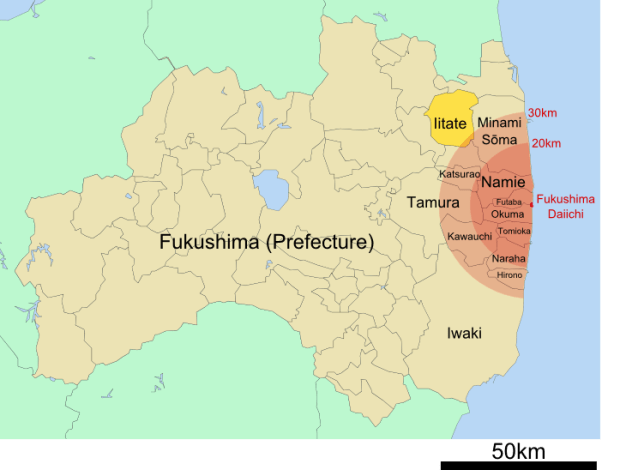
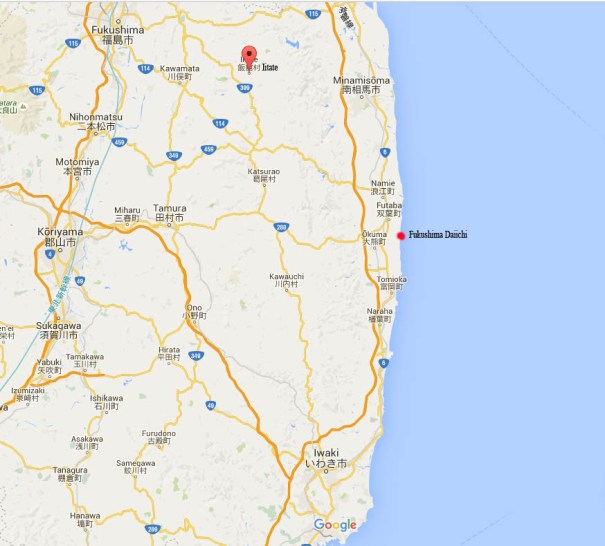
FUKUSHIMA – The central government has said it is considering plans to lift its evacuation order for most of the village of Iitate, Fukushima Prefecture, effective March 31.
The village is nearby the Fukushima No. 1 nuclear power plant, which experienced a meltdown disaster in 2011.
Yosuke Takagi, state minister of economy, trade and industry, conveyed the plan to Mayor Norio Kanno and other officials of the Fukushima Prefecture village at a meeting on Wednesday.
The government plans to make an official decision on the lifting shortly, along with a program to be launched in July to allow residents to stay overnight at their homes as part of preparations for permanent returns.
The evacuation order will be lifted for areas with less radiation from the three reactor meltdowns at the Tokyo Electric Power Co. Holdings Inc. plant, which was damaged in the March 2011 earthquake and tsunami.
As of the end of May, 5,917 residents in 1,770 households, or over 90 percent of the overall population of the village, were registered as citizens of such areas.
The government plans to finish decontamination work on houses by the end of this month and on farmland, roads and other facilities by the end of this year.
Visiting the village’s temporary office in the city of Fukushima on Wednesday, Takagi said the government aims to get the residents to return home by “resolving a series of challenges one by one.”
Kanno said, “We still have a long way to go and have to rebuild our village in a new form.”
The evacuation order will remain in place for highly contaminated areas, where 268 residents in 75 households are registered as local citizens.
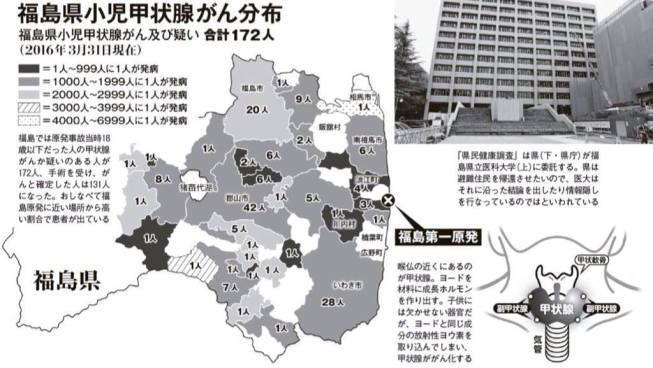
Distribution of 172 children who were 18 years old or younger at the time of the Fukushima nuclear accident and who were diagnosed with thyroid cancer or suspected of thyroid cancer as of March 31, 2016. 131 children out of 172 were confirmed to have thyroid cancer.















 nuclear-news