On Five Years Of An Ongoing Accident In Fukushima: It’s Not An Anniversary
DiaNuke editorial on the Five Years since the Earthquake-Tsunami-Meltdown
by Kumar Sundaram, March 12, 2016
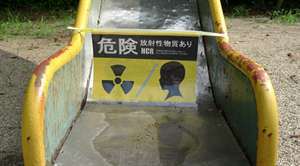
The absurd contradictions of disaster management: the government told families that it was safe for children to stay, but not safe for children to play.
On March 11, 2011, I was sitting in my office in the Institute of Defense Studies and Analysis, when the news of massive tsunami and earthquake came. I was working as a Senior Research Fellow on a project funded by the Dept. of Atomic Energy.
I was new to Facebook, and wished safety to all my Japanese friends, and I asked some over Facebook messaging and emails if they were fine.
And then, the news of nuclear accident in Fukushima Dai-Ichi reactors flashed. Within hours, it turned into an unimaginable horror.
I almost didn’t sleep for several days – checking every detail on the internet – the radiation counts, the design details of the reactors, every single news release, the weather reports for understanding the direction and speed of wind, getting glued to the map of Tohoku region. A number of other people tracking Fukushima on the social media from different countries became friends. We kept doing that for months. Some still meticulously gather every single detail.
For me, it was a reckoning of the insurmountable nature of nuclear accidents. The accidents might not happen so frequently, but the fact that every reactor can undergo an accident and there is no human response possible for nuclear accidents, even in technologically most advanced countries, makes nuclear power uniquely and unacceptably dangerous.
The accident also revealed decades of complacency in Japan. The nexus between politics, nuclear corporations, the elites, and the media was openly exposed. We can rely on the Indian system to be far worse than Japan in that respect. The labour mafia in Japan has been callously using the poor and migrant workers as cheap fodder in Fukushima’s clean-up.
The clean-up will take decades. They have not been able to get the reactor under control, even after 5 years. We have no clue about the state of tons of molten fuel in the crippled reactor. What the government means by ‘under control’ is just that they are pouring water daily to keep the temperature in the crumbled building low. Thousands of litres of contaminated water from the reactor are coming out daily, and they have no idea what to do with the water except storing it in thousands of huge tanks and stealthily letting it go into the Pacific Ocean.
A 20-kilometre radius area around the reactor remains uninhabitable, and more than 20,000 people evacuated from this area have no hope to return.
I have been to Fukushima twice since the accident. I went inside the evacuation zone and saw the ghost towns like Namie, Futaba and Itate. Houses, offices, shops, schools, playgrounds, railway stations, everything is there, but there are no humans. In 5 years, heavy dust and moss has accumulated everywhere.
There are decontamination workers working in this 20 kilometre zone, mostly scraping the top-soil and cleaning houses and offices. This highly radioactive dump is transported, shifted from one place to other in ‘temporary’ storage sites. The people doing this work know there’s no solution. They know everything is just an eyewash, for appearance’s sake. The same company which didn’t heed to warnings before the accident, and played every trick in the book to exclude as many people as possible from getting compensation, is gaining from these decontamination contracts.
Life for the evacuated people is unimaginably hard and shattered. Building a new life is not easy for most of them. There’s very little support from the government, and there are many attempts to stop even that as the years pass. There are documented proofs that the community in Fukushima is also facing social ostracism, as people fear that radiation-caused diseases might appear after several years. People are experiencing psychological breakdowns.
The resilience of the community, and the larger Japanese society, however, is moving. People across the country are providing support in every possible manner.
The political fallout of Fukushima is historic. Something has changed in the normally apolitical Japanese society. The kind and gentle Japanese people are angry. They understand the connections between corporations, government, politicians and the media. They are still grappling with how to make their collective response more effective. Thousands of reluctant activists flock to the Japanese parliament building in Tokyo every Friday after their work, chant slogans, play music, light candles, and share dreams of a better future. This has proliferated and there are weekly protests all over Japan.
In India, we have a additional set of problems when it comes to nuclear: higher population density, deeper corruption and unaccountability in the system, absence of an independent nuclear safety regulator, attempts to dilute even the ridiculously low nuclear liability. And more than anything else, brutal bulldozing of public dissent, environmental and safety concerns as the commitment for setting up new reactors stems primarily from the elite’s foreign policy choices rather than some well-thought energy policy.
Fukushima has led to policy changes in several countries. As a BBC survey has revealed, popular support for nuclear power is touching bottom, globally.
But in India, legitimate concerns about nuclear safety are deemed superstition. The previous government sent psychological counselors to Koodankulam when local residents raised objections about the project. And when these counselors couldn’t “cure” them, the police came. Thousands of para-military forces surrounded the villages, ransacked houses and fishing boats, and killed innocents.
Asking questions has become anti-national in India. Thousands of villagers on the southern-most tip of India face sedition charges for peacefully protesting against the project, which has now revealed itself as an expensive and dangerous white elephant. In almost 3 years since its commissioning, after much fanfare and repression, Koodankulam nuclear plant has not even operated successfully for 100 consecutive days. The latest news is that the reactor has been shut down again due to a dangerous leak. People around the area have reported a pungent smell coming from the plant for the last few days.
I left my previous job and have associated myself with the Coalition For Nuclear Disarmament and Peace (CNDP) after the Fukushima accident. We have been trying to mobilise solidarity for the struggling villagers, amplify their voices and connect the dots by collaborating with civil society groups to ask questions on liability, safety, economic viability and environmental impacts of the proposed and existing nuclear plants in India.
In this country with hugely anachronistic nuclear ambitions, which is one of the handful countries with expansion plans after Fukushima, we all have been labeled anti-national.
One of the first things the new BJP government did after coming to power was to deliberately ‘leak’ an intelligence report calling CNDP and other such organisations anti-national. Some 40 names were mentioned, including mine. The IB became an economist and axiomatically said we are bringing down India’s growth by 2 to 3 percent. How more absurd can it get? I survive in Delhi on odd freelance pieces of work and minimum organisational support.
In the 5th year of Fukushima, I have lost track of the details that I started accumulating in March 2011. It’s not about facts and figures any more. It’s about politics. It’s about power structures. It’s about our lifestyles. Everything needs to be questions and transformed if the world has to be kept safe from nuclear horror and climate change.
If challenging the status-quo is anti-national, so be it. I am proud to carry the label.
On Five Years Of An Ongoing Accident In Fukushima: It’s Not An Anniversary
Is Fukushima’s nuclear nightmare over? Don’t count on it
Christopher Busby is an expert on the health effects of ionizing radiation. He qualified in Chemical Physics at the Universities of London and Kent, and worked on the molecular physical chemistry of living cells for the Wellcome Foundation. Professor Busby is the Scientific Secretary of the European Committee on Radiation Risk based in Brussels and has edited many of its publications since its founding in 1998. He has held a number of honorary University positions, including Visiting Professor in the Faculty of Health of the University of Ulster. Busby currently lives in Riga, Latvia. See also: http://www.chrisbusbyexposed.org, http://www.greenaudit.org and http://www.llrc.org.
Thomas was described as “one of Britain’s leading experts on the health effects of radiation”. She is of the opinion that there is no danger and the Japanese refugees can come back and live there in the “zone”. Her main concern seemed to be how untidy it all was: “Left to rack and ruin,” she complained, sadly.
At one point, Rupert pulled out his Geiger counter and read the dose: 3 microSieverts per hour. “How much radiation would it give in a year to people who came back here,” he asked. Thomas replied: “About an extra milliSievert a year, which is not much considering you get 2mSv a year from natural background”.
“The long term impact on your health would be absolutely nothing.”
Now anyone with a calculator can easily multiply 3 microSieverts (3 x 10⁻⁶ Sv) by 24 hours and 365 days. The answer comes out to be 26 mSv (0.026Sv), not “about 1mSv” as the “leading expert on the health effects of radiation” reported.
I must personally ask if Gerry Thomas is a reliable expert; her CV shows she has published almost nothing in the way of original research, so we must ask how it is the BBC has taken her seriously.
This recalled the day the first reactor exploded in 2011. I was in London, and the BBC asked me to come into the studio and comment. Also present was a nuclear industry apologist, Dr Ian Fells. Like Geraldine Thomas he seemed unconcerned about the radiation: the main problem for him was that the lifts would not work. People would have to climb stairs, he complained.
I said then on that first day that this was a serious accident like Chernobyl, but he and everybody who followed him told the viewers that it was no problem, nothing like Chernobyl.
Some months later, looking back, it became clear I was correct on every point, but I never was invited back to the BBC. I visited Japan, took sophisticated measuring equipment, obtained vehicle air filters, spoke to the Japanese people and advised them to take Calcium tablets to block the Strontium-90.
My vehicle air filter measurements showed clearly that large areas of north east Japan were seriously contaminated – including Tokyo. This was too much for the nuclear industry: I was attacked in the Guardian newspaper by pro-nuclear George Monbiot in an attempt to destroy my credibility. One other attacker was Geraldine Thomas. What she said then was as madly incorrect then as what she is saying now. But the Guardian would not let me respond.
The important evidence for me in the recent BBC clip is the measurement of dose given by Rupert’s Geiger counter: 3microSieverts per hour (3Sv/h). Normal background in Japan (I know, I measured it there) is about 0.1Sv/h. So in terms of external radiation, Ruperts’s measurement gave 30 times normal background.
Is this a problem for human health? You bet it is. The question no-one asked is what is causing the excess dose? The answer is easy: radioactive contamination, principally of Caesium-137. On the basis of well-known physics relationships we can say that 3Sv/h at 1m above ground represents a surface contamination of about 900,000Bq per square metre of Cs-137. That is, 900,000 disintegrations per second in one square metre of surface: and note that they were standing on a tarmac road which appeared to be clean. And this is 5 years after the explosions. The material is everywhere, and it is in the form of dust particles which can be inhaled; invisible sparkling fairy-dust that kills hang in the air above such measurements.
The particles are not just of Caesium-137. They contain other long lived radioactivity, Strontium-90, Plutonium 239, Uranium-235, Uranium 238, Radium-226, Polonium-210, Lead-210, Tritium, isotopes of Rhodium, Ruthenium, Iodine, Cerium, Cobalt 60. The list is long.
The UN definition of ‘radioactively contaminated land’ is 37,000Bq/square meter, and so, on the basis of the measurement made by the BBC reporter, the town of Ohkuma in the Fukushima zone (and we assume everywhere else in the zone) is still, five years after the incident, more than 20 times the level where the UN would, and the Soviets did, step in and control the population.
But the Japanese government wants to send the people back there. It is bribing them with money and housing assistance. It is saying, like Gerry Thomas, there is no danger. And the BBC is giving this misdirection a credible platform. The argument is based on the current radiation risk model of the International Commission on Radiological Protection the ICRP.
Last month, my German colleagues and I published a scientific paper [2] in the peer reviewed journal Environmental Health and Toxicology. It uses real-world data from those exposed to the same substances that were released by Fukushima to show that the ICRP model is wrong by 1,000 times or more. This is a game-changing piece of research. But were we asked to appear on the BBC, or anywhere else? No. What do our findings and calculations suggest will have happened in the five years since the explosions and into the future? Let’s take a look at what has happened since 2011.
The reactors are still uncontrolled five years after the explosions and continue to release their radioactive contents to the environment despite all attempts to prevent this. Concerning the melted fuel, there is no way to assess the condition or specific whereabouts of the fuel though it is clearly out of the box and in the ground.
Meanwhile, robots fail at the extremely high radiation levels found; ground water flowing through the plant is becoming contaminated and is being pumped into storage tanks for treatment; high radiation levels and debris have delayed the removal of spent fuel from numbers 1, 2 and 3 reactor buildings. TEPCO plans to remove debris from reactor 3 and this work has begun. Then they are hoping to remove the fuel rods out of reactors 1 and 2 by 2020 and the work on removing debris from these 2 reactors has not begun yet.
Much of the radioactivity goes into the sea, where it travels several hundreds of km. up and down the coast, destroying sea life and contaminating intertidal sediment. The radionuclides bind to fine sediment and concentrate in river estuaries and tidal areas like Tokyo Bay. Here the particles are re-suspended and brought ashore to be inhaled by those living within 1km of the coast.
From work done by my group for the Irish government on the contaminated Irish Sea we know that this exposure will increase the rate of cancer in the coastal inhabitants by about 30 percent.
The releases have not been stopped despite huge amounts of work, thought and action. The treated water is still highly radioactive and cannot yet be released.
That is a real problem on site with three heavy spent fuel pools still full and largely inaccessible. Collapse of the buildings would lead to coolant loss and a fire or even an explosion releasing huge amounts of radioactivity. So this is one nightmare scenario: Son of Fukushima. A solid wall at the port side may have slowed the water down but diverting the water may cause problems with the ground water pressure on site and thus also threaten subsidence. Space for storing the radioactive water is running out and it seems likely that this will have to be eventually spilled into the Pacific.
Only 10 percent of the plant has been cleaned up although there are 8,000 workers on site at any one time, mostly dealing with the contaminated water. Run-off from storms brings more contamination down the rivers from the mountains.
There are millions of 1-ton container bags full of radioactive debris and other waste which has been collected in decontamination efforts outside the plant and many of these bags are only likely to last a handful of years before degrading and spilling their contents. Typhoons will spread this highly contaminated contents far and wide.
Let’s look at the only real health data which has emerged to see if it gives any support to my original estimate of 400,000 extra cancers in the 200km radius. Prof Tsuda has recently published a paper in the peer review literature identifying 116 thyroid cancers detected over 3 years by ultrasound scanning of 380,000 0-18 year olds.
The background rate is about 0.3 per 100,000 per year, so in three years we can expect 3.42 thyroid cancers. But 116 were found, an excess of about 112 cases. Geraldine says that these were all found because they looked: but Tsuda’s paper reports that an ultrasound study in Nagasaki (no exposures) found zero cases, and also an early ultrasound study also found zero cases. So she is wrong. The thyroid doses were reported to be about 10mSv. On the basis of the ICRP model, that gives an error of about 2000 times.
From the results of our new genetic paper we can safely predict a 100 percent increase in congenital malformations in the population up to 200km radius.
In an advanced technological country like Japan these will be picked up early by ultrasound and aborted, so we will not actually see them, even if there were data we could trust. What we will see is a fall in the birth rate and an increase in the death rate because we know what has been happening and what will happen; we have seen it before in Chernobyl. And just like Chernobyl, the (Western) authorities are influenced by or take their lead from the nuclear industry: the ICRP and the International Atomic Energy Agency, (IAEA) which since 1959 has taken over from the World Health Organization as the responsible authority for radiation and health (Yes!).
They keep the lid on the truth using ill-informed individuals like Geraldine Thomas and, by analogy with New Labour: New BBC. Increasingly I could say “New Britain” as opposed the Great Britain of my childhood, a country I was proud of where you could trust the BBC. I wonder how the reporters like Rupert can live with themselves presenting such misguided information.
Fukushima is far from being over, and the deaths have only just begun.
Reference:
1. http://www.bbc.com/news/world-asia-35761141
2. Genetic Radiation Risks-A Neglected Topic in the Low Dose …
http://www.ncbi.nlm.nih.gov/pubmed/26791091
Source: https://www.rt.com/op-edge/335362-fukushima-nuclear-japan-bbc/
Nuclear refugees tell of distrust, pressure to return to Fukushima
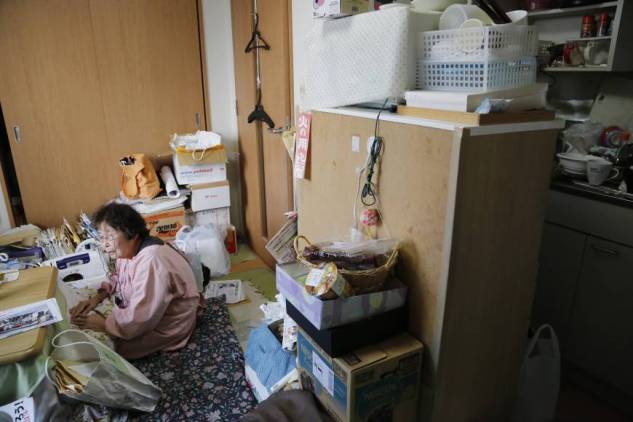
Tokiko Onoda speaks about her house in Fukushima from her apartment
in Tokyo on Feb. 9.
They feel like refugees, although they live in one of the world’s richest and most peaceful nations.
Five years ago, these people fled their homes, grabbing what they could, as a nearby nuclear plant melted down after being hit by tsunami, spewing radiation. All told, the disaster in Fukushima displaced 150,000 by the government’s count.
About 100,000 are still scattered around the nation, some in barrack-like temporary housing units and others in government-allocated apartment buildings hundreds of kilometers away.
Although authorities have started to open up areas near the damaged reactors that were previously off limits, only a fraction of residents have returned. For example, in the town of Naraha, where evacuation orders were lifted in September, 459 people, or 6 percent of the pre-disaster population, have gone back.
Most say they don’t want to return for fear of lingering radiation. Some don’t want the upheaval of moving again after trying to start their lives over elsewhere.
With government housing aid set to end next year, many feel pressured to move back.
Tokiko Onoda, 80, lives with her husband in a cramped, cluttered apartment on the 21st floor of a high-rise in the edge of Tokyo where about 1,000 people displaced by the disaster live in rent-free housing.
Several Fukushima towns that were deserted are now urging residents to return, saying it is safe to live in certain areas. An ambitious effort to decontaminate vast swaths of land by removing topsoil and razing shrubbery has turned farmland and coastlines into stretches of dirt with rows upon rows of black garbage bags filled with grass, soil and debris.
When housing aid ends in April 2017, people in apartments under the government program will have to start paying rent or move out. Those whose homes in Fukushima that are in areas still off-limits for living will continue to receive the aid.
Onoda fears hers will be cut off because her home is in Namie, where evacuation orders are gradually being lifted in parts of the town.
She doesn’t believe it’s safe to go back. She feels duped because she had believed that nuclear power was safe.
Onoda angrily talks about how authorities are treating people like her. Why didn’t the government give her land elsewhere to build a new home?
When she lived in Fukushima, she had a big house with a garden where she grew vegetables and peonies. She picked mushrooms and ferns in the hills.
“We worked so hard to build that house,” she said, often stopping to wipe away tears. “We had no worries in the world except to plan vacation trips to the hot springs.”
That home is now in shambles. Although it survived the magnitude-9.0 quake on March 11, 2011, burglars have ransacked it and rats have chewed the walls. The last time she visited, the dosimeter ticked at 4 microsieverts an hour, more than 100 times the average monitored in-air radiation in Tokyo. That’s not immediately life-threatening but it makes Onoda feel uncomfortable because of worries that cancer or other sicknesses may surface years later.
Before the disaster, the government had set the safe annual radiation dosage level at 1 millisievert. Afterward, it has adopted the 20 millisievert recommendation of the International Commission on Radiation Protection set for emergencies, and 1 millisievert became a long-term goal.
Onoda says she has done her best to cope. She has made friends. She keeps busy with tea parties, art classes and a sewing circle.
And now they want her to go back, after all she has gone through?
“Only someone who has gone through this evacuation can understand,” she said.
Ryuichi Kino, a journalist who wrote, edited and compiled the 2015 book, “The White Paper on Nuclear Evacuees,” believes people like Onoda have been treated like kimin, which means “people who have been discarded” because they have been forgotten or abandoned by society.
“We don’t even know their real numbers,” he said, noting the government lacks a clear definition for “evacuees,” and bases its figures on tallies of those receiving aid. A recent count in Fukushima and a neighboring prefecture found the total number may be as high as 200,000, Kino said.
“Evacuation is a term that assumes the situation is temporary, and there is a place to go back,” said Kino.
The government is spending about ¥40 billion ($400 million) a year on housing aid for those displaced by the disaster. It’s also financially backing Tokyo Electric Power Co., operator of the damaged Fukushima No. 1 nuclear plant, to make monthly compensation payments, now at a cumulative ¥5.9 trillion ($59 billion) and rising.
Tests with volunteers who wore dosimeters for two weeks in the town of Naraha found average radiation exposure to be at a rate of 1.12 millsieverts a year.
Government official Yuji Ishizaki, who is overseeing the lifting of evacuation orders, says he is merely following policy.
“There is no clear boundary for what is safe or not safe for radiation,” he said. “Even 1 millisievert might not be absolutely safe.”
Fukushima Medical University, the main academic body studying the health effects of the nuclear disaster, says no sickness linked to radiation has been detected so far, although sickness from lack of exercise, poor diet and mental stress has been observed.
The more than 100 cases of thyroid cancer found among the 370,000 people 18 years old and younger at the time of the disaster the university calls “a screening effect,” or a result of more rigorous testing.
Some scientists say that is unusually high, given that thyroid cancer among children is rare at 2 or 3 in 1 million. Thyroid cancers among the young surged in the Ukraine and Belarus after the 1986 Chernobyl catastrophe.
Seiichi Nakate is relatively content in his new life with his wife and two children, 13 and 11, in Sapporo, 600 km from Fukushima. There, some 1,500 people from Fukushima have formed a support network, often getting together for drinks and helping each other find jobs.
Nakate recently bought a house and started a company that refers professional helpers to disabled people, and has hired former Fukushima residents. He vows to never return to Fukushima because of the radiation danger.
He believes that from the beginning, authorities underplayed those risks. He doesn’t trust them.
After the disaster, he immediately sent his wife and children to a relatives’ home in southern Japan. The family started living together in Sapporo a year later.
The end of government housing support makes people feel pressure to return, he says.
“The government abandoned the people of Fukushima, even the children. Now the policy is to push us to go back,” he said. “It’s a policy that forces radiation upon people.”
Megumi Okada, a mother of four, is fighting hard to keep her housing aid in Tokyo, getting people to sign petitions and meeting with government officials.
She scoffs at how officials keep saying that people are living “as normal” in much of Fukushima. She doesn’t want her children eating the food or breathing the air. They get periodic blood tests to make sure they are healthy.
Her husband has found a job as a construction worker in Tokyo. Their apartment is just two rooms and a kitchen, but the rent is covered. Okada wants to work, but publicly funded child care is scarce in Japan, and private ones are costly.
“Nothing has progressed in five years,” she said. “We have the right to stay evacuated.”
Okada says she wants to apply for U.N. refugee status and move to Europe with her family, if she could.
“I know Japanese can’t become refugees now. But I wish we could,” she said. “It is about our staying alive.”
http://www.japantimes.co.jp/news/2016/03/11/national/nuclear-refugees-tell-distrust-pressure-return-fukushima/#.VuP97vl95D8
FIVE YEARS AFTER: Tougher work awaits TEPCO at Fukushima after water issue ends
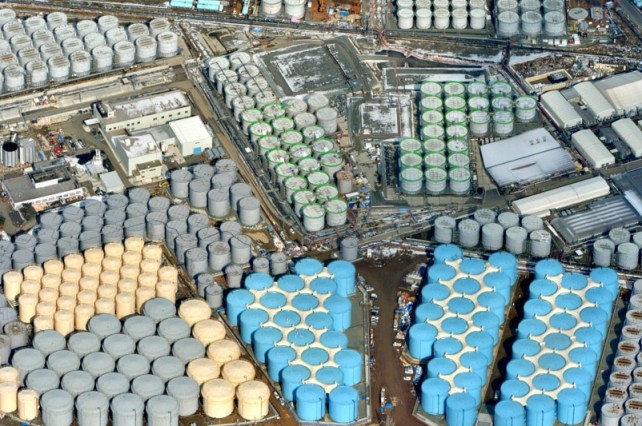
Rows of massive tanks storing radiation contaminated water line at the Fukushima No. 1 nuclear power plant in February.
OKUMA, Fukushima Prefecture–The ever-increasing rows of tanks storing radioactive water continue to eat up the precious available land at the Fukushima No. 1 nuclear power plant.
Five years after the Great East Japan Earthquake and tsunami on March 11, 2011, triggered the triple meltdown at the plant, Tokyo Electric Power Co. is still struggling to bring the contaminated water problem under control.
And the utility has yet to fully tackle the more difficult and time-consuming task of actually decommissioning the ruined nuclear plant.
Each day, TEPCO circulates 300 tons of water inside the No. 1 to No. 3 reactors to cool down the melted nuclear fuel within.
In addition, groundwater keeps flowing into the damaged reactor buildings and inevitably becomes highly contaminated by the radiation.
TEPCO reuses some of this contaminated water to cool down the damaged reactors.
The rest of the water is processed through the ALPS (advanced liquid processing system) multi-nuclide removal system and other equipment to remove highly radioactive substances. The water is then stored in tanks.
The advanced decontamination equipment has helped TEPCO to reduce the amount of highly contaminated water at the plant’s compound.
But 400 to 500 tons of less contaminated water still accumulates at the plant site on a daily basis.
To reduce the amount of groundwater flowing into the reactor buildings, TEPCO initiated its “subdrain plan” in September to pump groundwater from wells dug around the reactors’ premises and release the water into the ocean after the decontamination process.
On the seaside of the reactor buildings, the utility constructed underground walls to prevent contaminated groundwater from flowing into the sea.
Also around the reactor buildings, TEPCO installed coolant pipes to create an underground frozen soil wall, which is expected to divert the clean groundwater directly to the ocean.
But this is only a stop-gap measure at best.
The number of storage tanks, which are built at the site, has reached 1,000. Rows of tanks cover most of the parking lots, green spaces and vacant areas at the Fukushima plant site. Eventually, space will run out for storing the contaminated water.
The government will start full-fledged discussions on measures to reduce the amount of less contaminated water at the plant in fiscal 2016, which starts in April.
LONG ROAD TO DECOMMISSIONING
Five years after the onset of the nuclear disaster, TEPCO has taken the first step in its decommissioning road map.
The first major challenge in decommissioning the plant is removing spent fuel from storage pools in the upper parts of the reactor buildings.
TEPCO has already removed 1,535 fuel assemblies from the No. 4 reactor, which was offline for a periodic safety check when the tsunami slammed into the plant.
However, a large amount of debris and the high radiation levels have delayed the removal of spent fuel from the No. 1 to No. 3 reactor buildings.
Work is under way to remove debris from the upper part of the No. 3 reactor building. TEPCO plans to start removing the spent fuel in fiscal 2017.
According to TEPCO’s road map, the removal of spent fuel from the No. 1 and No. 2 reactor buildings will start in fiscal 2020. But the utility has not started taking debris out of the upper part of the buildings where the fuel storage pools are located.
The toughest task will be removing the melted fuel inside the No. 1 to 3 reactor containment vessels.
The locations and amount of melted fuel inside the reactors remain largely unknown. Extremely high radiation levels in the reactor containment vessels have prevented workers from analyzing the conditions. Even remote-controlled survey robots have failed to readily approach the core areas.
The preferred way to remove the melted fuel is the “water-covered method.” It involves pumping in water to fill the reactor containment vessels to the upper part and removing the fuel while the water keeps radiation exposure of the workers at low levels.
The government and TEPCO are also considering the “airborne method” if contaminated water keeps leaking from the containment vessels. Under this method, water would fill only the bottom part of the containment vessels, and the melted fuel would be removed through the air.
The two parties also need to develop special equipment to remove the melted fuel and keep it safely stored in containers.
They estimate the decommissioning process will take 30 to 40 years. But they have not specified the conditions that can finally bring an end to the nuclear disaster.
http://ajw.asahi.com/article/0311disaster/fukushima/AJ201603110047
Fukushima Five Years On: Not a Comedy of Errors, a Calamity of Terrors
Since it began March 11, 2011, thousands of freelancers have reported on the Fukushima-Daiichi triple reactor meltdowns and radiation gusher, the deluge of accidents, leaks, faulty cleanup efforts, the widespread contamination of workers, citizens, soil, food and water, and the long series of cancer studies, lawsuits, and ever-changing clean-up and decommissioning plans. As Japan Times reports last October, “Extremely high radiation levels and the inability to grasp the details about melted nuclear fuel make it impossible for [Tokyo Electric Power Co.] to chart the course of its planned decommissioning of the reactors.”
The journalism is partly a response to the lack of mainstream US news coverage, and partly a warning against similar radiation disasters risked in the United States every day by the operation of 23 identical GE reactors (Fukushima clones) in this country.
Japanese media coverage of the catastrophe in English, along with analysis by independent scientists, researchers, and institutes is mostly available online and much of it is reliable.
Five years into the crisis, officials from Tepco have said leaks from the wreckage with “at least” two trillion Becquerels of radioactivity entered the Pacific between August 2013 and May 2014. “At least” is vague enough to beg the question: Is the actual total 5 trillion; 25; 50? Relentless drainage of contaminated water from the site is estimated to be about 300 tons a day and has continued for 60 months. “We should be carefully monitoring the oceans after what is the largest accidental release of radioactive contaminants to the oceans in history,” researcher Ken Buesseler, of the Woods Hole Oceanographic Institute said last September.
However, Japan isn’t even monitoring seawater near Fukushima, according to The Ecologist.
Greenpeace launches study of 300-year effect on oceans
On Feb. 26, Greenpeace International launched a major investigation into the gusher’s effects on the Pacific Ocean near the wrecked Fukushima complex in Northeast Japan. The group said in a press release that its investigation will employ an underwater vehicle with a sensitive gamma radiation “Spectrometer,” and a sediment sampler.
Greenpeace noted that, “In addition to the initial release of liquid nuclear waste during the first weeks of the accident, and the daily releases ever since, contamination has also flowed from the land itself, particularly nearby forests and mountains of Fukushima, and are expected to continue to contaminate the Pacific Ocean for at least the next 300 years.”
Former Japanese Prime Minister Naoto Kan, who headed the government in 2011, joined the Greenpeace crew aboard the Rainbow Warrior on the opening day of its study, and Kan used the occasion to call for a Germany-like total phase-out of nuclear power.
“I once believed Japan’s advanced technology would prevent a nuclear accident like Chernobyl from happening in Japan,” Kan said. “But it did not, and I was faced with the very real crisis of having to evacuate 50 million people… Instead, we should shift to safer and cheaper renewable energy.”
Shaun Burnie, Senior Nuclear Specialist with Greenpeace Germany said, “There is an urgent need to understand the impact this contamination is having on the ocean — how radioactivity is both dispersing and concentrating — and its implications.”
“Tepco failed to prevent a multiple reactor meltdown and five years later it’s still an ongoing disaster. It has no credible solution to the water crisis they created and is failing to prevent further contamination of the Pacific Ocean,” Burnie said.
Criminal charges leveled against reactor execs
The first criminal charges against executives of Tepco were filed Feb. 29 alleging that three officials refused to take precautionary measures that could have prevented the loss of off-site power (known as “station blackout”), and the resulting complete meltdown, or melt-through, of reactor fuel in three units. Specifically, the three are accused of negligence resulting in death and injury, having ignored explicit professional warnings about the inadequate height of the seawall, and about the improper placement (in basements) of emergency diesel generators which were destroyed by tsunami. Many of the 14,000 Japanese citizens who signed on to the lawsuit said their action was taken partly to force disclosure at trial of important information still kept secret by Tepco.
Starting from scratch with no textbook
Last October, four-½ years into the unprecedented self-destruction of three-reactors in one place, Japan’s Atomic Energy Agency opened an institute “to develop” techniques to inspect and eventually decommission the three leaky ruins. Because of the vast, daunting and novel complexity of three melted reactors, the new “Remote Technology Development Center” is starting from scratch. That’s right: No one now knows how to disassemble and safely containerize the ferociously radioactive wreckage — times three.
Naohiro Masuda, Tepco’s chief of decontamination and decommissioning, told the AP Dec. 18, “This is something that’s never been experienced. A textbook doesn’t exist for something like this.” Radiation levels inside the cores are too high for even for robots to make useful inspections.
The ultimate goal of dismantling work is to remove the melted uranium fuel. Researchers don’t yet know how to patch massive quake-caused cracks in chambers under the failed reactors, which release tons of highly contaminated water every day. The new institute is tasked with inventing a first-ever technique to find and plug the leaks. The chambers must be made watertight, because removal of the melted fuel has to be done remotely and under water.
Planners must also invent a system of possible routes by which to remove the hundreds of tons of still-unseen melted fuel, and they’ve been told to find new ways of reducing radiation doses to workers conducting the mission.
Two mayors agree to host waste dumpsites
After first opposing the government’s plans, two towns in Fukushima Prefecture have agreed to Tokyo’s proposal for using them for “permanent” radioactive waste disposal. The sites, one at an existing private facility in Tomioka, and another at Naraha, have been chosen for disposal of “designated waste” in exchange for bribes, including the construction of an industrial park and subsidies worth about $81 million.
“Designated waste” is rubbish with between 8,000 and 100,000 Becquerels of radioactivity per kilogram. Confusingly, the Japan Times called this deadly refuse “low-level nuclear waste,” while the Asahi Shimbun called it “highly radioactive.”
The Tomioka facility, now run by Ecotech Clean Center, will be nationalized and will then bury some 650,000 cubic meters of designated waste which is mostly incinerator ash, sewage sludge and rice straw. It is a small fraction of the estimated 22 million cubic meters of waste that’s been collected in large black bags and stored outdoors at thousands of sites in 11 prefectures.
Waste with higher radiation levels is to be kept at temporary facilities being built near the doomed reactor complex.
Another proposal from the Ministry of Industry is to bury high-level radioactive waste under the seabed. Experts who made the idea public said such waste could be transported by ship, but this raised alarms about transfer mishaps, transport accidents, groundings, breakups, and sinkings of cargo ships.
Pollution solution: Declare safe today what was unsafe yesterday
Following the start of the ongoing disaster, the government’s official allowable public external radiation exposure was arbitrarily raised. One milliSievert (mSv) per year was raised to 20 mSv for residents in areas affected with radioactive fallout. For radiation workers in the nuclear industry the annual limit was raised from 100 mSv to 250 mSv. This had the double effect of both saving the industry billions in cleanup costs, and increasing radiation-induced health effects — especially in women, fetuses, infants, and children.
Robert Hunzinker reported in CounterPunch Dec. 14 that Physicians for Social Responsibility has warned that the new “allowable dose” means there’s a 1 in 200 risk of children getting cancer in the first year; and over two years the risk increases to 1 in 100.
Sea wall making matters worse
In October, Tepco completed a deep seawall dug into the shore between the ocean and the wrecked reactors. Intended to halt the flow of contaminated groundwater to the Pacific, the dam has cause groundwater levels to rise behind the wall. Now, in an attempt to fix the problem caused by the wall, Tepco dug new wells to pump backed-up groundwater, planning to dump less-contaminated groundwater from new wells into the sea. But the water is so heavily poisoned with tritium that sea dumping was not allowed. Now the company is pumping and dumping the fast rising groundwater into severely radioactive reactor buildings — where the water will become even more contaminated by passing over the mass of hot melted fuel inside. It’s not really a comedy of errors, but a calamity of terrors.
Fukushima Five Years On: Not a Comedy of Errors, a Calamity of Terrors
Fukushima+5, Part 6. “Dose” does not exist, only exposure
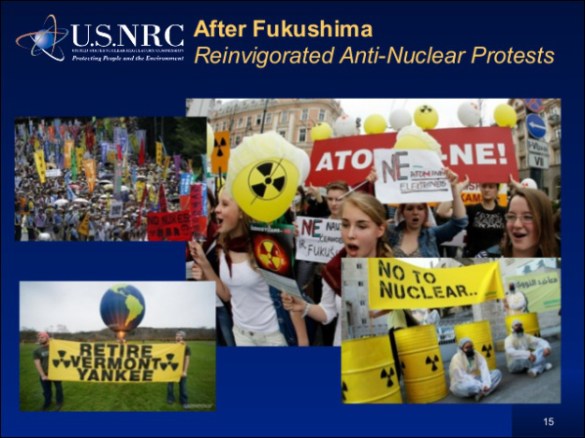
The onset of the Fukushima nuclear disaster on March 11, 2011 set off a new round of anti-nuclear protest across the world so large even the U.S. NRC was forced to take notice.
About 300 people gathered in the Diet Offices to commemorate the Tohoku earthquake, tsunami and Tepco’s meltdowns. Hosted by Friends of the Earth Japan and a large network of NGOs in Japan working on every nuclear concern, including continued aid and support to Chernobyl victims, this was a national-scale event. At 2:46 we paused to silently mark the time of the quake.
A number of people I have met previously on this tour are here. It feels good to have new friends here.
What follows is a piece I wrote in anticipation for this day. I know it is long. I hope some will read it through. It is Mary’s Manifesto on radiation, but I feel with some certainty that Rosalie Bertell would support it!
The Nuclear Dose Emperors Have No Clothes
It is now five years since three reactors melted down (and out of containment). Arnie Gundersen does not know where the melted fuel is, but he is pretty confident that it has now been cooled, and continues to be cooled to the point where it is not melting any more. He thinks maybe it is through all the metal containment, but still in the concrete of the reactor building floor. Huge amounts of radioactivity are still there, on-site, but huge amounts are distributed to the land, ground and surface waters, plants, animals children and to the men and women of Japan. And then there is the Pacific Ocean…
Interesting that the paper reports the UN Agency as saying the doses from 2012 on will not cause health problems… Does that mean they are admitting that the doses from 2011 definitely will?
The various official bodies really do not know how to think about radioactivity in an environment where people of all ages are living. Their thinking has been formed by the atomic workers of the world (all adult males) and the Hibakusha of Hiroshima and Nagasaki and a few other cases. The A-Bomb study was of a single acute dose of external radiation, much more like X-rays than like living in a “hot zone.”
We now have confirmation from Richardson, et all that many small radiation exposures over an extended time that add up deliver the same level of harm to a body as did the A-Bomb.
Citation: Risk of cancer from occupational exposure to ionizing radiation: retrospective cohort study of workers in France, the United Kingdom, and the United States (INWORKS). David B Richardson, et al. BMJ 2015;351:h5359 doi: 10.1136/bmj.h5359
Today, Lakota children in the Black Hills of the Dakotas and other uranium contaminated areas; children in Kazakhstan, Marshall Islands, Utah and other nuclear weapons test areas, children still living in contaminated areas of Ukraine and Belarus, and those living here in Japan are all effectively “swimming in radioactive “soup.” More exposure one day, less another but breathing, drinking, eating radioactivity across their lives. Here is the fundamental point that is missing from the regulator’s thinking: every adult was a child. From 2011 on, here in Japan, all children in contaminated areas (some far beyond Fukushima) are impacted to one degree or another.
Any calculation that assumes that exposure began after adulthood was attained applies only to the adults of 2011 and before. The adults that emerge from the children of Daiichi are different. They will likely continue to be exposed as adults, but the deal is done: any radiological damage in childhood will dominate. The cancers will likely come in adulthood, but not primarily from exposure as adults. This will continue. All the projections on health consequences imagine that for the rest of time there will be adults who were not exposed as children. This is magical thinking for these hot zones.
We can hope that people will leave. We know some people are paid to come in. But we cannot really imagine a real estate boon in Fukushima Prefecture. The deal is done.
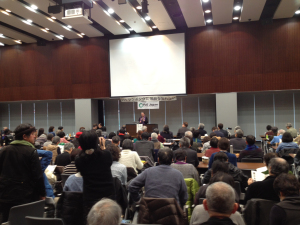
Mary Olson speaks at a Fukushima anniversary event in Japan’s Diet Building,
March 11, 2016.
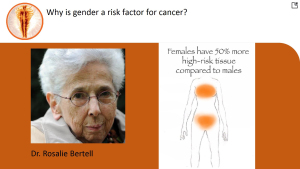
Another way to speak of childhood exposure to radiation is that it is an “opportunity cost” in terms of an individual who has been exposed as a child ever fitting the assumptions the regulators use about adults. Regulators tag age groups in a large hypothetical population. They do not assume that their “adults” were exposed from birth on. People growing up in contaminated areas do become adults. They do continue to be exposed, but their exposures as children make them a different category of adult when it comes to “risk.” Most regulators do not consider this. No regulation factors the gender difference.
Radiation regulators exercise powers of life and death and like that story of an Emperor who thinks he is wearing magical cloth, it is time, once again to to point and say “Look! You are naked!” These emperors of radiation regulation are clothed in mumbo jumbo of “dose” and “risk” and “keep the people confused.” None of this is real.
Japan Diary 4 tells the story of age and gender as factors in radiation harm. We can no longer say that “a millirem is a millirem.” It matters WHO is getting that exposure. What age? What gender? Likely we will someday learn about other important factors.
We could hypothetically make new units (infant-female millirem vs elderly-woman millirem vs Reference-Man millirem) but the concept of DOSE itself is beginning to fall apart in other ways. Following is a short peak at some of the fabric of evidence that our regulators (emperors) do not consider. Together these are why I join others who question the very basis of current radiation regulation. If enough people get these points, we will all point and say “you are naked!”
Point 1: It matters WHO gets exposed;
Point 2: “Dose” is an idea from chemistry and does not fit radiation harm;
My good friend Dennis Nelson points out that damage to cells from radiation is primarily physical, from energetic particles and waves. Dennis posits that “dose” is deeply rooted in chemistry where a substance can be either “safe” or “poisonous” and the difference depends on the mass of the substance that is introduced into the body. In this case, of poison, there is some level that is safe. In radiation exposure there is no level that is safe, just a higher statistical probability of disease or death when impacted by a larger number of particle or ray emissions. (See: www.serv.org) As I first read in Dr Helen Caldicott’s Nuclear Madness (updated in 1992), it takes only one living cell and a single radioactive emission in order to have the potential for a fatal cancer. It is this fact which should remove radiation from any concept of “dose.”
It is true that elements like uranium and plutonium area also toxic (poisonous). Here I am focusing on radiological impacts only, but those who live with uranium and plutonium contamination need to know there is a “double-header” of both!
Point 3: Radioactive decay makes a different kind of chaos in our biochemistry
In 1984 I had a job as Assistant in Research in a lab at Yale. I got contaminated with a radioactive element common in biological research: Phosphorus-32 (P32). Some of the exposure was internal. Like all radioactive elements, the body responds to the chemical characteristics: cesium is similar to potassium so it tracks to muscle; strontium is similar to calcium so it finds its way to bones, teeth and Mother’s milk; phosphorus has many routes in the body—in the lab we used it to track neural activity, but also tracks to the DNA itself. Sort of like giving the bank-robber a bank-guard uniform.
P32 has a 2 week half-life, making it pretty highly radioactive. When the radioactive decay step happens, the atom is no longer phosphorus, but becomes the stable atom, Sulphur32. Here is the rub: if the body has incorporated the phosphorus into a molecule, suddenly the molecule (with no warning) now has a Sulphur atom where it thought it had a phosphorus; particularly troubling inside a DNA strand.
Other radionuclides create similar chaos as they decay.
Point 4: Invisible bullets is the best way to describe impact of ionizing radiation and there is a much wider range of harm than only “ionization;”
I don’t want to get too far into the weeds here. My readers are not generally chemists or biophysicists, but suffice it to say, industrial fission is less than 100 years old. Regulation of radiation exposure is only a little older than fission, and came soon after the concentration of radium by Marie Curie and her cadre of researchers. Doctors quickly adopted radiation because it was observed to kill growths (tumors) of various kinds. (For a great read on this history, find Catherine Caulfield’s Multiple Exposures, 1989, now available on books.google.com)
Nonetheless, anyone can follow this: It is true that a radioactive wave or particle does knock an electron off of another atom (likely in a molecule). When the electron is knocked off, the remaining configuration now has a “charge” because the electron (minus) is gone. All of radiation regulation is based on measuring the production of ions in living tissue in response to X-rays. The details of other radioactive events (decay via emission of alpha, beta and neutrons) are mixed in, but the fundamental concept of “dose” comes from the simple measurement of ions generated by exposure.
While it is true that these ions can be very damaging to the cell, and even neighboring cells, there is no similar evaluation for direct physical damage to cell structures (much greater impacts than knocking off an electron). This includes:
Damage to cell membranes
Chromosomal breaks and other deformations
Mitochondrial damage
Primary germ cell damage
This list of types of cellular damage are more likely from internalized alpha particles and beta particles. For years the radiation regulators have ignored internal exposure, and attributed zero-dose to alpha particles since they bounce off the skin. Inside the body (inhaled, ingested or injected) they are many times (some estimates as high as 1000 times) more harmful than an X-ray/gamma ray.
Here are simple reasons why this makes sense. The alpha particle (an energetic bundle of 2 protons and 2 neutrons) is enormous compared to the wave of energy (no mass) and even compared to the beta (electron-sized). Does a cannon ball do more damage than a BB?
Where internal exposure has been considered a really bizarre concept of “effective dose equivalent” is used by the emperors of radiation. While there are mitigating parameters, such as inclusion of weighting factors derived from organ-doses studies (from equally inhuman experimentation in the U.S.), the whole approach exceeds credibility: the regulators decide how much ionization the internalized radionuclide is likely causing and then they distribute those ionizations as if they were to the whole body. Averaging the high local dose across the entire body mass–with no recognition that the energy to break a chromosome is local–that the concept of “dose” from external exposures includes distance from the source as a factor. When the source is internal, distance for the immediate tissues drops to zero. This is a quantum change, not a simple matter of degree.
Let’s get to it: dose is irrelevant in this picture.
Final Point 5: No two radiation exposures result in the same harm; every is unique.
Dr. Donnell Boardman was a physician in Massachusetts who treated some of the first nuclear power workers. Donnell told me (he was retired when I met him) that no two radiation exposures, including to the same person, are ever identical. Donnell liken radioactivity’s impact on living tissue to car collisions. We do not expect to find any two accidents that are identical. Donnell saw hundreds of nuclear workers and he said that nearly every story and the problems the individuals faced were unique.
Radiation is a physical event, but it depends as much on the body and the unique chain of events at the cellular level to determine the outcome. The broad-brush dose-response work done on adults is important, but the projections based on it just do not hold water.
Radiation Regulators: you have no clothes.
Mary Olson
March 11, 2016
Permalink: http://safeenergy.org/2016/03/11/japan-diary-2016-fukushima5-part-6/
Fukushima+5, Part 5. We Are All Hibakusha: Fission Never Results in Peaceful Atoms!
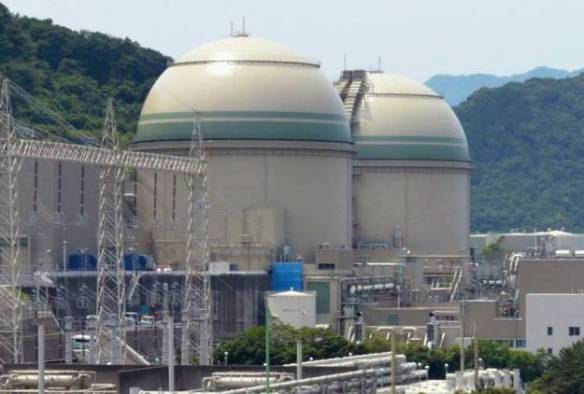
A Japanese court this week ordered the shutdown of two reactors at Takahama, leaving Japan with only two reactors (at Sendai) currently operating five years after the onset of the Fukushima disaster.
All my life I have tried to find the truth, and make it beautiful.” – Sting
It never ceases to amaze me how many wonderful people I meet in this work. Every stop on this tour is populated by exceptional hearts and minds. It reminds me of a woman I met during the years working to stop the US Department of Energy from selectively targeting Native Lands for nuclear waste. (Okay; the 1990’s round of that!) We were at an event at the Mole Lake Indian Reservation in Wisconsin. She was from the Western Shoshone Nation, home of the proposed Yucca Mountain Dump. She said she was “new” to nuclear issues. Welcoming her, I said, “this is a grim topic, but you will meet wonderful people who care about nuclear waste.”
She told me that the Shoshone People know this; she said, “It is a Law of the Universe.” What?!? She explained that uranium in the ground is neutral, but when people dig it up it becomes more and more negative. Inside a reactor uranium becomes the most negative thing on the planet. Shoshones know that the Universe IS in balance (in contrast to Judeo/Christian folks who think it “should” be). Thus, it is a Law that the most positive people drop what they are doing and pay attention to the most negative thing (nuclear energy/weapons).
This response from positive people of great integrity is the first, initial step; she explained there would be many more steps before nuclear fuel/waste is finally balanced.
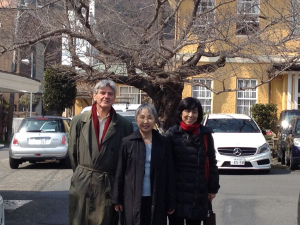
Three of the dedicated activists working in Japan and helping with this tour. From left to right, Steve Leeper, Peace Culture Village and tour organizer; Naoko Koizumi brilliant translator (my “bridge”); and Tamiko Nishijima of Peace Platform, our glue.
Here in this land of Fission Products (the contamination is at varying levels well beyond Fukushima Prefecture, see www.fairewinds.org, Arnie will be sharing more news in coming months from samples he has shipped home), I am meeting these many, many positive people.
Five years in, some are tired. Others are just beginning to realize that the Tepco disaster is not over. I think there is real potential for organizers now and Japan is blessed with some outstanding activists and service organizations. The focus for Green Action and other NGO allies is to stop the re-start of the reactors that have been on “atomic holiday” since March 2011.
NEWS! Since I began this Diary edition, my e-mail inbox tells me that a court has just issued the decision that Kansai Electric must reverse and take two Takahama nuclear reactors off-line. One unit had been lurching towards full operation after five years of no fission. It is a huge win for Green Action and all its allies that have been working to keep Japan fission-free! The ruling states that emergency planning for Takahama is not sufficient. The local activists I met were focused on what the reality of evacuation in Kyoto Prefecture could be. The largest cities near Takahama are over the Prefecture (“state”) line in Kyoto.
The report also specifies that the plan for MOX fuel use in Takahama is also insufficient! Green Action and Allies are working hard, in addition to stopping reactor re-start, to reverse the Japanese industry and federal commitment to MOX fuel.
Plutonium from reactor waste has been separated by the European nuclear giants (at one time BNFL and still AREVA) and AREVA is fabricating MOX fuel for use in the Japanese reactors as they restart. This pro-nuclear notion is profoundly disturbed thinking. MOX was in Fukushima Daiichi Unit-3 (only a small fraction, probably less than 5%). There is still expert debate about the difference between the explosions at Units 1, 2 and 3, but Arnie Gundersen has said many times there was a detonation shockwave at Unit 3, that hydrogen cannot cause that, and the MOX fuel may have had a role in what happened there.
Takahama had a small amount of MOX in the core as it limped towards restart. The plan remains to load 30% plutonium fuel there (if the plans are deemed sufficient in the future—we hope not!) Dr. Edwin Lyman (www.ucsusa.org) has done the calculations to show that when a MOX core is released in a major reactor accident, the long-term cancers that would result are twice the number from a regular uranium (LEU) core accident. Ed made that calculation initially during the NIX MOX campaign that NIRS and IEER led and UCS supported, before 2000. Long before the gender factor (see Blog 4).
It has taken traveling around the world to have this MOX thought come home:

A nuclear accident involving a fully-loaded MOX core could double the numbers in this chart based on an accident from a normal uranium core: 6 women for every 4 men could expect to suffer from a fatal cancer.
Double cancers in the MOX case for Reference Man = double cancers for little girls too. Juvenile girls when exposed will get ten times more cancer over their lives than the Reference Man (same dose, different gender, different age). Double that for a MOX fuel accident. The ratio is the same comparing the little girl to the adult man, MOX to MOX, but for policy decision making, one must now look at the consequences of a MOX accident compared to an LEU accident. Now female children will suffer twenty times more cancer compared to the Reference Man in a LEU accident.
Again: females exposed as girls, to fission products from MOX fuel in a major reactor accident would get twenty times more cancer than Reference Man exposed to LEU.
If this is not a reason for all good people to oppose MOX fuel use…what will it take?
It was deeply gratifying to me when I spoke in Northern Kyoto Prefecture and a grandmother at the back of the room began chanting “Nix MOX Takahama, Nix MOX Takahama!” NIRS launched the US grassroots NIX MOX campaign in 1996. It continues!
We are, all of us, a Law of the Universe. I am now getting ready for three of my largest events:
Citizen Nuclear Information Center talk, College Women’s Association of Japan Luncheon, and on Friday, March 11, the 5th Anniversary of the Tohoku quake and tsunami triggering the Tepco Fukushima Daiichi meltdowns, I will join NGO’s from the region at the Japanese Diet.
Mary Olson
March 10, 2016
Permalink: http://safeenergy.org/2016/03/10/japan-diary-2016-fukushima5-part-5/
Fukushima disaster sheds light on lack of preparedness for compensation
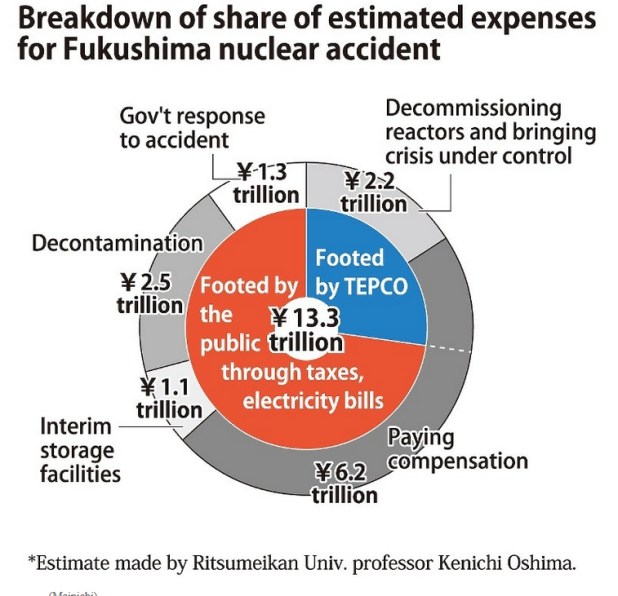
The crisis at the tsunami-hit Fukushima No. 1 Nuclear Power Plant has shed light on a lack of preparedness on the part of the government and utilities to pay massive amounts of compensation for a nuclear accident, which has placed a burden on the public.
At a panel of experts at the Japan Atomic Energy Commission (AEC), there have been calls since this past January for reviewing the current system under which nuclear plant operators are responsible for paying compensation for accidents without limits and setting an upper limit on damages.
“The number of nuclear power plant operators could decrease as long as they are required to bear risks exceeding their limits,” one member said.
“It’s important for operators to bear responsibility for such accidents on condition that they could have predicted such disasters,” another stated.
These problems emerged because operators cannot ascertain risks involving the operation of atomic power stations unless they can estimate the amount of compensation for accidents.
However, others in the panel argued that operators would cut back on their investment in safety measures unless they are to bear unlimited responsibility. As such, the overall direction of debate on the issue has not been set.
Under the current nuclear plant accident compensation system, atomic power station operators bear unlimited responsibility for compensation for accidents except in cases of massive natural disasters. However, there is no clear definition of “massive natural disasters,” and the national government is only required to extend the necessary assistance for efforts to deal with such accidents.
Following the outbreak of the Fukushima nuclear disaster, the national government placed Tokyo Electric Power Co. (TEPCO), the operator of the stricken plant, effectively under state control by providing the firm with an infusion of 1 trillion yen in public funds.
The government then created a system under which it loans necessary money for compensation payments to TEPCO via the Nuclear Damage Compensation and Decommissioning Facilitation Corp. (NDF) without interest. Thus the situation in which TEPCO would go under and become unable to pay compensation to victims of the nuclear crisis has been avoided.
When it placed TEPCO under de-facto state control, the central government explained that the operator of the plant would shoulder the responsibility in principle. However, the reality is different from the government explanation.
Kenichi Oshima, professor at Ritsumeikan University, estimates the total cost of dealing with the nuclear crisis at 13.3 trillion yen. The estimated cost includes 6.2 trillion yen to pay compensation, 2.5 trillion to decontaminate areas tainted by radioactive substances, 2.2 trillion yen to decommission reactors and bring the disaster under control, and 1.1 trillion yen to build interim storage facilities for waste contaminated with radioactive materials.
Of the total amount, TEPCO is likely to pay just over 3 trillion yen on its own, including part of the cost for bringing the crisis under control and paying compensation.
Most of the money needed to pay compensation will be secured from “general contributions” that operators of nuclear plants extend to the NDF. Much of the contributions are passed onto electricity bills consumers pay to utilities. Taxpayers’ money will be spent on the construction of interim storage facilities. Decontamination costs, which the government temporarily foots, will be covered with proceeds from the sales of shares the government holds in TEPCO to lessen the burden on the utility.
“The public is required to effectively shoulder over 70 percent of the costs. The public is being required to pay the costs in a way that lacks transparency,” Oshima said.
If the response to the accident progresses to a certain extent and TEPCO has rehabilitated itself, the government can recover the money it invested in the utility and prevent any increase in the burden on the public. However, this is no easy task.
A high-ranking official of TEPCO’s Kawasaki Thermal Power Plant says it has been successful in streamlining its regular checkup on its generators, shortening the checkup period, increasing the ratio of operation of the latest and most efficient generators and raising the profits by up to hundreds of millions of yen a day.
Learning how to rationalize operations from a worker who had previously worked for Toyota Motor Corp., the plant monitored plant workers’ moves by seconds to reduce time wasting.
“We succeeded in reducing the checkup period, which used to be 80 days in the pre-quake period, to 60 days,” the official said.
However, the increase in profits is attributable mainly to a sharp decline in oil prices. TEPCO posted a pretax profit of 436.2 billion yen in the April-December 2015 period on a consolidated basis. This is largely because fuel costs decreased by about 730 billion yen from the corresponding period of the previous year. If crude oil prices increase, it will offset reductions in expenses.
If the idled Kashiwazaki-Kariwa Nuclear Power Plant in Niigata Prefecture is to be reactivated, it will increase TEPCO’s monthly profits by 8 to 13 billion yen per reactor. However, there are no prospects that the plant can be reactivated in the foreseeable future.
If the government is to use the proceeds from its sales of TEPCO shares to fully cover decontamination expenses, the value of one share must exceed 1,000 yen. However, the current price is about the half that amount.
The government and electric power companies had promoted the use of atomic power by emphasizing that its costs are low. However, they failed to include risks of accidents and safety measures in power generation costs, and where the responsibility for nuclear accidents lies has remained unclear. As a result, members of the public are being forced to foot the costs and TEPCO is allowed to survive.
A system under which the government and private sector share the burden of nuclear accidents in an appropriate manner has not yet been established.
http://mainichi.jp/english/articles/20160311/p2a/00m/0na/019000c
TEPCO: Accident info was not shared among workers
A survey by the operator of the damaged Fukushima nuclear plant shows that information on a cooling system at one of the reactors was not shared by plant workers at the time of the 2011 accident.
Meltdowns took place at 3 of the plant’s reactors, starting with the No.1 unit. The complete loss of power at that reactor stopped all of its cooling systems.
Surveys in the year after the accident by the government, Diet, and Tokyo Electric Power Company showed that staff at the reactor did not know whether an emergency cooling system was functioning after an indicator lamp went off following the loss of power.
Different findings were obtained in a survey carried out last year by TEPCO.
One worker said he himself stopped the cooling system just before the loss of power. Another said he thought the system had not been functioning, because pressure inside the reactor was rising after the power went out.
The manager on duty at the time said he had no memory of being informed that the emergency cooling system had been stopped.
Just before the loss of power, the system was turned on and off to cool the reactor in stages.
TEPCO officials say reactor staff may have failed to share important information on the status of the cooling system amid confusion over the loss of power.
A later analysis shows that the meltdown started at the No.1 reactor in the evening of March 11th, the day of the accident.
But members of a task force set up that day believed that the cooling system was working until midnight. They included then plant chief Masao Yoshida.
The 2015 findings suggest that the delay in sharing the correct information may have affected the response to the accident.
News coverage of Fukushima disaster found lacking
Few reports identified health risks to public
Date:March 10, 2016Source:American UniversitySummary:A new analysis finds that US news media coverage following the 2011 Fukushima Daiichi nuclear disaster in Japan minimized health risks to the general population.
Five years after the 2011 Fukushima Daiichi nuclear disaster in Japan, the disaster no longer dominates U.S. news headlines, although experts say it is a continuing disaster with broad implications. A new analysis by American University sociology professor Celine-Marie Pascale finds that U.S. news media coverage following the disaster minimized health risks to the general population.
Pascale analyzed more than 2,000 news articles from four major U.S. outlets following the disaster’s occurrence from March 11, 2011 through March 11, 2013. Only 6 percent of the coverage–129 articles–focused on health risks to the public in Japan or elsewhere. Human risks were framed, instead, in terms of workers in the disabled nuclear plant. Pascale’s research has published in the flagship journal for the International Sociology Association, Current Sociology.
Disproportionate access
“It’s shocking to see how few articles discussed risk to the general population, and when they did, they typically characterized risk as low,” said Pascale, who studies the social construction of risk and meanings of risk in the 21st century. “We see articles in prestigious news outlets claiming that radioactivity from cosmic rays and rocks is more dangerous than the radiation emanating from the collapsing Fukushima Daiichi nuclear plant.”
Pascale studied news articles, editorials, and letters to the editor from two newspapers, The Washington Post and The New York Times, and two nationally prominent online news sites, Politico and The Huffington Post. These four media outlets are among the most prominent in the United States. They also are among the most cited by television news, talk shows, other newspapers, social media and blogs Pascale said.
Nuclear disasters have potentially large-scale and long-term consequences for people, environments, and economies around the globe. Given limited public knowledge about the details of nuclear energy and encumbered access to disaster sites, the media have disproportionate power around the globe to shape public knowledge, perception, and reaction to nuclear crises, Pascale said. Pascale’s article illustrates how systematic media practices minimized the presence of health risks, contributed to misinformation, and exacerbated uncertainties.
Pascale’s analysis initially characterized the risk to the general population in one of three ways: low, uncertain, or high. However, when examining the bases on which these characterizations were made, it was clear that all media characterizations of uncertain risk were subsequently interpreted as evidence of low risk. In two years of reporting, across all four media outlets, there were only a combined total of 17 articles reporting any noteworthy risk from the largest nuclear disaster in history.
Corporations and government agencies had disproportionate access to framing the event in the media, Pascale says. Even years after the disaster, government and corporate spokespersons constituted the majority of voices published. News accounts about local impact–for example, parents organizing to protect their children from radiation in school lunches–were also scarce.
Globalization of risk
Pascale says her findings show the need for the public to be critical consumers of news; expert knowledge can be used to create misinformation and uncertainty–especially in the information vacuums that arise during disasters.
“The mainstream media–in print and online–did little to report on health risks to the general population or to challenge the narratives of public officials and their experts,” Pascale said. “Discourses of the risks surrounding disasters are political struggles to control the presence and meaning of events and their consequences. How knowledge about disasters is reported can have more to do with relations of power than it does with the material consequences to people’s lives.”
While it is clear that the Fukushima Daiichi nuclear meltdown was a consequence of an earthquake and tsunami, like all disasters, it was also the result of political, economic and social choices that created or exacerbated broad-scale risks. In the 21st century, there’s an increasing “globalization of risk,” Pascale argues.
“People’s understanding of disasters will continue to be constructed primarily by media. How media members frame the presence of risk and the nature of disaster has enormous consequence for our well-being,” she said.
Story Source:
The above post is reprinted from materials provided by American University. Note: Materials may be edited for content and length.
Journal Reference:
- C.-M. Pascale. Vernacular epistemologies of risk: The crisis in Fukushima. Current Sociology, 2016; DOI: 10.1177/0011392115627284
Social workers visit temporary housing in Motomiya, Fukushima Prefecture, to interview disaster victims in December.
By Mari Yamaguchi
The ashes of half a dozen unidentified laborers ended up at a Buddhist temple in this town just north of the crippled Fukushima nuclear plant. Some of the dead men had no papers, others left no emergency contacts. Their names could not be confirmed and no family members had been tracked down to claim their remains.
They were simply labeled “decontamination troops” — unknown soldiers in Japan’s massive cleanup campaign to make Fukushima livable again five years after radiation poisoned the fertile countryside.
The men were among the 26,000 workers — many in their 50s and 60s from the margins of society with no special skills or close family ties — tasked with removing the contaminated topsoil and stuffing it into tens of thousands of black bags lining the fields and roads. They wipe off roofs, clean out gutters and chop down trees in a seemingly endless routine.
Coming from across Japan to do a dirty, risky and undesirable job, the workers make up the very bottom of the nation’s murky, caste-like subcontractor system long criticized for labor violations. Vulnerable to exploitation and shunned by local residents, they typically work on three-to-six-month contracts with little or no benefits, living in makeshift company barracks. And the government is not even making sure that their radiation levels are individually tested.
“They’re cleaning up radiation in Fukushima, doing sometimes unsafe work, and yet they can’t be proud of what they do or even considered legitimate workers,” said Mitsuo Nakamura, a former day laborer who now heads a citizens’ group supporting decontamination laborers. “They are exploited by the vested interests that have grown in the massive project.”
Residents of still partly deserted towns such as Minamisoma, where 8,000 laborers are based, worry that neighborhoods have turned into workers’ ghettos with deteriorating safety. Police data shows arrests among laborers since 2011 have climbed steadily from just one to 210 last year, including a dozen yakuza, or gangsters, police official Katsuhiko Ishida told a prefectural assembly. Residents are spooked by rumors that some laborers sport tattoos linked with yakuza, and by reports that a suspect in serial killings arrested in Osaka last year had worked in the area.
“Their massive presence has simply intimidated residents,” said Mayor Katsunobu Sakurai. “Frankly, the residents need their help but don’t want any trouble.”
Most of the men work for small subcontractors that are many layers beneath the few giants at the top of the construction food chain. Major projects such as this one are divided up among contractors, which then subcontract jobs to smaller outfits, some of which have dubious records.
The Ministry of Health, Labor and Welfare examined more than 300 companies doing Fukushima decontamination work and found that nearly 70 committed violations in the first half of last year, including underpayment of wages and overtime and failure to do compulsory radiation checks. Those companies were randomly chosen among thousands believed to be working in the area.
“Violations are so widespread in this multilayer subcontract system. It’s like a whack-a-mole situation,” said Mitsuaki Karino, a city assemblyman in Iwaki, a Fukushima city where his civil group has helped workers with complaints about employers.
Karino said workers are sometimes charged for meals or housing they were told would be free, he said, and if they lose jobs or contracts aren’t renewed, some go homeless.
“It’s a serious concern, particularly for workers who don’t have families or lost ties with them,” he said.
Government officials say they see no other way than to depend on the contracting system to clean up the radiated zone, a project whose ballooning cost is now estimated at 5 trillion yen ($44 billion).
“That’s how the construction industry has long operated. In order to accomplish decontamination, we need to rely on the practice,” said Tadashi Mouri, a health and labor ministry official in charge of nuclear workers’ health. He said the ministry has instructed top contractors to improve oversight of subcontractors.
Several arrests have been made in recent months over alleged labor violations.
A complaint filed by a worker with labor officials led to the October arrest of a construction company president who had allegedly dispatched workers to Fukushima under misleading circumstances. The investigation found that the worker had been offered pay of 17,000 yen ($150) per day, but after middlemen took a cut he was getting only 8,000 yen ($70).
In another case, a supervisor and a crane operator were arrested in July for alleged illegal dumping of radiated plant debris in Minamisoma. Five companies heading the project were suspended for six weeks.
Most workers keep their mouths shut for fear of losing their jobs. One laborer in a gray jacket and baggy pants, carrying cans of beer on his way home, said he was instructed never to talk to reporters.
A 62-year-old seasonal worker, Munenori Kagaya, said he had trouble finding jobs after he and his fellow workers fought for and won unpaid daily “danger” allowance of 10,000 yen ($88) for work in Tamura city in 2012.
Officials keep close tabs on journalists. Minutes after chatting with some workers in Minamisoma, Associated Press journalists received a call from a city official warning them not to talk to decontamination crews.
Beyond the work’s arduous nature, the men also face radiation exposure risks. Inhaling radioactive particles could trigger lung cancer, said Junji Kato, a doctor who provides health checks for some workers.
Although most laborers working in residential areas use protective gear properly, others in remote areas are not monitored closely, according to workers and Nakamura, the leader of the radiation workers support group. Many are not given compulsory training or education about dealing with radiation, he said.
Though group leaders’ radiation exposure levels are regularly checked, decontamination workers’ individual levels have not been systematically recorded. The government introduced a system in 2013 but only for a fee, and many lower subcontractor workers are likely not covered. Even non-alarmist experts say that workers doses must be kept individually for their own records as well as for studies of low-dose radiation impact.
Mouri, the government official, said decontamination workers’ average annual dose fell to 0.7 millisievert last year, a fraction of the 20-millisievert annual limit for those working at the nuclear plant, and is not a concern.
Though no radiation-induced illness has been detected, workers have developed diabetes, cerebral and respiratory problems, often long untreated due to lack of money, awareness and social ties, local hospital intern Toyoaki Sawano said in a medical magazine last month.
Having trouble making ends meet, a growing number of laborers are seeking welfare assistance, local authorities say. The officials worry that they may end up staying on, like construction laborers did in Osaka and Tokyo after the 1960s building boom, forming Japan’s poorest ghettos.
Police and volunteers have started neighborhood patrols amid concerns about safety. Some big construction companies have taken steps to address concerns. Hazama Ando Corp. imposed an 11 p.m. curfew on workers.
Residents say they avoid convenience stores in the evenings, when many laborers stop by after work to buy snacks, bento boxes or beer on their way home. Some of them used to discard their contaminated gloves and masks in garbage bins there, triggering complaints from the neighborhood and prompting the government to launch a “manner” campaign in December.
At a convenience store in Minamisoma on a recent evening, workers came in waves, waiting quietly in line to pay for food and other items.
“The workers face heartless rumors as if they are all reckless outlaws. They are the same human beings. Like anywhere, there are good guys and bad guys,” said Nakamura, the support group leader.
One resident grateful for the workers is Hideaki Kinoshita, a Buddhist monk who keeps the unidentified laborers’ ashes at his temple, in wooden boxes and wrapped in white cloth.
“We owe a lot to those who clean this town, doing the work that locals don’t even want to,” he said.
Minamisoma city official Tomoyuki Ohwada said the worker population should decline next year, when intensive decontamination efforts are scheduled to end. But Kinoshita believes many will still be needed, given the amount of work left to do.
“There is no end to this job,” Kinoshita said. “Five years from now, the workers will still be around. And more unclaimed ashes may end up here.”
FIVE YEARS AFTER: 1 in 3 Fukushima evacuees giving up hope of ever returning home
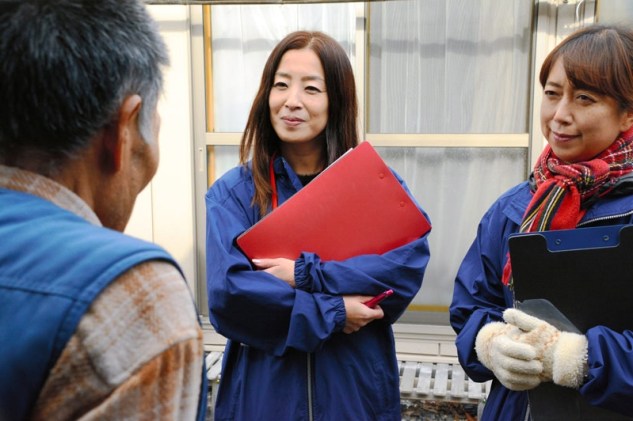
Social workers visit temporary housing in Motomiya, Fukushima Prefecture, to interview disaster victims in December.
More than one in three evacuees from the Fukushima nuclear disaster despair of ever returning home, a finding that points to a growing sense of hopelessness five years after the crisis unfolded.
This stark reality emerged in a survey carried out by The Asahi Shimbun and a research team headed by Akira Imai, a professor of local government policy at Fukushima University.
“There are so many people (outside Fukushima) today who are not aware that many people are still forced to live as evacuees,” a 34-year-old woman responded in the survey questionnaire. “No matter how we try to explain our plight, they seem unable to understand, and we feel saddened to realize that people tend to think we live outside our hometowns out of our own choice.”
Many respondents also wrote they were troubled by a perceived envy from other residents in their new communities over the compensation they receive from Tokyo Electric Power Co., the operator of the crippled Fukushima No. 1 nuclear power plant.
In the survey, of those who remain evacuated, 22 percent said they think they can return to their old homes within five years, 17 percent believe they can return home within 10 years and 9 percent said it might take up to 20 years.
Fourteen percent said it will take 21 years or longer to return home, while the remaining 38 percent said they believed they would never be able to return permanently.
As of March 9, the number of Fukushima residents living as evacuees within Fukushima Prefecture stood at 54,175. On Feb. 12, prefectural authorities reported that 43,149 evacuees were living outside the prefecture.
It was the fifth such survey by The Asahi Shimbun and Imai’s research team and was undertaken to mark the fifth anniversary of the nuclear accident, triggered by the Great East Japan Earthquake and tsunami, on March 11.
Questionnaires were sent to 398 evacuees who had responded to previous polls. Of the 225 respondents in Tokyo and 20 prefectures, 36, or 16 percent, said they had returned to their old homes.
Among those who remain evacuated, 65 people currently live in temporary housing for disaster victims, followed by 52 who have settled in homes they newly purchased.
Forty-one percent of those who remain evacuated said they want to eventually return to their old homes when their hometowns become safe, while 25 percent said they no longer want to return because it is unlikely the areas will ever be safe again.
The survey showed that evacuees are increasingly losing the will to hold on in their current plight, with only 32 percent of respondents saying they are determined to hold on, down from 55 percent in the previous survey in 2013.
Eighteen percent said they are losing the will to hold on. The same percentage said they are tormented by simmering anger. Both figures were up from the previous survey.
http://ajw.asahi.com/article/0311disaster/fukushima/AJ201603100059
Daily grind of decommissioning continues for workers at Fukushima plant
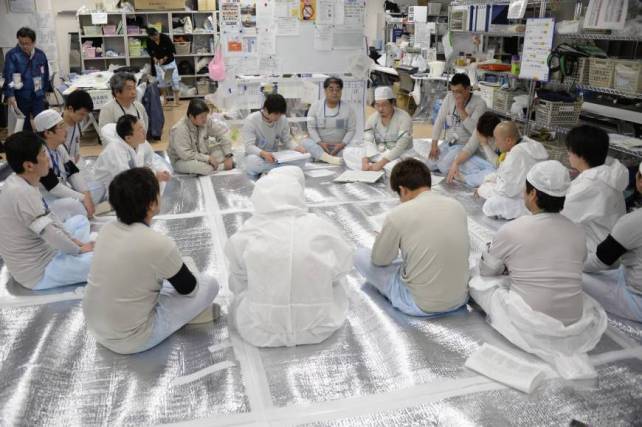
FUKUSHIMA – Five years after the March 2011 nuclear calamity started at the Fukushima No. 1 power plant, Tokyo Electric Power Co.’s efforts to contain the radioactive water at the site still makes headlines.
But not much is known about the daily lives and operations of some 7,000 workers at the plant engaged in decommissioning and other tasks.
To offer a glimpse of the workplace, Kyodo News followed Yasuki Hibi, 52, who heads major contractor Kajima Corp.’s civil engineering office at the wrecked plant, for a day last month. His office takes on a number of projects, including processing contaminated water and highly radioactive rubble.
“I feel that time has stopped here since that day,” said Hibi. “By taking part in the decommissioning work, I hope to let time flow again. Some of the workers were brought up in the local area, doing their best despite the circumstances.”
Hibi leaves his apartment in Iwaki, Fukushima Prefecture, about 50 km south of the complex, just before 8 a.m., dropping by at Kajima’s Iwaki office to check paperwork before traveling to another office in the town of Tomioka and then the nuclear plant. His wife and son live in Tokyo.
Kajima’s office at the plant is located in a building by the main gate. The building serves as a resting place for workers at the complex and houses offices for other firms engaged in decommissioning work.
Around 100 workers a day, including from affiliated companies, come and go at the Kajima office. The contractor is in charge of building sea walls near the plant aimed at prevent radiation-contaminated water from spilling into the ocean, as well as transporting highly radioactive soil to designated sites.
Hibi was posted to Kajima’s Fukushima plant office in January 2011, two months before the earthquake and tsunami struck. At the time, his job was to reinforce the earthquake resistance of reactors 5 and 6, which survived the disaster.
But after March 11, 2011, Kajima’s mission was focused on removing vehicles scattered by the tsunami and building a temporary sea wall, he said.
“Of Kajima’s civil engineering sections, the office at the Fukushima No. 1 nuclear power plant is unique,” Hibi said. “The radiation level in the air has dropped significantly, but there still are many hot spots around the reactor buildings.”
When Hibi arrives at the office, he makes sure the day’s work is in progress as scheduled. Some 20 workers on the early shift are already working at the complex by then.
Lunchtime is one of the few occasions where workers can relax.
The building’s eatery offers five different menu items, ranging from set meals to rice bowl dishes and noodles, and they are served at ¥380 with extra-large helpings for free. The food is cooked at a kitchen about 9 km away and carried there warm. Before the eatery opened, workers had to buy boxed lunches at convenience stores.
A large portion of Hibi’s work focuses on ensuring workers’ safety.
“Many other firms are involved and there are many cases in which workers need to work in small areas,” Hibi said. “I pay attention so that we won’t cause accidents.”
When he holds a meeting with staff who oversee the work site, Hibi asks detailed questions to avoid possible problems.
“Has there been anything wrong with the equipment recently?” Hibi asks the workers. “Is there any frost on the pipes?”
At noon, about 20 workers on the noon shift gather in the office, sitting in a circle for a meeting with Hibi. Afterward, they stand and together say: “Be safe!”
The workers change into disposable protective gear, including two thin rubber gloves on top of cotton ones. Adhesive tape is used to seal the gloves to the protective clothing so radiation won’t seep in.
Names and affiliations are written on the back and front of the protective gear in big, bold letters to clarify who’s who.
Workers appear used to the drill they have conducted for the past five years. One notable change is the half-face mask covering their mouth and nose, replacing a full-face mask used early on.
After seeing them off, Hibi also heads to the No. 1 reactor building, where workers are preparing to pour a bulking agent into an underground trench.
The radiation level is relatively high in this area, recording around 170 microsieverts per hour. A commercial flight between Tokyo and New York exposes passengers to about 10 microsieverts per hour. About 10 workers wear black vests made of tungsten over their protective gear. The vests reportedly reduce the radiation exposure to internal organs by 30 percent.
“Make sure that you are properly equipped to prevent a fall,” Hibi says to a worker through his mask. Checking various sites on the plant takes about two hours.
At 3:30 p.m., workers return to the office. Their working hours are limited to prevent excessive radiation exposure.
Shortly after 4 p.m., Hibi leaves the Kajima office. However, his day is not over yet. He heads to the firm’s office in Iwaki to check on upcoming construction schedules. It is close to 9 p.m. when he arrives back at his apartment.
Hibi’s day only illustrates a portion of what is going on at the Fukushima plant and he is well aware that the task of decommissioning has a long way to go.
“When I was involved in a project to dig a tunnel for a subway in Taiwan, I went to ride the train after it was completed,” Hibi said. “But decommissioning at the Fukushima No. 1 nuclear power plant won’t be completed anytime soon.
“I hope that when I turn 80-something, I can visit here and see how much progress has been made.”
Five Years of Forgetting: The Fukushima Disaster and Nuclear Amnesia
Shunichi Yamashita, a proclaimed expert on the effects of radioactivity, was invited by the #Fukushima prefecture in the aftermath of the meltdowns to reassure rather than investigate.
“The effects of radiation,”he claimed, “do not come to people who are happy and laughing, they come to people who are weak-minded.”
“People’s understanding of disasters will continue to be constructed by media. How media members frame the presence of risk and the nature of disasters matters.” – Celine Marie Pascale, American University, Mar 10, 2015
Fearing radiation; terrified by the nuclear option. Perfectly sensible instincts that never seem to convince establishments and those who have long ceased to loathe nuclear power and its various dangerous by-products. Each nuclear disaster, such as the meltdowns at the Fukushima Daiichi plants five years ago, come with its treasure of apologetics and justifications. The reason is always the same: nuclear energy is safe and we cannot really do without it.
To that end, the emergence of “radiophobia” is a designation that dismisses as much as it supposedly diagnoses. It pokes fun at those ninnies who think that they are about to perish because of the effects of nuclear catastrophe and radiation contamination. Risk, according to this philosophy of concerted denial, is always exaggerated.
Shunichi Yamashita, a proclaimed expert on the effects of radioactivity, was invited by the Fukushima prefecture in the aftermath of the meltdown to reassure rather than investigate.
“The effects of radiation,” he claimed, “do not come to people who are happy and laughing, they come to people who are weak-minded.”
This Dr. Strangelove dismissiveness is as much an advertisement for the virtues of doom as it is about the brutal consequences, real and imaginary, of radiation poisoning. Radiation is the invisible killer that stalks the earth, but for many, it is hardly worth a thought. For one, it suggests a simple calculation in environments that are not, supposedly, that dangerous. “With low radiation doses,” argued this doctor of nuclear apologetics, “the people have to decide for themselves whether to stay or to leave.”
Despite this bubbling confidence on the part of his colleagues, Japanese American physicist Michio Kaku had little time for such views as Yamashita’s. In an interview soon after the meltdown, Kaku claimed that, “The slightest disturbance could set off a full-scale meltdown at three nuclear power stations, far beyond what we saw at Chernobyl.”
Smile with upbeat confidence, and the problem goes away. If people are depressed before radiation, suggests Yamashita, they will succumb as the negative dramatists they are. “Stress is not good at all for people who are subjected to radiation.” Then again, stress could hardly be deemed good for anybody in particular, irrespective of radiation.
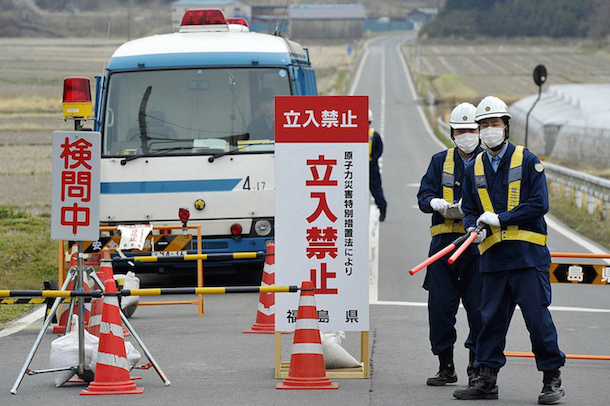
Security checkpoint outside Fukushima following the disaster.
Such fabulously misguided nonsense is central to the amnesiac context of Fukushima. Makiko Segawa put it rather poignantly in his contribution in the Asia-Pacific Journal: initial enthusiastic snaps and coverage by the press corps, an insatiable lust for disaster imagery, quietened in due course. Writing a year after the disaster, Segawa noted how “the journalists have packed up and gone and by accident of design Japan’s government seems to be mobilizing its agenda, aware that it is under less scrutiny.”
Robert Jacobs similar notes that Fukushima conforms to that litany of disasters that has afflicted the human experience, a matter of rejection and experience rather than learning and adapting. “Fukushima is taking its place alongside the many forgotten nuclear disasters of the last 70 years.”
Sociologist Celine Marie Pascale of the American University, on scouring some 2,100 news stories from four media outlets (The New York Times, Washington Post, The Huffington Post and Politico) came to the conclusion that a strategy of minimisation was underway. The implications of such an event had to be downplayed, de-emphasising the risk of massive contamination and environmental disaster. A mere 6 percent of the articles examined the health implications of the event. “We see articles in prestigious news outlets claiming that radioactivity from cosmic rays and rocks is more dangerous than the radiation emanating from the collapsing Fukushima Daiichi nuclear plant.”
A necessary process of mendacity has to come into play. The Tokyo Electric Power Plant (TEPCO), Japan’s largest power company and owner of the affected power plants, initially denied the existence of meltdowns when it knew three had taken place. It was a process of deception that continued for three months after the event, a situation made even more absurd for the fact that hundreds of thousands were evacuated in the vicinity. It is a disaster episode that keeps on giving.
Even in March 2015, their reassurances seemed less than comforting. Chief Decommissioning Officer Naohiro Masuda would claim rather blandly that, “Even if some contaminated water remains, I feel that we can reduce a substantial amount of risk.”
The nuclear genie is a creature that encourages the lie in planning establishments. There are lies about safety; there are lies about legacies. As Jacobs suggests, the Disneyfication of disaster sites affected by the nuclear or atomic scourge is all too real. The Manhattan Project that led to the development of the atomic weapons used on Hiroshima and Nagasaki became “Disney theme parks of American exceptionalism.” The quest for the nuclear option in both the military and energy contexts saw massive environmental degradation.
Even now, the ghostly sense of Fukushima should be a reminder of errors and negligence rather than dismissal and indifference. Jacobs suggests a simple but necessary formula to combat nuclear amnesia: see the impacts of radiation exposure “before they become vaguely visible as cancers nestled in health population statistics.”
Dentist urges people to keep kids’ baby teeth to study Fukushima radiation exposure
A movement calling on people to retain their children’s baby teeth to help study radiation exposure in the wake of the Fukushima nuclear disaster is gaining momentum in Japan.
The radioactive material strontium-90 is easily absorbed into baby teeth, and last year a group of experts formed the “Preserving Deciduous Teeth Network (PDTN),” urging people to keep their children’s baby teeth.
“Baby teeth are evidence of exposure to radiation. We urge people to keep them for the future,” says Takemasa Fujino, 67, a joint head of the network.
Fujino is president of a medical institution that operates three dental clinics in the Tokyo metropolitan region. One clinic is in Matsudo, Chiba Prefecture, which was regarded as a “hot spot” with relatively high levels of radiation following the March 2011 outbreak of the Fukushima No. 1 Nuclear Power Plant disaster.
With residents feeling uneasy, in 2011 Fujino began calling for people to preserve their children’s baby teeth, wanting to do something as a dentist to protect children’s lives and health.
So far, Fujino has had about 500 baby teeth donated, and has commissioned a Swiss testing facility to analyze some of them. Next year the network plans to establish its own testing facility in central Japan.
Baby teeth are formed from when the child is in the womb. “The teeth of children that were fetuses five years ago at the time of the accident will be coming at about this point exactly, and the movement to preserve them will become even more important,” Fujino says.
http://mainichi.jp/english/articles/20160307/p2a/00m/0na/015000c
1 This Month
19 February – VIRTUAL EVENT-Decision Time: AI and Our Nuclear Arsenal
12:45 p.m. Central / 1:45 p.m. Eastern
To see nuclear-related stories in greater depth and intensity – go to https://nuclearinformation.wordpress.com
-
Archives
- February 2026 (181)
- January 2026 (308)
- December 2025 (358)
- November 2025 (359)
- October 2025 (376)
- September 2025 (258)
- August 2025 (319)
- July 2025 (230)
- June 2025 (348)
- May 2025 (261)
- April 2025 (305)
- March 2025 (319)
-
Categories
- 1
- 1 NUCLEAR ISSUES
- business and costs
- climate change
- culture and arts
- ENERGY
- environment
- health
- history
- indigenous issues
- Legal
- marketing of nuclear
- media
- opposition to nuclear
- PERSONAL STORIES
- politics
- politics international
- Religion and ethics
- safety
- secrets,lies and civil liberties
- spinbuster
- technology
- Uranium
- wastes
- weapons and war
- Women
- 2 WORLD
- ACTION
- AFRICA
- Atrocities
- AUSTRALIA
- Christina's notes
- Christina's themes
- culture and arts
- Events
- Fuk 2022
- Fuk 2023
- Fukushima 2017
- Fukushima 2018
- fukushima 2019
- Fukushima 2020
- Fukushima 2021
- general
- global warming
- Humour (God we need it)
- Nuclear
- RARE EARTHS
- Reference
- resources – print
- Resources -audiovicual
- Weekly Newsletter
- World
- World Nuclear
- YouTube
-
RSS
Entries RSS
Comments RSS
 nuclear-news