8 towns and villages near Fukushima nuclear power plant 1,514 earthquake-related deaths 70% relocated 3 times or more

March 6, 2022
In eight towns and villages in Futaba County, Fukushima Prefecture, where evacuation orders were issued after the March 2011 accident at TEPCO’s Fukushima No. 1 nuclear power plant and nearly all residents evacuated in and out of the prefecture, 1,514 people were certified as earthquake-related deaths, and at least 1,025 were found to have moved to new evacuation sites three or more times, according to a new report. Of the 1,514, 136 died after 2004, indicating that the prolonged evacuation has pushed the victims to the edge.
The Mainichi Shimbun requested local governments in Fukushima Prefecture to disclose documents submitted by the bereaved families over the certification of earthquake-related deaths. The documents include a written history leading up to the deaths, and we analyzed their contents. The number of people certified as earthquake-related deaths in the prefecture as a whole was 2,331, about 1.5 times the number of direct deaths (1,605).
A survey of 1,514 people certified as earthquake-related deaths in eight towns and villages in Futaba County (six towns: Namie, Futaba, Okuma, Tomioka, Naraha, and Hirono; two villages: Katsurao and Kawauchi) showed that at least 1,025 people had moved their evacuation sites three or more times before their death. Of these, 248 had moved three times, 267 four times, 211 five times, and 299 six or more times.
A total of 2,034 people, 1,514 in eight towns and villages in Futaba County and 520 in Minamisoma City, which was ordered to evacuate within a 20-kilometer radius of the Daiichi Nuclear Power Plant, were identified as having died as earthquake-related deaths, and 70% of them were in their 80s or older. Those with a history of illness accounted for 80% of the deaths, with pneumonia and heart disease being the most common causes of death. A number of people suffered from depression or worsening dementia as a result of the long-term evacuation.
According to the Reconstruction Agency, more than 90% of those who were certified as earthquake-related deaths in Iwate and Miyagi prefectures affected by the Great East Japan Earthquake died within one year of the disaster. In contrast, in the eight towns and villages in Futaba County and Minamisoma City, almost half of all deaths from related causes occurred after one year had passed.
Applications for earthquake-related deaths from bereaved families are still being filed. However, the passage of time has made it difficult to determine the causal relationship between the deaths, and the certification rate is declining. In Tomioka Town, where 454 people, the largest number in Futaba County, were certified, the rate dropped from 94% in FY12 (83 certified out of 88 applications) to 38% from FY19 to FY21 (17 certified out of 45 total). Rokka Teramachi, Shuji Ozaki
Earthquake-related deaths
Deaths are not directly caused by collapsed buildings or tsunamis resulting from earthquakes, but by worsening physical condition due to evacuation after the disaster. Based on the disaster condolence payment system, a review board consisting of doctors and lawyers receives applications from bereaved families, examines them, and certifies them by the local government. If certified, the bereaved family will receive up to 5 million yen. According to the Reconstruction Agency, as of the end of September 2021, 3,784 people in 10 prefectures had been certified for the Great East Japan Earthquake.
https://mainichi.jp/articles/20220306/k00/00m/040/122000c?fbclid=IwAR0BSmgj0bjLlJJH9MgGN_5wTJz4KpSeTaa4x5acUPqnRrB1WMIZXZgMQ7U
The dead bodies in the exclusion zone of Fukushima Daiichi Nuclear Accident and their treatment
The original blogpost has been largely shortened by the translator. For more information please refer to the article in Japanese 「東京電力福島第一原子力発電所災害に係る避難指示区域内の御遺体の取扱について」. Translated by W. Crane.
June 11, 2016
An article published by Kyodo News on March 31, 2011 immediately raised a lot of attention at the time. It was titled Hundreds to up to a thousand dead bodies within the 20 km radius evacuation zone in Fukushima. “May have been contaminated after death” say police.
Some articles in English followed, such as this one by the Rediff News on the same day:
Japan: Radiation fears leaves bodies rotting, PM for scrapping N-plant
The fear of being affected by radiation has prevented authorities from collecting around 1,000 bodies of the March 11 earthquake and tsunami victims from within the 20-kilometer-radius evacuation zone near the troubled Fukushima nuclear plant.
The Kyodo news agency quoted a local police source as saying that said bodies had been ”Exposed to high levels of radiation after death.” On Sunday, high levels of radiation were detected on a body found in Okuma, Fukushima Prefecture, about 5 km from the Fukushima Daiichi Nuclear Power Station.
The authorities are now reportedly trying to figure out other ways to collect the bodies over fears that police officers, doctors and even family members may be exposed to radiation in their attempt to recover the dead bodies.
They also raised concerns that even after handing over the bodies to relatives, the cremation process could spread further radioactive materials. High levels of radiation detected on the Okuma town victim last Sunday had forced local police to give up on retrieving the body.
””Measures that can be taken vary depending on the level of radiation, so there need to be professionals who can control radiation. One option is to take decontamination vehicles there and decontaminate the bodies one by one,”” an expert on treating people exposed to radiation said.
Or this article in the Japan Times on April 1, 2016:
Hundreds of corpses believed irradiated, inaccessible
Radiation is preventing the retrieval of hundreds of bodies from inside the 20-km evacuation zone around the Fukushima No. 1 nuclear power plant, police sources said Thursday.
Based on initial reports after the March 11 catastrophe, the number of bodies is estimated at between a few hundred and 1,000, one of the sources said, adding that high radiation is now hampering full-scale searches.
That view was supported by the Sunday find of high radiation levels on a body found in Okuma, Fukushima Prefecture, 5 km from the plant.
The rescuers are now in a bind. Even if they retrieve the bodies, anyone who comes into contact with them risks being irradiated, too, whether they’re in the evacuation zone or not.
And if the bodies are cremated, the smoke could spread radioactive materials as well, the sources said. Even burial poses a problem. When the bodies decompose, they might contaminate the soil with radioactive materials.
Authorities are considering decontaminating and inspecting the bodies where they are found, but the sources said cleansing the decomposing bodies could damage them further.

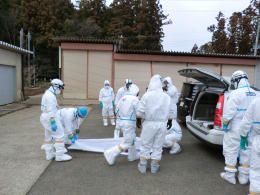
A follow up article was published on May 20 in the Kahoku Shinpo reporting that the above mentioned body was finally collected on April 1 and sent to Minamisoma city where it was diagnosed to have died of illness. No external wound was found on the body. The tsunami is ruled out of cause here completely.
The body found in Okuma
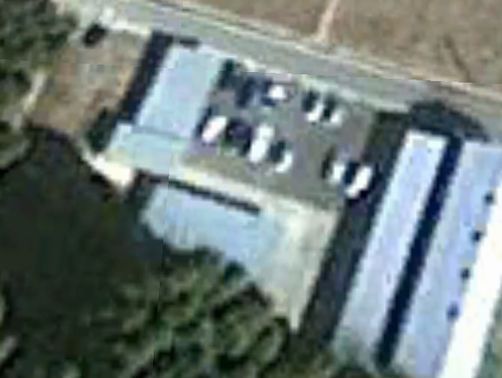
Google Earth as of 2011/3/19
In the original article in Japanese by Kyodo News, it is described that the contamination of the body that was found in Okuma was over the detection limit of the dosimeter, which is 100.000 cpm.
In an official letter discussing what to do with all the contaminated bodies (the title of this blog post comes from this letter) the Nuclear Safety Commission says that the air dose rate of 10 μSv/h at 1 m distance from the body could be considered the equivalent of a surface contamination of 100.000 cpm. It also says that in that case the clothes have to be removed from the body before treating it because such a surface contamination is enough to cause secondary irradiation to the treating person.
If the clothes have been contaminated by a plume then the inside of the lungs must have been contaminated as well.
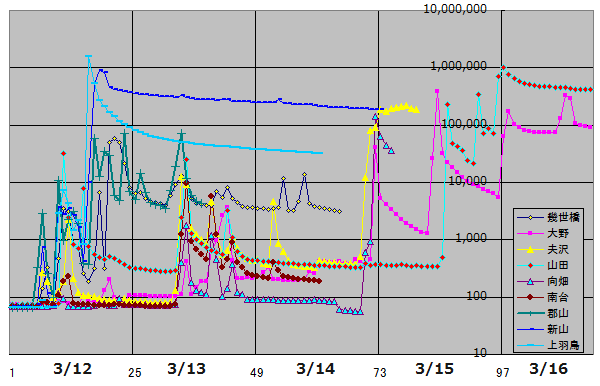
And this area was indeed hit by such a dense plume. The spot where the body was found was hit by a plume above 10 μSv/h first on March 13, followed by waves far higher than this (up to almost 100μSv/h, nearly 300 times the US army’s evacuation limit) on March 14 and 15. Just imagine breathing the air that was so radioactive that it contaminated the clothes so much as to cause secondary radiation.
unit:nSv/h
In the case of the people in Okuma town it would appear most likely that they died from inhaling the radiation, most probably iodine gas that was released first. But the industry, the regulators and the scientists mysteriously remain quiet about the fatal dose of when one is exposed to radiation internally. Otherwise what can be the explanation for the sudden deaths of several hundred people in a sparsely populated area? When even official sources state they were not earthquake or tsunami victims?
Maybe I am the only one but I cannot help thinking that these people whose bodies ended up being cremated and buried without identification are crying out silently that it is time to clear the real cause of their deaths. May their souls rest in peace.
Decontamination worker’s dead body found full of scars

According to Fukushima prefecture police, a decontamination worker’s dead body was found in the company area that he was working for on 5/16/2016.
The body is assumed to be the man in 40s, who had been missing since last Autumn.
Police found it in the gravel pit of the company area. The company undertakes decontamination works in Iwaki city. From juridical autopsy, intracranial injury was possibly the cause of death. There were several scars on the face and body.
The company president and 5 other employees and former employees were arrested for suspicion of abandonment of dead body.
No more details are reported.
http://irresponsibility.seesaa.net/archives/20160517-1.html
http://matomejapan.doorblog.jp/archives/60130534.html
1 This Month

of the week – Shut Down Drone Warfare!


Tell the Ukrainian Government to Drop Prosecution of Peace Activist Yurii Sheliazhenko

Petition to revoke the licensing of the Near Surface Nuclear Disposal Facility (NSDF) at Chalk River. https://www.ourcommons.ca/petitions/en/Petition/Details?Petition=e-7247
To see nuclear-related stories in greater depth and intensity – go to https://nuclearinformation.wordpress.com
-
Archives
- March 2026 (251)
- February 2026 (268)
- January 2026 (308)
- December 2025 (358)
- November 2025 (359)
- October 2025 (376)
- September 2025 (257)
- August 2025 (319)
- July 2025 (230)
- June 2025 (348)
- May 2025 (261)
- April 2025 (305)
-
Categories
- 1
- 1 NUCLEAR ISSUES
- business and costs
- climate change
- culture and arts
- ENERGY
- environment
- health
- history
- indigenous issues
- Legal
- marketing of nuclear
- media
- opposition to nuclear
- PERSONAL STORIES
- politics
- politics international
- Religion and ethics
- safety
- secrets,lies and civil liberties
- spinbuster
- technology
- Uranium
- wastes
- weapons and war
- Women
- 2 WORLD
- ACTION
- AFRICA
- Atrocities
- AUSTRALIA
- Christina's notes
- Christina's themes
- culture and arts
- Events
- Fuk 2022
- Fuk 2023
- Fukushima 2017
- Fukushima 2018
- fukushima 2019
- Fukushima 2020
- Fukushima 2021
- general
- global warming
- Humour (God we need it)
- Nuclear
- RARE EARTHS
- Reference
- resources – print
- Resources -audiovicual
- Weekly Newsletter
- World
- World Nuclear
- YouTube
-
RSS
Entries RSS
Comments RSS
 nuclear-news