Radioactivity at buried tank up in Daiichi plant

The operator of the crippled Fukushima Daiichi nuclear plant says the level of radioactivity near one underground wastewater tank at the plant is more than 100 times earlier readings.
Tokyo Electric Power Company says the tanks were built 3 years ago to store highly radioactive wastewater produced within the crippled plant. But all of the tanks soon went out of use due to repeated leaks of contaminated water.
The utility pumped most of the water out of them, but has been checking radioactivity levels of groundwater near the tanks.
On Wednesday, equipment detected 8,100 becquerels of beta-ray-emitting radioactive substances per liter of water. On Thursday, it went up to 9,300 becquerels.
A week ago, the level was only 87 becquerels.
TEPCO says it doesn’t know why the sharp rise took place. It says some highly radioactive water remains in the tank, but it is isolated with waterproof measures.
TEPCO says it will continue to analyze groundwater samples around the tank, and also compare them with data on the contaminated water left in part of the tank.
http://www3.nhk.or.jp/nhkworld/en/news/20160408_03/
Very pertinent comments and photos from Ray Masalas regarding the said “buried tank”:
I see the Japanese media is once again lying to protect Tepco. These were not tanks. They were in ground pools with sloped sides that were dug on site, lined with thin poly and filled with highly radioactive water. {See pic below} With a lining as thick as 2 garbage bags they leaked into the ground fast. Whether they transfered these tons of radioactive water to steel tanks or not, I’ll leave up to you to believe or not believe. At the same time they were building enclosed concrete ditches running down the west hill to sea. From the flyover footage I’d guess that there were about a dozen of these pits up on the west hill.

Sept 013. One of the “tanks” they spoke of.
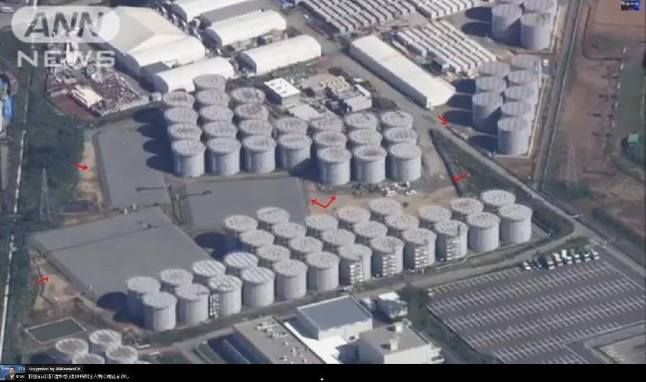
After they said that the transferred the radioactive water to steel tanks these empty pits magically got lids. My guess is that they dumped then refilled.

The enclosed concrete ditches running down to the sea were built at the same time. Dec 013
Freezing of soil near Fukushima plant going well, says TEPCO

Rainwater is discharged from newly constructed drainage outlets into the plant’s harbor during a media tour at the Fukushima No. 1 nuclear power plant on April 4.
The freezing of soil around the Fukushima No. 1 nuclear power plant to block the flow of groundwater is proceeding “largely smoothly,” the plant operator said April 4.
Tokyo Electric Power Co. started making a frozen underground wall in late March around the No. 1 to No. 4 reactors at the plant, which suffered a triple meltdown triggered by the March 2011 earthquake and tsunami.
The final part of the construction process to freeze the soil was unveiled to the media for the first time April 4 during a visit to the site by Yosuke Takagi, state minister of the economy.
To build the frozen soil wall to prevent groundwater flowing into the four reactor buildings and becoming contaminated with radioactive substances, the utility inserted 1,568 pipes to a depth of 30 meters and 1 meter apart.
The company is now circulating liquid with a temperature of minus 30 degrees through the pipes to first freeze the soil on the side of the sea so as not to drastically change the groundwater level at the plant.
As of April 4, the soil temperature had dropped to minus 4 to 6 degrees at some locations, according to TEPCO.
“While we need to keep making efforts to control the temperature deliberately, we can say that the project is proceeding largely smoothly so far,” the company spokesman said.
The utility also unveiled new drainage outlets for the K drainage channel to discharge water into the plant’s harbor and block it from being released into the outer ocean.
The construction of the new outlets was completed March 28. Radiation-contaminated rainwater coming through the K drainage channel had previously often flown into the outer ocean when it rained.
Contaminated water, fuel extraction stand in way of decommissioning Fukushima plant
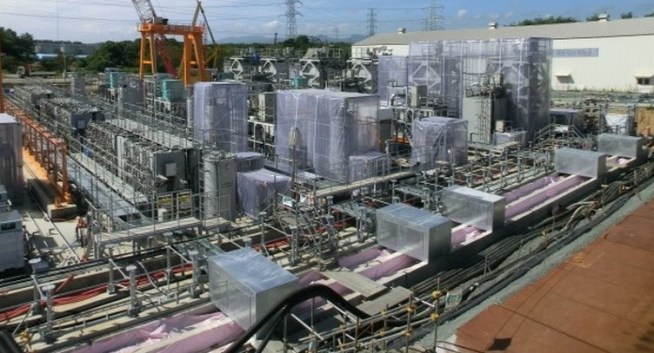
The Advanced Liquid Processing System (ALPS) is seen in September, 2012
With about five years having passed since the start of the Fukushima No. 1 Nuclear Power Plant disaster, nuclear workers still lack a method of treating the around 1,000 tanks of contaminated water stored on site, and the start of work to remove melted nuclear fuel from the plant remains at least five years away.
“Until the contaminated water issue is solved, decommissioning of the reactors remains far off. We have to stop the water,” says Tetsuo Ito, professor of nuclear energy safety engineering at the Kinki University Atomic Energy Research Institute. Akira Ono, chief of the Fukushima plant, says, “We’re still at step one” of the decommissioning process, which is estimated to take until 2041 to 2051.
Tokyo Electric Power Co. (TEPCO), the plant’s owner, is treating the contaminated water with its Advanced Liquid Processing System (ALPS), which can remove 62 varieties of radioactive material. However, ALPS cannot remove radioactive tritium, and because of this the treated water is stored in tanks. Tritium is extremely difficult to separate from water, because even if one of the hydrogen atoms in a water molecule is replaced by tritium, the chemical properties such as the boiling point barely change.
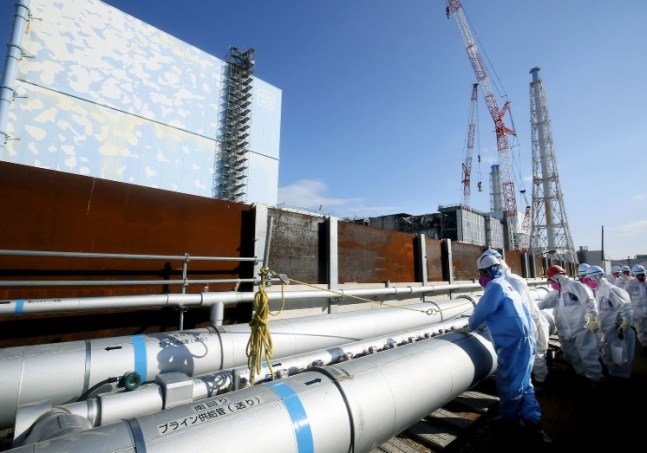
Pipes for an underground frozen wall to block contaminated water leakages are seen on the landward side of the Fukushima No. 1 Nuclear Power Plant, on Feb. 23, 2016.
The International Atomic Energy Agency (IAEA) has advised that tritium-containing water be released into the ocean, because its effect on the human body is very limited. Tritium-containing water is created even during the normal operation of a nuclear power plant, and it is released into the ocean in accordance with waste-disposal standards. However, there is local opposition to doing this at the Fukushima plant because of worries about its effects on the reputation of the local fishing industry, and no decision has been made on what to do with the water.
Tritium has a half-life of 12.3 years, so storing the water until the radiation naturally lessens is another option, but there is the risk of leaks during that time if the tanks’ conditions deteriorate.
As for decommissioning the plant reactors, at the end of 2011 the national government put together a roadmap that estimated the decommission work would take 30 to 40 years. To decommission the No. 1 through 3 reactors at the plant, 1,573 units of spent fuel will have to be removed from the spent fuel pools of these reactors, and 1,496 units’ worth of fuel that melted from the reactors will have to be removed. Safe removal of the melted fuel represents the largest problem.
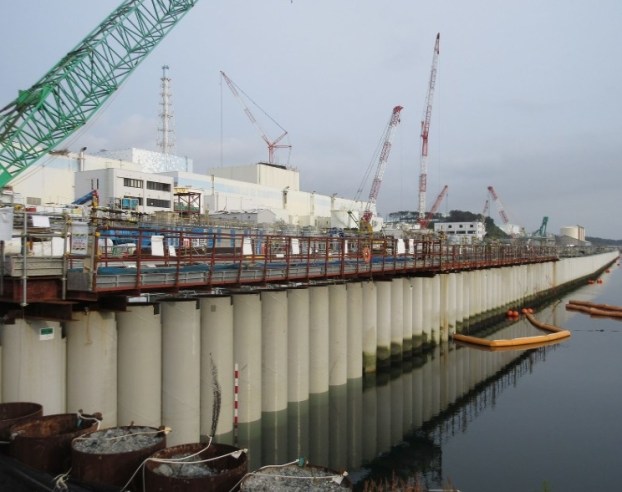
A wall constructed on the seaward side of the Fukushima No. 1 Nuclear Power Plant to prevent leakages is seen on Sept. 24, 2015.
The national government and TEPCO intend to decide on a plan for the fuel’s extraction in the first half of fiscal 2018, and start extraction efforts at one of the reactors within the year 2021. Toyoshi Fuketa, a member of the Nuclear Regulation Authority (NRA), argues that nuclear fuel that is too difficult to take out should be stored on-site, saying, “There is the option of just removing as much (of the melted fuel) as possible, and hardening the rest (to seal off its radiation).”
The cost for decommissioning the reactors is already estimated at 2 trillion yen, and this could grow if the decommissioning schedule is delayed.
While the No. 1 through 3 reactors at the plant were shut down at the time of the Great East Japan Earthquake on March 11, 2011, they lost all power due to the proceeding tsunami and, with no way to cool the nuclear reactors, they experienced a meltdown. The tsunami measured at up to 15.5 meters, and emergency underground power supplies were flooded and failed to function.
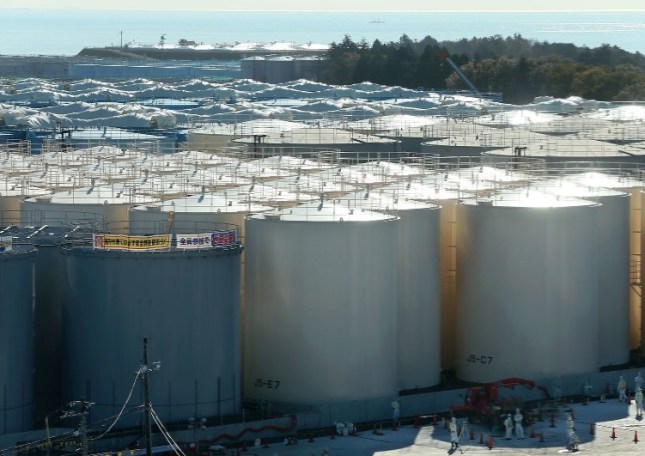
Tanks for holding contaminated water are seen on the grounds of the Fukushima No. 1 Nuclear Power Plant, on Nov. 5, 2015
The No. 1 reactor was equipped with a cooling system called Reactor Core Isolation Cooling (IC), but this didn’t activate, and on March 12 at 3:36 p.m. the No. 1 reactor suffered a hydrogen explosion. Then, on March 14 at 11:01 a.m. the No. 3 reactor also experienced a hydrogen explosion. The No. 4 reactor was already offline at the time of the disaster for a regular inspection, but hydrogen from the adjacent No. 3 reactor leaked in, and it suffered a hydrogen explosion as well at 6:14 a.m. on March 15. The No. 2 reactor was not hit by a hydrogen explosion, but among the No. 1 through 3 reactors it is thought to have leaked the most radiation. The disaster is rated a 7 on the International Nuclear Event Scale, the same as the Chernobyl disaster.
Masao Yoshida, the late chief of the Fukushima plant who headed up the frontline disaster-response efforts, testified to a government panel investigating the disaster, “We (who were on-site) imagined it as the destruction of eastern Japan. I really thought we were dead.”
Four reports on the disaster were put together, from the national government, the Diet, TEPCO and elsewhere in the private sector. They differ on points such as why the IC in the No. 1 reactor did not activate. The Diet probe raised the possibility that the IC system’s piping was damaged in the earthquake, but the national government’s investigative panel denied that earthquake damage was the cause. Due to the high radiation levels in the reactor buildings, there has not yet been an on-site investigation to better understand what happened.
http://mainichi.jp/english/articles/20160403/p2a/00m/0na/010000c
Prosecutors innocent TEPCO over radioactive water leakage into the ocean
The court said there is no evidence that proves that radioactive water flew out of the Fukushima nuclear power plant to the ocean. I hope this would finally convince those who haven’t been convinced that the state of Japan denies truth and violates peoples lives. Its time to get rid of Abe et al.
Prosecutors drop TEPCO case over radioactive water leakage
FUKUSHIMA–The Fukushima District Public Prosecutor’s Office announced on March 29 that it will not prosecute Tokyo Electric Power Co. or its executives for violating an environmental pollution law.
The decision came two and a half years after a group of plaintiffs, including residents of Fukushima Prefecture, filed a criminal complaint against TEPCO, operator of the crippled Fukushima No. 1 nuclear power plant, and its 32 current and former executives.
The group sought to bring charges against the utility and its executives for allowing radioactive contaminated water to be discharged into the sea.
In its decision, the prosecutors said there was “insufficient” evidence to press charges against TEPCO and some of its executives, including Naomi Hirose, company president. The remaining executives, the prosecutors said, “had no authority or responsibility to set measures to avoid the leakage in the first place,” therefore, the accusation has “no grounds.”
“The Fukushima police investigated the case for almost two years. It is extremely disappointing,” said Ruiko Muto, 62, the head of the plaintiff’s group, at a news conference in Tokyo on March 29. “We wanted them to look into the case further. We can’t accept this decision.”
The group is planning to appeal to the Committee for the Inquest of Prosecution. The group will meet with its lawyers on March 30 and decide on whether it will pursue further action.
http://ajw.asahi.com/article/0311disaster/fukushima/AJ201603300068
Charges ruled out for Tepco figures over Fukushima No. 1 radioactive water spillage into sea
FUKUSHIMA – Public prosecutors decided on Tuesday not to indict Tokyo Electric Power Co. President Naomi Hirose and other current and former executives of the utility over radioactive water leaks from the crippled Fukushima No. 1 nuclear power plant into the ocean.
Sufficient evidence was not found, the Fukushima District Public Prosecutor’s Office said.
In September 2013, a civic group filed a criminal complaint against 32 current and former Tepco executives, including Hirose and Tsunehisa Katsumata, former chairman of the operator of the northeastern nuclear power plant, saying tainted water leaked from storage tanks into the ocean due to their failure to take preventive measures.
Through its investigation, the Fukushima Prefectural Police concluded that some 300 tons of stored radioactive water had flowed into the sea as of July 2013 because Tepco executives neglected to monitor the tanks or take leak-prevention measures, and sent the case to the prosecutors last October.
The prosecutors said there was no evidence supporting the allegation that the leaked tainted water was carried into the sea by groundwater at the plant, which suffered meltdowns following the massive earthquake and tsunami in March 2011.
The group said it will ask for a prosecution inquest panel’s investigation.
TEPCO says 5.3 tons of tainted water leaked at nuclear plant
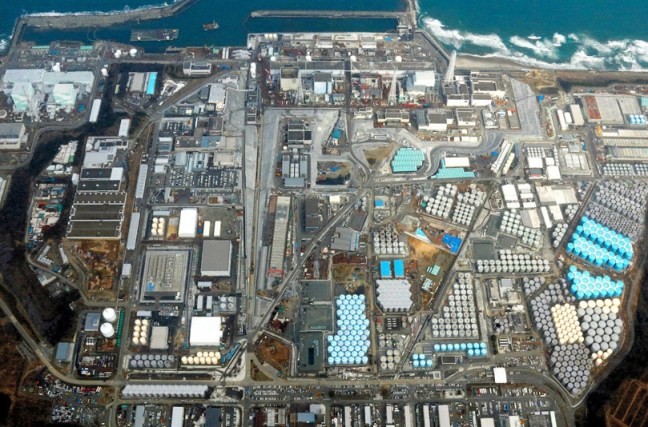
An estimated 5.3 tons of water contaminated with radiation leaked from a pipe in a building housing cesium removal equipment at the stricken Fukushima No. 1 nuclear power plant, the facility’s operator said.
The leaked water contained 383,000 becquerels of radioactive cesium per liter and 480,000 becquerels of beta ray-emitting radioactive substances per liter.
Tokyo Electric Power Co. said March 23 the water has not flowed outside the high temperature incinerator building. TEPCO said it was in the process of pumping up the water for storage.
The utility said workers doing remodeling work earlier in the day cut off a pipe inside the incinerator building. When workers subsequently operated radioactive material removal equipment in another building, contaminated water leaked from the cut section of the pipe to the floor of the incinerator building.
TEPCO said it is trying to determine the cause of the incident, adding that workers had confirmed that they closed a valve before cutting off the pipe to prevent water leakage
http://ajw.asahi.com/article/0311disaster/fukushima/AJ201603240048
2,029,900,000 Bq of Cs-134/137 leaked as contaminated water in Fukushima plant
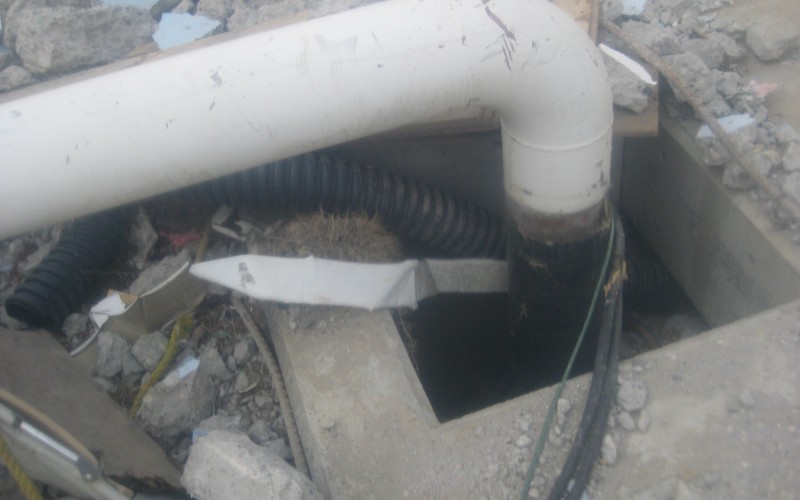
According to Tepco, a leakage detector of waste incineration building went off around noon of 3/23/2016.
Tepco reports the leaked volume was 5.3 t. The leaked contaminated water was from the cesium absorption facility to contain extremely high density of Cs-134/137.
From Tepco’s announcement, Cs-134/137 density was 383,000,000 Bq/m3.
All β nuclides to include Sr-90 was 480,000,000 Bq/m3.
At the moment of the press release, Tepco had not completed removing the leaked water but they state the building is designed to retain contaminated water inside.
The pipe from the cesium absorption facility was cut off due to a construction however somebody turned on the facility to cause the large leakage.
http://www.tepco.co.jp/cc/press/2016/1270693_7738.html
http://www.tepco.co.jp/cc/press/2016/1270654_7738.html
2,029,900,000 Bq of Cs-134/137 leaked as contaminated water in Fukushima plant
Tepco considering discharging Tritium to the Pacific

By 3/4/2016, Masuda, Fukushima plant decommissioning chief commented in the interview with a local newspaper company that they need to consider discharging the contaminated water to the Pacific.
The newspaper company is Kahoku shimpo.
Due to the high amount and the increasing speed, Tepco and the government of Japan cannot remove tritium from contaminated water. The government of Japan is to release a strategy plan by the end of this month.
Masuda said, he is aware that discharging the tritium water is one of the options after dilution.
The entire volume of tritium does not change even after dilution however it was not asked at least in the published part of the interview.
http://sophia806.blog91.fc2.com/blog-entry-96.html
FIVE YEARS AFTER: Tougher work awaits TEPCO at Fukushima after water issue ends
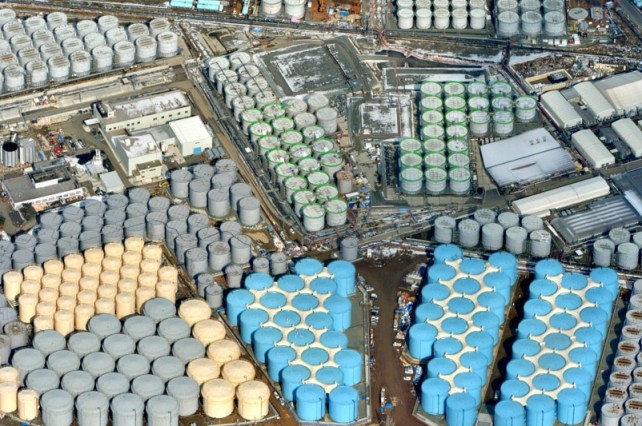
Rows of massive tanks storing radiation contaminated water line at the Fukushima No. 1 nuclear power plant in February.
OKUMA, Fukushima Prefecture–The ever-increasing rows of tanks storing radioactive water continue to eat up the precious available land at the Fukushima No. 1 nuclear power plant.
Five years after the Great East Japan Earthquake and tsunami on March 11, 2011, triggered the triple meltdown at the plant, Tokyo Electric Power Co. is still struggling to bring the contaminated water problem under control.
And the utility has yet to fully tackle the more difficult and time-consuming task of actually decommissioning the ruined nuclear plant.
Each day, TEPCO circulates 300 tons of water inside the No. 1 to No. 3 reactors to cool down the melted nuclear fuel within.
In addition, groundwater keeps flowing into the damaged reactor buildings and inevitably becomes highly contaminated by the radiation.
TEPCO reuses some of this contaminated water to cool down the damaged reactors.
The rest of the water is processed through the ALPS (advanced liquid processing system) multi-nuclide removal system and other equipment to remove highly radioactive substances. The water is then stored in tanks.
The advanced decontamination equipment has helped TEPCO to reduce the amount of highly contaminated water at the plant’s compound.
But 400 to 500 tons of less contaminated water still accumulates at the plant site on a daily basis.
To reduce the amount of groundwater flowing into the reactor buildings, TEPCO initiated its “subdrain plan” in September to pump groundwater from wells dug around the reactors’ premises and release the water into the ocean after the decontamination process.
On the seaside of the reactor buildings, the utility constructed underground walls to prevent contaminated groundwater from flowing into the sea.
Also around the reactor buildings, TEPCO installed coolant pipes to create an underground frozen soil wall, which is expected to divert the clean groundwater directly to the ocean.
But this is only a stop-gap measure at best.
The number of storage tanks, which are built at the site, has reached 1,000. Rows of tanks cover most of the parking lots, green spaces and vacant areas at the Fukushima plant site. Eventually, space will run out for storing the contaminated water.
The government will start full-fledged discussions on measures to reduce the amount of less contaminated water at the plant in fiscal 2016, which starts in April.
LONG ROAD TO DECOMMISSIONING
Five years after the onset of the nuclear disaster, TEPCO has taken the first step in its decommissioning road map.
The first major challenge in decommissioning the plant is removing spent fuel from storage pools in the upper parts of the reactor buildings.
TEPCO has already removed 1,535 fuel assemblies from the No. 4 reactor, which was offline for a periodic safety check when the tsunami slammed into the plant.
However, a large amount of debris and the high radiation levels have delayed the removal of spent fuel from the No. 1 to No. 3 reactor buildings.
Work is under way to remove debris from the upper part of the No. 3 reactor building. TEPCO plans to start removing the spent fuel in fiscal 2017.
According to TEPCO’s road map, the removal of spent fuel from the No. 1 and No. 2 reactor buildings will start in fiscal 2020. But the utility has not started taking debris out of the upper part of the buildings where the fuel storage pools are located.
The toughest task will be removing the melted fuel inside the No. 1 to 3 reactor containment vessels.
The locations and amount of melted fuel inside the reactors remain largely unknown. Extremely high radiation levels in the reactor containment vessels have prevented workers from analyzing the conditions. Even remote-controlled survey robots have failed to readily approach the core areas.
The preferred way to remove the melted fuel is the “water-covered method.” It involves pumping in water to fill the reactor containment vessels to the upper part and removing the fuel while the water keeps radiation exposure of the workers at low levels.
The government and TEPCO are also considering the “airborne method” if contaminated water keeps leaking from the containment vessels. Under this method, water would fill only the bottom part of the containment vessels, and the melted fuel would be removed through the air.
The two parties also need to develop special equipment to remove the melted fuel and keep it safely stored in containers.
They estimate the decommissioning process will take 30 to 40 years. But they have not specified the conditions that can finally bring an end to the nuclear disaster.
http://ajw.asahi.com/article/0311disaster/fukushima/AJ201603110047
Fukushima nuclear disaster left 10.7 million 1-ton container bags with radioactive debris
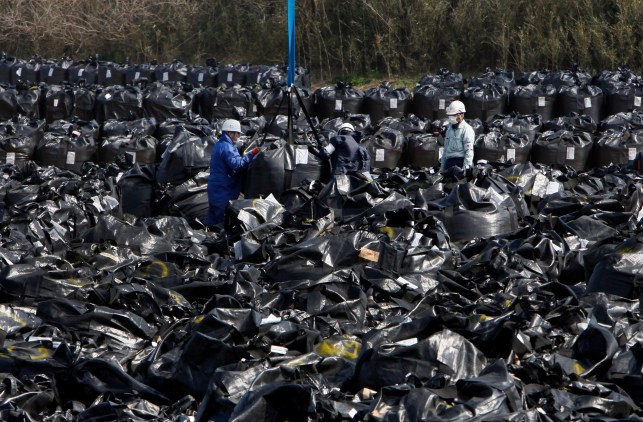
Five years after a powerful earthquake and tsunami sent the Fukushima Dai-ichi nuclear power plant in Japan into multiple meltdowns, cleaning up the mess both onsite and in surrounding towns remains a work in progress. Here’s a look, by the numbers, at the widespread effects of radiation from the March 11, 2011, disaster:
164,865: Fukushima residents who fled their homes after the disaster.
97,320: Number who still haven’t returned.
49: Municipalities in Fukushima that have completed decontamination work.
45: Number that have not.
30: Percent of electricity generated by nuclear power before the disaster.
1.7: Percent of electricity generated by nuclear power after the disaster.
3: Reactors currently online, out of 43 now workable.
54: Reactors with safety permits before the disaster.
53: Percent of the 1,017 Japanese in a March 5-6 Mainichi Shimbun newspaper survey who opposed restarting nuclear power plants.
30: Percent who supported restarts. The remaining 17 percent were undecided.
760,000: Metric tons of contaminated water currently stored at the Fukushima nuclear plant.
1,000: Tanks at the plant storing radioactive water after treatment.
10.7 million: Number of 1-ton container bags containing radioactive debris and other waste collected in decontamination outside the plant.
7,000: Workers decommissioning the Fukushima plant.
26,000: Laborers on decontamination work offsite.
200: Becquerels of radioactive cesium per cubic meter (264 gallons) in seawater immediately off the plant in 2015.
50 million: Becquerels of cesium per cubic meter in the same water in 2011.
7,400: Maximum number of becquerels of cesium per cubic meter allowed in drinking water by the U.S. Environmental Protection Agency.
Sources: Fukushima prefectural government, Japan Ministry of Internal Affairs, the Tokyo Electric Power Co., the Nuclear Regulation Authority, the Federation of Electric Power Companies and the Woods Hole Oceanographic Institution.—AP
More than 1,100 water storage tanks at Fukushima plant … and counting

Storage tanks to contain radioactive contaminated water continue being constructed at Fukushima
February 13, 2016 By Satoru Semba
The construction of large steel tanks on the site around Fukushima nuclear power plant to store highly contaminated water running through the nuclear site continues. There is a planned further construction of 20 more steel containers which are expected to store 30,000 tons of contaminated water. In addition to the steel tanks that are being constructed with no end in site, there are more than 9 million large black vinyl bags piling up in neat rows around the site filled with radioactive contaminated soil that has been scraped off the surface around the nuclear plant. Heavy rain during September, 2015 around the area of Fukushima caused flooding and swept more than 700 of these bags containing Fukushima-contaminated soil and grass into local rivers. Many of these bags are still unaccounted for with some spilling their radioactive content into the water system.
OKUMA, Fukushima Prefecture–From the air, the rows of different colored water storage tanks at the crippled Fukushima No. 1 nuclear power plant resemble a giant integrated circuit board.
As the fifth anniversary approaches of the earthquake and tsunami disaster that unleashed the nuclear catastrophe, the stricken facility is fast running out of space to position the tanks holding highly contaminated radioactive water.
As of Feb. 12, there were 1,106 massive water tanks on the premises.
Tokyo Electric Power Co., operator of the plant, constructed the tanks to store radiation-contaminated water that has been accumulating at the plant since the disaster unfolded in March 2011.
The utility plans to construct 20 more water storage tanks to accommodate 30,000 tons of water that is expected to be generated in the remaining months of 2016.
As the tanks occupy much of the parking lots, green spaces and vacant areas, TEPCO has no choice but to build new tanks in the narrow alleys between the huge containers.
The accumulation of contaminated water has been a persistent problem at the plant, which is only in the very early stages of decommissioning, a process that will take 30 to 40 years.
Storage tanks to contain radioactive contaminated water continue being constructed at Fukushima
More than 1,100 water storage tanks at Fukushima plant … and counting

OKUMA, Fukushima Prefecture–From the air, the rows of different colored water storage tanks at the crippled Fukushima No. 1 nuclear power plant resemble a giant integrated circuit board.
As the fifth anniversary approaches of the earthquake and tsunami disaster that unleashed the nuclear catastrophe, the stricken facility is fast running out of space to position the tanks holding highly contaminated radioactive water.
As of Feb. 12, there were 1,106 massive water tanks on the premises.
Tokyo Electric Power Co., operator of the plant, constructed the tanks to store radiation-contaminated water that has been accumulating at the plant since the disaster unfolded in March 2011.
The utility plans to construct 20 more water storage tanks to accommodate 30,000 tons of water that is expected to be generated in the remaining months of 2016.
As the tanks occupy much of the parking lots, green spaces and vacant areas, TEPCO has no choice but to build new tanks in the narrow alleys between the huge containers.
The accumulation of contaminated water has been a persistent problem at the plant, which is only in the very early stages of decommissioning, a process that will take 30 to 40 years.
http://ajw.asahi.com/article/0311disaster/fukushima/AJ201602130025
Japan Nuclear Regulation Authority Halts Fukushima Daiichi’s Ice Wall

Japanese Nuclear Regulation Authority, the NRA, has put the kibosh on plans by Tokyo Electric Power Co. to start freezing underground soil at the crippled Fukushima No. 1 nuclear power plant–a stunningly expensive project intended to solve the crisis of accumulating radioactive groundwater at the site.
The installation of the equipment required for forming a wall of frozen soil at the Fukushima Daiichi nuclear power plant to prevent groundwater entering the reactor buildings has been completed. Approval from the Japanese regulator must be sought before the creation of the wall itself can begin.
Ice wall technology is already widely used in civil engineering projects, such as the construction of tunnels near waterways. Small-scale tests using the technology have already been completed at the Fukushima Daiichi site. However, the full-scale use of the technology at Fukushima will see the largest ground freezing operation in the world.
Installation of the equipment for forming the ice wall began in June 2014 and a test that has circulated the chilling liquid to specific parts of the wall has been under way since April 2015. The north, south and west sides of the facility were completed last September, while the remaining pipes on the east side facing the sea were placed within the ground in November.
Tokyo Electric Power Company (Tepco) announced yesterday that all the necessary equipment is now in place for the creation of the ice wall. However, the company noted that it must get approval from the Nuclear Regulation Authority before the equipment can be put into operation. The regulator’s approval, Tepco said, would partly depend on the company “showing a method to ensure that the wall (and other groundwater pumping operations) do not invert the water level difference in any way that would cause contaminated water to flow out of the building’s basements”.
Kajima Corporation, the main contractor for the facility, has drilled holes some 30-35 metres into the ground and inserted pipes through which refrigerant will be then be pumped. This cooling will freeze the soil surrounding the pumps creating an impenetrable barrier around the reactor buildings. In total, some 1550 pipes have been placed in the ground to create a 1.5km-long ice wall around units 1 to 4. The wall is designed to remain effective for up to two months in the event of a loss of power. The Japanese government agreed to pay for construction of the ice wall, estimated to cost some JPY32 billion ($278 million).
Reducing the amount of contaminated water that it must deal with is a priority for Tepco. Groundwater naturally seeps from land to sea, but at the Fukushima Daiichi site it must negotiate the basements of reactors buildings. It is thought that more than 400 tonnes of groundwater enters the basements each day through cable and pipe penetrations as well as small cracks, mixing with the heavily contaminated water previously used to cool the damaged reactor cores.
The ice wall is only one part of a multi-layered strategy being employed to manage the flow of groundwater and rainwater at Fukushima Daiichi, Tepco said. Tepco is saying that its strategy to prevent water becoming contaminated has reduced the daily inflow of groundwater into the buildings to 150 tonnes per day. “Successful implementation of the frozen soil water is designed to reduce that inflow further, by keeping water out of the reactor buildings,” the company contends.
TEPCO has maintained that once the soil is frozen, it will form a circular barrier and reduce the flow of groundwater into the reactor buildings; and that, in turn, will prevent water contaminated with radioactive substances from accumulating.
But the Nuclear Regulation Authority contends that contaminated water accumulated in the reactor buildings could leak into the groundwater if the level inside the frozen soil wall drops too much.
TEPCO planned to construct a 1,500-meter-long frozen soil wall around the four reactor buildings by inserting 1,568 pipes to a depth of 30 meters at 1-meter intervals. Each pipe will freeze the soil around it once liquid of minus 30 degrees circulates inside the cylinder.
On Feb. 9, TEPCO completed the last part of the project to install temperature indicators, allowing it to start freezing the soil at a moment’s notice.
Groundwater is continuing to flow into basements of reactor buildings with melted nuclear fuel, adding to the amount of highly contaminated water being produced.
In May 2013, a committee of the Ministry of Economy, Trade and Industry drew up a report on the merits of constructing a frozen soil wall to reduce the volume of contaminated water.
Based on the report, TEPCO started the construction work in June 2014. The government has already spent about 34.5 billion yen ($300 million) on the project.
TEPCO maintained that once the frozen soil wall is completed, it should reduce the flow of groundwater into the reactor buildings from about 400 tons a day to 100 tons in tandem with other measures, including work to pump out groundwater from wells dug around the reactor buildings.
From the outset, the NRA cast doubt on the effectiveness of the frozen soil wall, saying that highly contaminated water accumulated in reactor buildings could leak into the ground if the groundwater level inside the wall drops too much.
The NRA repeatedly asked TEPCO whether the frozen soil wall would prove truly effective in reducing the amount of contaminated water.
“TEPCO is scattering a strange illusion that the problem of contaminated water can be solved completely if a frozen soil wall is constructed,” NRA chairman Shunichi Tanaka said in spring 2015.
In a test operation which started that spring, the reduction of groundwater levels was larger than expected in some places. The speed and direction of the groundwater flow could not be clarified in some locations.
Because it takes two months or so for the soil to thaw out, countermeasures cannot be taken immediately if problems crop up.
TEPCO acknowledges that there are limits to its crystal ball-gazing with regard to the problem of groundwater. However, it contends that it can prevent contaminated water from leaking into the ground by pouring water into the ground through wells if the level drops too much.
In December, the NRA took the rare move of proposing to TEPCO in a written document that the utility operate the frozen soil wall only in places where contaminated water is unlikely to leak into the ground.
However, TEPCO dug in its heels and said it intended to operate the frozen soil wall as a whole. But it also plans to consider the NRA’s proposal.
On Feb. 9, TEPCO President Naomi Hirose visited the NRA office and told Tanaka, “We will consider your proposal and get back to you in a most sincere manner.”


Sources :
http://www.tepco.co.jp/en/press/corp-com/release/2016/1267045_7763.html
http://www.world-nuclear-news.org/RS-Fukushima-Daiichi-ice-wall-equipment-in-place-1002165.html
http://www.japantimes.co.jp/news/2016/02/10/national/tepco-finishes-installing-fukushima-ice-shield-equipment/#.VrvH1lLzN_k
http://ajw.asahi.com/article/0311disaster/fukushima/AJ201602100079
Tepco started discharging contaminated groundwater beside crippled reactor buildings
Tepco started discharging the contaminated groundwater to the Pacific on 9/14/2015, Tepco reported.
It was discharged for nearly 6 hours in daytime. The reported volume of contaminated water was 838 tons.
The discharged water was pumped up from 20 of 41 wells called “sub-drain” situated beside crippled reactor buildings 1 ~ 4.
10,800,000 Bq/m3 of Cs-134/137 and 16,000,000 Bq/m3 of Tritium were measured from the water pumped this August. Tepco announced they purified water before discharging, however unremovable nuclide Tritium still remains in water. 390,000 ~ 600,000 Bq/m3 of Tritium was detected from “filtered” water from third party organization’s analysis.
http://www.tepco.co.jp/tepconews/library/archive-j.html?video_uuid=q2f3u22p&catid=69619
http://www.tepco.co.jp/decommision/planaction/sub-drain/index-j.html
http://www.tepco.co.jp/cc/press/2015/1259086_6818.html
http://www.tepco.co.jp/cc/press/2015/1259171_6818.html
http://www.tepco.co.jp/nu/fukushima-np/handouts/2015/images/handouts_150902_07-j.pdf
http://www.tepco.co.jp/cc/press/2015/1259687_6818.html
http://www.tepco.co.jp/cc/press/2015/1259973_6818.html
http://www.tepco.co.jp/cc/press/2015/1259923_6818.html
Source: Fukushima Diary
[Video] Tepco started discharging contaminated groundwater beside crippled reactor buildings
850 tons of ‘decontaminated’ Fukushima water dumped into ocean

Tokyo Electric Power Co. (TEPCO) that operates the crippled nuclear plant released its first 850 tons of filtered radioactive groundwater by sundown on September 14. This is a part of TEPCO’s “subdrain plan” that was approved in late July after a year-long battle with local fishermen who opposed the release fearing that it would pollute the ocean and contaminate marine life.
A third party panel has given the green light to the release after confirming that the radioactive content was below measurable limits, according to The Japan Times. TEPCO allows one becquerel of radioactive cesium per liter of decontaminated groundwater, three becquerels for elements that emit beta rays and up to 1,500 becquerels for tritium, which cannot be removed with existing technology.
Monday’s batch measured 330 to 600 becquerels per liter, TEPCO said, citing analyses conducted by the company and an outside organization.
TEPCO has yet to deal with remaining 680,000 tons of water that was used to cool the reactors during the 2011 meltdown.
“The risk that you run is that you have all these tanks full of water,” Dale Klein, the chairman of a committee created to prevent possible meltdowns, told AFP. “The longer you store the water, the more likely you are going to have (an) uncontrolled release,” he said. Klein added that he hopes the supplies will be released from storage in the next three years.
TEPCO, much criticized for handling the tsunami-triggered meltdown at Fukushima No.1 reactors, is running behind schedule on a project to build a huge underground ice barrier – the “ice wall” – around Fukushima plant as it tries to stop groundwater from reaching the reactor building basements.
In addition, flooding from Typhoon Etau caused new leaks of contaminated water to flow from the Fukushima nuclear power station into the ocean last week. The incident came after a rush of water overwhelmed the site’s drainage pumps.
Source: RT
https://www.rt.com/news/315350-fukushima-decontaminated-water-ocean/
Tepco dumps treated groundwater in Pacific to ease toxic water buildup at Fukushima No. 1
This article was removed from the Japan Times website certainly due to censorship. Maybe someone did not like something said in it or its style. Luckily i had already copied it early when it came out and before they deleted it.
FUKUSHIMA – Tepco on Monday discharged into the ocean filtered groundwater taken from wells around the damaged reactor buildings at the Fukushima No. 1 nuclear plant in an effort to curb the buildup of toxic water.
The project has been touted as one of Tokyo Electric Power Co.’s key measures in tackling the contaminated water problem.
Some 300 tons of untainted groundwater seeps into the buildings each day, where it mixes with water made radioactive by keeping the damaged reactors cool.
By pumping up groundwater through 41 wells and discharging it into the sea after treatment, the government and Tokyo Electric Power Co. hope to halve the amount flowing into the reactor buildings.
On Monday, Tepco released some 850 tons of filtered groundwater — part of some 4,000 tons pumped up last year on a trial basis and stored in tanks — after confirming that radiation levels were below measurable limits.
Tritium, which cannot be removed with existing technology, measured 330 to 600 becquerels per liter, well below the legally allowable limit of 1,500 becquerels, the utility said, citing analyses conducted by the company and an outside organization.
Fishermen in Fukushima Prefecture had long opposed releasing the water over concerns it would pollute the ocean and contaminate marine life, but signed off on the plan in August.
In exchange, the fishermen demanded among other things that Tepco and the government continue paying compensation for as long as the nuclear plant damages their business.
Tepco is running behind schedule on a project to build a huge underground ice wall at the site, another key measure to prevent groundwater from reaching the reactor building basements.
Source: Japan Times
1 This Month

of the week – Shut Down Drone Warfare!


Tell the Ukrainian Government to Drop Prosecution of Peace Activist Yurii Sheliazhenko

Petition to revoke the licensing of the Near Surface Nuclear Disposal Facility (NSDF) at Chalk River. https://www.ourcommons.ca/petitions/en/Petition/Details?Petition=e-7247
To see nuclear-related stories in greater depth and intensity – go to https://nuclearinformation.wordpress.com
-
Archives
- April 2026 (19)
- March 2026 (251)
- February 2026 (268)
- January 2026 (308)
- December 2025 (358)
- November 2025 (359)
- October 2025 (376)
- September 2025 (257)
- August 2025 (319)
- July 2025 (230)
- June 2025 (348)
- May 2025 (261)
-
Categories
- 1
- 1 NUCLEAR ISSUES
- business and costs
- climate change
- culture and arts
- ENERGY
- environment
- health
- history
- indigenous issues
- Legal
- marketing of nuclear
- media
- opposition to nuclear
- PERSONAL STORIES
- politics
- politics international
- Religion and ethics
- safety
- secrets,lies and civil liberties
- spinbuster
- technology
- Uranium
- wastes
- weapons and war
- Women
- 2 WORLD
- ACTION
- AFRICA
- Atrocities
- AUSTRALIA
- Christina's notes
- Christina's themes
- culture and arts
- Events
- Fuk 2022
- Fuk 2023
- Fukushima 2017
- Fukushima 2018
- fukushima 2019
- Fukushima 2020
- Fukushima 2021
- general
- global warming
- Humour (God we need it)
- Nuclear
- RARE EARTHS
- Reference
- resources – print
- Resources -audiovicual
- Weekly Newsletter
- World
- World Nuclear
- YouTube
-
RSS
Entries RSS
Comments RSS
 nuclear-news