10,000 tons of toxic water pools in Fukushima nuclear plant trenches
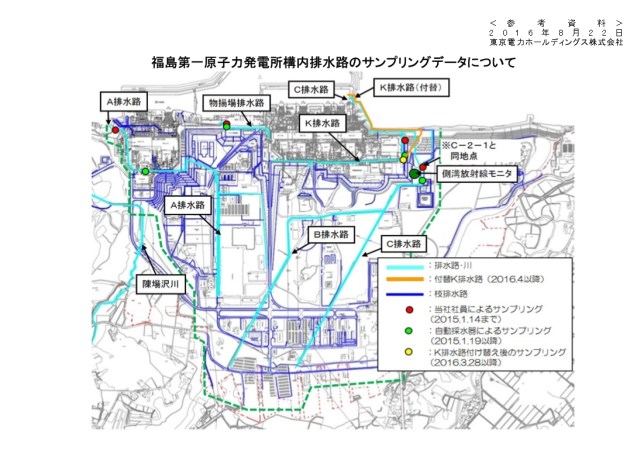
Drainage chart/map
TOKYO (Kyodo) — Around 10,000 tons of contaminated water have pooled in underground trenches around the Nos. 1 to 4 reactor buildings of the crippled Fukushima Daiichi nuclear power plant, according to the plant operator Tokyo Electric Power Company Holdings Inc.
Tokyo Electric has no immediate plan to remove the water in the trenches where cables run for the nuclear power complex devastated by the March 2011 earthquake and tsunami disaster.
Water that flew into the trenches in the wake of the huge tsunami is believed to have been mixed with highly radioactive water leaking from the basements of reactor buildings and contaminated rain water.
“Compared with around 70,000 tons of highly contaminated water that remain in the basements of the reactor buildings, (the water in the trenches) has a low level of concentration and thus poses little threat in terms of radiation exposure and the environment,” said an official of the utility known as TEPCO.

TEPCO said in a report issued in July — based on research conducted in fiscal 2015 — that it has found around 8,000 tons of toxic water in 17 locations in the trenches that connect with reactor buildings where highly radioactive water accumulates, as well as around 3,000 tons of toxic water at 11 locations in trenches that do not connect with reactor buildings.

Of the water in the trenches around the Nos. 1 to 4 reactor buildings, a removal procedure was completed by June for around 500 tons of water in a pipe that measured the highest level of radioactive cesium at 500,000 becquerels per liter.
The level of radioactive cesium in water at other locations in the trenches was mostly measured at several thousands becquerels or below.
The level in toxic water in the basements of reactor buildings has been measured at around dozens of millions becquerels at maximum.
TEPCO has said it will continue to monitor and measure the level of contamination in water in the trenches regularly and consider taking measures to remove the water in the future. But no concrete plan has been created yet.
The electricity firm has so far removed a total of around 10,000 tons of highly radioactive water at three locations in the trenches running in the seaside of the complex and completed the procedure to fill locations concerned with cement to prevent water leaks.
Still, the level of radioactive cesium remains unchecked at 40 locations in the trenches due to high radioactive levels as well as debris and other objects blocking the research operation.
Around 8,000 tons of contaminated water, including those with an extremely low level of contamination, have also been found in the trenches running around the Nos. 5 and 6 reactor buildings. The two units have lower levels of radiation doses than the Nos. 1 to 4 units as there were no nuclear meltdowns or hydrogen explosions there during the nuclear disaster.
http://mainichi.jp/english/articles/20160823/p2g/00m/0dm/074000c
Drainage charts/maps.
https://t.co/EIJkR80Biq
Tepcos Reports (PDF)
https://t.co/lTM563FjQe
Panel: TEPCO’s ‘ice wall’ failing at Fukushima nuclear plant
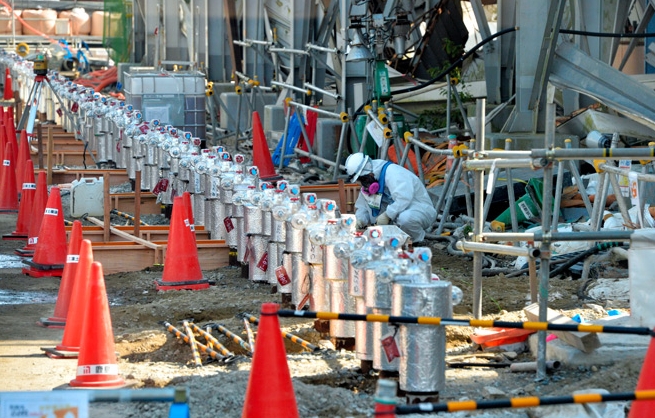
Devices to freeze the earth are set up on the southern side of the No. 4 reactor building at Tokyo Electric Power Co.’s Fukushima No. 1 nuclear power plant in Fukushima Prefecture in 2014.
Tokyo Electric Power Co.’s “frozen wall of earth” has failed to prevent groundwater from entering the crippled Fukushima No. 1 nuclear plant, and the utility needs a new plan to address the problem, experts said.
An expert panel with the Nuclear Regulation Authority received a report from TEPCO on the current state of the project on Aug. 18. The experts said the ice wall project, almost in its fifth month, has shown little or no success.
“The plan to block groundwater with a frozen wall of earth is failing,” said panel member Yoshinori Kitsutaka, a professor of engineering at Tokyo Metropolitan University. “They need to come up with another solution, even if they keep going forward with the plan.”
One big problem hampering work at the nuclear plant, which was hit by the Great East Japan Earthquake and tsunami in 2011, has been the tons of groundwater entering the buildings housing the No. 1 through No. 4 reactors every day.
The water becomes contaminated with radioactive materials within the reactor buildings.
TEPCO’s plan was to create a frozen wall of earth around the reactor buildings to divert the groundwater away from the plant and into the ocean.
The company started freezing the ground on March 31, and the project’s budget was 34.5 billion yen ($344 million) in taxpayer money as of the end of May.
But the amount of groundwater pumped from the ocean side of the frozen wall has shown little change from when there was no icy earth wall.
TEPCO’s report said 99 percent of thermometer readings on the 820-meter-long stretch showed temperatures of freezing or lower, suggesting the underground wall was frozen solid at those points.
However, the remaining 1 percent of the readings above freezing were in areas with high levels of groundwater concentration.
A 99-percent success rate may sound impressive, but much like dams, airlocks and Tupperware, TEPCO’s ice wall is failing if it is not 100-percent watertight.
The utility said the unfrozen sections could be reinforced with an injection of concrete.
The panel asked the utility submit calculations estimating the amount of groundwater that can be blocked if water is pumped before it reaches the frozen wall.
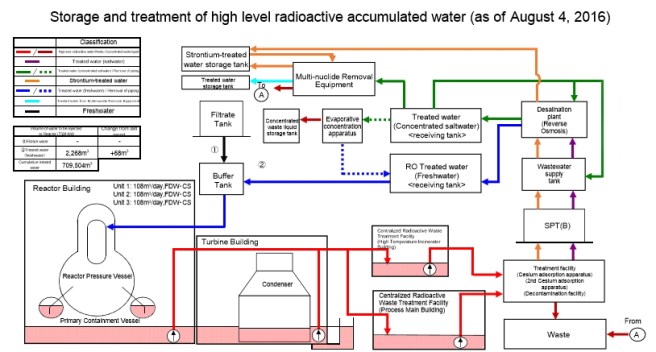
Situation of Storage and Treatment of Accumulated Water including Highly Concentrated Radioactive Materials at Fukushima Daiichi Nuclear Power Station
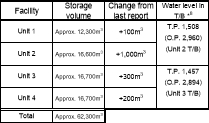
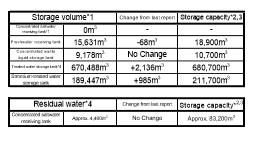
Situation of storing and treatment of accumulated water in the building (actual record) Stored amounts in each unit building (Units 1 to 4 (including condensers and trenches)) and stored and treated amounts, and other related data in the Accumulated Water Storing Facility as of July 28, 2016
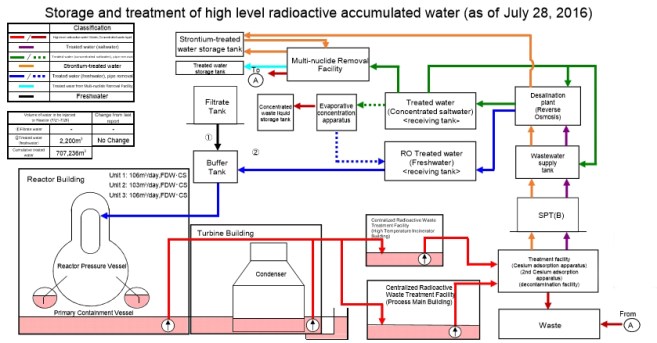
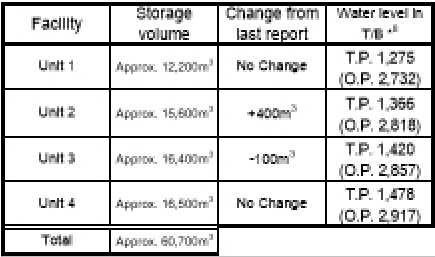
Forecast of storing and treatment
(1) Short term forecast
Water transfer is planned so that the levels of the accumulated water in Units 1 and 2 and Units 3 and 4 building will be maintained around at the level of OP. 3,000, based on the stored amount in the Accumulated Water Storing Facilities and the operating situation of the radioactive material treatment equipment. Water is transferred to the Process Main Building and/or High Temperature Incinerator Building as Accumulated Water Storing Facilities. Treatment is implemented considering the state of storage and transfer of Accumulated Water Storing Facilities.
We assume stored amounts in each unit building (Units 1 to 4 (including condenser and trench)), and stored and treated amounts, and other related data in the Accumulated Water Storing 2 Facilities as of August 4, 2016.
(2) Middle term forecast
Regarding accumulated water in Units 1 and 2 buildings and Units 3 and 4 buildings, from the viewpoint of reducing the risks of discharging to the ocean and leaking into the groundwater, it is necessary to keep enough capacity for the accumulated water in the building until its level reaches OP. 4,000 and to keep the accumulated water level lower than the groundwater level. On the other hand, based on the view of limiting inflow of underwater to buildings and reducing the amount of emerged accumulated water, we are planning to transfer accumulated water keeping its level in the building around OP. 3,000 considering water tank capacity. As for accumulated water of the Process Main Building and the High Temperature Incinerator Building, we are planning to treat the accumulated water considering the situation of construction of middle and low level waste water tanks, the operation factor of the radioactive material treatment instruments and duration for maintenance.
We forecast stored amounts in each unit building (Units 1 to 4 (including condensers and trenches)), and storing and treatment situations in the Accumulated Water Storing Facilities for the next 3 months.
Stored amounts in each building and the water storage equipment are forecasted to be unchanged in case transfer and treatment were implemented as scheduled without rain. However, it would be subject to change depending on the operation factor of the radioactive material treatment instruments and so on. Also, the water treated at the radioactive material treatment equipment (fresh water and condensed salt water) can be stored in the middle and low level waste water tanks.
http://www.tepco.co.jp/en/press/corp-com/release/2016/1315201_7763.html
Fukushima Daiichi Urged To Prepare For Future Tsunamis; No Sarcophagus For Meltdowns
TEPCO urged to cut risk of radioactive water leak
Japan’s nuclear regulator has urged the operator of the crippled Fukushima Daiichi nuclear power plant to reduce the risk of leaking of highly radioactive water from the facility into the sea, in case of another tsunami.
About 60,000 tons of such water is believed to have pooled in reactor buildings at the plant. The operator, Tokyo Electric Power Company, or TEPCO, is injecting water into the buildings to cool melted nuclear fuel, and groundwater is flowing into their basements.
The Nuclear Regulation Authority instructed TEPCO at a meeting on Tuesday to urgently study measures to lower the amount and radiation levels of the water.
The authority proposed 2 measures to TEPCO. One is building more tanks to store the water, even though the plant has about one thousand tanks. The other is treating the water using a system designed to filter out radioactive material, and circulating the water in a cooling system.
NRA member Toyoshi Fuketa said the utility cannot keep the water in the buildings forever. He said TEPCO should handle the water problem either along with that of other radioactive water or first of all.
Following the NRA’s instruction, TEPCO is to report the results of its study at a meeting next month or later.
State minister rules out sarcophagus option
Japan’s state minister for industry has ruled out the option of sealing off disabled reactors at the Fukushima Daiichi nuclear plant with a Chernobyl-style sarcophagus.
In first, Tepco admits ice wall can’t stop Fukushima No. 1 groundwater

The much-hyped ice wall at the crippled Fukushima No. 1 nuclear power plant has failed to stop groundwater from flowing in and mixing with highly radioactive water inside the wrecked reactor buildings, operator Tokyo Electric Power Co. Holdings Inc. has admitted.
Tepco officials also said at a meeting of the Nuclear Regulation Authority in Tokyo that it is not the utility’s ultimate goal to shut out groundwater with the ice wall, which has been built around the four damaged reactor buildings at the plant.
Tuesday’s announcement was apparently the first time the utility publicly said it is technically incapable of blocking off groundwater with the frozen wall.
Five years after the March 2011 quake and tsunami triggered the nuclear crisis, Tepco continues to be plagued by radiation-tainted groundwater, mostly rainwater that is mixing with contaminated water in the basement of the damaged reactor buildings.
In response, Tepco has completed most of the 1.5-km-long sunken wall of frozen soil around the stricken reactors to keep groundwater out. It has also built “subdrain” wells around the buildings to pump up the tainted groundwater for treatment and ultimate discharge into the Pacific.
While the completed sections of the ice wall began operating in March, it has not made a visible impact in reducing the amount of groundwater inflows. According to Tepco, the amount of groundwater pumped up from subdrains averaged 321 tons per day in June, just 31 tons less than the daily average in May.
Asked whether Tepco plans to eventually block rainwater from seeping through the ice wall, a Tepco official said it is not technically feasible “to keep out the groundwater 100 percent,” according to a video of the meeting released Tuesday by the NRA.
“We are aiming to control the amount of water going into the reactor buildings, with the ice wall and subdrains,” said Tomohiko Isogai, an official in charge of dismantling the plant.
Kiyoshi Takasaka, a nuclear expert at the Fukushima Prefectural Government, said it was the first time he had heard such a comment from Tepco, pressing the firm on whether it marked a “change of policy.”
A Tepco official denied this, saying that while it wants to “close off the wall as much as possible,” its ultimate goal has been to “curtail” groundwater inflow, not halt it.
Also at the meeting, NRA acting head Toyoshi Fuketa demanded that Tepco move quickly to reduce the amount of highly radioactive water inside the reactor buildings, saying such water presents the risk of escaping in the event of another monster tsunami. Some 60,000 tons of highly tainted water remain in the leaking basements of reactor buildings 1, 2, 3 and 4.
“We want the amount of (radioactive water) inside the buildings to be reduced as much as possible,” he said.
TEPCO to reuse tanks holding radioactively contaminated water at Fukushima plant

Tokyo Electric Power Co. (TEPCO) will reuse highly contaminated tanks at the crippled Fukushima No. 1 Nuclear Power Plant to store radioactively contaminated water after treatment, company sources said.
The company will return contaminated water to flange-type tanks that had held such water after removing radioactive materials from the water using the Advanced Liquid Processing System (ALPS). This is because TEPCO has failed to prevent contaminated water from being generated on the premises of the plant or to secure enough storage tanks to hold treated water.
TEPCO had submitted the reuse plan to the Nuclear Regulation Authority, which approved it on July 6 or earlier. TEPCO is set to begin reusing contaminated tanks as early as this month.
Flange-type tanks are assembled by tightening multiple steel plates with bolts. Since such tanks have higher risks of leaking contaminated water, TEPCO is gradually replacing them with tanks assembled by welding steel plates together.
TEPCO is trying to freeze underground soil to surround reactor buildings at the Fukushima power plant to prevent underground water from flowing beneath them and becoming contaminated with radioactive materials.
However, as the efforts have proven ineffective, the utility has decided to reuse flange-type tanks, which it had initially planned to dismantle.
Massive amounts of water are flowing onto the premises of reactor buildings at the atomic power station, generating some 400 tons of radioactively contaminated water a day. TEPCO uses ALPS to purify contaminated water, but the system cannot remove radioactive tritium.
The power company has stored the treated water mainly in welded-type tanks. There are already 1,000 water tanks on the premises of the power station.
http://mainichi.jp/english/articles/20160707/p2a/00m/0na/003000c
Tepco admits they concealed the fact of meltdown 7 million Bq of all β nuclides leaked as contaminated water in Fukushima plant

According to Tepco, highly contaminated water leaked from a water storage tank on 6/26/2016.
All β nuclides density is reportedly 96,000,000 Bq/m3. Cs-134/137 density is also 700,000 Bq/m3.
Tepco states the leaked volume was 72 L. Based on their announcement, at least 6,912,000 Bq of all β nuclides leaked to contain Sr-90.
Tepco says no contaminated water spread to the outside of the tank area.
The type of this tank has unwelded joint parts, which is vulnerable for leakage.
The life of these tanks was reported to be 5 years but in 2013 Tepco admitted it has no basis.
These tanks are not bearable for the contaminated water but these are still in use.
http://www.tepco.co.jp/press/mail/2016/1301003_8708.html
http://www.tepco.co.jp/press/mail/2016/1301004_8708.html
http://www.tepco.co.jp/press/mail/2016/1301009_8708.html
TEPCO expands ice wall operations at Fukushima
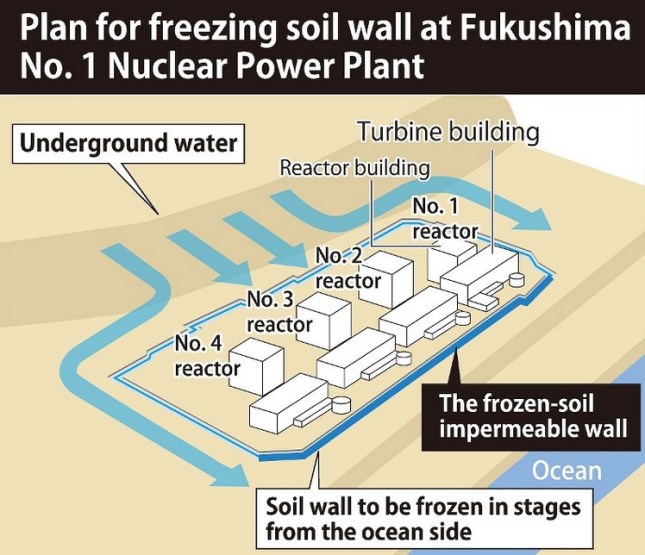
Tokyo Electric Power Company has expanded operations to create an underground ice wall at the Fukushima Daiichi nuclear plant to stop the volume of contaminated groundwater from increasing.
TEPCO on Monday began injecting a liquid refrigerant into more pipes that make up the 1,500-meter wall surrounding 4 damaged reactor buildings. The operation now covers 95 percent of the wall.
Groundwater flows into the buildings and becomes tainted with radioactive substances. Reducing its volume is a key to decommissioning the reactors.
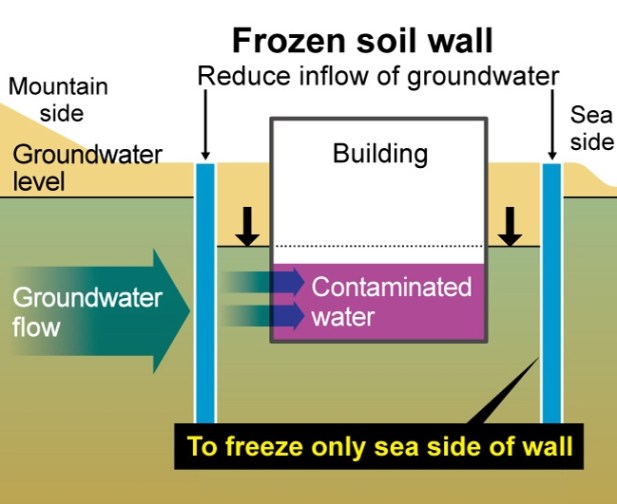
The operation started in March on the downstream side of the wall because lowering the water levels too much could cause tainted water to leak from the buildings.
Workers began freezing the upstream side after making sure there were no leaks.
The ice wall project still faces challenges. Ground temperatures have not fallen in some places, and groundwater levels outside the wall have not gone down.
Also on Monday, workers began injecting cement into the ground where temperatures have not fallen.
TEPCO examines ice wall at Fukushima Daiichi
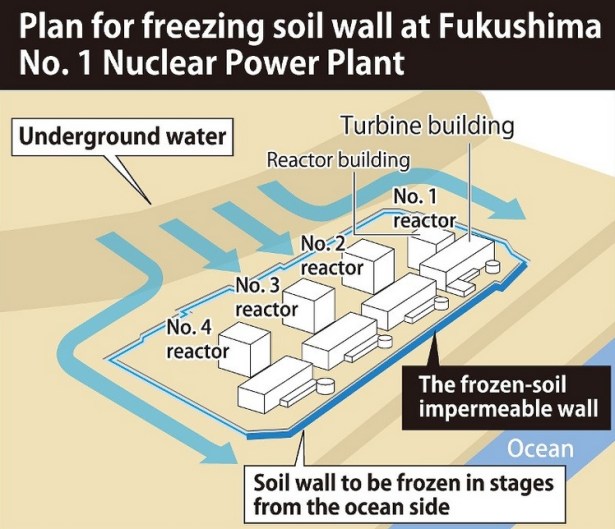
The operator of Fukushima Daiichi nuclear power plant will conduct extra work to help freeze the ground around the buildings housing the 4 crippled reactors.
Tokyo Electric Power Company discussed the idea with officials of the Nuclear Regulation Authority on Thursday.
TEPCO made the proposal after reporting some problems with a 1.5-kilometer-long frozen soil wall it has been building around the 4 reactor buildings since March.
The wall is aimed at cutting the amount of groundwater flowing into the basement of the buildings, where it becomes contaminated with radioactive substances and can flow out of the plant in the direction of the sea.
TEPCO said the amount of groundwater in some areas outside the wall near the sea has not yet fallen.
TEPCO said rainfall may be partly to blame for the problem, and added that it has seen a drop in groundwater levels elsewhere, in areas much closer to where the wall has been completed successfully. TEPCO said that, overall, the wall appears to be proving effective.
But many members of the regulatory agency said TEPCO’s argument is not convincing enough.
TEPCO admitted that underground temperatures at several locations along the wall have not yet fallen to zero, which indicates that the ground is not frozen there.
TEPCO said it will start extra work to pour cement into those locations to help seal off the wall completely.
The utility said it will be about a month before it can determine if the extra work has started producing a positive effect in reducing the amount of groundwater flowing in.
http://www3.nhk.or.jp/nhkworld/en/news/20160602_28/
In Fukushima, even robots can’t survive nuclear mayhem
The company that runs the Fukushima plant sent 5 robots to ground zero and not a single one survived. Incredibly high radiations in the block causes heat levels to rise and this melts the robots’ wiring.
A tsunami, triggered by an earthquake on March 11, 2011, initiated the Fukushima Daaiichi nuclear disaster in Japan which led to the evacuation of over 200,000 people.
Even after 5 years, there is still a tremendous amount of cleanup work left at ground zero. The Tokyo Electric Power Co. (TEPCO) which runs the plant has managed to clean up one building but is still struggling to do the same with other buildings which has burnt fuel rods. These fuel rods are nothing but chunks of radioactive waste weighing hundreds of metric tonnes.
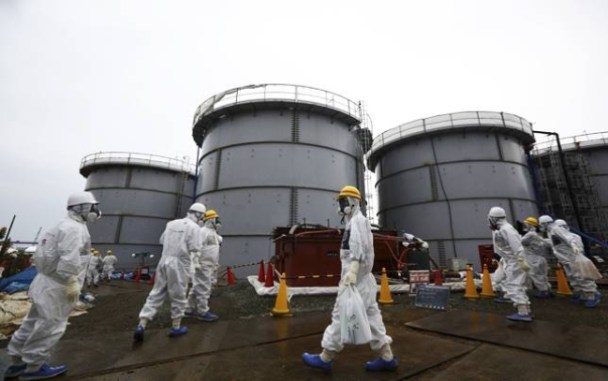
It took 2 years for TEPCO to design the robots for the job of extracting melted fuel rods and according to TEPCO’s head of decommissioning, Naohiro Masuda, the heat levels due to radiation are so extreme that it simply melts the robot’s wiring.
Japan had been trying out various methods to stop the radiations from damaging the area further. One such method was building “ice walls” to keep groundwater from reaching the reactors. A refrigerant chemical that forms an ice wall to block Fukushima’s fallout water and stop the ground water intrusion into the plant.

A million metric tonnes of irradiated water is being stored on the site and is pumped in to cool down the reactors. Disposing the radioactive water is still a challenge for TEPCO as storage tanks have already leaked some of the material into the ocean.
After TEPCO’s robots not surviving the heat levels of the radiations, it’s a place for no man or machine. Toshiba has developed new robots for picking up the fuel rods and to clean up the scene which previous robots failed to.
The entire cleanup process is expected to take around 30 to 40 years, but TEPCO is being blamed for its lukewarm response to the incident and is facing flak from the Japanese government and the people alike.
10% of TEPCO’s frozen soil wall at Fukushima site not working

The solid frozen soil wall that Tokyo Electric Power Co. is trying to create at its stricken Fukushima No. 1 nuclear power plant is falling short of expectations.
TEPCO said May 25 its attempt to freeze the soil around the crippled reactors to decrease contaminated groundwater has hit an unexpected glitch.
The utility said it has been unable to freeze the soil at about 10 percent of points it surveyed even though more than one-and-a-half months have passed since the program started.
This is due to the fact that soil temperatures have failed to drop sufficiently. In places where the temperature remains especially high, there is a possibility the soil will never freeze.
TEPCO reported the situation to the Nuclear Regulation Authority, the nation’s nuclear watchdog, saying it plans to implement additional work, such as injecting cement or other materials into the soil.
The project involved the construction of a 1,500-meter-long circular frozen soil wall around the No. 1 to No. 4 reactor buildings. The utility inserted 1,568 pipes to a depth of 30 meters and 1 meter apart. The idea was that each pipe would then freeze the soil around it once liquid of minus 30 degrees circulated inside the cylinders.
The project is aimed to stop flow of groundwater into reactor buildings, where melted nuclear fuel has accumulated in the basements, and, as a result, reduce the volume of highly contaminated water.
To date, around 34.5 billion yen ($315 million) has been spent on the project.
TEPCO started to freeze the soil in late March, with the goal of first creating an 820-meter-long portion, mainly along the side of the plant facing the sea.
According to TEPCO, the temperature of soil around pipes was lower than zero in only 88 percent of 5,800 or so sites it surveyed as of May 17. In the remaining 12 percent, temperatures were as high as 10 degrees in places.
In spots where temperatures fell short, the soil wall was riddled with holes. TEPCO plans to fill them in by injecting cement or other agents.
On the site of the plant facing a mountain, the utility has been freezing the soil in phases. Although it had planned to double the number of frozen soil sites as early as mid-May, that has not materialized.
“If the effects of the frozen soil wall fall short of what we have expected, we will hold talks with TECPO about additional steps,” said an NRA official in charge of the issue.
How Can Japan Settle The Issue Of Fukushima Daiichi Tritium? Drink It.

Water tanks crowding the Fukushima Daichi nuclear plant site
Here’s the problem in a nutshell—or rather a thimbleful—facing the Japanese government and Tokyo Electric Power Company (TEPCO), the operator of the crippled Fukushima Daiichi nuclear plant.
There are over 1,100 large steel tanks brimming with filtered water—except for a low contaminant called tritium—clogging both the plant and an expanding area outside the site.
The water is a mix of tons of groundwater flowing into the plant’s basements and tons of contaminated water that have become radiated after draining down there through the three damaged reactors the water was injected into to keep the melted uranium cores cool. This lethal liquid mix is pumped out the basements and decontaminated before it overflows and seeps into the sea; some of it is recycled back as coolant into the reactors while the rest is pumped into the storage tanks.
This process continues hour after hour, day after day, year after year: a cunningly worthy punishment of the gods for the latter-day Sisyphus, TEPCO. Consequently, every week or two a new tank-full of treated water is added to the forest of steel now covering the area like giant alien mushrooms. The total amount of stored water exceeds 800,000 cubic tons and is inexorably heading for one million tons and more without an end in site.
The cost is enormous, and picking up the tab is the Japanese taxpayer—not TEPCO, which is undergoing a ten-year reconstruction since a government bail out saved it from bankruptcy.
So the million-ton-plus dilemma for the government has boiled down to three options: keep on with the endless and expensive tank building and filling; find a way to remove the tritium from the water; or have TEPCO discharge (dump) the water into the ocean.
The latter option is by far the easiest and least expensive method, except that the water is tritiated: that is the water has become radioactive.
Without context, that’s a scary word, until you remember that sunbathing and eating bananas are pleasant radioactive pastimes. The point being that the energy tritium gives off is so low as to be unmeasurable with a dosimeter. And the particles (not rays) tritium expels can be stopped by plastic wrap—as Shunichi Tanaka, head of Japan’s Nuclear Regulatory Authority, told the press recently.
That’s a fact, but it’s not the point, say environmentalist foes of the dumping method. Ingesting tritium is a concern for health they argue. And they have experts to back up such concerns, though they are mostly theoretical. Meanwhile, there are experts on the other side of the debate pooh-poohing such worries and asking to see some solid proof to back up the theory.
Conclusion: Those supportive of nuclear power tend to minimize the health risks of tritium, while those opposing the use of nuclear power tend to exaggerate its risks.
What is not debatable is the negative psychological impact releasing the water into the sea will have on Japan’s nervous neighbors, the suffering people of the northeast, the region’s fishing industry and the Japanese electorate.
Given such concerns and uncertainties, organizations like Greenpeace urge the government to err on the side of caution. The best option, says Greenpeace, is to continue storing the water while exploring all technical options for tritium separation.
On the face of it, that seems reasonable. But then experts opposing this stance, like Lake Barrett, a nuclear industry consultant advising TEPCO, point out that while it may be possible to create a method of separating the tritium, it hasn’t been found yet, despite much effort; and it would likely cost a couple of billion dollars to develop and perfect in any case. It’s no surprise that TEPCO and the government have reached the same conclusion.
“All that money could be better spent on schools, hospitals,” Barrett told me. “And you can’t go on building tanks forever.”
Besides, he adds, “The very low levels of tritium in the stored water are not a meaningful health risk. After verification that the radioactivity levels are within conservative Japanese health risks, I would not hesitate to drink it, bathe in it, or eat fish or shellfish harvested from it.”
Now there’s an idea. If the government is to discharge the tritiated water into the ocean without turning a large portion of the electorate against it, it needs to persuade a majority of citizens that it is safe within reason to do so. This will require a number of carefully thought out steps.
The government will have to clearly explain the pros and cons of its action and the reason for its decision; it must establish a mechanism to compensate the fisherman for the shortfall they will undergo following the release; an international panel of independent, knowledgeable people, including environmentalists of the non-hysterical variety, is required to verify the tritiated water does indeed fall well below internationally accepted standards for release; and the panel members must be granted access to monitor the process at any time they wish.
Then for the coup de grâce, Prime Minister Abe, his cabinet members along with TEPCO executives should visit Fukushima Daiichi, and while standing in front of one the giant tanks each drink a glass of the tritiated water. This won’t sway everyone, of course, but it would give the government the minimum moral authority required to make such a contentious decision.
Fukushima ice wall won’t stop all radioactive groundwater from seeping out – chief architect

Chief architect Yuichi Okamura told AP that gaps in the wall and rainfall will still allow for water to creep into the facility and reach the damaged nuclear reactors, which will in turn create as much as 50 tons of contaminated water each day.
“It’s not zero,” Okamura, a general manager at Tokyo Electric Power Co. (TEPCO) said. “It’s a vicious cycle, like a cat-and-mouse game…we have come up against many unexpected problems.”
The wall, which will be 1.5km (1 mile) long, will consist of an underground pipe network stretching 30 meters (100 feet) below the surface, around the reactor and turbine buildings. The pipes are designed to transport refrigerant cooled to -30° Celsius (-22°F) to chill the nearby soil until it freezes.
The barrier is being turned on in sections for tests, and the entire freezing process will take eight months since it was first switched on in late March. The process requires an amount of electricity that would power 13,000 Japanese households.
Despite its current efforts, TEPCO – the operator of the Fukushima plant – has been fiercely criticized by those who say the groundwater issue should have been forecasted and dealt with sooner.
Shigeaki Tsunoyama, an honorary professor and former president of University of Aizu in Fukushima, said that building a concrete wall built into the hill near the plant after the disaster would have minimized the contaminated water issue.
Okamura acknowledged that the option of building a barrier at a higher elevation near the plant was considered in the days following the disaster, but defended the actions of TEPCO, stressing that the priority is on preventing contaminated water from escaping into the Pacific Ocean.
Others have criticized the US$312 million wall, which is being built by construction company Kajima Corp., as a waste of taxpayer money.
TEPCO has repeatedly faced criticism for its handling of the Fukushima crisis, which occurred after a massive earthquake and subsequent tsunami led to a meltdown of reactors at the facility in March 2011. The disaster was the worst nuclear accident to take place since Chernobyl in 1986.
The company has admitted that it did not act properly during the disaster, confessing in February that it announced the nuclear meltdowns far too late. It also stated in a 2012 report that it downplayed safety risks caused by the incident, out of fear that additional measures would lead to a shutdown of the plant and further fuel public anxiety and anti-nuclear campaigns.
Despite the ongoing problems encountered following the meltdowns, TEPCO has set 2020 as the goal for ending the plant’s water problem – an aim which critics say is far too optimistic.
However, the water problem is just part of the monumental challenges faced at the facility. Controlling and dismantling the plant is expected to take 40 years. Robots have been tasked with taking photos of the debris, as the radiation levels are too high for humans to complete the job.
https://www.rt.com/news/341231-fukushima-ice-wall-groundwater/
Dumping tritium from Fukushima into sea is best option: ministry

The industry ministry concluded that releasing diluted radioactive tritium into the sea is the most feasible option in dealing with contaminated water accumulating at the Fukushima No. 1 nuclear power plant.
The ministry’s working group said at a meeting on April 19 that separating tritium from the contaminated water is proving extremely difficult, and that four other options studied about disposal were either too time-consuming or expensive.
Releasing the water into the sea would cost 3.4 billion yen ($31 million) and take seven years and four months to complete, according to the group.
Tokyo Electric Power Co., the operator of the embattled nuclear plant, will decide on a disposal method based on the group’s findings. The utility has said it will not release treated water that still contains radioactive substances into the sea without gaining the understanding of local fishermen.
TEPCO has been struggling to ease the buildup of polluted water at the nuclear plant. Every day, tons of groundwater become contaminated with radioactive substances after entering damaged reactor buildings.
About 800,000 tons of water containing tritium are stored at the nuclear complex. This water was mostly used to cool melted nuclear fuel in the affected reactors.
TEPCO has been using a device called ALPS (advanced liquid processing system) to eliminate 62 kinds of radioactive substances, including cesium, from the water. But it cannot remove tritium.
The Ministry of Economy, Trade and Industry solicited ideas from the public on how to separate tritium from the polluted water. Six companies and one university submitted proposals.
However, experts in and out of Japan who evaluated the proposed methods concluded that none of the plans could be put into practical use in the near future.
The ministry’s working group narrowed its analysis to the five options that involved disposing of water containing tritium.
One suggestion was to inject the polluted water into deep layers of the Earth. Another proposal was to electrolyze the tritium-contaminated water and release it into the atmosphere.
The highest estimated cost in the proposals was 388.4 billion yen, with the longest period for completion reaching 13 years, according to the group’s study.
Ministry officials concluded that releasing water containing tritium into the sea after diluting it would be most reasonable in terms of both cost and time.
Japan Prepares for Release of Tritium From Fukushima Plant
Tritium may not penetrate plastic but goes everywhere H20 goes in the body. It can cross the blood brain barrier, the placental barrier, and is a known carcinogen. Just because they don’t know what to do with it doesn’t mean it’s ok to just release it. Something the nuclear industry is perfectly aware of.
Japan Prepares for Release of Tritium From Fukushima Plant
TOKYO — To dump or not to dump a little-discussed substance is the question brewing in Japan as it grapples with the aftermath of the nuclear catastrophe in Fukushima five years ago. The substance is tritium.
The radioactive material is nearly impossible to remove from the huge quantities of water used to cool melted-down reactors at the Fukushima Dai-ichi plant, which was wrecked by the massive tsunami in northeastern Japan in March 2011.
The water is still accumulating since 300 tons are needed every day to keep the reactors chilled. Some is leaking into the ocean.
Huge tanks lined up around the plant, at last count 1,000 of them, each hold hundreds of tons of water that have been cleansed of radioactive cesium and strontium but not of tritium.
Ridding water of tritium has been carried out in laboratories. But it’s an effort that would be extremely costly at the scale required for the Fukushima plant, which sits on the Pacific coast. Many scientists argue it isn’t worth it and say the risks of dumping the tritium-laced water into the sea are minimal.
Their calls to simply release the water into the Pacific Ocean are alarming many in Japan and elsewhere.
Rosa Yang, a nuclear expert at the Electric Power Research Institute, based in Palo Alto, California, who advises Japan on decommissioning reactors, believes the public angst is uncalled for. She says a Japanese government official should simply get up in public and drink water from one of the tanks to convince people it’s safe.
But the line between safe and unsafe radiation is murky, and children are more susceptible to radiation-linked illness. Tritium goes directly into soft tissues and organs of the human body, potentially increasing the risks of cancer and other sicknesses.
“Any exposure to tritium radiation could pose some health risk. This risk increases with prolonged exposure, and health risks include increased occurrence of cancer,” said Robert Daguillard, a spokesman for the U.S. Environmental Protection Agency.
The agency is trying to minimize the tritium from U.S. nuclear facilities that escapes into drinking water.
Right after the March 2011 disaster, many in Japan panicked, some even moving overseas although they lived hundreds of miles (kilometers) away from the Fukushima no-go zone. By now, concern has settled to the extent that some worry the lessons from the disaster are being forgotten.
Tritium may be the least of Japan’s worries. Much hazardous work remains to keep the plant stabilized, and new technology is needed for decommissioning the plant’s reactors and containing massive radioactive contamination.
The ranks of Japan’s anti-nuclear activists have been growing since the March 2011 accident, and many oppose releasing water with tritium into the sea. They argue that even if tritium’s radiation is weaker than strontium or cesium, it should be removed, and that good methods should be devised to do that.
Japan’s fisheries organization has repeatedly expressed concerns over the issue. News of a release of the water could devastate local fisheries just as communities in northeastern Japan struggle to recover from the 2011 disasters.
An isotope of hydrogen, or radioactive hydrogen, tritium exists in water form, and so like water can evaporate, although it is not known how much tritium escaped into the atmosphere from Fukushima as gas from explosions.
The amount of tritium in the contaminated water stored at Fukushima Dai-ichi is estimated at 3.4 peta becquerels, or 34 with a mind-boggling 14 zeros after it.
But theoretically collected in one place, it would amount to just 57 milliliters, or about the amount of liquid in a couple of espresso cups — a minuscule quantity in the overall masses of water.
To illustrate that point, Shunichi Tanaka, chairman of the Nuclear Regulation Authority, showed reporters a small bottle half-filled with blue water that was the equivalent of 57 milliliters.
Public distrust is running so high after the Fukushima accident that Tokyo Electric Power Co., or TEPCO, the utility that operates the Fukushima plant and oversees its decommissioning, has mostly kept quiet about the tritium, pending a political decision on releasing the water.
Privately, they say it will have to be released, but they can’t say that outright.
What will be released from Fukushima will be well below the global standard allowed for tritium in the water, say Tanaka and others favoring its release, which is likely to come gradually later this year, not all at once.
Proponents of releasing the tritium water argue that tritium already is in the natural environment, coming from the sun and from water containing tritium that is routinely released at nuclear plants around the world.
“Tritium is so weak in its radioactivity it won’t penetrate plastic wrapping,” said Tanaka.
1 This Month

of the week – Shut Down Drone Warfare!


Tell the Ukrainian Government to Drop Prosecution of Peace Activist Yurii Sheliazhenko

Petition to revoke the licensing of the Near Surface Nuclear Disposal Facility (NSDF) at Chalk River. https://www.ourcommons.ca/petitions/en/Petition/Details?Petition=e-7247
To see nuclear-related stories in greater depth and intensity – go to https://nuclearinformation.wordpress.com
-
Archives
- March 2026 (251)
- February 2026 (268)
- January 2026 (308)
- December 2025 (358)
- November 2025 (359)
- October 2025 (376)
- September 2025 (257)
- August 2025 (319)
- July 2025 (230)
- June 2025 (348)
- May 2025 (261)
- April 2025 (305)
-
Categories
- 1
- 1 NUCLEAR ISSUES
- business and costs
- climate change
- culture and arts
- ENERGY
- environment
- health
- history
- indigenous issues
- Legal
- marketing of nuclear
- media
- opposition to nuclear
- PERSONAL STORIES
- politics
- politics international
- Religion and ethics
- safety
- secrets,lies and civil liberties
- spinbuster
- technology
- Uranium
- wastes
- weapons and war
- Women
- 2 WORLD
- ACTION
- AFRICA
- Atrocities
- AUSTRALIA
- Christina's notes
- Christina's themes
- culture and arts
- Events
- Fuk 2022
- Fuk 2023
- Fukushima 2017
- Fukushima 2018
- fukushima 2019
- Fukushima 2020
- Fukushima 2021
- general
- global warming
- Humour (God we need it)
- Nuclear
- RARE EARTHS
- Reference
- resources – print
- Resources -audiovicual
- Weekly Newsletter
- World
- World Nuclear
- YouTube
-
RSS
Entries RSS
Comments RSS
 nuclear-news