Fukushima Food Ban in Taiwan Continued

Taiwan-Japan trade talks conclude with signing of two memorandums
Taipei, Nov. 30 (CNA) Annual trade and economic talks between Taiwan and Japan concluded in Taipei Wednesday, with the two sides signing two cooperation memorandums on product safety and language education.
Chiou I-jen (邱義仁), head of the Taiwan delegation and president of the Association of East Asian Relations (AEAR), and his Japanese counterpart, Japan Interchange Association Chairman Mitsuo Ohashi, signed the notes stipulating that the two countries will work together in the promotion of exchanges in the two areas.
Chiou and Ohashi left the venue without speaking to the press after the signing ceremony, but they agreed to be photographed.
Outside the venue, several dozen activists staged a protest against radiation-contaminated food products. The protest came after Ohashi urged Taiwan at the opening of the annual talks a day earlier to lift a ban on food products from five radiation-affected Japanese prefectures.
Asked if Japan had asked Taiwan to ease the ban during the two-day trade and economic meeting, AEAR Deputy Secretary-General Tsai Wei-kan (蔡偉淦) confirmed in a press conference held after the event that the Japanese side brought up the request, as had been expected.
However, the Taiwanese delegates expressed hope for understanding that there are still disputes over the issue, and that they would not discuss the issue during the annual talks, since it was not on the agenda, Tsai said.
Taiwan has banned imports of food products from five prefectures in Japan — Fukushima, Gunma, Chiba, Ibaraki and Tochigi — that were contaminated with radiation following the meltdown of the Fukushima Daiichi Nuclear Power Plant in March 2011, a catastrophe triggered by a massive earthquake and tsunami.
After Taiwan’s new government, inaugurated in May, revealed recently that it was considering lifting the ban on food from all of those prefectures except Fukushima, the idea has received strong opposition.
Economics Minister Lee Chih-kung (李世光) confirmed Wednesday that the controversial issue of Japanese food imports was not on the agenda of the 41st Taiwan-Japan Trade and Economic Meeting.
“It has been the Ministry of Economic Affairs’ consistent stance that no compromise can be made in the people’s welfare in the area of food safety,” Lee told the press.
He also agreed that all food regulations should meet international regulations and scientific rules.
Meanwhile, elaborating upon what was discussed during the meeting, Tsai said that Taiwan, as usual, asked Japan to co-sign an economic partnership agreement (EPA).
Such a pact is not just one that touches on simply economic problems, Tsai said, but involves political considerations.
Nevertheless, the Japanese side said its stance in establishing a comprehensive trade and investment relationship with Taiwan has not changed, he went on.
As for a request by Taiwan for Japan to open its doors to five more kinds of Taiwan-grown fruit, Tsai said the Japanese side requires more data and relevant documents.
At Wednesday’s press conference, Liu Ming-tang (劉明堂), head of the Bureau of Standards, Metrology and Inspection, said the cooperation memorandum on product safety mainly focuses on electronic and electrical products, as well as machinery.
It will help reduce safety risks, allowing consumers to enjoy a higher level of safety protection, Liu said.
On the language education memorandum, the Taiwanese delegation said that under the pact, personnel exchanges will be conducted in the hope of upgrading the quality of language and culture education on both sides.
The Taiwan-Japan trade and economic meeting has been the only official platform for Taiwanese and Japanese officials to discuss issues of mutual concern since diplomatic relations between the two countries were severed in 1972. It has been held annually since 1976.
Taiwan Continued Protest Against Food Imports from Japan
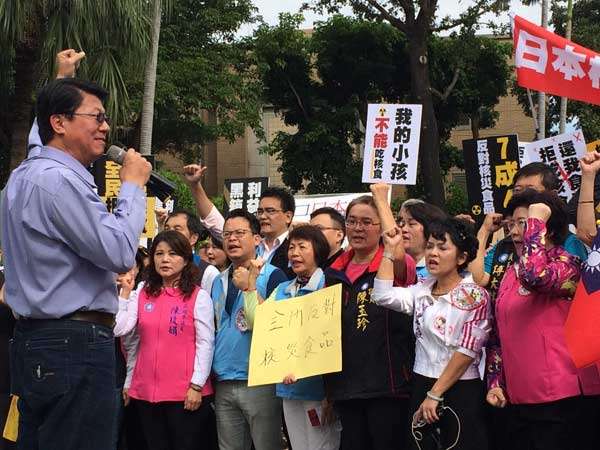
Hundreds protest Fukushima imports
TAIPEI, Taiwan — Hundreds on Thursday called for the president and premier to resign, accusing the ruling party of “selling out Taiwan” and “poisoning our children” in its push to ease a ban on food imports from Japan’s radiation-affected regions.
Protesters organized by the Kuomintang (KMT) demonstrated in front of the Executive Yuan early Thursday, as party councilors from across the country took turns addressing the crowd.
“We are humans, and humans don’t eat radiation-contaminated food,” the crowd chanted with Tainan City Councilor Hsieh Lung-chieh (謝龍介), who accused that Democratic Progressive Party (DPP) of betraying its promise to safeguard Taiwan’s food safety.
“We all remember clearly which party strongly protested against nuclear power in the past, but who’s about to feed poisonous food to our children now!” Hsieh said.
Taipei City Councilor Wang Hsin-yi (王欣儀) said the protest was not about political issues but was instead “a matter of life and death.”
Taipei City Councilor Ying Hsiao-wei (應曉薇) introduced a 3-year-old girl carried by an elderly woman, and urged the crowd to “fight the government to defend public health.”
Clash with Police
Hsieh asked police officers to “give way” to protesters so they could enter the Executive Yuan and submit their petition to the premier.
When the police stood their ground, demonstrators attempted to storm the grounds.
The clash ended after Hsu Fu (許輔), director of the Cabinet’s food safety office, stepped outside the Executive Yuan to receive the protesters’ petition and then invited KMT Legislator Alicia Wang (王育敏) and Chen Yi-ming (陳宜民) into the building for talks.
‘No contaminated food’
“No radiation-contaminated food products will be allowed into the nation,” according to a Cabinet press statement released Friday afternoon.
The Cabinet stated that it would take protesters’ concerns into account and reinstate its “four-noes policy” on Japanese food imports.
It said all products from the Fukushima Prefecture would continue to be prohibited from entering Taiwan’s borders.
Food products from Gunma, Ibaraki, Tochigi, and Chiba — four of the five prefectures affected by the 2011 Fukushima nuclear disaster — that are at high risk of absorbing radiation would also remain banned.
Those with a lower risk of radiation contamination would also stay banned if they did not have a certificate confirming state of origin and radiation levels.
Food products still banned by the U.S. and the Japanese government would also remain banned from Taiwan.
An earthquake and tsunami had triggered meltdowns of nuclear power plants in Fukushima Prefecture in 2011.
Dozens of countries worldwide imposed sanctions or tightened restrictions on food imports produced in the regions around Fukushima Prefecture.
Starting 2015, the European Union and the U.S. gradually lifted the bans as Tokyo continued to urge the move on grounds of fair international trade.
http://www.chinapost.com.tw/taiwan/national/national-news/2016/11/19/484392/Hundreds-protest.htm
Government communication on Japanese food is a failure: Luis Ko
The issue of allowing the import of food products from parts of Japan affected by the 2011 Fukushima nuclear disaster has triggered a spate of conflicts and quarrels in Taiwan. Apart from opposition parties and social groups including physicians, even Democratic Progressive Party city mayors and county magistrates have been sending out mixed signals. The uproar has even made the model student in the matter of food safety, I-Mei Foods Co. CEO Luis Ko, shake his head. On November 19, he wrote on his Facebook page that the government should plan first and move later, and not create needless public dissatisfaction and unease.
Because several countries recently gradually lifted import restrictions on products from the disaster-stricken areas, Taiwan could soon follow suit and allow the import of some products from Fukushima prefecture and from four other prefectures (Gunma, Ibaraki, Tochigi and Chiba). The government organized public hearings on the matter which were criticized as haphazard. Earlier this week, 15 county and city chiefs from ruling and opposition parties voiced their opposition and said they did not agree with the import of the food. However, after the Presidential Office and the Executive Yuan contacted the 13 DPP mayors and magistrates, they altered their stance and said they agreed with the central government, saying that what they opposed was food imported from Fukushima prefecture.
On November 19, I-Mei Foods CEO Luis Ko wrote on his Facebook page that he felt surprise and concern at the government’s current handling of its food safety policy. He wondered why the government departments and officials in charge of agricultural produce and foodstuffs were the ones to stand at the forefront of the discussions with the public, and why the officials at the Ministry of Health and Welfare and at the Food and Drug Administration, who have usually made brave statements about food safety issues, only played a “supporting role.” He said the government had failed in its internal communication and integration. “Major problems have arisen with the functioning of the government team!”
Luis Ko also says the fact that the new government has failed to successfully execute several policies over the past six months as a result of insufficient internal “communication and integration” and of being unable to “plan first and move later.” He concluded by calling on the president and the premier to bear in mind the profound hopes of the people and to show the ability to reflect.
Constant Taiwanese Opposition to Japan Contaminated Food Imports
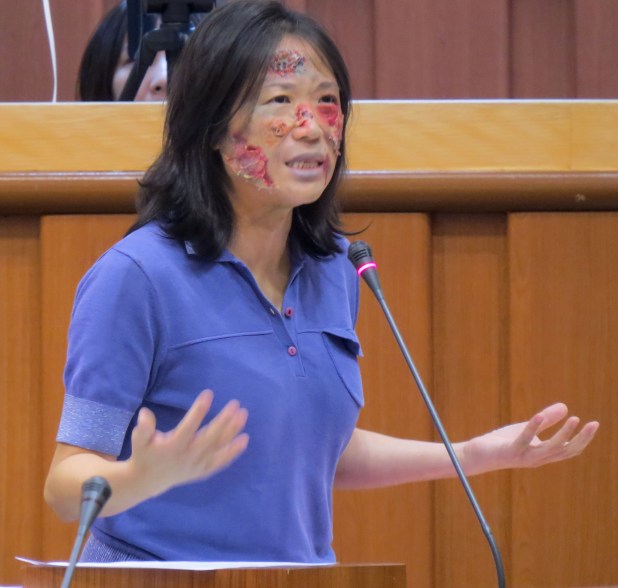
Keelung city council member Lu Mei-ling appeared with zombie makeup applied to her face
Keelung councilwoman paints face like zombie to protest ‘radioactive’ Japanese food Wearing makeup to appear like a zombie covered in radiation burns, Keelung councilwoman protests lifting of ban on imported Japanese food
At a city council budget review meeting in Keelung City on Thursday, council member Lu Mei-ling appeared with zombie makeup applied to her face to dramatize her concerns about the proposal to allow the import of food from radiation-affected areas of Japan.
Lu claimed if she ate radioactive food products for three months, her skin would start to look like the zombie makeup on her face and her bone marrow would contain large amounts of radiation, with no way to expel it from her body. She also questioned the health bureau for not having plans on educating the public about protecting themselves from this danger.
Lu said just thinking about a nuclear disaster makes her loose sleep at night, “I’m really afraid, just thinking about it makes me tremble, this isn’t serious?”
A group of 19 Keelung City Council members from across the political spectrum held a press conference at noon. Lead by Council Speaker Sung Wei-li (宋瑋莉), the councilors shouted “don’t eat or buy” and “no nukes, protect Taiwan.” Meanwhile 20 members of the council signed a joint statement asking Keelung Mayor Lin Yu-chang (林右昌) to “add a ban on the importation of foods from radiation-affected prefectures of Japan to The Keelung City Food Safety Regulations.”
Three nuclear reactors at the Fukushima Daiichi Nuclear Power Plant in March 2011 suffered meltdowns after sustaining damage from a magnitute 9.0 earthquake and flooding by a subsequent 13-to-15-meter tsunami. Four of the plant’s six reactors released radiation into the atmosphere and ocean, prompting many countries around the world, including Taiwan, to ban imports of food products from the Japanese prefectures of Fukushima, Ibaraki, Tochigi, Gunma and Chiba, for fear of radioactive contamination.
Taiwan’s government is now considering lifting the ban on food imports from four prefectures, and though Fukushima has been excluded from this list, the measure is still facing stiff opposition with protesters paralyzing 10 public hearings held by the Cabinet over the weekend on the issue.
The Cabinet is mulling a gradual lifting of the ban in two phases. The first phase would keep the ban on Fukushima, while lifting the ban on Ibaraki, Tochigi, Gunma and Chiba prefectures on the condition of batch-by-batch inspection and the exclusion of high-risk products, such as baby milk powder, drinking water, and tea products. A yet-to-be-announced second phase could take place six months later.
An analysis by Colorado State University showed that after taking 900,000 samples of food produced in Fukushima over the course of three years, found that radiation levels in the vast majority of the samples were below Japan’s limits, the strictest in the world. As for the safety seafood, a study released by the National Academy of Sciences in February 2016 said “the overall contamination risk for aquatic food items is very low” and has steadily decreased since the reactor meltdowns in 2011.
Many Japanese organizations have been pressing President Tsai Ying-wen to lift the ban on food products since she took office in May. Taiwan and China are reportedly the only countries still banning food from the five Japanese prefectures surrounding the Fukushima Dai-ichi nuclear power plant.
13 cities, counties issue statement on food imports from Japan
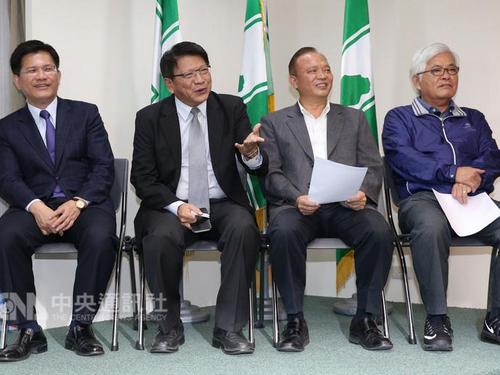
Taipei, Nov. 16 (CNA) Thirteen cities and counties governed by the ruling Democratic Progressive Party (DPP) issued a joint statement on Wednesday to clarify their position on the potential lifting of restrictions on food imports from radiation-affected areas of Japan.
The statement said that both the central government and local governments controlled by the DPP have an uncompromising commitment to safeguard the health of the general public.
The signatories to the statement called for the introduction of stricter food safety standards than those in the European Union and the United States.
On the government’s plan to allow food imports from four radiation-affected prefectures the signatories insisted on four principles.
The first is that the ban on imports of food products from Fukushima remains in place.
Second, the ban on tea, water, baby formula and aquatic products from four prefectures – Gunma, Chiba, Ibaraki and Tochigi – will not be lifted.
Third, no food products will be imported from these four prefectures without certificates of origin and radiation inspection documentation provided by the relevant authorities.
Fourth, the import ban will remain on food products not on sale in Japan and the United States.
At a regular DPP Central Standing Committee meeting later in the day, the heads of the 13 cities and counties said the position laid out in the joint statement is in line with that of the central government.
Taichung Mayor Lin Chia-lung (林佳龍) said that food safety is the responsibility of the government and any changes in import controls on food products should only be introduced after full disclosure of relevant information and communication with the public.
When asked if local government heads had been mobilized to endorse government policy, Pingtung County Magistrate Pan Meng-an (潘孟安) dismissed the suggestion, saying that local officials are more interested in the health and safety of their own citizens.
Taiwan has banned imports of food products from five prefectures in Japan that were contaminated with radiation following the meltdown of the Fukushima Daiichi Nuclear Power Plant in March 2011, which was triggered by a massive earthquake and tsunami.
Taiwan’s government is now considering lifting the ban on food imports from the five prefectures, though not Fukushima, but has encountered heavy opposition.
Since President Tsai Ing-wen (蔡英文) assumed office in May, different Japanese organizations have asked Taiwan to lift the ban on food products, according to domestic news reports.
‘Forgery’ suit filed against minister
TRUTHFUL? The Green Consumers’ Foundation claims that a Ministry of Health and Welfare report on Japanese food imports contains false and inaccurate information
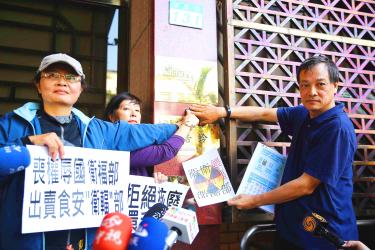
Green Consumers’ Foundation chairman Jay Fang, right, presses the doorbell of the Taipei District Prosecutors’ Office yesterday to file a lawsuit against Minister of Health and Welfare Lin Tzou-yien following the release of a ministry report on food imports from Japan.
Green Consumers’ Foundation chairman Jay Fang (方儉) yesterday filed a lawsuit against Minister of Health and Welfare Lin Tzou-yien (林奏延) at the Taipei District Prosecutors’ Office accusing the minister of “forgery,” claiming that the ministry’s Food and Drug Administration (FDA) used false data in its report on easing restrictions on Japanese food imports from the five prefectures closest to the Fukushima Dai-ichi nuclear power plant, which suffered a meltdown in March 2011.
Fang said that the government’s report provided at the weekend at public hearings on lifting the ban on imports of Japanese food items from the five prefectures contained false data that could mislead the public.
He said the report claims that “only China and Taiwan still impose a total ban on food imports from the five prefectures closest to Fukushima [Dai-ichi],” but the US FDA had issued an alert last month stating that the coast guard “may detain, without physical examination,” certain specified products from firms in 14 prefectures near Fukushima Dai-ichi.
The report also claims that “the standard [for acceptable radiation levels in food] in Taiwan is the same as other nations,” but Taiwan has looser standards than many nations, he added.
He said the government in January established 100 becquerel per kilogram (Bq/kg) as the standard radiation limit for food, but another 100Bq/kg was set as the standard radiation limit for iodine-131, meaning the total limit is 200Bq/kg.
“Is the Ministry of Health and Welfare protecting the public’s health or is it protecting radiation-contaminated food and feeding it to us?” Fan asked, urging the government to provide truthful data to the public.
In response, FDA Deputy Director Lin Ching-fu (林金富) said the ministry regrets that Fan has misread its data and that the ministry had not forged any data, adding that Fan, having filed a lawsuit, should be held to the equivalent legal liability.
FDA Division of Food Safety official Cheng Wei-chih (鄭維智) said safety standard for general food items is 100Bq/kg for “iodine-131” and 100Bq/kg for “cesium-134 and cesium-137,” and that the radioisotopes are examined separately.
http://www.taipeitimes.com/News/taiwan/archives/2016/11/15/2003659308
Taiwan protests at Public Hearings about Japanese food & Citizen Group Radiation Measuring
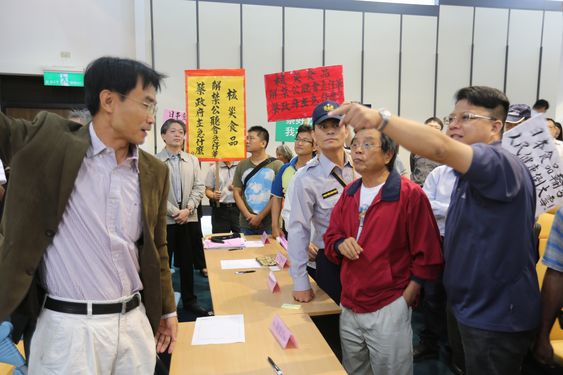
Public hearings on Japanese food in Tainan ends in rowdy protests
Taipei, Nov. 12 (CNA) A melee broke out at a public hearing in Tainan on lifting the ban on imports of currently banned Japanese food from radiation-affected prefectures when protesters clashed with government officials Saturday.
A total of 10 public hearings are scheduled from Nov. 12-14 in the northern, central, southern and eastern parts of Taiwan, as part of a government move widely seen as paving the way for its impending lifting of a five-year ban on Japanese produce from the prefectures affected by radiation following the Fukushima nuclear disaster in 2011.
The public hearing in Tainan was the first of the 10, and was presided over by Chen Chun-yen (陳俊言), head of the department of international cooperation under the Council of Agriculture. Also on hand were Chen Chi-chung (陳吉仲) , deputy director of the Council of Agriculture, and officials from the Office of Food Safety under the Executive Yuan, the Ministry of Health and Welfare and the Atomic Energy Council.
But shortly after the opening of the public hearing, Tsai Yu-hui(蔡育輝), a caucus whip of the opposition Kuomintang at the Tainan City Council, and City councilor Lu Kun-fu (盧崑福), led around two dozen protesters into the venue, demanding that the public hearing be suspended.
They lashed out at the central government for its “sneaky” way of holding the public hearing. Lu said that, as a Tainan city Councilor, he only learned about the public hearing Friday evening.
An agitated Lu later twice pushed and shoved Chen Chun-yen during the protest. Tsai and Lu presented a signature book to show that only one citizen attended the public hearing, shouting “is this the one-man public hearing?”
They questioned if this was really a public hearing with only government officials, protesters and policemen attending. The protesters also dashed to the chairman’s table and hoisting protest cards, with some smashing the papers on the chairman’s table and spilliing his cup of water, shouting angrily that “the food that even Japanese would not eat are going to be exported to Taiwan. Are (our) children worth nothing?”
A larger contingent of police force was sent in to help maintain order, and the public hearing was interrupted for nearly one hour.
When it reopened, the protesters said the procedure was a gross violation of regulations, noting that a public hearing should be announced 10 days before it is held. “This public hearing doesn’t count, as the Executive Yuan has grossly violated the law,” a protester said.
Chen Chun-yen said that the COA will review the procedural issue.
About 10 minutes before the forum ended, the chairman’s table was overturned. Chen Chun-yen then called an end to the forum after the scheduled two-hour period for the forum had expired. Both COA officials left the venue under police escort.
A similar public hearing was held in Chiayi Saturday morning in which participants said the government’s responsibility is to protect the people and ensure food safety.
They asked why the government wants to import risky food from Japan. Chen Chi-chung has said that a partial reopening of currently banned Japanese products could come next year, but would not include items from Fukushima.
In an interview with CNA on Thursday, he said Japan will still be required to produce certificates of radiation inspection and certificates of origin with each shipment, and Taiwan will also inspect imports shipment by shipment at its border.
Food imports from the Japanese prefectures of Fukushima, Ibaraki, Tochigi, Gunma and Chiba have been suspended in Taiwan since March 25, 2011 because of fears of radioactive contamination in those areas from a meltdown at the Fukushima Daiichi Nuclear Power Plant.
The nuclear disaster was triggered by a massive earthquake and tsunamis on March 11, 2011.
Since May 15, 2015, importers of Japanese food products have been required to present certificates of origin to prove that their items do not originate from any of the five prefectures.
For some imports such as tea, baby food, dairy and aquatic products, radiation inspection certificates are also required.
Various Japanese groups have reportedly asked Taiwan to lift the ban since President Tsai Ing-wen (蔡英文) assumed office in May. Her administration is keen to build stronger ties with Japan.
http://focustaiwan.tw/news/asoc/201611120005.aspx
Group to measure Japan radiation
A civic group opposed to the government’s plan to lift a ban on food and agricultural produce from five prefectures in Japan is to travel to Japan later this month to measure radiation levels.
Green Consumers’ Foundation chairman Jay Fang (方儉) said that while a government team went to Japan in August, it did not have its own radiation detection equipment.
The team relied entirely on data provided by Japan, and the report provided was very “rough,” he said.
Fang said he and three others would head to 25 locations in six prefectures — Chiba, Fukushima, Gunma, Tochigi, Ibaraki and Yamanashi — to check radiation levels in the food and the environment for themselves on Nov. 22.
Taiwan suspended food imports from the Japanese prefectures of Fukushima, Ibaraki, Tochigi, Gunma and Chiba following the 2011 Fukushima Dai-ichi nuclear power plant disaster.
The Executive Yuan on Thursday evening announced that 10 public hearings would be held nationwide from yesterday to tomorrow on the issue, amid reports that it will soon lift the ban on imported food items from the prefectures.
Fang said that he has two-and-a-half years of experience working in a laboratory and that his companions also have similar experience.
He said that they are “qualified personnel” and that their equipment meets International Atomic Energy Agency standards.
The inspections will be streamed live on his Facebook page, he said, welcoming the government to follow them online.
http://www.taipeitimes.com/News/taiwan/archives/2016/11/13/2003659171
Taiwan Minister Says Import Ban not a Bargaining Chip

Minister of Health and Welfare Lin Tzou-yien (林奏延) yesterday told lawmakers that the ministry would not risk the health of Taiwanese by lifting a ban on food imports from five Japanese prefectures near the stricken Fukushima Dai-ichi nuclear power plant.
Lin made the remarks at a meeting of the legislature’s Social Welfare and Environmental Hygiene Committee yesterday morning, which was to review the ministry’s general budget for next year.
Amid reports that Council of Agriculture Deputy Minister Chen Chi-chung (陳吉仲) last week asked the Democratic Progressive Party (DPP) caucus about the possibility of lifting the ban on agricultural products from the five prefectures — just days before the first round of the Taiwan-Japan Maritime Affairs Cooperation Dialogue Mechanism in Tokyo on Monday — Chinese Nationalist Party (KMT) Legislator Chiang Wan-an (蔣萬安) asked the minister if it was true the government planned to lift the ban as part of a trade-off.
Food and Drug Administration Director-General Chiang Yu-mei (姜郁美) said that the council report to the DPP caucus was only to explain risks and that it has implemented strict food import controls at borders to help ensure food safety.
She said all food imports from Japan not from the five prefectures — Fukushima, Ibaraki, Tochigi, Gunma and Chiba — must have a certificate of origin and a certificate proving they are free of radioactive contamination, adding that the agency would publish a products company name, if radiation readings were above legal tolerances.
“At present, we have no plans to lift the ban,” Lin said. “The ministry takes protecting the people’s health as its most important duty.”
After Chiang twice asked Lin to confirm that the government would not use lifting the ban as a negotiation tool in its talks with Japan on maritime affairs, Lin said that it would not.
http://www.taipeitimes.com/News/taiwan/archives/2016/11/03/2003658479
Increased Strontium in Sardines since Fukushima Accident?

Dogs fed sardines show high Strontium levels
by Dr. Peter Dobias, DVM
Why you might want to cut out small fish from your dog’s diet
I have had two dog patients with severely elevated levels of the element strontium. The interesting part is that these two dogs were fed a high amount of sardines and I highly suspect that strontium is coming from this source.
Strontium acts in the body the same way as calcium and deposits in bones. Sardines and other small fish are eaten whole with the bones and that is why they are more likely a source of this toxic element.
The reason why I am concerned is that the radioactive isotope strontium 90 is a toxic carcinogen and it has been released in Japan’s Fukushima disaster.
Here is an example of the results:

As a veterinarian, I source from almost three decades of experience, but still I like to see the proof. Hair testing for minerals and toxic elements has been really helpful because it is highly accurate and shows what is happening in different groups of dogs.
In the course of many years of testing, I have learned that dogs who eat fish-based foods have elevated mercury levels and sardines appear to be the cause of increased strontium. Since the Fukushima nuclear accident strontium is continuously being released into the oceans and not much is being done to inform the general public.
Sadly, I have noticed that dogs who have epilepsy have higher than average levels of strontium and mercury, which made me recommend against feeding fish and sardines to dogs, despite their nutritional benefits. Fish is not what it used to be.
http://peterdobias.com/blogs/blog/11014105-dogs-fed-sardines-show-high-strontium-levels
1 This Month

of the week – Shut Down Drone Warfare!


Tell the Ukrainian Government to Drop Prosecution of Peace Activist Yurii Sheliazhenko

Petition to revoke the licensing of the Near Surface Nuclear Disposal Facility (NSDF) at Chalk River. https://www.ourcommons.ca/petitions/en/Petition/Details?Petition=e-7247
To see nuclear-related stories in greater depth and intensity – go to https://nuclearinformation.wordpress.com
-
Archives
- March 2026 (244)
- February 2026 (268)
- January 2026 (308)
- December 2025 (358)
- November 2025 (359)
- October 2025 (376)
- September 2025 (257)
- August 2025 (319)
- July 2025 (230)
- June 2025 (348)
- May 2025 (261)
- April 2025 (305)
-
Categories
- 1
- 1 NUCLEAR ISSUES
- business and costs
- climate change
- culture and arts
- ENERGY
- environment
- health
- history
- indigenous issues
- Legal
- marketing of nuclear
- media
- opposition to nuclear
- PERSONAL STORIES
- politics
- politics international
- Religion and ethics
- safety
- secrets,lies and civil liberties
- spinbuster
- technology
- Uranium
- wastes
- weapons and war
- Women
- 2 WORLD
- ACTION
- AFRICA
- Atrocities
- AUSTRALIA
- Christina's notes
- Christina's themes
- culture and arts
- Events
- Fuk 2022
- Fuk 2023
- Fukushima 2017
- Fukushima 2018
- fukushima 2019
- Fukushima 2020
- Fukushima 2021
- general
- global warming
- Humour (God we need it)
- Nuclear
- RARE EARTHS
- Reference
- resources – print
- Resources -audiovicual
- Weekly Newsletter
- World
- World Nuclear
- YouTube
-
RSS
Entries RSS
Comments RSS
 nuclear-news