Only 6% of Fukushima Nuclear Disaster Compensation Paid by TEPCO

The operator of the crippled nuclear complex in Fukushima Prefecture has only paid 6 percent of the compensation sought by municipalities in connection with the 2011 nuclear crisis, according to a recent prefectural tally.
The delay in payments to the 12 municipalities, designated by the government as evacuation zones, highlights the continuing challenge to their reconstruction efforts six years after the nuclear disaster, triggered by the massive earthquake and tsunami in northeastern Japan on March 11, 2011.
The tally found that Tokyo Electric Power Company Holdings Inc. had by the end of 2016 paid around 2.6 billion yen ($22.5 million) of the 43.3 billion yen demanded by the 12 local governments.
TEPCO Employee Has Overwork Depression, Seeks Compensation

TEPCO employee says he has depression due to overwork, seeks compensation
A 35-year-old employee handling compensation claims relating to the Fukushima nuclear disaster for Tokyo Electric Power Co. (TEPCO) has filed an application with the Tokyo Central Labor Standards Inspection Office seeking workers’ compensation for depression.
Tadafumi Ichii filed the application on Oct. 31, arguing that he started suffering from depression as a result of being forced to work long hours illegally. According to his application and other information, in September 2011 — six months after the outbreak of the nuclear crisis — Ichii transferred to a division tasked with handling complaints from businesses that were not satisfied with the amounts of compensation they were offered for declining sales. In February 2013, he took over the role of giving advice to about 450 TEPCO employees on whether or not to pay damages.
The man clocked 89 hours overtime in March 2013, but he stated, “My overtime working hours, if combined with unpaid overtime and take-home work, stood at 169 hours (in March).” On the morning of June 20, 2013, he could not get out of bed, and failed to show up for work that day. He then transferred to TEPCO’s branch office in Tachikawa, western Tokyo, on July 1, 2013. He frequently started being absent from the office or leaving early, suffering symptoms such as vomiting in the office’s toilet. He was diagnosed on Sept. 3, 2013, as having tendency toward depression and he took a leave of absence from the following day. He was officially diagnosed with depression in April 2014.
The man received a notice from TEPCO in October this year stating that he would be dismissed on Nov. 5 when his recuperation period was due to expire. TEPCO demanded that Ichii submit documents including a doctor’s medical certificate, if he intended to return to work. Ichii says he still suffers symptoms such as insomnia. His doctor, therefore, has judged that he requires further medical treatment, he says.
“I worked hard until I was worn out,” Ichii said at a news conference.
An official with the public relations department at Tokyo Electric Power Company Holdings Inc. commented, “We understand that the labor standards inspection office concerned decides on individual claims for workers’ compensation. We decline to answer questions regarding individual cases.”
According to TEPCO, work to pay compensation to local residents whose livelihoods were lost and companies whose sales dropped due to the nuclear accident started in April 2011 and is ongoing.
As of Oct. 28, there were about 2,691,000 applications and about 6.479 trillion yen had been paid for a total of about 2,515,000 applications that TEPCO had finished screening.
http://mainichi.jp/english/articles/20161101/p2a/00m/0na/017000c
TEPCO worker seeks compensation over Fukushima job
A 35-year-old employee of Tokyo Electric Power Company is seeking insurance benefits, arguing that he developed depression due his work dealing with the aftermath of the Fukushima nuclear accident.
Tadafumi Ichii spoke to reporters on Monday after filing the request for workers’ accident compensation with labor authorities.
Ichii said that, in September of 2011, he was tasked with paying redress to businesses affected by the accident at the Fukushima Daiichi nuclear power plant six months earlier.
He said he was in charge of up to 180 companies and put in nearly 170 hours of overtime a month. He added that he was caught between his bosses and his clients, and mentally driven to the edge.
The utility reportedly plans to dismiss him when his sick leave ends in early November.
Ichii said he sacrificed his health to do the job and that he cannot accept the way his employers are treating him.
Tokyo Electric Power Company said in a statement that the utility will deal with the matter sincerely when it is contacted by labor authorities.
Public Cost of Fukushima Cleanup Tops $628 Billion and Is Expected to Climb
Meanwhile, problems still persist at the nuclear plant, most notably with the ‘highly contaminated’ water being stored in tanks at the site

That includes costs for radioactive decontamination and compensation payments, the Japan Times reported.
The public cost of cleaning up the 2011 Fukushima Daiichi nuclear plant disaster topped ¥4.2 trillion (roughly $628 billion) as of March, and is expected to keep climbing, the Japan Times reported on Sunday.
That includes costs for radioactive decontamination and compensation payments. Tokyo Electric Power Company (TEPCO) will sell off its shares to eventually pay back the cost of decontamination and waste disposal, but the Environment Ministry expects that the overall price of those activities could exceed what TEPCO would get for its shares.
Meanwhile, the taxpayer burden is expected to increase and TEPCO is asking for additional help from the government.
The Times reports:
The government estimates the proceeds from TEPCO share sale at ¥2.5 trillion, but to generate the estimated gain, the TEPCO stock price needs to trade at around ¥1,050, up sharply from current market levels of some ¥360.
In addition, the Environment Ministry expects that the cumulative total of decontamination and related costs could surpass the estimated share proceeds by the March 2017 end of the current fiscal year.
[….] TEPCO and six other power utilities charged their customers at least ¥327 billion in electricity rate hikes after Japan’s worst-ever nuclear accident. Moreover, consumers paid ¥219.3 billion or more for TEPCO, chiefly to finance the maintenance of equipment to clean up radioactive water at the plant and the operation of call centers to deal with inquiries about compensation payments.
Moreover, as Deutsche Welle noted on Monday, problems still persist at the nuclear plant, most notably with the “highly contaminated” water being stored in tanks at the site.
“There are numerous problems that are all interconnected, but one of the biggest that we are facing at the moment is the highly contaminated water that is being stored in huge steel tanks at the site,” Aileen Mioko-Smith, an anti-nuclear activist with the group Green Action Japan, told DW. “They are running out of space at the site to put these tanks, the water that is being generated on a daily basis means they have to keep constructing more, and the ones that are not welded have a history of leaking.”
“The situation with contaminated water at the site is a ticking time bomb and they don’t seem to know what they can do—other than to construct more tanks,” she said.
Fukushima disaster sheds light on lack of preparedness for compensation
The crisis at the tsunami-hit Fukushima No. 1 Nuclear Power Plant has shed light on a lack of preparedness on the part of the government and utilities to pay massive amounts of compensation for a nuclear accident, which has placed a burden on the public.
At a panel of experts at the Japan Atomic Energy Commission (AEC), there have been calls since this past January for reviewing the current system under which nuclear plant operators are responsible for paying compensation for accidents without limits and setting an upper limit on damages.
“The number of nuclear power plant operators could decrease as long as they are required to bear risks exceeding their limits,” one member said.
“It’s important for operators to bear responsibility for such accidents on condition that they could have predicted such disasters,” another stated.
These problems emerged because operators cannot ascertain risks involving the operation of atomic power stations unless they can estimate the amount of compensation for accidents.
However, others in the panel argued that operators would cut back on their investment in safety measures unless they are to bear unlimited responsibility. As such, the overall direction of debate on the issue has not been set.
Under the current nuclear plant accident compensation system, atomic power station operators bear unlimited responsibility for compensation for accidents except in cases of massive natural disasters. However, there is no clear definition of “massive natural disasters,” and the national government is only required to extend the necessary assistance for efforts to deal with such accidents.
Following the outbreak of the Fukushima nuclear disaster, the national government placed Tokyo Electric Power Co. (TEPCO), the operator of the stricken plant, effectively under state control by providing the firm with an infusion of 1 trillion yen in public funds.
The government then created a system under which it loans necessary money for compensation payments to TEPCO via the Nuclear Damage Compensation and Decommissioning Facilitation Corp. (NDF) without interest. Thus the situation in which TEPCO would go under and become unable to pay compensation to victims of the nuclear crisis has been avoided.
When it placed TEPCO under de-facto state control, the central government explained that the operator of the plant would shoulder the responsibility in principle. However, the reality is different from the government explanation.
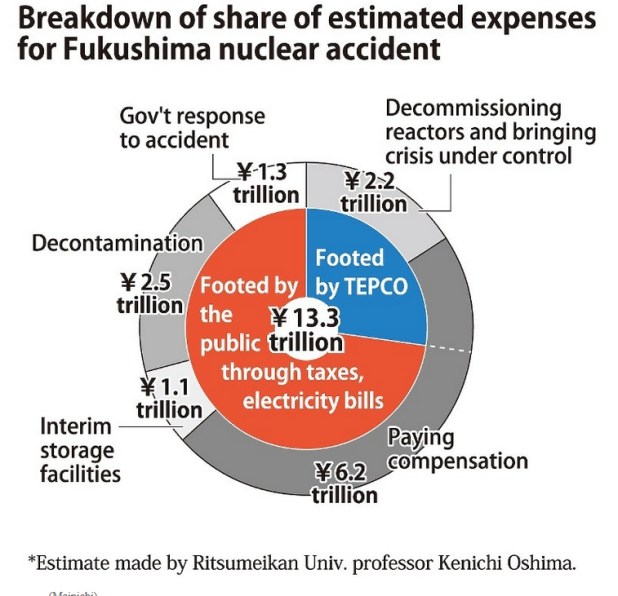
Kenichi Oshima, professor at Ritsumeikan University, estimates the total cost of dealing with the nuclear crisis at 13.3 trillion yen. The estimated cost includes 6.2 trillion yen to pay compensation, 2.5 trillion to decontaminate areas tainted by radioactive substances, 2.2 trillion yen to decommission reactors and bring the disaster under control, and 1.1 trillion yen to build interim storage facilities for waste contaminated with radioactive materials.
Of the total amount, TEPCO is likely to pay just over 3 trillion yen on its own, including part of the cost for bringing the crisis under control and paying compensation.
Most of the money needed to pay compensation will be secured from “general contributions” that operators of nuclear plants extend to the NDF. Much of the contributions are passed onto electricity bills consumers pay to utilities. Taxpayers’ money will be spent on the construction of interim storage facilities. Decontamination costs, which the government temporarily foots, will be covered with proceeds from the sales of shares the government holds in TEPCO to lessen the burden on the utility.
“The public is required to effectively shoulder over 70 percent of the costs. The public is being required to pay the costs in a way that lacks transparency,” Oshima said.
If the response to the accident progresses to a certain extent and TEPCO has rehabilitated itself, the government can recover the money it invested in the utility and prevent any increase in the burden on the public. However, this is no easy task.
A high-ranking official of TEPCO’s Kawasaki Thermal Power Plant says it has been successful in streamlining its regular checkup on its generators, shortening the checkup period, increasing the ratio of operation of the latest and most efficient generators and raising the profits by up to hundreds of millions of yen a day.
Learning how to rationalize operations from a worker who had previously worked for Toyota Motor Corp., the plant monitored plant workers’ moves by seconds to reduce time wasting.
“We succeeded in reducing the checkup period, which used to be 80 days in the pre-quake period, to 60 days,” the official said.
However, the increase in profits is attributable mainly to a sharp decline in oil prices. TEPCO posted a pretax profit of 436.2 billion yen in the April-December 2015 period on a consolidated basis. This is largely because fuel costs decreased by about 730 billion yen from the corresponding period of the previous year. If crude oil prices increase, it will offset reductions in expenses.
If the idled Kashiwazaki-Kariwa Nuclear Power Plant in Niigata Prefecture is to be reactivated, it will increase TEPCO’s monthly profits by 8 to 13 billion yen per reactor. However, there are no prospects that the plant can be reactivated in the foreseeable future.
If the government is to use the proceeds from its sales of TEPCO shares to fully cover decontamination expenses, the value of one share must exceed 1,000 yen. However, the current price is about the half that amount.
The government and electric power companies had promoted the use of atomic power by emphasizing that its costs are low. However, they failed to include risks of accidents and safety measures in power generation costs, and where the responsibility for nuclear accidents lies has remained unclear. As a result, members of the public are being forced to foot the costs and TEPCO is allowed to survive.
A system under which the government and private sector share the burden of nuclear accidents in an appropriate manner has not yet been established.
http://mainichi.jp/english/articles/20160311/p2a/00m/0na/019000c
1 This Month

of the week – Shut Down Drone Warfare!


Tell the Ukrainian Government to Drop Prosecution of Peace Activist Yurii Sheliazhenko

Petition to revoke the licensing of the Near Surface Nuclear Disposal Facility (NSDF) at Chalk River. https://www.ourcommons.ca/petitions/en/Petition/Details?Petition=e-7247
To see nuclear-related stories in greater depth and intensity – go to https://nuclearinformation.wordpress.com
-
Archives
- April 2026 (19)
- March 2026 (251)
- February 2026 (268)
- January 2026 (308)
- December 2025 (358)
- November 2025 (359)
- October 2025 (376)
- September 2025 (257)
- August 2025 (319)
- July 2025 (230)
- June 2025 (348)
- May 2025 (261)
-
Categories
- 1
- 1 NUCLEAR ISSUES
- business and costs
- climate change
- culture and arts
- ENERGY
- environment
- health
- history
- indigenous issues
- Legal
- marketing of nuclear
- media
- opposition to nuclear
- PERSONAL STORIES
- politics
- politics international
- Religion and ethics
- safety
- secrets,lies and civil liberties
- spinbuster
- technology
- Uranium
- wastes
- weapons and war
- Women
- 2 WORLD
- ACTION
- AFRICA
- Atrocities
- AUSTRALIA
- Christina's notes
- Christina's themes
- culture and arts
- Events
- Fuk 2022
- Fuk 2023
- Fukushima 2017
- Fukushima 2018
- fukushima 2019
- Fukushima 2020
- Fukushima 2021
- general
- global warming
- Humour (God we need it)
- Nuclear
- RARE EARTHS
- Reference
- resources – print
- Resources -audiovicual
- Weekly Newsletter
- World
- World Nuclear
- YouTube
-
RSS
Entries RSS
Comments RSS
 nuclear-news