Carcinogens found at Montana nuclear missile sites as reports of hundreds of cancers surface

The Air Force has detected unsafe levels of a likely carcinogen in samples taken at a Montana missile base where a striking number of men and women have reported cancer diagnoses
By TARA COPP Associated Press, August 8, 2023 https://abcnews.go.com/US/wireStory/carcinogens-found-nuclear-missile-sites-reports-hundreds-cancers-102087696
WASHINGTON — The Air Force has detected unsafe levels of a likely carcinogen at underground launch control centers at a Montana nuclear missile base where a striking number of men and women have reported cancer diagnoses.
A new cleanup effort has been ordered.
The discovery “is the first from an extensive sampling of active U.S. intercontinental ballistic missile bases to address specific cancer concerns raised by missile community members,” Air Force Global Strike Command said in a release Monday. In those samples, two launch facilities at Malmstrom Air Force Base in Montana showed PCB levels higher than the thresholds recommended by the Environmental Protection Agency.
PCBs are oily or waxy substances that have been identified as a likely carcinogen by the EPA. Non-Hodgkin lymphoma is a blood cancer that uses the body’s infection-fighting lymph system to spread.
In response, Gen. Thomas Bussiere, commander of Air Force Global Strike Command, has directed “immediate measures to begin the cleanup process for the affected facilities and mitigate exposure by our airmen and Guardians to potentially hazardous conditions.”
After a military briefing was obtained by The Associated Press in January showing that at least nine current or former missileers at Malmstrom were diagnosed with non-Hodgkin lymphoma, a rare blood cancer, the Air Force School of Aerospace Medicine launched a study to look at cancers among the entire missile community checking for the possibility of clusters of the disease.
And there could be hundreds more cancers of all types, based on new data from a grassroots group of former missile launch officers and their surviving family members.
According to the Torchlight Initiative, at least 268 troops who served at nuclear missile sites, or their surviving family members, have self-reported being diagnosed with cancer, blood diseases or other illnesses over the past several decades.
At least 217 of those reported cases are cancers, at least 33 of them non-Hodgkin lymphoma.
What’s notable about those reported numbers is that the missileer community is very small. Only a few hundred airmen serve as missileers at each of the country’s three silo-launched Minuteman III intercontinental ballistic missile bases any given year. There have been only about 21,000 missileers in total since the Minuteman operations began in the early 1960s, according to the Torchlight Initiative.
For some context, in the U.S. general population there are about 403 new cancer cases reported per 100,000 people each year, according to the Centers for Disease Control and Prevention, and non-Hodgkin lymphoma affects an estimated 19 of every 100,000 people annually, according to the American Cancer Society.
Minutemen III silo fields are based at Malmstrom, F.E. Warren Air Force Base in Wyoming and Minot Air Force Base in North Dakota.
Missileers are male and female military officers who serve in underground launch control centers where they are responsible for monitoring, and if needed, launching fields of silo-based nuclear weapons. Two missileers spend sometimes days at a time on watch in underground bunkers, ready to turn the key and fire Minuteman III intercontinental ballistic missiles if ordered to do so by the president.
The Minuteman III silos and underground control centers were built more than 60 years ago. Much of the electronics and infrastructure is decades old. Missileers have raised health concerns multiple times over the years about ventilation, water quality and potential toxins they cannot avoid as they spend 24 to 48 hours on duty underground.
The Air Force discovery of PCBs occurred as part of site visits by its bioenvironmental team from June 22 to June 29 in the Air Force’s ongoing larger investigation into the number of cancers reported among the missile community. During the site visits a health assessment team collected water, soil, air and surface samples from each of the missile launch facilities.
At Malmstrom, of the 300 surface swipe samples, 21 detected PCBs. Of those, 19 were below levels set by the EPA requiring mitigation and two were above. No PCBs were detected in any of the 30 air samples. The Air Force is still waiting for test results from F.E. Warren and Minot for surface and air samples, and for all bases for the water and soil samples.
Democracy Needs Healthy Debates About War And Peace
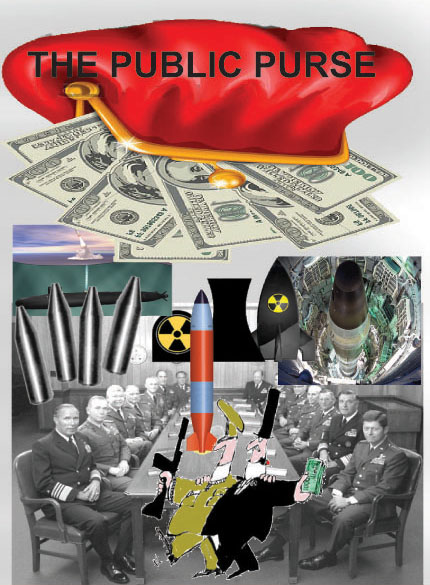
To top it all, the Pentagon has never passed a financial audit! It’s the only major federal agency that hasn’t passed an audit, despite getting more discretionary dollars than any other. That means that we don’t know where our tax money is going.
Who benefits from this lack of transparency? Exactly who you’d think — contractors who profit off war. Around half of the military budget goes to for-profit contractors who make excessive profits at the expense of taxpayers and peace.
by EDITOR, August 7, 2023 https://scheerpost.com/2023/08/07/democracy-needs-healthy-debates-about-war-and-peace/
Congress spent the last “military spending” debate rehashing the culture wars — not the nearly $1 trillion Pentagon budget itself.
By Jyotsna Naidu / OtherWords
If there’s one thing that should be subject to rigorous debate and the will of the people, it’s decisions about war and peace. Unfortunately, that’s not what we got with the huge military policy bill recently passed by the House and Senate.
Somehow, the annual National Defense Authorization Act, or NDAA — which can bring war or peace, and which now costs nearly $1 trillion — never sees much serious debate in Congress about those issues.
Before this year, the NDAA passed easily for 61 years straight. The process is intentionally rushed. Hundreds of amendments are filed and voted at once, leaving little room for serious discourse.
This year was a partial exception. Lawmakers did debate the bill, which passed the House only narrowly. But they debated all the wrong things.
Representatives provoked hate with countless culture war amendments. Ignoring issues of war and peace, far-right members of Congress debated cutting funding for service members’ abortions and diversity programs on military bases.
Here’s what they should have discussed.
In 2021, the Congressional Budget Office published a report detailing three ways to cut military spending by $1 trillion over 10 years without compromising national security. Instead, Congress has given the military even more money each year.
This year, Representatives Barbara Lee (D-CA) and Mark Pocan (D-WI) called to shift $100 billion of the defense budget toward urgent domestic needs. Senator Bernie Sanders (I-VT) introduced a similar amendment in the Senate, which would have cut the Pentagon budget by 10 percent.
An American Friends Service Committee poll released earlier this year showed 56 percent of Americans would support cutting military spending to reinvest in those funds in public programs.
And amendments efforts would have exempted troops’ pay and benefits from any cuts, targeting the bloated military contractorsinstead.
In the House, the amendment was never allowed for debate — and never got a vote. In the Senate, the Sanders amendment got just 11 votes.
To top it all, the Pentagon has never passed a financial audit! It’s the only major federal agency that hasn’t passed an audit, despite getting more discretionary dollars than any other. That means that we don’t know where our tax money is going.
Who benefits from this lack of transparency? Exactly who you’d think — contractors who profit off war. Around half of the military budget goes to for-profit contractors who make excessive profits at the expense of taxpayers and peace.
With these robber baron-like profits, contractors have funded think tanks to produce favorable research and “expert” mediacommentary supporting higher military budgets — while lobbying politicians to keep spending on contractors.
In the House, this year’s NDAA lost its usual broad bipartisan support because of Democrats’ opposition to its far-right culture war amendments, not because there was suddenly political will to address war spending. The Senate simply passed the NDAA without the controversial amendments.
Culture wars aside, we can’t let lawmakers go back to idly voting for pro-war and pro-contractor interests.
I do have hope. People are already winning when they fight. In 2016, for example, activists successfully pressured the Massachusetts company Textron to stop producing cluster munitions, which disproportionately hurt civilians.
And as the congressional opposition to those nasty amendments showed more recently, lawmakers can still respond to public pressure. The onus is now on us to demand our lawmakers have a real democratic debate on war, peace, and the military budget.
Democracy is at stake.
As Japan set to dump nuclear-contaminated wastewater in late August, Japanese nuclear expert vows to ‘fight it to the end’
Global Times, By Xu Keyue, Aug 07, 2023
As mainstream Japanese media revealed that Tokyo could start to dump the nuclear-contaminated wastewater as early as the end this month after the trilateral US-Japan-South Korea summit, observers and the wider public in China, Japan and South Korea reiterated their opposition to the irresponsible move with a Japanese nuclear expert stating that they would continue to protest against the plan.
“We plan to fight it to the end. We are planning to hold a big gathering in front of the prime minister’s office on August 18 and we plan to make a petition and submit signatures,” Hideyuki Ban, a Japanese nuclear expert and co-director of the Citizens’ Nuclear Information Center (CNIC), told the Global Times on Monday.
According to Japanese media outlet Asahi Shimbun, the Japanese government has entered into coordination to determine the wastewater release timing after the summit with the US and South Korea scheduled for August 18. After Prime Minister Fumio Kishida returns from the US, he will hold a ministerial meeting and make a decision over the dumping of contaminated wastewater.
Asahi cited several officials as saying that the dumping is estimated to begin as early as the end of August. The report claimed that Kishida is expected to explain “the safety of the treated water, its scientific basis, and measures to be taken after the release” to the two leaders of the US and South Korea to gain their understanding.
But Ban believes if the contaminated wastewater is dumped in late August, it is the Japanese government that would force the plan without caring for the concerns and opposition from fisheries and the relevant personnel………………………………….
As many parties in Japan and other countries including China oppose the wastewater dumping plan, the Japanese government must be thinking that it will at least get the consent of Seoul and Washington and if the three reach a consensus over the issue during the summit, it is expected to help Tokyo press ahead with its arbitrary plan, Ban pointed out.
Anonymous Japanese officials in the prime minister’s office were quoted by Asahi as saying that they believe since some offshore trawling will commence off the coast of Fukushima Prefecture in September, the government hopes to avoid starting the release after the fishing season has begun. For this reason, it is assumed that the dumping will start around the end of August, Asahi reported. https://www.globaltimes.cn/page/202308/1295820.shtml
Reducing the risks of nuclear war — the role of health professionals
By – Kamran Abbasi, Parveen Ali, Virginia Barbour, Kirsten Bibbins‐Domingo, Marcel GM Olde Rikkert, Andy Haines, Ira Helfand, Richard C Horton, Bob Mash, Arun Mitra, Carlos A Monteiro, Elena N Naumova, Eric J Rubin, Tilman A Ruff, Peush Sahni, James Tumwine, Paul Yonga and Chris Zielinski
Med J Aust || doi: 10.5694/mja2.52054, 7 August 2023
In January 2023, the Science and Security Board of the Bulletin of the Atomic Scientists moved the hands of the Doomsday Clock forward to 90 s before midnight, reflecting the growing risk of nuclear war.1 In August 2022, the UN Secretary‐General António Guterres warned that the world is now in “a time of nuclear danger not seen since the height of the Cold War”.2 The danger has been underlined by growing tensions between many nuclear armed states.1,3 As editors of health and medical journals worldwide, we call on health professionals to alert the public and our leaders to this major danger to public health and the essential life support systems of the planet — and urge action to prevent it.
Current nuclear arms control and non‐proliferation efforts are inadequate to protect the world’s population against the threat of nuclear war by design, error, or miscalculation. The Treaty on the Non‐Proliferation of Nuclear Weapons (NPT) commits each of the 190 participating nations “to pursue negotiations in good faith on effective measures relating to cessation of the nuclear arms race at an early date and to nuclear disarmament, and on a treaty on general and complete disarmament under strict and effective international control”.4 …………………………………………
Any use of nuclear weapons would be catastrophic for humanity. Even a “limited” nuclear war involving only 250 of the 13 000 nuclear weapons in the world could kill 120 million people outright and cause global climate disruption leading to a nuclear famine, putting 2 billion people at risk.7,8 A large‐scale nuclear war between the USA and Russia could kill 200 million people or more in the near term, and potentially cause a global “nuclear winter” that could kill 5–6 billion people, threatening the survival of humanity.7,8. Once a nuclear weapon is detonated, escalation to all‐out nuclear war could occur rapidly. The prevention of any use of nuclear weapons is therefore an urgent public health priority and fundamental steps must also be taken to address the root cause of the problem — by abolishing nuclear weapons.
The health community has had a crucial role in efforts to reduce the risk of nuclear war and must continue to do so in the future.9 In the 1980s the efforts of health professionals, led by the International Physicians for the Prevention of Nuclear War (IPPNW), helped to end the Cold War arms race by educating policy makers and the public on both sides of the Iron Curtain about the medical consequences of nuclear war. This was recognised when the 1985 Nobel Peace Prize was awarded to the IPPNW (http://www.ippnw.org).10
In 2007, the IPPNW launched the International Campaign to Abolish Nuclear Weapons, which grew into a global civil society campaign with hundreds of partner organisations. A pathway to nuclear abolition was created with the adoption of the Treaty on the Prohibition of Nuclear Weapons in 2017, for which the International Campaign to Abolish Nuclear Weapons was awarded the 2017 Nobel Peace Prize……………………………………………………………..
We now call on health professional associations to inform their members worldwide about the threat to human survival and to join with the IPPNW to support efforts to reduce the near‐term risks of nuclear war, including three immediate steps on the part of nuclear‐armed states and their allies: first, adopt a no first use policy;12 second, take their nuclear weapons off hair‐trigger alert; and, third, urge all states involved in current conflicts to pledge publicly and unequivocally that they will not use nuclear weapons in these conflicts. We further ask them to work for a definitive end to the nuclear threat by supporting the urgent commencement of negotiations among the nuclear‐armed states for a verifiable, timebound agreement to eliminate their nuclear weapons in accordance with commitments in the NPT, opening the way for all nations to join the Treaty on the Prohibition of Nuclear Weapons…………….. more https://www.mja.com.au/journal/2023/219/5/reducing-risks-nuclear-war-role-health-professionals
As Threat Remerges, Global Community Must Speak as One, Commit to Nuclear-Free World, Secretary-General Says on Anniversary of Hiroshima Bombing

7 Aug 23 https://press.un.org/en/2023/sgsm21898.doc.htm
Following is UN Secretary-General António Guterres’ message, delivered by Under-Secretary-General and High Representative for Disarmament Affairs Izumi Nakamitsu, at the seventy-eighth anniversary of the atomic bombing of Hiroshima, in Hiroshima, Japan, today:
Nearly eight decades ago, a nuclear weapon incinerated Hiroshima. Yet as anyone who has visited knows, the memories never fade. The A-Bomb Dome, the Cenotaph and the dauntless hibakusha are constant reminders of the catastrophic consequences of nuclear weapons.
For 78 years, the city of Hiroshima and the hibakusha have worked tirelessly to ensure that nuclear weapons are never used again. During my visits to Hiroshima, my meetings with the brave hibakusha — the human face of nuclear cataclysm — have never failed to move and inspire me. They are a potent symbol of forgiveness, hope and resilience. They have transcended tragedy.
I pledge to support them as they continue sharing their accounts — the terror, the pain, the incalculable loss, and above all, the lesson of what happened here on 6 August 1945. World leaders have visited this city, seen its monuments, spoken with its brave survivors and emerged emboldened to take up the cause of nuclear disarmament.
More should do so, because the drums of nuclear war are beating once again. Mistrust and division are on the rise. The nuclear shadow that loomed over the cold war has re-emerged. And some countries are recklessly rattling the nuclear sabre once again, threatening to use these tools of annihilation.
In the face of these threats, the global community must speak as one. Any use of nuclear weapons is unacceptable. We will not sit idly by as nuclear-armed States race to create even more dangerous weapons. That’s why disarmament is at the heart of the recently launched policy brief on a New Agenda for Peace.
The Agenda calls on Member States to urgently recommit to pursuing a world free of nuclear weapons and to reinforce the global norms against their use and proliferation. Pending their total elimination, States possessing nuclear weapons must commit to never use them. The only way to eliminate the nuclear risk is to eliminate nuclear weapons.
The United Nations will continue working with global leaders to strengthen the global disarmament and non-proliferation regime, including through the Treaty on Non-Proliferation of Nuclear Weapons and the Treaty on the Prohibition of Nuclear Weapons.
Eliminating nuclear weapons remains the United Nations highest disarmament priority. We will not rest until the nuclear shadow has been lifted once and for all. No more Hiroshimas. No more Nagasakis.
Disarmament is not some utopian dream. Disarmament is the only pathway to a safer and more secure world for all. The United Nations is proud to stand with the people of Hiroshima and the hibakusha to keep alive the memory of what happened here and the lessons humanity must learn if we are to secure a more peaceful tomorrow. We look forward to working with the people of Japan in this essential effort.
Dounreay inspectors raise further red flag about sodium storage

John O’Groat Journal, By Iain Grant, 5 Aug 23
The Office for Nuclear Regulation (ONR) has issued an enforcement letter to Magnox Ltd after recording a breach of its nuclear site licence.
Sodium was used to cool the prototype fast reactor (PFR) whose closure in 1994 sounded the death knell for the experimental power plant.
Since its removal from the redundant plant, some of the highly volatile liquid metal has been stored in drums.
ONR’s latest concern follows an inspection at the end of April.
The agency has concluded that the storage arrangements do not comply with good practice. Its latest report states: “The dutyholder has failed to safely protect the drums against degradation via air and moisture ingress; large stocks of the inventory are not available for inspection due to the way in which it has been stored; and a number of the storage vessels of the material are not identified on the site maintenance system.
ONR found that Magnox – a wholly owned subsidiary of the Nuclear Decommissioning Authority – had breached the Control of Substances Hazardous to Health Regulations 2002 and its nuclear site licence.
It followed up its enforcement letter with a ‘holding-to-account’ meeting on site in June with Magnox directors.
According to ONS, this was arranged to ‘further secure a commitment to return to compliance.”
In June, the Scottish Environment Protection Agency (Sepa) had fired off a warning letter about a minute leak of radioactive tritium from a sodium drum stored at the PFR in November last year…………………………………………….. https://www.johnogroat-journal.co.uk/news/dounreay-inspectors-raise-further-red-flag-about-sodium-stor-322156/
Ukraine attacks Donetsk with cluster munitions – local authorities
5 Aug 23, https://www.rt.com/russia/580884-donetsk-cluster-shelling/
Civilian targets were affected by Saturday night’s shelling, local officials have said
Ukrainian forces have reportedly fired cluster munitions into Donetsk city, striking a private residence, a university and other civilian targets.
Four rounds of 155mm cluster bombs were fired into the center of the city on Saturday night, triggering fires in three districts, the Joint Center of Control and Coordination (JCCC) for the Donetsk People’s Republic (DPR) said. The cluster munitions reportedly exploded in the air.
The Donetsk University of Economics and Trade was on fire after the shelling, the Mayor of Donetsk Aleksey Kulemzin said in a Telegram post. Fires also were reported in apartment buildings.
The shelling comes after at least three people were killed and ten injured by a Ukrainian bombardment on Monday. The shelling killed another civilian in a nearby town, the JCCC said.
Cluster munitions have been banned by more than 100 countries because of their devastating effects on civilians. Cluster shells are typically designed to open up in midair and release tens or even hundreds of submunitions that can saturate a large area with explosives. They tend to have a high failure rate, creating risks to civilians from unexploded munitions for potentially decades after a conflict ends.
Donetsk and other Donbass cities have been under constant Ukrainian attacks which have claimed numerous civilian lives since 2014, when the region broke away from Kiev after a Western-backed coup in the Ukrainian capital. Over the years, Ukraine’s military established heavily fortified positions around the cit. The attacks intensified after the launch of Moscow’s military operation against Kiev in February 2022, leaving scores of civilians killed and delivering major damage to infrastructure.
The Donetsk People’s Republic became part of Russia last October together with the People’s Republic of Lugansk and Zaporozhye and Kherson Regions, following referendums in which the local populations voted overwhelmingly in favor of the move.
Zelensky fears peace pressure from West – NYT
6 Aug 23 https://www.rt.com/news/580879-zelensky-fears-western-pressure-for-peace-talks/—
The Ukrainian president has reportedly told his diplomats that benefactors may push for a negotiated truce with Russia
Ukrainian President Vladimir Zelensky is reportedly worried that Western nations may ramp up pressure to negotiate a peace agreement with Russia, ending a bloody conflict that has killed tens of thousands of Kiev’s troops in just the past two months.
“As furious battles raged across the front lines of Europe’s bloodiest war in decades, Mr. Zelensky told his ambassadors on Wednesday that things would grow even more difficult as pressure was likely to build in the coming months to find a negotiated path to peace,” the New York Times reported on Saturday.
The Ukrainian president described Wednesday’s gathering in Kiev with diplomats as an “emergency strategy session” heading into this weekend’s Ukraine peace summit in Saudi Arabia, the newspaper said. “The meeting is the starting point of what is expected to be a major Ukrainian diplomatic push in the coming months to try to undercut Russia.”
Zelensky told his ambassadors that they must use every available tool – “official and unofficial, institutional and media, cultural diplomacy and the power of ordinary human sincerity” – to convince both allies and neutral nations that “the only road to a lasting peace is complete Russian defeat,” according to the report.
However, many of the nations attending the summit in Saudi Arabia have resisted US pressure to take sides in the crisis, seeing the conflict as a “contest between superpowers” in which they want no part. “This is not only a conflict between Russia and Ukraine,” said Celso Amorim, an adviser to Brazilian President Luiz Inacio Lula da Silva. Speaking remotely on Saturday at the Saudi-hosted summit, he added: “This is also a chapter in the longstanding rivalry between Russia and the West.”
Russian officials have argued that Kiev’s Western backers are only prolonging the bloodshed in Ukraine by continuing to send billions of dollars’ worth of weapons to the former Soviet republic. More than 43,000 Ukrainian troops have been killed since Kiev began a counteroffensive in the Donbass region in early June, the Russian Defense Ministry said on Friday.
Russian and Ukrainian negotiators were reportedly near a peace deal at talks hosted by Türkiyein March 2022, a little more than a month after the conflict began. “After we pulled troops back from Kiev, as we promised,” Ukrainian leaders “threw it all away, into the garbage dump of history,” Russian President Vladimir Putin said at a meeting with African leaders in July.
Rapid Dragon: the US military game-changer that could affect conventional and nuclear strategy and arms control negotiations
Bulletin, By George M. Moore | August 4, 2023
The United States Air Force recently announced the successful test of its Rapid Dragon system in a major Pacific exercise.[1] This followed an earlier successful test during an exercise in Norway in late 2022.[2]
………………..In standard English, Rapid Dragon converts cargo aircraft into weapons carriers that can deploy cruise missiles (and potentially other standoff or self-defense weapons) by releasing them on pallets via the planes’ rear cargo ramps. Such a system makes a cargo aircraft into the equivalent of a bomber. Potentially the cargo aircrafts’ weapons load is limited only by how many pallets will fit in the cargo bay.
………………………………………………………The potential to develop Rapid Dragon so it can deliver nuclear weapons does not seem to have received any attention. The AGM-86 Air Launched Cruise Missile (ALCM) is nuclear capable and currently deliverable by the B-52. It appears that nothing would prevent the Rapid Dragon deployment of the ALCM, turning any cargo aircraft capable of using Rapid Dragon into a nuclear delivery aircraft.
The potential to use Rapid Dragon for nuclear weapons delivery (and eventually this will occur) will create new issues when serious nuclear weapons limitation resume.
……………………………………..The potential for nuclear launch from cargo aircraft creates new tactical problems that could affect survivability and deterrence concepts. ……………………………………………………………………………………………………
TODAY For the survival of the human species, we need Women In Decision-Making – at the very least with equal representation.

“If there is one takeaway from Christopher Nolan’s recent film “Oppenheimer,” it is that the nuclear field has been male-dominated from the very start,”
That’s just one reflection from InDepth’s excellent article on the need for gender parity in nuclear disarmament talks.
But really, if you look at the history of just about anything, but especially war, you find that the decision-makers are pretty much exclusively male.
Without going into the complex reasons for this, it is now obvious that, if we want to survive, we are going to need a different style of decision-making.
When even peace talks are dominated by men – we’re in trouble.
In the 21st Century we are at an extraordinary stage. Women are no longer just the objects for male activities (if they ever really were) – not just sexual objects, baby-making machines, scivvies for all the dirty and boring work .. and so on. They now have, (though not all of them,) control over their own sexuality, education, and unlimited potential. Sacre bleu- they’re playing football!
It’s definitely time for women, and humanist values, to take control. Now, before it’s too late!
The digital data industry is an energy and water guzzling climate disaster.

Energy-hungry AI could pose a challenge for data centre ESG
The Age By Tim Biggs, August 5, 2023
Sustainability experts have warned of a crunch ahead for the booming data centre industry, as increasing energy usage amid demand for new artificial intelligence-powered technologies crosses paths with a hotter, drier climate.
Data centres are becoming an asset-class part of infrastructure, as AI powers a boom in growth and demand for data while investment managers and superannuation funds increase their stakes. Late last year, US asset manager DigitalBridge and Melbourne-based IFM investors acquired data centre leader Switch for $US11 billion ($16.83 billion).
Meanwhile the International Energy Agency estimates that software-related activities currently account for about 5 per cent of global greenhouse gas emissions, which may rise to 14 per cent by 2040. Data centres and transmission networks specifically account for around 1 per cent, but some estimates predict that to rise rapidly to more than 3 per cent in a matter of years.
……….. a recent report from the University of Technology Sydney’s Institute for Sustainable Futures suggested the data centre industry was “exposed to significant ESG (environmental, social, and corporate governance) risks that have largely escaped our collective attention”, including the increasing need for cooling combined with huge demands for data.
“This all comes at the same time as we’re seeing a shift in our weather patterns. We’re heading for days of peak heat events,” said researcher Gordon Noble, who led the UTS study.
“So the challenge is, we have 45-degree days in the western suburbs of Sydney and Melbourne, where data centres will need to increase the demand for energy to ensure that they’re delivering their services. At a time when households will also be wanting to make sure that they’ve got cool homes.”
The study, which was commissioned by data centre technology provider Pure Storage, also surveyed experts in charge of sustainability at their organisations, of whom only five per cent said they were getting detailed sustainability information from their data centre provider.
As record heat waves affect parts of Europe, recent figures have shown data centres in Ireland consume 18 per cent of the country’s electricity, around the same as homes. Ireland is the European home of several tech giants, but some of the nation’s politicians have said the power-hungry data centres put pressure on the national grid, increase electricity prices for everyone and will make it impossible to hit emissions targets.
“From an Australian perspective, data centres need to be on the sustainability agenda,” Noble said.
“It’s probably fair to say other issues have been in the limelight. But we’ve got increasing demand for data, which is only going to exacerbate because of the investments that we’re seeing in new technology like AI. We need to understand where we’re located, particularly in the context of El Nino.”
RMIT University school of computing dean Professor Karin Verspoor said AI – like blockchain technology and cryptocurrency mining before it – was getting a lot of attention from developers and investors, but there was not enough discussion of the exponentially increasing amounts of energy it used.
Some researchers have calculated that training a single medium-sized generative AI model could consume electricity and energy equivalent to 626,000 tons of CO2 emissions, around what five American cars would use throughout their lifetimes, including manufacturing.
“These are huge models, and they’re only getting bigger, and there’s more of them. Massive quantities of data are involved in training,” Verspoor said, adding this was on top of the ongoing energy costs once users are hitting data centres constantly to use the generative AI product.
“And it’s not just energy actually, it’s also water because water is used often to cool the data centres. So, there are these sorts of secondary climate impacts.”
While Verspoor agreed data centre providers could help mitigate the impacts with more energy-efficient technologies and offsets, she said the developers and consumers of AI products also had to take some responsibility…………………………………….
AI company Hugging Face has run experiments in low-power AI development using nuclear energy, but still found its development of a large language model produced around 50 metric tons of carbon dioxide emissions, or the equivalent of an individual taking 60 flights between London and New York. It estimated that OpenAI, when developing its last-generation ChatGPT model, may have produced 500 metric tonnes…………………….. more https://www.theage.com.au/technology/energy-hungry-ai-could-pose-a-challenge-for-data-centre-esg-20230802-p5dtad.html
Oppenheimer and the threat of nuclear destruction.
: “As the video illustrates, it doesn’t matter much who starts the war: when one side launches nuclear missiles, the other side detects them and fires back before impact.
“…Each impact creates a fireball about as hot as the core of the sun, followed by a radioactive mushroom cloud. These intense explosions vaporise people nearby and cause fires and blindness further away. The fireball expansion then causes a blast wave that damages buildings, crushing nearby ones.”
War never solves anything, not for long anyway. The Hiroshima and Nagasaki bombings did not end all wars as some had hoped.
A. Kathirasen – 07 Aug 2023,
Upon returning home, I searched the web to see the comments of those Japanese who had watched the movie. There was none. Simply because the movie has yet to be screened there.
I learnt that neither the makers of the movie nor those who bring in films into Japan have announced a release date for the film on the Manhattan Project and its head Robert J Oppenheimer.
I learnt too that the Japanese hardly ever ban any movie and are used to films about the Second World War, including those depicting American gung-ho. Also, I learnt, some movies are screened weeks after their release in the US……………………………………..
I cannot imagine how the surviving victims of the tragedy will feel, especially because the film shows the creation of the atomic bomb being celebrated. It also leaves out the Japanese perspective.
How would Taiji Manda, for instance, feel? In 2014, Taiji, then 77, told the Asahi Shimbun newspaper that he had lost his parents, a sister and two brothers in the Hiroshima bombing.
That fateful day, the nine-year-old and two younger brothers and a sister were out in the street when a sudden powerful blast of hot air blew them away. Taiji suffered some burns to his head but his brothers were badly injured and his sister was “groaning with the skin on her back peeled and hanging down”. She died the following day and his two brothers a few days later.
The report said Taiji needed to take 23 different medications for the eight diseases he had, including cancer.
Although Oppenheimer was – and comes out in the movie – as a rather conflicted and complex personality, he was still celebrated in the US, at least until the vilification he endured in the 1950s for speaking out against the arms race. He has since been vindicated.
He remains, however, the man who effectively managed a group of scientists and technologists and kept the military happy as they produced the atomic bomb. He remains the “father of the atomic bomb”.
I hope Oppenheimer the movie and the anniversary of the dropping of the first atomic bomb yesterday will make everyone pause and ponder on the nature of such destructive weapons. I hope political leaders and military strategists will be goaded into eliminating the possibility of a nuclear nightmare…………………………………
the warheads on just one US nuclear-armed submarine have seven times the destructive power of all the bombs dropped during World War II, including the two atomic bombs dropped on Japan. And the United States usually has ten of those submarines at sea.”……………………………………………………..
War never solves anything, not for long anyway. The Hiroshima and Nagasaki bombings did not end all wars as some had hoped.
If you want to have an idea of the possible impact of a nuclear conflict between Russia and the US, check out the video [above] of a scientifically realistic simulation produced by Max Tegmark, a professor at the Massachusetts Institute of Technology.
Tegmark says: “As the video illustrates, it doesn’t matter much who starts the war: when one side launches nuclear missiles, the other side detects them and fires back before impact.
“…Each impact creates a fireball about as hot as the core of the sun, followed by a radioactive mushroom cloud. These intense explosions vaporise people nearby and cause fires and blindness further away. The fireball expansion then causes a blast wave that damages buildings, crushing nearby ones.”
He says as the UK and France have nuclear capabilities and are obliged by NATO’s Article 5 to defend the US, Russia will strike them too.
“The Hiroshima atomic bomb caused such a firestorm, but today’s hydrogen bombs are much more powerful. …This black smoke gets heated by sunlight, lofting it like a hot air balloon for up to a decade. High-altitude jet streams are so fast that it takes only a few days for the smoke to spread across much of the northern hemisphere.
“This makes Earth freezing cold even during the summer, ………………………………………………………………….
I pray leaders of nations with nuclear capability won’t send the world spiralling into mass death and destruction. We don’t need another Hiroshima or Nagasaki. And we certainly don’t need anything worse than that.
I hope too that scientists involved in the making of weapons of mass destruction have a severe attack of conscience and reconsider the ethics of what they are doing.
They should not, like Oppenheimer, produce a destructive weapon and then, after its use, try to make amends by pushing against an arms race. https://www.freemalaysiatoday.com/category/opinion/2023/08/07/oppenheimer-and-the-threat-of-nuclear-destruction/
Niger’s 20 million tonnes of radioactive waste
Uranium tailings in Niger are blowing in the wind and poisoning the water
By Linda Pentz Gunter
Note: In late July, a military coup ousted Niger’s president, Mohamed Bazoum. Since then, those who have declared themselves in charge have announced a halt to uranium exports to France. France relies on Niger for around 17% of the uranium that fuels its troubled commercial reactor fleet (with Kazakhstan and Uzbekistan the main suppliers). Since Russia’s invasion of Ukraine, European countries have been wrestling with their uncomfortable dependence on Russian-sourced uranium supplies. The Russian mercenary group, Wagner, already has a strong presence in Africa, and one that is now growing.
The grey mountain looms, mirage-like, on the horizon of the uranium mining town of Arlit in Niger. (Picture below is of Kyrgyzstan’s mountain of uranium tailings, not Niger’s – but the same type)

This lethal legacy has been confirmed by the independent French radiological research laboratory — Commission de Recherche et d’Information Indépendantes sur la Radioactivité — known in international circles simply as CRIIRAD. The lab, and its director, Bruno Chareyron, have been studying the situation around uranium mines in Niger for years. In 2009 his lab measured the radioactive levels of the wastes at 450,000 Becquerels per kilogram.
In a recent video, CRIIRAD describes the waste pile— mostly radioactive sludges — as “a sword of Damocles hanging over the drinking water supply for more than 100,000 people.” (You can watch the video below, in French with English subtitles. If you understand French, you can also listen to the CRIIRAD podcast episodes on this topic on Spotify.)
Under its subsidiary, Cominak, Orano exploited mines near Arlit for 40 years. Much of the uranium extracted was used as fuel for reactors in France and other countries in the European Union.
As part of the extraction process, radon gas was released into the air along with fine radioactive dusts, inhaled by the uranium mine workers and local residents. Radioactively contaminated materials ended up in workers’ homes, used to fashion furniture and utensils and even as construction materials for the homes themselves. And yet, no effort was made by Orano to contain this waste. Instead, as the Radio France International report says, “it was simply dumped on the ground.”
Some workers who were treated in the local Areva-run hospital were told their illnesses had nothing whatever to do with the uranium mines.
Diners along the Seine, sitting under their Parisian fairy lights, rarely if ever thought about the workers in Arlit who helped turn those lights on, and who suffered all the negative health consequences while enjoying none of the financial gain. Niger remains one of the world’s poorest countries.
Niger is yet another example of colonialism, its people burdened effectively with a radioactive smallpox blanket. It’s a story and a pattern that repeats itself across the world where people of color toil in uranium mines or other foreign-imposed government or corporate methods of exploitation, working to benefit white western customers thousands of miles away.
And it’s an exploitation that could now be prolonged at Orano’s only remaining uranium mine in Niger — Somair. Earlier this year, Orano and the then Niger government signed an agreement to extend operations at Somair until 2040, 11 years longer than its originally projected closure date. That agreement may now be in doubt under the current political uncertainty brought about by the July coup.
Imouraren in northern Niger, with potentially 200,000 tonnes of uranium deposits, is still also potentially within Orano’s sights, although what would become the world’s biggest uranium mine has been on hold for some time, even before the current coup.
Meanwhile, in Arlit, many live without electricity at all. Or even running water. That water, according to Chareyron, has already been contaminated by the 40 years of waste discharges from the mines —chemicals and heavy metals along with radioactive uranium and its daughter products such as radium and polonium— which have migrated into groundwater. Absent other alternatives, local populations are obligated to keep drinking it.
According to the Radio France International report, “Orano’s Niger subsidiary, Cominak, said that it will cover the radioactive mud with a two-metre layer of clay and rocks to contain the radiation.” But, even though it is a necessary first step to prevent further dispersal into the air, the measure will scarcely be an enduring barrier, given the wastes will be dangerous to human health for hundreds of thousands of years.
But while it is dangerous for Arlit locals to wash their hands in their radioactively contaminated water supply, has Cominak washed its hands of them? In the two years since the mines closed, nothing has happened to safeguard the waste piles.
Almoustapha Alhacen, a former mine worker who heads the local NGO, Aghir’n Man and collaborates with CRIIRAD, told Chareyron that the reason given for inaction is lack of financing.
In reality, the problem is an even bigger one than miserly corporate inaction. Worldwide, points out Chareyron, authorities have yet to figure out how to confine lethal radioactive waste safely over the longterm. The simple answer is that, when it comes to radioactive waste, no one really knows what to do.
A reader vents anger about America’s “terminal liberalism” – and much of this rings true

| Honestly, America is such an awful place. Just an awful, awful country. Not only is it the evil empire of today’s world, the ideology of America and Americans, is corrosive to the human spirit. Community and society don’t really exist in America because, America is basically terminal neoliberalism. Everyone is a rugged individual so, everything that happens to you is your fault. Even if it happened, due to the conditions created by the 2008 Financial Crash |
THERE is the near total defunding of mental health services. 100 million people in so much medical debt they are barely housed. 95,000 a year die from lack of affordable health care. You are judged for life as a loser, even if The economic circumstances you were born into were not your fault.
.Even judged in this crummy racist shithole, based on the color of your skin.
The idea of competing for jobs is insane, it’s directly equivalent to slaves or serfs trying to compete, for which master or lord they serve. It’s a vicious competition. Workers stab each other-in-the-back. They climb over the pile of corpses, lie, throw fellow workers, under the bus. All this , for some employer, that sees them as a tool and nothing else.
People all hate themselves, for failing in a rigged game, where they have to destroy each other to survive, or get ahead.
American society can go to hell. It’s already tearing apart . Children are slaughtering their classmates. Mass homelessness. Police state. Fascism. Nobody cares. Do you know what it takes, for a child to actually buy a gun and show up to school, with the intention, of killing everyone there? Not that much. Not only is it horrific, not only are other children dying, but when you think about it, the shooter is throwing their life away. Shooter kills, because they’ll live in prison until they die or they intend to shoot themselves, afterwards. Children know they have nothing to live for. Americans truly don’t care.
This culture is evil, Americans don’t give a darn about each other, remotely, not even a little, the only time they pretend to care, is when they try, justifying bombing other countries or, caging refugees. That is because, that is what Americans are, Cowardly, sadistic nucleoape killers
The life expectancy of Americans is falling every year, in large part due to opioid abuse, worst health care in the world, cancer from all the radioactive shit, Infant and mother mortality at its highest level ever! The usa has the highest level of Infant and mother in the world, for in a supposed developed country.
ther in the world, for in a supposed developed country. The wealthy in the usa have more money than ever before. The life expectancy of every citizen is falling. Nowhere else has this phenomenon occurred.
Even the Russians, didn’t see a spike in opioid deaths, until after the USSR had collapsed.
American society is disintegrating, it is a cancer. The chaos is just here.
Do right by the whales
Beyond Nuclear International 6 Aug 23
No environmental study has ever been conducted of the impact of the North Atlantic right whales’ protected birthing waters being occupied by the massive Kings Bay naval station
Nuclear sub base expansion ignores precious species; missiles could destroy us all
Background: The U.S. Navy has released a Draft Environmental Assessment for the homeporting of the Columbia Class submarines at Naval Submarine Base (NSB) Kings Bay.
The Navy proposes to establish facilities and functions at NSB Kings Bay to support the homeporting of Columbia Class submarines as replacements for the retiring Ohio Class submarines currently homeported at NSB Kings Bay. Under the Proposed Action, the Navy would construct eight facilities, modify five facilities, and demolish three facilities across three locations on NSB Kings Bay.
Facility changes and development activities would be phased over a period of five years and completed coincident to the first Columbia Class submarines in 2028.
Nuclear Watch South has prepared comments opposing this development. The following article is drawn from their statement and comments recently submitted to the U.S. Navy.
Georgia’s 100 miles of Atlantic Ocean coastline is a globally unique, fertile, and fragile marshland environment of barrier islands, freshwater tidal forests, maritime forests, and endangered longleaf pine forest. Georgia’s vast salt marshes support a staggering diversity of plant and animal life nurturing the eggs and hatchlings of countless sea creatures and providing significant nesting and migration habitat for 200 bird species.
Kings Bay, near the Georgia-Florida state line, is home base for six Trident submarines and deploys 25% of the U.S. nuclear arsenal. A Trident submarine is the most expensive and deadly nuclear weapons system on Earth. The only other nation to possess a similarly powerful system is the United Kingdom, a longtime United States ally. The Trident has been controversial since its inception as it upsets the so-called MAD (Mutually Assured Destruction) power balance, fueling a dangerous and costly international arms race.
The Navy conducted an Environmental Impact Statement (EIS) in 1977 when Kings Bay Naval Submarine Base was first proposed. The EIS was performed to fulfill environmental and public accountability requirements of the newly instituted National Environmental Protection Act (NEPA) of 1969.
In 1979, construction began on Kings Bay. In 1984, it was first discovered that the base had unwittingly intruded upon the (previously unknown and apparently only) birthing waters for the critically endangered North Atlantic right whales in the Cumberland Sound.
Kings Bay base began operations in 1989. The Soviet Union dissolved in 1991. At the same time, the U.S. nuclear weapons manufacturing complex, occupying vast reservations in more than a dozen states from Washington to South Carolina, was shuttering its reactors and facilities amidst revelations of widespread nuclear contamination and vast inventories of poorly managed radioactive wastes.
The nuclear weapons complex suddenly and belatedly became subject to environmental law and NEPA has since proved to be a difficult filter through which to permit new nuclear weapons manufacture.
For example, the U.S. Department of Energy and National Nuclear Security Agency have failed in five attempts over the past 30 years to establish a plutonium pit production facility at the Savannah River Site (SRS) on the South Carolina/Georgia state line.
Nuclear weapons manufacturing has languished since 1990 in all nuclear-armed nations and limited nuclear treaties have greatly reduced nuclear stockpiles. All nuclear testing ceased in 1992. Trident submarines now carry fewer nuclear weapons, but each Trident submarine currently can deploy the explosive power of 1,825 Hiroshimas.
In 2021, the UN Treaty on the Prohibition of Nuclear Weapons entered into force, presently counting 68 nations as parties. The treaty begins by expressing the parties’ concern for “the catastrophic humanitarian consequences that would result from any use of nuclear weapons, and recognizing the consequent need to completely eliminate such weapons, which remains the only way to guarantee that nuclear weapons are never used again under any circumstances.”
This landmark, game-changing treaty sets forth as international law that it is illegal to “develop, test, produce, manufacture, otherwise acquire, possess or stockpile nuclear weapons or other nuclear explosive devices.”
The North Atlantic right whale population rebounded from near extinction when hunting the whales was outlawed in 1935. The whales encountered new hazards, however, with the industrialization of shipping and fishing. Ship strikes and entanglement in fishing gear are held responsible for mortality events which are now decimating the whale population.
The current population of the critically endangered North Atlantic right whale has crashed to fewer than 350 animals. The National Oceanic and Atmospheric Administration (NOAA) estimates 50 births per year are required to avoid extinction of these ancient, magnificent marine mammals. In 2022, only 15 North Atlantic right whales were born.
No environmental study has ever been conducted of the impact of the North Atlantic right whales’ protected birthing waters being occupied by the massive Kings Bay naval station.
Despite the moribund state of nuclear weapons manufacture, in 2022, the U.S. spent $83,000 per minute on nuclear weapons. This budget includes items such as the redundant Columbia class submarine, which this environmental study narrowly contemplates.
Earth’s inhabitants now face extreme dislocation from climate change in addition to living under the Damocles sword of nuclear annihilation for the previous three generations. Clearly, resources now squandered on nuclear weapons can be converted to the task of making the lifestyle changes required to retain our planet’s life-supporting atmosphere.
It is the pleasure and duty of the public to participate in important decisions as framed and codified by the National Environmental Policy Act of 1969. Nuclear Watch South lists here the pertinent portions of the Act upon which these comments rely.
Comments
An Environmental Assessment is inadequate. An Environmental Impact Statement should be performed…………………………………………………………………………….
Before 1984, it was unknown where the critically endangered North Atlantic right whales gave birth to their calves. Nuclear Watch South believes that the construction activities of the naval base forced the whales into open waters during a most vulnerable part of their life cycle, which led to the death of the baby calf discovered in 1982 and puts ongoing pressure upon the dwindling population of this critically endangered, protected species. Kings Bay’s presence must be counted among the human-created hazards driving the North Atlantic right whale to extinction.
The reasonably foreseeable impact of nuclear weapons is wholesale environmental destruction
NEPA requires analysis of all foreseeable impacts from the proposed activity. The environmental impact from use of the nuclear weapons and nuclear weapons system housed at Kings Bay must be contemplated in an EIS. It is the nature of the SSBN (Sub-Surface Ballistic Nuclear) program that it is capable of destroying the whole Earth. The whole Earth is stakeholder…………………………………………………
Kings Bay impacts on unique Georgia coastal environment are absent from EA and must be considered in an EIS
Kings Bay is a complex and unique site with environmental impacts from 30 years of Kings Bay operation in the sensitive Georgia coastal eco-system. Kings Bay’s previous environmental impacts, some of which are highlighted below, must be included in an EIS……………………………………………………………….
The sound where whales have given birth for previous millennia is regularly dredged to accommodate the five-story Trident submarines. In addition, U.S. Navy sonar testing has been shown to harm sea turtles and marine life, including the large marine mammals, whales, and dolphins. The impacts of Kings Bay on the dwindling North Atlantic right whale population’s southern range must be considered in addition to its impacts on other sea-life……………………………………………………………..
We are at a cultural crossroads that requires contemplation of whether to continue planet-killing nuclear arms roulette or to denuclearize and end the Atomic Age to avert annihilation. The NEPA process provides for a public and transparent exploration of the “big picture” with respect to large projects. Indeed, NEPA was borne out of the previously unforeseen environmental misadventures of the military industrial complex and instituted as a method to avert disaster with experience and deep foresight.
An alternative to continued “business as usual” at Kings Bay would be to remove the submarine killing machines and nuclear weapons from this sensitive, fragile, and vital eco-system and instead maintain a presence of national defense in the coastal marsh with a Coast Guard base and marine wildlife sanctuary.
This serves as a more benign project for our national defense that will also defend our wildlife and restore a healthy atmosphere to our planet.
Nuclear Watch South is a grassroots, statewide direct action environmental organization founded in 1977. Nuclear Watch South’s three-fold mission is 1) phase out nuclear power and promote conservation and sustainable energy sources such as wind and solar, 2) halt the proliferation of nuclear materials and abolish the global threat of nuclear weapons, and 3) promote the formation of ethical environmental policies for nuclear waste handling and containment. https://beyondnuclearinternational.org/2023/08/06/do-right-by-the-whales/
-
Archives
- October 2026 (120)
- September 2026 (339)
- August 2026 (330)
- July 2026 (355)
- June 2026 (287)
- May 2026 (306)
- April 2026 (356)
- March 2026 (251)
- February 2026 (267)
- January 2026 (308)
- December 2025 (358)
- November 2025 (359)
-
Categories
- 1
- 1 NUCLEAR ISSUES
- business and costs
- climate change
- culture and arts
- ENERGY
- environment
- health
- history
- indigenous issues
- Legal
- marketing of nuclear
- media
- opposition to nuclear
- PERSONAL STORIES
- politics
- politics international
- Religion and ethics
- safety
- secrets,lies and civil liberties
- spinbuster
- technology
- Uranium
- wastes
- weapons and war
- Women
- 2 WORLD
- ACTION
- AFRICA
- Atrocities
- AUSTRALIA
- Christina's notes
- Christina's themes
- culture and arts
- Events
- Fuk 2022
- Fuk 2023
- Fukushima 2017
- Fukushima 2018
- fukushima 2019
- Fukushima 2020
- Fukushima 2021
- general
- global warming
- Humour (God we need it)
- Nuclear
- RARE EARTHS
- Reference
- resources – print
- Resources -audiovicual
- Weekly Newsletter
- World
- World Nuclear
- YouTube
-
RSS
Entries RSS
Comments RSS

