‘Oppenheimer’ the movie versus our nuclear reality
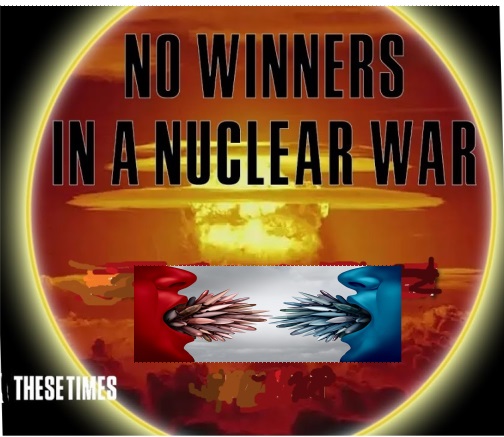
In a thermonuclear war, assuming the combatants maintained a so-called “second strike” capability to retaliate fully if hit first, there would be no winners — only losers.
BY HARLAN ULLMAN, OPINION CONTRIBUTOR – 08/07/23 https://thehill.com/opinion/national-security/4140178-oppenheimer-the-movie-versus-our-nuclear-reality/
Seventy-eight years ago, the first atomic bombs fell on Hiroshima on Aug. 6, 1945, and Nagasaki on Aug. 9, 1945. About 200,000 Japanese were initially killed.
The summer blockbuster “Oppenheimer” tells this story from the perspective of J. Robert Oppenheimer, the technical director of the Manhattan Project at Los Alamos, New Mexico, that built the bomb. But the movie does not tell the whole story, depriving the public of a broader understanding of the impact of the arrival of the nuclear age.
The movie omits how and why the actual decision to use these weapons was made and, despite Oppenheimer’s great regret about becoming a “destroyer of civilization,” that would become relevant only after the first hydrogen bomb was detonated in 1952.
The White House meeting to use these weapons lasted about an hour. The alternative was to continue the war and invade the Japanese home islands. But Operation Downfall, the invasion plan, estimated at least a million Allied casualties and many times that for the Japanese given their history of suicidal resistance. Hence, there was little debate on dropping the bombs. [Ed. these interpretations are questioned by many historians, with claims that the Japanese were already ready to surrender]]
After the “Little Boy” bomb leveled Hiroshima, the Japanese war cabinet voted to continue fighting. But when “Fat Man” destroyed Nagasaki, home to Japan’s largest Christian population and about 400 prisoners of war, the war cabinet was deadlocked. The emperor broke the deadlock. Japan would surrender unconditionally. The reason was “shock and awe.”
People could understand how thousands of plane bombing raids could cause vast amounts of death and destruction. But one bomb from a single bomber creating that carnage was inconceivable. The Japanese also did not know how many atomic weapons the U.S. possessed and assumed the worst. Hence, from suicidal resistance, Japan was shocked and awed into total capitulation.
The damages from the atomic bombings and Japanese deaths were expected to be no greater than the firebombing raids on Japanese and German cities. Tokyo and Nagoya, Hamburg, Dresden and Berlin had been continuously firebombed. The Japanese battleship “Haruna” was also firebombed. Hundreds of thousands of civilians died in those incidents, perishing in infernos as deadly as those caused by the atom bombs, many more than were initially killed at Hiroshima and Nagasaki.
Enola Gay was the single B-29 that bombed Hiroshima. The nuclear bombs dropped on Hiroshima and Nagasaki were in the 20 kiloton range. One kiloton had the explosive equivalent of 1,000 tons of TNT. Hence, the two atom bombs each had the power of 40,000 tons of TNT and were generated by nuclear fission — that was splitting atoms using uranium-235 and plutonium-239.
Then, nuclear weapons were seen as more powerful extensions of conventional weapons requiring fewer delivery systems. The future debate over the 1949 U.S. defense budget and the supercarrier versus the B-36 largely rested on the assumption that nuclear weapons were not existential to society.
But the thermonuclear age changed the nature of war, confirming Oppenheimer’s worst fears. For the only time in history, war was existential. In a thermonuclear war, assuming the combatants maintained a so-called “second strike” capability to retaliate fully if hit first, there would be no winners — only losers. And “boosted” fission would greatly increase the power of nuclear weapons.
A thermonuclear weapon is based on fusing atoms. The power of the first hydrogen bomb was about 10 megatons. A megaton is the equivalent of 1 million tons of TNT, or potentially, 1,000 times larger than a nuclear weapon.
B-29s could carry a 20-ton payload. Two thousand B-29s carried the combined explosive power of one 20 kiloton A-bomb. But a 20 megaton hydrogen bomb would have required 2 million B-29s to impose the same level of damage.
Whether or not Oppenheimer had the foresight to recognize the consequences of thermonuclear war, he certainly opposed developing those weapons. However, the nuclear genie was long out of the bottle. If the U.S. had not proceeded, the Soviet Union almost certainly would have, as Moscow had stolen many of our nuclear secrets, of which the “super bomb” was one.
But the question that Oppenheimer posed about weapons threatening humanity is more relevant today. Unlike the Cold War, China no longer believes, as Mao did, that “to have a few [atom bombs] is just fine.” Along with the U.S. and Russia, there could be three nuclear superpowers.
Britain, France, India, Pakistan and North Korea likewise are nuclear-armed as is Israel, which still has not confirmed its status. A number of states could go nuclear, including Japan, South Korea, Taiwan and, to the dismay of the U.S. among others, Iran.
What can be done to prevent armageddon? That may be the looming strategic question of the coming decades.
Nuclear weapons since Oppenheimer: Who’s in control?
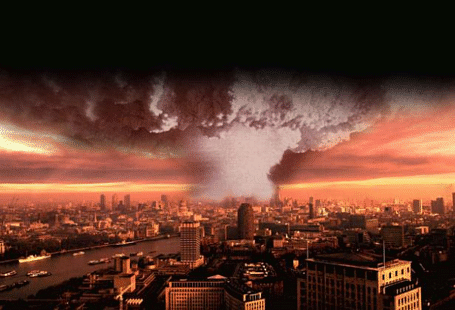
Bulletin, By Lisbeth Gronlund | August 4, 2023
The theme of control—and the lack of it—appears throughout Christopher Nolan’s latest film Oppenheimer.
………………………………………………………… While others were not so sanguine, Oppenheimer expected that he and other scientists who built the bomb would have a hand in future US policy. This belief also proved to be short-lived.
The scene in which the two bombs that would be detonated over Hiroshima and Nagasaki are boxed up and handed over to the military hammers home the point that the scientists were no longer in control of these weapons—literally and figuratively……………………..
…………………………….. Who really has been in control all these years? No one.
Policy makers—not just in the United States but in all nations with nuclear weapons—have abdicated their responsibilities to curb and eliminate the threat posed by their nuclear weapons. They have let the interests of their military and arms producers control the agenda—and the budget for these weapons. They have been swayed by the abstract goal of “deterrence,” which is a creature with a voracious appetite.
During the 2020 presidential election campaign, President Joe Biden pledged to adopt a “no first use” policy. It is shocking that the United States still considers using nuclear weapons first to be a viable option, even though it would likely spur a wider nuclear war. Sadly, it was not shocking that President Biden’s 2022 Nuclear Posture Review did not include this promised policy change. Instead, the president gave in to the military, which does not like to foreclose options. But, of course, that’s exactly what he and his overseas counterparts need to do—foreclose options. Take control. https://thebulletin.org/2023/08/nuclear-weapons-since-oppenheimer-whos-in-control/?utm_source=Newsletter&utm_medium=Email&utm_campaign=MondayNewsletter08072023&utm_content=NuclearRisk_WhosInControl_08042023
Demonstrators protest development of nuclear weapons in Oak Ridge
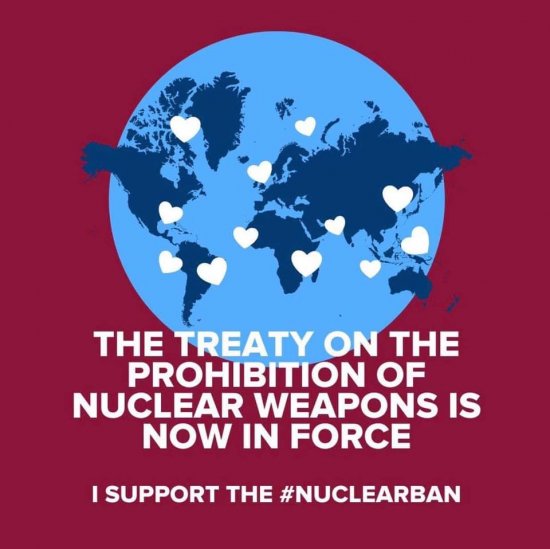
by: Ella Wales, Aug 6, 2023
OAK RIDGE, Tenn. (WATE) — Demonstrators held a march in Oak Ridge Saturday against the development and use of nuclear weapons.
The Oak Ridge Environmental Peace Alliance (OREPA) held the demonstration ahead of the 78th Anniversary of the U.S. bombings of Hiroshima and Nagasaki, Japan. The group marched from Alvin K. Bissell Park to the Y-12 National Security Complex.
Tanvi Kardile, coordinator of OREPA, said they are an anti-violence grassroots organization.
“We work against development of nuclear weapons, we fight against Y-12 which is still producing weapons to this day and we want to spread public awareness about what they’re doing out there,” she said.
The group’s demonstration aimed to support nuclear abolition in the United States.
“We came here to talk about the Treaty on the Prohibition of Nuclear Weapons, which is the only viable treaty that’s currently on the path to end nuclear weapons. The U.S. has not signed onto this treaty yet, so we’re here to spread public awareness about that,” Kardile said.
Philippines House panel OKs bill outlining nuclear damage compensation
By: Gabriel Pabico Lalu – Reporter / @GabrielLaluINQ INQUIRER.net August 07, 2023
MANILA, Philippines — A proposed measure that outlines civil liability and compensation in case of nuclear damage was approved by a House of Representatives panel on Monday.
During the hearing of the House Special Committee on nuclear energy, House Bill (HB) No. 8623, or the proposed Philippine Nuclear Liability Act, was approved, subject to discussions on the plenary.
A technical working group was also formed to reconcile differences between the original bill, authored by committee chairman and Pangasinan 2nd District Rep. Mark Cojuango, and the changes that would be made on the floor.
If enacted, the base version of the bill places that operators of nuclear installations would be liable for nuclear damage if there is proof that the incident was caused:
- in such nuclear installation or involving nuclear material coming from or originating in such nuclear installation
- involving nuclear material sent to such nuclear installation
It also specifies what conditions would require a joint liability — or when there is more than one operator handling the installation that caused the damage.
………………………………………………………………………………………………….. In a statement last May, the House of Representatives said IAEA informed lawmakers who hosted a forum on nuclear energy and international legal instruments that the law should contain the following provisions:
- regulatory control
- safe and secure uses
- offenses and penalties
- international cooperation
- peaceful uses
- compensation and liability
The IAEA said this after the House panel invited the Vienna-based organization to help Filipino lawmakers trying to come up with the necessary legal framework and policies for nuclear energy use.
https://newsinfo.inquirer.net/1813407/fwd-panel-oks-bill-outlining-compensation-in-case-of-nuclear-damage#ixzz89luKgXEL
Counting the dead at Hiroshima and Nagasaki

This is a very long, well-researched, and amply illustrated article. Below are a few snatches to give a sense of the work involved in seeking an answer to this question.
Bulletin, By Alex Wellerstein, August 4, 2020
How many people died as a result of the atomic bombings of Hiroshima and Nagasaki?
There is one thing that everyone who has tackled this question has agreed upon: The answer is probably fundamentally unknowable. The indiscriminate damage inflicted upon the cities, coupled with the existing disruptions of the wartime Japanese home front, means that any precise reckoning is never going to be achieved.
Earliest estimates……………………………………………………………………………………….
Occupation estimates………………………………….
……………………………………………………………………………………………………………………………………………….. One of the most useful sources they consulted was also one of the most grim: schools and schoolchildren, which kept meticulous attendance records. Not only were there good records, but “the headmasters in many instances had made earnest efforts to trace families by letter, messenger, or personal contact.” Even better, the researchers found that many of the children were not in their classrooms at the time of the bombing, but had been detailed into “patriotic work parties” throughout the city, working in factories or working on firebreaks. So this provided data for many different distances from the bombing, and different types of structures. In this tragic fashion, the most vulnerable of those who died at Hiroshima and Nagasaki played a key role in establishing the total death counts…………………………………………………………………………………………………………………………………
Japanese-led reconsiderations………………………………………………………………………………………………………………….
So what numbers should one use?
Given all of the above, and the disagreements about source terms that can dramatically alter the totals, what numbers should people who want to discuss the victims of the bombings use when doing so?
There is, I think it should be clear, no simple answer to this. In practice, authors and reports seem to cluster around two numbers, which I will call the “low” and the “high” estimates. The “low” estimates are those derived from the estimates of the 1940s: around 70,000 dead at Hiroshima, and around 40,000 dead at Nagasaki, for 110,000 total dead. The “high” estimates are those that derive from the 1977 re-estimation: around 140,000 dead at Hiroshima, and around 70,000 dead at Nagasaki, for a total of 210,000 total dead. Given that the “high” estimates are almost double the “low” estimates, this is a significant difference. There is no intellectually defensible reason to assume that, for example, an average (105,000 dead at Hiroshima, 55,000 dead at Nagasaki) would be more accurate or meaningful.
My qualitative sense is that historians who want to emphasize the suffering of the Japanese (and the injustice of the bombing) tend to prefer the “high” numbers, while those who want to emphasize the military necessity of the attack tend to prefer the “low” numbers. And therein lies the real question: What do these estimates do for us, rhetorically? It is clear that numbers, stripped from their technical contexts, are deployed primarily as a form of moral calculus. And this should not surprise us, given that so much of the argument defending the atomic bombs relies on another casualty estimate: how many people might have died in a full-scale land invasion of Japan (numbers that have been similarly contested for decades, ranging from tens of thousands of casualties, to the more imaginative millions).
Separately, the number of dead at Hiroshima and Nagasaki have also been explicitly compared to the estimated dead from the devastating firebombing attacks against both Germany (notably Dresden) and Japan (notably Tokyo) that preceded them. This argument is again part of the justification of atomic bombings, an attempt to show that they were not “special” in any particular moral sense when put up against “conventional” Allied activity. Whether this is or isn’t a strong argument is out of scope for this article, but it is just worth keeping in mind what work the “low” numbers do, for they pale in comparison with the highest estimates of the Tokyo bombing dead, and with the estimates for a land invasion of Japan.
Given that there is no satisfactory way to decide whether the “low” or “high” estimates are more accurate, it is fairly clear there is no “neutral” choice to be made. It ultimately comes down to which sort of authority one wishes to go with: the official estimates of the United States military in the 1940s, or the later estimates by a group of anti-nuclear weapons scientists, largely spearheaded by Japan. Both made legitimate points in making their estimations; neither show any apparent perfidy or obvious intellectual dishonesty.
Short of choosing one or the other, is there an elegant way to talk about the range? Saying “between 70,000 and 140,000 people died at Hiroshima” captures some of it, but does not really capture the reasons for the variance in these numbers. I might suggest, if there is space to do so, saying something like:
“The United States military estimated that around 70,000 people died at Hiroshima, though later independent estimates argued that the actual number was 140,000 dead. In both cases, the majority of the deaths occurred on the day of the bombing itself, with nearly all of them taking place by the end of 1945.”
This makes the authorship claims more explicit (even as it generalizes quite a bit into “the United States military” and “independent estimates”), and also makes it clear that this range is the cause of two entirely different assessments, not the errors of a single assessment. And it clarifies the question of timing, if the latter clause is allowed in. It is a wordy explanation—journalists will no doubt question whether it is worth the space in an article where they probably just wanted a simple number to quote—but if we are going to invoke such uncounted dead, it is worth the effort to do it in a way that is respectful of the uncertainties involved.
Ukraine fights narrative battle as counteroffensive stalls – NBC
Rt.com 7 Aug 23
Kiev and its supporters are reportedly worried about perceptions in the West
Faced with a lack of progress on the battlefield, the government in Kiev has taken up a public relations battle in the West, NBC News reported on Friday, citing several US and Ukrainian officials.
As some US officials are “frustrated at the pace” of the Ukrainian counteroffensive, Kiev and some of its backers “worry about losing control of the narrative,” according to NBC.
“If the perception gets out there that the Ukrainians can’t win, then we’re not going to provide them the stuff they need to win,” former US ambassador to Kiev William Taylor told the outlet, warning of a “self-fulfilling prophecy.”
Nikodem Rachon, spokesman for the Polish embassy in Washington, told NBC that Russia “exploits” Ukraine’s lack of battlefield success in propaganda, “aiming to weaken the unity of countries supporting Ukraine.”
President Vladimir Zelensky himself has admitted the “slower pace” of the counteroffensive, blaming the West for delayed deliveries of weapons and ammunition that gave the Russians time to dig in. Deputy Defense Minister Anna Maliar recently claimed gains of “about 241 square kilometers” of territory, which NBC described as “less than 100 square miles.”……………………………………………………………………………..
The Russian Defense Ministry reported on Friday that Ukraine had lost more than 43,000 troops and over 4,900 pieces of heavy weaponry over the course of June and July, including German-made tanks, US-made infantry fighting vehicles, and 747 pieces of artillery.
British intelligence has blamed “weeds and shrubs” growing along the line of contact for slowing down Ukraine’s armor. Kiev officials have latched onto another talking point, however. Leonid Polyakov, a former deputy defense minister of Ukraine who now works for a think tank advising President Vladimir Zelensky, told NBC that Ukraine can’t properly follow US military doctrine without air support.
We have launched a counteroffensive without any kind of air superiority – not in the air force, not in drones, not in helicopters,” Polyakov said. He told a story about two Ukrainian brigades that launched unsupported attacks in June and July and got “shredded” by Russian defenses.
“We wouldn’t do it. We’ve never done it and yet we’re asking them to do it,” agreed ex-ambassador Taylor, who fought in Vietnam as an infantry officer.
The US and its allies are currently training Ukrainian pilots on F-16 fighters, but no country has pledged to actually deliver the jets just yet. https://www.rt.com/russia/580844-ukraine-offensive-narrative-battle/
—
The nuclear arms race’s legacy: Toxic contamination, staggering cleanup costs and a culture of government secrecy
Advocates for a full Hanford cleanup warn that without such a commitment, the site will become a “national sacrifice zone,” a place abandoned in the name of national security.
By William J. Kinsella, 6 Aug 23, https://japantoday.com/category/features/opinions/the-nuclear-arms-race’s-legacy-at-home-toxic-contamination-staggering-cleanup-costs-and-a-culture-of-government-secrecy
RALEIGH, North Carolina
Christopher Nolan’s film “Oppenheimer” has focused new attention on the legacies of the Manhattan Project – the World War II program to develop nuclear weapons. As the anniversaries of the bombings of Hiroshima and Nagasaki on Aug. 6 and Aug. 9, 1945, approach, it’s a timely moment to look further at dilemmas wrought by the creation of the atomic bomb.
The Manhattan Project spawned a trinity of interconnected legacies. It initiated a global arms race that threatens the survival of humanity and the planet as we know it. It also led to widespread public health and environmental damage from nuclear weapons production and testing. And it generated a culture of governmental secrecy with troubling political consequences.
As a researcher examining communication in science, technology, energy and environmental contexts, I’ve studied these legacies of nuclear weapons production. From 2000 to 2005, I also served on a citizen advisory board that provides input to federal and state officials on a massive environmental cleanup program at the Hanford nuclear site in Washington state that continues today.
Hanford is less well known than Los Alamos, New Mexico, where scientists designed the first atomic weapons, but it was also crucial to the Manhattan Project. There, an enormous, secret industrial facility produced the plutonium fuel for the Trinity test on July 16, 1945, and the bomb that incinerated Nagasaki a few weeks later. (The Hiroshima bomb was fueled by uranium produced in Oak Ridge, Tennessee, at another of the principal Manhattan Project sites.)
Later, workers at Hanford made most of the plutonium used in the U.S. nuclear arsenal throughout the Cold War. In the process, Hanford became one of the most contaminated places on Earth. Total cleanup costs are projected to reach up to US$640 billion, and the job won’t be completed for decades, if ever.
Victims of nuclear tests
Nuclear weapons production and testing have harmed public health and the environment in multiple ways. For example, a new study released in preprint form in July 2023 while awaiting scientific peer review finds that fallout from the Trinity nuclear test reached 46 U.S. states and parts of Canada and Mexico.
Dozens of families who lived near the site – many of them Hispanic or Indigenous – were unknowingly exposed to radioactive contamination. So far, they have not been included in the federal program to compensate uranium miners and “downwinders” who developed radiation-linked illnesses after exposure to later atmospheric nuclear tests.
On July 27, 2023, however, the U.S. Senate voted to extend the Radiation Exposure Compensation Act and expand it to communities near the Trinity test site in New Mexico. A companion bill is under consideration in the House of Representatives.
The largest above-ground U.S. tests, along with tests conducted underwater, took place in the Pacific islands. Meanwhile, the Soviet Union and other nations conducted their own testing programs. Globally through 2017, nuclear-armed nations exploded 528 weapons above ground or underwater, and an additional 1,528 underground.
Estimating how many people have suffered health effects from these tests is notoriously difficult. So is accounting for disruptions to communities that were displaced by these experiments.
Polluted soil and water
Nuclear weapons production has also exposed many people, communities and ecosystems to radiological and toxic chemical pollution. Here, Hanford offers troubling lessons.
Starting in 1944, workers at the remote site in eastern Washington state irradiated uranium fuel in reactors and then dissolved it in acid to extract its plutonium content. Hanford’s nine reactors, located along the Columbia River to provide a source of cooling water, discharged water contaminated with radioactive and hazardous chemicals into the river through 1987, when the last operating reactor was shut down.
Extracting plutonium from the irradiated fuel, an activity called reprocessing, generated 56 million gallons of liquid waste laced with radioactive and chemical poisons. The wastes were stored in underground tanks designed to last 25 years, based on an assumption that a disposal solution would be developed later.
Seventy-eight years after the first tank was built, that solution remains elusive. A project to vitrify, or embed tank wastes in glass for permanent disposal, has been mired in technical, managerial and political difficulties, and repeatedly threatened with cancellation.
Now, officials are considering mixing some radioactive sludges with concrete grout and shipping them elsewhere for disposal – or perhaps leaving them in the tanks. Critics regard those proposals as risky compromises. Meanwhile, an estimated 1 million gallons of liquid waste have leaked from some tanks into the ground, threatening the Columbia River, a backbone of the Pacific Northwest’s economy and ecology.
Radioactive trash still litters parts of Hanford. Irradiated bodies of laboratory animals were buried there. The site houses radioactive debris ranging from medical waste to propulsion reactors from decommissioned submarines and parts of the reactor that partially melted down at Three Mile Island in Pennsylvania in 1979. Advocates for a full Hanford cleanup warn that without such a commitment, the site will become a “national sacrifice zone,” a place abandoned in the name of national security.
A culture of secrecy
As the movie “Oppenheimer” shows, government secrecy has shrouded nuclear weapons activities from their inception. Clearly, the science and technology of those weapons have dangerous potential and require careful safeguarding. But as I’ve argued previously, the principle of secrecy quickly expanded more broadly. Here again, Hanford provides an example.
Hanford’s reactor fuel was sometimes reprocessed before its most-highly radioactive isotopes had time to decay. In the 1940s and 1950s, managers knowingly released toxic gases into the air, contaminating farmlands and pastures downwind. Some releases supported an effort to monitor Soviet nuclear progress. By tracking deliberate emissions from Hanford, scientists learned better how to spot and evaluate Soviet nuclear tests.
In the mid-1980s, local residents grew suspicious about an apparent excess of illnesses and deaths in their community. Initially, strict secrecy – reinforced by the region’s economic dependence on the Hanford site – made it hard for concerned citizens to get information.
Once the curtain of secrecy was partially lifted under pressure from area residents and journalists, public outrage prompted two major health effects studies that engendered fierce controversy. By the close of the decade, more than 3,500 “downwinders” had filed lawsuits related to illnesses they attributed to Hanford. A judge finally dismissed the case in 2016 after awarding limited compensation to a handful of plaintiffs, leaving a bitter legacy of legal disputes and personal anguish.
Cautionary legacies
Currently active atomic weapons facilities also have seen their share of nuclear and toxic chemical contamination. Among them, Los Alamos National Laboratory – home to Oppenheimer’s original compound, and now a site for both military and civilian research – has contended with groundwater pollution, workplace hazards related to the toxic metal beryllium, and gaps in emergency planning and worker safety procedures.
As Nolan’s film recounts, J. Robert Oppenheimer and many other Manhattan Project scientists had deep concerns about how their work might create unprecedented dangers. Looking at the legacies of the Trinity test, I wonder whether any of them imagined the scale and scope of those outcomes.
Russia’s Kola nuclear power plant turns 50. That is not necessarily something to celebrate
The first VVER-440/230 reactor at Kola Nuclear Power Plant was connected to the electricity grid on June 29, 1973. Western sanctions do not trouble the safety as most spare parts are made in Russia, says environmental watchdog Bellona.
Barents Observer, By Thomas Nilsen June 23
The Kola plant became the world’s first to produce nuclear-generated electricity north of the Arctic Circle. Construction of the first reactor started in 1969 and four years later it was connected to the grid. A total of four reactors are today in operation at the power plant.
The two first are of the VVER-440/230 type, the Soviet Union’s first generation civilian water-cooled reactors. The last two are the second generation of the VVER-440/213 type.
Later, the USSR designed the larger VVER-1000 reactors that today are in operation at several nuclear power plants, including the Zaporizhzhia in the war zone in Ukraine.
A few years after the breakup of the Soviet Union, the International Atomic Energy Agency (IAEA) initiated a full safety evaluation of the old VVER-400/230 reactors, at that time in operation in Russia, Bulgaria and Czechoslovakia. A plant with similar reactors Greifswald in the former East Germany was already shut down for safety concerns.
Safety help
The IAEA report published in 1992 identified some 100 safety issues and pointed out a ranking of needed improvements. In the 90s, safety problems at Kola nuclear power plants caused headlines not only in Russia, but also in neighboring Scandinavian countries.
Norway granted the power plant both cash for improving the safety, but also practical equipment like external generators to ensure cooling in case of loss of power to the inbuilt cooling system. Foreign Minister of Norway at the time, Bjørn Tore Godal, however, ensured the Parliament in Oslo in 1995 that all Norwegian technical assistance to Kola nuclear power plant should not «contribute to prolong the lifetime of the reactors, only to improve the safety.»
Wartime
For wartime Russia, most of the internationally focused safety work at Kola nuclear power plant has come to an end.
“There are no more foreign donors helping Russia on nuclear safety in the northwest,” says Dmitry Gorchakov, a nuclear advisor with the Bellona Environmental Transparency Center in Vilnius. His group had to leave Russia for Lithuania after the full-scale war started. This spring, authorities in Moscow declared Bellona undesirable, meaning no one inside Russia can any longer work for, or stay in contact with, the environmentalists.
For Dmitry Gorchakov and his colleagues, that limits their access to reliable information.
“During the war, many official resources, government resources, are closed, they don’t share all information like they did before. We have to find new sources, new tools,” he says.
“Liars”
How Western sanctions are impacting radiation safety works on the Kola Peninsula is difficult to assess, according to Bellona.
“We don’t talk with officials. They are lying. About how they manage with sanctions, how they will work in different countries,” Gorchakov says. He, however, thinks the state nuclear corporation Rosatom easily can maneuver operations based on a domestic supply chain.
“Not much depends on foreign spare parts, uranium products. They make most inside the country,” Dmitry Gorchakov tells. Before starting to work for Bellona, Gorchakov worked for years for the nuclear industry inside Russia, often in tight contact with state officials.
He believes many of the safety programs initiated during decades of international cooperation now are put on hold.
“Some safety programs will be slowed down, while others will be canceled. They will maybe put it on pause,” he says.
“I think some Russian officials hope the war will stop sooner or later. But now they spend a lot of money on the war, so environmental problems are not a priority.”
“This could be dangerous, but we need to analyze it more,” Gorchakov says.
Operation until 2033
Meanwhile, reactor No. 1 at Kola NPP, originally built for a 30-years lifetime, celebrates its 50th anniversary.
Authorities granted one license prolongation after the other. In 2018, Rostechnadzor, the federal supervisory body for environmental, industrial and nuclear services, issued the license for the operation of Kola nuclear power plant’s unit No. 1 until July 6, 2033, the Barents Observer reported. The following year, unit No. 2 was granted an additional 15-years operation licence. …………………………………
The backup emergency external power system at the plant aimed to keep cooling water running in case of power fallouts, is supposed to come from two diesel generators, both delivered by Norway in the 90ties. Today, Norway has ended all practical cooperation on nuclear safety with Russia, including possible deliveries of spare parts to the Kola NPP’s emergency generators. ………. https://thebarentsobserver.com/en/nuclear-safety/2023/06/today-first-kola-npp-reactor-turns-50
Hinkley Point scaffolders begin industrial action over pay and shift patterns
Hinkley Point scaffolders begin industrial action over pay and shift
patterns. Over 300 scaffolders working at Hinkley Point C near
Burnham-On-Sea have begun unofficial strike action, voicing their concerns
about pay rates and shift patterns at the site.
The scaffolders working for
BYLOR began their protest on Wednesday and are now planning to take one day
a week off work as a form of unofficial strike. Tensions have reportedly
been escalating on site for some time, with workers expressing
dissatisfaction over their current compensation package.
Burnham-on-sea.com 5th Aug 2023
For Scotland, energy is our best argument for independence
,,,,,,,,,,, the Government’s obsession with nuclear power – the most expensive method ever devised for generating electricity. The Government claims nuclear is renewable. It isn’t. At current rates, there is maybe 90 years’ supply of uranium left – less if we use more. The Government claims it is clean. It isn’t. The toxic radioactive waste needs to be isolated from living things, including us, for centuries. The Government claims it provides energy security. It doesn’t. The UK has no uranium. Yet the UK Government, supported by its Labour opposition, is preparing to rapidly expand nuclear power at vast expense to the taxpayer.
The National, By Tommy Sheppard, 6th August 23
SOMETIMES I wonder what it’s going to take to make the UK Government take climate change seriously. We’ve spent this miserable, sodden Scottish summer watching holiday destinations in the Mediterranean combust. The news is full of floods and typhoons. Records are broken every day. Across the world people are drowning and burning.
All of this is going to get worse. Beyond the headlines, a catastrophe unfolds as the ice melts and sea levels rise. Famine and more mass migration result. The climate emergency is here now.
……………………………….We have created the climate crisis. And we can fix it, but only if our political leaders are prepared to take hard decisions and apply a degree of honesty and common sense which has so far escaped them.
……………….. We need to stop burning oil and gas……………..
Let’s start with new oil and gas exploitation. Of all the utter bollocks talked by Sunak’s government, this takes the biscuit. Despite committing to a policy of reducing oil and gas, we’re told it’s okay to massively increase drilling and extraction in the North Sea. This is an affront to common sense. The dogs in the street know you cannot reduce something by having more of it.
To be clear, what is now being considered is massive. Bigger than before…………………………
And then we’re told that if the UK does not allow this, some other country will, so it’s futile not doing it. This counsel of despair has been rejected by – among others – the Tory chair of the Climate Change Committee, Lord Deben,……………………….
Let’s be clear, the best way to capture carbon is to plant trees. Photosynthesis is how CO2 is taken out of the atmosphere. And one of the factors in rising CO2 levels is that these islands, like most of the world, have lost half the tree cover they used to have.
CARBON capture can never replace nature in sequestering carbon from the atmosphere. …………………………………………………………………………………
We can’t have a conversation about the deceitfulness of UK energy policy without discussing the Government’s obsession with nuclear power – the most expensive method ever devised for generating electricity. The Government claims nuclear is renewable. It isn’t. At current rates, there is maybe 90 years’ supply of uranium left – less if we use more. The Government claims it is clean. It isn’t. The toxic radioactive waste needs to be isolated from living things, including us, for centuries. The Government claims it provides energy security. It doesn’t. The UK has no uranium. Yet the UK Government, supported by its Labour opposition, is preparing to rapidly expand nuclear power at vast expense to the taxpayer.
……………………………………………. More than most countries, Scotland is blessed with renewable energy sources in abundance. We just need the political and financial commitment to develop them at a scale never before seen. That commitment won’t come from this UK Government, nor it seems the next one.
So, perhaps more than any other area of policy, the need for Scotland to have control over its energy production makes a compelling case for our political independence. https://www.thenational.scot/politics/23703825.tommy-sheppard-energy-best-argument-independence/
Nevada’s atomic fallout: How nuclear explosions in the Silver State reverberate through lives today
It happened not so long ago, though some who call Nevada home may not remember the “Atomic Era,” when more than 1,000 nuclear bombs were set off near the Las Vegas Valley.
But there are some in the Silver State who can never forget. These are their stories.
(Video) The stories of Hiroshima and Nagasaki, as told through the eyes of survivors. Channel 13 anchor Paulina Bucka hears from two Las Vegas residents who share how the 1945 bombings still impact them today.
The two bombs killed more than 300,000 people — and counting. “Whoever survived…sometimes they’d say they were better off dead,” Kumiko Noriega, a Las Vegas resident who grew up in Hiroshima after the bombings, told Channel 13.
so, so much.”
DOWNWINDERS: A TRUE LAS VEGAS STORY
(Video) During the height of the Cold War and atomic nuclear testing, Las Vegas became home to one of the largest atomic testing sites in the country.
In the vast Nevada desert, there are many stories of people who lived to tell about the effects of nuclear fallout — and many who did not. Paulina Bucka reports.
Even before its theater debut, the blockbuster biopic “Oppenheimer” prompted thought-provoking discussions about the past, present, and future implications of the atomic bomb and nuclear energy.
Oppenheimer’s grandchildren recently discussed his legacy at an event in Southern Nevada. Isabella Martin reports.
‘OPPENHEIMER’: THE BLOCKBUSTER FILM’S LAS VEGAS CONNECTION
Continue readingA warning from the Caribbean – none of us is safe from nuclear disaster
Nuclear disaster a very real prospect
Trinidad Express Editorial, 8 Aug 23
Two days ago, the world, led by Japan, peered through the long lens of history to August 6, 1945, when the first atomic bomb was released above Hiroshima that changed the world.
As Japan rang its peace bell and observed its annual moment of silence—at the exact time and date that the A-bomb innocuously nicknamed “Little Boy” was unleashed—Hollywood filmmaker Christopher Nolan threw his gaze forward to the age of artificial intelligence, calling this inflection point in global technological advancement an “Oppenheimer moment”.
Together, both cast modern perspectives on the 78-year-old event that killed between 129,000 and 226,000 mostly civilians and pushed the world to where it is now: in near-constant fear of global annihilation from nuclear weapons.
. In the time between that fateful day in 1945 and now, far from being chastened into complete nuclear disarmament, nations have invested in technological advancements that have made nuclear weapons 80 times more powerful than the one detonated over Hiroshima. These modern weapons now have more accurate and resilient delivery methods that can fly faster than the speed of sound……………………………………………….
last weekend’s anniversary reminds us that climate chaos is not the only threat to the future of humanity. Here in T&T, we may feel farther away from nuclear annihilation than from the weather crises we experience daily but one serves to remind us of the other.
As the Caribbean raises its voice on the world stage on climate change, so too our voices must be heard on the other looming threat to our existence. https://trinidadexpress.com/opinion/editorials/nuclear-disaster-a-very-real-prospect/article_2cff3a12-3585-11ee-a35f-334a8a703465.html
To 7 August – nuclear news this week

A bit of good news – The largest landfill in Latin America has now been restored into a thriving mangrove ecosystem.
TOP STORIES
Wilfred Burchett: The Atomic Plague,
Those who will fire the nuclear weapons are thoroughly trained to have no hesitation. We must stop them.
US rejects Australian plea to drop Assange case.
UK government must come clean, to tax-payers and consumers, on the financial figures before signing up to new nuclear programme. ( Full report. See in particular paras 41 -44)
Senate passes $886 billion National Defense Authorization Act (NDAA): No audits necessary.
Aggressive U.S. Push for Military Supremacy in the Arctic Could Trigger Nuclear War.
Climate. A Vital Atlantic Ocean System Could Collapse Sooner Than Previously Thought . The Chilling Truth: Antarctica Just Lost an Ice Mass the Size of My Country .
Nuclear. Well – It’s been THAT memorable week – the 78th anniversary. I can’t add to the many fine stories this week. Except to note that all nuclear-weapons nations are sticking to their policies, and the nuclear industry is enthusiastically propagandising -because we all know that small nuclear reactors etc have nothing to do with military use, don’t we?.
Christina notes. Forget Oppenheimer. The real nuclear hero is Joseph Rotblat. The persecution of Wilfred Burchett and Julian Assange .
CLIMATE. Nuclear war would be more devastating for Earth’s climate than cold war predictions – even with fewer weapons. What you won’t learn about in Oppenheimer: the potential effects of a nuclear winter.
ECONOMICS. How the “Nuclear Renaissance” Robs and Roasts Our Earth. First new US nuclear reactor in 3 decades may well also be its last. Nuclear power’s landmark project stumbles across the finish line. The unpalatable facts of the costs to consumers of electricity from new nuclear power. The High Costs and Failures of Nuclear Reactors.
ENERGY. The digital data industry is an energy-and-water-guzzling climate disaster. For Scotland, energy is our best argument for independence.
EMPLOYMENT. Hinkley Point scaffolders begin industrial action over pay and shift patterns.
ENVIRONMENT. Environment Agency allows Hinkley Point C permit variation to remove fish deterrent system. Nuclear Weapons: Devastation Inside the U.S. Do right by the whales. Water. Water Wars: Cooling the Data Centres. Environment Agency grants contentious Hinkley C water discharge permit.
ETHICS and RELIGION. Scared to Death! Oppenheimer and the threat of nuclear destruction. https://www.youtube.com/watch?v=-xthzy1PxTA&t=5s
HISTORY. Western Media Has Falsely Presented the Donbas’ Drive For Autonomy as Being Instigated By Moscow.
LEGAL. Judge tosses charges against executive in South Carolina nuclear debacle, but case may not be over.
MEDIA. Like ‘the tolling of a distant temple bell’, Ibuse Masuji’s Black Rain remembers the horrors of Hiroshima and warns of the inhumanity of war. ‘Barbenheimer’ highlights U.S. ignorance of nuclear reality. Greg Mitchell on “Oppenheimer” & Why Hollywood Is Still Afraid of the Truth About the Atomic Bomb. Why no Hollywood movie on Nagasaki A Bombing? Humans Might Be About to Break the Ocean? Don’t Stop the Presses.
OPPOSITION to NUCLEAR . Campaigners against Sizewell C nuclear plan welcome call for financial clarity from Science, Innovation and Technology Committee.
Together Against Sizewell environmental group angry at the coming destruction of marine life, as acoustic fish deterrent will not be installed at Hinkley Point C nuclear. Pacific anti-nuclear groups condemn Fiji’s Prime Minister Sitiveni Rabuka for backing Fukushima wastewater stance.
PERSONAL STORIES. Oppenheimer’s nuclear fallout: How his atomic legacy destroyed my world.
POLITICS.
- Why The Niger Coup Has Sparked Concerns About Nuclear Power.
- BRING IT HOME-Robert F. Kennedy, Jr.
- UK has no coherent plan to develop nuclear energy . Ambition alone will not build UK nuclear power. Another kick in the teeth for UK taxpayers as EDF pockets another £170m of public money for their Sizewell C White Elephant. Ministers diverted £136m from electric car fund to Sizewell C nuclear project despite infrastructure concerns.
- Sweden’s Nuclear Power Ambitions Quashed.
- Why is Ontario Government bent on building a new nuclear reactor, at a much greater cost than solar or wind technologies? New Brunswick Power is kicking the can down the road while the planet burns. ADVANCE Act on nuclear sends us backwards.
POLITICS INTERNATIONAL and DIPLOMACY.
- Requiem for NATO’s Nightmare – the Vilnius summit. Mexican president urges end to ‘irrational’ Ukraine war, wants Russia at peace talks. CIA Director Affirms U.S. Regime Change Strategy in Russia in Address at British Foundation.
- United Nations wants to resurrect a global disarmament mechanism last used in the 1980s.
- Saudi Arabia could convert civilian nuclear to military, Israeli expert warns.
- Prime Minister Anthony Albanese is reiterating his call for the case against Julian Assange to be dropped. Australian MPs Blast Blinken Over Assange.
PROTESTS. Protests held in Tokyo against nuclear water discharge,
SAFETY. UN nuclear watchdog finds no explosives at Zaporizhzhia plant. Russia’s Kola nuclear power plant turns 50. That is not necessarily something to celebrate. Non-compliant fire program halts decommissioning of Whiteshell Nuclear Laboratories.
URANIUM. Niger stops uranium and gold export to France.
WASTES.
- Niger’s 20 million tonnes of radioactive waste.
- The nuclear arms race’s legacy: Toxic contamination, staggering cleanup costs and a culture of government secrecy.
- Sellafield seeks partners for £4.8bn nuclear decommissioning works. UK’s Radioactive Waste Management holds meetings in Lincolnshire, seeking a location for nuclear waste dump
WAR and CONFLICT When facts cut through the fog of war. Is the US preparing to dump the proxy war in Ukraine so it can start another in Taiwan? Nuclear catastrophe threat is ‘great and growing’, warn over 100 top medical journals. Veterans, descendants of nuclear testing era urged to apply for British medal.
Decades Later, the U.S. Government Called Hiroshima and Nagasaki ‘Nuclear Tests’, Japan marks 78th anniversary of US atomic bombing on Hiroshima, calls nuclear deterrence ‘folly’. Japan condemns Russia nuclear threat on Hiroshima anniversary.
WEAPONS and WEAPONS SALES
The Sky’s the Limit on Nuclear Weapons Spending, But What Does It Really Get Us? US cluster munitions will bring more pain and death to Donbass civilians, and Washington doesn’t care. Kiev’s broken record: no matter what advanced weaponry the West sends, there is no magic wand to conjure a Ukrainian victory. Military Initiative by Australia, the United Kingdom and the United States (AUKUS) is Another Major Step in Prospective War on China. How Have Nuclear Weapons Evolved Since Oppenheimer and the Trinity Test?
Building for War: The US Imperium’s Top End Spend. USA flexes its belligerent muscles in Western Australia, showing off its nuclear submarines. AUKUS, Australia and the drive to war. A Client State.
Water Wars: Cooling the Data Centres

August 6, 2023, Dr Binoy Kampmar, https://theaimn.com/water-wars-cooling-the-data-centres/
Water. Data centres. The continuous, pressing need to cool the latter, which houses servers to store and process data, with the former, which is becoming ever more precious in the climate crisis. Hardly a good comingling of factors.
Like planting cotton in drought-stricken areas, decisions to place data hubs in various locations across the globe are becoming increasingly contentious from an environmental perspective, and not merely because of their carbon emitting propensities. In the United States, which houses 33% of the globe’s data centres, the problem of water usage is becoming acute.
As the Washington Post reported in April this year, residents in Mesa, Arizona were concerned that Meta’s decision to build another data centre was bound to cause more trouble than it was worth. “My first reaction was concern for our water,” claimed city council member Jenn Duff. (The state already has approximately 49 data centres.)
The move to liquid cooling from air cooling for increasingly complex IT processes has been relentless. As the authors of a piece in the ASHRAE Journal from July 2019 explain, “Air cooling has worked well for systems that deploy processors up to 150 W, but IT equipment is now being manufactured with processors well above 150 W where air cooling is no longer practical.” The use of liquid cooling was not only more efficient than air cooling regarding heat transfer, but “more energy efficient, reducing electrical energy costs significantly.” The authors, however, show little concern about the water supplies needed in such ventures.
The same cannot be said about a co-authored study on the environmental footprint of US-located data centres published two years later. During their investigations, the authors identified a telling tendency: “Our bottom-up approach reveals one-fifth of data center servers’ direct water footprint comes from moderately to highly stressed watersheds, while nearly half of servers are fully or partially powered by power plants located within water stressed reasons.” And to make things just that bit less appealing, it was also found that roughly 0.5% of total US greenhouse gas emissions could also be attributed to such centres.
Google has proven to be particularly thirsty in this regard, not to mention secretive in the amount of water it uses at its data hubs. In 2022, The Oregonian/Oregon Live reported that the company’s water use in The Dalles had almost tripled over five years. The increased usage was enabled, in no small part, because of increased access to the municipal water supply in return for an upgrade to the water supply and a transfer of certain water rights. Since establishing the first data centre in The Dalles in 2005, Google has also received tax breaks worth $260 million.
The city officials responsible for the arrangement were in no mood to answer questions posed by the inquisitive paper on Google’s water consumption. A prolonged 13-month legal battle ensued, with the city arguing that the company’s water use constituted a “trade secret”, thereby exempting them from Oregon’s disclosure rules. To have disclosed such details would have, argued Google, revealed information on how the company cooled their servers to eager competitors.
In the eventual settlement, The Dalles agreed to provide public access to 10 years of historical data on Google’s water consumption. The city also agreed to pay $53,000 to the Reporters Committee for Freedom of the Press, which had agreed to represent The Oregonian/Oregon Live. The city’s own costs had run into $106,000. But most troubling in the affair, leaving aside the lamentable conduct of public officials, was the willingness of a private company to bankroll a state entity in preventing access to public records. Tim Gleason, former dean of the University of Oregon’s School of Journalism and Communication, saw this distortion as more than just a touch troubling. “To allow a private entity to essentially fund public advocacy of keeping something out of the public domain is just contrary to the basic intent of the law.”
Instead of conceding that the whole enterprise had been a shabby affront to local residents concerned about the use of a precious communal resource, compromising both the public utility and Google, the company’s global head of infrastructure and water strategy, Ben Townsend, proved benevolent. “What we thought was really important was that we partner with the local utility and actually transfer those water rights over to the utility in a way that benefits the entire community.” That’s right, dear public, they’re doing it for you.
John Devoe, executive director of the WaterWatch advocacy group, also issued a grim warning in the face of Google’s ever increasing water use, which will burgeon further with two more data centres promised along the Columbia River. “If the data center water use doubles or triples over the next decade, it’s going to have serious effects on fish and wildlife on source water streams, and it’s potentially going to have serious effects for other water users in the area of The Dalles.”
Much of the policy making in this area is proving to be increasingly shoddy. With a global demand for ever more complex information systems, including AI, the Earth’s environment promises to be stripped further. Information hunger risks becoming a form of ecological license.
Decades Later, the U.S. Government Called Hiroshima and Nagasaki ‘Nuclear Tests’
The military was able to test both a uranium-fueled bomb on Hiroshima and a second plutonium bomb on Nagasaki to gauge their effects on big cities.
Today, in some elite circles of Russia and the United States, normalized talk of using “tactical” nuclear weapons has upped the madness ante.
NORMAN SOLOMON, AUG 1, 2023 https://wordpress.com/read/feeds/2663585/posts/4838936867
In 1980, when I asked the press office at the U.S. Department of Energy to send me a listing of nuclear bomb test explosions, the agency mailed me an official booklet with the title “Announced United States Nuclear Tests, July 1945 Through December 1979.” As you’d expect, the Trinity test in New Mexico was at the top of the list. Second on the list was Hiroshima. Third was Nagasaki.
So, 35 years after the atomic bombings of those Japanese cities in August 1945, the Energy Department—the agency in charge of nuclear weaponry—was categorizing them as “tests.”
Later on, the classification changed, apparently in an effort to avert a potential P.R. problem. By 1994, a new edition of the same document explained that the bombings of Hiroshima and Nagasaki “were not ‘tests’ in the sense that they were conducted to prove that the weapon would work as designed…or to advance weapon design, to determine weapons effects, or to verify weapon safety.”
But the atomic bombings of Hiroshima and Nagasaki actually were tests, in more ways than one.
Take it from the Manhattan Project’s director, Gen. Leslie Groves, who recalled: “To enable us to assess accurately the effects of the bomb, the targets should not have been previously damaged by air raids. It was also desirable that the first target be of such size that the damage would be confined within it, so that we could more definitely determine the power of the bomb.”
A physicist with the Manhattan Project, David H. Frisch, remembered that U.S. military strategists were eager “to use the bomb first where its effects would not only be politically effective but also technically measurable.” The military was able to test both a uranium-fueled bomb on Hiroshima and a second plutonium bomb on Nagasaki to gauge their effects on big cities.
For good measure, after the Trinity bomb test in the New Mexico desert used plutonium as its fission source on July 16, 1945, in early August the military was able to test both a uranium-fueled bomb on Hiroshima and a second plutonium bomb on Nagasaki to gauge their effects on big cities.
-
Archives
- October 2026 (120)
- September 2026 (339)
- August 2026 (330)
- July 2026 (355)
- June 2026 (287)
- May 2026 (306)
- April 2026 (356)
- March 2026 (251)
- February 2026 (267)
- January 2026 (308)
- December 2025 (358)
- November 2025 (359)
-
Categories
- 1
- 1 NUCLEAR ISSUES
- business and costs
- climate change
- culture and arts
- ENERGY
- environment
- health
- history
- indigenous issues
- Legal
- marketing of nuclear
- media
- opposition to nuclear
- PERSONAL STORIES
- politics
- politics international
- Religion and ethics
- safety
- secrets,lies and civil liberties
- spinbuster
- technology
- Uranium
- wastes
- weapons and war
- Women
- 2 WORLD
- ACTION
- AFRICA
- Atrocities
- AUSTRALIA
- Christina's notes
- Christina's themes
- culture and arts
- Events
- Fuk 2022
- Fuk 2023
- Fukushima 2017
- Fukushima 2018
- fukushima 2019
- Fukushima 2020
- Fukushima 2021
- general
- global warming
- Humour (God we need it)
- Nuclear
- RARE EARTHS
- Reference
- resources – print
- Resources -audiovicual
- Weekly Newsletter
- World
- World Nuclear
- YouTube
-
RSS
Entries RSS
Comments RSS

