Another Washington declaration: U.S. nuclear weapons on the Korean Peninsula
Foreign Policy Research Institute, Joseph Su 9 Aug 23
- On July 18, the USS Kentucky docked in South Korea, marking the first visit by a potentially nuclear-armed US submarine since the 1980s on the heels of North Korean missile launches.
- After North Korea conducted a record amount of missile tests in 2022, South Korea has become increasingly worried about the nuclear threat and sought further nuclear security guarantees with the United States, signing the Washington Declaration to increase deployments of US strategic assets on the peninsula.……….
Sending Kentucky to Korea
On July 18, 2023, the USS Kentucky, an Ohio-class ballistic missile submarine, docked in Busan, South Korea. The USS Kentucky is one of 14 Ohio-class submarines tasked with conducting nuclear deterrence patrols and carries up to 20 Trident II D5 nuclear-armed ballistic missiles. This visit marks the first port call by a nuclear-capable submarine since the 1980s and the 1991 decision to withdraw US nuclear forces from the Korean Peninsula.
…………………………………………………. The USS Kentucky is an Ohio-class submarine that joined the fleet in 1983 and continues to carry the United States’ nuclear forces at sea. Equipped with 20 launch tubes for the Trident II D5 missile which carries on average four nuclear warheads per missile, a single Ohio submarine could carry a nuclear payload 1,100 times more powerful than the two bombs combined that were dropped in 1945, even abiding by treaty limitations………………………………………………………………………………………………………………………………………………………………………………. https://www.fpri.org/article/2023/08/another-washington-declaration-us-nuclear-weapons-on-the-korean-peninsula/
Bringing the Pacific people together in solidarity to address nuclear legacy issues in the Pacific – Lesuma
By Ema Ganivatu, Thursday 10/08/2023 https://www.fijivillage.com/news/Bringing-the-Pacific-people-together-in-solidarity-to-address-nuclear-legacy-issues-in-the-Pacific–Lesuma-r84xf5/
We try bringing together Pacific people and groups, in unity and solidarity so that we have one united way against nuclear waste dumping, nuclear testing and addressing nuclear legacy issues in the Pacific.
This was highlighted by Pacific Network on Globalisation (PANG) in Fiji Nuclear Justice campaigner Epeli Lesuma in an interview with fijivillage News about the environmental issues surrounding the Pacific.
Lesuma says they are trying to clean the nuclear waste that colonial powers have left behind.
He says this issue refers to the testing that was undertaken by the UK, USA, France, Christmas Island, and the Marshall Islands and the Nuclear Justice in the Pacific campaign for PANG and similarly for other regional NGOs is largely based around addressing this issue in the Pacific.
He adds this campaign is also around addressing justice for indigenous communities, and affected communities in those countries.
Lesuma says it is important for us to prioritize the Pacific Island Forums panel of experts because they were a panel appointed by Pacific leaders and provided by small Pacific countries with Pacific people and concerns at heart.
He says Fiji was the chair of the forum when this panel of experts was appointed so Fijians need to continue to support the PIFs panel of experts over the International Atomic Energy Agency (IAEA) because PIFs are not swayed by their interests or the interest of more developed countries like Japan or America or France.
Lesuma says there is power in numbers and the old saying ‘United we stand, divided we fall’ comes into place at this time, so part of PANG’s work is ensuring that the campaign has one voice and one message in advocating for Nuclear Free Pacific.
U.S. group marks 1945 atomic bombings, at interfaith service in Hiroshima, urges abolishing nuclear weapons and building better world
Catholic Review, August 9, 2023, HIROSHIMA, Japan (OSV News) — On the 78th anniversary of the 1945 atomic bombing of Hiroshima, Archbishop Paul D. Etienne of Seattle and Archbishop John C. Wester of Santa Fe, N.M., and the Pilgrimage of Peace delegation from their archdioceses participated in an interfaith prayer ceremony and a peace memorial ceremony.
“It was hard to fathom that with just one bomb, this entire city along with some 140,000 people died as a result, far more than the tens of thousands gathered this morning to remember them,” Archbishop Etienne wrote on his blog about the interfaith ceremony at the Atomic Bomb Memorial Mound that was led by the Hiroshima Prefecture Federation of Religions.
Since the bombing on Aug. 6, 1945, many more people have died from radiation poisoning and other illness because of the bomb, and survivors (hibakusha) still carry physical and psychological wounds, the archbishop said.
“All of this was on my heart as we prayed together in this site of so much devastation, suffering and death,” he said.
During the service, several Shinto priests approached the altar with branches and reeds and bowed, followed by dozens of other dignitaries and religious leaders. Archbishops Etienne and Wester read the Prayer of St. Francis of Assisi as a reminder for all to be instruments of peace.
The Pilgrimage of Peace seeks to establish relationships with the bishops of Japan to work toward abolition of nuclear weapons, while “expressing our heartfelt sorrow for the devastating experiences endured by their nation,” according to the official pilgrimage site.
After the interfaith service, the Seattle/Santa Fe delegation walked to Hiroshima Peace Park for the annual Peace Memorial Ceremony, attended by more than 5,000 people from more than 110 nations. Speakers included the mayor and governor of Hiroshima and Japan’s prime minister. A representative shared words from the secretary general of the United Nations, and two young children read the Children’s Commitment to Peace.
The children, Archbishop Etienne said, “reminded us of simple and necessary things all of us can do to build a better world.”
The Peace Bell rang at 8:15 a.m. to mark the moment the bomb dropped on the city, followed by a moment of silence.
At nearby Gion Catholic Church, parishioners welcomed the delegation for a homemade lunch and played a short documentary about the Jesuit priests serving in Hiroshima on the day of the bombing. Their diaries detailed the experience of the blast, the indescribable heat, the black rain and the countless people trapped in buildings that went up in flames.
Led by Jesuit Father Pedro Arrupe, the Jesuit novitiate at Nagatsuka — located about three miles from the blast site — was immediately turned into a clinic housing more than 70 people that day. The home was soon overwhelmed with injured people, many with horrendous burns and bleeding, who made their way up the hill to the novitiate, Archbishop Etienne recounted.
…………………………………………………………………………………………………………… The prelate opened his Aug. 5 address by expressing “profound regret and sorrow for the atomic bombings that destroyed your beautiful cities of Hiroshima and Nagasaki.”
“Sadly, those atomic bombs were developed and built within my archdiocese. I stand before you today, humbly assuring you that while we can never know the full extent of your pain, we do wish to join our hearts with yours in a compassionate embrace of mutual regret,” Archbishop Wester said. “But even more so, I plead that we join together to make certain that these weapons will never be used again.”
He urged the “hibakusha” — the surviving victims of the atomic bombs that fell on Hiroshima and Nagasaki bombings — to “continue to provide the world with their painful testament for the needed abolition of nuclear weapons.” He called on the Japanese public to “press their national political leadership to sign and ratify the Treaty on the Prohibition of Nuclear Weapons, as the Vatican has done.”
To that end, he called for ongoing dialogue on nuclear disarmament, emphasizing this dialogue must be “respectful, rooted in prayer, based on nonviolence, and centered in the hope and belief that nuclear disarmament is achievable.”
It is not enough that we become instruments of peace, as important as that is,” Archbishop Wester said. “No, we must take up the cause of worldwide nuclear disarmament with an urgency that befits the seriousness of this cause and the dangerous threat that looms over all of humanity and the planet. I call upon all of us to take up the challenge of nuclear disarmament by engaging in the vital discussion and work that will lead to concrete action steps toward this noble goal.”
This story was written by Northwest Catholic, the magazine and website of the Archdiocese of Seattle.
Archbishop Paul D. Etienne of Seattle and Archbishop John C. Wester of Santa Fe, New Mexico, are both blogging about the Pilgrimage of Peace delegation in Japan. Their blogs can be found, respectively, at https://www.archbishopetienne.com and https://express.adobe.com/page/OQYvRXbV4lLr4. The Seattle Archdiocese’s website has daily updates on the pilgrimage: https://archseattle.org/about-the-archdiocese-of-seattle/archbishop-etienne/pilgrimage-of-peace.
We don’t need nuclear cruise missiles at sea
Washington Post, By the Editorial Board, August 9, 2023
When the Cold War ended more than 30 years ago — and a coolheaded realism still existed in both U.S. political parties about the dangers of expanding nuclear stockpiles — President George H.W. Bush removed cruise missiles armed with nuclear warheads from America’s ships and submarines. Bush’s move was a prudent step for nuclear stability. In 2013, President Barack Obama retired the nuclear cruise missiles permanently.
Or so we thought. This month, as House and Senate conferees begin to iron out differences between the two chambers on a nearly $900 billion Pentagon spending bill for next fiscal year, both the House and Senate armed services committees want to place a new generation of nuclear-armed sea-launched cruise missiles (known as SLCM-Ns) back on Navy vessels. That would be a mistake……………………….
putting SLCM-Ns aboard attack submarines would complicate the mission of those vessels, which are charged with hunting enemy vessels. They would take up limited launch-tube space needed for anti-submarine warfare and require the Navy to recertify crew members for nuclear operations. Carrying nuclear cruise missiles would also limit the subs’ participation in allied naval exercises as well as their ability to make port calls and maintenance stops in countries that don’t welcome nuclear platforms in their harbors. This goes for surface ships as well and helps explain why the Navy opposes the missiles’ return.
Another reason to forgo SLCM-Ns: They are destabilizing. Cruise missiles fly low, under radars, and at much higher speeds than a generation ago. That combination reduces warning times to minutes and would force our rivals in Moscow and Beijing to match the capability. Returning these weapons to our arsenal would also lead other nations — Iran comes to mind — to hurry their development.
Then there is the cost-benefit crunch. A new generation of SLCM-Ns (and their warheads) would cost roughly $10 billion over 10 years, according to the Congressional Budget Office, and perhaps much more to make them operational at sea. Conferees should weigh that price tag against the three systems the United States already has in place to deliver tactical nuclear weapons……………………………………………………..
The Pentagon is set to undergo a broad modernization of its nuclear triad that is expected to cost $756 billion, if not more, over the next 10 years. The Editorial Board has said that some of those moves make sense while others could be slowed, or even halted, without endangering our security. But bringing back shorter-range nuclear weapons, especially those removed for good reason decades ago, would prove both expensive and dangerous. https://www.washingtonpost.com/opinions/2023/08/09/nuclear-weapon-sea-launched-cruise-missile-slcmn/
Sweden to clear obstacles for new nuclear reactors
ZAWYA, August 9, 2023
ALTERNATIVE ENERGYSWEDENEUROPENUCLEAR
Sweden’s government said Wednesday it would remove limits on the number of nuclear reactors allowed in Sweden and simplify the permit process for new reactors.
“The climate transition requires a doubling of the electricity production in the coming 20 years,” Climate Minister Romina Pourmokhtari told a press conference.
She added that the government believed that new nuclear power equalling 10 conventional reactors would need to go into service in the 2030s and 2040s.
Pourmokhtari said the government was therefore moving forward with proposed legislation that would remove a ceiling of maximum 10 reactors in the country and a requirement that new reactors be built in the same locations as existing ones.
The climate minister said these limitations were “in the way of a modern view of nuclear power,” adding they would also simplify the process for building new ones.
Pourmokhtari said a bill had been prepared to be considered by parliament during the autumn.
The Scandinavian country voted in a 1980 non-binding referendum to phase out nuclear power.
Since then, Sweden has shut down six of its 12 reactors and the remaining ones, at three nuclear power plants, generate about 30 percent of the electricity used in the country today…………………………………
The reactors were opened in the 1970s and 1980s. Most of them have lifespans of around 40 years and are in need of modernisation.
Sweden’s Social Democrats — which led the previous government — have traditionally been opposed to building new reactors, while the centre-right has been in favour.
Immediately after coming to power in late 2022, Prime Minister Ulf Kristersson’s right-wing coalition government announced it was seeking to build new reactors.
It has also announced a change to Sweden’s energy policy, changing its goal of 100 percent “renewable” energy to 100 percent “fossil-free” energy. https://www.zawya.com/en/world/uk-and-europe/sweden-to-clear-obstacles-for-new-nuclear-reactors-fymh51z0—
Fish Hell – impacts of sea water nuclear cooling systems
12 July 2023 https://www.banng.info/news/regional-life/fish-hell/
Varrie Blowers looks at the devastating impacts of sea water cooling systems on the marine environment in the July 2023 edition of Regional Life
What amounts to a ‘fish hell’ is being proposed at the Hinkley Point C (HPC) new nuclear power station. This provides an indication of what might happen on the Blackwater if a new nuclear station or so-called Small Modular Reactors were ever built here.
In 2019, conservation groups predicted that the gigantic twin cooling water intake tunnels at HPC would kill up to 250,000 fish a day. Eels, small fish and the fry of many species, such as salmon, whiting and cod, and microorganisms will be sucked into the cooling system through the 5mm mesh installed to prevent larger fish being swallowed up into this fish hell, to be discharged in heated water after hideous suffering. If this seems outrageous, things may be about to get worse.
To gain Planning Permission HPC’s developer, Electricité de France (EDF), was required to instal Acoustic Fish Deterrents (AFDs) in the intake pipes to give some warning to fish to keep away. EDF does not now want to instal these, most likely for financial reasons. Without AFDs, Stop Hinkley! argues that up to 500,000 fish a day will be sucked into the cooling water intakes. That suggests 11 billion fish and other marine life will be destroyed in the c.60 years life of the station.
Conditions may be different in the Bradwell B context but any nuclear development that requires cooling water from the estuary would severely affect marine life. Affected, too, would be the many wildfowl and migratory birds that depend on fish and other marine life for food in estuaries like the Severn and Blackwater, which support important and protected habitats.
In other sobering news, an ‘unheard of’ heatwave in our coastal waters has been reported. Before you jump into the sea, consider the impacts of warmer water on our marine life. If the heatwave continues through the summer, experts believe ‘we could see the mass mortality of kelp, seagrass, fish and oysters’ (Guardian, 20 June).
Uranium profits in Niger. France is grabbing it all
Meillure Ecole du Senagal 24 April 23
Of the 5504 billion CFA francs (US$ 5504 millions) in annual uranium revenues, Niger earns only 86 billion CFA francs and France quietly takes the 5418 billion CFA francs.
Niger mines 43,000 tonnes a year, selling for 43 million CFA francs a tonne (US$ 64 000) at 43,000 CFA francs a kilo (US$ 64). Niger’s uranium is listed on the stock market, more specifically on the Chicago exchange. A kilo of uranium dioxide sells for 128 million CFA francs(US$ 128 000), not forgetting that on the international market the cost of materials fluctuates.
On the basis of current figures (128 million CFA francs (US$128 000 X 43,000 tonnes = 5504 billion CFA francs (US$ 5504 millions), we realize that out of the 5504 billion CFA francs (US$ 5 504 millions), Niger will only be entitled to 86 billion CFA francs (US$ 86 millions) i.e. a shortfall of 5418 billion CFA francs (US$ 5418 millins) for the country of Niger.
Ukrainian counteroffensive ‘highly unlikely’ to succeed, US officials tell CNN
https://www.rt.com/russia/581006-ukraine-counteroffensive-unlikely-success/ 8 Aug 23
Reports from the battlefield have become increasingly “sobering,” one US Congressman has told the network
Kiev’s Western backers are losing faith in the ability of the Ukrainian military to penetrate Russian defenses and turn the tide of the conflict, US and other Western officials told CNN on Tuesday.
“[The Ukrainians are] still going to see, for the next couple of weeks, if there is a chance of making some progress. But for them to really make progress that would change the balance of this conflict, I think, it’s extremely, highly unlikely,” an unnamed “senior Western diplomat” told the American broadcaster.
Illinois Representative Mike Quigley, a Democrat who recently met with US commanders in Europe, described their briefings as “sobering.”
“We’re reminded of the challenges [the Ukrainians] face,” he said, adding that “This is the most difficult time of the war.”
Ukraine launched its long-awaited counteroffensive against Russian forces in early June, assaulting multiple points along the frontline from Zaporozhye to Donetsk regions. However, the Russian military had spent several months preparing a dense and multi-layered network of minefields, trenches, and fortifications, which the Ukrainian side has thus far failed to overcome.
Advancing through minefields without air support, Ukraine’s Western-trained and NATO-equipped units have suffered horrendous casualties, losing 43,000 troops and 4,900 pieces of heavy weaponry in just over two months, according to the most recent figures from the Russian Defense Ministry.
“[The] Russians have a number of defensive lines and [Ukrainian forces] haven’t really gone through the first line,” another anonymous Western diplomat told CNN. “Even if they would keep on fighting for the next several weeks, if they haven’t been able to make more breakthroughs throughout these last seven, eight weeks, what is the likelihood that they will suddenly, with more depleted forces, make them?”
Despite the best efforts of Ukraine’s armed forces chief, Gen. Valery Zaluzhny, to convince the US that “the initiative is on our side,” officials told CNN that Ukrainian President Vladimir Zelensky could soon be pushed to sue for peace if progress remains stalled.
A senior US military official predicted that Kiev would rely more and more on piecemeal strikes within Russia – like the recent drone attacks on Moscow – to compensate for its shortcomings on the battlefield. The Kremlin has drawn similar conclusions from these attacks, with spokesman Dmitry Peskov declaring last week that Kiev was launching “terrorist strikes” as “acts of desperation” to distract from its failing counteroffensive.
Poll Shows Majority of Americans Oppose Further Aid in Ukraine
By Talia Mullin / ScheerPost, 9 Aug 23
On Aug. 4, 2023, CNN released a poll, conducted with Social Science Research Solutions (SSRS), which found that most Americans oppose Congress authorizing additional aid to Ukraine in their war with Russia. While previous coverage highlighted a divide between Democrats and Republicans concerning the United States’ role in Ukraine, the recent poll results reveal a split public opinion on whether the U.S. has sufficiently supported Ukraine.
The poll was conducted by SSRS, an independent research company, in July with a random national sample of 1,279 adults who completed the survey by telephone or online after being initially contacted by mail.
According to the poll, 55% of respondents say that Congress should not authorize further funding to support Ukraine, and an additional 51% believe the U.S. has already done enough to help Ukrainian forces. This contrasts a poll conducted in Feb. 2022 which found that 62% of people felt that the U.S. could have been doing more to aid Ukraine. ……………………………………….
more https://scheerpost.com/2023/08/09/poll-shows-majority-of-americans-oppose-further-aid-in-ukraine/
—
Additional information on tritium .

Robert Alvarez, 9 Aug 23,
To augment Gordon Edward;s ‘s excellent overview about tritium here are some other basic facts.
As for tritium being “mildly radioactive,” as Gordon points out, this is not the case when taken in the body- as tritiated water-the most common form of exposure. The Defense Nuclear Facility Safety Board overseeing DOE nuclear sites informed the Secretary of Energy in June 2019 that “tritiated water vapor represents a significant risk to those exposed to it, as its dose consequence to an exposed individual is 15,000 to 20,000 times higher than that for an equivalent amount of tritium gas.”
With a specific activity of 9,619 curies per gram, tritium emits, as it decays, nearly 400 trillion energetic disintegrations per second. William H. McBride, Professor of radiation oncology at the UCLA Medical School, describes ionizing radiation disintegrations as “explosive packages of energy” that are “highly efficient at forming complex, potentially lethal DNA double strand breaks.”
Source: William MacBride, UCLA School of Medicine Vice Chair for Research in Radiation, Principal Investigator of UCLA’s Center for Medical Countermeasures Against Radiation — National Institutes of Health, Jan 27, 2014.
“No matter how it is taken into the body,” states a fact sheet, from the Energy Departments’ Argonne National Laboratory, “tritium is uniformly distributed through all biological fluids within one to two hours.” During that brief time, the DNFSB points out that “the combination of a rapid intake and a short biological half-life means a large fraction of the radiological dose is acutely delivered within hours to days…” McBride underscored this concern, stating that, “damage to DNA can occur within minutes to hours.”
Ten arrested at protest against nuclear weapons at Volkel airbase
The Koninklijke Marechaussee arrested ten people at Volkel Airbase on Tuesday morning. They had climbed over the fence and sat down on the runway in protest against nuclear weapons and CO2 emissions.
This is the second protest at the airbase in two days. On Monday, about 60 activists from het Vredeskamp demonstrated in front of the airbase’s entrance, Omroep Brabant reports. The protest lasted a symbolic 78 minutes – Sunday was the 78th anniversary of an atomic bomb hitting the Japanese city of Hiroshima.
The presence of nuclear weapons at the Volkel base was an open secret for many years. But it has now been leaked and confirmed multiple times, according to the broadcaster.
The demonstrators detained on Tuesday are six Americans, three Dutchmen, and one German, Het Vredeskamp told Omroep Brabant. The protest group is planning a “multi-day peace camp” with more demonstrations to come.
Final Hearing on the Chalk River Megadump – Thursday, August 10, Commission hearing, 9am to 12 noon

Gordon Edwards, 9 Aug 23
Thursday, August 10, from 9 am to noon – CNSC will be conducting its final public hearings on the planned “megadump” at Chalk River — a gigantic mound of radioactive and non-radioactive toxic wastes, five to seven stories high, about one kilometre from the Ottawa River. About two-thirds of the radionuclides in the listed radioactive inventory have half-lives in excess of 5000 years. To tune in to the live webcast, visit http://cnsc.isilive.ca
Thursday’s hearings will be for the sole purpose of allowing the Algonquin communities of Kebaowek and Kitigan-Zibi to make their final presentations to the Commissioners. The Chalk River site is situiated on the unceded territory of 11 Algonquin communities. The Commission will not allow the Algonquin representatives to appear in person, they must make their case by zoom. The Indigenous leaders are explicitly forbidden from introducing any new evidence, they are asked to simply summarize the evidence that has already been presented to the CNSC.
Although the United Nations Declaration on the Rights of Indigenous Peoples (UNDRIP) states that hazardous materials cannot be stored or disposed of on Indigenous land without the free, prior, informed consent of the Indigenous people whose land is affected, and although the Government of Canada acknowledges that it has a duty to consult with Indigenous Peoples, the Algonquins were not brought into the process until after all the major decisions had been made, including the site for the megadump (euphemistically called a Near Surface Disposal Facility NSDF).Keboawek Ashinbeg Nation, and Kitigan-Zibi Nation, do not consent to the project. They particularly object to the siting of these very long-lived highly toxic wastes so close to the Ottawa River.
All the key decisions about this project were made by a consortium of multinational corporations headed by SNC-Lavalin — a Quebec-based company that the Prime Minister has been eager to protect from criminal prosecution in the past. SNC-Lavalin was banned for 10 years from bidding on any international projects funded by the World Bank because of a proven record of fraudulent practices in many countries. In Quebec, SNC-Lavalin corporate executives went to jail for fraudulent practices connected with a “Super-Hospital” and a major Bridge, and for an elaborate corporate scheme to funnel illegal donations to political parties while hiding the true facts in its duplicitous corporate ledgers using an elaborate coding system.
The consortium, operating under the name “Canadian Nuclear Laboratories (CNL)”, was originally hired under the Harper administration but with a premature renewal of their contract by the Trudeau administration. CNL has been receiving close to a billion dollars a year in taxpayers money since the consortium was hired.
All Canadians should be concerned that long-lived human-made post-fission wastes are about to be permanently “disposed of” (i.e.placed in a gigantic glorified landfill) without the consent of the Indigenous people or of the 174 municipalities (including the City of Montreal) that have strongly objected to the project. Apparenlty, the convenience of the nuclear promoters with the complicity of a captured nuclear regulator over-rules the wishes of Canadian citizens or the long-term protection of a major river from unnecessary ultimate contamination.
Target China

The UNZ Review, MIKE WHITNEY • AUGUST 3, 2023
The Biden Administration is implementing a plan to draw Taiwan into a direct military confrontation with the People’s Republic of China. The plan bears many similarities to the strategy that was used in Ukraine where Russia was goaded into invading the country in response to emerging threats to its national security. In this case, Beijing is expected to react to mounting challenges to its territorial integrity by US proxies and their political allies operating in Taiwan. These incitements will inevitably lead to greater material support from the United States which has stealthily worked behind the scenes (and in the media) to create a crisis.
The ultimate objective of these machinations, is to arm, train and provide logistical support for Taiwanese separatists who will spearhead Washington’s proxy war on China. According to a number of independent reports, there is already growing operational collaboration between the Taiwanese Army and US Armed Forces. That collaboration will undoubtedly deepen after hostilities break out and the island is plunged into war.
The plan to confront China militarily was outlined in the 2022 National Security Strategy in which the PRC was identified as “America’s most consequential geopolitical challenge” who expressed its “intent to reshape the international order.” This NSS analysis was followed by an explicit commitment to prevail in the struggle to control the “Indo-Pacific” region which “fuels much of the world’s economic growth and will be the epicenter of 21st century geopolitics.”...(“No region will be of more significance to …everyday Americans than the Indo-Pacific.”) Biden’s NSS emphasizes the critical role the military will play in the impending confrontation with China: “We will…modernize and strengthen our military so it is equipped for the era of strategic competition with major powers”… “America will not hesitate to use force to defend our national interests”.
Drawing China into a Taiwan quagmire is the first phase of a broader containment strategy aimed at preserving America’s top spot in the global order while preventing China from becoming the region’s dominant economy. The plan also includes economic, cyber and informational elements that are designed to work in concert with the military component. In its entirety, the strategy represents Washington’s best effort to roll-back the clock to the heyday of the unipolar world order when America set the global agenda and the United States had no rival.
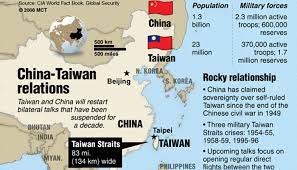
Trouble in Taiwan
Taiwan is not a country. Taiwan is an island off the coast of China much like Santa Catalina is an island off the coast of California. No one disputes that Santa Catalina is part of the United States, just as no one disputes that Taiwan is a part of China. The issue was settled long ago, and the US agrees with the results of that settlement. For all practical purposes, the issue has been resolved.
The United Nations does not recognize Taiwan’s independence nor do the 181 countries that have established diplomatic relations with China. In fact, the UN adopted a General Assembly Resolution back in 1971 acknowledging the “People’s Republic of China as the sole legal government representing the whole of China.”
The One-China policy explicitly relates to the status of Taiwan. Taiwan is part of China, that’s what the One-China policy means. Nations that want to have relations with China must agree on the status of Taiwan; it is the foundational principle upon which all relations with China are based. The issue is not debatable. One can either accept that ‘Taiwan is an inalienable part of China’s territory’ or take their business elsewhere. There is no third option.
The United States claims that it is committed to the One-China policy. In their recent visits to Beijing, all three senior-level officials from the Biden Administration (Anthony Blinken, Janet Yellen and John Kerry) publicly stated their unwavering support for the One-China policy. This is an excerpt from an article at Forbes:

Secretary of State Antony Blinken reiterated the U.S.’ position on its One China policy as he met with China’s leader Xi Jinping Monday, saying it does not support Taiwanese independence and that containing China’s economy was not an American goal….
Blinken said the U.S. held a “One China” policy and does not support Taiwanese independence, but is concerned about China’s “provocative actions” along the Taiwan Strait. Blinken Tells Xi Jinping U.S. Does Not Support Taiwanese Independence, After Meeting To Quell Tensions, Forbes
President Joe Biden has also stated his support for the One-China principle on many, many occasions, which is what you would expect since it is the official position of the United States government. Here’s a short recap on the issue from China’s Ministry of Foreign Affairs:
The US made the following commitments to China regarding the one-China principle in the three China-US joint communiqués.
In the Shanghai Communiqué released in 1972, the US explicitly stated that “The United States acknowledges that all Chinese on either side of the Taiwan Strait maintain there is but one China and that Taiwan is a part of China. The United States Government does not challenge that position”.
In the Joint Communiqué on the Establishment of Diplomatic Relations released in 1978, the US clearly stated that, “The Government of the United States of America acknowledges the Chinese position that there is but one China and Taiwan is part of China”.
In the August 17 Communiqué released in 1982, the US unequivocally stated that “In the Joint Communiqué on the Establishment of Diplomatic Relations on January 1, 1979, issued by the Government of the People’s Republic of China and the Government of the United States of America, the United States of America recognized the Government of the People’s Republic of China as the sole legal Government of China, and it acknowledged the Chinese position that there is but one China and Taiwan is part of China”, and that “it has no intention of infringing on Chinese sovereignty and territorial integrity, or interfering in China’s internal affairs, or pursuing a policy of ‘two Chinas’ or ‘one China, one Taiwan’”. (China’s Ministry of Foreign Affairs)
The western media would like their readers to think there is some “gray area” here and that the issue regarding China’s sovereign territory has not been settled. But—as we have shown—it has been settled. Taiwan is China. We must assume therefore that the media is being intentionally misleading in order to garner support for an “independence” movement that serves only one purpose; to legitimize the arming and training of US assets and insurgents that will be used in a bloody conflagration with China. In truth, the United States is laying the groundwork for a proxy-war on China, and Taiwan has been designated as the frontlines in that war. The independence movement is merely the cover Washington has chosen to conceal its real objectives.
This is why Taiwan has become a flashpoint in US-China relations. This is why numerous US-led delegations have visited Taiwan expressing their tacit support for Taiwan independence. This is why Congress has allocated millions of dollars to provide lethal weaponry for the Taiwanese military. This is why the US Navy has sent warships through the Taiwan Strait and conducted massive military drills on China’s perimeter. This is why Washington continues to provoke Beijing on the one issue that it is most sensitive. All of these incitements were conjured-up with one goal in mind: War with China. This is from Politico:
The Biden administration announced a $345 million weapons package for Taiwan on Friday, the first tranche in a total of $1 billion the U.S. has allotted to be transferred directly from Pentagon stockpiles to the island this year…..………………………………………………..
Repeat: “The move is sure to anger China.”
Indeed, the move was designed to anger China. That was clearly the point. But, why? Why is Washington challenging China on an issue on which there is virtually universal agreement?
- To goad China into overreacting and thus alienating itself from its allies and regional trading partners.
- To turn public opinion against China by portraying the country as a violent aggressor that poses a clear threat to its neighbors.
Here’s more from the World Socialist Web Site:
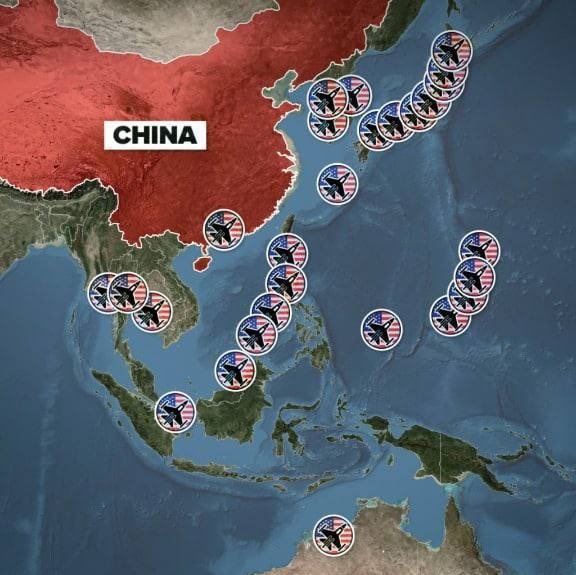
……………………………………………………………………………………………………………………………….. Preparing for war with China, US provides $345 million in arms to Taiwan,
Imagine if China sent millions of dollars of lethal weapons to a budding secessionist movement in Texas. ……………………………………………………………………………………………………………
And, ask yourself this: Haven’t we seen this drill before? Didn’t this same scenario unfold in Ukraine following the CIA-backed coup in 2014 after which the US armed and trained Ukrainian forces to dig-in and provoke hostilities with Russia?……………………………………………………………………………………………………………………………………………………………………………………
Let’s summarize:
- The Indo-Pacific is now America’s top foreign policy priority because that is the area that will experience the most growth
- The US will lead with its military and with the allies who share US interests
- “We will…modernize and strengthen our military” to prevail in our “strategic competition with major powers.”
- America’s Number 1 enemy is China; “the PRC presents America’s most consequential geopolitical challenge ….The PRC is the only competitor with both the intent to reshape the international order and, increasingly, the economic, diplomatic, military, and technological power to do it…”
- “The post-Cold War era is over” but the United States is prepared to preserve the “rules-based order” whatever the cost in blood and treasure.
This is America’s foreign policy in a nutshell. US leaders and their globalist allies are fully committed to prevailing in today’s great power struggle with Russia and China. They have a clear grasp of the objectives they want to achieve and they are prepared to risk anything, including nuclear war, to achieve them. Any developments in Taiwan must be seen through the lens of Washington’s geopolitical ambitions which are clearly driving events.…. more https://www.unz.com/mwhitney/target-china/
Campaign for Nuclear Disarmament Bypasses Gender Parity

“If there is one takeaway from Christopher Nolan’s recent film “Oppenheimer,” it is that the nuclear field has been male-dominated from the very start,”
participants in nuclear negotiations perceive that the field has rewarded characteristics, expertise and experiences that are more commonly associated with men, such as toughness, seriousness, risk-taking and military-training.
Such negotiations would be enhanced, and have more possibility for success, if they broadened the ‘diplomatic tool-box’ to also include ‘feminine’ approaches of flexibility, compromise, multi-faceted problem solving, compassion and human interaction (focusing on the people involved and not just the topics),
InDepthNews, By Thalif Deen https://indepthnews.net/campaign-for-nuclear-disarmament-bypasses-gender-parity/
UNITED NATIONS. 6 August 2023 (IDN) — The United Nations has been a vociferous and longstanding advocate of gender empowerment in its political, social and economic agenda characterized by 17 Sustainable Development Goals (SDGs), including poverty and hunger eradication, quality education, human rights and climate change.
In her 23 July presentation, titled Gender inclusivity and approaches to enhance the NPT Review Process, Vanessa Lanteigne, a Rotary Peace Fellow and representative of Parliamentarians for Nuclear Non-Proliferation and Disarmament (PNND), pointed out that in 2019, 76% of heads of delegations to the NPT were men, and that since 2000, all of the Presidents/Chairs of the NPT Prep-Coms have been male and only one President of an NPT Review Conference has been a woman.
She proposed that NPT institute targets for gender inclusion in State Parties’ delegations, with sanctions for imbalanced delegations similar to those applied by Inter-Parliamentary Union for its assemblies.
Lanteigne also noted that a fully-realized gender equality requires that issues, views, and approaches relating to characteristics associated with masculinity and femininity are both fully represented in security frameworks.
She cited the assessment by Ireland in its working paper Gender in the Non-Proliferation Treaty that the NPT Review process has traditionally taken a ‘one -dimensional security approach to addressing nuclear weapons, in terms of the issues which are prioritised’.
She proposed that the NPT establish a subsidiary body to explore nuclear non-proliferation, risk-reduction and disarmament issues in a broader security framework of common and human security incorporating gender, peace, diplomacy, conflict resolution and international law.
Jackie Cabasso, Executive Director at Western States Legal Foundation, told IDN it is completely obvious that women and gender non-conforming people are grossly under-represented in the NPT process.
“And it’s a matter of common sense that people of all genders should be equal partners in making decisions as consequential as the future of nuclear weapons”, she said.
It is also possible that establishing policies like the Inter-Parliamentary Union’s targets for gender balance in States Parties’ delegations to the NPT—enforced, if necessary, by voting sanctions, could help lead the way to improvements in gender equity in delegations’ home countries, said Cabasso, who co-founded the Abolition 2000 Global Network to Eliminate Nuclear Weapons.
However, when talking about how to challenge the seemingly intractable centrality of nuclear threats as an instrument of global domination, she argued, having equal participation in the discussion by all genders will not solve the problem.
“What is needed is a fundamental transformation in the mindset, values, and practices of the institutions that continue to place the construct of “national security” above the increasingly pressing need for universal “human security,” declared Cabasso.
Shampa Biswas, Judge & Mrs. Timothy A. Paul Chair of Political Science and Professor of Politics at Whitman College, Washington told IDN “It is appalling that we are still talking about gender parity in 2023!”.
“If there is one takeaway from Christopher Nolan’s recent film “Oppenheimer,” it is that the nuclear field has been male-dominated from the very start,” she pointed out.
However, although many fields have made great strides toward gender inclusivity, the nuclear policy-making field still remains woefully behind, said Biswas, is an international relations theorist specializing in postcolonial theory and nuclear politics.
“If we are serious about nuclear disarmament, it is imperative that we diversify the field in substantial ways to include voices that can draw attention to the dangers of nuclear weapons from a variety of perspectives and help redefine the meaning of security away from its masculinist, militarist connotations”.
Women’s voices, she said, are critical to that endeavor.
“I support the idea of instituting targets for more gender-inclusive delegations but wish there was a way to do this via incentives rather than penalties,” declared Biswas.
In her 23 July presentation on further strengthening the review process of the Non-Proliferation Treaty (NPT), Lanteigne said the NPT Review process would be enriched, strengthened and made more effective by elevating gender inclusivity and approaches because we could then access a full range of security approaches to our global challenges.
Gender inclusivity and approaches mean firstly that different sexes (male, female and nondeterminate) are included equitably in decision-making processes and leadership positions within the security sector.
And secondly, that diverse gender perspectives, issues and approaches to peace and security are meaningfully incorporated in order to utilize a more diverse, comprehensive and holistic security framework. Integrating these two principles that will support Security Council Resolution 1325 on Women, Peace and Security, which, “stressed the importance of ‘equal participation and full involvement’ of women and the need to increase [women’s] role in decision-making with regard to conflict prevention and resolution”.
Meanwhile, Sustainable Development Goal 5 focuses on gender equality and empowerment of women and girls.
There are indicators that state parties are not only aware and willing to work towards gender equity and inclusion but are actively referencing and promoting it on their own.
At the 2019 PrepCom more than 20 statements were made on behalf of over 60 State Parties addressing the importance of gender perspectives to the NPT, Lanteigne said.
Three papers were submitted directly related to nuclear issues and gender, and eight working papers included references to the links.
Reviewing policies to support equal access to participation is important because it is correlated with improved organizational efficiency and innovative capacity by including more diverse expertise resulting in creative solutions and sustainable developments.
But a gender-inclusive approach should be supplemented by gender-diverse analyses as well. Gender equality requires that issues, views, and approaches relating to characteristics associated with masculinity and femininity are both fully represented in security frameworks.
Research reports that participants in nuclear negotiations perceive that the field has rewarded characteristics, expertise and experiences that are more commonly associated with men, such as toughness, seriousness, risk-taking and military-training.
Such negotiations would be enhanced, and have more possibility for success, if they broadened the ‘diplomatic tool-box’ to also include ‘feminine’ approaches of flexibility, compromise, multi-faceted problem solving, compassion and human interaction (focusing on the people involved and not just the topics), she argued.
An example of a gender-inclusive approach which could hold lessons for the NPT Review Process comes from the Inter-Parliamentary Union Gender Partnership Group which was instituted to ensure that gender-diverse perspectives were incorporated and that the inclusion of women was not just a numerical representation but holistic in terms of representing security approaches more often associated with women.
Other examples of gender-inclusive principles and approaches can be found in the feminist foreign policies adopted by Canada, Germany, Ireland and Sweden among others.
These political steps forward, though, remain at risk of being rolled back like in the case of Sweden by succeeding governments highlighting the need to institutionalize the importance of gender in international organizations and procedures.
“We propose that the NPT establishes a subsidiary body to explore nuclear non-proliferation, risk reduction and disarmament issues in a broader security framework of common and human security incorporating gender, peace, diplomacy, conflict resolution and international law.”
“This broader framework of common and human security will be beneficial to giving gender-diverse perspectives opportunities to participate in conflict resolution and security fields to ensure that inclusivity is fully and substantively implemented and symbolic tokenism is avoided.” [IDN-InDepthNews]
Oppenheimer’ depicts a man becoming powerful—and irrelevant

By Laura Grego | August 4, 2023, https://thebulletin.org/2023/08/oppenheimer-depicts-a-man-becoming-powerful-and-irrelevant/?utm_source=Newsletter&utm_medium=Email&utm_campaign=MondayNewsletter08072023&utm_content=NuclearRisk_PowerfulAndIrrelevant_08042023
It was a packed house on Barbenheimer’s opening night—a box-office phenomenon of double feature viewing of Greta Gerwig’s Barbie and Christopher Nolan’s biopic Oppenheimer. It was a stormy night, too. So much so that we mistook the thunder outside for sound effects. (The sound design of Nolan’s film was spectacular and powerful, especially the silences.) I was glad to see Oppenheimer with longtime colleagues who work in this field. Like Nolan, so many of my cultural touchstones were about the Cold War. Generation X grew up acutely aware of the possibility of nuclear Armageddon, but it’s been a long time since teenagers were lining up for a film about nuclear weapons.
When I read Kai Bird and Martin J. Sherwin’s book American Prometheus, which the film is based on, a few weeks ago before seeing the movie, I was struck by a few things I hadn’t really known or understood about Oppenheimer. One surprise to me was how much J. Robert Oppenheimer was passionate about his two early loves: physics and New Mexico. By all accounts he loved the land and the people living there. And that love seemed to have been the reason the Manhattan Project’s secret laboratory was built in Los Alamos—though its remoteness seemed to suit the security needs of the project.
By the same logic, when came the moment of testing the bomb, the Trinity team selected a “suitably isolated” spot in the southern New Mexico desert for the first nuclear explosion. Little is said in American Prometheus about those who lived near the Jornada del Muerto site, only that the Trinity team had to “evict a few ranchers by eminent domain.” The scientists and engineers believed that the flat terrain and generally low winds would limit the spread of radiation. While the Tularosa basin was remote, about half-a-million people lived within 150 miles of the Trinity site. They were not warned or told to evacuate, neither before nor after the test. And data on civilian exposure from the Trinity test was not collected, so as not to alarm the public.
In fact, this negligence would become a regular feature of the post-war US nuclear test program, which included more than 200 aboveground nuclear explosions. Data collected by the National Cancer Institute shows the fallout from these tests has led to tens to hundreds of thousands of excess cancers. Some people have received compensation from the government for their illnesses, but not Trinity downwinders. (Though the Senate’s recent vote for a major expansion of the Radiation Exposure Compensation Act may remedy this.)
When I entered the theatre on that stormy night, I wondered whether Nolan’s Oppenheimer would pause to acknowledge that these first casualties of the nuclear age were in a place so close to the heart of Oppenheimer the man. In the end, the film’s perspective is Oppenheimer’s first-person, subjective point of view, with Nolan not inclined to widen the lens further. As someone who has worked on these issues for decades, I felt it to be a great weakness of the film, almost unforgiveable, to make so little room in a three-hour movie for those who suffered from the decisions made by “great men” in cloistered rooms. The film also fails by showing the Hiroshima and Nagasaki devastation only obliquely and reflected to us through Oppenheimer’s emotional remove.
Another thing that struck me in the book is that Oppenheimer’s strategy of persuading other scientists to join the project included his argument that the nuclear weapon would end not just the war in Japan, it would “end all wars,” once people understood the enormity of the weapons. Today it seems an incredibly naïve idea: 80 years later, the United States is still spending a billion dollars every five days to maintain its nuclear weapons. But how was Oppenheimer—so widely educated in history and philosophy and steeped in ethics—unable to see its consequences? Was he blinded by the greatness of his own creation or by ambition? Others would see this more clearly.
In the film, Oppenheimer’s friend and confidante Isidor Rabi provides a much-needed counterbalance to Oppenheimer’s intellectualizing, recognizing that the bomb “will fall on the just and unjust alike,” adding that he did not wish the culmination of three centuries of physics to be a weapon of mass destruction.
To retake control on what had been set in motion, it would have taken not only wisdom but more political savvy than Oppenheimer demonstrated. In the film, the scene in which the decision is taken to drop bombs on Hiroshima and Nagasaki skillfully shows an Oppenheimer who is being outmaneuvered. If he had really intended to argue the position of the Franck report and Szilard petition—two documents pressed on him by Manhattan project scientists—before the US political and military leadership, it seems it would have taken a different temperament and set of skills than he had. Oppenheimer was not the man for that moment.
Oppenheimer’s post-war attempt to advise the US government on nuclear weapons as a political insider ended in 1954 with the cruel public humiliation of the Atomic Energy Commission’s security hearing. After this, either because this experience broke him or he was not suited to the life of a nongovernmental critic, he essentially withdrew from the public debate about nuclear weapons almost entirely. He confined his comments mainly to abstracted and intellectual debates for the rest of his life. Oppenheimer did not sign the Einstein-Russell Manifesto against nuclear war, nor did he join the Pugwash Conferences thereafter.
As American Prometheus puts it, “Oppenheimer was still capable of being a critic; he just wanted to stand alone and with far more ambiguity than his fellow scientists. He was consumed with deep ethical and philosophical dilemmas posed by nuclear weapons, but at times it seemed that, as Thorpe put it, ‘Oppenheimer offered to weep for the world, but not to help change it.’”
Toward the end of the film, Oppenheimer is given an Enrico Fermi Award and being fêted—maybe because, as Einstein’s voiceover suggests, he was no longer so relevant.
-
Archives
- October 2026 (120)
- September 2026 (339)
- August 2026 (330)
- July 2026 (355)
- June 2026 (287)
- May 2026 (306)
- April 2026 (356)
- March 2026 (251)
- February 2026 (267)
- January 2026 (308)
- December 2025 (358)
- November 2025 (359)
-
Categories
- 1
- 1 NUCLEAR ISSUES
- business and costs
- climate change
- culture and arts
- ENERGY
- environment
- health
- history
- indigenous issues
- Legal
- marketing of nuclear
- media
- opposition to nuclear
- PERSONAL STORIES
- politics
- politics international
- Religion and ethics
- safety
- secrets,lies and civil liberties
- spinbuster
- technology
- Uranium
- wastes
- weapons and war
- Women
- 2 WORLD
- ACTION
- AFRICA
- Atrocities
- AUSTRALIA
- Christina's notes
- Christina's themes
- culture and arts
- Events
- Fuk 2022
- Fuk 2023
- Fukushima 2017
- Fukushima 2018
- fukushima 2019
- Fukushima 2020
- Fukushima 2021
- general
- global warming
- Humour (God we need it)
- Nuclear
- RARE EARTHS
- Reference
- resources – print
- Resources -audiovicual
- Weekly Newsletter
- World
- World Nuclear
- YouTube
-
RSS
Entries RSS
Comments RSS

