AI for peace: In Rome, Nobel laureates call for disarming AI and nuclear weapons
Bulletin, By François Diaz-Maurin, John Mecklin | Analysis | July 17, 2026
ROME—In a future nuclear crisis, the speed of artificial intelligence may leave little room for human judgment or decision-making. Other AI impacts—its potential to empower destabilizing cyber-attacks or allow for the near-instantaneous generation of disinformation—increase the odds of such a crisis occurring in the first place. Touching on these themes and others, an international group of Nobel Prize winners issued a pointed warning Thursday on emerging nuclear risks in an era of rapidly developing AI technology.
The group’s declaration, titled Humanity at the Threshold: A Declaration on Artificial Intelligence and Nuclear Weapons, followed two days of meetings among the Nobel laureates, top scientific and policy experts, and religious leaders in the Papal Villas of Castel Gandolfo, a summer retreat for popes since the 1600s.
Dubbed The Global Nobel Laureates Assembly on Artificial Intelligence and Nuclear War, the meetings included expert presentations on eight themes related to the rapid advance of AI models, their use in military systems that include command and control of nuclear weapons, and the practical and ethical challenges connected to efforts to reduce the dangers that the AI-nuke nexus poses to humanity.
The assembly followed recent efforts at highlighting the risks posed by the ongoing AI and nuclear arms races. Last year, the Nobel Laureate Assembly for the Prevention of Nuclear War met at the University of Chicago and issued a declaration calling on policymakers and leaders to reduce the threat of nuclear war. And earlier this month, the United Nations published its first scientific assessment report on the opportunities, risks, and impacts of AI; the assessment explains how the technology could exacerbate global inequality.
But this week marked the first time that such a large and diverse gathering of scientists, experts, activists, and religious leaders addressed, in concert, the risks of AI and nuclear weapons.
The Rome Declaration presented a harrowing description of the problem:
AI built into nuclear systems leaves little time for, or even replaces, human judgement in a crisis. This technology changes the context in which nuclear-armed states compete with each other. … AI uplifts cyber attacks that can fracture critical civilian and strategic infrastructure. AI enables information warfare: Peace depends on a shared reality. Without facts there can be no truth; without truth there can be no trust; and without trust, no dialogue, no verification, and no restraint among nations.
The most advanced AI capabilities, computing resources, and data infrastructures are becoming increasingly concentrated in a small number of countries and corporations, creating significant asymmetries of power and limited incentives for cooperation. AI is a technology that causes economic, military, and social disruption, and is developing at a pace unprecedented in human history.
In the midst of a worsening nuclear arms race, we are embarking on an equally dangerous AI race.
The declaration’s subtitle—Toward an Unarmed and Disarming Peace—reflected the religious underpinnings of the assembly by referencing language Pope Leo XIV used in his May encyclical Magnifica Humanitas: on safeguarding the human person in the time of artificial intelligence. The Vatican was able to convene a diverse group of thought leaders in a way that arguably would not be possible otherwise. It’s a group that could have real impact.
“I might reach a million people,” 2011 Nobel physics laureate Brian Schmidt said. “But the Pope can reach 2 billion. That’s 2,000 times more than me.”………………………………………………………………………….. https://thebulletin.org/2026/07/ai-for-peace-in-rome-nobel-laureates-call-for-disarming-ai-and-nuclear-weapons/?utm_source=ActiveCampaign&utm_medium=email&utm_content=In%20Rome%2C%20Nobel%20laureates%20call%20for%20disarming%20AI%20and%20nuclear%20weapons&utm_campaign=20260720%20Monday%20Newsletter
Nuclear deal that would permit uranium enrichment by Saudi Arabia in limbo awaiting Trump admin sign-off
18 July By Davis Winkie, Zachary Cohen, https://edition.cnn.com/2026/07/18/politics/saudi-arabia-trump-nuclear-enrichment
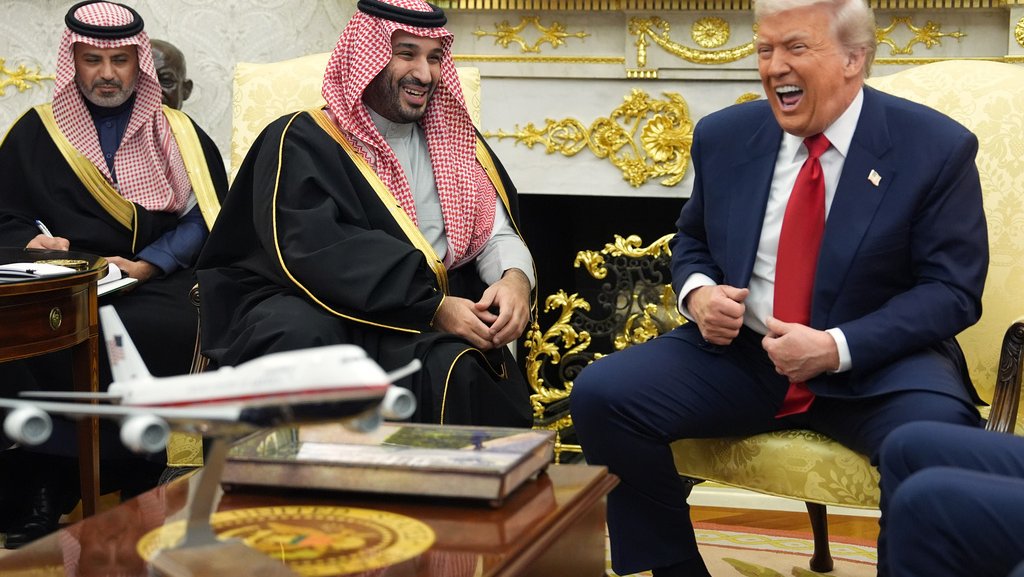
The Trump administration has tentatively agreed to allow Saudi Arabia to enrich uranium without enacting international safeguards intended to prevent nuclear weapons development, according to sources familiar with the matter and documents reviewed by CNN.
The draft nuclear accord that outlines US support for Riyadh’s civilian nuclear program is awaiting President Donald Trump’s signature despite US-Saudi negotiations concluding in October 2025.
Two sources familiar with the matter indicated that the ongoing war with Iran — which according to Trump was launched in part to prevent Tehran from using its enriched uranium to build nuclear weapons — has played a role in delaying Trump’s signature. Some on Capitol Hill also believe the Trump administration is delaying sign-off because it could face a bipartisan disapproval resolution blocking the deals from going into effect, said one of the sources.
Experts told CNN the deal could potentially provide Saudi Arabia with a path to nuclear weapons unless stringent safeguards are put in place. The country’s Crown Prince, Mohammed bin Salman, has previously threatened to build his own nuclear weapons should Iran, his country’s principal regional rival, acquire the bomb.
Four sources said the agreement, which includes a civil nuclear cooperation deal known as a 123 agreement and a mandatory nuclear safeguards agreement, still have not been sent to Congress for review, as federal law requires the White House to do once signed.
The White House did not answer questions regarding the agreements and instead referred CNN to an October 2025 statement from Energy Secretary Chris Wright announcing the end of negotiations.
“We’ve come together on a deal for civil nuclear cooperation,” Wright said at the time. “Together, with bilateral safeguard agreements, we want to grow our partnership, bring American nuclear technology to Saudi Arabia and keep a firm commitment to nonproliferation.”
The Saudi Arabian Embassy in Washington, DC did not respond to a request for comment.
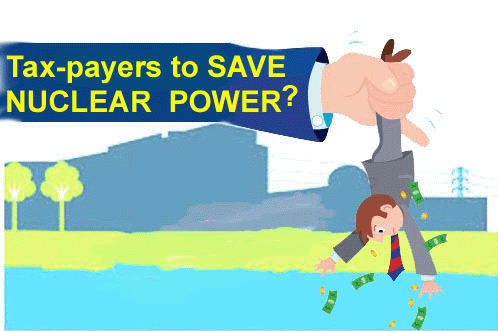
A Contract for Difference for nuclear lifetime extension for Sizewell B – a nice save for the nuclear industry?
Jérôme à Paris, Jul 22, 2026
A few days ago, the British government announced the extension of the production life of the 1.2 GW Sizewell B nuclear power plant for 20 years, from 2035, and that included the fact that the electricity produced will be sold under a CfD at a price of 70.50 GBP/MWh (in 2025 prices, to be indexed). ……….
it is proper that the power also be sold to ratepayers at a fixed price. The existence of the CfD will also allow the owners to achieve a lower cost of capital (possibly through limited-recourse financing, but in any case through more favorable corporate funding as such a revenue line underpins their balance sheet), ensuring that the price achieved could be more competitive….
Secondly, this puts the production cost risk on the operator (EDF in this case, with Centrica having a 20% stake), as they will have to deliver power at a fixed price, irrespective of what they need to spend to keep the plant running (I have not checked if they can wiggle out of the contract by stopping production earlier in case it becomes too costly to run, but I see that this would have other likely consequences, including reputational, for the operator in any case).
The third point is that this puts a very visible price tag to nuclear plant lifetime extension. There’s often the blithe assumption that existing plants can continue to run at a very low cost. This reminds everybody that it is not the case, and existing plants definitely have ongoing operating costs – and older plants have significant heavy maintenance, refurbishment and safety costs to manage. The price level proposed here can be seen as attractive for baseload decarbonated power, but it’s certainly not low or the most competitive available these days.
The big question is whether the price is actually the right one. There can only be rather limited competition for nuclear lifetime extension CfDs, so one must consider the temptation for the operator to pad its costs and ask for a price that ensures as profitable an operation as possible (I presume that the price level was negotiated on the basis of detailed cost assumptions provided by the operator and checked by the regulator and experts). There is also the risk that the operator could ask later on for relaxation of safety or other standards in order to lower its ongoing costs (including possibly via the direct or indirect threat to stop operations.
Against that is the fact that the nuclear industry cannot afford to show that it is materially less competitive than alternatives, in particular than offshore wind, the renewable sector with the most similar characteristic as nuclear (large capacity plants, higher capacity factor). If the ask price for extension is barely competitive against new-build offshore wind, what would that say about new-build nuclear? Hinckley Point negotiated a CfD a decade ago, which EDF is not very happy with, even though it is already quite a bit higher (it was 89.5 GBP/MWh for 35 years (rather than 20), indexed from 2012, which means its current level is 131 GBP/MWh, and we’re still some years before operations), given all the cost overruns experienced in the meantime……………………………….. https://jeromeaparis.substack.com/p/a-cfd-for-nuclear-lifetime-extension
Von der Leyen paints target signs on Europe with Ukraine drone pact
This is not sleepwalking into war. The European elites’ eyes are wide open and crazed.
The European Union has officially joined the war effort against Russia. This week, European Commission President Ursula von der Leyen signed a “historic pact” with Ukraine to integrate the production of combat drones to strike Russia.
According to Euronews reporting, the pact also envisages the joint production of ballistic missiles.
This scaled-up war effort will be funded by the €90 billion loan that the EU is releasing to Ukraine. A bill that will be paid for by generations of European taxpayers.
Von der Leyen was greeted in Kiev by Ukraine’s unelected martial-law president, Vladimir Zelensky. That makes two people who do not have a democratic mandate making decisions that are driving Europe to all-out war with Russia. Von der Leyen is a political appointee. She is not elected by popular ballot. Formerly, she was Germany’s Minister of Defense, and not a particularly bright one either. Dogged by corruption scandals and abuse of power over procuring Covid-19 vaccines from Big Pharma, von der Leyen is an exemplar of “failing upwards.”
On her 11th visit to Kiev since the conflict escalated in February 2022, von der Leyen declared that the “tide is turning” in the NATO proxy war against Russia. She was referring to the increase in long-range air strikes on Russian territory and the release of €90 bn to fund the war.
In a public speech, she brazenly announced that the European Union was explicitly allied with Ukraine as a participant in the war.
“In Europe, we already have huge technological and industrial capacity that can be deployed. And we have safe and secure production sites that can help to scale up,” von der Leyen said.
She added: “But we do not have that battle-tested knowledge and expertise that Ukraine has forged. So the point I am making is that we need to combine our strengths. Together, we can work on joint production.”
The innovation, which von der Leyen and her NATO planners presumably think is ever-so smart, is that European countries will produce munitions that are “safe” from Russian retaliatory strikes. The drones and missiles will be transported to Ukraine, from where they can be launched to hit deep into Russian territory to target the capital, Moscow, and take out oil industrial facilities all over the country. In recent months, NATO-backed Ukrainian drones have killed hundreds of Russian civilians. Von der Leyen’s pact with Ukraine is giving a green light to intensify this terror campaign.
But it’s von der Leyen’s arrogant sense of impunity that is astounding and should be viewed as deeply disturbing. She apparently assumes that European countries can serve as an arsenal of weapons for Ukraine to attack Russia. Yet, in her view, Russia is not permitted to take retaliatory action against the EU (and NATO) as a participant in the war. This is insanely reckless and stupid.
Of course, the European Union, NATO, and the United States have been participants in the proxy war against Russia since their coup in Kiev in 2014 to install and weaponize a NeoNazi regime. That background of weaponization and ideological programming culminated in war erupting in 2022. The Collective West has supplied an estimated $400 billion to prop up the regime since 2022, has supplied NATO mercenaries and advisors, as well as providing targeting logistics and operational expertise for long-range missiles.
Ukraine has also signed bilateral military pacts with individual EU countries, such as Germany, France, Denmark, the Netherlands, and Norway. Britain has signed a One Hundred Year Defense Pact. All of these arrangements provide weapons, warplanes, drones, and missiles.
However, the EU support that von der Leyen unveiled this week is a commitment from the entire 27-nation EU bloc to join the war on an industrial scale.
In April this year, the Russian Ministry of Defense published a list of European companies and their locations that it said were partners in Ukraine’s war effort. Russia said that these sites could henceforth be considered legitimate targets for retaliation. So far, Russia has refrained from directly striking any EU or NATO state. But how long this Russian restraint will last is a pressing question in the light of increasing provocation by the EU and NATO.
Von der Leyen has taken to describing the Ukrainian regime as a “net provider of security for Europe.” This is to supposedly justify European citizens enduring economic hardship as public monies are funnelled to the corrupt regime.
This week, on cue for the drone deal and fusing of the EU and Ukrainian economies, Zelensky reshuffled his Cabinet for the second time in only a matter of months in an attempt to give the impression that he was cleaning up notorious corruption. Prime Minister Yulia Syrvydenko was sacked because she was close to Zelensky’s former Chief of Staff Andriy Yermak, who was forced to quit owing to a massive corruption scandal involving military procurement. In his latest clean-up act, Zelensky made the mistake of sacking Defense Minister Myhailo Federov, sparking public protests in Kiev and other cities. Federov, who had only been in the job for six months, was seen as an earnest reformer. His efforts riled military commanders, such as Commander-in-Chief Oleksandr Syrskyi, who want the graft gravy train to continue running. No surprise that Zelensky backed the old guard to stay in place, especially as the €90 bn EU freight car is soon to arrive in Kiev.
Indeed, the tide is turning, but not in the way that delusional von der Leyen imagines. Russian forces on the ground are wearing down the last NATO-backed Ukrainian defenses while ramped-up Russian air strikes are destroying drone-making centers in Kiev and other cities.
That is why the EU and NATO are innovating a new tactic of removing drone production sites from Ukraine and seemingly out of Russia’s reach by stationing these sites in European nations. The implicit idea is that the EU can scale up the war effort safely without suffering any consequences.
The Russophobic EU leadership is driving Europe to war against Russia, as Professor Richard Sakwa commented this week in an interview with Glenn Diesen. The decisions are being made autocratically without any democratic mandate. Effectively, the EU has become a dictatorship for war. Another manifestation of this was seen at the Bastille Day parade in Paris on July 14, when NATO troops joined French and Ukrainian regiments in a unified show of belligerence towards Russia.
And brain-dead bureaucrats like Ursula von der Leyen on her €400,ooo a-year salary are happily painting target signs across European nations.
This is not sleepwalking into war. The European elites’ eyes are wide open and crazed.
New Swiss nuclear plants could put thousands of renewables jobs at risk
If nuclear power stations were to be authorised again in Switzerland, this would have a negative impact on employment in the construction and renewable energy sectors.
July 19, 2026 , https://www.swissinfo.ch/eng/energy-transition/new-swiss-nuclear-plants-could-put-thousands-of-renewables-jobs-at-risk/91767485
A recent study by the Zurich University of Applied Sciences (ZHAW) suggests that thousands of jobs are at risk. According to the authors of the study, simply lifting the ban on the construction of new nuclear power stations, without any other measures, would put between 5,800 and 9,500 jobs at risk in the photovoltaic and construction sectors over the next five years. Over the next ten years, the number of jobs at risk could rise to as many as 10,600.
The construction of a new nuclear power station would create new jobs but, as Switzerland would have to acquire the necessary expertise and technology from abroad, such a project would not even come close to offsetting job losses in the photovoltaic and construction sectors, according to researchers at the ZHAW.
The study states that “an energy and climate policy focused on renewable energy and building renovation is better not only from an environmental perspective, but also in terms of employment”. The ban on the construction of new nuclear power stations provided for in the Federal Act on Nuclear Energy “not only safeguards the strategy of investing in renewable energy, but also protects local jobs in Switzerland”.
In Switzerland, the construction of new nuclear power stations is currently banned, but the Swiss government and parliament are in favour of overturning the ban. At the end of June, however, a broad coalition of opponents launched a referendum against this decision. Swiss voters will likely be able to decide whether to lift the ban in February 2027. In 2017, the Swiss citizens voted against the construction of new nuclear power stations by approving the Energy Strategy 2050 with 58% of the vote.
A supercharged El Niño is threatening more deadly heatwaves — and Americans are ignoring the risks

Heat is America’s top weather killer
— but two-thirds of adults show little concern, experts discover. For
many Americans, summer now means confronting a punishing heatwave at some
point. The Fourth of July weekend was one such case: Triple-digit
temperatures led to dozens of deaths in New Jersey, canceled holiday block
parties across states and resulted in buckling rail lines.
A historic,
supercharged global El Niño event isn’t going to make matters any better
— with more intense heat domes forecast this year on top of rising
temperatures linked to climate change, meteorologist Jeff Berardelli, told
The Independent. “90 percent of models say this will be a ‘historic
event’…. An event so intense it doesn’t exist in our approximately
175-year record. And the models show big impacts worldwide,” he said.
Despite these extreme conditions, large numbers of Americans appear
indifferent. Some two-thirds of U.S. adults are not moderately or very
worried about extreme heat, according to a recent study by the Yale Program
on Climate Change Communication.
Independent 18th July 2026,
https://www.independent.co.uk/news/world/americas/heat-wave-climate-change-el-nino-images-b3015749.html
American forces struck a nuclear power plant under construction in southern Iran,
President Trump said American forces ‘hit Iran hard’ in honour of the US service members killed in Jordan on Friday
The state atomic energy
agency called the attack a “clear violation of international law”. The Atomic
Energy Organisation said that several projectiles hit the Darkhovin nuclear
power plant in Khuzestan province, but did not give details about possible
damage from the attack.
The United Nations’ International Atomic Energy
Agency (IAEA) called for restraint, adding that it was looking into the
reports. It also highlighted that the plant was in the “very early stages
of construction” and “contained no nuclear material when last visited
by the IAEA”.
Times 20th July 2026,
https://www.thetimes.com/world/europe/article/iran-claims-us-strikes-hit-nuclear-power-plant-0kb7cpghx
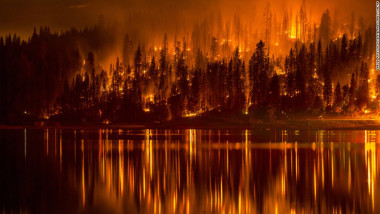
‘It’s only going to get worse’: wildfires forcing firefighters to make impossible choices
Ajit Niranjan and Caroline Davies
It’s only going to get worse’: wildfires forcing firefighters to
make impossible choices. As the climate crisis fuels more intense blazes,
pushing them to new parts of the world, those tackling them are forced to
ration resources and decide which to fight.
Guardian 18th July 2026,
https://www.theguardian.com/news/ng-interactive/2026/jul/18/the-impossible-choices-of-a-deadly-wildfire-season
Jacobs to assist in planning of UK SMR projects
In May, the company (Jacobs) was selected by GBE-N to provide
environmental services for potential SMR nuclear development at its Oldbury
site. Jacobs said that its work, with a multidisciplinary team including
AtkinsRéalis and AECOM, would cover terrestrial and marine environments,
environmental assessments, Habitats Regulations Assessment and “associated
activities to inform future potential planning, design and permitting
decisions”.
World Nuclear News 21st July 2026 https://www.world-nuclear-news.org/articles/jacobs-to-assist-in-planning-of-uk-smr-projects
Two more Czech sites lined up for Rolls-Royce SMRs
The Czech Ministry of Industry and Trade, ČEZ and Rolls-Royce SMR have
signed a memorandum of understanding to start preparatory activities for
small modular reactor projects at two more locations. There is already a
project being worked on by ČEZ and Rolls-Royce SMR for the UK-based
company’s 470 MWe small modular reactors (SMRs) at the existing nuclear
power plant site of Temelín, in the South Bohemian region. The
newly-signed agreement means work can take place for the next proposed SMR
projects at the Tušimice site in the Ústí nad Labem region and
Dětmarovice site in the Moravian-Silesian region.
World Nuclear News 21st July 2026, https://www.world-nuclear-news.org/articles/two-more-czech-sites-lined-up-for-rolls-royce-smrs
First SMR deal in Argentina is ‘nuclear investment landmark’
The plan would mark the largest investment in Argentina’s nuclear sector and add a
privately financed Gen III+ SMR to a site already home to Atucha I, Atucha
II, and the ongoing Atucha I life-extension programme.
Modern Power Systems 21st July 2026, https://www.modernpowersystems.com/news/first-smr-deal-in-argentina-is-nuclear-investment-landmark/
Crunch time for the nuclear lobby’s biggest lie (Small Modular Nuclear Reactors)?
22 July 2026, https://theaimn.net/crunch-time-for-the-nuclear-lobbys-biggest-lie-small-modular-nuclear-reactors/
There could be a big drama now, about Small Modular Nuclear Reactors sort of not really going to happen in the UK. But I don’t think so. The nuclear lobby is adept at twisting a negative outlook into a sorta positive one. And I’m sorry to say, but I think that Andy Burnham might just co-operate in this process.
At the moment, the UK, and the world, are waiting for the UK’s new progressive poster boy, Andy Burnham, to declare his policies on all sorts of things. His general theme is “left of centre”, socially progressive, with the emphasis on economic reform – “business-friendly socialism”. Most likely, Burnham’s approach to the big issues of climate and nuclear will be a cautious “business-as usual.” Those who are deeply concerned about climate and nuclear issues can hardly blame him. Unfortunately, the reality is that Burnham could never have got where he is now, if he bucked the prevailing system, with Labour now a kind of weaker Tory party.
At the moment, the UK, and the world, are waiting for the UK’s new progressive poster boy, Andy Burnham, to declare his policies on all sorts of things. His general theme is “left of centre”, socially progressive, with the emphasis on economic reform – “business-friendly socialism”. Most likely, Burnham’s approach to the big issues of climate and nuclear will be a cautious “business-as usual.” Those who are deeply concerned about climate and nuclear issues can hardly blame him. Unfortunately, the reality is that Burnham could never have got where he is now, if he bucked the prevailing system, with Labour now a kind of weaker Tory party.
What has this got to do with Small Modular Nuclear Reactors?
Well, as I have written before, the global nuclear lobby now depends on the UK to kick off the new nuclear renaissance, with a fleet of small nuclear reactors in the UK, as promised by the previous Prime Minister with his Great British Energy – Nuclear. The stated purpose is to provide the UK soon, with cheap, plentiful, clean, climate-friendly, proven technology, safe, community-welcomed, waste-free, peaceful electricity. In that statement there are already 10 lies. Of all those lies, I would say that “soon” is the biggest whopper of them all.
SOON
The most “exciting” SMR plan, that of Poland-based SGE (Synthos Green Energy), promises 14 SMRs in operation by 2034. That would provide about the same amount of electricity as one large nuclear reactor. However, SMRs that each provide 300 MW would provide very much more – but then they would have to be larger, and no longer qualify as “small”. Either way, that would be only a beginning – many, many more SMRs would be needed to meet the UK’s electricity needs. And, let’s not forget – the coming wave of data farms for artificial intelligence is going to probably double that need.
So, even in the most optimistic scenario, SMRs are not going to cut the mustard for showing the world that soon Small Modular Nuclear Reactors will power a nation. Of course the promise of “soon” also relates to the claim that SMRs are needed for action on climate change. Clearly, they are going to be irrelevant, too late for reducing greenhouse gas emissions, whereas we have renewable energy right now. And of course, but rarely mentioned – energy efficiency, energy conservation – the really effective way to reduce greenhouse emissions.
CHEAP
The next biggest whopper about Small Modular Nuclear Reactors is the statement that they would be cheap. Here we get into the minefield of deliberate obfuscation about the financial facts. The cost of building SMRs is likely to be astronomic, and the only practicable way is to build them en masse. That would mean that the company building them would need to have big orders, not just for one or two reactors. Big orders bring with them a heap of problems. Like an IKEA cupboard, these “modular” items are all the same – if you buy a whole lot of them they’d better all work out perfectly – no chance really to just try out one. Buyers are reluctant, and so are investors.
Of course, the argument will be that SMRs will provide cheap electricity. Well that absolutely would necessitate economies of scale. That was the reason that the idea of small reactors was abandoned in the past. Simply, a large reactor producing a huge amount of electricity has got to produce it more efficiently and cheaply. The proponents of SMRs never talk about the accompanying costs – insurance, the security staff required, the transport and disposal of toxic long-lasting wastes. The truth is, those proponents absolutely know that their product is in fact very expensive. And that is why the subservient corporate media consistently baffle us with convoluted arguments that minimise the cost to tax-payers. They know damn well that the only way that SMRs could possibly be developed is by government funding. Keir Starmer backed a Rolls Royce plan that would be blatantly funded by the tax-payer. The SGE plan purports to be privately funded, but it’s tangled up with various government-funded schemes.
These were 2 lies – but there are 8 more to go.
Plentiful? – well, apart from Russia and China’s 2 duds – SMR’s don’t actually exist – quite the reverse of plentiful.
Clean? They are still part of a dirty production system, starting from uranium mining, with its workers exposed to radiation, and its piles of radioactive tailings.
Climate-friendly? There is a whole chain of steps from mining through to waste disposal that involve fossil fuel energy.
Proven technology? Well, they don’t even exist.
Safe? SMRs can’t melt down in the same way as big reactors, but still contain radioactive material, a target for theft, terrorists or military attacks Can still have accidents releasing radiation.
Community-welcomed? This really is a big one, with a lack of proper consultation on plans – There’s strong resistance from some local groups, such as Radiation Free Lakeland.
Peaceful? The hidden military pressures behind the new push for small nuclear reactors.
Wastes? Stanford-led research finds small modular reactors will exacerbate challenges of highly radioactive nuclear waste.
Now that Starmer, with his big promises, has gone, it’s probably no longer up to the UK’s Prime Minister to lead the global charge on small nuclear reactors. Andy Burnham has to negotiate the whole troubled energy scene, try to be progressive, placate the fossil fuel lobbies, and the nuclear lobby. He has been very quiet on nuclear policy, but he is committed to the existing defence and AUKUS nuclear agreements. So for “peaceful” nuclear, he’s most likely to go for a compromise – SMRs, supporting just a few, rather than the much-touted “fleets” of them.
So, no doubt the USA will take up the torch – One Year After Executive Orders, U.S. Nuclear Energy Renaissance is in Full Swing.
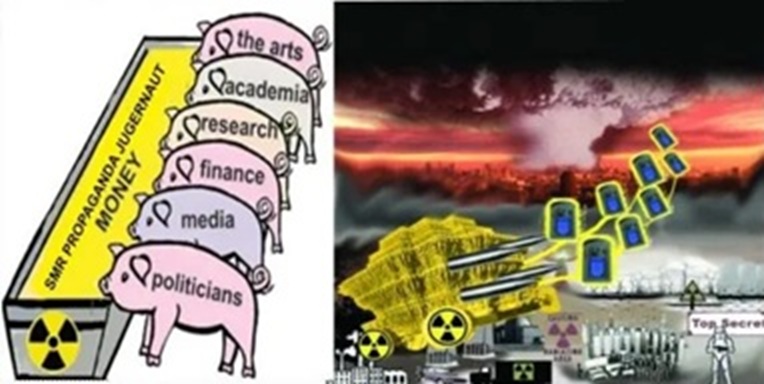
The media is awash with the wonder of new nuclear reactors, in concert with the AI data farm boom. The few voices who call for restraint, and point out the problems, are drowned out by the cacophony of handouts from the companies promising SMRs, handouts faithfully regurgitated by the corporate media, and by those universities which have bought into the propaganda.
There are the many good, decent people, whose living depends on their work within the uranium-nuclear-defence industries. And communities that are caught up in the nuclear industry, and its associated government bonuses. And many professionals, especially journalists, who, if they paused to look at the whole picture, might see the folly and the danger and the lies, of this so much touted technology. And of course, politicians who would be out of a job if they opposed the sacred cows of new energy and nuclear defence. So the whole SMR juggernaut moves on, bit by bit, and has itself become one big lie.
Are Trump and AI driving a nuclear power boom?

July 20, 202 By Berly McCoy, Geoff Brumfiel, Regina G. Barber, Rebecca Ramirez, https://www.npr.org/2026/07/20/nx-s1-5884889/are-trump-and-ai-driving-a-nuclear-power-boom
A race started by President Trump is leading to the rapid construction of new, experimental nuclear reactors. If they work, they could power data centers for artificial intelligence. But critics worry that the breakneck pace is compromising safety and public trust. NPR correspondent Geoff Brumfiel talks about the potential risks and benefits, and whether this may lead to a new nuclear age.
Red, white and glowing blue: Trump’s push for new reactors reaches the finish line
June 29, 2026, Geoff Brumfiel, https://www.npr.org/2026/06/29/nx-s1-5847944/new-nuclear-reactors-america-250-safety-concerns
A little over a year ago, President Trump set an ambitious goal: He wanted to see American companies build at least three new experimental nuclear reactors by July 4, 2026, the 250th anniversary of the Declaration of Independence.
Shortly after Trump signed an executive order enshrining his goal, the Department of Energy launched its Reactor Pilot Program. The program is designed to help companies build and run test reactors quickly, in part by radically cutting back on the regulations required for such reactors.
That program has sparked a nuclear race, and with less than a week to go, two companies have already reached the goal of switching on their reactor (“going critical” in nuclear-speak).
On June 4, Antares Nuclear announced it had gone critical, and Valar Atomics said it went critical on June 18 and is now producing tens of kilowatts of heat from its new reactor core, which is operating out of a tentlike structure in the Utah desert.
Other companies are getting close to making the deadline, and all this happened in less than the span of a year.
“We haven’t done anything this fast, basically ever,” said Nick Touran, chief nuclear officer at Ocean Atomics, which seeks to put nuclear power onto civilian ships. His company isn’t part of this program, but he has been tracking it closely.
He says this pilot program could jump-start America’s nuclear industry.
“I’m just excited that we’re now actually building these little reactors and trying it out and we’re going to look at what the economic story is and find out if there’s a market,” he said. “It’s going to be so much better than sitting there talking about it like we did for the last 40 years.”
But for others, the speed sparks alarm. The race is “essentially an exercise in public relations,” said Edwin Lyman, director of nuclear power safety at the Union of Concerned Scientists. And, he added, the slashing of regulations undoes decades of safety lessons learned in the nuclear industry.
“This is taking us back to the 1950s, and that is not progress,” he said.
Building the core
A lot of the action is happening at the Department of Energy’s Idaho National Laboratory, where several of the companies have set up shop. One of them is Radiant, which hopes to build small reactors for everything from disaster relief to data centers. Rita Baranwal, the firm’s chief nuclear officer, said they are assembling their reactor inside a special secure building called the DOME.
“By July 4, we’re tracking to get the reactor into DOME and to initiate the testing,” she told NPR this month.
Initiating testing isn’t quite the same as going critical, and Baranwal said Radiant probably won’t be critical by the July 4 deadline. But she does expect that Radiant’s reactor will be running soon. “The only thing we will not be doing at [Idaho National Laboratory] this summer is generating electricity,” she said.
Radiant’s reactor looks radically different from the massive reactors that exist today. It’s far smaller, and its nuclear fuel takes a different form. In a modern power reactor, nuclear fuel is loaded into long tubes, but Radiant’s reactor uses little nuclear fuel balls filled with grains of uranium. “Do you remember gobstoppers?” Baranwal said
These nuclear gobstoppers can operate at higher temperatures and are more resistant to melting down. Radiant and several other companies plan on using this type of fuel along with other tech to build a bunch of smaller, more mobile reactors.
“We have broken ground on our factory to mass-produce reactors. We’re targeting around 50 per year,” she said. (Currently, 96 reactors are operating in the United States.).
Safety worries
To get the reactors built this quickly comes at a cost. This year, NPR reported that the Energy Department completely rewrote its safety and security standards to make it easier for companies to win regulatory approval. The department has said that the cut regulations were “unnecessary” and that safety hasn’t been compromised.
The department consulted with the companies but not with the public. It also exempted the new reactors from environmental reviews.
And that has some skeptics of the program worried.
“Yes, of course, if you bend all the rules, you can do things quickly,” said Lyman, referring to the Energy Department’s decision to rewrite its rules for the program.
The test reactors might be working, he said, “but that should not be confused with anything related to a nuclear power reactor that’s capable of producing electricity in a stable and safe way.”
Lyman said he worries that deregulation will erode standards for things like how much security is required or how much environmental monitoring should be done, at a time when these mass-produced little reactors could start popping up at locations all over the country.
Ceases to be a nuclear power’: The high-stakes deal the new UK PM inherits

SBS News, 21 July 2026 By Yasmine Alwakal
Andy Burnham has inherited a major AUKUS commitment with Australia. Whether Britain can deliver it is another question
IN BRIEF
- On Monday, former Manchester mayor Andy Burnham succeeded Keir Starmer as the United Kingdom’s prime minister.
- Experts say the change in leadership could impact the UK’s investment in defence but is unlikely to impact AUKUS.
Labour leader Andy Burnham has become the United Kingdom’s seventh prime minister in a decade — but experts say it remains unclear how the former mayor of Greater Manchester will approach the country’s most important strategic partnership with Australia.
Newly departed UK Prime Minister Keir Starmer suffered a high-profile split with his defence secretary, John Healey, over a perceived failure to properly fund the department.
Burnham now inherits Starmer’s £298bn ($573b) defence spending commitment over the next four years, £4.7b ($9b) of which is unfunded and will need to make up part of Burnham’s first budget.
Experts have said that, while Burnham is unlikely to renegotiate the AUKUS agreement, defence is likely to play a central position in the new UK leader’s job description, given the growing threat of Russia to NATO members.
Jennifer Parker, a non-resident fellow at the Lowy Institute, told SBS News that policymakers in Australia will be watching Burnham’s approach to foreign affairs closely.
“I think there are broader questions about the implications of Andy Burnham’s views on defence and the defence investment plan in the UK … [but] in many ways, AUKUS is critical for the UK,” Parker told SBS News.
The UK, alongside Australia and the United States, entered into trilateral AUKUS security agreement in 2021.
The deal is divided into two key pillars: Australia’s acquisition of conventionally-armed, nuclear-powered submarine capability and the development and delivery of advanced capabilities such as underwater drones.
In July 2025, Australia also entered into a bilateral agreement with the UK dubbed the Geelong Treaty. The 50-year agreement enables the cooperative design, building, operation, sustainment, and disposal of nuclear-powered submarines known as SSN.
Will Burnham deliver on the UK’s AUKUS commitments?
Since 1968, the UK has been a member of the Nuclear Non-Proliferation Treaty and is recognised as one of the five permanent members of the United Nations Security Council.
Parker said since the end of the Cold War the UK has operated ballistic missile submarines called SSBNs:
“Now, you need to have SSN’s — attack submarines — to be able to protect your ballistic missile submarines. AUKUS, for the UK makes designing, building and operating SSN’s cheaper. So, it makes it easier.”
That’s why she believes the UK, whether led by current UK Prime Minister Keir Starmer or the incoming Burnham, will continue to uphold its AUKUS commitments.
“If the UK can’t achieve AUKUS … the long-term impact is quite significant in terms of the UK ceases to be a nuclear weapons power. Which really changes its global status.”
According to the Australian government, the UK will deliver its first SSN’s by the late 2030s. Defence Minister Richard Marles said the first class of Australian-built submarines is intended to enter service by the early 2040s…………………………………………………………………..
Parker from the Lowy Institute also believes the Australian government will watch to see if the UK takes “strides” to address what she described as capability constraints facing UK submarine industrial bases………….
“As much as I’m confident they’ll make it [AUKUS] work, whether they’ll make it work within the stated time frames is genuinely an open question.”
The UK’s defence committee has launched an inquiry into its military resilience and preparedness. It follows a July report by its defence ministry, which found that 47 out of 49 major defence projects in the UK were delayed or over budget.
In a statement, Dan Jarvis, the newly appointed defence secretary, said:
“Many projects had been announced with insufficient or no funding at all. The consequences were profound: limited availability of warships and aircraft, an army facing a recruitment crisis, morale weakened and renewal of our nuclear deterrent delayed.” https://www.sbs.com.au/news/article/andy-burnham-aukus-submarine-deal-australia/j38e9qzzf
1 This Month





PLEASE OPPOSE HR 8255 AND S.3639 – bills would accelerate satellite deployment, with no environmental review or safeguards – https://ncstd5li.quorum.us/campaign/169331/
To see nuclear-related stories in greater depth and intensity – go to https://nuclearinformation.wordpress.com
-
Archives
- October 2026 (49)
- September 2026 (339)
- August 2026 (330)
- July 2026 (355)
- June 2026 (287)
- May 2026 (306)
- April 2026 (356)
- March 2026 (251)
- February 2026 (267)
- January 2026 (308)
- December 2025 (358)
- November 2025 (359)
-
Categories
- 1
- 1 NUCLEAR ISSUES
- business and costs
- climate change
- culture and arts
- ENERGY
- environment
- health
- history
- indigenous issues
- Legal
- marketing of nuclear
- media
- opposition to nuclear
- PERSONAL STORIES
- politics
- politics international
- Religion and ethics
- safety
- secrets,lies and civil liberties
- spinbuster
- technology
- Uranium
- wastes
- weapons and war
- Women
- 2 WORLD
- ACTION
- AFRICA
- Atrocities
- AUSTRALIA
- Christina's notes
- Christina's themes
- culture and arts
- Events
- Fuk 2022
- Fuk 2023
- Fukushima 2017
- Fukushima 2018
- fukushima 2019
- Fukushima 2020
- Fukushima 2021
- general
- global warming
- Humour (God we need it)
- Nuclear
- RARE EARTHS
- Reference
- resources – print
- Resources -audiovicual
- Weekly Newsletter
- World
- World Nuclear
- YouTube
-
RSS
Entries RSS
Comments RSS

