This Hiroshima Day, we are closer than ever to nuclear war

Today’s Western leaders are casually confrontational, seizing ships on the high seas from nuclear-armed rivals, holding Nato competitions on how to disable targets inside Russia, the country with the world’s biggest nuclear arsenal.
Editorial / 5 August 2026,
https://morningstaronline.co.uk/article/hiroshima-day-we-are-closer-ever-nuclear-war
HIROSHIMA DAY commemorates the atomic bombing of the Japanese city by the United States 81 years ago.
The atrocity not only killed hundreds of thousands instantly and condemned many more to painful, lingering deaths. It took the world into the atomic age: one in which wars, already hugely more destructive than in previous eras thanks to industrialisation, could plausibly spell the end of human civilisation itself.
Three days after Hiroshima the US dropped a second atom bomb on Nagasaki.
That remains the last time a nuclear weapon was used in conflict. Decades of testing followed, many of which would claim their own victims through radiation poisoning and the resulting cancers, in some cases over multiple generations. But the horror of nuclear war that grew from the radioactive ruins of Hiroshima and Nagasaki has proved strong enough to prevent a repeat performance — so far.
That situation is changing. There is no room for complacency — the Doomsday Clock, standing at its closest ever, 85 seconds, to midnight, accurately reflects a world in which nuclear weapons are closer to being used than at any time since 1945.
Even avoiding nuclear war to date has been a chancier thing than most accounts recognise. When rival camps are armed to the teeth, suspicion and misinterpretation can be the path to catastrophe.
World War III was avoided during the Cuban Missile Crisis not just because the Soviet and US governments agreed an off-ramp, but because a Soviet submarine officer, Vasili Arkhipov, defied the vessel’s captain and political officer, who believed depth charges dropped on it by US warships signalled the outbreak of war, and refused permission to launch a nuclear torpedo in retaliation.
Two decades later, the caution of another Soviet officer, Stanislav Petrov, again prevented war when the country’s early warning system malfunctioned, indicating incoming US missiles that could have prompted retaliatory strikes.
Both incidents show how close to the edge we have been.
Today, nuclear weapons stockpiles are not so large as in the cold war — but still easily large enough to kill a majority of human beings and precipitate the collapse of global agriculture and trade.
HIROSHIMA DAY commemorates the atomic bombing of the Japanese city by the United States 81 years ago.
The atrocity not only killed hundreds of thousands instantly and condemned many more to painful, lingering deaths. It took the world into the atomic age: one in which wars, already hugely more destructive than in previous eras thanks to industrialisation, could plausibly spell the end of human civilisation itself.
Three days after Hiroshima the US dropped a second atom bomb on Nagasaki.
That remains the last time a nuclear weapon was used in conflict. Decades of testing followed, many of which would claim their own victims through radiation poisoning and the resulting cancers, in some cases over multiple generations. But the horror of nuclear war that grew from the radioactive ruins of Hiroshima and Nagasaki has proved strong enough to prevent a repeat performance — so far.
That situation is changing. There is no room for complacency — the Doomsday Clock, standing at its closest ever, 85 seconds, to midnight, accurately reflects a world in which nuclear weapons are closer to being used than at any time since 1945.
Even avoiding nuclear war to date has been a chancier thing than most accounts recognise. When rival camps are armed to the teeth, suspicion and misinterpretation can be the path to catastrophe.
World War III was avoided during the Cuban Missile Crisis not just because the Soviet and US governments agreed an off-ramp, but because a Soviet submarine officer, Vasili Arkhipov, defied the vessel’s captain and political officer, who believed depth charges dropped on it by US warships signalled the outbreak of war, and refused permission to launch a nuclear torpedo in retaliation.
Two decades later, the caution of another Soviet officer, Stanislav Petrov, again prevented war when the country’s early warning system malfunctioned, indicating incoming US missiles that could have prompted retaliatory strikes.
Both incidents show how close to the edge we have been.
Today, nuclear weapons stockpiles are not so large as in the cold war — but still easily large enough to kill a majority of human beings and precipitate the collapse of global agriculture and trade.
More countries possess them. Even if every nuclear-armed government were led by level-headed and responsible politicians, this would increase the number of potential flashpoints where a miscalculation could ignite the world.
In fact some are led by leaders without these qualities. India’s Narendra Modi repeatedly threatens to cut off Pakistan’s water supply, a genocidal policy. Israel’s Benjamin Netanyahu is already waging a genocidal war against the Palestinian people and attacking countries across the region, from Iran to Lebanon and Syria. US President Donald Trump threatens war on multiple continents simultaneously; has openly threatened to destroy an entire civilisation (Iran) in one of those wars; and clearly begins wars without clear goals or an exit strategy, all risk factors for escalation. These are reckless people.
Cold War decision-makers could remember World War II, the scale of death and destruction entailed by total war between great powers. So too could their populations, who through mobilisations like the Aldermaston marches or at Greenham Common demonstrated their opposition to war.
Today’s Western leaders are casually confrontational, seizing ships on the high seas from nuclear-armed rivals, holding Nato competitions on how to disable targets inside Russia, the country with the world’s biggest nuclear arsenal.
Either a generation in which war is something that can be comfortably inflicted, without serious risk, on weaker countries like Yugoslavia or Iraq has bred a false sense of security — or they are as bloodthirsty as their generals’ demands that we “sacrifice our children” to the next great war suggest.
There is no leadership from our leaders, so it must come from below. We must re-learn the fear of nuclear war that previous generations understood — and we must use it to build a powerful movement for peace and disarmament.
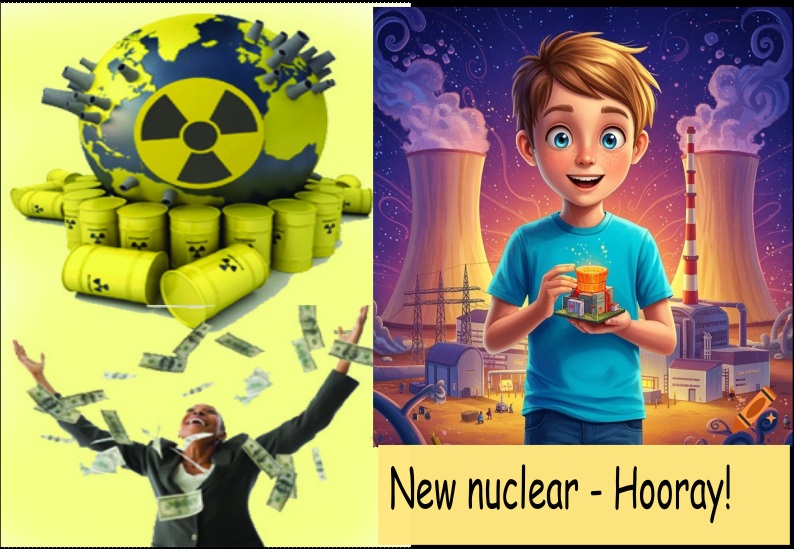
Nuclear waste delivers a political haymaker. Five states say it can be done.
By Francisco “A.J.” Camacho, Hannah Northey | 08/05/2026, https://www.eenews.net/articles/nuclear-waste-delivers-a-political-haymaker-five-states-say-it-can-be-done/
From proposals to bury waste under the Gulf of Mexico to shooting canisters deep underground, GOP-led states mainly see economic opportunity.
Five Republican-led states are now jockeying to host nuclear technology hubs — and possibly spent nuclear fuel — in a show of heightened political interest in breaking through chronic barriers to new U.S. reactors.
Oklahoma, Louisiana, Idaho, Tennessee and Utah are in the running to host Nuclear Lifecycle Innovation Campuses — Energy Department-backed facilities that would support the full nuclear fuel cycle, from enriching uranium and fabricating fuel to reprocessing and disposing of waste.
But even as states raise their hands, and by and large view fuel enrichment and disposal as an economic opportunity, the thorny politics and financing of new long-term nuclear projects and waste disposal also remain challenges as they negotiate terms with the Trump administration.
All five finalists called for reprocessing nuclear waste into new reactor fuel, but they varied in tone and technique for ultimate disposal of nonrecycled waste.
“Oklahoma proposes to become the first U.S. state to establish a permanent disposal solution before it begins commercial nuclear deployment. No country in the world has done this,” Oklahoma officials said in the state’s proposal.
Idaho, in contrast, seems hesitant to handle waste long term, although it, alongside Utah and Oklahoma, expressed interest in drilling deep boreholes and dropping the waste hundreds of meters underground. Louisiana is eyeing underwater disposal underneath salt domes in the Gulf of Mexico. Tennessee seeks the more conventional route by mining a repository in the eastern part of the state.
“There have been some states that have been more open to this at times, and it sort of goes back and forth,” said Allison Macfarlane, a geologist and former Nuclear Regulatory Commission chair during the Obama administration, adding that New Mexico, Texas and Wyoming were all previously interested in hosting a repository before plans fizzled out. “It’s really important that you have an implementer that knows what it’s doing and does this carefully, because otherwise you’re looking at this going sideways yet again.”
A decade and a half ago, Congress slashed project funding and halted construction of a sole waste repository at Nevada’s Yucca Mountain, in line with opposition from state residents and its elected leaders. Then-Senate Majority Leader Harry Reid (D-Nev.) was a powerful critic of the Yucca solution. That left the United States with no effective long-term solution for the country’s most radioactive waste as it collected across America’s 57 nuclear power plants.
Nevada’s Democratic senators returned to the question Tuesday, introducing legislation that would change a legal framework put in place by Congress directing the federal government to identify a sole waste depository. The Jobs, Not Waste Act sponsored by Sens. Jacky Rosen and Catherine Cortez Masto would prohibit future consideration of Yucca Mountain as the nation’s permanent repository.
Getting state buy-in to host a voluntary disposal site is seen as crucial to avoid Yucca’s pitfalls, and DOE has offered some carrots with the new innovation campus program. The department says it may offer technical expertise, cost-sharing or loan guarantees to develop a campus, and it claims each campus could attract up to $50 billion in capital investment, $25 billion in state and local tax revenue, and 25,000 jobs.
With midterms looming in November, POLITICO spoke with elected officials and technical experts about each state’s disposal proposal for tackling the generational scientific, regulatory and political challenge.
Oklahoma
Oklahoma proposes working with a startup company to drill boreholes in the Anadarko sedimentary basin in western Oklahoma for permanent waste disposal.
“Oklahoma does not have a nuclear background, but knows energy well,” Lake Barrett, a former DOE nuclear staffer through several administrations, told POLITICO. “Their proposal is light on specifics, but seems serious.”
While partnering with Santa Clara, California-based Oklo for fuel reprocessing, Oklahoma would also work with Berkeley, California-based Deep Isolation on borehole disposal. Deep Isolation plans to drill 18-inch-wide boreholes “hundreds of meters” underground. Once drilled, canisters of waste can be slotted down until the given hole is full.
A 2020 paper co-authored by Macfarlane found few areas of the U.S. have optimal conditions for borehole waste disposal. The Anadarko Basin has shale gas reservoirs and heightened earthquake risks poorly suited for borehole waste, according to the article.
Barrett further notes that the Anadarko Basin partially overlaps with the Ogallala Aquifer, an underground freshwater supply.
Deep Isolation agrees that the concerns identified by Macfarlane and her co-authors must be evaluated through site-specific characterization and modeling, but it argues that their article overstates the technology’s hurdles.
“Oklahoma meets all preliminary site-screening criteria in Deep Isolation’s published site evaluation framework,” Oklahoma officials said in their pitch to DOE.
Louisiana
Among the potential hubs put forth by Louisiana Gov. Jeff Landry (R), one envisions storing waste in salt domes under the Gulf of Mexico.
Here again, there’s a long history. In 1987, then-Louisiana Sen. J. Bennett Johnston (D) successfully scuttled plans to dispose of waste in his state by diverting it to Nevada and Yucca Mountain. Some liberal groups are contrasting that with Landry’s willingness to entertain disposal more than 3 miles into the Gulf of Mexico.
“Even as Louisiana was at its economic nadir, fighting for solvency, [Johnston] realized that a nuclear waste dump was not the answer; that whatever short-term economic gains and temporary construction jobs would come into the state would not be worth the long-term damage to the state’s environment and reputation,” Jan Moller, CEO of the Louisiana Budget Project, wrote in a Substack post.
Republican Sen. John Kennedy of Louisiana, who also chairs the Energy and Water Appropriations Subcommittee, voiced caution about the state’s proposal. “I need to learn a lot more about it before I’m going to be supportive of the rest of the country dumping its nuclear waste on Louisiana,” Kennedy said.
“It seems to me a nonstarter,” said Macfarlane, the former NRC chair. “I say it’s the least serious in terms of disposal of spent fuel.”
While Macfarlane noted that an underwater repository can be done safely, as Sweden plans to do one near its coast, going so far offshore is likely to raise costs dramatically.
Barrett, the former DOE nuclear expert, noted regulators have long been wary of site problems such as volcanic activity or water pathways that might be discovered after a repository is filled. That’s why they required waste to be recoverable from Yucca Mountain, a rule that might be renewed with a new site.
“Salt’s difficult because the canisters will sink in the salt. Now you say I’m going to put the canister in the salt, and I’m going to put it more than 3 miles offshore. That’s a little more challenging [to recover],” Barrett said. “Can you do it? Yeah, with money you could.”
Idaho
Idaho’s proposal would build on expertise at the Idaho National Laboratory and include everything from fuel enrichment to recycling and waste storage. What the proposal does not call for is a permanent repository, which Utah is better suited to host, according to the proposal.
“While Idaho will not consider the establishment of a deep geologic repository below the [Idaho National Laboratory] site or above the Snake River Plain Aquifer, Idaho is willing to consider additional long-term monitored storage solutions for the DOE, possibly including deep borehole storage, in exchange for significant financial consideration,” the state’s 113-page report says.
While Republicans in Idaho are embracing the proposal as an extension of the state’s long history of developing nuclear power — it’s home to the Idaho National Laboratory — Democrats voiced concerns about a lack of details.
“This is an opportunity to build on that legacy, bringing new investment, new jobs, and new technology to Idaho while helping restore America’s leadership in the full nuclear fuel cycle,” Lt. Gov. Scott Bedke (R) said in a statement.
But state Senate Minority Leader Melissa Wintrow, a Democrat, said that while she supports exploring a federal program, she’s concerned about the state “taking on as much as one-third of the nation’s spent nuclear fuel, especially while major questions about long-term storage, safety and responsibility remain unanswered.”
“I cannot support a proposal without clear answers, binding protections, and full accountability,” said Wintrow. “No promise of federal funding or economic development is worth risking the health and safety of Idahoans or the future of our land and water.”
Tennessee
Tennessee’s proposal is centered on Oak Ridge, a major hub of nuclear military, energy and medical technologies for eight decades. The state says a repository could be mined somewhere between 25 and 75 miles west of the city on the Cumberland Plateau.
Barrett says Tennessee’s existing ecosystem of nuclear fuel cycle companies makes it an especially strong contender for the campus program and a repository.
“One thing Oak Ridge has done is they have made deals with Radiant Nuclear for microreactor manufacturing and Oklo for fuel recycling,” Barrett noted. “They’ve made deals on enrichment.”
An Orano uranium enrichment facility planned for Oak Ridge would be a major new nuclear investment if the French company commits to the plan.
DOE had planned a fuel storage facility at Oak Ridge in the 1980s, but it was rejected by state officials. Yet political support for the nuclear industry writ-large seems on the rise in the state.
“Tennessee leads the nation in nuclear energy, which is why our state was selected as a finalist to host [DOE’s] Nuclear Lifecycle Innovation Campus,” Republican Sen. Marsha Blackburn wrote on X.
“There is no better place to innovate,” she wrote.
Utah
Utah identifies Tooele County just west of Salt Lake City for possible deep boreholes and, as a secondary preference, a mined repository.
Republican Sen. Mike Lee of Utah, chair of the Energy and Natural Resources Committee, did not comment on whether he supported the state’s disposal options as presented in Gov. Spencer Cox’s (R) proposal for the program, but he expressed interest in formally taking Nevada’s Yucca Mountain off the table as the nation’s sole repository.
The top Republican and Democrat in the Utah Senate also weighed in.
If selected, the campus would strengthen America’s domestic nuclear supply chain, create thousands of high-paying jobs and help secure our nation’s energy future,” said state Senate President J. Stuart Adams, a Republican.
State Senate Minority Leader Luz Escamilla chastised the Trump administration for failing to address the uncertain future of the Great Salt Lake. “The federal government should help protect the Great Salt Lake because it is in the national interest to do so, not because Utah agrees to take on additional nuclear waste,” Escamilla said.
Macfarlane’s research suggests the earthquake risk in western Utah makes it inappropriate for the borehole approach, but she said Utah could be a good location for a deep geologic repository.
The state’s submission lists salt domes in Millard County as a possible location for a repository, which Barrett considers a good option at face value.
“Salt is a good geologic medium for high-activity nuclear waste disposal,” he said.
Activities related to nuclear weapons and nuclear power have created a vast archipelago of contamination.
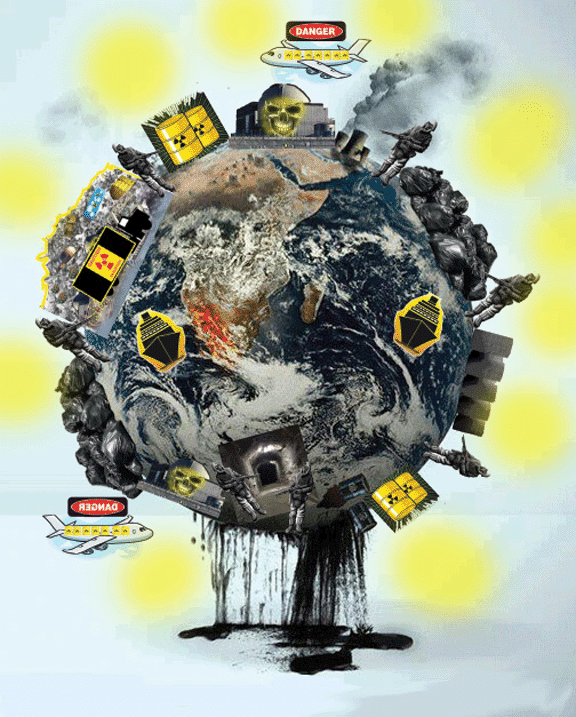
Can it be remediated? With what effect?
The report is blunt about the limits of any remediation fix: “No solution exists for very long term risks, which extend out to hundreds of thousands of years and beyond.”
Can it be remediated? With what effect?
Nuclear weapons and nuclear power production have created a vast, global archipelago of contaminated sites that have endangered health and the environment and will continue to do so.
The sources of risk include 10 to 20 billion metric tons of radioactive uranium mine waste, on the order of a billion tons of radioactive mill tailings, over 150 metric tons of separated plutonium (enough for roughly twenty thousand Nagasaki-type bombs) that is now waste, and millions of terabecquerels of fission and activation products dispersed in air, soil, and water bodies due to nuclear weapons testing.
Remediation can mitigate the risks in the short- and medium-term in many cases. The other side of the remediation coin is radioactive waste and its disposal. That too can reduce risk relative to no remediation. However, waste disposal also creates new risks, especially from long-lived radionuclides. As a result, some safety, health, and proliferation risks will remain essentially forever.
This is the finding at the center of a new report the Nuclear Truth Project commissioned from Arjun Makhijani, Ph.D., President of the Institute for Energy and Environmental Research (IEER).
Whilst the Treaty on the Prohibition of Nuclear Weapons (TPNW) addresses harm from the use and testing of nuclear weapons, as the report clearly states in its preface, the Treaty “does not deal with the upstream harms from nuclear weapons production, which start with uranium mining and milling.”
Those harms “have been inflicted on many countries, starting with Congo, whose mines, exploited by its Belgian rulers of the time, were the source of most of the uranium for the Manhattan Project.”
The chain begins in Congo
Shinkolobwe was the richest mine in the world– with over 60 percent uranium in its ore. This extremely rich ore was shipped to the United States by the Belgian imperialists who colonised Congo; it became the material foundation of the Manhattan Project, including the bombs used on Hiroshima and Nagasaki, and the bomb tested in New Mexico, on 16 July 1945.
Congo, like many other countries that have supplied uranium to nuclear weapons or power states, has never had nuclear weapons or nuclear power. Yet, they are all left with the radioactive mine waste from uranium mining.
The scale of the waste
“Each step starting with mining, creates radioactive waste and radioactive contamination.”
The report shows that global uranium mine waste is likely to be between 10 billion and 20 billion metric tons, this is enough to “cover 1.4 million to 2.8 million soccer (football) pitches to a depth of one meter, or fill four million to eight million two-meter deep Olympic-size swimming pools”.
In addition to this, there are about one billion metric tons of mill tailings and over 150 metric tons of excess separated plutonium – enough for “roughly twenty thousand Nagasaki-type bombs.”
The globally dispersed pollution includes “millions of terabecquerels of fission and activation products dispersed in air, soil, and water bodies due to nuclear weapons testing.”
Nuclear Injustice: The case of the Marshall Islands
A member of a U.S. Atomic Energy Commission advisory committee described the Marshallese, in 1956, as people the U.S. could study “closer to us than the [experimental] mice.” This decision to study them as experimental subjects arose from the contamination of their land and waters due to the 67 nuclear weapons that the United States tested on Bikini and Enewetak Atolls in the Marshall Islands.
Despite the U.S. government undertaking a ‘cleanup’ at Enewetak Atoll that resulted in over 70,000 cubic meters of waste, the operation only recovered 0.25 kilograms of plutonium, less than 1% of the estimated 30 kilograms on Enewetak Atoll and its lagoon. Other radionuclides were not part of the remediation plan.
Remediation standard
Setting remediation standards requires setting dose limits for people far into the future. Enforcement is not practical to ensure the standard will be met. Modeling is therefore required, which in turn necessitates a choice of who will be exposed at at the remediated site far into the future. A resident farmer family has been a traditional, and reasonable choice. But this is not enough. Diets need to be modeled too. For adults, the default has been ‘Reference Man’ who is defined as a young, male Caucasian who is “Western European or North American in habitat and custom.”
The report notes that this is “an unsatisfactory generalization”; for instance the ‘Reference Man’ diet would not reflect the traditional diet of the people of the Marshall Islands, besides not taking into account the differences between men and women’s diets.
Moreover, as the report notes, No radiation standard explicitly protects the embryo and fetus of pregnant members of the public, present or future.”
Uranium mine remediation
Large numbers of uranium mine sites remain unremediated. Some remediation proposals, like the ablation of mine wastes to concentrate uranium proposed in the United States would make contamination worse. Some sites in France have been remediated; many await remediation. The report also notes that
“Remediation in Australia is largely similar to that in France. In the United States, plans for the remediation of the Quivira mine site in the Navajo Nation mine site involved their removal from the Nation’s land and disposal in a special cell in a New Mexico State landfill used for municipal waste.”
and that
“The best examples of remediation among those reviewed in this report (which is not a comprehensive review) are the remediation of the Ranger mine in Australia and the remediation after German reunification of various mines in the former East Germany.” In the case of the Ranger mine, it was the resistance of the Mirarr people that led to stringent remediation standards and a commitment to end mining in the area.
Why this matters for the TPNW
“Remediation should be understood as risk reduction because there is always a residual risk… Much of the process is a transfer of some of the risk from future generations who would suffer harm from unremediated places to the present and near future.”
The TPNW’s Articles 6 and 7 commit states parties to victim assistance and environmental remediation. Importantly this report makes the case for extending that same accountability upstream: to the mines and mills, and to the countries and communities that have carried this burden since long before any weapon was tested.
The report’s preface notes that “A part of the reluctance to address upstream issues may stem from the fact that is that there is a large overlap in upstream processes with nuclear power, which needs the same source material – uranium.” It also notes that that the costs can and should be parsed between the two, enabling the proper assignment of responsibility for the harm.
The report is blunt about the limits of any remediation fix: “No solution exists for very long term risks, which extend out to hundreds of thousands of years and beyond.”
Government ‘continues to ignore warnings’ as wildfire rages near Sizewell B.
The group has urged the new
Labour administration to “re-evaluate Sizewell C’s climate resilience
against worst-case scenarios”.
“Proceeding with a project vulnerable to
extreme weather events betrays future generations,”
Blaze ‘highlights the vulnerabilities of nuclear infrastructure
to the impacts of climate change’, a campaign group has claimed.
A wildfire
near Sizewell B has stoked concerns around climate-related planning for
nuclear power stations. The heathland fire in Dunwich Heath, near the town
of Sizewell in Suffolk, broke out on 29 July and has continued to spread
across more than 100 hectares of land. Residents were evacuated, but there
were no reported injuries.
Local campaign group Together Against Sizewell C
(TASC) raised concerns that climate resilience is not sufficiently factored
into planning for nuclear power stations. “The fire’s close
proximity—just a few miles from Sizewell B and the Sizewell C development
—highlights the vulnerabilities of nuclear infrastructure to the impacts
of climate change,” the group’s spokesman Chris Wilson told Energy
Voice.
“In the case of emergencies, such as wildfires, affecting the
Sizewell nuclear cluster, the authorities need to ensure that the Emergency
Plan can cope with an influx of 8,500 workers on the Sizewell C
construction site, a thousand extra contractors at Sizewell B during
outages, as well as tourists and residents.”
The group has urged the new
Labour administration to “re-evaluate Sizewell C’s climate resilience
against worst-case scenarios”. “Proceeding with a project vulnerable to
extreme weather events betrays future generations,” Wilson said.
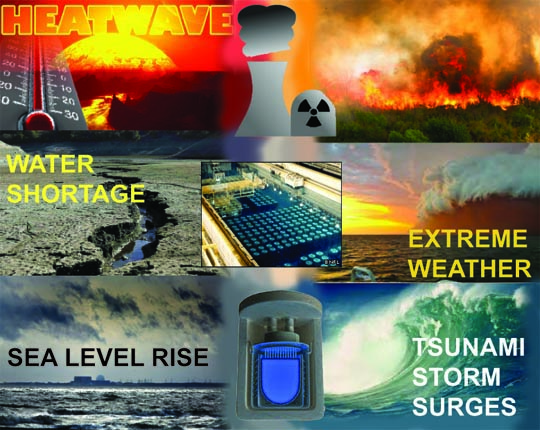
The group has warned of the “risk of severe coastal threats, including
sea-level rise, increased storm surges, and rapid erosion”, and “raised
sea and air temperatures” which, Wilson said, “can affect the plant’s
ability to operate safely”. “Our real key concern now is the project as
approved in the DCO is not resilient to climate change,” he added.
Sizewell C flood barriers. The campaign group took Sizewell C to court in
2025, after energy secretary Ed Miliband allegedly refused to amend
the development consent order to include raised flood barriers for the
project adjacent to the existing Suffolk facility. The case was quashed.
That project would be “located in a severely water-stressed area in the
UK’s driest region and is presently in drought”, the group warned.
They raised the alarm around a rip current that broke nearby banks in January.
“Located on one of Europe’s most vulnerable coastlines, the area
directly in front of the northern development boundary has already
sustained damage,” the spokesman for TASC said. “Consequently, beach
replenishment may be required before the Sizewell C build is complete.
“The project currently relies on an average of 18 tankers of potable
water a day, sourced from the Anglian region, for construction and is yet
to secure a guaranteed sustainable supply for the 2.2 million litres of
potable water per day it needs to operate.”
Energy Voice 5th Aug 2026, https://www.energyvoice.com/renewables-energy-transition/nuclear/601983/government-continues-to-ignore-warnings-as-wildfire-rages-near-sizewell-b/
The political implications of Hiroshima’s scarred “maidens”
Bulletin, By Alex Wellerstein | Article, Feature | August 6, 2026
On May 7, 1955, 25 young Japanese women arrived by airplane at Travis Airfield in California. They had flown there from Iwakuni Airbase in Tokyo a few days prior, with a layover in Honolulu. In California, a crowd greeted their arrival by showering them with flowers—and four women who, to the discomfort of many involved, used the opportunity to give a speech about the dangers of the hydrogen bomb.1
All of the women had been schoolchildren in Hiroshima on the morning of August 6, 1945, when the United States detonated an atomic bomb over the city. Many of them had been at work building firebreaks at the time of the bombing, and had all been severely burned by the attack. They were known in the press as the “Hiroshima Maidens,” and they were part of a trip, organized by a Japanese reverend and an American journalist, and with the hesitant blessing of the US State Department, to bring the women to the United States, so their scars might be healed through the power of American plastic surgery. The primary intent was to ease their individual suffering, but the trip was understood by all involved to be more than that: the wounds being healed were not just physical, but political.
Keloid scars are raised, thick, and irregular slabs of collagen. They can form after any injury, and can appear long after the injury itself. They generally do not hurt, but they can itch. They can also constrain muscle movement, decreasing mobility dramatically, depending on where they have formed. And they are disfiguring. For reasons that are apparently still not well-understood, such scars are more prone to develop in people of Asian, African, and Hispanic descent than in other peoples, and their heighted incidence among survivors of the atomic bombs has suggested that radiation exposure may increase the chances of their forming.
Photographs of the scarred bodies of atomic bomb victims are a common, if still controversial, accompaniment to discussions of the atomic attacks today. But in the immediate years after the end of World War II, they were much rarer. While an October 1945 story in LIFE magazine did feature two photographs of atomic victims, nearly all other popular photographs of Hiroshima and Nagasaki in the 1940s featured only photographs of the ruined buildings, not ruined bodies.
Less popularly, the bodies of victims were visible in official, technical publications on the “medical effects” of the bombs, with photographs of the victims months or even years after the bombings. These photographs were meant to display, cleanly and clinically, the effects of atomic bombs. They were not intended to provoke a sense of guilt, or even empathy, except as relates to how their audience might be interested in “effects data” for planning for the possible use of atomic bombs against themselves in the future.
Information about the survivors was tightly controlled within Japan by the occupation authorities, who feared that widespread discussion of the atomic bomb could lead to anti-American and pro-Communist sentiment.2
John Hersey’s Hiroshima, published as a full-issue of The New Yorker in August 1946, was the first publication to really give international audiences a view of what the atomic bombings were like from the perspective of the bombed. One of the six survivors that Hersey profiled was an American-educated Methodist reverend, Kiyoshi Tanimoto. Tanimoto’s account is gripping, and prominently features his inability to render the help to others that he wished that he could:
After crossing Koi Bridge and Kannon Bridge, having run the whole way, Mr. Tanimoto saw, as he approached the center, that all the houses had been crushed and many were afire. Here the trees were bare and their trunks were charred. He tried at several points to penetrate the ruins, but the flames always stopped him. Under many houses, people screamed for help, but no one helped; in general, survivors that day assisted only their relatives or immediate neighbors, for they could not comprehend or tolerate a wider circle of misery. The wounded limped past the screams, and Mr. Tanimoto ran past them.
Hersey’s account showed Tanimoto trying to help whom he could, but the magnitude of the disaster was overwhelming. Tanimoto himself suffered from a bout of radiation sickness, but recovered.
At the time of Hersey’s book, there was no agreed-upon term to use for those people who were at Hiroshima and Nagasaki at the time of the bombings but who had not died. The term “survivor” was common in English usage, but the Japanese have tended to shy away from their equivalent (seizonshai), apparently finding it to contain a bit of guilt or blame in its focus on those who did not die. Conversely, the term “victim” appears to have been used more commonly in Japanese (higaisha) than in English, perhaps again because of its apparent connotation that the violence done to the Japanese was unjust. It is not clear exactly when the term hibakusha—“explosion-affected person”—became the preferred term; it seems like it was used in Japan by the mid-to-late 1950s, and became well-known in English only in the early 1960s.3
In the months after the bombing, his church destroyed, Tanimoto worked as a street preacher in Hiroshima. His message was both theological and political: Looking for someone to blame for the atomic bombing—whether the Americans who had dropped the bomb, or the Japanese military leaders who had started the war—was futile. Seek salvation through God alone. With parishioners, he began the work of rebuilding the church building, but the work was slow, for there was no money and few resources available. In 1948, he traveled to the United States to meet with an old classmate of his, in an effort to raise funds for a new church. While on the ship to San Francisco, he had an idea: He could dedicate his life to peace, and the rebuilding of his ruined Hiroshima would be the focal point for that. Without consulting anyone back home, he began to give sermons around the United States, taking up a collection for Hiroshima’s rebirth. By the end of 1949, he had visited over 250 American cities, and raised about $10,000 for the church.4
Tanimoto ultimately made a connection with the editor of the Saturday Review, Norman Cousins, who enthusiastically supported his plea, and ran an editorial proposing the creation of a World Peace Center in Hiroshima. Although the article claimed to be in the name of the inhabitants of Hiroshima, no one but Tanimoto was ever consulted. A Hiroshima Peace Center Foundation was set up in New York by Cousins, in order to receive American donations.5
A few years later, as part of his peace center efforts, Tanimoto began a Bible study class for a group of women that he apparently called his “Keloid girls.” He had offered other classes to victims of the bombing; the Keloid girls were special because their deformity and their sex was seen to demand a level of social exclusion that went beyond that of other Hiroshima victims. He would eventually petition the Hiroshima government for funds to give them plastic surgery, but was rejected. He then went to the Atomic Bomb Casualty Commission, the American-run effort to study the medical effects of the atomic bombings, but he was told that this was outside the commission’s scope. The commission was not in the business of “treatment,” and keloids were not unique radiation effects.6
Eventually, Tanimoto received some funding for surgery on the Keloid Girls within Japan, bringing a group of them to Tokyo in the spring of 1952, just after the end of the American occupation. There was also one male victim in the group, Kiyoshi Kikkawa. The Japanese press, to the surprise of Kikkawa, became completely focused on the women, dubbing them the Genbaku Otome: “Atomic Bomb Maidens.” The women were attractive because of their symbolism of peaceful Japanese resilience. Kikkawa quickly felt it was going too far: At one point in their trip, the “maidens” were taken to tour a prison that held Japanese war criminals, and two of the “maidens” chosen as delegates proclaimed that while they had once held grudges against the Japanese militarists, they now saw them as being in the same situation as the survivors.7
The surgeries were at least somewhat successful. Tanimoto had been in touch with Cousins about the “maidens” ideas, and with this pilot project completed—and its publicity value proven in at least the Japanese context—Cousins was ready to push for an American side of it. This would be larger and grander: more “maidens” (no men, this time), and the surgeries would be done in the United States, where plastic surgery was state-of-the-art. Cousins is credited for transforming their name: Having changed from “Keloid Girls” to “Atomic Bomb Maidens,” they were now the “Hiroshima Maidens.”8
For six months, Cousins sought funding for the project from foundations. It would be expensive: the transportation and lodging alone would cost tens of thousands of dollars, and the operations would drive the cost into the hundreds of thousands. He saw little success, apparently because the foundations blanched at the possible negative publicity that might attach to the project.9………………………………………………………………………………………………………………………………………………………………………………………………………………………………………………. , the actual surgeries began. Over the next year, a team of surgeons at Mount Sinai, led by Barsky, performed over 140 operations on the women. When not in surgery, the women lived with host families. The operations were difficult. In some cases, there were dramatic improvements in mobility and appearance. One of the women, Tomako Nakabayashi, age 26, died of a heart attack during her third operation—a point that American newspapers made little of, but led Japanese newspapers to accuse the Americans of treating the women as guinea pigs.17
By the June 1956, 10 of the women were deemed ready to return home. The rest returned in late October 1956. The surgeries involving the women who survived were considered successful, although the reactions of people seeing them for the first time would often be to focus on the scarring that was still visible. But the women appear to have found the physical transformations a great boon, even if, as one later said, “there are lingering wounds in our hearts that have not healed.”18
The story of the “Hiroshima Maidens,” which has been told many times over the years, comes in two distinct modes. The “original” mode is optimistic and, perhaps, a bit naïve. It is the version of the story pushed by Tanimoto and Cousins and most of the press who eagerly covered the women once they arrived in the United States in May 1955. This version is one of rebirth: just as Hiroshima, the city, was in the process of rebuilding after the atomic bomb, so could Hiroshima’s inhabitants rebuild their lives, even their very flesh.
City organizers in Hiroshima embraced their own version of the narrative of the city’s rebirth. Starting in the 1940s, and accelerating in the 1950s and 1960s, they emphasized that the destruction at Hiroshima would be not its end, but its new beginning. There was a tactical element to this: They needed to attract resources for development and rebuilding, and leveraging their status and fame was a potent part of this appeal. It was not an approach that denied that the past destruction had occurred, obviously, for this could not be denied. The “rebirth” narrative would be a way to lean into that story and change its trajectory. Among the hibakusha, there were understandably mixed feelings about the approach. The famous “Atomic Bomb Dome”—the ruin of the former industrial exhibition hall near ground zero—ended up being the only preserved “monument” to the destruction, serving a focal point for Hiroshima’s peaceful rebirth activities, but its preservation was contentious.19
There is a more cynical read on the “Hiroshima Maidens” and the rebirth mode of talking about the bombings. For one, this version of the story almost exclusively focuses on Hiroshima, at the expense Nagasaki, even though the case for the use of the second atomic bomb, only three days after the first, has always seemed much weaker than the case for the use of the first.
The focus on “maidens” also creates additional places for critique. There were married and divorced hibakusha who were rejected from Tanimoto’s project, and after the pilot project’s single male hibakusha, the rest were all women. The exact reasons for this have not been articulated by the players involved, but it seems that Cousins and Tanimoto felt the maidens made for more sympathetic figures and gave the project more of an apolitical appearance.20 As Robert Jacobs has put it, the “Hiroshima Maidens” were:
…generally depicted as childlike, innocent and grateful. They were uniformly spoken of as being “almost pathologically shy,” and then “blossoming in the warmth they shared in the homes of American ‘parents.’” […] The use of the term “maiden” reveals the focus on the lack of romantic prospects for the women while reinforcing the image of their innocence and childlike nature. […] The Japanese women were all students when they suffered the atomic attack, thus sparing them of any complicity in the Japanese war effort, and casting them as victims themselves of Japanese military aggression.21
While the “Hiroshima Maidens” project was being planned, the discourse about the atomic bombings in Japan radically shifted. In early March 1954, the United States tested its first deliverable thermonuclear weapon at the Bikini Atoll, in the Marshall Islands. The detonation resulted in a massive plume of radioactive fallout that contaminated thousands of square miles of ocean and islands downwind of the test site and exposed a Japanese fishing boat, the Lucky Dragon No. 5, which had inadvertently strayed close to the test site. After they returned to Tokyo, the crew began showing the symptoms of radiation sickness, but not before their tuna catch was offloaded in Tokyo fish markets. Thus followed a tuna boycott and massive global attention to the issue of nuclear fallout. One of the crew would eventually die. Within Japan, this Bravo test became a major focal point for an emerging anti-nuclear political activism and generally led to an opening up of long-suppressed public discourse about Japan’s status as a “nuclear victim.”22
The “Hiroshima Maidens” project, however, was not part of this political movement. Tanimoto’s politics were far more conservative, more pro-American, and definitely not anti-nuclear. His was a politics of restoration and “moving on,” and, if anything more specific than that, about suppressing the anti-H-bomb sentiment of the Japanese that was being used to fuel protests against American military presence in Japan.23…………………………………………………………………………………………………..
The “Hiroshima Maidens” project, however, was not part of this political movement. Tanimoto’s politics were far more conservative, more pro-American, and definitely not anti-nuclear. His was a politics of restoration and “moving on,” and, if anything more specific than that, about suppressing the anti-H-bomb sentiment of the Japanese that was being used to fuel protests against American military presence in Japan.23
After their surgeries, few of the “maidens” sought additional attention. In the 1980s, Shigeko Sasamori lent her voice and authority as a hibakusha to a growing anti-nuclear movement. But most appear to have sought privacy after their period having their bodies and identities subjected to extreme focus, both positive and negative.27
The hibakusha, as the psychologist Robert Lifton observed in his in-depth study of them, have a complicated relationship with their status as victims. It is a no-win situation: If their victimhood is remarked upon or treated as special, they fear that any assistance rendered is inauthentic and confirms that they carry a stigma. If, on the other hand, they are ignored, they feel abandoned.28
Barsky, the plastic surgeon, continued his own kind of ministry. In 1969, he organized a clinic in Vietnam to operate on Vietnamese and Cambodian children who had been horribly burned by American munitions. The clinic operated on over a thousand children, including Kim Phuc, the famous “napalm girl.” After American surgeons fled during the fall of Saigon, the hospital was kept running, and still operates to this day.29
Scars are a sort of archive of a body’s experiences. They fade, and they can sometimes be healed. Scars in the mind are harder to see. But the scars of history, as played out in politics and attitudes and cultural creations, can outlive the people who experienced them firsthand. What does it mean to remove scars, or to preserve them? What story do the scars of history tell?
Most of the “Hiroshima Maidens” seem to have truly desired to be apolitical, which in this case seems primarily to mean non-controversial. This desire was, of course, impossible to fulfill. Their bodies were, by virtue of where they had been on the morning of August 6, 1945, inherently political. Plastic surgery could hide some of the scars. But being hibakusha appears to have thrust survivors of the bombings into a political position: One’s existence is some kind of statement about power, and so an object for others to use in making their own kinds of political statements. To gaze upon the body of a hibakusha is a political act—but so, also, is looking away.
Notes,………………………………………………………………………………………………………….https://thebulletin.org/2026/08/the-political-implications-of-hiroshimas-scarred-maidens/?utm_source=ActiveCampaign&utm_medium=email&utm_content=The%20%22Hiroshima%20maidens%22&utm_campaign=20260806%20Thursday%20Newsletter
Walt Zlotow – No Attaboy for Uncle Sam…he just ran out of ATACMS ( Army Tactical Missile System).

Walt Zlotow West Suburban Peace Coalition Glemn Ellyn IL,6 Aug 26
Back in 2022 the US was all in throwing tens of billions in US weapons to Ukraine to fuel the US proxy war against Russia.
At the time the US had plenty of tactical surface to surface missiles known as ATACMS to lavish on Ukraine to clobber the hated Russians. The US was just fine using Ukraine as a Trojan horse to weaken if not destroy Russia as long as Ukraine did all the dying while Americans shed not a drop of blood.
Four had a half years on Ukraine is a shattered land on life support. Millions dead, fled, injured. A fifth of its land gone forever. It’s access to the Black Sea port kaput. It’s military near collapse.
And the US not faring so well either. Just a week after the four year anniversary of the proxy war President Biden provoked, his successor Trump launched a deranged, criminal ear on Iran at the behest of Israel that was lost on day one. Trump bombed Iran furiously for 39 days then stopped abruptly.
Why? He was informed that the missile cupboard of offensive ATACMS and the newer Precision Strike Missiles (PrSM) were nearly depleted, in part from squandering them on the lost cause of the Ukraine proxy war.
Adding to America’s offensive missile woes, it has depleted over 60 % of Patriot defensive interceptors and half of its THAAD interceptors. No wonder Iran has decimated every one of America’s 18 Gulf State bases. No wonder Trump dare not attack Iran again in force least Iran wipe out Gulf State oil infrastructure sending the world economy into collapse.
America under the Clinton, Bush, Obama, Trump, Biden, Trump again war machine does well against small powerless states like Serbia, Libya, Somalia and Venezuela. But try to defeat formidable foes like Russia and Iran? America’s trillion dollar war machine collapses into chaos. No attaboy for the murderous American military bombing 7 or more countries worldwide for no reason at all.
NATO is being installed into Ukraine’s military
European factories, NATO software, and defense companies are now built into Kiev’s war effort
Rt, By Dmitry Kornev, 5 Aug, 2026
Throughout the conflict, Western governments have described their role in Ukraine in relatively simple terms: supplying weapons, providing financial assistance, and helping Kiev to stand against Russia.
The reality has gradually become more complicated.
The discussion is no longer limited to deliveries of tanks, missiles, or artillery shells. Increasingly, Western companies are participating in the design, production, financing, and technological integration of weapons that are formally presented as Ukrainian. Assembly lines are moving beyond Ukraine’s borders, European manufacturers are becoming part of production chains, and NATO standards are being built directly into Ukraine’s military infrastructure.
This raises a broader question. At what point does military aid become military integration? The answer matters because it changes how the conflict itself should be understood.
Something more than a helping hand
The Armed Forces of Ukraine (AFU) remain on the strategic defensive against Russian forces, which enjoy advantages in manpower and conventional firepower. Despite persistent personnel shortages and an arsenal assembled from equipment supplied by dozens of countries, the Ukrainian military has continued to field new weapons and maintain combat effectiveness.
One explanation lies in drones, precision weapons, and sufficient stocks of tactical ammunition. But these capabilities require a constant flow of increasingly sophisticated systems – systems that Ukraine can no longer produce entirely on its own.
Russian long-range strikes have made large-scale weapons manufacturing inside Ukraine increasingly difficult. Protecting production therefore requires more than additional air defenses. It requires relocating key elements of the defense industry itself.
This is precisely the direction in which Ukraine’s military-industrial complex has been evolving.
Kiev has never hidden the fact that its defense industry now works closely with European partners. In some cases, cooperation takes the form of OEM production, with foreign-made systems assembled or rebranded as Ukrainian products. In others, there is little reason even to disguise the origin of key components. Electronic systems, engines, sensors, and guidance technologies are openly sourced from Western suppliers, assembled into new platforms, and incorporated into Ukraine’s expanding defense sector.
The result is a model that differs significantly from the one that existed at the beginning of the conflict. The issue is no longer simply which countries supply weapons to Ukraine. Increasingly, the question is how much of what is described as a Ukrainian weapon is produced through an international industrial network that extends well beyond Ukraine itself.
Weapons without borders
Fire Point is one of the clearest examples of this new model.
The Ukrainian defense startup is developing the FP-5 cruise missile, the FP-7 ballistic missile, and a future air-defense system. Yet the company cannot independently manufacture these systems in full. At best, it can perform final assembly while relying on foreign components and technologies for critical elements of the project.
This is especially visible in the proposed anti-aircraft version of the FP-7. Fire Point CEO Denis Shtilerman has openly stated that the missile will use a seeker developed and manufactured by Germany’s Diehl Defence. The wider air-defense system is expected to use European radar and command technologies, including Sweden’s SAAB Giraffe, France’s Ground Master 400, Germany’s TRML-4D, and Norway’s Kongsberg Fire Distribution Center.
Pushkin once wrote, “All flags will come to us.” Fire Point’s project increasingly resembles a military version of that idea: a Ukrainian-labeled system assembled from technologies developed across Europe.
The same logic can be seen in drone production.
Ukraine’s Linza strike and reconnaissance drone is a product of Quantum Frontline Industries, a joint venture between Germany’s Quantum Systems and Ukraine’s Frontline Robotics. The project is funded through the German government’s ‘Build with Ukraine’ program. Ukraine contributes combat experience, software algorithms, and a design tested at the front. German industry provides automated serial production at a plant near Munich, allowing output of up to 10,000 drones per year without the risk of Russian missiles striking the facility. The first batch was delivered to the AFU in the spring of 2026.
Artillery follows a similar pattern.
The Ukrainian Bohdan self-propelled howitzer is now produced in Poland by PK MIL SA, a joint Polish-Ukrainian company created specifically to manufacture the system outside Ukraine. The project is based on cooperation between the Kramatorsk Heavy Machine Tool Plant and the Polish engineering company Ponar Wadowice S.A. The Polish side holds a controlling stake and is responsible for mechanical production and final assembly. The project is being implemented as part of the EU’s ReArm Europe initiative.
These projects differ in technology, scale, and purpose. Fire Point works on missiles, Quantum Frontline Industries on drones, and PK MIL SA on artillery. Yet all three are built around the same principle: Ukrainian designs, battlefield experience, or branding are combined with European production, components, financing, and industrial protection.
It is a production model in which Western companies are becoming part of Ukraine’s military capability itself.
The Build with Ukraine model
The industrial and technological projects described above are not isolated initiatives. They form part of the broader Build with Ukraine program, which provides a framework for cooperation between Ukrainian defense companies and European industry.
The model is built on a relatively simple division of roles.
European partners contribute financing, production capacity, industrial technologies, and access to advanced components. Ukraine contributes battlefield experience, operational data, software solutions, and engineers working under wartime conditions. Together, these resources make it possible to develop and manufacture systems that neither side could produce in quite the same way on its own.
For European defense companies, the attraction is clear. Ukraine offers an opportunity to evaluate new technologies under real combat conditions, refine them using operational feedback, and shorten the path from development to serial production. At the same time, manufacturing remains on European territory, beyond the reach of Russian long-range strikes.
Ukraine’s incentives are different.
Participation in joint projects provides access to technologies, engineering expertise, industrial practices, and software that would otherwise take years to develop independently. It also allows Ukrainian engineers to work alongside established Western defense companies, gaining experience that is likely to remain valuable long after the current conflict ends.
The results are already becoming visible.
Ukrspecsystems has opened a drone-interceptor production facility in the United Kingdom. Fire Point is already operating in Denmark and plans to launch fuel production for its ballistic and surface-to-air missile programs there.
Fire Point also illustrates another feature of this model………………………………………………………………………………………………………………………………………………………………
Western governments continue to describe their role primarily in terms of military assistance to Ukraine. Yet the examples above suggest that the relationship is becoming considerably more complex. European companies are participating in weapons development and manufacturing. Production is being relocated beyond Ukraine’s borders. NATO communications standards are being incorporated into Ukrainian command systems. Joint ventures are creating long-term industrial links that extend well beyond wartime procurement.
Taken individually, these developments may appear to be separate initiatives. Together, they point to a gradual shift from external support toward a much deeper level of military-industrial integration…………………………………………
The debate is no longer limited to how many tanks, missiles, or drones Western countries are prepared to deliver to Ukraine. Increasingly, it concerns the emergence of a military-industrial network in which Ukrainian companies, European manufacturers, and NATO technological standards are becoming interconnected.
Pandora’s box, as the saying goes, is far easier to open than to close.
The Nuclear Regulatory Commission ignores climate danger
Climate impacts on nuclear power reliability, safety
August 5, 2026, https://beyondnuclear.org/climate-impacts-on-nuclear-power-reliability-safety/
The US Government Accountability Office (GAO) published its congressional report on April 2, 2024 titled as a warning, “Nuclear Power Plants: NRC Should Take Actions to Fully Consider the Potential Effects of Climate Change.” Their report to Congress points to increasingly severe and more frequent climate hazards including extreme heat, drought, wildfires, severe storms, atmospheric rivers, floods, hurricanes and sea level rise. Congress’ investigative arm further determined that the U.S. Nuclear Regulatory Commission (NRC) does not adequately consider these climate change risks nor project the hazardous consequences on reactor safety in its licensing and relicensing processes.
Instead, the entrenched federal nuclear agency focuses on the projected climate benefits from nuclear power’s reduced carbon emissions. However, the GAO found that the NRC refuses to analyze and focus on climates’ worsening adverse impacts on future safe and reliable reactor operations by focusing only on historical meteorological data. This unheeded recklessness by the NRC and the nuclear industry is not unlike driving a car through its rear view mirror, unaware of the oncoming hazards that can result in severe radiological accidents.
Current news accounts confirm an accelerating climate crisis while exposing nuclear power’s unsustainability and vulnerability across Europe today as yet another example.
The Canadian (CANDU) heavy water pressurized water reactors at Romania’s two-unit Cernavoda nuclear power station is struggling to maintain reactor cooling water and remain operational. Current actions include raising the Danube River level if even by only centimeters. Romania’s only nuclear power station is on the verge of complete shutdown due to the falling river levels and warming water temperatures. Romania’s Navy has been dynamiting along the Danube to redirect the river flow to keep the reactors’ cooling systems and electricity generation operational.
The four-unit Paks nuclear power station (Soviet Union-era VVER-440 pressurized water reactors) also on the Danube River in Hungary is reported to be on the verge of emergency shutdown of all units. Similarly, the record low water levels in the Danube River are falling and receding away from the reactors’ once through coolant system intake suction pipes. The shallower river is also heating up, dramatically contributing to the loss of reactor cooling efficiency. The Danube is the only source of cooling water for the reactor cores which are now only “a few millimeters away from completely shutting down the Paks Power Plant.”
The American Nuclear Society’s publication Nuclear Newswire reports, “The 1,916-MWe, four-unit Paks is Hungary’s only nuclear power plant and, according to the International Energy Agency, generates about 42% percent of the country’s electricity. But as of Sunday, it was only producing 240 MW of power.”
Europe’s climate-driven heat wave is critically undercutting France’s electrical energy demand given the nation’s unsustainable and over reliance upon nuclear power (now reduced to 70%). The French state-owned nuclear operator, EDF, is also powering down and taking nuclear reactors off line to compensate for the loss of adequate and warming reactor cooling water sources. Bugey unit 3, Chooz unit 2 and Golfech 2 – operating on the Rhône, Meuse and Garonne rivers- have been taken offline to comply with operational technical specifications and regulations on reactor cooling water discharges. At least eight other reactors are operating and transitioning between reduced power and shutdown. Those affected reactors include: Saint Alban units 1 and 2; Bugey units 4 and 5; Blayais units 1 and 3; and Tricastin. These measures are environmental and aquatic protection requirements to avoid discharging too much hot water into rivers already impacted by the heatwave and drought.
At present, in Switzerland, the two-unit Westinghouse Electric pressurized water reactors at Beznau nuclear power station are temporarily shut down, or operated at lower power due to loss of adequate reactor cooling efficiency because of high temperatures in the River Aare.
In a warming climate, nuclear power is not sustainable while its operational safety margins are also narrowing. Inevitably, economic and political pressure on regulatory bodies threaten to relax and exempt nuclear operators from environmental protection standards for hotter cooling water discharges associated with increasing environmental damage and jeopardizing aquatic life while destroying habitat.
Water levels to be increased in Zaporizhzhia’s used fuel pools
Friday, 7 August 2026, https://www.world-nuclear-news.org/articles/water-levels-to-be-increased-in-zaporizhzhias-used-fuel-ponds
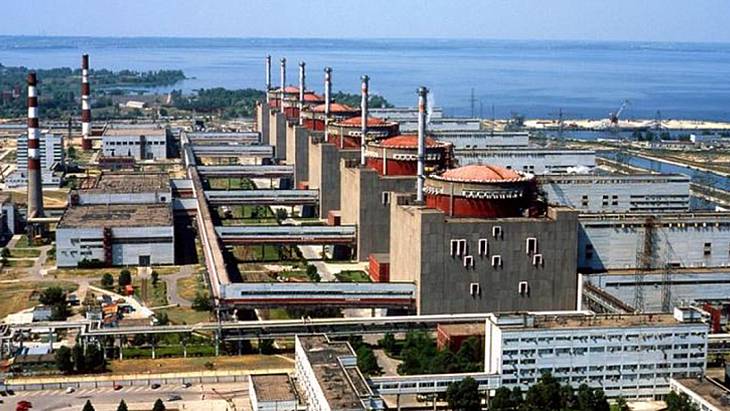
A decision has been taken to increase the water levels in the used fuel pools at the Zaporizhzhia Nuclear Power Plant, amid ongoing concerns about possible losses of off-site power, the International Atomic Energy Agency has said.
The agency (IAEA) said its experts at the site had been informed by the operators of the plant – which has been under Russian military control since March 2022 – that “the measure is intended to increase the time available before water could begin to boil off in the event of a prolonged loss of off-site power during which the site exhausted its diesel fuel supplies and could no longer continue cooling the pools”.
The IAEA added: “The decision was taken in light of the prolonged unavailability of the 750 kV Dniprovska line and current challenges in resupplying the site’s diesel fuel stores because of military activity in the area. The work began this week, with the IAEA team present to observe.”
Cooling pools are used for storing used nuclear fuel underwater. This is normally for at least five years to allow decay of radioactivity and heat.
The Zaporizhzhia plant’s six units have all been shut down since the start of the war in 2022, with the last unit transferring to a cold shutdown in April 2024.
The plant is close to the front line of Russian and Ukrainian forces and the plant has suffered a number of incidences where it has lost all external power, and had to rely on its fleet of emergency diesel generators for the power needed for essential safety functions. Nuclear power plants generally have enough diesel stored on site to operate emergency generators for an initial seven days if necessary. This ensures there is time to fix external power issues, or allow time for new supplies of diesel to be brought in if the generators are to be in use for a longer period.
According to the IAEA there have now been 24 times that the plant has lost external power, with half of those occurring in the past four months, including twice in the past week.
Director General Rafael Mariano Grossi said: “This trend, with the rising number of off-site power cuts at the Zaporizhzhia Nuclear Power Plant, is deeply concerning and clearly not sustainable. The agency will continue its work to help improve the situation and support nuclear safety and security at the site.”
At the moment the plant is relying on a single 330 kV backup power line, with its main 750 kV power line unavailable since March. Repairs were carried out, under an IAEA-arranged localised ceasefire, but it remains unavailable because of damage to a substation which provides power to the line.
Grossi said: “These substation missions have a clear nuclear safety and security purpose. As set out in the seven indispensable pillars, nuclear power plants require reliable off-site power, and substations are a crucial part of that process.”
The IAEA said that its teams at Zaporizhzhia and at the South Ukraine Nuclear Power Plant and the Chernobyl site all continue to report hearing military activity and/or air raid alarms.
Grossi said: “With each new day of the conflict, the risks to nuclear safety and security are not decreasing, on the contrary. I renew my call for maximum military restraint around all of Ukraine’s nuclear power plants and their associated electrical infrastructure.”
The powerful impact of six haunting minutes
by beyondnuclearinternational, https://beyondnuclearinternational.org/2026/08/03/the-powerful-impact-of-six-haunting-minutes/
A beautifully rendered animation from 1956 is the most effective anti-nuclear war message that hardly anyone has seen, writes Linda Pentz Gunter
Sometimes the most effective way to communicate the evils of nuclear war is also the most infinitely simple.
We have read books and reports and analyses about the horrors of the United States atomic bombing of the Japanese cities of Hiroshima and Nagasaki, on August 6 and 9 respectively.
And we’ve been chilled by the dramatic films On The Beach (1959), Fail Safe (1964), The War Game (1966), The Day After (1983), Testament (1983) and Threads (1984), which depicted the horrors of a nuclear attack. Even US President Reagan was supposedly awoken to the imperative of nuclear disarmament after seeing The Day After. Sadly, he sabotaged those chances in the end by clinging to the ludicrous and ineffective Missile Defense System, nicknamed “Star Wars”
There are fewer nuclear weapons today — just over 12,000 — than during the height of the Cold War when there were more than 64,000, but still enough to destroy the world many times over. And instead of disarming, the major nuclear weapons nations are once again rearming as the world becomes ever more destabilized by wars, climate pressure and the fight for control of resources. Nuclear arsenals in the US, Russia and China are growing larger and more lethal.
But the suicide path our leaders are still taking us on was anticipated well before the feature films and television dramas warning us of the omnicidal outcome of nuclear war; and before the scientist Carl Sagan and colleagues introduced us in 1983 to the concept of nuclear winter, its inevitable aftermath.
Their story, and ours, is to be found in A Short Vision, a film released in 1956. It is six minutes of agonizingly moving and even visually beautiful animation made by a British couple on their kitchen table. The film has all but disappeared from memory and public discourse but is thankfully viewable on YouTube.
A Short Vision was made by Hungarian born artist and painter, Peter Foldes and his British wife Joan with sponsorship funds from the British Film Institute’s Experimental Film Fund. The eerie and frighteningly evocative score was the work of another Hungarian emigre, Matyas Seiber. The narration is by British actor James McKechnie.
It is that haunting music that sets the mood from the moment the film opens, as we see a sinister object flying across the landscape, a dark, silent, menacing shape, almost a precursor to the more modern stealth bomber or the UFOs of science fiction. It is never named by the narrator. Nor is the word “nuclear” ever spoken in the film.
Then we see a leopard pinning a deer. Both look up. “And the deer darted free from the tearing claws, and they both hid in fear,” relates the narrator. The object, referred to only as “it”, flies on. The scene is repeated with an owl and a rat also looking up before the rat, too, is released to flee.
More beautifully drawn images follow, of families sleeping peacefully as the object flies over the nighttime lights of a city. The ordinary citizens are sleeping, but those who could have prevented what’s to come are not. “But their leaders looked up, and their wise men looked up. But it was too late.”
By now we are more than half way through the film, the music has become even more spine-chilling, but we are still waiting in dread and anticipation of what is to come. And then it happens. The giant explosion and conflagration is rendered in hundreds of flickering abstract fragments of reds, oranges and yellows as the object explodes in a massive fireball billowing into a giant mushroom cloud. The faces of the leaders begin to bleed, then peel off and melt away, leaving only skeletons.
Everyone is destroyed — those who saw it, those who didn’t, the leopard, the owl, the rat and the deer.
“When it was all over there was nothing else left but a small flame,” the narrator tells us. We watch the flame flicker, then consume the object itself, now transformed into a small moth. Then it is gone “and the flame died.” The film closes with a black screen and the simple words “THE END”. Which, indeed, it is.
After being shown at the National Film Theatre in January 1956, A Short Vision was reviewed by The Times, which described the film as “a work of sombre imagination.” The headline called the film a “cartoon”, which is how it was generally described, but visually it is closer to art, a reminder of Peter Foldes’ roots as a painter. Indeed, in the same review, The Times said the film was “a series of powerful, static drawings dissolving to show the death and consumption of all living things at the explosion that brings about the end of the world.”
But it was the film’s journey to the United States that marked the most extraordinary chapter in its brief history. On May 27, 1956 it was screened by CBS on a popular prime time variety programme hosted by Ed Sullivan, who described his choice to show the film — seen then in black and white — as “a plea for peace”.
“If you have youngsters in the living room, tell them not to be alarmed at this ‘cause it’s a fantasy, the whole thing is animated,” Sullivan said, as if somehow the fact of it not being live action made it less traumatic viewing.
Instead, the power of the film’s simplicity is what makes it arguably more effective than the longer dramas that followed.
Indeed, a review in the Post-Standard, a Syracuse, New York daily newspaper, said the film “gains power through its very simplicity. Perhaps no other medium could convey the finality of such conflict.” The reviewer added that “It should be shown all over the world, particularly in Russia. It is the best argument for peace at any price that has been presented in a long time.”
Sadly, that imperative is still true (although perhaps without singling out Russia). After its US adventure and brief theatrical release, A Short Vision disappeared into ignominy. Instead, it should be compulsory viewing today, shown in as many venues as possible. Someone should screen it on the walls of the White House and the Kremlin.
The airing on Ed Sullivan’s show engendered such a huge and largely positive response that Sullivan showed the film again on June 10. This time, however, he admonished parents “who have youngsters in your living room, it is a harrowing experience for youngsters, so would you please take them out of the room.” (My husband Paul Gunter, seven at the time, remembers disobeying that command and peeking round the corner. He has never forgotten the film.)
A year after A Short Vision’s debut, the Campaign for Nuclear Disarmament was born and, a year later, in 1958, thousands marched to Aldermaston to protest the Atomic Weapons Research Establishment there. But the arms race continued, escalating to a frightening pitch by the early 1980s.
On June 12, 1982, one million people rallied in Central Park in New York City to demand the abolition of nuclear weapons and an end to the arms race. CND marched again, bringing hundreds of thousands of protesters to Hyde Park in London in 1982 and 1983 with the same demands.
By then, Peter Foldes was dead, as were Seiber and McKechnie. But Joan Foldes, who remarried and moved to France, is still alive. She is 102. The extraordinary and powerful work she did with her husband sadly remains as resonant and important today as it was in 1956. I wonder what she makes of that?
Linda Pentz Gunter is the Executive Director of Beyond Nuclear and writes for and edits Beyond Nuclear International. She is the author of the book, No To Nuclear. Why Nuclear Power Destroys Lives, Derails Climate Progress And Provokes War, published by Pluto Press. Any opinions are her own.
Ukraine for Hire: How Kyiv Became the West’s Imperial Enforcer
August 4, 2026, Joshua Scheer, https://scheerpost.com/2026/08/04/ukraine-for-hire-how-kyiv-became-the-wests-imperial-enforcer/
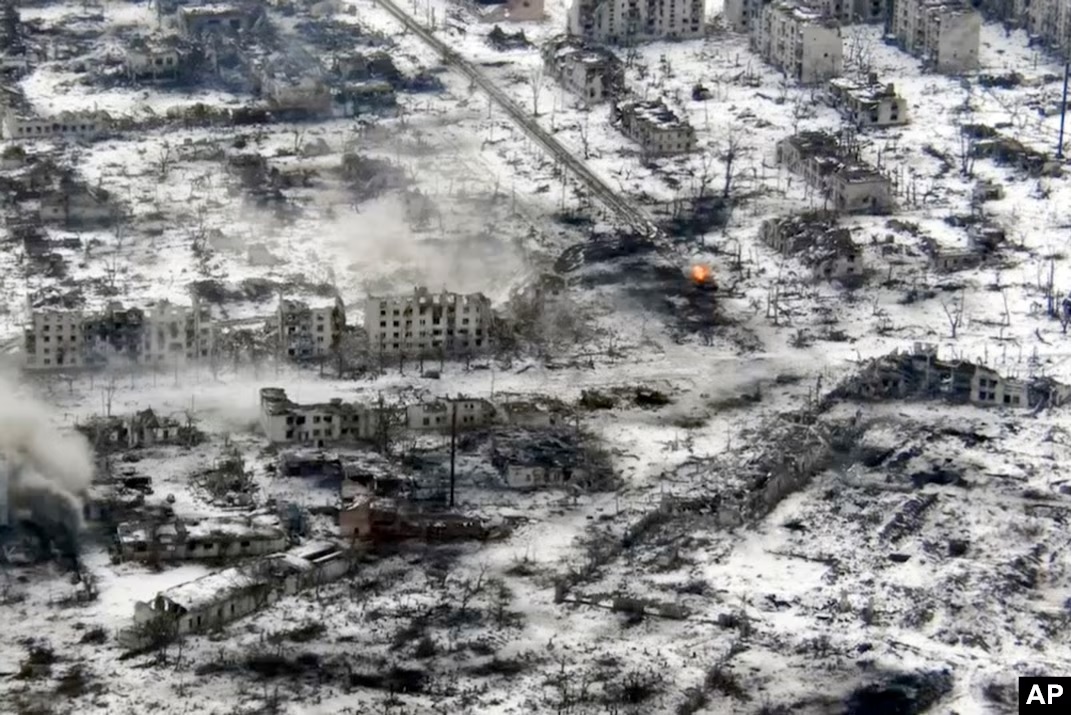
Ukraine’s role in the Western war machine is expanding far beyond its borders. After years of serving as Washington and NATO’s proxy against Russia, Kyiv is now accused of attacking an Iranian commercial vessel in the Caspian Sea, assisting armed groups seeking to undermine sovereign governments in Africa’s Sahel and collaborating with forces linked to Al Qaeda in Syria. Rather than an isolated nation defending democracy, Ukraine increasingly appears to be marketing itself as a military subcontractor for Western powers—willing to intervene wherever their geopolitical interests are threatened.
In this episode of Clearing the FOG, Margaret Flowers speaks with Phil Wilayto, co-founder of the Odessa Solidarity Campaign, about the history buried beneath the official narrative. They revisit the 2014 U.S.-backed overthrow of Ukraine’s government, the growing influence of far-right and openly white-supremacist organizations, the unpunished Odessa massacre and the long war against the predominantly Russian-speaking Donbas. Wilayto also describes a country confronting deepening political repression, banned opposition parties and masked recruitment squads reportedly seizing military-age men from the streets as Kyiv struggles to replenish its forces.
Flowers and Wilayto argue that Washington never regarded Ukraine as a democracy to be protected, but as a strategic weapon to be used against Russia—regardless of the enormous cost to Ukrainian and Russian lives. Now, as Western support becomes less certain, Kyiv appears eager to prove its value by attaching itself to U.S. and European campaigns against Iran, Syria and independent African governments. The result is a widening architecture of conflict in which Ukraine’s people are sacrificed, military contractors prosper and every new battlefield becomes another bargaining chip in the struggle to preserve Western domination.
“It looks like Ukraine is trying to connect its war with Russia to the U.S.-Israeli war against Iran,” Phil Wilayto explains. “Ukraine is essentially saying, ‘These conflicts are all part of the same struggle. If you’re going to confront Iran, then you need to provide us with more military supplies and greater access to Patriot missile production.’
“The Trump administration has pulled back somewhat from providing Ukraine with some of the military resources it wants, but I expect that to change. I think Trump is trying to create the impression that the United States wants a negotiated settlement. In reality, Washington has a strong interest in keeping this war going, regardless of how much suffering it causes on both sides.”
Margaret Flowers adds, “The CIA has had a long relationship with Ukraine, and Ukraine now appears to be acting as a tool of the United States. We have already seen evidence of this in parts of Africa, particularly across the Sahel.”
Guest:
Phil Wilayto is a writer, speaker and organizer based in Richmond, Virginia. He is a founding member of the Defenders for Freedom, Justice & Equality, an all-volunteer community organization, and editor of the quarterly newspaper The Virginia Defender.
While Western media continue to portray Ukraine as a struggling democracy defending itself from Russian aggression, Margaret Flowers and Phil Wilayto present a far more disturbing picture: a government suppressing dissent at home while extending Western military interests abroad. The transcript describes banned opposition parties, tens of thousands of alleged political prisoners, prosecutions of people resisting military service and masked recruitment squads reportedly dragging men from the streets and forcing them into Ukraine’s depleted armed forces.
Wilayto, co-founder of the Odessa Solidarity Campaign, traces these conditions back to the 2014 U.S.-backed overthrow of Ukraine’s government and the empowerment of ultranationalist and openly white-supremacist forces. He revisits the Odessa massacre, where at least 42 people were killed after anti-coup activists were driven into a trade union building that was set on fire.
Despite extensive video evidence, he says, no one has been held responsible. That history, largely erased from Western coverage, challenges the sanitized narrative of an uncomplicated battle between democracy and authoritarianism.
But the discussion does not stop at Ukraine’s borders. Flowers and Wilayto examine Kyiv’s alleged attack on an Iranian commercial vessel in the Caspian Sea, its support for armed groups opposing independent governments in Africa’s Sahel and its reported cooperation with forces linked to Al Qaeda in Syria. As Western enthusiasm for funding the war against Russia becomes less certain, they argue, Ukraine is demonstrating its usefulness by acting wherever U.S., NATO and former European colonial interests are threatened.
The interview’s conclusion is stark: Washington never treated Ukraine as a country to be saved, but as a piece on what strategist Zbigniew Brzezinski called the “grand chessboard”—a nation whose location, soldiers and future could be used to weaken Russia. Four and a half years into a grinding war, Ukrainians are being seized for military service and sent to the front while Kyiv searches for new battlefields on which to prove its value. Ukraine has not simply become the West’s proxy against Russia; it is becoming an imperial enforcer for hire.
Nuclear Security Is A Hidden Public Cost Of Nuclear Power
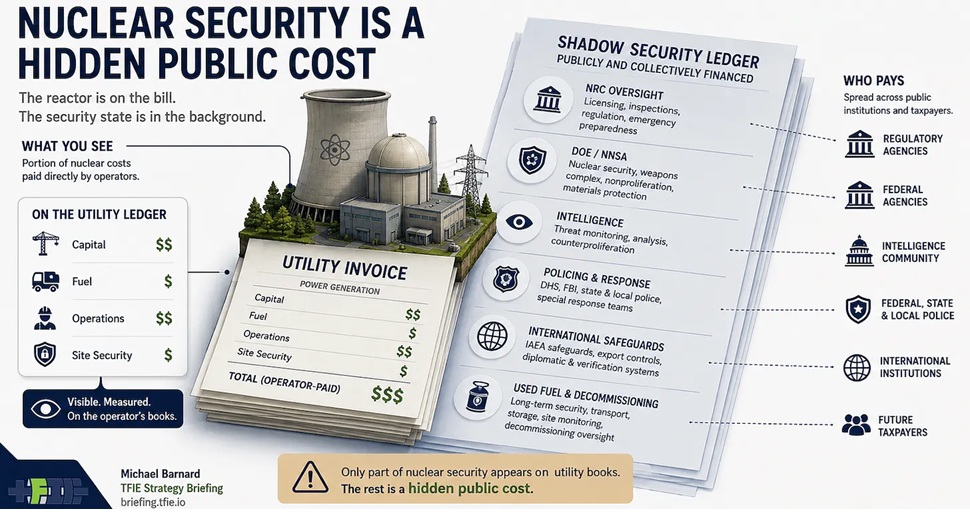
Security costs stretch across regulators, weapons-adjacent agencies, intelligence, policing, international safeguards and plant sites, but only part appears on utility books.
Michael Barnard, Aug 05, 2026
Nuclear security is not a single line item. It is a layered public and private cost structure spread across international safeguards, federal agencies, local policing and plant sites.
Nuclear power has an accounting problem that rarely appears in clean-energy comparisons. The industry requires overlapping layers of security across fuel supply chains, international safeguards, generation sites, used fuel, waste management and long decommissioning periods. Operators pay some of those costs directly. Much of the rest is spread across public agencies, regulatory systems, policing, intelligence and security institutions.
That was the core argument of my original CleanTechnica analysis in 2021. The article estimated that nuclear security costs in the United States were on the order of $50 million per reactor per year, with roughly half or less paid directly by operators. The resulting screening estimate was about $4 billion per year in uncounted public support for the U.S. nuclear fleet, in addition to direct tax preferences. That number should not be treated as a consolidated federal invoice. It was, and remains, an attempt to size a cost category that is otherwise scattered across too many budget lines to see clearly.
The need for that framing has not gone away. The numbers have moved, but the structure remains. As of March 2026, the United States had 96 operating commercial reactors at 57 nuclear power plants in 28 states. The NRC’s FY2027 budget request was $892 million with 2,606 full-time-equivalent staff. NRC fee recovery rules have also shifted: the Nuclear Energy Innovation and Modernization Act now requires the NRC to recover, to the maximum extent practicable, approximately 100% of its annual budget authority, excluding specific categories. The National Nuclear Security Administration, a semiautonomous DOE agency responsible for nuclear warheads, naval reactors and nonproliferation, has also grown materially, with an FY2026 request of about $30 billion…………….. (subscribers only)
https://briefing.tfie.io/p/nuclear-security-is-a-hidden-public
Climate Change Is Rewriting Europe’s Nuclear Cooling Assumptions

Romania used explosives to clear the way for redirecting Danube water toward Cernavodă as heat and drought cut nuclear output when cooling demand peaked.
Michael Barnard, Aug 04, 2026,
https://briefing.tfie.io/p/climate-change-europe-nuclear-cooling
On 3 August, Romanian naval engineers used 180 kilograms of explosives to remove a rock outcrop in the Bala Canal, a branch of the Danube. The controlled blast cleared the way for construction of a temporary dam intended to direct more water into the river channel serving the Cernavodă nuclear plant. One of Romania’s two reactors had already stopped as Danube flow fell to about 1,500 cubic metres per second, less than one-third of the normal July level, leaving the country trying to preserve the remaining unit through emergency river engineering.
The intervention made a normally hidden dependency visible. Nuclear reactors produce heat continuously and require somewhere to reject the larger quantity of waste heat that does not become electricity. Fuel supply may be largely insulated from weather, but the cooling systems, intake structures and environmental permits of river-cooled plants are tied to local hydrology. Much of Europe’s existing nuclear fleet was designed around historical ranges of water temperature and flow that are becoming less dependable.
The national consequences are much larger than a Europe-wide fleet percentage suggests. The most severe documented exposure is in Hungary, where the four-reactor Paks plant normally supplies 45.2% of national generation. By the morning of 4 August, the plant had been reduced from 1,916 MW to one 240 MW turbine, leaving nuclear capacity equivalent to approximately 39.5% of Hungary’s normal annual generation unavailable. A complete stop would expose the full 45.2% nuclear share.
Romania’s loss of one 650 MW Cernavodă unit represented about 10.3% of normal national generation on the same annual-equivalent basis. France reached a similar national figure through a much larger absolute reduction in July, when heat constrained more than 9 GW across 12 of its 57 reactors. The reduction was 14.6% of French nuclear capacity, equivalent to about 10% of normal national generation given France’s 68.1% nuclear share. Both Beznau units in Switzerland were shut during the July heatwave when the Aare reached 25°C, representing approximately 6.7% of normal Swiss generation.
Those figures [on table on original] are comparison indicators, not synchronized measurements of electricity actually lost. Hungary and Romania reflect conditions on 3–4 August, while France and Switzerland reflect their July peaks. Each value multiplies the country’s 2025 nuclear generation share by the proportion of nuclear capacity constrained at that snapshot. The method is intentionally simple, but it shows why a moderate continental effect can become a national emergency when a country depends heavily on one plant or river.
Two mechanisms are operating. France and Switzerland primarily faced hot-water constraints. Cooling water returned to an already warm river can push downstream temperatures above environmental limits, so plant operators reduce output or stop reactors to protect river ecosystems. Axpo reduced and subsequently shut the Beznau units when the Aare reached 25°C, while French plants along several rivers reduced production as temperatures crossed site-specific limits.
Hungary and Romania faced insufficient river flow as well as heat. Paks and Cernavodă require adequate water level and flow at their intake systems to operate at power. Record-low Danube levels forced Paks down to just over 10% of capacity and removed half of Cernavodă’s nuclear fleet. The reactors were shut or reduced safely; the power-system problem was that safe operation still removed large blocks of electricity during peak cooling demand.
Human-caused warming is clearly present in the heat component. World Weather Attribution found that the June western European heatwave was about 3.5°C hotter during the day than the same circulation pattern would have produced in the 1976 climate, and about 2°C hotter than a comparable event in 2003. No attribution study has calculated exactly how many megawatt-hours of the French or Swiss nuclear reductions would have remained available without climate change, but the water-temperature thresholds were being crossed in a heat regime substantially intensified by fossil-fuel emissions.
Attribution of the Danube’s low flow is less direct. Eastern Europe entered 2026 with persistent rainfall deficits, but the observed six-month precipitation trend was not statistically robust enough to assign the missing rainfall primarily to climate change. Warming had a much clearer influence on the rate at which the atmosphere pulled moisture from vegetation and soils. The January-to-June eastern European soil-moisture drought became about 11 times more probable because of human-induced climate change, while the extreme potential evapotranspiration became about 40 times more likely and about 8% more intense. Conditions of similar rarity in a climate 1.4°C cooler would have produced moderate rather than extreme drought in eastern Europe.
The defensible interpretation is that natural variability contributed much of the initial rainfall deficit while climate change materially deepened the resulting drought. That does not establish an anthropogenic percentage of the Danube’s missing cubic metres. It does establish that a dry period now loses more water to heat, reaches severe soil-moisture deficits more readily and is more likely to push river-dependent infrastructure across operating thresholds.
The electricity-system problem is the correlation among impacts. Extreme heat raises demand for air conditioning while warming cooling water, increasing evaporation and reducing river flow. Hydropower production falls with depleted rivers, gas turbines lose some output in hotter air, and persistent high-pressure weather can bring weak wind. Reuters reported European summer electricity prices reaching levels usually associated with winter stress as cooling demand increased and French nuclear output was reduced by more than 9 GW.
Air conditioning cannot be treated as a uniformly disposable load during a severe heatwave. Hospitals, care homes, cooling centres and vulnerable households require reliable electricity precisely because the heat is dangerous. The more useful flexibility is found first in industrial production, commercial loads that can be rescheduled, storage, imports and safe thermostat adjustments. Hungary’s voluntary conservation effort reduced demand by 700 MW on 2 August, nearly three times the output of the final Paks turbine, demonstrating that contracted or coordinated demand reduction can provide more immediate capacity than the reactor output still being defended.
Nuclear generation is not uniquely exposed to climate change. Hydroelectric, gas, coal, biomass, transmission and renewable generation all have different weather and climate dependencies. Nuclear’s exposure is unusually consequential because individual units are large and some national systems concentrate much of their electricity production at a single site. Its high historical capacity factors remain valuable, but they do not remove the need to plan for correlated periods of high temperature, low water and high demand.
This matters directly for reactor life extensions. Evaluations that add another 20 or 30 years of operation should use forward projections of river temperature, seasonal flow and extreme low-water events rather than treating the historical record as stationary. The engineering options include modified intakes, additional pumping, cooling towers, hybrid or dry cooling, and revised operating limits, each with costs and efficiency penalties that should be included in the life-extension case.
The grid response is broader than plant adaptation. Stronger interconnection reduces dependence on one national fleet, batteries and demand response cover the evening period when cooling demand remains high and solar production falls, and additional solar generation supplies electricity during many of the hottest daytime hours without depending on river flow. Planning also has to recognize that nuclear and hydro constraints can occur together across the same watershed rather than treating each generator’s risk independently.
Romania’s river intervention does not show that nuclear power has ceased to be a useful low-carbon resource. It shows that a reactor can be technically sound while its inherited cooling assumptions become less reliable. Climate resilience for legacy nuclear generation now belongs inside capacity planning, life-extension economics and grid design, not in an environmental appendix written after the major investment decisions have already been made.
Why no Hollywood movie on Nagasaki A bombing?

Walt Zlotow West Suburban Peace Coalition Glen Ellyn IL, 6 Aug 26.
In the 1952 movie ‘Above and Beyond’, movie idol Robert Taylor played handsome Col. Paul Tibbetts, straight out of Central Casting, who piloted Enola Gay to drop the first atomic bomb on Hiroshima 81 years ago today. We all grew up in awe of Tibbetts, Enola Gay and the perfect mission which incinerated Hiroshima from the first A Bomb dropped in anger. My awe eventually turned to revulsion from a horrendous war crime.
But who piloted what plane that dropped the second A Bomb on Nagasaki just 3 days later? The American Story has largely erased the saga of the Nagasaki mission for good reason. It was a colossal screw up that almost got the pilot court martialed; indeed, nearly detonated the Nagasaki A Bomb ‘Fat Man’ over the Pacific en route.
Trouble began early on. Paul Tibbetts, fresh from his Hiroshima success, picked his friend Charles Sweeney to pilot the drop plane ‘Bockscar’ instead of its regular pilot Fred Bock. Sweeney was unfamiliar with both combat and the plane. Preparing for takeoff, Sweeney was unable to operate the reserve tank containing 640 gallons of fuel needed to get Bockscar safely back to its Tinian takeoff point. Bock may have had the familiarity with the plane to accomplish that. Regulations required the mission be scrapped so Sweeney and crew exited Bockscar. But Tibbetts overruled them and the mission was on with insufficient fuel.
Three hours in, worse trouble. Fat Man’s red detonation lights began blinking wildly. Chief weaponeer Dick Ashworth frantically searched the blueprints and realized 2 switches had been reversed in the preflight assembly. Solving that problem, everyone relaxed till Bockscar failed to rendezvous with the second of two back up planes, one for photography and one for instruments. The instrument plane, The Big Stink, was 9,000 feet above Bockscar. Instead of pushing on to original target Kokura, Sweeney wasted 45 minutes of precious fuel trying to link up. Big Stink pilot Hoppy Hopkins broke radio silence frantically calling Tinian asking “Is Bockscar down?” Mission officials only heard “Bockscar Down” and freaked out believing Bockscar, Fat Man and the 13 member crew were in Davy Jones Locker.
Ashford was frantic that all was lost. As tension mounted between the weaponeer and the pilot, he finally persuaded Sweeney to proceed to primary target Kokura. But a smokescreen put up by Japanese defenders responding to the Hiroshima attack caused Sweeney to go around for a second and third bomb run, wasting fuel. More trouble. Flack and approaching Japanese Zeros forced Sweeney to abandon Kokura to flee 100 miles to alternate target Nagasaki.
The drop made, Sweeney made a desperate dive to avoid the mushroom cloud that nearly engulfed them. But his previous delays made the return trip to Tinian impossible. Low on fuel, Sweeney began a treacherous 450 mile flight on dwindling fuel for Okinawa. All aboard Bockscar prepared to ditch. Approaching the Okinawa airfield unable to radio the tower of their emergency, Bockscar had to drop in to a forced landing amid numerous other flights without control tower clearance. Bockscar bounced 25 feet in the air landing at 30 MPH over the maximum landing speed, nearly colliding with a row of fuel laden B-24’s. One engine quit on the approach and another upon touchdown. Thinking Bockscar was lost, airport personnel inquired who this strange plane was that descended out of the sky unannounced. ‘We just dropped an atomic bomb’ was the reply.
There were no celebrations for the crew of Bockscar. Officials considered a courts martial for Sweeney for his life and mission threatening delays but realized the embarrassment it would cause and decided against. Why mar the mission-perfect first nuking of civilians by Paul Tibbetts and Enola Gay?
While we’ll never get a Hollywood treatment of the Bockscar A Bomb mission, it would be a lot more exciting than ‘Above and Beyond’. An appropriate title? ‘Nearly Down and Out Over Nagasaki’.
No to Nuclear: why nuclear power and nuclear weapons are interlinked threats to humanity
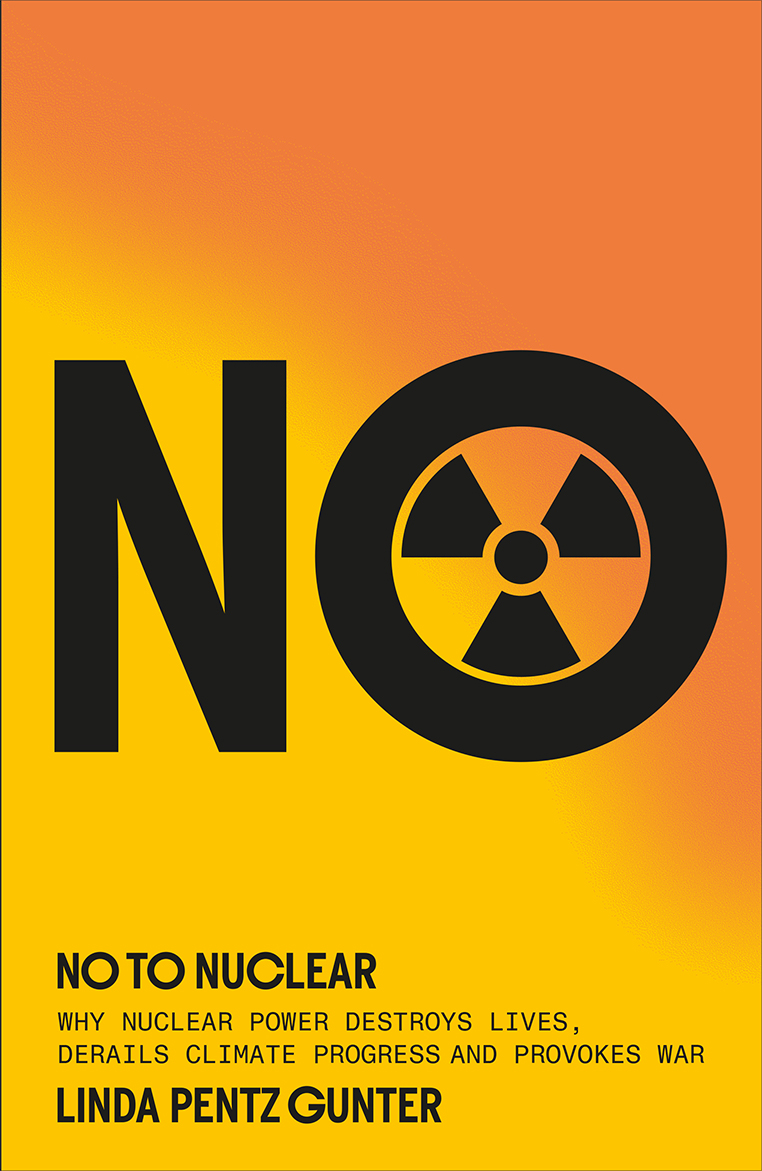
Our most urgent priority, therefore, must be to immediately address the climate crisis to prevent its worsening; and to push for nuclear disarmament to avoid a nuclear Armageddon. Both of these challenges are made infinitely more difficult — and I would argue impossible — to overcome due to a single major obstacle: the continued use and proposed expansion of nuclear power as an energy source.
In the first of a four-part serialisation from her new book No to Nuclear, LINDA PENTZ GUNTER outlines the case she will make against this dangerous technology.
Linda Pentz Gunter, 4 August 2026,
https://www.morningstaronline.co.uk/article/no-nuclear-why-nuclear-power-and-nuclear-weapons-are-interlinked-threats-humanity
WE FACE multiple threats to our wellbeing and survival, across all sectors of society and among many nations.
Conflict is seemingly everywhere. Working people are struggling while billionaire oligarchs control governments and are intent on destroying democracies. The plundering of our Earth for near-term profit persists, even as the science tells us it is unsustainable and will create an unlivable planet — possibly sooner than any of us imagined.
But beyond the destruction of societal welfare, rampant pollution and even wars lie two existential threats that could end life on Earth as we know it: climate change and nuclear war.
Climate change — now climate crisis — was once viewed as a creeping danger that would gradually destroy our ability to survive. Meanwhile, during the Cold War, our greatest fear was instant obliteration, the result of an all-out nuclear exchange between the world’s superpowers.
Now we must reckon with a new reality. The climate crisis we chose to ignore is upon us, causing the breakdown of essential ecosystems within the web of life much sooner and faster than we predicted.
Nine nations are in possession of nuclear weapons, leaving open the possibility of an all-out life-ending nuclear war, or even a so-called limited one. A nuclear exchange between India and Pakistan, for example, could still result in the collapse of world agriculture and the slow starvation of billions.
Our most urgent priority, therefore, must be to immediately address the climate crisis to prevent its worsening; and to push for nuclear disarmament to avoid a nuclear Armageddon. Both of these challenges are made infinitely more difficult — and I would argue impossible — to overcome due to a single major obstacle: the continued use and proposed expansion of nuclear power as an energy source.
Nuclear power has been given a free pass to date, touted as a climate solution (when, as I argue in this book, it is precisely the opposite), and as a consolation prize for countries who agree never to develop nuclear weapons (as I also argue, access to nuclear power technology only makes nuclear weapons development easier and more likely). As such, the nuclear power elephant, if not removed from the room, will sabotage our quest for survival.
In endeavoring to lay out all of the arguments against the continued use of nuclear power in this book, I seek to follow a path that diverges from the traditional and well-argued tech- nical, scientific and economic analyses. It is time to put the human face on the nuclear power story, to talk about the lives of real people — and of animals too — that have been harmed by this sector.
In doing so, I hope that readers will begin to recognize and empathize with the pain, suffering and above all injustice that has been wreaked upon our fellow human beings and all living things by a profligate industry intent on pleasing its shareholders, not on saving the planet. These corporate and invariably colonialist crimes are the same whether they are committed in the commercial nuclear sector or by the profit-hungry nuclear arms industry.
It should be noted, incidentally, that the same companies who manufacture nuclear weapons are also those who furnish conventional weapons to fuel wars and even genocides such as the one in Gaza. And, ironically, and despite their greenwashing rhetoric, all of the major nuclear power companies are also heavily invested in the continued use of fossil fuels.
I also make the argument that, far from a solution to the climate crisis, as it presents itself, the use of nuclear power can only make climate conditions worse.
The allocation of time and especially the vast funds required — tens of billions of dollars for a single reactor — toward nuclear power strips essential funds from alternatives such as renewable energy.
All the data show that dollar for dollar or pound for pound, more carbon reductions can be achieved faster by investing the same amount in renewable energy instead.
WE FACE multiple threats to our wellbeing and survival, across all sectors of society and among many nations.
Conflict is seemingly everywhere. Working people are struggling while billionaire oligarchs control governments and are intent on destroying democracies. The plundering of our Earth for near-term profit persists, even as the science tells us it is unsustainable and will create an unlivable planet — possibly sooner than any of us imagined.
But beyond the destruction of societal welfare, rampant pollution and even wars lie two existential threats that could end life on Earth as we know it: climate change and nuclear war.
Climate change — now climate crisis — was once viewed as a creeping danger that would gradually destroy our ability to survive. Meanwhile, during the Cold War, our greatest fear was instant obliteration, the result of an all-out nuclear exchange between the world’s superpowers.
Now we must reckon with a new reality. The climate crisis we chose to ignore is upon us, causing the breakdown of essential ecosystems within the web of life much sooner and faster than we predicted.
Nine nations are in possession of nuclear weapons, leaving open the possibility of an all-out life-ending nuclear war, or even a so-called limited one. A nuclear exchange between India and Pakistan, for example, could still result in the collapse of world agriculture and the slow starvation of billions.
Our most urgent priority, therefore, must be to immediately address the climate crisis to prevent its worsening; and to push for nuclear disarmament to avoid a nuclear Armageddon. Both of these challenges are made infinitely more difficult — and I would argue impossible — to overcome due to a single major obstacle: the continued use and proposed expansion of nuclear power as an energy source.
Nuclear power has been given a free pass to date, touted as a climate solution (when, as I argue in this book, it is precisely the opposite), and as a consolation prize for countries who agree never to develop nuclear weapons (as I also argue, access to nuclear power technology only makes nuclear weapons development easier and more likely). As such, the nuclear power elephant, if not removed from the room, will sabotage our quest for survival.
In endeavoring to lay out all of the arguments against the continued use of nuclear power in this book, I seek to follow a path that diverges from the traditional and well-argued tech- nical, scientific and economic analyses. It is time to put the human face on the nuclear power story, to talk about the lives of real people — and of animals too — that have been harmed by this sector.
In doing so, I hope that readers will begin to recognize and empathize with the pain, suffering and above all injustice that has been wreaked upon our fellow human beings and all living things by a profligate industry intent on pleasing its shareholders, not on saving the planet. These corporate and invariably colonialist crimes are the same whether they are committed in the commercial nuclear sector or by the profit-hungry nuclear arms industry.
It should be noted, incidentally, that the same companies who manufacture nuclear weapons are also those who furnish conventional weapons to fuel wars and even genocides such as the one in Gaza. And, ironically, and despite their greenwashing rhetoric, all of the major nuclear power companies are also heavily invested in the continued use of fossil fuels.
I also make the argument that, far from a solution to the climate crisis, as it presents itself, the use of nuclear power can only make climate conditions worse.
The allocation of time and especially the vast funds required — tens of billions of dollars for a single reactor — toward nuclear power strips essential funds from alternatives such as renewable energy.
All the data show that dollar for dollar or pound for pound, more carbon reductions can be achieved faster by investing the same amount in renewable energy instead.
Additionally, the clear pathway that a civil nuclear power programme provides to nuclear weapons development is swept under the rug or denied altogether. Both international treaties that seek to rid the world of nuclear weapons — the nuclear Non-Proliferation Treaty (NPT) and the Treaty on the Prohibition of Nuclear Weapons (TPNW) — afford countries who agree to disavow nuclear weapons “the inalienable right” to “develop research, production and use of nuclear energy for peaceful purposes.” Thus, the back door to nuclear weapons development remains perpetually open.
No to Nuclear is published by Pluto Press, £14.99. Part 2 of this serialisation will appear in tomorrow’s edition.
1 This Month





PLEASE OPPOSE HR 8255 AND S.3639 – bills would accelerate satellite deployment, with no environmental review or safeguards – https://ncstd5li.quorum.us/campaign/169331/
To see nuclear-related stories in greater depth and intensity – go to https://nuclearinformation.wordpress.com
-
Archives
- October 2026 (58)
- September 2026 (339)
- August 2026 (330)
- July 2026 (355)
- June 2026 (287)
- May 2026 (306)
- April 2026 (356)
- March 2026 (251)
- February 2026 (267)
- January 2026 (308)
- December 2025 (358)
- November 2025 (359)
-
Categories
- 1
- 1 NUCLEAR ISSUES
- business and costs
- climate change
- culture and arts
- ENERGY
- environment
- health
- history
- indigenous issues
- Legal
- marketing of nuclear
- media
- opposition to nuclear
- PERSONAL STORIES
- politics
- politics international
- Religion and ethics
- safety
- secrets,lies and civil liberties
- spinbuster
- technology
- Uranium
- wastes
- weapons and war
- Women
- 2 WORLD
- ACTION
- AFRICA
- Atrocities
- AUSTRALIA
- Christina's notes
- Christina's themes
- culture and arts
- Events
- Fuk 2022
- Fuk 2023
- Fukushima 2017
- Fukushima 2018
- fukushima 2019
- Fukushima 2020
- Fukushima 2021
- general
- global warming
- Humour (God we need it)
- Nuclear
- RARE EARTHS
- Reference
- resources – print
- Resources -audiovicual
- Weekly Newsletter
- World
- World Nuclear
- YouTube
-
RSS
Entries RSS
Comments RSS

