The U.S.-Saudi Nuclear Deal Is a Test Case for South Korean Uranium Enrichment
U.S. and South Korean policymakers should develop diplomatic and institutional measures to address potential concerns and opposition surrounding nuclear-powered submarine and fuel cooperation.
By Ellen Kim, August 3, 2026,
https://keia.org/analysis/the-u-s-saudi-nuclear-deal-is-a-test-case-for-south-korean-uranium-enrichment/
On July 22, the United States and Saudi Arabia signed a civil nuclear cooperation agreement. However, the future of the agreement became uncertain the following day when President Donald Trump made Saudi Arabia’s normalization of relations with Israel, via accession to the Abraham Accords, a final requirement for its implementation.
The U.S.-Saudi nuclear agreement has drawn considerable attention in South Korea because the U.S. administration has opened the possibility of allowing uranium enrichment on Saudi territory, contingent upon the results of a two-year joint feasibility study. During bilateral negotiations to revise the 2015 U.S.-South Korea civil nuclear cooperation agreement, South Korea sought but could not obtain U.S. advance consent to enrich or reprocess U.S. spent nuclear fuel. That situation began to change after President Trump approved a nuclear-powered submarine program for South Korea during his summit with South Korean President Lee Jae Myung last October. The two governments subsequently agreed to cooperate on options for procuring nuclear submarine fuel, and bilateral discussions on civil nuclear cooperation, including on uranium enrichment, resumed with working-level talks held in June of this year.
Against this backdrop, the future of the U.S.-Saudi nuclear cooperation agreement will serve as an important test case for future U.S.-South Korea talks. The decision to conditionally permit uranium enrichment in Saudi Arabia, even as the United States remains engaged in a conflict with Iran aimed at preventing the country from acquiring nuclear weapons, has already prompted concerns in Congress that the agreement could fuel an arms race and spur nuclear proliferation in the Middle East.
The security environment on the Korean Peninsula is not so different. While the United States and South Korea continue to pursue the denuclearization of North Korea, South Korea’s pursuit of a low-enriched uranium program to support its nuclear-powered submarine program is also likely to face criticism from those concerned about nuclear proliferation in Northeast Asia. Consequently, even if the U.S.-Saudi nuclear agreement ultimately clears congressional approval, growing concerns over nuclear proliferation in the United States and the broader international community could pose significant obstacles to advancing future U.S.-South Korea cooperation on these issues.
For this reason, U.S. and South Korean policymakers should closely examine the U.S.-Saudi nuclear agreement and develop diplomatic and institutional measures to address potential concerns and opposition surrounding nuclear-powered submarine and fuel cooperation.
First, South Korea should clearly differentiate its case from that of Saudi Arabia. Unlike Saudi Arabia, South Korea ratified and brought into force the International Atomic Energy Agency (IAEA) Additional Protocol to its Safeguards Agreement in 2004. Since then, it has accepted expanded IAEA access and short-notice inspections, strengthened the transparency of its civilian nuclear activities, and faithfully fulfilled its obligations under the international nonproliferation regime. South Korea should emphasize this strong nonproliferation record and make clear that any future uranium enrichment program for nuclear-powered submarine development would operate under the IAEA’s stringent safeguards and verification regime. In addition, Seoul should proactively propose additional enhanced safeguards and verification mechanisms to ensure that nuclear materials cannot be diverted for purposes beyond those agreed upon by Washington and Seoul.
Second, the United States and South Korea should develop a win-win strategy for civil nuclear industry cooperation. South Korea currently operates twenty-six nuclear power reactors and has emerged as a major exporter of nuclear power plants. To compete more effectively with China and Russia, whose influence in the global nuclear market continues to expand, the United States and South Korea should leverage their respective strengths to build a more competitive partnership. Given South Korea’s recent indication of energy as a priority sector for its investment projects in the United States, there is an opportunity to align these investments with expanded bilateral cooperation in the nuclear industry.
Finally, the most important prerequisite for U.S.-South Korea cooperation on nuclear-powered submarines and fuel is mutual trust. Such cooperation cannot be advanced solely through decisions by the executive branch in the United States; it will ultimately require the support and approval of Congress. However, the current U.S.-South Korea relationship faces multiple challenges spanning security, trade, and other areas. Rather than addressing nuclear cooperation in isolation, both governments should manage the alliance comprehensively and approach these issues with a long-term perspective, resolving them gradually while preserving the broader strength and credibility of the alliance.
Ukraine’s “Turning the Tide” Narrative has Already Sunk

The result is an information environment in which the possibility of mutual coexistence with Russia is treated as almost unthinkable, even as the costs continue to mount for Ukrainians, Russians, and Europeans alike.
How the mainstream media spins each new failure as success – with Leonid Ragozin
Ian Proud, Aug 10, 2026, https://thepeacemonger.substack.com/p/ukraines-turning-the-tide-narrative?utm_source=post-email-title&publication_id=3221990&post_id=210596621&utm_campaign=email-post-title&isFreemail=true&r=1ise1&triedRedirect=true&utm_medium=email
One of the most striking features of the Ukraine war has been the speed with which Western and Ukrainian narratives appear in the mainstream, dominate the discussion for a while, and then quietly collapse with absolutely no reflection on how they were wrong.
The latest example was the campaign launched this summer that ‘Ukraine is turning the tide’ against Russia in the war.
In conversation with independent journalist Leonid Ragozin, we examined what that campaign actually delivered. Back in June, long-range strikes deep into Russian territory and occupied areas — particularly Crimea — were presented as the pressure that would force Putin to the table on terms closer to Ukraine’s.
Defence Minister Mikhail Fedorov was the public face of the effort. Forty days later the results are clear: Russia’s position has not softened by an inch. In fact, it has hardened.
The possibility of land swaps that once featured in negotiations after Ukraine’s Kursk offensive has now been taken off the table. Fedorov has been removed, triggering a political crisis in Kyiv and the replacement of the Army’s Soviet-style commander-in-chief.
As Leonid pointed out, this follows a familiar pattern. The 2023 summer offensive was sold as the moment Ukraine would roll Russian forces back. The Kursk operation briefly revived the idea of territorial leverage. Each time the goalposts have shifted — and each time they have shifted in Russia’s favour.
What began in late April 2022 (thanks to Liz Truss) as talk of liberating Crimea has now contracted to trying to hold the remaining parts of Donetsk. The human and material cost of the progressive contraction of the narrative has been enormous.
What makes the current moment particularly revealing is the gap between elite rhetoric and public sentiment. Gallup polling over the past three years shows a clear shift among Ukrainians: where two-thirds once insisted the only acceptable end was total Russian defeat, the same proportion now favour a negotiated settlement.
Yet the war continues.
Leonid’s explanation is straightforward and uncomfortable. This is not primarily a war of nations. It is a war of interlocking elites — securocratic structures in all participating countries and defence-industry and bureaucratic interests in the West — whose incentives diverge sharply from those of ordinary people.
The same dynamic helps explain the hermetic quality of Western media coverage.
Having worked for the BBC for twelve years, Leonid notes how far British (and wider Western) journalism has travelled from its willingness to scrutinise government claims over Iraq, to providing a blank cheque for foreign policy idiocy in Ukraine.
Nuance has been replaced by a single vantage point that treats any deviation from the Overton window as suspect.
The result is an information environment in which the possibility of mutual coexistence with Russia is treated as almost unthinkable, even as the costs continue to mount for Ukrainians, Russians, and Europeans alike.
We also discussed the deeper cultural and political roots of this hostility — the way liberal elites, in competing with the populist right, adopted their own version of enemy-creation, and the neocolonial mindset that still treats the region as a theatre for proxy competition rather than a space for independent states with legitimate interests.
Mainstream journalists are now as complicit in the needless blood-letting that continues in Ukraine with no end in sight. One wonders what they will call the next, vanishingly insignificant turn of the tide?
The full conversation with Leonid is available here.
Trump claims he’s ‘low-keying it’ with Iran after report he could walk away without nuclear deal

The president claims economic challenges will continue harming Iran, even if US negotiators have been unable to clinch a deal for the Strait of Hormuz to reopen
Josh Marcus in San FranciscoSunday 09 August 2026
. Donald Trump is taking a
wait-and-see approach to Iran as negotiations to reopen the Strait of
Hormuz and permanently end the war appear to have once again stalled
following reports that the president is reportedly considering walking away
from the conflict without securing a nuclear deal. “We are low keying
it,” Trump told Axios on Sunday, claiming the U.S. strategy will
eventually “work out.” “We are only semi-negotiating with them,” he
added. “We are just watching Iran with its huge inflation and the fact
they have no money.”
Independent 9th Aug 2026,
https://www.the-independent.com/news/world/americas/us-politics/trump-iran-strait-of-hormuz-negotiations-terms-b3030066.html
Energoatom: Zaporizhzhia NPP lost external power twice on Aug 8
Ukrinform 8th Aug 2026
The Russian-occupied Zaporizhzhia Nuclear Power Plant (ZNPP) lost its external power supply twice on Saturday, August 8.
Ukraine’s state nuclear power operator Energoatom reported this on Telegram, according to Ukrinform.
At 10:59, the 330 kV overhead power line L-243 Ferosplavna – ZTPP No. 1, which supplies power for the plant’s own needs, was briefly disconnected.
The line was automatically reconnected at the Ferosplavna substation and remained energized. While the necessary procedures were being carried out, the plant’s own needs were supplied by diesel generators.
At 11:52, power to the ZNPP was restored.
However, at 14:26, the plant again lost its external power supply. Its own needs were once again switched to diesel generator power.
At 15:35, the plant’s own needs were supplied via the 330 kV Ferosplavna-1 overhead line, restoring the ZNPP’s external power supply.
“The situation once again demonstrates the vulnerability of the Zaporizhzhia NPP under Russian occupation. Any disruption to the normal power supply systems of a nuclear facility creates additional risks to nuclear and radiation safety,” the company said………………………….. https://www.ukrinform.net/rubric-economy/4152446-energoatom-zaporizhzhia-npp-lost-external-power-twice-on-aug-8.html
Drought and scorching heatwaves threaten Europe’s vision of a nuclear-powered future

James C. Reynolds, 8 Aug 26
hotter summers and
a changing climate are interfering with how nuclear power works. It is an image that
somehow captures the crisis of Europe’s present and future: a smouldering
wildfire burning on grassland just two miles from a nuclear plant.
More than 100 firefighters were called in to tackle the blaze sweeping through
Dunwich Heath on the Suffolk coast at the end of July, which lies just
north of the Sizewell B nuclear plant that powers up to 2.5 million British
homes. The fire tore through the equivalent of 210 football pitches on the
Suffolk coast before it was extinguished.
Across the continent, wildfires
have been much more severe and widespread. Spain and France have seen tens
of thousands of acres of land scorched over the last month, and nearly a
quarter of a million people were forced from their homes. The Independent
saw first-hand how communities have been torn apart as France recorded its
hottest July on record.
Independent 8th Aug 2026, https://www.independent.co.uk/news/world/europe/europe-heatwave-drought-nuclear-power-b3027942.html
The trouble with Small Modular Nuclear Reactors (SMRs) – THEY’RE NOT SMALL
7 August 2026 Noel Wauchope, https://theaimn.net/the-trouble-with-small-modular-nuclear-reactors-smrs-theyre-not-small/

The big boasts for small nuclear reactors are that they are modular and they are small.

Modular – yes. They’re a sort of LEGO or IKEA thing – parts made in one place, then shipped to another place and assembled. (That process has its problems, too – but today I’m just focussing on the small aspect.
A small modular reactor (SMR) is an emergent class of nuclear fission reactors with a rated electrical power of less than 300 megawatts (MWe) (Wikipedia) MWE (Megawatts electric) refers specifically to the amount of electrical power a system can produce. Large reactors generate over 700 MW(e). Microreactors range in capacity from 1 to 20 MWe.
So – now we have SMRs being touted as the great new source of electricity – a sort of vision of little nuclear reactors dotted in their many thousands all over the world.
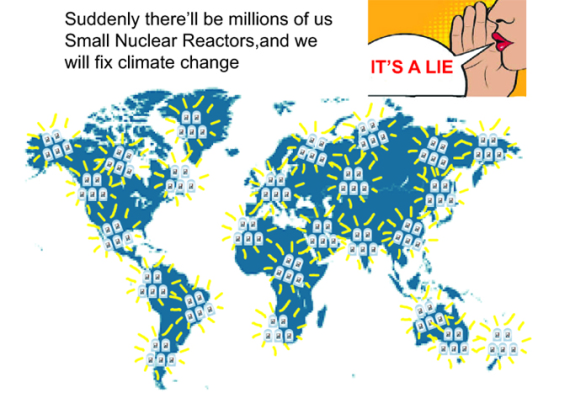
But that’s not really a practical plan. So – how about bundling a bunch of them together – so they can produce a large amount of electricity, and we can still call them a Small Modular Nuclear Power Plant?
Case study 1 – NuScale – the American experiment

The NuScale SMR is a pressurized water reactor (PWR) – a type of light-water nuclear reactor. In a PWR, water is used both as a neutron moderator and as coolant fluid for the reactor core. So it’s pretty much a small version of the “tried and tested” large nuclear reactors. This was the first SMR design to get Nuclear Regulatory Commission licensing. The Department of Energy approved $1.35 billion to the project, over 10 years subject to appropriations.
In 2015 NuScale Power and Utah Associated Municipal Power Systems (UAMPS) planned a single plant, containing 12 “modules” – i.e. 12 SMRs, which would provide 924 MWe – same as a large nuclear reactor. so – no longer small. The estimated costs kept rising, reaching $9.3 Billion by 2023. So the plan, now named VOYGR, was changed from 12 modules to six. Even at 6 modules with 462 MWe- still a large project.
In November 2023 UAMPS officially terminated the CFPP agreement. The Idaho project would have been NuScale’s first commercial deployment. The project that was supposed to demonstrate SMR viability in the US was dead. NuScale took a $100M+ write-down. The cancellation sent shockwaves through the SMR industry. Investor interest, always poor, collapsed. In a class-action lawsuit filed Nov. 15, investors say NuScale “made materially false and/or misleading statements and failed to disclose material adverse facts about the Company’s business, operations, and prospects.”
NuScale continues to push its VOYGR plan – to Romania, Poland, Kazakhstan, Ukraine, and the Philippines. The company continues to burn cash with no revenue from reactor operations. The VOYGR design remains the only NRC-certified SMR.
Case study 2 – X-Energy ‘s MWe Xe-100 plant – the British experiment.

In September 2025, X-energy and Centrica signed a Joint Development Agreement for the UK’s first advanced nuclear fleet, targeting 6 GW nationwide with Hartlepool identified as the preferred first site for a 12-unit/960 MWe Xe-100 plant.
The Xe-100 is a 200MWt (75MWe) reactor. The Xe-100 SMR is a high temperature gas-cooled (HTGR) pebble bed modular reactor. “It uses tennis ball-sized pebbles made of thousands of TRISO micro-fuel particles which consist of fissile U-235 surrounded by pyrolytic graphite, which acts as the moderator – slowing down fast neutrons so they more efficiently split the U-235 nucleus.”
So this UK plan is different from the American pioneer project, Nuscale. It is using different fuel, – a Pebble Bed Nuclear Reactor. This has been tried in the past as a large reactor, and was a failure. The Xe-100 has a new variant – TRISO (Tri-structural Isotropic particle fuel). Thousands of poppy seed-sized particles are combined into compact fuel forms. These tiny uranium kernels are encased in three layers of ceramic coating that’s needed to absorb the nasty byproducts that form during the atom-splitting process.
So, like the American NuScale project, this will be a world first.
Both projects were hugely touted as safe. And it’s true – they can’t melt down like a Chernobyl or Fukushima event. But at 462 MWe (the Utah project) and 960MWe (Hartlepool) they are both big plants, with the potential for accidents or terrorist attacks, including cyber-disruption, to release a large amount of ionising radiation to the surrounding area. Even within the nuclear hierarchy, there are anxieties about the safety of TRISO fuel. And TRISO discharges the largest volume of spent nuclear fuels waste in the industry.
The UTAH Nuscale project sank because it was becoming more and more expensive. Assisted by the government, it was still a private enterprise project, and the Utah Associated Municipal Power Systems balked at the cost.
The Hartlepool X Energy project is intended to become a successful private enterprise project, but it is strongly backed by the UK government’s Great British Energy – Nuclear with funding provided by its Future Nuclear Enabling Fund. However TRISO fuel is highly expensive to make, and with still uncertainties about its safety, it is not likely that this pioneer initiative for Hartlepool will really bring the wave of private investment that the UK government has been hoping for.
In both cases, these have been attempts to show the Western world that small modular nuclear reactors are a really big profitable thing – they will power the mighty data farms etc.
Community acceptance is the big bonus that the nuclear industry desperately needs
This is much less of a problem in totalitarian nations like Russia and China. Both countries have only one small nuclear reactor in operation, and in each case, it hasn’t been very successful. Both China and Russia are ramping up their nuclear weapons, and they don’t need to worry so much about public acceptance of the “peaceful” nuclear industry, and of community agreement on matters nuclear.
The Ukraine Delusion

Israel is a part of the Ukraine-Russia war story in other very important ways, some of which now look decidedly self-defeating for Ukraine and Zelensky.
Nate Bear, Aug 07, 2026, https://www.donotpanic.news/p/the-ukraine-delusion
I’ve held back on writing about the Russia-Ukraine war, and this article probably won’t win me many fans. But for better or worse, I always try to tell it how I, at least, see it. And I’m tired. Tired of the liberal delusion, the hypocrisy, the childish analysis, and outright bloodthirstiness over Ukraine.
I’m tired of the pretence that a proxy war which has now lasted longer that the first world war is a righteous battle against evil for the soul of the world.
I’m tired of the fact that wanting an end to a war which has killed hundreds of thousands of young men, and thousands of civilians, is seen by some as an outrageous, morally deplorable position.
I’m tired of the fact that rational analysis and context is so often labelled as pro-Putin apologia, and how it is almost impossible to get good information on the war that isn’t polluted by an anti-Russia agenda. And even good information and analysis which recognises that Russia isn’t losing, that Ukraine is suffering, still too often suggests that the west must wage this war for many more years. This otherwise rational analysis, while detailing all the ways in which Ukraine is definitely not winning the war, nevertheless concludes that it must be fought for many more years to avoid “a bad peace.”
Time and again we see the same conclusion. That to give Russia what it wants, namely Crimea, the four annexed oblasts and a neutral Ukraine, would be a “bad peace” that rewards aggression. But few politicians or journalists when selling this story ever spell out explicitly what a “good peace” is and what it would require. But we don’t have to guess. Zelensky has on many occasions. And he has maintained the only way the war can end is if Russia returns to Ukraine not just the four oblasts annexed in 2022, but also Crimea, and he also wants security guarantees which would amount to the effective integration of Ukraine into NATO.
This is a delusional position that guarantees never peace and a forever war. And forever war isn’t an abstract. It means forever death. Forever destruction. It means European societies becoming securitised and militarised, with the Russian foe a ready-made excuse for a Palantir-powered surveillance state. And this position rests atop a childish assertion repeated ad nauseum that grants the war its legitimacy: that Russia’s invasion of Ukraine was “unprovoked.”
Nothing is ever unprovoked. You can agree or disagree with whether the provocation warranted the reaction. But unprovoked is not an analysis, it is an emotional appeal, and in the case of Russia-Ukraine, it is propaganda designed to obscure the long history which led to Russia’s invasion.
It is, in many ways, not dissimilar to the propaganda that October 7th was an unprovoked attack on Israel. Or that Pearl Harbour was an unprovoked attack on the United States.
Narratives which strip out cause and effect and proclaim that a bad thing just happened without any preceding events, that good people were then drawn reluctantly into war to defend themselves against bad people, is the oldest trick in the war propaganda book designed to shut down critical intellectual inquiry.
So, briefly (for more detail read this by John Mearsheimer), the events preceding Russia’s invasion of Ukraine include a 1990 promise made by the US Secretary of State James Baker that if post-Soviet Russia allowed a unified Germany to remained in NATO, “NATO would not shift one inch eastward.” It was a promise made with an understanding that Russia was a legitimate country with legitimate security interests. That promise of course was repeatedly broken until NATO stretched to Russia’s borders. The preceding events also include the NATO-backed remilitarisation of Ukraine following the ousting of Victor Yanukovych in 2014, the Russian annexation of Crimea in response and Ukraine’s bombing of the Donbass which killed hundreds of Russian-speaking Ukrainians. It includes an acute understanding among the Russian leadership that Napoleonic France, imperial Germany, and Nazi Germany all crossed Ukraine to invade Russia itself.
You don’t have to think that Russia was right to invade Ukraine to try and understand why it invaded Ukraine, a consideration we are never prompted to investigate in a discourse dominated by normative moral judgements viewed exclusively through the lens of western imperialism. The shape of post-2014 Ukraine made Russia fearful that the country could once again be the launchpad for an invasion. And it wasn’t as if Putin hid this fact. He repeatedly warned, into late 2021 and early 2022, that the further militarisation of Ukraine was a red line and if Ukraine and the west refused diplomacy, Russia would act. He hadn’t been that bothered about Ukraine before 2014, there was no war talk, because it wasn’t the threat then that he perceived it became.
Again, this is not a defence of Putin, it is a question of cause and effect, and of the western arrogance and hubris that believes only its red lines on geostrategic issues are valid. Would the US have allowed a military alliance led by China to be built up through South America, reaching Mexico without a response? Would western media have dismissed American concerns about Chinese militarism as paranoid nonsense if Chinese military bases were dotted throughout South America? Of course not! The media would have demanded war and sold us war. But when the roles are reversed, American militarism becomes mere Russian paranoia.
And now the war that NATO expansionism threatened is not just here but is in danger of become a permanent fixture of our lives, with European economies embracing the bloodshed and building war economies. And to build these war economies, the liberal class is demanding more cuts to a welfare state already decimated, in many places, by two decades of austerity. This week the Financial Times ran this article, demonstrating the brazenness with which anti-working class, hyper-capitalist, hyper-imperialist prescriptions are now presented as sensible opinion.
A “warfare state” all to fight a mythical Russia that, as Mearsheimer laid out in this video, didn’t invade Ukraine with anything like a force sufficient to conquer the country, but as a final gambit to force Ukraine to the negotiating table. Of course it failed. The liberal media and political class, however, continue to insist that Russia’s goal is full conquest, with more to follow, in order to legitimise the creation of war economies. That the liberal class would build a warfare state that decimates the welfare state to confront Russia, rather than seek diplomacy and partnership with a country which is home to huge volumes of minerals needed to build, for example, a cleaner energy system, is a demonstration of utter failure.
And who would these “warfare state” economies be powered by? In part, Israel, which has agreed a $4 billion deal with Greece to supply an air defence system, supplied a similar system to Germany for the same price last year, and handed over a half billion dollar missile system to Slovakia.
Israel is a part of the Ukraine-Russia war story in other very important ways, some of which now look decidedly self-defeating for Ukraine and Zelensky.
When the Iran war started, Zelensky enthusiastically embraced it and regurgitated all the classics, saying that the US-Israeli assault was a good thing because it would “rid the Iranian people of a terrorist regime.” In March, with the war on Iran raging, he urged Netanyahu to work with him, saying “he has what I need and I have what he needs.” But now Ukraine is out of interceptor missiles because they’ve all been used in the war on Iran, with Kiev defenceless against Russian missile attacks. Yesterday, every missile launched at Kiev hit its target, with zero interceptors launched. And now, after embracing the war on Iran, Zelensky is complaining about the lack of interceptors, a direct consequence of the war he supported. He hitched himself to empire, yet because of the over-stretching imperial adventurism he himself relies on, that empire has found itself unable to defend his country. It reveals a man who has no plan, beyond hoping that the weapons keep flowing.
Liberals appear reluctant to make the connection between the two imperial wars, preferring the dissonance that comes with an empire state of mind.
This dissonance has also been on display elsewhere, with pro-Ukraine war influencers demanding the west sends more weapons to Ukraine and incredulous at North Korea sending weapons to Russia, seemingly unable to follow their own logic on third-party countries sending weapons to principal conflict belligerents. Empire brains blinded to their own raging hypocrisy.
But as I’m writing, I can hear a criticism, and can even form one against myself. Why, Nate, when you are so morally strident on Israel and Palestine, are you decrying “normative moral judgements” on Ukraine and Russia?
Because the two situations could not be more different.
Ukraine is a state with a standing army supported by empire fighting another state with a standing army. Palestine has been denied statehood despite the 1947 UN two-state partition agreement (putting aside whatever one thinks about the legitimacy of that agreement), has no standing army to defend itself and Palestinians are fighting a colonial occupation armed by empire. If anything, Ukraine is far more similar to Israel than it is to Palestine. Indeed, in 2024 Zelensky proclaimed Israel as the ideal model for Ukraine, saying he wanted Ukraine to be a “big Israel.”
Both Ukraine and Israel are proxies at the tip of the imperial spear, one in Europe and one in the Middle East. You don’t have to be the invader to be a tool of imperialism. Sometimes being the invaded is more useful as it imparts a moral surety that helps shield your imperial role from critical analysis. I would argue this is exactly what has happened in the case of Ukraine.
None of this is to say I don’t have sympathy with ordinary Ukrainians. I do. I think they’ve been sold down the river, by both Europe and their own leaders, and have been coerced into fighting a war a majority now want to end with negotiations. The average Ukrainian is quite different to the average genocide-supporting Israeli who upholds apartheid.
Yet despite the wishes of a majority of Ukrainians, Europe and Zelensky refuse diplomacy and continue to fight, incurring enormous costs on Ukraine and ordinary Ukrainians. Of course, enormous costs are being inflicted on Russia too, but these costs have not been, and will not be sufficient for a “good peace.” And any costs that would really bite risk an uncontrolled, catastrophic escalation.
The final irony is that despite the war being marketed to westerners as totalitarianism versus democracy, Ukrainians can’t even elect a leader who would enact their wish to see a negotiated end to the war since Zelensky, whose term officially expired in 2024, introduced martial law and cancelled elections.
So, as I said, for better or worse, this is my perspective on Russia-Ukraine.
A war which advances only imperialist interests, interests which run counter to European security and prosperity. A war which threatens, at worst, to go nuclear. A war which wasn’t unprovoked. A war which, with their minds empty and hearts lacking true solidarity, consciousness or justice, has become a necessary intellectual organising principle for the liberal media and political class.
I’ve probably not made many fans, but I’d be delighted if I have.
Space: the billionaires’ playground

private space companies have relied on government contracts, and particularly military funding, to make themselves both rich and indispensable to state powers. Most recently, private interests have been lining up to slake themselves at a long-dormant tap that they hope will provide a new stream of wealth: the Moon.
According to Musk, humans moving to Mars isn’t just a possibility; it’s a moral imperative. But a closer look suggests Mars is really a distraction meant to dazzle us while Musk accrues ever more money and power here on Earth.
8 July 2026, Lucian Walkowicz, https://newint.org/science-and-technology/2026/space-billionaires-playground?utm_source=ni-email-whatcounts%20&utm_medium=1%20NI%20Main%20List1%20-%20enews%20-%20International%20AND%20North%20America&utm_campaign=YYYY-MM-DD%20enews%20-%207%20August%20enews
As tycoons like Elon Musk attempt to seize space for profit, the Earth is being trashed, writes astronomer Lucian Walkowicz.
For years, the wealthy have been telling us that our salvation lies in space.
‘There is a strong humanitarian argument for making life multiplanetary’, billionaire Elon Musk has said, claiming that getting to Mars will prevent human extinction, and is therefore as crucial as tackling poverty.
Meanwhile, his company’s launches from its ‘Starbase’ have trashed surrounding wildlife areas and displaced longtime residents, while the boss harps on about using its heavy-lift rockets as a high-speed, heavily polluting replacement for commercial air travel, and putting factories on the Moon.
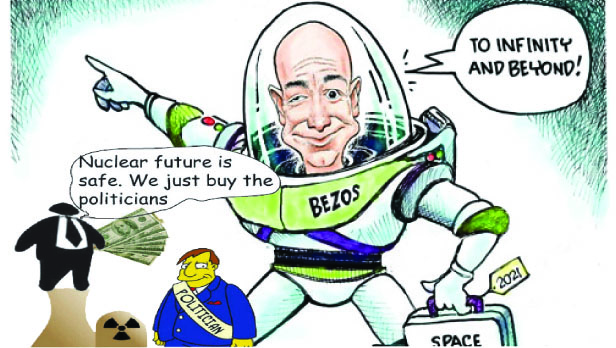
Fellow tycoon Jeff Bezos – founder of Amazon, equally notorious for its own ‘humanitarian’ approach – has enthused about housing populations in orbital cylinders and protecting the Earth by taking polluting industries off planet. Meanwhile emissions from his companies’ own deliveries have soared.
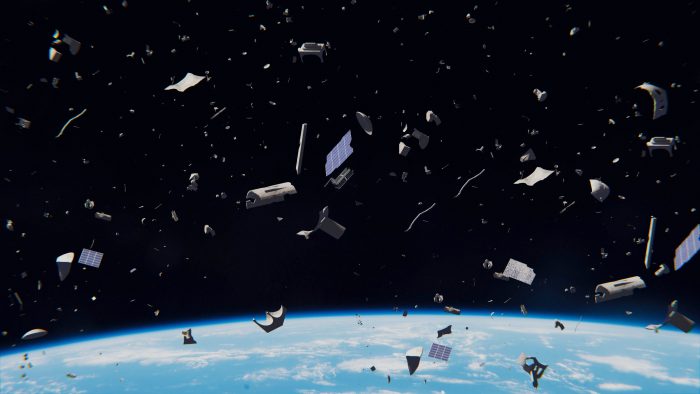
These supposedly futuristic visions for space have been weaponized to justify a wide array of activities (both on our planet and beyond it), including expanding state surveillance and violence, dispossessing people of their homelands, cluttering low Earth orbit with garbage, plundering the Moon and polluting both our environment and the night sky.
While outwardly the likes of Musk and Bezos might advocate for our future in the stars, in reality they are greedily gorging themselves at the trough of profit while simultaneously creating the conditions that may bind humanity to Earth forever.
Bait and switch
Musk in particular has an outsized influence that exemplifies how space narratives have been wielded to justify a vast array of projects on Earth.
Before SpaceX had their rapid rate of rocket launches, before they were sending rafts of Starlink satellites into orbit, their main source of press coverage was Elon Musk’s mouth. Born to a wealthy white family in apartheid South Africa, this tycoon substitutes provocation for charisma by making exaggerated assertions and brushing aside details. Drawing on a long history of colonial rhetoric around space, he has managed to harness public attention with his futuristic plans to populate Mars with human settlements.
According to Musk, humans moving to Mars isn’t just a possibility; it’s a moral imperative. But a closer look suggests Mars is really a distraction meant to dazzle us while Musk accrues ever more money and power here on Earth.
Musk has conjured a litany of planet-killing bogeymen to justify his Mars ambitions – from rogue asteroids to the expansion of the sun several billion years from now – in order to argue that migration to Mars is a must.
As for what happens if people get to this radiation-baked, arid, oxidized hellscape? No problem, Musk will simply nuke the polar ice caps and melt them. No matter that most scientists and engineers cock an eyebrow at these supposed easy fixes, nor even that anyone with common sense knows that nuclear weapons do not make planets more hospitable.
Leveraging this allegedly visionary perspective, SpaceX has been able to harness not only the imaginations of the wider public, but of its workforce as well. The company offers a seductive opportunity for people who want to see a science fiction future come to reality. But few in the sector seem to think carefully about which of the many futures depicted in science fiction are actually on offer. Despite numerous reports over the years of gruelling and dangerous working conditions, as well as rampant racist and sexist harassment, SpaceX continues to attract workers with a glimmer of Mars in their eyes.
Meanwhile, by manufacturing urgency around this goal, Musk has also been able to justify the expansion of SpaceX’s business at breakneck speed. The ‘move fast and break things’ ethos infuses much of the tech industry, but paired with Musk’s pose as global saviour, SpaceX has been able to gain damaging momentum, outpacing regulatory structures around launches, orbital traffic and environmental protections. This drive has allowed Musk to tap a deep vein of wealth via military contracts, stuffing his coffers and elevating him to quasi-statesman status.
Greater good or greater greed
Take the Starlink satellite megaconstellation. Like Musk’s plans for Mars, Starlink – which first entered commercial service in 2021 – was framed as a necessary project, whose merit only the most selfish person could deny. Its purported goal was to provide internet to so-called ‘underserved’ communities.
But as Starlink began pumping hundreds of reflective satellites into orbit, astronomers promptly raised the alarm that they had begun to mar the night sky. Some also pointed out that Starlink’s service was both unneeded and priced out of reach for the places it was supposedly meant to help, pointing out the twisting of the word ‘underserved’ from its usual meaning of underresourced to ‘a place that does not have enough free market choices’.
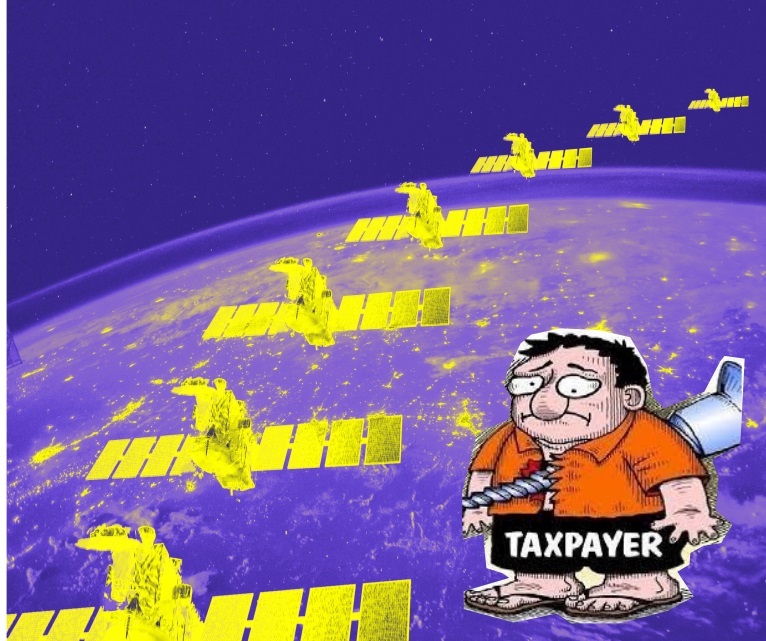
Today there are nearly 9,500 Starlink satellites in space, meaning that this single project by a US company is now responsible for 65 per cent of satellites in low Earth orbit, a sea-change that has taken less than seven years. The massive increase in overall numbers has raised widespread alarm over the possibility of extremely high speed collisions and the potential for an escalating cascade of further collisions, known as the ‘Kessler syndrome’. The resulting ballistic debris would ultimately make entire regions of space around earth unusable.
Every time we take the extension of capitalism beyond Earth as a foregone conclusion, we disregard the myriad ways all Earth life has related to our skies.
Of course, there are also the impacts here on Earth: before Starlink satellites create light pollution in the night sky, the launches that put them there create pollution in our immediate environment. A single launch of one of SpaceX’s rockets, the Falcon 9, releases an amount of carbon into the atmosphere equivalent to driving a typical car 70 times around the world.
The satellites themselves also have a limited lifespan of a few years, after which they deorbit into our atmosphere, spreading metal pollution (including mercury) across the planet. Meanwhile, organizers in the Rio Grande Valley have raised the alarm for years about the environmental damage and gentrification driven by SpaceX’s presence in the area of its ‘Starbase’.
Regulatory frameworks have struggled to keep up with SpaceX’s impact: while there are US regulations around launches and their environmental impacts, few were really developed with space in mind, and none were equipped to deal with SpaceX’s high volume of launches. Under the most recent Trump administration, already inadequate regulation has become even looser. In February 2026 the FCC fast-tracked a proposal for SpaceX to launch a million new satellites as part of its plan to create orbital data centres to support an expansion of AI. Meanwhile other countries get no say in this company filling the skies.
We’d do well to question whether the profusion of AI into every aspect of human existence is making things better or simply drowning us in brain-rotting slop.
No matter, though: the people best positioned to profit from cramming a million new satellites into space claim orbital data centres will preserve our planet by eliminating their demands on its land, energy and water resources. However, that argument relies on people thinking of space as a realm that is separate from Earth, when it is Earth’s resources and environment that bear the consequences of this huge profusion in the number of launches required to transport satellites off the planet, as well as the vapourized metals from them reentering its atmosphere.
Ultimately, it doesn’t matter what Starlink’s intended purpose is, or whether anyone can afford it, because individual internet users aren’t SpaceX’s target customer – the military is. Because of wide adoption of the more secure, military-grade version of Starlink, called Starshield, militaries around the world now treat Musk as a de facto statesman who has the capacity to determine which conflicts have access to the internet at which time. For example, in April 2025, SpaceX was awarded $6 billion dollars by the US military for 28 launches that year. This was just one contract.
On top of that, SpaceX is working with the US’s National Reconnaissance Office on the development of ‘Ground Moving Target Indicator’ technology, a space-based panopticon designed to better track people’s movements on Earth.
Even more recently, some have commented that SpaceX’s relatively low launch costs open the possibility of permanent weapons installations in space. ‘Imagine a strike package of thousands of 200-pound bombs, on electric grid sites, government buildings, railway crossings, border stations and road intersections – without putting planes or military personnel at risk’, gushed writer on geopolitics Michael Hochberg in the Wall Street Journal this April.
The ideological capital gained by SpaceX via Musk’s plans ‘for Mars’ has allowed him to hoard massive wealth. Meanwhile these projects pose a grave threat to human futures both in space and on Earth by enabling state surveillance and acts of war, crowding low Earth orbit with potential debris that could one day bar our access to space entirely, and raining pollution into our atmosphere, land and water.
Space is a place
There is a tendency for people to believe that space, in all its wild expansiveness, is beyond the realm of humankind. However, we are literally in and of space. There is no crisp boundary between where Earth’s atmosphere stops and space begins, and like all borders, the ‘boundary’ of space – formally called the von Kármán line – is a collective fiction that has practical utility but not material reality.
While the few humans who have crossed the von Kármán line (whether professional astronauts or celebrities who can afford a ticket) garner the most attention, their number is miniscule compared with people whose lives are enmeshed with space while remaining on Earth. Some of these people are professionals at government agencies or private companies, but most are not space workers at all.
They include anyone who uses tools that rely on space infrastructure, like GPS, but also those who are acutely impacted due to living in the vicinity of launch sites. After all, SpaceX is merely continuing a colonial legacy: near the equator, where the rotation of the Earth provides a slightly bigger boost to launching rockets, launch sites like Brazil’s Alcântara Space Center and the European Space Agency’s Guiana Space Centre, in French Guiana, have dispossessed communities from their lands and battered the surrounding ecosystems since the 1980s and 1960s, respectively.
Moreover, the money lives on Earth. The question of how to squeeze an actual profit out of space, independent of the state, has stymied many a thirsty capitalist.
The rash of asteroid mining ventures that cropped up 15 years ago have now largely shuttered or gone dormant, as no one yet knows how to lasso and plunder an asteroid without the cost outstripping the benefit. Instead, private space companies have relied on government contracts, and particularly military funding, to make themselves both rich and indispensable to state powers. Most recently, private interests have been lining up to slake themselves at a long-dormant tap that they hope will provide a new stream of wealth: the Moon.
Lunar plunder
While many governments and companies around the world have set their sights on the Moon, the US is the driving force in radically reshaping common understandings of space that have been with humanity throughout its existence. Government contracts have been a reliable source of income for private space companies since the first military surveillance satellites. What’s new is the US’s accelerating demolition of publicly funded institutions in favour of private enterprise, enabling a modern crop of companies to act with greater autonomy.
This is particularly concerning in what it might mean for the Moon. Unlike Mars or asteroids, the Moon is essentially in Earth’s backyard: while having a sustained human presence there still presents difficult challenges, getting to its surface is a solved problem. In the past few years, the space agencies of India, China, Japan and the US have all successfully landed robotic spacecraft on the Moon, often with participation from private companies profiting off government contracts. US-based company Intuitive Machines also became the first private company to land there independently.
The combination of the Moon’s proximity and the US’s refusal to embrace international agreements, like the Moon Treaty, that provide stricter lunar protections, has opened up the possibility of private entities being able to independently plunder the Moon for ‘space resources’, ie anything that can be excavated and sold on Earth.
The Moon is a source of helium, and particularly helium-3, an element with widespread industrial applications, of which there is a shortage. The Moon also has potential reserves of water ice, which could be used to create fuel for launching rockets from the lunar surface, or used to support a human presence.
In 2020 the United States and seven other signatories released the Artemis Accords, a set of US-driven international agreements created in anticipation of its own Artemis Program. The Accords circumvent existing international channels for space diplomacy, like the UN’s Committee on the Peaceful Uses of Outer Space (COPUOS), allowing the US to essentially bully other nations into accepting a US-centric framework for lunar exploitation.
The Artemis Accords, along with a more recent chaotic splatter of space-related Executive Orders by president Donald Trump claiming to ‘ensure American space superiority’, make explicit a shift away from viewing space as the common heritage of humanity. Rather, the Artemis programme is instead being used to paint a picture of the moon as not only a place humans can go, but one where we can extract and exploit. While until now private companies have mostly benefitted from lucrative contracts to go to space, future prospects have everyone from small space start-ups to Lockheed Martin drooling over the possibility of extended plunder and occupation of the Moon.
In the context of rising fascist tides around the globe, the US’s renewed focus on human spaceflight through Artemis functions as a kind of time machine back to a future that never was.
One of fascism’s defining characteristics is a preoccupation with national decline, paired with a promise of rebirth that can only be actualized through removal of enemies. In the fascist cosmology of today, the Apollo moon landings were the beginning of a future that died on the vine, a future that projected colonial projects and control out into the infinite, with the power to consolidate social hierarchies In the first Trump administration, then-vice president and chair of the National Space Council, Mike Pence, repeatedly said that Artemis would put ‘the first woman and the next man’ on the Moon.
A woman alone on the Moon is unthinkable, so the next man is always mentioned. In this image, the Moon and Artemis astronauts are used as a stand-in for the Garden of Eden: Artemis is literally the virgin sister of Apollo, the Moon an unsullied landscape in which a man-woman pair can be placed to restore the US to a time before the imagined invasion of the administration’s internal and external enemies.
NASA press around the Artemis programme similarly often mentions the diversity of its astronaut corps, but doubling down on American individualism cannot separate Artemis from its utility as propaganda. After all, a handful of people who are not white men leaving Earth’s atmosphere cannot conceivably be a sign of liberatory progress, at least not while squads of paramilitary police kidnap hundreds of thousands of people off the streets of US cities.
Reclaiming space
Space is and has been many things to many people: while the Moon may currently be the stage for US propaganda, it has also been a companion to all life on Earth since our planet’s earliest days. The Moon remains the most visible part of space in light-polluted cities, where most people now live. It has been at the heart of human cultures for our entire existence, not just as a practical tool and biological rhythm, but also a relative, a deity, a reminder and more.
Despite aligned campaigns of both state and capital to radically reshape and control the contours of how people imagine and relate to space, the way that space functions in the fascist imagination is not the only way. Every time we take the extension of capitalism beyond the realm of Earth as a foregone conclusion, we disregard the myriad ways that not only humans but all Earth life has related to our skies. Remember: fascism is relatively new; the cosmos has seen everything.
Space’s wealthy beneficiaries tell us that if we will all just stand aside and let them plunder the heavens, a glossy future awaits humankind. However, we need look no further than the physical realities of space industries to see these stories crack: natural sanctuaries littered with debris from launch sites, an orbit filled with trash and surveillance. The damage done to our own planet in the name of a rush to prospect beyond it is its own evidence that colonialism in space has never been anything but colonialism on Earth.
Whether it’s in the form of Mars colonies, asteroid mining, space tourism, or Moon bases, their visions are nothing but a bankrupt utopia that promises to line their pockets and leave Earth in ruins.
If the most fundamental requirement for liberation is the ability to imagine that the future contains an abundance of possibilities, we must recognize these attempts to seize space for profit and war as attempts to shrink the horizon of potential human flourishing. Can we act to reclaim space for futures that include us all? Only (space)time will tell.
An Eighty-Year Nuclear Nightmare: The U.S., Japan, and Korea

July 31, 2026, Brad Wolf
Organizing Committee of the International People’s Tribunal, https://abombtribunal.campaignus.me/34/?q=YToxOntzOjEyOiJrZXl3b3JkX3R5cGUiO3M6MzoiYWxsIjt9&bmode=view&idx=172837199&t=board
On the right corner of my desk, next to my laptop and always in eyeshot, sits a metal model of an atom bomb I assembled from a kit, a model of “Little Boy,” the bomb the U.S. dropped on Hiroshima. The model is made from aluminum alloy parts and is a 1/12th scale of the original atom bomb, about nine inches long. The ad for the bomb contained a video with dramatic music showing the model spinning through the air as it falls toward its imagined target.
“Perfect for collectors,” the ad boasted. “A must-have for history enthusiasts. Very enjoyable assembly process.”
Toward the bottom of the ad, perhaps as an afterthought, perhaps recognizing the implications of marketing such a murderous model, was the following: “By assembling this model, you can understand the history and moral issues of nuclear weapons and trigger thoughts about the future of the world.”
The kit came with a tiny screwdriver, two dozen tiny screws, a sanding rod, glue, and decals. The aluminum alloy parts were in molded plates. The model even had a metal cart to assemble that the bomb sits on so it can be pulled around your desk, pretending you’re getting ready to load it onto the Enola Gay, extinguish a city in a flash.
On the morning of August 6, 1945, the real “Little Boy” exploded with a flash 2,000 feet above the city of Hiroshima, which sits on the Ota River delta on Hiroshima Bay. The Ota River has six channels splitting Hiroshima into islets. Bomb victims staggered toward these channels to throw themselves into the water hoping to extinguish their burning bodies. The channels became so clogged with bodies that others couldn’t squeeze in. Some people, closer to the hypocenter, were vaporized, reduced to shadows seared into stone. Temperatures on the ground reached 4,000 degrees.
As we once again approach that fateful day of August 6th, it is important to recognize that not just the U.S. and Japan are intertwined in a nuclear nightmare that has lasted over eighty years, but also 70,000 Koreans who were exposed to the two atomic bombs incinerating Hiroshima and Nagasaki, people forcibly removed from their homeland by the Japanese and sent to work in these cities. Japan colonized Korea in 1910 and for decades used Koreans as they saw fit, from Comfort Women to slave labor. The Koreans then became atomic bomb victims, despite their country not being at war with the United States. They are among the unintended victims, the forgotten victims.
This November in Seoul, South Korea, the surviving Korean bomb victims will testify at a People’s Tribunal holding the U.S. accountable for war crimes. Lawyers from around the world have been preparing legal briefs and will argue the case. The U.S. government is invited to appear as the defendant at the Tribunal. The Republic of South Korea has also been asked to appear as a witness.
Once let loose, an atomic bomb keeps on killing, generation after generation, the cancers passed down to those not even born when the bombs first exploded. The Korean atomic bomb victims, as well as the Japanese, have horrific stories testifying to this. Children of the bomb. Atomic maladies. The bomb wages war against the future.
The second atomic bomb that was dropped on August 9th incinerating another Japanese city had a different nickname. That bomb had an even bigger belly and used plutonium rather than uranium. They called it “Fat Man.” The same ad for the model of the “Little Boy” atom bomb had a second ad inducing you to buy “Fat Man.” It is another 1/12th scale model of the original, this one weighing 6.2 pounds when completed. I declined the offer to buy and build it. One was repellent enough.
The U.S. currently has 5,277 nuclear warheads. Russia has 5,4490. China, approximately 600. France and the U.K have about 250 each and Israel has about 90. India, Pakistan, and North Korea bring up the rear with a few nukes each. In total there are over 12,300 nuclear warheads spanning the globe. The Korean atomic bomb victims stand as ready reminders of what happens when these things are unleashed.
Brad Wolf edited the recent book on the writings of Philip Berrigan entitled A Ministry of Risk which was published in April by Fordham University Press. He co-coordinated the Merchants of Death War Crimes Tribunal and is currently chair of the organizing committee of the International People’s Tribunal on the Korean Victims of the 1945 Atomic Bombings. He is executive director of Peace Action Network of Lancaster, Pennsylvania.
Trump’s nuclear deal: a disaster for the Middle East?
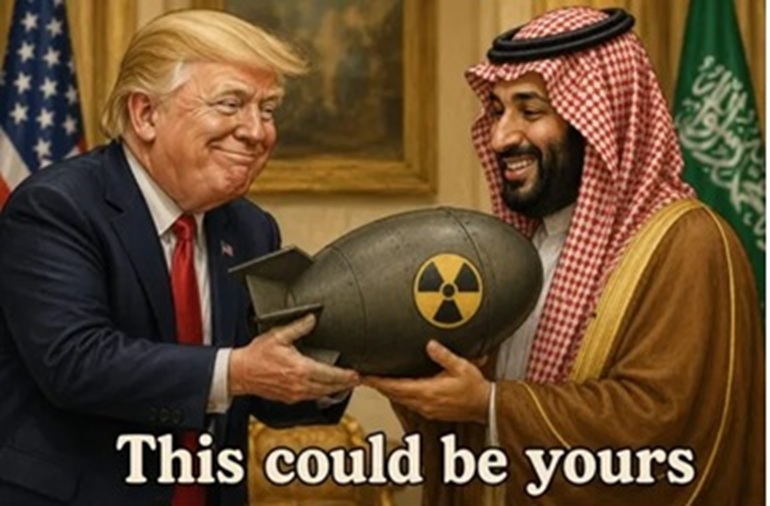
No, the real reason is to gain atomic weapons to protect itself against its main foe: Iran. MbS has made no secret of his desire to build a bomb, and the deal would be a concrete step in that direction. Despite Trump’s claims to the contrary, it appears to permit nuclear enrichment on Saudi soil, thus enabling Riyadh to follow the likes of India, Israel and Pakistan in covertly enriching uranium to weapons-grade level
The hard truth is that the “era of non-proliferation is coming to an end”
Well, is it on or is it off? No one’s quite sure, said Al Jazeera (Doha). Two weeks ago, the United States and Saudi Arabia signed a multibillion-dollar deal allowing US companies to build and operate nuclear power plants on Saudi soil over the next 30 years.
But a day later, President Trump added a new condition, via social media: Saudi Arabia must fall in line with the UAE and other Arab nations that have signed the Abraham Accords, and recognise the state of Israel.
‘Reckless’ agreement
And that may prove a deal breaker, said David Frum in The Atlantic. Riyadh had been working towards this landmark pact for almost two decades. Thanks to the savvy of its de facto leader Crown Prince Mohammed bin Salman (MbS), who ensured the private equity firm of Trump’s son-in-law, Jared Kushner, would get its share of the billion-dollar nuclear licensing deals at stake, he almost got it over the line.
But now it must surely be in doubt, said Mohamad Elmasry on Middle East Eye. Riyadh has vowed it won’t normalise relations until Israel guarantees Palestinian statehood. And MbS has reportedly told US officials that hostility towards Israel is so great among Saudis in the wake of Israel’s devastating war in Gaza, that to sign a normalisation treaty would probably get him assassinated.
It’s obvious why the Saudis still badly want this nuclear deal, said Joseph Cirincione on MS Now (New York). It’s not, as they claim, to diversify their energy profile: that makes no sense for a nation sitting on an ocean of oil and blessed with the ideal wind and solar conditions for generating renewable energy – a far cheaper option.
No, the real reason is to gain atomic weapons to protect itself against its main foe: Iran. MbS has made no secret of his desire to build a bomb, and the deal would be a concrete step in that direction. Despite Trump’s claims to the contrary, it appears to permit nuclear enrichment on Saudi soil, thus enabling Riyadh to follow the likes of India, Israel and Pakistan in covertly enriching uranium to weapons-grade levels.
‘Guiding hand’
Who knows what’ll happen if this “reckless” deal goes ahead, said Mitchell Plitnick on Mondoweiss (New York). The “gold standard” nuclear-power pact that the US signed with the United Arab Emirates in 2009 required the UAE to forego the ability to enrich uranium, and obliged it to submit to International Atomic Energy Agency inspections: this Saudi deal has no such restrictions.
Which is why it would inevitably trigger a Middle East arms race, said Azriel Bermant in Foreign Policy. If the deal proceeds, Iran would openly seek its own nuclear deterrent, something it has so far officially forsworn. “It beggars belief that the US went to war against Iran to prevent it from acquiring a nuclear weapon yet now acts in a way that is an open invitation for Tehran to weaponise.” And in a way that would also pour “proliferation kerosene” on Turkey and Egypt’s “smouldering nuclear ambitions”, said Matthew Kroenig and Henry Sokolski in The Wall Street Journal. Trump’s deal invites disaster.
Actually, the US is doing the right thing, said the Washington Examiner. The hard truth is that the “era of non-proliferation is coming to an end”: Pakistan and North Korea are both testing nuclear weapons. Given that sobering reality, better the US offer “a guiding hand” to the Saudis and oversee their nuclear agenda than let China or Russia fill the void.
Good or bad, the deal matters a lot to the US president, said Sharon Squassoni in The Bulletin of the Atomic Scientists (Chicago), so rumours of its death “are premature”. After all, it’s not some “spur-of-the-moment fantasy” cooked up by Trump. The same deal was also being considered under Joe Biden, and then too enrichment was a quid pro quo for recognising Israel.
The Saudis won’t do so, of course, given recent history, but they won’t have to. Although Congress can disapprove the deal once it’s submitted, the present Congress – due to adjourn on 18 December – is much less likely to do so than any freshly elected one. So the Saudis can “call Trump’s bluff by simply sitting back” and waiting for him to succumb to the pressure of the December deadline.
Hiroshima and Nagasaki vigils are not just about the past
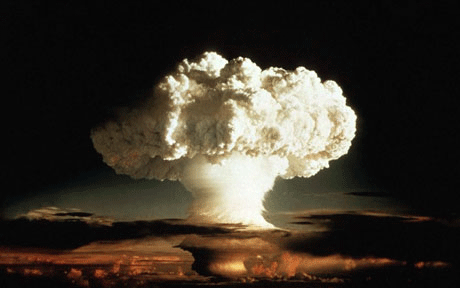
Simon Barrow, SCND: AS communities across Scotland gather for vigils and
local events marking the 81st anniversary of the atomic bombings of
Hiroshima and Nagasaki, these remembrance activities across Scotland carry
a sharp, pressing urgency.
We are not merely looking back at history. We
are staring at an existential threat of our own making which is
exponentially more disastrous than what happened in 1945. As Kyoko Gibson,
a second-generation hibakusha (survivor) from Hiroshima, starkly reminds
us: “Under that mushroom cloud, rising out of a temperature of 5000C,
some say 7000C, 70,000 people died instantly and many more afterwards.
“As we know, water boils at 100C degrees and steel melts at 1500C. Within
four months, 140,000 died and to this day people continue to die from
radiation-related illnesses.”
The National 8th Aug 2026,
https://www.thenational.scot/politics/26447180.hiroshima-nagasaki-vigils-not-just-past/
Nagasaki warns of risk of nuclear war on 81st A-bomb anniversary

Nikkei Asian Review 9th Aug 2026
Mayor calls nuclear weapons an ‘absolute evil’ that cannot coexist with humanityMayor calls nuclear weapons an ‘absolute evil’ that cannot coexist with humanity
NAGASAKI, Japan (Kyodo) — Nagasaki on Sunday warned nuclear powers and deterrence-reliant nations of the increased risk of a war using nuclear weapons, as the Japanese city marked the 81st anniversary of the U.S. atomic bombing with a resolve to prevent such a tragedy from ever happening again.
“Nuclear weapons are not a ‘necessary evil’ but an ‘absolute evil,’ and can never coexist with humanity,” Mayor Shiro Suzuki said in the Peace Declaration read during the annual memorial ceremony for the attack on the southwestern city, which followed the atomic bombing of Hiroshima three days earlier.
Adding cadence and vocal inflection, Suzuki’s powerful voice pierced through the Peace Park as he called the concept of nuclear deterrence “extremely dangerous and fragile.”
This year’s commemoration comes amid geopolitical tensions in the wake of the Middle East conflict and Russia’s invasion of Ukraine.
A moment of silence was held at 11:02 a.m., when the plutonium device codenamed “Fat Man” was dropped by a U.S. bomber and exploded over Nagasaki. It remains the last place to have suffered a nuclear attack.
Still, more than 12,000 nuclear warheads exist, Suzuki pointed out. He expressed concern over unpredictability in the conflicts in Ukraine and the Middle East, where nuclear states are involved, referring to Russia’s invasion of Ukraine and the U.S.-led war on Iran.
The commemoration event at the Nagasaki park, located near the hypocenter, was attended by some 3,700 people, including representatives from 98 countries and regions, as well as the European Union.
U.S. Ambassador to Japan George Glass was not present at the ceremony, with Japan’s close security ally represented by Deputy Chief of Mission Aaron Snipe.
Prime Minister Sanae Takaichi delivered a speech following a brief heckle from the crowd, reiterating what she said in the Hiroshima commemoration last Thursday that Japan “is upholding” the three nonnuclear principles……………………………………………………………………………………………………………………………………………………. https://asia.nikkei.com/spotlight/society/nagasaki-warns-of-risk-of-nuclear-war-on-81st-a-bomb-anniversary
US War on ICC Isn’t New, Isn’t Just Coming From GOP, and Isn’t Just About Israel

SCHEERPOST, August 8, 2026, By Stephen Zunes
This is a disingenuous bipartisan effort to discredit the ICC and international humanitarian law as a whole.
The United States has launched an all-out assault on the International Criminal Court (ICC). In the past few weeks alone, the Trump administration has vowed to eradicate the top court, pressured countries to withdraw from it, and has attacked progressive political leaders like New York City Mayor Zohran Mamdani who seek to carry out its mandates.
These attacks are jarring, but they are not new, are not only about Israel, and are not just coming from Republicans.
The renewed chorus of attacks began on July 13, when Secretary of State Marco Rubio renewed a U.S. attack on the court by announcing a plan to “dismantle” the ICC “brick by brick, if necessary.” Rubio claimed that, without such action, U.S. police officers or border patrol agents “could be dragged before an international court, tried by judges from random countries across the globe, found guilty under international laws we neither consent to nor control, and then imprisoned thousands of miles from America.”
This claim is utter nonsense. The ICC has no jurisdiction over crimes committed by law enforcement officers in the United States. And while Rubio claims that the U.S. has not consented to the international humanitarian law that the ICC seeks to uphold, such law is actually drawn directly from binding treaties — including the Genocide Convention as well as the Geneva Conventions and related protocols, which the U.S. government has signed, ratified, and in many cases, incorporated into its own military manuals.
More revealing is Rubio’s complaint that the United States can’t “control” international law. No country can do that, nor should they be able to. The law is the law. As Kenneth Roth, the former longtime director of Human Rights Watch, put it: “Law is meant to bind people, not be controlled by them.”
In an op-ed for the Wall Street Journal accompanying his official announcement from the State Department, Rubio claimed that the court is “run” by “hostile Third World governments united by their enmity toward the U.S.” This is also untrue. Virtually every European government is a member of the ICC. None of its 18 justices are from countries with hostile state relations with the U.S., and all but three of those countries are inarguably democracies. Of the 73 people indicted by the ICC, none of them have been Americans and only six of them have been associated with governments allied with the United States.
Rubio’s attack was followed by continued attention on the court, this time from Mamdani, who called on federal authorities to act on an ICC warrant for Israeli Prime Minister Benjamin Netanyahu and arrest him during a planned trip to New York later this year. In response, Mamdani was falsely accused of unfairly singling out Israel, even though he explicitly stated that his position would apply to “any other war criminals.” His focus on Netanyahu was simply because no other indicted war criminal was scheduled to visit his city.
Only two Israelis have ever been indicted by the ICC. This hasn’t stopped prominent U.S. politicians like Democratic Senate leader Chuck Schumer (D-New York) to insist that the court has an “anti-Israel bias.” Similarly, Rep. Josh Gottheimer (D-New Jersey) has accused the ICC of a “continued, longstanding bias against the Jewish state,” and former Rep. Kathy Manning (D-North Carolina) has criticized what she referred to as its “efforts to single out and undermine Israel.”
What actually appears to bother these lawmakers is not the baseless claim that the ICC has an anti-Israel, anti-American, or anti-Western bias, but that it refuses to make exceptions for the United States and its allies. These demonstrably false statements from lawmakers reveal a disingenuous bipartisan effort to discredit the ICC and, by extension, international humanitarian law as a whole, in the eyes of the American public…………………………………………………………………………………………………………………………………..
The post-World War II international legal system upon which the International Criminal Court is based was crafted by Western nations, particularly the idealists of the Roosevelt and Truman administrations. While there are some reasonable critiques of the limitations of this “rules-based international order,” it at least sent a message — however unevenly these principles may have been enforced — that the killing of civilians, torture, territorial conquest, maltreatment of prisoners of war, apartheid, and genocide are illegal, and that perpetrators of these crimes should be held accountable.
This is what Trump administration officials, members of Congress, and critics of Mamdani’s statement oppose. They are essentially rejecting the liberal international order in favor of a new system in which governments — at least the United States and its allies — are no longer bound by such principles. https://scheerpost.com/2026/08/08/us-war-on-icc-isnt-new-isnt-just-coming-from-gop-and-isnt-just-about-israel/
Press Opinion Treats US Devastation of Cuba as Reason for More Devastation
Gregory Shupak, August 6, 2026, https://fair.org/home/press-opinion-treats-us-devastation-of-cuba-as-reason-for-more-devastation/
The energy blockade that the Trump administration has imposed on Cuba is hammering the island. As UN High Commissioner for Human Rights Volker Türk (UN News, 6/8/26) recently pointed out:
The fuel restrictions imposed since early 2026 and recent tightening of extraterritorial sanctions, taken together, are directly harming Cubans, especially the most vulnerable. Children are dying because doctors lack access to essential medical supplies and medicines…. These sanctions must be lifted immediately.
Broad swaths of the US media’s chattering class have taken a different angle, suggesting that the Cuban government is the primary—if not the sole—cause of the pain being inflicted on the country. The function of such propaganda is to justify the US’s economic warfare: If the Cuban government can’t run the country, the logic goes, then the US is right to try and bring it down.
It’s the same narrative pushed by US officials and Cubans in exile, who together constitute the large majority of sources in news coverage of Cuba from prominent US outlets, as a recent FAIR study (7/15/26) showed.
Much of the US commentariat is also pretending that the Cuban revolution’s extraordinary achievements have not occurred. Acknowledging them would, of course, get in the way of the narrative that Cuban leaders are so malign and incompetent that the US is obligated to bring about a counter revolution.
‘A golden opportunity’
At times, the punditry is explicit in its support for regime change in Cuba. In the Wall Street Journal (7/12/26), Mary Anastasia O’Grady wrote:
Once South Africa ceased to be a Cold War pawn, the economic costs of sanctions imposed by countries across the globe broke the government’s resistance…. Cubans aren’t likely to escape tyranny without a similar leg up from the outside.
The South African apartheid analogy is absurd: Upon taking power, the Cuban revolution made fighting racial discrimination a priority (Black Perspectives, 3/8/16), and Cuba played a crucial part in supporting South Africa’s struggle against apartheid.
But what’s most relevant here is O’Grady’s suggestion that “the outside” is inflicting “the economic costs of sanctions” so that Cubans can “escape tyranny.” As Türk pointed out, this anti-“tyranny” plan involves killing children by depriving them of “access to essential medical supplies and medicines.”
The Washington Post’s editorial board (2/6/26) sounded impressed by the effects of Trump’s siege. “Washington’s pressure on Havana is working,” it wrote:
Cuba looks ready to implode. The island suffers from food shortages, energy blackouts and looming economic collapse. President Donald Trump’s decision to remove Venezuelan dictator Nicolás Maduro from power has cut off the Cubans from what has historically been their main source of oil. Having successfully pressured the Mexican government to also slash oil supplies, Trump has effectively created a blockade that has brought the regime to its knees.
With such extraordinary leverage, it would be unwise to settle for anything less than dramatic change on America’s terms: economic, personal and political freedom for all Cubans.
The paper, in short, cheered the US blockade creating “food shortages, energy blackouts and looming economic collapse” so that Cuba would be forced to make “dramatic change on America’s terms.”
The editors’ assertions relied on a simplistic caricature of personal and political life in Cuba, and on what appears to be an assumption that their readers won’t notice that depriving people of food, energy and even minimal economic security—as the blockade does—also denies them economic and personal freedom. However, the more salient point is probably that the US has no right under the UN Charter to interfere in Cuba’s affairs, let alone to use food as a weapon to restore capitalism, which, as any conservative will tell you, is what “economic freedom” means.
In an op-ed for the Washington Post (2/11/26), former New York Times reporter Lizette Alvarez claimed that “Trump’s love of the deal and Cuba’s imminent collapse present a golden opportunity to finally drive meaningful change on the island.”
Even before the Trump administration intensified the energy blockade at the start of the year, as UN special rapporteur Alena Douhan (11/21/25) noted, the “golden opportunity” created by the embargo had resulted in “the widespread inaccessibility of 69% of medicines to Cubans, including medicine against cancer, heart diseases, repellents, tests for dengue and other infections.”
Alvarez contended that the US “could lift the embargo,” but that “Cuban President Miguel Díaz-Canel would have to agree to deadline-driven reforms,” including “eliminating restrictions that hamper private investment and business.” At no point did the author spell out why she believes that the US is entitled to “drive” change in Cuba, much less deprive Cubans of medicine until they allow “private investment and business” to operate unimpeded.
‘No ring of Navy warships’
The US began to impose a blockade on Cuba in 1960 to “decrease monetary and real wages, to bring about hunger, desperation and overthrow of government.” Rather than recognize such factors in Cuban suffering, many voices in the corporate media have embraced the political and economic equivalent of flat Earthism.
For instance, Judy Pino (USA Today, 3/10/26) euphemistically referred to Trump’s aggression against Cuba as “pressure on the regime” and said that “daily life [in Cuba] shows the cost of [the Cuban government’s] repression and chronic mismanagement.” In 2018, the UN estimated that the embargo had cost Cuba’s economy $130 billion (Reuters, 5/8/18)—from a country whose entire GDP, according to the World Bank, is $107 billion—but Pino wrote as though that’s not a leading cause of the challenges Cubans are facing.
A Wall Street Journal editorial (7/9/26) wrote that US Ambassador to the United Nations Mike Waltz
took apart the claim that the US blocks Cuba’s access to world markets. “If there’s an embargo, a blockade, whatever name they want to put on it, how did humanitarian aid from Belize, Canada, Chile, China, Colombia, the European Union, Mexico, Spain, Russia, Uruguay and the UN itself reach the country just in the last few months?” Mr. Waltz asked. “There is no ring of Navy warships sitting around this island blocking trade or humanitarian aid going into Cuba. It’s fake. It’s false. It’s a lie. Period.”
Economic blockades don’t require naval encirclements, of course. The Journal gaslit its readers, denying US subversion and writing as if allowing smatterings of aid into Cuba to mitigate the effects of that subversion is the same as permitting Cuba to participate in the global economy.
‘Facts tell a different story’
O’Grady (Wall Street Journal, 6/21/26) wrote that “the [Cuban] dictatorship’s excuse for the widespread misery is the same as it ever was: Washington’s Cuba policy. The facts tell a different story.”
The US-based Center for Economic and Policy Research has marshaled quite a few facts that refute O’Grady’s view. CEPR (4/27/26) pointed out that, because the US tightened the embargo during Trump’s first term and the Biden government did next to nothing to ease it, Cuban medical importers have been unable
to obtain at affordable prices many basic medical supplies, such as syringes, inhalers, and even saline solution; more sophisticated medical equipment, such as imaging and ultrasound systems; and inputs for the manufacturing of pharmaceuticals. The redesignation of Cuba as a State Sponsor of Terrorism in 2021 has made it extremely challenging to obtain financing for the purchase of these goods—at any price—or to simply execute international payments to purchase them. The end result of these multiple barriers generated by these sanctions has been massive shortages of medical goods— supplies, equipment, medicines.
Thus, CEPR concluded that “the primary cause” of an
unprecedented rise in Cuba’s [infant mortality rate], and the crisis in its once robust health care system, is almost certainly the hardening of US sanctions that began in 2017 and increased steadily in the years thereafter, with only a minor easing during the Biden administration.
In the New York Times (3/1/26), economist Mauricio de Miranda Parrondo asserted that
the [Cuban] leadership prioritizes political control over the needs of the population. The Cuban economy has suffered greatly for it. The country is no longer capable of producing the basic goods it needs; today it imports most of the food it consumes, despite the fertility of its lands and its long agricultural tradition.
This view ignores US sabotage, a rather significant factor. For instance, a team of UN Special Rapporteurs and Independent Experts pointed out that the US’s groundless decision to classify Cuba as a “State Sponsor of Terrorism” worsens problems in Cuba’s agricultural production
by exerting directly or indirectly more pressure on States and businesses trading with Cuba. In particular, access from abroad to agricultural inputs, including fertilisers, is almost completely blocked, as is the case for spare parts for the maintenance or repair of agricultural machinery and infrastructure.
Thus, the American “leadership prioritizes political control [of Cuba] over the needs of the [Cuban] population.”
Erasing Cuba’s accomplishments
Corporate media outlets rarely admit that Cuban socialism achieved a great deal despite US aggression.
The Washington Post (2/6/26) argued that Cuba’s “67-year experiment with Communism has been an abject failure.” Consider the most recent rankings from the UN Human Development Index (HDI), which measures long-term progress in three key dimensions of human development: a long and healthy life, access to knowledge, and a decent standard of living. Based on 2023 data, Cuba was classified as having a high level of human development and ranked 97th out of 193 countries and territories. While conditions in Cuba appear to have deteriorated since the US enacted the oil blockade earlier this year, faring well on the HDI very recently makes clear that it’s absurd to say that Cuba’s last 67 years have been nothing but an “abject failure.”
Alvarez (Washington Post, 2/11/26) said Cuba has an “unworkable Communist economic system.” But it wasn’t long ago that Cuba had the same rate of infant mortality as Canada, and a better one than the United States. That suggests that it’s the US that has an unworkable capitalist economic system, particularly when one considers that Cuba successfully cared for its infants under the US embargo, and the US itself faced no such aggression.
George Will of the Post (6/24/26) claimed that “the only good [Communist Cuba’s] evil ever produced” is the memoir of Armando Valladares, an opponent of Fidel Castro’s government who later served as US ambassador to the United Nations during the Reagan and first Bush administrations.
For Will, it seems, it was “evil” to provide vital support to Haiti, Indonesia and Pakistan after devastating earthquakes hit each of these countries (Al Jazeera, 2/16/10). It was “evil” to fight Ebola in West Africa (Time, 11/5/14) and Covid-19 in Italy (Reuters, 3/22/20) at the peak of the pandemic nightmare. Helping liberate Angola, Namibia and South Africa from colonialism, imperialism and apartheid (Warscapes, 4/11/16; Jacobin, 5/20/22)? That’s “evil” too, apparently.
‘Disastrous policies of the socialist experiment’
In the Wall Street Journal (7/7/26), Roberto González declared, “For more than six decades, Cuba has been one of the few places on Earth where the disastrous economic policies of the socialist experiment persisted.” Yet in Subalternity vs. Hegemony: Cuba’s Outstanding Achievements in Science and Biotechnology, 1959–2014 (Springer, 2016), the scholars Angelo Baracca and Rosella Franconi noted that
the Cuban government had an unusual level of commitment to scientific and technological development, and a long-term vision to support health biotechnology, despite difficult economic conditions.
Through the “crusade the [Cuban] government has carried out in favor of more education and scientific research,” the country had developed “innovative, world-class products,” Barracca and Franconi noted. By 2018, Cuba held 1,200 international biopharmaceutical patents, and sold medicine and equipment to more than 50 countries (Institute for New Economic Thinking, 3/5/18). But there’s no room for such non-disasters in Gonzalez’s narrative.
It’s easy to tell that none of these commentators sincerely wanted Cubans to overcome the challenges they’re facing. If they did, they’d call for the simplest way to quickly enable the country to build on its past successes. That, to state the painfully obvious, is to end both Trump’s energy blockade and the longer-term embargo.
Instead, they stuck to a cruel, reactionary script: simultaneously gloss over the misery that the US is subjecting Cuba to, and all the good that Cuba has done for itself and the world, to create the impression that Cuba needs to be liberated by its US torturers.
Where has all the disarmament gone?

by beyondnuclearinternational, https://beyondnuclearinternational.org/2026/08/06/where-has-all-the-disarmament-gone/
The rulers of the nine nuclear-armed nations are busily upgrading their nuclear weapons arsenals, writes Lawrence Wittner
Although 81 years have passed since the atomic bombing of Japan in August 1945, the rulers of major nations continue their reckless march toward a nuclear holocaust.
The nine nuclear powers (the United States, Russia, China, Britain, France, Israel, India, Pakistan, and North Korea), possessing some 12,100 nuclear warheads, are all busily upgrading and expanding their nuclear weapons arsenals at an accelerating pace. Nuclear weapons spending rose to an all-time high of $119 billion in 2025―a 19 percent increase over the preceding year. The U.S. government alone, which accounted for more than half of this spending, is embarked on a $1.7 trillion, decades-long nuclear weapons buildup.
As the International Campaign to Abolish Nuclear Weapons (ICAN) has observed, “this overwhelming spending on nuclear weapons shows a willingness to research, develop, finance and build tools to exterminate humanity.”
Moreover, international nuclear arms control and disarmament agreements among the nuclear powers have collapsed. Russia and the United States own 86 percent of the world’s nuclear weapons and, although they signed numerous treaties in the past to limit or reduce the size of their nuclear arsenals, the last of these treaties, New START, expired this February.
The accelerating nuclear arms race is accompanied by repeated threats of nuclear war. Russian officials are particularly notorious in this connection. According to the Voice of America, from early 2022 to late 2024 Russian officials publicly issued 135 nuclear threats, with 27 of them coming from Vladimir Putin. But America’s Donald Trump has also publicly and repeatedly threatened other countries with nuclear destruction, as has North Korea’s Kim Jong Un.
Early this year, the editors of the Bulletin of the Atomic Scientists, assessing this deteriorating situation, moved the hands of their famous “Doomsday Clock” to 85 seconds to midnight, the most dangerous setting in its history.
Of course, there have been a great many warnings that nuclear weapons portend global disaster, including many beginning right after the shocking annihilation of Hiroshima and Nagasaki. “Seldom, if ever,” reported CBS radio commentator Edward R. Murrow, “has war ended leaving the victors . . . with such a realization that . . . survival is not assured.”
The Chicago Tribune warned that a future atomic war would leave the world “a barren waste, in which the survivors . . . will hide in caves.” In France, the resistance leader Albert Camus declared that the modern world had “reached the last degree of savagery,” in which nations were faced with the prospect of “collective suicide.”
As nuclear fear swept around the world, large numbers of people sought to avert catastrophe. Some called for dramatically strengthened global governance to prevent the outbreak of nuclear war, while others, with the same goal in mind, championed nuclear disarmament. Speaking on behalf of the newly-formed Emergency Committee of Atomic Scientists, Albert Einstein typified this popular uprising by arguing that “a new type of thinking is essential if mankind is to survive.”
Over subsequent decades, the antinuclear movement ebbed and flowed, but, at times of mass mobilization, it had an important effect on nuclear weapons policies. Naturally, the leaders of many nations felt the allure of nuclear weapons, especially after thousands of years of human history in which national security often seemed to rest upon military strength. Nevertheless, as indicated by opinion polls and massive demonstrations, antinuclear agitation inspired revulsion against nuclear weapons and nuclear war among large portions of the public. Consequently, most governments decided not to build nuclear weapons or even to deploy them on their territory.
Hard-pressed by antinuclear campaigners and public opinion, even the small number of governments that built nuclear weapons found themselves unable to resist agreement on nuclear arms control and disarmament measures. Dwight Eisenhower, John F. Kennedy, Nikita Khrushchev, Ronald Reagan, and George H.W. Bush were not nuclear “doves” when they entered office, but, in response to popular pressure, they took significant action to curb nuclear dangers. Some government officials, like Mikhail Gorbachev, even became fervent converts to the antinuclear cause.
As the 20th century came to an end, however, progress in rolling back the nuclear menace began to unravel. Popular protest declined, and nuclear disarmament organizations dwindled in size. By contrast, conservative and militarist forces grew more assertive, blocking U.S. Senate ratification of the Comprehensive Test Ban Treaty, demanding the building of new nuclear weapons, and derailing Barack Obama’s initiative for creating a nuclear weapons-free world.
Although nuclear disarmament organizations were on the defensive during the early 21st century, they retained enough strength to produce one major victory. Joining together in the International Campaign to Abolish Nuclear Weapons, they cooperated closely with officials in small, non-nuclear nations to produce a series of UN conferences on nuclear issues. Then, at the 2017 conference, the national delegates voted 122 to 1 to adopt the UN Treaty on the Prohibition of Nuclear Weapons (TPNW), which banned nuclear weapons. Entering into force in January 2021, the treaty has been signed, thus far, by 100 countries―a majority of the world’s nations.
Even so, the situation remains dire. Today, most rulers of the nuclear powers are nationalistic, militaristic, and authoritarian, with no interest in nuclear disarmament. Instead, they are busy readying their nations for a disastrous nuclear war. Not surprisingly, none of them is willing to sign or even abide by the TPNW. Although the antinuclear movement continues to oppose their priorities, it remains weak and unable to halt the momentum toward nuclear catastrophe.
Thus, unless there is an advent of new, less hawkish rulers, a movement revival, or both, a nuclear war seems likely.
Admittedly, it’s possible that, when a calamitous nuclear war does occur, it will finally convince even the slow learners among government officials that the nuclear age requires new thinking about international relations. Unfortunately, that recognition will arrive too late to matter, for such a war will snuff out most life on earth.
Lawrence S. Wittner is Professor of History Emeritus at SUNY/Albany and the author of Confronting the Bomb (Stanford University Press).
1 This Month





PLEASE OPPOSE HR 8255 AND S.3639 – bills would accelerate satellite deployment, with no environmental review or safeguards – https://ncstd5li.quorum.us/campaign/169331/
To see nuclear-related stories in greater depth and intensity – go to https://nuclearinformation.wordpress.com
-
Archives
- October 2026 (58)
- September 2026 (339)
- August 2026 (330)
- July 2026 (355)
- June 2026 (287)
- May 2026 (306)
- April 2026 (356)
- March 2026 (251)
- February 2026 (267)
- January 2026 (308)
- December 2025 (358)
- November 2025 (359)
-
Categories
- 1
- 1 NUCLEAR ISSUES
- business and costs
- climate change
- culture and arts
- ENERGY
- environment
- health
- history
- indigenous issues
- Legal
- marketing of nuclear
- media
- opposition to nuclear
- PERSONAL STORIES
- politics
- politics international
- Religion and ethics
- safety
- secrets,lies and civil liberties
- spinbuster
- technology
- Uranium
- wastes
- weapons and war
- Women
- 2 WORLD
- ACTION
- AFRICA
- Atrocities
- AUSTRALIA
- Christina's notes
- Christina's themes
- culture and arts
- Events
- Fuk 2022
- Fuk 2023
- Fukushima 2017
- Fukushima 2018
- fukushima 2019
- Fukushima 2020
- Fukushima 2021
- general
- global warming
- Humour (God we need it)
- Nuclear
- RARE EARTHS
- Reference
- resources – print
- Resources -audiovicual
- Weekly Newsletter
- World
- World Nuclear
- YouTube
-
RSS
Entries RSS
Comments RSS

