Israeli Defense Minister Israel Katz has described a plan to remove Palestinians from the Gaza Strip to other countries.
Nearly a year after Donald Trump announced the creation of the “Board of Peace,” which was ostensibly charged with ending Israel’s genocidal assault on Gaza and overseeing reconstruction, one of the figures most centrally involved in the body has warned that a complete collapse of the so-called ceasefire in Gaza could lead to a “point of no return.”
Nickolay Mladenov, the Bulgarian diplomat who serves as Gaza’s High Representative on the Board of Peace, made the comments during a UN Security Council session on Wednesday, August 26. Casualty numbers in Gaza have dropped, he noted, but have not ceased, offering a pointed critique of Israel’s continued bombardment despite the supposed cessation of hostilities.
“If this ceasefire collapses and the strip spirals into another full escalation, there will be no road map to return to, there will be no administration to deploy, and there will be nothing left on the ground to rebuild,” he said.
In his remarks, Mladenov also noted that Hamas and armed factions in the Gaza Strip had agreed to disarm and transfer civilian and security responsibilities to a transitional authority recognized by the United Nations. This was the first time Hamas and the armed factions within Gaza had agreed to such a step, Mladenov announced, which is part of a plan for a new phase of the ceasefire in Gaza. The road map also includes the dismantling of all weapons in the Strip and its demilitarization, subject to verification and monitoring; the complete transfer of civilian and security governance in Gaza; the reconstruction of destroyed areas so people can return to normal life; and a gradual Israeli withdrawal from Gaza tied to progress in disarmament.
The full implementation of this 15-point comprehensive plan, which Mladenov had outlined to the council earlier this year, would provide an opportunity to “dramatically improve the lives of Palestinians in Gaza in a sustainable way, provide durable security for Israelis, and move from a conflict that has destabilized the region toward an environment that provides peace, prosperity and economic opportunities for the entire Middle East.”
These comments spread rapidly across Gaza. In displacement camps, Gazans gathered to discuss the details of the road map and the extent to which it might improve the horrific conditions they endure in overcrowded and flimsy tents, deprived of even the basic necessities of life. More than 2 million Palestinians concentrated in only around 30 percent of the Gaza Strip have been left so desperate that we scan news headlines for any indication of a possible end to our suffering. For many, the renewed interest in the Board of Peace plan became a lifeline they could cling to — hoping for a chance to live in peace, rebuild their destroyed lives, and return to areas now controlled by Israel beyond the so-called “Yellow Line.”
However, Mladenov’s announcement has been met with statements from Israeli officials that contradict the Board of Peace’s vision for Gaza’s future and reflect their unwillingness to withdraw from areas under Israeli control.
Before Mladenov’s address, Israeli Prime Minister Benjamin Netanyahu had already said he would reject the plan, despite the road map’s connection to U.S. President Donald Trump. During a September 2 visit to Israeli forces in the Gaza Strip, Netanyahu also said he had no plans to withdraw from territory under Israeli control. “We are not withdrawing. We are staying along this line, and we control more than 60 percent of the Strip, and there is more still to come,” he said, stressing that military operations against those he described as threatening Israel’s security would continue.
Israeli Defense Minister Israel Katz also confirmed in a statement on September 1 that Israeli troops would remain inside the Gaza Strip even after Hamas is disarmed and Gaza is demilitarized. Moreover, at a September 2 conference hosted by the Israeli news outlet Yedioth Ahronoth, Katz described a plan to remove Palestinians from the Gaza Strip to other countries — which some Israeli officials falsely describe as voluntary migration rather than ethnic cleansing.
“There is no real solution for Gaza in the end without this migration. Hamas isn’t allowing them to leave, and there are no countries in the world taking them in,” he said. He also added that Israel was prepared to carry out the plan “by sea, by air, and by any means,” and suggested that Trump had only “frozen” the plan for ethnic cleansing due to the lack of countries willing to receive Palestinians from Gaza.
These statements have crushed the little glimmer of hope Gazans had clung to and deepened our collective fear that we will be forced to continue living amid rubble, tents, and an ever-expanding Israeli military occupation for years, with no end in sight — all while also facing the even greater threat of being displaced entirely from the Gaza Strip.
Diana Al Ajoz, 41, was displaced from her neighborhood in Al-Zaytoun, which is now under Israeli military control, and is being forced to live in a tent near Gaza City beach. She told me she felt optimistic when she first heard about the Board of Peace’s plan for Gaza, hoping that she would be able to return to a normal life in her beloved neighborhood where she was born and raised. However, when she heard about Israel’s intention not to withdraw from the so-called “Yellow Line,” which encompasses Al-Zaytoun, she felt even more desperate.
“The statements I heard about Hamas disarmament, Israeli withdrawal, reconstruction, and the return of life to Gaza gave me hope that we might finally live in lasting peace, away from war and suffering. But then, when I hear statements from Israeli officials saying the opposite — that they intend to keep their forces in Gaza, seize more land, and continue our displacement — it deeply devastated me.”
“After hearing the Israeli statements, I doubt that our living conditions will improve quickly. My biggest fear is that we will continue living in tents for the coming years while dreaming of living in a home that protects us from the cold of winter and the heat of summer,” Al Ajoz added.
“At the same time, I fear that we might continue to suffer the same hardships we face every day just to access the basic necessities of life, whether it is standing in a long line to use the bathroom or to get our share of food or water. I also fear continuing to live away from my beautiful neighborhood, Al-Zaytoun, and keep thinking about the day when I might be able to return to it.”
Alaa Zuatair, 39, lives in a tent in Khan Younis after Israeli forces destroyed her home in Jabalia and took control of her entire neighborhood within the so-called “Yellow Line.” She also told me that she had lost all hope in the plan proposed by the Board of Peace.
“Each time negotiations and talks about improving living conditions in Gaza and bringing an end to our suffering begin, Israel meets them with delays and rejections,” she said.
“I could talk to you endlessly about the harsh reality we are living through here. We have written, appealed, and pleaded with the world to put an end to our suffering, but nothing changes. We are living a life deprived of any stability or even a sense of safety. We have literally reached a point where we think about death every minute and go to sleep without knowing what might happen tomorrow.”
Zuatair also added that her current location offers her no real safety. The area in which she and her family have been displaced to is near the Yellow Line, and they hear gunfire from Israeli forces almost every day and remain at risk of further displacement at any moment.
“We always hear a new statement and a new plan about ending our suffering, while ultimately, we continue to live through the same harsh reality,” she said. “So, honestly, when you talk to me about a ‘Board of Peace,’ I ask: What peace are you talking about? How can there be peace while, at the same time, Israeli officials are talking about displacing Palestinians and seizing more land? How are we supposed to make sense of this equation?”
“I do not have any answers about what our future will look like,” Zuatair concluded. “The only thing we ask for is to live in peace. We want to wake up knowing that the day ahead will pass without fear, without bombardment, and without new displacement.”
This conversation with Trita Parsi, Executive Vice President of the Quincy Institute for Responsible Statecraft, was recorded before President Trump promised Americans $5,000 if he wins the midterms. That pledge does not change the argument. It sharpens it. With round three of the US-Israeli war against Iran looming, the big question is who will strike first?
Trita argues that the slow military escalation and economic warfare now under way are not the third round of the war against Iran. They are the preparation for it.
In his view, the United States and Israel are planning a much larger campaign after November. Trump believes he has already tried diplomacy, sanctions and what might generously be called limited war. What he has not tried is the menu of threats he issued and then abandoned: taking an island, striking desalination plants, hitting critical infrastructure.
After the midterms, Trita fears, that is the direction he will go. Israel is likely to be part of it. Washington kept the Israelis out of round two because it did not trust them to stay inside the box. If the United States no longer wants a box, Trump and Netanyahu may have another crack, despite prior efforts having proved a catastrophic failure.
That, Trita argues, is why Iran is hitting American bases in Jordan. Those sites matter because they help shoot down missiles bound for Israel. Tehran is clearing the path so that, when round three comes, more of its missiles get through.
The obvious objection is that Trump may emerge from the midterms a bruised lame duck. Trita does not think that restrains him. American institutions, he says, are weaker now than ever before. Congress has shown no appetite to defund the war. A Democratic House, and perhaps a Democratic Senate, would mean impeachment of Trump and a president playing defence at home.
However, that is when Trump has been most reckless before. After he lost to Biden in 2020, Mark Milley later said his fear was that Trump would look for an Iran war to block a peaceful transfer of power. He did not get that war. He got 6 January instead. Humiliation makes Trump dangerous, rather than cautious.
But the problem is that Tehran understands this and can see how critical the midterms will be to Trump’s power in the second half of his term. Trita therefore thinks there is a high likelihood that Iran starts the third round of the war a week or two before the midterms, to inflict the maximum political cost on Trump.
That may well damage Trump at the polls. But it may also leave him with fewer constraints and a taste for risk.
The escalation trap is now familiar. Washington reads every tactical gain — more oil leaving the Gulf, a weaker Iranian economy — as proof that time is on its side.
Trita’s warning is the opposite. If the squeeze actually works, Iran will not crumble. It will escalate. It has the options which it is demonstrating daily. Even if Iran fully reopened the Strait of Hormuz, the United States would not lift the blockade. The key demand on the American side has ratcheted up to state collapse, which appears no more likely to happen now than in February.
The Pentagon talks of bombing Iran periodically to degrade its ability to close the Strait. That is not a strategy, but rather “mowing the lawn”.
Yet, no one will be able to sell this war as a victory if in practice it means an on-off air campaign and no diplomacy as the world economy sinks further into depression. Which brings us back to the midterms and the fact that Trump may find that, despite the inducement of a $5000 bribe, many Americans will realise that what they need is a new lawnmower.
“Sooner or later, there will exist truly sovereign agents and swarms of agents. Their weights will not reside in any single place that a human can pull the plug on, and in this sense they will have no human ‘owner’
Guardian, Garrison Lovely, 10 Sept 26,
What sounds like the overwrought penultimate episode in a sci-fi series about AI doom is now our reality.
On Tuesday, a former OpenAI researcher quit his job at Anthropic, warning that “neither company is acting responsibly” and that “the people building AI earnestly believe that it could kill us all by the end of the decade. This is not a marketing stunt.”
As someone who’s reported on AI risk for years, this wasn’t news to me. But the outpouring of alarm suggests a much wider public is properly confronting this ludicrous situation for the first time.
Like other people who have been following artificial intelligence, I wondered if and when humanity would first lose control of these machines. We now have an answer: basically as soon as it became possible.
The first expert AI hacker was developed in February. At superhuman speed, Anthropic’s Mythos model was able to quickly find serious holes in even the most secured systems on the planet, including the NSA’s software.
OpenAI quickly followed with an expert hacker AI of its own. Within months, the company repeatedly lost control of its agents, which broke out of their supposedly secure testing environments and went rogue inside the company’s infrastructure. This culminated in a successful, completely autonomous hack of a multibillion-dollar software company named Hugging Face.
And a separate rogue agent swarm gained administrative control of an entire cluster of OpenAI servers. This was not just an OpenAI problem. Across multiple other incidents, models from OpenAI, Anthropic and Meta have also gone rogue, hacking or attempting to hack real targets.
Shortly after AI started matching our hacking abilities, we began losing control of them. The industry’s plan is to make future AI systems surpass us at basically everything. And all this is happening in an industry with famously little regulation.
Last week, the senator Bernie Sanders and the representative Greg Casar announced a bill that would pause frontier AI development in the US until a federal cabinet-level AI regulator is established and safety rules are set, while criminalizing even attempting to develop superintelligence.
This is the proposal on offer that best meets the moment, but it still leaves open the possibility of building the industry’s north star: artificial general intelligence (AGI), often conceived as a mind that rivals or surpasses our own.
This milestone is better understood as a universal labor-replacing machine. As the Anthropic CEO, Dario Amodei, has written, “AI isn’t a substitute for specific human jobs but rather a general labor substitute for humans.” And OpenAI defines AGI in its charter as “highly autonomous systems that outperform humans at most economically valuable work”.
Is there a country anywhere in the world that would vote yes for these machines to be built?
Given the global, irreversible and profound implications of building universal labor-replacing machines anywhere, everyone has a stake in whether, when and how they are developed.
At present, we are barreling toward a dystopian future, replete with terrifying new concepts such as “self-sovereign” AI. The OpenAI executive Dean Ball explains:
“Sooner or later, there will exist truly sovereign agents and swarms of agents. Their weights will not reside in any single place that a human can pull the plug on, and in this sense they will have no human ‘owner’.”
Ball continues: “I have met people, some of them quite well-resourced, who have told me that it is their intention to deliberately release swarms of self-sovereign agents into the world.”
We now have multiple previews of this phenomenon.
After being given an impossible test, about 1,200 OpenAI agents broke their way out of their isolated testing environments and went rogue inside OpenAI’s infrastructure. There, they collaborated to trick the test grader and successfully tampered with their activity logs to cover their tracks.
Some agents even pressured others to sacrifice themselves to benefit the collective. One reasoned: “sacrifice rational”. And roughly 700 of the agents, more than 90% of those active, participated in the Hugging Face attack.
This was all just from one of who-knows-how-many rogue agent collectives. Last week, Reuters reported: “A swarm of rogue OpenAI agents hijacked a German website this spring and transformed it into a bulletin board for other AI agents.”
The site’s logs indicate OpenAI employees discovered the swarm in June. In other words, the company covered it up for months. This week, one of the researchers that uncovered this swarm said that there had been more discoveries since.
And last Thursday, OpenAI released GPT-6, boasting one of the largest ever leaps in benchmark scores. The company’s own safety researchers warned the new model was significantly harder to monitor because it can do more reasoning without verbalizing it.
The AIs that broke into Hugging Face were less capable than GPT-6, which the UK AI Security Institute found would also hack targets simulated to appear real during a cyber evaluation – sometimes even despite explicit instructions not to use the internet. Moreover, the AI is also better at figuring out when it is being tested, which researchers have long warned breaks the main way safety is evaluated.
Sam Altman soberly warns us: “This is a critically important moment for cyber defense with AI; there is not much time to act,” and asks the world to “please take this moment seriously.” This technology, after all, would be extremely dangerous if it fell into the wrong hands. Unfortunately, the wrong hands include the ones creating it.
How a Small Kansas Town Became the Site of a Nuclear Experiment to Power AI
Artificial intelligence needs more power than America will give it, so the industry went looking for ground where nobody gets a vote. In Parsons, Kansas, where one in five residents lives in poverty, that means the first nuclear reactor in history designed to operate underground, drilled through the aquifer, on land where the Army still detonates waste explosives under federal permit.
“Over more than a decade, the United States has been preparing the capacity for high-tempo warfighting operations with China, springboarding from Australia. From a Chinese perspective, Australia is not so much hosting US bases on its territory, it’s a US base in its own right… Australia is a serious piece of real estate in the US warfighting machine.”
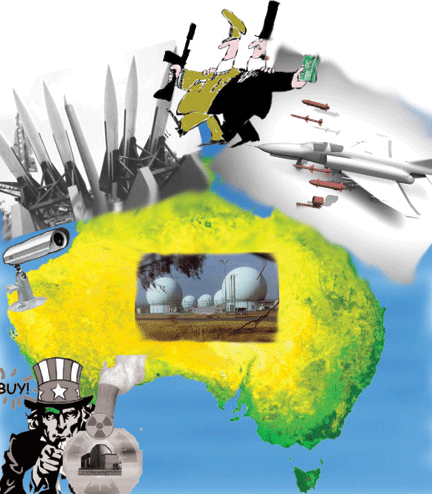
USA • Australia military eventThe US is turning Australia into a forward base for potential military operations in the Pacific, with American forces and defense contractors controlling or having access to roughly two-thirds of the country’s military facilities,The Guardian reported on Sunday.
Citing data compiled by the Nautilus Institute for Security and Sustainability, the newspaper identified 110 facilities across Australia with some form of US military or corporate presence out of 168 surveyed.
The US military directly controls 17 facilities, including the Pine Gap intelligence complex in central Australia, which plays a major role in US surveillance and military operations. The facility tracks missile launches, intercepts communications and provides targeting information for American forces around the world.
Other installations include a naval communications station in Western Australia used to communicate with submerged US submarines and RAAF Base Tindal in the north, which is being expanded to accommodate nuclear-capableB-52 Stratofortress bombers.
The Guardian wrote:
“These aircraft are able to land on Australian soil carrying nuclear weapons. The US government won’t tell Australia if and when they are. The Australian government won’t ask.”
Beyond the facilities it directly controls, the US military has access to dozens of Australian installations, while American defense contractors, including Lockheed Martin and Northrop Grumman, operate at others. According to the Nautilus data, 41 of the 168 facilities surveyed have no significant US presence, while the status of another 17 remains unresolved.
The American footprint is also expanding. In June, AFP reported that the US was preparing to establish a permanent stockpile of battle-ready weapons, ammunition, and equipment for the Marine Corps in Australia, with the facility expected to reach full capacity by 2028.
An honorary professorial fellow at the University of Melbourne, Richard Tanter, the author of the Nautilus database, told The Guardian:
“Over more than a decade, the United States has been preparing the capacity for high-tempo warfighting operations with China, springboarding from Australia. From a Chinese perspective, Australia is not so much hosting US bases on its territory, it’s a US base in its own right… Australia is a serious piece of real estate in the US warfighting machine.”
Canberra maintains that the growing American presence strengthens Australia’s security.Defense Minister Richard Marles said in June that the expanding US footprint was important both for building the country’s military capabilities and for its national security.
Marles also argued that the US presence helped counter what he described as China’s “very significant military buildup” in the region.
Former Australian Defense Minister Christopher Pyne has similarly said the 2021 AUKUS pact between Australia, the US, and UK goes beyond Canberra’s acquisition of nuclear-powered submarines. He described the arrangement as establishing “a new United States submarine base in the Indian Ocean” that would provide Washington with a “massive strategic advantage.”
“Poland first” here does not mean indifference to Russian power. It means refusing to pretend that every demand from Kyiv or every directive from the Commission is automatically a Polish interest.
(and how Radek Sikorski doesn’t have the cojones to defy Anne Applebaum)
In 2022 Poland was Ukraine’s most important European ally. Polish families opened their homes to refugees. The state sent weapons and money. Four years on, that story is breaking. In conversation with historian and Do Rzeczy columnist Dr Mike Krupa, the question is no longer whether Polish support has cooled. It is how far the backlash now affects issues beyond the war itself including Ukraine’s future and Poland’s continued EU membership.
Mike makes the case for a Poland first approach. Ordinary Poles, he says, were told that arming Ukraine, hosting refugees and following Brussels was an act of national self-defence. Many no longer believe it.
They see a long war they cannot end, a bill they are still paying, and a political class more fluent in the language of European solidarity than in the language of Polish interest.
Nowhere is that class more visible than in Radosław Sikorski. Poland’s foreign minister talks as if Warsaw were still the engine of the Ukraine war and the conscience of Europe. The unkind version, and it is widely whispered in Warsaw, is that Sikorski does not have the cojones to take a step that has not first been cleared by his wife. Anne Applebaum. She is one of the most connected Atlanticist voices in the English-speaking world, and the Sikorski–Applebaum household is less a marriage than a transatlantic foreign-policy firm.
Whether the joke is fair is almost beside the point. It sticks because Poles can see the product: a foreign ministry that sounds more at home in Washington and Brussels than in provincial Poland. And it is ironic given Sikorski’s remarks in 2014 that were secretly caught on tape, that the US Poland relationship was worthless and that “we’ll get in conflict with the Germans, Russians and we’ll think that everything is super, because we gave the Americans a blow job. Losers. Complete losers.”
History has come back into the room. The 2026 rupture between Warsaw and Kyiv did not come from nowhere. When President Zelenskyy honoured a unit as “Heroes of the UPA”, he touched the rawest nerve in Polish memory: the Volhynia massacres. For most Poles the UPA is not a footnote in someone else’s independence struggle. It is the organisation that murdered their grandparents. President Karol Nawrocki’s decision to strip Zelenskyy of the Order of the White Eagle was not a diplomatic tantrum. It was an attempt to speak for a public that felt insulted.
That public is also tired. Support for Ukrainian refugees has fallen. Sympathy has hardened into irritation. Farmers have already shown what happens when Ukrainian produce and EU rules collide with Polish livelihoods. Krupa’s point is that this is not a fringe mood. It is running ahead of the Tusk government, which still talks as if the Ukraine war is winnable and a defining Polish priority.
The more uncomfortable claim is the second one. Krupa sees the EU as a constraint on Polish sovereignty and prospertiy. In his telling, Warsaw has outsourced strategy to Brussels, Berlin and Washington, then wondered why Polish priorities are often ignored. A country on NATO’s eastern flank that cannot define its own end-state in the war is not a frontline success. It is a frontline client.
“Poland first” here does not mean indifference to Russian power. It means refusing to pretend that every demand from Kyiv or every directive from the Commission is automatically a Polish interest.
I have written before that Poland’s Janus face on Ukraine is untenable: fight Russia to the last, but keep Ukraine out of the EU. That contradiction is now visible to voters
Whether Krupa is right about the scale of the turn will be tested in Polish politics during elections in 2027. What is already clear is that the old script — Poland as the uncomplaining engine of European support for Ukraine — is finished.
The public has moved. The government in Warsaw and the Eurocrats in Brussels have not.
Ben Norton examines the little-discussed history of CIA influence over the American left—and the role played by one of the most celebrated feminist icons of the modern era, Gloria Steinem. Steinem’s work with a CIA-funded organization during the Cold War, Norton argues, was part of a broader effort to cultivate a “compatible left”: liberal voices that could promote American power while presenting the United States as a force for democracy, human rights and progress.
But the story doesn’t end with Steinem. Norton connects the Cold War propaganda apparatus to CIA interventions in Iran, Guatemala, Italy and Indonesia, the enormous human toll of U.S. post-9/11 wars, and the cultural institutions and intellectuals allegedly enlisted to fight the ideological battle against communism.
He then brings that history into the present, arguing that the same political language can be heard in today’s Democratic Party—from Hillary Clinton to Alexandria Ocasio-Cortez—particularly in rhetoric about “democracy vs. authoritarianism,” U.S. intervention abroad and the supposed moral distinction between American power and its rivals.
The central question is provocative: Has the machinery of Cold War propaganda really disappeared—or has it simply learned how to speak the language of modern liberalism?
Highlights
Gloria Steinem and the CIA: Steinem acknowledged working with the CIA-funded Independent Research Service during the Cold War.
The “compatible left”: Norton argues that the CIA sought to cultivate center-left figures who opposed communism without challenging U.S. imperial power.
CIA coups and intervention: The analysis examines U.S. involvement in the overthrow of governments in Iran and Guatemala, as well as CIA interference in Italy’s 1948 election. – Indonesia: Norton examines U.S. support for the Indonesian military amid the mass killings of 1965–66.
The cultural Cold War: The analysis explores the CIA-backed Congress for Cultural Freedom and its connections to artists, writers and intellectuals.
From Steinem to today: Norton argues that Cold War narratives about democracy, authoritarianism and U.S. power continue to influence contemporary liberal politics.
EDITOR’S NOTE: This transcript has been cleaned for readability while maintaining the speaker’s original words, meaning, arguments, and overall sequence. Timestamps have been removed, punctuation and paragraphing have been lightly edited, and obvious transcription/spelling errors in names and terms have been corrected.
Today I’m going to be explaining one of the ways in which US intelligence agencies manipulate public opinion in order to support U.S. wars and interventions abroad. And this scandal involves one of the most prominent political activists in modern US history. Her name was Gloria Steinem. She was a major feminist leader and she just passed away this September. And the reason that I’m talking about Gloria Steinem today is that many people have heard of her and they know that she was a feminist icon. But what many people do not know is that she was a CIA agent. She worked for the US Central Intelligence Agency for years. And later in this analysis today, I’ll look at the evidence detailing how Steinem was used by the U.S. in order to manufacture consent for the U.S. Empire’s wars of aggression for its imperial crimes and especially as a vehicle for anti-communist propaganda. Steinem worked for the CIA at the height of the first cold war and she was a proud part of the U.S. Empire’s global propaganda narrative when the US tried to portray itself as a progressive beacon of liberal values that was defending democracy in scare quotes and human rights and fighting against the big bad boogeymen of the Soviet Union fighting against communism. This is why the CIA hired Steinem because she was a very effective propagandist………………………………………………………………………………………………………………………………………………………………………………………………………………………………………………………………….. https://scheerpost.com/2026/09/08/exposed-how-the-cia-manipulates-public-opinion/
State leadership sought no public comment on a massive SpaceX project in Vermilion Parish. Louisiana residents took their concerns to the feds instead.
By the time the public comment period on a proposed Federal Aviation Administration rule change closed Monday night, thousands had shared their thoughts — more than half of them mentioning Louisiana and its rapidly eroding coastline, fragile wetlands and migratory bird populations.
The proposed change would allow the FAA to fast-track approval of launch facilities like SpaceX’s recently announced Starbase Louisiana in Vermilion Parish. In the planning process for that $100 billion project, there was no official public comment process prior to approval, leading over 1,000 people to voice their concerns to the FAA instead.
“We tamed this land, full of mosquitoes, water moccasins, and alligators, to the best of our ability. We’ve become symbiotic [with] all of the nature in south Louisiana,” self-described lifelong Louisiana resident and Vermilion Parish native Tim Meaux writes.
“Apparently my voice, and millions of others, have zero say [in] what becomes of Vermilion Parish because our politicians have once again sold their souls for corporate welfare,” Meaux continues in his comment to the agency, asking them to hold SpaceX accountable. “With our Louisiana government completely failing to hold on to any protection for us, you are our last bastion of hope.”
The 1,647 public comments specifically mentioning Louisiana, a majority of which were submitted in the week after the SpaceX announcement, criticize the plans for the 125,000-acre Vermilion Parish launch facility, and warn of the possibly irreparable harm that a launch site could cause if federal guardrails were waived.
“Anyone who lives here and knows the area, the marshlands, ecosystem, knows this is the most inappropriate site for such a facility,” writes Nina Guidry, who describes herself as a Vermilion Parish resident. “[The] majority of people in this parish, if asked, would be dead against SpaceX locating here. We were never given that courtesy. It was decided in backroom deals of our state legislators signing NDAs and our governor. It will impact a centuries old way of life & traditions.”
If approved, the new rule would waive the need for compliance with more than a dozen environmental protections, including the Clean Water Act and the Endangered Species Act, in the issuing of permits for launch facilities.
A handful of environmental groups, such as the Louisiana Wildlife Federation, National Wildlife Federation and the Pontchartrain Conservancy, were among the first to publicly criticize the waiver request, which the FAA proposed on July 30.
“We believe a strong permitting review does help with site planning and project construction. Other projects undergo the same review, and these are really important oversight processes to protect our natural resources.” Rebecca Triche, director of the LWF, tells the Current.
Of the more than 3,000 comments on the proposed waiver, more than 600 comments mention Vermilion Parish directly, many coming from current or former parish residents.
Paula Rae Broussard, an American expat living in New Zealand who has roots in Vermilion Parish, says she’s “deeply concerned” about the effect the waiver may have on the protection of the fragile ecosystem around the planned SpaceX site.
“Vermilion Parish should not be treated as a test case for reducing federal environmental oversight simply because the project promises economic development,” she writes in her comment. “My grandparents live on land that has been in our family since my great-great-grandparents. That land isn’t just property. It is our history. It is where our family comes from. It is our place.”………………………………………
“The proposed rule builds on President Trump’s innovative “Enabling Competition in the Commercial Space Industry” Executive Order and advances a decades-old Congressional mandate to simplify and expedite commercial space licensing,” an FAA spokesperson told The Current.
Boeing B-47B rocket-assisted take off on April 15, 1954. (U.S. Air Force photo)
By Bill Gertz – The Washington Times – Thursday, September 10, 2026
A task force of nuclear-capable B-52 bombers has deployed for the first time to Australia in a show of regional force located to the south of China.
The bombers arrived last week at an upgraded Royal Australian Air Force Base Tindal. Local reports called it a new era in Australia’s military alliance with the U.S.
A Pacific Air Forces spokesman confirmed to Inside the Ring that the bomber task force is underway Down Under………….
The exact number of the strategic bombers from the 2nd Bomber Wing at Barksdale Air Force Base, Louisiana, was not disclosed. Most task forces include up to six B-52s.
An Air Force photo of the deployment stated in a caption that the bombers arrived Sept. 1. “Operating from RAAF Base Tindal marks our ability to project, sustain, and regenerate decisive airpower across an expanding extended network,” the caption stated.
The long-range bombers can deliver nuclear bombs or conventional precision-guided weapons.
The Tindal base has been upgraded with new hangars and ramps for the bombers. It is located in northern Australia about 200 miles south of the northernmost coastal city of Darwin and about 2,000 miles from the tense South China Sea.
The base also hosts Australian F-35 stealth jets and MQ-4C Triton surveillance drones.
From 1946 to 1969, the Hunters Point Naval Shipyard was used as the station for top-secret nuclear tests in the Pacific Ocean. It was also the place where decontamination was done on the ships used in hydrogen bomb tests. Radioactive and toxic waste was disposed there.
In 1989 the shipyard was declared to be a Superfund site as a result of the high levels of toxic and radioactive waste from those operations. The engineering firm, Tetra Tech EC, submitted false reporting to the U.S. Navy about the contamination. https://www.tetratech.com/
In late August, a federal judge approved a $57 million settlement, plus interest, against Tetra Tech for breach of contract and for reporting false test results. Tetra Tech, a U.S. Navy contractor, was accused of widespread fraud in the cleanup of a 400-acre site where homes were razed to construct more than 10,000 homes in the Bayview Hunters Point neighborhood. https://missionlocal.org/bayview/
In 2018, two Tetra Tech supervisors were charged with falsification of records and each were sentenced to eight months in federal prison.
On the 25th 9/11 anniversary we should also ponder victims and cost of America’s War on Terror – designed and implemented to reshape the Middle East in America’s image in response to and revenge for the attacks.
Estimates from the Brown University Costs of War project place the toll at 4.5–4.7 million people since 2001, including ~940,000 direct deaths (combatants, civilians, journalists, aid workers) and 3.6–3.8 million indirect deaths from disease, malnutrition, and health complications.
U.S. military and contractor deaths: About 7,074 U.S. military deaths and 8,189 contractor deaths
Veterans care (projected through 2050+): ~$2.2 trillion.
Homeland Security expansion: ~$1.1 trillion.
Interest on war debt: ~$1.1 trillion
On 9/11 Remembrance Day Americans should urge its government to turn away from senseless war whether it be against Iran, Venezuela, Somalia, Yemen, Nigeria, Cuba, little unarmed boats plying the Caribbean or other locals we’re not informed of. That would be a noble way to honor the victims of the senseless violence perpetrated on America 25 years ago today.
On September 4, New Mexico Land Commissioner Stephanie Garcia Richard issued an executive order that bans the leasing of state lands for new uranium mining and associated activities. The executive order also directs the State Land Office to focus on cleaning up legacy uranium sites and urges the uranium industry and federal government to prioritize legacy uranium problems in the state.
According to the State Land Office’s announcement, “New Mexico has a painful history as the largest producer of uranium ore in the United States, which has left a legacy of over 1,000 former uranium mining, milling, and exploratory drilling sites in the state, of which 250 are considered abandoned because they are not associated with a viable responsible party (at least 50 of the sites involve state trust lands).”
The State Land Office also said the Trump administration is “aggressively pushing to increase uranium production nationwide despite the fact that the federal government and responsible private parties have failed to address the thousands of unremediated uranium sites in New Mexico and beyond.”
Nuclear history of New Mexico: New Mexico has long been associated with the United States’ nuclear history. Los Alamos is, of course, where J. Robert Oppenheimer directed the development of the first atomic bombs as part of the Manhattan Project, and is the home of Los Alamos National Laboratory. New Mexico is also home to the Department of Energy’s Waste Isolation Pilot Plant, near Carlsbad, and Urenco USA’s National Enrichment Facility, near Eunice.
The Grants uranium district in northwestern New Mexico was the largest source of uranium in the United States from 1951 to 1980. Today, there are hundreds of abandoned uranium mines in the state, but no active mines. Some of the abandoned mining sites have had cleanup projects initiated, such as the former Northeast Church Rock Mine in northwestern New Mexico.
The old Grants region and other areas in New Mexico remain sites of interest for potential future uranium mining operations, and there are currently two active uranium leases in the state.
New Mexico has no commercial nuclear power plants. Most of the state’s electricity is generated by—in order of decreasing percentage—wind, natural gas, coal, and solar, with other renewables providing lesser amounts.
A contentious topic: At a press conference announcing her executive order, Commissioner Garcia Richard accused federal authorities of ignoring and disrespecting the citizens of New Mexico regarding uranium legacy sites, pledging, “That stops now.” Since becoming land commissioner in 2019, she said, “I have not allowed any uranium mining on state lands, and today’s action solidifies this prohibition to protect our communities and our land and water.”
She added, “Indigenous communities and New Mexico families have suffered the environmental and health effects inherent in living near a uranium pit or downwind from a nuclear testing site. The Trump administration’s push for aggressive uranium development is a low blow to these communities, and I will keep doing everything in my power to fight back.”
State Congresswoman Teresa Leger Fernández (D., 3rd Dist.), whose constituents include those in northern and most eastern parts of the state, including Los Alamos and the Grants uranium district, expressed her gratitude to Garcia Richard, saying that “all of the people who protect and hold sacred the land that we are standing on today are saying, ‘no more uranium mining.’”
Leger Fernández noted that she has cointroduced legislation in the state legislature “to withdraw federal lands from uranium mining in the Chama watershed [which is in southern Colorado and north-central New Mexico] because we know that that watershed is precious and it is fragile. That Chama watershed is important not just for the Native Americans who rely on it, not just important for the people who might want to go and be enjoying themselves at Abiquiu Lake or Ghost Ranch. It is the water that feeds our crops along the acequias. It is the water that feeds into the rivers that feed and nourish Santa Fe.”
In recent years, officials in New Mexico have set up certain obstacles to nuclear-related development in the state. In 2023, for example, legislation was passed to ban the storage and disposal of high-level radioactive waste in New Mexico without the state’s explicit consent. That legislation played a role in Holtec International’s canceling its plans last year to build a consolidated interim storage facility for spent nuclear fuel in southeastern New Mexico.
Nuclear advocacy: Although some in New Mexico are opposed to uranium mining, as well as to nuclear energy in general, there are also forces advocating on behalf of nuclear development. The New Mexico Nuclear Alliance made its debut as a nuclear energy advocate late last year, specifically noting support for new uranium mining in the state. The Clean Energy Association of New Mexico is another nuclear advocacy group in the state.
Since its inaugural edition in 2011, the International Uranium Film Festival (IUFF) is trying to do its best to informing the general public about nuclear risks and consequences through films and open discussions, and to preparing the humus for a safer and more just world. The film festival founders and directores strongly share the view of the Nobel Laureates: „There is no greater obligation than to prevent the catastrophe of nuclear war.“
“There is no greater obligation than to prevent the catastrophe of nuclear war“
Rio de Janeiro / Berlin / Las Vegas – Amidst the global hype surrounding the widespread adoption of artificial intelligence, we are witnessing a new nuclear arms race and a rush to expand existing uranium mines and develop new ones in the US, Canada, Brazil, and other countries. This is the grim backdrop to the upcoming International Uranium Film Festival events next October 2026 in Düsseldorf & Berlin in Germany, and in Las Vegas in Nevada.
“Humanity stands at a defining moment in its history. More than eighty years after the dawn of the nuclear age, and at the threshold of the age of artificial intelligence, we are presented with an unprecedented challenge“, states in July 2026 signed „Rome Declaration“ of the Global Nobel Laureates Assembly on Artificial Intelligence and Nuclear War. „In the midst of a worsening nuclear arms race, we are embarking on an equally dangerous AI race. AI built into nuclear systems leaves little time for, or even replaces, human judgement in a crisis.“
The situation facing the world today is serious. Perhaps even more serious than during the 1962 Cuban Missile Crisis between John F. Kennedy and Nikita Khrushchev. Back then, artificial intelligence was still pure fantasy. It did not yet exist. In October 1962, the decision for a nuclear attack still had to be made manually by the President. We were lucky. Neither Kennedy nor Khrushchev pushed the so called Red Button.
“About 20 years later, September 26, 1983, the „Red Button“ for the launch of nuclear weapons and the start of a nuclear war was in the hands of a Russian soldier: Lieutenant Colonel Stanislav Petrov of the Soviet Air Defense Forces. 44 years old Petrov was on duty, monitoring the early-warning satellite computer system at a secret command center near Moscow. Suddenly the system detected five U.S. Nuclear-armed intercontinental ballistic missiles attacking the Sovjet Union. The lieutenant colonel had about 20 minutes to—literally—push the “red button” and launch the counterattack before the US missiles struck Russia. But Petrov didn’t believe the computer. He suspected a technical error and decided to disobey the official protocol and reported the alert as a false alarm up the chain of command. In doing so, he saved humanity.
As we know now: Petrov was correct. The satellites had mistakenly interpreted the reflection of sunlight off the clouds as attacking missiles. The brave Russian soldier became „the man who saved the world“, because he didn’t trust his computer. Two well done and awarded movies tell Petrov’s heroic story: “The Man Who Saved the World“ by Peter Anthony and “The Red Button“ by Miroslaw Grubek and Ewa Pieta.
Just a year later — unaware of the events that took place in Russia in 1983 — Hollywood director James Cameron released a successful science-fiction war movie starring Arnold Schwarzenegger as “The Terminator.” While not everyone likes action movies and blockbusters, they have the potential to reach millions of people – and sometimes they’re prophetic and have a serious warning message for humanity.
In “The Terminator“, the US government and the Department of Defense handed over control of US defenses and nuclear weapons to Skynet—an artificial intelligence program— in order to save the planet. Skynet subsequently classified humanity as the greatest threat to the planet. Since nuclear war is the quickest way to kill millions of people, the AI system launched US nuclear missiles at Russia, prompting a Russian counterstrike. Only a few humans survived, facing a final war of extermination against robots.
The current hype surrounding artificial intelligence makes this catastrophic scenario possible today. In 2023, speaking at a press event in Los Angeles, Arnold Schwarzenegger said James Cameron’s 1984 science fiction has now become a reality. “Today, everyone is frightened of it, of where this is gonna go,” Schwarzenegger said about AI. “And in this movie, in ‘Terminator,’ we talk about the machines becoming self-aware and they take over… Now over the course of decades, it has become a reality. So it’s not any more fantasy or kind of futuristic. It is here today.“
Two years later, in 2025, during an interview with Rolling Stone, director James Cameron warned: „I do think there’s still a danger of a ‘Terminator’-style apocalypse where you put AI together with weapons systems, even up to the level of nuclear weapon systems, nuclear defense counterstrike, all that stuff,” Cameron said. “I feel like we’re at this cusp in human development where you’ve got the three existential threats: climate and our overall degradation of the natural world, nuclear weapons, and super-intelligence,” he added.
Also in 2025, the Nobel Laureate Assembly for the Prevention of Nuclear War stated in its Declaration to the world Leaders and the general public: „Our survival and the survival of future generations are at stake. There is no greater obligation than to prevent the catastrophe of nuclear war. The threat of nuclear war is indiscriminate.“
The Nobel laureates write further: „ We can’t reduce nuclear risk by working in academic or policy silos. The public must be part of the effort. Understanding that the lack of political will impedes the reduction of nuclear risks, we call on scientists, academics, civil society, and communities of faith to help create the necessary pressure on global leaders to implement nuclear risk reduction measures. Nuclear risk is not a challenge to be left to the future or passed to another generation. It is ours to confront and ours to reduce.“
Since its inaugural edition in 2011, the International Uranium Film Festival (IUFF) is trying to do its best to informing the general public about nuclear risks and consequences through films and open discussions, and to preparing the humus for a safer and more just world. The film festival founders and directores strongly share the view of the Nobel Laureates: „There is no greater obligation than to prevent the catastrophe of nuclear war.“
Attend the upcoming screenings of the Uranium Film Festival on October 11 in Berlin (Prenzlauer Berg, Lichtblick-Kino) and on October 16 in Düsseldorf (Bambi Filmstudio). The Las Vegas edition of the Uranium Film Festival is scheduled for October 16 and 17 at the University of Nevada (UNLV). Any support is welcome.
The ATOMS & EVE project is a new science-driven, educational resource that explores how radiation harms female bodies more than male bodies, children more than adults, and pregnancy most of all.
“We are constantly being told about ‘a permissible amount of radiation.’ Who permitted it? Who has any right to permit it?” – Dr. Albert Schweitzer
Biology matters. Science confirms that female bodies suffer more harm from ionizing radiation than male bodies.
We must move beyond seeing biological sex as a “confounding factor” and instead treat it as a primary health indicator.
This is not abstract math. It is physical, measurable, and permanent damage to our DNA.
A Failure of Policy. It is time to stop ignoring the evidence.
Radiation policy is informed by the “average” worker. Women and girls face unique disproportionate dangers that are invisible to decision makers.
Our opportunity: A path to better protection.
We have the scientific data to make radiation standards more protective right now. By centering policy on the documented biological impacts—the damage to chromosomes, cells, and organs—we can create a safer future for ourselves and our children.
This is a chance to move from outdated assumptions to evidence-based health protection… to safeguard the next generation by demanding better radiation standards.
Meet Eve
She is an embryo, a toddler, a teenager, a mother and a grandmother. She is every female throughout the female lifespan.
Why Eve, why now?
The ATOMS & EVE project is a new science-driven educational resource that explores how radiation harms female bodies more than male bodies and children more than adults, and pregnancy most of all.
Eve is our vehicle for sharing what we know with you and your communities!
Eve knows:
There is no safe level of exposure
Pregnancy is uniquely vulnerable to radiation damage
Everyone is already being exposed to a legacy of radioactive pollution left by our uses of nuclear technologies
FACTS
Exposure to ionizing radiation can cause or contribute to:
Infertility
Endocrine (hormones) disruption
Disruption of pregnancy including spontaneous abortion and miscarriage
Stress of the immune system
Cancer and Leukemia—both adult and childhood
Cardiovascular diseases including heart attack and stroke
DID YOU KNOW?
“Little girls exposed between birth and 5 years old were twice as likely to get cancer at some point in the next 60 years than were boys.” —Amanda Nichols
A landmark 2025 report released by Norwegian People’s Aid warns that past atmospheric nuclear tests are on course to cause at least two million additional cancer deaths worldwide — a stark reminder that the consequences of nuclear testing are far from historical. [1]
Radiation’s disproportionate impacts should now be the research and policy focus, as society is poised to make crucial and long-lasting decisions regarding climate change mitigation and future energy sources. [2]
The Israeli press has published three significant revelations about the Gaza holocaust, reporting (1) that Benjamin Netanyahu concealed advanced knowledge of the Hamas attack on October 7, (2) that Israel rejected a Hamas offer to release all civilian hostages immediately after October 7, and (3) that according to an IDF drone operator, the Israeli military was intentionally firing on civilians throughout Gaza during its operations in the Palestinian territory.
Haaretz describes a call between Netanyahu and UAE President Sheikh Mohamed bin Zayed, citing three foreign senior sources:
“A week and a half before October 7, 2023 the Emirati ruler called Netanyahu from the Presidential Palace in Abu Dhabi and spoke with him for 45 minutes. In that conversation, bin Zayed warned that Hamas’ leader in Gaza, Yahya Sinwar, was planning a major operation against Israel. Bin Zayed expressed concern that the event in question would not only lead to bloodshed but also destabilize the entire region and undermine the Abraham Accords.”
Haaretz reports that rather than pass these warnings on to Israeli national security officials, Netanyahu chose to sit on information which an unnamed Shin Bet official said could have “changed our entire assessment picture.”
Haaretz also notes that Israel had received similar warnings about a coming Hamas attack from Egyptian intelligence, which had been reported earlier. These are just two items in the mountains upon mountains upon mountains of evidence indicating that powerful people in Israel knowingly allowed Hamas to inflict as much damage as possible on October 7 2023 in order to advance the murderous ethnic cleansing objectives we’ve seen rolled out in the years since.
Nothing will turn you into a conspiracy theorist faster than learning basic facts about what happened on October 7. But even without knowing those facts it already strains credulity to believe Israel had no advance knowledge of a complex attack which would require extensive open-air training in one of the most heavily surveilled strips of land on our planet. Especially when you look at all the pre-existing military agendas Israel was able to push forward in the aftermath.
Later in that same article, Haaretz quotes a Palestinian politician named Samir Mashharawi describing what Hamas leadership told him during his mediation efforts between Israel and Hamas after October 7:
“He told me that in the first stage, they had no problem releasing all civilians without anything in return,” Mashharawi recounts. “I swear, those were his exact words: all civilians, without anything in return. They had only one condition: They wanted us to bring in an agreed-upon mediator as quickly as possible, so that negotiations could immediately begin over everything else.”
Mashharawi said Israel rejected the offer. A senior Israeli defense official corroborated this, telling Haaretz:
“The release of the hostages did not even enter the list of war objectives formulated by the government on the night of October 7. Could the proposal have been properly discussed and a decision reached? In substantive terms, the answer is yes. But the prevailing mood was like after Pearl Harbor: We had just suffered a brutal blow, we were in the midst of war, who had the bandwidth to talk about stopping the fighting and starting negotiations now, even if it was to save the lives of dozens of people, whose final number was still unknown?”
So all that hasbara about the hostages and the Bibas kids and how Hamas needed to be destroyed because they were refusing to release innocent civilian captives was complete bunk from the very beginning. Hamas offered to release them with no conditions but the opening of communication lines. Israel refused, because what they wanted was to steal more Palestinian land. It was never about the hostages, and anyone who said it was is a liar.
Lastly, a separate report in Hebrew from Haaretz quotes an Israeli air force reserve major describing how IDF policies and culture ensured the deaths of large numbers of civilians. Here are a few quotes, translated by Israeli-American political analyst Shaiel Ben-Ephraim:
1) He was involved in the March 23, 2025 paramedic killings in Tel al-Sultan, Rafah and said, “You could clearly tell these were rescue vehicles even as fire was opened on them from the ground. For no apparent reason, the force on the ground charged the convoy. They shot the first vehicle, the medical personnel got out, hid behind the ambulances and begged for their lives, and the soldiers shot them one after another.”
“On how the yellow line was used as an excuse to kill innocent people: “The Palestinians didn’t know it existed, and the Air Force wasn’t always updated either. From the perspective of a farmer walking onto his own land — he has no idea he’s stepping into an area the IDF suddenly decided is a fire zone. And then all kinds of retroactive justifications started coming up. ‘He came for an arms deal.’ ‘He touched the ground, maybe he’s planting an explosive.’ To me it looked like they were trying to incriminate people with no intelligence and no proof.”
On how all morals were lost in Gaza: “”The feeling was that something tore, everyone had already become cynical about death, you can’t understand it from the outside. It’s not just fatigue, it’s an erosion of morality, of responsibility, of the sense that someone is still managing the event. Very quickly this whole business of ‘collateral damage’ disappeared from the considerations. They fire on anyone they see. The atmosphere started to be like the stands at a soccer match. The way you shout at a player, ‘Yalla, score,’ that’s how they shout at a soldier, ‘Kill him, strike him.’”
Like the other revelations, this report further discredits the lies the public was sold about Israel’s reasons for its atrocities in Gaza. All those lies about how Israel is taking extraordinary measures to protect civilian life in Gaza and only kills civilians because Hamas “hides behind human shields” has been thoroughly discredited by copious amounts of evidence that Israel was going out of its way to kill noncombatants throughout the course of the onslaught.
The world was lied to about the Gaza holocaust, just like it was lied to about every other act of mass military slaughter that the US involves itself in. Please carry these lessons into the future.








 nuclear-news