From Occupation to Erasure: How Legacy Media Failed Gaza
ScheerPost Staff, May 25, 2026
The Complicit Lens: How Media Helped Normalize the Destruction of Gaza
On the latest episode of Scheer Intelligence, host Robert Scheer sat down with media scholar Robin Andersen for a blistering examination of how major American media institutions covered — and often concealed — the realities unfolding in Gaza.
At the center of the discussion is Andersen’s new book, The Complicit Lens: U.S. Media Coverage of Israel’s Genocide in Gaza, which argues that corporate media did far more than simply fail the public. According to Andersen, institutions like The New York Times and CNN helped manufacture a sanitized narrative that erased the historical roots of Palestinian suffering while shielding Israeli state violence from meaningful scrutiny.
Throughout the conversation, Scheer and Andersen return to a central question: What happens when the institutions tasked with informing the public become instruments of political messaging?
Andersen points to leaked newsroom directives reportedly instructing journalists to avoid words such as “occupation,” “ethnic cleansing,” and even “refugee camp.” The effect, she argues, was not merely semantic. It fundamentally stripped audiences of the historical and legal context necessary to understand Gaza itself. If Palestinians are never described as occupied people, then their resistance appears irrational rather than rooted in decades of dispossession and military control.
Scheer repeatedly stresses that this is not simply a failure of journalism, but a crisis of democracy and intellectual freedom. The conversation expands beyond Gaza into the repression seen across American universities, where students and professors protesting the war increasingly found themselves surveilled, punished, or accused of antisemitism. Andersen describes how campus protests were portrayed not as organic moral outrage, but as dangerous extremism requiring police intervention and political suppression.The interview also confronts the growing contradiction at the heart of American political discourse: criticism of the Israeli government is increasingly treated as hostility toward Jewish identity itself. Scheer, drawing from his own Jewish background, calls this “a blasphemy against the Jewish people,” arguing that the history of Jewish struggle has long been rooted in universal human rights and dissent against oppression — not unconditional allegiance to state power.
One of the most striking parts of the discussion centers on how Palestinian voices — especially journalists documenting the destruction on the ground — were marginalized by establishment media even as they risked and lost their lives reporting from Gaza. Andersen argues that social media and independent outlets became essential because they bypassed traditional gatekeepers that often repeated official Israeli talking points without verification.Scheer ultimately frames the crisis as one extending far beyond a single conflict. If governments, media institutions, and universities can collectively narrow the boundaries of acceptable speech around Gaza, then the implications for democratic society are profound. The issue is no longer only about what is happening overseas, but whether Americans themselves retain the ability to openly question power without fear of censorship, retaliation, or ideological policing.
By the end of the interview, Andersen delivers a stark warning: journalism that abandons accuracy, historical context, and moral clarity ceases to function as journalism at all. It becomes public relations for power.
And in moments of mass suffering, silence and distortion become forms of complicity.
Scheer Intelligence: Highlights
……………………………………………………………………………………………………………………………………………………………………………….From Occupation to Erasure: How Legacy Media Failed Gaza
128 years of US exploitation, degradation of Cuba continues on steroids
17 May 2026 AIMN Editorial, By Walt Zlotow , West Suburban Peace Coalition Glen Ellyn IL, 128 years of US exploitation, degradation of Cuba continues on steroids – The Australian Independent Media Network
One must go back to 1898 for the last time the US was not exploiting Cuba and its people to benefit rapacious US capitalism and organized crime. That year the US cooked up fairy tale about Spain blowing up the US Maine, sent to Havana Harbor to intimidate Cuba’s Spanish ruler. The Maine did blow up but from an accidental internal explosion, not a Spanish mine. Those 261 sailors could not be said to have died in vain so President McKinley and his war party blamed Spain in order to declare war, kick Spain out of the Americas and take over Cuba for US exploitation.
But nothing in the previous 126 years compares to the diabolical cruelty, including death, the US has inflicted upon Cuba by President Trump and his bloodthirsty Secretary of State Marco Rubio.
This is not exaggeration. Need a lifesaving operation in Cuba under the Trump, Rubio oil blockade? Faggedaboudit. Much medical care is unavailable in oil starved Cuba when the lights go dark. Food and life sustaining supplies are becoming scares as farmers and merchants cannot get their wares to the people with a transport system largely shut down. Nearly a fifth of Cubans have fled the Trump, Rubio regime change operation.
Trump glories in their death and destruction he’s unleased. “THERE WILL BE NO MORE OIL OR MONEY GOING TO CUBA – ZERO! I strongly suggest they make a deal, BEFORE IT IS TOO LATE.”
Trump is expanding in more grotesque terms US policy to degrade Cuba into submission going back to 1960. A secret State Department memo back then under Eisenhower promoted overthrowing Castro thru:
“… a line of action, while adroit and inconspicuous as possible, denies money and supplies to Cuba to bring about hunger, desperation and overthrow of the Castro government.”
Trump simply dropped the “adroit and inconspicuous” fig leaf.
Ironically, the first US embargo in Cuba was good for the Cuban people. In April, 1958, Eisenhower imposed an arms embargo on the Batista regime. The US had been supporting Batista’s murderous rule for 25 years to insure his support of US economic control, both legal and criminal that enriched US capitalists and Mafia enterprises to the detriment of the Cuban people. Eisenhower didn’t have an epiphany to help the Cuban people. He simply saw the inevitable triumph of Castro’s revolution and sought to curry favor with its eventual rulers.
Twenty months later Castro prevailed, Batista fled and Cuba finally ended 62 years of US cruelty and exploitation. Not quite. Within year the US imposed Cuban embargo 2.0 designed not to facilitate the inevitable revolution but to destroy it. Sixty-six years on, with the entire world community except Israel voting year after year in the UN for the US to stop, America’s endless lust to crush the Cuban revolution continues apace. And under the depraved Trump, Rubio oil embargo, it has become a monumental war crime against the 11 million sorrowful Cuban souls.
Memorial Day: The Glorification of War, Not War’s Victims
Edward Curtin, SCHEERPOST, 25 May 26
Although Memorial Day in the United Sates is ostensibly a day for honoring soldiers killed in wars, it is, rather, a day for promoting war. If it were to honor the dead, all its pageantry would be in opposition to war.
Rather than being haunted by the ghosts of war, many Americans are very proud of all its soldiers killed while killing foreigners for the military industrial complex and the super-rich who own the country.
For the U.S.A. is a warfare state; it has been waging imperialistic overseas wars for a long, long time, and using its soldiers as cannon fodder. Most families of dead soldiers find it impossible to admit that their loved ones died in vain, even if courageously.
Without waging wars, the U.S. economy, as presently constituted, would collapse. Business goes on as usual.
……………………………………………………………………………………………………………………………………………………………………………………………….. not all of the wars’ victims die. Vast numbers become “living corpses,” also mostly anonymous and forsaken. Across the world and here at home wherever the American war machine has set its sights, the lame and crippled struggle on, victims of bombs and bullets, napalm and white phosphorous, nuclear radiation, torture, biological weapons – all the grotesque weapons the ghouls of the weapons’ industries have conjured up from hell for their paymasters. Countless living victims, yes, but the weapons industries carefully count their bloody profits, as do those who invest in these companies while turning a blind eye to their own complicity. Do they fly the flag on Memorial Day on their manicured lawns?
Many of the wounds of war are psychological and spiritual. And so many of the victims suffer silently. Wars’ terrors follow them everywhere down their nights and down their days, and they can often find no escape from the nightmare images that populate their minds, flashing in and out. It’s beyond imagining the living hell of children worldwide reliving the sight of the bloodied mangled bodies of their parents at their feet, victims of bombs or death squads or perhaps “collateral damage,” as if any words or reasons could undue their everlasting trauma or cover up the radical evil of those who killed them.
We owe it the wounded, dead, and tormented war victims everywhere to memorialize them with the words:
War is a lie, and only truth will free us. We need a non-violent revolution.
And to stop marching with the drums drumming and the flags flying as if we are proud of the U.S. killing machine. Memorial Day: The Glorification of War, Not War’s Victims – christinamacpherson@gmail.com – Gmail
The Obstacles to Peace in Europe Are Not What We Think
by Thierry Meyssan, Voltaire Network | Paris (France) | 26 May 2026, The Obstacles to Peace in Europe Are Not What We Think, by Thierry Meyssan
The compromise reached between Presidents Donald Trump and Vladimir Putin on August 15 has still not materialized in Ukraine. The obstacles are not those the United States anticipated. Ukraine is not cooperating, while Germany and the United Kingdom want war.
President Donald Trump acknowledged to his counterpart Xi Jinping that he was his equal. Since World War II, every American president has considered himself superior to others because he was the most powerful and the richest.
Conversely, from a Chinese perspective, Xi Jinping considers himself the equal not only of Donald Trump, but of each of his counterparts. A Chinese person does not believe that having greater resources makes you superior.
This concept of a hierarchy between nations is purely Western. Therefore, the evolution of the US president should not be interpreted without considering the cultural context of the observer.
The following week, Russian President Vladimir Putin, in turn, visited Beijing. Western commentators asserted that the Russian was being held hostage by the Chinese. Again, this demonstrates a complete misunderstanding of their relationship. It is not the product of their respective interests, but of their shared history. From the sacking of the Summer Palace to the Nazi attempt to exterminate the Slavs, each has experienced how Westerners behave. They have concluded that they can only resist them by remaining united. It is therefore absurd to consider replicating what Richard Nixon and Henry Kissinger did in 1972: decoupling the two states.
At the Anchorage summit on August 15, 2025, Donald Trump and Vladimir Putin discussed doing business between their two countries and making peace in Ukraine. Despite several attempts, Washington failed because it wanted to sell weapons to the Europeans first. Today, it seems much more difficult, and the Europeans are beginning to manufacture their own.
President Trump has therefore begun withdrawing troops from Europe and abandoning the war that the Pentagon planned to extend to Transnistria and Bosnia and Herzegovina. He announced that he would withdraw at least 5,000 troops from Germany. Vladimir Putin, for his part, decreed that he would grant Russian citizenship to any adult Transnistrian who requested it. Finally, Donald Trump withdrew his support for the European Union High Commissioner who was administering Bosnia and Herzegovina in violation of the Dayton Agreement (1995). Simultaneously, his former Secretary of National Security, General Michael Flynn, is organizing US investments in the Serb-held area of Bosnia and Herzegovina.
These events suggest that the United States favors a peace in Ukraine that recognizes all of Novorossiya as Russian. This is historically and culturally justified, but it will only be possible by holding a referendum on self-determination. For the moment, Russian forces have no intention of liberating Odessa. The peace treaty could, however, acknowledge this.
Here again, contrary to what we believe, the difficulties do not lie where we perceive them.
The three main ones are now:
1) recognition of the Nazi ideology of the current government in Kyiv and the denazification of Ukraine;
2) recognition of the undemocratic nature of German reunification and the independence of East Germany;
3) recognition of the UK’s anti-Russian obsession and the dismantling of the European Defence Union before it is definitively formed.
Ukraine
Even though Western powers persist in believing that the Russian intervention in Ukraine is an attempt at annexation and the beginning of Russia’s westward expansion, Moscow never invaded its neighbor, but rather implemented Resolution 2202, which it had guaranteed before the Security Council.
To claim that Russia invaded Ukraine is as absurd as saying that France invaded Rwanda. We know that it intervened to end a genocide (for which it was partly responsible), in accordance with a Security Council resolution.
The current Ukrainian government is illegitimate. President Volodymyr Zelensky’s term expired long ago. Every three months, he extends martial law, which serves no other purpose than to prevent new elections. However, his latest decree on this matter extends martial law from May 2nd to August 4th. It would be possible to organize an election campaign and a vote during that time. However, the electoral lists will need to be cleaned up, as they still include soldiers killed in action and civilians who fled. No one knows their exact number, but they could represent between one and two-thirds of registered voters.
The Verkhovna Rada (parliament) is equally problematic. Only a third of the members participate. The laws it passes are therefore of dubious legitimacy. For example, it voted to destroy one hundred million books—on the grounds that they were signed by Russian authors or printed in Russia, without distinguishing between contemporary authors and literary classics. Similarly, this parliament banned the country’s main church and all opposition parties. Moreover, there is a CIA office within the Rada itself that drafts all the laws. The members present simply ratify them.
Russia’s primary demand is the denazification of Ukraine. This is what President Putin declared when launching his special military operation. From a Russian perspective, this is non-negotiable. Indeed, what defines the identity of the Russian Federation is not the memory of Catherine the Great, but that of the Soviet struggle against Nazism. This ideology aimed to annihilate the entire Slavic population (but neither the Jewish nor the Roma population), as explained in Mein Kampf. Even if we in the West are unaware of it, the Second World War was not waged to carry out the Holocaust, but to murder the Slavic population.
The Verkhovna Rada (parliament) is equally problematic. Only a third of the members participate. The laws it passes are therefore of dubious legitimacy. For example, it voted to destroy one hundred million books—on the grounds that they were signed by Russian authors or printed in Russia, without distinguishing between contemporary authors and literary classics. Similarly, this parliament banned the country’s main church and all opposition parties. Moreover, there is a CIA office within the Rada itself that drafts all the laws. The members present simply ratify them.
Yet, the illegitimate administration of the unelected president Zelensky refuses any denazification measures. There are currently numerous monuments glorifying the Nazis and their collaborators, the “fundamental nationalists.” The history of Ukraine was entirely rewritten by them, with the help of British MI6 and the American CIA, after the Second World War. This propaganda aims to make people believe that the “Banderists” fought the Nazis, which is absolutely false. No: the Banderites were Nazis.
Convinced that there will never be denazification, the “fundamental nationalists” are planning the construction of a Pantheon in their honor. General Kyrylo Budanov, head of the presidential administration, organized the repatriation of the remains of perpetrators of crimes against humanity, buried around the world during the Cold War, on March 28. Rob Jetten and Luc Frieden, the Dutch and Luxembourgish prime ministers, have already agreed to the transfer of the bodies of the fascist Yevhen Konovalets and the Nazi Andriy Melnyk.
Germany
In our minds, Germany is a democratic state that successfully reunified in 1990. However, as Dmitry Medvedev, Vice Chairman of the Security Council of the Russian Federation, recently stated, reunification is merely an illusion. West Germans never consulted East Germans. Under international law, reunification is invalid.
The 2025 federal elections produced different and opposing results in the former West and East Germany. West Germans voted for the CDU or SPD, while East Germans voted for the AfD. This is the sole reason why the first two parties are classified as “democratic” and the third as “far-right.”
Yet, Chancellor Friedrich Merz (a Christian Democrat) has pursued a widespread crackdown on all those who challenge his authority, labeling them “conspiracy theorists.” Relying on the Munich Office for the Protection of the Constitution (a branch of the federal body which housed many of the Reich police officials after the war), he banned several media outlets and imprisoned journalists.
Simultaneously, Germany is gradually rebuilding its army with financial assistance from the United Kingdom, just as its predecessor, Chancellor Adolf Hitler, rebuilt the German army with the help of the Governor of the Bank of England, Lord Montagu Norman. He has reinstated conscription for men and requires every volunteer to notify Berlin before going on holiday abroad.
Germany is also rebuilding its military-industrial complex, this time with European funds.
It is preparing for a war like the one in Ukraine, even though a war against Russia would be of a completely different nature. Regardless, the entire German industry is now producing Ukrainian drones and selling them in the Gulf against Iran. Following this logic, Berlin wants to bring Ukraine into the European Union, even though it does not meet the accession criteria set by the treaties: it would simply be a matter of creating a new status, that of “associate member,” and the trick would be done. Having ignored the negative results of the 2005 French and Dutch referendums, this would be just another decision made against the will of the people.
Friedrich Merz, grandson of a Nazi dignitary, cannot imagine his country not being allied with the Ukrainian “fundamental nationalists,” nor holding accountable those who sabotaged the Nord Stream gas pipeline and caused the collapse of German industry.
The United Kingdom
Since the 19th century, the United Kingdom has perceived Russia as its sole rival, not only in Europe, but in the world. Lord Curzon, Viceroy of India, conceived the “Great Game,” the colonization of Central Asia, in order to neutralize the Russian Empire. Today, British strategy remains unchanged.
London continues to portray Moscow as an obscurantist power. It is no longer a matter of fabricating the Zinoviev telegram (which allowed the Soviets to be accused of wanting to interfere in the UK elections), but of making people believe that the Kremlin’s occupant is a madman who has a passenger plane shot down in Ukraine and poisoned Sergei and Yulia Skripal or Alexei Navalny.
Its latest invention is the attack on European airports by unidentified drones. Regardless of the truth, London is using this to convince the North Sea states to join its Joint Expeditionary Force, which it has just transformed into a military alliance, the “Northern Marines,” under its command. It hopes to bring all the member states of the European Union and Turkey into the alliance.
This is why the hereditary Lords—and there are still some—are doing everything they can to keep Keir Starmer in Downing Street. The Prime Minister is, in fact, a Labour member who is, in secret, an agent of big business: unbeknownst to his own party and the media, he attended meetings of the Rockefeller Trilateral Commission. Also unbeknownst to everyone, he appointed Peter Mandelson—an accomplice of the criminal Jeffrey Epstein—as Her Majesty’s ambassador to Washington.
The important thing is to maintain the illusion that the United Kingdom has no dealings with either the State of Israel or Hamas; to continue concealing the fact that Israeli chiefs of staff have been secretly visiting Whitehall throughout the Gaza genocide, in which the British army actively participated. It is better to claim, like Christian Turner, Peter Mendelson’s successor, that only one state has a “special relationship” with Washington: Israel.
Survey begins to determine remote island’s suitability for nuclear disposal site

But while the local leaders of the municipalities in Hokkaido and Genkai approved the literature reviews, the Hokkaido and Saga governors, whose permission NUMO will seek to go on to the next stage — a preliminary on-site survey — are opposed
By Eric Johnston, STAFF WRITER, May 21, 2026, https://www.japantimes.co.jp/tag/nuclear-energy/
A survey to determine the suitability of a remote island in the Ogasawara Islands chain as a final disposal site for radioactive nuclear waste began Wednesday.
The National Waste Management Organization of Japan (NUMO) will carry out a review of the scientific literature on the geology of Minamitorishima, Japan’s easternmost island, located nearly 2,000 kilometers from Tokyo.
The literature review is the first stage of an investigation into whether the site would be suitable for constructing an underground nuclear storage facility. The radioactive waste would need to be buried at least 300 meters underground for up to 100,000 years.
Minamitorishima has no civilian residents and is part of Ogasawara Village. The mayor, Masaki Shibuya, gave his approval for the survey last month.
Over the next two years or so, experts will scrutinize geological maps and academic papers regarding earthquake fault lines and volcanic activity on and around the island.
Local governments that agree to participate in the literature review can receive up to ¥2 billion in grants, and the central government has been encouraging as many of them as possible to raise their hands.
“The final disposal of radioactive waste is a critical issue that Japan as a whole must resolve, and we intend to conduct literature surveys in as many parts of the country as possible,” NUMO President Akira Yamaguchi said in a statement Wednesday.
Minamitorishima is only the fourth site to agree to the survey. Suttsu town and Kamoenai village in Hokkaido Prefecture have been surveyed, and NUMO is compiling feedback on the report. Genkai, in Saga Prefecture, is currently undergoing a survey as well.
But while the local leaders of the municipalities in Hokkaido and Genkai approved the literature reviews, the Hokkaido and Saga governors, whose permission NUMO will seek to go on to the next stage — a preliminary on-site survey — are opposed.
“If Suttsu and Kamenaichi intend to proceed with a preliminary survey, I’ll express opposition at this time,” Hokkaido Gov. Naomichi Suzuki said in March, citing an October 2000 prefectural assembly ordinance opposing the introduction of nuclear waste into the prefecture.
Saga Prefecture Gov. Yoshinori Yamaguchi has also indicated his opposition to his prefecture hosting a final disposal facility.
“I have no intention of accepting any new burdens,” Yamaguchi said in April when asked about his position on whether he’d provide consent for Genkai to conduct a preliminary on-site survey after the literature survey.
Unlike the other three candidate sites, Minamitorishima has no permanent residents and is off-limits to the public. It houses facilities operated by the Maritime Self-Defense Force, the Japan Meteorological Agency, and the Land, Infrastructure, Transport and Tourism Ministry.
The Japanese government is moving to restart as many nuclear power plants as possible. But on-site storage facilities for spent nuclear fuel at many power plants are approaching full capacity, while plans to have the spent fuel recycled at the Rokkasho Reprocessing Plant in Aomori Prefecture remain stalled.
In February, the Federation of Electric Power Companies of Japan released figures showing that storage pools at 17 nuclear plants where spent fuel is cooled were 78% full as of the end of last year.
World War Trump (everywhere, Somalia too)

In the Trumpian Age, Every Accusation Is Also a Confession
SCHEEROST, Nick Turse Tom Dispatch, May 22, 2026
“It’s got no anything,” President Donald Trump said of Somalia in a recent xenophobic rant. “All they do is run around shooting each other.”
As is true of so much with this administration, every accusation is also a confession.
U.S. troops have been shooting Somalis since the early 1990s, after lame duck President George H. W. Bush launched an ostensibly humanitarian intervention there that would be embraced by his successor, Bill Clinton. By June 1993, U.S. and U.N. troops had begun attacking various targets in Somalia’s capital, Mogadishu, linked to warlord Mohamed Farrah Aidid, who had helped overthrow dictator Mohamed Siad Barre.
The next month, in a major escalation, U.S. helicopter gunships attacked a house in that city where a group of Somali clan leaders was meeting. The International Committee of the Red Cross said 54 people were killed and 161 wounded. Aidid claimed that 73 Somalis had died, including women and children, and more than 200 had been wounded. U.S. forces suffered no casualties whatsoever.
And it wasn’t long before — in the early 2000s, under Bush’s son, George W., as part of what became known as the Global War on Terror — American troops began slaughtering Somalis again. In addition to major conflicts in Afghanistan and Iraq, Bush, the younger, launched early drone wars from Pakistan to Yemen, including in Somalia. His successor, President Barack Obama, upped the Forever War ante, becoming an assassin-in-chief in Somalia and beyond. Obama’s vice president, Joe Biden, continued the drone war there, too, when he entered the White House.
However, for all those years of slaughter in Somalia, no American president has ever attacked Somalis with the persistence and at the rate of President Donald J. Trump, especially in his second term in office.
The second Bush administration conducted 11 airstrikes in Somalia, killing as many as 144 people — including possibly 55 civilians, according to the think tank New America. Obama presided over 48 strikes during his eight years in office that killed as many as 553 people. Trump’s first term saw a massive escalation in such drone strikes. Over his first four years, Trump carried out 219 attacks, a 271% increase over the 16 years of the George W. Bush and Obama presidencies. But even that spike has paled in comparison to the relentless rate of attacks during Trump’s second term in office. While Biden exceeded Obama’s total in half the time — 51 strikes in four years — Trump is already set to eclipse his own infamous first-term record in less than a year and a half. He has presided over at least 190, if not more, air strikes in Somalia.
Trump’s killing spree in Somalia is just a small part of his wider war on the world. It’s no exaggeration to say that he has the U.S. military “run[ning] around shooting” people on an epic scale. During his two terms in office, Trump has overseen armed interventions and military operations — including air strikes, commando raids, proxy conflicts, so-called 127e programs, and full-scale wars — in Afghanistan, the Central African Republic, Cameroon, Ecuador, Egypt, Iran, Iraq, Kenya, Lebanon, Libya, Mali, Niger, Nigeria, North Korea, Pakistan, the Philippines, Somalia, Syria, Tunisia, Venezuela, Yemen, and an unspecified country in the Indo-Pacific region, as well as attacks on civilians in boats in the Caribbean Sea and the eastern Pacific Ocean. His second term has, in fact been a furious blitz of global war-making, only half-noticed by the American news media. In March, for example, the United States made war on three continents during just three days, conducting attacks in Africa, Asia, and South America. During that span, the U.S. also struck a civilian boat in the eastern Pacific Ocean.
Less than a year and a half into Trump’s second term, the U.S. has already killed more than 2,000 civilians from Latin America to the Middle East and Africa. “This is unprecedented in terms of the sheer number of theaters where harm to civilians has been reported within such a short space of time,” said Megan Karlshoej-Pedersen, a policy specialist with Airwars, a British-based organization that tracks civilian harm globally. She also pointed to attacks in the Caribbean Sea, the eastern Pacific Ocean, Iran, Nigeria, Somalia, Syria, Venezuela, and Yemen.
A War on Children
Since the U.S. began conducting air strikes in Somalia back in 2007, as many as 170 civilians have been killed, according to Airwars. The U.S. military has, however, only admitted to six of those deaths and 11 other injuries — and has never publicly apologized to any families of the victims or those who survived its attacks.
In one April 2018 attack in Somalia during Trump’s first term, a U.S. drone strike killed at least three (and possibly five) civilians. A woman and child were among the dead, according to formerly secret U.S. military investigation documents, but the same report concluded that their identities might never be known. A 2023 investigation I undertook for The Intercept, however, exposed the details of that disastrous attack. The woman and child — 22-year-old Luul Dahir Mohamed and her 4-year-old daughter, Mariam Shilow Muse — survived the initial strike but were killed by a double-tap attack as they fled for their lives. Abdi Dahir Mohamed, one of Luul’s brothers, said of the Americans who killed his sister and niece: “They know innocent people were killed, but they’ve never told us a reason or apologized. No one has been held accountable.”……………………………………………………………………………………………………………………………………………………………………………………………………………………………………………………………………………………………………………. Some of those attacks could well have been categorized as crimes of war. Others are certainly extrajudicial killings — or, simply put, outright murders. Those deaths and so many others can be traced back to Donald Trump and his contempt for the lives of people across this planet.
“It’s filthy dirty, disgusting dirty,” Trump said of Somalia, but in truth, that’s a more apt description for the soul of the country that exports slaughter, year after year, and is led by a man who revels in it. “It’s a horrible place,” he continued about Somalia.
And once again, every accusation of his should be considered a confession, too. https://scheerpost.com/2026/05/22/world-war-trump/
American Democracy Does Not Exist
Caitlin Johnstone, May 20, 2026, https://www.caitlinjohnst.one/p/american-democracy-does-not-exist?utm_source=post-email-title&publication_id=82124&post_id=198559968&utm_campaign=email-post-title&isFreemail=true&r=1ise1&triedRedirect=true&utm_medium=email
Thomas Massie has lost his congressional seat against a primary opponent whose Israel lobby funding made the race the most expensive House of Representatives primary in history. Massie has been a rare Republican opponent of Israeli abuses on Capitol Hill.
The spending on Massie’s ouster topped out at a staggering $32 million when all was said and done. The second- and third-most expensive House primary races were also heavily slanted by Israel lobby funding, with AIPAC pouring millions into toppling progressive Democrats Cori Bush and Jamaal Bowman.
Americans just watched the Israel lobby openly manipulate yet another election, and then in like two weeks they’re going to hear their government tell them they need to regime change another foreign country to bring “democracy” to its people. Americans themselves do not have democracy.
The ceasefire with Iran is tenuous and could end at any time. Washington is currently drumming up ridiculously transparent pretexts to justify attacking Cuba. And you just know as soon as the bombs start falling on whatever country they’re going to fall on, Americans will be told this is a good thing because it will bring freedom and democracy to whatever population is getting ripped apart by military explosives.
It’s just so silly how often the US propaganda machine bangs on about “democracy” while vast fortunes are poured into slanting the American electoral process to advance the agendas of plutocrats and special interest groups.
Let’s bring democracy to the Iraqi people! Oh no, the Russians are interfering in our democracy!
And meanwhile nothing of the sort actually exists in America. When the elections go toward whoever can afford to spend the most on manipulating and deceiving the public into voting their way, that’s not democracy. That’s plutocracy.
The rich buy up news outlets and social media platforms, pour funding into think tanks and lobby groups, and sponsor the primary campaigns of anyone who disagrees with them, and in so doing they are able to exert enough influence to get the public to vote in whatever way advances their agendas.
That’s why Americans have a joke of a minimum wage and no normal healthcare system. It’s why corporations are allowed to exploit the working class and pollute the environment without consequence. It’s why AI is being shoved down our throats with zero regulation while it consumes our clean water and takes our jobs. And it’s why American-made bombs are still falling in Lebanon and Gaza.
The rich and powerful are going to keep doing this until they are made to stop. They’re going to keep using their wealth and influence to manipulate public behavior until people stop allowing them to. You can’t vote this problem away, because they control the votes.
Forget about bringing democracy to Cuba. Try bringing democracy to the United States.
.
The military threat to nuclear power plants around the world
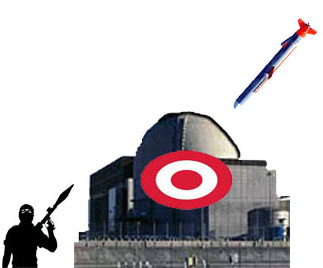
Direct strike could release radioactive material and cause mass terror
By Chas Newkey-Burden, The Week UK, https://theweek.com/world-news/the-threat-to-nuclear-power-plants-around-the-world
The “vulnerability” of the civilian energy infrastructure was exposed this week when a drone strike on the United Arab Emirates cut off power to a nuclear reactor, said Bloomberg.
It’s the first time a fully operating nuclear power plant has had to rely on back-up generators because of a military attack, but reactors in Ukraine and Iran have also been threatened by recent conflicts.
Why would a nuclear site be targeted?
A country might target a nuclear power plant to cripple an enemy’s power grid, or to force a surrender through the psychological terror of threatening a radiological disaster. An attack on such facilities could also be used to delay a nation’s ability to enrich nuclear material.
Alternatively, armies may attack, or occupy, a nuclear plant to seize control of a strategic geographic corridor or to prevent defending forces from using the area.
What does international law say?
Under the Geneva Conventions, civilian structures, including nuclear power plants, “are protected against attack”, but the treaties also state that they can be hit “for such time as they are military objectives”. This is a “loophole” that “aggressor states” have “interpreted widely”, said Dan Sabbagh, The Guardian’s defence and security editor.
Attacking a nuclear power plant also breaks legal resolutions passed by the UN Security Council and the International Atomic Energy Agency’s board of governors.
What would happen if a site were hit?
An attack on a nuclear site would not necessarily lead to a mushroom cloud or an immediate release of radiation because modern plants are built with multiple safety systems that can shut down reactors and contain damage.
But the reactor’s core could continue to heat up after a strike. This could lead to a build up of hydrogen gas, which could cause further explosions and damage. If the reactor began to degrade, radioactive material could be released and that can remain in the environment for years or even decades. It could potentially spread across borders and enter water systems or settle into the soil.
There are other consequences. Attacks on nuclear installations “risk undermining the emerging nuclear renaissance” in Western economies as an alternative to fossil fuels, said Bloomberg. Politicians and the public are “highly sensitive to radiation emergencies”, so an incident in one country “tends to dampen enthusiasm” for nuclear power elsewhere.
An attack on a nuclear plant would also be a hugely symbolic moment. Although conventional power plants have been “repeatedly bombed” by Russia during the Ukraine war, said Sabbagh, Kyiv’s three functioning nuclear plants have “remained relatively unscathed” because Moscow regarded a direct attack on them to be “taboo”.
‘Independent’ Cuban Media Pushing Regime Change

Mint Press News, May 21, 2026, Alan Macleod
Amid escalating U.S. aggression towards the Cuban island through a maximum pressure campaign and the threat of military intervention, the United States government has been covertly funding a huge network of Cuban media outlets that claim to be independent in a push for regime change against the independent socialist government.
These outlets present themselves as unbiased investigative journalism, but are quietly being financed by Washington through USAID, the National Endowment for Democracy and the Open Society Foundation in order to sow discontent across the Caribbean nation, softening it up for a potentially “imminent” invasion by the Trump administration.
Cuba faces some of its worst energy blackouts in its history, thanks to the U.S. blockade, which is attempting to strangle the island into submission. As a Communist state defying U.S. orders, Cuba has, since 1959, been in the crosshairs of Washington, which is attempting to overthrow the government. MintPress sheds light on this shady regime change nexus.
Independent Journalism, Funded by the State Department
CubaNet is one of the most influential and well-established news outlets covering affairs on the Caribbean island. Founded by anti-government activists in 1994, the site has become the go-to source of information for corporate media, which regularly cite it, and present it as an objective and unbiased independent media (e.g., The Washington Post, The Wall Street Journal, Fox News, and The Los Angeles Times). CubaNet reporters have written op-eds in major U.S. newspapers such as USA Today, calling for an immediate change in government on the island.
But CubaNet is not as independent as it seems. The outlet is bankrolled by the U.S. national security state. CubaNet has received millions of dollars in funding from USAID and the National Endowment for Democracy, as well as the Open Society Foundation.
One currently active $500,000 USAID grant, for instance, was awarded to CubaNet to “engage on-island young Cubans through objective and uncensored multimedia journalism.” While ostensibly a laudable goal, even the grant’s own one-sentence description hints that its purpose is to undermine and attack the Cuban government. It states that it will (emphasis added) “increase the free flow of information to and from Cuba in order to offset the regime’s disinformation campaigns.”
Another news organization receiving huge sums of money from Washington is ADN Cuba. Literally meaning “Cuba’s DNA,” the outlet has amassed a significant following online, boasting over 100,000 subscribers on YouTube, over 200,000 on Instagram and over 1.3 million on Facebook. It describes itself as “an independent media outlet committed to freedom and democracy in Cuba.” Yet it is actually based in Spain. And it does not seem particularly committed to transparency about its funding.
What is clear, however, is that ADN Cuba has received millions of dollars from the U.S. national security state. In September 2024, USAID approved a $1.1 million grant to ADN Cuba — a gigantic amount of money for an organization that publishes barely one story per day on its website. This was on top of a $1.5 million allocation for the 2022-2024 period.
Indeed, since 2020, ADN Cuba has received in excess of $3 million from USAID alone. This relationship is not disclosed to readers — even in stories directly covering USAID funding Cuban media — and is relegated to the footnotes of obscure U.S. government funding databases.
Diario de Cuba is another Spanish-based news outlet that publishes a wide variety of stories, all with one thing in common: a deep aversion to the Cuban government. The BBC describes it and CubaNet as key sources for impartial news, run by journalists who “report without censorship and to paint a broader picture on the country’s reality.”
And just like CubaNet, Diario de Cuba has received seven-figure funding from Washington. Between 2016 and 2020, Diario de Cuba received $1.3 million in USAID cash — almost as much as CubaNet over the same period. This generous funding has allowed it to reach a global audience, with over 600,000 followers on Facebook alone.
The Central Intelligence Agency used to directly (and secretly) sponsor hundreds of media outlets across the world. However, after a series of scandals and more information about its nefarious activities came to public attention, Washington decided to outsource many of its most controversial foreign operations to organizations such as the National Endowment for Democracy and the U.S. Agency for International Development.
“It would be terrible for democratic groups around the world to be seen as subsidized by the C.I.A.,” Carl Gershman, the NED’s longtime president [until 2021], said, explaining the 1983 decision to create his organization. NED co-founder Allen Weinstein agreed: “A lot of what we do today was done covertly 25 years ago by the C.I.A.,” he told The Washington Post.
Under the guise of democracy promotion and human rights, the U.S. government channels money to political and social groups across the world in order to maximize its strategic goals, including regime change.
In recent years, the U.S. has used the twin organizations of the NED and USAID to bankroll anti-government protests in Hong Kong, to attempt a color revolution in Belarus, to overthrow the government of Ukraine in 2014 and to organize riots across Iran earlier this year.
In Cuba, the NED and USAID played a critical role in organizing a (failed) uprising against the government in 2021. USAID in particular spent millions of dollars funding, organizing and promoting the San Isidro Movement — a collective of musicians, artists, and journalists– to lead a counter-revolution on the island.
San Isidro members were at the forefront of a wave of nationwide protests that July. The demonstrations were immediately signal boosted by Western corporate media, top celebrities and U.S. politicians, including President Joe Biden. Neitzens were flooded with the astroturfed “SOS Cuba” campaign, that trended across the Internet for days.
In the end, however, the coordinated efforts of the U.S. failed to convince ordinary Cubans to take to the streets, and the movement quickly petered out.
Esteban Rodríguez, a key member of the San Isidro movement, is a producer at ADN Cuba.
Pause US Money, and see ‘Independent’ Media Immediately Collapse
……………………………………………………………………………………………………………………………………………………………………………………………………………………………………………………………. Jobs for the Boys
All this, however, pales in comparison to the resources the U.S. has dedicated to Radio and TV Martí. Founded in 1985 by the Reagan administration, the Miami-based network boasts dozens of full-time employees and receives tens of millions of dollars from Washington annually.
Unlike the rest of the journalism industry, workers at Radio and TV Martí enjoy strong job security and six-figure wages, despite the fact that the Cuban government is able to jam and block many of their broadcasts from reaching Cuba, meaning precious few people consume its content.
Since its creation, Washington has spent at least $800 million on Radio and TV Martí.
The outlets profiled make up only a small portion of the network of anti-government media being funded by the United States. Most of the recipients of American money remain anonymous — a decision taken in part to hide their identities and preserve their credibility inside Cuba.
The National Endowment for Democracy considers Cuba a “long-standing priority,” and is currently officially funding 32 separate projects on the island.
Media related grants include one $80,000 project titled “Strengthening Access to Information,”…………………………………………………………………………………………………………………………….
Anti-government media are only a small portion of the huge array of groups Washington secretly funds and supports. From musicians and academics, to civil society, educational and religious groups, to think tanks, charities and NGOs, there exists a vast nexus of organizations receiving vast sums of money from the U.S. government.
Two of these bodies include The Observatorio Cubano de Derechos Humanos (Cuban Observatory of Human Rights, or OCDH) and lawyers’ group, Cubalex.
Both groups produce reports denouncing the Cuban government and are regularly cited as impartial authorities on human rights on the island in Western outlets, such as The New York Times, CNN and The Washington Post. But what readers are not told is that both organizations are bankrolled by the U.S. national security state. ……………………………………………………………………………………………………………………………………..
Digital Bombardment
In 2010, a new social media and messaging app, Zunzuneo, took Cuba by storm. From nowhere, it went viral, picking up tens of thousands of users — a very large number for the time on such an internet-sparse island.
None of its users, however, were aware that the platform had been secretly created by USAID in order to promote regime change. Their plan was to first provide an excellent service that would capture the market, then to slowly drip feed Cubans anti-government messaging, and finally to direct them to join “smart mobs” aimed at triggering a color revolution……………………………………………………………………………………………………………………………………………………….
Unending War on Cuba
In October, for the 33rd consecutive year, the United Nations voted overwhelmingly (165-7) to call for an end to the American blockade against Cuba. This economic war was established by the Eisenhower administration in response to the Cuban Revolution of 1959, which overthrew the U.S.-backed dictator, Fulgencio Batista.
These illegal unilateral coercive measures, which an internal U.S. government memo states are designed to “decrease monetary and real wages, to bring about hunger, desperation and overthrow of government,” cost Cuba billions every year, and severely impede its development.
The U.S. attempted to invade Cuba in 1961, and brought the world to the brink of annihilation during the subsequent Cuban missile crisis. It reportedly attempted to kill its leader Fidel Castro hundreds of times and carried out waves of terror attacks against the country, including using biological weapons on the island.
Successive administrations continued the economic war against Cuba, which was ramped up after the fall of the Soviet Union. But the Trump State Department, run by Cuban-American Marco Rubio, has taken it to a new level, declaring the island to be one of its top priorities.
Trump himself has declared that Cuba is “next” on the list of countries being targeted for regime change. “We may stop by Cuba after we’re finished” with Iran he said last month.
It is in this context that the U.S. government’s funding of a vast array of media outlets targeting Cuba should be seen; the media attack is just one facet of Washington’s multipronged approach to regime change.
Many of the organizations profiled here publish in English, and nearly all are used as supposedly credible sources of information on Cuba for Western corporate media, meaning that U.S. State Department narratives are laundered into the American public consciousness through this network.
Many Cubans and Americans are completely unaware that their news about the island comes largely through a matrix of shady outlets quietly funded by the U.S. national security state via the NED and USAID. Their purpose is to keep up the flow of negative stories in order to soften the public up into accepting regime change on the island. After all, in war, truth is always the first casualty. https://www.mintpressnews.com/revealed-usaid-ned-open-society-quietly-bankroll-cubas-independent-media-in-push-for-regime-change/290942/
Newly Released Tritium Review Analyzes LANL Tritium Reports, Highlights Infant Doses
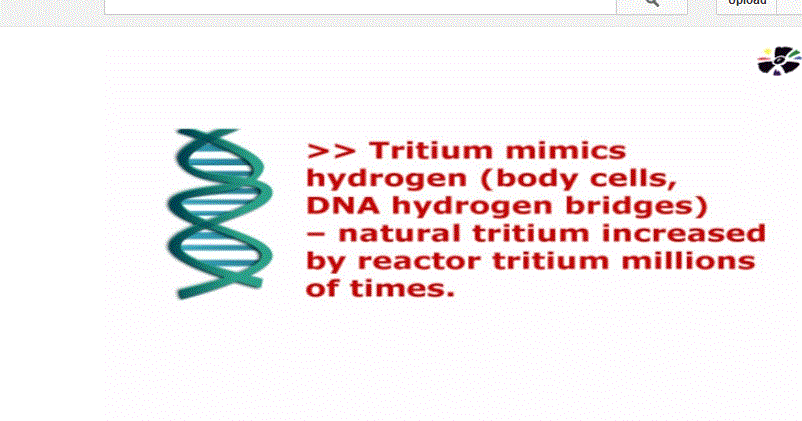
A newly released independent review of Los Alamos National Laboratory’s 2025 tritium venting raises serious concerns about radiation risks to children and infants and highlights major gaps in LANL’s public reporting and decision-making process.
The review also questions LANL’s decision to proceed with venting despite no measurable pressure buildup in the waste containers — meaning the explosion risk used to justify the releases may not have existed. https://www.ccwnewmexico.org/tritium
On May 14th, 2026, the Communities for Clean Water published the review analyzing two reports LANL released following its controversial September 2025 tritium release operations.
Authored by Dr. Arjun Makhijani, President of the Institute for Energy and Environmental Research (https://ieer.org/), the “Review of Los Alamos National Laboratory’s tritium venting reports – Volume 1 and Volume 2” provides a summary of the tritium venting as well as the data and estimates detailed in the two LANL reports.
1. FTWC Radioactive Air Emissions Summary, Volume 1: Stack Emissions & Off-Site Dose Consequence, LA-UR: 25-31093, November 14, 2025; and
2. FTWC Radioactive Air Emissions Summary, Volume 2: Environmental Sampling & Expanded Plume Modeling, LA-UR: 26-20967, February 17, 2026.
Notably, LANL formally acknowledged for the first time that estimated radiation doses to infants were more than three times higher than doses to adults — a change that came only after sustained public pressure and community participation in public meetings and hearings. Nevertheless, infant doses were not considered during the planning and modeling that took place prior to the tritium releases. LANL stated that infant doses would not be taken into account moving forward.
“Don’t Be Bothered by Their Screams”: Ben-Gvir Proudly Posts Video of Police Dragging Members of the Flotilla Team
Joshua Scheer, May 21, 2026 , https://scheerpost.com/2026/05/21/itamar-ben-gvir-turns-torture-into-a-public-spectacle-dont-be-bothered-by-their-screams/
Ben-Gvir himself reportedly captioned the footage, “That’s how we welcome terror supporters. Welcome to Israel,” while another clip showed him taunting handcuffed detainees. The outrage became so intense that even Israeli Prime Minister Benjamin Netanyahu publicly distanced himself from the spectacle, calling the conduct “not in line with Israel’s values and norms.”
There is something here that feels ripped straight from the darkest chapters of our fascist past — not hidden away in secret archives decades later, but broadcast openly, proudly, in real time. Israeli National Security Minister Itamar Ben-Gvir shared footage of police violently dragging members of the flotilla team while mocking their suffering with the chilling phrase: “Don’t be bothered by their screams.”
And if this is what they are willing to show the public — if this is the sanitized version uploaded for propaganda and applause — then imagine the unspeakable torture, humiliation, and violence taking place in the shadows, far from cameras and headlines. History indeed has a way of repeating itself, especially when cruelty becomes spectacle and those in power begin celebrating the pain of the powerless.
Ben-Gvir himself has repeatedly demanded harsher measures, more repression, more brutality, always insisting there is not enough force, not enough punishment, not enough fear inflicted on Palestinians and dissenters alike. The language is no longer even disguised. It echoes the rhetoric of authoritarian regimes that taught generations what happens when a society stops seeing human beings as human.
What makes this moment especially horrifying is not merely the violence itself, but the pride. The celebration. The transformation of state cruelty into political theater for a cheering audience. Fascism does not arrive all at once. It grows through normalization — through laughter at suffering, through public spectacles of domination, through officials who learn there is political capital in dehumanization.
And history has shown us, again and again, where that road leads.
A diplomatic firestorm has erupted and what began as another act of humiliation proudly broadcast by Itamar Ben-Gvir quickly spiraled into a rare global diplomatic backlash, with governments across Europe, North America, and beyond publicly condemning Israel’s treatment of Gaza flotilla activists. Britain’s Yvette Cooper said she was “truly appalled,” while Italy’s Giorgia Meloni called the footage “inadmissible.”
Spain announced plans to ban Ben-Gvir from entering the country and push for wider European sanctions. France, Canada, Australia, Belgium, the Netherlands, Poland, Ireland, Denmark, Sweden, Luxembourg, Cyprus, Qatar, Turkey, South Korea, and top European Union officials all denounced the scenes as degrading, humiliating, illegal, or incompatible with democratic values. Several countries summoned Israeli ambassadors demanding explanations or apologies after footage showed activists zip-tied, dragged, and forced to kneel while Ben-Gvir mocked them online. Even figures inside Israel and allied diplomats distanced themselves from the spectacle, exposing just how politically toxic the images became on the world stage. But for many observers, the outrage also raised a darker question: if world leaders are only now reacting because Western citizens were humiliated on camera, what horrors have Palestinians endured for years outside the spotlight?
With Al Jazeera reporting that many analysts are now calling the collapse of the “Hasbara” which “for decades, Israel has relied on “Hasbara” – a Hebrew term translating to “explanation” – a propaganda campaign to justify its policies and military actions against Palestinians to the international community”
The fracturing of this illusion helps explain the frantic damage control coming from Israeli officials after the flotilla footage went global.
Critics argue the outrage inside the Israeli government was never truly about the abuse itself, but about the devastating public relations fallout after images of activists being zip-tied, dragged, and forced to kneel spread across the world.
The strategy has long depended on controlling the narrative and framing Israel as acting out of necessity while dismissing criticism as misunderstanding or bias.
But according to Palestinian policy analyst Fathi Nimer, the sheer brazenness of Ben-Gvir’s video shattered that carefully managed image in real time. As Israel pours hundreds of millions into global messaging campaigns amid growing international isolation over Gaza, the footage instead exposed to millions what critics say Palestinians have experienced for years behind prison walls, checkpoints, and military occupation — only this time the humiliation was proudly broadcast by the officials themselves.
One can only hope that this shatters the illusion forever. That no amount of polished public relations campaigns, carefully managed talking points, or billion-dollar propaganda operations can put this genie back in the bottle. Because the world did not witness a “misunderstanding” or an isolated incident — it witnessed state humiliation proudly performed for applause. It witnessed officials mocking bound detainees while the machinery of occupation operated in plain sight. And for millions watching across the globe, the question is no longer whether these abuses happen, but how long they have been happening beyond the reach of cameras.
Perhaps the most damning part of all this is that the mask did not slip accidentally — it was ripped off willingly by those who no longer feel the need to hide their contempt. History teaches that systems built on dehumanization eventually reveal themselves completely. The only question is whether the world finally chooses to see what Palestinians have been trying to show it for generations.
Antidotes to the media-nuclear-military-corporate-complex news this week

Some bits of good news – 27 years after their existence was confirmed, Brazil has begun demarcating land for one of the Amazon’s most vulnerable uncontacted peoples.
A community saved an English river. ‘David Attenborough Effect’: Meet the wildlife artists inspired by the legendary broadcaster
Significant story of the week – Media Myopia As We Hurtle Towards Climate Oblivion.
TOP STORIES.
Nobody Sincerely Believes Cuba Threatens The United States.
A national analysis of the impact of proximity to nuclear power plants on lung, breast and colon cancer mortalities in the U.S., 2000–2020.
The American epoch of oil is collapsing. What comes next could be ugly.
The Nuclear Lie at the Center of U.S. Foreign Policy
The Aging Empire versus Slowing Empire: Trump-Xi Meeting.
128 years of US exploitation, degradation of Cuba continues on steroids – Walt Zlotow.
Labour accused of making nuclear sector ‘more dangerous’ after capture by ‘vested interests’.
Death will kill with its poisonous wings
Climate. Media Myopia As We Hurtle Towards Climate Oblivion. Heatwaves in high 40 degrees Celsius are ‘new normal’ for India and Pakistan, scientists warn.
Noel’s notes. Will there be global war over Taiwan? – Sociology matters. Why does Substack, like everyone else, want me to put an App on my phone?
AUSTRALIA.
Israel Kidnapped Gaza Flotilla Activists, A Father Demands Answers | The West Report.
Israel Is Running Australia and No One Is Talking About It.
NUCLEAR-RELATED ITEMS
ARTS and CULTURE. The West’s Descent Toward Totalitarianism.
ECONOMICS. Spending watchdog warns £38bn cost of Sizewell C nuclear plant is ‘risky’ Power from Sizewell C will be more expensive than Hinkley Point, says UK watchdog
5 Stocks That Benefit From the Government’s $94 Million Spending Spree on Nuclear Reactors – ALSO AT https://nuclear-news.net/2026/05/21/1-b1-5-stocks-that-benefit-from-the-governments-94-million-spending-spree-on-nuclear-reactors/
Questions grow in Belgium over plan to nationalize Engie nuclear plants..
EDUCATION. Trump Describes Executions to Kids, While MAGA Bans Lessons Causing “Discomfort” .
| ENVIRONMENT.The President of Peace Makes War on the Planet. |
| ETHICS and RELIGION The Messiah Has Landed – Not. Never again – Worst antisemitism comes from Zionists, says Australian Jew. |
| EVENTS. 1 June Webinar – The High Cost of Nuclear Power – Registe |
| HEALTH. Does Proximity to Nuclear Power Plants Increase Cancer Risk? |
| HISTORY. Cuba Has a Rich History of International Solidarity – US Wants to Extinguish It. https://www.youtube.com/watch?v=HSkOxYkBsB4 |
| HUMAN RIGHTS. “Don’t Be Bothered by Their Screams”: Ben-Gvir Proudly Posts Video of Police Dragging Members of the Flotilla Team. Julian Assange Free Speech and Democracy. https://www.youtube.com/watch?v=GQwe73OcXMo |
| LEGAL. ICC Targets Finance Minister Bezalel Smotrich For War Crimes— He Responds by Promising More War Crimes. International Criminal Court (ICC) Issues Arrest Warrants For Five Additional Senior Israeli Officials. Did Trump Just Create a Political Slush Fund With Taxpayer Money? Mirrors of Greed: Elon Musk, OpenAI and the Tech Brat Battle. |
| MEDIA. ‘Independent’ Cuban Media Pushing Regime Change. ‘Buffer Zone’ Is Media’s Euphemism for Israeli Occupation. Republicans should be worrying about millions of fools voting for treason and criminal war destroying the economy – Walt Zlotow. |
| OPPOSITION to NUCLEAR . Kenyan communities protest planned nuclear plant near Lake Victoria. |
| PERSONAL STORIES. “Without Weapons, We Can Do Anything”: Remembering Razan al-Najjar. The children who learn war before they learn the world. The Spoiled Prince of Kiev: Zelensky has deceived and ruined his country with Western help. |
| POLITICS. American Democracy Does Not Exist. Trump is the joke….. that is no longer funny. As support for Israel declines in the U.S., the ‘Special Relationship 2.0’ is starting to take shape. Pete Hegseth “War Crimes Secretary” Called Out. On Iran war he opposed then supported, Secretary of State Rubio channeled wrong predecessor– Walt Zlotow. |
| POLITICS INTERNATIONAL and DIPLOMACY. Conference at UN to review nuclear nonproliferation treaty fails to reach agreement After Offering ‘No Tangible Concessions’ in Iran Peace Talks, Trump Issues Latest Violent Threat. Trump‑Xi summit: Cautious Progress On Trade, Ties And Some ‘Win‑Wins’. Trump overseeing decline of US world dominance…and that’s good. US President Donald Trump, Chinese President Xi Jinping end unipolar age in Beijing. Latvia prime minister resigns over “straying” Ukraine drones. |
| RADIATION. Very low doses of ionising radiation statistically still give children increased cancer risk. Newly Released Tritium Review Analyzes LANL Tritium Reports, Highlights Infant Doses. CHANGES TO RADIATION PROTECTION STANDARDS – FOR WORSE OR FOR BETTER ? |
| SAFETY. The military threat to nuclear power plants around the world. Grossi warns at Security Council against attacks on nuclear plants. Danger at Europe’s largest nuclear plant ‘near point of no return’ after deadly attack. Reactor to be halted after radioactive steam detected in northeastern Japan nuclear plant. UK Nuclear Regulatory Review. Incident – Drone Strikes Nuclear Power Plant in UAE — This Could Get Bad. First attack on Arab nuclear site sends warning to Gulf, US. T he police force protecting our nuclear sites keeps losing classified stuff. |
| SECRETS and LIES. Declassified: UK Knew NATO Expansion ‘Would Provoke’ Russia War. |
| SPACE. EXPLORATION, WEAPONS. With launches slated to grow a hundredfold, Space Force seeks more sites, money, people, and AI. |
| SPINBUSTER. Another study shows the stupidity of Scottish nuclear. |
| TECHNOLOGY. Why Small Modular Nuclear Reactors Are a Dead End. |
| WASTES. Geological Disposal Facility (GDF) is crucial to ‘nuclear renaissance’ Government told. Scotland the Dump. Survey begins to determine remote island’s suitability for nuclear disposal site. |
WAR and CONFLICT. World War Trump (everywhere, Somalia too)
- Fading western imperial war$ on Iran, Palestine, Lebanon, Cuba & more.
- Pentagon quietly shut legally required program to prevent civilian deaths by military, watchdog finds.
- From Asia to the Middle East, US Bombs Are a Failed Foreign Policy Choice.
- Strike near UAE reactor revives concerns over nuclear plant safety in wartime.
- UAE blames Iran or proxies for strike near nuclear plant, as Trump tells Tehran ‘clock is ticking’. The United Arab Emirates said a drone strike caused a fire at the perimeter of its Barakah nuclear power plant.
- Epic Interruptus: The Iranian Snare and American Defeat.
- How Russia signals nuclear resolve with civilian nuclear energy infrastructure.
WEAPONS and WEAPONS SALES.
White Elephant in Space: The Extortionate Expense of Golden Dome. Golden Dome or Golden Scam?
Russian nuclear weapons, 2026.
‘He asked if I would defend them’: Trump shares key details of Xi meeting.
Biden left Trump a poison pill that sabotaged his criminal Iran war,
Why Small Modular Nuclear Reactors Are a Dead End

The big question is, can SMRs deliver on their promises to overcome the historic drawbacks of conventional nuclear power? The answer is no.
Richard Heinberg, May 19, 2026, Common Dreams, https://www.commondreams.org/opinion/smrs-dead-end
The nuclear power industry is currently promoting designs for small modular reactors, or SMRs, that will supposedly be cheaper, safer, and faster to build than older nuclear power plants. Bill Gates and Amazon are investing in the technology. Moreover, some environmentalists, including Mark Lynas and Bill McKibben, support SMRs in the hope that they can lower carbon emissions. And, according to polls, far more Americans now approve of the development of nuclear energy than was the case just a decade or two ago.
This year, the world has been plunged into a global energy crisis: With the closure of the Strait of Hormuz, nearly a fifth of world oil shipments have been held up, with economic impacts likely to reverberate for months or years. World leaders are suddenly desperate for energy alternatives, and are turning to solar, coal, and nuclear. At the same time, electricity demand for data centers is exploding, and builders of those centers hope to use SMRs to power artificial intelligence (AI).
In short, it looks like a great moment for the nuclear industry.
Yet Indigenous peoples, technology critics, and old-school environmentalists still oppose nukes—even in new, highly touted forms. I agree with their critiques. In this article, we’ll look at the current nuclear revival and see why it may end up being a zombie attack.
Nuclear Renaissance?
Before looking at SMRs specifically, it’s helpful to understand the status of the nuclear industry in more general terms. The industry’s potential resurgence comes after three decades in the doldrums following the Chernobyl catastrophe in 1986. Today, roughly 440 nuclear power plants, spread across 30 countries and with a combined net capacity of around 400 gigawatts (GW), provide about 10% of the world’s electricity.
If you think, as I do, that the global polycrisis is an inevitable outgrowth of industrialism and its consequences (resource depletion, pollution, and overpopulation), then you’re likely to view SMRs as a pointless and dangerous waste of resources.
The US, which has the largest number of plants of any country (96), is seeing a slow phaseout of old reactors (average age 44 years), but has commissioned three new ones during the last decade. China is now operating 60 reactors, with up to 40 others under construction. India is likewise hoping to grow its nuclear industry rapidly and is experimenting with fast breeder reactors. Globally, the International Energy Agency forecasts total nuclear power capacity to grow to over 700 GW by 2050, and small modular reactors are expected to make up a significant share of this growth. A year ago, the Trump administration unveiled an ambitious nuclear strategy that includes a goal to quadruple the United States’ nuclear capacity by 2050, with SMRs playing a key role.
The principal drivers of renewed interest in nuclear power are climate change (globally), the Trump administration (in the US), tech companies’ voracious demand for electricity, and Asian nations’ hunger for more industrial power. Most nations want to limit their carbon emissions, and the main low-carbon alternatives to fossil fuels are solar, wind, hydro, and nuclear. Solar and wind are intermittent (“variable”) sources, requiring energy storage to align electricity supply with demand. Hydro has limited potential for growth. That leaves nuclear power, which has the advantage of being reliable and steady, and has possibilities for expansion.
If it’s helpful to understand why the industry is growing again, it’s just as important to know the reasons for its long period of dormancy:
Cost: Nuclear power plants are complex and expensive, employing technology that’s internationally regulated due to concerns about proliferation of nuclear weapons. Despite over 80 years of the industry’s development, nuclear plants still take a long time to build and are often plagued with cost overruns.- Fuel: Uranium, the fuel for nearly all existing nuclear power plants, is a depleting nonrenewable resource, and supplies are running short. Uranium mining is a dirty, expensive process, and mine closures, mostly due to resource depletion, are expected to lead to fuel shortfalls by 2035. While geologists have identified more uranium resources, opening new mines will entail further environmental destruction and harm to human communities, of which the uranium mining industry already has a grim history.
- Waste: Despite decades of research, the global nuclear industry still has found no good place to put the 300,000 tons of nuclear waste—as well as 480,000 tons of depleted uranium in the US alone—that it has produced in the last 80+ years.
- Safety: While nuclear accidents are relatively rare, they can be devastating and expensive when they occur. The Fukushima disaster of 2011 resulted in direct cleanup costs of up to $180 billion as of 2016, but the damage still has not been completely contained, and indirect costs to human health have been estimated at half a trillion dollars. Further, nuclear power technology is still tied to the threat of nuclear weapons proliferation.
- Water Issues: Nearly all nuclear power plants use water as a coolant and are highly vulnerable to droughts and floods. Droughts reduce the availability of water for cooling, while floods (nuclear plants are generally built next to rivers, lakes, and other bodies of water) damage safety infrastructure and risk contaminating water sources.
If the nuclear industry can overcome its historic obstacles, a door is open. According to the industry, small modular reactors are the main way forward.
SMRs: Promise or Hype?
The main arguments for SMRs are that they would be cheaper and faster to build than conventional power plants; that they would be safer; and, being smaller, that they could be installed to power remote towns or data centers. The idea is to build components in a centralized factory and then assemble those components at power generation sites.
“Small” is defined as 300 megawatts of electrical power or less. While most existing nuclear plants are in the one-gigawatt (1,000 MW) range, some proposed SMRs are 20 megawatts or less; these are called “micro” reactors.
For the most part, SMRs are still at the design stage. China has one SMR under construction. In the United States, TerraPower, founded by Microsoft’s Bill Gates, has received a permit to build a 345-megawatt (not exactly “small,” but close) sodium-cooled reactor in Kemmerer, Wyoming.
Clearly it is possible to get funding and approval for these new-generation power plants. The big question is, can SMRs deliver on their promises to overcome the historic drawbacks of conventional nuclear power?
- Cost: SMRs will only be cheaper to build if large numbers are ordered; the first prototypes may be even more costly than conventional plants. Meanwhile, construction costs per MW of capacity will likely be higher, and operating costs are largely unknown until real-world data can be collected. The cost of electricity from SMRs is therefore also yet-to-be-determined, but preliminary estimates put it much higher than solar or wind.
- Fuel: Most proposed SMRs use uranium, but some designs on the drawing boards would use depleted uranium or thorium as fuels (see below). For now, however, the uranium fuel constraint looming over the nuclear industry remains in place. SMRs also won’t use their fuel more efficiently than conventional reactors, despite some claims to the contrary.
- Uranium From Seawater: The supply limits of uranium could be greatly expanded by harvesting it from seawater, where the potential resource is enormous—albeit at a concentration of about 3.3 parts per billion. The total oceanic uranium resource is estimated at 4.5 billion tons, over 500 times all identified land-based uranium resources. However, extracting the uranium will take a lot of energy: The best existing technology using absorbent materials will offer an energy return on energy invested (ERoEI) of about 4:1, which is lower than the ERoEI for solar, wind, hydro, fossil fuels, or conventional uranium mining.
- Waste: Some proposed SMR designs would be breeder reactors that could get rid of depleted uranium or even nuclear waste by using them as fuels—but this technology has faced significant challenges (see below). Otherwise, SMRs will do nothing to solve, and may actually worsen, the nuclear waste dilemma.
- Safety: SMRs are designed to be safer than conventional nuclear plants, using passive, gravity-driven cooling systems that don’t require electricity or human intervention to shut down. However, their overall safety is controversial. There is still no real-world data to support the industry’s promises. And having lots of smaller nuclear plants dotted across the landscape could make it easier for nuclear materials to end up in the hands of bad actors. The resilience of SMRs in the face of more frequent and more severe natural disasters is also controversial; a 2021 study concluded that storms, droughts, and higher ambient temperatures linked to climate change are likely to pose operational risks to all nuclear power plants.
The biggest remaining advantages of SMRs are the speed with which they could bedeployed once the manufacturing infrastructure is in place, and the prospect of providing non-grid-tied dedicated power sources for data centers.
What About Further Technological Advances?
When confronted with the limits of one technology, nuclear advocates often shift the conversation to another. However, close examination usually shows that each technological “solution” has its own problems:
Fast-Breeder Reactors: If nuclear fuel is scarce, why not develop fast breeders, which produce more nuclear fuel than they consume? Currently, Russia operates two fast breeders and India’s first one reached criticality in late April. China has a fast-breeder reactor for research. The US, France, and Japan operated breeders in the past but have shut down research along these lines due to high capital and operational costs, safety risks related to sodium coolant, and nuclear proliferation concerns.
- Alternative Cooling Systems: Water-cooled reactors (a category that includes nearly all existing commercial nuclear plants) pose risks of loss-of-coolant accidents due to pipe breaks, high-pressure operation failures, age-related component deterioration, and earthquakes or other natural disasters. The industry’s solution: Use sodium or helium as a coolant. Unfortunately, sodium is highly chemically reactive and ignites upon contact with air and reacts explosively with water, while helium is a depleting non-renewable resource that is becoming economically scarce at a rapid rate.
- Thorium Reactors: If uranium is scarce and might lead to weapons proliferation, why not use more abundant thorium? China already has an experimental two-megawatt thorium reactor in the Gobi Desert. However, thorium reactors have steep development costs and produce a highly radioactive byproduct, uranium-232, which decays into isotopes that emit penetrating gamma rays, making fuel handling and maintenance more hazardous and costly. Also, thorium reactors require a “driver” fuel: Thorium-232 is fertile, not fissile, meaning it needs a different radioactive fuel (like uranium or plutonium) to initiate the chain reaction. Therefore, proliferation concerns remain.
Currently, there is little real-world data regarding these “new” nuclear technologies, even though all have been discussed or experimented with for decades. The nuclear industry hasn’t actually solved its many dilemmas, and the current nuclear renaissance isn’t being driven by novel solutions so much as by the rapid worsening of society’s energy-related problems, primarily climate change: World leaders are now so desperate for reliable low-carbon energy sources that they are willing to overlook substantial risks, if only the nuclear industry will put a shiny gloss on its latest iteration of products. And leaders of the tech industry, keenly aware of the soaring electricity demand from AI, are even more desperate for ways to power the exponential growth of their companies without risking a backlash from the rest of society, which may suffer from higher electricity prices or shortages.
If Not SMRs, Then What?
Nuclear power is a product of high-tech modern industrialism. The proponents of nuclear power assume—and nuclear reactors rely on—global supply chains, uninterrupted grid power, reliable water resources, and functioning political systems. The future that’s unfolding around us is a polycrisis in which supply chains, grid power, water, weather, and politics-as-usual are all threatened. In these unfolding circumstances, the only solutions that make sense are ones that are small-scale, local, low-risk, and nature based.
What to do about carbon emissions? Yes, we need to replace fossil fuels with low-carbon energy sources—but these should be as low-tech as possible, and we should aim to reduce overall energy usage.
What to do about AI data centers? That’s easy: Don’t build them. We are rushing headlong into an AI-managed future without an adequate understanding of what AI is, does, or is likely to do in the future. Besides, AI appears to be perhaps the biggest investment bubble in history.
Most political and economic leaders have taken the attitude that we must go to any possible lengths to save industrial modernity. But industrial modernity is the essence of our problem: It is a crisis-generating machine—and one that, prior to its inevitable self-destruction, is creating enormous wealth for a small minority of people, while entrapping everyone else in dreary systems of employment, payment, debt, dependency, and distraction that leave little time for reflection on the futility of it all.
Moreover, SMRs will do nothing to solve our immediate global energy crisis. The oil shortages that are already sweeping over the world in the wake of the US-Iran war cannot, in most cases, be offset with electricity—at least not right away. While electrification is a good interim energy strategy for gradually winding down modernity with minimal casualties, it’s one that will take time, and some things will be hard or impossible to meaningfully electrify—including heavy manufacturing and air travel. Meanwhile, the world needs gasoline, diesel, and jet fuel now; SMRs will take decades to deploy.
The opinion you hold about SMRs will have a lot to do with your general attitude toward technology. If you think humanity’s fate and future rest with high tech (including AI and advanced rockets to enable colonization of other planets), then you’re almost guaranteed to believe that SMRs will help us get there. But if you think, as I do, that the global polycrisis is an inevitable outgrowth of industrialism and its consequences (resource depletion, pollution, and overpopulation), then you’re likely to view SMRs as a pointless and dangerous waste of resources.
Once we see why industrial modernity is unsustainable, the most important question becomes: What is a viable exit strategy? On our way out the door of modernity and back toward simplicity, we need to minimize the creation of new problems and relearn nature’s elegant solutions. When our priorities are thus reoriented, nuclear power makes no sense.
Nobody Sincerely Believes Cuba Threatens The United States
Caitlin Johnstone, May 22, 2026, https://www.caitlinjohnst.one/p/nobody-sincerely-believes-cuba-threatens?utm_source=post-email-title&publication_id=82124&post_id=198793245&utm_campaign=email-post-title&isFreemail=true&r=1ise1&triedRedirect=true&utm_medium=email
In a sign that the US is preparing for yet another evil war, Marco Rubio is now claiming that Cuba poses a “national security threat” to the United States, saying the likelihood of a peaceful agreement is “not high”.
“Cuba not only has weapons that they’ve acquired from Russia and China over the years, but they also host Russian and Chinese intelligence presence in their country — not far from where we’re standing right now,” Rubio told the press on Thursday. “So Cuba has always posed a national security threat to the United States. They, by the way, have been one of the leading sponsors of terrorism in the entire region.”
Rubio’s comments come as a US intelligence report laundered through Axios claims that Cuba may be preparing to launch a drone strike against US military forces. Havana said the Axios report misrepresents Cuba’s defensive measures as a preparation to attack, accusing the US of “fabricating pretexts, creating and spreading falsehoods, and distorting as extraordinary the logical preparation required to face a potential aggression.”
The US has also unsealed an indictment for Raul Castro, the 94 year-old brother of Fidel Castro, in a move that resembles the playbook used for the kidnapping of Venezuela’s President Nicolas Maduro.
The excuses for military action are already being rolled out. This happens as US war machinery relocates to the Caribbean, and as Cuba flounders under a crushing US oil blockade that is already inflicting a severe humanitarian toll.
And everyone knows it’s all based on lies. You know it. I know it. Marco Rubio knows it. The war propagandists know it. The gusanos brigading social media begging for war know it. We all know it’s a sham.
Not one person sincerely believes Cuba poses a threat to the United States.
No one sincerely believes Cuba just coincidentally became an urgent menace to US national security all of a sudden right when the US began scrambling to consolidate geostrategic control in the middle east and the western hemisphere.
Nobody actually thinks that a tiny, impoverished island nation is preparing to launch a war of aggression against the United States.
This is a performance put on by warmongers and bootlickers. It insults our intelligence and robs us of dignity.
If things cool down with Iran, then it’s a safe bet they’re going in for the kill shot on Cuba. The US empire never makes peace, it just moves the crosshairs of its war machinery from nation to nation.
We see this over and over again.
Yay! The troops are leaving Afghanistan — oh, now they’re waging a proxy war in Ukraine.
Excellent, they’re deescalating against Yemen — whoa, now they’re kidnapping the president of Venezuela.
Oh hey, it looks like the mass slaughter in Gaza has slowed down — oh, now they’re going to war with Iran.
Look, they’re pulling thousands of troops out of Germany — oh, it’s so they can move them to Poland.
Hey these Iran negotiations are finally getting somewhere — ah man, now they’re invading Cuba.
Over and over and over and over again. As soon as the human butchery slows down in one place, it picks up somewhere else.
The US empire exists in a constant state of war. War is the glue that holds the empire together. If the wars stop, the empire stops.
That’s why the denizens of the empire are never allowed to vote for an end to wars. You can vote for candidates who will end abortions or trans rights or corporate regulations, but you can’t vote for a candidate who will actually end the wars. Peace is never on the ballot, because war is too critical for the functioning of the empire.
Which is why it’s so important for us all to stand against the war machine. If we can end the wars, we can end the empire. Not until then will we have a shot at building a healthy world.
Cuba Has a Rich History of International Solidarity. US Wants to Extinguish It.
While tightening sanctions, the U.S, State Department has boosted funding for regime change programs.
A darling of the Cuban American right, Secretary of State Marco Rubio is leading the latest drive to destabilize the island.
Ultimately, the blockade isolates Cuba precisely because its revolutionary idealism mocks U.S. imperial ambitions. The sanctions are the culmination of seven decades of coercion and obscene hypocrisy. An empire that spreads war is strangling a country that exports doctors. Indeed, a rich government that claims vaccines are dangerous is persecuting a poor society that not only invents vaccines, but shares them with the world. And while celebrating genocide and deportations, U.S. leaders throttle a nation for its defiant tradition of solidarity: Its refusal to tolerate the suffering of the exploited. Decades after the Cold War, Cuba remains an obsessive target of a U.S.-backed counterrevolution, as well as the storm-lashed epicenter of the struggle against U.S. imperialism
Trump’s economic powerplay and preparations for a potential invasion are only the latest moves in an ongoing saga of aggression toward Cuba
Washington has long deployed economic pressure to challenge Cuba’s fiercely independent social and foreign policies
By Jonathan Ng , Truthout, May 20, 2026 https://truthout.org/articles/cuba-has-a-rich-history-of-international-solidarity-us-wants-to-extinguish-it/?utm_source=Truthout&utm_campaign=073831ce6e-EMAIL_CAMPAIGN_2026_05_20_08_57&utm_medium=email&utm_term=0_bbb541a1db-073831ce6e-650192793
At night, the U.S. Naval Base in Guantánamo, Cuba appears like a tangled string of Christmas lights along the coastline, casting colored silhouettes across the waves that lap ashore. Sailors and Marines pack the local sports bar blaring pop music. Others frequent the bowling alley or play video games under intense strobe lights. Yet in contrast to the brightly illuminated base, nighttime blots out the nearby town of Caimanera, as a result of the energy blockade on Cuba that President Donald Trump tightened this January.
Trump claims that the embargo is necessary to promote a democratic transition in Cuba. Similarly, U.S.-backed opposition leaders in Miami such as Rosa María Payá argue that “the Cuban people [are] grateful” for the sanctions, which will help “make Cuba great again.”
But the truth is far more bitter. Trump’s sanctions are accelerating a social crisis that has immobilized Cuban industry, gutted public services, and forced over 10 percent of the population to leave the island in recent years. Hospitals lack electricity, and grocery store shelves are empty amid rolling blackouts. Ratcheting up pressure, U.S. authorities issued a new raft of sanctions against senior Cuban officials this May, while conducting military reconnaissance flights off the coastline.
Trump’s economic powerplay and preparations for a potential invasion are only the latest moves in an ongoing saga of aggression toward Cuba. Rather than prioritizing democracy, Washington has long deployed economic pressure to challenge the island’s fiercely independent social and foreign policies — above all, its commitment to wealth redistribution, solidarity with liberation struggles, and opposition to U.S. imperial hubris.
Forming the Noose
Washington’s professed support for democracy in Cuba rings hollow when placed against the historical backdrop. In the 1950s, U.S. officials assisted the island’s dictator Fulgencio Batista, as he attempted to extinguish a popular revolution spearheaded by Fidel Castro. His regime tortured over 700 dissidents to death, dangling mutilated bodies from telegraph poles and tossing them into gutters. While training Batista’s forces, the CIA confided that they were “too enthusiastic” about torture. Nonetheless, Washington organized “to prevent a Castro victory,” fearing that his leftist agenda would undermine its vice-like grip over Cuban politics and commerce.
After taking power in January 1959, revolutionary leaders nationalized strategic industries, outlawed formal racial segregation, and pursued a breathtaking array of anti-poverty reforms. In response, the State Department promoted “economic warfare” by plotting to reduce access to oil and the U.S. sugar market. Officials emphasized that they should “disguise these actions” as peaceful. But their objective was clear: “to bring about hunger, desperation and overthrow of [the Castro] government.”
In 1961, President John F. Kennedy escalated pressure by bankrolling terrorist operations and a failed invasion at the Bay of Pigs. He also armed counterrevolutionaries that targeted the revolution’s literacy campaign, butchering teachers for teaching peasants to read.
To defend Cuba, Castro stationed Soviet missiles on the island. At the brink of nuclear war, Kennedy vehemently opposed a “no-invasion guarantee” in negotiations with Soviet leaders, while refusing to even talk to Cuban officials. Privately, he was blunt: “our objective is to preserve our right to invade” in an emergency. After the Soviets withdrew the missiles, U.S. officials insisted that their “ultimate objective” remained “the overthrow of… Castro,” sponsoring attacks against industrial sites and “tighten[ing] the noose around the Cuban economy.”
Yet their most cynical ploy targeted Cuba’s youth. As relations deteriorated, the U.S. government organized Operation Peter Pan, which sowed chaos and fractured families by convincing Cubans to ship their children to the United States. To spark a mass exodus, the CIA published false propaganda announcing that authorities planned to abolish parental authority. Radio advertisements warned that socialists would seize and “indoctrinate” every minor. “Don’t let your child be taken!” broadcasts warned.
Meanwhile, the State Department colluded with Father Bryan Walsh and the Catholic Welfare Bureau in Miami, which oversaw the transfer of over 14,000 Cuban children to the United States. Many never reunited with their families. Walsh packed Cuban children into orphanages, foster homes, and makeshift facilities. One Peter Pan survivor, Alex López, recalled living for one year in a snake-infested camp in the Everglades. Residents slept in canvas tents and washed in the swamp. But the worst part was the priests. López described the sadistic cruelty of one of the camp rectors and “being raped by that horrible man.” Many others also experienced sexual abuse, violence, and neglect. Walsh himself forced campers to strip before beating them with paddles. In 2006, one survivor claimed that the priest raped him.
Today, Cuban American leaders cite Operation Peter Pan as an example of principled resistance against communist tyranny. In reality, the operation was a cruel microcosm of U.S. policy toward Cuba, revealing both the cynicism of the counterrevolution and rapacity of Washington. Although under siege, the island became the only Latin American country without malnutrition or illiteracy, prompting UNICEF to call it a “paradise for children” in the region in 2010. Yet it was precisely these reforms that infuriated the U.S. and Cuban elite, turning Cuba into an intolerable symbol of dignity and defiance.
The Reverse Passage
The United States has not only targeted Cuba because of its socialist system but also due to the country’s commitment to radical solidarity. Throughout the Cold War, Cuban leaders repeatedly challenged U.S. aggression abroad and efforts to assert Western supremacy in the Global South.
In particular, Cuba offered a model for decolonization, while actively supporting national liberation movements. In 1959, the Cuban-Argentine revolutionary Ernesto “Che” Guevara led a solidarity trip to Gaza. Afterward, Cuba became a leading champion of Palestinian rights, offering substantial economic and military aid to the Palestine Liberation Organization. It also was a major ally to Vietnamese nationalists during the Vietnam War, sending equipment to build the Ho Chi Minh Trail. And Cuba became a safe haven for political refugees as U.S.-backed dictatorships ravaged Latin America through the 1980s.
Read more: Cuba Has a Rich History of International Solidarity. US Wants to Extinguish It.Most notably, half a million Cubans fought for decolonization in Africa. Their sacrifices helped Mozambique, Guinea-Bissau, Namibia, and other countries gain independence. Recognizing their contribution, the Algerian leader and herald of Pan-Africanism, Ahmed Ben Bella, declared that without the Cuban Revolution, “no place for justice, for dignity [would exist] in this world.”
Above all, Cuban support for Angola proved decisive. In 1975, U.S. officials encouraged apartheid South Africa to topple President Agostinho Neto and the Popular Movement for the Liberation of Angola (MPLA), which had recently wrested independence from Portugal. Secretary of State Henry Kissinger hoped that ousting Neto’s leftist government would enhance U.S. prestige. But as South African armor approached Luanda, Castro initiated Operation Carlota — airlifting thousands of Cuban troops to repel the invasion.
The historian Piero Gleijeses concludes that the operation embodied a genuine commitment to racial justice. It entailed a sort of reverse passage, as the Cuban descendants of African slaves crossed the Atlantic to vanquish white supremacy and the last vestiges of colonialism. Within months, Black Cuban and Angolan troops repelled the offensive. A South African military analyst lamented that “over 300 years of colonialism” was disappearing. “White elitism has suffered an irreversible blow.”
Within months, Black Cuban and Angolan troops repelled the offensive. A South African military analyst lamented that “over 300 years of colonialism” was disappearing. “White elitism has suffered an irreversible blow.”
In 1987, the United States again conspired with South Africa, as apartheid forces streamed across the border and cornered Angolan units at the town of Cuito Cuanavale. Cuba responded with a massive troop surge. “[W]e placed ourselves in the lion’s jaws,” Castro recalled, claiming that his soldiers maneuvered “like a boxer who with his left hand blocks the blow and with his right – strikes.” Against the odds, Cuban reinforcements secured a smashing victory. The counteroffensive not only preserved Angola’s sovereignty, but forced South Africa to grant Namibia independence and fatally weakened the apartheid regime. Nelson Mandela concluded that Cuba’s victory was “the turning point for the liberation of our continent, and of my people, from the scourge of apartheid.”
In short, the island’s pugnacious opposition to imperialism made it a permanent target of U.S. aggression. Historically, Cuba has spent a greater proportion of its GDP on foreign aid than virtually any other country. And unlike the United States, it is famous for fighting colonialism and directing medical missions, treating millions of poor patients across the world. Demonstrating their anticolonial convictions, 32 Cuban security personnel died defending Venezuelan territory from Trump’s illegal invasion this January. For these reasons, Washington has regarded Cuba as a threat to U.S. imperial leadership and the geographical hierarchies — in Venezuela, Palestine, Africa, and elsewhere — that it aims to preserve.
Unrestrained Extremism
After the Soviet Union dissolved, Cuba lost an essential lifeline, and its economy slid into a prolonged crisis. Smelling blood, Cuban American conservatives lobbied to tighten the blockade in order to instigate regime change. Miami remained the strategic base of the counterrevolution, as right-wing residents flexed their political connections to block the normalization of relations, strengthen the embargo, and trigger an uprising.
Despite their pro-democracy rhetoric, conservative Cuban American activists had an embarrassing record. For decades, they had used Florida as a launching pad for violent operations against Cuba, while viciously attacking moderate voices — at one point, perpetrating 45 percent of all terrorist bombings in the world. Far-right community leaders such as Jorge Mas Canosa, Luis Posada Carriles, and Orlando Bosch strafed beaches with machine guns, planted explosives, and even bombed a Cuban airplane killing 73 civilians. “All of Castro’s planes are warplanes,” Bosch explained in a chilling deadpan.
Under Mas Canosa’s guidance, the Cuban American National Foundation (CANF) became the main powerbroker shaping policy. Although posing as an independent grassroots actor, the foundation maintained deep ties to the U.S. government. CANF co-founder Raul Masvidal explained that “the National Security Council wanted to start an organization that would help popularize” its campaign of economic pressure and diplomatic isolation against Cuba.
And the foundation was its answer. Over the 1990s and 2000s, CANF laundered federal funds for activists bombing the island and the electoral campaigns of hardline politicians. The godfather of the Cuban American exile community, CANF president Mas Canosa aimed to turn Cuba into an anarcho-capitalist paradise, promoting “a very aggressive privatization campaign” that “has to be radical and… immediate. Privatize everything.” In 1992, he revamped sanctions with the Cuban Democracy Act, which Sen. Robert Torricelli (D-New Jersey), a leading recipient of foundation funds, designed to “wreak havoc on that island.”
Meanwhile, CANF financed Brothers to the Rescue, a self-identified humanitarian group of airplane pilots helping Cuban rafters reach the U.S. shoreline. Yet Fernando Morais’s book The Last Soldiers of the Cold War demonstrates that the Brothers were intensely political. Flying U.S. government aircraft, they frequently penetrated Cuban airspace to jam transmissions at Havana’s international airport, putting thousands of lives in danger. Director José Basulto boasted that pilots dumped a “tremendous amount” of propaganda exhorting citizens to “overthrow” the socialist state. The Brothers even passed reconnaissance information from flights to Cuban Americans planting bombs on beaches.
In 1996, Cuba shot down two of their aircraft, after persistently warning U.S. authorities against future incursions. Exploiting the incident, CANF pressed President Bill Clinton to sign the Helms-Burton Act, which drastically tightened the blockade. Facing an election year, Clinton signed the bill to win Cuban American votes, while privately recognizing that it violated international law. Beside themselves with victory, CANF then ramped up bombing attacks in Havana to undermine the tourist industry. Posada, who directed the strikes, admitted that Mas Canosa “controlled everything,” slipping him cash “[w]henver I needed money.”
Despite relentless harassment, Cubans successfully rebuilt their economy. Between 1999 and 2014, the election of left-leaning “Pink Tide” governments in Latin America allowed Cuba to escape its isolation, while securing new allies and trade partners. In 2015, President Barack Obama opened talks with Havana, taking the first step toward the normalization of relations. The diplomatic thaw eased restrictions on travel and remittances, relaxed controls on investment, and promoted bilateral cooperation in medical research and other areas.
More than anything, it signaled the failure of U.S. aggression. Since the 1990s, the Cuban American right had led a campaign to strangle the island, attempting everything from economic subterfuge to terrorism. Instead, its efforts revealed the revolution’s resilience, as well as the unrestrained extremism of its leading adversaries.
The Price of Dignity
The thaw did not last long. In 2017, the State Department claimed that Cuba launched “acoustic attacks” against its Havana embassy, harassing U.S. diplomats with a weapon that emitted a high-pitched noise powerful enough to inflict brain injuries. FBI investigators and medical specialists found no evidence that Cuba deployed such technology, or that the sci-fi device even existed. The most likely culprit for the sound was crickets chirping.
Yet Trump exploited the scandal to slam Cubans with heavy sanctions, which President Joe Biden later maintained, instigating a humanitarian crisis. In 2018, Cuba’s infant mortality rate was lower than the rate in the United States. Since then, it has increased 148 percent, as hospitals face acute shortages of medicine and equipment. The Center for Economic and Policy Research bluntly concluded this May that the blockade “has killed a lot of babies.”
While tightening sanctions, the State Department has boosted funding for regime change programs. Leaked documents reveal that officials have plotted in recent decades to build a militant opposition movement. They hope to respond “rapidly, discreetly, and opportunistically” to crises, “hastening a peaceful transition to a… market-oriented society.” The department has funneled illegal funding to government critics, sponsored dissident rappers, and attempted to create a social media platform to spark an uprising. To block access to foreign currency, it is even bullying poor countries into expelling Cuban doctors, depriving some communities of healthcare altogether.
A darling of the Cuban American right, Secretary of State Marco Rubio is leading the latest drive to destabilize the island. Rubio grew up amid the rabid politics and violence of counterrevolutionary Miami. In his memoir, he fondly recalls buying baseball tickets with cocaine money from his brother-in-law, who smuggled drugs with a Bay of Pigs veteran. Since January, he has overseen the energy embargo that frequently plunges the island into darkness.
Claiming Rubio as “one of our own,” CANF debuted a “roadmap” for the island this May, promoting the privatization of healthcare and education, dismantling of welfare programs, and end to “restrictions on profit repatriation.” Authors portray the United States as “the salvation of Cuba,” while asking Cubans to accept Cuban American leadership since, they say, “We know how a capitalist system works.” As the humanitarian disaster worsens, CANF continues to champion hardline tactics, including the indictment against Raúl Castro announced by the U.S. on Tuesday for his role in the 1996 defensive operation against Brothers to the Rescue. Appealing to Cuban American extremists, Trump now speculates about “taking Cuba.”
Nevertheless, Cubans continue to challenge oppression worldwide. The Palestinian doctor Murid Abukhater, who recently studied medicine in Cuba, emphasizes that they educate Palestinians for free to “save the lives of our people” from genocide. This solidarity is breathtakingly poignant since the island’s population has itself lived “under a long siege, just like us in Gaza,” Abukhater explained.
Ultimately, the blockade isolates Cuba precisely because its revolutionary idealism mocks U.S. imperial ambitions. The sanctions are the culmination of seven decades of coercion and obscene hypocrisy. An empire that spreads war is strangling a country that exports doctors. Indeed, a rich government that claims vaccines are dangerous is persecuting a poor society that not only invents vaccines, but shares them with the world. And while celebrating genocide and deportations, U.S. leaders throttle a nation for its defiant tradition of solidarity: Its refusal to tolerate the suffering of the exploited. Decades after the Cold War, Cuba remains an obsessive target of a U.S.-backed counterrevolution, as well as the storm-lashed epicenter of the struggle against U.S. imperialism.
The author would like to thank Sarah Priscilla Lee of the Learning Sciences program at Northwestern University for reviewing this article.
1 This Month
25 June- THE PUKE ON NUKES
Thursday, June 25, 2026
7pm Central Time (8pm ET, 6pm MT, 5pm PT) UTC – 5
From NRC & DOE Deregulation to Techno-Fascist Billionaires Going Nuclear, Plus a Few Songs from Atomic Cabaret REGISTER
26 June – Radiation Trainwreck at the NRC / Join the Protect Better Campaign – https://us02web.zoom.us/meeting/register/4ZlZ5_qLSHGiLSCg8FF6Bg#/registration

1st July – Webinar Waste of Space: The Environmental Harm of Military and Civil Space Activity st July, 7 pm

Report Launch Online: We are seeing an increasing exploitation of space for military and commercial purposes. This must change.
Protect Sazan Island from the Trump family! https://secure.avaaz.org/campaign/en/protect_sazan_island_from_the_trump_family_loc/?bqFCVab&v=174511&cl=22707147157&_checksum=5e9dde668860e8231c33699735e16a1fbf22ab2cb01da50c999fe8732b9775ef&utm_source=email&utm_medium=blast_email&utm_campaign=174511


Cuba Is Not a Failed State – It Is a Besieged State
PETITION: “Global Appeal to Endorse Palestinian Right of Return of Refugees”
To see nuclear-related stories in greater depth and intensity – go to https://nuclearinformation.wordpress.com
-
Archives
- June 2026 (230)
- May 2026 (306)
- April 2026 (356)
- March 2026 (251)
- February 2026 (268)
- January 2026 (308)
- December 2025 (358)
- November 2025 (359)
- October 2025 (376)
- September 2025 (257)
- August 2025 (319)
- July 2025 (230)
-
Categories
- 1
- 1 NUCLEAR ISSUES
- business and costs
- climate change
- culture and arts
- ENERGY
- environment
- health
- history
- indigenous issues
- Legal
- marketing of nuclear
- media
- opposition to nuclear
- PERSONAL STORIES
- politics
- politics international
- Religion and ethics
- safety
- secrets,lies and civil liberties
- spinbuster
- technology
- Uranium
- wastes
- weapons and war
- Women
- 2 WORLD
- ACTION
- AFRICA
- Atrocities
- AUSTRALIA
- Christina's notes
- Christina's themes
- culture and arts
- Events
- Fuk 2022
- Fuk 2023
- Fukushima 2017
- Fukushima 2018
- fukushima 2019
- Fukushima 2020
- Fukushima 2021
- general
- global warming
- Humour (God we need it)
- Nuclear
- RARE EARTHS
- Reference
- resources – print
- Resources -audiovicual
- Weekly Newsletter
- World
- World Nuclear
- YouTube
-
RSS
Entries RSS
Comments RSS
 nuclear-news
