The military threat to nuclear power plants around the world
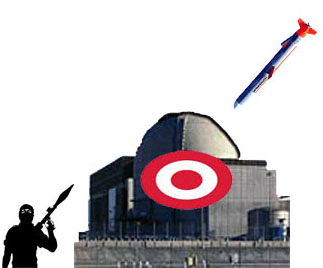
Direct strike could release radioactive material and cause mass terror
By Chas Newkey-Burden, The Week UK, https://theweek.com/world-news/the-threat-to-nuclear-power-plants-around-the-world
The “vulnerability” of the civilian energy infrastructure was exposed this week when a drone strike on the United Arab Emirates cut off power to a nuclear reactor, said Bloomberg.
It’s the first time a fully operating nuclear power plant has had to rely on back-up generators because of a military attack, but reactors in Ukraine and Iran have also been threatened by recent conflicts.
Why would a nuclear site be targeted?
A country might target a nuclear power plant to cripple an enemy’s power grid, or to force a surrender through the psychological terror of threatening a radiological disaster. An attack on such facilities could also be used to delay a nation’s ability to enrich nuclear material.
Alternatively, armies may attack, or occupy, a nuclear plant to seize control of a strategic geographic corridor or to prevent defending forces from using the area.
What does international law say?
Under the Geneva Conventions, civilian structures, including nuclear power plants, “are protected against attack”, but the treaties also state that they can be hit “for such time as they are military objectives”. This is a “loophole” that “aggressor states” have “interpreted widely”, said Dan Sabbagh, The Guardian’s defence and security editor.
Attacking a nuclear power plant also breaks legal resolutions passed by the UN Security Council and the International Atomic Energy Agency’s board of governors.
What would happen if a site were hit?
An attack on a nuclear site would not necessarily lead to a mushroom cloud or an immediate release of radiation because modern plants are built with multiple safety systems that can shut down reactors and contain damage.
But the reactor’s core could continue to heat up after a strike. This could lead to a build up of hydrogen gas, which could cause further explosions and damage. If the reactor began to degrade, radioactive material could be released and that can remain in the environment for years or even decades. It could potentially spread across borders and enter water systems or settle into the soil.
There are other consequences. Attacks on nuclear installations “risk undermining the emerging nuclear renaissance” in Western economies as an alternative to fossil fuels, said Bloomberg. Politicians and the public are “highly sensitive to radiation emergencies”, so an incident in one country “tends to dampen enthusiasm” for nuclear power elsewhere.
An attack on a nuclear plant would also be a hugely symbolic moment. Although conventional power plants have been “repeatedly bombed” by Russia during the Ukraine war, said Sabbagh, Kyiv’s three functioning nuclear plants have “remained relatively unscathed” because Moscow regarded a direct attack on them to be “taboo”.
No comments yet.
-
Archives
- October 2026 (129)
- September 2026 (339)
- August 2026 (330)
- July 2026 (355)
- June 2026 (287)
- May 2026 (306)
- April 2026 (356)
- March 2026 (251)
- February 2026 (267)
- January 2026 (308)
- December 2025 (358)
- November 2025 (359)
-
Categories
- 1
- 1 NUCLEAR ISSUES
- business and costs
- climate change
- culture and arts
- ENERGY
- environment
- health
- history
- indigenous issues
- Legal
- marketing of nuclear
- media
- opposition to nuclear
- PERSONAL STORIES
- politics
- politics international
- Religion and ethics
- safety
- secrets,lies and civil liberties
- spinbuster
- technology
- Uranium
- wastes
- weapons and war
- Women
- 2 WORLD
- ACTION
- AFRICA
- Atrocities
- AUSTRALIA
- Christina's notes
- Christina's themes
- culture and arts
- Events
- Fuk 2022
- Fuk 2023
- Fukushima 2017
- Fukushima 2018
- fukushima 2019
- Fukushima 2020
- Fukushima 2021
- general
- global warming
- Humour (God we need it)
- Nuclear
- RARE EARTHS
- Reference
- resources – print
- Resources -audiovicual
- Weekly Newsletter
- World
- World Nuclear
- YouTube
-
RSS
Entries RSS
Comments RSS


Leave a Reply