Rokkasho plant should be shut down in energy policy shift
 Japan Nuclear Fuel Ltd.’s Rokkasho nuclear fuel reprocessing plant in Rokkasho, Aomori Prefecture, in 2018
July 31, 2020
Japan’s nuclear watchdog has effectively endorsed the safety of a controversial nuclear reprocessing plant being built in a village along the Pacific coast in northern Japan.
The Nuclear Regulation Authority on July 29 approved an outline of safety measures for the trouble-plagued nuclear fuel reprocessing plant Japan Nuclear Fuel Ltd. is building in Rokkasho, Aomori Prefecture.
The NRA said the outline meets the new safety standards introduced after the 2011 Fukushima nuclear disaster.
The NRA’s decision marks a major step forward in constructing the plant for recovering plutonium from spent nuclear reactor fuel, the core facility for the government’s program to establish a nuclear fuel recycling system.
NRA Chairman Toyoshi Fuketa, however, stressed that the body’s decision does not mean an endorsement of the nuclear fuel recycling policy per se, saying in a news conference that it is a “policy issue” whether there is enough of a rationale for pursuing the policy.
Prime Minister Shinzo Abe’s administration should confront the reality that the catastrophic accident at the Fukushima No. 1 nuclear power plant has completely changed the environment surrounding nuclear power generation and make a fundamental review of the government’s nuclear energy policy.
Nuclear fuel recycling involves recovering plutonium from spent nuclear fuel to be reused in reactors. The government has been promoting recycling separated plutonium back into the fuel of reactors since the 1950s under the rationale that Japan, a nation poor in natural resources, needs to make more efficient use of nuclear fuel.
More than half a century on, the share of nuclear power generation in Japan’s overall electricity production is now very small as most of the reactors that were shut down in the wake of the Fukushima meltdowns have yet to be restarted.
It is also nearly impossible to find a site for building a new nuclear plant. As aged reactors will be decommissioned one after another in the coming years, the importance of nuclear power generation for Japan’s energy supply will steadily diminish.
Over the long term, Japan needs to phase out nuclear power generation to remove public anxiety about a large-scale accident.
Nuclear fuel recycling can have no great significance in this new era when Japan has to start shifting away from atomic energy. Many industrial nations have long given up nuclear reprocessing as economically unviable.
Another big problem with reprocessing the spent fuel is that it produces plutonium, a material that can also be used to make nuclear weapons.
Japan has a stockpile of some 46 tons of plutonium, stored both at home and abroad, an amount enough to make 6,000 atomic bombs. It is fueling fears and drawing criticism internationally.
Japan Nuclear Fuel’s plant in Rokkasho is designed to have the capacity of reprocessing 800 tons of spent nuclear fuel annually to recover 7 tons of plutonium.
But the plan to develop a fast neutron reactor that can “consume” plutonium by transforming it into other forms of nuclear waste, the key technology for plutonium consumption, has gone awry with the decision to decommission Japan’s “Monju” prototype sodium-cooled fast-breeder reactor.
There are clearly also limitations to the plan to burn so-called MOX (mixed oxide) fuel, which is usually plutonium blended with natural uranium, in existing nuclear reactors.
The government has promised the international community to reduce the nation’s surplus plutonium. That means the reprocessing operation at the Rokkasho plant will have to be restricted so that the amount of plutonium recovered will not exceed consumption.
It simply does not make sense to spend as much as 14 trillion yen ($134.33 billion) on building the plant to recover a small amount of plutonium.
Given that this huge cost will be passed onto consumers through higher electricity bills, it is impossible to win broad public support for the project.
If the government decides to pull the plug on the fuel recycling program, it will have to face tough policy challenges it has long avoided tackling, such as how to dispose of spent fuel. But the nation cannot make the inevitable leap into the new age of energy if it continues spending huge amounts on nuclear power generation, which is beset by so many problems.
There is a growing global trend toward renewable energy sources such as solar and wind power. This is the time for the government to make a radical shift in its energy policy.
Hiroshima court recognizes Hiroshima ‘black rain’ victims outside designated area as hibakusha after 75 years
How long will it take for the Fukushima victims outside the evacuation zone to be finally all recognized?
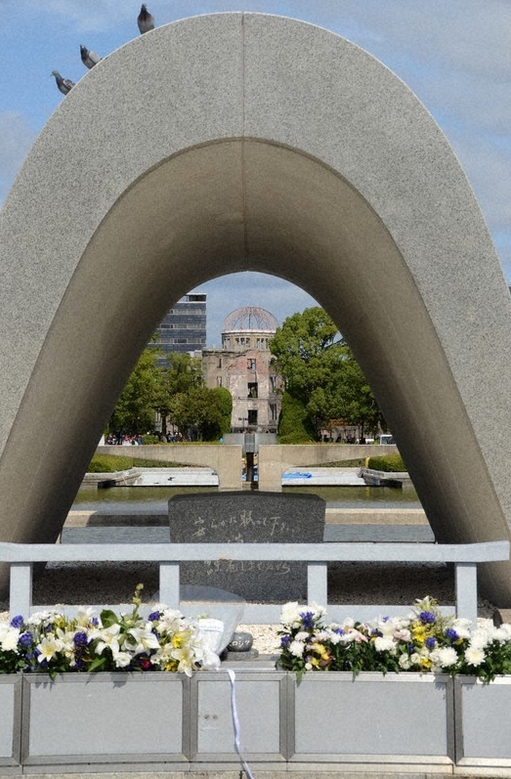 In this October 2019 file photo, the cenotaph for the 1945 atomic bombing victims is seen at the Hiroshima Peace Memorial Park. The Atomic Bomb Dome is seen in the background.
Japan court recognizes Hiroshima ‘black rain’ victims outside designated area as hibakusha
July 29, 2020
HIROSHIMA (Kyodo) — A Japanese court ruled Wednesday that state health care benefits should be extended to people who were exposed to radioactive “black rain” after the 1945 U.S. atomic bombing of Hiroshima outside a zone currently recognized by the government.
The Hiroshima District Court ruled in favor of a suit filed by 84 plaintiffs in their 70s to 90s. It said they should receive the same health care benefits as provided for atomic bomb survivors who were in the zone where the state has recognized black rain fell.
It is the first court decision regarding the boundary of the area affected by radioactive rain and subsequent health problems among survivors.
Presiding Judge Yoshiyuki Takashima said, “It is possible black rain fell outside the designated zone and reasonable to conclude that they were affected by radiation if they were exposed (to such rain.)”
The court then determined that the plaintiffs developed diseases specific to atomic bomb survivors due to the effect of black rain.
Following the ruling, Chief Cabinet Secretary Yoshihide Suga said in a press conference the government has not decided whether to appeal the ruling.
The designated area lies northwest of the hypocenter of the atomic bombing on Aug. 6, 1945 and measures about 19 kilometers in length and 11 km in width.
People who were recognized as being in the affected area at the time of the bombing are eligible to receive periodic health checkups free of charge. Among them, those who developed illnesses believed to be caused by radiation effects can receive free health care services in principle.
The 84 plaintiffs including deceased individuals represented by family members developed such illnesses as cancer and cataracts after they were exposed to black rain containing radioactive materials outside the designated area and consumed contaminated food and water.
They had applied to the city and prefectural governments of Hiroshima for health care benefits for atomic bomb survivors between 2015 and 2018, but their applications for atomic bomb survivors’ certificates were turned down.
The plaintiffs sued the Hiroshima city and prefectural governments from 2015, seeking the nullification of their decisions.
The local governments insisted there was no scientific evidence that radioactive rain fell on areas outside the designated zone and the plaintiffs’ health problems were caused by their exposure to radiation.
The ruling was also welcomed by people in Nagasaki Prefecture, where an atomic bomb was also dropped three days after Hiroshima and there are survivors who claim to have been exposed to radioactive rain but have not been eligible for the state’s healthcare aid.
“(The ruling) departed from the unscientific ways of judging whether plaintiffs are ‘hibakusha’ (A-bomb survivors) simply based on distances (from the hypocenter) and administrative jurisdictions,” said Koichi Kawano, an 80-year-old resident of the town of Nagayo in Nagasaki, who survived the bombing.
Japan’s law on supporting atomic bomb survivors defines victims eligible for state aid in the following four categories.
They are those who were directly exposed to the bombing, people who entered within 2 km from the hypocenters of Hiroshima or Nagasaki in the period of two weeks from the attacks, those who were affected by radiation while rescuing survivors or other reasons and fetuses exposed to radiation in the womb.
The plaintiffs claimed they fit into the third category.
Hiroshima court recognizes atomic bomb ‘black rain’ victims
July 29, 2020
TOKYO — A Japanese court on Wednesday for the first time recognized people exposed to radioactive “black rain” that fell after the 1945 U.S. atomic attack on Hiroshima as atomic bomb survivors, ordering the city and the prefecture to provide the same government medical benefits as given to other survivors.
The Hiroshima District Court said all 84 plaintiffs who were outside of a zone previously set by the government as where radioactive rain fell also developed radiation-induced illnesses and should be certified as atomic bomb victims. All of the plaintiffs are older than their late 70s, with some in their 90s.
The landmark ruling comes a week before the city marks the 75th anniversary of the U.S. bombing.
The U.S. dropped the world’s first atomic bomb on Hiroshima on Aug. 6, 1945, killing 140,000 people and almost destroying the entire city. The plaintiffs were in areas northwest of the ground zero where radioactive black rain fell hours after the bomb was dropped.
The plaintiffs have developed illnesses such as cancer and cataracts linked to radiation after they were exposed to black rain, not only that which fell but also by taking water and food in the area contaminated with radiation.
They filed the lawsuit after Hiroshima city and prefectural officials rejected their request to expand the zone to cover their areas where black rain also fell.
In Wednesday’s ruling, the court said the plaintiffs’ argument about their black rain exposure was reasonable and that their medical records showed they have health problems linked to radiation exposure.
One of the plaintiffs, Minoru Honke, who was exposed to black rain at age 4, said more than a dozen people died during the trial. “I want to tell them that we won,” he said.
Osamu Saito, a doctor who has examined atomic bomb survivors in Hiroshima, welcomed the ruling for considering the survivors’ welfare based on an assumption that anyone who was in these areas and hit by the rain could have been affected by radiation.
Earlier in the day, dozens of plaintiffs walked into the Hiroshima court in the rain, showing a banner saying “Certificates to all ‘black rain’ victims.” As soon as the ruling was issued, lawyers for the plaintiffs ran out of the court, showing a banner saying “Full victory,” and their supporters applauded and cheered.
Chief Cabinet Secretary Yoshihide Suga told reporters that the government will closely examine the ruling and respond after consulting with related government agencies and Hiroshima officials.
Tohoku disaster funds spent for wining, dining company execs
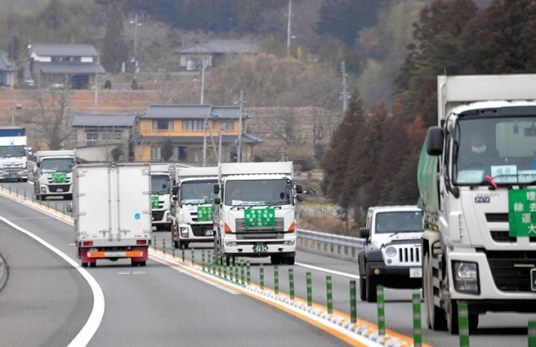 A convoy of trucks transports radioactive debris from decontamination work.
July 27, 2020
Subcontractors hired to rebuild the disaster-stricken Tohoku region created slush funds with taxpayer money to wine and dine and give cash to senior officials of four major construction companies, The Asahi Shimbun has learned.
The combined sum of the slush funds reached at least 160 million yen ($1.51 million), a result of padded bills paid for by revenue collected under a new tax levied for reconstruction projects in the region.
The four construction companies whose executives accepted the gifts from the subcontractors are Shimizu Corp., Hazama Ando Corp., Kajima Corp. and Taisei Corp. Together, they received more than 1 trillion yen worth of government contracts to rebuild the Tohoku region from the 2011 Great East Japan Earthquake, tsunami and Fukushima nuclear disaster.
The projects included disposal of the mountains of debris generated by the tsunami and rebuilding communities affected by the triple meltdown at the Fukushima No. 1 nuclear plant.
The subcontractors received orders from those four general contractors, inflated the costs of the work, and pooled the excess money into slush funds.
Cash gifts from the slush funds were presented to senior officials of those companies at their branches in the Tohoku region who had an influential say in selecting subcontractors and how the funds for the projects should be allocated.
The slush funds also covered parties at night clubs to entertain the executives and even paid for the cost of overseas trips.
The slush funds were uncovered by the Tokyo Regional Taxation Bureau, sources said.
An employee with a subcontractor said that on one occasion, the company was forced to shell out more than 1 million yen to cover the drinking expenses of a senior Kajima official at a high-end club.
The employee also said the subcontractor used the slush fund to buy an expensive watch that the Kajima official wanted to give to a hostess, and to pay for the expenses of his frequent trips to the Philippines.
The Kajima official was also given “pocket money” worth 300,000 yen to 500,000 yen per occasion, the employee said.
A Tokyo company received a contract from Shimizu to clean up Okuma, a town co-hosting the crippled nuclear plant.
Shimizu overpaid the company for the work, allowing it to build a slush fund totaling tens of millions of yen.
On 10 occasions, the subcontractor used the slush fund to give a cash gift to a senior Shimizu official who oversaw the Okuma project. It also used the fund to entertain the official over dinner.
A Hazama Ando official in a similar high-level position is believed to have taken about 10 million yen from a slush fund of a subcontractor in connection with a project to dismantle buildings in Namie, Fukushima Prefecture.
The Tokyo Regional Taxation Bureau ordered the Shimizu subcontractor and Hazama Ando to pay back taxes and penalties for tax evasion, saying payments from the slush funds to their senior officials should have been declared as earnings.
After the slush funds came to light, the gift-receiving senior officials with Shimizu and Hazama Ando left their companies.
A company in Hyogo Prefecture that sells waste-disposal machinery accumulated a slush fund totaling 44 million yen from 2014 to 2015 through business transactions with another company. The two companies were involved in the tax-funded rebuilding projects in the Tohoku region.
The Hyogo company planned to use the slush fund to give money to senior officials with Taisei and Kajima.
Taisei was in charge of waste disposal in Kesennuma, Miyagi Prefecture, while Kajima oversaw a project to build a waste-processing facility in Tomioka, Fukushima Prefecture.
Multiple subcontractors involved in a reconstruction project in Miyako, Iwate Prefecture, pooled together about 100 million yen in a slush fund to provide favors to a senior Kajima official and other officials at the site and others.
Tax authorities in Osaka and Sendai are looking into the cases.
Asked by The Asahi Shimbun about allegations he received 10 million yen from a slush fund, the former Hazama Ando official said, “I cannot say anything other than the fact that I left the company.”
The senior official with Kajima declined to comment.
Shimizu acknowledged that the senior official in the field accepted excessive entertainment from the subcontractor. It said the official’s actions caused the company to lose money that should have been reported as profit.
“The official in question paid back the money he received (to Shimizu) and quit,” a Shimizu official said.
Taisei said the company does not provide details about deals with subcontractors.
Over eight years from 2011, more than 12 trillion yen in taxpayer money was spent on infrastructure projects to construct roads, embankments and housing in the disaster-hit region. In excess of 6 trillion yen in public money has been spent on rebuilding communities from the nuclear disaster.
The bulk of these funds came from revenue from the new tax to reconstruct Tohoku.
The construction industry, which had been battered by a sharp drop in public works projects, experienced a record boom with the Tohoku-related projects.
(This story was compiled from reports by Takashi Ichida, senior staff writer, Yuta Hanano and Hiroyoshi Itabashi.)
Robot to use brush to retrieve melted fuel at Fukushima plant
 The robotic arm to be used for collecting melted fuel at the No. 2 reactor of the Fukushima No. 1 nuclear power plant (Provided by the International Research Institute for Nuclear Decommissioning)
 A vacuum vessel to collect powdered nuclear debris (Provided by the International Research Institute for Nuclear Decommissioning)
July 27, 2020
FUKUSHIMA–A robotic arm under development in Britain will use a brush and vacuum vessel on its end to collect melted fuel in a step toward retrieving debris at the crippled Fukushima No. 1 nuclear power plant.
Details of the device, which will start collecting debris inside the No. 2 reactor on a trial basis next year, were announced on July 2.
The government and plant operator Tokyo Electric Power Co. plan to retrieve melted fuel at the No. 2 reactor ahead of two other reactors because radiation levels are relatively low.
The No. 2 reactor, along with the No. 1 and No. 3 reactors, suffered meltdowns following the Great East Japan Earthquake and tsunami in 2011.
The situation inside the No. 2 reactor is relatively known through past inspections. It has been confirmed that apparent debris in the lower part of its containment vessel can be collected with a robot.
Measuring 22 meters long and weighing 4.6 tons, the robotic arm will be made of high-strength stainless steel so it will not bend when stretched out.
It will be inserted into a closed box connected to a hole made on the side of the containment vessel and remotely operated to prevent radioactive substances from being released.
The arm will attach powdered nuclear debris to its brush and also suck the debris with its vacuum vessel.
Under the plan, debris totaling approximately 1 gram or so will be collected in each of the several rounds of the trial procedure.
An experiment will start in Britain as early as August with the use of a model of the containment vessel.
The robotic arm will be transported to Japan around February for the training of operators at the Japan Atomic Energy Agency’s facility in Naraha, Fukushima Prefecture.
The retrieved fuel will be measured for weight and radiation levels, put in a metal transfer vessel and moved to an analysis center in Ibaraki Prefecture.
In the full-scale retrieval stage, different equipment will be used.
Melted fuel to be removed is estimated to record a radiation reading of 6 millisieverts per hour even at distances of 20 centimeters from it.
That means the annual dose limit for ordinary individuals of 1 millisievert will be reached in 10 minutes.
Training is expected to reduce the time required for workers to put debris into the transfer vessel near the fuel.
Other measures to lessen workers’ doses will be taken, such as introducing panels to block radiation.
Experts propose two methods to scrap Daiichi plant
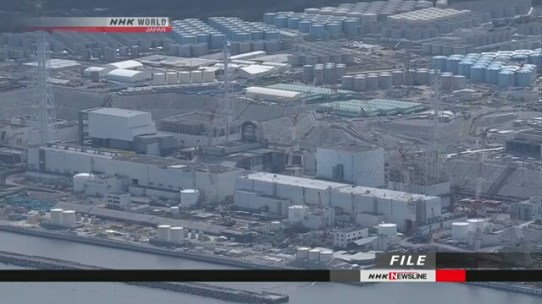
July 26, 2020
Japanese atomic energy experts have proposed two ways to decommission the crippled Fukushima Daiichi nuclear power plant.
The Atomic Energy Society of Japan floated the two methods in a report.
One proposal is to dismantle and remove all parts of the reactor buildings and leave the site vacant. The other is to dismantle and remove parts of the reactor buildings that are above ground and leave behind the underground structures.
The experts say each method has been studied in the United States and European countries.
They say amounts of radioactive waste to be generated during decommissioning work will vary significantly, depending on when the dismantling of reactor buildings begins — namely, starting to dismantle contaminated buildings soon or waiting a certain period for their radiation levels to drop.
A decommissioning timeline released by the Japanese government and the plant’s operator, Tokyo Electric Power Company, shows the scrapping process will be completed by 2051. But the plan is unclear on how the reactor buildings will be decommissioned.
Miyano Hiroshi, a member of the Atomic Energy Society of Japan, says it will be difficult to draw a conclusion from various arguments on how to decommission the plant. But he adds discussions are important and that he hopes the society’s report will contribute to the debate.
Robots in Fukushima monitor cucumber production in IT-farming joint project
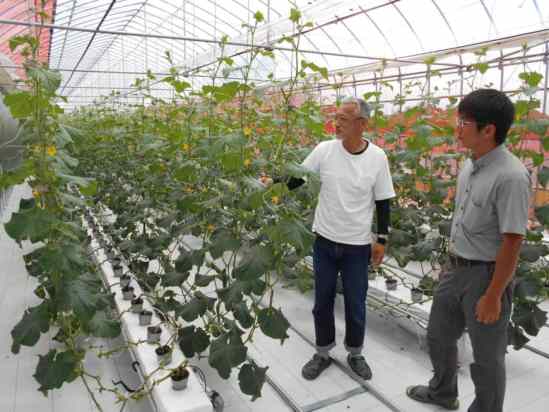 Katsumi Hashimoto (left) president of the Fukushima Seed Center, talks about how he teamed up with two other technology companies to make cucumber farming less labor intensive.
Jul 24, 2020
Three ventures from the IT and farming industries have started testing methods to produce cucumbers with less human labor in Sukagawa, Fukushima Prefecture, in the hope that it will reinvigorate the agriculture industry suffering from a worsening labor shortage, including a lack of successors.
Two technology companies, Benefic Co. and MK tech, have teamed up with Fukushima Seed Center and established a project team called Smart Agri Fukushima.
The team created a 1,300-square-meter testing greenhouse, planted 2,000 cucumbers and is monitoring temperatures, humidity and carbon dioxide among other data remotely using robots. The team has already shipped 1.6 tons of produce to a local agricultural cooperative, with a plan to expand the greenhouse to 1 hectare, or eight times the current scale, in the next five years.
In developing robots to monitor the cucumbers, Benefic will be in charge of its software while MK tech will manufacture the hardware. In the greenhouse, cucumbers are produced through a unique hanging method, which makes it easier for robots to monitor the produce, rather than the usual method which is to cut the plant at a certain height.
According to the seed center, the Sukagawa area, well-known for cucumbers, has been struggling for years with a shortage of labor, causing farmers to automate the farming process to make it more attractive to younger people. In the future, they hope to spread the smart farming method nationwide.
“We want to protect cucumber farming by making the fields less labor intensive,” said Katsumi Hashimoto, president of the seed center.
https://www.japantimes.co.jp/news/2020/07/24/national/robots-farming-fukushima/
Activist Professor Unveils English-language Video Warning of Tokyo Olympics Radiation Risk
SEOUL, July 24 (Korea Bizwire) — Ahead of the Tokyo Summer Olympics scheduled to be held next year in Japan, Seo Kyung-duk, a professor at Sungshin Women’s University, unveiled on Thursday a video in English on social media such as YouTube, Instagram and Facebook, warning that the radiation risk still remains high in Japan.
The four-minute video focuses on highlighting the risk of being exposed to radioactive materials in Fukushima.
In 2013, Japanese Prime Minister Shinzo Abe declared that the radiation in Fukushima was sufficiently under control.
The video, however, claims that in the seven years after the Fukushima nuclear disaster, the region’s nuclear power plant and its neighboring areas still remain a dangerous radioactive area, with the radiation level of some Fukushima areas being up to 1,775 times higher than internationally recommended levels.
The video warned that the Fukushima nuclear disaster is not terminated but still underway, adding that those who want to visit the Tokyo Olympics should be careful about the risk of being exposed to radiation.
“The Japanese government plans to host some Olympic games in Fukushima as well as providing ingredients and foods from Fukushima to the athletes participating in the Tokyo Olympics,” Seo said.
“This move is a sign that the Japanese government only wants to use the Tokyo Olympics as a chance to herald the rebuilding of Fukushima, neglecting the region’s radiation risk.”
Lina Jang (linajang@koreabizwire.com)
For the nuclear industry, coronavirus is helpful, as nuclear wastes go quietly from Germany to Russia
 FoE Europe 25th June 2020, Russia and Germany have taken advantage of the coronavirus crisis to resume
shipping radioactive waste to dump in the Urals and Siberia in northern
Russia.
Germany was exporting radioactive waste from it’s nuclear power stations to
Russia, via the harbor of Amsterdam, they directly organized protests in
the three countries.
and sea of uranium – a waste product of nuclear fuel production by Urenco
Germany – was put on hold. That was before the coronavirus crisis hit.
in March 2020, when Covid-19 lockdowns restricted people’s right to protest
in Russia even further, the shipments of radioactive waste were set to
resume.
United Arabs Emirate’s nuclear power station cut corners on safety
Al Jazeera 1st Aug 2020, Paul Dorfman, an honorary senior research fellow at the Energy Institute,
University College London and founder and chair of the Nuclear Consulting
Group, has criticised the Barakah reactors’ “cheap and cheerful” design
that he says cuts corners on safety.
Dorfman authored a report (PDF) last
year detailing key safety features Barakah’s reactors lack, such as a “core
catcher” to literally stop the core of a reactor from breaching the
containment building in the event of a meltdown. The reactors are also
missing so-called Generation III Defence-In-Depth reinforcements to the
containment building to shield against a radiological release resulting
from a missile or fighter jet attack. Both of these engineering features
are standard on new reactors built in Europe, says Dorfman.
French company EDF fined – it spread false information on cost of Hinkley nuclear power project
 Bunham-on-sea.com 1st Aug 2020, The French market watchdog has levelled a £4.5m fine against energy giant
EDF for misleading investors about the cost of the Hinkley Point C nuclear
project. Regulators say the French state-owned energy company spread
“false information” about its agreement with the Government to build
the nuclear plant near Burnham-On-Sea.
AMF, France’s financial markets
authority, says the company may have set EDF’s share price “at an
abnormal or artificial level” by claiming in a news release dated October
2014 that the terms of its deal with the UK government were “unchanged”
from the 2013 agreement.
Chinese minority owner of Hinkley nuclear project appoints CEO from China’s military area
New head of Chinese investor in Hinkley nuclear plant brings military links
China General Nuclear’s role in the Hinkley Point C nuclear power station has come under scrutiny recently
Telegraph ByEd Clowes1 August 2020 China General Nuclear, the
minority owner of the Hinkley Point C power station, has appointed a chairman with close ties to the Chinese Communist Party and the country’s military nuclear programme.
leader of the state-owned conglomerate last week, speaking on the virtues
of Communism and the value of a strong nuclear industry. He previously
served as deputy general manager at China National Nuclear Corporation, the
organisation responsible for developing the country’s nuclear weapons.
and called on his colleagues to build a company that was more infused with
Communist ideals.
strategy held at its own university, which is designated as an official
Communist Party school. Mr Changli spoke of “in-depth implementation of
general secretary Xi Jinping’s important expositions on high-quality
development”, and said: “We must be good commanders and good
combatants.” CGN owns a 33.5pc stake in the £22.5bn Hinkley Point C
project in Somerset where it has partnered with EDF, the French energy
giant.
Westminster and stoke speculation that the civil nuclear company will be
merged with CNNC.https://www.telegraph.co.uk/business/2020/08/01/new-head-chinese-investor-hinkley-nuclear-plant-brings-military/
Who flew drones over the nuclear reactors?
|
Mystery at Arizona’s Palo Verde nuclear plant: Who flew drones over the reactors? AZ Central,
Ryan RandazzoArizona Republic, Security guards at Palo Verde Nuclear Generating Station west of Phoenix noticed something odd on a September night last year.Five or six drones buzzed over the perimeter fence of the nuclear plant— the largest power generator in the United States — 50 miles west of Phoenix. They went across the open desert where security guards practice “force-on-force” simulated combat drills to sharpen their skills to ward off an assault, over heavy-duty gates and arrived at the protected area around the concrete-domed reactors. They stayed for nearly an hour, and came back the next night for a repeat performance. Nobody except the drones’ pilots knows whether this was a case of hobbyists touring the plant out of curiosity, or something much more nefarious, intended to disrupt a massive power source for customers from Texas to California. And nobody in any official capacity seems to know who piloted the drones that night or the next……… Security guards at Palo Verde Nuclear Generating Station west of Phoenix noticed something odd on a September night last year. Five or six drones buzzed over the perimeter fence of the nuclear plant— the largest power generator in the United States — 50 miles west of Phoenix. They went across the open desert where security guards practice “force-on-force” simulated combat drills to sharpen their skills to ward off an assault, over heavy-duty gates and arrived at the protected area around the concrete-domed reactors. They stayed for nearly an hour, and came back the next night for a repeat performance. Nobody except the drones’ pilots knows whether this was a case of hobbyists touring the plant out of curiosity, or something much more nefarious, intended to disrupt a massive power source for customers from Texas to California. And nobody in any official capacity seems to know who piloted the drones that night or the next……… Security guards at Palo Verde Nuclear Generating Station west of Phoenix noticed something odd on a September night last year. Five or six drones buzzed over the perimeter fence of the nuclear plant— the largest power generator in the United States — 50 miles west of Phoenix. They went across the open desert where security guards practice “force-on-force” simulated combat drills to sharpen their skills to ward off an assault, over heavy-duty gates and arrived at the protected area around the concrete-domed reactors. They stayed for nearly an hour, and came back the next night for a repeat performance. Nobody except the drones’ pilots knows whether this was a case of hobbyists touring the plant out of curiosity, or something much more nefarious, intended to disrupt a massive power source for customers from Texas to California. And nobody in any official capacity seems to know who piloted the drones that night or the next……. The Palo Verde incidents are apparently not the first time something like this has happened. One NRC email discusses “several high-speed” drone overflights of the Limerick Generating Station in Pennsylvania approximately eight months prior. Another indicates there had been 42 drone incidents in three years. APS officials said some of those were at Palo Verde. What if the pilots meant harm?At least one person in the NRC was concerned last year that an airspace restriction from the FAA wasn’t sufficient. “I would point out that restricted airspace will do nothing to stop an adversarial attack and even the detection systems identified earlier in this email chain have limited success rates, and there is even lower likelihood that law enforcement will arrive quickly enough to actually engage with the pilots,” wrote Joseph Rivers, a senior security adviser with the Nuclear Regulatory Commission who recently retired…… A columnist for Forbes went even further, speculating that the drones could have made three-dimensional maps of the power plant to assist a later attack. …… https://www.azcentral.com/story/money/business/energy/2020/07/31/drones-flew-over-palo-verde-nuclear-plant-arizona-pilots-unknown/5551928002/ |
|
|
BOOKS on The New Nuclear Threat
|
|



The WHO says coronavirus is a once-in-a century crisis that will impact lives for decades
Deaths from coronavirus as at early August 2020
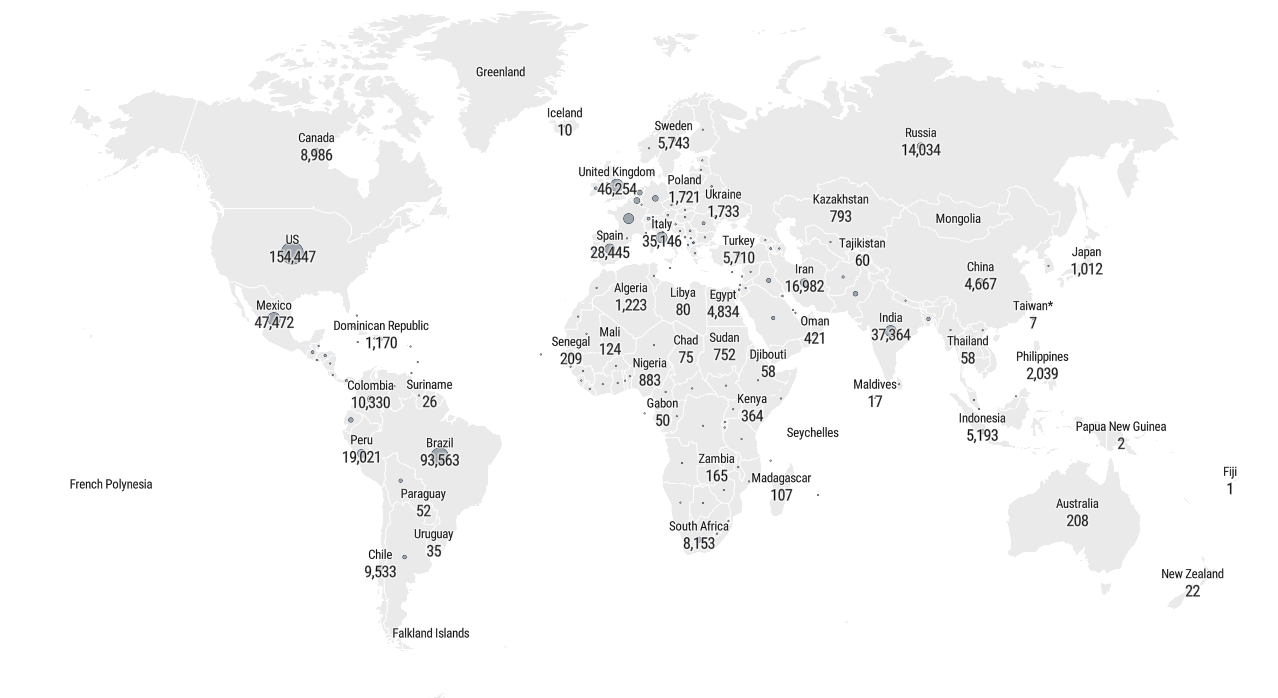
The WHO says coronavirus is a once-in-a century crisis that will impact lives for decades, SBS World News, 2 Aug 20, The World Health Organization committee “highlighted the anticipated lengthy duration of this COVID-19 pandemic”.
The World Health Organization has warned the coronavirus pandemic is likely to be “lengthy” after its emergency committee met to evaluate the crisis six months after sounding the international alarm.
The committee “highlighted the anticipated lengthy duration of this COVID-19 pandemic”, the WHO said in a statement, and warned of the risk of “response fatigue” given the socio-economic pressures on countries.
The panel gathered Friday for the fourth time over the coronavirus crisis, half a year on from its January 30 declaration of a public health emergency of international concern (PHEIC) – the WHO’s highest level of alarm………
Warning over crisis fatigue
Several countries around the world have imposed strict lockdowns in a bid to control the spread of the respiratory disease, plunging economies into sharp contraction.
The committee urged the WHO to provide nuanced, pragmatic guidance on COVID-19 management “to reduce the risk of response fatigue in the context of socio-economic pressures”.
The panel urged the WHO to support countries in preparing for the rollout of proven therapeutics and vaccines.
It called for improved understanding of the epidemiology and severity of COVID-19, including its long-term health effects.
And the committee wanted more light shed on the dynamics of the virus, such as “modes of transmission, shedding, potential mutations; immunity and correlates of protection”.
The near six-hour gathering was hosted at the WHO’s headquarters in Geneva, with some participants joining via video-link.
The committee will reconvene within the next three months……..https://www.sbs.com.au/news/the-who-says-coronavirus-is-a-once-in-a-century-crisis-that-will-impact-lives-for-decades
The potential for a new coronoavirus, with bats as a possible transmitter
The next coronavirus may already be circulating in bats, study suggests, by Tom Avril, Philadelphia Inquirer, While the exact origin of the coronavirus remains murky, scientists have been racing to determine how it jumped from animals to humans so they can prevent another pandemic.
The next one could just be a matter of time, a study published this week suggests. The authors said a virus with similar ability to infect humans may already be out there, carried by a type of bats known for having horseshoe-shaped “leafs” on their noses.
Scientists made that prediction after constructing a family tree of the coronavirus — tracing its ancestry by comparing its genetic code with that of other coronaviruses found in bats, humans, and a scaly animal called the pangolin.
The lineage of the virus that causes COVID-19 appears to have branched off from its closest viral relatives about 40 to 70 years ago, the authors wrote in Nature Microbiology. And other viruses in the same branch of the family likely share a similar ability to latch onto cells in human airways, said Maciej F. Boni, a Pennsylvania State University biologist and lead study author.
“It’s very likely there are lots of other lineages that nobody knows about, because nobody has sampled, that are circulating quietly in bats,” he said. “Potentially all of them could have this ability to infect human cells.”……
by using a battery of statistical techniques, the scientists identified three genetic regions in the coronavirus that appeared to have remained intact for decades. They identified the same three regions in another coronavirus that came from a bat found in Yunnan, a province in southern China near Laos.
That virus cannot infect humans but is otherwise highly similar to the one causing the pandemic, which was first identified in human patients in the city of Wuhan. The two viruses seem to have branched apart in the family tree sometime in the 1960s, and almost certainly have undiscovered cousins with the potential to infect humans, said Boni, who collaborated with scientists in Europe and China…….
By itself, the presence of similar coronaviruses in bats would not mean another pandemic is imminent, said Kevin Olival, vice president for research at EcoHealth Alliance, a nonprofit that works with scientists worldwide to protect people and animals from infectious disease…….
What is not in dispute is that viruses have been jumping from animals to humans for centuries, and that it will happen again.
And coronaviruses carried by bats are a prime suspect.
Sure enough, as the world now knows too well, that came true. https://www.inquirer.com/health/coronavirus/covd19-bats-china-virus-origin-penn-state-rna-genetics-20200729.html
1 This Month


Tell Congress: Prevent Nuclear Catastrophe in Iran

Tell Congress: Prevent Nuclear Catastrophe in Iran

Read the Public Inquiry Report, the Commissioners’ report, Surrendering Australia: The AUKUS Deception is available to download for free at aukuspublicinquiry.com. Or just watch the replay of the National Press Club Luncheon.
To see nuclear-related stories in greater depth and intensity – go to https://nuclearinformation.wordpress.com
Say No to NASA’s Reckless Nuclear Reactor on the Moon
-
Archives
- November 2026 (284)
- October 2026 (302)
- September 2026 (339)
- August 2026 (330)
- July 2026 (355)
- June 2026 (287)
- May 2026 (306)
- April 2026 (356)
- March 2026 (251)
- February 2026 (267)
- January 2026 (308)
- December 2025 (358)
-
Categories
- 1
- 1 NUCLEAR ISSUES
- business and costs
- climate change
- culture and arts
- ENERGY
- environment
- health
- history
- indigenous issues
- Legal
- marketing of nuclear
- media
- opposition to nuclear
- PERSONAL STORIES
- politics
- politics international
- Religion and ethics
- safety
- secrets,lies and civil liberties
- spinbuster
- technology
- Uranium
- wastes
- weapons and war
- Women
- 2 WORLD
- ACTION
- AFRICA
- Atrocities
- AUSTRALIA
- Christina's notes
- Christina's themes
- culture and arts
- Events
- Fuk 2022
- Fuk 2023
- Fukushima 2017
- Fukushima 2018
- fukushima 2019
- Fukushima 2020
- Fukushima 2021
- general
- global warming
- Humour (God we need it)
- Nuclear
- RARE EARTHS
- Reference
- resources – print
- Resources -audiovicual
- Weekly Newsletter
- World
- World Nuclear
- YouTube
-
RSS
Entries RSS
Comments RSS

