France says Iran is building nuclear weapons capacity, urgent to revive 2015 deal
|
France says Iran is building nuclear weapons capacity, urgent to revive 2015 deal, ABC, 17 Jan 21, Iran is in the process of building up its nuclear weapons capacity and it is urgent that Tehran and Washington return to a 2015 nuclear agreement, France’s Foreign Minister Jean-Yves Le Drian has said.
Key points:
Iran has been accelerating its breaches of the nuclear deal and earlier this month started pressing ahead with plans to enrich uranium to 20 per cent fissile strength at its underground Fordow nuclear plant. That is the level Tehran achieved before striking the deal with world powers to contain its disputed nuclear ambitions. The Islamic Republic’s breaches of the nuclear agreement since President Donald Trump withdrew the United States in 2018 and subsequently imposed sanctions on Tehran may complicate efforts by president-elect Joe Biden, who takes office on January 20, to rejoin the pact………. https://www.abc.net.au/news/2021-01-17/french-minister-says-iran-is-building-nuclear-weapons-capacity/13064994 |
|
Jan 31 – Scotland’s Beyond Nuclear to hold Virtual Conference
 The National 16th Jan 2021, HELENSBURGH CND’s Beyond Nuclear conference was postponed twice last year due to the pandemic. But the event will now be taking place virtually on January 31, from 11am to 4.30pm. To be staged by virtual event group
Cameron, Beyond Nuclear is designed to answer the question: “Why would we in Scotland want or need to have nuclear power stations when we have almost
unlimited potential for clean, renewable energy production?” The
conference will be in two parts; the first an examination of the negatives
involved in nuclear power production, contrasting with the positives of
clean renewable energy in the second.
https://www.thenational.scot/news/19016360.join-cnd-event-consider-scotlands-nuclear-future/
Israeli Defence Force drawing up plans to strike Iran’s nuclear program
Report: IDF drawing up plans to strike Iran’s nuclear program
Newspaper says IDF chief has asked for options to derail atomic production, day after Likud minister warned Israel could attack Islamic Republic if US rejoins nuclear deal, Times of Israel, By TOI STAFF14 January 2021The Israel Defense Forces is drawing up plans for an attack on Iran’s nuclear program, the Israel Hayom daily reported Thursday in a front-page article.
The newspaper said that IDF Chief of Staff Aviv Kohavi has asked for three alternate proposals to derail Tehran’s program, without elaborating on them. It only indicated one of the proposals is a military strike, noting that such a plan would require a significant budgetary boost for the Israeli military………..
The Israel Hayom report came a day after Likud minister Tzachi Hanegbi, considered an ally of Prime Minister Benjamin Netanyahu, threatened that Israel could attack Iran’s nuclear program if the United States rejoined the nuclear deal, as US President-elect Joe Biden has indicated he plans to do………. https://www.timesofisrael.com/report-idf-drawing-up-plans-to-strike-irans-nuclear-program/
Belarus Nuclear Plant Taken Offline After ‘Protection System Activated’
|
Belarus Nuclear Plant Taken Offline After ‘Protection System Activated’, Radio Free Europe, 17 Jan, MINSK — Belarusian authorities say the country’s new nuclear power plant has been taken offline during testing procedures after the generator protection system was triggered.At 7:02 p.m., Unit 1 at the Astravets plant was “disconnected from the network after the generator protection system was activated,” the Energy Ministry said in a statement on January 16.
This occurred “during the pilot industrial operation of Power Unit 1, as part of which the systems and equipment are being tested,” the ministry said, adding that radiation levels in the area were “normal.” In November 2020, just three days after it was inaugurated near the western city of Astravets, Belarus’s only nuclear plant halted electricity production after voltage transformers were said to have exploded. The plant resumed operations several days later…… https://www.rferl.org/a/belarus-nuclear-plant-taken-offline-after-protection-system-activated-/31049225.html |
|
New consultations in Ignace, Ontario, over nuclear waste site

 New consultations in Ignace over nuclear waste site, Residents asked to fill out survey from Nuclear Waste Management Organization between Jan. 18 and Feb. 26 By: IGNACE, Ont. – Residents in Ignace, one of two remaining candidates to serve as a repository for Canada’s nuclear’s waste, are being asked to weigh in as the Nuclear Waste Management Organization’s site selection process continues.
Beginning Monday, residents can fill out a short survey created by the NWMO and the Township of Ignace that will help guide how the agency engages the public as it conducts numerous studies in the area in early 2021.
The agency narrowed its list of candidate sites to two – Ignace and South Bruce – in January of 2020. Final site selection was scheduled for 2023, with construction of a nuclear waste repository expected to take another 10 years to complete.
……….. Some experts and civil society groups have raised serious concerns over “deficient” federal nuclear waste policies, calling for an overhaul before moving forward.https://www.tbnewswatch.com/local-news/new-consultations-in-ignace-over-nuclear-waste-site-3268753
Biden nominates Iran nuclear deal negotiator to State Department
Biden nominates Iran nuclear deal negotiator to State Department
Wendy Sherman, Joe Biden’s nominee for deputy secretary of state, was key US negotiator of 2015 Iran nuclear accord.
United States President-elect Joe Biden has nominated a key negotiator of the 2015 Iran nuclear agreement to be the US’s next deputy secretary of state, the second-highest position at the State Department.
In a statement on Saturday, Biden unveiled a string of State Department nominees, including longstanding diplomat Wendy Sherman to be deputy secretary of state……https://www.aljazeera.com/news/2021/1/16/biden-nominates-iran-nuclear-deal-negotiator-to-state-department
Profound questions raised by the employment tribunal case; bullying at Sellafield nuclear site?

 Byline Times 15th Jan 2021, An employment tribunal case that has been running for more than two yearshas started to raise profound questions over management at Europe’s
largest nuclear reprocessing plant, the ability of the employment tribunal
system to defend the rights of whistleblowers, ethical conduct by major law firms, and a conflict of interest at the Equality and Human Rights Commission.
The case of McDermott versus Sellafield, the Nuclear
Decommissioning Authority and former Sellafield HR director Heather Roberts
has been brought under the Public Interest Disclosure Act 1998 – also
known as the Whistleblowers’ Act. Alison McDermott, an HR professional
and diversity specialist, claims that the sudden termination of her
freelance contract in October 2018 by Sellafield was linked to her
protected disclosures containing evidence of systemic bullying, and racist
and sexist incidents at the Sellafield site in Cumbria.
Hydrogen from wind and solar systems could be the ultimate solution to the planet’s pollution problem.
latest claim to fame, two spinoffs of German tech conglomerate Siemens are
joining forces to advance green hydrogen technology by building
wind-to-hydrogen systems to help decarbonize the global economy.
element can be an energy carrier, it can be used to store energy and it can
be used in fuel cells to power vehicles. Green hydrogen is a particularly
attractive option because its production comes from hydrolyzing water using
electricity produced by renewable systems, meaning it has a much lower
carbon footprint than gas- or coal-sourced hydrogen.
pollution problem.
https://oilprice.com/Energy/Energy-General/German-Tech-Giant-Places-Major-Bet-On-Green-Hydrogen.html
January 17 Energy News — geoharvey

Opinion: ¶ “Worried About Earth’s Future? Well, The Outlook Is Worse Than Even Scientists Can Grasp” • A research paper published this week reviews over 150 studies to produce a stark summary of the state of the natural world. It says that future environmental conditions will be far more dangerous than experts currently believe. [Red, […]
January 17 Energy News — geoharvey
Thyroid cancer at ages 0 and 2 at the time of the nuclear accident-Health survey in Fukushima Prefecture January 2021
Thyroid cancer at ages 0 and 2 at the time of the nuclear accident-Health survey in Fukushima  Prefecture Posted by: ourplanet Posted on: Thu, 01/14/2021 –00:46 http://ourplanet-tv.org/?q=node/2537 (Japanese only)
(Translated from Google) The “Prefectural Health Survey” Review Committee was held in Fukushima City on the 15th to discuss the health survey of Fukushima citizens following the accident at the Fukushima Daiichi Nuclear Power Plant. For the first time, it was discovered that two infants, a 0-year-old girl and a 2-year-old girl at the time of the accident, were diagnosed with thyroid cancer.
Material https://www.pref.fukushima.lg.jp/site/portal/kenkocyosa-kentoiinkai-40.html

This time, the result of the fourth round of thyroid examination until June last year was newly announced. The number of children diagnosed with suspected thyroid cancer by fine needle cytology increased by 6 from the previous time to 27, and the number of children who underwent thyroidectomy increased by 3 from the previous time to 16 children. Up to now, 252 patients have been diagnosed with thyroid cancer or suspected thyroid cancer from prior examination, of which 203 have undergone thyroid surgery. 202 people, excluding one, were confirmed to have thyroid cancer.
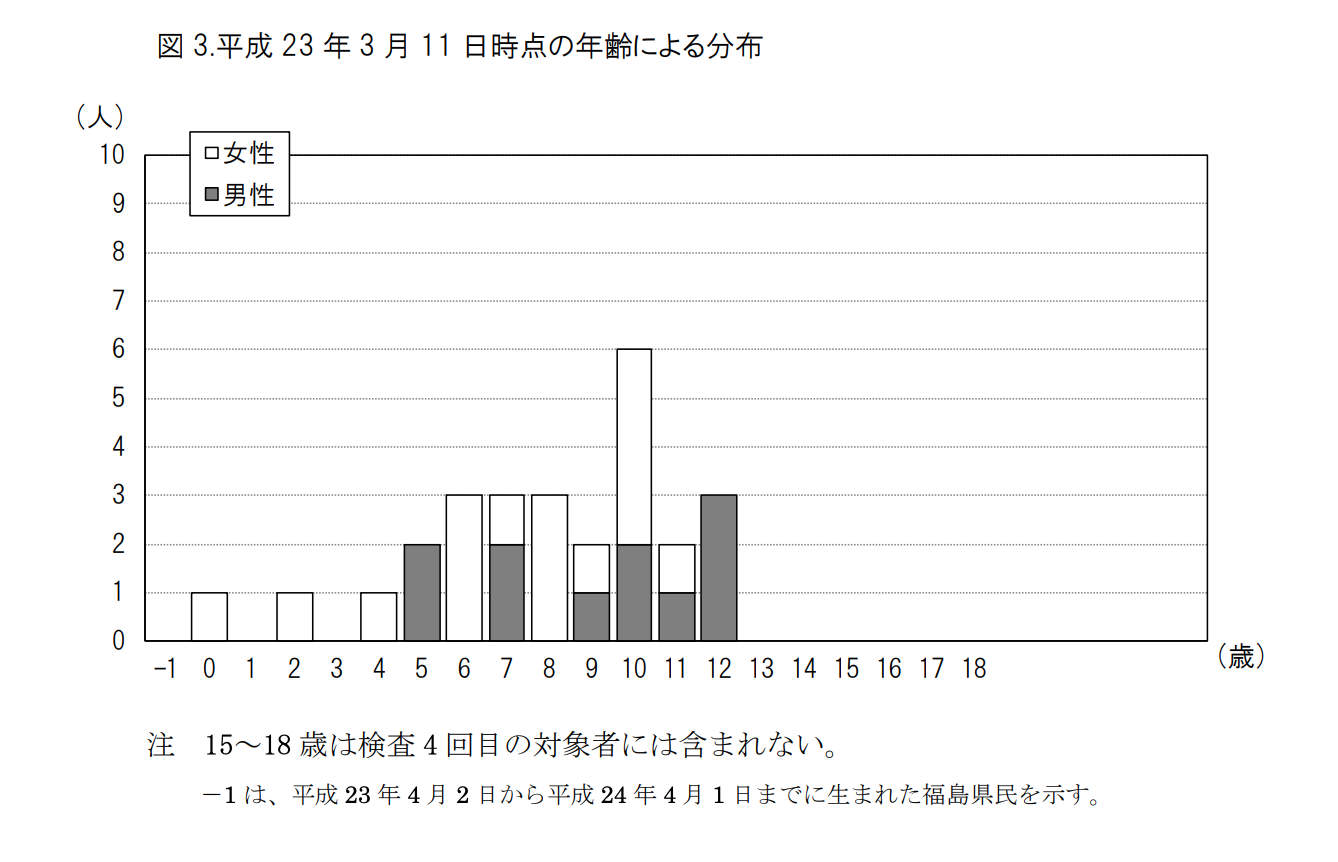
In the fourth round of examination, it was found for the first time that a girl who was 0 years old and a girl who was 2 years old at the time of the accident were diagnosed with thyroid cancer. Since the age of the examination is not the actual age but the grade, the ages at the time of the examination are 9 years old (3rd grade of elementary school) and 11 years old (5th grade of elementary school), respectively. According to the previous test results of 27 patients, 5 patients had “A1 judgement” without nodules or tumors, and 16 people had “A2 judgement” with nodules of 5 mm or less or cysts of 2 cm or less, 5 mm or more. 5 people had a “B-judgement” with nodules or cysts of 2 cm or more, and 1 had not been examined. He had the smallest tumor size of 6.1 mm and the largest tumor was 29.4 mm.
What stands out in the results of the fourth round of examination is the high dose of radiation for people diagnosed with thyroid cancer. Of the 27 patients diagnosed as suspected of being malignant by fine needle cytology, 11 patients (40.7%) who submitted the basic survey questionnaire had an exposure dose of less than 1 mSv in 2 patients (18.1%) 4 months after the accident. The number of children exposed to 2mSv or more was the highest, with 4 (36.3%) from 1mSv to 2mSv and 5 (45.5%) from 2mSv to 5mSv. In particular, the two boys who were five years old at the time of the accident were both over 2mSv.
According to the results of the basic survey of all Fukushima residents, 62.2% are less than 1mSv, 31.6% are from 1mSv to 2mSv, and 5.5% are from 2mSv to 3mSv. Very different.

To review the mass examination at school At this review committee, a major shift was made to reviewing simultaneous examinations at schools. The test, which has found more than 200 people with thyroid cancer, raises the theory of “overdiagnosis” among experts who deny the effects of radiation exposure, saying that they are finding thyroid cancer that they do not have to find. There is a growing opinion that the mass examination at school should be reviewed.
Based on these opinions, the review committee decided to conduct an interview survey at schools in the prefecture on August 31st last time. This time, there was a report on the results of a survey conducted by the prefecture at 26 elementary and junior high schools and high schools in the prefecture.
At many schools, thyroid examinations were performed during class hours, criticized by Shoichiro Tsugane, a member of the National Cancer Center, saying, “You can’t take this without a strong will.” “The benefits of the test are not except that you can be reassured when you get negative. The discovery of thyroid cancer has little benefit in avoiding death or poor quality of life, especially when you are diagnosed with thyroid cancer. “I think it will be a huge disadvantage for those who do,” he said. “Thyroid examination in a group of asymptomatic healthy people is not desirable. I asked him to stop the mass examination at school. ..
In addition, Professor Toshiya Inaba of Hiroshima University also cut out at the school examination that “they are left behind” and said, “Parents are not worried. The school rents the venue. The prefectural medical college has an inspection. I understand each position well, but in the end, it is the people who are left unattended. ” He emphasized that the prefectures and medical colleges that are the subjects of the survey should explain more to children and students the significance of the test and the fact that it can be rejected.

In response, Professor Satoshi Tomita of Fukushima University argued head-on. He criticized that “many Fukushima residents have anxiety about their health” and that members of the Prefectural Health Investigation Committee, especially members outside Fukushima Prefecture, are calling for the cancellation or reduction of examinations. He said that thyroid examination is a way to relieve the anxiety of Fukushima residents, “the anxiety of Fukushima residents, especially those with children, is left behind.” “It is dangerous to go in the direction of reduction easily.” “Thinking” was pointed out.
Ikuko Abe, chairman of the Fukushima Clinical Psychologists Association, who also lives in Fukushima Prefecture and has a close relationship with schools, agrees with this, saying, “I agree with Professor Tomita’s opinion.” “Given the anxiety about radiation that Fukushima residents have, thyroid examinations are very reassuring,” she said. “Reducing or eliminating the examinations still takes the opposite position. I want you to do it. “
What caught my eye in the discussion was the presence of Katsushi Tahara, director of the Ministry of the Environment’s Health and Welfare Department. The members of the review committee from the Ministry of the Environment have not said much, but have played a role in important aspects of policy change. This time too, Mr. Tahara considers the fact that the school is cooperating with the implementation of the examination, such as encouraging households whose delivery to Fukushima Medical University is delayed to submit again when the deadline has passed. About 30% of the children undergoing medical examinations at school were asked intensively about this point, such as confirming that the school side took over the collection of consent forms.
To conduct hearings with the person to be inspected Following a survey of the school, the prefecture proposed to have a place to hear directly from the children and students who had been inspected. Questions were raised about the representativeness of the interviewees, and there was an opinion requesting a quantitative survey such as a questionnaire, but the prefecture’s proposal was approved because the survey took too long.
Regarding this “interview survey,” there was a harsh debate over the neutrality of the content, such as the opinion that a pilot study was unavoidable and that the voices of patients diagnosed with thyroid cancer should also be heard. With the strong push back of the constellation chairman, it was decided that the selection of the target audience and the holding method would be left to the chairperson and the prefecture. The results will be reported at the next meeting.
In response to the further shift to reviewing mass screening at school in this “interview,” Chiba parent and child of the “thyroid cancer support group Hydrangea Association” that supports families with thyroid cancer said, “Accident Among the 0-year-old and 2-year-old children at that time, a child with thyroid cancer appeared and my chest hurts. Thyroid cancer also has recurrence and metastasis, and early detection and early treatment are beneficial for the child. Given that the cancer was found in a school test, there can be no argument to eliminate the school test. ” The group has made offers to the prefecture three times in the past and opposes the reduction of inspections.
”Small Modular Reactors”’- governments are being sucked in by the ”billionaires’ nuclear club”

SNC-Lavalin Scandal-ridden SNC-Lavalin is playing a major role in the push for SMRs.
Terrestrial Energy….. Terrestrial Energy’s advisory board includes Dr. Ernest Moniz, the former US Secretary of the Dept. of Energy (2013-2017) who provided more than $12 billion in loan guarantees to the nuclear industry. Moniz has been a key advisor to the Biden-Harris transition team, which has come out in favour of SMRs.
The “billionaires’ nuclear club” …“As long as Bill Gates is wasting his own money or that of other billionaires, it is not so much of an issue. The problem is that he is lobbying hard for government investment.”
Going after the public purse
Bill Gates was apparently very busy during the 2015 Paris climate talks. He also went on stage during the talks to announce a collaboration among 24 countries and the EU on something called Mission Innovation – an attempt to “accelerate global clean energy innovation” and “increase government support” for the technologies.
Gates’ PR tactic is effective: provide a bit of capital to create an SMR “bandwagon,” with governments fearing their economies would be left behind unless they massively fund such innovations.
governments “are being suckers. Because if Wall Street and the banks will not finance this, why should it be the role of the government to engage in venture capitalism of this kind?”
It will take a Herculean effort from the public to defeat this NICE Future, but along with the Assembly of First Nations, three political parties – the NDP, the Bloc Quebecois, and the Green Party – have now come out against SMRs.
|
Mini-Nukes, Big Bucks: The Interests Behind the SMR Push https://watershedsentinel.ca/articles/mini-nukes-big-bucks-the-money-behind-small-modular-reactors/
It’s remarkable that only five years ago, the National Energy Board predicted: “No new nuclear units are anticipated to be built in any province” by 2040.So what happened? The answer involves looking at some of the key influencers at work behind the scenes, lobbying for government funding for SMRs. |

13.7 million sign petition urging all nations to ban nuclear weapons

 13 million sign petition urging all nations to ban nuclear weapons, http://www.asahi.com/ajw/articles/14106594, By RYO SASAKI/ Staff Writer, January 14, 2021 A petition by an organization of survivors of the 1945 atomic bombings of Hiroshima and Nagasaki urging all nations to sign the U.N. treaty banning nuclear weapons has garnered a whopping 13.7 million signatures.
The Appeal of the Hibakusha association made the announcement during an online news conference on Jan. 13 after submitting the petition to the United Nations on Jan. 8.
The treaty goes into effect on Jan. 22.
The association collected the signatures on the streets, internet and elsewhere before finishing the effort at the end of December.
A total of 1,497 incumbent and former prefectural governors and mayors in Japan added their names to the petition. The petition also drew support from numerous people in countries other than Japan.
The campaign association, comprised of members of Nihon Hidankyo (Japan Confederation of A- and H-Bomb Sufferers Organizations) and other organizations, began their activities to achieve a nuclear-free world “while we still live” in April 2016.
The Treaty on the Prohibition of Nuclear Weapons was adopted in July 2017. Since then, the campaign has been asking all nations to join the treaty and advocating for it to take effect as early as possible.
The campaign to collect signatures was initially to end by September 2020, but was extended after it appeared that the treaty was likely to go into effect in the near future.
The association collected more than 1 million signatures over the additional three months, mainly online.
Far-right extremists and nuclear terrorism
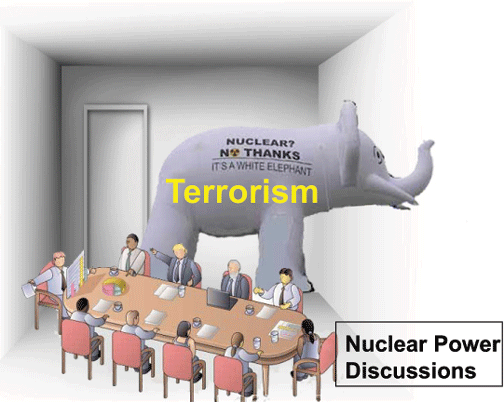
 A threat to confront: far-right extremists and nuclear terrorism, Bulletin of the Atomic Scientists By Rebecca L. Earnhardt, Brendan Hyatt, Nickolas Roth | January 14, 2021 Last March, neo-Nazi Timothy Wilson was killed during a shootout as he was planning to bomb a hospital treating COVID-19 patients. Like other neo-Nazis, Wilson viewed the pandemic and increased unrest among the American public as an opportunity to popularize Nazi ideas, spark further chaos, and accelerate societal collapse.[1] This past week, Ashli Babbitt was shot and killed while storming the US Capitol as part of a right-wing uprising; several years earlier, she was an employee of the Calvert Cliffs nuclear plant, exhibiting violent behavior during this period. [2] Acts of violence by far-right extremists are on the rise in the United States. Until now, most of these incidents have lacked sophistication, but a critical question for national security experts is whether US far-right extremist groups that espouse violence can carry out something catastrophic. Every president serving in the last two decades has said that nuclear terrorism is a significant national security threat. Analysis of this threat has been, for good reason, mostly focused on foreign extremist groups, but recent events raise questions of whether there should be greater focus in the United States on far-right, domestic extremist threats. These extremists represent a unique danger because of their prevalence in federal institutions such as the military and the potential that they might infiltrate nuclear facilities, where they could access sensitive information and nuclear materials. The far-right extremist nuclear terrorism threat, which has some history, is amplified today by an ideology focused on accelerating the collapse of society and a documented interest in pursuing nuclear terrorism. Officials need to act decisively to better understand and mitigate this threat. Far-right narratives of nuclear terror. The intersection between violent far-right extremist ideology and catastrophic terrorism goes back decades. In The Turner Diaries, a 1978 novel labeled the “bible of the racist right,” the protagonists use acts of nuclear terror in service of the creation of a “white world.” Protagonists bomb nuclear installations, seize nuclear weapons, target missiles at New York City and Tel Aviv, and ultimately destroy the Pentagon in a suicidal nuclear attack.[3] The International Centre for Counterterrorism ties the Diaries to “at least 200 murders and at least 40 terrorist attacks/hate crimes” in the last 40 years.[4] This includes Timothy McVeigh’s 1995 bombing of the Alfred P. Murrah Federal Building in Oklahoma City, resulting in the deaths of 168 people.[5] McVeigh, however, is not the only far-right terrorist to be inspired by the Diaries. In 2011, violent far-right extremist Anders Breivik’s terror attacks killed 77 people in Norway. Dozens of pages in his 1,500-page “manifesto” discuss the execution of different acts of nuclear terrorism.[6] An increasingly active generation of violent far-right extremist groups and actors have adopted an especially dangerous ideology that is compatible with an act of nuclear terror: accelerationism.[7] Violent far-right extremists who adopt accelerationism view societal collapse as inevitable and seek to hasten that collapse in service of “total revolution”—the complete destruction of the existing system of governance.[8] Violent far-right extremists who adopt accelerationism hope to set off a series of violent chain events, with violence begetting more violence, destabilizing society.[9] Indiscriminate, highly destructive acts of terror—like a nuclear attack—are therefore perfect tools to sow chaos and accelerate this societal collapse. In Siege, one of the defining theoretical works of violent far-right accelerationism, author and accelerationist leader James Mason writes that, “[White supremacists] will be the single survivor in a war against the System, a TOTAL WAR against the System.”[10] In a recent act of violent far-right extremist terrorism, Brenton Tarrant, the Australian perpetrator of the 2019 terrorist attack on Christchurch masjidain in New Zealand, wrote about accelerationism in his manifesto.[11] Groups with nuclear interests. Inspired by the ideas of accelerationism, the modern breed of violent far-right extremism is becoming more destructive, and nuclear weapons certainly fit into this profile of catastrophic violence. The intention to bring about a cataclysmic clash of civilizations bears resemblance to better known terrorist organizations like Al Qaeda and Aum Shinrikyo, both of which have pursued nuclear weapons. As director of intelligence and counterintelligence at the US Department of Energy, Rolf Mowatt-Larssen, once observed, “Osama bin Ladin has signaled a specific purpose for using WMD in al Qaeda’s quest to destroy the global status quo, and to create conditions more conducive to the overthrow of apostate regimes throughout the Islamic world.”[12] Like Al-Qaeda, violent far-right extremists support the creation of a new society that is in line with their own ideology. One of the most notable and violent far-right extremist groups that have adopted accelerationism and operate in the United States is the Atomwaffen Division (AWD).[13] The organization’s name translates from German to “the nuclear weapons division,” indicating that its members have an explicit interest in nuclear terrorism. Brandon Russel, a former Florida National Guard member and an AWD co-founder, is one case of an aspiring nuclear terrorist. A heavily armed Russel and a fellow AWD member were recently arrested while in route to the Turkey Point nuclear power plant. During the investigation officials found that Russel lived in an apartment with two AWD co-conspirators; in the apartment was a prominently placed copy of the Turner Diaries and a framed photo of Oklahoma City Bomber Timothy McVeigh. The trio stockpiled weapons and explosives with the intent to blow up, among other targets, a nuclear power plant. In their apartment, police found pipe bomb components, traces of the explosive hexamethylene triperoxide diamine, and detonators. Police also detected two radioactive materials—thorium and americium—in his bedroom.[14] AWD was not the first far-right extremist in America to consider using radioactive or nuclear materials in a terrorist attack. Several previously documented attempts by violent far-right extremists to commit acts of radiological terror indicate a longstanding interest among far-right actors in highly destructive, non-conventional acts of terror.[15] In 2004, National Socialist Movement member Demetrius Van Crocker attempted to build a dirty bomb to blow up a courthouse.[16] In 2008, James Cummings, a white supremacist, obtained four 1-gallon containers of a mix of depleted uranium and thorium-232. He planned to use these materials to assemble a dirty bomb.[17] In 2013, a member of the Ku Klux Klan who worked at General Electric carried out research on radiation dispersal devices, learning what level of emission was required to kill humans.[18] Could they really pull it off? While some violent far-right extremists are clearly motivated to carry out catastrophic terrorist attacks, a question remains: Do they possess the means and opportunity to conduct an act of nuclear terrorism? There is no public evidence violent far-right extremist groups have obtained the resources or exhibited the requisite operational sophistication to carry out an act of nuclear terrorism. Many of the plots involving far-right extremists and nuclear terrorism have been poorly conceived and were unlikely to succeed. These incidents, however, likely do not provide a complete picture of the threat, because publicly accessible information on the capability of these groups is limited, creating ambiguity about their general capabilities………. The most concerning evidence that violent far-right extremists might have access to nuclear weapons or weapons-useable material lies in their presence in the US military and other parts of the federal government. The presence of white supremacists in the military is well-known and well-documented. ……….. https://thebulletin.org/2021/01/a-threat-to-confront-far-right-extremists-and-nuclear-terrorism/
|
|
Why Japanese people should say ‘Sayonara’ to nuclear energy- a nun’s voice for nuclear victims

Sister Reiley, who has served as a missioner in Japan since 1968, was referring to the accident at Fukushima-Daichi Nuclear plant, which occurred on March 11, 2011. The accident was triggered by a devastating tsunami that followed a powerful 9.0 earthquake that hit a large part of Japan’s northern coast.
The quake and tsunami left more than 18,000 people dead or missing and hundreds of thousands of houses and businesses destroyed, according to Japan’s National Police Agency. More than 160,000 people fled the region near the nuclear plant because of the meltdown and more than 40,000 are still unable to return home due to radiation contamination.
Last June, Sister Reiley took the 3.5-hour train ride from Tokyo, where she lives, to Fukushima to give this Maryknoll reporter a tour around Haramachi, a town near where the Fukushima-Daichi nuclear accident happened.
The area had the feeling of a sci-fi apocalyptic movie: A ghost town with abandoned farmlands that could not be used; streets blocked with fences and no-trespassing signs; decaying houses damaged by the earthquake that cannot be repaired because they are contaminated; Geiger counter boxes under the street signs to measure the level of radioactivity; thousands of huge black vinyl bags filled with radioactive dirt; security guards wearing masks and radioactive protective gear at checkpoints, only allowing entrance to radioactive waste cleaning crews—many of them immigrants who are temporarily hired to do a job that could harm their health. …….
Sister Reiley has striven to show God’s love for the people by speaking out against nuclear energy in a country whose 52 nuclear plants, she believes, pose an enormous threat to human life.
After the triple disaster in 2011, Sister Reiley responded to the Japanese Catholic Church’s call for volunteers. “Initially I went several times a year to several different Japan Caritas bases wherever the need was at the time,” says Sister Reiley. “But gradually towns far away from the reactor returned to normal, (except) Haramachi where the need is still great for the elderly, differently abled and those people in a low economic bracket. They don’t have the means to move away from the reactor area.”
…….. Her concern about nuclear energy began in 1979 in her native Schuylkill County, Pa. She was visiting home from her mission in Japan when there was a reactor meltdown at the Three Mile Island nuclear plant in nearby Dauphin County. It is considered the most serious nuclear accident in U.S. history, according to the U.S. Nuclear Regulatory Commission.
“We’re poisoning our earth,” Sister Reiley remembers her father saying shortly after the nuclear accident.
“In 1999, there was a nuclear accident at the Tokaimura [nuclear facility] in Ibaraki Prefecture,” Sister Reiley says. “About two years after that accident happened, I asked the families [at the cancer hospital], ‘Where are you from?’ ‘Ibaraki.’ ‘Where are you from?’ ‘Ibaraki.’”
Out of the 24 beds for children with cancer at the hospital, at the time, seven children were from Ibaraki, explains the missioner. “But nobody can document that and say absolutely, ‘that’s why [the nuclear accident] they got cancer’.”
Still, the missioner works tirelessly to raise awareness about the dangers in nuclear energy Nearly 25 years after the 1986 nuclear accident in Chernobyl, in the former Soviet Union, Sister Reiley read an article, in a Japanese newspaper, about the high incidences of cancer linked to the nuclear accident. The report cited a study conducted by an international team of researchers led by the National Cancer Institute. That gave the Maryknoll sister an opportunity to question what happened at the nuclear facility in Japan. She visited the newspaper headquarters to speak to the editors.
“Won’t you please do some research about Tokaimura? About the accident that happened in Ibaraki?” she asked. The paper did not respond to her request. She was undaunted.
That sombre day in June in Haramachi, as we drove back to the train station, we saw a farm with cattle and stopped for a lesson from Sister Reiley. She explained that the government had asked the owner to kill the cattle. The cows’ milk could not be sold nor could the cows be slaughtered to sell their meat because they were contaminated. The cows, she continued, were innocent victims of problems caused by human beings.
“But this wonderful man asked the government to let the cows live a natural life and die a natural death,” says Sister Reiley.
Then she translated a sign at the cattle ranch. “We lived here with no fear of nuclear energy and now we realise that we lost something that can never be returned to us and we want people to understand that we have to say sayonara, goodbye, to nuclear energy.” https://catholicoutlook.org/jana-voice-for-nuclear-victims/
Big doubts on small nuclear reactors – on economics, on waste problems
 Former U.S. regulator questions small nuclear reactor technology, Business case for small reactors ‘doesn’t fly,’ says expert on nuclear waste, Jacques Poitras · CBC News Jan 15, 2021 A former head of the United States’ nuclear regulator is raising questions about the molten-salt technology that would be used in one model of proposed New Brunswick-made nuclear reactors.
The technology pitched by Saint John’s Moltex Energy is key to its business case because, the company argues, it would reuse some of the nuclear waste from Point Lepreau and lower the long-term cost and radioactivity of storing the remainder.
But Allison Macfarlane, the former chairperson of the U.S. Nuclear Regulatory Commission and a specialist in the storage of nuclear waste, said no one has yet proven that it’s possible or viable to reprocess nuclear waste and lower the cost and risks of storage.
“Nobody knows what the numbers are, and anybody who gives you numbers is selling you a bridge to nowhere because they don’t know,” said Macfarlane, now the director of the School of Public Policy and Global Affairs at the University of British Columbia.
“Nobody’s really doing this right now. … Nobody has ever set up a molten salt reactor and used it to produce electricity.”
Macfarlane said she couldn’t comment specifically on Moltex, calling information about the company’s technology “very vague.”
But she said the general selling point for molten-salt technology is dubious.
“Nobody’s been able to answer my questions yet on what all these wastes are and how much of them there are, and how heat-producing they are and what their compositions are,” she said.
“My sense is that all of these reactor folks have not really paid a lot of attention to the back end of these fuel cycles,” she said, referring to the long-term risks and costs of securely storing nuclear waste.
Moltex is one of two Saint John-based companies pitching small nuclear reactors as the next step for nuclear power in the province and as a non-carbon-dioxide emitting alternative to fossil fuel electricity generation.
Moltex North America CEO Rory O’Sullivan said the company’s technology will allow it to affordably extract the most radioactive parts of the existing nuclear waste from the Point Lepreau Generating Station.
The waste is now stored in pellet form in silos near the plant and is inspected regularly.
The process would remove less than one per cent of the material to fuel the Moltex reactor and O’Sullivan said that would make the remainder less radioactive for a much shorter amount of time.
Existing plans for nuclear waste in Canada are to store it in an eventual permanent repository deep underground, where it would be secure for the hundreds of thousands of years it remained radioactive………..
Shorter-term radioactivity complicates storage
Macfarlane said a shorter-term radioactivity life for waste would actually complicate its storage underground because it might lead to a facility that has to be funded and secured rather than sealed up and abandoned.
“That means that you believe that the institutions that exist to keep monitoring that … will exist for hundreds of years, and I think that is a ridiculous assumption,” she said.
“I’m looking at the United States, I’m seeing institutions crumbling in a matter of a few years. I have no faith that institutions can last that long and that there will be streams of money to maintain the safety and security of these facilities. That’s why you will need a deep geologic repository for this material.”
And she said that’s assuming the technology will successfully extract all of the most radioactive material.
“They are assuming that they remove one hundred per cent of the difficult, radionuclides, the difficult isotopes, that complicate the waste,” she said.
“My response is: prove it. Because if you leave five per cent, you have high-level waste that you’re going to be dealing with. If you leave one per cent, you’re going to have high-level waste that you’re going to be dealing with. So sorry, that one doesn’t fly with me.”
Macfarlane, a geologist by training, raised doubts about molten-salt technology and waste issues in a 2018 paper she co-authored for the Bulletin of the Atomic Scientists………. https://www.cbc.ca/news/canada/new-brunswick/nuclear-waste-reactors-new-brunswick-allison-macfarlane-moltex-arc-1.5873542
1 This Month

Tell Congress: Prevent Nuclear Catastrophe in Iran

Tell Congress: Prevent Nuclear Catastrophe in Iran

Read the Public Inquiry Report, the Commissioners’ report, Surrendering Australia: The AUKUS Deception is available to download for free at aukuspublicinquiry.com. Or just watch the replay of the National Press Club Luncheon.


Shut down the radiation-damaged Heysham nuclear reactors now
To see nuclear-related stories in greater depth and intensity – go to https://nuclearinformation.wordpress.com

Say No to NASA’s Reckless Nuclear Reactor on the Moon
Say No to NASA’s Reckless Nuclear Reactor on the Moon
-
Archives
- November 2026 (256)
- October 2026 (302)
- September 2026 (339)
- August 2026 (330)
- July 2026 (355)
- June 2026 (287)
- May 2026 (306)
- April 2026 (356)
- March 2026 (251)
- February 2026 (267)
- January 2026 (308)
- December 2025 (358)
-
Categories
- 1
- 1 NUCLEAR ISSUES
- business and costs
- climate change
- culture and arts
- ENERGY
- environment
- health
- history
- indigenous issues
- Legal
- marketing of nuclear
- media
- opposition to nuclear
- PERSONAL STORIES
- politics
- politics international
- Religion and ethics
- safety
- secrets,lies and civil liberties
- spinbuster
- technology
- Uranium
- wastes
- weapons and war
- Women
- 2 WORLD
- ACTION
- AFRICA
- Atrocities
- AUSTRALIA
- Christina's notes
- Christina's themes
- culture and arts
- Events
- Fuk 2022
- Fuk 2023
- Fukushima 2017
- Fukushima 2018
- fukushima 2019
- Fukushima 2020
- Fukushima 2021
- general
- global warming
- Humour (God we need it)
- Nuclear
- RARE EARTHS
- Reference
- resources – print
- Resources -audiovicual
- Weekly Newsletter
- World
- World Nuclear
- YouTube
-
RSS
Entries RSS
Comments RSS

