New highly radioactive particles found in Fukushima

Date: February 17, 2021 Source: University of Helsinki Summary: The 10 year anniversary of the Fukushima Daiichi nuclear accident occurs in March. Recent work documents new, large (> 300 micrometers), highly radioactive particles that were released from one of the damaged Fukushima reactors.
The 10 year anniversary of the Fukushima Daiichi nuclear accident occurs in March. Work just published in the Journal ‘Science of the Total Environment’ documents new, large (> 300 micrometers), highly radioactive particles that were released from one of the damaged Fukushima reactors.
Particles containing radioactive cesium (134+137Cs) were released from the damaged reactors at the Fukushima Daiichi Nuclear Power Plant (FDNPP) during the 2011 nuclear disaster. Small (micrometer-sized) particles (known as CsMPs) were widely distributed, reaching as far as Tokyo. CsMPs have been the subject of many studies in recent years. However, it recently became apparent that larger (>300 micrometers) Cs-containing particles, with much higher levels of activity (~ 105 Bq), were also released from reactor unit 1 that suffered a hydrogen explosion. These particles were deposited within a narrow zone that stretches ~8 km north-northwest of the reactor site. To date, little is known about the composition of these larger particles and their potential environmental and human health impacts.
Now, work just published in the journal Science of the Total Environment characterizes these larger particles at the atomic-scale and reports high levels of activity that exceed 105 Bq.
The particles, reported in the study, were found during a survey of surface soils 3.9 km north-northwest of reactor unit 1.
From 31 Cs-particles collected during the sampling campaign, two have given the highest ever particle-associated 134+137Cs activities for materials emitted from the FDNPP (specifically: 6.1 × 10⁵ and 2.5 × 10⁶ Bq, respectively, for the particles, after decay-correction to the date of the FDNPP accident).
The study involved scientists from Japan, Finland, France, the UK, and USA, and was led by Dr. Satoshi Utsunomiya and graduate student Kazuya Morooka (Department of Chemistry, Kyushu University). The team used a combination of advanced analytical techniques (synchrotron-based nano-focus X-ray analysis, secondary ion mass spectrometry, and high-resolution transmission electron microscopy) to fully characterize the particles. The particle with a 134+137Cs activity of 6.1 × 10⁵ Bq was found to be an aggregate of smaller, flakey silicate nanoparticles, which had a glass like structure. This particle likely came from reactor building materials, which were damaged during the Unit 1 hydrogen explosion; then, as the particle formed, it likely adsorbed Cs that had had been volatized from the reactor fuel. The 134+137Cs activity of the other particle exceeded 106 Bq. This particle had a glassy carbon core and a surface that was embedded with other micro-particles, which included a Pb-Sn alloy, fibrous Al-silicate, Ca-carbonate / hydroxide, and quartz.
The composition of the surface embedded micro-particles likely reflect the composition of airborne particles within the reactor building at the moment of the hydrogen explosion, thus providing a forensic window into the events of March 11th 2011. Utsunomiya added, “The new particles from regions close to the damaged reactor provide valuable forensic clues. They give snap-shots of the atmospheric conditions in the reactor building at the time of the hydrogen explosion, and of the physio-chemical phenomena that occurred during reactor meltdown.” He continued, “whilst nearly ten years have passed since the accident, the importance of scientific insights has never been more critical. Clean-up and repatriation of residents continues and a thorough understanding of the contamination forms and their distribution is important for risk assessment and public trust.
Professor Gareth Law (co-author, University of Helsinki) added, “clean-up and decommissioning efforts at the site face difficult challenges, particularly the removal and safe management of accident debris that has very high levels of radioactivity. Therein, prior knowledge of debris composition can help inform safe management approaches.”
Given the high radioactivity associated with the new particles, the project team were also interested in understanding their potential health / dose impacts.
Dr Utsunomiya stated, “Owing to their large size, the health effects of the new particles are likely limited to external radiation hazards during static contact with skin. As such, despite the very high level of activity, we expect that the particles would have negligible health impacts for humans as they would not easily adhere to the skin. However, we do need to consider possible effects on the other living creatures such as filter feeders in habitats surrounding Fukushima Daiichi. Even though ten years have nearly passed, the half-life of 137Cs is ~30 years. So, the activity in the newly found highly radioactive particles has not yet decayed significantly. As such, they will remain in the environment for many decades to come, and this type of particle could occasionally still be found in radiation hot spots.”
Professor Rod Ewing (co-author from Stanford University) stated “this paper is part of a series of publications that provide a detailed picture of the material emitted during the Fukushima Daiichi reactor meltdowns. This is exactly the type of work required for remediation and an understanding of long-term health effects.”
Professor Bernd Grambow (co-author from IMT Atlantique) added “the present work, using cutting-edge analytical tools, gives only a very small insight in the very large diversity of particles released during the nuclear accident, much more work is necessary to get a realistic picture of the highly heterogeneous environmental and health impact.”
Story Source:
Materials provided by University of Helsinki. Note: Content may be edited for style and length.
Journal Reference:
- Kazuya Morooka, Eitaro Kurihara, Masato Takehara, Ryu Takami, Kazuki Fueda, Kenji Horie, Mami Takehara, Shinya Yamasaki, Toshihiko Ohnuki, Bernd Grambow, Gareth T.W. Law, Joyce W.L. Ang, William R. Bower, Julia Parker, Rodney C. Ewing, Satoshi Utsunomiya. New highly radioactive particles derived from Fukushima Daiichi Reactor Unit 1: Properties and environmental impacts. Science of The Total Environment, 2021; 773: 145639 DOI: 10.1016/j.scitotenv.2021.145639
https://www.sciencedaily.com/releases/2021/02/210217134852.htm
Korean, Japanese bishops oppose discharge from Fukushima plant
Scientists, environmentalists and fishing groups are against the idea of releasing contaminated water into the sea

February 17, 2021
Catholic bishops in South Korea and Japan have issued a joint statement to strongly oppose the Japanese government’s decision to discharge radioactive water from the damaged Fukushima nuclear power plant into the sea.
Following years of debate over the disposal of the liquid which includes water used to cool the Fukushima Daiichi plant that was hit by a massive tsunami and earthquake in 2011, Japanese authorities have decided to release a million tonnes of treated water into the sea.
The initial plan was to start releasing the water from 2022 but a final decision has not been made, according to Japanese media.
Most of the radioactive isotopes have been removed using a complex filtration process. But one isotope, tritium, cannot be removed, so water has been stored in huge tanks that will fill up by 2022, the BBC reported.
Scientists, environmentalists and fishing groups have opposed the idea of releasing contaminated water into the sea, citing possible risks.
“We oppose the discharge of tritium-containing water, a radioactive material that has been purified and treated, into the ocean,” said a joint statement from the Justice and Peace Commissions of the bishops’ conferences of Korea and Japan, the Korean bishops’ ecological and environmental committee and the Japanese bishops’ subcommittee on nuclear for peace.
The statement has been signed by heads of each organization and concerns have been raised about the direct impact of the contaminated water on public health and marine life.
“The water contains tritium, which is a radioactive material, purified through the contaminated water treatment system of the Fukushima plant. Secondary treatment of radionuclides remaining in the treated water is still in the testing stage, and no definite results have been obtained,” the statement said.
The statement also pointed out that the report from the Japanese government did not mention the effects of the treated water on marine life, the marine environment and human health.
“Once released into the sea, radioactive material cannot be restored to its original state. It will have impacts on humans and nature. It will cause greater anxiety and damage to people around the world.”
In a separate statement, the Korean bishops’ ecological and environmental committee expressed concerns about the recent tritium leak at the Wolseong nuclear power plant in Gyeongju in South Korea.
On Jan. 7, Korean media reported on radioactivity leaking from the plant, prompting Korea Hydro and Nuclear Power Company to investigate. The initial results exposed a wide range of radioactive contamination in the plant and adjacent areas
The Korean Church demanded the government “conduct a thorough and transparent investigation into the leakage and immediate follow-up measures for radioactive leaks in all nuclear power plants.”
Japan’s Fukushima Meltdowns (New Video): Much Still Unknown 10 Years Later

By The Fairewinds Crew
February 17, 2021
As we approach the 10th commemoration of Japan’s March 11, 2011, Fukushima Dai-ichi triple meltdowns, organizations around the globe, including environmental groups, nonprofits (like Fairewinds Energy Education), engineering and pronuclear organizations, and media organizations like Japan’s Nippon TV, will release new information.
Some of this information is really new and recently uncovered. Other media events will bring people together to share and discuss what these major meltdowns meant to the people of Japan and communities worldwide. And sometimes, these media events are just a corporation or an agency marketing new nukes by putting their positive spin on nuclear power rather than acknowledging its dangers. For example, nuclear zealots continue to claim that atomic power reactors are safer for workers than working at Toys R Us, and reactors cannot meltdown and certainly will never blow up. The Fukushima disaster proved them wrong, but yet they persist!
As Fukushima Daichi Units One, Two, and Three were melting down, Nippon TV, the largest and flagship station of the Nippon Television Network System, dispatched television film crews to monitor the events as they unfolded. No one in the world has ever captured the core melting down, but Nippon TV captured two meltdown-induced explosions on film.
Now, Nippon TV has just released a new digital copy of the Fukushima Dai-ichi Unit One and Unit Three explosions.
At Fairewinds, we congratulate Nippon for the excellent work they did to create the original initial explosion footage in 2011 and on this essential remastered copy just completed in 2021. Nippon’s newly released digital footage is important historically and technically.
That said, the new video footage and Nippon’s ensuing interview with Tokyo Electric Company (TEPCO), the atomic power corporation that owns all six Fukushima Dai-ichi nuclear power plants, contain three glaring technical errors.
- First, Fairewinds continues to have significant concerns about TEPCO’s technical interpretations of these explosions’ cause.
- Second, TEPCO is blaming newly uncovered lethal radioactivity sitting at the top of the containment structure on the supersonic shockwave.
- Third, TEPCO does not discuss that there likely was a second explosion that occurred 3 seconds after the first.
Understanding the mechanics behind explosions is critical to understanding what happened at Fukushima and what such a danger means to nuclear power anywhere in the world.
- There are two explosion methods: a deflagration shock wave, which happened at Fukushima Unit One and Three Mile Island in Middletown, Pennsylvania, in the United States. While still destructive, a deflagration shockwave travels at subsonic speeds (less than 760 miles an hour, the speed of sound).
- The second type of explosion is called a detonation shockwave. It is much more destructive because it travels at supersonic speeds. In 2011, with Geoff Sutton’s assistance from the United Kingdom, Fairewinds clearly showed that the Unit Three explosion was the more destructive detonation shockwave while Unit One’s was a deflagration.
Does it matter whether or not an explosion at Fukushima was a detonation or a deflagration? Absolutely! Hydrogen gas at room (atmospheric) pressure cannot create a supersonic shockwave. Fairewinds’s 2011 findings that a detonation shockwave occurred should have changed the scientific and nuclear engineering analyses of such events worldwide.
No nuclear power radioactive release containment system built anywhere in the world will withstand a detonation shockwave!
The fact that a detonation shockwave did occur is something the nuclear industry has ignored since Fairewinds’ Arnie Gundersen and Geoff Sutton identified it did happen at Fukushima Unit Three in 2011.
The nuke industry and its regulatory handlers do not believe that a supersonic shockwave explosion will ever happen in a nuclear power plant. If they admitted that an atomic reactor containment system would fail by Does it matter whether or not an explosion at Fukushima was a detonation or a deflagration? Absolutely! Hydrogen gas at room (atmospheric) pressure cannot create a supersonic shockwave. Fairewinds’s 2011 findings that a detonation shockwave occurred should have changed the scientific and nuclear engineering analyses of such events worldwide.
No nuclear power radioactive release containment system built anywhere in the world will withstand a detonation shockwave!
The fact that a detonation shockwave did occur is something the nuclear industry has ignored since Fairewinds’ Arnie Gundersen and Geoff Sutton identified it did happen at Fukushima Unit Three in 2011.
The nuke industry and its regulatory handlers do not believe that a supersonic shockwave explosion will ever happen in a nuclear power plant. If they admitted that an atomic reactor containment system would fail by detonation, the nuke industry would also have to acknowledge that nuke plants’ containment systems are not failsafe. Nuclear power containment systems will fail when there is a supersonic shockwave explosion.
The supposedly failsafe containment system at Fukushima Dai-ichi Unit Three failed and released massive amounts of radioactivity into the local environment and the worldwide atmosphere. Such an enormous human tragedy will happen again at an atomic power reactor somewhere in the world.
Think about that. No nuke in the world can withstand a supersonic shockwave, and here is the evidence on international TV and across the Internet that it occurred in 2011, as Fairewinds said.
Fairewinds second area of concern about TEPCO’s analysis on this latest NIPPON video is the linkage of recently discovered lethal radiation levels at the top of the containment to the supersonic detonation. Ten years ago, immediately following the three meltdowns at Fukushima in 2011, Fairewinds identified superheated highly radioactive gases escaping from this same area that TEPCO suddenly claims it has just uncovered in 2021. The containment was leaking before the explosion and continued to spread radioactivity after the blast. Still, no nuclear engineer or scientist is surprised that significant contamination continues to leak from the damaged containment system. The containment was breached, which allowed this radiation to leak! However, there is no evidence to suggest that the explosion is the cause of that leak since the containment was leaking before the supersonic shockwave.
Finally, Nippon’s remastered video vividly shows Fairewinds’ third concern. The eye is drawn to the detonation’s sudden flash and the ensuing upward-moving black cloud of rubble. Now, look again. About three seconds after the initial vertical blast, a white cloud suddenly moves horizontally at ground level to the north.
Detonation, the nuke industry would also have to acknowledge that nuke plants’ containment systems are not failsafe. Nuclear power containment systems will fail when there is a supersonic shockwave explosion.
The supposedly failsafe containment system at Fukushima Dai-ichi Unit Three failed and released massive amounts of radioactivity into the local environment and the worldwide atmosphere. Such an enormous human tragedy will happen again at an atomic power reactor somewhere in the world.
Think about that. No nuke in the world can withstand a supersonic shockwave, and here is the evidence on international TV and across the Internet that it occurred in 2011, as Fairewinds said.
Fairewinds second area of concern about TEPCO’s analysis on this latest NIPPON video is the linkage of recently discovered lethal radiation levels at the top of the containment to the supersonic detonation. Ten years ago, immediately following the three meltdowns at Fukushima in 2011, Fairewinds identified superheated highly radioactive gases escaping from this same area that TEPCO suddenly claims it has just uncovered in 2021. The containment was leaking before the explosion and continued to spread radioactivity after the blast. Still, no nuclear engineer or scientist is surprised that significant contamination continues to leak from the damaged containment system. The containment was breached, which allowed this radiation to leak! However, there is no evidence to suggest that the explosion is the cause of that leak since the containment was leaking before the supersonic shockwave.
Finally, Nippon’s remastered video vividly shows Fairewinds’ third concern. The eye is drawn to the detonation’s sudden flash and the ensuing upward-moving black cloud of rubble. Now, look again. About three seconds after the initial vertical blast, a white cloud suddenly moves horizontally at ground level to the north.

Community-volunteer citizen-scientists Arnie met while collecting radioactive samples in Fukushima prefecture say they heard more than one explosion. They said it sounded like the snapping of bamboo burning in a fire. This new video shows that there were at least two explosions, one vertically and one horizontally. As more data becomes available, Fairewinds Energy Education will put forward the reasons why, but as of now, the entire explosion sequence at Fukushima Unit Three is something the nuclear industry zealots want to ignore. They continue to hope that history will not repeat itself while they continue to build and operate more lethally radioactive and highly risky atomic reactors.
Throughout the Nippon video, the announcer reverentially refers to TEPCO and the Japanese Regulators as “the authorities” and “officials”. This kind of public propaganda occurs because TEPCO, the Japanese Government and its regulators, and the International Atomic Energy Agency (IAEA) have successfully captured the Japanese media.
What was called for in 2011 and is still desperately required in 2021 are independent experts. These would be people from outside TEPCO, its captive regulators, or its allies embedded in the nuclear industry. Once again, Fairewinds calls for an independent consortium of experts who would be able to give a frank assessment of the magnitude and extent of the problems that lie ahead for the failed Fukushima cleanup.
Did you know that in 2013, Fairewinds and 16 other international experts coauthored a letter to the United Nations (UN) asking it to establish this independent panel? The UN never had the courtesy even to acknowledge that it received these serious requests and recommendations. Such machinations by TEPCO, the Japanese Government, and the international nuclear industry are indeed a human rights and environmental injustice issue!
Ten years have passed, yet Japan’s citizens still wait for independent oversight of the Fukushima disaster. The people of Japan deserve better than the authorities covering up the truth and lying to them.
Japan town mayor OKs restarting nuclear reactor over 40 years old
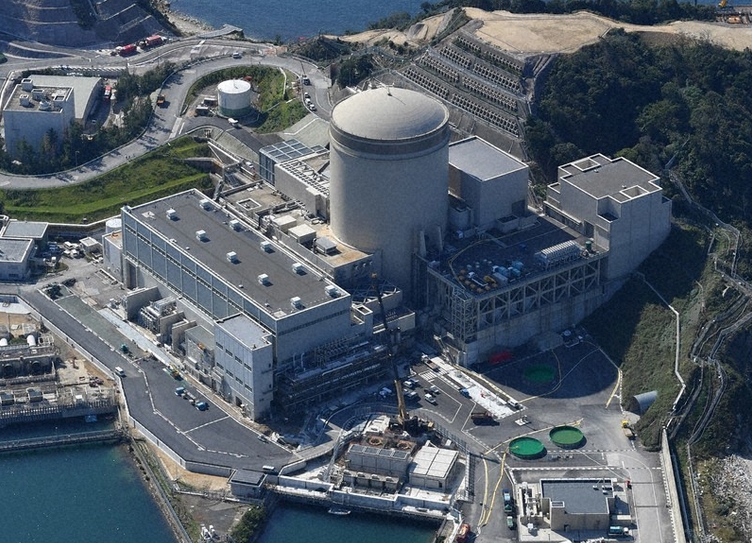
The No. 3 reactor at Kansai Electric Power Co.’s Mihama Nuclear Power Station is seen from a Mainichi Shimbun helicopter on Oct. 20, 2020.
February 16, 2021
TSURUGA, Fukui — The mayor of a central Japan town hosting a nuclear power plant operated by Kansai Electric Power Co. informed the speaker of the municipal assembly on Feb. 15 that he would approve the restart of a reactor at the plant that is more than 40 years old.
Mayor Hideki Toshima of the Fukui Prefecture town of Mihama told Mihama Municipal Assembly Speaker Yoshihiro Takenaka that he would approve the restart of the No. 3 reactor at Mihama Nuclear Power Station, which began operating in the 1970s. The assembly had already approved the reactivation of the aging reactor.
Meanwhile, Mayor Yutaka Nose of the prefectural town of Takahama, home to Kansai Electric’s Takahama Nuclear Power Station, whose No. 1 and 2 reactors are also over 40 years old, has given the green light for resuming the operations of the two rectors, while the Takahama Municipal Assembly has also approved of the move.
Now that local consent has been secured, the focus has shifted to the decisions expected from Gov. Tatsuji Sugimoto and the prefectural assembly.
The Mihama plant’s No. 3 reactor went online in December 1976. In response to the meltdowns at Tokyo Electric Power Co.’s Fukushima Daiichi Nuclear Power Station following the March 2011 Great East Japan Earthquake and tsunami, the Japanese government limited the operational life of nuclear reactors to “40 years in principle” in July 2013, while allowing a one-time extension of up to 20 years if the reactor fulfilled safety standards. The No. 3 reactor at the Mihama power station, along with the No. 1 and No. 2 rectors at the Takahama plant, have passed screening by the Nuclear Regulation Authority.
Mayor Toshima said on Feb. 15 that conditions to approve the restart “have all been met, including understanding from the townspeople and consent from the municipal assembly, as well as promising feedback over regional development by the central government and Kansai Electric.” He added, “Both supporters and skeptics of the reactor restart are concerned about its safety. I will make sure to pay attention to the process.”
Toshima had spoken with Economy, Trade and Industry Minister Hiroshi Kajiyama online three days prior. He had then expressed his intension to approve the reactivation, saying that the central government had given him positive responses about regional development and other measures he had requested.
As a general rule, a nuclear power plant operator is expected to obtain consent for restarting a rector from the local governments around the plant as well as local assemblies. As a condition for approving the restart, the Fukui Prefectural Government said Kansai Electric would need to present candidate sites outside the prefecture for interim spent nuclear fuel storage facilities. The prefectural government maintained that until that condition was achieved, the parties were “not even at the starting line of discussion.”
However, after Kansai Electric proposed on Feb. 12 that it would finalize a planned site for the storage facilities by the end of 2023, the prefectural government demonstrated a positive attitude toward reactivation. Discussion on restarting the aging reactor may develop further at the prefectural assembly session convening on Feb. 16.
https://mainichi.jp/english/articles/20210216/p2a/00m/0na/008000c
Fukushima spillage raises questions about threat of future earthquakes
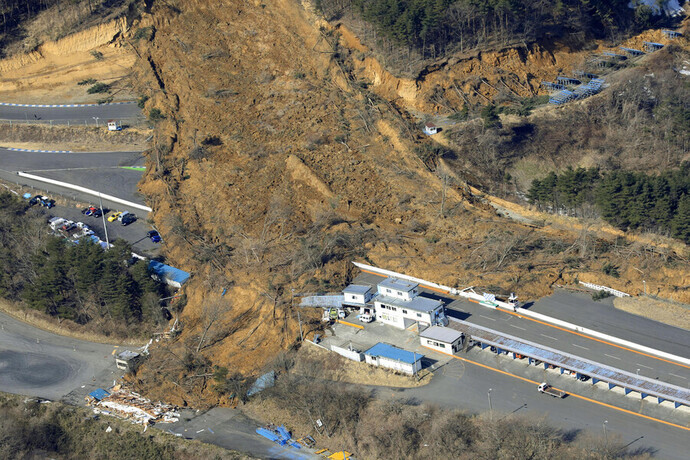
A road in Nihonmatsu has been blocked by a landslide on Feb. 14 following a 7.3-magnitude earthquake the day before in Japan’s Fukushima Prefecture.
Feb.16,2021
The occurrence of a 7.3-magnitude earthquake in the waters off of Fukushima on Feb. 13 is prompting growing concerns about the safety of the Fukushima Daiichi Nuclear Power Plant, as some mention the possibility of other quakes at a similar scale.
Experts said that with no way of knowing how large future earthquakes will be, swift preparations are needed to prevent damage to the plant.
According to reporting by Japan’s NHK television network on Feb. 15, the Japanese government’s Earthquake Survey Committee stressed the need to be on the alert over the next week or so for earthquakes at a “strong 6” on the Japanese seismic intensity scale. The warning suggested the possibility of additional quakes on par with the one on Feb. 13, which was a strong 6.
“We need to prepare,” the committee said, noting the possibility of eastern Japan being “ambushed by strong vibrations and/or a tsunami caused by a large-scale earthquake.”
In an interview with NHK, Tohoku University professor Shinji Toda said there was the “possibility of a 9.0-magnitude earthquake and tsunami occurring in the waters off of Fukushima and Miyagi, as well as the north and south of the area where the [2011 Tohoku] earthquake occurred 10 years ago and the area outside of the Japan Trench.”
Hong Tae-kyung, a professor of earth system sciences at Yonsei University, warned that the associated ground motion could be large relative to the scale of the earthquake itself.
“The scale of this earthquake was within a predictable level for the region, but the fact that the ground motion was so much larger gives pause,” he explained.
“Ground motion differs according to earthquake scale, sedimentary layer thickness, observation position and other factors, and it’s common for ground motion to be larger near the coast due to the sedimentary layer’s thickness. But even when you take all of that into account, the ground motion was very large,” he said.
“There’s a possibility the ground motion exceeded what the Fukushima nuclear power plant could withstand in terms of its design.”
With predictions that additional large-scale earthquakes could occur, observers are calling for swift preparations to prevent damage to the Fukushima plant. According to Kyodo News and other Japanese media, some spillage was determined to have occurred during the earthquake in tanks holding spent nuclear fuel at the upper layers of the No. 5 and 6 reactors at the Fukushima plant.
Japanese nuclear power authorities and the Tokyo Electric Power Company (TEPCO), which operates the plant, stated that there had been no radiation exposure as a result of the tank spillage.
Institute of Nuclear Safety director Han Byeong-seop agreed that the “nuclear power plant safety issues resulting from the earthquake were not at a concerning level,” but stressed the “need to prepare for a compound disaster in the wake of an earthquake.”
“The amount of water that spilled from the spent nuclear fuel in this earthquake was minute, so it wasn’t at a worrisome level, and there does not appear to have been any damage to the power plant,” he said.
“But with the Tohoku earthquake in 2011, there was major damage resulting from a compound disaster involving both an earthquake and tsunami, and there’s no way of predicting the scale of additional earthquakes that we might see this time,” he added.
“There need to be continued preparations for a compound disaster.”
Oh Chang-whan, a professor of earth and environmental sciences at Jeonbuk National University, said, “Nuclear power plants are designed to be safe during earthquakes, yet even so we saw issues with water spillage.”
“Nobody can predict for certain what kind of damage an earthquake or tsunami might cause. We need to prepare,” he urged.
http://english.hani.co.kr/arti/english_edition/e_international/983206.html
At the nuclear power plant in Fukushima found a leak of radioactive water
February 14, 2021
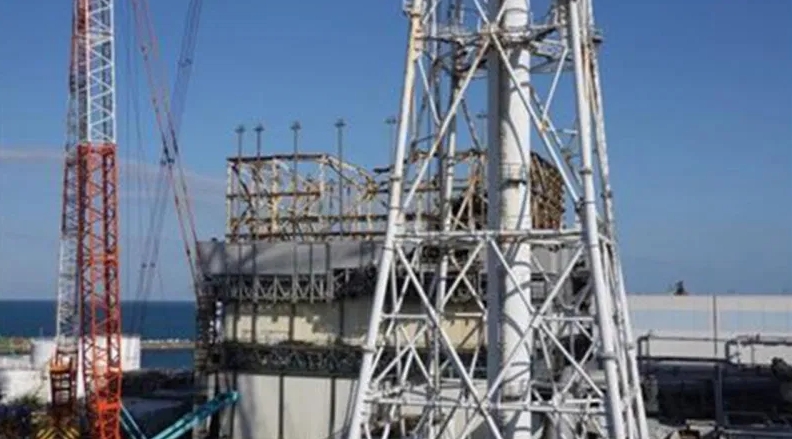
A radioactive water leak was discovered at the Fukushima nuclear power plant. It is reported by RIA Novosti citing a press release from TEPCO (Tokyo Electric Power Company).
TEPCO specialists found out that due to the earthquake in northeast Japan, a small amount of water poured out of the pools for storing spent nuclear fuel at various units of the Fukushima-1 and Fukushima-2 nuclear power plants.
Representatives of the company said that about 160 milliliters of water were spilled at the first power unit of the Fukushima-2 nuclear power plant, and another 1.4 liters spilled from another pool. They assured that this incident should not affect the cooling of the spent fuel. Local media also reported that about 600 milliliters of water spilled out at the fifth power unit of the emergency nuclear power plant “Fukushima-1”, and 1.6 liters of liquid at the sixth. Another 600 milliliters were missing in the common pool for the two power units.
It is noted that the spilled water does not pose a threat to the environment, since its volumes are too small, and the content of radioactive substances in it is insignificant.
Earlier it was reported that in northeast Japan happened powerful earthquake. The magnitude of the earthquake was 7.1, the epicenter was recorded in the area of Fukushima prefecture. The number of victims of the disaster exceeded 100 people.
Nuclear lobby planning to take over the U.N Climate Change Conference

Meet the Young Generation Network and its group of nuclear schills who will lead the attempted nuclear takeover of the 26th UN Climate Change Conference of the Parties (COP26) in Glasgow on 1 – 12 November 2021.
Just by chance? They all happen to be ambitious young people who hope to have a big career in the nuclear industry. Well, you can’t blame them for that. But let’s be wary of their advice on nuclear power as the solution for global heating.
Arun Khuttan. End States Engineer at Magnox Ltd.UKAlice Cunha da Silva. Latin America Nuclear Leader | Westinghouse Electric Company.
Hannah Paterson, Technology Manager at Sellafield Ltd UK
Matthew Mairinger Technical Engineer with Ontario Power Generation, Canada
Miguel Trenkel-Lopez Assistant Engineer at Magnox Ltd,Bristol, UK
Saralyn Thomas Formerly at AREVAnuclear company, now at Abbott Risk Consulting (ARC) Risk Management consultancy services to the Nuclear Industry
Vicki Dingwall of EDF nuclear company
Water leaks indicate new damage at Fukushima nuclear plant
 Water leaks indicate new damage at Fukushima nuclear plant By MARI YAMAGUCHI TOKYO (AP) — Cooling water levels have fallen in two reactors at the wrecked Fukushima nuclear plant since a powerful earthquake hit the area last weekend, indicating possible additional damage, its operator said Friday.
New damage could further complicate the plant’s already difficult decommissioning process, which is expected to take decades. Tokyo Electric Power Co. spokesman Keisuke Matsuo said the drop in water levels in the Unit 1 and 3 reactors indicates that the existing damage to their primary containment chambers was worsened by Saturday’s magnitude 7.3 quake, allowing more water to leak. The leaked water is believed to have remained inside the reactor buildings and there is no sign of any outside impact, he said. In 2011, a powerful magnitude 9.1 earthquake and tsunami damaged the Fukushima plant’s cooling systems, causing three reactor cores to melt and nuclear fuel to fall to the bottom of their primary containment vessels. TEPCO will monitor the water and temperatures at the bottom of the containment vessels, Matsuo said. Since the 2011 disaster, cooling water has been escaping constantly from the damaged primary containment vessels into the basements of the reactor buildings. To make up for the loss, additional cooling water has been pumped into the reactors to cool the melted fuel remaining inside them. The recent decline in the water levels indicates that more water than before is leaking out, TEPCO said…….. TEPCO initially reported that there was no abnormality at the plant from Saturday’s quake. Matsuo said the cooling water level fell as much as 70 centimeters (27 inches) in the primary containment chamber of the Unit 1 reactor and about 30 centimeters (11 inches) in Unit 3. TEPCO wasn’t able to determine any decline in Unit 2 because indicators have been taken out to prepare for the removal of melted debris, it said. Increased leakage could require more cooling water to be pumped into the reactors, which would result in more contaminated water that is treated and stored in huge tanks at the plant. TEPCO says its storage capacity of 1.37 million tons will be full next summer. A government panel’s recommendation that it be gradually released into the sea has faced fierce opposition from local residents and a decision is still pending. Meanwhile, the Tokyo High Court on Friday held the government as well as TEPCO accountable for the 2011 nuclear disaster, ordering both to pay about 280 million yen ($2.6 million) in compensation to more than 40 plaintiffs forced to evacuate to Chiba, near Tokyo, for their lost livelihoods and homes. Friday’s decision reverses an earlier ruling by the Chiba district court that excluded the government from responsibility. Judge Yukio Shirai said the government could have foreseen the risk of a massive tsunami and taken measures after a long-term assessment in 2002 of seismic activities. Lawyers representing the plaintiffs welcomed the decision and said it would affect other pending cases. “The case raises the question of whether we should tolerate a society that prioritizes economic activities over people’s lives and health,” said Izutaro Mangi, a lawyer representing the plaintiffs. https://apnews.com/article/water-leaks-fukushima-new-damage-a7ecf765d0233b1cad7332ff9fed5ffe |
|
On nuclear power as climate solution, Bill Gates shows alarming ignorance
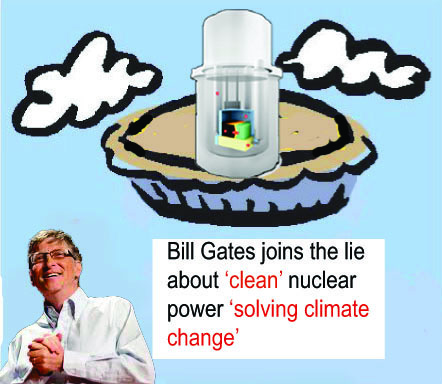
David Lowry’s Blog 16th Feb 2021 The multi-billionaire Bill Gates, founder of Microsoft, in his new book, “How to Avoid a Climate Disaster”, is sceptical of the Green New Deal.(Allen Lane/Penguin) published on 16 February. Gates secured much pre-publication publicity for his new tome, including an interview in the Guardian Weekend Magazine, which wrote “Of the Green New Deal, the proposal backed by Alexandria Ocasio-Cortez [the Congresswoman who has promoted the merits of the GND in the US] that raises the goal of carbon neutrality in a decade, he is flatly dismissive, with Gates telling the interviewer. “Well, it’s a fairytale. It’s like saying vaccines don’t work – that’s a form of science denialism. Why peddle fantasies to people?”
Gates also opined: “I’m not a survivalist.” Instead his version of survivalism is to fund innovation, the reporter noted. “I’m putting money into carbon capture and nuclear fission” Gates told her. (Bill Gates: ‘Carbon neutrality in a decade is a fairytale. Why peddle fantasies?’, Guardian, 13 February 2021; https://www.theguardian.com/technology/2021/feb/15/bill-gates-carbon-neutrality-in-a-decade-is-a-fairytale-why-peddle-fantasies)
Indeed, his book is laced with positive, if inaccurate, mentions of nuclear power. For example, he asserts on page 84, in a section on “Making Carbon-Free Electricity”, uns der a sub-section titled ‘ Nuclear Fission’ he writes: “”Here’s the one sentence case for nuclear power: It’s the only carbon-free energy sources that can reliably deliver power day and night, through every season.”
I am appalled at the idea of ”Mothers For Nuclear”


As a mother myself, I am appalled that such a group as ”Mothers For Nuclear” even exists. Dont

Christina Macpherson’s websites & blogs
they know about the effects of ionising radiation on women, especially pregnant women? Don’t they know about the breast cancers, the birth deformities in irradiated areas such as Pacific atomic bomb sites, and Belarus-Ukraine, near the Chernobyl site. No, they don’t seem to. (Perhaps that ‘s the beauty of a narrowly S.T.E.M. education?)
Both Heather Hoff and Kristin Zaitz work at the Diablo Nuclear Power Plant. Hoff worked as a plant operator, and now as a procedure writer. Zaitz works as a civil engineer.
Hoff was inspired by none other than that top nuclear schill Michael Shellenberger, and by the glossy nuclear advertising film ”Pandora’s Promise”.
They sound very sincere, but also very ignorant of the negative issues around the nuclear industry.
Why am I not surprised? The nuclear industry is busting its guts trying to get women onside. Their favourite thing is getting (preferably young and attractive) women into engineering, and at the top of nuclear companies. (This is good in two ways – good to promote the industry’s ‘gender equality’ image, and good if they muck up, as Leslie Dewan did, in her bogus claims for Transatomic’s molten salt reactor – let a woman take the flak!)
The thing is – lots of women have expertise in biology, genetics – and an understanding of the effects of ionising radiation. But the nuclear industry has got us all conned that these are ”soft”sciences. So – if you’ve got ”hard” scienvce knowledge – like engineering, then you can be an authority on nuclear issues.
These two women sound very sincere – alarmingly so.
The Activists Who Embrace Nuclear Power, New Yorker, By Rebecca Tuhus-Dubrow, February 19, 2021
To be fervently pro-nuclear, in the manner of Hoff and Zaitz, is to see in the peaceful splitting of the atom something almost miraculous. It is to see an energy source that has been steadily providing low-carbon electricity for decades—doing vastly more good than harm, saving vastly more lives than it has taken—but which has received little credit and instead been maligned. It is to believe that the most significant problem with nuclear power, by far, is public perception. ………..—the pro-nuclear world view can edge toward dogmatism. Hoff and Zaitz certainly seem readier to tout studies that confirm their views, and reluctant to acknowledge any flaws that nuclear energy may have. ……https://www.newyorker.com/tech/annals-of-technology/the-activists-who-embrace-nuclear-power
Natural gas, not renewable energy, was most responsibe for Texas power failure in freezing conditions
Why is Texas suffering power blackouts during the winter freeze?
The oil- and gas-rich state is experiencing what officials call a ‘total failure’ of its electricity infrastructure Guardian, Lauren Aratani, Thu 18 Feb 2021 “…...Did renewable energy play a role in the grid’s malfunction?
While Republicans have been blaming frozen wind turbines for the state’s blackouts, officials and experts say that malfunctions in natural gas operations played the largest role in the power crisis.
Ercot said all of its sources of power, including those from renewable sources, were affected by the freezing temperatures. The state largely relies on natural gas for its power supply, though some comes from wind turbines and less from coal and nuclear sources.
Natural gas can handle the state’s high temperatures in the summer, but extreme cold weather makes it difficult for the gas to flow to power plants and heat homes. Michael Webber, an energy resources professor at the University of Texas Austin, told the Texas Tribune that “gas is failing in the most spectacular fashion right now”.
With the climate crisis likely to trigger more freak weather events like the one Texas is suffering it is noteworthy that there are places that experience frigidly cold weather that rely heavily on wind turbines and manage to have electricity in the winter. In Iowa, a state which sees freezing temperatures more often than Texas, nearly 40% of electricity is generated by wind turbines……. https://www.theguardian.com/us-news/2021/feb/18/why-is-texas-suffering-power-blackouts-during-the-winter-freeze
In Texas freezing temperatures, the major power loss was from coal, gas, nuclear facilities, not renewables
major power failures across Texas as increased demand for heating has overwhelmed the energy grid. Supplies of both electricity and gas have been intermittent, with the authorities saying they need to “safely manage the balance of supply and demand on the grid” to avoid another major power cut.
Advancing the Treaty on the Prohibition of Nuclear Weapons — IPPNW peace and health blog

There are many things to be done to build the legal, political and moral force of this historic treaty; grow its membership and implementation; and use it as effectively as possible to advance the eradication of nuclear weapons and reduce the likelihood and scale of their use in the meantime. Important work for all treaty supporters is increasing the number of states signing the treaty and converting those signatures to ratifications. A key moment will come when the first nuclear-armed or accomplice state chooses to get on the right of history and become part of the solution rather than the problem.
Advancing the Treaty on the Prohibition of Nuclear Weapons — IPPNW peace and health blog
February 19 Energy News — geoharvey

Opinion: ¶ “Lies, Damned Lies, And Greg Abbott” • While people were suffering and even dying in Texas, Governor Abbott was on Fox News talking to Sean Hannity about the situation. He said the Green New Deal would be a “deadly deal” for the US, and blamed renewables for the shortfall. But renewables aren’t to […]
February 19 Energy News — geoharvey
Government Appointment of Coal Mine CEO to UK Nuke Dump Plans – Not Dodgy At All ?!! —

Letter sent today to MP Tim Farron from Radiation Free Lakeland first published on our dedicated campaign website Lakes Against Nuclear Dump Dear Tim, West Cumbria Mining is in Bed with BEIS (Dept of Business, Energy & Industrial Strategy) BEIS are Responsible for the “Delivery of a Geological Disposal Facility in the UK” . BEIS […]
Government Appointment of Coal Mine CEO to UK Nuke Dump Plans – Not Dodgy At All ?!! —
1 This Month

Tell Congress: Prevent Nuclear Catastrophe in Iran

Tell Congress: Prevent Nuclear Catastrophe in Iran

Read the Public Inquiry Report, the Commissioners’ report, Surrendering Australia: The AUKUS Deception is available to download for free at aukuspublicinquiry.com. Or just watch the replay of the National Press Club Luncheon.


Shut down the radiation-damaged Heysham nuclear reactors now
To see nuclear-related stories in greater depth and intensity – go to https://nuclearinformation.wordpress.com

Say No to NASA’s Reckless Nuclear Reactor on the Moon
Say No to NASA’s Reckless Nuclear Reactor on the Moon
-
Archives
- November 2026 (255)
- October 2026 (302)
- September 2026 (339)
- August 2026 (330)
- July 2026 (355)
- June 2026 (287)
- May 2026 (306)
- April 2026 (356)
- March 2026 (251)
- February 2026 (267)
- January 2026 (308)
- December 2025 (358)
-
Categories
- 1
- 1 NUCLEAR ISSUES
- business and costs
- climate change
- culture and arts
- ENERGY
- environment
- health
- history
- indigenous issues
- Legal
- marketing of nuclear
- media
- opposition to nuclear
- PERSONAL STORIES
- politics
- politics international
- Religion and ethics
- safety
- secrets,lies and civil liberties
- spinbuster
- technology
- Uranium
- wastes
- weapons and war
- Women
- 2 WORLD
- ACTION
- AFRICA
- Atrocities
- AUSTRALIA
- Christina's notes
- Christina's themes
- culture and arts
- Events
- Fuk 2022
- Fuk 2023
- Fukushima 2017
- Fukushima 2018
- fukushima 2019
- Fukushima 2020
- Fukushima 2021
- general
- global warming
- Humour (God we need it)
- Nuclear
- RARE EARTHS
- Reference
- resources – print
- Resources -audiovicual
- Weekly Newsletter
- World
- World Nuclear
- YouTube
-
RSS
Entries RSS
Comments RSS

