War and some unusual developments regarding nuclear-related topics – Guam and the Northern Mariana Islands

The huge problem with the idea of having a nuclear reactor power plant on a military base is that it may cause catastrophic damage to all human life in and around the immediate area despite official comments from the U.S. Army that there are several safety prevention measures being taken to address this concern.
War and some unusual developments regarding nuclear-related topicsm By Rick Arriola Perez | May 09 2022 https://www.saipantribune.com/index.php/war-and-some-unusual-developments-regarding-nuclear-related-topics/
Guam and the Northern Mariana Islands are one island chain that is embedded in the minds of Chinese military personnel who are charged with selecting and figuring out what adversary targets are most important to knock out, should China and the United States ever go to hot war.
Guam’s Andersen Air Force Base is a huge military threat to the Chinese and to the North Koreans and Russians. Andersen is one of the most important American military bases in the world. Andersen has one of the world’s largest petroleum, oil, and lubricant storage facilities, training facilities, and areas that store, manage, maintain and load ordnance and other weapons of war.
Andersen is located atop stolen Chamorro family lands located in our Deep Blue Pacific Ocean Marianas Trench continent. The U.S. Air Force is not formally required to ask permission to fly over foreign national airspace because from the American military perspective, we are close yet far enough away from any nation that requires the United States to first seek diplomatic approvals and notifications. This is one of the many benefits afforded the Pentagon and the Air Force by residing in Guam and the Marianas.
Guam’s Andersen Air Force Base is also the perfect location to store, manage, hold, and/or stage live nuclear missiles and weapons into and out of fighters, unmanned systems, and strategic aircraft that are assigned America’s nuclear bombing missions. These activities go relatively unnoticed because of our unique location. Missions can simply be initiated any day or night throughout the year.
But bombs are not the only thing that is on the nuclear discussion table these days
These days the Department of Defense is also moving forward with design plan options to construct and operationalize nuclear-powered micro-reactors, transportable on Air Force cargo planes, to be used as power generation sources for military bases in remote locations.
These nuclear reactors are intended to generate the power equivalent of up to 1% of a large commercial nuclear power plant once assembled and turned on. The huge problem with the idea of having a nuclear reactor power plant on a military base is that it may cause catastrophic damage to all human life in and around the immediate area despite official comments from the U.S. Army that there are several safety prevention measures being taken to address this concern.
One rationale that is being proposed to support the construction and design of nuclear reactors is that it will save over time millions of gallons of fossil fuel from being consumed, which is in line with environmental sustainability up to a point. Opposing viewpoints argue that there is simply no need to place a nuclear reactor in a remote military base because the amount of power generation it provides is not really needed because existing diesel-powered generators are adequate for use on remote military bases.
Nuclear reactor controversies are nothing new to the Pentagon and the Army
The Army previously had a nuclear reactor program that started during the time of the Korean war era, lasting up through the Vietnam war era. The program had mixed results, one catastrophic outcome, and was quite expensive to maintain. The current program under consideration is supported by the idea that having a small and mobile nuclear power plant for use by base personnel will also mitigate military casualty rates associated with the transportation and security protection of fuel in land-based warfighting areas. Supporters also point to the need for a constant source of power generation required for radars and for high-energy weapons.
So why should our Chamorro Pacific Islander Deep Blue Continent civilization be concerned about these developments?
The Pentagon and the Army have identified Guam as one of approximately 10 sites that are slated to have a micro nuclear reactor. The Marshall Islands is also another site identified to receive a nuclear reactor.
But what our Chamorro people should be aware, as well as the people of Micronesia, especially the Marshallese, is that it is the U.S. Congress, not the Pentagon, that has been the genesis behind the push to get the Pentagon funding to move forward on this micro-nuclear reactor effort. Why is this the case?
What the Guam and NMI congressmen need to do
Michael San Nicolas and Kilili Sablan have not articulated why Congress has been pushing the Pentagon to look into the design, construction, and use of small nuclear reactors for the Army.
Both congressmen have not publicly addressed the need for a multi-Mariana Islands nuclear bomb shelter infrastructure study nor has there been any effort by these congressional leaders to introduce authorization language addressing this huge human health, readiness, and life or death safety issue tied to the increased militarization of our Mariana Island chain.
President Biden will be the final authority as to whether a small mobile nuclear reactor program will proceed or be cancelled. These congressmen have not talked to President Biden about this very important matter.
Diseconomics and other factors mean that small nuclear reactors are duds

Such awkward realities won’t stop determined lobbyists and legislators from showering tax funds on SMR developers, seen as the industry’s last hope of revival (at least for now). With little private capital at stake, taxpayers bearing most of the cost, and customers bearing the cost-overrun and performance risks190 (as they did in the similarly structured WPPSS nuclear fiasco four decades ago), some SMRs may get built. I expect they’ll fail for the same fundamental reasons as their predecessors, then be quickly forgotten as marketers substitute the next shiny object.
A lifetime of such disappointments has not yet induced sobriety. As long as the industry can fund potent lobbying that leverages orders of magnitude more federal funding, the party will carry on.
US nuclear power: Status, prospects, and climate implications, Science Direct, Amory B.Lovins, Stanford University, USA The Electricity Journal, Volume 35, Issue 4, May 2022,
”…………………………………………………….. Advanced” or “Small Modular Reactors,” SMRs174, seek to revive and improve concepts generally tried and rejected decades ago due to economic175, technical176, safety177, or proliferation178 flaws179. BNEF estimates that early SMRs might generate at ~10× current solar prices, falling by severalfold after tens of GW were built, but not by enough to come anywhere near competing. Despite strong Federal support, proposed projects are challenged to find enough customers180 and markets181. Developers and nations are also pursuing >50 diverse designs—a repeatedly reproven failure condition.
SMRs’ basic economics are worse than meets the eye, because their goalposts keep receding. Reactors are built big because, for physics reasons, they don’t scale down well. Small reactors, say their more thoughtful advocates, will produce electricity initially about twice as costly as today’s big ones, which in turn, as noted earlier, are ~3–13× costlier per MWh than modern renewables (let alone efficiency). But those renewables will get another ~2× cheaper (say BNEF and NREL) by the time SMRs could be tested and start to scale toward the mass production that’s supposed to cut their costs. High volume cannot possibly cut SMRs’ costs by 2 × (3 to 13) × 2-fold, or ~12× to ~52×.
Indeed, SMRs couldn’t compete even if the steam they produce to turn the turbine were free. Why not? In big light-water reactors, ~78–87% of the prohibitive capital cost buys non-nuclear components like the turbine, generator, heat sink, switchyard, and controls. Thus even if the nuclear island were free and a shared non-nuclear remainder were still at GW scale so it didn’t cost more per unit182, the whole SMR complex would still be manyfold out of the money.
SMRs are also too late. Despite streamlined (if not premature) licensing and many billions in Federal funding commitments, the first SMR module delivery isn’t expected until 2029. That’s in the same smaller-LWR project that just lost over half its subscribed sales as customers considered cost, timing, and risk183, and may lose the rest if they read a soberly scathing 2022 critique184. That analysis found that the vendor claims very low financial and performance risks but opaquely imposes them all on the customers. The first “advanced” reactors (a sodium-cooled fast reactor and a high-temperature gas reactor), ambitiously skipping over prototypes, are hoped by some advocates to start up in 2027–28. DOE in 2017 rosily assessed that if such initial projects succeeded, a first commercial demonstrator would then take another 6–8 years’ construction and 5 years’ operation before commercial orders, implying commercial generation at earliest in the late 2030s, more plausibly in the 2040s. But the US Administration plans to decarbonize the grid with renewables by 2035, preëmpting SMRs’ climate mission185.
An additional challenge would be siting new SMRs or clusters of them (which cuts cost but means that a problem with one SMR can affect, or block access to, others at the same site, as was predicted and experienced at Fukushima Daiichi). It looks harder to secure numerous sites and offtake agreements than a few. It would take roughly 50 SMR orders to justify building a factory to start capturing economies of production scale, and hundreds or thousands of SMRs to start seeing meaningful, though inadequate, cost reductions. A study assuming high electricity demand and cheap SMRs estimated a US need for just 350 SMRs by 2050186; some advocates expect far more. It’s hard to imagine how dozens of States and hundreds of localities could quickly approve those sites, especially given internal NRC dissension on basic SMR safety187 and the obvious financial risks188.
No credible path could deploy enough SMR capacity to replace inevitably retiring reactors timely and produce significant additional output by then—but efficiency and renewables could readily do that and more, based on their deployment rates and price behaviors observed in the US and global marketplace. For example189, through 2020, CAISO (wholesale power manager for a seventh of the US economy) reported 120 GW of renewables and storage in its interconnection queue, plus 158 GW in the non-ISO West; just solar-paired-with-storage projects in CAISO rose to over 71 GW by 5 Jan 2022, with the paired solar totaling nearly 64 GW—all three orders of magnitude more than the first 77-MW NuScale module hoped to enter service many years later.
Such awkward realities won’t stop determined lobbyists and legislators from showering tax funds on SMR developers, seen as the industry’s last hope of revival (at least for now). With little private capital at stake, taxpayers bearing most of the cost, and customers bearing the cost-overrun and performance risks190 (as they did in the similarly structured WPPSS nuclear fiasco four decades ago), some SMRs may get built. I expect they’ll fail for the same fundamental reasons as their predecessors, then be quickly forgotten as marketers substitute the next shiny object.
A lifetime of such disappointments has not yet induced sobriety. As long as the industry can fund potent lobbying that leverages orders of magnitude more federal funding, the party will carry on. But where does its seemingly perpetual disappointment leave the Earth’s imperiled climate?…………………………. https://www.sciencedirect.com/science/article/pii/S1040619022000483
Kishida, Johnson Enjoy Popcorn from Fukushima

May 6, 2022
Japanese Prime Minister Fumio Kishida and his British counterpart, Boris Johnson, enjoyed popcorn from Fukushima Prefecture, northeastern Japan, during their meeting in London on Thursday.
At the meeting, Johnson informed Kishida of Britain’s plan to lift by the end of June its import restrictions on food produced in Fukushima and other areas in Japan, which were introduced after the March 2011 nuclear accident at Tokyo Electric Power Company Holdings Inc.’s tsunami-crippled Fukushima No. 1 power station.
According to a statement released by the office of the British prime minister after the two leaders’ meeting, Johnson said he was “pleased” that Britain would soon lift the remaining restrictions on Fukushima food products.
The popcorn Kishida and Johnson tasted was flavored with peach nectar and coconuts, a photograph released by the British prime minister’s office showed. Kishida brought with him the popcorn produced by Hishinuma Farm in the city of Fukushima.
When the two met in Brussels in March this year, they enjoyed Fukushima-produced karinto, or deep-fried Japanese snack made with brown sugar. At that time, Johnson, who called himself a fan of karinto, brought the snack with him.
Thought chlorinated chicken was bad? Fukushima food to be imported as restrictions get lifted

May 6, 2022
Those worried about imported chlorinated chicken from America might want to re-think their priorities after Boris Johnson struck a nuclear agreement with the Japanese prime minister, Fumio Kishida.
From now on, fish and vegetables grown near the old Fukushima nuclear plant in Japan can be freely sold in Britain after the Food Standards Agency (FSA) scrapped a rule on radioactivity levels in produce.
The agency reviewed controls ahead of the Japanese PM’s meeting with Johnson, with the pair sharing some ‘Fukushima popcorn’ to mark the lifting of all of the remaining restrictions.
The FSA said: “Our risk assessment shows that removing the 100 becquerels per kilogram (Bq/kg) maximum level of radiocaesium for food imported from Japan to the UK would result in a negligible increase in dose and any associated risk to UK consumers.
“Without specific import controls, the emphasis would fall on food businesses to ensure food is safe under General Food Law. However, we would not recommend businesses need to take any precautions beyond their normal due diligence.”

Tesco and Waitrose said they had no immediate plans to introduce the items in store. They are already available in limited quantities at some specialist Japanese grocers.
Downing Street said that the Prime Minister “was pleased Great Britain would soon lift the remaining restrictions on Fukushima”.
Dumping treated nuclear wastewater in Pacific Ocean not recommended

May 2, 2022
Japan has proposed discharging treated nuclear wastewater into the Pacific Ocean, and an independent panel of global experts on nuclear issues was developed to support Pacific nations in their consultations. Robert Richmond, a research professor at the University of Hawaiʻi at Mānoa School of Ocean and Earth Science and Technology (SOEST) and director of the Kewalo Marine Laboratory, was one of five experts selected to join the panel.
In 2011, a massive earthquake and tsunami in Fukushima, Japan damaged the Daiichi Nuclear Power Plant. To prevent further damage and overheating, workers pumped water through the remains. Last year, Japan announced its intentions to begin discharging the accumulated radioactively contaminated cooling water into the Pacific Ocean starting in 2023, claiming that after treatment, it is safe to do so. Some Pacific nations are concerned about whether that can be done safely.
The Pacific Islands Forum, made up of 18 independent Pacific Island countries, created the expert panel to provide independent technical advice as part of the ongoing dialogue with Japan officials and representatives of the nuclear power plant in Fukushima where the wastewater has accumulated since the tsunami.
“At this point, we’re unanimous in saying we don’t see enough information to support dumping the radioactively contaminated water into the ocean,” said Richmond, who has conducted marine conservation research in the Pacific for more than four decades. “Our first recommendation to the group is to take that option off the table for now.”
Trans-boundary issue
Through the movement of ocean currents and transport by pelagic fishes that can take up and accumulate radionuclides (a radioactive and unstable form of an element), more widespread distribution can and will take place.
“This is truly a trans-boundary issue,” said Richmond. “Fish don’t respect political lines, and neither do radionuclides or pollutants in the ocean. I really commend the members of the Pacific Islands Forum for recognizing that this is an issue that they need additional information on.”
In announcing the formation of the panel, Pacific Islands Forum Secretary General Henry Puna emphasized, “Our ultimate goal is to safeguard the Blue Pacific—our ocean, our environment and our peoples—from any further nuclear contamination. This is the legacy we must leave for our children.”
Richmond has studied the uptake of radioactive Ru-106 in crayfish as an indicator of leakage from nuclear power plants while working at the Department of Radiation Biology and Biophysics at the University of Rochester Medical School and spent two years performing research on Enewetak Atoll, home to the U.S. nuclear testing program from 1948–58. He presented at the 7th Our Oceans Conference in Palau. This event, co-hosted by the Republic of Palau and the U.S., offered a key moment for countries, civil society and industry to commit to concrete and significant actions to protect the ocean. Richmond emphasized the need for adequate and accurate information for decision makers to make sound decisions to protect and conserve marine habitats and life, and all those who depend on ocean resources.
“This is not the first nuclear incident, and it won’t be the last,” said Richmond. “Perhaps this can be an opportunity to try different approaches that have never been tried before. Maybe this could be a learning opportunity to really set the bar for the future of not continuing to use our oceans as the dumping ground.”
Additional panel members are Ken Buesseler, senior scientist and oceanographer of the Woods Hole Oceanographic Institution; Arjun Makhijani, president of the Institute for Energy and Environmental Research; Antony Hooker, associate professor and director, Centre for Radiation Research, Education and Innovation, the University of Adelaide; Ferenc (Jacob Rolf) Dalnoki-Veress, scientist-in-residence and adjunct professor at the James Martin Center for Nonproliferation Studies, Middlebury Institute of International Studies at Monterey.
The panel recently shared a detailed set of initial recommendations to the Secretariat that will be available soon.
This research is an example of UH Mānoa’s goal of Excellence in Research: Advancing the Research and Creative Work Enterprise (PDF), one of four goals identified in the 2015–25 Strategic Plan (PDF), updated in December 2020.
Japan Says It Needs Nuclear Power. Can Host Towns Ever Trust It Again?

The Ukraine war has shown the fragility of Japan’s energy supplies. But the decision to restart plants after the Fukushima disaster is fraught with emotions and political calculation.
May 4, 2022
KASHIWAZAKI, Japan — Growing up, Mika Kasahara saw the nuclear power plant that hugs the coast of her hometown simply as the place where her father worked, a familiar fortress of cooling tanks and steel lightning towers overlooking the Sea of Japan.
“We thought that as long as nothing bad happened, it’s fine,” Ms. Kasahara, 45, said.
After the disaster 11 years ago at a nuclear power station in Fukushima, where an earthquake and tsunami led to a triple meltdown, Japan took most of its nuclear plants offline. Now, Ms. Kasahara, spooked by security breaches and damaged infrastructure at the power station near her home, wants it shuttered for good.
Ms. Kasahara symbolizes the long road Japan faces as Prime Minister Fumio Kishida, confronting threats to fuel supplies posed by the Ukraine war and vowing urgent action to reduce carbon emissions, intensifies efforts to reboot the country’s nuclear power network.
For the first time since the Fukushima catastrophe, a small majority of the Japanese public has expressed support for bringing the plants back online, indicating a growing awareness that the world’s third-largest economy may struggle to keep the lights on as it confronts its own limited resources during a time of geopolitical upheaval.
But the decision to restart the plants is fraught with emotions and political calculation, not to mention the gargantuan technical task of fortifying the stations against future disasters in an earthquake-prone nation.
In Kashiwazaki, a midsize suburban city, and neighboring Kariwa, a small village, which together host the seven-reactor plant — the world’s largest — in Niigata Prefecture in northwestern Japan, the fate of the nation’s idled power plants is deeply personal.


When Ms. Kasahara’s father died of esophagus and lung cancer three years ago, she wondered if his two decades inside the plant had been a factor. A traffic jam during an evacuation drill left her fearing that she and her family would be trapped by a nuclear accident.
“I was honestly very afraid,” she said.
Business leaders and workers whose livelihoods depend on the plant warn that if it does not come back online, the area will deteriorate, like many rural Japanese communities that are experiencing steep population decline. Currently about 5,500 people are working to maintain the idled plant, although employment would be likely to grow if it reopened.
Many local residents work in the plant or know friends and family who do. “I think that there are more people who understand the necessity of the plant,” said Masaaki Komuro, chief executive of Niigata Kankyo Service, a maintenance contractor at the facility.
Public polling presents a muddier picture. According to a 2020 survey by the city of Kashiwazaki, close to 20 percent of residents want to decommission the plant immediately. About 40 percent would accept the temporary operation of some reactors, but ultimately want the plant shut down. Just over half of prefectural residents oppose a nuclear restart, according to a 2021 survey by Niigata Nippo, a local newspaper.
The public wariness will be tested in an election for governor this month in Niigata Prefecture. The current governor, Hideyo Hanazumi, 63, is backed by the governing Liberal Democrats but has remained vague about his restart intentions. His challenger, Naomi Katagiri, a 72-year-old architect, promises to block the resumption of operations in Kashiwazaki and Kariwa.
The stakes are high because an unwritten government policy requires local political leaders to ratify nuclear reboots. Kariwa’s mayor, Hiroo Shinada, 65, is a vociferous proponent, while the mayor of Kashiwazaki, Masahiro Sakurai, 60, is investing in wind power but would support the temporary operation of some reactors.


“Japan is not like Communist China that can impose a project” on communities, said Daisaku Yamamoto, an associate professor of Asian studies at Colgate University and a native of Kashiwazaki. While the national government influences local decisions, host communities “are not powerless either,” he said.
Local opposition isn’t the only obstacle to restarting nuclear power stations. All plants must adhere to strict new guidelines adopted by Japan’s nuclear regulator two years after the Fukushima disaster. Operators are required to bolster tsunami defenses, build backup cooling pools and install filtered vents that would reduce radioactive discharges.
Out of 60 reactors in Japan, 24 have been decommissioned and five are currently operating. Another five have been approved to restart but are suspended for routine checkups, and three are under construction. The rest have not been approved to restart.
Nuclear power now contributes less than 4 percent of the nation’s electricity, down from nearly a third before the Fukushima disaster. Japan currently draws more than three-quarters of its electricity from fossil fuels, and about 18 percent from renewable sources.
Since 2014, the Liberal Democrats have said nuclear plants should generate more than 20 percent of Japan’s electricity by 2030. The war in Ukraine and the threat of a blackout in Tokyo after a strong earthquake this spring have made the public more receptive to this message.
In a March poll by the Nikkei business newspaper, 53 percent supported a restart of the plants. As recently as four years ago, more than 60 percent of the Japanese public opposed rebooting nuclear power.
In hopes of accelerating regulatory approvals, some Liberal Democratic lawmakers have submitted a proposal to loosen requirements for physical barriers to terrorism at plants.


“The people who say that they are afraid of war or terrorism attacks against nuclear plants are probably the type of people who would oppose the restarts no matter what,” said Tsuyoshi Takagi, secretary-general of the Liberal Democrats’ task force on energy stability.
In Kashiwazaki and Kariwa, the national regulator has suspended approvals, citing concerns about the safety culture at the Tokyo Electric Power Company, the plant’s operator.
Last year, Tokyo Electric revealed that a plant worker had used a colleague’s security card and bypassed biometric systems in 2020, gaining entrance to a control room. The company admitted flawed welding work and a failure to install fire prevention machinery in a reactor. It reported that an earthquake in 2007 had damaged two concrete pegs in a building foundation, and the regulator found a risk of liquefaction in the ground beneath a sea wall protecting reactors.
Officials at Tokyo Electric say they are addressing the issues. The company has spent about $9 billion reinforcing the Kashiwazaki-Kariwa plant.
The setbacks have raised doubts among residents about the competence of the company, which also operated the Fukushima plant where the meltdowns occurred 11 years ago.
“I only feel distrust,” Miyuki Igarashi, 33, said as she loaded her 6-month-old daughter into an S.U.V. at a strip mall in Kashiwazaki. “I think they are hiding things.”
Some local residents say the problems have been overblown by antinuclear activists.
“People who oppose the restarts keep pointing out things that are wrong, and there is no end to it,” said Motonori Nishikata, 44, who worked at the plant for seven years before opening a grilled beef restaurant in Kashiwazaki.


The community is already preparing for an eventual restart, in part by readying for a possible accident. Public shelters have installed filters to keep out radioactive contaminants. Pharmacists stock iodine pills, meant to block the most harmful effects of radiation.
Those who lived through the 2011 Fukushima crisis say the risk is not worth it.
Junko Isogai, 48, was raising two young daughters with her husband in Koriyama, a city in Fukushima Prefecture, when the meltdowns occurred 42 miles away.
Worried about their daughters’ health, the couple decided that she and the girls should move to Niigata, although her husband stayed behind for the next five years, working to pay the mortgage on a house they had built just before the disaster.
In Niigata, her elder daughter, Suzu, was bullied at school, called “dirty” by a classmate because of her Fukushima roots.
Three years ago, Ms. Isogai ran for a seat in the prefectural assembly, opposing a restart at the Kashiwazaki-Kariwa plant. She lost but plans to run again next April.
“I don’t want anyone else to be in the situation that I was put in,” she said.

Hiroshima man’s anime sheds light on Fukushima nuclear project

May 3, 2022
Hiroshima resident Hidenobu Fukumoto was astonished when he learned there was once a plan to build a nuclear power plant in his hometown, the first city devastated by a nuclear bomb.
He discovered the shocking news by chance while visiting Fukushima Prefecture, which suffered its own nuclear disaster in 2011, as a “kamishibai” picture card show artist.
“I was stunned,” said Fukumoto, who has produced about 170 kamishibai titles based on the accounts of residents affected by the disaster. “I decided to face up to the new fact about Hiroshima I discovered during my visits to Fukushima.”
Fukumoto, 65, has created a 57-minute anime exploring why Fukushima Prefecture ended up hosting a nuclear plant. It tells the story through the eyes of residents who evacuated from their hometowns following the Fukushima No. 1 nuclear power plant accident.
“I realized how all these events related to atomic bombing and nuclear plants led to the promotion of nuclear power,” he said. “I’ll be glad if it (the anime) helps the people of Fukushima stop blaming themselves for benefiting from the nuclear plant and set themselves free from the accusing stares of people around them.”
The anime, titled “Fukushima Genpatsu Hajimari Monogatari: Toge” (The prologue to the Fukushima nuclear power plant: Mountain pass), portrays a man in his 60s who was born in 1949 in Okuma, a town in Fukushima Prefecture that co-hosts the now-stricken plant.
When Japan’s economy begins booming following the period of postwar poverty, the protagonist enters a university in Tokyo and enjoys his college life.
The story illustrates the major events leading up to the construction of the nuclear plant in Fukushima Prefecture at a time when people in Japan were suddenly blessed with material wealth.
In 1953, U.S. President Dwight D. Eisenhower called for the peaceful use of nuclear power during his “Atoms for Peace” speech at the United Nations. In response, exhibitions were held in Hiroshima and elsewhere to champion the cause.
In 1954, the tuna fishing boat Daigo Fukuryu Maru and other vessels were contaminated by fallout from the U.S. hydrogen bomb test at Bikini Atoll. Six years later, Fukushima Prefecture announced its bid to host a nuclear plant.
In one scene from the anime, a girl asks her mother lying on a bed at the Hiroshima Atomic-bomb Survivors Hospital to take her to an exhibition on the peaceful use of atomic energy when she recovers.
Another scene shows young people in Fukushima leaving their hometown to seek jobs, while long-term residents are split over whether the prefecture should host a nuclear plant.
When the protagonist eventually returns home in Okuma and sees a massive nuclear plant standing in the town, he is left speechless.
The anime then fast-forwards to 2011, when the Great East Japan Earthquake and tsunami triggered the triple meltdown at the plant.
“The move to promote atomic power prevailed globally under the pretext of the peaceful use of nuclear energy, overshadowing even the destruction of Hiroshima brought on by the atomic bomb,” the protagonist said while living as an evacuee at the end of the story. “Ordinary people like us could do nothing about it.”

Fukumoto, who works as a “kamishibai” picture card show artist under the name of Teppei Ikumasa, said he wrote scripts and drew illustrations for the anime based on his interviews with people in Fukushima.
He began creating the work after hearing from a Fukushima resident that there was a plan to build a nuclear plant in Hiroshima.
Fukumoto heads Machimonogatari Seisaku Iinkai (Town story production committee), a Hiroshima-based group that uses kamishibai and other tools to pass on local culture to the next generations.
Following the 2011 nuclear disaster, he visited the affected areas to listen to what residents had to say.
He learned about the Hiroshima nuclear plant plan from an Okuma resident who was working as a storyteller using Fukumoto’s kamishibai.
Fukumoto found an article online that said U.S. Congressman Sidney Yates proposed constructing a nuclear plant in Hiroshima in 1955.
Yu Sato, 20, a sophomore at Hiroshima City University who helps with Fukumoto’s kamishibai project as a volunteer, confirmed Yates’ original remarks by searching the congressional records kept in the Library of Congress’ online database.
“I have introduced today a bill to construct in the city of Hiroshima, Japan, through the cooperative efforts of the Governments of the United States and Japan, an atomic power reactor dedicated to the advancement of peace and progress by producing power for industrial purposes,” reads the transcript of the speech, which is also given in the anime.
STORY HITS HOME
Fukumoto’s kamishibai project has struck a chord with many Fukushima residents who experienced the nuclear disaster.
Yoko Oka, 61, who lives in Fukushima city as an evacuee from Namie, Fukushima Prefecture, met Fukumoto at a gathering place for people living in temporary housing in Kori in the prefecture in summer 2014.
Oka has been performing kamishibai with him both at home and abroad since then.

She said she still remembers what Fukumoto told her: “I want you to tell people exactly what you went through and how you felt at the time. Only those who experienced the disaster can do that.”
Oka said her impression of Hiroshima, devastated by the 1945 atomic bombing, changed after the 2011 nuclear accident.
“I began imagining how hard it was to bring the city exposed to radiation back to what it is now,” she said. “I was shocked to learn from this anime that there was a plan to build a nuclear plant in Hiroshima.”
Kinue Ishii, 70, who also performs kamishibai with Oka as a member of a storytelling group, said people can think deeply about the nuclear accident by learning why the nuclear plant was built in Fukushima.
“I want people to imagine themselves becoming victims of a nuclear accident by watching this anime,” Ishii said.
Hisai Yashima, 56, another member of the storytelling group, said she hopes the anime will help raise awareness of what led to the construction of the nuclear plant because people from outside Fukushima often ask her why the prefecture approved the plan.
The package of an anime DVD and a 16-page, A4-size picture book costs 2,000 yen ($16). For more details, visit the production committee’s website: https://matimonogatari.iinaa.net) (Japanese only).
(This article was compiled from reports by Miki Morimoto and Yusuke Noda.)
3 doctors to be dispatched nationwide to respond to nuclear accident; government requests early expansion

May 2, 2022
The Federation of Electric Power Companies of Japan (DENJIREN) learned in an interview on May 2 that only three doctors have been dispatched to power plants nationwide to provide initial treatment and health care to workers in the event of a nuclear power plant accident. The Federation of Electric Power Companies of Japan (DENJI-ren) explained that “doctors can be stationed at the power plants for about one month after the accident,” and they plan to increase the number of doctors to five in FY2024.
The Ministry of Health, Labor, and Welfare (MHLW) has pointed out that “it is difficult to maintain a permanent system with only three doctors,” and has called for an early expansion.
The dispatched doctors will provide lifesaving treatment and simple decontamination in the plant’s infirmary and other facilities in the event of worker injuries and illnesses, determine the priority of treatment, and prevent heat stroke and infectious diseases. Surgeries and mass exposures will not be handled, but transported outside. The company will respond to any nuclear power plant.
https://kahoku.news/articles/knp2022050201000378.html?fbclid=IwAR1pKh0iAGQwD56hGTvK47NdqEjWClLYf7q1W4U5u6zbKaAd-nT-a30ZlSs
TEPCO net profit slides 96.9%; cost for Fukushima well out of reach

April 29, 2022
Tokyo Electric Power Co.’s dismal financial results have compounded the difficulties facing the company in compensating victims of the Fukushima nuclear disaster and covering the cleanup and decommissioning costs.
The parent company, Tokyo Electric Power Co. Holdings Inc., on April 28 announced that net profit for the fiscal year that ended in March plummeted by 96.9 percent over the previous year to 5.6 billion yen ($43 million).
“With fuel prices continuing to surge, the business environment surrounding our company is not a very optimistic one,” Tomoaki Kobayakawa, the company president, said at the news conference to announce the business results.
He said the company would begin work to revise its corporate structure, including reorganizing group companies and heightening cooperative efforts with other companies.
Despite the dwindling profits, TEPCO must still carry out various tasks to clean up the mess made by the 2011 triple meltdown at its Fukushima No. 1 nuclear power plant.
In 2016, the government calculated that the total cost of compensating people displaced by the disaster, decommissioning reactors at the plant and conducting radiation decontamination work would come to a staggering 21.5 trillion yen.
TEPCO is expected to contribute about 16 trillion yen of that total.
About 10 trillion yen has already been spent for compensation and to remove radiation. Much of that total has been paid for by the government on condition that TEPCO reimburses it later.
Under the plan to rebuild TEPCO, the utility must also set aside about 500 billion yen a year to pay for decommissioning work.
But the last time TEPCO was able to reach that monetary goal was in fiscal 2017. For the past three years, it has only managed to set aside about 300 billion yen annually.
The company had also set a goal of 450 billion yen in net profit by 2030.
But as Yoshimitsu Kobayashi, the company chairman, admitted, “If nothing is done, profits will increasingly shrink and we will be unable to fulfill our responsibility regarding Fukushima.”
Retail sales of electric power used to be TEPCO’s strong point. But as of the end of 2021, newly created electric power companies accounted for 30.4 percent of the electricity sold in the area normally covered by TEPCO.
That is the largest ratio of any of the major electric power companies in Japan.
As a result, TEPCO Energy Partner Inc., which handles retail sales, recorded a loss of 66.4 billion yen for the fiscal year that ended in March.
TEPCO has also failed to capitalize on renewable energy, which had been considered a growth sector.
The government in December 2021 picked a group led by trading company Mitsubishi Corp. instead of TEPCO to handle offshore wind power facilities in Chiba and Akita prefectures.
And there is no sign of when TEPCO’s Kashiwazaki-Kariwa nuclear power plant in Niigata Prefecture can resume operations.
TODAY. Even more dangerous GROUPTHINK – swallowing the idea that a nuclear war could be won
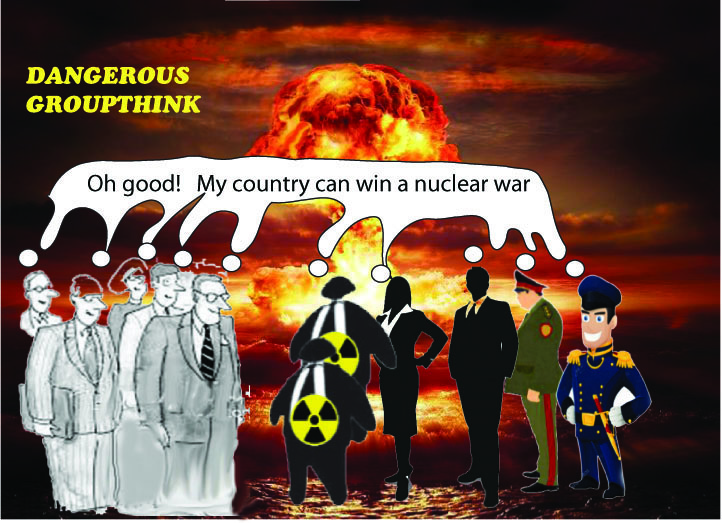
Of course, it must be disappointing to the developers and then the buyers of magnificent new toys, to know that those toys cannot actually be really played with. I mean, they did have a couple of little real games in 1945, and that was fun.
Since then, they’ ve had some sort of second-rate games – testing the toys on indigenous lands, and in the oceans, I mean, tough luck that this destroyed environments, brought cancer and death and dislocation to indigenous communities. And heck, even some white communities were damaged! Also, just building the toys caused thousands of workers to be made ill, and many to die.
But we knew that it was all in a good cause – didn’t we?
And now, many voices, especially some powerful and oh-so-knowledgeable voices, are calling for getting serious with these toys – time to nuke the Russians to bring peace and democracy to them? And, time for the Russians to nuke us in the interests of getting in first?
But the trouble is, some thoughtful people think that it might not work out so well. Apparently, even a very clever computer worked it out that no-one could win in a nuclear war. Indeed, the computer thought that the only way to win – is not to play.
To write seriously – it would be an awful pity if we let those oh-so-knowledgeable voices pass their thinking on to us all, or to enough people – so that using nuclear weapons whether bombs or ”tactical” is accepted as an OK thing to do.
U.S. Intelligence played a part in the sinking of Russia’s Flagship vessel
 | |||
US Intel Assisted In Sinking Russian Flagship Vessel: Officials Claim Bombshell
Escalation https://www.zerohedge.com/geopolitical/us-intel-assisted-sinking-russian-flagship-vessel-officials-say-bombshell-revelation, BY TYLER DURDEN, FRIDAY, MAY 06, 2022
Less than 24 hours after The New York Times issued a provocative report citing unnamed US officials who are celebrating that American intelligence-sharing with Ukraine’s military has helped take out multiple Russian generals since the Feb.24 invasion, NBC News is out with yet another bombshell claim sourced to the deep state US intel officials.
Amid what seems escalation after escalation, and new revelations of Washington’s deepening and perhaps increasingly direct role in fighting Russia in Ukraine, NBC brings us this doozy…
“Intelligence shared by the U.S. helped Ukraine sink the Russian cruiser Moskva, U.S. officials told NBC News, confirming an American role in perhaps the most embarrassing blow to Vladimir Putin’s troubled invasion of Ukraine.”
As a reminder of just how hugely significant the claim is – and just how dangerous in terms of representing a massive escalation – the Moskva was considered the flagship of Russia’s Black Sea Fleet, had 510 crewmen on board before Neptune anti-cruise ship missiles scored a direct hit in mid-April, and was the most embarrassing single blow to President Putin’s war effort of the whole conflict thus far.’
The report continues:
“The attack happened after Ukrainian forces asked the Americans about a ship sailing in the Black Sea south of Odesa, U.S. officials told NBC News. The U.S. identified it as the Moskva, officials said, and helped confirm its location, after which the Ukrainians targeted the ship.”
This comes after the NY Times revealed in a report the night prior that much of the intel-sharing is focused on Russian troop and equipment movements.
According to further details based on anonymous US senior officials:
The U.S. did not know in advance that Ukraine was going to target the Moskva, officials said, and was not involved in the decision to strike. Maritime intelligence is shared with Ukraine to help it defend against attack from Russian ships, officials added.
The U.S. role in the sinking has not been previously reported.
Biden admin officials in the days after the Moskva sinking had been relatively silent, possibly suggesting that they knew more about the details than what their quiet public stance let on.
The April 15 event had initially also been met with lack of answers from Moscow as it attempted to deal with the crisis of its flagship missile cruiser sinking to the bottom of the Black Sea after it was hit off Odessa, and as it later said all the crew were evacuated. However some Ukrainian and Western officials said the ship suffered casualties.
It goes without saying that this fresh NBC report will be viewed by Moscow as an outrageous acknowledged escalation by Washington, though so far Russian leadership’s public response has been rather muted…
The Kremlin had previously warned it would hold external countries supplying arms and other forms of assistance “responsible” – and that “decision-making” centers including Kiev would come under increased attack. Meanwhile, cruise missile strikes even as far west as Lviv do appear to be expanding this week.
Indeed it seems that these intentional “leaks” to the media, likely as part of a deliberate strategy of seeking to intimidate Russia in hopes it will more quickly back off its military operations, will instead only serve to ratchet things further as broader great power tensions hit boiling point.
Antiwar Coalitions in Action

Antiwar Groups Protest Defense Industry Profiteering in Ukraine, Tyler Walicek, Truthout, 3 May 22,
”……………………………………………….. In the meantime, large-scale real-world protests against the war have erupted on numerous fronts — both within Russia and Ukraine and across the globe. Progressive, pacifist and anti-imperialist groups in the U.S. are no exception, having mobilized their considerable institutional resources to voice their own opposition. Given the unlikelihood of influencing the actions of the Russian government, they’ve targeted the realm in which they are mostly likely to have an impact — namely, U.S. policy. Because of its deep entanglements in the war, the U.S. response could easily be a critical determining factor on the outcome: either negotiation, drawdown and eventual peace, or escalation and sustained bloodshed.
Though the U.S. antiwar movement has never reattained the scale of its Vietnam-era heyday, plenty of groups with antiwar missions are active in the modern day. Many date to the resistance against the U.S.’s imperial expeditions in Afghanistan and Iraq in the early 2000s — for example, CODEPINK, the sizeable progressive and feminist antiwar organization, was founded in 2002. The group has been one of the more visible in mounting a response to the Ukraine issue, voicing dissent with the provision of weapons and directing public attention to the geopolitical context of NATO’s aggressive posture in the preceding years.
Truthout reached CODEPINK cofounder and activist Medea Benjamin, a Green Party member and former California Senate candidate, to learn more about the group’s agitational efforts and how antiwar elements in the U.S. might conceivably affect policy. As Benjamin sees it, the effort begins with education and informing the public: counteracting a media apparatus that insistently seeks to justify opening the floodgates of advanced weaponry — sometimes very directly.
“[The idea that weapons and sanctions are necessary] is being pushed by people in the White House and most members of Congress. It’s certainly being pushed by the corporate media,” Benjamin said. (Take The New York Times, for instance, which conceded sanctions may be “harsh,” but deemed they were ultimately “appropriate.” We are left to wonder why the Times didn’t insist the U.S. be so “harshly” sanctioned in the wake of the invasion of Iraq.)
Benjamin underscored the structural incentives: “The weapons companies [are] concerned about the drawing down of U.S. wars in Afghanistan and in Iraq. [The state] sees this as an opportunity to really debilitate Russia.… The ability to bleed the Russian economy and to curtail its reach also means that the U.S. is strengthening its position globally.”
CODEPINK and its allies, galvanized by the war, have busied themselves in a flurry of activity. CODEPINK had in fact already rallied a number of times in protest of rising tensions, before the crisis’s late-February outbreak. Immediately after Russian troops made their first incursion into Ukraine, the organization, along with U.K.-based groups like the Stop the War Coalition, the No to NATO Network and the Campaign for Nuclear Disarmament, held an emergency online panel and rally, bringing together figures like Jeremy Corbyn and historian and writer Vijay Prashad to denounce the war (Corbyn called it “abominable, appalling and unnecessary”), and to call for peace.
CODEPINK’s series of webinars drew thousands — including, as Benjamin described, “representatives from members of parliaments from many governments, including the British, Irish, German, French and Spanish, [and] well-known academics and activists.” In April, Benjamin also hosted another “Stop the War in Ukraine” online rally featuring Noam Chomsky, another appearance from Vijay Prashad, Greek leftist politician Yanis Varoufakis, New Left Review editor Tariq Ali, and other notable voices.
These online events occurred in tandem with real-world rallies — “days of action,” which, Benjamin said, brought together “about 125 different groups around the world.” CODEPINK has long worked beside organizations like the ANSWER Coalition (another large antiwar group in the United States, which has also hosted online conversations). Together with the Black Alliance for Peace, Peace Action, and others, the coalition put together a rally in Washington, D.C.’s Lafayette Square as tensions rose. Further CODEPINK protests took place across various U.S. locales, where volunteers demonstrated, put up flyers and gathered signatures on petitions.
As Benjamin framed it, the core message in conducting this public outreach amounted to posing the questions, “Do you want the war in Ukraine to end? Do you want to save the lives of Ukrainian people? Well, then let’s call for a ceasefire and for serious negotiations.” She feels that this approach is a convincing one: “Once we have a chance to talk to people about it, we do get them to our side.”
Benjamin and CODEPINK plan to sustain their current rates of activity. In June, the group is joining the Mass Poor People’s Assembly and Moral March on Washington, D.C. — an effort spearheaded by the Poor People’s Campaign to speak out against militarism and the bloated defense budget, among other systemic issues. Benjamin also highlighted future plans to send activists to protest an upcoming NATO strategic summit in Madrid, along with an international antiwar coalition of considerable size. Their hope is to apply pressure at a critical time: “With the upcoming election in November, I think that we can be part of talking about why this is happening, not allowing Biden to get away with blaming everything on Russia, but instead putting the blame on militarism and the inability to really seriously push for a negotiated solution,” Benjamin told Truthout.
Resolute Nonviolence

Joining CODEPINK at the Madrid NATO summit and elsewhere will be World Beyond War (WBW), a U.S.-based pacifist organization that maintains international chapters, including in Ukraine. David Swanson is WBW’s executive director. In a conversation with Truthout, he described the group’s assiduous organizing efforts. Like CODEPINK, WBW’s current strategy is to inform the public, presenting pacifist arguments for abolishing war, nuclear weaponry and arms dealing. WBW’s output has included innumerable articles, books, interviews, op-eds, videos, podcasts, and other media. In addition, said Swanson, “We’ve done tons of webinars, online and offline educational events. We have lots of speakers, we go and talk to classrooms, go and talk to peace groups that organize events and do tons of the same online.”
To augment the media push, WBW has also directed substantial real-world actions. “The past week, we’ve been doing protests all over the world,” said Swanson. The immediate future will see WBW participate in widespread protests on a global day of action, planned for May 7.“We’ve done these days before, usually in coalition with other groups, sometimes globally, sometimes nationally, trying to do days of events where we have at least small and sometimes large demonstrations or rallies or protests everywhere.”
WBW is also engaging in some more pointed confrontations. In one instance, a WBW advisory board member disrupted an event in Canada by confronting the deputy prime minister with an antiwar, anti-NATO diatribe. Another arm of WBW’s strategy, ongoing for years, is to protest at the physical offices of weapons manufacturers — major beneficiaries of wars that are incentivized to ensure they remain as drawn-out and destructive as possible. WBW will be demonstrating at the next annual meeting of aviation and defense corporation Northrop Grumman. Members aim to draw attention to the key role that the corporation and other arms manufacturers like Lockheed Martin play in “the war on Ukraine from which [they are] proudly profiting,” Swanson said. “There are Congress members proudly profiting from stock ownership in Lockheed Martin.”
Swanson sees the attention that the war on Ukraine has received as an opportunity to buttress opposition to militarism in general — and to flag certain contradictory narratives from U.S. empire and its mouthpieces. “After decades of demanding that war victims be treated with some sympathy and respect,” he said, “to have that finally happen in one place is an opportunity to say ‘Yes! Right on! What about all the other war victims?’ To have the U.S. government want war treated as a crime and prosecuted in a court — wonderful! Now how about all the other wars?”
That sort of hypocrisy around foreign policy is one of the state’s (and dominant media’s) most reliable features. Again, the tragedy of Ukraine has been especially amplified because it serves a convenient ideological function in contesting Russia’s geopolitical position. (And, as many have pointed, or blurted, out: Sympathy towards this conflict has also had particular purchase because Ukraine is considered a “civilized” European country with a large white population. A number of media figures have told on themselves on this front.)
Key to WBW’s ideology is an unswerving commitment to pacifism. As Swanson described it, “We are opposed to all war, all militarism, all war thinking, all support for military funding, always, without exception.… We think that’s actually the moral thing to do.” Nonviolence, for WBW, is non-negotiable — as evidenced by a recent article of his, which criticized the Poor People’s Campaign for an email that seemed to condone arming Ukraine. As Swanson continued: “To drag this on, to fight Russia to the last Ukrainian as we have their backs with the money rolling in — I don’t think this is a moral position. This is the point we struggle to educate people on: that the United States and Ukraine, as well as Russia, should be trying to end the war. It’s almost considered treasonous. The ‘proper’ position is to want to continue the war to weaken Russia.”
People Can Still Stop Wars
Countless organizers are just as aghast as Swanson at the grotesqueries of this war as well at its ideological utility for other powerful warmongering interests, their rank hypocrisy on display. Despite its distance from the conflict and a lack of leverage over Russia’s actions, the U.S. antiwar movement does, conceivably, have the potential to impact its own government. A U.S. pivot to pursuing a diplomatic resolution might help avoid a prolonged and grueling war of attrition. Yet if present conditions continue to accelerate — continued Russian aggression (as well as their significant battlefield setbacks) as the West increasingly arms Ukraine — the war may develop into the latter.
There are challenging moral questions to be weighed by the war’s opponents: questions of pacifism and self-defense, of how best to show solidarity with a beleaguered Ukraine, of how a war of aggression might be mitigated without worsening violence. Even understanding the conflict requires triangulating between the relentless propaganda of two powerful and deceptive nations. It would be easy for antiwar activists to give into the long odds and a sense of impotence or apathy, in a struggle that can seem quixotic. Yet the U.S. military and government, while an imposing edifice of power and profit, is not invulnerable, and mass protest and dissent have swayed the course of its history in the past. Despite their differences, antiwar organizers are collectively buoyed by a faith in what history has demonstrated: that people, when organized, can still stop wars. https://truthout.org/articles/antiwar-groups-protest-defense-industry-profiteering-in-ukraine/?eType=EmailBlastContent&eId=77e07376-4f26-4746-9b6e-12d42fb0f129
[Book review] Documenting the tragic aftermath of the Fukushima nuclear disaster
Natsuko Katayama kept fastidious notes on what she saw – and the people she spoke to – on the grounds of the Fukushima nuclear site.
People on the Front Lines: A Record of Nine Years of Disaster Relief by Workers at the Fukushima Nuclear Plant” Written by Natsuko Katayama, translated by Lee Eon-suk, published by Prunsoop, sold for 23,000 won.
We have already forgotten about Fukushima. Hardly anyone remembers what happened there 11 years ago.People seemed apathetic when the incoming administration’s transition team announced that it will be extending the operational life of 18 nuclear reactors. There’s little sign of public pushback or opposition. Short-term profit is regarded as more important and precious than human lives and the environment, as greed erodes fear.I try to imagine the 179 notebooks that reporter Natsuko Katayama kept over nine years at Fukushima. Those tattered notebooks must contain not only the blood, sweat and tears of those years, but also pain, anger and sadness. Disaster, sacrifice, suffering, frustration, tenacity, hope and sadness arise amid unfamiliar words such as Fukushima, nuclear power, workers, contaminated water, nuclear meltdown, protective equipment, radiation exposure, risk, and subcontractors and then grow dim amid imaginary shouts and groans.
Katayama, a reporter on the city desk at the Tokyo Shimbun newspaper, went undercover at Fukushima after the Tohoku earthquake in March 2011 and continued digging for the truth there through 2019. She recorded her struggle in 179 notebooks which serve as the basis for “People on the Front Lines.” The “people on the front lines” that she met at Fukushima during those nine years can be seen as “minor characters.”According to Osamu Aoki, a freelance journalist whose commentary appears at the end of the book, this book represents “reportage that insists on covering minor characters.”“There are too many major characters in the world of journalism, including newspapers. [. . .] But there are many voices that are omitted in that process. Unknown people have feelings that contain facts we need to savor, ponder, contemplate and ruminate over,” Aoki wrote in the essay.
In reality, this book is a treasure trove of those minor characters. Katayama’s reporting is raw and intimate precisely because it is so plain and unadorned. Nine years of reporting is divided into nine chapters, which are summarized in a table of contents that runs for six pages.Randomly sampling the table of contents feels as if you’ve already read the whole book.“Fighting with sweat under the masks.” “Home before winter?” “Please tell them what’s happening here.” “Heading into the reactor with a son’s encouragement.” “Drilling into the containment vessel despite the radiation.” “Families scattered to the winds.” “Let’s live here.” “They do want to work until the reactor is decommissioned.” “Enough with these pointless inspections.” “Nothing has changed since the accident.” “How long will the contaminated water keep leaking?” “The scariest thing is being forgotten.” “A colleague died, but the work resumes.” “Are they just going to throw it away in the end?” “Someone’s got to do the work.” “We face the radiation, but the company keeps the money.” And so on.
Sei (55, a pseudonym) had been working with nuclear reactors since getting a part-time job at one in high school, at the age of 16. He fled Fukushima with his family three days after the nuclear accident, but came back four months later.Sei firmly believed in the safety of the reactor. That was partly because he’d been working at nuclear reactors for four decades. His confidence in the five-fold barrier that was supposed to keep the radiation out was shattered into pieces.
This is what he told Katayama: “We didn’t take any precautions after the accidents at Chernobyl and Three Mile Island in the US because we saw those as being other countries’ problems. There was too much arrogance in the government and the power company. I felt betrayed because I’d believed it was absolutely safe.”Sei was the technician who “drilled into the containment vessel despite the radiation.” He knew it was risky but thought that someone had to do it.Compensation from the government made things harder for the victims. They had to deal with resentment from those around them, who thought they didn’t have to work anymore.
Katayama recorded what she was told about the suffering of scattered families who were shuffled from one shelter to another, suffering that they were reluctant to talk about. The victims were shunned in other areas, and their children were treated as refugees and “contaminants” at nurseries and schools.Parents felt they had to dress their children in plain clothes to keep a low profile. Family breakdowns were common, including separations and divorces. With so many people separated from their families, some were even driven to suicide.Workers went about their duties in the wrecked reactor despite radiation so heavy that not even robots could operate. That raises many questions. For example, why did they work there? Was it because of the money?
The only way to learn how those workers truly felt was to rub shoulders with them in the field. The stories that Katayama tells so plainly present us with the complex interiority of people facing an unheard-of disaster.Do people carry the genes of hope that allow them to overcome extreme discouragement when they are pushed to the brink? Their desire to return home and remake it into a place where children can live in peace through their own strength could be seen as foolish bravado. But that conceals their heavy responsibility as members of society — the notion of “if not us, then who?”In July 2011, a 56-year-old worker was diagnosed with cancer of the bladder, large intestine and stomach after just four months at the Fukushima nuclear plant. The cancer hadn’t metastasized, but had occurred separately in those organs.
But the government didn’t recognize the cancers as being job-related. Too little time had elapsed between the radiation exposure and the occurrence of cancer for a causal relationship to be established, the government said.That worker had gone to Fukushima not because he wanted to, but because he didn’t want to lose his job. He had been more afraid of being terminated than being exposed to radiation, but now he regrets that decision.The workers who combated the disaster at Fukushima were given unreasonable duties without receiving decent pay in a network of subcontractors that were often seven or eight times removed from the prime contractor.
Any incident, no matter how horrific, is forgotten with time. But Katayama had been meticulously investigating, listening, and recording what had happened at the Fukushima nuclear plant with the conviction that it must not be forgotten. In the eighth year after the accident, she started coughing up blood and was diagnosed with cancer of the throat.The workers that Katayama had gotten to know during her long reportage were worried about her. “How did you come down with cancer before we did?”One worker who was already racked with illness offered her comfort. “When one door closes, another opens.”Katayama maintains her journalistic interest in Fukushima. She’s now in her 11th year reporting there, and on her 220th notebook.By Kim Jin-cheol, staff reporterPlease direct questions or comments to [english@hani.co.kr]
Militarism in the USA on the rise, with the Ukraine war

The U.S. public largely endorses these policies, with a majority approving of or wishing to increase weaponry shipments. (Further, a remarkable 35 percent favor direct military action — “even if it risks nuclear conflict with Russia,”
Antiwar Groups Protest Defense Industry Profiteering in Ukraine, Tyler Walicek, Truthout, 3 May 22, The war of aggression that Russia has perpetrated in Ukraine has rightly generated widespread condemnation, both among Russia’s Western critics and the world at large. On the war’s obvious heinousness, almost all of the U.S. political spectrum is in agreement. However, opinions as to the appropriate Western response proceed from vastly different premises.
The predominant left position is, on the whole, resolutely antiwar. U.S. activists of all stripes have been rolling out ambitious organizing efforts in the hopes of nudging the conflict towards diplomacy and an eventual ceasefire. Given the considerable death toll and the millions of refugees the war has produced — to say nothing of the threat of conventional or nuclear escalation — the matter is an urgent one.
In the process of organizing opposition, there has, of course, been much in the way of internal debate among various left factions. More contentious dimensions include the question of arming Ukrainians, the comparative moral weighting of nonviolence and self-defense, and the degree of culpability that should be attributed to NATO for its demonstrable role in decades of ratcheting tensions.
Whatever their perspective on the circumstances, organizers from left-liberals to communists are calling upon the means of protest at their disposal, from media initiatives to global rallies to demonstrations at the thresholds of the military-industrial complex. To mount an effective confrontation with the U.S. empire and defense industry and influence a far-flung conflict is a daunting prospect. Yet despite the historic scale of the challenge, coalitions of antiwar activists are striving to realize their vision of the end of imperial aggression — perpetrated by Russia and the U.S. alike.
Defaulting to Militarism
Antiwar organizers generally share a conviction that diplomacy should take precedence in resolving the Russia-Ukraine conflict. The vast majority are vehemently opposed to any form of active U.S. military intervention — a prudent stance for those who wish to avoid a hot war with a nuclear power. Unsurprisingly, the same cannot be said for the U.S. political establishment, which has seized upon the opportunity to vilify Russia, seemingly eager to court a clash between the two deteriorating superpowers. Right-wing war fervor, always simmering below the surface, has boiled over; Republican jingoists (and a number of foolhardy op-eds in major media) espoused everything from a no-fly zone to refusing to rule out the deployment of U.S. ground troops.
These lawmakers’ martial fantasies are more than a little cavalier about the potential for Great Power conflict. Comparatively less reckless centrists, for their part, mostly favor a two-pronged approach: the imposition of devastating punitive sanctions on Russia and the delivery of vast amounts of weaponry to Ukrainian forces — stopping short of outright U.S. military intervention.
Democrats have leaped to snipe at the right by demonstrating who can demand the larger flood of weaponry, while leveraging the conflict for all manner of political purposes. By any measure, it has been a field day for fawning, ham-fisted propagandists like noted stenographer Bret Stephens. (“The U.S. stands up to bullies!”) Both parties are unequivocal in their shared support for an overflowing bounty of war materiel and other assistance. As of this writing, the White House is requesting a stunning $33 billion for Ukraine. The number keeps climbing.
The U.S. public largely endorses these policies, with a majority approving of or wishing to increase weaponry shipments. (Further, a remarkable 35 percent favor direct military action — “even if it risks nuclear conflict with Russia,” speaking poorly of their aptitude in risk assessment.) NATO has held out against calls to impose a no-fly zone; at least the military alliance sees the wisdom in avoiding a shooting war with Russian forces.
The shooting will instead be done by Ukrainian hands with plentiful Western arms — very much to the benefit of the U.S. defense industry. It is no coincidence that we see such an eagerness to fortify Ukraine among the government and media. Not only is the state keen to see Russia battered and chastened, but conflict and arms deals, as ever, mean profit.
Antiwar activists perceive the inundation of Ukraine with armaments as yet another round of war profiteering — one that risks precluding diplomatic solutions. As Ukrainian President Volodymyr Zelenskyy petitions the world to arm Ukraine and intervene militarily, antiwar groups, in contrast, have spoken out in strident opposition to the staggering influx of Western arms, as well as the Cold-War style bellicosity that U.S. power has again taken up with gusto.
Antiwar Coalitions in Action
In the meantime, large-scale real-world protests against the war have erupted on numerous fronts — both within Russia and Ukraine and across the globe. Progressive, pacifist and anti-imperialist groups in the U.S. are no exception, having mobilized their considerable institutional resources to voice their own opposition. Given the unlikelihood of influencing the actions of the Russian government, they’ve targeted the realm in which they are mostly likely to have an impact — namely, U.S. policy. Because of its deep entanglements in the war, the U.S. response could easily be a critical determining factor on the outcome: either negotiation, drawdown and eventual peace, or escalation and sustained bloodshed………………….. https://truthout.org/articles/antiwar-groups-protest-defense-industry-profiteering-in-ukraine/?eType=EmailBlastContent&eId=77e07376-4f26-4746-9b6e-12d42fb0f129
Ukraine seeks Russia’s total defeat – top officials
Kiev insists the only document it will sign with Moscow is Russia’s “capitulation”, https://www.rt.com/russia/554887-ukraine-treaty-russia-capitulation/ 3 May 22,
Ukraine’s top security official has said that, instead of a peace treaty, Kiev is only prepared to sign a document with Moscow that would finalize Russia’s defeat. The announcement comes as the conflict between the two countries continues to rage.
During an TV interview on Monday, Alexey Danilov, the head of Ukraine’s National Security and Defense Council (NSDC), was asked about international security assurances for Kiev and possible peace with Russia.
Danilov replied: “With Russia we can only sign an act of its capitulation. The sooner they do it, the better it will be for their country.”
The official noted earlier in the interview that President Volodymyr Zelensky’s office handles the talks and not the NSDC. “We have our own views. The president knows my stance on the issue,” he said. He added that he believes Zelensky will not violate Ukraine’s constitution, which guarantees the country’s territorial integrity and aspirations to join NATO.
Later on Monday, Zelensky’s adviser Alexey Arestovich brought up Danilov’s remarks during a chat with activist and YouTuber Mark Feygin. “The statement is very simple: there will be no peace treaty with Russia. There will only be the capitulation of the Russian Federation,” Arestovich said.
Asked whether Danilov had been authorized to make such statements, Arestovich said: “He doesn’t just make statements like that. He’s an official of the highest rank. It’s a completely new reality.”
Moscow wants Ukraine to renounce its bid to join NATO, as well as recognize Crimea as part of Russia, and the independence of the Donbass republics. Moscow also seeks the “demilitarization” and “denazification” of Ukraine.
Peace negotiations stalled after a meeting in Istanbul, Turkey, in late March. Russian Foreign Minister Sergey Lavrov accused Kiev on Sunday of frequently changing positions and “sabotaging” the talks.
Russia attacked neighboring Ukraine in late February, following Kiev’s failure to implement the terms of the Minsk agreements, first signed in 2014, and Moscow’s eventual recognition of the Donbass republics of Donetsk and Lugansk. The German and French brokered protocol was designed to give the breakaway regions special status within the Ukrainian state.
Kiev insists the Russian offensive was completely unprovoked and has denied claims it was planning to retake the two republics by force.
1 This Month
Tell Congress: Prevent Nuclear Catastrophe in Iran

Tell Congress: Prevent Nuclear Catastrophe in Iran

Read the Public Inquiry Report, the Commissioners’ report, Surrendering Australia: The AUKUS Deception is available to download for free at aukuspublicinquiry.com. Or just watch the replay of the National Press Club Luncheon.


Shut down the radiation-damaged Heysham nuclear reactors now
To see nuclear-related stories in greater depth and intensity – go to https://nuclearinformation.wordpress.com

Say No to NASA’s Reckless Nuclear Reactor on the Moon
Say No to NASA’s Reckless Nuclear Reactor on the Moon
-
Archives
- November 2026 (214)
- October 2026 (302)
- September 2026 (339)
- August 2026 (330)
- July 2026 (355)
- June 2026 (287)
- May 2026 (306)
- April 2026 (356)
- March 2026 (251)
- February 2026 (267)
- January 2026 (308)
- December 2025 (358)
-
Categories
- 1
- 1 NUCLEAR ISSUES
- business and costs
- climate change
- culture and arts
- ENERGY
- environment
- health
- history
- indigenous issues
- Legal
- marketing of nuclear
- media
- opposition to nuclear
- PERSONAL STORIES
- politics
- politics international
- Religion and ethics
- safety
- secrets,lies and civil liberties
- spinbuster
- technology
- Uranium
- wastes
- weapons and war
- Women
- 2 WORLD
- ACTION
- AFRICA
- Atrocities
- AUSTRALIA
- Christina's notes
- Christina's themes
- culture and arts
- Events
- Fuk 2022
- Fuk 2023
- Fukushima 2017
- Fukushima 2018
- fukushima 2019
- Fukushima 2020
- Fukushima 2021
- general
- global warming
- Humour (God we need it)
- Nuclear
- RARE EARTHS
- Reference
- resources – print
- Resources -audiovicual
- Weekly Newsletter
- World
- World Nuclear
- YouTube
-
RSS
Entries RSS
Comments RSS

