I will not run away even if people say I am a “walking rumor mill”.

June 11, 2022
I think I might have to close down the store.
In December 2012, when asked by Guntaro Managi, 46, a lawyer visiting from Tokyo, to become a plaintiff leader, Takashi Nakajima, 66, who runs a local fish supermarket in Soma City, Fukushima Prefecture, could not give an immediate answer. I might have to close down the store,” he said.
Immediately after the Great East Japan Earthquake, supermarkets were packed with people every day in search of water and food. They cooked rice from stores they had left over, negotiated to buy fish from frozen warehouses at markets, and carried water in bleached kettles. Some people came from far away by bicycle or on foot due to lack of gasoline. 1,500 people a day formed a long line. While stores in the area were closed, they worked desperately to secure foodstuffs so as not to let the local people starve to death.
After the accident at TEPCO’s Fukushima Daiichi nuclear power plant, the fishing industry in Fukushima was forced to suspend operations. Both the fish brokers and the retailers’ association, of which Mr. Nakajima is the president, were in dire straits because they could not get local fish. We have no choice but to hang ourselves,” he said. Such voices came in on a daily basis. With the help of a lawyer, he filed a direct claim for damages with Tokyo Electric Power Company (TEPCO), but the company was slow to take action.
Sales down 30%, living on a pension with his wife without pay
It was then that he was asked to become the leader of the plaintiffs’ group in a lawsuit seeking compensation from TEPCO and the central government. His wife Kazumi, 66, told him, “Everyone is going to hang themselves. My son will teach you how to cut fish. I’ll teach my son how to cut fish, and we’ll take care of the restaurant. The fact that the lawyers had told him, “We are prepared to win even if it costs us our own money,” also crossed his mind. We can’t just run away.
Meetings of the plaintiffs’ group, lawsuits, negotiations with the government and TEPCO…. He began to leave the restaurant frequently. Due in part to the nuclear accident, sales have dropped by 30% at best, and now he and his wife live on a pension without pay.
As the head of the plaintiffs’ group, he was prepared to face criticism from those around him for continuing to complain about the damage. I was very angry when I was told by neighbors that I was a “walking rumor mill. However, his determination to have TEPCO and the national government admit responsibility for the nuclear accident and apologize, and to help victims other than the plaintiffs, was unwavering.
The government’s efforts to restart the nuclear power plants will not end with the court’s decision.
More than 11 years have passed since the accident, and more than 100 plaintiffs have died. Mr. Nakashima cannot forget Mitsuo Takagi, then 71, a ramen shop owner in Minamisoma, Fukushima Prefecture, who committed suicide in 2003. In court, he said, “I was happy when my children came to the store with their families. Now that the area has been designated as an evacuation zone, I can’t even open that store. Do you understand my frustration? There was no suicide note.
There was no suicide note,” Nakajima said. I believe that the Supreme Court’s decision will recognize the government’s responsibility. I wanted my friends who passed away to hear this. The government is now trying to restart the nuclear reactors. The ruling is not the end of the matter. The plaintiffs’ group will not disband and will continue to fight until we hand over to the next generation a society in which nuclear accidents will never happen again.
Fukushima lawsuit: “Give back our livelihood, give back our community! The lawsuit was filed on March 11, 2013 under the slogan “Give back our livelihoods, give back our community! The lawsuit was filed on March 11, 2013 under the slogan “Give back our livelihood, give back our community! The Fukushima District Court (Kanazawa Hideki, presiding judge) in the first trial held the government liable for one-half of TEPCO’s damages, but the Sendai High Court (Ueda Satoshi, presiding judge) in the second trial found the government’s liability equal to that of TEPCO and doubled the amount of damages to 1.01 billion yen. The high court decision expands the area covered by the “loss of hometown” compensation, which was only allowed in the difficult-to-return zone under the government’s “Interim Guidelines” for compensation standards. The court also approved compensation for victims in the Fukushima and Aizu regions and parts of Tochigi and Miyagi prefectures that are outside the evacuation zone.
On April 17, the Supreme Court’s Second Petty Bench will issue a unified decision on whether the government is liable for damages in four lawsuits filed by victims of the nuclear power plant accident in Fukushima, Gunma, Chiba, and Ehime prefectures against TEPCO and the government. Ahead of the ruling, which could have a tremendous impact on the approximately 30 class action lawsuits filed nationwide, we asked the plaintiffs in the four lawsuits about the past 11 years and what the future holds.
https://www.tokyo-np.co.jp/article/182747?rct=national&fbclid=IwAR2NuOz8_wblQXnJ4Ol7SryV1nCGWAXlBlKwKSg6TBCEwWnQiC-S7s9ASio
Government OKs reopening of Fukushima village section to residents in June

June 3, 2022
Fukushima – More than a decade since the March 2011 nuclear disaster, some registered residents of part of a Fukushima village made off-limits by high radiation levels can finally return home after the government decided Friday to lift evacuation orders on June 12.
While some areas around stations and rail tracks had their so-called “difficult-to-return” zone classification lifted, it is the first time for the classification to be lifted to host permanent residents again.
A 0.95 square kilometer part of Katsurao, located near the defunct Fukushima No. 1 nuclear power plant, will have the designation lifted, the government’s nuclear emergency response headquarters and the Reconstruction Agency agreed in a joint meeting.
The move comes after national and local governments decided in May that the area’s radiation decontamination and infrastructural developments had progressed enough to reopen.
“This is a big step toward the restoration of the village,” said Mayor Hiroshi Shinoki in a statement. “The lifting is not a goal, but a start.”
The entirety of Katsurao became off-limits after the nuclear crisis triggered by an enormous earthquake and tsunami on March 11, 2011, with evacuation orders for most of the village lifted on June 12, 2016.
Of the 30 registered households and 82 residents in the relevant part of Katsurao, just four households totaling eight people have expressed an intention to return, according to the village government.
Currently, around 337 sq. km of land in six municipalities of Fukushima Prefecture, including Katsurao, Okuma and Futaba, is still subject to the difficult-to-return zone classification.
At Friday’s meeting, Prime Minister Fumio Kishida said he intends to “move ahead with work to lift restrictions and further accelerate Fukushima’s recovery.”
Among the five other Fukushima municipalities inside the zone, Futaba and Okuma are set to have restrictions partially lifted from June onward, while the other three can expect partial removals in spring 2023.
However, more than 90% of the difficult-to-return zone in the prefecture will remain under the classification, and there is no concrete timetable for when it will be completely accessible again.
Aging Fukui nuclear unit to restart in Aug., 2 months early

June 10, 2022
An aging nuclear reactor in central Japan’s Fukui Prefecture will resume operating in August, about two months earlier than scheduled, with the unit expected to help ease tight electricity supply conditions during the busy summer season, its operator said Friday.
After being offline for about 10 years, Kansai Electric Power Co.’s Mihama No. 3 reactor initially restarted in June last year, becoming the first nuclear unit to operate beyond the government-mandated 40-year service period introduced under new rules set after the 2011 Fukushima disaster.
But the No. 3 unit was then suspended just four months after its restart after failing to meet the Oct. 25 deadline set by regulators to implement antiterrorism measures.
Kansai Electric said it will now start operation of a designated safety facility in late July and thus bring forward the schedule for the reactor’s restart from Aug. 12.
With the reactor back online, it is hoped the country’s power reserve rate, except for Hokkaido and Okinawa, in August will improve to 4.7 percent from 4.4 percent. The reactor was initially scheduled to operate from Oct. 20.
While the No. 3 unit was given the green light to operate, the Nos. 1 and 2 units of the plant in Mihama on the Sea of Japan coast were terminated in April 2015 in line with the 40-year limit.
Disaster-prone Japan has recently been struggling to provide stable power supply, with most of its nuclear power plants remaining offline under stricter safety regulations imposed since the Fukushima nuclear accident and an increasing number of aging thermal power plants being shut down.
“We will operate our nuclear plants in a safe manner while considering current challenges in the power supply and demand,” Kansai Electric said in a statement.
Even so, power supply still looks tight this summer as the government projects the reserve rate to drop to 3.1 percent in July, just 0.1 point above the required level for stable power supply.
Economy, Trade and Industry Minister Koichi Hagiuda on Friday urged the public again to save energy such as by setting air conditioning to 28 C, turning off unnecessary lights and avoiding stacking too much food in refrigerators.
Areas reopening after Fukushima nuclear disaster need sustained gov’t support

June 10, 2022
Evacuation orders that have been in place since the 2011 Fukushima Daiichi Nuclear Power Station disaster are set to be lifted in part of the Fukushima Prefecture village of Katsurao, one of the so-called difficult-to-return zones, on June 12.
Difficult-to-return zones, which people are forbidden from entering in principle due to high radiation levels, have been left behind in the recovery process. The latest move marks the first time that people will be able to live in one of these areas since the meltdowns triggered by the March 2011 Great East Japan Earthquake and tsunami.
The central parts of six difficult-to-return towns and villages including Katsurao have been designated as “zones for reconstruction and recovery,” and the national government has been carrying out decontamination work there. The part of the village of Katsurao set to reopen for living is one of such zones, finally marking a step forward more than 11 years after the accident.
However, of the 82 people in 30 households registered in that part of Katsurao, at this stage only eight people in four households have expressed their intention to return.
Evacuation orders were lifted in 2016 for other parts of Katsurao that fell outside the difficult-to-return zone, five years after the onset of the disaster. Another six years have passed since then, and residents have apparently become hesitant to return.
Through next spring, it is expected to become possible for people to permanently return to designated reconstruction and recovery zones in five remaining towns and villages including the towns of Futaba and Okuma, which the crippled nuclear power station straddles.
Many residents, however, are reluctant to return as those areas face an uncertain future. While local bodies are planning to secure medical care and attract commercial facilities into the areas, there is a need to steadily prepare such a living environment.
Besides worries about the future, an additional source of concern for people is that decontamination work in areas outside the specified reconstruction and recovery zones has yet to commence.
The government promised to create an environment enabling all residents wanting to return to do so in the 2020s. But the only places outside the restoration and recovery zones that the government has decided to decontaminate are returning residents’ homes and their vicinities. It has not revealed how it plans to handle other land and homes.
If the scope of decontamination work is not fixed, there will likely be many residents unable to decide whether they can return with peace of mind. The government needs to quickly present a course of action.
The road to recovery of the difficult-to-return zones is still far off. An official at Katsurao Murazukuri Kosha, a public corporation that is promoting the revival of the village, stressed, “First, it’s important to properly support the lives of people who have returned. We want to move forward one step at a time from there.”
The government has a responsibility to accomplish the revitalization of Fukushima. It must listen to the voices of residents, and continue to offer sustained support.
https://mainichi.jp/english/articles/20220610/p2a/00m/0op/013000c
No to Fukushima discharge

Ukraine’s high casualty rate could bring war to tipping point

Ukraine is not short on bravery and determination. Western support is still in place, as shown by the UK announcement to supply a handful of – perhaps three – multiple rocket launchers this week, even if Kyiv said almost immediately it wanted many times more. But it is Russia’s forces that have found a way to advance in the Donbas, raising the question of whether the three-month war is at another turning point.
Ukraine’s high casualty rate could bring war to tipping point
Analysis: Kyiv’s fighting strength is stretched, yet Russia could now benefit from a pause in fighting, Guardian Dan Sabbagh in Kyiv 10 June 22, ”…………………… The sheer number – more than 20,000 casualties a month – raises questions about what state Ukraine’s army will be in if the war drags on into the autumn. The same is true for the Russians too, of course. But the invaders already control large chunks of Ukraine, and they can pause the fighting with the territorial upper hand.
……………………………………………..Western officials prefer not to discuss the impact of the war on the defenders, instead highlighting the problems for the Russians in their briefings. This week, one of those officials said their estimate was that the invaders had lost “15,000 to 20,000 dead”, out of an invasion force that was 150,000 or more. Yet despite this, Moscow’s army has still not lost its offensive capability.
But they chose not to provide similar estimates for Ukraine, which can create a lopsided impression that the Russians are faring worse. In fact, with an artillery overmatch of 10 or 15 to one, according to the Ukrainians, it may well be that the invaders’ casualty rate is far lower at the moment, because they are able to deal death from a greater distance to defenders who cannot see them.
Ammunition is certainly running short on the Ukrainian side, again by their own admission. Vadym Skibitsky, the deputy head of Ukraine’s military intelligence, has said Ukraine is using 5,000 to 6,000 artillery rounds a day, and has “almost used up” its stockpile of Soviet 152mm standard shells. It is now relying on Nato-standard 155mm howitzers; it is unclear how many of these it has.
Commanders have told the Guardian that Ukraine struggles for some basic equipment such as encrypted radios (where mobile phones work, it is not uncommon to rely on the secure Signal app instead) or advanced sights and optics of the types commonly used by western militaries.
Ukraine is not short on bravery and determination. Western support is still in place, as shown by the UK announcement to supply a handful of – perhaps three – multiple rocket launchers this week, even if Kyiv said almost immediately it wanted many times more. But it is Russia’s forces that have found a way to advance in the Donbas, raising the question of whether the three-month war is at another turning point. https://www.theguardian.com/world/2022/jun/10/ukraine-casualty-rate-russia-war-tipping-point
Another episode in the unlawful spying and harassment of Julian Assange and his legal team, by the UK and USA governments
Julian Assange’s Australian lawyer who counts Amal Clooney and Amber Heard as friends says she has reached settlement with government ‘over breach of her human rights after it admitted she was likely put under covert surveillance’
- Jennifer Robinson has reached settlement with Government over surveillance
- She said it accepted covert surveillance of her ‘likely breached her human rights’
- She was one of the three lead claimants in a complaint against the Government
- She said it raises ‘grave concerns’ over interference with ‘journalistic material
By JESSICA WARREN FOR MAILONLINE, DAILY MAIL, 10 June 2022
One of WikiLeaks founder Julian Assange‘s lawyers has reached a settlement with the Government after it accepted it was likely she was the subject of ‘covert surveillance which breached her human rights’, she said.
Jennifer Robinson welcomed a statement by the European Court of Human Rights which she said meant the UK Government has ‘accepted her rights were breached by surveillance’.
She was one of the three lead claimants in a complaint against the UK Government which went to the court.
Ms Robinson said the UK Government has reached a ‘friendly settlement’, admitting there was reasonable cause to believe she was the subject of surveillance.
She said: ‘The UK Government has now admitted that its surveillance and information-sharing arrangements with the US violated my rights. That includes in relation to the protection of confidential journalistic material.
‘This follows a pattern of unlawful spying on Julian Assange and his legal team, and it raises grave concerns about government interference with journalistic material and privilege.
‘It also raises serious questions about what information the UK and US governments have been sharing about Mr Assange’s case against extradition to the US.’
The development came as Mr Assange awaits a decision by Home Secretary Priti Patel on whether he should be extradited to the United States.
Ms Robinson, who works from the respected Doughty Chambers in London, has represented Assange for some 12 years.
She is the go-to barrister for the rich and famous, and counts the Hollywood elite among her inner circle, travelling to George and Amal Clooney’s wedding on a speedboat with actor Bill Murray.
In 2019, she was named international pro bono barrister of the year and prior to lockdown, was pictured at events with Prince Charles and Cherie Blair.
She has also appeared on BBC Question Time and supported Amber Heard during the Johnny Depp’s libel case against The Sun newspaper in 2020…………………. https://www.dailymail.co.uk/news/article-10901023/Julian-Assanges-lawyer-reached-settlement-government-breach-human-rights.html
Japan court: Nuclear plant’s tsunami safeguards inadequate.
TechXplore, 10 June 22, A Japanese court on Tuesday ordered a utility not to restart a nuclear power plant because of inadequate tsunami safeguards, backing the safety concerns of residents at a time the government is pushing for more reactors to resume power generation after pledging to ban imports of Russian fossil fuels.
The Sapporo District Court ruled that Hokkaido Electric Power Co. must not operate any of the three reactors at its coastal Tomari nuclear power plant in northern Japan because the inadequate tsunami protection could endanger people’s lives.
The utility said it will appeal the ruling, which it called “regrettable and absolutely unacceptable.”………………..
About 1,200 people from the area of the Tomari plant and elsewhere filed a lawsuit in late 2012 demanding that it be decommissioned because of inadequate earthquake and tsunami protections. In its ruling, the court dismissed that demand.
Chief Judge Tetsuya Taniguchi said Hokkaido Electric failed to take steps to address safety concerns and demonstrate the adequacy of the plant’s existing seawall, which was built after the Fukushima disaster but has since faced questions about its weak foundation.
………… The court also ruled that Hokkaido Electric had failed to adequately explain how it can ensure the safety of spent nuclear fuel inside the reactors. https://techxplore.com/news/2022-05-japan-court-nuclear-tsunami-safeguards.html
Fresh blow for EDF with probe into practices at Tricastin nuclear plant

PARIS, June 9 (Reuters) – French power utility EDF faces an investigation into alleged non-disclosure of safety incidents at its Tricastin nuclear power plant, the lawyer of a whistleblower told Reuters on Thursday, in another setback for the state-controlled company.
Last month, EDF said the nuclear outages related to an inspections and repairs program would cost it 4.5 billion euros ($4.82 billion), more than estimated earlier.
The company has been forced to launch checks across its nuclear fleet after discovering corrosion on high-pressure pipes which has prompted outages and repairs.
The whistleblower’s lawyer William Bourdon told Reuters that his client, an EDF employee, filed a complaint against the management of the site in November claiming “endangerment of people’s lives” and violations of civil law.
EDF is not the subject of a probe as yet, but prosecutors have launched an investigation “against X”, Bourdon said, confirming media reports, which allows them to investigate the actions of several parties.
EDF declined to comment, and the Marseille prosecutors leading the investigation in southern France were not immediately available to comment.
EDF, in which the French state owns more than 80%, operates 56 reactors across France and is responsible for about 70% of the country’s power supply.
Despite the news of the probe, EDF shares were up almost 5% shortly after 0830 GMT after business daily Les Echos said the government planned to nationalise the company, a prospect flagged by Emmanuel Macron during his reelection campaign.
Ukrainian nationalists’ massacre of 100,000 Poles approaching 80th anniversary — Anti-bellum
The First News (Poland)July 11, 2019 Over 100,000 slaughtered with axes, pitchforks, scythes and knives: The Wołyń massacre started 76 years ago today and lasted for two years Today marks 76 years since the coordinated attack by Ukrainian nationalists on 99 Polish towns and villages in Wołyń. Between 1943 and 1945, members of the Ukrainian […]
Ukrainian nationalists’ massacre of 100,000 Poles approaching 80th anniversary — Anti-bellum
China Says It Does Not Want To See Another North Korean Nuclear Test
NDTV
China’s UN Ambassador Zhang Jun has urged Washington to ease unilateral sanctions on North Korea and end joint military exercises with South Korea in a bid to revive talks with Pyongyang.
WorldReuters: June 10, 2022 United Nations:
China’s U.N. envoy said on Thursday that Beijing does not want to see North Korea carry out a new nuclear test, which is partly why China vetoed a U.S.-led bid to impose new U.N. sanctions on Pyongyang over renewed ballistic missiles launches.
But Ambassador Zhang Jun warned against making presumptions on how Beijing might react at the United Nations if North Korea goes ahead with its first nuclear test since 2017. Washington has warned such a test could happen at “any time” and it would again push for more U.N. sanctions.
Let’s see what will happen, but I think we should not prejudge what will happen with a nuclear test,” Zhang told Reuters, two weeks after China and Russia vetoed imposing more U.N. Security Council sanctions on North Korea.
“The denuclearization is one of the key goals of China,” Zhang said. “We do not want to see another test.”
The double veto publicly split the 15-member Security Council for the first time since it started punishing Pyongyang in 2006. The body has steadily – and unanimously – ratcheted up sanctions over the years in a bid to cut off funding for North Korea’s nuclear weapons and ballistic missile programs.
However, in recent years China and Russia have been pushing for an easing of sanctions on humanitarian grounds – and in the hope that North Korea can be convinced to return to negotiations with the United States on giving up its nuclear weapons………………….. https://www.ndtv.com/world-news/china-says-it-does-not-want-to-see-another-north-korean-nuclear-test-3054324
Iran removes nuclear watchdog’s cameras after criticism
David GrittenBBC News Iran has told the global nuclear watchdog it is removing 27 surveillance cameras from its nuclear facilities.
It comes after the International Atomic Energy Agency’s board censured Iran for not answering questions about uranium traces found at three undeclared sites.
IAEA Director General Rafael Grossi said 40 cameras would remain, but that the move posed a “serious challenge”.
Unless it was reversed within three to four weeks, he warned, it would deal a “fatal blow” to the Iran nuclear deal.
Under the 2015 agreement with world powers, Iran agreed to limit its nuclear activities and allow continuous and robust monitoring by the IAEA’s inspectors in return for relief from economic sanctions.
However, it has been close to collapse since the US pulled out unilaterally and reinstated sanctions four years ago and Iran responded by breaching key commitments.
The US now wants to rejoin the deal if Iran returns to compliance, but indirect negotiations in Vienna have stalled since March…………………………… https://www.bbc.com/news/world-middle-east-61719196
Climate action is going in the right direction, but what now? What is a realistic aim?

| The world’s 1.5°C climate goal is slipping out of reach – so now what? Scientists say it is still theoretically possible to limit global warming to 1.5°C, but realistically that now seems practically impossible. Should we admit our failure and double down on holding warming below 2°C? As scientists frequently point out, 1.5°C isn’t a cliff edge. It isn’t a precisely calculated moment at which we know we will hit tipping points that turn the Amazon into a savannah or commit Antarctica’s ice sheets to a rapid collapse. While most scientists maintain that 1.5°C is still technically possible, the majority of those New Scientist spoke to think the goal will be missed. The idea of conceding that prospects for hitting 1.5°C are dead might seem irredeemably gloomy. But it is worth remembering the path we were on before the world adopted the goal in 2015. Five years earlier, climate pledges globally had us on track for up to 5°C of warming by 2100, an apocalyptic level that would be almost impossible to adapt to, given that we are already struggling to do so after heating Earth by just over a degree. Humanity shifted the goalposts at Paris, prioritising 1.5°C over 2°C. We have made significant progress to even have a chance of landing somewhere between the two. History may yet judge failure on 1.5°C as a success, given how much the rallying cry has dragged societies in the right direction. New Scientist 7th June 2022 https://www.newscientist.com/article/2323175-the-worlds-1-5c-climate-goal-is-slipping-out-of-reach-so-now-what/ |
International Energy Agency stresses that energy efficiency must be at the forefront of climate policies

With the world facing an almost unprecedented energy crisis, the
International Energy Agency (IEA) aims to once again put energy efficiency
at the forefront of policymakers’ agenda. During its 7th Global Energy
Efficiency Conference hosted in Sonderborg, Denmark, the IEA has sought to
convince policymakers worldwide of the merits of energy efficiency policies
while providing a policy toolkit to go with it.
“Energy efficiency is a
critical solution to so many of the world’s most urgent challenges,”
said Fatih Birol, the IEA’s executive director. According to an IEA
analysis presented during the conference, the world could achieve massive
energy savings by the end of the decade through increased ambition while
simultaneously reducing CO2 emissions.
Euractiv 8th June 2022 https://www.euractiv.com/section/energy/news/iea-presents-energy-efficiency-push-to-make-russias-gas-oil-obsolete/
Nuclear Free Local Authorities (NFLA) join the call for UK to join the nuclear ban Treaty Summit
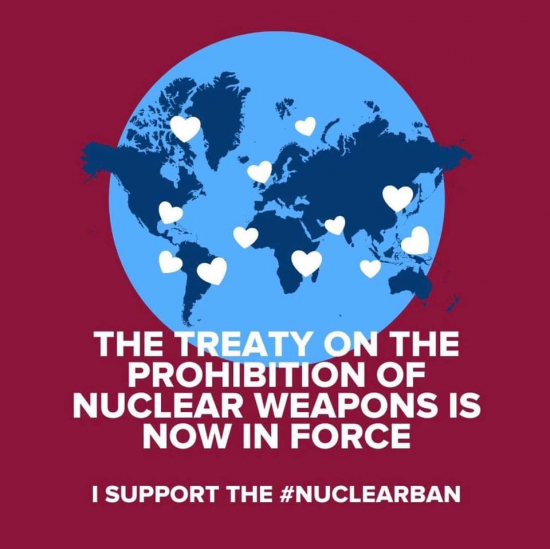
| The Nuclear Free Local Authorities have joined with campaign groups opposed to nuclear weapons in calling on the British Foreign Secretary to ensure that the UK is represented at the forthcoming nuclear treaty ban conference to be held later this month in Vienna. Sixty-one member states of the United Nations have so far signed and ratified the UN Treaty on the Prohibition of Nuclear Weapons, the first international law to prohibit the manufacture, stockpiling, transfer and use of nuclear weapons which entered force in January 2021. A further twenty-five states have signed the Treaty in readiness to ratify it. These member states will meet at the UN in Vienna between 21 – 23 June to discuss the progress so far in creating a nuclear weapons free world, and, in light of the recent conflict in Ukraine, the next best steps to get there. None of the world’s nuclear weapons states have so far engaged with the treaty, and the UK has steadfastly refused to recognise it, despite five of the states, including the UK, making a commitment as signatories to the Nuclear Non-Proliferation Treaty to work in ‘good faith’ to achieve global nuclear disarmament at the earliest possible date. Britain made this commitment as one of the first signatories to the NPT in 1968. NFLA 8th June 2022 https://www.nuclearpolicy.info/news/nuclear-free-local-authorities-join-call-for-uk-to-attend-nuclear-ban-summit/ |
1 This Month
Tell Congress: Prevent Nuclear Catastrophe in Iran

Tell Congress: Prevent Nuclear Catastrophe in Iran

Read the Public Inquiry Report, the Commissioners’ report, Surrendering Australia: The AUKUS Deception is available to download for free at aukuspublicinquiry.com. Or just watch the replay of the National Press Club Luncheon.


Shut down the radiation-damaged Heysham nuclear reactors now
To see nuclear-related stories in greater depth and intensity – go to https://nuclearinformation.wordpress.com

Say No to NASA’s Reckless Nuclear Reactor on the Moon
Say No to NASA’s Reckless Nuclear Reactor on the Moon
-
Archives
- November 2026 (190)
- October 2026 (302)
- September 2026 (339)
- August 2026 (330)
- July 2026 (355)
- June 2026 (287)
- May 2026 (306)
- April 2026 (356)
- March 2026 (251)
- February 2026 (267)
- January 2026 (308)
- December 2025 (358)
-
Categories
- 1
- 1 NUCLEAR ISSUES
- business and costs
- climate change
- culture and arts
- ENERGY
- environment
- health
- history
- indigenous issues
- Legal
- marketing of nuclear
- media
- opposition to nuclear
- PERSONAL STORIES
- politics
- politics international
- Religion and ethics
- safety
- secrets,lies and civil liberties
- spinbuster
- technology
- Uranium
- wastes
- weapons and war
- Women
- 2 WORLD
- ACTION
- AFRICA
- Atrocities
- AUSTRALIA
- Christina's notes
- Christina's themes
- culture and arts
- Events
- Fuk 2022
- Fuk 2023
- Fukushima 2017
- Fukushima 2018
- fukushima 2019
- Fukushima 2020
- Fukushima 2021
- general
- global warming
- Humour (God we need it)
- Nuclear
- RARE EARTHS
- Reference
- resources – print
- Resources -audiovicual
- Weekly Newsletter
- World
- World Nuclear
- YouTube
-
RSS
Entries RSS
Comments RSS

