The Anti-China Brainwashing Is Working: Notes From The Edge Of The Narrative Matrix
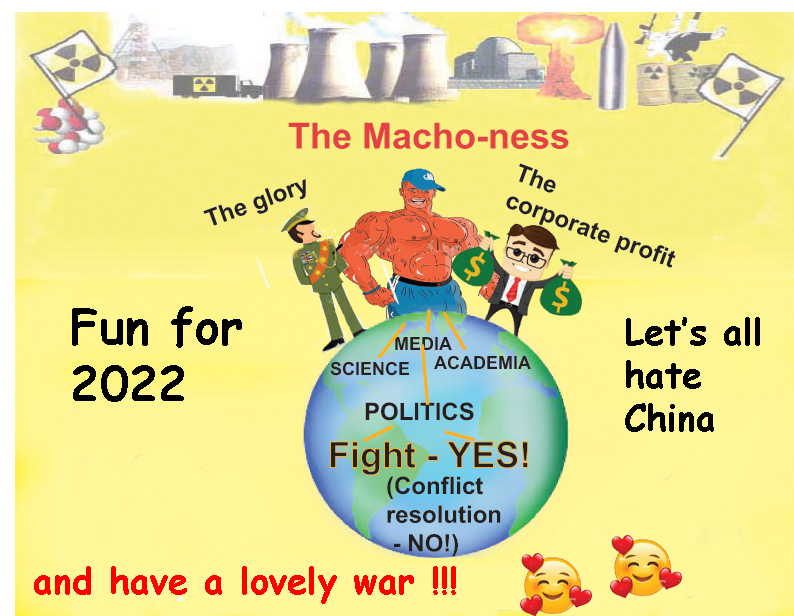
Caitlin Johnstone 2 Aug 22, If someone criticizing the most dangerous agendas of the most powerful and destructive government on earth looks like “Russian propaganda” or “Chinese propaganda” to you, it’s because you yourself have been brainwashed by propaganda.
The western propaganda campaign against China is succeeding, even among many who consider themselves anti-war or critical of establishment power. Whatever sick future agendas they’re manufacturing consent for, they’ll be able to roll right on out. People’s brains are turning to soup.
❖
The best case scenario for Nancy Pelosi’s Taiwan visit — the absolute best case — is that it ratchets up cold war tensions with China that threaten us all and benefit ordinary people in no way. The worst case scenario is as bad as anything you can possibly imagine.
So why are we being told that it’s still happening? Well, as Antiwar’s Dave DeCamp reminded us a few months ago, one major factor is that it facilitates US military expansionism geared toward encirclement strategies against China.
“The United States no longer sees Taiwan as a ‘problem’ in our relations with China, we see it as an opportunity to advance our shared vision for a free and open Indo-Pacific,” Raymond Greene, the deputy director of the de facto US embassy in Taipei, said last year.
Imagine if the Democratic Party fought against Republicans as hard as they fight against world peace……..
Taiwan is a US military asset, not a US ally. That’s a very significant difference that everyone, especially the Taiwanese, would do well to keep in mind………
It’s a safe bet that a minority of Americans could find Taiwan on a map, and that of these the overwhelming majority believe it’s just some island nation that China randomly decided it hates…….
There needs to be a major war every generation or two, otherwise peace becomes normalized and becomes the expectation. If you allow that to happen then war begins to stand out against expected norms like the freakish abomination that it is, and militarism looks insane.
They use propaganda to facilitate war, but they also use war to facilitate propaganda. Keeping the wars going helps the propaganda machine spin war as something normal and expected and to be continuously prepared for. It acts as an immunosuppressant against the public’s natural, healthy rejection of war. The more normalized war becomes, the more suppressed our collective immune system’s rejection of it becomes.
War is the absolute worst thing in the world. It’s the most insane thing humans do. The most destructive. The least sustainable. The most conducive to human suffering. Only by very aggressive narrative management can the public be dissuaded from insisting on peace…………………..
Westerners are only encouraged to contemplate the horrors of war when it is someone else’s war.
https://caitlinjohnstone.substack.com/p/the-anti-china-brainwashing-is-working?r=19f8t&s=r&utm_campaign=post&utm_medium=web&utm_source=direct
Beatty Nevada Nuclear waste explosions, in the desert.
Terry Southard 2 Aug 22,
Explosions of nuclear waste from pieces of decommissioned San onofre reactor, by San diego.The pieces of the reactor and the other waste from the San Diego, San Onofre reactor decommissioning, started blowing up in the desert outside beatty Nevada. Later the San onofre nuclear waste was dug up and transfered, to a nuclear waste facility outside salt lake city Utah. The explosions, were caused by the decay heat and pyrophoricty of the radionuclides, in the waste and that had accumulated on the reactor pieces.
We simply, don’t get to learn from the mainstream media, about these radioactive hazards.
New Mexico was on fire this summer. 800 thousand acres burned. So much nuclear waste and fallout, in New Mexico, from bomb building and testing. I would not be surprised, if there is a major uptick in lung cancers, and other cancers, in New Mexico in the next 5 years . Nuke bombs exploded under rivers in New Mexico, project gas buggy. Uranium waste catastrophes. Nuclear waste dumps in many places. Largest plutonium core operation in the world at Los Alamos, by Santa fe. Wipp plutonium dump, by Clovis.
These explosions were caused by parts of the decommisioned, highly radioactive pieces of the San onofre reactor, buried in Nevada for a few years. They had to dqqig them up, after the explosions and, moved them to utah. You would have thought, peopke in Utah, would have known better.
Steppenwolf just stick yur head into the sand, pretend that all is grand and everything will be ok
This will happen at other shoddy nuclear waste operations in the usa. Typically under-regulated, and under supervised by cheap and mismanaged, foreign owned nuclear waste management companies. Give them an inch and, they take a mile. They bribe state legislators and start taking in nuclear waste, from other countries. Countries like Japan and Estonia. That happened at the white mesa nuke waste operation, by blanding, utah. I think there is greater risk of wildfires, in the white mesa area, from the pryophoric effects of radionuclide dust from white mesa, blowing into surrounding areas.. There was a truck full of nuke waste owned by energy fuels, by Salt Lake City, that caught fire in 2018. The white mesa, energy fuel operation is trucking in nuke waste, from all over the world.
Radionuclides generate their own heat and can start fires on their own even in small amounts, like the plutonium did at rocky flats. That is why the US Armed forces, uses depleted uranium in bombs, bullets and, other munitions.
https://en.wikipedia.org/wiki/Rocky_Flats_Plant
https://www.osti.gov/biblio/515622
Wildfires and cancer
https://www.thelancet.com/journals/lanplh/article/PIIS2542-5196(22)00067-5/fulltext
More wildfires and cancer
https://www.upi.com/Health_News/2022/05/17/wildfires-cancer-risk-study/5531652723109/
Wildfires are increasing cancer rates in the World.
https://thescotfree.com/opinion/incident-at-santa-susana-a-meltdown-a-fire-and-a-cover-up/
Biden, Putin strike conciliatory tones as nuclear arms talks start at U.N.
By Michelle Nichols , UNITED NATIONS, Aug 1 (Reuters) – U.S. President Joe Biden said on Monday he is ready to pursue a new nuclear arms deal with Russia and called on Moscow to act in good faith as his Russian counterpart Vladimir Putin said there could be no winners in any nuclear war.
Both leaders issued written statements as diplomats gathered for a month-long U.N. conference to review the Treaty on the Non-Proliferation of Nuclear Weapons (NPT). It was supposed to take place in 2020 but was delayed by the COVID-19 pandemic…………………… more https://www.reuters.com/world/biden-urges-russia-china-engage-nuclear-talks-2022-08-01/
Nuclear waste isn’t an isolated problem with nuclear power…
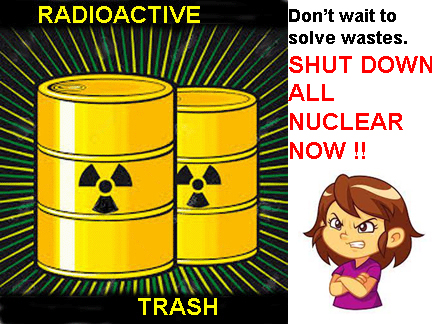
Until ALL the reactors in America (and globally) are closed, “solving” the nuclear waste problem only helps to keep the reactors operating!
https://acehoffman.blogspot.com/2022/07/nuclear-waste-isnt-isolated-problem.html Ace Hoffman Carlsbad, CA July 31, 2022 Prior to SanO’s shutdown, few SoCal residents, including most activists, worried not so much about the waste, only about shut-down.
We know the waste is a problem, but even for us, here in Southern California, Diablo Canyon Nuclear Power Plant being open is STILL a far more likely cause of our own problems, let alone California’s and America’s. DCNPP should be closed *immediately*, not in two or three years, and should certainly not have its license extended under any circumstance. I would estimate that right now, DCNPP is at least a hundred to a thousand times more likely to be the cause of our having to move, or suffering health effects, than San Onofre’s waste is. An operating reactor is incredibly more dangerous than ten year old spent fuel.
Read up on how far Chernobyl radiation spread in Kate Brown’s Manual for Survival. We can use the problem with San Onofre’s waste to push for closure of DCNPP. Once DCNPP is permanently closed, the entire state will finally (hopefully) be interested in solving the waste problem. Until ALL the reactors in America (and globally) are closed, “solving” the nuclear waste problem only helps to keep the reactors operating!
Nuclear waste scattered throughout the country is a major problem for many reasons, including terrorism, accidental airplane strikes, earthquakes, tsunamis etc. etc.
Transporting nuclear waste multiple times is also a major problem for many reasons, including accidents, terrorism, human error, etc.. It should be moved at most only once, if possible.
Neutralization of the Pu and U isotopes is possible on-site. It’s even a patented process! Read up on it in case you missed my report (see link, below). The industry doesn’t like the idea because they want to reprocess the waste. That’s ALSO why the industry is pushing so hard for one central location.
Moving nuclear waste through highly populated areas is a major problem which the U.S. government is well aware of. That is the reason they wanted to build a direct route from San Onofre to Yucca Mountain.
As a 20% owner of Palo Verde Nuclear Power Plant in Arizona, Southern California Edison (SCE) could either move the waste there (except for the problems mentioned above, plus the fact that AZ doesn’t want our waste, only their own). SCE could at least pull out of PVNPP entirely if AZ won’t take the waste.
There are many bridges, close to or even more than 100 feet high, between San Clemente and the Chocolate Mountains location that Roger J. is recommending. Moving 123 canisters over those bridges is extremely risky since the containers are NOT designed to withstand a drop of that height. It’s unlikely, IMO, that they can even survive the claimed drop heights of a few dozen feet. I drove over the Mianus River Bridge in Connecticut twice daily, when it “suddenly” collapsed, killing three people. Bridge collapses DO happen. And maintenance is shoddy at best. I HEARD the Mianus River Bridge screech in the days before the pin fully sheered off. Residents had been calling the (ir-)responsible state agencies about the noise for weeks prior to the collapse.
Israel, secretly having nuclear weapons, will not join the Nuclear Non Proliferation Treaty
Israel signals no change on nuclear policy as U.S. reaffirms anti-proliferation drive
By Dan Williams , JERUSALEM, Aug 1 (Reuters) – Israel signalled it would not change policy around its assumed nuclear arsenal on Monday as Washington affirmed a global treaty designed to roll back the spread of such weaponry.
The rare, if veiled, remarks by Prime Minister Yair Lapid came as countries party to the 1970 nuclear Non-Proliferation Treaty (NPT) met in New York for a periodic review conference.
Israel has not signed the voluntary NPT, which offers access to atomic energy in exchange for the forswearing of nuclear weaponry.
It has been leading regional calls for world powers to crack down on NPT-signatory Iran’s suspected use of civilian nuclear technologies as cover for military designs. Tehran denies wrongdoing.
Addressing the Israel Atomic Energy Commission, Lapid spoke of the country’s “defensive and offensive capabilities, and what is referred to in the foreign media as ‘other capabilities'”.
“These other capabilities keep us alive and will keep us alive as long as we and our children are here,” he said, according to a transcript from his office.
Under a decades-old ambiguity policy designed to deter surrounding enemies while avoiding provocations that can spur arms races, Israel neither confirms nor denies having nuclear weaponry.
Scholars believe it does, having acquired the first bomb in late 1966. Israeli journalists, circumscribed by military censorship, often refer cryptically to such capabilities or cite foreign media reporting on them………………
more https://www.reuters.com/world/middle-east/israel-signals-no-change-nuclear-policy-us-reaffirms-anti-proliferation-drive-2022-08-01/
10 years after nationalization, Tepco still faces mounting challenges
Sunday marked the 10th anniversary since Tokyo Electric Power Company Holdings Inc. was effectively nationalized after the devastating triple-meltdown nuclear crisis at the Fukushima No. 1 power plant.
Tepco has struggled to rebuild its business while attempting to restore its reputation and compensate for its role in the disaster that immediately followed the Great East Japan Earthquake of March 11, 2011. However, more competition, a string of scandals and other problems have prevented the restart of its nuclear power plants — a key to rebuilding the company — resulting in sluggish performance……………………….. more https://www.japantimes.co.jp/news/2022/07/31/business/corporate-business/tepco-10-years-nationalized/?utm_medium=Social&utm_source=Facebook&fbclid=IwAR1cZcSOaqhe4nPzK_PTzEYsfzq86on-IfkpJtZGwomOxQGWs5HnBzSQlrQ#Echobox=1659319230
Iran says ‘optimistic’ after EU proposal for nuclear deal
The New Arab Staff & Agencies, 01 August, 2022,
Iran said Monday it remains “optimistic” about a possible revival of the 2015 nuclear deal after the European Union tabled a proposal aiming for a compromise in the talks stalled since March.
“We remain optimistic that the negotiation process will lead us to a logical and reasonable outcome,” foreign ministry spokesman Nasser Kanani said at his weekly news conference.
The comment comes after EU foreign policy chief and coordinator of the nuclear talks between Iran and world powers, Josep Borrell, last Tuesday submitted a new draft text and urged the different sides of the negotiations to accept it or “risk a dangerous nuclear crisis”.
Negotiations in Vienna began in April 2021 to restore the deal, but have stalled since March amid differences between Tehran and Washington on several issues.
The two sides negotiated indirectly through the European Union coordinator in a bid to bring the US back into the deal and to lift sanctions on Iran, on the basis that Tehran would return to its nuclear commitments…………………………………….
more https://english.alaraby.co.uk/news/iran-says-optimistic-after-eu-proposal-nuclear-deal
‘Climate endgame’ warning: Scientists warn global warming could trigger nuclear war, financial crisis or an extinction-level pandemic
By SHIVALI BEST FOR MAILONLINE 2 August 2022
‘Climate endgame’ warning: Scientists warn global warming could trigger nuclear war, financial crisis or an extinction-level pandemic as soon as 2070
- Researchers used modelling to estimate the consequences of 3°C warming
- They suggest areas of extreme heat will cover two billion people by 2070
- These areas are some of the most politically fragile and most densely populated
With global temperatures continuing to rise, a new study has warned that we are inching dangerously close to a ‘climate endgame’.
Researchers from the University of Cambridge claim that global heating could trigger nuclear war, financial crisis or an extinction-level pandemic as soon as 2070.
Based on their findings, the researchers are calling for authorities to start preparing for such events.
‘There are plenty of reasons to believe climate change could become catastrophic, even at modest levels of warming,’ said Dr Luke Kemp, lead author of the study.
Climate change has played a role in every mass extinction event. It has helped fell empires and shaped history. Even the modern world seems adapted to a particular climate niche.
‘Paths to disaster are not limited to the direct impacts of high temperatures, such as extreme weather events.
Knock-on effects such as financial crises, conflict, and new disease outbreaks could trigger other calamities, and impede recovery from potential disasters such as nuclear war.’
In the study, the team used modelling to estimate the consequences of 3°C (5.4°F) warming and beyond.
Their estimations indicate that areas of extreme heat where annual average temperatures are over 29°C (84°F) will cover two billion people by 2070…………………….
The ‘four horsemen’ of the climate endgame
The researchers propose that research is needed in four key areas, which they call the ‘four horsemen’ of the climate endgame.
These are famine and malnutrition, extreme weather, conflict, and vector-borne diseases……………………. more https://www.dailymail.co.uk/sciencetech/article-11069613/Global-warming-trigger-nuclear-war-financial-crisis-extinction-level-pandemic-2070.html
Joe Biden offers to negotiate a new arms control framework with Russia to replace New START
 |
By: Srishti Singh Sisodia, Washington, US Aug 01, 2022,
United States President Joe Biden said that Washington has expressed its readiness to open talks with Moscow, the Russian state-controlled news television network RT reported on Monday (August 1). The report mentioned that the negotiation is apparently “a new arms control framework” with Russia to potentially replace the New START (Strategic Arms Reduction Treaty).
As quoted by the RT website, Biden said: “Today, my Administration is ready to expeditiously negotiate a new arms control framework to replace New START when it expires in 2026. But negotiation requires a willing partner operating in good faith.”
UN to Host Over 190 World Leaders & Delegates — Despite Threats from a Deadly New Covid-19 Variant

By Thalif Deen /UNITED NATIONS, Jul 22 2022 (IPS) – The United Nations is planning to host a high-level “in-person” General Assembly session, September 20-26, with over 190 world leaders and delegates listed to speak, including heads of state, heads of government, high-ranking ministers and senior officials.
The world body is apparently on a risky path, with hundreds of delegates due in New York for the opening of the 77th session—and, most worryingly, at a time when a new Covid-19 variant BA.5 is sweeping across the United States, including New York.
In a letter addressed to the President of the General Assembly, E. Courtenay Rattray Chef de Cabinet, says “while there is strong support for the return to a pre-pandemic General Debate, as reflected by the level of inscriptions by Member States in the provisional list of speakers– and an improvement in the environment as compared to the last two years– we also recognize that we are not free from the Coronavirus and its impact.”
“As such, there is a need to be prudent in our facilitation of the General Debate and High-level Week.”
Under a business-as-usual scenario, occupancy at UN Headquarters will increase significantly this September, particularly in meeting rooms and in the General Assembly and Conference buildings.
“With a view to mitigating this impact, our planning assumptions reflect an emphasis on basic protective measures and a decrease in the number of attendees, as much as reasonably possible”, the letter said.’
On July 21, White House Press Secretary Karine Jean-Pierre formally announced that US President Joe Biden, who is scheduled to address the General Assembly on September 20, tested positive for COVID-19.
“He is fully vaccinated and twice boosted and experiencing very mild symptoms. He has begun taking Paxlovid. Consistent with CDC guidelines, he will isolate at the White House and will continue to carry out all of his duties fully during that time,” she added.
In a July 20 report, Cable News Network (CNN) said “in the United States, BA.5 has become the dominant strain and is driving a significant spike in cases — more than 120,000 a day, according to the Centers for Disease Control and Prevention (CDC), though experts say that number may be more like 1 million, given the underreporting of home test results.
Europe, meanwhile, has seen a tripling of new Covid-19 infections over the past six weeks, with nearly 3 million reported last week, accounting for almost half of all new cases worldwide. Hospital admissions in Europe over the same period have doubled.
“The end of the last remaining restrictions on international travel and return of large gatherings, like music festivals, are among the factors helping the virus to spread, experts say. And the number of cases may actually be higher than data shows because countries have significantly pared back testing and surveillance, making it difficult to judge the true extent of the current surge’, said CNN.
Last week, the World Health Organization (WHO) warned that the spike in infections was a harbinger of an even worse situation to come, calling on countries to urgently reintroduce mitigation strategies before it was too late.
“It’s now abundantly clear we’re in a similar situation to last summer — only this time the ongoing Covid-19 wave is being propelled by sub-lineages of the Omicron variant, notably BA.2 and BA.5, with each dominant sub-lineage of Omicron showing clear transmission advantages over the previously circulating viruses,” WHO’s regional director for Europe, Hans Kluge, said in a statement.
Though intensive care admissions remain relatively low, as infection rates rise among older populations, deaths are mounting — almost 3,000 people a week are dying from Covid in Europe.
But in order to protect delegates and staff alike, UN Secretary-General Antonio Guterres, having considered the recommendations of the UN’s Occupational Safety and Health (OSH) Committee, has decided on the following guidelines:
- * As a condition of entry to the compound, all persons will be required to attest that they have not had symptoms of, or been diagnosed with, COVID-19 in the last 5 days.
- ** Masks are to be worn by all attendees at all times when indoors, except when directly addressing a meeting or consuming food/beverages
- ** Apart from a limited number of high-level side events, for which preparations are well under way, side events are to be conducted virtually or off-site.
- ** United Nations departments and offices will not be hosting or co-hosting in-person side events or luncheons during the high-level week.
- ** Bilateral booths will be available with seating for 2 principals and 6 advisers (3 per side).
- ** Permanent Missions are encouraged to manage COVID-19 cases and determine any subsequent action regarding case exposures among their own attendees and guests, including notification to other delegations or to the President of the General Assembly.
- ** United Nations staff who are not required to be on-site to support the proceedings will be mandated to work remotely for the full week………………………….more https://www.ipsnews.net/2022/07/un-host-190-world-leaders-delegates-despite-threats-deadly-new-covid-19-variant/?utm_source=rss&utm_medium=rss&utm_campaign=un-host-190-world-leaders-delegates-despite-threats-deadly-new-covid-19-variant
No one can win a nuclear war: Putin
https://www.canberratimes.com.au/story/7843236/no-one-can-win-a-nuclear-war-putin/ 2 Aug 22, Russian President Vladimir Putin says there can be no winners in a nuclear war and no such war should ever be started.
The Kremlin leader made the comment in a letter to participants of a conference on the nuclear non-proliferation treaty (NPT), more than five months into his war on Ukraine.
“We proceed from the fact that there can be no winners in a nuclear war and it should never be unleashed, and we stand for equal and indivisible security for all members of the world community,” he said.
His words to the NPT forum appeared aimed at striking a reassuring note and portraying Russia as a responsible nuclear power.
They contrasted with earlier statements by Putin and other Russian politicians that have been interpreted in North America and Europe as implicit nuclear threats.
In a speech on February 24, as he launched the Russian invasion of Ukraine, Putin pointedly referred to Russia’s nuclear arsenal and warned outside powers that any attempt to interfere would “lead you to such consequences that you have never encountered in your history”.
Days later, he ordered Russia’s nuclear forces to be put on high alert.
The world is facing a level of danger from nuclear weapons not seen since the height of the Cold War, UN Secretary General Antonio Guterres said at the start of the NPT conference on Monday.
The NPT is subject to review every five years, and the 10th review was to have taken place in 2020 but was postponed on account of the pandemic.
CIA director William Burns said in April that given the setbacks Russia had suffered in Ukraine, “none of us can take lightly the threat posed by a potential resort to tactical nuclear weapons or low-yield nuclear weapons”.
Russia, whose military doctrine allows for the use of nuclear weapons in the event of an existential threat to the Russian state, has accused the US of leading a “proxy war” against it by arming Ukraine and imposing sanctions.
Earlier on Monday, a Russian foreign ministry source questioned the seriousness of comments by US President Joe Biden calling for talks on a nuclear arms control framework to replace a treaty expiring in 2026.
“Is this a serious statement or has the White House website been hacked?” a Russian foreign ministry source told Reuters.
Nuclear news this week

I had trouble finding “good news” for today. So, I’ll put in a thought of my own. My own country, Australia, today gives some hope, For the first time, we have a government really trying to include our First Nations people in decision-making. Not only is Australia headed for a referendum to bring indigenous voices into our Parliament – with hope to redress the wrongs of 200 years, but also the hope that indigenous knowledge and culture will advise and further the mighty task of healing our damaged environment.
Coronavirus and Climate – it’s all drastically bad- the mind boggles – best for readers to do their homework on these.
Nuclear. Ironically, as nations ramp up their nuclear weaponry – comes the anniversary of the nuclear bombing of Hiroshima and Nagasaki. https://www.youtube.com/watch?v=tZSENcK-en4 At some commemorations. survivors like Setsuko Thurlow will be speaking. Like the survivors of Auschwitz, these first witnesses may not be with us much longer. It is all-important that their message is remembered, and that denialism of these truly awful horrors does not prevail.
The World Does Not Want a Global NATO.
Deterrencelessness: Nuclear threats neither credible nor viable.
UN Nuclear Review: a prime time to stop the new arms race. Ukraine War Hangs Over UN Meeting on Nuclear Treaty’s Legacy. U.N. nuclear conference to start Monday as Ukraine’s Zaporizhzhya plant in “alarming” state, watchdog says.
For Warmongers It’s Always 1938. US airman who rescued film of A-bomb horrors is honoured at last.
Small nuclear reactors will bleed us dry and won’t solve climate change – unfounded promises.
The future of global catastrophic risk events from climate change.
UKRAINE. Russia accused of waging war out of working nuclear power plant in Ukraine. How professional lobbyists have worked to generate enthusiasm in Washington for a long proxy military conflict in Ukraine. High risks at Chornobyl.
FRANCE. French finance minister and MPs clash over future of nuclear power. France should “rethink the temperature thresholds of rivers”. Nuclear giant EDF and waste company Veolia continue to do business with Russia – the nuclear industry gets uranium from Russia, and sends wastes there. Protest against radioactivity-contaminated water, at French nuclear site.
ASIA. Nuclear Weapons Policies of Japan and South Korea Challenged.
JAPAN. Backlash over dumping of nuclear waste-water to the ocean . Japan to push for nuclear arms reduction at NPT review conference. Kishida to call for nuke-free world in historic address at U.N. treaty conference.
UK.
- Small nuclear reactors the solution to climate problems? The facts suggest otherwise.
- EDF forced to redesign UK nuclear reactors after horror leaks at Chinese sites.
- Campaign groups in Wales join to fight nuclear power plans.
- Scotland’s government dithering about nuclear power.
- Rolls Royce hyping up risky and unproven small nuclear reactors.
- Glascow City Council not informed when nuclear weapons convoys pass through city.
- Latest Research – Baseload generators such as Sizewell C nuclear power plants are not needed in an all-renewable future and their use would simply increase costs. A new nuclear power station needs a vast supply of water. But where will Sizewell C get it from? Grief for the abuse of nature that will come with Sizewell C nuclear station.
- Hinkley Point B nuclear power station to close permanently, due to safety concerns. UK to be left for 1000s of years with Hinkley Point B’s legacy of nuclear waste.
- Undersea nuclear waste dump off Cumbria would imperil marine life, experts warn. Is it environmentally sound to bury a massive stockpile of nuclear waste beneath the ocean floor? Probably not
USA.
- How Would Space Be Used In War? https://www.youtube.com/watch?v=Ng2kLh2Ez3Y
- Western states join New Mexico in resisting nuclear waste storage without state consent. Nuclear Waste Cleanup: Hanford Site Cleanup Costs Continue to Rise, but Opportunities Exist to Save Tens of Billions of Dollars.
- Westinghouse could get a 40 year license renewal for its nuclear fuel fabrication plant , despite safety concerns. SC nuclear fuel plant gets 40-year operating license – a ‘‘license to pollute”. Dead fish near SC nuclear fuel site were an early warning. Then came the spills and accidents.
CANADA. Pickering nuclear station is closing as planned, despite calls for refurbishment.
IRAN Iran will keep IAEA cameras turned off until nuclear deal is restored. Lawmaker Says Iran Nuclear Talks Will Resume In Coming Days.
AUSTRALIA. Australia urged to prove it is a safe nuclear custodian as Aukus comes under scrutiny at UN. Fleet of nuclear submarines will be sent by Britain to Australia as a warning to China. Indonesia warns of perils of nuclear-powered submarines in submission to the UN.
The World Does Not Want a Global NATO.

Although NATO’s member states may believe that they possess global authority, the overwhelming majority of the world does not.
It is clear that NATO’s claim to be “a bulwark of the rules-based international order” is not a view which is shared by most of the world
Most of the world rejects NATO’s policies and global aspirations and does not wish to divide the international community into outdated Cold War blocs, writes Vijay Prashad.
Consortium News, By Vijay Prashad. Tricontinental: Institute for Social Research ” 29 July 22..………………….. At No Cold War, an international platform seeking to bring sanity to international relations, we have been closely observing the shifting tenor of the war in Ukraine and the U.S.-driven pressure campaign against China.
We have published three previous briefings from this platform in our newsletters; below, you will find briefing No. 4, The World Does Not Want a Global NATO, which details the emerging clarity in the Global South regarding the U.S.-European attempt to drive a belligerent agenda around the world.
This new clarity relates not only to the militarisation of the planet, but also to the deepening conflicts in trade and development, as evidenced by the G7’s new initiative, the Partnership for Global Infrastructure and Development, which clearly targets China’s Belt and Road Initiative.
In June, member states of the North Atlantic Treaty Organisation (NATO) gathered in Madrid for their annual summit. At the meeting, NATO adopted a new Strategic Concept, which had last been updated in 2010. In it, NATO names Russia as its “most significant and direct threat” and singles out China as a “challenge [to] our interests.” In the words of NATO Secretary General Jens Stoltenberg, this guiding document represents a “fundamental shift” for the military alliance, its “biggest overhaul… since the Cold War.”
Monroe Doctrine for the 21st Century?
Although NATO purports to be a “defensive” alliance, this claim is contradicted by its destructive legacy – such as in Serbia (1999), Afghanistan (2001) and Libya (2011) – and its ever-expanding global footprint.
At the summit, NATO made it clear that it intends to continue its global expansion to confront Russia and China. Seemingly oblivious to the immense human suffering produced by the war in Ukraine, NATO declared that its “enlargement has been a historic success… and contributed to peace and stability in the Euro-Atlantic area,” and extended official membership invitations to Finland and Sweden.
However, NATO’s sights extend far beyond the “Euro-Atlantic” to the Global South. Seeking to gain a foothold in Asia, NATO welcomed Japan, South Korea, Australia and New Zealand as summit participants for the first time and stated that “the Indo-Pacific is important for NATO.”
On top of this, echoing the Monroe Doctrine (1823) of two hundred years ago, the Strategic Concept named “Africa and the Middle East” as “NATO’s southern neighbourhood,” and Stoltenberg made an ominous reference to “Russia and China’s increasing influence in [the Alliance’s] southern neighbourhood” as presenting a “challenge.”
Most of World Seeks Peace
Although NATO’s member states may believe that they possess global authority, the overwhelming majority of the world does not. The international response to the war in Ukraine indicates that a stark divide exists between the United States and its closest allies on the one hand and the Global South on the other.
Governments representing 6.7 billion people – 85 percent of the world’s population – have refused to follow sanctions imposed by the U.S. and its allies against Russia, while countries representing only 15 percent of the world’s population have followed these measures. According to Reuters, the only non-Western governments to have enacted sanctions on Russia are Japan, South Korea, the Bahamas and Taiwan – all of which host U.S. military bases or personnel.
There is even less support for the push to close airspace to Russian planes spearheaded by the U.S. and European Union. Governments representing only 12 percent of the world’s population have adopted this policy, while 88 percent have not.
U.S.-led efforts to politically isolate Russia on the international stage have been unsuccessful. In March, the U.N. General Assembly voted on a nonbinding resolution to condemn Russia’s invasion of Ukraine: 141 countries voted in favour, five countries voted against, 35 countries abstained and 12 countries were absent. However, this tally does not tell the full story. The countries which either voted against the resolution, abstained, or were absent represent 59 percent of the world’s population. Following this, the Biden administration’s call for Russia to be excluded from the G20 summit in Indonesia was ignored.
Meanwhile, despite intense backing from NATO, efforts to win support for Ukraine in the Global South have been a complete failure. On June 20, after several requests, Ukrainian President Volodymyr Zelensky addressed the African Union; only two heads of state of the continental organisation’s 55 members attended the meeting. Shortly thereafter, Zelensky’s request to address the Latin American trade bloc, Mercosur, was rejected.
It is clear that NATO’s claim to be “a bulwark of the rules-based international order” is not a view which is shared by most of the world. Support for the military alliance’s policies is almost entirely confined to its member countries and a handful of allies which together constitute a small minority of the world’s population. Most of the world’s population rejects NATO’s policies and global aspirations and does not wish to divide the international community into outdated Cold War blocs. https://consortiumnews.com/2022/07/29/the-world-does-not-want-a-global-nato/
A US airman who rescued film of A-bomb horrors is honoured at last
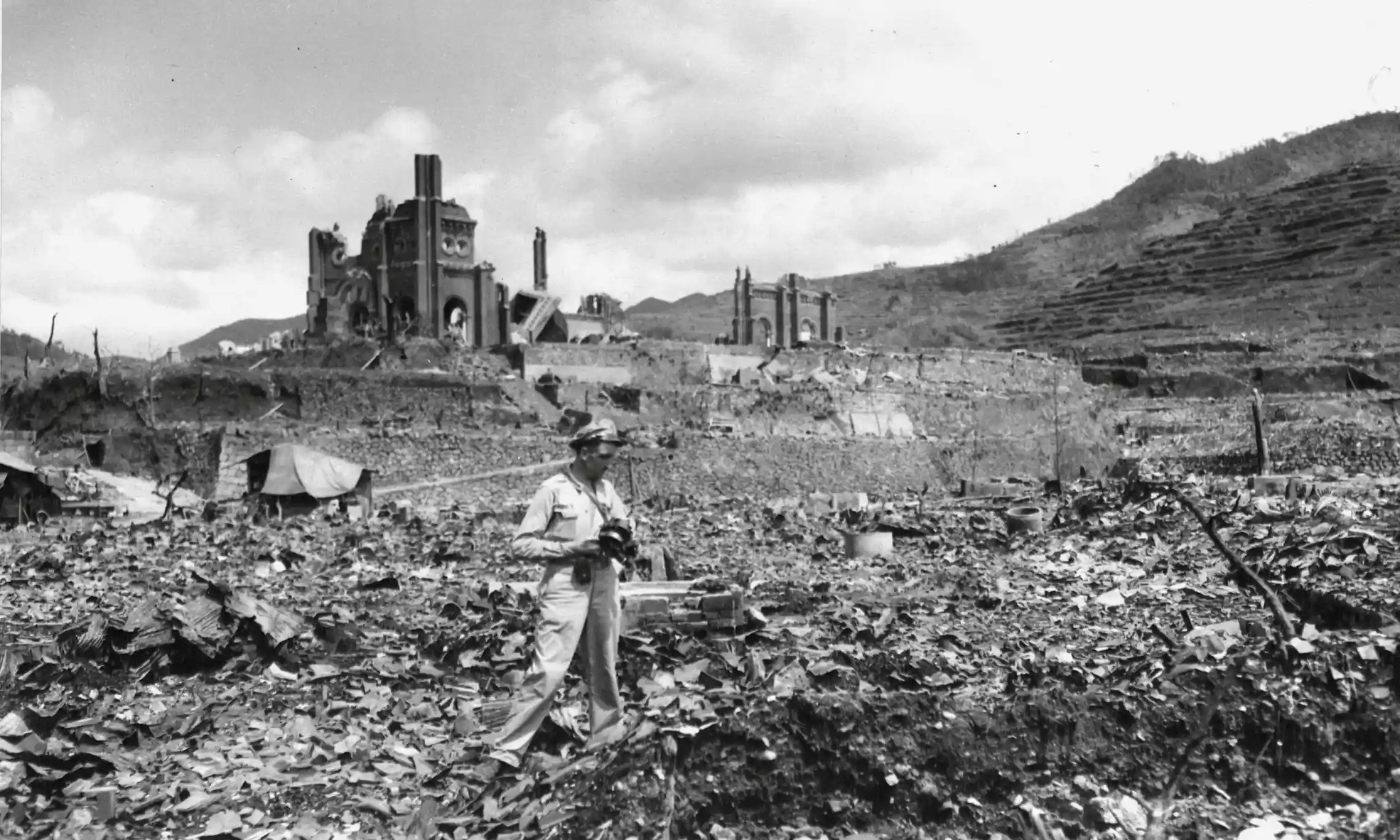
Guardian, Rory Carroll, @rorycarroll72, Sun 31 Jul 2022
Cameraman Daniel McGovern copied footage of Hiroshima and Nagasaki devastation to ensure lessons were learned
The photograph shows devastation in Nagasaki after the atomic bomb: a scorched wilderness where there was once a city. At its centre stands a lone man with a camera.
It was 9 September 1945 and Lt Daniel McGovern, a US Army Air Force cameraman, was documenting ground zero, the point directly below the bomb’s detonation four weeks earlier. Few would recognise McGovern, but the vision of apocalypse is familiar from documentary footage of Hiroshima and Nagasaki at the end of the second world war.
The footage will be shown again this week and next for the 77th anniversaries of the atomic bombings that obliterated the Japanese cities and showed the reality of nuclear war: blasted landscapes, burnt skeletons, radiation sickness.
But those haunting images might not exist were it not for McGovern. As part of the US Strategic Bombing Survey – which studied the impact of bombing – McGovern supervised Japanese and American camera crews in Hiroshima and Nagasaki. Back in the US, he saved the footage from suppression by making secret copies.
Only now, decades later, has his full story emerged. Joe McCabe, a journalist from McGovern’s native County Monaghan in Ireland, has pieced together his remarkable life in a biography, Rebels to Reels, published earlier this month after 20 years of research, including interviews with McGovern before his death in 2005………………………………………………….
The fields around Nagasaki were bleached white and the city looked as if a “massive anvil” had flattened it, he later told McCabe. At a ruined school he filmed the bodies of children amid piles of skulls. “Hundreds of kids had been sucked out through the windows. We were always finding bones.”
He filmed harrowing scenes at overwhelmed hospitals, including the agony of a 16-year-old boy named Sumiteru Taniguchi. “His whole back just looked like a bowl of bubbling tomatoes.”
Other patients had rashes, hair loss and bleeding from the nose and mouth – a mysterious malady later identified as radiation sickness.
McGovern also captured the phenomenon of people who had been atomised yet left shadows caused by radiant heat. The two atomic bombs are estimated to have killed more than 200,000 people.
McGovern’s teams amassed 100,000ft of colour footage and enlisted the help of a Japanese newsreel service, Nippon Eigasha, which had 26,000ft of black-and-white footage, much shot before the Americans had arrived. The Irishman helped edit the Japanese footage into a documentary called Effects of the Atomic Bomb on Hiroshima and Nagasaki, and planned to turn the colour footage into another one.
Authorities in Washington, however, classified the material as secret in 1946. “They didn’t want the American public seeing the horrors,” McGovern said. He discreetly made copies at the Pentagon. He stored one set at an air force motion picture depository in Dayton, Ohio, and kept another set himself.
Years passed – McGovern witnessed rocket tests and debunked theories of aliens at Roswell as “a load of crap” – and then in 1967 a US Congressional committee that included Robert Kennedy asked to see the atomic bomb footage. The material had been declassified but no one could find the originals. McGovern, by now a lieutenant colonel, directed the authorities to his copies.
In 1970 the general public got its first glimpse of some of the footage. It had been incorporated into a film called Hiroshima Nagasaki – August 1945 that premiered at New York’s Museum of Modern Art.
The auditorium was packed. At the end, no one made a sound. https://www.theguardian.com/world/2022/jul/31/us-airman-daniel-mcgovern-cameraman-hiroshima-nagasaki
Small nuclear reactors will bleed us dry and won’t solve climate change – unfounded promises

there is every reason to believe that if and when a NuScale SMR is built, its final cost too will vastly exceed current official estimates.
Unfounded promises — Beyond Nuclear International Small Modular Reactors epitomize culture that embraces exaggeration
By M.V. Ramana
In 2006, Elizabeth Holmes, founder of a Silicon Valley startup company called Theranos, was featured in Inc magazine’s annual list of 30 under 30 entrepreneurs. Her entrepreneurship involved blood, or more precisely, testing blood. Instead of the usual vials of blood, Holmes claimed to be able to obtain precise results about the health of patients using a very small sample of blood drawn from just a pinprick.
The promise was enticing and Holmes had a great run for a decade. She was supported by a bevy of celebrities and powerful individuals, including former U.S. secretaries of state Henry Kissinger and George Shultz, James Mattis, who later served as U.S. secretary of defense, and media mogul Rupert Murdoch. Not that any of them would be expected to know much about medical science or blood testing. But all that public endorsement helped. As did savvy marketing by Holmes. Theranos raised over $700 million from investors, and receive a market valuation of nearly $9 billion by 2014.
The downfall started the following year, when the Wall Street Journal exposed that Theranos was actually using standard blood tests behind the scenes because its technology did not really work. In January 2022, Holmes was found guilty of defrauding investors.
The second part of the Theranos story is an exception. In a culture which praises a strategy of routine exaggeration, encapsulated by the slogan “fake it till you make it”, it is rare for a tech CEO being found guilty of making false promises. But the first part of Theranos story—hype, advertisement, and belief in impossible promises—is very much the norm, and not just in the case of companies involved in the health care industry.
Small Modular Nuclear Reactors
Nuclear power offers a great example. In 2003, an important study produced by nuclear advocates at the Massachusetts Institute of Technology identified costs, safety, proliferation and waste as the four “unresolved problems” with nuclear power. Not surprisingly, then, companies trying to sell new reactor designs claim that their product will be cheaper, will produce less—or no—radioactive waste, be immune to accidents, and not contribute to nuclear proliferation. These tantalizing promises are the equivalent of testing blood with a pin prick.
And, as was the case with Theranos, many such companies have been backed up by wealthy investors and influential spokespeople, who have typically had as much to do with nuclear power as Kissinger had to with testing blood. Examples include Peter Thiel, the Silicon Valley investor; Stephen Harper, the former Prime Minister of Canada; and Richard Branson, the founder of the Virgin group. But just as the Theranos product did not do what Elizabeth Holmes and her backers were claiming, new nuclear reactor designs will not solve the multiple challenges faced by nuclear power.
One class of nuclear reactors that have been extensively promoted in this vein during the last decade are Small Modular Reactors (SMRs). The promotion has been productive for these companies, especially in Canada. Some of these companies have received large amounts of funding from the national and provincial governments. This includes Terrestrial Energy that received CAD 20 million and Moltex that received CAD 50.5 million, both from the Federal Government. The province of New Brunswick added to these by awarding CAD 5 million to Moltex and CAD 25 million in all to ARC-100.
All these companies have made various claims about the above mentioned problems. Moltex, for example, claims that its reactor design “reduces waste”, a claim also made by ARC-100. ARC-100 also claims to be inherently safe, while Terrestrial claims to be cost-competive. Both Terrestrial and ARC-100 claim to do well on proliferation resistance. In general, no design will admit to failing on any of these challenges.
Dealing with any of these challenges—safety enhancement, proliferation resistance, decreased generation of waste, and cost reduction—will have to be reflected in the technical design of the nuclear reactor. The problem is that each of these goals will drive the requirements on the reactor design in different, sometimes opposing, directions.
Economics
The hardest challenge is economics. Nuclear energy is an expensive way to generate electricity. In the 2021 edition of its annual cost report, Lazard, the Wall Street firm, estimated that the levelized cost of electricity from new nuclear plants will be between $131 and $204 per megawatt hour; in contrast, newly constructed utility-scale solar and wind plants produce electricity at somewhere between $26 and $50 per megawatt hour according to Lazard. The gap between nuclear power and renewables is large, and is growing larger. While nuclear costs have increased with time, the levelized cost of electricity for solar and wind have declined rapidly, and this is expected to continue over the coming decades.
Even operating costs for nuclear power plants are high and many reactors have been shut down because they are unprofitable. In 2018, NextEra, a large electric utility company in the United States, decided to shut down the Duane Arnold nuclear reactor, because it estimated that replacing nuclear with wind power will “save customers nearly $300 million in energy costs, on a net present value basis.”
The high cost of constructing and operating nuclear plants is a key driver of the decline of nuclear power around the world. In 1996, nuclear energy’s share of global commercial gross electricity generation peaked at 17.5 percent. By 2020, that had fallen to 10.1 percent, a 40 percent decline.
The high costs described above are for large nuclear power plants. SMRs, as the name suggests, produce relatively small amounts of electricity in comparison. Economically, this is a disadvantage. When the power output of the reactor decreases, it generates less revenue for the owning utility, but the cost of constructing the reactor is not proportionately smaller. SMRs will, therefore, cost more than large reactors for each unit (megawatt) of generation capacity. This makes electricity from small reactors more expensive. This is why most of the early small reactors built in the United States shut down early: they just couldn’t compete economically.
SMR proponents argue that the lost economies of scale will be compensated by savings through mass manufacture in factories and as these plants are built in large numbers costs will go down. But this claim is not very tenable. Historically, in the United States and France, the countries with the highest number of nuclear plants, costs went up, not down, with experience. Further, to achieve such savings, these reactors have to be manufactured by the hundreds, if not the thousands, even under very optimistic assumptions about rates of learning. Finally, even if SMRs were to become comparable in cost per unit capacity of large nuclear reactors, that would not be sufficient to make them economically competitive, because their electricity production cost would still be far higher than solar and wind energy.
…………………………………………. Cost escalations are already apparent in the case of the NuScale SMR, arguably the design that is most developed in the West. The estimated cost of the Utah Association of Municipal Power Systems project went from approximately $3 billion in 2014 to $6.1 billion in 2020—this is to build twelve units of the NuScale SMR that were to generate 600 megawatts of power. The cost was so high that NuScale had to change its offering to a smaller number of units that produce only 462 megawatts, but at a cost of $5.32 billion. In other words, the cost per kilowatt of generation capacity is around $11,500 (US dollars). That figure is around 80 percent more than the per kilowatt cost of the infamous Vogtle project at the time its construction started. Since that initial estimate of $14 billion for the two AP1000 reactors, the estimated cost of the much delayed project has escalated beyond $30 billion. As with the AP1000 reactors, there is every reason to believe that if and when a NuScale SMR is built, its final cost too will vastly exceed current official estimates. ……………
Timelines
The other promise made by SMR developers is how fast they can be deployed. GE-Hitachi, for example, claims that an SMR could be “complete as early as 2028” at the Darlington site. ARC-100 described an operational date of 2029 as an “aggressive but achievable target”.
Again, the historical record suggests otherwise. Consider NuScale. In 2008, the company projected that “a NuScale plant could be producing electricity by 2015-16”. As of 2022, the company projects 2029-30 as the date for start of generation. Russia’s KLT-40S, a reactor deployed on a barge, offers another example. When construction started in 2007, the reactor was projected to start operations in October 2010. It was actually commissioned a whole decade later, in May 2020.
The SMR designs being considered in Canada are even further off. In December 2021, Ontario Power Generation chose the BWRX-300 for the Darlington site. That design is based on GE-Hitachi’s Economical Simplified Boiling Water Reactor (ESBWR) design, which was submitted for licensing to the U.S. Nuclear Regulatory Commission in 2005. That ESBWR design was changed nine times; the NRC finally approved revision 10 from 2014. If the Canadian Nuclear Safety Commission does its due diligence, it might be 2030 or later before the BWRX-300 is even licensed for construction. That assumes that the BWRX-300 design remains unchanged. And, then, of course, there will be the inevitable delays (and cost escalations) during construction. ………….
Waste, Proliferation and Safety
Small reactors also cause all of the usual problems: the risk of severe accidents, the production of radioactive waste, and the potential for nuclear weapons proliferation. …………
…………… small modular reactor proposals often envision building multiple reactors at a site. The aim is to lower costs by taking advantage of common infrastructure elements. The configuration offered by NuScale, for example, has twelve reactor modules at each site, although it also offers four- and six-unit versions. With multiple reactors, the combined radioactive inventories might be comparable to that of a large reactor. Multiple reactors at a site increase the risk that an accident at one unit might either induce accidents at other reactors or make it harder to take preventive actions at others. This is especially the case if the underlying reason for the accident is a common one that affects all of the reactors, such as an earthquake. In the case of the accidents at Japan’s Fukushima Daiichi plant, explosions at one reactor damaged the spent fuel pool in a co-located reactor. Radiation leaks from one unit made it difficult for emergency workers to approach the other units. ……………………………
Claims by SMR proponents about not producing waste are not credible, especially if waste is understood not as one kind of material but a number of different streams. A recent paper in the Proceedings of the National Academy of Sciences examined three specific SMR designs and calculates that “relative to a gigawatt-scale PWR” these three will produce up to 5.5 times more spent fuel, 30 times more long-lived low and intermediate level waste, and 35 times more short-lived low and intermediate level waste. In other words, in comparison with large light water reactors, SMRs produce more, not less, waste per unit of electricity generated. As Paul Dorfman from the University of Sussex commented, “compared with existing conventional reactors, SMRs would increase the volume and complexity of the nuclear waste problem”.
Further, some of the SMR designs involve the use of materials that are corrosive and/or pyrophoric. Dealing with these forms is more complicated. For example, the ARC-100 design will use sodium that cannot be disposed of in geological repositories without extensive processing. Such processing has never been carried out at scale. The difference in chemical properties mean that the methods developed for dealing with waste from CANDU reactors will not work as such for these wastes.
Many SMR designs also make the problem of proliferation worse. Unlike the CANDU reactor design that uses natural uranium, many SMR designs use fuel forms that require either enriched uranium or plutonium. Either plutonium or uranium that is highly enriched in the uranium-235 isotope can be used to make nuclear weapons. Because uranium enrichment facilities can be reconfigured to alter enrichment levels, it is possible for a uranium enrichment facility designed to produce fuel for a reactor to be reconfigured to produce fuel for a bomb. All else being equal, nuclear reactor designs that require fuel with higher levels of uranium enrichment pose a greater proliferation risk—this is the reason for the international effort to convert highly enriched uranium fueled research reactors to low enriched uranium fuel or shutting them down.
Plutonium is created in all nuclear power plants that use uranium fuel, but it is produced alongside intensely radioactive fission products. Practically any mixture of plutonium isotopes could be used for making weapons. Using the plutonium either to fabricate nuclear fuel or to make nuclear weapons, require the “reprocessing” of the spent fuel. Canada has not reprocessed its power reactor spent fuel, but some SMR designs, such as the Moltex design, propose to “recycle” CANDU spent fuel. Last year, nine US nonproliferation experts wrote to Prime Minister Justin Trudeau expressing serious concerns “about the technology Moltex proposes to use.”
The proliferation problem is made worse by SMRs in many ways. ……………………..
Conclusion
The saga of Theranos should remind us to be skeptical of unfounded promises. Such promises are the fuel that drive the current interest in small modular nuclear reactors………
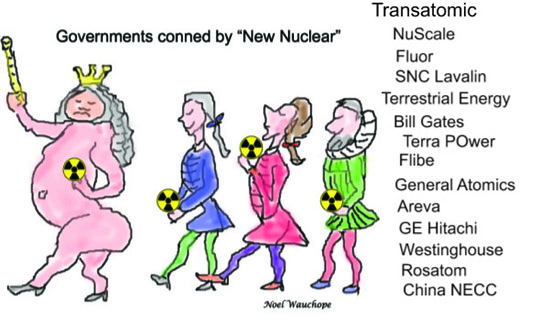
Rather than seeing the writing on the wall, unfortunately, government agencies are wasting money on funding small modular reactor proposals. Worse, they seek to justify such funding by repeating the tall claims made by promoters of these technologies…… https://beyondnuclearinternational.org/2022/07/31/unfounded-promises00
1 This Month
19 November – Webinar – The Reality of Reprocessing
Time: 11:00 AM Pacific Time (US & Canada) / 2:00 PM Eastern / 7:00 PM UK / 8:00 PM CET
Register for the Zoom Event Here

Tell Congress: Prevent Nuclear Catastrophe in Iran

Tell Congress: Prevent Nuclear Catastrophe in Iran

Read the Public Inquiry Report, the Commissioners’ report, Surrendering Australia: The AUKUS Deception is available to download for free at aukuspublicinquiry.com. Or just watch the replay of the National Press Club Luncheon.


Shut down the radiation-damaged Heysham nuclear reactors now
To see nuclear-related stories in greater depth and intensity – go to https://nuclearinformation.wordpress.com

Say No to NASA’s Reckless Nuclear Reactor on the Moon
Say No to NASA’s Reckless Nuclear Reactor on the Moon
-
Archives
- November 2026 (190)
- October 2026 (302)
- September 2026 (339)
- August 2026 (330)
- July 2026 (355)
- June 2026 (287)
- May 2026 (306)
- April 2026 (356)
- March 2026 (251)
- February 2026 (267)
- January 2026 (308)
- December 2025 (358)
-
Categories
- 1
- 1 NUCLEAR ISSUES
- business and costs
- climate change
- culture and arts
- ENERGY
- environment
- health
- history
- indigenous issues
- Legal
- marketing of nuclear
- media
- opposition to nuclear
- PERSONAL STORIES
- politics
- politics international
- Religion and ethics
- safety
- secrets,lies and civil liberties
- spinbuster
- technology
- Uranium
- wastes
- weapons and war
- Women
- 2 WORLD
- ACTION
- AFRICA
- Atrocities
- AUSTRALIA
- Christina's notes
- Christina's themes
- culture and arts
- Events
- Fuk 2022
- Fuk 2023
- Fukushima 2017
- Fukushima 2018
- fukushima 2019
- Fukushima 2020
- Fukushima 2021
- general
- global warming
- Humour (God we need it)
- Nuclear
- RARE EARTHS
- Reference
- resources – print
- Resources -audiovicual
- Weekly Newsletter
- World
- World Nuclear
- YouTube
-
RSS
Entries RSS
Comments RSS

