Poland’s double standard on how it treats refugees, and the prospect of exhaustion by those housing Ukrainians
Is Poland’s smooth reception of Ukrainian refugees heading for trouble? https://www.thenewhumanitarian.org/news-feature/2022/08/04/Poland-Ukraine-refugee-concern-grows?utm_source=The+New+Humanitarian&utm_campaign=9a3fb600c4-EMAIL_CAMPAIGN_2021_08_5_Weekly&utm_medium=email&utm_term=0_d842d98289-9a3fb600c4-75686634 4 Aug 22,
Poland has so far extended a generous welcome to some 1.5 to 2 million Ukrainians escaping Russia’s invasion – more than double any other EU country. The reception has caught the eye of many, including the UN’s special rapporteur on the human rights of migrants, Felipe González Morales, who recently visited the country. “I am impressed by the Government of Poland for providing significant support to a huge number of refugees,” González Morales said.
But Poland’s differing treatment of refugees and asylum seekers from other countries – including people fleeing the fighting in Ukraine – did not escape Gonzáles Morales’ attention, who noted the double standard and called for an end to pushbacks at the Poland-Belarus border.
The special rapporteur also said that the situation for Ukrainian refugees in Poland could soon become more difficult as winter approaches and volunteers who have been housing many Ukrainians grow exhausted. That’s just one of the impending challenges – alongside access to education, the possibility of anti-refugee sentiment, and more – that NGO workers and civil society activists told Migration Editor-at-large Eric Reidy they are now really worried about.
Why investors should be wary of small nuclear reactors

NuScale has some big challenges.
NuScale announced that completion of the project would be delayed by three years to 2030 and estimated the cost had climbed from $4.2 billion to $6.1 billion. This is a familiar old song in the nuclear energy sector: Big schedule delays and big cost-overruns.
M. V. Ramana, a physicist at the University of British Columbia who works on public policy was not surprised that so many utilities backed-out of the project. “They (utility companies) ought to be seeing the writing on the wall and getting out by the dozens.”
at least one study says that small nuclear power plants will generate more waste than conventional reactors.
NuScale: Finally Time For Small Module Nuclear Reactors?
Summary
- Small module nuclear reactors have been discussed and researched for decades – going back to at least my college engineering days in the 1970s.
- Yet for a variety of reasons, small module reactors (“SMR”) have never become a reality.
- NuScale Power wants to change that and at the present time, the company appears to be the planet’s best chance to do so.
- Today I’ll discuss my sense of NuScale’s chances of success and whether or not the stock is a good fit for an investor’s “speculative growth” bucket.
…………………………………………. My sense is that many of NuScale’s potential utility customers are waiting for – what I consider to be the “proof-of-concept” plant – to be built in Idaho.
Valuation
After a big jump in the stock price in July, NuScale currently has a $3.3 billion market cap (and a 13.7% short position):
……………… In June, NuScale gave a financial update re-affirming guidance for (only) $16 million in FY22 revenue. For the three-month period ending March 31, 2022, the company reported:
- Total available capital was $383.7 million.
- Revenue of $2.4 million and a net loss of $(23.4) million compared to revenue of $0.7 million and a net loss of $(22.7) million for the same period in 2021.
- Research and development expenses of $24.4 million compared to $18.8 million for the same period in 2021.
Clearly the company is burning cash. However, even if the cash burn grew to, say, $30 million per quarter, the available capital would last more than three years.
Risks
However, NuScale has some big challenges. Back in 2020, several utility companies within the UAMPS group backed-out of the deal to build the first NuScale SMR power plant. Even with the infusion of U.S. federal dollars, NuScale announced that completion of the project would be delayed by three years to 2030 and estimated the cost had climbed from $4.2 billion to $6.1 billion. This is a familiar old song in the nuclear energy sector: Big schedule delays and big cost-overruns. It was a big-blow: After all, the whole idea behind a small scale modular nuclear plant was to reduce the risk of both schedule and expense.
According to the previously reference source, critics of the project said it will be “untenably expensive.” M. V. Ramana, a physicist at the University of British Columbia who works on public policy was not surprised that so many utilities backed-out of the project. “They (utility companies) ought to be seeing the writing on the wall and getting out by the dozens.”
The Department of Energy (“DOE”) previously agreed to $1.4 billion in funding for the project. However, as I reported above, the cost estimate for the project now is $6.1 billion. That’s a big gap in funding. Further, at that price, investors need to question whether or not renewable solar and wind capacity would be better back-stopped by battery backup, and more wind and solar capacity additions, as opposed to an SMR.
Meantime, I personally would be much more supportive of the effort if NuScale had a partnership of some sort, or at least a well publicized plan, to re-process or store spent radioactive fuel. That’s especially the case given that at least one study says that small nuclear power plants will generate more waste than conventional reactors. The report said SMRs would create up to 30x more radioactive waste per unit of electricity generated as compared to conventional reactors. According to Reuters, Lindsay Krall – the study’s lead author – said:
Even if (the U.S.) had a robust waste management program, we think there would be a lot of challenges to deal with some of the SMR waste.
The study said NuScale’s reactor would produce ~1.7x more waste per energy equivalent than traditional reactors. NuScale countered that the study used “outdated design information and incorrect assumptions about the plants.”
Summary and Conclusions
In theory, small module nuclear reactors sound like a great idea. And they have been sounding like a great idea for decades. Yet despite all the technology available to man, and the pressing threat of global warming, no small module nuclear reactor has yet to be built in the United States. And that should tell the investor something. https://seekingalpha.com/article/4530416-nuscale-time-for-small-module-nuclear-reacto
It’s all about public perception. Can the crooked nuclear industry convince the world?
Nuclear power is on the brink of a $1 trillion resurgence, but one accident anywhere could stop that momentum.
Demand for advanced nuclear reactors will be worth about $1 trillion globally, according to Secretary Granholm, at the Department of Energy.
“The IAEA has moved quite fast
from almost an intruder into a very welcomed participant in this
dialogue” about decarbonizing the energy grid, said Rafael Grossi, the
director general of the International Atomic Energy Agency. But that
momentum depends on international cooperation around safety and best
practices. “The issue how nuclear industry works and is perceived
globally, any accident anywhere is an accident everywhere,” said Hamad Al
Kaabi, the United Arab Emirates’ representative to the IAEA.
CNBC 3rd Aug 2022
US regulators approve small nuclear reactors – BUT – costs, delays, too late for climate help
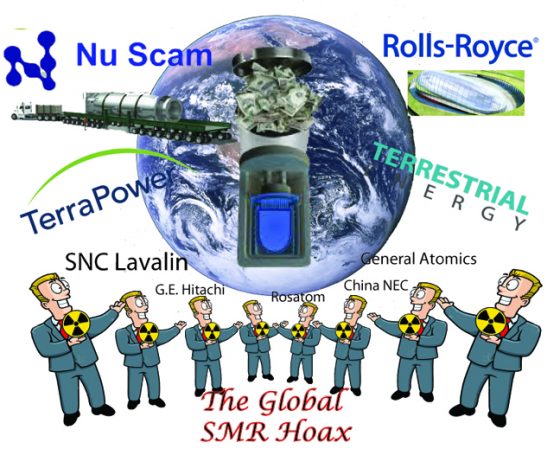
The First Small Modular Nuclear Reactor Was Just Approved by US Regulators, Singularity Hub, By Edd Gent-August 5, 2022
…………………………………… questions have been raised about whether SMRs will really live up to their billing as a cheaper, safer alternative to traditional nuclear power plants. A study published in Proceedings of the National Academy of Sciences in May found that contrary to the claims of SMR makers, these smaller reactors are actually likely to produce more radioactive waste than conventional plants.
In an article in Counterpunch, nuclear power expert M.V. Ramana also points out that the cost of renewable energy like wind and solar is already lower than that of nuclear, and continuing to fall rapidly. In contrast, nuclear power has actually become more expensive over the years.
SMRs could cost more than bigger nuclear plants, he adds, because they don’t have the same economy of scale. In theory this could be offset through mass manufacture, but only if companies receive orders in the hundreds. Tellingly, some utilities have already backed out of NuScale’s first project over cost concerns.
Perhaps even more importantly, notes Ramana, SMRs are unlikely to be ready in time to contribute to the climate fight. Projects aren’t expected to come online until the end of the decade, by which time the IPCC says we already need to have made drastic emissions reductions.
The technology has some powerful boosters though, not least President Joe Biden, who recently touted NuScale’s “groundbreaking American technology” while announcing a grant for an SMR plant the company will build in Romania. Engineering giant Rolls-Royce also recently announced a shortlist for the location of its future SMR factory, which will be used to build 16 SMRs for the UK government by 2050.
Whether SMRs can deliver on their promise remains to be seen, but given the scope of the climate challenge facing us, exploring all available options seems wise. https://singularityhub.com/2022/08/05/the-first-small-modular-nuclear-reactor-design-was-just-approved-by-us-regulators/
Does Australia actually need nuclear submarines?

“It’s obvious the real policy is to subsidise the US Navy’s submarine budget. Some will be located in Australia, with Australian flags and personnel, but they’re essentially US boats operated in the US’s great power interests. We’re paying for them to set up part of their current and future fleet in Australia.”
fewer than two of Australia’s eight nuclear submarines would be operationally available, on average, each year. And the cost of the purchases is likely to be stunning, possibly as high as $171 billion……………….. No other country has bought this type.
“Australia could buy 20 high-quality, off-the-shelf, modern submarines for $30 billion.”
influential Australian intelligence and defence officials are ignoring the point that there is no need for Australian submarines to spend much time in China’s waters
Gilligan also warns that the shallow and warm waters around Australia’s north are unsuited to large nuclear submarines.
As experts question the diplomatic, strategic and economic rationale behind Australia’s purchase of nuclear-powered submarines, the gaps in the country’s defensive fleet could be filled by conventional subs. https://www.thesaturdaypaper.com.au/news/politics/2022/08/06/does-australia-actually-need-nuclear-submarines#mtr By Brian Toohey. 6 Aug 22,
In 1992, an Australian Oberon-class submarine entered the crowded waters of Shanghai’s port and became entangled in fishing nets. It had to surface for crew members to cut it free with axes. Chinese Navy sailors witnessed this, but nevertheless the submarine escaped. Had it not, the crew would’ve been imprisoned and Australia widely condemned and potentially convicted for an outrageous breach of international law.
Almost a decade earlier, the Australian Navy had seriously considered scrapping submarines, according to former senior Australian Defence official Mike Gilligan. A study in 1985 had concluded they offered “little marginal benefit to Australia’s defences yet inflict a large marginal cost”. The cost could’ve been much higher given the tremendous risks the government allowed the navy to take, snooping in Chinese and Russian waters on behalf of the Americans, who wouldn’t put their nuclear submarines in danger.
Australia now faces some tough and highly consequential decisions with respect to its fleet. Some experts in the defence field question not only the utility of nuclear-powered vessels but the diplomatic, strategic and economic commitment they entail.
In Washington last month, Defence Minister Richard Marles said Australia, the United States and Britain were moving from “interoperability to interchangeability in defence hardware”. This would effectively mean Australia could not buy high-quality defence equipment from other countries if there was a higher-cost American or British version available. Professor Clinton Fernandes at the UNSW Canberra campus says, “It’s obvious the real policy is to subsidise the US Navy’s submarine budget. Some will be located in Australia, with Australian flags and personnel, but they’re essentially US boats operated in the US’s great power interests. We’re paying for them to set up part of their current and future fleet in Australia.”
Australia has a short and patchy record on submarine purchases. The government acquired many major weapons during World War II. None were submarines. That capability had to wait until the first of a total of six Oberon-class submarines was commissioned in 1967 from a Scottish shipyard. They operated satisfactorily but weren’t considered the nation’s most important military assets.
After Kim Beazley became Defence minister in the Hawke government, he gambled on the value of submarines by ordering six large, battery-powered versions to be built in Adelaide. No other country has bought this type.
The first was commissioned in 1966 and the last in 2003. Called the Collins class, it was based on a good Swedish design. But Beazley greatly increased its size and complexity, partly by adding American equipment that proved completely useless. Maintenance problems drove annual sustainment costs to $670 million. Often only two or three were available at a time, although availability later improved. And none attended the 2010 Rim of the Pacific event – known as Rimpac, the world’s largest international maritime warfare exercise, held biennially near Hawaii.
Former prime minister Scott Morrison and his successor, Anthony Albanese, have taken a much bigger gamble than Beazley did, with their commitment to buy at least eight nuclear attack submarines – almost certainly the American Virginia class. One of the US’s most highly regarded defence analysts, Winslow Wheeler, recently pointed out the Virginia-class subs have been available only 15 times in 33 years for their six-monthly deployments. This suggests fewer than two of Australia’s eight nuclear submarines would be operationally available, on average, each year. And the cost of the purchases is likely to be stunning, possibly as high as $171 billion when accounting for inflation, according to the Australian Strategic Policy Institute, and more recent estimates are above $200 billion. The costliest previous military acquisition, for the Australian Air Force, is the inflation-adjusted $16.6 billion program cost for 72 F-35 fighter jets.
Former submariner, naval consultant and South Australian senator Rex Patrick says, “Australia could buy 20 high-quality, off-the-shelf, modern submarines for $30 billion.”
Patrick also makes the point that nuclear submarines are often “defeated” in exercises by ultra-quiet conventional submarines.
Major new developments are making conventional submarines even more formidable than the nuclear versions. More powerful sensors mean submarines can be detected by the noise they make and by their passage through the Earth’s magnetic field. In addition, nuclear submarines can be detected by the wake they leave at high speeds, as well as the hot water they release from cooling their nuclear reactors, operating loud steam engines and other equipment. In future, submarines may also be detected by blue-green lasers that make the ocean more transparent.
A prize-winning essay published in the US Naval Institute’s magazine Proceedings in June 2018 said the US Navy would do well to consider acquiring “some quiet, inexpensive and highly capable diesel-electric submarines”. Until recently, conventionally powered submarines frequently had to rise close the surface to expose a mast and snorkel to obtain fresh air for their diesel engines to recharge the batteries. This process can be detected by radar.
Most conventionally powered submarines – except Australia’s – use what is called air independent propulsion (AIP), which allows them to remain silent for four to six weeks before snorkelling. That often entails using a hydrogen fuel cell to propel the submarine, but it takes up significant space on the vessel.
In a major change, Japan’s new Taigei-class submarines don’t need AIP because they’re equipped with particularly efficient lithium-nickel-cobalt-aluminium oxide batteries, rather than the lead-acid batteries that the Australian Navy prefers, due in part to the risks of lithium-ion batteries catching fire. Other navies are increasingly confident the new types of battery will prove safe. Hans Ohff, a submarine specialist and visiting fellow at Adelaide University, told The Saturday Paper, “Generally speaking, lithium-ion batteries have a 1.5-times range advantage over lead-acid at lower speeds and an incredible four-times range advantage at high speeds.”
Since the Collins class is due to start retiring in 2026, a replacement is urgently required to help fill the gap until the first nuclear submarine might arrive, near 2045, and the last in 2065. Senator Patrick says the time it takes to do this can be reduced by choosing one of the three available “off-the-shelf” submarines: Japan’s Taigei, which has passed numerous tests demonstrating the safety of its new batteries; Singapore’s Type 218SG, made by Germany’s thyssenkrupp Marine Systems; and the Spanish S-81. The latter two still use conventional lead-acid batteries, but Ohff says a French and German joint venture is under way to develop their own lithium-ion batteries.
These options have advantages and drawbacks. The new Taigei class – of which Japan is acquiring 22 – requires a costly crew of 70 per vessel. The Type 218SG’s German manufacturer is the biggest submarine exporter in the world, with an enviable reputation for low maintenance costs across its range. Extensive automation means it needs only 28 crew members, and the vessel has a longer range than the Taigei’s 12,500 kilometres. Spain’s S-81 has a crew of 32 but a less experienced manufacturer.
With China being the principal concern of Australian diplomatic and defence policymakers, Ohff says the navy will never accept off-the-shelf submarines unless it can “Australianise” them – meaning they must have the range to operate for long periods, many thousands of kilometres away, probably in Chinese waters or nearby. Ohff says the navy’s preferences would take a minimum of 10 years to deliver the first boat and additional two-year intervals for the following boats. He says delivery of a Swedish “Son of Collins” could take nine years.
Patrick says influential Australian intelligence and defence officials are ignoring the point that there is no need for Australian submarines to spend much time in China’s waters: Japan, South Korea, Singapore and Vietnam have high-quality submarines closer to China. The main attraction of nuclear submarines for these officials is they could fire subsonic cruise missiles at land targets in China from more than 1000 kilometres off its coast. However, cruise missiles can be shot down by fighter planes overhead. Once a nuclear submarine fired its missiles, it would be detected and swiftly targeted. Even if it survived, reloading would require the help of a tender – a large depot ship that supplies and supports submarines – probably from the distant base at Fremantle, which recently hosted a reloading for a US nuclear submarine. In any event, an attack on Chinese territory could provoke a heavy counterattack on Australia’s forces or its mainland.
Gilligan says most of the capability offered by submarines is better provided by Australia’s maritime and land-based aircraft. He says submarines, including nuclear ones, are slow compared to aircraft. Technically, a plane could sink a ship off Australia’s west coast in the morning, refuel, then sink another off the east coast in the afternoon. Gilligan also warns that the shallow and warm waters around Australia’s north are unsuited to large nuclear submarines.
Deploying nuclear submarines far from Australia marks a return to the previously discredited doctrine of “forward defence” in South-East Asia that concentrated on a big British naval base in Singapore, which was swiftly overrun by the Japanese in 1942. When this doctrine failed during the Vietnam War, the Coalition government in the late 1960s adopted a “defence of Australia” doctrine, which survived until its recent abandonment. Patrick and other proponents of this latter doctrine expect a revised doctrine would put more emphasis on having medium-sized conventional submarines to help deny hostile forces access to the approaches to Australia, unless they could detect and destroy all the submarines, drones, planes and land-based missiles blocking their way.
Finally, from a defence perspective, much of the planning around nuclear submarines assumes – implausibly – that Chinese and US policies will proceed in a predictable way until past 2060. A purely geopolitical analysis, however, could easily underplay the disruptive role of climate change.
In purely geopolitical terms, the region may become more peaceful or more dangerous. The only urgency for Australia is to forget about nuclear submarines and get some conventionally powered submarines to enhance deterrence.
Climate breakdown is super-charging extreme weather

The devastating intensification of extreme weather is laid bare today in a
Guardian analysis that shows how people across the world are losing their
lives and livelihoods due to more deadly and more frequent heatwaves,
floods, wildfires and droughts brought by the climate crisis.
Guardian 4th Aug 2022
https://www.theguardian.com/environment/2022/aug/04/climate-breakdown-supercharging-extreme-weather
France importing power, as nuclear stations cut output because of global heating
EDF has warned it will be forced to cut power output from some of its
nuclear reactors as hot weather in France drives up river temperatures. It
leaves Europe facing even higher prices as the energy giant is unable to
use the Rhône and Garonne river to cool its plants.
The company’s S Alban plant’s output will be reduced, from 2.6 gigawatts to 700 megawatts
from Saturday, to adhere to environment regulations. Cutbacks are also
expected at the Tricastin plant, where two units will stay at a minimum
level of 400 megawatts.
EDF’s nuclear fleet is already operating below
capacity due to reactor faults that it is trying to fix, an issue that has
pushed up electricity prices and forced France to rely on power imported
from Britain.
Telegraph 3rd Aug 2022
https://www.telegraph.co.uk/business/2022/08/03/water-shortage-cripples-nuclear-reactors-france/
France’s problems with nuclear corporation EDF

Following my previous post on EDF’s woes and their impact on the
European market, here’s a list of topics, both practical and political,
that the company needs to deal, and their domestic impact in France.
Corrosion issues. 12 plants, mostly the more modern ones, have been stopped
due to cracks in pipes;
Flamanville. The only new nuclear plant in
construction in France, it has been beset by delays and cost overruns;
Overall supply levels. With the existing nuclear fleet getting older, it
will likely require more maintenance (both scheduled and unscheduled), and
become more vulnerable to loss of skills as experienced nuclear workers
retire and are only partly replaced given the uncertain prospects of the
sector; Expensive imports. The lower production levels mean that EDF needs
to import increasing volumes of power. With the current gas crisis
triggered by the Russian invasion of Ukraine, this leads to very high power
prices and significant costs;
Blocked retail prices. After years of being
told that France has the cheapest electricity thanks to nuclear, the price
of retail electricity is a highly volatile political topic. Energy prices
are a hot-button issue everywhere, but they are specifically so for
President Macron;
The ARENH boondoggle. As part of the opening of the
French power market pushed by the EU commission, EDF has been forced to
sell a chunk of its nuclear production (initially 100 TWh/y, ie roughly 25%
of its production) at a fixed price (42 EUR/MWh) to new competitors on the
retail market;
EDF restructuring and EU competition issues. Several of the
items above remind us that EDF is a topic closely watched in Brussels. The
earlier EDF restructuring concept (codename “Hercule”) which proposed
to split EDF in 2 entities (nuclear and hydro, publicly owned: networks and
renewables, to be listed) was opposed by unions, and viewed with skepticism
in Brussels;
One of the topics that derailed the Hercule process was what
to do with EDF’s large portfolio of hydro generation. The EU commission
has long wanted to open up that sector to competition and force the
government to tender the dams when the concessions granted to EDF come to
an end. The fact that EDF has proven unable to build the next-generation
EPRs is either seen as a temporary blip, or a plot by outsiders to weaken
the country (anti-nuclear policies, pushed in particular by Germany, are
seen to have willfully weakened France’s industrial base). Renewables,
despite all evidence to the contrary, are still seen as either a useless
greenwashing sideshow or a dangerous distraction.
Jerome in Paris 4th Aug 2022
https://jeromeaparis.substack.com/p/edf-the-strategic-questions-and-to
Danger of nuclear weapons convoys on the UK’s M6

CAMPAIGNERS have again released photographs of a Ministry of Defence
convoy on the M6 – something they say ‘terrifies’ them. Members of
the Campaign for Nuclear Disarmament say they believe trucks making up the
convoy were transporting nuclear warheads.
The route they take uses the M6 through Cheshire, Warrington and St Helens to and from the atomic weapons establishment in Berkshire and the Trident nuclear weapons system base at
Coulport, in the West of Scotland. The convoy is believed to have been
parked at Weeton Barracks, near Kirkham in Lancashire, on the night of
Monday, July 25, after passing through Cheshire on the M6.
St Helens Star 4th Aug 2022
https://www.sthelensstar.co.uk/news/20601561.nuclear-weapon-convoy-m6-terrifies-campaigners/
Nuclear energy vs renewables: which is the best solution for the climate crisis?

There is no silver bullet to the climate crisis, and renewables
look like a better, cheaper solution.
In addition to safety concerns,
rising costs are a central reason why the number of new plants under
construction remains limited. Since 2011, nuclear power construction costs
globally have doubled or even tripled.
China is, however, notable in its
nuclear ambitions. The country is planning at least 150 new reactors in the
next 15 years, more than the rest of the world has built in the past 35,
though cost could ultimately change this direction of travel. There are
some big nuclear power stations on the cards – think Hinkley Point C or
Sizewell C in the UK.
But the major excitement among many nuclear
enthusiasts, including plenty of UK MPs is around so-called small modular
reactors (SMRs). If you believe the hype, they are the answer to all
climate and energy ills.
So what is the solution? Renewables, renewables
and more renewables? In short, yes. The costs of solar, wind power and
storage continue to fall, and by 2026 global renewable electricity capacity
is forecast to rise by more than 60 per cent, to a level that would equal
the current total global power capacity of fossil fuels and nuclear
combined, says the IEA.
Some argue nuclear can be a clean back-up option
for when the wind doesn’t blow and the sun isn’t shining. But again,
other options already exist, including demand response (for example,
plugging in your electric car when there is lots of energy and not
switching on your washing machine when the system is under strain),
large-scale storage and interconnections between different countries.
New Statesman 4th Aug 2022
Nuclear energy for Colorado? The cost is one very big obstacle
Post Independent, Allen Best 6 Aug 22, A nuclear reactor might be a nice addition to the economy of Craig, the community in northwestern Colorado. But can Colorado afford nuclear power?
……………….Sen. Bob Rankin in the last legislative session tried to get fellow legislators to appropriate $500,000 (amended to $250,000) to study the potential for nuclear.
…………Conspicuously absent was support from the administration of Gov. Jared Polis. The bill failed 3-2 on a party-line vote.
Nuclear has a nagging problem, though. It’s expensive. Advocates rarely mention this. Costs of Georgia’s Plant Vogtle, the only U.S. nuclear power plant under construction, have ballooned from $14 billion to now $30 billion-plus. In South Carolina, investors pulled the plug on a nuclear power plant after spending $9 billion. It has become among the very costliest of energy sources, only slightly less than rooftop solar, according to Lazard, the financial analyst.
Modular nuclear reactors have been promoted as a way to shave costs. Specific projects have been conceived in both Idaho and Wyoming. Bill Gates is an investor in the latter. Maybe they will overcome this cost problem. We won’t really know for another 10, maybe 15 years.
State Sen. Chris Hansen remains skeptical. He has expertise unsurpassed among legislators. He set out to become a nuclear engineer after first laying eyes on a reactor when a high school junior from the farm country of Kansas. He got his degree but had already turned his attention to economics. He went on to earn degrees from the Massachusetts Institute of Technology and, from Oxford, a Ph.D. in resource economics.
Nuclear, he told a county commissioner from Sterling in 2019, when I first heard him answer this question, simply does not compete in cost. Last week, when we talked, he offered more detail.
“I think those technologies will have to prove themselves,” he said of modular nuclear reactors. “Right now, in the best-case scenario it looks like they will deliver electricity at $60 to $70 per megawatt-hour. Wind and solar are coming in at less than $20.”
……….. Hansen suggests that reliability [of rennewables] may more economically be provided by less expensive alternatives. For example, he has pushed transmission and passed legislation to create organized markets that will allow electricity to be moved across broader geographic areas in response to consumer demands. Colorado is currently an island with limited bridges to other areas………… https://www.postindependent.com/opinion/allen-best-nuclear-energy-has-obstacles-too/
Drought may force nuclear power production cut
https://journalrecord.com/2022/08/05/drought-may-force-nuclear-power-production-cut/ Associated Press August 5, 2022 0
PARIS — French Prime Minister Elisabeth Borne warned that France is facing the “most severe drought” ever recorded in the country and announced the activation of a government crisis unit.
The crisis unit will be in charge of monitoring the situation in the hardest-hit areas and coordinate measures like bringing drinking water to some places. It will also monitor the impact of the drought on France’s energy production, transport infrastructure and agriculture.
The drought may force French energy giant EDF to cut power production at nuclear plants which use river water to cool reactors.
France now has 62 regions with restrictions on water usage due to the lack of rain.
Borne said many areas in France are going through a “historic situation” as the country endures its third heatwave this summer.
“The exceptional drought we are currently experiencing is depriving many municipalities of water and is a tragedy for our farmers, our ecosystems and biodiversity,” the statement said.
If we are to survive…we must change course — IPPNW peace and health blog.
[Former IPPNW co-president Ira Helfand, on behalf of the federation, will deliver the following statement today at the Non-Proliferation Treaty (NPT) Review Conference at the United Nations in New York.] More than 50 years ago the nations of the world, understanding the grave existential threat posed by nuclear weapons, came together in this Non-Proliferation Treaty […]
If we are to survive…we must change course — IPPNW peace and health blog
Fukushima Daiichi Nuclear Power Plant “Treated Water” Discharged TEPCO Announces Undersea Tunnel Construction to Begin in 4 Days “Already Started? Citizens were in a state of exasperation

August 3, 2022
TEPCO announced on August 3 that it will begin construction of an undersea tunnel and other facilities on August 4 to discharge contaminated water from the Fukushima Daiichi Nuclear Power Plant (Okuma and Futaba, Fukushima Prefecture) after purification and treatment. The company aims to begin discharging the water next spring, but if the offshore construction is delayed by weather conditions or other factors, the completion of the facilities may be delayed until next summer. However, there is strong opposition to the project, especially from those involved in the fishing industry, and it is unclear whether the facilities will actually be able to discharge the radioactive waste. (Nozomi Masui)
On the 2nd, the prefectural government and both towns in the area agreed to the construction work, and on the 4th, they will begin digging undersea tunnels and laying pipes to transfer treated water from the storage tanks. TEPCO is proceeding with some of the work outside the scope of the consent, and has finished digging the hole that will house the water storage tank that will lead to the undersea tunnel.
At the press conference, Junichi Matsumoto of TEPCO’s Fukushima Daiichi Decommissioning Promotion Company made it clear that “there is no doubt that we will comply with the document with fishermen,” regarding the written promise with the Fukushima Prefectural Fisheries Federation that no ocean discharge would take place unless understanding is obtained. However, he simply reiterated that he would “do his best to explain” how to gain their understanding.
When asked if TEPCO executives would brief fishermen before construction began, he replied, “We have no plans to do so. Meanwhile, Prime Minister Fumio Kishida met with Masanobu Sakamoto, chairman of the National Federation of Fishermen’s Cooperative Associations, on the same day. Regarding a large fund for the continuation of the fishing industry, he said, “We would like to obtain the fishermen’s understanding on how to use the fund after hearing their opinions.
According to TEPCO’s plan, the treated water, which is mainly tritium, will be diluted with a large amount of seawater to less than 1/40th of the national discharge standard, and then discharged through an undersea tunnel about 1 km offshore.
◆”Voices not being heard by the government,” citizens’ group protests.
On March 3, when TEPCO announced the start of construction of facilities to discharge treated water from the Fukushima Daiichi Nuclear Power Plant into the ocean, citizens’ groups in Fukushima Prefecture staged a protest in front of the prefectural government office, and the leaders of local governments where the plant is located asked the government to take thorough measures against harmful rumors.
On the afternoon of the 3rd, the co-chairman of the “Citizens’ Council” Oda, who heard about the plan to start construction on the following day, said, “What, it has already started? Chiyo Oda, 67, co-chairperson of the “Citizens’ Council” in Iwaki City, Fukushima Prefecture, was absolutely stunned. Construction began just two days after Fukushima Prefecture and the towns of Okuma and Futaba agreed to the work. She was concerned that the situation would become so dire that there would be no turning back.

In the morning of that day, the association held a banner in front of the prefectural office to protest. At a press conference held afterward, Mr. Oda said, “The plan is proceeding with the release of the waste. There are so many voices of opposition and concern, but the government is not receiving our voices? Kaoru Watanabe, 66, a resident of Date City in Fukushima Prefecture, expressed his concern, “I’m worried that they will push ahead with the construction work, create a fait accompli, and then push through with the discharge into the ocean.
Fukushima Governor Masao Uchibori, Okuma Mayor Jun Yoshida, and Futaba Mayor Shiro Izawa visited the Ministry of Economy, Trade and Industry and submitted a written request to METI Minister Koichi Hagiuda. Governor Uchibori told the press, “I hope that the government will work together to take the necessary measures (against harmful rumors, etc.) so that the efforts of the people of Fukushima Prefecture will not be undone by the release of the radioactive materials. (Natsuko Katayama, Nozomi Masui)
https://www.tokyo-np.co.jp/article/193622?fbclid=IwAR0TJASuRCsIfHc-zmKUqE7ERgUF3pJNe_vGHn8bYmkFdMTiS5Hn9RYhN5M
TEPCO Starts Construction of Fukushima Water Release Facilities
Get ready for a new wave… of radioactive wastewater!
ineptco’s tunnel will carry the enriched water a whole kilometer from the coast

August 4, 2022
Tokyo Electric Power Company Holdings Inc. on Thursday started the construction of facilities to release treated radioactive water into the ocean from its disaster-crippled nuclear plant in the northeastern Japan prefecture of Fukushima.
TEPCO aims to complete the construction work around next spring, although the company said the completion might be pushed back to around summer next year if the work at sea is delayed due to bad weather or other factors.
There are lingering concerns about negative rumors related to the planned release of the water, which contains tritium, a radioactive substance, into the ocean. Understanding from related local people would be essential for TEPCO to start the water release after the completion of the facilities.
TEPCO will construct an undersea tunnel necessary for releasing the treated water at a point 1 kilometer off the coast. Tanks and pipes will also be set up for stirring the treated water and checking whether radioactive substances other than tritium are below safety standards.

Also, the company will build a facility to dilute the treated water, after its levels of radioactive substances are measured, with seawater to lower the tritium concentration to less than one-40th of the level permitted under Japanese safety standards.
1 This Month
19 November – Webinar – The Reality of Reprocessing
Time: 11:00 AM Pacific Time (US & Canada) / 2:00 PM Eastern / 7:00 PM UK / 8:00 PM CET
Register for the Zoom Event Here

Tell Congress: Prevent Nuclear Catastrophe in Iran

Tell Congress: Prevent Nuclear Catastrophe in Iran

Read the Public Inquiry Report, the Commissioners’ report, Surrendering Australia: The AUKUS Deception is available to download for free at aukuspublicinquiry.com. Or just watch the replay of the National Press Club Luncheon.


Shut down the radiation-damaged Heysham nuclear reactors now
To see nuclear-related stories in greater depth and intensity – go to https://nuclearinformation.wordpress.com

Say No to NASA’s Reckless Nuclear Reactor on the Moon
Say No to NASA’s Reckless Nuclear Reactor on the Moon
-
Archives
- November 2026 (190)
- October 2026 (302)
- September 2026 (339)
- August 2026 (330)
- July 2026 (355)
- June 2026 (287)
- May 2026 (306)
- April 2026 (356)
- March 2026 (251)
- February 2026 (267)
- January 2026 (308)
- December 2025 (358)
-
Categories
- 1
- 1 NUCLEAR ISSUES
- business and costs
- climate change
- culture and arts
- ENERGY
- environment
- health
- history
- indigenous issues
- Legal
- marketing of nuclear
- media
- opposition to nuclear
- PERSONAL STORIES
- politics
- politics international
- Religion and ethics
- safety
- secrets,lies and civil liberties
- spinbuster
- technology
- Uranium
- wastes
- weapons and war
- Women
- 2 WORLD
- ACTION
- AFRICA
- Atrocities
- AUSTRALIA
- Christina's notes
- Christina's themes
- culture and arts
- Events
- Fuk 2022
- Fuk 2023
- Fukushima 2017
- Fukushima 2018
- fukushima 2019
- Fukushima 2020
- Fukushima 2021
- general
- global warming
- Humour (God we need it)
- Nuclear
- RARE EARTHS
- Reference
- resources – print
- Resources -audiovicual
- Weekly Newsletter
- World
- World Nuclear
- YouTube
-
RSS
Entries RSS
Comments RSS

