Nishnawbe Aski Nation opposes possible site for storage of nuclear waste

Globe and Mail, MARSHA MCLEOD, 11 Aug.22,
Nishnawbe Aski Nation’s chiefs-in-assembly passed a resolution Wednesday “vehemently” opposing the possibility of an underground repository for nuclear waste in Northern Ontario.
The chiefs’ resolution calls on Nishnawbe Aski Nation, or NAN, which represents 49 First Nation communities within Northern Ontario, to take action to stop such a possibility, including through protest and possible legal action.
We’re fighting for our young people. We’re talking hundreds of years from now – that’s who we’re speaking up for,” said Nishnawbe Aski Nation Grand Chief Derek Fox in an interview. “NAN is going to do all it can – and I was mandated by the chiefs to do all we can – to stop this from happening.”
Chiefs, youth leaders and women’s advocates raised concerns during NAN’s annual Keewaywin Conference, which is being held in Timmins, Ont., this week. Some leaders also expressed anger at a lack of consultation of NAN’s communities over the possible site. The chiefs’ resolution speaks to a years-long search by the Nuclear Waste Management Organization, or NWMO, for a site to build a “deep geological repository,” or GDR, which would see Canada’s spent nuclear fuel stored in a facility located at least 500 metres below-ground.
That search has been narrowed to two possible sites: one located between Ignace and Wabigoon Lake Ojibway Nation in Northern Ontario, which is the site of concern to NAN, and another near South Bruce, Ont. A decision between the two sites is expected by the end of 2023, said Bob Watts, NWMO’s vice-president of Indigenous relations and strategic programs.
If the site near Ignace is selected, the township of Ignace, as well as Wabigoon Lake Ojibway Nation, would hold approval power over the project going forward, Mr. Watts confirmed.
Wabigoon Lake is not a member of NAN and the site would sit just south of NAN’s territory – within Treaty 3, but Mr. Fox pointed out that any issue with the site will not just affect Treaty 3, but the entire region.
“All rivers flow north from that area,” he said. “Nuclear waste doesn’t know treaty boundaries. A spill does not know treaty boundaries. A nuclear waste accident is not going to say, okay, well, we only agreed to pollute Treaty 3.”
Any kind of pollution in the rivers, lakes and waterways of the region would have “devastating” effects, he said………………………………….
In discussions ahead of Wednesday’s vote on the resolution, chiefs and other leaders expressed their concerns about the possible location of the site.
“Northern Ontario is not a garbage can,” said Constance Lake First Nation Chief Ramona Sutherland. “We work for seven generations of our people – I don’t want to pass this down to my son, my grandson, and then his sons.”
Neskantaga First Nation Chief Wayne Moonias called the proposal “disturbing,” and added, “the thought of having a nuclear waste site in our area – it’s just not something that we can live with.” https://www.theglobeandmail.com/politics/article-nishnawbe-aski-nation-opposes-possible-site-for-storage-of-nuclear/—
President Biden’s new weapons package for Ukraine is the largest one yet, Pentagon says

President Biden has sent $9.8 billion in security aid to Ukraine since entering office, https://www.foxnews.com/politics/president-bidens-new-weapons-package-ukraine-largest-yet-pentagon By Anders Hagstrom | Fox News 10 Aug 22
The Pentagon unveiled its latest $1 billion weapons package to support Ukraine against Russia’s invasion on Monday.
The Department of Defense says the massive delivery is the largest weapons package the U.S. has sent to Ukraine under President Joe Biden’s administration. The U.S. has sent a total of $9.8 billion in security assistance for Ukraine since Biden gained office, far eclipsing the $2 billion the U.S. sent between 2014 and 2021.
“To meet Ukraine’s evolving battlefield requirements, the United States will continue to work with its Allies and partners to provide Ukraine with key capabilities calibrated to make a difference,” the Pentagon wrote in a statement.
Archbishop Wester apologizes for harms caused by nuclear weapons industry
Catholic News Service, August 10, 2022
A New Mexico archbishop whose archdiocese is home to two major federal nuclear weapons research facilities and an Air Force base apologized for the atomic bombings of Japan and to Indigenous New Mexicans, uranium miners and scientists suffering from ill health related to the nuclear weapons industry.
Archbishop John C. Wester of Santa Fe said the time has come for the world to fervently work to undertake the long process to achieve nuclear disarmament.
He made the comments in a homily during a Mass Aug. 9 marking the 77th anniversary of the bombing of Nagasaki, Japan…………………..
He called on American and Japanese people to “drive the international will to ensure that nuclear weapons are never used again.”
The appeal follows the January release of his pastoral letter, “Living in the Light of Christ’s Peace: A Conversation Toward Nuclear Disarmament.” In it, he invited people in New Mexico in particular, but around the world as well to begin conversations on how to end the nuclear threat facing the planet.
Archbishop Wester said he believes the Santa Fe Archdiocese must lead the call for nuclear disarmament because it is where the Los Alamos and Sandia national laboratories are located. The labs conducts high-level weapons research and development.
The archbishop’s apology extended to other communities of people affected by research, development and manufacturing of nuclear weapons:
— Residents of the Marshall Islands in the Pacific, where dozens of nuclear explosion tests were conducted from 1946 to 1958, drenching atolls with radiation.
— Native American communities in the Tularosa Basin of southeastern New Mexico near wear the first above-ground nuclear explosion was conducted.
— The 7,700 scientists and other lab workers who have filed claims with the government for serious illnesses linked to their work.
He called Tularosa Basin residents the “first nuclear victims.”
Radioactive fallout from the first atomic test explosion July 16, 1945, blanketed the basin. Residents have experienced high rates of cancer, including rare forms of the disease, according to numerous studies by health experts.
Archbishop Wester recognized the work of several members of Catholic parishes in the affected area who have seen family members die from cancer. He also pointed to their work for “just compensation” from the federal government for survivors and their families through the Tularosa Basin Downwinders Consortium.
He also lamented plans by the federal government to spend up to $2 trillion over the next 30 years to modernize weapons and build new missiles, submarines and bombers to deliver them.
“This is nuclear weapons forever,” he said. “We are in a new nuclear arms race that is arguably more dangerous than the first.”………………………….
A Buddhist, Roshi Joan Halifax, founder of the Upaya Zen Center in Santa Fe, urged people to understand human suffering and to strive for “being peace” in the world.
She also encouraged each person to expand their “moral circle” and “practice radical inclusion” of all life on earth to understand the imperative of acting to eliminate nuclear weapons.
https://catholicnews.com/archbishop-wester-apologizes-for-harms-caused-by-nuclear-weapons-industry/—
New leader of Canada’s New Brunswick Liberals breaks ranks with the party’s previous support for Small Nuclear Reactors
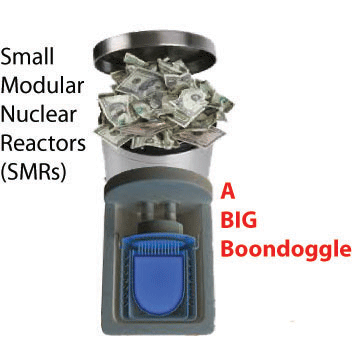
New Liberal leader questions small nuclear reactors. Susan Holt says it’s not clear the technology is a responsible energy solution
Jacques Poitras · CBC News · Aug 10, 2022
The new leader of the New Brunswick Liberals is questioning whether small modular nuclear reactors are the answer to the province’s energy needs, a more cautious stance than her party’s previous full-throated support for the technology.
Susan Holt said after winning the leadership Saturday that while the potential jobs created by SMRs would be good for the province, she was looking for more evidence they were the right bet for clean energy.
“It’s an interesting project on the economic development level … but I’m not sure it’s the solution for electricity generation for our province,” Holt told reporters.
“I think it’s not clear yet if it will really give us energy in a way that’s responsible and efficient with our investments, so there’s still more to determine there.”
Two companies based in Saint John, ARC Clean Energy and Moltex Energy, have received tens of millions of dollars in taxpayer funding to develop reactors………..
Last year the province handed ARC $20 million, while Moltex received more than $50 million from the federal government.
The previous provincial Liberal government gave each of them $5 million.
Holt held the title of chief of business relationships at the Jobs Board secretariat under then-Liberal Premier Brian Gallant at the time ARC and Moltex got that initial funding.
Both the Liberals and the Progressive Conservatives have been enthusiastic supporters of SMRs until now, ………………..
at legislative committee hearings in January, former N.B. Power CEO Gaëtan Thomas and officials from Saint John Energy warned that SMRs may not be ready in time to replace electricity from the Belledune generating station, which must stop using coal by 2030.
Louise Comeau, the director of climate change and energy solutions for the Conservation Council of New Brunswick, welcomed Holt’s comments.
“It sounds to me like the new leader is open to more information and analysis, which is what we desperately needed on the question of small modular nuclear reactors,” she said.
“We’ve been more in a phase of hype and boosterism. … I think what she’s said is we need to have more information, we need to look at all options, and we would really agree with that. Wind and solar and efficiency and other options all have to be part of the portfolio.”
Susan O’Donnell, a member of the Coalition for Responsible Energy Development in New Brunswick, said she was happy Holt was “reading the independent research about SMRs instead of the nuclear industry sales and promotional materials.”…………………..
In January, the Pembina Institute, a clean energy think tank, released a report that said small nuclear reactors would be more expensive and generate less electricity than a combination of renewable energy and energy efficiency measures. https://www.cbc.ca/news/canada/new-brunswick/susan-holt-questions-small-nuclear-reactors-1.6545007
Further cuts in output predicted, from France’s nuclear reactors as heat wave continues.

State owned French energy major EDF is reducing output at nuclear power
stations on the Rhône and Garonne rivers as heatwaves push up river
temperatures, restricting its ability to use river water to cool the
plants. EDF, which is Europe’s biggest producer of nuclear energy, has
said it would extend output cuts at several NPPs on the two rivers as the
hot spell continues, but that a minimum level of output, 400 MW, would be
maintained.
Further cuts in output are likely in the near future at nuclear
power plants Tricastin (3.6 GW), St Alban (2.6 GW, but now at 700 MW) and
Golfech (2.7 GW) owing to high temperatures in the Rhône and Garonne
rivers. EDF started imposing production restrictions in mid-July at
Tricastin, St Alban and Bugey on the Rhône and Blayais at the mouth of the
Garonne as temperature rose to unusually high levels.
Modern Power Systems 9th Aug 2022
https://www.modernpowersystems.com/news/newsedf-cuts-output-from-nuclear-generation-9915875
“Shell” companies purchase radioactive materials, prompting push for nuclear licensing reform

Defense News, By Bryant Harris, 10 Aug 22,
WASHINGTON – Late last year, government employees forged a copy of a license to buy hazardous, radioactive material. They created shell companies, then placed orders, generated invoices and paid two U.S.-based vendors.
The scheme worked. The employees successfully had the material shipped, complete with radioactive stickers on the side, then confirmed delivery.
But the workers were actually investigators from the Government Accountability Office, the congressional watchdog, and they were testing the Nuclear Regulatory Commission’s ability to regulate the sale and procurement of dangerous materials.
The act, and a subsequent report from the GAO, alarmed Rep. Ritchie Torres, D-N.Y., who is now calling on the Nuclear Regulatory Commission to overhaul its licensing system as a way to avoid a national security disaster.
“Anyone could open a shell company with a fraudulent license to obtain dangerous amounts of radioactive material that could be weaponized into a dirty bomb,” Torres told Defense News in an interview on Wednesday. “Disperse radioactive material in a city as densely populated as New York, and it could cause catastrophic damage.”
The commission classifies radioactive material into five categories of risk. Only categories one and two currently are subject to its independent license verification system – a loophole that Torres and the GAO fear that an individual or group could exploit to wreak havoc by building a dirty bomb that combines combines conventional explosives with category three radioactive materials.
Torres, who sits on the House Homeland Security Committee, is pressing the NRC to immediately expand its independent license verification system to include category three quantities of radioactive materials. He formally made the licensing overhaul request in a letter seen by Defense News on Wednesday. This request is in line with the GAO’s recommendations in what Torres called an “alarming report.”………………………
more https://www.defensenews.com/congress/2022/08/10/shell-companies-purchase-radioactive-materials-prompting-push-for-nuclear-licensing-reform/
Utility company Eon talks about possibility of delaying the closure of Germany’s last nuclear reactor
German utility Eon is open to discuss the operational extension of its 1.4
GW nuclear reactor Isar 2 as a way for Germany to secure supplies this
winter in the face of an energy crisis, its CFO said on Wednesday.
“Our last nuclear power station will go offline at the end of the year,” said
Mark Spieker, CFO of Eon, in a speech published prior to the presentation
of the company’s interim results. “If, as part of the ongoing stress
test, the federal government reassess the situation, we’re open to
discussions,” he added.
Germany is due to close its last three nuclear
reactors with a total capacity of 4.1 GW by the end of 2022, but the recent
energy crisis caused by Russia’s invasion of Ukraine has spurred calls to
extend the reactors’ lifetimes to avoid blackouts over the winter.
Montel 10th Aug 2022
https://www.montelnews.com/news/1341852/eon-open-to-discussion-on-nuclear-lifetime-extension
Legal challenge to Sizewell C nuclear project
Campaign group Together Against Sizewell C (TASC) has now sent a
pre-action protocol letter, signalling the start of judicial review process
challenging the decision, which it contends is “unlawful”. The Planning
Inspectorate’s report to the business secretary stated that “unless the
outstanding water supply strategy can be resolved”, the case for granting
consent was “not made out”.
Building 9th Aug 2022
https://www.building.co.uk/news/sizewell-c-approval-faces-legal-challenge/5118719.article
The United States, in decline but still able to kill us all
The march of folly in American strategic policy has enshrined the madness of control by a giant defence industry and defence budget now past $800 billion.

The fiercely presented wearisome trope of commitment to a Rules Based International Order is quite suddenly unmasked as an American Establishment desire to maintain a unipolar control of the world, with violence.
The fiercely presented wearisome trope of commitment to a Rules Based International Order is quite suddenly unmasked as an American Establishment desire to maintain a unipolar control of the world, with violence.
The global dominance of the United States, in so many fields, from space, to science, to entertainment, to sport, to novelty in the development of the English language, has been taken for granted, is part of our fabric of Australian existence.
Reinforced by the Covid Era of Isolation, Netflix, Facebook, and Computer Games and inability even to get to Bali or Thailand let alone China, we are now in a noisy metal barrel where even dissident voices seem projections from the dissident voices of the US, similarly muted and squeezed. At a time when the US and its roles in the world are suddenly dramatically changing.
The undoing of the United States, the collapse of the imperial centre, is happening with little awareness in Australia. Our generally oblivious mindframes affect the capacity of political leaders to reflect upon or point to core problems of our world. Richard Adams, the author of Watership Down, that great rabbit adventure full of meaning for human society, coined the rabbit language word ‘tharn’ for the mental state of rabbits caught in the headlights and stuck. We are a tharn nation, gabbling about entertainments and irritations, eyes glued to the seatback monitor, not wanting to know that the plane is crashing.
Heed these markers:
- The Americans were first to the moon, but NASA after the retirement of the space shuttle has depended on Russian rockets to get to their joint space station. The Russians are now planning to remove the propulsion units of the station which keep it from crashing, their property, for use on a bigger new venture. America is losing in space, though US private business has appallingly taken the lead in cluttering near space with junk.
- The fiercely presented wearisome trope of commitment to a Rules Based International Order is quite suddenly unmasked as an American Establishment desire to maintain a unipolar control of the world, with violence. This is being unmasked in much of the world if not NATO and AUKUS and the conservative acolytes in Japan and ROK. Ideological assertions of democracy versus autocracy, built by vilification and isolation of China and Russia, is rotting from the head as big democracies are in serious trouble.
- We are doing OK in Australia, our minds from age 12 filled with bubblegum flavoured vape and Tiktok, graduating to Facebook and the metaverse, and with a newer, kinder, kinda-tealish government we can all go to sleep, take off our masks and order American franchised fast food. Or real Aussie drinks. But while we have had a narrow focus on bad boys in the SAS we fail to review our complicity in the great crimes of the twenty first century, led by champions of democracy, smashing the lives of people in a number of countries far more violently than has the Ukraine war so far. Biden and his Secretary of State were advocates for invasions of Afghanistan and Iraq, so appallingly bringing down bad governments and making countries ungovernable. Creating Al Qaeda and ISIS in the process, directly through funding and arming extremists (in Afghanistan beginning before the Russians were invited into Afghanistan) and via embitterment of ordinary people. The world is destabilised, American control is widely undone.
- The march of folly in American strategic policy has enshrined the madness of control by a giant defence industry and defence budget now past $800 billion. Poverty of foreign policy has led to regimes of sanctions which have been substantially shaped by Richard Nephew whose book reveals that far from focusing on potentates and oligarchs, the targets of sanctions must be ordinary people and the purpose is to inflict pain and weaken resolve (his words). Consider sanctions related deaths in Iraq Venezuela Cuba, Afghanistan Pain but no loss of resolve, hatred not submission. The US official study of the effects of strategic bombing on Germany in World War II by J K Galbraith and others long ago suggested morale and resolve were increased by the bombing of cities and civilians. And yet we have the ongoing commitment to defend and achieve democracy by mass murder, with constant focus on disruption, regime change, and violence… not on peace.
- Jeffrey Sachs has recently returned to the themes of his 2013 book on the 50th anniversary of President John Kennedy’s Commencement Speech at American University in 1963. Speaking in the aftermath of the Cuban Missile Crisis, Kennedy spoke of peace not as an event or a state but a constant process of engagement. We now have no such thing, we are in an Age of Hostility, Meanness, Folly, and Decay.right wing is fervently in support. Stanley Kubrick made a movie about such madness, we are sleeping through it.
Australia recognises, as does the United States, that Taiwan is part of China. Though the media vague up the history, China kicked the Portuguese and Dutch out of Taiwan early in the 1600s, long before the greatest land grab in history, of Britain over the Australian continent, could even be imagined as the British didn’t know it was there then. The government in Taipei is the Government of the Republic of China. The large opposition party in the National Assembly is the Kuomintang, ruling party of the government of the Republic of China that lost the revolutionary war on the mainland in 1949 and retreated to Taiwan. The ROC held the China seat in the UN until 1971 with American backing. The majority of local governments in Taiwan are governed by the KMT because the party of the national government is on the nose both because of its independence-advocating foreign policy and corruption allegations. Pelosi’s visit risks great power war as not seen since 1945. The American right wing is fervently in support. Stanley Kubrick made a movie about such madness, we are sleeping through it.
The US economy is in serious trouble………………………………….
The US campaign for unipolar dominance has included partly fabricated propaganda against China and Russia. This no longer convinces or concerns a wide sweep of the world beyond NATO, the G7, the EU and AUKUS. Mix in enough lies and it all seems lies.
The summit meeting of BRICS in June seemed a more constructive meeting than the G7. The countries of Eurasia also have the Shanghai Cooperation Organisation SCO. The Iran,Russia, Turkey summit meeting in Tehran in July 2022 seems to have been more successful than President Biden’s visit to Saudi Arabia to meet also other Arab leaders, a visit described by the Wall Street Journal as worse than an embarrassment,…………………………..more https://johnmenadue.com/the-united-states-in-decline-but-still-able-to-kill-us-all/
Nagasaki urges the elimination of nuclear weapons as city marks 77th A-bomb anniversary

August 9, 2022 (Mainichi Japan) NAGASAKI (Kyodo) — Nagasaki marked the 77th anniversary Tuesday of the U.S. atomic bombing of the southwestern Japan city during World War II, with Mayor Tomihisa Taue calling for the abolition of nuclear weapons amid mounting concern over their potential use following Russia’s invasion of Ukraine.
The atomic bombing of Nagasaki, three days after a similar bomb was dropped on Hiroshima around 300 kilometers to the northeast, had taken the lives of an estimated 74,000 people by the end of 1945, with many others suffering from the effects of burns and radiation-related illnesses long after the attack.
A moment of silence was observed at 11:02 a.m., the exact time on Aug. 9, 1945, when a plutonium bomb codenamed “Fat Man” dropped by a U.S. bomber exploded over the port city, only the second time a nuclear weapon has been used in war.
In a Peace Declaration delivered during a memorial ceremony at the city’s Peace Park, the mayor called on nuclear weapons states to present a concrete way forward to achieve nuclear disarmament at the ongoing review conference of the Nuclear Non-Proliferation Treaty.
Taue also demanded that the Japanese government lead discussions on a possible nuclear weapons free-zone in Northeast Asia, as well as sign and ratify a U.N. treaty banning nuclear weapons………………………………………………….
In the Peace Park, atomic bomb survivors and relatives of the victims gathered to offer prayers, some with flowers in their hands, from the early morning as cicadas sang in the trees.
“I heard a loud boom and saw a bright spark on that day even though I had escaped to an air raid shelter after seeing a plane approach,” said Michiko Kaida, 89. She said she was around 8 kilometers from the hypocenter with her friends.
“It is difficult for me to recall that day and the aftermath. It was so devastating,” she said………………
Over a one-year period through the end of July, the city confirmed the deaths of 3,160 atomic bomb survivors. Its list of those officially recognized as victims of the atomic bombing now bears the names of 192,310 people.

The combined number of officially recognized survivors of the two nuclear attacks, known as hibakusha, stood at 118,935 as of March, down 8,820 from a year earlier, the Ministry of Health, Labor and Welfare said. Their average age was 84.53. https://mainichi.jp/english/articles/20220809/p2g/00m/0na/010000c
Hiroshima, Nagasaki – Never Again Nuclear War! No to Nuclear Weapons
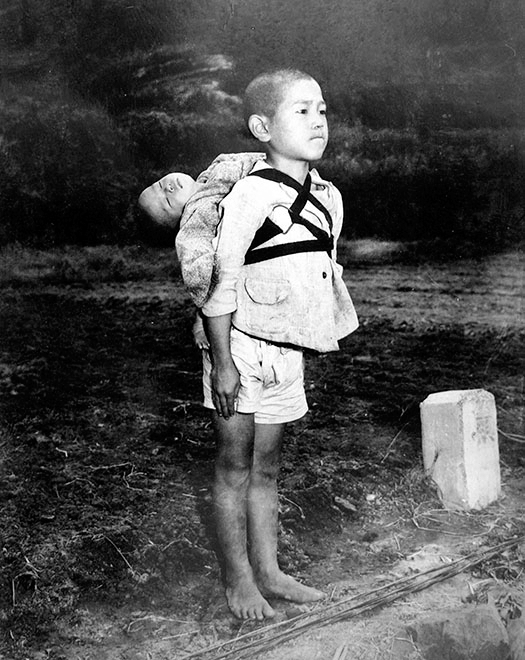
This is perhaps the saddest photograph of the time of America’s August 1945 nuclear bombing of Hiroshima and Nagasaki. The dignity of this boy, as he waits, with his small dead brother strapped to his back, to include the brother in a mass grave in Nagasaki..
We know that the bombing of people is unethical, immoral, and simply wrong.
We know that chemical and biological weapons of mass destruction are inhumane and immoral. The global human society knows this, too, and they are illegal under the United Nations Ban – the Chemical Weapons Convention (CWC) and United Nations Biological Weapons Convention (BWC)
The Treaty on the Prohibition of Nuclear Weapons(TPNW), or the Nuclear Weapon Ban Treaty, is the first legally binding international agreement to comprehensively prohibit nuclear weapons, with the goal of leading towards their total elimination. 66 nations have ratified the treaty, and it was passed by 120 countries at the United Nations in July 2017.
The nuclear lobby, and the “hawks” may scoff, but this Treaty is clear evidence that the world is coming to see that considering the humanitarian effects of nuclear war, – the treaty prohibits the development, testing, production, stockpiling, stationing, transfer, use and threat of use of nuclear weapons, as well as assistance and encouragement to the prohibited activities.
The goal is the complete elimination of nuclear weapons. Sounds too extreme to be taken seriously? It is not as extreme as the goal of using them, which is still actively being considered by the Pentagon.
It’s rarely mentioned that USA’s original plan was to explode a nuclear bomb on the moon. It’s rarely mentioned in the current hype about Mars exploration, that the Trump administration’s plan is for nuclear weapons in space .
The humanitarian, the “emotional” side, of discussing nuclear weapons is now taken seriously, much as the nuclear proponents will pontificate about “strategy”, “security” etc. With the UN nuclear ban treaty – nuclear weapons are no longer “respectable”, and are headed towards eventual elimination.
Nuclear reactors at Bugey, Blayais, Saint-Alban-Sanit-Maurice, Golfech and Tricastin allowed to release hotter water into rivers

New thermal discharge limits applicable to the reactors of the Bugey,
Blayais, Saint-Alban-Saint-Maurice, Golfech and Tricastin power plants have
been set and will be valid until 11 September. The nuclear power plants of
Blayais, Saint-Alban-Saint-Maurice, Golfech, Bugey and Tricastin will
benefit until September 11 from environmental exemptions concerning water
discharge temperatures due to high temperatures, despite impacts possible
negative effects on the environment.
A decree published on Saturday in the
Official Journal sets ” new thermal discharge limits applicable to the
reactors of the nuclear power plant of Bugey, Blayais,
Saint-Alban-Saint-Maurice, Golfech and Tricastin “. It is specified that
the implementation of these measures will be “associated with a
reinforced environmental monitoring program”.
Le Figaro 6th Aug 2022
Taiwan not worth a mushroom cloud
Many talk about “national interest”; the need for security; and standing up for principles. But with Taiwan the choice may be more stark: allow the Chinese Communist Party to take it over or engage in a nuclear war.
Principles are meaningless amid nuclear devastation, and so is national interest and security.
http://www.crispinhull.com.au/2022/08/08/taiwan-not-worth-a-mushroom-cloud/?utm_source=mailpoet&utm_medium=email&utm_campaign=crispin-hull-column Crispin Hull 8 Aug 22,
The odd thing about the visit by the Speaker of the US House of Representatives to Taiwan was that it was done by a woman, Nancy Pelosi. Usually, women in government tend to be the negotiators and compromisers, not the aggressors and agitators.
Why not just leave well alone?
Why create for future schoolchildren (if there are any survivors) one of the “Ten Causes of the Third World War”: Pelosi’s visit to Taiwan. Just as we learned that the 10 causes of World War I and World War II included equally trivial misjudgments.
And, take note, as far as the Chinese leadership is concerned, Pelosi is not a legislator, separate from the executive government, making a visit off her own bat, because they could not conceive of such a thing. For them, she is part of the US Government. So, to them, the trip was a deliberate provocation.
The other puzzling thing about Taiwan is the way the US, on the one hand, talks the talk of defending democratic Taiwan against the bully China, but on the other hand officially accepts that Taiwan is part of China.
The US did that on January 1, 1979, when it recognised the People’s Republic of China and established diplomatic relations with it as “the sole legitimate government of China”. On the same day, the United States withdrew its recognition of, and terminated diplomatic relations with, the Republic of China (Taiwan) as the government of China.
In 1979, of course, Taiwan was not a democracy so it did not really matter in principle which of the two autocracies was the “sole legitimate government of China”. At the time, the US “national interest” suggested that the trade opportunities with mainland China were too good and democracy was not being undermined by the de-recognition of semi-autocratic Taiwan.
After Taiwan evolved into a democracy in 1996 with the first free, open, and fair election for the presidency, the US had a “whoops” moment, followed by nearly three decades of juggling three balls in the air: the principle of supporting democracy; supporting US national trade interests; and opposing ever-growing Chinese influence.
The three are hopelessly incompatible, even as the first and the third become ever more urgent. The solution for the US could have been dreamt up by the Chinese communists themselves: “deliberate ambiguity”.
The US should go back to that. More importantly, Australia should go back there, irrespective of what the US does. The west should play the long game with China and wait for it to go the way of the Soviet Union caused as the economic cost of not playing by the rules results in unsustainable pressure on the regime.
Already China is paying a penalty for its trade trashing of Australia. Australia has now found other markets. China has come back cap in hand for some of those goods and Australia has said, “No thanks, you are too unreliable because you do not follow the rules and legal principle.”
In any event, we should not, in the perspicacious words of defence expert Hugh White, “sleepwalk into war”.
If democratic Taiwan is so important to defend, why doesn’t the US officially recognise it as a nation? And if it does not recognise Taiwan as an independent democratic nation, why threaten military action if the central government of the nation that the US does recognise as exercising sovereignty over Taiwan sends in its army and police forces to physically exercise that sovereignty?
Not being a democracy is not a cause for war, nor is the overthrow of democracy in one part of a country a cause for war. If they were, the world would be in a constant state of war.
Pelosi’s visit coincided with the Rim of the Pacific naval exercise (RIMPAC), but to Chinese Communist Party chiefs it was not a coincidence.
Twenty-six nations, 38 surface ships, four submarines, nine national land forces, 170 aircraft and 25,000 military personnel took part.
From a Chinese perspective this is a tad threatening. To us it is benign. To Taiwan and Australia firing rockets over Taiwan and the seas around it is a tad threatening, To the Chinese it is a benign military exercise in its own back yard
Of course, China is jealous as well as threatened by RIMPAC. China has no friends, just nations it bribes or debt-burdens into military co-operation.
But the danger point comes when the US goes beyond seeking voluntary co-operation with allies and friends and aims for full military integration and interoperability.
The trouble here is that the US military exerts influence verging on control over the US Government. Its top military officer has a seat on the National Security Council (not just an advisory role). Both General Douglas MacArthur (Korea) and General Curtis Le May (Cuba) urged the use of nuclear weapons.
Mercifully, Presidents Truman and Kennedy stood up to them, but Biden is no Truman or Kennedy. Moreover, a change in Administration usually means little change in the military-industrial complex’s way of doing things.
In Australia, a change of Government has also meant very little change to the lock-step American Alliance – until now.
The new Defence Minister, Richard Marles, has ordered a Defence Forces Review. Maybe it will start questioning the pattern of blindly joining every major US military folly (Vietnam, Afghanistan and Iraq, for example), irrespective of whether it has anything to do with us.
Many talk about “national interest”; the need for security; and standing up for principles. But with Taiwan the choice may be more stark: allow the Chinese Communist Party to take it over or engage in a nuclear war.
Principles are meaningless amid nuclear devastation, and so is national interest and security.
It is unfortunate that 23 million people would go under the Chinese Communist jackboot, but that is better than going under a nuclear mushroom.
We allowed them to imprison, murder, and torture the Uyghurs and Tibetans and did nothing. What is the difference with Taiwan? Maybe it is just a good case to bolster a profitable arms race.
Hisashi Ouchi Suffered an 83-day Death By Radiation Poisoning

https://science.howstuffworks.com/hisashi-ouchi.htm By: Patrick J. Kiger | Aug 8, 2022
On the morning of Sept. 30, 1999, at a nuclear fuel-processing plant in Tokaimura, Japan, 35-year-old Hisashi Ouchi and two other workers were purifying uranium oxide to make fuel rods for a research reactor.
As this account published a few months later in The Washington Post details, Ouchi was standing at a tank, holding a funnel, while a co-worker named Masato Shinohara poured a mixture of intermediate-enriched uranium oxide into it from a bucket.
Suddenly, they were startled by a flash of blue light, the first sign that something terrible was about to happen.
The workers, who had no previous experience in handling uranium with that level of enrichment, inadvertently had put too much of it in the tank, as this 2000 article in Bulletin of the Atomic Scientists details. As a result, they inadvertently triggered what’s known in the nuclear industry as a criticality accident — a release of radiation from an uncontrolled nuclear chain reaction.
Ouchi, who was closest to the nuclear reaction, received what probably was one of the biggest exposures to radiation in the history of nuclear accidents. He was about to suffer a horrifying fate that would become a cautionary lesson of the perils of the Atomic Age.
“The most obvious lesson is that when you’re working with [fissile] materials, criticality limits are there for a reason,” explains Edwin Lyman, a physicist and director of nuclear power safety for the Union of Concerned Scientists, and co-author, with his colleague Steven Dolley, of the article in Bulletin of the Atomic Scientists.
If safeguards aren’t carefully taught and followed, there’s potential for “a devastating type of accident,” Lyman says.
It wasn’t the first time it had happened. A 2000 U.S. Nuclear Regulatory Commission report noted that before Tokaimura, 21 previous criticality accidents had occurred between 1953 and 1997.
The two workers quickly left the room, according to The Post’s account. But even so, the damage already had been done. Ouchi, who was closest to the reaction, had received a massive dose of radiation. There have been various estimates of the exact amount, but a 2010 presentation by Masashi Kanamori of the Japan Atomic Energy Agency put the amount at 16 to 25 gray equivalents (GyEq), while Shinohara, who was about 18 inches (46 centimeters) away, received a lesser but still extremely harmful dose of about 6 to 9 GyEq and a third man, who was further away, was exposed to less radiation.
Internet articles frequently describe Ouchi as ‘the most radioactive man in history,’ or words to that effect, but nuclear expert Lyman stops a bit short of that assessment.
“The estimated doses for Ouchi were among the highest known, though I’m not sure if it’s the highest,” explains Lyman. “These typically occur in these kinds of criticality accidents.”
What Does a High Dose of Radiation Do To the Body?
The radiation dose in a criticality accident can be even worse than in a catastrophic accident at a nuclear power plant, such as the 1986 reactor explosion at Chernobyl in Ukraine, then a part of the Soviet Union, where the radiation was dispersed. (Even so, 28 people eventually died from radiation exposure.)
“These criticality accidents present the potential for delivery of a large amount of radiation in a short period of time, though a burst of neutrons and gamma rays,” Lyman says. “That one burst, if you’re close enough, you can sustain more than a lethal dose of radiation in seconds. So that’s the scary thing about it.”
High doses of radiation damage the body, rendering it unable to make new cells, so that the bone marrow, for example, stops making the red blood cells that carry oxygen and the white blood cells that fight infection, according to Lyman. “Your fate is predetermined, even though there will be a delay,” he says, “if you have a high enough dose of ionizing radiation that will kill cells, to the extent that your organs will not function.”
According to an October 1999 account in medical journal BMJ, the irradiated workers were taken to the National Institute of Radiological Sciences in Chiba, just east of Tokyo. There, it was determined that their lymphatic blood count had dropped to almost zero. Their symptoms included nausea, dehydration and diarrhea. Three days later, they were transferred to University of Tokyo Hospital, where doctors tried various measures in a desperate effort to save their lives.
Ouchi’s Condition Continued to Deteriorate
When Ouchi, a handsome, powerfully built, former high school rugby player who had a wife and young son, arrived at the hospital, he didn’t yet look like a victim of intense radiation exposure, according to “A Slow Death: 83 Days of Radiation Sickness,” a 2002 book by a team of journalists from Japan’s NHK-TV, later translated into English by Maho Harada. His face was slightly red and swollen and his eyes were bloodshot, but he didn’t have any blisters or burns, though he complained of pain in his ears and hand. The doctor who examined him even thought that it might be possible to save his life.
But within a day, Ouchi’s condition got worse. He began to require oxygen, and his abdomen swelled, according to the book. Things continued downhill after he arrived at the University of Tokyo hospital. Six days after the accident, a specialist who looked at images of the chromosomes in Ouchi’s bone marrow cells saw only scattered black dots, indicating that they were broken into pieces. Ouchi’s body wouldn’t be able to generate new cells. A week after the accident, Ouchi received a peripheral blood stem cell transplant, with his sister volunteering as a donor.
Nevertheless, Ouchi’s condition continued to deteriorate, according to the book. He began to complain of thirst, and when medical tape was removed from his chest, his skin started coming off with it. He began developing blisters. Tests showed that the radiation had killed the chromosomes that normally would enable his skin to regenerate, so that his epidermis, the outer layer that protected his body, gradually vanished. The pain became intense. He began experiencing breathing problems as well. Two weeks after the accident, he was no longer able to eat, and had to be fed intravenously. Two months into his ordeal, his heart stopped, though doctors were able to revive him.
On Dec. 21, at 11:21 p.m., Ouchi’s body finally gave out. According to Lyman’s and Dolley’s article, he died of multiple organ failure. Japan’s Prime Minister at the time, Keizo Obuchi, issued a statement expressing his condolences to the worker’s family and promised to improve nuclear safety measures, according to Japan Times.
Shinohara, Ouchi’s co-worker, died in April 2000 of multiple organ failure as well, according to The Guardian.
The Japanese government’s investigation concluded that the accident’s main causes included inadequate regulatory oversight, lack of an appropriate safety culture, and inadequate worker training and qualification, according to this April 2000 report by the U.S. Nuclear Regulatory Commission. Six officials from the company that operated the plant were charged with professional negligence and violating nuclear safety laws. In 2003, a court gave them suspended prison terms, and the company and at least one of the officials also were assessed fines, according to the Sydney Morning Herald.
1 This Month
19 November – Webinar – The Reality of Reprocessing
Time: 11:00 AM Pacific Time (US & Canada) / 2:00 PM Eastern / 7:00 PM UK / 8:00 PM CET
Register for the Zoom Event Here

Tell Congress: Prevent Nuclear Catastrophe in Iran

Tell Congress: Prevent Nuclear Catastrophe in Iran

Read the Public Inquiry Report, the Commissioners’ report, Surrendering Australia: The AUKUS Deception is available to download for free at aukuspublicinquiry.com. Or just watch the replay of the National Press Club Luncheon.


Shut down the radiation-damaged Heysham nuclear reactors now
To see nuclear-related stories in greater depth and intensity – go to https://nuclearinformation.wordpress.com

Say No to NASA’s Reckless Nuclear Reactor on the Moon
Say No to NASA’s Reckless Nuclear Reactor on the Moon
-
Archives
- November 2026 (190)
- October 2026 (302)
- September 2026 (339)
- August 2026 (330)
- July 2026 (355)
- June 2026 (287)
- May 2026 (306)
- April 2026 (356)
- March 2026 (251)
- February 2026 (267)
- January 2026 (308)
- December 2025 (358)
-
Categories
- 1
- 1 NUCLEAR ISSUES
- business and costs
- climate change
- culture and arts
- ENERGY
- environment
- health
- history
- indigenous issues
- Legal
- marketing of nuclear
- media
- opposition to nuclear
- PERSONAL STORIES
- politics
- politics international
- Religion and ethics
- safety
- secrets,lies and civil liberties
- spinbuster
- technology
- Uranium
- wastes
- weapons and war
- Women
- 2 WORLD
- ACTION
- AFRICA
- Atrocities
- AUSTRALIA
- Christina's notes
- Christina's themes
- culture and arts
- Events
- Fuk 2022
- Fuk 2023
- Fukushima 2017
- Fukushima 2018
- fukushima 2019
- Fukushima 2020
- Fukushima 2021
- general
- global warming
- Humour (God we need it)
- Nuclear
- RARE EARTHS
- Reference
- resources – print
- Resources -audiovicual
- Weekly Newsletter
- World
- World Nuclear
- YouTube
-
RSS
Entries RSS
Comments RSS

