The real death count for Hiroshima and Nagasaki was at least 210,000 – and more later.
The real death count for Hiroshima and nagasaki was 210,000 It was not 15,000 for Hiroshima and 74,000 for Nagasaki. That does not reflect birth defects, or other health effects we now know, are part of nuclear bomb fallout
The Atomic Bombings of Hiroshima and Nagasaki: A Summary of the Human Consequences, 1945-2018, and Lessons for Homo sapiens to End the Nuclear Weapon Age
Masao Tomonaga Pages 491-517 | Received 01 Sep 2019, Accepted 02 Oct 2019, Accepted author version posted online: 13 Nov 2019, Published online: 02 Dec 2019
ABSTRACT
Seventy-four years have passed since the atomic bombings of Hiroshima and Nagasaki. Approximately 210,000 victims died, and another 210,000 people survived. The damage to their health has continued, consisting of three phases of late effects: the appearance of leukemia, the first malignant disease, in 1949; an intermediate phase entailing the development of many types of cancer; and a final phase of lifelong cancers for hibakusha who experienced the bombing as a child, as well as a second wave of leukemia for elderly hibakusha and psychological damage such as depression and post-traumatic stress disorder. Thus, the human consequences of the atomic bombings have not ceased; many people are still dying of radiation-induced malignant diseases. Therefore, it is too early to finalize the total death toll. Hibakusha have faced a never-ending struggle to regenerate their lives and families under the fear of disease. As the only group of Homo sapiens experiencing real nuclear attacks, hibakusha have continued to engage in a lifelong movement to eliminate nuclear weapons. Political leaders, especially of nuclear-weapon states, must learn the wisdom of the hibakusha to save Homo sapiens from possible global extinction by nuclear war.
Introduction
The first nuclear weapon was detonated in New Mexico on 16 July 1945. That test explosion was soon followed by the wartime use of two atomic bombs on Hiroshima and Nagasaki on August 6 and 9, respectively. This opened the nuclear weapon age in the history of humanity. In the long history of wars and weapons, Homo sapiens had finally gained an ultimate weapon of mass destruction capable of obliterating itself……………………………….
Immediate Death and Early Lethal Consequences of the Bombings
Death-rate
Under the two gigantic mushroom clouds, approximately 280,000 citizens in Hiroshima and 240,000 in Nagasaki were suddenly thrown into chaos and agony. A total of approximately 140,000 in Hiroshima (Hiroshima 1971) and 73,000 in Nagasaki (Nagasaki, 1977) died instantaneously or within five months due to the combined effects of three components of physical energy generated by nuclear fissions: blast wind (pressure), radiant heat, and ionizing radiation. A total of more than 210,000 remaining victims, 140,000 in Hiroshima and 74,000 in Nagasaki, survived the first five months of death and agony and became hibakusha (Figure 1 on original).
A curve of death rates calculated in the aftermath by the surviving medical staff and students of Nagasaki Medical College showed almost 100% in residents living within a 500-meter radius of ground zero; 90% within 1,000 meters; 50% within1,500 meters; and 10% within 2,000 meters, making a clear concentric figure (Figure 2) (Shirabe 2006). Later the death-rate curve of Hiroshima was compared with Nagasaki’s, revealing that two curves were very similar, as if two scientific experiments were conducted. Among areas within 1,000 meters, the Nagasaki Medical School Hospital was exceptional – The death rate in the facility was as low as 43%. This is obviously because of the shielding effect of the thickest concrete walls of the hospital buildings.
Figure 2. [on original] Death rates by distance from ground zero in the first three months in areas of Nagasaki city.
The residents of both cities were mostly noncombatant civilians, including many women and children. Military combatants were only a minority. There were fewer adult males than females, and most of the males worked at military arsenals. Many young men went to war in the later stages of World War II. Young students were employed by military arsenals located close to ground zero; that increased the number of victims.
Citizens were suddenly thrown into firestorms at home, factories, and schools; on open roads or on ground; in automobiles and trams; and in city offices, hospitals, pharmacies, fire stations, and almost all city structures.
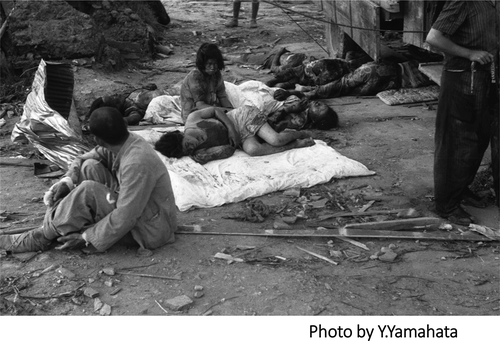
Many survivors spent the night on the road or the ground (Figure 3). Subsequently, many severely injured victims were forced to remain where they survived the first strike without being provided any meaningful medical treatment. Most of them died there.
Figure 3. The second morning after Nagasaki bombing.
……………………………….. In areas within 1 kilometer of ground zero, human bodies without any shielding, namely in open air on the roads and ground, were instantaneously squeezed by the blast wind (pressure) against walls, causing multiple fractures of skeletons and ruptures of the abdominal cavity causing escape of colons. Many people in open roads and grounds were carbonized by the direct effect of heat rays within 1.0 km from ground zero (Figure 7, Photo A). Many residential areas full of Japanese houses were crushed by the wind and burned out in which many victims were also burned to white bones (Figure 7, Photo B). The skin of people on open roads or grounds within 0.5–1.5 km were deeply flash-burned due to heavy heat rays. The skins were soon peeled off because of necrosis in the deep skin layer (For an example of a boy whose back was entirely burned, see Figure 8). With large areas of skin peeling off, people suffered severe pain and bleeding.
Figure 7. Body effects by heat rays and fire burn (1).
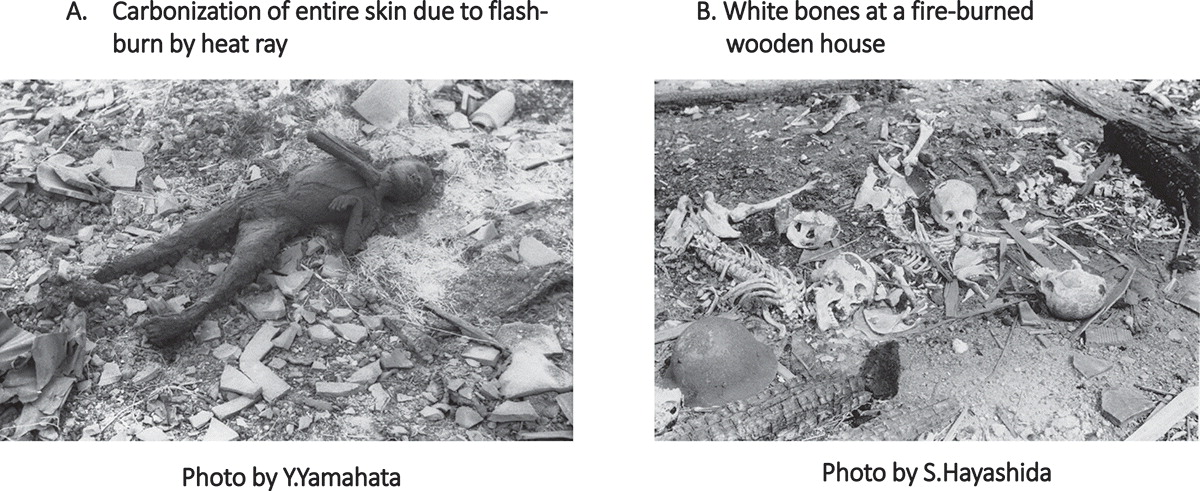
Figure 7. Body effects by heat rays and fire burn (1).

In three months after the bombing, these deep skin flash burns began to heal. However, with tissue being regenerated, keloid was quite often formed as shown in Figure 9. It was charcterized by marked thickening of the wounds, sometimes resembling cancerous proliferation of the skin.
Figure 9. Keloid formation after a severe flash burn by heat rays.

Thus many residential areas full of Japanese wooden houses were crushed and burned. The firestorms that continued over to next day finally flattened city areas within a 4 km radius. According to the saddest memory of some survivors, the blast wind tore off the heads of babies who were being carried on their mothers’ backs in the traditional Japanese way. Most of the mothers also died soon.
At the same time, the victims were irradiated by 100 grays (Gy)1 or more of combined gamma and neutron rays generated by nuclear fissions (Figure 6). Thus it could be possible to say that they were killed in three ways at once.
The people within 1 km of ground zero who finally survived were mostly those who were working inside a concrete building with thick walls or in a basement. Some other survivors were inside private air-raid shelters or military arsenals set in large shelters. Heat rays were effectively blocked by the walls, and radiation and blast were partially shielded before victims were exposed, thus allowing them to survive. But there were only a few hundred of these people. Many of those who survived at various proximal points were severely injured by debris and pieces of glass from damaged houses, heated and irradiated simultaneously. Many of them died within the first three months.
Struggle for Survival
Medical rescue teams perished and hospitals were all destroyed on the first day of the bombing. It therefore was impossible to find any meaningful medical aid. The situation was much severer in Hiroshima where over 90% of medical staffs, doctors, nurses, and pharmacists were dead. The Nagasaki Medical College Hospital, the largest and strongest concrete buildings in Nagasaki City, located 600 meters from ground zero, did provide fairly good shielding effects; the death rate was a relatively as low as 43%. Subsequently 900 lives in total – approximately half of the total number of professors, doctors, nurses and medical students were lost in the entire college facility including the hospital. Most of those who survived were severely injured by the blast wind and heat ray. The hospital had completely ceased to function. Within a few days, medical staffs and medical students who had survived opened first-aid stations around the margin of flattened areas.
n the late afternoon on the first day, several rescue trucks arrived carrying medical teams consisting of military doctors and nurses from Omura Navy Hospital, located 45 km north of Nagasaki City. They brought back approximately 700 severely injured victims, most of them severely burned, to the hospital and started treatment for burns and injuries consisting of bone fractures, cuts from pieces of glass, and embedding of debris and pieces of glass fragments deep in the skin. This number was very small compared to the total number of victims who suffered severe injuries, estimated to be approximately 30,000 in Nagasaki. A few hundred victims out of 700 were able to survive, thanks to intensive care at Omura Navy Hospital. They were indeed lucky people.
Several small rescue teams started their clinical activities within a few days. Some surgical operations were performed for those who had severe fractures due to the blast wind. There was no good treatment for severe skin burn, especially those cases with wide areas of skin burn. There were no stocks of drugs such as antibiotics and frozen blood plasma. Only oil and ointment were used. Even drip infusions of water and electrolytes such as salts and glucose (sugar) were not available in such small ambulatory facilities.
As a result of this lack of care, many survivors who were alive on the first and second days began to die due to severe bleeding from injuries such as severe fractures, dislocations, abdominal ruptures, thoracic punctures, and scalp and brain damage and also from dehydration and lack of adequate food supplies.
Initial Difficulty in Recognizing Radiation Effects
In the early days after the atomic bombings, many doctors had difficulty in identifying the symptoms of radiation-related ailments. There was no information about the nature of this new type of bomb. They did not even know that the bombs were nuclear and that radiation was dangerous to human beings. …………………………………………………………………………………….
Late Effects of Atomic Bombings: 1948–2018
About 270,000 victims of Hiroshima and Nagasaki finally recovered their health. They had to start their new daily life with a serious shortage of food and other necessities. After spending three years of recovery with relatively good health, hibakusha encountered the first malignant disease: leukemia. It is classified as the earliest occurring malignant disease due to atomic-bomb radiation because it was clearly distinguished from the disorders caused by ARS. Therefore, leukemia was the first malignant disease derived from cells injured by initial radiation exposure; the cells then transformed to malignant leukemia cells. This earliest delayed, or “late”, effect was followed by many kinds of cancer of various organs. Thus, the late effect spans an extremely long period.
First Malignant Disease Observed as the Earliest Late Effect of Atomic Bombings
Leukemias
In 1949, doctors in Hiroshima and Nagasaki began to recognize a gradual increase in the number of hibakusha patients, including children, suffering from leukemia. The excess annual rate of leukemia continued to rise until 1955 and then continued at an elevated level for more than 10 years (Figure 12) (Gunz and Henderson 1974). Acute and chronic types of leukemia both were observed.
These leukemias were later analyzed in detail when the first dosimetry system (DS65) became available. A clear radiation-dose dependency was revealed as a curve that elevated exponentially (called quadratic) from 100 millisieverts (mSv) at around 2.0 km from ground zero to more than 4 Gy at around 1.0 km (Figure 13 on original). Dose is thus inversely proportional to the square of the distance. Total leukemia incidence was four to five times higher than the control group of Nagasaki citizens not exposed to the bombing (Preston et al. 1996).
……………………………. People who were children under the age of 10 at the time of the bombings are now in their seventies. Some of them suffer from MDS. The increase in MDS among childhood survivors indicates that the massive irradiation of the whole body injured blood cells in bone marrow, and that these cells have survived more than 70 years in the bodies of hibakusha, and finally resulted in leukemia-inducing gene abnormality. MDS patients occasionally develop acute leukemia 3–5 years after the first diagnosis, and mostly die. Therefore, it can be said that atomic bomb is still killing some hibakusha even after more than a half century……………………..
Intermediate to Life-long Delayed Effects of Exposure to Atomic-bomb Radiation
Cancers
Around 1960, the incidence of solid cancers began to rise gradually. The elevated cancer incidence lasted for a long time (Ozasa 2016). It peaked around the year 2000 and remained at that level until now. The types of cancer that appeared include lung, breast, thyroid, stomach, colon, liver, skin, and bladder. ……………………………………….
In-utero Radiation Exposure
Microcephaly
In both Hiroshima and Nagasaki, many pregnant women were exposed to various doses of radiation. Miscarriages and malformation of newborn babies were frequently observed, but there were no good statistics showing radiation-dose effect. Some mothers who were in the early prenatal period at the time of the bombing sometimes bore babies who had a small head. The babies later became mentally disabled. There were 62 such babies recorded among 1,470 (Otake and Schull 1998). The larger the dose to the mother’s uterus was, the higher the incidence of microcephalic babies, suggesting high-dose radiation interrupted brain development. This is the most obvious phenomenon observed among fetuses exposed to radiation in utero.
Cancers
In-utero exposed babies were later found to have an increased risk of cancer development during their early adulthood. The follow-up study is now ongoing (Izumi et al. 2003)……………………………………………………………..
Summary of Hibakusha Life, 1945–2018
Can Homo Sapiens Gain the Ethical Wisdom to End the Nuclear Weapon Age and Survive?
The consequences of the atomic bombings linger on. First generation hibakusha population will cease to exist probably around 2045. If genetic transmission of radiation-related diseases to the second generation of hibakusha would be proved in the future, atomic bombs will continue to affect those descendants forever. The year 2045 will mark the 100th annniversary of the Hiroshima and Nagasaki nuclear bombings and of the nuclear weapon age. If we human beings fail to eradicate nuclear weapons before the first century ends, what should we do? This is the question that all hibakusha have posed in their 70-year struggle for survival all the time after bombings.
Summary of Hibakusha Life, 1945–2018
Can Homo Sapiens Gain the Ethical Wisdom to End the Nuclear Weapon Age and Survive?
The consequences of the atomic bombings linger on. First generation hibakusha population will cease to exist probably around 2045. If genetic transmission of radiation-related diseases to the second generation of hibakusha would be proved in the future, atomic bombs will continue to affect those descendants forever. The year 2045 will mark the 100th annniversary of the Hiroshima and Nagasaki nuclear bombings and of the nuclear weapon age. If we human beings fail to eradicate nuclear weapons before the first century ends, what should we do? This is the question that all hibakusha have posed in their 70-year struggle for survival all the time after bombings…………………………………………………………………………..more https://www.tandfonline.com/doi/full/10.1080/25751654.2019.1681226
TODAY. Russia and Ukraine blame each other. Whom to believe?
My natural inclination is to not believe either of them. They’re both putting out propaganda, sure to include many lies.
The big issue right now is the danger around the Zaporizhzhia (or Zaporozhye) nuclear power station – the largest in Europe, which is being shelled by artillery. The Ukrainians say that Russia is doing this. The Russians say that it’s the Ukrainianians.
Of course, we being good Anglophone news absorbers, we are obliged to believe that the Russians are shelling Zaporizhzhia , a place where they are now in control. We have to believe that it is always the Russians’ fault, otherwise we are pretty much traitorous, (and our publications like this one, will be censored and erased from Google Search)
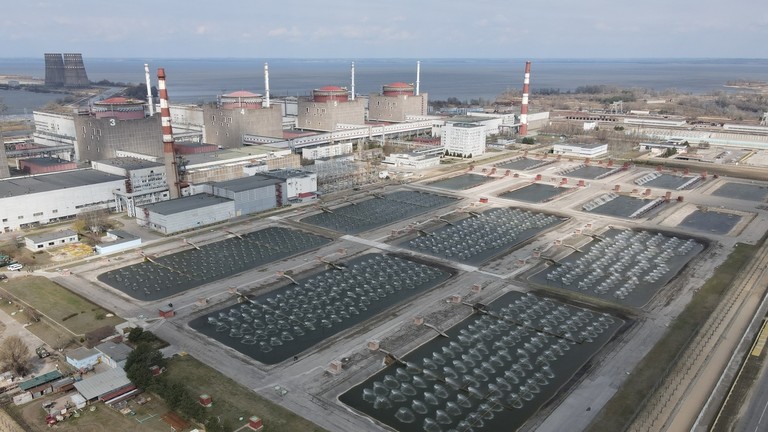
The picture above shows the Zaporizhzhia NPP and its huge collection of nuclear wastes. No wonder that Mr Grossi, head of IAEA security is tearing his hair out in anxiety over this perilous situation.
Now I, (treacherously) think that it is the Ukrainians who are shelling the nuclear station. They do have a motive, as they are desperate to get it back under Ukrainian control. But why would the Russians want to attack the place, where they’re already in control? “In order to discredit Ukraine” – say Zelensky and co. Gimme a break. The Rusians may be awful etc etc, but they;re not stupid.
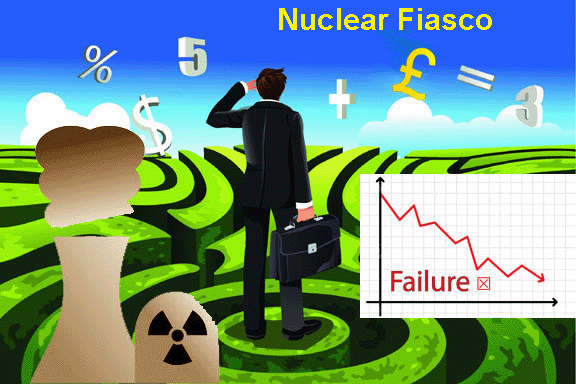
Electricite de France (EDF) nuclear corporation is headed for bankruptcy – that’s why France’s government is nationalising it.
Is EDF running out of money? The French government is to spend £20
billion buying back the final 16% of Electricité de France (EDF) shares
still privately owned, bringing the company back under public ownership.
Why are they renationalising this company? The answer is simple. It is to
avoid EDF going bankrupt. Right now, over half (29 out of 56) of EDF’s
French nuclear reactors are currently offline. The company is already
hugely indebted and faces a massive bill of up to 100 billion euros (£85
billion) to keep its ageing nuclear fleet going.
And EDF’s flagship EPR reactor is over-cost and over-time everywhere it is being attempted to be
built. Aside from its debts, EDF has faced issues with ageing reactors,
after experts warned President Macron of significant corrosion safety
problems in EDF nuclear power plants in France as cracks were detected in
the cooling systems of some nuclear reactors.
Meanwhile there is delay after delay in bringing online every one of the EDF flagship nuclear
reactors, in Finland, in France, even here in Somerset. In desperation to
help fund its latest lossmaker at Sizewell, Suffolk, EDF is reaching out to
fellow utility giant Centrica for help. Could this be the same Centrica,
which in 2016 abandoned plans to invest in EDF’s Hinkley C partly because
of ‘the lengthening time frame for a return on the capital invested in a
project of this scale’?
Electrical Review 9th Aug 2022
Elon Musk’s SpaceX now leaving junk in Australia’s backyard
Independent Australia, By Darren Crawford | 10 August 2022 After a SpaceX capsule crashed onto an Australian farm, we’re left wondering if Elon Musk will clean up his own mess, writes Darren Crawford.
ACCORDING TO the ABC, the Australian Space Agency (ASA) has confirmed that debris found in a sheep paddock in the Snowy Mountains region of New South Wales, Australia, belongs to Elon Musk’s SpaceX Dragon capsule, which was launched in November 2020.
Local authorities were alerted after nearby residents heard a loud bang earlier this year on 9 July. It is now thought the bang was the noise of the capsule re-entering the Earth’s atmosphere. New South Wales Police and the ASA visited one of the sites on Saturday 31 July and confirmed that two of the pieces are from a SpaceX mission.
According to the ABC, the ASA is continuing to engage with its counterparts in the U.S. as well as other parts of the Commonwealth and local authorities.
An ASA spokesperson said:
“The agency is operating under the Australian Government Space Re-entry Debris Plan which outlines roles and responsibilities for key Australian government agencies and committees in supporting the response to space re-entry debris.”
So who is responsible for the clean-up?
According to the ABC report, the space debris will remain in place for now. However, the pieces could eventually be returned to U.S. soil.
Australian National University’s Institute of Space deputy director Dr Cassandra Steer said there was an obligation under international space law to repatriate any debris to the country from where it originated.
Dr Steer went on to confirm that “Any space object, or part thereof, has to be repatriated” and should be sent back to the U.S. However, SpaceX has only confirmed that the debris is theirs and is yet to commit to the costs associated with returning it to the U.S.
Dr Steer added:
“We have clarity in terms of lines of responsibilities. The U.S. is liable for any damage that is caused by this space debris… and Australia could go to the U.S. and seek some form of compensation if there are any costs involved in cleaning it up.”
Elon Musk and SpaceX have a poor environmental record
As reported earlier this year, Elon Musk and fellow billionaires Richard Branson and Jeff Bezos are currently participating in a dick-swinging rocket contest to see who can get to Mars first. Suffering from massive rocket envy, these three men are speeding up the climate change process by increasing the amount of carbon dioxide and other gases in the Earth’s atmosphere with every launch.
The Guardian reports that one rocket launch alone can release up to 300 tons of carbon dioxide into the Earth’s upper atmosphere and it can stay there for years. This is in comparison to a standard long-haul flight which produces three tons of carbon dioxide per passenger/per flight, into the lower atmosphere.
These impacts do not include what happens on the ground during a launch, including the heat and noise pollution in the immediate area, or the impacts on local wildlife.
There appear to be few controls put in place to protect the planet and its inhabitants from falling space junk by Elon Musk and SpaceX. In March 2021, a SpaceX rocket blew up on launch and debris was scattered throughout the protected area. According to a local non-profit environmental group, it took three months to clean up the mess.
According to the report, launch site ditches on SpaceX land and public property in the U.S. have dumped runoff water directly into the tidal flats threatening local fish breeding grounds, and public beaches and roads have been closed for longer than the agreed times.
Finally, at an earlier launch in 2018, a jettisoned SpaceX booster rocket missed its target drone ship a few hundred kilometres out to sea and destroyed itself on impact slamming into the ocean at 500 km/hour.
So, will Elon Musk and SpaceX clean up their mess down under?
This is the great unknown, as Elon Musk’s environmental record in relation to his SpaceX program is extremely poor.
It is also clear, as can be seen by his recently abandoned Twitter purchase, that Elon Musk doesn’t care who he burns, or how hard he burns them, to get his own way.
It is apparent that Elon Musk sees the increasing amount of pollution produced by his SpaceX endeavours as little more than collateral damage and less of a threat to our civilisation. Similarly, he doesn’t care whose backyard he trashes (as long as it’s not his, obviously).
Instead of turning his immense intelligence (and wealth) to solving our current problems, Elon Musk (and his billionaire space mates) seek to exacerbate these problems by polluting the planet further.
It will be interesting to see whether he does the right thing by the Australian Government and its people and pays for the clean-up of his mess.
Update, 10 August 2022:
The ABC is reporting that SpaceX has confirmed that the space debris spread throughout an Australian sheep paddock is indeed remnants of their Dragon Capsule and is sending a team down under to investigate………………………….
What was not stated was whether any ASA or government agencies were aware of or engaged in any of SpaceX’s planning. Space Law Lecturer at UNSW Canberra, Duncan Blake, wondered if they had coordinated with Australian agencies prior to their risk assessment — “If they didn’t, then that seems somewhat arrogant to make a decision that affects Australia without consulting Australians,” he said.
There has been no mention of the cost of removal or the debris, or as to whether Elon Musk and SpaceX will be more honest and open in the future and advise all Australians about the potential damage falling SpaceX junk may cause in their country.
https://independentaustralia.net/environment/environment-display/elon-musks-spacex-now-leaving-junk-in-our-own-backyard,16650
Ukraine and its Western backers should be held accountable for the ‘suicidal’ attack on Europe’s largest nuclear powerplant

The US secretary of state hoped to make Russia look like a ‘nuclear terrorist’. Instead, he implicated himself
Even as UN Secretary-General António Guterres addressed survivors of the World War Two US atomic bomb attack on Hiroshima, halfway around the world, the armed forces of Ukraine seemed hellbent on unleashing a modern-day nuclear holocaust on Europe by firing artillery rockets at the Zaporozhye power plant.
This week’s assault, which damaged safety equipment and disrupted power to the facility, the continent’s largest, was characterized by Guterres as “suicidal.”
Kiev was quick to blame Russia for the attacks, accusing Moscow of conducting “nuclear terrorism,” and calling for the international community to send in a delegation of “international peacekeepers” to “completely demilitarize the territory.”
The Zaporozhye nuclear facility has been under the physical control of Russia since its forces occupied the site back in March. Since then, the plant has been operated by Ukrainian technicians working under the supervision of Russian atomic energy experts. The facility contains six nuclear reactors which, before the start of the military operation, generated approximately one-fifth of Ukraine’s electricity. Three of these reactors ceased operation after the Russians took control the site, and another one was forced to shut down after the facility was shelled on August 5. The two remaining reactors were likewise compelled to reduce their output to half as a safety precaution.
Ukraine’s ambassador to the International Atomic Energy Agency (IAEA), Yevhenii Tsymbaliuk, declared that Russian forces were attempting to cause electricity blackouts in southern Ukraine by shelling the plant. The Ukrainian state nuclear agency, Energoatom, has accused the Russian military of placing explosives throughout the Zaporozhye nuclear plant, which would be detonated in the event of a Ukrainian counterattack which threatened to capture the facility. The Ukrainian military has also accused Russia of placing military equipment, including ammunition, in buildings located near the nuclear reactors.
The only problem with the Ukrainian narrative is that, simply put, none of it is true. The August 5 attack on the Zaporozhye nuclear facility was carried out by artillery rockets whose impact characteristics point clearly to having originated from Ukrainian controlled territory. Moreover, Russian air defense and counter-battery radars situated in the vicinity of the plant would have detected the ballistic trajectory of the incoming rockets, providing unimpeachable evidence of the origin of the attack. So, too, would have US and NATO intelligence collection platforms operating over and around Ukraine. And, given the propaganda victory that could be achieved by releasing such evidence, one can rest assured that the US would very much take full advantage of any scenario which would reproduce the release of U-2 imagery during the Cuban missile crisis, or the release of the audio tapes of the Soviet fighter pilot downing KAL 007…………………………….
The Ukrainian attack on the Zaporozhye nuclear facility was, in typical Orwellian fashion, forecasted by the United States four days before it took place. During an August 1 news conference at the United Nations, US Secretary of State Antony Blinken accused Russia of using the nuclear facility as a base from which it conducted artillery strikes against Ukraine. Blinken declared that the act of firing artillery rockets from proximity to the nuclear power plant was “the height of irresponsibility,” implying that these rockets could land on the power plant itself. Blinken also added that the Russians were using the nuclear facility as a “nuclear shield” which prevented any Ukrainian attack out of fear of striking the nuclear reactors.
Blinken’s brazen parroting of Ukrainian government talking points was made more absurd by the absolute dearth of evidence to back up his powerful pronouncements. Normally, when someone of the stature of the Secretary of State speaks in such a public manner about issues of this importance, there is some intelligence information that is released – for instance, overhead imagery showing Russian troop locations near the Zaporozhye nuclear plant – to sustain the allegation. No such data was provided, however, because Blinken had ceased functioning as the head of the American diplomatic service, and instead was functioning as little more than a Ukrainian propagandist.
For its part, Russia has made it clear that there were no Russian forces located in the vicinity of the Zaporozhye nuclear facility save for a small contingent of troops for security purposes (it is, after all, an active nuclear power plant.) Again, while Russia can clearly provide overhead imagery of its force disposition in the vicinity of the plant, operational security precludes it from doing so. It is, after all, the job of the accuser to provide the evidence of a crime, not the accused.
Blinken’s August 1 statement served as the initiation of a public relations campaign which culminated in the Ukrainian artillery attack on the Zaporozhye nuclear facility. The goal of this campaign appears to be twofold – first, to put Russia in a bad light, and second, to allow Ukraine to accomplish that which it could not achieve through military force – the eviction of Russian troops from Zaporozhye. The calls for international intervention emanating from the West point to a concerted effort in promoting a pro-Ukrainian narrative even when all parties know the underlying facts sustaining this narrative are not true. To counteract that, Russia has extended its own invitation to IAEA monitors to visit the powerplant and summoned a UN Security Council meeting to discuss the situation.
This is far more serious than simply another information warfare campaign gone bad. While the Zaporozhye nuclear facility is constructed to standards which would be able to survive a direct hit from an artillery rocket, the disruption of power and/or damage to safety equipment could lead to the kind of runaway event that preceded the Chernobyl nuclear disaster. The Russian Defense Ministry noted that the Ukrainian attack on the power plant had caused a power surge which triggered an emergency shutdown. The head of the Ukrainian company operating the plant further noted that all but one power line connecting it to Ukraine’s energy system had been destroyed, declaring that any power blackout could be “very unsafe for such a nuclear facility.”
Secretary-General Guterres rightly called the attack on the Zaporozhye nuclear facility “suicidal.” However, the “nuclear terrorists” involved in this atrocity do not hail from Moscow, but rather Washington and Kiev. When the dust from Russia’s military operation finally settles, and those responsible for perpetrating crimes such as the attack on the Zaporozhye nuclear facility can be held accountable, Tony Blinken’s name should, if there were any justice in this world, be at the top of this list.
https://www.rt.com/russia/560561-ukraine-nuclear-powerplant-attack/
Russia summons session of UN Security Council over nuclear emergency
https://www.rt.com/russia/560576-zaporozhye-nuclear-plant-un/ 10 Aug 22, Moscow has accused Kiev of striking the Zaporozhye nuclear power plant, risking a repeat of the Chernobyl disaster
Russia has summoned an emergency session of the UN Security Council to discuss the situation at Ukraine’s Zaporozhye nuclear power plant, which has been the subject of regular shelling attacks. Moscow wants the chief of the UN nuclear watchdog, the International Atomic Energy Agency (IAEA), to brief the council on the situation.
The move, which was reported by Russian media on Tuesday, was confirmed by the deputy head of Russia’s mission to the UN, Dmitry Polyansky, who said the public needed to learn about “Ukrainian provocations.” The meeting is expected to take place on Thursday.
The IAEA has not had access to the site since before the Russian-Ukrainian conflict escalated in late February and relies on reports from Ukraine to assess the situation on the ground. The Zaporozhye plant is manned by Ukrainian nuclear workers despite being under Russian control.
On Saturday, Director General Rafael Mariano Grossi expressed the IAEA’s concern over the artillery strikes, stating that they underlined “the very real risk of a nuclear disaster that could threaten public health and the environment in Ukraine and beyond.”
“I condemn any violent acts carried out at or near the Zaporozhye nuclear power plant or against its staff,” he stressed.
Grossi is expected to lead an inspection of the facility for an independent assessment of the situation and verification that non-proliferation safeguards remain in place.
The Zaporozhye plant is the largest in Europe and stores tens of tons of enriched uranium and plutonium in its reactor cores and spent fuel storage, according to the IAEA. The watchdog chief earlier said he was alarmed that the security of the radioactive materials may be compromised amid Russian-Ukrainian hostilities.
Both Kiev and Moscow stated that they were eager for the proposed inspection to take place. However, it has yet to materialize due to security concerns. The Russian foreign ministry said on Tuesday that the delay played into Kiev’s hands by allowing it to continue its provocative attacks.
Moscow called on UN Secretary General Antonio Guterres to leverage his authority to speed up the IAEA visit. The UN Department of Safety and Security is acting irresponsibly by stalling the visit, foreign ministry spokesperson Maria Zakharova alleged in an interview on Wednesday.
Guterres last week said that “any attack to a nuclear plant is a suicidal thing.”
Russian diplomats and military officials stated that attacks on Zaporozhye power plant could result in a disaster worse than the Chernobyl reactor meltdown and steam explosion in 1986.
Nuclear bomb tests at Maralinga triggered Hedley Marston to study fallout over Australia
ABC Radio Adelaide / By Daniel Keane 10 Aug 22,
Hedley Marston could be charming, genial and witty but he was not above fulmination, especially where fulminations of a different kind were concerned.
In the mid-1950s, the CSIRO biochemist emerged as arguably the most significant contemporary critic of Britain’s nuclear weapons testing program, which was launched on Australia’s Montebello Islands almost 70 years ago in October 1952.
Despite the imminent anniversary Marston remains an obscure figure, but his biographer Roger Cross believes that should change.
“He appears to be totally unknown to the Australian public and, of course, to South Australians — he was a South Australian after all,” Dr Cross said.
Marston’s reservations about the nuclear program were far from spontaneous; indeed, his strongest concerns weren’t voiced until several years after the first test, when he recorded a radioactive plume passing over Adelaide.
The source of that plume was Operation Buffalo, a series of four nuclear blasts in 1956, and Marston was especially outraged by the fact that the general population was not warned.
“Sooner or later the public will demand a commission of enquiry on the ‘fall out’ in Australia,” he wrote to nuclear physicist and weapons advocate Sir Mark Oliphant.
“When this happens some of the boys will qualify for the hangman’s noose.”
What made Marston’s fury difficult to dismiss, especially for those inclined to deride opposition to nuclear testing as the exclusive preserve of ‘commies’ and ‘conchies’, was the fact that he was no peacenik.
Detractors might have damned him as an arriviste, but never as an activist: his cordial relations with Oliphant and other scientific grandees demonstrate that Marston was, in many respects, an establishment man.
Dr Cross has described Marston’s elegant prose as “Churchillian”, and the adjective is apposite in other ways.
While the roguish Marston might not have gone as far as the British wartime leader’s assertion that, during conflict, truth is so precious “that she should always be attended by a bodyguard of lies”, he had, in a 1947 letter to the editor, publicly defended scientific secrecy:
Under present conditions of fear and mistrust among nations it is obvious that military technology must be kept secret; and to achieve this end it should be conducted in special military laboratories where strictest security measures may be observed.”
But by late 1956, Marston’s alarm at radioactive fallout across parts of Australia was such that he was privately demanding greater disclosures to the general public.
Much of his ire was aimed at the Atomic Weapons Tests Safety Committee — a body established before the Maralinga tests, but after blasts had already occurred at Emu Fields* and the Montebello Islands.
“He was the only senior Australian scientist to express concerns and, because of his character, the concerns that he expressed were very forthright,” said Dr Cross, whose biography of Marston, aptly entitled Fallout, inspired the documentary Silent Storm.
“When the safety committee after each explosion said there was absolutely no effect on Australians, he believed that they were lying.”
‘If the wind changes, we need to go’
The experiments that led Marston, whose reputation largely rested on his expertise in sheep nutrition, to reach this conclusion were two-fold.
In the more protracted one, he analysed the presence of radioactive iodine-131 — a common component of nuclear fallout — in the thyroids of sheep.
“One group he kept penned up under cover eating dried hay, which had been cut some time before. The other group, he put outside eating the grass,” Dr Cross said.
“He tested the thyroids in each group – the ones on the hay only had background amounts of iodine-131.
“But the ones in the fields had a tremendously high concentration of this radioactive isotope, both north and south of the city.”

A fallout map from the 1985 royal commission, which stated that while fallout at Maralinga Village from the October 11, 1956, test was “considered to be ‘negligible from a biological point of view’ it does suggest difficulties with the forecast prior to the test”.(Royal Commission into British Nuclear Tests in Australia)
For the other experiment, Marston conducted air monitoring in Adelaide.
He was especially alarmed by what he found for the period following the Maralinga test of October 11, 1956.
“There was a wind shear and at least part, maybe the major part, of that cloud, blew in a south-easterly direction and that took it towards Adelaide and the country towns in between,” Dr Cross said.
“The safety committee — who must have known of the wind shear — had done nothing about warning Adelaide people perhaps to stay indoors.”……………………………………………………
Despite Marston’s reservations, the nuclear program carried on regardless.
Less than a year after the Operation Buffalo tests, Maralinga was hosting Operation Antler.
In September 1957, newspapers around Australia reported on an upcoming “second test” that would, weather permitting, proceed as part of a “spring series”.
If it hadn’t been for the presence of the words “atomic” and “radioactive”, a reader might easily have inferred that what was being described was as commonplace as a game of cricket.
 |
EDF sues French government for €8.4bn after Macron forces it to sell energy at a loss

EDF is suing the French government for €8.3bn (£7bn) after Emmanuel
Macron forced the nuclear giant to sell energy at a loss.
The company has filed a compensation claim with the Conseil d’Etat, the French
administrative supreme court, over “losses incurred” as a result of a
price cap extended in January. Paris ordered EDF, which is currently 84pc
state owned, to sell more of its power to French rivals at below market
prices in an attempt to support households and businesses as energy costs
soared.
EDF, which is in the process of being fully nationalised by the
French state, said the €8.3bn figure reflected losses “estimated to
date”, suggesting the price cap could cost it €15bn over the full year.
EDF estimated the changes would cost it between €7.7bn and €8.4bn when
they were first announced and said it would consider “any measure to
protect its interests”. Before the measure was enacted, competitors were
allowed to buy 100TWh of EDF’s electricity at a heavy discount to balance
its monopoly position. In January, the Elysée ordered that cap to be
increased by a fifth.
Telegraph 9th Aug 2022
Very high radiation risks amid shelling at the Zaporizhzhia nuclear power plant.

The head of Ukraine ‘s state nuclear power firm has warned of “very high”
radiation risks amid shelling at the Zaporizhzhia nuclear power plant.
Energoatom’s chief, Petro Kotin, said it was vital Kyiv regains control
over the facility in the Russian-occupied south in time for winter.
He added that last week’s shelling had damaged three lines that connect the
plant to the Ukrainian grid and that Russia wanted to connect the facility
to its grid. Some of the shelling landed near storage facilities for spent
fuel, an area that has 174 containers of highly radioactive material, Kotin
said. He warned of the dangers of them being hit, saying: “This is…the
most radioactive material in all the nuclear power plant.
Mirror 10th Aug 2022
https://www.mirror.co.uk/news/world-news/ukraines-nuclear-chief-warns-very-27702181
French Nuclear Giant Sues Government For $8 Billion
https://oilprice.com/Latest-Energy-News/World-News/French-Nuclear-Giant-Sues-Government-For-8-Billion.html— By Charles Hugh Smith – Aug 10, 2022,
French nuclear giant EDF, forced to sell power to competitors below market value, is now suing the French government for over $8 billion in compensation.
EDF says it has lost 8.3 billion euros (nearly $8.6 billion at today’s exchange rate) as of the date of filing the claim against the government, and anticipates losing more than 15 billion euros for the full year.
The French power company, which is already 84% owned by the government and is in the process of being fully nationalized, is forced to sell electricity it produces to rival power plants to increase competition as EDF holds a monopoly.
The initial government decree states that suppliers can purchase up to 25% of EDF’s annual nuclear output between July 2011 and December 2025 at a fixed, discounted price of about $47 per MWh. However, in January this year, the government implemented a larger cap at one-fifth in order to reduce consumer energy bills for this year. Then, in March, the government issued additional decrees, further increasing the volume and reducing the price for EDF.
The losses cited by EDF stem from this time period.
In June, EDF reported earnings showing its largest ever half-year loss. EDF lost 5.3 billion euros in the first half of this year, compared to 4.2 billion euros in profit for the same period of 2021.
EDF’s power stations account for 70-75% of France’s power consumption, and the government is keen on nationalizing the giant in order to ensure energy supplies amid a looming crisis that began when Russia invaded Ukraine.
Losses are mounting for EDF in other areas, as well.
Last week, EDF was forced to slash output at nuclear power stations on two rivers as a heatwave spreading across Europe has rendered the rivers too hot to cool the units.
Britain’s electricity needs for winter cannot depend on France’s unreliable nuclear power
Dave Toke: Oliver Wright writes that National Grid planning “assumes that Britain will be able to import 5.7GW of electricity via interconnectors, including from France” (“Ministers vow to keep lights
on as winter power squeeze looms”, Aug 9).
However, the French electricity system is in crisis owing to the fact that about half of France’s nuclear power station fleet is offline because of corrosion and other problems. Ageing reactors need urgent repair. There seems little prospect that these problems will be fully resolved by this winter.
Indeed these problems are exacerbating European power problems, already severe because of the war in Ukraine. Apart from the fact that this causes potentially serious issues for the UK, it emphasises that nuclear power is by no means as reliable as may otherwise be assumed.
Times 10th Aug 2022
https://www.thetimes.co.uk/article/times-letters-conserving-energy-and-saving-money-wjrh0kcxn
Nishnawbe Aski Nation opposes possible site for storage of nuclear waste

Globe and Mail, MARSHA MCLEOD, 11 Aug.22,
Nishnawbe Aski Nation’s chiefs-in-assembly passed a resolution Wednesday “vehemently” opposing the possibility of an underground repository for nuclear waste in Northern Ontario.
The chiefs’ resolution calls on Nishnawbe Aski Nation, or NAN, which represents 49 First Nation communities within Northern Ontario, to take action to stop such a possibility, including through protest and possible legal action.
We’re fighting for our young people. We’re talking hundreds of years from now – that’s who we’re speaking up for,” said Nishnawbe Aski Nation Grand Chief Derek Fox in an interview. “NAN is going to do all it can – and I was mandated by the chiefs to do all we can – to stop this from happening.”
Chiefs, youth leaders and women’s advocates raised concerns during NAN’s annual Keewaywin Conference, which is being held in Timmins, Ont., this week. Some leaders also expressed anger at a lack of consultation of NAN’s communities over the possible site. The chiefs’ resolution speaks to a years-long search by the Nuclear Waste Management Organization, or NWMO, for a site to build a “deep geological repository,” or GDR, which would see Canada’s spent nuclear fuel stored in a facility located at least 500 metres below-ground.
That search has been narrowed to two possible sites: one located between Ignace and Wabigoon Lake Ojibway Nation in Northern Ontario, which is the site of concern to NAN, and another near South Bruce, Ont. A decision between the two sites is expected by the end of 2023, said Bob Watts, NWMO’s vice-president of Indigenous relations and strategic programs.
If the site near Ignace is selected, the township of Ignace, as well as Wabigoon Lake Ojibway Nation, would hold approval power over the project going forward, Mr. Watts confirmed.
Wabigoon Lake is not a member of NAN and the site would sit just south of NAN’s territory – within Treaty 3, but Mr. Fox pointed out that any issue with the site will not just affect Treaty 3, but the entire region.
“All rivers flow north from that area,” he said. “Nuclear waste doesn’t know treaty boundaries. A spill does not know treaty boundaries. A nuclear waste accident is not going to say, okay, well, we only agreed to pollute Treaty 3.”
Any kind of pollution in the rivers, lakes and waterways of the region would have “devastating” effects, he said………………………………….
In discussions ahead of Wednesday’s vote on the resolution, chiefs and other leaders expressed their concerns about the possible location of the site.
“Northern Ontario is not a garbage can,” said Constance Lake First Nation Chief Ramona Sutherland. “We work for seven generations of our people – I don’t want to pass this down to my son, my grandson, and then his sons.”
Neskantaga First Nation Chief Wayne Moonias called the proposal “disturbing,” and added, “the thought of having a nuclear waste site in our area – it’s just not something that we can live with.” https://www.theglobeandmail.com/politics/article-nishnawbe-aski-nation-opposes-possible-site-for-storage-of-nuclear/—
President Biden’s new weapons package for Ukraine is the largest one yet, Pentagon says

President Biden has sent $9.8 billion in security aid to Ukraine since entering office, https://www.foxnews.com/politics/president-bidens-new-weapons-package-ukraine-largest-yet-pentagon By Anders Hagstrom | Fox News 10 Aug 22
The Pentagon unveiled its latest $1 billion weapons package to support Ukraine against Russia’s invasion on Monday.
The Department of Defense says the massive delivery is the largest weapons package the U.S. has sent to Ukraine under President Joe Biden’s administration. The U.S. has sent a total of $9.8 billion in security assistance for Ukraine since Biden gained office, far eclipsing the $2 billion the U.S. sent between 2014 and 2021.
“To meet Ukraine’s evolving battlefield requirements, the United States will continue to work with its Allies and partners to provide Ukraine with key capabilities calibrated to make a difference,” the Pentagon wrote in a statement.
Archbishop Wester apologizes for harms caused by nuclear weapons industry
Catholic News Service, August 10, 2022
A New Mexico archbishop whose archdiocese is home to two major federal nuclear weapons research facilities and an Air Force base apologized for the atomic bombings of Japan and to Indigenous New Mexicans, uranium miners and scientists suffering from ill health related to the nuclear weapons industry.
Archbishop John C. Wester of Santa Fe said the time has come for the world to fervently work to undertake the long process to achieve nuclear disarmament.
He made the comments in a homily during a Mass Aug. 9 marking the 77th anniversary of the bombing of Nagasaki, Japan…………………..
He called on American and Japanese people to “drive the international will to ensure that nuclear weapons are never used again.”
The appeal follows the January release of his pastoral letter, “Living in the Light of Christ’s Peace: A Conversation Toward Nuclear Disarmament.” In it, he invited people in New Mexico in particular, but around the world as well to begin conversations on how to end the nuclear threat facing the planet.
Archbishop Wester said he believes the Santa Fe Archdiocese must lead the call for nuclear disarmament because it is where the Los Alamos and Sandia national laboratories are located. The labs conducts high-level weapons research and development.
The archbishop’s apology extended to other communities of people affected by research, development and manufacturing of nuclear weapons:
— Residents of the Marshall Islands in the Pacific, where dozens of nuclear explosion tests were conducted from 1946 to 1958, drenching atolls with radiation.
— Native American communities in the Tularosa Basin of southeastern New Mexico near wear the first above-ground nuclear explosion was conducted.
— The 7,700 scientists and other lab workers who have filed claims with the government for serious illnesses linked to their work.
He called Tularosa Basin residents the “first nuclear victims.”
Radioactive fallout from the first atomic test explosion July 16, 1945, blanketed the basin. Residents have experienced high rates of cancer, including rare forms of the disease, according to numerous studies by health experts.
Archbishop Wester recognized the work of several members of Catholic parishes in the affected area who have seen family members die from cancer. He also pointed to their work for “just compensation” from the federal government for survivors and their families through the Tularosa Basin Downwinders Consortium.
He also lamented plans by the federal government to spend up to $2 trillion over the next 30 years to modernize weapons and build new missiles, submarines and bombers to deliver them.
“This is nuclear weapons forever,” he said. “We are in a new nuclear arms race that is arguably more dangerous than the first.”………………………….
A Buddhist, Roshi Joan Halifax, founder of the Upaya Zen Center in Santa Fe, urged people to understand human suffering and to strive for “being peace” in the world.
She also encouraged each person to expand their “moral circle” and “practice radical inclusion” of all life on earth to understand the imperative of acting to eliminate nuclear weapons.
https://catholicnews.com/archbishop-wester-apologizes-for-harms-caused-by-nuclear-weapons-industry/—
New leader of Canada’s New Brunswick Liberals breaks ranks with the party’s previous support for Small Nuclear Reactors

New Liberal leader questions small nuclear reactors. Susan Holt says it’s not clear the technology is a responsible energy solution
Jacques Poitras · CBC News · Aug 10, 2022
The new leader of the New Brunswick Liberals is questioning whether small modular nuclear reactors are the answer to the province’s energy needs, a more cautious stance than her party’s previous full-throated support for the technology.
Susan Holt said after winning the leadership Saturday that while the potential jobs created by SMRs would be good for the province, she was looking for more evidence they were the right bet for clean energy.
“It’s an interesting project on the economic development level … but I’m not sure it’s the solution for electricity generation for our province,” Holt told reporters.
“I think it’s not clear yet if it will really give us energy in a way that’s responsible and efficient with our investments, so there’s still more to determine there.”
Two companies based in Saint John, ARC Clean Energy and Moltex Energy, have received tens of millions of dollars in taxpayer funding to develop reactors………..
Last year the province handed ARC $20 million, while Moltex received more than $50 million from the federal government.
The previous provincial Liberal government gave each of them $5 million.
Holt held the title of chief of business relationships at the Jobs Board secretariat under then-Liberal Premier Brian Gallant at the time ARC and Moltex got that initial funding.
Both the Liberals and the Progressive Conservatives have been enthusiastic supporters of SMRs until now, ………………..
at legislative committee hearings in January, former N.B. Power CEO Gaëtan Thomas and officials from Saint John Energy warned that SMRs may not be ready in time to replace electricity from the Belledune generating station, which must stop using coal by 2030.
Louise Comeau, the director of climate change and energy solutions for the Conservation Council of New Brunswick, welcomed Holt’s comments.
“It sounds to me like the new leader is open to more information and analysis, which is what we desperately needed on the question of small modular nuclear reactors,” she said.
“We’ve been more in a phase of hype and boosterism. … I think what she’s said is we need to have more information, we need to look at all options, and we would really agree with that. Wind and solar and efficiency and other options all have to be part of the portfolio.”
Susan O’Donnell, a member of the Coalition for Responsible Energy Development in New Brunswick, said she was happy Holt was “reading the independent research about SMRs instead of the nuclear industry sales and promotional materials.”…………………..
In January, the Pembina Institute, a clean energy think tank, released a report that said small nuclear reactors would be more expensive and generate less electricity than a combination of renewable energy and energy efficiency measures. https://www.cbc.ca/news/canada/new-brunswick/susan-holt-questions-small-nuclear-reactors-1.6545007
1 This Month
19 November – Webinar – The Reality of Reprocessing
Time: 11:00 AM Pacific Time (US & Canada) / 2:00 PM Eastern / 7:00 PM UK / 8:00 PM CET
Register for the Zoom Event Here

Tell Congress: Prevent Nuclear Catastrophe in Iran

Tell Congress: Prevent Nuclear Catastrophe in Iran

Read the Public Inquiry Report, the Commissioners’ report, Surrendering Australia: The AUKUS Deception is available to download for free at aukuspublicinquiry.com. Or just watch the replay of the National Press Club Luncheon.


Shut down the radiation-damaged Heysham nuclear reactors now
To see nuclear-related stories in greater depth and intensity – go to https://nuclearinformation.wordpress.com

Say No to NASA’s Reckless Nuclear Reactor on the Moon
Say No to NASA’s Reckless Nuclear Reactor on the Moon
-
Archives
- November 2026 (186)
- October 2026 (302)
- September 2026 (339)
- August 2026 (330)
- July 2026 (355)
- June 2026 (287)
- May 2026 (306)
- April 2026 (356)
- March 2026 (251)
- February 2026 (267)
- January 2026 (308)
- December 2025 (358)
-
Categories
- 1
- 1 NUCLEAR ISSUES
- business and costs
- climate change
- culture and arts
- ENERGY
- environment
- health
- history
- indigenous issues
- Legal
- marketing of nuclear
- media
- opposition to nuclear
- PERSONAL STORIES
- politics
- politics international
- Religion and ethics
- safety
- secrets,lies and civil liberties
- spinbuster
- technology
- Uranium
- wastes
- weapons and war
- Women
- 2 WORLD
- ACTION
- AFRICA
- Atrocities
- AUSTRALIA
- Christina's notes
- Christina's themes
- culture and arts
- Events
- Fuk 2022
- Fuk 2023
- Fukushima 2017
- Fukushima 2018
- fukushima 2019
- Fukushima 2020
- Fukushima 2021
- general
- global warming
- Humour (God we need it)
- Nuclear
- RARE EARTHS
- Reference
- resources – print
- Resources -audiovicual
- Weekly Newsletter
- World
- World Nuclear
- YouTube
-
RSS
Entries RSS
Comments RSS

