New book, ‘FUKUSHIMA: THE DEATH KNELL FOR NUCLEAR ENERGY?’
Fukushima should warn us off nuclear power, says eco-theologian  http://www.indcatholicnews.com/news.php?viewStory=21443 By: Ellen Teague, November 15, 2012 Columban priest Sean McDonagh takes the view that nuclear power should not be seen as the solution to global warming. He will be saying as much next Thursday when he launches his latest book, ‘FUKUSHIMA: THE DEATH KNELL FOR NUCLEAR ENERGY?’ at Heythrop College in London. More emphasis on energy efficiency and the promotion of green energy is preferable to any expansion of nuclear power, says the eco-theologian. Continue reading
“Strong in the Rain” – new book about Fukushima’s catastrophe
Fukushima Daiichi Worker: “We’re looking at a Chernobyl-type situation, maybe worse” -Book http://enenews.com/fukushima-daiichi-worker-were-looking-at-a-chernobyl-type-situation-maybe-worse
November 4th, 2012
Title: Chapter 4: Meltdown
Source: The Asia-Pacific Journal
Authors: Lucy Birmingham and David McNeill
Date: November 5, 2012
Strong in the Rain, a new book co-authored by Japan Focus coordinator David McNeill and Lucy Birmingham, Time magazine’s Tokyo correspondent, tells the story of Japan’s 2001 [sic] triple disaster through the eyes of six ordinary Japanese people. […] In this except from Chapter Four, [a maintenance worker at the Fukushima Daiichi nuclear plant] Watanabe Kai (a pseudonym) and Mayor Sakurai Katsunobu begin to realize the full scale of the triple meltdown at the Daiichi plant and what it will mean for their lives.
[…] It was just after 3:00 pm. Kai and thousands of workers had been allowed to leave to check on their families. […]
Trying to put together what happened at the refugee center in Iwaki, Kai feared the worst. The center was crowded with people from his town who sat fearful and transfixed in front of the TV, but few were as qualified as he was to imagine how bad this could get. A professor from the elite University of Tokyo was saying that there was no cause for alarm but it was obvious that there was no water in the reactors and that the fuel was melting. Why were they saying it isn’t melting down?, he wondered. We’re looking at a Chernobyl-type situation, maybe worse. Eventually, he thought, the evacuation area could stretch to 100km or perhaps 200 km. […]
Still, as soon as he saw the explosion on March 12, he began waiting for a call from his company, asking him to save the plant and clean up the mess. […]
The call came later, about a week after the crisis began. “We have to go back,” said Kai’s manager. He used a military term; “final battle orders.” […]
“Fresh Currents” – a must-read book for Japan and the world
Even if you don’t live in Japan, “Fresh Currents” has something profound to offer. As the Kyoto Journal’s Einarsen notes, “The writings in ‘Fresh Currents’ explore Japan’s path forward from Fukushima to a renewable energy future — and why this is important, wherever you live.”
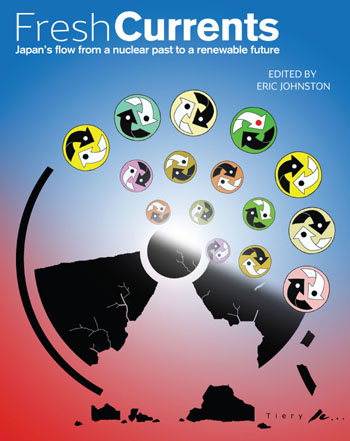
“Fresh Currents” can be downloaded free. It is also available from good bookstores, priced ¥2,000. For more details, including news updates, visit:www.freshcurrents.org. Stephen Hesse is a professor in the Law Faculty of Chuo University. He can be reached at stevehesse@hotmail.com.
‘Fresh Currents’ charts the way to, and from, Fukushima, Japan Times, 28 Oct 12, By STEPHEN HESSE This month’s column is about a book that is very much more than just a book: It is a work of art, a labor of love and a realizable dream of a better future for Japan…..
Japan has limited options regarding its energy future: To accept the status quo and the cronyism that taints its government-industry relations, leaving energy policy in the hands of those who prioritize political gain; or to pursue national energy security that puts a priority on safety and on sharing the costs and benefits, financial and technological, across all of the nation’s regions and residents.
In a nutshell, Japan can either remain nuclear, with all the dangers that portends for these islands perched on the Pacific Rim of Fire — or it can pursue policies that foster and reward dramatic increases in energy conservation and efficiency and the development of alternative energies that are safe and widely decentralized. Continue reading
New book – Nuclear Roulette
 All-Time Darwin Award: The Nuclear Industry Rady Ananda Activist Post 18 Oct 12, Gar Smith’s Nuclear Roulette: The Truth about the Most Dangerous Energy Source on Earth is a 14-point condemnation of President Eisenhower’s “peaceful atom,” an exposé of official and corporate lies, and a multi-pronged platform of alternatives.
“In 2000 alone, civilian reactors produced enough plutonium to make more than 34,000 nuclear bombs,” writes Smith. [1] Continue reading
Global nuclear war danger still, 50 years after Cuban missile crisis
Nuclear weapons still have the power to instantly destroy the world October 23, 2012, This month is the 50th anniversary of the Cuban Missile Crisis — which took place Oct. 16-28 in 1962 — so we’re going to hear a great deal about the weeks when the world almost died. But the past is a foreign country, a place where everything was in black and white, and men still wore hats, so it’s just scary stories about a long-gone time.
Or so it seems.
The outlines of the tale are well known. It was 17 years since the United States had used nuclear weapons on Japan, and the Soviet Union now had them, too. Lots of them. The American and Soviet arsenals included some 30,000 nuclear weapons, and not all of them were carried by bombers any more. Some were mounted on rockets that could reach
their targets in the other country in half an hour……
What almost nobody knew until very recently is that the crisis did not really end on Oct. 28. A new book by Sergo Mikoyan — “The Soviet Cuban Missile Crisis: Castro, Mikoyan, Kennedy, Khrushchev, and the Missiles of November” — reveals that it continued all the way through November……. the whole world could have ended.
As Robert McNamara, Kennedy’s defence secretary in 1962, said 40 years later: “We were just plain lucky in October 1962 — and without that luck most of you would never have been born because the world would have been destroyed instantly or made unlivable in October 1962.”
Then he said the bit that applies to us. “Something like that could happen today, tomorrow, next year. It will happen at some point. That is why we must abolish nuclear weapons as soon as possible.” They are still there, you know, and human beings still make mistakes.
http://www.capebretonpost.com/Opinion/Columns/2012-10-23/article-3105130/Nuclear-weapons-still-have-the-power-to-instantly-destroy-the-world/1
New book: Mad Science: the Nuclear Power Experiment
 Joseph Mangano’s “Mad Science: the Nuclear Power Experiment” http://www.counterpunch.org/2012/10/05/nuclear-lies-cover-ups-and-secrecy/ Nuclear Lies, Cover-Ups and Secrecy by JANETTE D. SHERMAN, MD Do Governments and Corporations lie, cover-up and maintain secrecy as they harm our planet and us? Joe Mangano’s new book Mad Science – The Nuclear Power Experiment clearly lays it out that they have done so for more than half a century.
This book is a page-turner, filled with useful information that many of us don’t know or have forgot. His chapter “Tiny Atoms, Big Risks” explains the various forms of nuclear energy in terms that anyone can understand, and details the harm that has come to all life on our planet as a result of nuclear bombs and nuclear power plants. Continue reading
The true scale of Chernobyl’s radioactive disaster
 Chernobyl, Insight from the Inside by Vladimir M.
  Chernousenko, Scientific Director of the Ukrainian Academy of Sciences Institute of Physics in Kiev’s Task Force for the Rectification of the Consequences of the Chernobyl Accident
Foreward, pp. XVI-XVII, From the Publisher:
The author’s chief motivation for writing this book is that he considers it vitally important that the world should be told the unvarnished truth about the scale and consequences of the disaster, the legacy of which will remain with us for many generations. He presents realistic estimates and new unpublished hard data from various reliable sources about the radiation pollution caused by the accident. The figures prove to be much higher than anyone dared assume up to now. We are confronted with horrendous numbers regarding the radiation pollution of the soil and aquifers in the Soviet Union. On the basis of these data, it is estimated that a territory of a least 100,000 km^2 is so polluted as to be uninhabitable. There are even estimates of an amount three times as high.
The author’s greatest concern is the well-being of the people still living in this huge territory. Many of those who are still living in the polluted areas want to leave, but the problems posed by local administration and bureaucracy do not allow them to do so. For lack of precedence, the effects on their health in the long-term can only be guessed at, at the present time. But those effects are already beginning to become evident. The health statistics included in this book are a matter of serious concern and urgently call for further investigations. Continue reading
Fresh Currents: Japan’s flow from a nuclear past to a renewable future
To concerned individuals everywhere:
We now stand at a critical watershed for Japan and the world – will we choose to revert to the dangerous, costly and centrally-controlled industry of nuclear power, rely on the CO2-producing fuels of oil and coal, or embrace the exciting new possibilities of decentralized renewable energy technologies?
Living only 60 kilometers from the Oi nuclear power plant (reopened in June amidst growing protests across the country), we felt compelled to add something positive to the growing movement towards a sustainable energy future. *Fresh Currents* was put together from a network of writers associated with *Kyoto Journal,* an NPO based in Kyoto that has been publishing in print and digitally for over 25 years. This book would not have been possible without the kind donations of people who visited our Indiegogo campaign or the incredibly hard work of all the volunteer writers, translators, photographers, designers and illustrators. We deeply thank everyone who has been or who will be a part of our project!

Please download your complimentary digital copy of *Fresh Currents,*
our book on Fukushima and Japan’s energy future, HERE….
http://download.freshcurrents.org/
A print edition will be available at the end of September (¥2000).
Join us! You can do four things to help move our project forward:
* Give us feedback! Point out texts that that you find
especially valuable. Ask someone to review Fresh Currents
* Please send this PDF of *Fresh Currents *to any educational,
environmental or citizen group, individual, blog, or website who has
interest in our energy future. May this publication multiply and spread!
* We are looking for a Japanese publisher and appreciate any
suggestions you may have in this regard.
* We wish to produce a screening of films in Kyoto related to
nuclear power, Fukushima, and renewable energy technologies. Do you
have a favorite film? Please send your suggestion to our Heartwork Editor
Jennifer Teeter: teeter42(at)gmail.com
Thank you!
The Fresh Currents Team
Look for Fresh Currents & Kyoto Journal on Facebook
Thanks to http://fukushima.greenaction-japan.org/ for the links and info!
Art and science of radiation induced mutations in small animals
 Cornelia Hesse-Honegger. Genetic damage small wild life due to “normally venting” reactors. http://www.wissenskunst.ch/en/biographie.htm have a look at the illustrations. quote: Biography Cornelia Hesse-Honegger,scientific illustrator and science artist, was born in 1944 in Zurich, Switzerland. For 25 years she worked as a scientific illustrator for the scientific department of the Natural History Museum at the University of Zurich. Since 1969 she has collected and painted leaf bugs, Heteroptera. Her watercolors are exhibited internationally at museums and galleries. Her work is an interface between art and science; it plays witness to a beautiful but endangered nature.
Since the catastrophe of Chernobyl in 1986, she has collected, studied and painted morphologically disturbed insects, which she finds in the fallout areas of Chernobyl as well as near nuclear installations. As a result of her studies, she is convinced that in
Picture:
Eyes of the Drosophila Mutant ey.opt.
Black painted eyes with different shapes and part of wings growing out of the eyes.
Watercolor, 1987 end quote
http://trendland.net/cornelia-hesse-honegger-morphologically-disturbed-insects/#
Cornelia Hesse-Honegger : Morphologically Disturbed Insects
http://www.designfederation.net/illustration/the-bugs-of-cornelia-hesse-honegger/
www.mendel-museum.com/eng/1online/popart/bio/c.pdf
The unnecessary atrocity of Hiroshima nuclear bombing
Ham’s conclusion to his very well documented and stringently argued book is that for 70 years the world has accepted an American myth – that the atomic bombs ended the war by shocking Japan into surrender. In fact it was ‘a planned massacre of innocent civilians – an unwarranted, American atrocity’.
Hiroshima: A stain on human history , HIROSHIMA NAGASAKI BY PAUL HAM(Bantam Press £25) By PETER LEWIS, PUBLISHED, 26 July 2012 This controversial book delivers a double-whammy in the way of shocks. First, it argues that the Atomic Bombing of two Japanese cities in August, 1945, was militarily unnecessary and politically unjustified.
Second, by interviewing many survivors while he was living in the two cities, Paul Ham, an Australian journalist and expert on the Pacific war, gives an eye-witness picture that leaves Dante’s Inferno looking pale.
Let me start with the inferno, so that we realise just what we are considering. Tomiko Nakamura was a schoolgirl of 13 at Shintaku High School in Hiroshima when the Bomb exploded, killing almost all her 300 schoolmates in the playground. Although over a mile from the blast, the flash, she remembers, ‘felt like the sun had fallen out of the sky and landed right in front of us’.
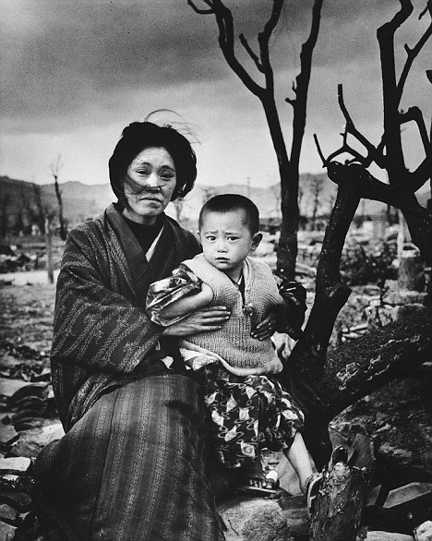
She regained consciousness in darkness. The mushroom cloud had turned dirty brown and cut off the sun. Flashes like ‘sunrises’ were coming from it in all directions. She examined her scalp covered in glass splinters. ‘My skin rolled off my legs like stockings’. Her shirt and trousers had been burnt onto her flesh. ‘I felt very sick and sat down but the flames were coming closer’. She started to walk over the rubble. ‘Voices beneath the timbers cried “Help! Help! It’s so hot!” I just kept walking’.
She reached a bridge where people with black or red faces were jumping into the river. ‘I couldn’t tell men from women. Some were holding their insides in their hands, staring at them. Everywhere dehydrated people were crying for water but when they drank some they died. A girl screamed: ‘The faster I die the better!’ as she jumped into the river. Continue reading
Nuclear Disasters and Lessons Learned… A Mother’s Response
Silence Deafening http://www.silencedeafening.com/index.html Fukushima Fallout … Nuclear Disasters and Lessons Learned… A Mother’s Response Facts are facts. There have been at least three major nuclear power disasters to date: Three Mile Island in 1979, Chernobyl in 1986, and now Fukushima Daiichi in 2011… and there are many more smaller nuclear accidents and near misses every year. Do we wait for another catastrophic event, or do we act now?
Nuclear fallout is a harmful and mysterious tragedy that we can’t see, taste, hear, smell or feel. Rather than recoil in fear from Fukushima Daiichi, it really only serves to empower us into further action. This book is a mother’s account of dealing with radioactive fallout from the Fukushima Daiichi disaster, the worst in world history. This book speaks to the urgent need for food monitoring, conservation and renewable energy, as radiation from nuclear power is now migrating into our homes and kitchens.
Book: guide to radiation cancer treatment
Book details minimum recommended guidelines for radiation oncology practices News Medical July 19, 2012 The American Society for Radiation Oncology (ASTRO) is proud to announce the publication of Safety is No Accident: A Framework for Quality Radiation Oncology and Care, a comprehensive book detailing minimum recommended guidelines for radiation oncology practices.
The 52-page document represents an intensive collaboration among 31 specialists from all of the major societies in the radiation oncology field, representing physicians, medical physicists, radiation therapists, medical dosimetrists, nurses and administrators to ensure safe and effective radiation therapy treatment for patients, led by Writing Chairmen Anthony L. Zietman, MD, FASTRO, Jatinder R. Palta, PhD, and Michael L. Steinberg, MD, FASTRO……
http://www.news-medical.net/news/20120719/Book-details-minimum-recommended-guidelines-for-radiation-oncology-practices.aspx
Book claims that Israel’s Mossad killed Iranian nuclear scientists
Israeli agents assassinated Iranian scientists Jerusalem Post, By YAAKOV LAPPIN07/11/2012 New book says foreign mercenaries not behind attacks; Co-author to ‘Post:’ Targeted killings damaged Tehran’s nuclear program. The shadowy men on motorcycles who were behind the assassinations of four Iranian nuclear scientists in recent years were Mossad agents, not foreign mercenaries, according to a new book on the history of Israeli intelligenceservices.
The book, co-authored by veteran Israeli intelligence correspondent Yossi Melman and CBS journalist Dan Raviv, is called Spies Against Armageddon: Inside Israel’s Secret Wars, (Levant Book). It was published this week…….
Both ex-Mossad chief Meir Dagan – who apparently oversaw much of what occurred in Iran – and former Shin Bet chief Yuval Diskin have warned against a current military strike on Iran, with Diskin going as far as accusing Prime MinisterBinyamin Netanyahu and Defense Minister Ehud Barak of being “messianic.”…… http://www.jpost.com/IranianThreat/News/Article.aspx?id=277016
Book describes the murders of Iran’s nuclear scientists
 Israeli spies behind Iran assassinations: Book, Times of India. AP | Jul 9, 2012, WASHINGTON: A new book claims Israel’s spy agency dispatched assassins into Iran, as part of a campaign to sabotage the country’s disputed nuclear program.
Israeli operatives have killed at least four Iranian nuclear scientists, including targeting them with operatives on motorcycles, an assassination technique used by the Israeli spy service, the Mossad, according to authors Dan Raviv and Yossi Melman in their book to be published July 9, “Spies Against Armageddon: Inside Israel’s Secret Wars“. Continue reading
A positive book for our planet – “Loving This Planet”
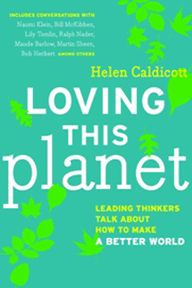 Together with some of the most brilliant thinkers and inspiring advocates of our time, including Maude Barlow, Bill McKibben, Daniel Ellsberg, Lily Tomlin, and many others, Caldicott—whom Meryl Streep has called “my inspiration to speak out”—scrutinizes our unsustainable dependence on nuclear energy and the absurdity of nuclear arms and seeks to raise awareness about other planetary issues, including deforestation, sea-level rise, and privatization of water reserves.
Loving This Planet Leading Thinkers Talk About How to Make a Better World HELEN CALDICOTT paperback $17.95
PAPERBACK ORIGINAL MORE THAN TWO DOZEN INTERNATIONALLY RECOGNIZED ADVOCATES DISCUSS THE STATE OF THE PLANET IN CANDID CONVERSATIONS WITH LEADING ANTINUCLEAR ACTIVIST DR. HELEN CALDICOTT
God bless Helen Caldicott. —LOS ANGELES TIMES Ever since quitting her job as a pediatrician at Harvard Medical School in 1980, Helen Caldicott has worke d tirelessly for a safe, sustainable, nuclear-free planet, most recently by hosting a weekly radio show featuring environmentalists and leading activists from around the globe.
Together with some of the most brilliant thinkers and inspiring advocates of our time, including Maude Barlow, Bill McKibben, and many others, Caldicott—whom Meryl Streep has called “my inspiration to speak out”—scrutinizes our unsustainable dependence on nuclear energy and the absurdity of nuclear arms and seeks to raise awareness about other planetary issues, including deforestation, sea-level rise, and privatization of water reserves.
In these stirring conversations, we hear from Martin Sheen on the power of grassroots movements and the ability of unionized labor to influence politicians; Jonathan Schell, bestselling author and contributing editor to The Nation and Harper’s Magazine, on key environmental and economic fallacies; and award-winning nuclear engineer Arjun Makhijani on transitioning to a society based completely on renewable energy, omitting the need for fossil fuels or nuclear power. Continue reading
1 This Month



Shut down the radiation-damaged Heysham nuclear reactors now
To see nuclear-related stories in greater depth and intensity – go to https://nuclearinformation.wordpress.com

Say No to NASA’s Reckless Nuclear Reactor on the Moon
Say No to NASA’s Reckless Nuclear Reactor on the Moon
-
Archives
- October 2026 (247)
- September 2026 (339)
- August 2026 (330)
- July 2026 (355)
- June 2026 (287)
- May 2026 (306)
- April 2026 (356)
- March 2026 (251)
- February 2026 (267)
- January 2026 (308)
- December 2025 (358)
- November 2025 (359)
-
Categories
- 1
- 1 NUCLEAR ISSUES
- business and costs
- climate change
- culture and arts
- ENERGY
- environment
- health
- history
- indigenous issues
- Legal
- marketing of nuclear
- media
- opposition to nuclear
- PERSONAL STORIES
- politics
- politics international
- Religion and ethics
- safety
- secrets,lies and civil liberties
- spinbuster
- technology
- Uranium
- wastes
- weapons and war
- Women
- 2 WORLD
- ACTION
- AFRICA
- Atrocities
- AUSTRALIA
- Christina's notes
- Christina's themes
- culture and arts
- Events
- Fuk 2022
- Fuk 2023
- Fukushima 2017
- Fukushima 2018
- fukushima 2019
- Fukushima 2020
- Fukushima 2021
- general
- global warming
- Humour (God we need it)
- Nuclear
- RARE EARTHS
- Reference
- resources – print
- Resources -audiovicual
- Weekly Newsletter
- World
- World Nuclear
- YouTube
-
RSS
Entries RSS
Comments RSS

