Yoshito Matsushige, photographer of iconic Hiroshima bombing pictures
the American military confiscated all of the post-bomb prints, just as they seized the Japanese newsreel footage,
 Journalist Took Five Historic Pictures—That Must Never Be Repeated The Nation, Greg Mitchell on August 8, 2013 Yoshito Matsushige, a photographer for the Chugoku Shimbun, took the only pictures in Hiroshima on August 6, 1945, that have surfaced since. It was these five photos Life magazine published on September 29, 1952, hailing them as the “First Pictures—Atom Blasts Through Eyes of Victims,” breaking the long media blackout on graphic images from Hiroshima and Nagasaki.
On August 6, 1945, Matsushige wandered around Hiroshima for ten hours, carrying one of the few cameras that survived the atomic bombing and two rolls of film with twenty-four possible exposures. This was no ordinary photo opportunity. He lined up one gripping shot after another, but he could only push the shutter seven times. Continue reading
The Amazing foolishness of nuclear weapons and nuclear power building
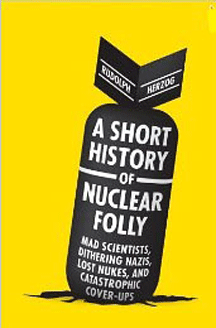 Book Review: A Short History Of Nuclear Folly http://www2.macleans.ca/2013/07/19/a-short-history-of-nuclear-folly/ by Bookmarked and Andrew Stobo Sniderman on Friday, July 19, 2013 A Short History Of Nuclear Folly By Rudolph Herzog
Reading about human courtship of nuclear destruction is like watching the wobbles of an amateur tightrope walker: one gawks in terror and amazement. Herzog, son of the eminent filmmaker, offers a snapshot tour of the “frivolity, naïveté, and unscrupulousness” with which nuclear devices have been used since physicists figured out how to get a big bang out of a wee atom. This is not a scholarly or particularly well-structured book, and it reads more like a collection of cool stuff the author found while reading around the subject of nuclear madness. Yet Herzog will make your jaw drop with regularity.
For examples: Cold-Warring Soviets forced 40,000 soldiers to march into the site of a nuclear test explosion immediately after the ascension of its mushroom cloud, just to see what happened to the poor fellows; an influential American physicist sought to blast an alternative international shipping route to the Panama and Suez canals using nuclear bombs as convenient excavation devices; and, my favourite, plutonium-powered pacemakers enraptured doctors with their long-lasting convenience, except that no one bothered to keep track of them once the patients eventually died. Woe to the cremators.
Beyond the shocking “indifference to the fate of individuals” of the superpowers as they tinkered with their nuclear toys, Herzog identifies one central problem with the nuclear fixation: persistent failures of imagination. “No one was able to picture the worst-case scenario.” So it was typical that the Soviet Union gleefully built nuclear-powered satellites, but didn’t prepare for the possibility of them crashing back to Earth. As it happened, in 1977 a malfunctioning Soviet satellite with 45 kilograms of radioactive uranium on board crashed in the Yukon. American radiation detectors didn’t work in the Canadian winter cold, but thankfully some random mushers stumbled upon the wreckage. It could have been worse. Indeed, though there was plenty of folly, often fatal, we somehow avoided Armageddon.
New Book: A Short History of Nuclear Folly
A Short History of Nuclear Folly [Hardcover] http://www.amazon.com/A-Short-History-Nuclear-Folly/dp/1612191738/ref=sr_1_1?ie=UTF8&qid=1369261455&sr=8-1&keywords=short+history+of+nuclear+folly Release date: April 30, 2013
In an unprecedented people’s history, Herzog digs deep into archives, interviews nuclear scientists, and collects dozens of rare photos. He explores the “accidental” drop of a Nagasaki-type bomb on a train conductor’s home, the implanting of plutonium into patients’ hearts, and the invention of wild tactical nukes, including weapons designed to kill enemy astronauts.
Told in a riveting narrative voice, Herzog—the son of filmmaker Werner Herzog—also draws on childhood memories of the final period of the Cold War in Germany, the country once seen as the nuclear battleground for NATO and the Warsaw Pact countries, and discusses evidence that Nazi scientists knew how to make atomic weaponry . . . and chose not to.
USA Safety Issue – Nuclear Missile Launch Crews
Overlooked Story of the Week: ‘Rot’ and ‘Crisis’ For Nuclear Missile Launch Crews, The Nation, Greg Mitchell on May 10, 2013 “…..Sadly overlooked, however, was an exclusive from the Associated Press. Oh, no big deal. Just “rot” and “crisis” and a wave of firings in one program you especially don’t want to witness this in: Our nuclear missle launch program.
At Minot Air Force Base in North Dakota the commander confirmed, as the story put it, “the willful violation of safety rules—including a possible compromise of launch codes—was tolerated.” Seventeen members of launch crews have been fired, an unprecedented action in its scope……
As I’ve done for, oh, the past thirty years, in numeous articles and three books, this is where I remind readers that the US still has a first-strike nuclear policy, and thousands of nuclear weapons, more than two decades after the end of the Cold War—and that we have used nuclear weapons before, setting (and for most Americans, defending) a precedent.
 Greg Mitchell’s new book is “Hollywood Bomb.” His previous books on this subject were “Atomic Cover-up” and, with Robert Jay Lifton, “Hiroshima in America.”
The New York Times is again pushing for war in the Middle East, while McClatchy news outlets are again advising caution, Greg Mitchell writes. http://www.thenation.com/blog/174272/overlooked-story-week-rot-and-crisis-nuclear-missile-launch-crews#
An unpopular truth – Iran does not have nuclear weapons
No, Iran does not posses nuclear weapons, The Spectator, Peter Oborne 1 May 2013 “…… two weeks ago I published a book, co-authored with David Morrison, A Dangerous Delusion: Why the West is Wrong about Nuclear Iran. Since then my co-author and I have been subject to a series of misrepresentations and innuendo on a scale and (in some cases) virulence that I have never encountered before…….
not one of our critics have even tried to deal with the central, factual points of our short book: that Iran isn’t in possession of nuclear weapons and isn’t building them; that the US and Israeli intelligence agencies don’t think they are; that Iran is entitled under the Non-Proliferation Treaty to develop peaceful nuclear power; that in 2005 it put proposals on the table to do this under full international scrutiny (including co-ownership).
We acknowledge that Iran’s human rights record – as Geoffrey Robertson has graphically portrayed in his recent book – is dreadful. We view President Ahmadinejad’s denials of the Holocaust as utterly odious. However, to judge Iran by Ahmadinejad alone would be a mistake. He steps down in a few weeks, and in any case the final decision on nuclear matters lies with the Supreme Leader, who has repeatedly denounced nuclear weapons as forbidden under Islam. It is in the best interest of the west, let alone ordinary Iranians whose lives are being made miserable by sanctions, to engage with Iran pragmatically rather than carry on with the current policy of isolation.
In the wake of June’s elections we hope and believe that a solution satisfactory to all parties can be agreed. We passionately believe that the alternative is too ghastly to contemplate. However, if an agreement is to be reached, we in the west need to recognize that Iran – with all its faults – is an independent nation with legitimate interests, and is a fully signed up member of the Non-Proliferation Treaty, with every right to enrich uranium.
We also need to be clear about the facts. This is why in our book we have attempted to expose the myths, falsehoods and delusions that surround this grave and troubling subject. There is an argument of massive importance to be engaged in here. If my critics wish to challenge me to open debate about the thesis of our book, I would be delighted to engage. They know how to get hold of me: any time, any place. http://blogs.spectator.co.uk/peter-oborne/2013/05/no-iran-is-an-independent-nation-with-legitimate-interests-that-does-not-posses-nuclear-weapons/
A Short History of Nuclear Folly – book and audio
 AUDIO –– ‘A Short History of Nuclear Folly’ and the lasting effects of the nuclear arms race
Book ‘A Short History of Nuclear Folly’ and the lasting effects of the nuclear arms race Jacob Margolis with Michelle Lanz | Take Two | April 30th, 2013, Though Russia and the U.S. are working together when it comes to investigating the bombing suspects in Boston – their relationship wasn’t always so amicable. Even today we have our problems.
Back in the 1980s there was always the threat of mutually assured nuclear destruction. Many people probably remember a time when, as schoolchildren, they were trained to hide under their wooden desks during nuclear blast drills. Had a blast actually happened they’d essentially be hiding under kindling, but that’s beside the point.
Before the threat of World War III, however, countries at the forefront of the nuclear arms race had to test these new weapons of mass destruction. The United States in particular tested weapons across the West, and radiation is still found in places like Nevada and Utah today. They treated Earth as their own nuclear testing playground, but that process could have a nasty effect on the environment.
In Rudolph Herzog’s new book, “A Short History of Nuclear Folly: Mad Scientists, Dithering Nazis, Lost Nukes and Catastrophic Cover-ups,” he traces the history of the nuclear race and what effects it has on the world today.
Interview Highlights:….http://www.scpr.org/programs/take-two/2013/04/30/31559/a-short-history-of-nuclear-folly-and-the-lasting-e/
New book “Plutopia” exposes the horror legacy of nuclear weapons making
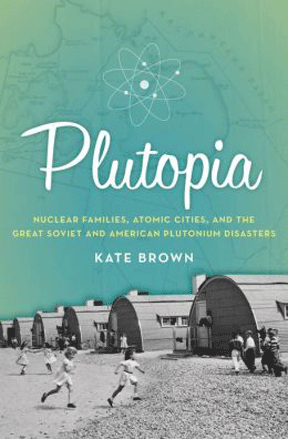 Plutopia: Nuclear Families, Atomic Cities, and the Great Soviet and American Plutonium Disasters Kate Brown http://www.amazon.com/gp/product/0199855765/ref=as_li_ss_tl?ie=UTF8&camp=1789&creative=390957&creativeASIN=0199855765&linkCode=as2&tag=slatmaga-20 While many transnational histories of the nuclear arms race have been written, Kate Brown provides the first definitive account of the great plutonium disasters of the United States and the Soviet Union.
In Plutopia, Brown draws on official records and dozens of interviews to tell the extraordinary stories of Richland, Washington and Ozersk, Russia-the first two cities in the world to produce plutonium. To contain secrets, American and Soviet leaders created plutopias–communities of nuclear families living in highly-subsidized, limited-access atomic cities. Fully employed and medically monitored, the residents of Richland and Ozersk enjoyed all the pleasures of consumer society, while nearby, migrants, prisoners, and soldiers were banned from plutopia–they lived in temporary “staging grounds” and often performed the most dangerous work at the plant.
Brown shows that the plants’ segregation of permanent and temporary workers and of nuclear and non-nuclear zones created a bubble of immunity, where dumps and accidents were glossed over and plant managers freely embezzled and polluted. In four decades, the Hanford plant near Richland and the Maiak plant near Ozersk each issued at least 200 million curies of radioactive isotopes into the surrounding environment–equaling four Chernobyls–laying waste to hundreds of square miles and contaminating rivers, fields, forests, and food supplies.
Because of the decades of secrecy, downwind and downriver neighbors of the plutonium plants had difficulty proving what they suspected, that the rash of illnesses, cancers, and birth defects in their communities were caused by the plants’ radioactive emissions. Plutopia was successful because in its zoned-off isolation it appeared to deliver the promises of the American dream and Soviet communism; in reality, it concealed disasters that remain highly unstable and threatening today.
A plan to crash plane into Oak Ridge nuclear reactor
Book: Hijackers had airplane in nosedive heading for U.S. nuclear reactor — “A very, very scary situation” -Energy Official http://enenews.com/book-hijackers-had-airplane-in-nosedive-heading-for-u-s-nuclear-reactor-a-very-very-scary-situation-energy-official
Title: The odd side of Oak Ridge history
Source: Knoxville News
Author: Frank Munger
Date: April 16, 2013
On the morning of Nov. 11, 1972, Oak Ridge stood still — or nearly so — while a hijacked Southern Airways jetliner circled above.
“It was a very, very scary situation,” Jim Alexander, a retired public affairs officer at the Department of Energy, recalled in a 2001 interview.
The hijackers threatened to crash the airplane into the Oak Ridge nuclear facilities if their demands, including $10 million in cash, were not met. […]
The threat was real, according to a 1977 book, “The Odyssey of Terror.”
The author, Ed Blair, wrote that the hijackers went berserk after placing a call to the White House and being shunned by John Ehrlichman, an aide to President Nixon, who apparently was unaware of the crisis. Blair reported that the hijackers held a grenade to the pilot’s head and ordered him to dive the plane toward the Oak Ridge reactor. The plane was actually in a nosedive when a report came over the radio that the money demands were being met […]
See also: Japan Gov’t Experts: Airplane crash affecting Fukushima spent fuel pool a key security issue for future
50 Soviet Union atomic bombs missing
Lawyer’s second book chronicles missing nuclear bombs Seacoastonline, By Elizabeth Dinan March 01, 2013 PORTSMOUTH — After the collapse of the former Soviet Union, Portsmouth attorney Bob Shaines was living in the post-communist country as a U. S. Defense Department consultant when he learned that 50 Russian, 10-kiloton, suitcase-sized, plutonium bombs were unaccounted for.
“The bombs, he said, “were small enough to be transported by diplomatic pouch and designed to give the Soviets a potential retaliatory weapon in the event of a nuclear war by placing them at various sites in Western cities.”
The missing bombs, and efforts by a global task force to find them, lays the foundation for Shaines’ new book, “Secrets In A Time of Peace.” He calls the book a memoir, but says it’s fiction, though based on actual events, real people, and personal experiences from his time living in Russia between 1991 and 1996…… http://www.seacoastonline.com/articles/20130301-NEWS-130309984
Dispelling the myths that nuclear weapons are necessary or even useful
On the uselessness of nuclear weapons Scientific American By Ashutosh Jogalekar | January 13, 2013 Two foundational beliefs have colored our views of nuclear weapons since the end of World War 2; one, that they were essential or at least very significant for ending the war, and two, that they have been and will continue to be linchpins of deterrence. These beliefs have, in one way or another, guided all our thinking about these mythic creations. Ward Wilson who is at the Monterey Institute of International Studies wants to demolish these and other myths about nukes in a new book titled “5 Myths about Nuclear Weapons“, and I have seen few volumes which deliver their message so effectively in such few words. Below are Wilson’s thoughts about the two dominant nuclear myths interspersed with a few of my own.
“Nuclear weapons were paramount in ending World War 2″.
This is where it all begins. Continue reading
Reviewing latest book on the state of the nuclear world
Book Review Podcast: The State of the Nuclear World, January 11, 2013, Arts Beat, By JOHN WILLIAMS This week in The New York Times Book Review, Bill Keller reviews three new books that address the current thinking about nuclear weapons. Mr. Keller writes:
Fear of nuclear weapons spiked for a time after 9/11, when we confronted the possibility of fissile material in the hands of stateless enemies, and you can find a reservoir of existential fear today in Israel, as it contemplates a nuclear Iran. The nuclear weapons of fragile Pakistan and inscrutable North Korea preoccupy large sectors of our intelligence community. But for most of us anxiety has given way to a kind of complacency. The longer we have gone without seeing nuclear weapons used, the more we assume they will not be used. Three new books challenge that complacency, from three different directions.
This week, Mr. Keller discusses those books…. http://artsbeat.blogs.nytimes.com/2013/01/11/book-review-podcast-the-state-of-the-nuclear-world/
What made the atomic scientists tick?
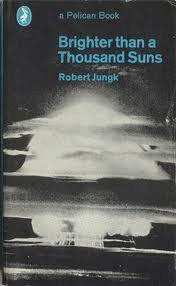 Character before knowledge, Online Opinion, by Noel Wauchope 10 Jan 13, ” Brighter than a Thousand Suns”, A Personal History of the Atomic Scientists, by Robert Jungk, was first published in 1956. “Why are we interested only in what scientists do, and not in what they are? ” This opening question informs Jungk’s entire book. Jungk conversed with many of the scientists of the early days of atomic research, and through until 1954. With the earliest conversations, Jungk was struck by ”the arbitrary and unnatural separation of scientific research from the reality of the individual personality”. To Jungk, it was this division that ”allowed the creation of such monstrosities as the atomic bomb and the hydrogen bomb”.
To this day, many nuclear scientists think of their work as purely mathematical and technical. The human results of nuclear weapons are none of their business. Others, especially after Hiroshima, suffered “their great crisis of conscience”……..
From then on, it was a rush to test the bomb, and then use it, before the Japanese surrendered. Three atomic bombs were built. The first – tested: if the test was a failure – it would be reported as a “girl” – if successful a “boy”.
For the second and third bombs, 67 Scientists petitioned the government to warn the Japanese first – a petition that was prevented by General Groves from reaching the White House. Enrico Fermi commented “Don’t bother me with your conscientious scruples! After all, the thing is superb physics!”
The $2 billion Manhattan Project would be seen as a senseless waste of money, if Japan surrendered. Truman authorised the bombing of Hiroshima and Nagasaki. Oppenheimer explained later that his Interim Committee’s recommendation was “a technical opinion”.
The reactions of the scientists were conflicted……
Robert Jungk’s account of the men, and some women, too, who developed atomic weapons , is set against the background of the big events of the time, with a sympathetic attitude to the pressures and problems that surrounded these people.
From 1951 to 1955 the general attitude of atomic scientists was one of enthusiasm for the hydrogen bomb (1000 times more powerful than the first atomic bomb). Jungk muses on this: “How is one to explain such macabre enthusiasm which had swept away all the earlier scruples and objections to the Super monster?” http://www.onlineopinion.com.au/view.asp?article=14554
Book Review: Atomic bombing of Hiroshima was not necessary
 BOOK REVIEW The rush to the nuclear The Nation, 6 Jan 13, The end of World War II needn’t have been so terrible as to witness the birth of the bomb,says author Paul Ham
Hiroshima Nagasaki: The Real Story
In six decades the story behind the birth of the atomic
age has lost none of fascination, in equal parts because the power of
the nucleus was immediately put to such horrific use, and because its
risks have still not been fully contained, in conflict or in peace.
While Australian journalist Paul Ham’s book “Hiroshima Nagasaki”
appears to offer nothing new as claimed, it’s an enlightening analysis
of those dangerous early years, drawn into a modern context….. In
the end he comes firmly down on the side of those who say the bombing
of Hiroshima and Nagasaki was utterly without justification, and these
voices include many wartime generals. Japan was blockaded, its supply
lines strangled, meaning that the Allies didn’t even need to launch a
dreaded, costly invasion of the mainland, let alone unleash nuclear
terror…… http://www.nationmultimedia.com/life/The-rush-to-the-nuclear-30197326.html
New book on the heroic “Fukushima 50”
 now a recently published book sheds light on dozens of those workers, including their real names and numerous quotes, and an account by the plant’s heroic operations chief, Masao Yoshida, who has largely avoided giving interviews despite intense public interest in
his role in the saga.
 Book reveals human drama in Fukushima No. 1 crisis http://www.japantimes.co.jp/text/nn20121211f2.html#.UMf-ohGksug.twitter By KAZUAKI NAGATA, 12 Dec 12 Experts and journalists have written a number of reports, some even running several hundred pages, about the cause of the triple meltdown crisis at the Fukushima No. 1 power plant and the chain of events that followed.
Behind the scenes: “Shino Fuchi wo Mita Otoko” (“A Man Who Was on the Brink of Death”) interviews the people involved in battling the Fukushima nuclear crisis in March 2011 and takes the rare step of using their real names. YOSHIAKI MIURA
But little has come to light about the human drama of how the plant workers who came to be dubbed the “Fukushima 50,” fought against incredible odds to avert catastrophic reactor explosions that would have led to the contamination of all eastern Japan. Continue reading
Wikileaks book warns on Internet surveillance
 Julian Assange’s book an exercise in dystopian musings WikiLeaks founder’s Cypherpunks warns tool he relies on and used to make his name is ‘global surveillance industry’ target Esther Addley guardian.co.uk, 26 November 2012 Julian Assange‘s new book is not a manifesto, he writes in its introduction – “There is no time for that”. Instead the short volume,entitledCypherpunks: Freedom and the Future of the Internet and published on Monday, is intended to be what the Wikileaks founder calls “a watchman’s shout in the night”, warning of an imminent threat to all civilisation from “the most dangerous facilitator of totalitarianism we have ever seen” – the web……
1 This Month


Shut down the radiation-damaged Heysham nuclear reactors now
To see nuclear-related stories in greater depth and intensity – go to https://nuclearinformation.wordpress.com

Say No to NASA’s Reckless Nuclear Reactor on the Moon
Say No to NASA’s Reckless Nuclear Reactor on the Moon
-
Archives
- October 2026 (247)
- September 2026 (339)
- August 2026 (330)
- July 2026 (355)
- June 2026 (287)
- May 2026 (306)
- April 2026 (356)
- March 2026 (251)
- February 2026 (267)
- January 2026 (308)
- December 2025 (358)
- November 2025 (359)
-
Categories
- 1
- 1 NUCLEAR ISSUES
- business and costs
- climate change
- culture and arts
- ENERGY
- environment
- health
- history
- indigenous issues
- Legal
- marketing of nuclear
- media
- opposition to nuclear
- PERSONAL STORIES
- politics
- politics international
- Religion and ethics
- safety
- secrets,lies and civil liberties
- spinbuster
- technology
- Uranium
- wastes
- weapons and war
- Women
- 2 WORLD
- ACTION
- AFRICA
- Atrocities
- AUSTRALIA
- Christina's notes
- Christina's themes
- culture and arts
- Events
- Fuk 2022
- Fuk 2023
- Fukushima 2017
- Fukushima 2018
- fukushima 2019
- Fukushima 2020
- Fukushima 2021
- general
- global warming
- Humour (God we need it)
- Nuclear
- RARE EARTHS
- Reference
- resources – print
- Resources -audiovicual
- Weekly Newsletter
- World
- World Nuclear
- YouTube
-
RSS
Entries RSS
Comments RSS

