How the BBC distorted the story of Sellafield
The spectre of the new nuclear renaissance
Al’Khalili then went on to give every impression that high level nuclear waste can be safely stored using the process of ‘vitrification’, that is, turning it in glass, and so binding the waste safely into a permanent, impermeable matrix.
What he failed to mention is that the glass is by no means permanent and durable storage medium for “thousands of generations” as the glass is liable to break down – and that the problem of long term disposal of these wastes remains unsolved. For example, asR C Ewing and colleagues wrote in 1995 in the journal Progress in Nuclear Energy,
“the post-disposal radiation damage to waste form glasses and crystalline ceramics is significant. The cumulative α-decay doses which are projected for nuclear waste glasses … are well within the range for which important changes in the physical and chemical properties may occur, e.g. the transition from the crystalline-to-aperiodic state in ceramics.”
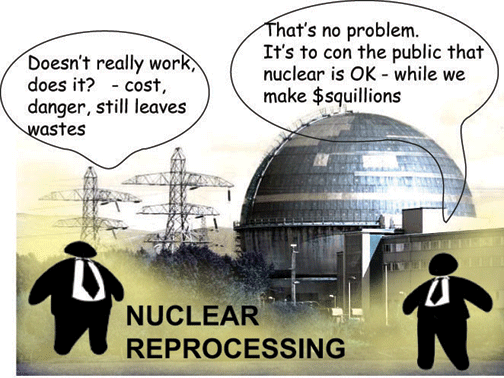
 ‘Inside Sellafield’ and military plutonium – the BBC’s nuclear lies of omission http://www.
theecologist.org/reviews/2984689/inside_sellafield_and_military_plutonium_the_bbcs_nuclear_lies_
of_omission.html Dr David Lowry 12th August 2015
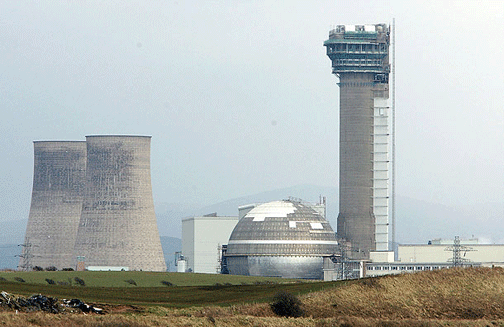 Lowry – understating the severity of accidents, concealing the role of the UK’s nuclear power stations in breeding military plutonium, and giving false reassurance over the unsolved problems of high level nuclear waste.
For one of these programmes the BBC commissioned Baghdad-born Professor Jameel ‘Jim’ Al-Khalili, theoretical physicist and Chair in the Public Engagement in Science from the University of Surrey, to research and present one programme called ‘Britain’s Nuclear Secrets: Inside Sellafield‘.
As a regular BBC broadcaster, hosting the long-running The Life Scientific on Radio 4, and maker of several science television programmes on television, including on quantum physics and the history of electricity, he was eminently qualified to make this programme.
However the programme was highly misleading thanks to major omissions, concealing the severity of accidents, and how the UK’s entire ‘civilian’ nuclear programme was subverted into producing military plutonium that fed into the Sellafield bomb factory. Continue reading
How radioactive isotopes impact on the human body
Lies, damn lies, and radiation health, A Prosperous Way Down by Mary Logan Health impacts of unseen dangers

Each isotope has different rates of biomagnification and then uptake and also different impacts in the body. Strontium follows calcium pathways in the body, so it settles in bone marrow, replacing structure and weakening bones and teeth, and causing leukemia.Cesium follows potassium pathways, lodging in muscle such as the heart. Many other isotopes act in other damaging ways in the body.
The dangers are probably still small for most foods, but hazards are tenfold to a hundredfold for children, infants, and fetuses, who have the fastest rates of mitosis and development. Rapidly dividing cells in the young are most sensitive in any organism. Similarly, organs with rapidly dividing cells are affected (bone marrow, digestive tract, skin). So risk avoidance is most important for the young.
Some of the list of long-term impacts for human health include the following:
- Circulatory damage (high blood pressure, rhythm disturbances, MI, stroke, cardiomyopathies, rhythm disturbances artery spasm, especially during cardiac stress such as temperature extremes, physical/emotional stress) (Bandazhevsky, 2001)
- Hematologic problems (leukemias especially)
- Endocrine problems (especially Hypothyroidism, thyroid nodules/Cancer, and Diabetes)
- Immune system
- Uro-genital system
- Musculoskeletal system
- Dental problems as cesium replaces calcium in teeth and bones
- Central nervous system and psyche
- The eye (cataracts and retinopathies)
- Increase in congenital malformations
- Increase in cancers
- Accelerated aging
- Increased frequency of mutations
- Fertility problems and Change in secondary sex ratio (Yablokov, 2012)
- Because exposure to radiation is invisible and difficult to detect, it is far under-represented as risk factor for disease. Causes of mortality for radiation exposure are difficult to track beyond the obviously linked leukemias and cancer. Manmade radiation from above-ground testing beginning in the 1950s has been added to by military depleted uranium from expanding use in the Middle East and expanding failures in the 435 nuclear power plants (NPPs) around the world, along with the reprocessing plants. Radiation is often ignored as a reason for immunosuppression, various cancers, and perhaps even endocrine dysfunction, especially thyroid. Because radiation impacts have not been measured in the general population, radiation’s contribution to cancers and other diseases go unnoticed. Women are more vulnerable than men, and children are at least ten to perhaps hundreds of times as vulnerable as adults, because of the rapid mitosis of their cells as they grow. Fetuses are even more vulnerable…..http://prosperouswaydown.com/epistemology-radiation-health/
How the Fukushima nuclear disaster happened
The Worst Disaster That You’ll Never Hear Anything About, Criticl, 2 Aug 15 The Fukushima Daiichi nuclear disaster embodies one of the worst man-made calamities in human history that day-by-day receives a dearth of coverage. Three nuclear reactors melting down on March 11th, 2011 ushered in the beginning of one of the most effective and insidious works of misinformation and obfuscation of reality that has been seen in recent memory.
The impetus for the disaster arose from the 2011 Tohoku earthquake, which was estimated to be the most powerful earthquake to ever hit the island in recorded history. The magnitude of the 869 Jogan Sanriku quake (the previous record holder) is only an approximation due to the lack of seismograph technology, nonetheless the Tohoku earthquake was more powerful than the plant was designed to withstand.
Nuclear reactors are designed to shutdown at the slightest event, quickly reducing the amount of heat produced; yet any heat inside the reactor (comprised of the radioactive decay of short lived fission products) is still a magnanimous amount. Backup diesel generators were quickly ushered into action at Fukushima after outside power was destroyed by the quake in order to keep the reactors cool to prevent a meltdown.
However, standard operation procedures for the plant flew out the window when tsunami waves of 14-20 meters struck the Fukushima prefecture shortly after the earthquake, rendering the 5.7-meter seawall beyond useless and knocking out the generators. Interestingly enough, the nearby Onagawa plant was saved by a 14.8-meter seawall despite being struck by a more powerful wave. Yanosuki Hirai fought bureaucracy for years that clamored for the same 5.7-meter seawall at Onagawa, and got his higher wall, remarking, “Corporate ethics is different from compliance, just being ‘not guilty’ is not enough.” The wall was remarkably effective to the point that local residents sought shelter in the plant’s gymnasium after their homes were destroyed by the wave.
The resulting influx of water into the Fukushima reactor led to a station blackout, meaning the operators lost all monitors and the ability to remotely control the reactor. Isolation condensers can cool the reactor with no electricity as long as the condenser is filled with water. Regrettably, operators had no idea that the reactor was quickly running out of water and that the valves opening the condensers were not working, rendering the first line of defence against a potential meltdown useless.
Authorities decided next to depressurize the reactors and inject water from fire engines to flood the reactors, yet unseen diversions to steam condensers via small bypasses meant injected water was not sufficient to prevent an overheating of the core. Reactor 1 saw a hydrogen explosion resulting from molten fuel cladding three hours after the tsunami. Vents and piping intended to filter hydrogen were either severely damaged by the earthquake or unable to operate due to a lack of power.
Unit 2 and the Unit 3 Reactor Core had steam-powered turbines that would circulate cooling water, but suffered a hydrogen explosion due to the pressure in the reactor becoming too low for the turbines to operate. Operators were too inexperienced to properly inject water via the fire engines, which again resulted in a meltdown of both reactors. Leading the cleanup efforts several days later, Japanese authorities quickly created a temporary cover over Unit 1 and begin to filter out contaminated water and repair the other components of the reactors, while devising a plan to contain exposed radioactive material from the damaged reactors……………. Like what you see? https://thefirsttruth.wordpress.com/
https://criticl.me/post/worst-disaster-youll-never-hear-anything-about-3562
Media failed to report the death and health toll from Chernobyl
Fukushima Not Even Close To Being Under Control, Oil Price, By ZeroHedge Sun, 28 June 2015 “……..As an example of how media fails to deal with disaster blowback, here are some Chernobyl facts that have not received enough widespread news coverage: Over one million (1,000,000) people have already died from Chernobyl’s fallout.
Additionally, the Rechitsa Orphanage in Belarus has been caring for a very large population of deathly sick and deformed children. Children are 10 to 20 times more sensitive to radiation than adults.
Zhuravichi Children’s Home is another institution, among many, for the Chernobyl-stricken: “The home is hidden deep in the countryside and, even today, the majority of people in Belarus are not aware of the existence of such institutions” (Source: Chernobyl Children’s Project-UK).
One million (1,000,000) is a lot of dead people. But, how many more will die? Approximately seven million (7,000,000) people in the Chernobyl vicinity were hit with one of the most potent exposures to radiation in the history of the Atomic Age.
The exclusion zone around Chernobyl is known as “Death Valley.” It has been increased from 30 to 70 square kilometres. No humans will ever be able to live in the zone again. It is a permanent “dead zone.”
Additionally, over 25,000 died and 70,000 disabled because of exposure to extremely dangerous levels of radiation in order to help contain Chernobyl. Twenty percent of those deaths were suicides, as the slow agonizing “death march of radiation exposure” was too much to endure……..http://oilprice.com/Latest-Energy-News/World-News/Fukushima-Not-Even-Close-To-Being-Under-Control.html
Failure of USA’s small scale reactor in Antarctica – costly and cancer-causing

Christina Macpherson’s websites & blogs
This is quite an old article, but I find it remarkable because, for once, it mentions the enormous cost of security measures needed for small nuclear reactors in remote areas.
That is what is being proposed for Australia – by both the thorium enthusiasts, and the overseas companies desperate to keep the nuclear industry alive by selling small reactors to Australa (or, even more insidiously, by providing them to Australia “for free”, in exchange for South Australia importing radioactive trash, as outlined by nuclear proponent Oscar Archer )
the PM-2A’s purpose was to test whether reactors could be built in remote locations using prefabricated parts.
After the reactor was closed down, the US shipped 7700 cubic metres of radioactive contaminated rock and dirt to California, but passed through Dunedin, with a population of 124,000, the second largest city on New Zealand’s South Island, where it stayed for four days, raising local concerns, the New Zealand news site stuff.co.nz.
Russia has found that the logistics of even finding customers for its ANPP’s outweigh even the logistics of operating the plants. Russia has staked a financial bonanza on prospective orders for the plants, but there are, simply, no takers. And if there were, the logistics of securing such a plant against terrorists or accidents in remote areas would require at least the staff of a stationary plant.

Small-scale US nuclear reactor blamed for spiking cancer rates, casting pall over Russia’s FNPP fetish AMSTERDAM – A small nuclear power plant operated the United States at Antarctica’s McMurdo Sound has been implicated in dozens of cases of an unusual cancer in personnel who worked at or near the station between the years 1964 and 1973, US and New Zealand media have indicated. March 7, 2011 by Bellona Continue reading
Thorough analysis of Switzerland’s plan for exit from nuclear power
It is a simple statement of fact that Germany today produces more solar and wind power than the entire projected electricity demand for Switzerland in 2050. What is possible in Germany should be manageable in Switzerland too. ………Conservation, greater efficiencies, alternative energy sources, the smart grid, and the introduction of new technologies mean that Switzerland should be readily able to find ways to replace the energy lost by the closing of its existing nuclear power plants.
 Small country, big challenge: Switzerland’s upcoming transition to sustainable energy,Bulletin of the Atomic Scientists, 25 July 15 Dominic A. Notter
Abstract
Switzerland has long met a good portion of its energy needs by using nuclear power. But in the wake of the accident at Fukushima, the country will have to turn elsewhere—while still remaining true to its history of self-sufficiency and energy independence. This effort is made more complicated by fears that one of its traditional energy sources, hydropower, may no longer be as reliable as in the past. But with a combination of energy conservation, greater efficiencies, alternative energy sources, the “smart grid,” and the introduction of new technologies currently on the drawing board, the country may readily be able to replace the energy lost by the closing of its existing nuclear power plants. And the loss of the snowpack and glaciers (due to climate change) may not be as dire for Switzerland’s hydropower as first anticipated……. Continue reading
Environmental factors, not genes, cause cancer, as history shows
 Scientists suggest that cancer is purely man-made http://phys.org/news/2010-10-scientists-cancer-purely-man-made.html#jCp October 14, 2010 (PhysOrg.com) –– Cancer is a modern, man-made disease caused by environmental factors such as pollution and diet, a study by University of Manchester scientists has strongly suggested.
The study of remains and literature from ancient Egypt and Greece and earlier periods – carried out at Manchester’s KNH Centre for Biomedical Egyptology and published in Nature Reviews Cancer – includes the first histological diagnosis of cancer in an Egyptian mummy.
Finding only one case of the disease in the investigation of hundreds of Egyptian mummies, with few references to cancer in literary evidence, proves that cancer was extremely rare in antiquity. The disease rate has risen massively since the Industrial Revolution, in particular childhood cancer – proving that the rise is not simply due to people living longer. Continue reading
Ukraine chaos spiralling further out of control: the role of Assistant Secretary of State Victoria Nuland
Now, the Ukraine chaos threatens to spiral even further out of control with the neo-Nazis and other right-wing militias – supplied with a bounty of weapons to kill ethnic Russians in the east – turning on the political leadership in Kiev.
 Thus, it seems unlikely that Nuland, regarded by some in Washington as the new “star” in U.S. foreign policy, will be fired for her dangerous incompetence, just as most neocons who authored the Iraq disaster remain “respected” experts employed by major think tanks, given prized space on op-ed pages, and consulted at the highest levels of the U.S. government.
The Mess That Nuland Made, Reader Supportede News By Robert Parry, Consortium News 22 July 15
Assistant Secretary of State Victoria Nuland engineered Ukraine’s “regime change” in early 2014 without weighing the likely chaos and consequences. Now, as neo-Nazis turn their guns on the government, it’s hard to see how anyone can clean up the mess that Nuland made, writes Robert Parry.
 s the Ukrainian army squares off against ultra-right and neo-Nazi militias in the west and violence against ethnic Russians continues in the east, the obvious folly of the Obama administration’s Ukraine policy has come into focus even for many who tried to ignore the facts, or what you might call “the mess that Victoria Nuland made.”
Assistant Secretary of State for European Affairs “Toria” Nuland was the “mastermind” behind the Feb. 22, 2014 “regime change” in Ukraine, plotting the overthrow of the democratically elected government of President Viktor Yanukovych while convincing the ever-gullible U.S. mainstream media that the coup wasn’t really a coup but a victory for “democracy.”
To sell this latest neocon-driven “regime change” to the American people, the ugliness of the coup-makers had to be systematically airbrushed, particularly the key role of neo-Nazis and other ultra-nationalists from the Right Sektor. For the U.S.-organized propaganda campaign to work, the coup-makers had to wear white hats, not brown shirts.
So, for nearly a year and a half, the West’s mainstream media, especially The New York Times and The Washington Post, twisted their reporting into all kinds of contortions to avoid telling their readers that the new regime in Kiev was permeated by and dependent on neo-Nazi fighters and Ukrainian ultra-nationalists who wanted a pure-blood Ukraine, without ethnic Russians.
Any mention of that sordid reality was deemed “Russian propaganda” and anyone who spoke this inconvenient truth was a “stooge of Moscow.” It wasn’t until July 7 that the Times admitted the importance of the neo-Nazis and other ultra-nationalists in waging war against ethnic Russian rebels in the east. The Times also reported that these far-right forces had been joined by Islamic militants. Some of those jihadists have been called “brothers” of the hyper-brutal Islamic State. Continue reading
France’s nuclear corporation AREVA going down the financial gurgler
As Areva Goes Belly Up, Modi’s French Nuclear Plans May Start Unravelling, DiaNuke.org, 24 July 15 “………..The signs of Areva’s irreparable decline if not imminent death have been on the horizon these past years. With its single product catalogue, Areva has struggled to complete two identical EPR reactors, the first at Olkiluoto for TVO in Finland (still not operational despite a nine-year delay and a trebling of costs) and the second in Flamanville, France, plagued by equally serious construction and security flaws, delays and outrageous cost over-runs. …….

Reactor woes continue
The estimated price of the reactor continues to go up and up – it has nearly trebled from 3.3 billion euros eight years ago to around 9 billion euros at current estimates and could go higher if the EPR’s technical problems persist. The company has run up a deficit estimated at 4.8 billion euros for a turnover of 8.3 billion. Its recapitalisation requirements stand at 7 billion euros. The French government has stepped in to impose draconian solutions on the company that will see its design, construction and operations arm hacked off and handed over to its arch enemy, EDF. When the negotiations with EDF are completed – the haggling over price is currently underway – Areva, a company that has built and operated some 64 nuclear reactors will be reduced to a dwarf.
The French nuclear security watchdog, ASN, has issued a number of severe warnings to Areva on major security issues and manufacturing and construction flaws in the reactor being built in Flamanville, France, one of four EPRs under construction in the world. One of the latest warnings concerns the weakness of the reinforced steel core at the heart of the reactor where nuclear fission takes place. French papers have described fissures in the reactor’s innermost core as measuring as much as 42 centimetres. If the ASN’s suspicions about the poor quality of the forging done by Areva are proved right (the final test results will be available in October), the reactor dome will have to be removed. This can only mean one thing: the total abandonment of the EPR in France. A decision is not expected until 2016.
Several reports published in France on the woes of the EPR describe it as a product of “French technological hubris”. It is a gigantic reactor that looks good on paper. But as the adage goes, the proof of the pudding lies in the eating and India did not wait long enough to see the reactor’s performance before rushing in to buy an untried product.
“The EPR reactor whose problems are at the heart of the current crisis is an expensive failure,” writes energy analyst Nick Butler. “It has to be written off and replaced by a new generation of smaller, less complex reactors that can be built on time and on budget. The EPR was designed at a time when it was believed that energy costs would rise inexorably. That is no longer the case.”…………There is also the question of Areva’s massive debt.
Uncertain future
The Finnish nuclear operator TVO is suing Areva for billions of dollars for the delays, cost over-runs (estimated at 7 billion euros instead of the 3.3 billion originally projected) and technical flaws related to the EPR in Olkiluoto. The failure of the Finnish EPR has contributed vastly to Areva’s troubles.
Once hailed as the harbinger of a nuclear renaissance, the EPR is fast becoming one of the world’s most criticised and by far the most expensive nuclear white elephants. In France work began in 2007 and the reactor was to have gone on stream in 2012. This date has now been pushed forward to 2017 at three times the initial cost.
Leaving aside the problems linked to cost, safety and technological know-how, it is at this stage totally unclear if EDF would like to pursue the EPR programme at all. Last year the European Commission gave the go ahead for building another EPR reactor at Hinkley Point in Britain. But British authorities, which were to have signed in March 2015, now appear reluctant to go ahead. The Financial Times reported that the project might be completely abandoned. In the US, plans to build the EPR have currently been suspended. as World Nuclear News reported in March, Areva “has asked the US Nuclear Regulatory Commission (NRC) to suspend work on the design certification of the US EPR until further notice, prompting Unistar Nuclear Energy to request the suspension of the review of its construction and operation licence (COL) application for Calvert Cliffs 3.” http://www.dianuke.org/why-is-india-bent-on-joining-the-sinking-french-nuclear-ship/
Control of electricity at the local level, with batteries for renewable energy
In the end, the solution might lie on a smaller scale: giving everyone the power to store their own power. Tesla is one company of several in this game: it recently announced a device called the Powerwall, designed for homes and businesses. It uses the same batteries as electric cars to store energy, either from renewables or cheap night-time electricity, ready to be used during the day.
If such systems become commonplace, we might all become a little more aware of where our energy is coming from, and how our own behaviour affects its use and production

The battery revolution that will let us all be power brokers, New Scientist 22 July 15
Companies are racing to find better ways to store electricity – and so provide us with cheaper energy when and where we want it “……... Although they are still dwarfed in most respects by the bulky lead-acid batteries found in almost every car on the road today, in 2015, lithium-ion batteries will account for around a third of the money spent on rechargeable batteries globally (see “Turn it on”), and just under a sixth of the total energy stored, according to French research firm Avicenne.
Effects of Fukushima radiation on pale grass blue butterfly
The biological impacts of the Fukushima nuclear accident on the pale grass blue butterfly / 福島原子力発電所事故のヤマトシジミへの生物学的影響 http://csrp.jp/posts/654
Atsuki Hiyama, Chiyo Nohara, Seira Kinjo, Wataru Taira, Shinichi Gima, Akira Tanahara & Joji M. Otaki
AffiliationsContributionsCorresponding author
Scientific Reports 2, Article number: 570 doi:10.1038/srep00570
Received 06 June 2012 Accepted 24 July 2012 Published 09 August 2012 Updated online 06 August 2013
Corrigendum (August, 2013)
The collapse of the Fukushima Dai-ichi Nuclear Power Plant caused a massive release of radioactive materials to the environment. A prompt and reliable system for evaluating the biological impacts of this accident on animals has not been available. Here we show that the accident caused physiological and genetic damage to the pale grass blue Zizeeria maha, a common lycaenid butterfly in Japan. We collected the first-voltine adults in the Fukushima area in May 2011, some of which showed relatively mild abnormalities. The F1 offspring from the first-voltine females showed more severe abnormalities, which were inherited by the F2 generation. Adult butterflies collected in September 2011 showed more severe abnormalities than those collected in May. Similar abnormalities were experimentally reproduced in individuals from a non-contaminated area by external and internal low-dose exposures. We conclude that artificial radionuclides from the Fukushima Nuclear Power Plant caused physiological and genetic damage to this species.
http://www.nature.com/srep/2012/120809/srep00570/full/srep00570.html
Hiyama A, Nohara C, Kinjo S, Taira W, Gima S, Tanahara A, Otaki JM. (2012)
The biological impacts of the Fukushima nuclear accident on the pale grass blue
butterfly. Scientific Reports 2: 570. DOI: 10.1038/srep00570
Published on 9 August 2012
要旨
福島第一原子力発電所の崩壊は環境への放射性物質の大規模な放出を引き起こした。この事故の動物への生物学的影響を評価する迅速で信頼に足る実験系は現在のところ報告されていない。我々はここに、この事故が日本で普通に見られる鱗翅目シジミチョウ科ヤマトシジミへの生理的・遺伝的損傷の原因となっていることを示した。第一化の成虫を福島地域で 2011 年 5 月に採集したところ、そのうちいくつかは比較的軽度の異常を示した。第一化の雌から産まれた F1 には親世代より高い異常が観察された。この異常は次世代 F2 に遺伝した。2011 年 9 月に採集した成虫の蝶には 5 月に採集されたものに比べ、より過酷な異常が観察された。同様の異常は、非汚染地域の個体において、外部および内部の低線量被曝により、実験的に再現された。我々は、福島原子力発電所由来の人工放射性核種がこの生物種に生理的・遺伝的損傷を引き起こしたと結論する。
http://w3.u-ryukyu.ac.jp/bcphunit/Hiyama_et_al_2012_verJP.pdf
Danger for China, in planning inland nuclear facilities
 Drought and earthquakes pose “enormous risk” to China’s nuclear plans, China Dialogue Wang Yi’nan 27.02.2013


China’s nuclear industry is shifting inland, away from the crowded coast. It’s a risky move, argues Wang Yi’nan When the Fukushima nuclear disaster struck, China was building new nuclear power capacity at a rate unprecedented in world history: 40% of all reactors planned or under construction were in China. Targets for installed nuclear generation capacity by 2020 were raised repeatedly – from 40 gigawatts in 2007 to 80 gigawatts in 2010.
Preparations were also under way for more than 20 inland nuclear power plants. The 41-plus gigawatts of capacity already completed or under construction lies along China’s seaboard. Space is running out.
But Fukushima sent shockwaves through the nuclear industry. In China, focus shifted from the speed and scale of expansion to questions of safety and quality. The government placed a moratorium on approvals for new nuclear plants, which lasted for more than a year, a period during which debate on what to do raged – over safety, scale of expansion, technology, site locations and, most crucially, whether or not the process of considering applications to build new inland nuclear power plants should be restarted.
China’s nuclear moratorium may have been lifted, but those arguments continue today……..China’s realities warn against inland nuclear development.
Figures from the China Earthquake Administration’s Institute of Geology show that, since 1900, China has been hit by almost 800 earthquakes of magnitude six or above, causing destruction in all regions except Guizhou, Zhejiang and Hong Kong. Despite having only 7% of the world’s landmass, China – where three tectonic plates meet – gets more than a third of all strong continental earthquakes.
Moreover, China’s per-head freshwater resources are only one quarter of the global average. Inland nuclear power plants require a failsafe, 100% reliable and never-ending supply of water for cooling. Even if a reactor stops operating it still requires water to carry off heat. If the water dries up, we could see a Fukushima-style disaster, with terrible consequences: radioactive pollutants released into nearby rivers and lakes, affecting the safety of water on which hundreds of millions rely.
In June last year, Reuters covered a report by European and US scientists on the vulnerabilities of nuclear and thermal power to climate change. According to the report, “under climate change, a lack of water for cooling is severely restricting generating capacity at nuclear power plants in the EU and US. In the summer seasons of 2003 to 2009, many inland nuclear power plants were forced to shut down due to a lack of cooling water.”
The authors predicted that “due to a lack of water for cooling, between 2030 and 2060 nuclear and thermal generating capacity will drop 4-16% in the US, and 6-19% in the EU,” and went on to stress that “opting to build nuclear and other thermal power plants by the sea is an effective and important strategy to cope with climate change.”
China is densely populated and prone to both drought and earthquakes, making the development of inland nuclear power inadvisable. It has also long sought to emulate the EU and US, regions which have now realised the outlook for inland nuclear power is bleak. China should not make the same mistake………
Safety standards still not being met
Moreover, there are still limits to China’s ability to run nuclear power plants.
During the State Council’s safety audit of 41 reactors in operation or under construction, some plants and fuel recycling facilities were found not to meet new safety standards for flood and earthquake resilience, while some plants did not have procedures for preventing or mitigating major accidents. Others had not evaluated tsunami risks and responses.
The Taishan Nuclear Power Plant has no guidelines for managing a major accident, for example. The Taishan No.2 reactor, Ling’Ao and Tianwan Nuclear Power Plants have procedures only for certain types of major accident……..
China has better and more realistic options to relieve energy shortages and cut emissions. These include more efficient use of resources including coal; the promotion of energy-saving techniques such as the use of energy performance contracting(where energy savings from new buildings systems pay for the cost of a building renewal project) a tool which, if used in China as it is in the EU, would save the equivalent of several Three Gorges Dams’ worth of energy.
Comprehensive clean-energy solutions, incorporating solar power, wind power, bioenergy, pumped-storage hydropower and natural gas peak power plants, can provide China with the clean, reliable and efficient energy it needs for a new type of industrialisation.
China’s development must be built on genuinely safe, reliable, clean and efficient energy. Blindly opting for nuclear power in response to energy shortages and emissions pressures is to drink from a poisoned chalice. https://www.chinadialogue.net/article/show/single/en/5746-Drought-and-earthquakes-pose-enormous-risk-to-China-s-nuclear-plans
21 years after shutdown, USA’s Experimental Breeder Nuclear Reactor-II (EBR-II) is entombed
USA’s Experimental Breeder Reactor-II now permanently entombed, World Nuclear News
01 July 2015 The main clean-up contractor at the US Department of Energy’s (DOE’s) Idaho Site, has entombed an historic nuclear reactor in place and treated the reactor’s remaining sodium coolant….CH2M-WG, Idaho, LLC (CWI) said yesterday that crews with the Decontamination and Decommissioning (D&D) Program recently completed pouring more than 3400 cubic yards of concrete grout into the basement of the Experimental Breeder Reactor-II (EBR-II) building to fill in any remaining void spaces and effectively entomb the reactor.
Workers also removed and treated the last of the sodium coolant from the reactor’s nine heat exchangers. The exchangers were used to cool the liquid metal and direct the steam to a generating turbine to produce electricity when the reactor was operating.
The EBR-II was the basis of the US Integral Fast Reactor (IFR) program…….. The reactor was shut down in 1994 and its fuel was removed and transported to another site facility for safe storage.
The DOE grouted the reactor in place instead of removing it to protect workers from industrial hazards and radiological risks, CWI said. Crews filled the reactor vessel with grout over two years ago and recently completed the remainder of grouting at the facility under CWI’s contract.
The Ugly Australians, And Other Miners, Leaving Health and Environmental Damage in Namibia
[Paladin’s] Langer Heinrich Uranium mine[Namibia] …
Craton Mining and Exploration [copper] is a subsidiary of Australian-based International Base Metals…..
Rio Tinto owns Rössing Uranium Mine…
[Australian] Deep Yellow Limited (DYL) the Aussinanis uranium project.
Aussies in toxic trail By Shinovene Immanuel, Ndanki Kahiurika 10 July 15 http://www.namibian.com.na/indexx.php?id=28936&page_type=story_detail&category_id=1#sthash.TJSxEgQV.P3bN2nwk.uxfs&st_refDomain=blogs.icerocket.com&st_refQuery=/search?tab=buzz&fr=h&q=uranium+Australia NAMIBIA, a mining frontier for decades, continues to struggle with mining companies which subject workers to dangerous working conditions.
TROUBLING
What ICIJ uncovered and pieced together suggests a troubling track record on the part of Australian companies in the rush for Africa’s minerals, including practices that would be impermissible, even unthinkable, in Australia and other parts of the developed world.
ICIJ found that, at the end of 2014, there were more than 150 Australian-listed active mining companies with recorded properties in Africa. Other estimates, using different criteria, put the number even higher.
Australian companies have 49 mining licences in Namibia; two of those companies are operational.
Even though Australian firms run successful mining companies which contribute to Namibia’s economy and workplace conditions have improved compared to two decades ago, there are still questions about the safety of workers.
Thousands of people, including village chiefs, former employees, human rights defenders and government agencies across Africa have taken Australian companies, their subsidiaries and their contractors to court for alleged negligence, unfair dismissal and eviction or pollution, according to court submissions and judgements unearthed from more than a dozen countries.
Grim future for France’s nuclear companies AREVA and EDF
Burdened by losses, EDF’s foreign activities are currently unable to finance the increasing requirements at home, where the production costs of nuclear plants are rising by around 5% each year and investment needs are increasing.
The international trend is not for a nuclear renaissance but for a boom in renewable energy, and France will not be able to export significantly more reactors, or to develop new reprocessing contracts abroad under profitable conditions.
To understand just how far the French nuclear industry has fallen in recent years, look no further than the value of EDF and Areva. Since 2007, EDF’s stock price has fallen more than 70%; Areva’s by more than 85%. If Areva weren’t 83% government-owned, it almost certainly would have declared bankruptcy by now.
 nuClear News July 15 http://www.no2nuclearpower.org.uk/nuclearnews/NuClearNewsNo75.pdf The deep crisis which the French nuclear industry is experiencing is not new, although it seems to have shocked some commentators. It actually represents the outcome of a strategy launched at the end of the 1990s which was always flawed. The project involved an aggressive export policy which it was hoped would disguise predictable difficulties at home, according to a report by WISE Paris for Greenpeace. (1)
1 This Month



26 September – International Day for the Total Elimination of Nuclear Weapons


PLEASE OPPOSE HR 8255 AND S.3639 – bills would accelerate satellite deployment, with no environmental review or safeguards – https://ncstd5li.quorum.us/campaign/169331/
To see nuclear-related stories in greater depth and intensity – go to https://nuclearinformation.wordpress.com
-
Archives
- September 2026 (245)
- August 2026 (330)
- July 2026 (355)
- June 2026 (287)
- May 2026 (306)
- April 2026 (356)
- March 2026 (251)
- February 2026 (267)
- January 2026 (308)
- December 2025 (358)
- November 2025 (359)
- October 2025 (375)
-
Categories
- 1
- 1 NUCLEAR ISSUES
- business and costs
- climate change
- culture and arts
- ENERGY
- environment
- health
- history
- indigenous issues
- Legal
- marketing of nuclear
- media
- opposition to nuclear
- PERSONAL STORIES
- politics
- politics international
- Religion and ethics
- safety
- secrets,lies and civil liberties
- spinbuster
- technology
- Uranium
- wastes
- weapons and war
- Women
- 2 WORLD
- ACTION
- AFRICA
- Atrocities
- AUSTRALIA
- Christina's notes
- Christina's themes
- culture and arts
- Events
- Fuk 2022
- Fuk 2023
- Fukushima 2017
- Fukushima 2018
- fukushima 2019
- Fukushima 2020
- Fukushima 2021
- general
- global warming
- Humour (God we need it)
- Nuclear
- RARE EARTHS
- Reference
- resources – print
- Resources -audiovicual
- Weekly Newsletter
- World
- World Nuclear
- YouTube
-
RSS
Entries RSS
Comments RSS
 nuclear-news