When France shuts its nuclear reactors, it will be left with a monumental radioactive trash problem
 French nuclear waste will triple after decommissioning: agency http://www.reuters.com/article/2015/07/01/us-france-nuclear-waste-idUSKCN0PB4TM20150701
In a report released on Wednesday, Andra estimated that final nuclear waste volumes will eventually reach 4.3 million cubic meters, up from 1.46 million at the end of 2013 and an estimated 2.5 million in 2030.
That is based on an average lifespan of 50 years for utility EDF’s 58 nuclear reactors and including a new reactor under construction in Flamanville. Most of that waste will be only slightly radioactive, such as building rubble and clothing used during decommissioning, but because of its bulk, it requires increasing amounts of space.
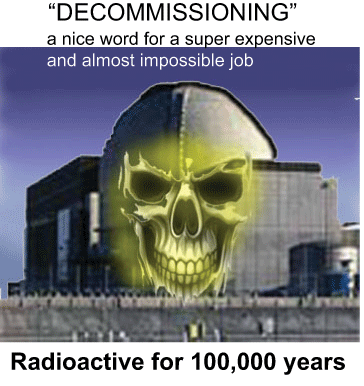
Andra, which publishes a nuclear waste inventory every three years, expects its low-level waste facility in Morvilliers, in the Aube region, would fill up between 2020 and 2025.
“We want to warn that the storage centers are filling up and that we need to optimize waste management because storage facilities are a rare resource,” Andra executive Michele Tallec told Reuters.
Volumes of highly radioactive, long-life waste – which represent just 0.2 percent of the volume but 98 percent of the radioactivity – should rise from 3,200 cubic meters at the end of 2013 to about 10,000 cubic meters when all France’s nuclear plants reach their end of life.
This waste is scheduled to be buried in the controversial deep-storage site in Bure, in eastern France, which already has a test facility but has not received any nuclear waste.
his year, Andra plans to present the French government and nuclear regulator ASN a technical dossier on Bure, which aims to bury nuclear waste 500 meters underground in thick layers of argillite rock, which Andra says will prevent most radioactive particles from traveling more than a few meters over hundreds of thousands of years.
Andra plans to put in a formal request to build the 35 billion euro facility – which faces resistance from environmental groups and local residents – in 2017 and hopes to start construction in 2020 with a view to open it for first testing in 2025.(Reporting by Benjamin Mallet and Michel Rose, writing by Geert De Clercq, editing by David Evans)
Game Over for UK’s Hinkley Point Nuclear power project?
The UK Government is now said to be deeply concerned about the future of the Hinkley project following revelations about problems at the similar reactor being built at Flamanville
Nuclear needs a blank cheque Now that it is plain that nuclear power has failed miserably to compete with renewable energy even on the somewhat skewed playing field represented by the (proposed) Hinkley C deal, nuclear supporters are trying to engineer a ‘blank cheque’ to be given to nuclear developers
nuClear News, July 15 http://www.no2nuclearpower.org.uk/nuclearnews/NuClearNewsNo75.pdf There is a growing chorus of critics calling for Hinkley Point C to be scrapped altogether, according to the Sunday Times.
It would be one of the most expensive man-made objects ever built in the world. At a cost of £24.5bn it would tie British households into paying for astonishingly expensive electricity subsidies until 2060. The world has changed since 2010 when Hinkley was first named as a site for new reactors. The price of renewables has plummeted.

Sorry, but Nuclear Power just won’t help against climate change – new campaign

 nuClear News, July edition, http://www.no2nuclearpower.org.uk/nuclearnews/NuClearNewsNo75.pdf “…. Don’t Nuke the Climate On June 16, seven international clean energy organizations launched a major new campaign aimed at keeping nuclear power out of all negotiations at the upcoming UN climate talks in Paris. The UN Climate Change Conference (‘COP-21’) will be held in Paris from November 30 to December 11.
- Nuclear Power is Not a Silver Bullet: Nuclear power could at most make a modest contribution to climate change abatement. The main limitation is that it is used almost exclusively for electricity generation, which accounts for less than 25% of global greenhouse emissions. Even tripling nuclear power generation would reduce emissions by less than 10% − and then only if the assumption is that it displaces coal.
- Greenhouse Emissions from the Nuclear Fuel Cycle: Claims that nuclear power is ‘greenhouse free’ are false. Nuclear power is more greenhouse intensive than most renewable energy sources and energy efficiency measures. Life-cycle greenhouse emissions from nuclear power will increase as relatively high-grade uranium ores are mined out.
- Nuclear Power – A Slow Response to an Urgent Problem: The nuclear industry does not have the capacity to rapidly expand production as a result of 20 years of stagnation. Limitations include bottlenecks in the reactor manufacturing sector, dwindling and ageing workforces, and the considerable time it takes to build a reactor and to pay back the energy debt from construction.
- Nuclear Power and Climate Change Countries and regions with a high reliance on nuclear power also tend to have high greenhouse gas emissions. Some countries are planning to replace fossil fuel-fired power plants with nuclear power in order to increase fossil fuel exports − in such cases any potential climate change mitigation benefits of nuclear power are lost.
- Climate Change and Nuclear Hazards Nuclear power plants are vulnerable to threats which are being exacerbated by climate change. These include dwindling and warming No2NuclearPower nuClear news No.75, July 2015 22 water sources, sea-level rise, storm damage, drought, and jelly-fish swarms. ‘Water wars’ − in particular, disputes over the allocation of increasingly scarce water resources between power generation and agriculture − are becoming increasingly common and are being exacerbated by climate change.
- Weapons Proliferation and Nuclear Winter Civil nuclear programs have provided cover for numerous covert weapons programs and an expansion of nuclear power would exacerbate the problem. Nuclear warfare − even a limited nuclear war involving a tiny fraction of the global arsenal − has the potential to cause catastrophic climate change.
- Renewables and Energy Efficiency: Global renewable power capacity more than doubled from 2004 to 2014 (and non-hydro renewables grew 8-fold). Over that decade, and the one before it, nuclear power flatlined. Global renewable capacity (including hydro) is 4.6 times greater than nuclear capacity, and renewable electricity generation more than doubles nuclear generation. A growing body of research demonstrates the potential for renewables to largely supplant fossil fuels for power supply globally. Energy efficiency and renewables are the Twin Pillars of a clean energy future. A University of Cambridge study concluded that 73% of global energy use could be saved by energy efficiency and conservation measures − making it far easier to achieve a lowcarbon, nonnuclear future.
Organization of Canadian Nuclear Industries (OCI) to work with Romania to market nuclear reactors
 MOU promotes stronger ties among Canadian and Romanian nuclear suppliers Market Watch, BUCHAREST, Romania, Jul 2, 2015 (Canada NewsWire via COMTEX) — The Organization of Canadian Nuclear Industries (OCI) is proud to announce the signing today of a Memorandum of Understanding (MOU) with the Romanian Atomic Forum Association (ROMATOM)……..
The Partnering Workshop included an update on the planned Cernavoda 3/4 CANDU project as well as presentations by Canadian and Romanian nuclear suppliers on their nuclear capabilities and experience along with discussions on their mutual interest in collaborating on the Cernavoda 3/4 CANDU Project.
This MOU outlines several ways that OCI and ROMATOM will work together including identifying opportunities at nuclear projects in Romania, Canada, and other countries on which OCI and ROMATOM companies can cooperate. The OCI-ROMATOM MOU will also encourage and facilitate cooperation among Canadian and Romanian nuclear research institutes and universities on nuclear research, development, and nuclear education……..
The Canada-Romania Cernavoda 3/4 Supply Chain Partnering Workshop was the focal point of a three day 12 company OCI-led Trade Mission to Romania that kicked off with a July 1 Canada Day Celebration hosted by the Canadian Embassy …… The Trade Mission to Romania was supported by co-funding from Global Opportunities for Associations (GOA) program through which the Foreign Affairs, Trade and Development Canada (DFATD) encourages and supports trade associations in taking member companies into promising export markets.
Organization of Canadian Nuclear Industries (OCI) is an association of 180 leading Canadian suppliers to the nuclear industry in Canada and foreign markets. OCI…provides……engineering services and support to CANDU nuclear power plants in Canada as well as to CANDU and Light Water Reactor (LWR) plants in offshore markets. OCI promotes the continued and expanded use of nuclear energy in Canada and supports member companies in both domestic and international nuclear markets………http://www.marketwatch.com/story/mou-promotes-stronger-ties-among-canadian-and-romanian-nuclear-suppliers-2015-07-02
Depleted uranium especially hazardous – gradually becomes more radioactive – a problem for Utah
 Federal regulators hear Utah testimony on depleted uranium By Amy Joi O’Donoghue, Deseret News, June 25 2015 “…………The NRC is proposing to adopt a rule that for the first time specifically addresses the disposal of the material, which is a waste stream generated from the enrichment process of uranium in the nuclear fuel cycle.
Depleted uranium poses unique disposal challenges because it does not hit its peak radioactivity until 2.1 million years, and actually grows more radioactive over time. In its disposal stage, however, depleted uranium contains radioactivity that falls under the lowest level classified by the federal government — that of class A — and is legally within limits on what can be buried in Utah at EnergySolutions’ Clive facility.
Matt Pacenza, executive director of the radioactive waste watchdog organization called HEAL Utah, believes that the NRC is making a huge mistake by classifying depleted uranium as class A.
“Right now, a regulatory loophole could allow waste that does not reach a peak hazard for 2.1 million years to be treated just like waste which loses 90 percent of its hazard in less than 200,” his presentation asserted.
Pacenza, who spoke at the briefing Thursday, said the safety of the public and the environment cannot be assured given the complex nature of depleted uranium and its long-lived radioactivity.
HEAL Utah has lobbied hard against any depleted uranium being disposed of at EnergySolutions’ commercial facility in Tooele County ever since the Salt Lake-based company inked a contract with the U.S. Department of Energy in 2009 to begin accepting stockpiles of the waste — with the initial shipments reaching 10,500 tons.
Utah Gov. Gary Herbert intervened, successfully getting some of those shipments turned around after he launched objections with the federal agency over the uncertainties associated with the material’s disposal.
State regulators then convened multiple hearings and crafted their own rules governing the disposal of any significant amounts of depleted uranium, including the requirement that EnergySolutions develop a site-specific performance assessment designed to specifically contemplate depleted uranium’s unique character……….
The NRC’s proposed rule on depleted uranium would affect commercial facilities in Utah and Texas, as well as Washington and South Carolina.
Mike Garner, executive director of the Northwest Interstate Compact — a regional alliance with oversight of low-level radioactive waste management — argued before the commission that the proposed rule should not be hoisted on states that aren’t planning to take depleted uranium, a concern echoed by the Nuclear Energy Institute that argued the proposal would be unnecessarily costly and burdensome.
Pacenza, too, added that the proposal is undergoing significant modifications that show how much industry — particularly EnergySolutions — is influencing the potential regulation of depleted uranium……
Comments on the rule can be submitted atwww.regulations.gov
Email: amyjoi@deseretnews.com, Twitter: amyjoi16 http://www.deseretnews.com/article/865631459/Federal-regulators-hear-Utah-testimony-on-depleted-uranium.html?pg=all
USA military know that nuclear radiation accumulates in biological organisms
 The Bioaccumulation of contamination in plankton, US Armed Forces, 1955 , Paul Langley’s Nuclear History Blog Quote (emphasis added) “Page 59. The problem of radioactive particles falling into the ocean raises the question of their availability to this portion of the biosphere. Plankton normally found in sea water are consumed in large quantities by fish.
These plankton concentrate mineral elements from the water, and it has been found that radioactivity may be concentrated(Page 60) in this manner by as much as a thousand fold. Thus, for example, one gram of plankton could contain a thousand times as much radioactivity as a gram of water adjacent to it. The radioactivity from these plankton which form a portion of fish diet tends to concentrate in the liver of the fish, and, if sufficiently high levels of contamination are encountered, could have a marked effect upon the ecology of an ocean area.
http://www.ncbi.nlm.nih.gov/pubmed/7752105
J Radiat Res. 1994 Dec;35(4):213-21.
Concentration factors for Cs-137 in marine algae from Japanese coastal waters.
Tateda Y, Koyanagi T.
Source
Abiko Research Laboratory, Central Research Institute of Electric Power Industry, Chiba, Japan.
Abstract
Concentration factors (CF: Bq.kg-1 in wet algae/Bq.kg-1 in filtered seawater) for Cs-137 in Japanese coastal algae, were investigated during 1984-1990. Cs-137/Cs(stable) atom ratios were also examined to clarify the distribution equilibrium of Cs-137 in marine algae and sea water. The CFs in marine algae were within the range of 5.4 approximately 92, and the geometric mean of CF was 28 +/- 2 (standard error) in Japanese coastal species. The CFs in edible species were within the range of 5.4 approximately 67, and the geometric mean of CF was 26 +/- 4 (standard error). The values of Cs-137/Cs atom ratios in marine algae and sea water indicated that Cs-137 reached an equilibrium state in partition between algae and sea water. Therefore, the CF value obtained in the present study can be regarded as an equilibrated value. Our results showed that the CF for Cs-137 in Japanese coastal algae were consistent with the Japanese guideline CFs, but were smaller than the recommended value by IAEA.
PMID: 7752105 [PubMed – indexed for MEDLINE] Free full text
end quote.
http://www.dutchdailynews.com/greenpeace-in-japan/………….https://nuclearhistory.wordpress.com/2013/03/16/the-bioaccumulation-of-contamination-in-plankton-us-armed-forces-1955/
How the West brought about the Ukraine crisis, and what to do about it
Why the Ukraine Crisis Is the West’s Fault The Liberal Delusions That Provoked Putin MULTUM NON MULTA By John J. Mearsheimer , 19 June 15 According to the prevailing wisdom in the West, the Ukraine crisis can be blamed almost entirely on Russian aggression. Russian President Vladimir Putin, the argument goes, annexed Crimea out of a long-standing desire to resuscitate the Soviet empire, and he may eventually go after the rest of Ukraine, as well as other countries in eastern Europe. In this view, the ouster of Ukrainian President Viktor Yanukovych in February 2014 merely provided a pretext for Putin’s decision to order Russian forces to seize part of Ukraine.But this account is wrong: the United States and its European allies share most of the responsibility for the crisis. The taproot of the trouble is NATO enlargement, the central element of a larger strategy to move Ukraine out of Russia’s orbit and integrate it into the West…………….
The West’s triple package of policies — NATO enlargement, EU expansion, and democracy promotion — added fuel to a fire waiting to ignite……….
To achieve this end, the United States and its allies should publicly rule out NATO’s expansion into both Georgia and Ukraine. The West should also help fashion an economic rescue plan for Ukraine funded jointly by the EU, the International Monetary Fund, Russia, and the United States — a proposal that Moscow should welcome, given its interest in having a prosperous and stable Ukraine on its western flank. And the West should considerably limit its social-engineering efforts inside Ukraine. It is time to put an end to Western support for another Orange Revolution. Nevertheless, U.S. and European leaders should encourage Ukraine to respect minority rights, especially the language rights of its Russian speakers.
Some may argue that changing policy toward Ukraine at this late date would seriously damage U.S. credibility around the world. There would undoubtedly be certain costs, but the costs of continuing a misguided strategy would be much greater. Furthermore, other countries are likely to respect a state that learns from its mistakes and ultimately devises a policy that deals effectively with the problem at hand. That option is clearly open to the United States…….
21st Century electricity – and the nuclear industry’s war against it
POWER SHIFT: THE DEPLOYMENT OF A 21ST CENTURY ELECTRICITY SECTOR AND THE NUCLEAR WAR TO STOP IT, MARK COOPER SENIOR FELLOW FOR ECONOMIC ANALYSIS INSTITUTE FOR ENERGY AND THE ENVIRONMENT VERMONT LAW SCHOOL JUNE 2015Nuclear power industry cannot be saved by EPA Clean Power Plan
Report says EPA Clean Power Plan cannot save nuclear http://www.fierceenergy.com/story/report-says-epa-clean-power-plan-cannot-save-nuclear/2015-06-18 By Barbara Vergetis Lundin
The 20th Century model of large baseload electricity generation, including nuclear reactors, is in an irreversible decline in the face of the emerging 21st Century decentralized power model relying on renewables, energy efficiency, and technology-based demand management, says Mark Cooper, senior fellow for economic analysis, Institute for Energy and the Environment, Vermont Law School, in a new report.
For policymakers and ratepayers, Cooper’s stark conclusion means that “last-ditch efforts to prop-up nuclear power with amendments to the EPA Clean Power Plan (CPP), state-level subsidies (e.g., Exelon’s “nuclear blackmail” threat of Illinois lawmakers over five reactors in that state and FirstEnergy’s bailout scheme involving the Davis-Besse reactor in Ohio), attacks in Indiana, Ohio, Nevada, North Carolina and other states on renewable energy standards, and preferential rate-setting arrangements (e.g., Exelon’s Ginna reactor at Rochester, New York) are costly detours on the road to a much more consumer friendly, reliable and sustainable low carbon electricity sector.”
Cooper said: “Nuclear reactors old and new are far from a necessary part of a low-carbon solution. Nuclear power, with its war against the transformation of the electricity system, is part of the problem, not the solution. Following a path toward a 21st century electricity system poses no serious threat to reliability up to a 30-40 percent level. Beyond that, we already know the specific actions that can carry the system to much higher levels of reliance on renewables. Combining these measures which allow the system to operate at high levels of penetration with the implementation of aggressive efficiency measures meets 80 percent of ‘business as usual’ or base case demand. It is no longer a question of if this will happen, only when it will happen.”
 The report concludes that, even with tinkering, the EPA Clean Power Plan will not save nuclear power.
“After decades of claiming to be a low-cost source of power because of low operating costs, aging reactors are no longer cost competitive even in that narrow view of operating cost,” the report says. “Not even the full implementation of the EPA Clean Power Rule would save aging reactors from early retirement, so the owners of those reactors have launched a major campaign to increase revenues with direct subsidies from state and federal policymakers and secure jerry-rigged market pricing rules that undermine alternatives.”
The report further contends that the “Exelon reactor bailout schemes” in New York State and Illinois will not work.
The report says, “Ginna is a New York reactor and Quad Cities is a two-reactor site in Illinois for which Exelon has stated specific revenue increases are needed, although these estimates are shrouded in uncertainty. The operating costs are quite high and total costs are higher still, well above recent market clearing prices…Operating costs alone are almost twice the current market clearing price of electricity and…things are likely to get worse rather than better over time…The frantic push for states to bail out these reactors when a response at the regional level is more appropriate (if a reaction is needed at all) will saddle state ratepayers with much larger burdens.”
The report does contend that more renewables are feasible without creating reliability issues.
“In the mid-term, expansion of renewables to the 30-40 percent range can be easily accommodated with the existing physical assets and management tools with no negative impact on reliability. The electricity system only needs to be operated with policies that allow the renewables to enter. In the long-term, a wide range of measures to support the penetration of alternatives to much higher levels (80 percent or more) has been identified,” the report says. “Building an electricity system on principles of dynamic flexibility requires an institutional transformation and the deployment of supporting physical infrastructure. Given the need to respond to climate change and the cost of the alternatives, the 21st century model for the electricity system is the least-cost approach by a wide margin”.
For more:
– see this report
USA Congress bars US assistance going to Ukraine’s Nazi military unit

 U.S. House Admits Nazi Role in Ukraine OpEdNews 6/12/2015 By Robert Parry (about the author) Last February, when ethnic Russian rebels were closing in on the Ukrainian port of Mariupol, the New York Times rhapsodically described the heroes defending the city and indeed Western civilization — the courageous Azov battalion facing down barbarians at the gate. What the Times didn’t tell its readers was that these “heroes” were Nazis, some of them even wearing Swastikas and SS symbols.
The long Times article by Rick Lyman fit with the sorry performance of America’s “paper of record” as it has descended into outright propaganda — hiding the dark side of the post-coup regime in Kiev. But what makes Lyman’s sadly typical story noteworthy today is that the Republican-controlled U.S. House of Representatives has just voted unanimously to bar U.S. assistance going to the Azov battalion because of its Nazi ties.
The challenges posed in the cleanup of Japan’s Fukushima nuclear plan
What’s ahead for Japan’s Fukushima nuclear plant http://www.nwitimes.com/business/local/what-s-ahead-for-japan-s-fukushima-nuclear-plant/article_6032428a-090a-5d83-99ff-b0dce1f61627.html Mari Yamaguchi Associated Press TOKYO | Four years after an earthquake and tsunami destroyed Japan’s Fukushima nuclear power plant, the road ahead remains riddled with unknowns.
The government approved a revised 30- to 40-year roadmap Friday that delays by three years the start of a key initial step — the removal of still-radioactive fuel rods in the three reactors that had meltdowns following the March 2011 disaster in northeast Japan.
Experts have yet to pinpoint the exact location of the melted fuel inside the three reactors and study it, and still need to develop robots capable of working safely in such highly radioactive conditions. And then there’s the question of what to do with the waste.
Some of the uncertainties and questions: Continue reading
Effects of ionising radiation on the brains of space travellers
 What happens to your brain on the way to Mars? Science Advances, 1 May 2015
 NASA report against program for nuclear power in space missions
NASA Releases Space Nuclear Power Study, Federation of American Scientists, (FAS) Jun.04, 2015 NASA has released a long-awaited Nuclear Power Assessment Study that examines the prospects for the use of nuclear power in civilian space missions over the next 20 years.
The Study concludes that there is a continuing demand for radioisotope power systems, which have been used in deep space exploration for decades, but that there is no imminent requirement for a new fission reactor program.
The 177-page Study, prepared for NASA by Johns Hopkins University Applied Physics Laboratory, had been completed several months ago but was withheld from public release due to unspecified “security concerns,” according to Space News. Those concerns may have involved the discussion of the proposed use of highly enriched uranium as fuel for a space reactor, or the handling of plutonium-238 for radioisotope power sources……
development of nuclear reactor technology for use in space has been dogged by a repeated series of false starts in which anticipated mission requirements failed to materialize.
“The United States has spent billions of dollars on space reactor programs, which have resulted in only one flight of an FPS [fission power source],” the new NASA report noted. That was the 1965 launch of the SNAP 10-A reactor on the SNAPSHOT mission. It had an electrical failure after a month’s operation and “it remains in a 1300-km altitude, ‘nuclear-safe’ orbit, although debris-shedding events of some level may have occurred,” the report said.
The development and use of space nuclear power raises potential environmental safety and public health issues. As a result, the NASA report said, “it may be prudent to build in more time in the development schedule for the first launch of a new space reactor. Public interest would likely be large, and it is possible that opposition could be substantial.”
In any case, specific presidential approval is required for the launch of a nuclear power source into space, pursuant to Presidential Directive 25 of 1977.
“For any U.S. space mission involving the use of RPS [radioisotope power sources], radioisotope heating units, nuclear reactors, or a major nuclear source, launch approval must be obtained from the Office of the President,” the report noted. http://fas.org/blogs/secrecy/2015/06/nasa-npas/
70 years of cancer-causing nuclear pollution in St Louis
 This week, internationally recognized physician Dr. Helen Caldicott reviewed documents and reports concerning the West Lake landfill. She stated in no uncertain terms that the health records and data clearly show that contaminants have been causing cancers in the affected region at elevated levels.
As the recipient of 21 honorary doctoral degrees for her work on the health consequences of exposure to nuclear material including the disasters at Three Mile Island, Chernobyl, and Fukushima, Caldicott is one of the world’s most-respected experts on the topic. With regard to the West Lake site, she concluded that ongoing health dangers demand that, “the [West Lake] site needs to be dealt with immediately. It needs to be cleaned-up this year.”
Radioactive site continues to plague St. Louis residents and region http://www.examiner.com/article/radioactive-site-continues-to-plague-st-louis-residents-and-region, 29 May 15 In North Saint Louis County, Missouri, in the City of Bridgeton, there is a ticking time bomb in the form of several contiguous landfills which contain radioactive waste and all the “daughter products” associated with weapons-grade uranium processing. Most notably, the site in question, the West Lake landfill, has the largest concentration in the nation of one of these highly dangerous daughter products.
 In a 2013 report entitled, The West Lake Landfill: A Radioactive Legacy of the Nuclear Arms Race, Robert Alvarez states, “Of significance is the fact that the largest estimated amount of Thorium-230, a long-lived, highly radiotoxic element, is present at West Lake — more than any other U.S. nuclear weapons storage or disposal site.” Continue reading
High cancer rates in thorium and uranium contaminated sites in Missouri
The problem, critics such as McKeel and Kleba said, is that the study’s design diluted the string of infant deaths into regional data, making the amount seem statistically insignificant. Between October 1999 and October 2000, the Riverfront Times reported, seven of the eight deaths were children at Kleba’s church, all of whom lived near Dardenne Creek.
in an unexpected turn, a 2014 Missouri Department of Health and Senior Services study did indeed find higher rates of cancers in ZIP codes near known contaminated sites in St. Louis County, and the state promptly requested help from the Center for Disease Control to conducted further studies in the area.

 St. Louis burning: What killed the babies near Weldon Spring? Aljazeera America by Ryan Schuessler @RyanSchuessler1 April 30, 2015
State health studies did little to ease residents’, activists’ concerns about potential radiation exposure in metro area This is part two of a three-part series investigating the effects of radioactive waste from the Manhattan Project on St. Louis and its suburbs. Part one examined the health problems impacting those who lived near Coldwater Creek.
DARDENNE PRAIRIE, Mo. — On a Saturday afternoon in late February at the Immaculate Conception Parish of Dardenne, a fresh snow was falling on the graves of more than a dozen infant-sized tombstones. The church bells tolled, signaling the beginning of Mass as parishioners walked briskly through the cold.
It was at this Roman Catholic parish where, some 15 years ago, the small congregation’s streak of infant deaths caught the attention of locals and media, both of whom drew connections to the area’s atomic history that left groundwater in the area contaminated with uranium.
But the state of Missouri said nothing was out of the ordinary. Continue reading
1 This Month



26 September – International Day for the Total Elimination of Nuclear Weapons


PLEASE OPPOSE HR 8255 AND S.3639 – bills would accelerate satellite deployment, with no environmental review or safeguards – https://ncstd5li.quorum.us/campaign/169331/
To see nuclear-related stories in greater depth and intensity – go to https://nuclearinformation.wordpress.com
-
Archives
- September 2026 (245)
- August 2026 (330)
- July 2026 (355)
- June 2026 (287)
- May 2026 (306)
- April 2026 (356)
- March 2026 (251)
- February 2026 (267)
- January 2026 (308)
- December 2025 (358)
- November 2025 (359)
- October 2025 (375)
-
Categories
- 1
- 1 NUCLEAR ISSUES
- business and costs
- climate change
- culture and arts
- ENERGY
- environment
- health
- history
- indigenous issues
- Legal
- marketing of nuclear
- media
- opposition to nuclear
- PERSONAL STORIES
- politics
- politics international
- Religion and ethics
- safety
- secrets,lies and civil liberties
- spinbuster
- technology
- Uranium
- wastes
- weapons and war
- Women
- 2 WORLD
- ACTION
- AFRICA
- Atrocities
- AUSTRALIA
- Christina's notes
- Christina's themes
- culture and arts
- Events
- Fuk 2022
- Fuk 2023
- Fukushima 2017
- Fukushima 2018
- fukushima 2019
- Fukushima 2020
- Fukushima 2021
- general
- global warming
- Humour (God we need it)
- Nuclear
- RARE EARTHS
- Reference
- resources – print
- Resources -audiovicual
- Weekly Newsletter
- World
- World Nuclear
- YouTube
-
RSS
Entries RSS
Comments RSS
 nuclear-news