Fukushima youths ready to desert irradiated hometowns, survey finds
FUKUSHIMA – In 30 to 40 years from now, a majority of the young people living in 12 radiation-contaminated municipalities in Fukushima do not plan to be living in the same place where they experienced the March 2011 earthquake and tsunami, it has been learned.
A survey by a panel from the Reconstruction Agency found that more than 50 percent of those respondents between the ages of 10 and 29 stopped short of choosing their prefectural hometowns as the place where they want to be living three or four decades from now.
The 12 municipalities were tainted by fallout from the triple core meltdown that crippled Tokyo Electric Power Co.’s poorly protected Fukushima No. 1 nuclear power station in March 2011 — a man-made disaster triggered by the quake and tsunami.
Many of the locales are partially or entirely within the evacuation zone designated around the power plant.
Based on the survey results, the panel plans to draw up proposals on the future of the 12 municipalities as early as this summer, informed sources said.
The survey, conducted in February and March, covered members of some 13,000 households randomly selected from the 77,600 still remaining in the 12 municipalities. Valid answers were only obtained from about 5,100 of the households.
The survey said the proportion of respondents willing to stay in the municipalities where they were residing at the time of the disaster topped 60 percent among those in their 30s or above. For those between 10 and 29, including elementary and junior high school students, the share dropped below 50 percent.
While a majority of those between their 30s and 60s expressed hope of working in their hometowns in the future, the ratio was less than 40 percent for younger people.
“The results are very shocking,” said Satoshi Endo, mayor of the town of Hirono, adding that the town, one of the 12 municipalities listed, needs to create a future vision that appeals to children.
About 60 percent of those who evacuated Hirono have not yet returned.
The Fukushima Prefectural Government will present a clear vision so young people can have hope about their hometowns, a senior official said.
The Reconstruction Agency established the panel last December to discuss the future of the 12 evacuated municipalities.
The proposals will be reflected in the agency’s budget request for fiscal 2016.
The remaining 11 municipalities were the cities of Tamura and Minamisoma, the towns of Kawamata, Naraha, Tomioka, Okuma, Futaba and Namie, and the villages of Kawauchi, Katsurao and Iitate.
Source : Japan Times
http://www.japantimes.co.jp/news/2015/06/05/national/fukushima-youths-ready-desert-irradiated-hometowns-survey-finds/#.VXHhGkZZNBS
Recovery, remediation, decommissioning at Fukushima
 Managing contaminated water involves removal of the sources of contamination and isolating ground water from sources
Full remediation and decommissioning of reactors at Fukushima may take a long time. Hasty schedules are not possible or expected as they clash with the safety of people. Water flowing over the melted cores of Units 1, 2 & 3 stricken by the earthquake and tsunami carries a cocktail of radio-nuclides. The integrity of the primary containment vessels of these reactors is not known. They have to develop the needed technologies to handle the cores; it may face its own trials and tribulations.
Fukushima now witnesses a beehive of activity. In April 2013, exactly two years after the accident, the site engaged 2950 workers in various remediation tasks. By February 2014, the work force grew steadily to 7150.
Mr. Naohiro MASUDA, chief decommissioning officer and president of Fukushima Daiichi Decontamination and Decommissioning Engineering Company presented updates of the progress thus far, and the future plans at an international conference organized by the Japanese Atomic Industrial Forum on April 13-14, 2015 at Tokyo.
He covered, among other topics: the present status of the plants; measures against contaminated water; fuel removal from the spent fuel pool and fuel debris removal.
The Tokyo Electric Power Company (TEPCO) maintains the reactors at cold shutdown stage by continuously injecting water into them. The operators removed spent fuel rods from the spent fuel pool at Unit 4 by Dec 22, 2014. Now they plan to remove fuel debris from Units 1, 2 and 3.
Maximum dose rate at the site boundary is only 0.03 mSv per year, as against allowed limit of one mSv per year.
Managing contaminated water is a humongous challenge. It involves removal of the sources of contamination, isolating ground water from sources and prevention of water leakage.
TEPCO uses 16 specially designed pieces of equipment each of which can remove one or more of the sixty-two different radio-nuclides including caesium-137 and strontium-90 from water. Each may process 250 to 1200 cubic metres per day. Tritium is a major issue. TEPCO is reportedly discussing with fishermen for its gradual release into sea.
Daily, about 400 tonnes of ground water enter the building. As this water gets contaminated, it has to be stored and decontaminated. Besides other methods, TEPCO plans to construct a frozen soil impermeable wall on the land side to prevent entry of ground water. The wall will use refrigerated coolant at minus 30 degree Celsius, running through pipes that have been placed vertically in the ground, to freeze the surrounding soil.
“There are many underground pipes and other structures associated with each of the four generating units. Building a watertight physical structure around all those obstacles would be nearly impossible and, even if it could be done, the construction would be more complex, time consuming, and disruptive.
It likely would also generate much more potentially contaminated excavated soil that would need to be safely disposed of,” TEPCO stated at its website…
The wall will be in place for six years, the period needed to drain and clean the contaminated water from the buildings and make them watertight.
According to Hiroshi Kainuma, Fukushima University, the yield of rice in Fukushima came down from 4, 45, 700T in 2010 to 3, 53,600 T in 2011. In 2013, it rose to 3, 82,600T closer to earlier years.
In 2012, 71 bags of food had radioactivity above the legal reference value. In 2013, 28; in 2014, no such bag was found.
Neither abortions nor abortion rates have increased in Fukushima. Divorce rate has not increased.
Birth rates lowered. Kainuma noted that the number of direct deaths caused by earthquake and tsunami in Fukushima was 1612; the number of disaster-related deaths due to evacuation was higher at 1793!
Decontamination specialists, with unenviable tasks assigned to them used, on large industrial scales, technologies which were successfully deployed on small scales. There were failures. Diligent auditors did not condone such ‘aberrations.’ You may express empathy or sympathy or hostility on that action depending on which side of the isle you are in!
The reactor owners, regulators and others responsible to operate the Fukushima Daiichi plants safely managed to melt the cores of three of them, throwing nuclear industry world-wide into disarray! Ultimately, the Japanese ingenuity and their expertise in robotics, miniature electronics, and precision engineering will win the day. Japan needs nuclear power; many plants will start operation, though presently only energy specialists look at them benignly.
Source : The Hindu
http://www.thehindu.com/sci-tech/science/recovery-remediation-decommissioning-at-fukushima/article7278520.ece
Meltdown in France’s nuclear dream – taxpayers to cop the costs
External factors may have precipitated the crash of Areva, but the cause is internal. Areva and the French nuclear industry is controlled by engineers and state officials and the market comes as an afterthought.
The problems of time and cost overruns in China, Finland and now in France at Flamanville are self-made and part of the “esprit de corps” arrogant attitude of the organisation.
Now, 13 years later, the problem needs to be addressed and risks costing billion of euros and thousands of jobs
 France’s Nuclear Industry Dream Faces Melt-Down At Expense Of State Coffers, Tax Payers Forbes, Marcel Michelson, 3 June 15 France has decided to rescue its Areva nuclear energy company once again, this time by combining the nuclear power station creation business with state-controlled power operator EDF , its biggest client.
Only a few years back, in 2010, Areva’s finances had been restored by the forced sale of its transport and transmission activities to industrial group Alstom and electrical engineer Schneider . Meanwhile, GE of the United States controls the Alstom power activities as part of its own rescue recapitalisation.
The rest of Areva includes uranium mines, nuclear waste recycling, transport, storage and some alternative energy activities.
For all intents and purposes, Areva is dead. Continue reading
Calculating the true cost of nuclear power
 What’s the true cost of nuclear power? Ask The Nuclear Fuel Cycle Cost Calculator. http://boingboing.net/2015/06/05/whats-the-true-cost-of-nucle.html
By Xeni Jardin , Jun 5, 2015 Created by the Bulletin of the Atomic Scientists, this nifty Nuclear Fuel Cycle Cost Calculator serves “provide countries around the world with nuanced estimates of the full cost of nuclear power—-almost instantly.”
Discussions of the future of nuclear power often focus on safety,proliferation, waste storage, and carbon emissions – accepting cost as a given. This tool breaks the cost of investing in nuclear power into its component parts and considers the price of three configurations of the ‘fuel cycle’ – that is, the process that includes everything from the mining and production of uranium fuel to the disposal of spent fuel after it has been used to generate electricity.
NASA report against program for nuclear power in space missions
NASA Releases Space Nuclear Power Study, Federation of American Scientists, (FAS) Jun.04, 2015 NASA has released a long-awaited Nuclear Power Assessment Study that examines the prospects for the use of nuclear power in civilian space missions over the next 20 years.
The Study concludes that there is a continuing demand for radioisotope power systems, which have been used in deep space exploration for decades, but that there is no imminent requirement for a new fission reactor program.
The 177-page Study, prepared for NASA by Johns Hopkins University Applied Physics Laboratory, had been completed several months ago but was withheld from public release due to unspecified “security concerns,” according to Space News. Those concerns may have involved the discussion of the proposed use of highly enriched uranium as fuel for a space reactor, or the handling of plutonium-238 for radioisotope power sources……
development of nuclear reactor technology for use in space has been dogged by a repeated series of false starts in which anticipated mission requirements failed to materialize.
“The United States has spent billions of dollars on space reactor programs, which have resulted in only one flight of an FPS [fission power source],” the new NASA report noted. That was the 1965 launch of the SNAP 10-A reactor on the SNAPSHOT mission. It had an electrical failure after a month’s operation and “it remains in a 1300-km altitude, ‘nuclear-safe’ orbit, although debris-shedding events of some level may have occurred,” the report said.
The development and use of space nuclear power raises potential environmental safety and public health issues. As a result, the NASA report said, “it may be prudent to build in more time in the development schedule for the first launch of a new space reactor. Public interest would likely be large, and it is possible that opposition could be substantial.”
In any case, specific presidential approval is required for the launch of a nuclear power source into space, pursuant to Presidential Directive 25 of 1977.
“For any U.S. space mission involving the use of RPS [radioisotope power sources], radioisotope heating units, nuclear reactors, or a major nuclear source, launch approval must be obtained from the Office of the President,” the report noted. http://fas.org/blogs/secrecy/2015/06/nasa-npas/
USA Senate passes Act Restricting NSA Surveillance Powers

 Senate Passes USA Freedom Act, Restricting NSA Surveillance Powers http://www.truthdig.com/eartotheground/item/senate_passes_usa_freedom_act_restricting_nsa_surveillance_powers_20150602 by Roisin Davis Jun 2, 2015 In a move seen to vindicate whistleblower Edward Snowden, the Senate on Tuesday passed the USA Freedom Act, which will end the bulk collection of Americans’ phone records.
As the Guardian explains, this is the most significant surveillance reform for decades, “a direct result” of Snowden’s revelations to the paper two years ago. “The passage of the USA Freedom Act,” the Guardian states, “paves the way for telecom companies to assume responsibility of the controversial phone records collection program, while also bringing to a close a short lapse in the broad NSA and FBI domestic spying authorities. Those powers expired with key provisions of the Patriot Act at 12.01 am on Monday amid a showdown between defense hawks and civil liberties advocates.”
Needing only a simple majority to pass, the final tally of the vote showed that 67 senators were in favor of the measure and 32 against.
The vote comes only two days after key parts of the Patriot Act expired, and BBC News compares the two:
What is changing? The expiry of the Patriot Act brings to an end bulk collection of Americans’ phone metadata – who called who, when and for how long, but not the content of calls – by the US. Under its successor, records must be held by telecommunications companies and investigators need a court order to access specific information. Technology companies will be given greater leeway to reveal data requests. The measures are intended to balance concerns on privacy with providing the authorities the tools they need to prevent attacks.
What stays the same? Key parts of the Patriot Act are retained in the Freedom Act. They include the provision allowing the monitoring of “lone wolf” suspects – potential attackers not linked to foreign terror groups, despite the US authorities admitting the powers have never been used. The Freedom Act also maintains a provision allowing investigators to monitor travel and business records of individuals, something law officers says is more effective than bulk collection.
100% renewable energy future for the world – no coal, oil, nuclear
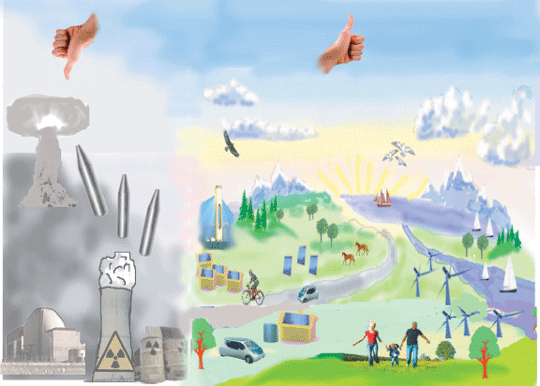 A Fossil Fuel Free World is Possible: How to Power a Warming Earth Without Oil, Coal and Nuclear Democracy Now, 5 June 15 Is a 100% renewable energy future possible? According to Stanford professor Mark Jacobson, the answer is yes. Jacobson has developed plans for all 50 states to transform their power infrastructure to rely on wind, water and solar power.
This comes as California lawmakers have approved a dozen ambitious environmental and energy bills creating new standards for energy efficiency. Dubbed the California climate leadership package, the 12 bills set high benchmarks for reducing greenhouse gas emissions and petroleum use. We speak with Jacobson and Noah Diffenbaugh, Stanford University Associate Professor and a Senior Fellow at the Stanford Woods Institute for the Environment.
TRANSCRIPT
This is a rush transcript. Copy may not be in its final form…………
MARK JACOBSON: Well, our plans are to change the energy infrastructure in each and every state in the United States, and in fact, ultimately, every country of the world, to infrastructures run entirely on wind, water, and solar power for all purposes. So that is electricity, transportation, heating and cooling and industry……
MARK JACOBSON: Well in our plans, we do it state-by-state. Continue reading
France pins its nuclear hopes on exporting reactors
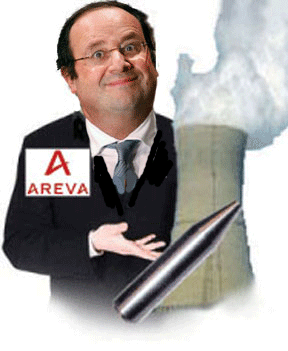 Rescued Areva faces uncertain future as nuclear fuel group By Geert De Clercq (Reuters) 5 June 15 – France‘s Areva faces an uncertain future as a specialised nuclear fuel supplier, as a state rescue moves its core nuclear reactor activities to its utility customer EDF. Shares in the state-owned firm briefly rose almost 6 percent on Thursday after the government said late on Wednesday it would recapitalise Areva and approved EDF’s plan to take over Areva’s reactor unit.
The government plan unwinds Areva’s much-vaunted model of an integrated nuclear group that mines and enriches uranium, produces nuclear fuel, builds reactors and recycles spent fuel. Created fifteen years ago from the nuclear fuel group Cogema and reactor builder Framatome, Areva had ambitions to sell as many as 16 of its massive EPR reactors to energy-hungry developing countries.
But it has not sold a reactor since 2007 and the four it did sell have been plagued by delays and cost overruns. More than two decades after it was designed, not a single EPR is in operation today.
Still, the French government said it hopes an EDF-led nuclear industry could win the export contracts that have proved so elusive for Areva.”The French camp must work together abroad,” Economy Minister Emmanuel Macron told France Info radio on Thursday. Continue reading
Canadian News media criticised for trivialising nuclear waste dumping
 Toxic editorial at best http://blogs.windsorstar.com/open-newsroom/letters/toxic-editorial-at-best BEVERLY FERNANDEZ, Spokesperson, Stop The Great Lakes Nuclear Dump, Southampton, Ont. Jun 04, 2015 Re: We must dispose of nuclear waste here, Star editorial, May 30. I take exception to this editorial.The Star is entitled to its opinion, but be sure to get the facts correct. You state “the stuff … is garden-variety stuff found in every neighbourhood”.
The Kincardine nuclear waste dump will bury low and intermediate level nuclear waste. Intermediate waste includes resins and components from within the nuclear reactors themselves. These remain radioactive for 100,000 years.
I don’t know what kind of neighbourhood Star staff live in, but the vast majority of neighbourhoods do not hold lethal nuclear waste that remains radioactive for 100,000 years. Stating “the stuff just isn’t that scary or unusual” is completely misleading.
You state, “a virtually impossible leak of a barely hazardous substance.” We are not talking dental X-rays. We are talking about the most lethal material humans have ever created.
There are only three deep dumps that held radioactive nuclear waste on our entire planet. All three failed.The most recent is Waste Isolation Pilot Plant in New Mexico. It was to hold radioactive weapons waste safely for 10,000 years.WIPP is similar in depth and design to the Kincardine dump. In 2014, WIPP leaked a mere 15 years into its operational phase. It contaminated 22 workers. Radioactivity travelled to the next town.
On planet Earth, history proves a 100 per cent failure rate for nuclear waste dumps. So much for your “virtually impossible leak” theory.Ontario contains over a million square kilometres and no other sites were considered. Is the drinking water of 40 million people of so little concern?
Time for a Mideast Nuclear Free Zone and for Israel to join the NPT
 Israel should join the NPT in return for a Mideast Nuclear Free Zone i24 News, YAKUB HALABI, 2 JUNE 15 “…….The Middle East and world politics, however, have gone through tremendous political, economic and social changes in the past four decades that not only render Israel’s ambiguous nuclear policy obsolete, but turned the whole project of Israel’s nuclear program into a liability.
First, Israel is no longer under an existential threat: as reflected in the 2002 Arab Peace Initiative, the Arab states are willing to normalize relations with Israel in exchange for full withdrawal from the 1967 occupied territories. And second, instead of being a deterrent against the Arab states and Iran, its alleged nuclear arsenal may be stimulating not only a nuclear arms race in the region, but also political tension and conventional wars as Israel seeks to preserve its monopoly as the region’s only nuclear power. Israel struck twice at Arab states in order to deprive regional states from possessing nuclear power: in 1981 against Iraq and in 2007 against Syria. More recently it has said it would not rule out a strike against Iran for the same objective.
It is true that the powers’ negotiations with Iran could beget a bad agreement or none at all. The outcome for the regional players, however, would be the same: Iran would continue to march slowly but safely towards manufacturing a nuclear bomb. Under these circumstances, Israel would have no choice but to attack Iran’s nuclear facilities, in order to maintain its monopoly over nuclear power, prevent a potential regional nuclear war, and deter other states from following in Iran’s footsteps.
Further, Israel wants the United States to apply a double standard: Israel would remain an exception to the rule and privileged over the Arab-Muslim states. In this regard, the question looms large: can the US continue to turn a blind eye to Israel’s nuclear weapons (according to foreign media reports) and impose sanctions on every other Middle Eastern state which dares follow in Israel’s footsteps?
A few weeks ago, the American assistant secretary of state for international security and non-proliferation, Thomas Countryman, visited Israel in order to examine the likelihood of creating a nuclear weapons free zone (NWFZ) in the Middle East.
In my opinion, Iran would be more willing to abandon its nuclear aspirations under a regional NWFZ agreement than under the current conditions of preserving its monopoly. In short, Israel should take part in the P5+1 negotiations in which it would declare its willingness to strip itself of nuclear weapons and join the NPT in return for signing a Middle East Nuclear Free Zone.
Yakub Halabi is an Arab-citizen of Israel, assistant professor of international relations and fellow at the Azrieli Institute of Israel Studies, Concordia University in Montreal, Canada. http://www.i24news.tv/en/opinion/73445-150602-israel-s-alleged-nuclear-arsenal-a-liability-not-an-asset
Big fines for USA’s nuclear weapons labs for new security violations
 Nuclear weapons labs hit with sizable fines for new security violations A classified material was missing for years before anyone noticed, and a lab official’s public slides included bomb design data, Center for Public Integrity 6 June 15 By Patrick Malone
In notices published by the Energy Department on June 5, the National Nuclear Security Administration provided only general information about the materials and data that got loose but said the breaches were among the most serious such infractions, and could have an “adverse impact on national security.”
It said a private company that operates Sandia National Laboratories in Albuquerque, New Mexico, would be fined $577,500 for its poor handling of classified nuclear bomb design information.
A second private company that operates Los Alamos National Laboratories, also in New Mexico, faced a fine of $247,500 for failing to secure something that was identified only as classified “matter,” according to one of the notices, as well as a fine of $150,000 for an unrelated employee safety violation.
The notice did not explain what the missing “matter” is, but accused Los Alamos of conducting a poor investigation into what happened to it and of wrongly assuming, for years, that it had been safely destroyed.
The Energy Department said the two violations involving classified materials and data were labelled with its highest level of severity because they “involve the actual or high potential for adverse impact on the national security,” but it did not explain further. Even Los Alamos’s own internal inquiry “concluded that a compromise of classified information cannot be ruled out,” the Energy Department said.
The notices suggest that the laboratories – which endured unusual scrutiny a decade ago over allegations that they had failed to safeguard highly sensitive nuclear weapons information – are still having trouble complying with security regulations…….
In a separate probe, Energy Department investigators similarly found a longstanding security breach went undetected for years at Sandia National Laboratories. http://www.publicintegrity.org/2015/06/05/17462/nuclear-weapons-labs-hit-sizable-fines-new-security-violations?utm_campaign=syndication
France’s AREVA-EDF nuclear merger – easier said than done
France Grapples With a Knotty Nuclear Problem http://blogs.wsj.com/corporate-intelligence/2015/06/04/france-grapples-with-a-knotty-nuclear-problem/ By AMBROISE ECORCHEVILLE
The reconstitution of France’s nuclear industry is officially underway. Under orders from President François Hollande, atomic-power utility Electricité de France ‘sEDF.FR -0.45% is going to invest in the nuclear-reactor business of Areva to help refinance the troubled engineering group. The two state-controlled companies have a month to clinch a comprehensive deal.
That’s going to be easier said than done.
Leaving aside the questions about the future of nuclear energy in a world of fast-changing energy markets and geopolitical uncertainty, the interests of the French state, EDF and Areva are far from convergent.
Take Areva’s finances. The group, whose operations run from uranium mining to treating nuclear waste, needs a cash injection of €6 billion ($6.6 billion) to €8 billion. EDF, according to people familiar with the matter, has offered to invest €2 billion in Areva’s reactors unit. Some analysts question the willingness of the government to make up the difference. They note France’s stretched public finances and long-term risks associated with Areva’s unfinished, much-delayed, and over-budget nuclear reactor projects in Finland and France.
The future commercial ties between EDF and Areva also leave unanswered questions. The government wants to reset them. EDF’s success in diversifying its sources of nuclear fuel for its park of French reactors, responsible for about three quarters of the country’s electricity, has squeezed margins at Areva.
True, France could try to lure foreign investment but outside investors can only ever hope to be junior partners in such a strategic industry. Areva sees itself best placed to pick up business from the €55 billion investment program EDF is considering to extend the average life of its nuclear power plants to 60 from 40 years.
As for EDF, there are financial and commercial risks in being a more vertically integrated nuclear business. Building reactors is capital intensive, while foreign customers may not fancy have the prospect of EDF bidding to build, operate and now equip new projects.
The government could dull the pain by letting EDF raise electricity prices at home. That would bring a smile to the faces of shareholders, not least the state given its 84.5% stake, just not necessarily to those of President Hollande’s electorate
Court rules in favour of Germany’s nuclear fuel tax
German nuclear fuel duty is legal, says European court, World Nuclear News 05 June 2015 Germany’s tax on nuclear fuel conforms to European Union laws, the European Court of Justice (ECJ) ruled yesterday.
Since January 2011, each gram of fissile nuclear fuel loaded into a German reactor has carried a levy of €145 ($161). The tax is expected to bring in about €2.3 billion ($2.6 billion) in revenues annually.
That tax was imposed by the state as a consequence of an amendment to the 2002 Atomic Energy Act that allowed longer operating lives for German reactors. However, the government adhered to the new tax even though, in reaction to the 2011 Fukushima accident in Japan, it took away the longer lives and forced the early closure of older units. Power companies were quick to take the matter to court……..
The ECJ has now ruled that the duty on nuclear fuel is indeed compatible with EU law. It said, “By today’s judgement, the Court of Justice replies that EU law does not preclude a duty such as the German duty on nuclear fuel.”
The court rejected a claim that nuclear fuel must be exempt from taxation under the European directive on taxation of energy products and electricity. This directive exempts energy products subject to harmonized excise duty and used to produce electricity. The court noted that nuclear fuel is not included in the list of fuels set out in that directive. “In essence, the court rejects the idea that a duty cannot be levied at the same time on the consumption of electricity and on the sources from which it is produced which are not energy products within the meaning of the directive,” the ECJ said in a statement.
The ECJ also determined that the EU directive concerning the general arrangements for excise duty does not preclude the German duty on nuclear fuel. It said Germany’s tax is levied on a fuel for electricity production and not levied on the consumption of the electricity produced. It therefore does not constitute excise duty or ‘other indirect taxes’ on that product within the meaning of the directive, the court ruled.
Germany’s tax on nuclear fuel does not also constitute state aid, the court said…….http://www.world-nuclear-news.org/NP-German-nuclear-fuel-duty-is-legal-says-European-court-0506155.html
Saudi Arabia aiming to be the Saudi Arabia of renewable energy
 Saudi Arabia: an unlikely ally in the march towards renewable energy, Guardian, Molly Scott Cato, 5 June 15 The oil-rich kingdom’s enthusiasm for renewables has nothing to do with saving the planet from climate change and everything to do with economic dominance “……..How striking, therefore, to learn that the Saudi oil minister, Ali al-Naimi, is predicting that within just 25 years we could no longer need fossil fuels. This, from a representative of a country that has done more than most to block progress in climate negotiations.
Of course, this announcement has little, if anything, to do with a newly discovered yearning to save the planet from climate change; it has everything to do with economics. Saudi Arabia finds itself in the fortunate position whereby it can effortlessly switch from dominating the energy market of the 20th century through oil to dominating the 21st century with renewables. Al-Naimi believes that solar power will benefit the economy even more than fossil fuels. The evidence for this is that global investment in renewables jumped 16% in 2014, with solar attracting over half the total funding for the first time, driven by a 80% decline in manufacturing costs for solar in the last six years……..
Far from being a curse that concentrates power in the hands of an elite, renewables work most effectively when in community ownership. Energiewende(energy transformation) in Germany has shown this to be the case. Here, local ownership of renewables has provided a dramatic economic payback to investing communities.
The end game of climate change was always going to be a tussle between the vested interests of the past, using the wealth and power of the fossil fuel era to defend their assets, and the visionary supporters of the new clean energy technologies. The powerhouse states of the fossil era look set to overtake us on the path to a renewable energy future, while we continue to live under a finance curse inflicted on us by a government deeply attached to the finance industry. Saudi Arabia’s motivation may not be protecting the planet from climate change, or indeed improving community control over energy production, but it might just become a useful ally in the transformation towards a new energy era. http://www.theguardian.com/commentisfree/2015/jun/04/saudi-arabia-ally-renewable-energy-oil-rich
Coal fired energy ‘s decline in Germany, and Europe generally
we still occasionally see rubbish published around the place that there are all these coal fired power plants about to begin operation in Germany. The Carbon Tracker report points out that since 2008 there were more than 100 new coal plants announced that have not been built. Once you take into account closures, not just openings, since 2000 there has been a new reduction of 19 gigawatts of coal capacity.
The reality that blogosphere and the conservative press don’t seem to have caught up with is that with wholesale power prices stuck at low levels, construction of a new coal fired power station is a licence to haemorrhage money.
The circumstances surrounding this European utility decline look eerily familiar to the situation here in Australia. Electricity demand has stagnated, while solar PV in particular has taken off.
Could this be AGL and EnergyAustralia’s horrible fate?, Climate Spectator TRISTAN EDIS 5 JUN, “……………….A report released by the Carbon Tracker Initiative has collated a huge array of data which provides a striking summary of how Europe’s conventional power utilities have been thrown into financial turmoil since 2008 due to being squeezed at one end by improved energy productivity and at the other end by growing use of renewable energy.
As the chart below [in original article] illustrates the stock market value of the EU’s largest 5 power generators has plunged by over 100 billion euros (or 37% of their value) between 2008 to 2013. The other big utility in the chart below that has beaten the trend has been Enel which moved into renewables….
 This hasn’t been simply a function of a broader economic downturn in Europe. By contrast with the plunge in these utilities’ stock value Germany’s stock market increased 18% over the same period with a major divergence emerging in performance…..
at the same time as electricity demand was stagnating, renewable energy was being pushed into the system driven by governments’ responding to public concern about climate change and a future industrial opportunity. The chart below [in original article] illustrates that while power demand has stagnated, renewables gained 10% market share from nuclear and fossil fuel generators……… Continue reading
1 This Month





PLEASE OPPOSE HR 8255 AND S.3639 – bills would accelerate satellite deployment, with no environmental review or safeguards – https://ncstd5li.quorum.us/campaign/169331/
To see nuclear-related stories in greater depth and intensity – go to https://nuclearinformation.wordpress.com
-
Archives
- October 2026 (74)
- September 2026 (339)
- August 2026 (330)
- July 2026 (355)
- June 2026 (287)
- May 2026 (306)
- April 2026 (356)
- March 2026 (251)
- February 2026 (267)
- January 2026 (308)
- December 2025 (358)
- November 2025 (359)
-
Categories
- 1
- 1 NUCLEAR ISSUES
- business and costs
- climate change
- culture and arts
- ENERGY
- environment
- health
- history
- indigenous issues
- Legal
- marketing of nuclear
- media
- opposition to nuclear
- PERSONAL STORIES
- politics
- politics international
- Religion and ethics
- safety
- secrets,lies and civil liberties
- spinbuster
- technology
- Uranium
- wastes
- weapons and war
- Women
- 2 WORLD
- ACTION
- AFRICA
- Atrocities
- AUSTRALIA
- Christina's notes
- Christina's themes
- culture and arts
- Events
- Fuk 2022
- Fuk 2023
- Fukushima 2017
- Fukushima 2018
- fukushima 2019
- Fukushima 2020
- Fukushima 2021
- general
- global warming
- Humour (God we need it)
- Nuclear
- RARE EARTHS
- Reference
- resources – print
- Resources -audiovicual
- Weekly Newsletter
- World
- World Nuclear
- YouTube
-
RSS
Entries RSS
Comments RSS

