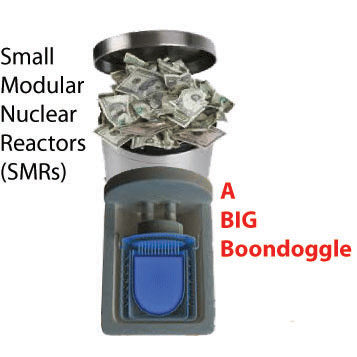
Mini nuclear reactors – costly, and need costly security – while renewables get cheaper
But for all the activity, the nascent SMR industry faces familiar nuclear challenges: cost, public acceptability, security and waste disposal. The nuclear industry has a long record of broken promises over cost
Developing SMRs is not going to be cheap either …40-70 SMRs would need to be ordered to make building a factory worthwhile…….. All the while, the competition from renewable energy gets hotter as it falls in price.
Security is also a key issue for nuclear plants….The challenge for SMRs is that security costs soar relative to power output if there are small reactors in many locations to protect.
 Are mini-nuclear reactors the answer to the climate change crisis?
Industry looks to the UK to develop factory-built reactors ready to provide affordable, low-carbon energy wherever it is needed – but issues around security and waste disposal remain, Guardian, Damian Carrington, 24 Nov 15 Mini nuclear power plants could be trucked into a town near you to provide your hot water, or shipped to any country that wants to plug them into their electricity grid from the dock. That is the aim of those developing “small modular reactors” and, from the US to China to Poland, they want the UK to be at the centre of the nascent industry. The UK government says it is “fully enthused” about the technology.
With UN climate change summit in Paris imminent, the question of how to keep the lights on affordably, while cutting emissions, is pressing.
Small modular reactors (SMRs) aim to capture the advantages of nuclear power – always-on, low-carbon energy – while avoiding the problems, principally the vast cost and time taken to build huge plants. Current plants, such as the plannedFrench-Chinese Hinkley Point project in Somerset, have to be built on-site, a task likened to “building a cathedral within a cathedral”. Continue reading
Birth defects from nuclear radiation
The first documented excesses of congenital anomalies were among children of survivors of the Hiroshima and Nagasaki bombings.
The 1986 meltdown at Chernobyl produced numerous reports of certain congenital anomalies among populations subject to fallout from the stricken reactor

Open Journal of Pediatrics
Vol.05 No.01(2015), Article ID:54828,13 pages
10.4236/ojped.2015.51013
Changes in Congenital Anomaly Incidence in West Coast and Pacific States (USA) after Arrival of Fukushima Fallout Joseph Mangano*, Janette D. Sherman
Radiation and Public Health Project, New York, USA
ABSTRACT
Radioactive fallout after the March 2011 Fukushima nuclear meltdown entered the U.S. environment within days; levels of radioactivity were particularly elevated in the five western states bordering on the Pacific Ocean. The particular sensitivity of the fetus to radiation exposure, and the ability of radioisotopes to attach to cells, tissues, and DNA raise the question of whether fetuses/newborns with birth defects with the greater exposures suffered elevated harm during the period after the meltdown.
We compare rates of five congenital anomalies for 2010 and 2011 births from April-November. The increase of 13.00% in the five western states is significantly greater than the 3.77% decrease for all other U.S. states combined (CI 0.030 – 0.205, p < 0.008). Consistent patterns of elevated increases are observed in the west (20 of 21 comparisons, 6 of which are statistically significant/borderline significant), by state, type of birth defect, month of birth, and month of conception.
While these five anomalies are relatively uncommon (about 7500 cases per year in the U.S.), sometimes making statistical significance difficult to achieve, the consistency of the results lend strength to the analysis, and suggest fetal harm from Fukushima may have occurred in western U.S. states.
The harmful effects of radiation exposure to chromosomes have been known for nearly a century, starting with the discovery of chromosomal deformities in irradiated fruit flies [1] . Experiments with mice [2] [3] and rats [4] confirmed this knowledge, and documented elevated risk for congenital defects, at relatively low doses of exposure. Populations exposed to pre-conception X-rays have been shown to have higher congenital anomalies [5] as were those living in areas with relatively high background radiation [6] [7] .
One form of radiation, byproducts of uranium or plutonium fission, was first introduced into the environment from weapons and reactors seven decades ago [8] -[10] . These isotopes bind with cells, tissues, and DNA of the unborn, and thus risks of congenital defects in irradiated populations have been studied. The first documented excesses of congenital anomalies were among children of survivors of the Hiroshima and Nagasaki bombings. [8] -[10] . During the 1950s, reports of various defects among newborns in the Marshall Islands, the site of 67 large-scale U.S. nuclear weapons tests, were made public. Other studies found links with between atmospheric tests and elevated birth defects, including a high rate of Down Syndrome in northwest England in 1963-1964, the peak period of global fallout from tests [11] . Another report documented elevated birth defect incidence near the Hanford nuclear weapons plant in Washington state (USA) [12] .
The 1986 meltdown at Chernobyl produced numerous reports of certain congenital anomalies among populations subject to fallout from the stricken reactor. One documented a doubling of congenital developmental anomalies among infants born to fathers who worked as liquidators to contain the meltdown [13] . Various analyses presented elevated congenital anomaly rates in various parts of the Belarus region, which received the greatest doses of radioactivity from the meltdown, in the years following Chernobyl [14] -[22] . Other research also found high birth defect rates in the Ukraine [23] [24] , Bulgaria [25] , Croatia [26] , and Germany [27] -[30] including areas with fallout levels well below those Belarussian sites closest to the reactor.
Post-Chernobyl studies also identified elevated rates of specific anomalies, the most-analyzed of which was Down syndrome (Trisomy-21), mostly in Germany [31] -[39] . Other conditions included neural tube defects in Turkey [40] -[43] , cleft lip/palate in Germany [44] [45] , and anencephaly in Turkey [46] . Meta-analyses concluded that a pattern of elevated congenital anomaly rates was associated with exposure to the Chernobyl meltdown [47] -[49] .
No published reports exist on the change in congenital defects rates in Japan after the March 2011 meltdown at Fukushima. However, at least one report examines morphological abnormality rates in aphids in the first sexual reproduction period after the meltdown, and found a 13.2% rate close to Fukushima vs. 3.8% in seven control areas [50] .
Changes in the rate of one type of birth defect, congenital hypothyroidism, have been reported. In the five U.S. states bordering on the Pacific Ocean, with the most elevated levels of environmental radiation after the meltdown, a 16% increase in incidence of the disorder was observed in the nine months following the meltdown, compared to a 3% decrease in 36 other U.S. states [51] . The gap was particularly large (28% increase vs. a 4% decrease) in the first 14 weeks after the arrival of fallout. In addition, the rate of California newborns with a Thyroid Stimulating Hormone score of 19 micro international units per milliliter of blood during initial screening, was 27% greater in the nine months after the meltdown compared to other periods in 2011-2012 [52] . The known affinity for radioactive iodine to attack cell membranes and DNA in the thyroid gland indicates a potential link between Fukushima fallout and congenital hypothyroidism.
Historical reports linking exposure to ionizing radiation with congenital anomaly risk, plus the initial reports on congenital hypothyroidism in the western U.S. suggest further analysis be conducted on other birth defects.
The U.S. Centers for Disease Control and Prevention (CDC) publishes national data collected by state health departments on incidence of five congenital anomalies in the nation. These include Anencephaly, Cleft Lip/Pa- late, Down Syndrome, Omphalocele/Gastroschisis, and Spina Bifida/Meningocele [53] . Approximately 7500 cases of these five defects occur in the U.S. each year. As of mid-2014, the CDC web site contained complete birth defect data for the years 2007 to 2012.
These five specific anomalies to be addressed in this report, merit some discussion, including their suspected link with radiation exposure………http://file.scirp.org/Html/13-1330400_54828.htm
17 year delay before USA govt even starts cleanup of Hanford radioactive waste

 U.S. government proposes 17-year delay in start of Hanford nuclear tank cleanup — until 2039 http://www.latimes.com/science/la-na-hanford-delay-20151118-story.html Ralph VartabedianContact Reporter, 19 Nov 15
The Energy Department has proposed a 17-year delay in building a complex waste treatment plant at its radioactively contaminated Hanford site in Washington state, pushing back the full start-up for processing nuclear bomb waste to 2039.
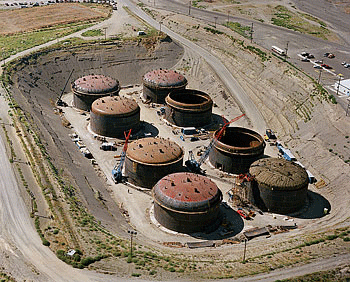
The department submitted the 29-page plan in federal court as part of a suit to amend an agreement with the state that requires the plant to start operating in 2022.
A series of serious technical questions about the plant’s design have caused one delay after another. Two of the major facilities at the cleanup site, which resembles a small industrial city, are under a construction halt ordered in 2013 by then-Energy Secretary Steven Chu.
The plant, located on a desert plateau above the Columbia River, is designed to transform 56 million gallons of radioactive sludge, currently stored in underground tanks, into solid glass that could theoretically be stored for thousands of years.
The waste was a byproduct of plutonium production, which started with the Manhattan Project during World War II.
The 586-square-mile Hanford site is widely considered the most contaminated place in the country, requiring 8,000 workers to remediate half a century of careless industrial practices that were done under strict federal secrecy. The Energy Department filing shows the extent of the problems. Continue reading
Deep nuclear waste burial plan approved by Finland’s government
 Deep Storage Plans Approved. IEEE Spectrum By Lucas Laursen 17 Nov 2015 Finland’s government issued a construction license to nuclear disposal consortium Posiva last week, Reuters reported. The license gives the group approval to build a storage facility on Olkiluoto Island, Finland, designed to last 100,000 years.

Nuclear waste consists of metal rods composed mostly of uranium with a molecular weight of 238. Over time, the depleted uranium atoms release radioactive particles—a process called decay—that converts the uranium into lighter elements. Over billions of years, those atoms decay, too. By the end, all that is left is lead.
In the (long) meantime, however, the radioactive material can contaminate its surroundings, and therefore requires costly management. The United States and other nuclear-powered countries have thus far proven unable to agree on where to store their half-century’s worth of accumulated nuclear waste. An earthquake, volcanic activity, or even a slow leak of water could disrupt the temporary facilities in which the waste now sits.
To provide safer and more permanent storage, Posiva proposes to bury electrically-welded iron-and-copper capsules 400 meters underground. The capsules would be surrounded by clay barriers and capped with rubble and cement. The facility, which would have a 6,500 metric ton capacity, could likely hold Finland and Sweden’s projected future nuclear waste. But that capacity doesn’t come close to the volume required by larger nations such as the United States, which has over 70,000 metric tons of waste piled up, and produces an additional 2,200 tons a year.
Though tunneling has been going on for over a decade, Posiva had to wait for the Finnish government to approve its 2012 construction permit application before it could begin the trickier task of loading radioactive waste into its metal coffins. That task may begin as soon as 2023, continue for up to a century, and end when operators fill in the access tunnels with rubble and cap them off with cement. Posiva estimates that installation and operating costs for the first century will be around €3 billion (US $3.21 billion). http://spectrum.ieee.org/energywise/energy/nuclear/nuclear-waste-deep-storage-plans-approved
Finland’s nuclear waste burial plan
 Finland’s Nuclear Waste Solution. IEEE Spectrum, By Sandra Upson 30 Nov 2009 Here on Olkiluoto Island, the forest is king. Elk and deer graze near sun-dappled rivers and shimmering streams, and humans search out blueberries and chanterelle mushrooms. Weathered red farmhouses sit along sleepy dirt roads in fields abutting the woods. Far beneath the vivid green forest, deep in the bedrock, workers are digging the labyrinthine passages and chambers that they hope to someday pack with all of Finland’s spent nuclear fuel.
Posiva, the Finnish company building an underground repository here, says it knows how to imprison nuclear waste for 100 000 years. These multimillennial thinkers are confident that copper canisters of Scandinavian design, tucked into that bedrock, will isolate the waste in an underground cavern impervious to whatever the future brings: sinking permafrost, rising water, earthquakes, copper-eating microbes, or oblivious land developers in the year 25 000. If the Finnish government agrees—a decision is expected by 2012—this site will become the world’s first deep, permanent repository for spent nuclear fuel.
Of course, not everyone shares Posiva’s confidence. ”It’s deep hubris to think you can contain it,” says Charles McCombie, executive director of the Association for Regional and International Underground Storage, based in Switzerland.
There’s more at stake here than the interment of 5500 metric tons of spent Finnish fuel. More than 50 years after the first commercial nuclear power plants went operational in the United Kingdom and the United States, the world’s 270 000 metric tons of spent nuclear fuel remain in limbo. After it gets swapped out of a reactor, utilities put it in specially designed pools, where chilled, circulating water absorbs the initial heat and radioactivity. After about five or six years, the fuel has cooled considerably, enabling utilities with limited pool space to load it into huge, million-dollar steel casks that are left to sit on concrete pads within guarded compounds.
The arrangement is far from ideal. Continue reading
Travel to Mars completely stalled by reality of radiation danger
 Space Radiation Is Quietly Stopping Us From Sending Humans to Mars
In order to create a colony, we need to be able to survive a long trip through space. Neel V. Patel, November 17, 2015 Innumberable dangers threaten human astronauts traveling into deep space. Some of these, like asteroids, are obvious and avoidable with some decent LIDAR. Others aren’t. At the top of the not-so-much list is space radiation, something NASA is in no way prepared to protect explorers from while ferrying them to Mars. The radiation environment beyond the magnetosphere is not conducive to life, meaning sending astronauts out there without protection is equivalent to sending them to their doom.
While we’ve sent astronauts into space for over half a century now, the vast majority of these missions have been limited to traveling into low Earth orbit — between 99 and 1,200 miles in altitude. The Earth’s magnetic field — which extends thousands of miles into space — protects the planet from being hit head-on by high-energy solar particles traveling over one million miles per hour.
There are three big sources of space radiation, and they all pose a certain amount of risk that can’t always be anticipated or protected against. The first is trapped radiation. Some particles don’t get deflected by the Earth’s magnetic field. Instead, they’re trapped in one of the big two magnetic rings surrounding the Earth, and accumulate together as part of the Van Allen radiation belts. NASA has only had to contend with the Van Allen belts during the Apollo missions.
The second source is galactic cosmic radiation, or GCR, which originates from outside the solar system. These ionized atoms travel at basically the speed of light, although Earth’s magnetic field is also able to protect the planet and objects in low Earth orbit from GCR.
The last source is from solar particle events, which are huge injections energetic particles produced by the sun. There’s a distinction between the solar winds normally emitted by the sun, which take about a day to get to the Earth, and these higher-intensity events that hit us within 10 minutes. Besides producing a potentially lethal amount of radiation for astronauts, SPE can sometimes be wildly unpredictable, making it difficult for NASA scientists and engineers to develop protective measures against them.
NASA examines space radiation the way employers determine acceptable risks for their employees — they will not subject astronauts to an occupational risk of developing cancer beyond a certain threshold……. Continue reading
PRISM (Power Reactor Innovative Small Module) and MOX much touted, but nuclear waste burial is best
Another option on the table is PRISM. Developed by GE Hitachi (GEH), PRISM is a sodium-cooled fast reactor that uses a metallic fuel alloy of zirconium, uranium, and plutonium. GEH claims PRISM would reduce the plutonium stockpile quicker than MOX and be the most efficient solution for the UK. The problem is, despite being based on established technology, a PRISM reactor has yet to be built, and the UK is understandably a little reluctant to commit in this direction. Seen as something of a gamble, it remains in the running alongside the currently more favoured MOX option.
Amid all the uncertainty, one thing is for sure. Regardless of what decision is taken, a proportion of the plutonium will end up as waste and will need to be safely disposed of.

 Unlike MOX and PRISM, immobilisation has no prominent industry backers. In comparison to exploiting the plutonium for our energy needs, there is no great fortune to be made from disposing of it safely. But immobilising the entire plutonium stockpile may in fact be a more economically sound approach than reprocessing
Sellafield plutonium a multi-layered problem, The Engineer UK, 6 November 2015 | By Andrew Wade “……..It takes somewhere in the region of 5-10kg of plutonium to make a nuclear weapon, so 140 tons is a slightly worrying amount to have sitting in a concrete shed in Cumbria. While everyone at the press conference was at pains to point out that there are no major safety concerns with the current storage, it is widely accepted that a long-term plan needs to be formulated. This, however, is where things get tricky. The potential energy of the plutonium if converted to nuclear fuel is massive, but there are several competing technologies vying for endorsement, none of which are well proven as financially viable.
Top of the list – and the government’s current preference – is for some application that uses mixed oxide fuel, or MOX. MOX is made by blending plutonium with natural or depleted uranium to create a fuel that is similar, but not identical, to the low-enriched uranium used in most nuclear plants today. MOX can be – and in several European countries is – used in thermal reactors alongside uranium. But despite past concerns, there is in reality no shortage of uranium today, so no huge need to supplement it with MOX in current reactors. Where MOX could in fact lead to greater efficiencies is in fast reactors, but these are costly and difficult to operate, and would not make economic sense unless the cost of uranium fell.
To complicate matters further, developing MOX is by no means a straightforward process. Continue reading
Scientists confirm “elevated” raadioactivity levels in honey near nuclear power station
 Radioactive honey found near nuclear power station, Rt.com 2 Nov, 2015 Honey contaminated with nuclear waste has been found near a disused power station in Scotland, scientists have confirmed, with samples of the product testing positive for “elevated” radioactivity. The samples showed levels of radioactive caesium-137 that are 14 times higher than samples of honey from elsewhere in the UK, prompting scientists to call for an investigation into wider contamination at the site.
The plant, which closed in 1994, no longer produces nuclear energy. It is still in the process of being decommissioned, however.
Independent nuclear energy consultant John Large said bees are an important barometer of environmental health.“Bees are key indicators of what is happening in the environment. They forage in a three-mile radius around the hive and anything in the soil is drawn up into plants and into the nectar they collect.
“This reading is within the limit for human consumption, but caesium-137 should not be turning up in honey at all,” he added.
The results are included in the government’s Radioactivity In Food and the Environment report, published last week…….https://www.rt.com/uk/320505-nuclear-plant-honey-contamination/#.VjfDMS3IGhs.twitter
Transition from nuclear energy to renewables, in Germany
 Germany Could Be a Model for How We’ll Get Power in the Future
The European nation’s energy revolution has made it a leader in replacing nukes and fossil fuels with wind and solar technology. National Geographic, By Robert Kunzig Photographs by Luca Locatelli OCTOBER 15, 2015 “…..Germany’s Audacious Goal
Fell, who was installing PV panels on his roof in Hammelburg, realized that the new law would never lead to a countrywide boom: It paid people to produce energy, but not enough. In 1993 he got the city council to pass an ordinance obliging the municipal utility to guarantee any renewable energy producer a price that more than covered costs. Fell promptly organized an association of local investors to build a 15-kilowatt solar power plant—tiny by today’s standards, but the association was one of the first of its kind. Now there are hundreds in Germany.
In 1998 Fell rode a Green wave and his success in Hammelburg into the Bundestag. The Greens formed a governing coalition with the SPD. Fell teamed up with Hermann Scheer, a prominent SPD advocate of solar energy, to craft a law that in 2000 took the Hammelburg experiment nationwide and has since been imitated around the world. Its feed-in tariffs were guaranteed for 20 years, and they paid well.
“My basic principle,” Fell said, “was the payment had to be so high that investors could make a profit. We live in a market economy, after all. It’s logical.”…….
The biogas, the solar panels that cover many roofs, and especially the wind turbines allow Wildpoldsried to produce nearly five times as much electricity as it consumes. Einsiedler manages the turbines, and he’s had little trouble recruiting investors. Thirty people invested in the first one; 94 jumped on the next. “These are their wind turbines,” Einsiedler said. Wind turbines are a dramatic and sometimes controversial addition to the German landscape—“asparagification,” opponents call it—but when people have a financial stake in the asparagus, Einsiedler said, their attitude changes.
It wasn’t hard to persuade farmers and homeowners to put solar panels on their roofs; the feed-in tariff, which paid them 50 cents a kilowatt-hour when it started in 2000, was a good deal. At the peak of the boom, in 2012, 7.6 gigawatts of PV panels were installed in Germany in a single year—the equivalent, when the sun is shining, of seven nuclear plants. A German solar-panel industry blossomed, until it was undercut by lower-cost manufacturers in China—which took the boom worldwide.
Fell’s law, then, helped drive down the cost of solar and wind, making them competitive in many regions with fossil fuels. One sign of that: Germany’s tariff for large new solar facilities has fallen from 50 euro cents a kilowatt-hour to less than 10. “We’ve created a completely new situation in 15 years—that’s the huge success of the renewable energy law,” Fell said.
Germans paid for this success not through taxes but through a renewable-energy surcharge on their electricity bills. This year the surcharge is 6.17 euro cents per kilowatt-hour, which for the average customer amounts to about 18 euros a month—a hardship for some, Rosenkranz told me, but not for the average German worker. The German economy as a whole devotes about as much of its gross national product to electricity as it did in 1991.
In the 2013 elections Fell lost his seat in the Bundestag, a victim of internal Green Party politics. He’s back in Hammelburg now, but he doesn’t have to look at the steam plumes from Grafenrheinfeld: Last June the reactor became the latest to be switched off. No one, not even the industry, thinks nuclear is coming back in Germany…….
Germany’s big utilities have been losing money lately—because of the energiewende, they say; because of their failure to adapt to the energiewende, say their critics. E.ON, the largest utility, which owns Grafenrheinfeld and many other plants, declared a loss of more than three billion euros last year.
“The utilities in Germany had one strategy,” Flasbarth said, “and that was to defend their track—nuclear plus fossil. They didn’t have a strategy B.” Having missed the energiewende train as it left the station, they’re now chasing it. E.ON is splitting into two companies, one devoted to coal, gas, and nuclear, the other to renewables. The CEO, once a critic of the energiewende, is going with the renewables.
Vattenfall, a Swedish state-owned company that’s another one of Germany’s four big utilities, is attempting a similar evolution. “We’re a role model for the energiewende,” ……..
Vattenfall, however, plans to sell its lignite business, if it can find a buyer, so it can focus on renewables. It’s investing billions of euros in two new offshore wind parks in the North Sea—because there’s more wind offshore than on and because a large corporation needs a large project to pay its overhead. “We can’t do onshore in Germany,” Wiese said. “It’s too small.”
Vattenfall isn’t alone: The renewables boom has moved into the North and Baltic Seas and, increasingly, into the hands of the utilities. Merkel’s government has encouraged the shift, capping construction of solar and onshore wind and changing the rules in ways that shut out citizens associations. Last year the amount of new solar fell to around 1.9 gigawatts, a quarter of the 2012 peak. Critics say the government is helping big utilities at the expense of the citizens’ movement that launched the energiewende.
At the end of April, Vattenfall formally inaugurated its first German North Sea wind park, an 80-turbine project called DanTysk that lies some 50 miles offshore. The ceremony in a Hamburg ballroom was a happy occasion for the city of Munich too. Its municipal utility, Stadtwerke München, owns 49 percent of the project. As a result Munich now produces enough renewable electricity to supply its households, subway, and tram lines. By 2025 it plans to meet all of its demand with renewables……
Though Germany isn’t on track to meet its own goal for 2020, it’s ahead of the European Union’s schedule. It could have left things there—and many in Merkel’s CDU wanted her to do just that. Instead, she and Economics Minister Sigmar Gabriel, head of the SPD, reaffirmed their 40 percent commitment last fall……..http://ngm.nationalgeographic.com/2015/11/climate-change/germany-renewable-energy-revolution-text
Is nuclear fusion a goer? Not really
 Another Fusion White Elephant Sighted in Germany http://helian.net/blog/October 27th, 2015 Helian According to an article that just appeared in Science magazine, scientists in Germany have completed building a stellarator by the name of Wendelstein 7-X (W7-X), and are seeking regulatory permission to turn the facility on in November. If you can’t get past the Science paywall, here’s an article in the popular media with some links. Like the much bigger ITER facility now under construction at Cadarache in France, W7-X is a magnetic fusion device. In other words, its goal is to confine a plasma of heavy hydrogen isotopes at temperatures much hotter than the center of the sun with powerful magnetic fields in order to get them to fuse, releasing energy in the process. There are significant differences between stellarators and the tokamak design used for ITER, but in both approaches the idea is to hold the plasma in place long enough to get significantly more fusion energy out than was necessary to confine and heat the plasma. Both approaches are probably scientifically feasible. Both are also white elephants, and a waste of scarce research dollars.
The problem is that both designs have an Achilles heel. Its name is tritium. Tritium is a heavy isotope of hydrogen with a nucleus containing a proton and two neutrons instead of the usual lone proton. Fusion reactions between tritium and deuterium, another heavy isotope of hydrogen with a single neutron in addition to the usual proton, begin to occur fast enough to be attractive as an energy source at plasma temperatures and densities much less than would be necessary for any alternative reaction. The deuterium-tritium, or DT, reaction will remain the only feasible one for both stellarator and tokamak fusion reactors for the foreseeable future. Unfortunately, tritium occurs in nature in only tiny trace amounts.
The question is, then, where do you get the tritium fuel to keep the fusion reactions going? Well, in addition to a helium nucleus, the DT fusion reaction produces a fast neutron. These can react with lithium to produce tritium. If a lithium-containing blanket could be built surrounding the reaction chamber in such a way as to avoid interfering with the magnetic fields, and yet thick enough and close enough to capture enough of the neutrons, then it should be possible to generate enough tritium to replace that burned up in the fusion process. It sounds complicated but, again, it appears to be at least scientifically feasible. However, it is by no means as certain that it is economically feasible.
Consider what we’re dealing with here. Tritium is an extremely slippery material that can pass right through walls of some types of metal. It is also highly radioactive, with a half-life of about 12.3 years. It will be necessary to find some way to efficiently extract it from the lithium blanket, allowing none of it to leak into the surrounding environment. If any of it gets away, it will be easily detectable. The neighbors are sure to complain and, probably, lawyer up. Again, all this might be doable. The problem is that it will never be doable at a low enough cost to make fusion reactor designs based on these approaches even remotely economically competitive with the non-fossil alternative sources of energy that will be available for, at the very least, the next several centuries.
What’s that? Reactor design studies by large and prestigious universities and corporations have all come to the conclusion that these magnetic fusion beasts will be able to produce electricity at least as cheaply as the competition? I don’t think so. I’ve participated in just such a government-funded study, conducted by a major corporation as prime contractor, with several other prominent universities and corporations participating as subcontractors. I’m familiar with the methodology used in several others. In general, it’s possible to make the cost electricity come out at whatever figure you choose, within reason, using the most approved methods and the most sound project management and financial software. If the government is funding the work, it can be safely assumed that they don’t want to hear something like, “Fuggedaboudit, this thing will be way too expensive to build and run.” That would make the office that funded the work look silly, and the fusion researchers involved in the design look like welfare queens in white coats. The “right” cost numbers will always come out of these studies in the end.
I submit that a better way to come up with a cost estimate is to use a little common sense. Do you really think that a commercial power company will be able to master the intricacies of tritium production and extraction from the vicinity of a highly radioactive reaction chamber at anywhere near the cost of, say, wind and solar combined with next generation nuclear reactors for baseload power? If you do, you’re a great deal more optimistic than me. W7-X cost a billion euros. ITER is slated to cost 13 billion, and will likely come in at well over that. With research money hard to come by in Europe for much worthier projects, throwing amounts like that down a rat hole doesn’t seem like a good plan.
All this may come as a disappointment to fusion enthusiasts. On the other hand, you may want to consider the fact that, if fusion had been easy, we would probably have managed to blow ourselves up with pure fusion weapons by now. Beyond that, you never know when some obscure genius might succeed in pulling a rabbit out of their hat in the form of some novel confinement scheme. Several companies claim they have sure-fire approaches that are so good they will be able to dispense with tritium entirely in favor of more plentiful, naturally occurring isotopes. See, for example, here, here, andhere, and the summary at the Next Big Future website. I’m not optimistic about any of them, either, but you never know.
All too many failures in nuclear power pipelines
 Nuclear Pipe Nightmares, UCS Dave Lochbaum, director, Nuclear Safety Project October 27, 2015 Disaster by Design
If you had a dollar for every foot of pipe—or even just a quarter for every three inches of pipe—used in the nation’s nuclear power plants, you would probably not be reading this post. That chore would be delegated to one or more of your many minions.
Pipes at nuclear power plants carry cooling water to the reactor vessel and spent fuel pool, transport steam to the main turbine, provide hydrogen gas to cool the main generators, supply fuel and lubricating oil to the emergency diesel generators, maintain the fire sprinklers ready to extinguish fires, and numerous other vital functions. Given so many pipes, a success rate of 99.99%—remarkably similar to a failure rate of one broken pipe out of ten thousand pipes—would result in lots of piping failures.
The Electric Power Research Institute’s report revealed lots of piping failures at U.S. nuclear power plants between 1961 and 1997 (Fig. 1). The non-leaking failures are identified by inspections indicating that safety margins had been compromised, forcing the pipes to be replaced before they leak. The leaking failures are identified by puddles on the floor or other obvious signs, again forcing pipes to be replaced.
[excellent charts on original]
The Electric Power Research Institute’s report identified numerous reasons why pipes break (Fig. 2). MIC under corrosion stands for microbiologically induced corrosion—tiny little bugs that eat metal. Pipes can be designed wrong, installed wrong, or weakened via an array of methods during use.
[article goes on to describe pipe failures at:]
Dresden Nuclear Plant
Fission Stories #65 described the January 25, 1994, …..
Browns Ferry Nuclear Plant
On August 14, 1984…..
Surry Nuclear Plant
On December 9, 1986,….
Mihama Nuclear Plant
A 22-inch diameter pipe in the condensate/feedwater system ruptured on August 9, 2004, at the Mihama nuclear plant in Japan …..
Oyster Creek and Dresden Nuclear Plants
LaSalle Nuclear Plant
On May 27, 1985…..
Oyster Creek Nuclear Plant
Fission Stories #29 described how 133,000 gallons drained from the condensate storage tank at the Oyster Creek nuclear plant in New Jersey in September 1996…..
Davis Besse Nuclear Plant
Fission Stories #131 described the March 2002 discovery by workers at the Davis-Besse nuclear plant in Ohio that a crack in a pipe allowing a control rod inside the reactor vessel to be connected to and manipulated by its electric motor outside the vessel had been leaking cooling water from the reactor for as long as six years……
Byron Nuclear Plant
On October 19, 2007, workers brushing away rust on the outer surface of a cooling water pipe at the Byron nuclear plant in Illinois poked a hole in it……
Big Rock Point Nuclear Plant
The NRC described a broken pipe at the Big Rock Point nuclear plant in their annual report to the U.S. Congress on abnormal occurrences in 1998…….
Safety by Intent
The table above from the Electric Power Research Institute indicates that 1,816 failures were identified by testing and inspection at U.S. nuclear power plants between 1961 and 1997 while 2,247 failures were found after pipes had leaked.
This data reinforce a theme too often appearing in nuclear safety posts to our All Things Nuclear blog—testing and inspection efforts are less effective than they need to be. Afederal regulation requires that plant owners have extensive testing and inspection programs that find and fix safety problems in a timely and effective manner. If compliance with this regulation were fact rather than fiction, the data should show more piping failures are found via tests and inspections than by puddles on the floor.
The NRC must figure out why testing and inspection efforts are violating federal safety regulations by failing to find and fix piping failures in a timely and effective manner. http://allthingsnuclear.org/nuclear-pipe-nightmares/
World Health Organisation, Dr Alice Stewart, Sr Rosalie Bertell on low Dose Radiation Exposure

 W.H.O. IPHECA report 1995… areas over 5 mSv/year were designated mandatory EVACUATION zones.
http://apps.who.int/iris/bitstream/10665/41801/1/9241561815_eng.pdf
The international standard for external exposure has been 1mSv/year. With the advent of ‘modern medicine’, the use of nuclear chemicals, xrays, dental included, of course…… it is harder for exposure to be limited in this way, but all people should be aware and consider xrays for children especially only when absolutely necessary! Dr. Alice Stewart showed that very low doses for children is far worse and causes cancers in children a few years later! Leukemia being prevalent.
Low Level radiation exposure from Sister Doctor Rosalie Bertell:
“When you are talking about constant low radiation exposure, what you are doing is introducing mistakes into the gene-pool. And those mistakes will eventually turn up by killing that line, that cell line, that species line. The amount of damage determines whether this happens in two generations or in seven generations or 10 generations. So what we are doing by introducing more mistakes into the DNA or the gene pool is we are shortening the number of generations that will be viable on the planet.
We have shortened the number of generations that will follow us. We have shortened that already. So we reduced the viability of living systems on this planet, whether it can recover or not. We don’t have any outside source to get new DNA. So we have the DNA we have, whoever will live on this planet in the future is present right now in the DNA. So if we damage it, we don’t have another place to get it.
There will be no living thing on earth in the future that is not present now in a seed, in a sperm and the ovum of all living plants and animals. So it is all here now. It is not going to come from Mars or somewhere. Living things come from living things. So we carry this very precious seed for the future. And when you damage it you do two things. You produce an organism that is less viable, less harmonized with the environment. At the same time, we are leaving toxic and radioactive waste around. So you are going to have a more hazardous environment and a less capable organism. That is a death syndrome for the species, not only for the individual. It is going to be harder to live. The body will be less able to take stress, and you are increasing the stress at the same time.
We are responsible for what we turn over to the next generation. It is amazing to me because I am the daughter of people that came from Europe, migrated to Canada and the United States for a better life for their children. And it seems that our generation does not care for the future. It is not our heritage. Our heritage was to give something better to our children than what we received. And we seem not to care. I find this very strange, and I think most of our grandparents would turn over in their graves, if they knew what we are doing.”
Dr. Rosalie Bertell 2010 Interview
http://nf2045.blogspot.fr/2014/04/2010-interview-with-rosalie-bertell.html
Federal authorities cancel shipment of high level radioactive trash to Idaho
Feds cancel research shipment of spent nuclear fuel to Idaho, Salt Lake Tribune, By KEITH RIDLER The Associated Press, 25 Oct 15, Boise, Idaho • Federal authorities have canceled the first of two proposed research shipments of spent nuclear fuel to eastern Idaho but still hope to deliver the second.
The U.S. Department of Energy said Friday that 25 fuel rods weighing about 100 pounds will not be sent to the Idaho National Laboratory.
The move comes after federal and state officials couldn’t come to terms on a waiver to a 1995 agreement that ties such shipments to nuclear waste cleanup at the 890-square-mile site. The federal agency is currently in violation of the agreement because of its failure to convert 900,000 gallons of liquid waste into solid form due to malfunctions at a $571 million plant……..
The Department of Energy wants to better understand “high burnup” spent fuel that is accumulating at nuclear power plants in the U.S. High burnup fuel remains in nuclear reactor cores longer to produce more energy but comes out more radioactive and hotter. It’s cooled in pools before being encased in steel and concrete.

The first proposed shipment to Idaho initially set for August would have come from the Byron Nuclear Power Station in Illinois.
The second shipment, also of 25 spent nuclear fuel rods weighing about 100 pounds, is scheduled for January 2016, from the North Anna Nuclear Power Station in Virginia.
The Department of Energy “will continue to work with the state of Idaho in an effort to identify a path forward for the proposed second shipment,” the agency said……..http://www.sltrib.com/home/3097310-155/feds-cancel-research-shipment-of-spent
Decadesof bungling over radioactive landfill in St Louis County
 How a six-figure deal from the 1960s blocked clean-up of radiotoxic site, Examiner, Byron DeLear , 13 Oct 15 One hundred and twenty-six thousand dollars. That’s how much money was offered by Contemporary Metals Corporation in 1962 to acquire all the contents of the world’s first nuclear waste dump. It may seem unbelievable and incredibly reckless by today’s standards for the U.S government to even consider off-loading thousands of tons of highly dangerous radioactive material to a small private entity, but at that time the dangers were neither fully known nor appreciated. A subsequent owner illegally dumped a large quantity of this radioactive material at the West Lake Landfill.
Today, an underground fire threatens to ignite these dangerous substances inundated with uranium, thorium, and radium — a radiotoxic concoction found to be unique to nuclear weapons-related waste. Recently, experts brought by Missouri Attorney General Chris Koster estimate the fire could reach the radioactive waste in as little as 3-6 months. These same experts cite evidence of the radioactive contaminants leaching off-site into trees and groundwater. Emergency evacuation plans warning of a potential “catastrophic event” have also been released by St. Louis County — naturally, as can be expected, folks are growing restless.
Yesterday, four local school districts have sent letters to parents letting them know of the potential emergency and that the circumstances are being closely monitored. “We remain frustrated by the situation at the Landfill,” said Mike Fulton, superintendant of the Pattonville School District. “This impacts not only our community, but the entire St. Louis region.”
With the underground fire burning for nearly six years, four decades of inaction by a rotating cavalcade of shape-shifting private interests, numerous state and federal agencies, officials, and politicians, one might wonder:
What’s makes the West Lake Landfill case so special? — so absolutely unique a situation to have foisted upon this region a decades-long, ongoing saga of bungled management, finger-pointing, and negligence? Why hasn’t the site been cleaned-up? Continue reading
Radiation and cancer: to USA’s NRC it’s PR not science, that counts
Instead of treating cancer as a scientific issue, the nuclear industry treats it as a PR challenge. Frequent attempts are made to trivialize the dangers of radiation. Often this involves the Radiation- Is-Everywhere tactic complete with ludicrous examples (“It’s just like eating a banana,” or “It’s just like flying to Denver”). They like to show how little radiation is in an average X-ray but they are careful not to mention that radioactive exposure is cumulative: every dose adds.
The dirty little secret of the nuclear industry is that all NPP regularly discharge radiation into the environment. Nuclear power plants cannot operate without these discharges, and the NRC sets standards for what is allowable.
The push by the nuclear industry to block cancer research demonstrates their true colors.
 NRC Blocks Cancer Study Near San Onofre and other Nuclear Power Plants http://voiceofoc.org/2015/10/nrc-blocks-cancer-study-near-san-onofre-and-other-nuclear-power-plants/
By Roger Johnson October 14, 2015 Do the regular radioactive emissions from nuclear power plants (NPP) increase the risk of cancer? No one knows for sure whether living near a NPP can cause cancer, but on Sept. 8 the Nuclear Regulatory Commission (NRC) terminated a study designed to find out. It would have been carried out by the prestigious National Academy of Sciences which spent 5 years planning the study.
One of the six locations chosen for study was our own San Onofre. The medical records of everyone living within 31 miles of San Onofre (a circle from Huntington Beach around to Solana Beach) would have been part of the study. The research proposal is entitled Analysis of Cancer Risks in Populations near Nuclear Facilities.
The NRC logo is “Protecting People and the Environment” but many wonder if it should read “Protecting the Nuclear 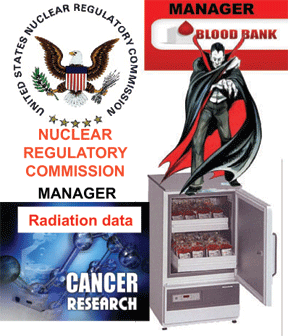 Industry and Its Profits.”
The NRC said it could not afford the $8 million, but no one swallows this since the NRC has an annual budget of over $1 billion (90 percent of which comes from the industry it is supposed to be regulating).
The NRC also said that it already knows the answer: low-level radiation coming from NPP is harmless. It continues to cite a now thoroughly discredited study by the National Cancer Institute (NCI) which examined this issue a quarter of a century ago and failed to find cancer streaks. The nuclear industry prefers this study because it likes the results.
We now know that the NCI study failed because it studied only cancer deaths, not incidence, and it studied only where people died, not where they lived or worked. It also averaged people living very near a NPP with those who lived far away. Also worrisome are recent studies in Europe which discovered that children who live near a NPP double their risk of cancer. The NAS is well-aware of this and designed part of the study to focus on children.
Instead of treating cancer as a scientific issue, the nuclear industry treats it as a PR challenge. Continue reading
1 This Month



26 September – International Day for the Total Elimination of Nuclear Weapons


PLEASE OPPOSE HR 8255 AND S.3639 – bills would accelerate satellite deployment, with no environmental review or safeguards – https://ncstd5li.quorum.us/campaign/169331/
To see nuclear-related stories in greater depth and intensity – go to https://nuclearinformation.wordpress.com
-
Archives
- September 2026 (245)
- August 2026 (330)
- July 2026 (355)
- June 2026 (287)
- May 2026 (306)
- April 2026 (356)
- March 2026 (251)
- February 2026 (267)
- January 2026 (308)
- December 2025 (358)
- November 2025 (359)
- October 2025 (375)
-
Categories
- 1
- 1 NUCLEAR ISSUES
- business and costs
- climate change
- culture and arts
- ENERGY
- environment
- health
- history
- indigenous issues
- Legal
- marketing of nuclear
- media
- opposition to nuclear
- PERSONAL STORIES
- politics
- politics international
- Religion and ethics
- safety
- secrets,lies and civil liberties
- spinbuster
- technology
- Uranium
- wastes
- weapons and war
- Women
- 2 WORLD
- ACTION
- AFRICA
- Atrocities
- AUSTRALIA
- Christina's notes
- Christina's themes
- culture and arts
- Events
- Fuk 2022
- Fuk 2023
- Fukushima 2017
- Fukushima 2018
- fukushima 2019
- Fukushima 2020
- Fukushima 2021
- general
- global warming
- Humour (God we need it)
- Nuclear
- RARE EARTHS
- Reference
- resources – print
- Resources -audiovicual
- Weekly Newsletter
- World
- World Nuclear
- YouTube
-
RSS
Entries RSS
Comments RSS
 nuclear-news