Radioactive matter travels faster than expected through carbonate rock
Radioactive matter migrates more quickly through fractured carbonate rock, Science Daily December 18, 2015
- Source:
- American Associates, Ben-Gurion University of the Negev
- Summary:
- A new study has determined the impact of intrinsic colloid formation on increased migration of leaked radioactive materials in the environment. Colloids are microscopic inorganic or organic solids that remain suspended in water. Intrinsic colloids are formed when radioactive waste mixes with other dissolved components in the groundwater, such as bicarbonate.
- Researchers at Ben-Gurion University of the Negev (BGU) have found that radioactive matter migrates more quickly in carbonate bedrock formations once it has leaked from a tank from near surface waste sites and geological repositories.
Corroded stored waste containers can lead to radionuclide (radioactive) leakage, which may reach groundwater.
The study, published in the online journal Environmental Science & Technology (ACS Publications), determined the impact of intrinsic colloid formation on increased migration of leaked radioactive materials in the environment. Colloids are microscopic inorganic or organic solids that remain suspended in water. Intrinsic colloids are formed when radioactive waste mixes with other dissolved components in the groundwater, such as bicarbonate.
“This study showed that intrinsic colloids formed by interactions between soluble Cerium (Ce) and carbonates significantly increase the mobility of Ce injected into a carbonate rock fracture,” explains BGU Zuckerberg Institute for Water Research Director Prof. Noam Weisbrod, Ph.D. “The formation of intrinsic colloids, if not accounted for, could result in the under prediction of radionuclide migration through fractures in fine-grained carbonate bedrock, such as chalk.”……..http://www.sciencedaily.com/releases/2015/12/151218110259.htm
“Culture of quiet” about India’s Top-Secret Nuclear City to Produce Thermonuclear Weapons
The nuclear city would, in short, be ringed by a security perimeter of thousands of military and paramilitary guards.
in choosing to remain publicly silent, the United States was taking a risk, evidently to try and reap financial and strategic rewards.

 India Is Building a Top-Secret Nuclear City to Produce Thermonuclear Weapons, Experts Say The weapons could upgrade India as a nuclear power — and deeply unsettle Pakistan and China. Foreign Policy.com BY ADRIAN LEVY DECEMBER 16, 2015 “………A culture of quiet
Like the villagers in Challakere, some key members of the Indian Parliament say they know little about the project.
One veteran lawmaker, who has twice been a cabinet minister, and who asked not to be named due to the sensitivity of the topic, said his colleagues are rarely briefed about nuclear weapons-related issues. “Frankly, we in Parliament discover little,” he said, “and what we do find out is normally from Western newspapers.” And in an interview with Indian reporters in 2003, Jayanthi Natarajan, a former lawmaker who later served as minister for environment and forests, said that she and other members of Parliament had “tried time and again to raise [nuclear-related] issues … and have achieved precious little.” Continue reading
Corporate Astroturf “Nuclear for Climate” is really a lobby group of 140 pro nuclear societies.
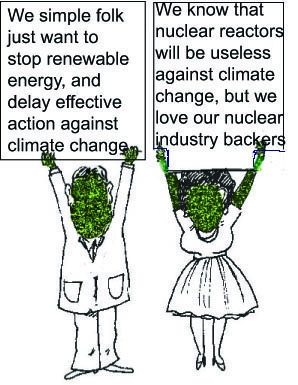 Nuclear for Climate isn’t a network of grassroots environmentalists, it’s a network of more than 140 nuclear societies. It isn’t grassroots environmentalism, it’s corporate astroturf.
Nuclear lobbyists’ epic COP21 fail. Our next job? Keep their hands off climate funds, Ecologist, Jim Green16th December 2015 “……..Robert Stone, director of the Pandora’s Promise pro-nuclear propaganda film, launched a ‘resource hub’ called Energy For Humanity, promoting “more advanced, mass-producible, passively safe, reactor designs”.
Rauli Partanen and Janne Korhonen, members of the Finnish Ecomodernist Society, have been attacking environmentalists for opposing nuclear power. Rebutting a rebuttal by Michael Mariotte from the Nuclear Information and Resource Service, Partanen and Korhonen offer this gem:
“Even the much-maligned Olkiluoto 3 nuclear project [in Finland] turns out to be very fast way of adding low-carbon energy production when compared to any real-world combination of alternatives.”
A single reactor that will take well over a decade to build (and is three times over budget) is a “very fast way” of adding low-carbon energy? Huh? Maybe that’s why a second reactor of the same EPR design to be built at Okiluoto was cancelled in May 2015, while the main players are locked in a €10 billion legal battle.
‘The instransigent network of anti-nukes’ versus Astroturf
Partanen and Korhanan authored a booklet called ‘Climate Gamble: Is Anti-Nuclear Activism Endangering Our Future?‘, and crowdfunded the printing of 5,000 copies which were distributed for free at the COP21 conference.
James Hansen and three other climate scientists were in Paris to promote nuclear power. Hansen attacks the “intransigent network of anti-nukes” that has “grown to include ‘Big Green,’ huge groups such as the Natural Resources Defense Council, Environmental Defense Fund and World Wide Fund for Nature. They have trained lawyers, scientists, and media staff ready to denounce any positive news about nuclear power.”
By way of sharp contrast, the impoverished US nuclear industry could only rustle up US$60 million (€55m) to lobby Congress and federal agencies in 2013-14.
So is there an undercurrent of grassroots pro-nuclear environmentalism waiting to burst forth if only their voice could cut through Big Green hegemony? Perhaps Nuclear for Climate, promoted as a ‘grassroots organization‘, is the environmental network to take on Big Green?
Well, no. Nuclear for Climate isn’t a network of grassroots environmentalists, it’s a network of more than 140 nuclear societies. It isn’t grassroots environmentalism, it’s corporate astroturf.
And the list of 140 associations includes 36 chapters of the ‘Women in Nuclear’ organisation and 43 chapters of the ‘Young Generation Network’. One wonders whether these organisations have any meaningful existence. Does Tanzania really have a pro-nuclear Young Generation Network? Don’t young people in Tanzania have better things to do?
Nuclear for Climate has a website, a hashtag, a twitter handle and all the modern social media sine qua non. But it has some work to do with its messaging. One of its COP21 memes was: ‘The radioactive waste are not good for the climate? Wrong!’ So radioactive waste is good for the climate?! http://www.theecologist.org/News/news_analysis/2986693/nuclear_lobbyists_epic_cop21_fail_our_next_job_keep_their_hands_off_climate_funds.html
India’s river of nuclear death and disease
 India’s nuclear industry pours its wastes into a river of death and disease Scientists say nuclear workers, village residents, and children living near mines and factories are falling ill after persistent exposure to unsafe radiation Center For Public Integrity , By Adrian Levy
 December 14, 2015 Jadugoda, Jharkhand, INDIA —
When Ghosh’s team seven years ago collected samples from the river and also from adjacent wells, he was alarmed by the results. The water was adulterated with radioactive alpha particles that cannot be absorbed through the skin or clothes, but if ingested cause 1,000 times more damage than other types of radiation. In some places, the levels were 160 percent higher than safe limits set by the World Health Organization.
“It was potentially catastrophic,” Ghosh said in a recent interview. Millions of people along the waterway were potentially exposed.
What the professor’s team uncovered was hard evidence of the toxic footprint cast by the country’s secret nuclear mining and fuel fabrication program. It is now the subject of a potentially powerful legal action, shining an unusual light on India’s nuclear ambitions and placing a cloud over its future reactor operations……..
On August 21, 2014, however, a justice in this state’s court ordered an official inquiry into allegations that the nuclear industry has exposed tens of thousands of workers and villagers to dangerous levels of radiation, heavy metals or other carcinogens, including arsenic, from polluted rivers and underground water supplies that have percolated through the foodchain — from fish swimming in the Subarnarekha River to vegetables washed in its tainted water.
Given the absolute secrecy that surrounds the nuclear sector in India, the case is a closed affair, and all evidence is officially presented to the judge. But the Center for Public Integrity has reviewed hundreds of pages of personal testimony and clinical reports in the case that present a disturbing scenario.
India’s nuclear chiefs have long maintained that ill health in the region is caused by endemic poverty and and the unsanitary conditions of its tribal people, known locally as Adivasi, or first people. But the testimony and reports document how nuclear installations, fabrication plants and mines have repeatedly breached international safety standards for the past 20 years. Doctors and health workers, as well as international radiation experts, say that nuclear chiefs have repeatedly suppressed or rebuffed their warnings. Continue reading
Official data now reveals hugh extent of Fukushima radiation to USA West Coast
OFFICIAL DATA: FUKUSHIMA BOMBARDED WEST COAST WITH 790X NORMAL RADIATION http://www.thedailysheeple.com/official-data-fukushima-bombarded-west-coast-with-790x-normal-radiation_122015 DECEMBER 14, 2015 | JOSHUA KRAUSE | THE DAILY SHEEPLE |Ever since the meltdown of the Fukushima Daiichi power plant in 2011, our government has been pretty quiet about the environmental and health implications of that disaster. When the plant first melted down, much of our population was justifiably alarmed. After all, many of us remembered the Chernobyl incident and how the radiation it produced spread all across Europe, and in smaller amounts, the world.
But the government assured us that everything would be fine, and at most we would see a negligible amount of radioactive particles in the United States. Everyone who said otherwise was and still is, called a quack or a conspiracy theorist.
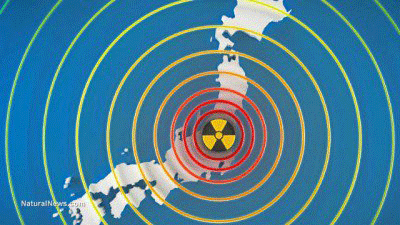
However, official government data that was collected in 2011 has just seen the light of day, and it suggests that our initial concerns were probably correct. The information was collected by officials with Los Angeles County when concerns were raised by residents. After state and federal agencies failed to test the area for radiation in a timely manner, the county hired their own people to run the test. Natural News reported on the results.
Samples were taken between April 29 and May 2, 2011, approximately seven weeks after the radioactive releases from Fukushima. The county found that gross alpha radiation levels at a location in Los Angeles were 300 femtocuries per cubic meter (fCi/m3), and levels at a Hacienda Heights location were 200 fCi/m3.
For context, the Lawrence Livermore National Laboratory reports the average (annual median) level of gross alpha activity for the state of California as just 0.38 fCi/m3 – that is, 790 times lower.
The levels detected in Los Angeles County were a full 100 times higher than the level that requires an investigation at a U.S. nuclear laboratory, according to the Environmental Monitoring Plan at Brookhaven National Laboratory: “If the gross alpha activity in the [air] filters is greater than 3 fCi/m3, then collect more samples in the vicinity, and project manager will review all detections above the limits … All values greater than the above-stated gross alpha/beta concentration shall trigger an investigation.”
Finally, the Los Angeles County levels were almost 15 times higher than the federal regulatory limit for alpha radiation, which is 21 fCi/m3, according to a 2010 document from Idaho National Laboratory.
Moreover, the alpha radiation emitting particles that were deposited on the West Coast are incredibly dangerous for humans. While Gamma and Beta Radiation have far more power and penetration, Alpha rays produce a tremendous amount of damage in the human body when ingested. Because they don’t penetrate materials like Gamma rays do, all of their energy is deposited into the cells that reside near the particle.
More importantly, it doesn’t take very many of these particles to ruin your long-term health. For instance, if you were exposed to a temporary large dose of radiation, your body could probably recover from it, perhaps without even developing cancer. But when the particle itself is embedded in your tissue for weeks, months, and in some cases for years, as it destroys and mutates surrounding cells over and over again, you can expect a significantly shorter lifespan. Even if the amount radiation is small, it’s also continuous, and its source is difficult to remove
So while the government was telling us that everything was hunky dory in the weeks after the Fukushima meltdown, major West Coast cities like Los Angeles were being drenched in alarming levels of this radioactive waste.
Who knows how much of that fell onto the countless farms in the Central Valley, which feed much of the United States? And since they failed to inform us about the danger we were in then, who knows how much danger we are in now? Our government hates to admit when its wrong (or they won’t admit that they lied to us), so if we are still in danger, somehow I doubt they will have anything to say to us now.
Delivered by The Daily Sheeple
We encourage you to share and republish our reports, analyses, breaking news and videos (Click for details).
Contributed by Joshua Krause of The Daily Sheeple.
Joshua Krause is a reporter, writer and researcher at The Daily Sheeple. He was born and raised in the Bay Area and is a freelance writer and author. You can follow Joshua’s reports at Facebook or on his personal Twitter. Joshua’s website is Strange Danger .
India’s authorities in denial about nuclear industry’s radiation-caused deaths
“Inside UCIL, they see themselves as under siege, defending the nation, one atom at a time,” Biruli said, “and outside … we are absorbing those atoms and whatever else the corporation spews out from its broken pipes and dams. We’re drinking it all up, feeding it to our kids, and our wives, if they can conceive, are absorbing them into their blood stream.”
 India’s nuclear industry pours its wastes into a river of death and disease Scientists say nuclear workers, village residents, and children living near mines and factories are falling ill after persistent exposure to unsafe radiation Center For Public Integrity , By Adrian Levy December 14, 2015 Jadugoda, Jharkhand, INDIA
……..Denying what scientists documented
India’s nuclear project is seen as the country’s most prestigious enterprise, a tangible expression of the nation’s resilience and resourcefulness. This idea was cemented when India tested nuclear devices in 1998, in twin blasts. Feeding the weapons program was UCIL’s duty, and protecting the mines became paramount.
As a result, the UCIL-funded health studies were not welcomed by the Bhabha Atomic Research Center, the country’s premier civil and military nuclear research facility, which has a Health Physics Laboratory in Jadugoda. It said in 1999, after a quick visual inspection of villagers living close to the mines, that its own experts “unanimously agreed that the disease pattern could not be ascribed to radiation exposure.” The complainers were “backwards people” who suffered from “alcoholism, malaria and malnutrition,” the company said. But it took no soil, water or air samples and launched no epidemiological study.
UCIL subsequently reversed its own position. “There is no radiation or any related health problems in Jadugoda and its surrounding areas,” J.L. Bhasin, the managing director of UCIL, concluded in 1999, in a press conference before local reporters in Jadugoda. A.N. Mullick, UCIL’s chief medical officer for 25 years, issued a press statement a few months later that “I have not come across any radiation-related ailments during my entire career.” Continue reading
India’s secretive, toxic, uranium industry and its radiation deaths
According to the uranium corporation’s own records, 17 UCIL laborers died in 1994, 14 more in 1995, 19 in 1996 and 21 in 1997; no cause of death was revealed in the records seen by the Center, but critics claim most if not all were radiation-related.
The corporation will not discuss the causes of these deaths. But a spokesman for the Jarkhandi Organization Against Radiation (JOAR), a local group formed in 1998 out of a student lobby for indigenous rights, said it has investigated these cases and that “from what we can see all of them contracted illnesses associated with radiation or exposure to heavy metals.”
India’s nuclear industry pours its wastes into a river of death and disease Scientists say nuclear workers, village residents, and children living near mines and factories are falling ill after persistent exposure to unsafe radiation Center For Public Integrity , By Adrian Levy December 14, 2015 Jadugoda, Jharkhand, INDIA “………Charting the trail of disease and ill health back to its source, Ghosh’s team learned that the alpha radiation they had recorded came from the mines, mills and fabrication plants of East Singhbhum, a district whose name means the land of the lions, where the state-owned Uranium Corporation of India Ltd is sitting on a mountain of 174,000 tons of raw uranium. The company, based in Jadugoda, a country town 160 miles west of Kolkata, is the sole source of India’s domestically-mined nuclear reactor fuel, a monopoly that has allowed it to be both combative and secretive.
After starting work in 1967 with a single mine, the corporation now controls six underground pits and one opencast operation that stretch across 1,313 hilly acres, extracting an estimated 5,000 tons of uranium ore a day, generating an annual turnover of $123 million. It supplies nine of the reactors that help India produce plutonium for its arsenal of nuclear weapons, and is thus considered vital to India’s security.
The company crushes the ore below ground and treats it with sulfuric acid, transforming it into magnesium diuranate or “yellowcake,” which is then loaded into drums and taken to the Rakha Mines railway station. From there, it is transported to the Nuclear Fuel Complex in Hyderabad, 861 miles to the southwest. Workers ultimately process it into uranium dioxide pellets that are stacked in rods, inserted into reactors all over India.
Wherever uranium is extracted, anywhere in the world, from Australia to New Mexico, it is a messy, environmentally disruptive process. However, the poor quality of ore eked out of these wooded hills means that for every kilogram of uranium extracted, 1750 kilograms of toxic slurry, known as tailings, must be discarded into three, colossal ponds. Studies by scientists from North America, Australia and Europe show that while these ponds contain only small quantities of uranium, equally hazardous isotopes connected to uranium’s decay are also present, including thorium, radium, polonium and lead, some of which have a half-life of thousands of years. Arsenic is a byproduct, as is radon, a carcinogen.
The tailing ponds in Jharkhand, Ghosh’s team and other scientists discovered, have never been lined with rubble, concrete or special plastics, as organizations like the U.S. Environmental Protection Agency have advised for domestic ponds, and as a result their contents leached in winters into the water table. Lacking a cap, the ponds evaporated in summers, leaving a toxic dust that blew over nearby villages. Thirty five thousand people live in seven villages that lie within a mile and half of the three huge ponds, most of them members of tribal communities.
Moreover, during the monsoon season, the ponds regularly overflowed onto adjacent lands, with contaminants reaching streams and groundwater that eventually tainted the Subarnarekha River, according to studies of the issue by Ghosh’s team and other scientists. Pipes carrying radioactive slurry also frequently burst, leaching into rivers and across villages, according to photographs taken by residents. Lorries hired by the mines also dumped toxic effluent in local fields when the ponds were full, actions caught in photographs and on video taken by villagers and shown to the Center.
When Ghosh published his team’s results, there was no reaction from the mine or the Indian government. A senior official in the U.S. State Department declined to discuss the contents of Jardine’s leaked cable, but said he was aware of criticisms about the uranium corporation.
The evidence begins to pile up……… According to the uranium corporation’s own records, 17 UCIL laborers died in 1994, 14 more in 1995, 19 in 1996 and 21 in 1997; no cause of death was revealed in the records seen by the Center, but critics claim most if not all were radiation-related.
The corporation will not discuss the causes of these deaths. But a spokesman for the Jarkhandi Organization Against Radiation (JOAR), a local group formed in 1998 out of a student lobby for indigenous rights, said it has investigated these cases and that “from what we can see all of them contracted illnesses associated with radiation or exposure to heavy metals.” The spokesman, who asked the Center to withhold his name because intelligence officials and police have arrested him in the past and accused him of “anti-national activities,” claimed the number of deaths was actually “four times higher” than UCIL admitted.
Birulee contacted doctors and public health researchers at Jawaharlal Nehru University, in Delhi, one of India’s best government-funded institutions. They came up with a hypothesis about his mother’s death, blaming the family’s laundry. “My father,” Birulee said, “would bring back his cotton uniform, caked in uranium dust, to be washed once a week, as did all the other contract laborers. There were no facilities in the mines and no warnings.”
Birulee wondered how many other families had been similarly affected and, working with the JNU doctors, helped arrange for midwives to visit nearby villages. They found that 47% of women suffered disruptions to their menstrual cycle, while 18% had had miscarriages or stillborn babies over the previous 5 years. One third were infertile. Many complained their children were born with partially formed skulls, blood disorders, missing eyes or toes, fused fingers or brittle limbs. Livestock too were suffering, with veterinarians reporting that buffaloes and cows were infertile or suffering from blood disorders.
Arjun Soren was one of those affected. Born in Bhatin village, adjacent to another uranium mine on the other side of the tailing pond, Soren became the first member of the Santhal tribe to get a medical degree, and one of his first cases was to track the deteriorating health of his family. “My aunt died of cancer of the gallbladder,” Soren recalled. “My nephew has a rare blood disorder.” Then Soren himself was diagnosed with leukemia and transferred to Mumbai for treatment. “Radiation and toxins from the mining processes has to be the reason,” Soren said. “I spent my childhood playing, breathing, drinking, eating there.”………..
Birulee lodged a protest with the state’s Environment Committee, in Bihar’s capital. Its chairman, Gautam Sagar Rana, directed UCIL to finance an independent health inquiry, led by two professors from Patna Medical College, who were accompanied by the uranium conglomerate’s deputy general manager, R.P. Verma; and the head of its health unit, A.R. Khan. Analyzing a representative sample of those between 4 and 60 years old living within a mile and a half of the third tailing dam, the researchers hired by UCIL concluded that the residents were “affected by radiation.”……..http://www.publicintegrity.org/2015/12/14/18844/india-s-nuclear-industry-pours-its-wastes-river-death-and-disease
Nuclear fusion – a super expensive pipedream
 The challenges that make fusion potentially permanently decades away have been identified as threefold. The first is for the reactor to generate more energy than it takes to produce it. The second is for the reactor to produce more energy than the facility as a whole uses to make it. And the third is to actually make electricity in this fashion without going completely broke.
The False Promise of Nuclear Fusion http://www.counterpunch.org/2015/12/11/the-false-promise-of-nuclear-fusion/ by LINDA PENTZ GUNTER There have been some pretty radioactive climate change ideas making the rounds at the COP21 talks in Paris. Team Hansen’s wildly unrealistic notion of switching on 61 new nuclear reactors a year was taking the cake until an even fruitier one reared its familiar head: the nuclear chimera known as ITER.
ITER was originally called the International Thermonuclear Experimental Reactor, with ‘experimental’ being the operative word in that lofty title. Which is perhaps why today they refer to it only by acronym (apparently the word ‘thermonuclear’ also had some rather explosive connotations.) The official website equates ITER with its coincidental Latin meaning, ‘The Way’.
ITER was initiated in 1985 by then presidents Reagan and Gorbachev. The multi-nation project included not only the United States and the already crumbling Soviet Union, but the European Union and Japan. Today there are 35 countries in the partnership.
If it ever gets completed and actually works, ITER will be a fusion reactor known as a Tokomak. Fusion is the physicists’ wet dream, and they’ve been hallucinating about ITER for precisely three decades and Tokomaks and fusion itself for even longer.
ITER itself isn’t even the final step to electricity-producing fusion power plants. Its purpose is in “preparing the way for the fusion power plants of tomorrow.” A tomorrow that is heralded as ten years away, decade after decade. Continue reading
Billionaires’ nuclear love affair in the ‘Breakthrough Energy Coalition’
Is Gates’s ‘Breakthrough Energy Coalition’ a nuclear spearhead?, Ecologist, Linda Pentz Gunter 6th December 2015
“……A nuclear love-affair revealed
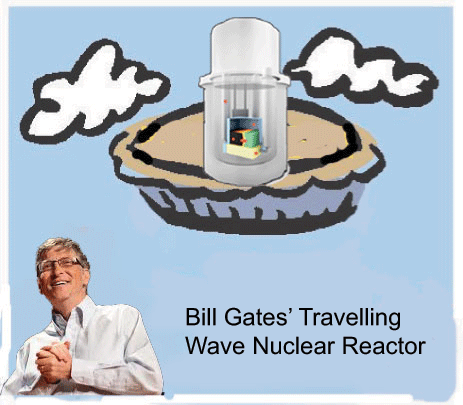 Gates is already squandering part of his wealth on Terra Power LLC, a nuclear design and engineering company seeking an elusive, expensive and futile so-called Generation IV traveling wave reactor that can never deliver electricity in time.
Mukesh Ambani is an investor in Terra Power. Amazon founder, Jeff Bezos, is betting his money on the perpetually 40 years away nuclear fusion dream, which, even if it were ever to work, will be far too expensive to apply to developing countries.
Virgin Group founder, Richard Branson, publicly touts nuclear energy and put his name on Pandora’s Promise as executive producer. “We should continue to develop advanced nuclear power to add to the mix”, he said in promoting the film via the Breakthrough Institute’s website. (See our debunk of the film’s numerous errors of fact and omission.)
Chris Hohn’s TCI hedge fund invested in J-Power, a Japanese utility company whose assets included nuclear power stations. In 2008, the Japanese government barred TCI from increasing its stake in J-Power and the hedge fund withdrew.
Vinod Khosla loves nuclear power and is on record blaming environmentalists rather than nuclear energy’s obviously disastrous economics, for its failure. “Most new power plants in this country are coal, because the environmentalists opposed nuclear”, Khosla said in a 2008 interview.
Chinese billionaire Jack Ma of Alibaba, was recently brought onto British Prime Minister David Cameron’s Business Advisory Group, probably not coincidentally one day before a state visit by the Chinese president to seal a deal involving China’s investment in the UK’s planned Hinkley-C nuclear power plant.
Ratan Tata’s eponymous corporation leapt at the chance of investing in nuclear energy in India with the passage of the nuclear non-proliferation treaty-violating US-India deal….. http://www.theecologist.org/News/news_analysis/2986571/is_gatess_breakthrough_energy_coalition_a_nuclear_spearhead.html
Germany expecting nuclear utilities to pay the costs of decommissioning and disposal of radioactive trash
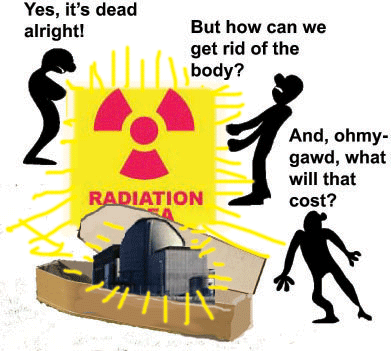
 Germany: Utilities Must Shoulder Nuclear Phase-Out Costs http://www.powermag.com/germany-utilities-must-shoulder-nuclear-phase-costs/ 12/01/2015 | Sonal Patel Germany’s nuclear power–producing companies will be able to shoulder the costs of the nuclear phase-out—including costs for decommissioning and the disposal of radioactive waste. That’s according to the country’s Federal Ministry for Economic Affairs and Energy, as it published the results of a “stress test” on October 10. The government on July 1 reaffirmed that energy companies must bear the costs of dismantling their nuclear plants and concluded in October that reserves set aside by EON SE, RWE AG, Energie Baden-Wuerttemberg AG, Vattenfall AB, and Stadtwerke Muenchen GmbH of €38.3 billion ($41.98 billion) are within various scenarios examined during the stress test.
In the wake of the Fukushima disaster, Germany decreed the phase-out of all its nuclear capacity by December 2022. It shuttered eight reactors in the immediate aftermath of the Japanese earthquake and tsunami, and this June it closed the Grafenrheinfeld plant (Figure 3). Eight reactors remain open.
The government-commissioned study, prepared by auditing company Warth & Klein Grant Thornton AG, breaks down expected costs across five different categories, from dismantling to final storage. It finds that cost estimates made by companies are higher than the international average. Dismantling costs in Germany are estimated by the companies at €857 million ($939 million) per reactor compared to between €205 million ($224 million) and €542 million ($594 million) in other countries. If nuclear plants are dismantled in “an efficient manner,” overall costs could be slashed by about €6 billion ($6.5 billion), the auditors also said.
“We do not consider the scenarios requiring the highest provisions to be likely to materialise, as they are based on the assumption of major losses being incurred by the companies over a long period of time,” Minister Sigmar Gabriel said. Gabriel noted that the Federal Cabinet will soon establish a commission to review financing for the nuclear phase-out to adopt draft legislation on extended liability for the dismantling of nuclear power plants and the disposal of nuclear waste. The results of the stress test will be made available to the commission.
Nuclear waste storage in rock salt not as safe as they thought
 Nuclear waste storage sites in rock salt may be more vulnerable than previously thought, Phys Org
November 26, 2015 Research from The University of Texas at Austin shows that rock salt, used by Germany and the United States as a subsurface container for radioactive waste, might not be as impermeable as thought or as capable of isolating nuclear waste from groundwater in the event that a capsule or storage vessel failed.
 A team of researchers from the university has used field testing and 3-D micro-CT imaging of laboratory experiments to show that rock salt can become permeable. Their findings, published in the Nov. 27 issue of Science, has implications for oil and gas operations, and, most notably, nuclear waste storage. The team includes researchers from the university’s Cockrell School of Engineering and Jackson School of Geosciences.
“What this new information tells us is that the potential for permeability is there and should be a consideration when deciding where and how to store nuclear waste,” said Maša Prodanovic, assistant professor in the Department of Petroleum and Geosystems Engineering. “If it’s an existing nuclear waste storage site, you may want to re-evaluate it with this new information.”
Salt generally blocks fluid flow at shallow depth, a feature that allows oil reservoirs to form. But scientists have long suspected that salt becomes permeable at greater depth. Jackson School professor James E. Gardner confirmed this theory through laboratory experiments with synthetic rock salt……
The critical takeaway is that salt can develop permeability, even in absence of mining activity,” said assistant professor Marc A. Hesse of the Jackson School’s Department of Geological Sciences. “Further work is necessary to study the quantity of flow that can occur.”
The Waste Isolation Pilot Plant, in Carlsbad, New Mexico, stores low-level nuclear waste in salt beds beneath the ground. However, high-level waste from the nation’s nuclear energy sector is stored at the power plants in pools or dry casks, methods that are considered temporary solutions. For decades there has been a proposal to build a permanent central repository under Nevada’s Yucca Mountains, but that proposal has stalled because of political and regulatory hurdles. This has renewed interest in rock salt as an alternative permanent storage solution for high-level nuclear waste. In this context, the findings of the team from UT Austin provide a timely reminder that rock salt is a dynamic material over long timescales.
Ghanbarzadeh hopes that “our discovery encourages others to ask questions about the safety of current and future disposal sites.” http://phys.org/news/2015-11-nuclear-storage-sites-salt-vulnerable.html#jCp
Natural greenhouse gases increase with higher temperatures: will ,accelerate global warming
 Global warming will be faster than expected http://www.sciencedaily.com/releases/
 2015/11/151126104037.htm November 26, 2015
- Source:
- Linköping Universitet
- Global warming will progress faster than what was previously believed. The reason is that greenhouse gas emissions that arise naturally are also affected by increased temperatures. This has been confirmed in a new study that measures natural methane emissions.
- “Everything indicates that global warming caused by humans leads to increased natural greenhouse gas emissions. Our detailed measurements reveal a clear pattern of greater methane emissions from lakes at higher temperatures,” says Sivakiruthika Natchimuthu, doctoral student at Tema Environmental Change, Linköping University, Sweden, and lead author of the latest publication on this topic from her group.
Over the past two years the research team at Linköping University has contributed to numerous studies that all point in the same direction: natural greenhouse gas emissions will increase when the climate gets warmer. In the latest study the researchers examined the emissions of the greenhouse gas methane from three lakes. The effects were clear and the methane emissions increased exponentially with temperature. Their measurements show that a temperature increase from 15 to 20 degrees Celsius almost doubled the methane level. The findings was recently published in Limnology and Oceanography.
While increased anthropogenic emissions of greenhouse gases are expected and included in climate predictions, the future development of the natural emissions has been less clear.
Now knowledge of a vicious circle emerge: greenhouse gas emissions from the burning of fossil fuels lead to higher temperatures, which in turn lead to increased natural emissions and further warming.
“We’re not talking about hypotheses anymore. The evidence is growing and the results of the detailed studies are surprisingly clear. [DB1] The question is no longer if the natural emissions will increase but rather how much they will increase with warming,” says David Bastviken, professor at Tema Environmental Change, Linköping University.
- This means that warming will be faster than expected from anthropogenic greenhouse gas emissions alone. According to Professor Bastviken this also means that any reductions in anthropogenic greenhouse emissions is a double victory, by both reducing the direct effect on warming, but also by preventing the feedback with increased natural emissions.
Coal ash is NOT more radioactive than nuclear waste
 Coal ash is NOT more radioactive than nuclear waste http://www.cejournal.net/?p=410 The idea that coal ash is 100 times more radioactive than nuclear waste has been making the rounds among bloggers and Twitterers discussing the coal ash catastrophe in Tennessee, thanks to a headline which makes that assertion in Scientific American online. In fact, Google the words in the headline and you’ll come up with dozens of Web sites that have repeated this statement.
The problem is that it is a profoundly preposterous idea unsupported by a single shred of evidence. Continue reading
Declaration of the World Nuclear Victims Forum in Hiroshima
The world nuclear victims forum was held at Hiroshima.
“A charter of world Nuclear Victim’s rights” was adopted. https://www.facebook.com/permalink.php?story_fbid=10154396267119937&id=685379936
世界核被害者フォーラム
Declaration of the World Nuclear Victims Forum in Hiroshima
(Draft Elements of a Charter of World Nuclear Victims’ Rights)
November 23, 2015
1. We, participants in the World Nuclear Victims Forum, gathered in Hiroshima from November 21 to 23 in 2015, 70 years after the atomic bombings by the US government.
2. We define the rights of nuclear victims in the narrow sense of not distinguishing between victims of military and industrial nuclear use, including victims of the atomic bombings in Hiroshima and Nagasaki and of nuclear testing, as well as victims of exposure to radiation and radioactive contamination created by the entire process including uranium mining and milling, and nuclear development, use and waste. In the broad sense, we confirm that until we end the nuclear age, any person anywhere could at any time become a victim=a Hibakusha, and that nuclear weapons, nuclear power and humanity cannot coexist.
3. We recall that the radiation, heat and blast of the atomic bombings of Hiroshima and Nagasaki sacrificed not only Japanese but also Koreans, Chinese, Taiwanese and people from other countries there as a result of Japan’s colonization and invasion, and Allied prisoners of war. Continue reading
Is nuclear power competitive? Actually – NO!
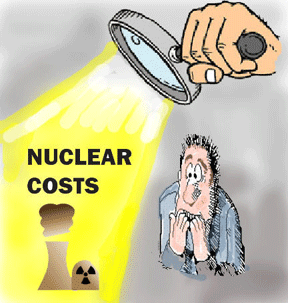 Nuclear Power Is No Fix for Climate, Energy Intelligence, M.V. Ramana, 27 Nov 15
Once actual projects were on the drawing board, however, these hypothetical numbers moved quickly north. In Europe, two French-led flagship projects were initially estimated at around $2,250-$2,475/kW in the case of the Olkiluoto-3 reactor in Finland in 2004, and around $2,600/kW in the case of the Flamanville plant in France in 2006, both higher than the figures assumed by the academic and industry studies. In the US, cost estimates by electric utilities building reactors were higher — the corresponding initial estimates for two Westinghouse AP1000 reactors under construction at the Vogtle nuclear power plant in Georgia were $4,700/kW, for just the nuclear reactor, and $6,412/kW, when the other costs associated with the project were included.
When construction actually started, those numbers were soon obsolete and costs once again rose. Today, as work on these projects continues and completion dates are extended well beyond original dates, the cost estimates keep rising. As of early 2015, Vogtle’s total cost was estimated at around $7,300/kW. Likewise, the costs of the two European projects have more than doubled. The story is similar in Russia, India and China, although the starting cost estimates were lower.
Original construction timelines now seem completely absurd. Olkiluoto-3’s construction time went from four years to 13 and Flamanville-3 from five to 11. One of the Koodankulam reactors in southern India took 12 years to be commissioned, in comparison with the initial estimate of six years; the second one is yet to start operating, and the construction period count there is upwards of 13 years. All of these experiences should serve as reminders that cost and time overruns for reactor construction, long the bugbears of the nuclear industry, have not been exorcised by modern construction and manufacturing methods.
The industry typically attempts to explain these cost and time overruns as the result of teething problems in first-of-a-kind projects and argues that as more projects get under way these problems will be sorted out. Unfortunately, historical experience belies this expectation: Nuclear construction costs have typically gone up, not down, as more reactors are built, and this trend has been extensively documented in the US, France and India. The tendency toward increased costs despite experience is being demonstrated currently, with the estimated cost of a planned French reactor at Hinkley Point in the UK higher than estimates for the same reactor at Flamanville and Olkiluoto, and with the estimated cost of the Russian reactors proposed to be constructed in Turkey and in Bangladesh being higher than the Koodankulam reactors in India.
Higher Generating Costs
For a long time now, the nuclear industry had a comforting answer to this problem of high construction costs: it may take a lot, both of time and money, to build a reactor, but once built and paid for, the reactor will generate low-cost electricity that can be sold for handsome profits. The experiences of the last few years have burst that bubble. Marginal costs associated with producing nuclear electricity have been rising, to the point that some utilities are doing the unthinkable: shutting down nuclear reactors even though their licenses would allow them to operate for a decade or more beyond the planned shutdown date.
Annual expenditures in the US averaged for the whole fleet — not counting initial construction costs, which have largely been paid off — cover fuel purchases, salaries for workers and activities like uprating generation capacity, replacing equipment and regulatory work. The total is in the vicinity of $40 to $45 per megawatt hour, which should be seen in the context of recent bids for new solar photovoltaic projects (including the cost of recouping initial construction expenditures) that are around $50/MWh, and even lower than $40/MWh in some parts of the country. These higher-than-expected nuclear generating costs and the falling costs of competing sources of electricity explain why in the past few years US utilities have decided to prematurely shut down at least eight reactors — particularly stand-alone single units that don’t enjoy the economies of scale of plants with two or more reactors.
Across the Atlantic, Vattenfall, the Swedish state-owned utility, is closing down two reactors at the Ringhals nuclear power plant earlier than planned. Another large utility, E.On, justified its decision to shut down two of the reactors at Sweden’s Oskarshamn power plant by saying that “there are no prospects of generating financial profitability either in the short or the long term.” Although there have been no shutdowns yet in France, its audit court, Cour des Comptes, estimated that production costs for EDF’s 58 reactors had risen from €49.6 to €59.8/MWh between 2010 and 2013. The company has also been selling much less electricity to its competitors than in earlier years, leading analysts to conclude that “nuclear energy is less competitive than it was in the past.” This, in France, the country most reliant on nuclear power — and which has also decided to pare back nuclear’s contribution to its overall generation from just under 80% to 50% by 2025……….. http://www.energyintel.com/pages/worldopinionarticle.aspx?DocID=906841
1 This Month



26 September – International Day for the Total Elimination of Nuclear Weapons


PLEASE OPPOSE HR 8255 AND S.3639 – bills would accelerate satellite deployment, with no environmental review or safeguards – https://ncstd5li.quorum.us/campaign/169331/
To see nuclear-related stories in greater depth and intensity – go to https://nuclearinformation.wordpress.com
-
Archives
- September 2026 (245)
- August 2026 (330)
- July 2026 (355)
- June 2026 (287)
- May 2026 (306)
- April 2026 (356)
- March 2026 (251)
- February 2026 (267)
- January 2026 (308)
- December 2025 (358)
- November 2025 (359)
- October 2025 (375)
-
Categories
- 1
- 1 NUCLEAR ISSUES
- business and costs
- climate change
- culture and arts
- ENERGY
- environment
- health
- history
- indigenous issues
- Legal
- marketing of nuclear
- media
- opposition to nuclear
- PERSONAL STORIES
- politics
- politics international
- Religion and ethics
- safety
- secrets,lies and civil liberties
- spinbuster
- technology
- Uranium
- wastes
- weapons and war
- Women
- 2 WORLD
- ACTION
- AFRICA
- Atrocities
- AUSTRALIA
- Christina's notes
- Christina's themes
- culture and arts
- Events
- Fuk 2022
- Fuk 2023
- Fukushima 2017
- Fukushima 2018
- fukushima 2019
- Fukushima 2020
- Fukushima 2021
- general
- global warming
- Humour (God we need it)
- Nuclear
- RARE EARTHS
- Reference
- resources – print
- Resources -audiovicual
- Weekly Newsletter
- World
- World Nuclear
- YouTube
-
RSS
Entries RSS
Comments RSS
 nuclear-news